UNIVERSITI TEKNIKAL MALAYSIA MELAKA
AUTOMATIC HEIGHT ADJUSTABLE ROSTRUM
This report submitted in accordance with requirement of the Universiti Teknikal
Malaysia Melaka (UTeM) for the Bachelor Degree of Manufacturing Engineering
(Robotics & Automation) with Honours
by
SAMUEL CHAN IAN DIAN
B050710164
FACULTY OF MANUFACTURING ENGINEERING
DECLARATION
I hereby, declared this report entitled “Automatic Height Adjustable Rostrum” is the
results of my own research except as cited in references.
Signature :
Author’s Name : SAMUEL CHAN IAN DIAN
APPROVAL
This report is submitted to the Faculty of Manufacturing Engineering of UTeM as a
partial fulfilment of the requirements for the degree of Bachelor of Manufacturing
Engineering (Robotics & Automation) with Honours. The member of the supervisory
committee is as follow:
ABSTRAK
Innovasi dalam produk-produk harian adalah satu proses yang berterusan dan tidak
akan berhenti selagi ada permintaan untuk membuat sesuatu dengan lebih baik dan
lebih cekap. Projek ini menumpu pada suatu aspek innovasi dalam mimbar iaitu aspek
kawalan ketinggian. Mimbar merupakan suatu perabot yang digunakan oleh
penceramah untuk meletak barang-barang atau dokumen yang penting semasa berucap.
Dalam pengajian ini, satu sistem kawalan ketinggian yang automatik akan direka bagi
mimbar untuk mengawal ketinggian mengikut bentuk badan dan ketinggian. Merujuk
kepada hasil kajian daripada rekabentuk mimbar yang dahulu, ketinggian dikawal
secara manual di mana seseorang itu perlu menetapkan ketinggian atau mengubah
ketinggian secara fizikal. Konsep rekabentuk akan dibuat berpandu kepada rujukan
yang telah dibuat dan satu rekabentuk akan dipilih. Proses fabrikasi rekabentuk adalah
untuk merealisasikan sistem kawalan ketinggian automatik dalam projek ini. Hasil
kajian projek ini akan dibincang secara terperinci dalam pelbagai aspek untuk
menganalisasi fungsi sistem tersebut. Projek ini diharapkan dapat memberi keselesaan
ABSTRACT
The innovation on the many daily products is an on-going process and is never going
to end as long as there are demands for better and more efficient method of doing
something. The project focuses on a particular innovation of the rostrum which is the
height adjustment. Rostrum is a rigid body furniture that are used for speakers to place
important documents during speeches. The study intends to produce an automated
height adjustment system for the rostrum so that different body statures of speakers
could be adjust accordingly. Studies have been made on previous rostrum designs and
the height adjustable mechanisms that were apply in the rostrum designs. The height
adjustments in the rostrum designs are usually manually-controlled which requires a
person to pre-set the height or manually adjust it. From the references, few conceptual
designs are generated and selected. The fabrication of the project takes place to create
the desired automated height adjustment mechanism. The results of the project will be
discussed in depth to determine the functionality of the system. The project hopes to
DEDICATION
To my mother,
for her love and support
To my sister,
for constantly reminding me about my studies
To the ones that I love,
ACKNOWLEDGEMENT
First of all, I would like to take this opportunity to say thank you to my family for a
lifetime of love and support. My mother, thank you very much for holding firm to me
through things that made me nervous and taught me the value of perseverance. Thank
you my sister, for being my best friend and letting me blabber about around. Thank you
for the intelligent and creative feedbacks that deserve my upmost gratitude at time of
need.
A big thanks to my supervisor, Dr. Zamberi for the guidance, encouragement, advice
and inspiration for the completion of the project in my final year of studies. He made me
realize the value of time and the importance of getting things completed way before the
deadline. The help and the encouragement you did to help me throughout this period will
never be forgotten. Sorry for the inconveniences and difficulties caused throughout this
period that I may have made happen.
A special thanks to my friends for sharing their experiences through the course of the
year, which without it I would felt so mundane. They have been a great help to ease the
passing of the days when assignments and tasks seem endless. I would like to thank my
university for providing me the place to pursue my studies in which I have learned and
experienced a lot.
And, finally, thank you to my love one for the encouragement and support. The love and
TABLE OF CONTENT
Abstrak i
Abstract ii
Dedication iii
Acknowledgement iv
Table of Content v
List of Tables ix
List of Figures x
List of Abbreviation & Symbols xiii
1. INTRODUCTION 1
1.1 Background of the Project 1
1.2 Problem Statement 2
1.3 Objectives 3
1.4 Scope of Work 4
1.5 Organization 4
2. LITERATURE REVIEW 6
2.1 Introduction 6
2.2 Rostrum 6
2.3 History and Development of Rostrum 9
2.4 Transmission Mechanism 18
2.4.1 Lead Screw 18
2.4.2 Ball Screw 19
2.4.3 Transmission Mechanism Parameters Consideration 20
2.4.3.1 Load 20
2.4.3.2 Back-drive 20
2.4.3.3 Driving Torque 20
2.4.3.4 Accuracy 21
2.4.3.5 Lead 21
2.4.3.7 Backlash 22
2.4.3.8 Wipers 22
2.4.4 Lead screw vs. Ball screw 23
2.4.5 Gears 24
2.4.6 Belt 27
2.4.6.1 V-Belt Drive 27
2.6.4.2 Toothed Belt Drive 28
2.4.7 Chain Drives 29
2.4.8 Cams 29
2.5 Sensors 31
2.5.1 Proximity Sensor 31
2.5.1.1 Photoelectric Sensor 32
2.5.1.2 Capacitive Proximity Sensor 35
2.5.1.3 Ultrasonic Proximity Sensor 36
2.5.1.4 Inductive Proximity Sensor 37
2.5.2 Vision System 38
2.6 Height Adjustment Mechanism 40
2.6.1 Power Window 40
2.6.2 Aerial Work Platform 41
2.7 Summary 42
3. METHODOLOGY 44
3.1 Introduction 44
3.2 Process Planning 44
3.3 Project Development Flow 45
3.3.1 Concepts and Ideas 46
3.3.2 Identifying and Finalize Design 47
3.3.3 Material Determination 51
3.3.4 Fabrication of the Design 53
3.3.5 Testing 54
3.3.6 Verifying Results 56
3.5 Summary 58
4. CONCEPTUAL DESIGN 60
4.1 Introduction 60
4.2 Conceptual Design 60
4.2.1 Conceptual Design A 62
4.2.2 Conceptual Design B 63
4.2.3 Conceptual Design C 64
4.2.4 Design Selection 65
4.2.4.1 Concept Scoring Method 65
4.2.4.2 Design Analysis 67
4.3 Control 70
4.3.1 Method of Control 71
4.3.1.1 Ladder Diagram 71
4.3.1.2 Electrical Schematics 72
4.4 Detection Method 74
4.5 Final Design 75
4.5 Summary 76
5. RESULTS AND DISCUSSION 77
5.1 Introduction 77
5.2 Material Determination 78
5.3 Bill of Materials 80
5.4 Fabrication 82
5.4.1 Process Planning and Material Preparation 83
5.4.2 Phase 1: Fabrication of Support Structure and Housing 84
5.4.3 Phase 2: Mechanism and Detection System 88
5.4.4 Phase 3: Refining and Finishing Design 95
5.5 Result and Outcome 96
5.6 Discussion 99
6. CONCLUSION AND FUTURE RECOMMNEDATION 102
REFERENCES 104
APPENDICES
A1 Gantt Chart for FYP 1
A2 Gantt Chart for FYP 2
B U.S. Patents
C Optoelectronic Sensing Modes Brochure
D Related Journals
LIST OF TABLES
2.1 Comparison between lead screw and ball screw 23
2.2 Basic gear type comparison 26
2.3 Photoemitter-detector pairs mode with advantages and disadvantages 33
3.1 The concept scoring matrix used to evaluate designs with the first 49
concept serving as the overall reference concept
3.2 Design analysis 51
3.3 Table for testing of mechanism and detection 55
4.1 Concept designs and related technology used 61
4.2 Results of concept scoring 65
4.3 Design analysis of the conceptual designs
5.1 Material determination matrix 78
5.2 Bill of material 80
LIST OF FIGURES
1.1 Rostrum 2
2.1 Old fashion rostrum 7
2.2 The Rostra Vetera 8
2.3 Manual vertically adjustable lectern 10
2.4 Longitudinal shafts with segments of worm gears 10
2.5 Upward and Downward positions of the rostrum 11
2.6 Wooden Lecterns 12
2.7 Non-swiveling pneumatic lectern at front and bottom perspective 13
2.8 Modern lectern 14
2.9 Display of different functions of the modern lectern 15
2.10 Lectern suitable for disable in wheelchair 16
2.11 Height mechanism and movable desk top of the design for different users 16
2.12 Modern lectern with touch screen technology 17
2.13 Basic components of lead screw mechanism 18
2.14 Design of ball screw 19
2.15 Gear design (left) and gear meshing (right) 24
2.16 Gear train of three gears 25
2.17 Multi V-belt drive 28
2.18 Timing belt drive 28
2.19 Chains and sprocket 29
2.20 Cams: (a) elliptic, (b) heart-shaped, (c) pear-shaped 30
2.21 Followers (a) point, (b) knife, (c) roller, (d) sliding and oscillating, 30
(e) flat, (f) mushroom
2.22 Illustration of a capacitive sensor by a company 35
2.23 Capacitance sensors application (a) capacitance antenna at robot cell 36
(b) human entering the robot cell
2.24 Simple ultrasonic sensor by local company 36
2.25 Illustration of inductive sensor by a sensor company 37
87
2.27 Basic vision system 38
2.28 Window lifting mechanism 40
2.29 Cherry Picker 41
2.30 Scissor lift illustration 42
3.1 The flow of project development 46
3.2 Design Flow Chart 48
3.3 Design Selection 48
3.4 Fabrication process flow 53
3.5 Detection flow 57
4.1 Concept A 62
4.2 Concept B 63
4.3 Concept C 64
4.4 Ladder Diagram 71
4.5 Electrical schematics 73
4.6 Estimation angle of shoulder detection 75
4.7 Rough estimation of final design 76
5.1 Fabrication process flow with dateline 83
5.2 Example of a joint 84
5.3 Outer and inner frame 85
5.4 Rubber mat adhesive bonded on base 85
5.5 Hatch door design with lock and door knob 86
5.6 Secondary height adjustment devices mounted to right and left of inner
column
5.7 Secondary height adjustment mechanism 87
5.8 Bracket placed on the base and support by frame wood 89
5.9 Front view and back view of the bracket assembly 89
5.10 Bridge aluminium hollow bar 90
5.11 Bridge of the aluminium bar to join the bracket and the inner column 90
5.13 The guide rail from top view and the guide rail from side 92
5.14 Electric circuit to control the height mechanism 93
5.15 Illustration of wood finishing on the rostrum 96
5.16 Automatic height adjustable rostrum 97
LIST OF ABBREVIATIONS
CCIR - Consultative Committee for International Radio
FYP 1 - Final Year Project 1/Projek Sarjana Muda 1
FYP 2 - Final Year Project 2/Projek Sarjana Muda 1
HDPE - High density polyethylene
ILS12X • Intelligent lectern model by the ILS company
LAN • Local Area Network
NTSC • National Television System Committee
PAL • Phase Alternation Line
RS-170 - Standard black and white video format used in the United States
CAD - Computer Aided Design
CHAPTER 1
INTRODUCTION
This chapter provides an introduction on the project entitled, “Automatic Height
Adjustable Rostrum”. Rostrum is rigid column body furniture that provides a place for
the speakers to place their notes and other speech material during a speech. The topics
include covered the background of the project, objectives, scope, problem statement and
organization. In depth discussion on the project will be highlighted in later chapters.
1.1 Background of the Project
Historically, rostrum is a platform used by the speakers in the Roman Forum for public
orators, and it was normally decorated with the prows of captured enemy ships. These
days, the term rostrum refers to wooden furniture with a base joint with a vertical
column up to the desk where the important documents are placed and the microphone is
usually located (Figure 1.1). Improving in living standards and the search of new
creative and innovative technologies requires better function of this product. In this
the main idea that can be implemented is to have an automatic height adjustable
mechanism, which suits different users characteristics.
Figure 1.1: Rostrum.
(Retrieved from http://www.podiumsandlecterns.ie/images/Lectern51.jpg)
Frequently, at lectures or speeches there will be a number of people that will deliver the
lecture or speech to the listening audience and in the event that there is a different in
body stature in height of the speakers, the rostrum may be readily adjusted to suit the
particular speaker at any one time. The need of this particular technology in the rostrum
will be studied can carried out in the project. Height adjustment technology in rostrum is
not something new and because of that the study will focus on an innovative idea of
making the mechanism automatic.
1.2 Problem Statement
The rostrum is a furniture often used by a speaker to place important items such as
reports, speech notes, laptop and others for the purpose of aiding the progress of the
speech. Traditionally, rostrum is built with a specific height from the base to where the
[image:18.612.234.412.129.298.2]would have to adjust themselves in order to be as comfortable as possible in delivering
their speech. In long speeches or long lectures, this will create difficulties and
discomfort to the speaker and a prolong exposure could create a health related problem.
For example, a speaker that is too tall for the lectern will have to hunch over to deliver
the speech whereas a speaker that is too short will have to strain upwards and the lectern
may eclipse the speaker. This causes a lot of discomfort to the speaker throughout the
session and may lead health related problem in the long run.
A rostrum with the most fundamental ergonomic value would have a height adjustable
mechanism which allows suitable range of height preferences to be achieved. This
allows the speech or lecture to be smoothly delivered to listening audience without the
need to worry about backache or any health related problem. By attaining this factor, the
added value of the rostrum can be the focusing point for future development. It is
important that the rostrum is aesthetically pleasing as the audience attention will be
focused on the rostrum and the speaker when the speech or lecture is being delivered.
1.3 Objectives
The objectives of this project are:
To study and design a suitable sensing system for height measurement.
To design and fabricate the mechanism of the automatic height adjustable
rostrum based on effective cost, functionability, weight and ergonomic values.
To implement the system that is able to synergistically integrate the mechanical,
electrical and elements control.
1.4 Scopes of Work
The works commenced within the duration of this project covers the following:
Design and fabrication the rostrum. Implementation of an electrical motor to
actuate the height adjustable mechanism with proximity sensors located at
strategic location to sense speaker’s body features.
Design electrical motor control scheme using microcontroller and relay to
control vertical movements of the rostrum.
Perform experimental validation of the automatic system using different control
parameters. (eg. height, distance and etc.)
1.5 Organization
The organization of the project is as follow:
a) Chapter 2: Literature Review- In this chapter, the references and relevant
details regarding the project are collected and layout, including previous
development of similar work, mechanism and detection methods.
b) Chapter 3: Methodology- The chapter discuss on the methods and flows
in which the project is going to be carried out. The chapter conveys the
steps needed to complete project successfully.
c) Chapter 4: Results- The results of the project are shown with the relevant
aspects such as the detection and the mechanism and the result of project
d) Chapter 5: Discussion- This chapter explores the various analytical
aspects of the projects with comprehensive understanding of the issues
involved.
e) Chapter 6: Conclusion and Recommendation- The chapter concludes the
CHAPTER 2
LITERATURE REVIEW
2.1 Introduction
This chapter presents the literatures and information related to the study of the automatic
height adjustable rostrum. The purpose of this chapter is to review the essential and
fundamental concept, design and manufacturability of the proposed product. In this
chapter, topics that are of importance to the project are highlighted; such as sensors,
mechanisms, materials and designs.
2.2 Rostrum
According to the Concise Oxford English Dictionary (Eleventh Edition), a rostrum is
defined as a raised platform on which a person stands to make a public speech, play
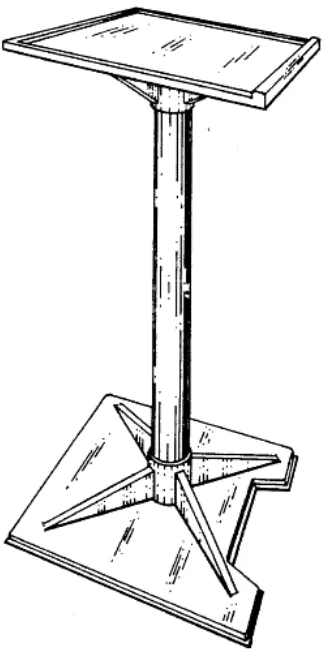
music or conduct an orchestra. Rostrum is a vertical stand used for holding important
documents on the top when a speech is being delivered (Figure 2.1). Beyond holding
notes, rostrum provides a leaning surface for speaker and provides a security barrier
the materials related to the speech and sometimes to amplify the voice of the speaker
through a microphone.
Figure 2.1: Old fashion rostrum.
(Retrieved from Waters United State Patent, et al., 1979)
The word “Rostrum” is derived from the term “Rostra” (plural for rostrum). According
to William Smith (1875) in his publication of, A Dictionary of Greek and Roman
Antiquities, rostra was the name applied to stage in the Roman Forum, from which the
orators addressed the public. The name of Rostra was obtained after the conclusion of
the great Latin war, when it was adorned with the beaks (rostra) of the ships of the
[image:23.612.244.406.145.472.2]ravaged and returned to Rome as a war prize and these Rostra were then used to
decorate the speakers’ platform in the Roman Forum.
Rostra is situated between the Comitium or place of meeting of the curies and the forum
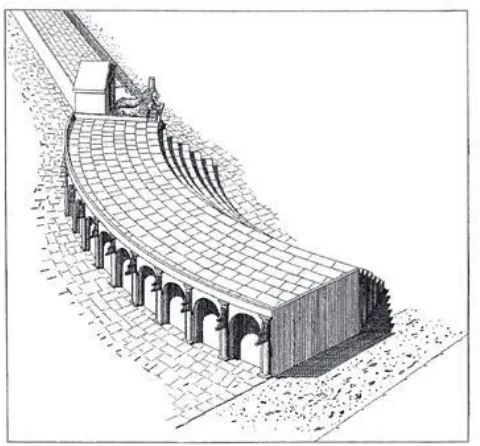
or place of meeting for the tribes, so that the speaker may address both sides. The shape
of the Rostra took the shape of a circular building with raised arches and a stand or
platform on the top bordered by a parapet. The Rostra can be accessed by steps, one on
each side alike the churches in Rome where the preacher ascends on the east side and
descent on the west side. This enables the orators to walk to and fro while addressing his
audience. The following figure shows the illustration of the Rostra Vetera, as derived by
Einar Gjerstad, a Swedish archaeologist of the ancient Mediterranean.
Figure 2.2: The Rostra Vetera.
(Retrieved from http://en.wikipedia.org/wiki/File:Rostra_Vetera.jpg)
Lectern is derived from the Latin word “lectus”, past participle of “legere”, which means
[image:24.612.209.449.359.582.2]