INVESTIGATION
Comparative and Transcriptome Analyses Uncover
Key Aspects of Coding- and Long Noncoding RNAs
in Flatworm Mitochondrial Genomes
Eric Ross,*,†David Blair,‡Carlos Guerrero-Hernández,†and Alejandro Sánchez Alvarado*,†,1
*Howard Hughes Medical Institute,†Stowers Institute for Medical Research, Kansas City, Missouri 64110, and‡College of Marine and Environmental Sciences, James Cook University, Townsville, Qld 4811, Queensland, Australia
ORCID IDs: 0000-0001-8317-7271 (E.R.); 0000-0002-1966-6959 (A.S.A.)
ABSTRACT Exploiting the conservation of various features of mitochondrial genomes has been instrumental in resolving phylogenetic relationships. Despite extensive sequence evidence, it has not previously been possible to conclusively resolve some key aspects offlatworm mitochondrial genomes, including generally conserved traits, such as start codons, noncoding regions, the full complement of tRNAs, and whether ATP8 is, or is not, encoded by this extranuclear genome. In an effort to address these difficulties, we sought to determine the mitochondrial transcriptomes and genomes of sexual and asexual taxa of freshwater triclads, a group previously poorly represented inflatworm mitogenomic studies. We have discovered evidence for an alternative start codon, an extendedcox1gene, a previously undescribed conserved open reading frame, long noncoding RNAs, and a highly conserved gene order across the large evolutionary distances represented within the triclads. Our findings contribute to the expansion and refinement of mitogenomics to address evolutionary issues in this diverse group of animals.
KEYWORDS
Platyhelminthes mitochondria
Schmidtea mediterranea atp8
lncRNAs
The large phylum Platyhelminthes (flatworms) is an important member of the superphylum Lophotrochozoa (Simakovet al.2013; Halanych et al.1995). The Platyhelminthes is now regarded as consisting of a small group, the Catenulida, and its much larger sister, the Rhabditophora (Larsson and Jondelius 2008). Among the many major groups in the Rhabditophora is the Neodermata, containing the well-known parasitic groups, Monogenea, Trematoda, and Cestoda. Many com-plete mitochondrial (mt) sequences are available for neodermatans (Wey-Fabriziuset al.2013) and, with the exception of some members of the genusSchistosoma, the mt gene order is generally conserved among these. Many studies on systematics, taxonomy, and biogeog-raphy of neodermatans have utilized data from mt genomes. Mitoge-nomic data for other taxa within the Rhabditophora are few, limiting
options for study. Our interest is in the Tricladida, a major and wide-spread taxon with many representatives in marine, freshwater, and terrestrial habitats (Alvarez-Presaset al.2008). To date, only two com-plete, and one near-comcom-plete, mt genome have been published for this taxon (Sakai and Sakaizumi 2012; (Solà et al. 2015). We present the complete mt sequences of the asexual (SmedAsxl) (Benazzi and Ballester 1970), and sexual (SmedSxl) (Benazziet al.1975) biotypes of the dugesiid triclad,Schmidtea mediterranea, as well as mt sequences from aGirardiaspecies (Tricladida: Dugesiidae), andPhagocata gracilis (Tricladida: Planariidae)(Kenket al.1972). We use these and other available platyhelminth mt genomes, as well as transcriptional data, as guides for annotation. In addition, we identify a previously unde-scribed open reading frame (ORF), and uncover evidence for the tran-scription of long noncoding mt RNAs (lncmtRNA). Our analyses provide support for the existence of a TTG start codon, an extended cox1gene, and a broadly conserved mt gene order among the triclads.
MATERIALS AND METHODS
Assembly of the mitochondrial genome sequence for a sexual biotype of S. mediterranea
DNA was isolated from sexually mature and juvenile worms from a clonal hermaphroditic S2F2 strain ofS. mediterranea. The sequencing was performed by the Genome Center at Washington University as Copyright © 2016 Rosset al.
doi: 10.1534/g3.116.028175
Manuscript received April 7, 2015; accepted for publication February 19, 2016; published Early Online February 23, 2016.
This is an open-access article distributed under the terms of the Creative Commons Attribution 4.0 International License (http://creativecommons.org/ licenses/by/4.0/), which permits unrestricted use, distribution, and reproduction in any medium, provided the original work is properly cited.
Supplemental material is available online atwww.g3journal.org/lookup/suppl/ doi:10.1534/g3.116.028175/-/DC1
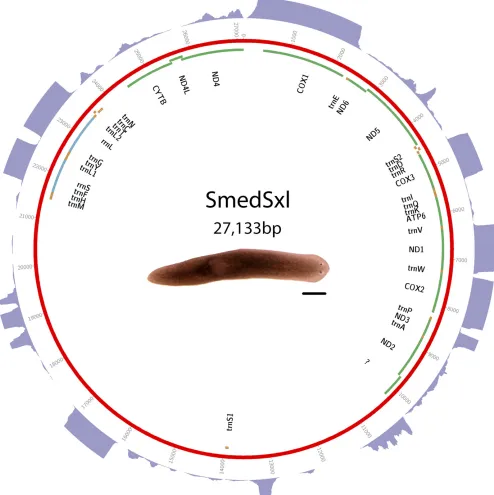
part of theS. mediterraneagenome project (Robbet al.2008). Assembly was performed at the Joint Genome Institute. Sequence and annota-tions are available in GenBank as accession JX398125. See Figure 1 for a visual representation of the mt genome, and Supplemental Material, Table S1for start and stop positions.
Assembly of the mitochondrial genome sequence for an asexual biotype of S. mediterranea
DNA was isolated from clonal worms of the asexual biotype of S. mediterranea(CIW4). Cofactor Genomics performed library
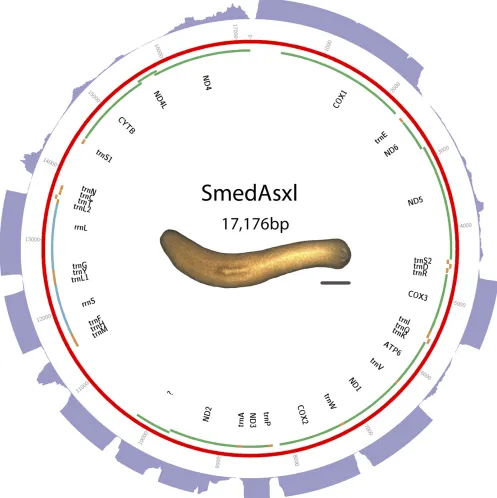
construc-tion and sequencing using the Illumina sequencing platform. Assembly was performed with SOAPdenovo2 (Luoet al.2012) using a kmer size of 77. Other parameters were left at default. Sequence and annotations are available in GenBank as accession KM821047. See Figure 2 for a visual representation of the mt genome, andTable S2for start and stop positions.
PCR and sequencing of key regions of the S. mediterranea mitochondrial genomes
[image:2.603.56.550.52.547.2]reverse primers from regions predicted to be different were designed (Figure S5 andTable S5). Because of the repetitive nature of these sequences, and rich A/T content of these regions, annealing, extension, and amplification parameters were adjusted as follows. For sexual bio-type, a melting temperature of 5for 5 min followed by 35 rounds of amplification of 94and 62for 50 sec each, and 72elongation for 5 min, was used. For the asexual biotype, all conditions remain the same except that only 20 rounds of amplification were required, and annealing and elongation temperatures were changed to 50and 60, respectively. The resulting products (Figure S6) were purified using
QIAquick PCR purification (Qiagen) and bidirectionally sequenced, confirming the predicted sizes of the assembled S. mediterranea assembled genomes.
Assembly of the mitochondrial genome sequence for an asexual biotype of Girardia sp.
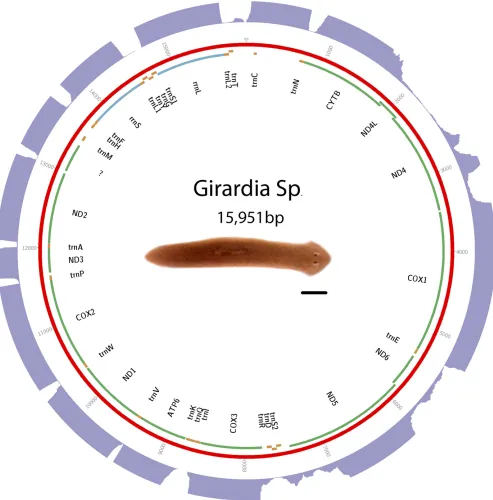
[image:3.603.53.550.51.549.2](Luoet al.2012) using a kmer size of 55. Other parameters were left at default. Sequence and annotations are available in GenBank as ac-cession KP090061. See Figure 3 for a visual representation of the mt genome, andTable S3for start and stop positions.
Assembly of the mitochondrial genome sequence for an asexual biotype of P. gracilis
DNA was isolated fromP. gracilisworms obtained commercially from Carolina Biological Supply as “black planaria”. Library construction and sequencing was performed using the Illumina sequencing
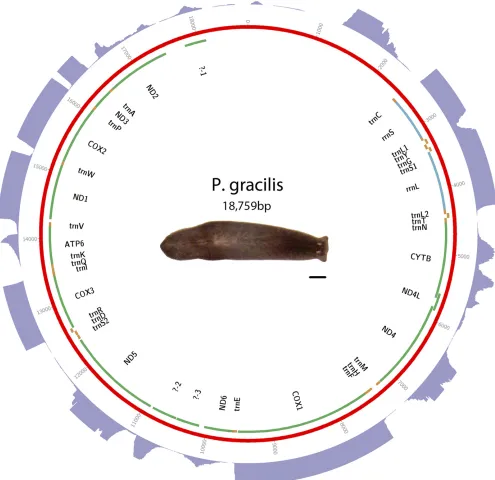
plat-form. Assembly was performed with MITObim (Hahnet al.2013). Sequence and annotations are available in GenBank as accession KP090060. See Figure 4 for a visual representation of the mt genome, andTable S4for start and stop positions.
RNA alignments to mitochondrial genomes
[image:4.603.56.549.48.548.2]chloroform was performed, followed by RNA precipitation using isopropanol. The RNA pellets were washed with 75% ethanol and resuspended in 100 ml nuclease-free water to an approximate con-centration of 550 ng/ml (P. gracilis), 491 ng/ml (Girardia sp.), 1566 ng/ml (S. mediterranea, asexual), and 764 ng/ml (S. mediterra-nea, sexual) . mRNAseq libraries were generated from 1 to 1.5 mg of high quality total RNA, as assessed using the Agilent 2100 Bio-analyzer. Libraries were made according to the manufacturer’s direc-tions for the TruSeq RNA Sample Prep Kit v2, or TruSeq Stranded mRNA LT Kit (Illumina, RS-122-2101, and RS-122-2001). Resulting short fragment libraries were checked for quality and quantity using the Bioanalyzer. Equal molar libraries were pooled, requantified and
[image:5.603.55.550.48.528.2]sequenced as 100 bp paired reads on the Illumina HiSequation 2000 or 2500 instruments, using HiSeq Control Software 1.5.15 or 2.0.5, respectively. Following sequencing, Illumina Primary Analysis ver-sion RTA 1.13.48 or 1.17.20, and Secondary Analysis verver-sion CASAVA-1.8.2, were run to demultiplex reads for all libraries and generate FASTQ files. S. mediterreanea RNA was sequenced as directional paired-end reads.Girardiasp. andP. gracilisRNA was sequenced as nondirectional paired-end reads. Alignments were performed with bowtie2, using default parameters (Langmead and Salzberg 2012). Sequences are deposited with the NCBI (Accession Numbers:SmedSxl: SRR955511, SmedAsxl: SRR955099, Girardia Sp.: SRR319520,P. gracilis: SRR3194561).
Transcript assembly and availability
The RNA sequencing described above was used to assemble tran-scripts forGirardiasp. andP. gracilis, using the Trinity transcrip-tome assembly tool with default parameters (Haas et al. 2013). Transcriptome sequences are already available forS. mediterranea (Robbet al.2008).
Mitochondrial gene annotations
The DOGMA (Wymanet al.2004) and MITOS (Berntet al.2013) mt genome annotation tools were run on all genome assemblies to produce initial gene annotations. These annotations were addi-tionally curated manually using homology andde novo transcrip-tome assemblies from each species to confirm start and stop positions. Circular diagrams were created with Circos (Krzywinski et al.2009).
Putative start codon position identification
In order to identify probable start codons for each of the 12 protein coding genes identified inS. mediterranea, we translated allflatworm mt genomes available in the NCBI, as well as our data for two bio-types forS. mediterranea,P. gracilis, andGirardiasp., into ORFs of at least 80 amino acids on the sense strand using EMBOSS (Riceet al. 2000). Translation Table 9 (European Nucleotide Archive, http:// www.ebi.ac.uk/ena/browse/translation-tables), the echinoderm and flatworm mitochondrial translation table, was used. These ORFs were then aligned via BLASTP (Camachoet al.2009) to our puta-tiveS. mediterraneagene annotations. The ORFs corresponding to each gene from each species were collected, and multi-aligned with MUSCLE (Edgar 2004).
Data and reagent availability
All sequencing data are available in GenBank with accession numbers as listed in the respective sections of theMaterials and Methods. Accessions for data deposited in public repositories are: GenBank JX398125, KM821047, KP090060, and KP090061.
RESULTS AND DISCUSSION
Triclads contain the full complement of mitochondrial-encoded genes described in other Platyhelminthes As previously reported for other species, mitochondrial sequences are well represented in extracts of genomic DNA. We took advantage of this to identify and assemble mt DNA and genomes of the SmedSxl and the SmedAsxl biotypes ofS. mediterranea,Girardiasp., andP. gracilis. The relative abundances of mt sequences allowed us to generate assemblies of.6000·,.7000·,.2500·,.200·coverage for the SmedSxl, SmedAsxl,Girardiasp., andP. gracilismt genomes, respectively (Figure 1, Figure 2, Figure 3, and Figure 4). The extensive coverage allowed us to annotate with confidence the genes encoded by these genomes including the tRNAs (Figure S1,Figure S2,Figure S3, and Figure S4). The genomes ofS. mediterranea,P. gracilis, andGirardia sp., contain the full complement of mitochondrial genes reported for the phylum (Johnston 2006). Interestingly, we noticed a significant difference in the respective sizes of these mt genomes due to differ-ing lengths of noncoddiffer-ing regions (Figure 1, Figure 2, Figure 3, and Figure 4). We conclude from these data that, even though the full complement of platyhelminth mt genes is found in the Planariidae, such similarity is not accompanied by comparable genome sizes.
Directional RNA sequence supports that all mitochondrial transcription is from a single strand in triclads
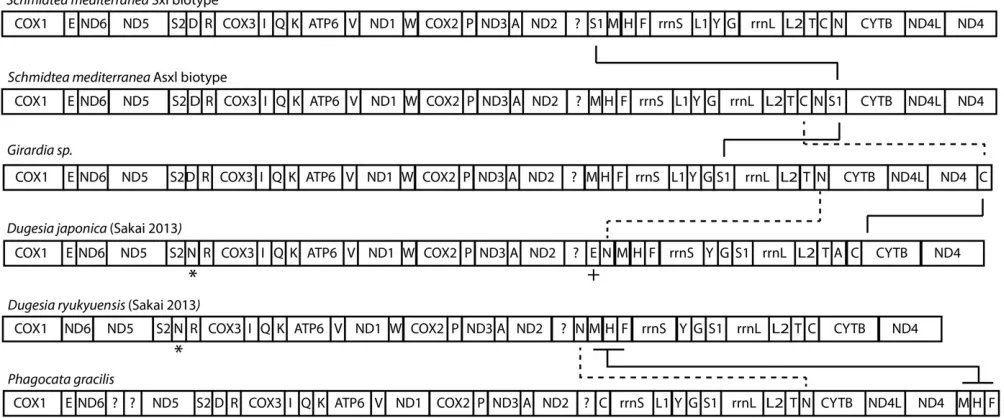
[image:6.603.52.554.52.261.2]We generated extensive directional transcriptional data for the S.mediterraneabiotypes. Alignments of these to mt genomes were used to improve annotations. Because it has been previously re-ported that all mt genes of parasitic platyhelminths are transcribed from a single strand of DNA (Johnston 2006), we also sought to utilize our transcriptome data to test whether single-stranded tran-scription occurs in triclads. For both biotypes of S.mediterranea, except for a small number of sequences aligning antisense to the rRNA, all sequences aligning to the mitochondrial genomes aligned to the same DNA strand (Figure 1 and Figure 2). Given that the 16s Figure 5 Schematic of gene order for six triclads, this includesfive species and two biotypes ofS. mediterranea. The tRNA marked“”is a second
RNA is a considerable contaminant in PolyA-selected mRNA, we suspect these rRNA alignments are not evidence of antisense tran-scription, but rather contamination of nonPolyA RNA (data not shown). We conclude from these data that transcription from a single strand of mitochondrial DNA is not an exclusive attribute of parasitic flatworms, but also shared by nonparasitic members of the phylum.
Gene order is strikingly conserved in triclad mitochondrial genomes
In addition to the four genomes presented here, two other complete or near-complete triclad genomes have been published:Dugesia ryukyuenis andDugesia japonica(Sakai and Sakaizumi 2012). These six genomes represent two superfamilies of triclads (Riutort et al.2012) Despite the evolutionary distances between these species, very few mt gene rearrangements are apparent (Figure 5). For instance, there appears to be only a single tRNA difference between the S. mediterranea biotypes, two tRNA differences between the SmedSxl and Girardia sp., a single block of three tRNAs betweenGirardiasp. andP. gracilis, and two tRNAs rearranged between the AsxlS. mediterraneabiotype and the two previously publishedDugesiaspecies (Figure 5). Moreover, some clusters of triclad mt genes are also seen in other Platyhelminthes. The gene cartridge composed ofcytb,nd4L, andnd4is conserved in all studied parasitic platyhelminth mt genomes (Littlewoodet al.2006). Our data demonstrate the existence of this gene configuration in non-parasiticflatworms, and supports the hypothesis that such conservation of gene order may be a result of the extensive overlap of the genes composing this cartridge (Krakauer and Plotkin 2002).
Noncoding regions in triclad mitochondrial genomes vary greatly in length
Even though the full complement of platyhelminth mt genes is present in triclads (Figure 1, Figure 2, Figure 3, and Figure 4), and the order of these genes is highly conserved (Figure 5), there is considerable vari-ability in the length of the noncoding regions. At 27,133 bp in length, the mt genome of the SmedSxl biotype is exceeded in length by only 23 of the 4861 metazoan mt genomes deposited with NCBI (NCBI 2015), and it is by far the longest mt genome known from the Platyzoa (Wey-Fabrizius et al.2013). Such extraordinary length is due to an extended long noncoding region (11,212 bp), interrupted only by a single putativetrnaS1(Figure 1). In contrast, thetrnaS1in the SmedAsxl biotype is found just before the cytb gene, and the long noncoding region is only 1249 bp. The unexpected size difference between the SmedSxl and SmedAsxl mt genomes and the physical location oftrnaS1was confirmed via PCR (Figure S5,Figure S6, and Table S5). Amplification product sizes and sequences confirm the as-sembly. Interestingly, larger than expected products for SmedSxl lanes 5, 6, 7, and 8 in this AT rich, noncoding area of the genome, indicate that we may be underestimating the size of the SmedSxl biotype genome (Table S5). InGirardiasp., the long noncoding region is 861 bp in length, and is interrupted by a single tRNA (trnC), while theP. gracilis mt genome assembly displays a long noncoding region of 3726 bp.
Additionally, there are two putative and shorter noncoding regions in theS. mediterraneamt genomes ranging in size from 427 to 716 bp (Figure 1 and Figure 2). Betweennad4 andcox1there is a 427 bp noncoding region in both biotypes. This region does not appear to be conserved inGirardiasp., nor in the previously published triclad mitochondrial genomes (Sakai and Sakaizumi 2012). A second short putative noncoding region is found before thecytbgene. These regions are 716 bp and 639 bp in the SmedSxl and SmedAsxl biotypes, re-spectively.P. gracilishas a second short noncoding region of 321 bp immediately afternad2. We conclude that the diversity of lengths and
positions of noncoding regions in triclad mt genomes may be under species- and/or strain-specific microevolutionary selective forces.
New long noncoding RNAs may be transcribed from triclad mitochondrial genomes
Recently, long noncoding RNAs (lncRNAs) have been identified in what were previously thought to be noncoding regions in the human mt genome (Rackham et al. 2011). The depth of our RNAseq efforts allowed us to test whether lncRNAs may be transcribed from planar-ian mt genomes. Alignment of transcriptomes to their respective mt genomes identified several intergenic regions that appear to be tran-scriptionally active (Figure 1, Figure 2, Figure 3, and Figure 4). For instance, such regions were found in the SmedSxl mt genome at positions 16,100–17,099 bp (average depth of coverage2000·), 23,740–24,449 bp (average depth 15·), and 18,500–19,599 bp (average depth 250·). Similarly, we also observed transcripts aligning to intergenic regions in Girardiasp. (positions 140–689; average depth800·), andP. gracilis(positions 1269–2100; average depth600·). The variability of depth coverage may reflect differ-ences in RNA processivity, but this hypothesis needs to be tested experimentally. Nevertheless, because these transcripts are longer than 100 bp (Øromet al.2010), we conclude that mitochondrial long noncoding RNAs (mtlncRNAs) may be a characteristic of mt genomes across a broad phylogenetic distribution, and are deserving of further study.
Noncanonical start codons are common in free-livingflatworms
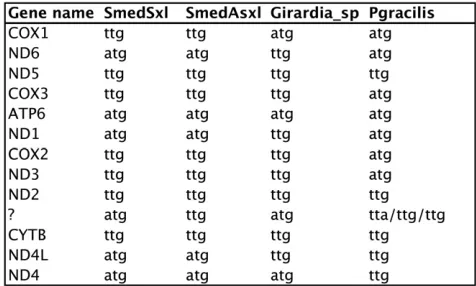
[image:7.603.312.550.48.191.2]with precision to TTG starts (e.g.,cox2andnd3in the SmedSxl mt genome; Figure 1 and Figure 6). The addition of a TTG to Translation Table 9 (http://www.ebi.ac.uk/ena/browse/translation-tables) should be considered for future mt genome annotations.
Triclad mt genomes encode for an atypically large cox1 gene
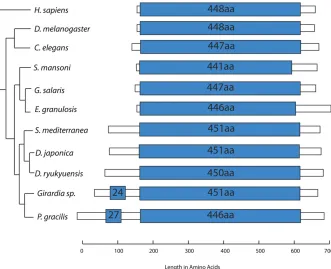
Cytochromecoxidase subunit 1 (COX1) is a highly conserved protein in metazoans, both in amino acid sequence and in size (Folmeret al. 1994). The C-terminus of the triclad COX1 proteins contains the highly conserved, canonical cytochrome c/quinol oxidase polypep-tide I domain (PFAM 00115, e-value, 1e–100) (Figure 7); however, its precise identification in the triclad mt genomes was challenging even after considering TTG start codons. The ORFs coding for COX1 were longer than expected in each of the analyzed triclad mt genomes due to the presence of an extended 59end (N-terminus). The average length of the tricladcox1ORFs is 630 aa. The shortest is D. ryukyuensis at 621 aa, and the longest isP. gracilisat 700 aa (Figure 7). This is in contrast to the conserved size ofcox1, not only in sister metazoan groups, such as the deuterostomes (Homo sapiens, 513 aa) and the ecdysozoans (Drosophila melanogaster, 483 aa; Caenorhabditis elegans, 525 aa), but also in evolutionarily distant organisms such as plants (Arabidopsis thaliana, 527 aa). The aver-age length of thecox1genes currently deposited in REFSEQ for the Metazoa is 516 aa. In addition to those species reported in this paper, only two species have NCBI-depositedcox1genes longer than 600 aa (the coralEuphyllia ancoraat 694 aa, and the spongePlakena trilophaat 766 aa) (NCBI 2015). We conclude that an unusually long cox1gene is characteristic of triclads.
Transcriptomic analyses revealed a transcribed ORF that may represent a noncanonical atp8
After aligning the transcriptome to the mt genomes ofGirardiasp., P. gracilis, andS. mediterranea, we noticed a previously undescribed
transcript mapping directly afternad2in both species (Figure 1, Figure 2, Figure 3, and Figure 4). These novel transcripts contained abonafide ORF in all three species.P. graciliscontains two other ORFs between nd5 and nd6 as well; these are not conserved in position. Remarkably, inspection of three other published flatworm mitochondrial ge-nomes,i.e.,D. ryukyuensis,D. japonica(Sakai and Sakaizumi 2012), andCrenobia alpina(Solàet al.2015) uncovered sequences of similar lengths with predicted ORFs immediately followingnad2. The canon-icalATP8in Metazoa contains both a signal peptide and transmem-brane domain, but the sequence is poorly conserved beyond thefirst four amino acids, MPQL (Hoffmannet al.1992). Interestingly, like the canonical ATP8, each ORF is predicted by SMART (Letunicet al. 2014) to contain at least one transmembrane domain and, with the exception ofC. alpina, signal peptides (Figure 8). Because of its con-served location and predicted motif architecture, we postulate that this transcriptionally identified ORF may code for a highly divergent triclad ATP8.
DISCUSSION
Traditionally, the annotation of mt genomes involves gene prediction tools and is based upon homology to other species. Although this approach has been very successful in bringing order to the wealth of mt genome sequences available (NCBI 2015), this strategy has some limitations. For instance, poorly conserved genes may be undetected, and, in the absence of an experimentally established translation table for the organisms under study, gene prediction efforts may result in either truncated or missing gene annotations. We sought to overcome these difficulties by taking advantage of the depth of data that is routinely acquired during RNA sequencing experiments. Such data sets normally encompass mitochondrial transcripts that should, in principle, com-plement traditional mt genome annotation efforts.
[image:8.603.51.382.46.315.2]complement of predicted mt genes described for triclads, providing, for thefirst time for any taxon, systematic transcriptional evidence to support the annotation of newly assembled mt genomes. Remarkably, this method identified novel transcripts that mapped to mt genomic regions not previously known to be transcriptionally active. For in-stance, we discovered a putative mtlncRNA in S. mediterranea. In vertebrates, mtlncRNAs have been described both antisense to genes as well as in noncoding regions (Rackhamet al.2011). This novel class of mt transcripts, therefore, occurs in taxa other than mammals, and merits further investigation. Although it is unclear what the biological importance of these may be, recent evidence from mammals indicates that mtlncRNAs may be associated with aging endothelial cells (Bianchessiet al.2015).
In addition to the identification of a mtlncRNA, we identified an ORF that may be a triclad ATP8. This has been identified as a vital component in mitochondrial ATP synthase in yeast and is presumed to operate similarly in Metazoa (Stephenset al.2003). The absence of ATP8 in the mt genomes of several taxa, including Platyhel-minthes, and other platyzoans (Wey-Fabriziuset al.2013), has long
been unexplained (Gissi et al. 2008). Without functional experi-ments, it is impossible to definitively label this transcribed ORF as atp8, but we believe that it is more parsimonious that a conserved ORF be a gene known to be present in other mitochondrial ge-nomes, rather than a member of an entirely new class of genes. Future biochemical studies in heterologous systems should be able to address this possibility.
[image:9.603.51.358.42.490.2]The ability to integrate RNAseq as part of mt genome assembly pipelines not only allows for improved gene annotation, but also creates novel opportunities for gene discovery. Our findings that manyflatworm mt genomes transcribe both lncRNAs, and a posi-tionally conserved ORF, demonstrate the value of this approach. These novel data not only further progress toward resolving long-standing issues withflatworm mt genomes, but also indicate that this approach can be used to shed light on previously unknown transcriptional activities of extranuclear DNA. The results reported here emphasize that the biological functions of mt genomes are understudied, and that the addition of RNAseq to the mt genome analysis toolkit is a step forward toward resolving this deficiency.
ACKNOWLEDGMENTS
The authors acknowledge Dan Rokhsar and Jarrod Chapman at the Joint Genome Institute for the preliminary assembly of the SmedSxl mt genome. They also thank Marta Riutort for sharing results prior to publication, Sarah Elliot for assistance with RNA extraction, and the Molecular Biology Core at Stowers Institute for Medical Research for library creation and sequencing. A.S.A. is an investigator of the Howard Hughes Medical Institute and the Stowers Institute for Medical Research.
LITERATURE CITED
Alvarez-Presas, M., J. Baguna, and M. Riutort, 2008 Molecular phylogeny of land and freshwater planarians (Tricladida, Platyhelminthes): from freshwater to land and back. Mol. Phylogenet. Evol. 47(2): 555–568.
Benazzi, M. B. J., and R. Ballester, 1970 First report on an asexual form of the planarianDugesia lugubriss. l.Lincei—Rendiconti Scienze Fisiche. Matematiche e Naturali XLVIII: 282–283.
Benazzi, M., J. Baguñà, R. Ballester, I. Puccinelli, and R. Del Papa, 1975 Further contribution to the taxonomy of the“Dugesia lugubris -polychroagroup”with description ofDugesia mediterranean.sp. (Tricladida, Paludicola). Boll. Zool. 42: 81–89.
Bernt, M., A. Donath, F. Juhling, F. Externbrink, C. Florentzet al., 2013 MITOS: improved de novo metazoan mitochondrial genome an-notation. Mol. Phylogenet. Evol. 69(2): 313–319.
Bianchessi, V., I. Badi, M. Bertolotti, P. Nigro, Y. D’Alessandraet al., 2015 The mitochondrial lncRNA ASncmtRNA-2 is induced in aging and replicative senescence in endothelial cells. J. Mol. Cell. Cardiol. 81C: 62–70.
Camacho, C., G. Coulouris, V. Avagyan, N. Ma, J. Papadopouloset al., 2009 BLAST+: architecture and applications. BMC Bioinformatics 10: 421.
Edgar, R. C., 2004 MUSCLE: multiple sequence alignment with high ac-curacy and high throughput. Nucleic Acids Res. 32(5): 1792–1797. Folmer, O., M. Black, W. Hoeh, R. Lutz, and R. Vrijenhoek, 1994 DNA
primers for amplification of mitochondrial cytochromecoxidase subunit I from diverse metazoan invertebrates. Mol. Mar. Biol. Biotechnol. 3(5): 294–299.
Gissi, C., F. Iannelli, and G. Pesole, 2008 Evolution of the mitochondrial genome of Metazoa as exemplified by comparison of congeneric species. Heredity (Edinb) 101(4): 301–320.
Haas, B. J., A. Papanicolaou, M. Yassour, M. Grabherr, P. D. Bloodet al., 2013 De novotranscript sequence reconstruction from RNA-seq using the Trinity platform for reference generation and analysis. Nat. Protoc. 8(8): 1494–1512.
Hahn, C., L. Bachmann, and B. Chevreux, 2013 Reconstructing mito-chondrial genomes directly from genomic next-generation sequencing reads—a baiting and iterative mapping approach. Nucleic Acids Res. 41(13): e129.
Halanych, K. M., J. D. Bacheller, A. M. Aguinaldo, S. M. Liva, D. M. Hillis et al., 1995 Evidence from 18S ribosomal DNA that the lophophorates are protostome animals. Science 267(5204): 1641–1643.
Hoffmann, R. J., J. L. Boore, and W. M. Brown, 1992 A novel mitochondrial genome organization for the blue mussel,Mytilus edulis. Genetics 131(2): 397–412.
Johnston, D. A., 2006 Genomes and genomics of parasiticflatworms, pp. 37–68 inParasitic Flatworms: Molecular Biology,Biochemistry, Immu-nology and Physiology, edited by Maule, A. G., and N. J. Marks. CABI, Wallingford, UK.
Kenk, R., 1972 EPA Biota of Freshwater Ecosystems,Identification Manual, volume 1. Freshwater planarians (Turbellaria) of North America. Water
Pollution Control Research Series. US Environmental Protection Agency, Washington DC.
Krakauer, D. C., and J. B. Plotkin, 2002 Redundancy, antiredundancy, and the robustness of genomes. Proc. Natl. Acad. Sci. USA 99(3): 1405–1409. Krzywinski, M., J. Schein, I. Birol, J. Connors, R. Gascoyneet al.,
2009 Circos: an information aesthetic for comparative genomics. Genome Res. 19(9): 1639–1645.
Langmead, B., and S. L. Salzberg, 2012 Fast gapped-read alignment with Bowtie 2. Nat. Methods 9(4): 357–359.
Larsson, K., and U. Jondelius, 2008 Phylogeny of Catenulida and support for Platyhelminthes. Org. Divers. Evol. 8(5): 378–387.
Letunic, I., T. Doerks, and P. Bork, 2014 SMART: recent updates, new developments and status in 2015. Nucleic Acids Res. 43: D257–D260. Littlewood, D. T., A. E. Lockyer, B. L. Webster, D. A. Johnston, and T. H. Le,
2006 The complete mitochondrial genomes ofSchistosoma haematobium andSchistosoma spindaleand the evolutionary history of mitochondrial genome changes among parasiticflatworms. Mol. Phylogenet. Evol. 39(2): 452–467.
Luo, R., B. Liu, Y. Xie, Z. Li, W. Huanget al., 2012 SOAPdenovo2: an empirically improved memory-efficient short-read de novo assembler. Gigascience 1 (1):18.
NCBI, 2015 Available at:http://www.ncbi.nlm.nih.gov/genomes/ OrganelleResource.cgi?taxid=33208. Accessed: January 21, 2015. Ørom, U. A., T. Derrien, M. Beringer, K. Gumireddy, A. Gardiniet al.,
2010 Long noncoding RNAs with enhancer-like function in human cells. Cell 143(1): 46–58.
Rackham, O., A. M. Shearwood, T. R. Mercer, S. M. Davies, J. S. Mattick et al., 2011 Long noncoding RNAs are generated from the mitochon-drial genome and regulated by nuclear-encoded proteins. RNA 17(12): 2085–2093.
Rice, P., I. Longden, and A. Bleasby, 2000 EMBOSS: the European Mo-lecular Biology Open Software Suite. Trends Genet. 16(6): 276–277. Riutort, M., M. Alvarez-Presas, E. Lazaro, and E. Solà, andPaps, J.,
2012 Evolutionary history of the Tricladida and the Platyhelminthes: an up-to-date phylogenetic and systematic account. Int. J. Dev. Biol. 56(1–3): 5–17.
Robb, S. M., E. Ross, and A. Sanchez Alvarado, 2008 SmedGD: the Schmidtea mediterraneagenome database. Nucleic Acids Res. 36: D599– D606.
Sakai, M., and M. Sakaizumi, 2012 The complete mitochondrial genome of Dugesia japonica(Platyhelminthes; order Tricladida). Zoolog. Sci. 29(10): 672–680.
Simakov, O., F. Marletaz, S. J. Cho, E. Edsinger-Gonzales, P. Havlaket al., 2013 Insights into bilaterian evolution from three spiralian genomes. Nature 493(7433): 526–531.
Solà, E., M. Álvarez-Presas, C. Frías-López, D. T. J. Littlewood, J. Rozaset al., 2015 Evolutionary analysis of mitogenomes from parasitic and free-livingflatworms. PLoS One 10: e0120081.
Stephens, A. N., M. A. Khan, X. Roucou, P. Nagley, and R. J. Devenish, 2003 The molecular neighborhood of subunit 8 of yeast mitochondrial F1F0-ATP synthase probed by cysteine scanning mutagenesis and chemical modification. J. Biol. Chem. 278(20): 17867–17875.
Wägele, J. W., and T. Bartholomaeus, 2014 Deep Metazoan Phylogeny: the Backbone of the Tree of Life. New Insights From Analyses of Molecules, Morphology,and Theory of Data Analysis, Walter de Gruyter, Boston. Wey-Fabrizius, A. R., L. Podsiadlowski, H. Herlyn, and T. Hankeln,
2013 Platyzoan mitochondrial genomes. Mol. Phylogenet. Evol. 69(2): 365–375.
Wyman, S. K., R. K. Jansen, and J. L. Boore, 2004 Automatic annotation of organellar genomes with DOGMA. Bioinformatics 20(17): 3252–3255.