BORANG PENGESAHAN STATUS TESIS*
JUDUL: SECURE PEER-TO-PEER WmELESS LAN DATA SHARING SESI PENGAJIAN: 2008f2009
Saya LEE HUI LZAN
mengaku membenarkan tesis PSM ini disirnpan di Perpustakaan Fakulti Teknologi Maklumat dan Komunikasi dengan syarat-syarat kegunaan seperti berikut:
1. Tesis dan project adalah hakrnilik Universiti Teknikal Malaysia Melaka.
2. Perpustakaan Fakulti Teknologi Maklumat dan Komunikasi dibenarkan membuat salinan untuk tujuan pengajian sahaja.
3. Perpustakaan Fakulti Teknologi MaMumat dan Komunikasi dibenarkan membuat salinan tesis ini sebagai bahan pertukaran antara instituisi pengajian tinggi. 4.
**
Sila tandakan(0
SULIT (Mengandungi maklumat yang berdarjah keselamatan atau kepentingan Malaysia seperti yang termaktub di dalam AKTA RAHSIA RASMI 1972)
TERHAD (Mengandungi maklurnat TERHAD yang telah ditentukan oleh organisasi/badan di mana penyelidikan dijalankan
(TANDATANGAN PENULIS) (TANDATANGAN PENYELIA)
Alarnat tetap : 44. Jln Poh Lena K o n ~ (W-FAD~PW W A N MOW Batu 19 Sengkan~ 84800 Bukit Gambir. G W Z A L I
Nama Penyelia
Tarikh: 3c
3
Tarikh:3
1 6
/
SECURE PEER-TO-PEER WIRELESS LAN DATA SHARING
LEE HUI LIAN
This report is submitted in partial fulfillment of the requirements for the Bachelor of Computer Science (Computer Networking)
FACULTY OF INFORMATION AND COMMUNICATION TECHNOLOGY UNIVERSITI TEKNIKAL MALAYSIA MELAKA
DECLARATION
I hereby declare that this project report entitled
SECURE PEER-TO-PEER WIRELESS LAN DATA SHARING
is written by me and is my own effort and that no part has been plagiarized without citations
STUDENT Date:
(LEE HUI LIAN)
SUPERVISOR : Date:
DEDICATION
To my beloved parents and siblings, they had given me their blessings and encourage me in doing my degree study.
To my dearest lecturers who had assisted me by giving support and advices.
ACKNOWLEDGEMENTS
My deepest thanks, especially to Puan Khadijah Wan Mohd. Ghazali. She had guided me a lot during the time I complete my final year project. At the same time, I
want to take this opportunity to thanks all UTeM staffs. Thanks for their directly or indirectly help and assistance throughout the period doing my project. Many opinions and advices fkom them have ease and fasten my progress for my project.
Not forgetting I would like to take this opportunity to thanks my parents for giving me their blessings when doing final year project.
ABSTRACT
TABLE OF CONTENTS
CHAPTER SUBJECT
DECLARATION DEDICATION
ACKNOWLEDGEMENTS ABSTRACT
ABSTRAK
TABLE OF CONTENTS LIST OF TABLES LIST OF FIGURES
LIST OF ABBREVIATIONS LIST OF ATTACHMENTS
CHAPTER I INTRODUCTION
1.1 Project background 1 2 Problem Statement 1.3 Objective
1.4 Scope
1.5 Project Significance 1.6 Expected Output 1.7 Conclusion
CHAPTER
II
LITERATURE
REVIEW AND PROJECT METHODOLOGY2.1 Introduction 2.2 Literature Review
22.1 Domain 2.2.2 Keyword
2.2.3 Previous Research 2.2.3.1 Technique
22.3.2 Facts and Findings 2.3 Proposed Solution
2.3.1 Project Methodology 2.4 Project Schedule and Milestones
2.4.1 Gantt Chart 2.5 Conclusion
CHAPTER In ANALYSIS
3.1 Introduction 3.2 Problem Analysis
3.2.1 Description of Current System Situation 3.2.2 Activity Diagram
3.2.3 Flow Chart of Current Systems 3.2.4 Problem Description
3.3 Requirement Analysis 3 -3.1 Data Requirement 3.3.2 Functional Requirement 3.3.3 Non-functional Requirement 3.3 -4 Others Requirement
CHAPTER
IV
DESIGN 4.1 Introduction 4.2 High-Level Design4.2.1 System Architecture 4.2.2 Navigation Design 4.2.3 User Interface Design
4.2.3.1 Input Design 4.2.3.2 Output Design 4.2.4 Database design
4.2.4.1 Conceptual and Logical Database Design 4.3 Detailed Design
4.3.1 Software Design
4.3.2 Physical Database Design 4.4 Conclusion
CHAPTER V IMPLEMENTATION
5.1 Introduction
5.2 Sofkware Development Environment Setup 5.3 Software Configuration Management
5.3.1 Configuration Environment Setup 5.3.2 Version Control Procedure 5.4 Implementation Status
CHAPTER M
TESTING
6.1 Introduction 6.2 Test Plan
6.2.1 Test Organization 6.2.2 Test Environment 62.3 Test Schedule 6.3 Test Strategy
6.3.1 Classes of Tests 6.4 Test Design
6.4.1 Test Description 6.4.2 Test Data 6.5 Test Results and Analysis 6.6 Conclusion
CHAPTERVLI PROJECT CONCLUSION
7.1 Observation on Weaknesses and Strengths 7.2 Propositions for Improvement
7.3 Contribution 7.4 Conclusion
LIST OF TABLES
TABLE TITLE PAGE
Table 2.1 Table 2.2 Table 2.3 Table 2.4 Table 3.1 Table 3.2 Table 3.3 Table 3.4 Table 4.1 Table 4.2 Table 4.3 Table 4.4
Table 4.5 Table 4.6 Table 4.7 Table 4.8
Table 5.1
Scishare versus Secure Peer-to-Peer Wireless LAN Data Sharing
Homeviews versus Secure Peer-to-Peer Wireless LAN Data Sharing
Surface Texture Peer-to-Peer Data Sharing System Project Schedule
Describe for Current System Situation System Input
System Output
Use Case for Secure Peer-to-peer Wireless LAN Data Sharing
Input for Login
Input for Connection Process Input for Search File
Input for Upload File
Input for Add New Members Input for Delete New Members
Data Dictionary for User Login Details Data Dictionary of Files
Table 5.2 Implementation Status Table 6.1
Table 6.2
Table 6.3 Table 6.4
Table 6.5
Table 6.6 Table 6.7 Table 6.8 Table 6.9 Table 6.10 Table 6.1 1 Table 6.12 Table 6.13 Table 6.14 Table 6.15 Table 6.1 6 Table 6.17
Table 6.18 Table 6.19
Test Organization
Test Environment for Secure P2P WLAN Data Sharing
Test Schedule
Classes of Test for Secure P2P WLAN Data Sharing
LIST OF FIGURES
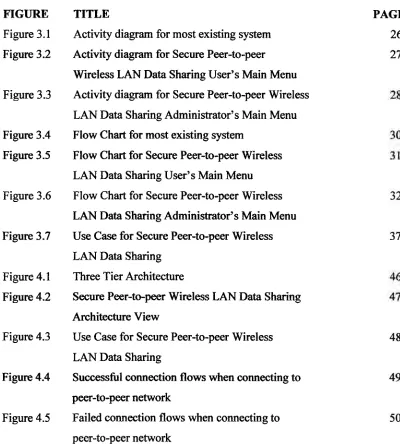
FIGURE Figure 3.1 Figure 3.2
Figure 3.3
Figure 3.4 Figure 3 -5
Figure 3.6
Figure 3.7
Figure 4.1 Figure 4.2
Figure 4.3
Figure 4.4
Figure 4.5
TITLE
Activity diagram for most existing system Activity diagram for Secure Peer-to-peer Wireless LAN Data Sharing User's Main Menu Activity diagram for Secure Peer-to-peer Wireless LAN Data Sharing Administrator's Main Menu Flow Chart for most existing system
Flow Chart for Secure Peer-to-peer Wireless LAN Data Sharing User's Main Menu Flow Chart for Secure Peer-to-peer Wireless LAN Data Sharing Administrator's Main Menu Use Case for Secure Peer-to-peer Wireless LAN Data Sharing
Three Tier Architecture
Secure Peer-to-peer Wireless LAN Data Sharing Architecture View
Use Case for Secure Peer-to-peer Wireless LAN Data Sharing
SuccessfUl connection flows when connecting to peer-to-peer network
Failed connection flows when connecting to peer-to-peer network
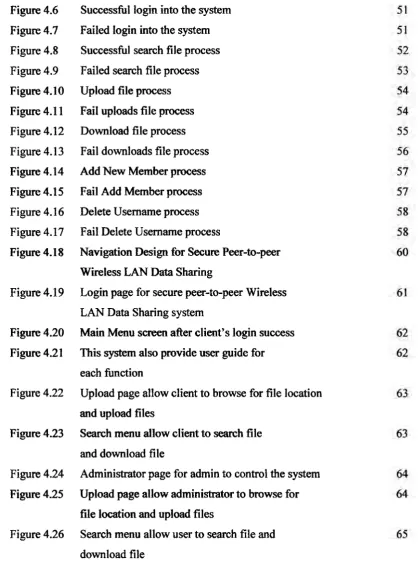
Figure 4.6
Figure 4.7
Figure 4.8
Figure 4.9
Figure 4.10
Figure 4.1 1
Figure 4.12
Figure 4.13
Figure 4.14
Figure 4.15
Figure 4.16
Figure 4.17
Figure 4.18
Figure 4.19
Figure 4.20
Figure 4.21
Figure 4.22
Figure 4.23
Figure 4.24
Figure 4.25
Figure 4.26
Successful login into the system Failed login into the system Successful search file process Failed search file process Upload file process Fail uploads file process Download file process Fail downloads file process Add New Member process Fail Add Member process Delete Username process Fail Delete Username process
Navigation Design for Secure Peer-to-peer Wireless LAN Data Sharing
Login page for secure peer-to-peer Wireless LAN Data Sharing system
Main Menu s a w n after client's login success This system also provide user guide for each function
Upload page allow client to browse for file location and upload files
Search menu allow client to search file and download file
Administrator page for admin to control the system Upload page allow administrator to browse for file location and upload files
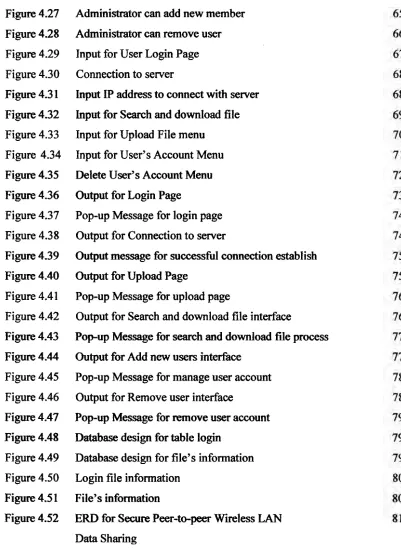
Figure 4.27
Figure 4.28
Figure 4.29
Figure 4.30
Figure 4.3 1
Figure 4.32
Figure 4.33
Figure 4.34
Figure 4.35
Figure 4.36
Figure 4.37
Figure 4.38
Figure 4.39
Figure 4.40
Figure 4.41
Figure 4.42
Figure 4.43
Figure 4.44
Figure 4.45
Figure 4.46
Figure 4.47
Figure 4.48
Figure 4.49
Figure 4.50
Figure 4.5 1
Figure 4.52
Administrator can add new member Administrator can remove user Input for User Login Page Connection to server
Input
IP
address to connect with server Input for Search and download file Input for Upload File menuInput for User's Account Menu Delete User's Account Menu Output for Login Page
Pop-up Message for login page Output for Connection to server
Output message for successful connection establish Output for Upload Page
Pop-up Message for upload page
Output for Search and download file interface
Pop-up Message for search and download file process Output for Add new users interface
Pop-up Message for manage user account Output for Remove user interface
Pop-up Message for remove user account Database design for table login
Database design for file's information Login file information
File's information
Figure 4.53 Normalization 1NF for Secure Peer-to-peer Wireless 8 1 LAN Data Sharing
Figure 4.54 Secure Peer-to-Peer Wireless LAN Data Sharing Module 82 Figure 5.1 Software Development Environment Setup for Secure 92
Peer-to-peer Wireless LAN
Data
Sharing SystemLIST OF ABBREWAnONS ACRONYM AMT API DBMS DFD DHCP DNS ERD ICT J AD JDBC JIT JVM ODBC PMP P2P RAD RAM RDBMS SDLC TCP/IP UMZ WORD
Advanced Manufacturing Technology Application Programming Interface Database Management System Data Flow Diagram
Dynamic host configuration protocol Domain Name System
Entity Relationship Diagram Institute of Computer Technology Joint Application Development Java Database Connectivity Just-in-Time
Java Virtual Machines Open Database Connectivity Project Management Plan Peer-to-Peer
Rapid Application Development Random Access Memory
Relational Database Management System System Development Life Cycle
xviii
WLAN BITC
Wireless Local Area Network
LIST OF ATTACHMENTS
ATTACHMENT TlTLE
Appendix (A) Log book Appendix (B) Project Proposal Appendix (C) Gantt Chart Appendix @) Data Dictionary Appendix (E) Test Result Appendix (F) User Manual
CHAPTER 1
INTRODUCTION
1.1 Project Background
Network security is a most important significance for the secure peer-to-peer network sharing
fhat
is enables user access the network by specifies username and password. Once authenticated, a firewall enforces access policies such as what servicesare allowed to be accessed by the network users. Furthermore, communication between
two hosts using the network could be encrypted to maintain privacy.
Another significant feature of the project is that it enables to users to share files with another user anywhere in the area of wireless LAN without requiring an intermediary. Any computer network consists of a minimum of a couple of workstations, at least one shared resource, and a medium by which to comect the computers or called clientlserver networks. In the client server model, one system acts as a server and caters to request sent and the other server acts as a client and sends requests to server for services. There is one server and many clients connected to the server requesting for services and the server acts as an intermediary if the clients want to communicate with each others.
curnuhve bandwidth of network participants rather than conventional centralized resources where a relatively low number of servers provide the core value to a service or application. An additional, peer-to-peer network has one equal node only and does not have the notion of clients or servers, which have autonomy and which can collaborate with each other, pulling together their resources, in order either obtain services or jointly tackle large computing jobs. Within this application the peer-to-peer networking concept is used to share files, example the exchange of MPEG Layer3 (mp3) compressed audio files. However, Peer-to-peer is not only about file sharing, it is also about establishing multimedia communication networks based on Peer-&Peer concepts or resource sharing.
To distinguish peer-to-peer networks with a central entity fiom those without any central entities, it is general practice to split the peer-to-peer networking definition into two subdeflnitions which is hybrid peer-&peer and pure peer-to-peer. Hybrid peer-to- peer which allows the existence of central entities in its network, and the pure peer-to- peer networking concepts act as equals, merging the roles of clients and server and there is no central server managing the network.
In this project, the main target is to develop a secure peer-to-peer wireless LAN
1.2 Problem Statement
Network security is a complicated subject, historically only tackled by well- trained and experienced experts. Unauthorized access is a very high-level term that can refer to a number of different sorts of attacks. The goal of these attacks is to access some resource that machine should not provide the attacker. To overcome this issues, this project is require to set up a security system with authenticate person only allow to connect to server.
The second problem statement is if a database in server does not update frequently and always neglect by user. It will cause a waste time for user and cause network traffic within node. As the number of simultaneous client requests to a given
server increases, the server can become severely overloaded.
Furthermore, file searching will became bore some and burdensome job in the peer-to-peer network. This because no systematic system is uses for file searching, files record no capture and arrange properly in the database.
1 3 Objective
9 To develop a secure wireless CAN peer-to-peer networking
-
Require username and password to establish a connection and access server.-
To avoid unauthorized access serva and maintain privacy of the data>
To provide a wireless LAN data sharing-
Many clients in same network-
Once established a connection, user able download shared file in server>
To upload file and download file from server-
User able to update file in specific directory, all the file capture into database-
User able to download file from file server>
To search file-
Users are allows to search shared files from file server's database1.4 Scope
The purpose of this project is to design a secure wireless LAN peer-to-peer data sharing which is ad-hoc network. Each time a register user wants to access server, there need to require permission such as usemame and password to authenticate identity after establish a connection to server.