
City, University of London Institutional Repository
Citation
:
Zheng, X., Ma, Q., Shao, S. and Khayyer, A. (2017). Modelling of violent water
wave propagation and impact by incompressible SPH with first-order consistent kernel
interpolation scheme. Water, 9(6), doi: 10.3390/w9060400
This is the published version of the paper.
This version of the publication may differ from the final published
version.
Permanent repository link: http://openaccess.city.ac.uk/id/eprint/18495/
Link to published version
:
http://dx.doi.org/10.3390/w9060400
Copyright and reuse:
City Research Online aims to make research
outputs of City, University of London available to a wider audience.
Copyright and Moral Rights remain with the author(s) and/or copyright
holders. URLs from City Research Online may be freely distributed and
linked to.
Article
Modelling of Violent Water Wave Propagation and
Impact by Incompressible SPH with First-Order
Consistent Kernel Interpolation Scheme
Xing Zheng1,*, Qingwei Ma1,2, Songdong Shao1,3and Abbas Khayyer4
1 College of Shipbuilding Engineering, Harbin Engineering University, Harbin 150001, China;
[email protected] (Q.M.); [email protected] (S.S.)
2 School of Mathematics, Computer Science and Engineering, City, University of London,
London EC1V 0HB, UK
3 Department of Civil and Structural Engineering, University of Sheffield, Sheffield S1 3JD, UK
4 Department of Civil and Earth Resources Engineering, Kyoto University, Kyoto 615-8540, Japan;
* Correspondence: [email protected]; Tel.: +86-451-8256-8147
Academic Editors: Gordon Huang and Yurui Fan
Received: 30 April 2017; Accepted: 31 May 2017; Published: 4 June 2017
Abstract:The Smoothed Particle Hydrodynamics (SPH) method has proven to have great potential in dealing with the wave–structure interactions since it can deal with the large amplitude and breaking waves and easily captures the free surface. The paper will adopt an incompressible SPH (ISPH) approach to simulate the wave propagation and impact, in which the fluid pressure is solved using a pressure Poisson equation and thus more stable and accurate pressure fields can be obtained. The focus of the study is on comparing three different pressure gradient calculation models in SPH and proposing the most efficient first-order consistent kernel interpolation (C1_KI) numerical scheme for modelling violent wave impact. The improvement of the model is validated by the benchmark dam break flows and laboratory wave propagation and impact experiments.
Keywords:ISPH; wave propagation; wave impact; dam break; C1_KI scheme
1. Introduction
The wave propagation and its impact on structure is a common natural phenomenon that is very important in the field of ocean and coastal engineering. During this process, the waves involve with large deformation of free surface, wave breaking, wave run-up and their strong interactions with the structures. Thus, modelling of wave system is of great interest but is also a difficult task in both physical experiments and the numerical simulations.
There are generally two classes of models for wave simulations. In the early years, the Laplace equation with fully nonlinear boundary conditions was used for simple wave problems [1–3], while the Navier–Stokes (N-S) equations with more realistic physical boundary conditions were solved in recent numerical models [4,5]. As a result, various numerical schemes, such as the finite element, finite volume and finite difference methods have been used to solve the N-S equations to investigate the nonlinear water wave propagation and its interaction with the structures [6,7]. To relieve the CPU expense and meanwhile provide reasonable solutions for the large domain problems, different forms of the Shallow Water Equations (SWEs) are also proposed in the modelling of wave system [8].
In the last two decades, the Smoothed Particle Hydrodynamics (SPH) method has emerged as a promising mesh-free Lagrangian modelling technique. Although the SPH model may use more CPU time than the grid counterpart in some cases, it has the advantage of tracking the free surface in an easy and accurate way. In this approach, the governing equations are discretized and solved by the
individual particles within the computational domain. SPH was originally developed for the study of astrophysics [9,10] and then employed to study the wave propagating and overtopping over coastal structures [11]. Based on the algorithm of the Moving Particle Semi-implicit (MPS) approach [12] and SPH projection method [13], a strict incompressible algorithm of the SPH model [14] was developed and then it was further improved to simulate wave breaking and post-breaking [15]. The major difference between the standard weakly compressible SPH (WCSPH) [9,10] and the incompressible SPH [14] lies in that the former calculates the fluid pressure explicitly by using an equation of state, while the latter employs a strict incompressible formulation to solve the pressure implicitly by a pressure Poisson equation (PPE). Both the WCSPH and ISPH show capabilities and limitations. For WCSPH, it has been highlighted the better possibility to parallelize the numerical code for simulations in real conditions [16]. The pressure field has also been improved by different form of diffusive terms in the continuity equation for wave–structure interaction problems [17,18]. Furthermore, the acoustic components related to the use of the state equation can be eliminated by an appropriate filtering in the data post-processing to recover the incompressible solution [19]. For the impact problems, it has been noticed that ISPH sometimes shows singularities since the pressure is inversely proportional to the adopted time step [20]. On the other hand, the numerical time stepping length of ISPH can be larger than that of WCSPH, so the general computational efficiency could be higher [21,22].
In this paper, an incompressible SPH model will be employed to simulate solitary wave propagation and impact on a slope with different conditions. Although the ISPH model could predict stable and noise-free pressure field in many cases, the numerical accuracy and efficiency could be compromised in the free surface water waves. Among a variety of influence factors, the calculation of pressure gradient plays a very important role in the process. Thus, the current study presents an improved first-order derivative of pressure model for the violent wave simulations, from the first-order consistent kernel interpolation scheme (C1_KI). The proposed C1_KI ISPH model is first verified by the benchmark dam break flow and solitary wave propagation over a constant depth. Then, the wave propagation and impact on an inclined wall are investigated under different slope angles based on the self-designed laboratory experiment.
2. ISPH Methodology
2.1. Governing Equations and Solution Algorithms
The Navier–Stokes (N-S) equations are used to describe the fluid motion. In the incompressible SPH method, the fluid density is considered to be a constant, and therefore the mass and momentum conservation equations are written in the Lagrangian form as follows:
∇ ·u=0, (1)
Du
Dt =−
1
ρ∇P+g+ν0∇
2u, (2)
whereρis the fluid density;uis the particle velocity;tis the time;Pis the particle pressure;gis the
gravitational acceleration; andν0is the kinematic viscosity. A two-step projection method is used
to solve the velocity and pressure field from Equations (1) and (2). The first step is the prediction of velocity in the time domain without considering the pressure term. The intermediate particle velocity
u∗and positionr∗are obtained by
u∗ =ut+∆u∗, (3)
∆u∗ =g+ν0∇2u
∆t, (4)
r∗=rt+u∗∆t, (5)
The second step is the correction step in which the pressure term is added, and ∆u∗∗ is the correction of particle velocity
∆u∗∗=−1 ρ∇P
t+∆t∆t, (6)
The followingut+∆tandrt+∆trepresent the velocity and position of particle at new time step
ut+∆t=u∗+∆u∗∗, (7)
rt+∆t=rt+u
t+ut+∆t
2 ∆t, (8)
Combining Equations (1)–(6), the following pressure Poisson equation (PPE) is obtained
∇2Pt+∆t= ρ∇ ·u
∗
∆t , (9)
Similarly, Shao and Lo [14] proposed a projection-based incompressible approach by imposing the density invariance on each particle, leading to the following PPE:
∇ ·
1
ρ∗∇P
t+∆t= ρ0−ρ∗
ρ0∆t2 , (10)
whereρ∗is the particle density at intermediate time step. Due toρ∗/ρ0being very close to unity,
the difference between the left- and right-hand sides of the denominator in Equation (10) can be ignored, and the combined PPE incorporating both the divergence-free and density-invariance terms is obtained as:
∇2Pt+∆t=
αρ0−ρ
∗
∆t2 + (1−α)
ρ0∇ ·u∗
∆t , (11)
whereαis a blending coefficient and a value of 0.01 is adopted in this paper from the computational
experience. In this paper, only a 2D ISPH formulation is used.
2.2. Calculation of Spatial Derivatives
A common approach to calculate the gradient of pressure and the divergence of velocity is through the following equations:
∇Pi=ρi N
∑
j=1mj Pj
ρ2j + Pi
ρ2i !
∇iW ri−rj
,h
, (12)
∇ ·ui =−
1
ρi N
∑
j=1mjuij·∇iW ri−rj
,h
, (13)
whereuij=ui−ujis defined;∇iWis the gradient of SPH kernel function and a cubic spline kernel [10]
is used;mis the particle mass;his the kernel smoothing length;Nis the total neighbouring particle number; andiandjindicate the reference and neighbouring particles, respectively.
The viscosity term in Equation (2) adopts the following form
∇ ·(νi∇ui) = N
∑
j=14mj
νi+νj
ρi+ρj
uij·rij rij2+η2
! ·∇iW
ri−rj ,h
whereη2=0.01h2is a small parameter to avoid singularity; andrij=ri−rjis defined. The Laplacian
term in Equation (11) is discretised by combining the SPH gradient and divergence rules to obtain
∇ ·
1
ρ∗∇Pt+1
= N
∑
j=1mj
8
ρi+ρj2 Pij·rij
rij2+η2·∇iW ri−rj,h
, (15)
wherePij =Pi−Pjis defined.
2.3. Free Surface and Solid Boundary Conditions
The dynamic free surface conditions require a prescribed pressure to be imposed on the surface particles, such as throughP= 0. In this paper, we use three auxiliary functions combined with the ratio of particle number density to accurately identify the free surface particles. This has shown to be more robust than using either the density or the divergence rules in conventional ISPH practice. The particles on the solid boundary should satisfy the pressure boundary condition, which is represented by the following momentum balance as
n· ∇P=ρ
n·g−n·U., (16)
wherenis the unit vector normal to the solid boundary. More detailed procedures to implement the free surface and solid boundary conditions can be referred to Zheng [21].
3. Improved First-Order Derivative Scheme
In this section three pressure calculation models are compared and an optimum is chosen to use in the practical water wave simulations.
3.1. Simplified Finite Difference Interpolation (SFDI) Scheme
In the traditional SPH calculation of pressure gradient in Equation (12), the computational results are heavily affected by the particle distributions and the shape of solid boundary. To improve this, the first-order derivative of pressure on the solid boundary was formulated by the Simplified Finite Difference Interpolation (SFDI) scheme originally proposed by Sriram and Ma [23] in their MLPG_R approach. SFDI is a second-order accurate scheme based on the Taylor series expansion, which can also be used for the inner fluid particles. In the 2D case, the pressure gradient model formulated by SFDI can be found in [24]. The relevant key formulas are summarized as follows:
∂f
∂x
ri
= N
∑
j=1,j6=ini,xmBij,xk−ni,xyBij,y
ni,x1ni,x2−ni,xy2
(fj−fi), (17)
∂f
∂y
ri
= N
∑
j=1,j6=ini,x1Bij,y−ni,xyBij,x ni,x1ni,x2−ni,xy2
(fj− fi), (18)
ni,xy= N
∑
j=1,j6=i(rj,xm−ri,xm)(rj,xk−ri,xk)
rj −ri
2 W
rj −ri
, (19)
Bij,xm =
(rj,xm−ri,xm)
rj −ri
2 W
rj −ri
, (20)
wherem= 1 andk= 2 orm= 2 andk= 1;Nis the number of neighbouring particles affecting particlei;
3.2. Moving Least Square (MLS) Method
MLS is a widely used interpolation scheme for meshless kernel approximation, which can get very high accuracy for the function estimation. Atluri and Shen [25] and Zheng et al. [26] have done many comparisons of improved meshless interpolation schemes with the MLS method. More details of MLS method for the function estimation and first order derivative calculation can refer to Zheng et al. [26]. The accuracy of MLS scheme is very high and the calculation process is more complex than the other traditional meshless interpolation methods. Although the dimension of matrix is not large, the computational cost is demanding as it includes successive multiplication of several matrices and matrix inversions. Although MLS has been widely used for the meshless interpolation comparison [24,26,27], it is less documented in the wave propagation simulations. The key formulations of MLS are summarized as follows.
The unknown function is represented by f(x)as
f(x)≈ N
∑
j=1Φj(x)fj, (21)
whereNis the number of nodes that affect the function atx; andΦj(x)is the interpolation or shape
function given by
Φj(x) = m
∑
l=1ψl(x)[A−1(x)B(x)]lj =ΨT(x)A−1(x)Bj(x), (22)
Assume the basis function to be linear
ψT(x) = [ψ1,ψ2,ψ3] = [1,x,y], (23)
and define the matrixB(x)andA(x)as
B(x) =ΨTW(x) = [w1(x−x1)ψ(x1),w2(x−x2)ψ(x2),· · ·], (24)
A(x) =ΨTW(x)Ψ=B(x)Ψ, (25)
whereW(x)andΨare respectively expressed by
W(x) =
w1(x−x1) 0· · · 0
0
· · ·
0 wN(x−xN)
, (26)
ΨT = [ψ(x1),ψ(x2),· · ·,ψ(xN)], (27)
andw(x−xj)is a weight function which can adopt different forms.
The gradient of the unknown function Equation (20) is estimated by
∇f(x)≈ N
∑
j=1∇Φj(x)fj, (28)
The partial derivative of shape function with respect toxcan be directly differentiated as
whereA−,x1is the partial derivative ofA−1, i.e.,A−,x1 =−A−1A,xA−1; andBjis thej-th column ofB,
for which the partial derivative is calculated as
Bj,x=
∂wj(x−xj)
∂x ψ(xj), (30)
3.3. First-Order Consistent Kernel Interpolation (C1_KI) Scheme
The standard SPH practice widely uses the following symmetric summation form to calculate the first-order derivative as
∇f(xi) = N
∑
j=1[f(xj)−f(xi)]∇W(xj−xi,h)∆j, (31)
However, the above equation was based on the assumption of ∑N j=1
(xj−xi)∇W(xj−xi,h)∆j=1
(∆j is the particle volume), which cannot be exactly satisfied when the particles are disorderly
distributed or near the solid boundary. To improve this, the present paper applies the Taylor series expansion of f(x)at pointxj, then multiplies this by a kernel functionW and integrates over its
support domain.
Eventually it gives the values off(xi), fx(xi)and fy(xi)in the following matrix form
f(xi) fx(xi) fy(xi)
=
N
∑
j=1
W ∑N
j=1
(xj−xi)W
N
∑
j=1
(yj−yi)W
N
∑
j=1
(xj−xi)W N
∑
j=1
(xj−xi)2W N
∑
j=1
(xj−xi)(yj−yi)W
N
∑
j=1
(yj−yi)W N
∑
j=1
(xj−xi)(yj−yi)W N
∑
j=1
(yj−yi)2W
−1
N
∑
J=1
f(xj)W
N
∑
j=1
f(xj)(xj−xi)W
N
∑
j=1
f(xj)(yj−yi)W
, (32)
This method is easy to be expanded to 3D and higher-order problems. As known from Equation (32), when the distributed particles are symmetric about xi, the error
terms become ∑N
j=1
(xj−xi)2W 6= 0, N ∑ j=1
(yj−yi)2W 6= 0, N ∑ j=1
(xj−xi)2(yj−yi)W = 0
and ∑N j=1
(xj−xi)(yj−yi)2W=0, so all of f(xi), fx(xi) and fy(xi) can achieve the second-order
accuracy ofO(h2). On the other hand, when the distributed particles are asymmetric about xi,
the error terms become ∑N
j=1
(xj−xi)2(yj−yi)W 6= 0 and N ∑ j=1
(xj−xi)2(yj−yi)W 6= 0, so only f(xi)
can reach the second-order accuracy ofO(h2), while f
x(xi)and fy(xi)merely obtain the first-order
4. Convergence and Accuracy of Different Pressure Gradient Models
In this section, several investigations are made into the convergence and accuracy behaviours of the three pressure gradient models, under the uniform and random particle distributions. The error of the numerical results is quantified as
E_ax= 1 M
M
∑
j=1 efx(xj)−fx(xj)
e fx(xj)
, (33)
whereE_axis the defined mean error; efx(xj)is the numerical value of the gradient component; fx(xj)
is the analytical solution; andMis the number of sampling points in the inner fluid domain or near the boundary area. Here, the near boundary area is defined as the inner region at a distance of 2DX
(twice of the particle spacing) from the computational boundary and the remaining area inside is the inner fluid area.
The computational domain of the test is chosen as a square with side length being of 1 m as shown in Figure1a-d. The test function uses a polynomial function of second order expressed by
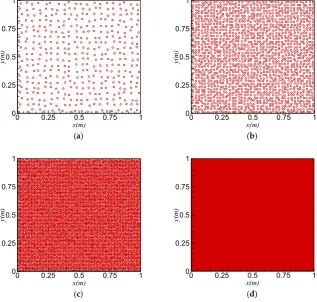
f(x,y) = exp(2x+3y). The calculation nodes are irregularly distributed in the domain by using the quasi-random number generator. The sample node distributions are illustrated in Figure1, for the particle number of 400, 1600, 6400 and 25,600, respectively, corresponding to the particle sizeDXof 0.05 m, 0.025 m, 0.0125 m and 0.00625 m.
Water 2017, 9, 400 7 of 17
quasi-random number generator. The sample node distributions are illustrated in Figure 1, for the particle number of 400, 1600, 6400 and 25,600, respectively, corresponding to the particle size DX of 0.05 m, 0.025 m, 0.0125 m and 0.00625 m.
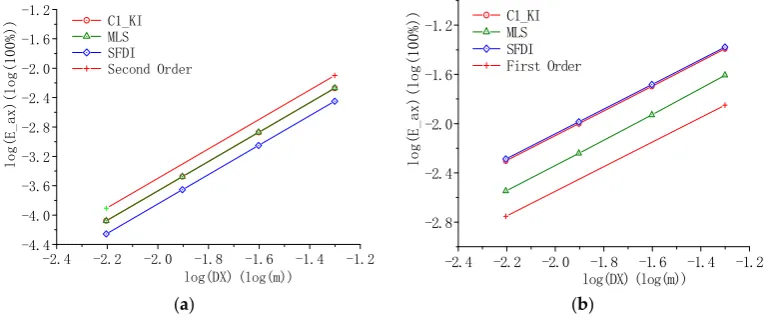
When the particles are uniformly distributed, the convergence rate of the inner domain and near boundary area is shown in Figure 2a,b, respectively. It is shown from Figure 2a that E a_ x can
reach the second-order accuracy for all three pressure gradient methods in the inner fluid domain. Among these SFDI can get the highest accuracy, while the errors of C1_KI and MLS are almost the same. As shown in Figure 2b near the boundary area, MLS can achieve the best results with minimum error while C1_KI performs similarly to SFDI to achieve first-order accuracy. On the other hand, Figure 3a suggests that when the particles are randomly distributed, C1_KI can achieve the most promising results in the inner fluid domain. In the area near the boundary as shown in Figure 3b, both C1_KI and MLS obtain similar results which are better than those computed by SFDI.
(a) (b)
[image:8.595.140.458.367.669.2](c) (d)
Figure 1. Random particle distributions with particle number: (a) 400; (b) 1600; (c) 6400; and (d) 25,600.
x(m)
y(
m
)
0 0.25 0.5 0.75 1 0
0.25 0.5 0.75 1
x(m)
y(
m
)
0 0.25 0.5 0.75 1 0
0.25 0.5 0.75 1
x(m)
y(
m
)
0 0.25 0.5 0.75 1 0
0.25 0.5 0.75 1
x(m)
y(m
)
0 0.25 0.5 0.75 1 0
0.25 0.5 0.75 1
Figure 1.Random particle distributions with particle number: (a) 400; (b) 1600; (c) 6400; and (d) 25,600.
When the particles are uniformly distributed, the convergence rate of the inner domain and near boundary area is shown in Figure2a,b, respectively. It is shown from Figure2a thatE_axcan reach the
C1_KI performs similarly to SFDI to achieve first-order accuracy. On the other hand, Figure3a suggests that when the particles are randomly distributed, C1_KI can achieve the most promising results in the inner fluid domain. In the area near the boundary as shown in Figure3b, both C1_KI and MLS obtain similar results which are better than those computed by SFDI.Water 2017, 9, 400 8 of 17
C1_KI MLS SFDI Second Order
-2.4 -2.2 -2.0 -1.8 -1.6 -1.4 -1.2 -4.4 -4.0 -3.6 -3.2 -2.8 -2.4 -2.0 -1.6 -1.2 lo g( E_ ax ) log(DX)(log(m)) (log (10 0%)
) C1_KI
MLS SFDI
First Order
-2.4 -2.2 -2.0 -1.8 -1.6 -1.4 -1.2
-2.8 -2.4 -2.0 -1.6 -1.2 lo g(E _a x) log(DX) (l og( 1 00 %)) (log(m))
(a) (b)
Figure 2. Convergence and error analysis of first-order derivative calculation under uniform particle distributions in the: (a) inner fluid area; and (b) near boundary area.
C1_KI MLS SFDI
First Order
-2.4 -2.2 -2.0 -1.8 -1.6 -1.4 -1.2 -3.0 -2.8 -2.6 -2.4 -2.2 -2.0 -1.8 -1.6 -1.4 log( E_ax) log(DX) (log(m)) (log( 100%) ) C1_KI MLS SFDI First Order
-2.4 -2.2 -2.0 -1.8 -1.6 -1.4 -1.2 -2.4 -2.2 -2.0 -1.8 -1.6 -1.4 -1.2 -1.0 lo g(E _a x) log(DX) (l og(1 00%) ) (log(m))
[image:9.595.106.489.157.318.2](a) (b)
Figure 3. Convergence and error analysis of first-order derivative calculation under disordered particle distributions in the: (a) inner fluid area; and (b) near boundary area.
Generally speaking, Figure 3 implies that all of the three pressure gradient models can only achieve the first-order accuracy when the particles are irregularly distributed. In practical water wave modelling, the situation of particle randomness should increase from the wave propagation to wave–structure interaction cases because there are frequent exchanges of location within neighbour particles and surface-to-inner particles. Computationally, MLS is the most expensive one since it includes quite a few inverse calculations and matrix multiplications [24,26]. Overall, C1_KI scheme performs quite satisfactory among the three in view of computational accuracy under all tested conditions, thus it will be used to study the wave propagation and impact in the next model applications.
5. Model Applications in Water Wave Modelling
5.1. Dam Break Wave Impact on a Vertical Wall
The dam break flow has always been a benchmark violent free surface flow to validate the numerical models. In this example, a rectangular column of water is initially confined. The width of
water column is a and the height is H . At the beginning of the computation, the dam is
instantaneously collapsed. A schematic setup of the dam break flow domain is given in Figure 4,
where L is the distance between the two vertical walls. There are two pressure sensors p1 and p2
located on the left and right walls, respectively, with a distance of h1 and h2 from the horizontal
Figure 2.Convergence and error analysis of first-order derivative calculation under uniform particle distributions in the: (a) inner fluid area; and (b) near boundary area.
Water 2017, 9, 400 8 of 17
C1_KI MLS SFDI Second Order
-2.4 -2.2 -2.0 -1.8 -1.6 -1.4 -1.2 -4.4 -4.0 -3.6 -3.2 -2.8 -2.4 -2.0 -1.6 -1.2 lo g( E_ ax ) log(DX)(log(m)) (log (10 0%)
) C1_KI
MLS SFDI
First Order
-2.4 -2.2 -2.0 -1.8 -1.6 -1.4 -1.2
-2.8 -2.4 -2.0 -1.6 -1.2 lo g(E _a x) log(DX) (l og( 1 00 %)) (log(m))
(a) (b)
Figure 2. Convergence and error analysis of first-order derivative calculation under uniform particle distributions in the: (a) inner fluid area; and (b) near boundary area.
C1_KI MLS SFDI
First Order
-2.4 -2.2 -2.0 -1.8 -1.6 -1.4 -1.2 -3.0 -2.8 -2.6 -2.4 -2.2 -2.0 -1.8 -1.6 -1.4 log( E_ax) log(DX) (log(m)) (log( 100%) ) C1_KI MLS SFDI First Order
-2.4 -2.2 -2.0 -1.8 -1.6 -1.4 -1.2 -2.4 -2.2 -2.0 -1.8 -1.6 -1.4 -1.2 -1.0 lo g(E _a x) log(DX) (l og(1 00%) ) (log(m))
[image:9.595.111.488.367.521.2](a) (b)
Figure 3. Convergence and error analysis of first-order derivative calculation under disordered particle distributions in the: (a) inner fluid area; and (b) near boundary area.
Generally speaking, Figure 3 implies that all of the three pressure gradient models can only achieve the first-order accuracy when the particles are irregularly distributed. In practical water wave modelling, the situation of particle randomness should increase from the wave propagation to wave–structure interaction cases because there are frequent exchanges of location within neighbour particles and surface-to-inner particles. Computationally, MLS is the most expensive one since it includes quite a few inverse calculations and matrix multiplications [24,26]. Overall, C1_KI scheme performs quite satisfactory among the three in view of computational accuracy under all tested conditions, thus it will be used to study the wave propagation and impact in the next model applications.
5. Model Applications in Water Wave Modelling
5.1. Dam Break Wave Impact on a Vertical Wall
The dam break flow has always been a benchmark violent free surface flow to validate the numerical models. In this example, a rectangular column of water is initially confined. The width of
water column is a and the height is H . At the beginning of the computation, the dam is
instantaneously collapsed. A schematic setup of the dam break flow domain is given in Figure 4,
where L is the distance between the two vertical walls. There are two pressure sensors p1 and p2
located on the left and right walls, respectively, with a distance of h1 and h2 from the horizontal
Figure 3.Convergence and error analysis of first-order derivative calculation under disordered particle distributions in the: (a) inner fluid area; and (b) near boundary area.
Generally speaking, Figure3implies that all of the three pressure gradient models can only achieve the first-order accuracy when the particles are irregularly distributed. In practical water wave modelling, the situation of particle randomness should increase from the wave propagation to wave–structure interaction cases because there are frequent exchanges of location within neighbour particles and surface-to-inner particles. Computationally, MLS is the most expensive one since it includes quite a few inverse calculations and matrix multiplications [24,26]. Overall, C1_KI scheme performs quite satisfactory among the three in view of computational accuracy under all tested conditions, thus it will be used to study the wave propagation and impact in the next model applications.
5. Model Applications in Water Wave Modelling
5.1. Dam Break Wave Impact on a Vertical Wall
water column isaand the height isH. At the beginning of the computation, the dam is instantaneously collapsed. A schematic setup of the dam break flow domain is given in Figure4, whereLis the distance between the two vertical walls. There are two pressure sensorsp1andp2located on the left and right
walls, respectively, with a distance ofh1andh2from the horizontal bed. In the following analysis, all
the variables are non-dimensionalised by using the dam widthaand gravitational accelerationg, such aset=t
p
g/2aorHe =H/(2a).
Water 2017, 9, 400 9 of 17
bed. In the following analysis, all the variables are non-dimensionalised by using the dam width a
[image:10.595.174.419.185.300.2]and gravitational acceleration g, such as t=t g/ 2a or H =H/ (2 )a .
Figure 4. Schematic setup of dam break flow domain.
In the present simulations it is assumed a = 0.5 m, H a/ =2.0 and L a/ =4. The total particle
number is 60 × 120 with a particle size of 0.00833 m. The non-dimensionalised time step is given by / (2 ) 0.003
t t g a
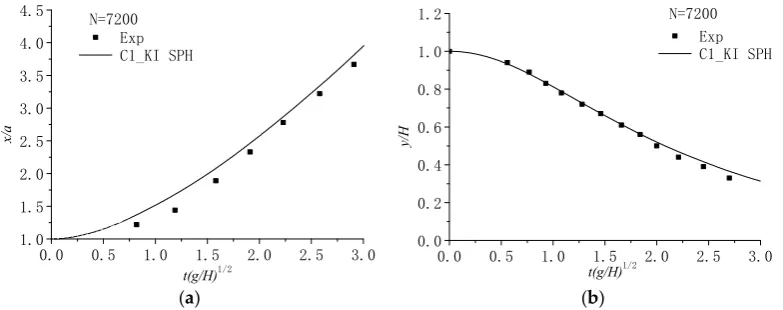
Δ = Δ = . To validate the proposed C1_KI SPH computations, Figure 5a,b gives the comparisons of dam break flow leading edge and water column height, respectively, with the experimental results from [28]. A good agreement is found in both cases.
0.0 0.5 1.0 1.5 2.0 2.5 3.0
1.0 1.5 2.0 2.5 3.0 3.5 4.0 4.5
x/
a
t(g/H)1/2
Exp C1_KI SPH N=7200
0.0 0.5 1.0 1.5 2.0 2.5 3.0
0.0 0.2 0.4 0.6 0.8 1.0 1.2
y/H
t(g/H)1/2
Exp C1_KI SPH N=7200
[image:10.595.104.496.418.573.2](a) (b)
Figure 5. Comparisons between C1_KI SPH computations and experimental results on dam break flow: (a) leading edge; and (b) water column height.
To carry out more robust model validations, three tests are run by changing the height of dam
with H=a, H=2a and H=4a, and the simulations continue to the stage when the dam break
wave front hits on the right vertical wall. For analysis purpose, the non-dimensional pressure is
expressed as p= p/ 2ρga. The total particle numbers N used in case of H=a are 400, 1600,
4900, in H=2a are 800, 3200, 9800, and in H=4a are 1600, 6400, 19600, respectively, for the study
of the model convergence. Correspondingly, the particle sizes of three cases are 0.025 m, 0.0125 m and 0.00714 m.
The computational results of pressure time history on sensor point p1 are shown in Figure
6a–c for the different dam height to width ratios H a/ . The vertical height of sensor point p1 is
1 0.1
h = a from the bed. Figure 6 shows that the peak pressure value changes with the height of
water column, which is 0.4, 0.8 and 1.6, respectively, for H a/ = 1, 2 and 4. Thus the relationship
between maximum pressure and water column height seems to follow a linear correlation. Besides, C1_KI SPH computations demonstrate good convergence behaviours and different particle numbers
Figure 4.Schematic setup of dam break flow domain.
In the present simulations it is assumeda= 0.5 m,H/a =2.0 andL/a=4. The total particle number is 60×120 with a particle size of 0.00833 m. The non-dimensionalised time step is given by∆et=∆t
p
g/(2a) =0.003. To validate the proposed C1_KI SPH computations, Figure5a,b gives the comparisons of dam break flow leading edge and water column height, respectively, with the experimental results from [28]. A good agreement is found in both cases.
Water 2017, 9, 400 9 of 17
bed. In the following analysis, all the variables are non-dimensionalised by using the dam width a
and gravitational acceleration g, such as t=t g/ 2a or H =H/ (2 )a .
Figure 4. Schematic setup of dam break flow domain.
In the present simulations it is assumed a = 0.5 m, H a/ =2.0 and L a/ =4. The total particle number is 60 × 120 with a particle size of 0.00833 m. The non-dimensionalised time step is given by
/ (2 ) 0.003
t t g a
Δ = Δ = . To validate the proposed C1_KI SPH computations, Figure 5a,b gives the
comparisons of dam break flow leading edge and water column height, respectively, with the experimental results from [28]. A good agreement is found in both cases.
0.0 0.5 1.0 1.5 2.0 2.5 3.0
1.0 1.5 2.0 2.5 3.0 3.5 4.0 4.5
x/
a
t(g/H)1/2
Exp C1_KI SPH N=7200
0.0 0.5 1.0 1.5 2.0 2.5 3.0
0.0 0.2 0.4 0.6 0.8 1.0 1.2
y/H
t(g/H)1/2
Exp C1_KI SPH N=7200
(a) (b)
Figure 5. Comparisons between C1_KI SPH computations and experimental results on dam break flow: (a) leading edge; and (b) water column height.
To carry out more robust model validations, three tests are run by changing the height of dam with H =a, H=2a and H=4a, and the simulations continue to the stage when the dam break wave front hits on the right vertical wall. For analysis purpose, the non-dimensional pressure is expressed as p=p/ 2ρga. The total particle numbers N used in case of H=a are 400, 1600, 4900, in H=2a are 800, 3200, 9800, and in H=4a are 1600, 6400, 19600, respectively, for the study of the model convergence. Correspondingly, the particle sizes of three cases are 0.025 m, 0.0125 m and 0.00714 m.
The computational results of pressure time history on sensor point p1 are shown in Figure
6a–c for the different dam height to width ratios H a/ . The vertical height of sensor point p1 is
1 0.1
h = a from the bed. Figure 6 shows that the peak pressure value changes with the height of water column, which is 0.4, 0.8 and 1.6, respectively, for H a/ = 1, 2 and 4. Thus the relationship between maximum pressure and water column height seems to follow a linear correlation. Besides, C1_KI SPH computations demonstrate good convergence behaviours and different particle numbers
Figure 5.Comparisons between C1_KI SPH computations and experimental results on dam break flow: (a) leading edge; and (b) water column height.
To carry out more robust model validations, three tests are run by changing the height of dam withH=a,H=2aandH=4a, and the simulations continue to the stage when the dam break wave front hits on the right vertical wall. For analysis purpose, the non-dimensional pressure is expressed as
e
p=p/2ρga. The total particle numbersNused in case ofH=aare 400, 1600, 4900, inH=2aare 800,
3200, 9800, and inH=4aare 1600, 6400, 19600, respectively, for the study of the model convergence. Correspondingly, the particle sizes of three cases are 0.025 m, 0.0125 m and 0.00714 m.
The computational results of pressure time history on sensor pointp1are shown in Figure6a–c for
the different dam height to width ratiosH/a. The vertical height of sensor pointp1ish1=0.1afrom
demonstrate good convergence behaviours and different particle numbers lead to almost identical results. Although the numerical results demonstrate some kinds of oscillation in the time history, they tend to become smoother with the refinement of particle size.
Water 2017, 9, 400 10 of 17
lead to almost identical results. Although the numerical results demonstrate some kinds of oscillation in the time history, they tend to become smoother with the refinement of particle size.
0.0 1.5 3.0 4.5
0.0 0.2 0.4 0.6 P/( 2 ρ ga ) t(g/2a)1/2 N=400 N=1600 N=4900
0.0 1.5 3.0 4.5
0.0 0.4 0.8 1.2 P/ (2 ρ ga) t(g/2a)1/2
N = 800
N = 3200
N = 9800
0.0 1.5 3.0 4.5
0.0 0.4 0.8 1.2 1.6 2.0 P /( 2 ρ ga ) t(g/2a)1/2
N = 1600
N = 6400
N = 19600
[image:11.595.97.502.143.257.2](a) (b) (c)
Figure 6. Time history of computed pressures for different water column height and particle number:
(a) H=a; (b) H=2a; and (c) H=4a.
To quantify the accuracy of pressure predictions made by C1_KI SPH, the comparisons with experimental data of Zhou et al. [29] are also made. In this case, the water column dimension is a = 2 m and H =0.5a, and the distance between the two vertical walls is L=5.367H . On the right wall, there is a pressure sensor point P2 with a height of h2=0.133a from the bed. From the C1_KI SPH
simulations, the particle snapshots with pressure distributions are shown in Figure 7a-f at different time instants after the dam break. Besides, Figure 8 gives the time history of dam break flow impact pressures on the right wall computed by using different particle numbers. Compared with the experimental pressure data [29], not only a good agreement has been found, but also the pressure history of C1_KI SPH computations becomes more reasonable with a higher particle resolution.
)
/( gH
P ρ
:
(a) (b)
(c) (d)
[image:11.595.120.475.445.719.2](e) (f)
Figure 7. Particle snapshots with pressure distributions at different times computed by C1_KI SPH:
(a)
t
= 0.0; (b)t
= 3.0; (c)t
= 6.0; (d)t
= 6.75; (e)t
= 9.0; and (f)t
= 12.0.0.1 0.2 0.3 0.4 0.5 0.6 0.7 0.8 0.9 1
x
y
0 1 2 3 4 5
0 0.5 1 1.5 2 (m) (m ) x y
0 1 2 3 4 5
0 0.5 1 1.5 2 (m) (m ) x y
0 1 2 3 4 5
0 0.5 1 1.5 2 (m) (m ) x y
0 1 2 3 4 5
0 0.5 1 1.5 2 (m) (m) x y
0 1 2 3 4 5
0 0.5 1 1.5 2 (m) (m) x y
0 1 2 3 4 5
0 0.5 1 1.5 2 (m) (m)
Figure 6.Time history of computed pressures for different water column height and particle number: (a)H=a; (b)H=2a; and (c)H=4a.
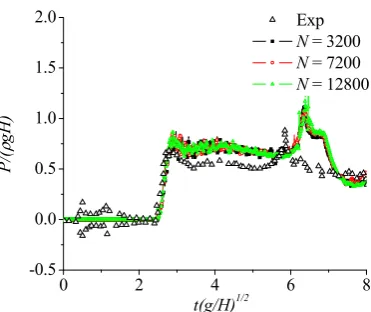
To quantify the accuracy of pressure predictions made by C1_KI SPH, the comparisons with experimental data of Zhou et al. [29] are also made. In this case, the water column dimension isa= 2 m andH=0.5a, and the distance between the two vertical walls isL=5.367H. On the right wall, there is a pressure sensor pointP2with a height ofh2=0.133afrom the bed. From the C1_KI SPH simulations,
the particle snapshots with pressure distributions are shown in Figure7a-f at different time instants after the dam break. Besides, Figure8gives the time history of dam break flow impact pressures on the right wall computed by using different particle numbers. Compared with the experimental pressure data [29], not only a good agreement has been found, but also the pressure history of C1_KI SPH computations becomes more reasonable with a higher particle resolution.
Water 2017, 9, 400 10 of 17
lead to almost identical results. Although the numerical results demonstrate some kinds of oscillation in the time history, they tend to become smoother with the refinement of particle size.
0.0 1.5 3.0 4.5
0.0 0.2 0.4 0.6 P/( 2 ρ ga ) t(g/2a)1/2 N=400 N=1600 N=4900
0.0 1.5 3.0 4.5
0.0 0.4 0.8 1.2 P/ (2 ρ ga) t(g/2a)1/2 N = 800
N = 3200
N = 9800
0.0 1.5 3.0 4.5
0.0 0.4 0.8 1.2 1.6 2.0 P /( 2 ρ ga ) t(g/2a)1/2
N = 1600
N = 6400
N = 19600
(a) (b) (c)
Figure 6. Time history of computed pressures for different water column height and particle number:
(a) H=a; (b) H=2a; and (c) H=4a.
To quantify the accuracy of pressure predictions made by C1_KI SPH, the comparisons with experimental data of Zhou et al. [29] are also made. In this case, the water column dimension is a = 2 m and H =0.5a, and the distance between the two vertical walls is L=5.367H. On the right wall, there is a pressure sensor point P2 with a height of h2=0.133a from the bed. From the C1_KI SPH
simulations, the particle snapshots with pressure distributions are shown in Figure 7a-f at different time instants after the dam break. Besides, Figure 8 gives the time history of dam break flow impact pressures on the right wall computed by using different particle numbers. Compared with the experimental pressure data [29], not only a good agreement has been found, but also the pressure history of C1_KI SPH computations becomes more reasonable with a higher particle resolution.
)
/( gH
P ρ
:
(a) (b)
(c) (d)
(e) (f)
Figure 7. Particle snapshots with pressure distributions at different times computed by C1_KI SPH:
(a)
t
= 0.0; (b)t
= 3.0; (c)t
= 6.0; (d)t
= 6.75; (e)t
= 9.0; and (f)t
= 12.0.0.1 0.2 0.3 0.4 0.5 0.6 0.7 0.8 0.9 1
x
y
0 1 2 3 4 5
0 0.5 1 1.5 2 (m) (m ) x y
0 1 2 3 4 5
0 0.5 1 1.5 2 (m) (m ) x y
0 1 2 3 4 5
0 0.5 1 1.5 2 (m) (m ) x y
0 1 2 3 4 5
0 0.5 1 1.5 2 (m) (m) x y
0 1 2 3 4 5
0 0.5 1 1.5 2 (m) (m) x y
0 1 2 3 4 5
0 0.5 1 1.5 2 (m) (m)
0 2 4 6 8 -0.5
0.0 0.5 1.0 1.5 2.0
P/(
ρ
gH)
t(g/H)1/2
[image:12.595.205.391.86.242.2]Exp N = 3200 N = 7200 N = 12800
Figure 8. Pressure time history on right wall computed by C1_KI SPH with different particle numbers, compared with experimental data [29].
To show more clearly the improvement of proposed model, Figure 9 gives the pressure errors between the experimental data [29] and ISPH results computed by C1_KI, MLS and SFDI models using different particle numbers N. Again it fully demonstrates that C1_ KI scheme can achieve the lowest error and have the fastest convergence rate.
Figure 9. Comparisons of pressure errors for C1_KI, MLS and SFDI models with different particle numbers.
5.2. Solitary Wave Propagation over a Constant Depth
Recently the correlation in between the energy conservation properties and applied pressure gradient models has been extensively explored [30]. The solitary wave propagation over a constant water depth is considered in this section. The interaction between tsunami wave and coastal structure is the topic related to practical coastal and ocean engineering problems and therefore attracts increasing attentions. In most cases, the solitary wave is used to represent certain characteristics of the tsunami wave [31,32]. Long-distance wave propagation is still a huge challenge to SPH models since the wave form cannot be well reserved due to the particle disorders and numerical dissipations. To verify the robustness of the proposed C1_KI SPH scheme, the computed solitary wave profiles are compared with the analytical solutions derived from the Boussinesq equation referred to Zheng et al. [33].
Here, consider a solitary wave with the wave amplitude a = 0.05 m, water depth d = 0.25 m and total length of the tank L = 30.0 m. The computational time step is kept constant as 0.001 s. The
3.4 3.6 3.8 4.0 4.2
-1.0 -0.8 -0.6 -0.4 -0.2
log(
Err
) (log
(100
%))
log(N)
[image:12.595.173.422.363.536.2]C1_KI MLS SFDI
Figure 8.Pressure time history on right wall computed by C1_KI SPH with different particle numbers, compared with experimental data [29].
To show more clearly the improvement of proposed model, Figure9gives the pressure errors between the experimental data [29] and ISPH results computed by C1_KI, MLS and SFDI models using different particle numbersN. Again it fully demonstrates that C1_ KI scheme can achieve the lowest error and have the fastest convergence rate.
0 2 4 6 8
-0.5 0.0 0.5 1.0 1.5 2.0
P/(
ρ
gH)
t(g/H)1/2
Exp N = 3200 N = 7200 N = 12800
Figure 8. Pressure time history on right wall computed by C1_KI SPH with different particle numbers, compared with experimental data [29].
To show more clearly the improvement of proposed model, Figure 9 gives the pressure errors between the experimental data [29] and ISPH results computed by C1_KI, MLS and SFDI models using different particle numbers N. Again it fully demonstrates that C1_ KI scheme can achieve the lowest error and have the fastest convergence rate.
Figure 9. Comparisons of pressure errors for C1_KI, MLS and SFDI models with different particle numbers.
5.2. Solitary Wave Propagation over a Constant Depth
Recently the correlation in between the energy conservation properties and applied pressure gradient models has been extensively explored [30]. The solitary wave propagation over a constant water depth is considered in this section. The interaction between tsunami wave and coastal structure is the topic related to practical coastal and ocean engineering problems and therefore attracts increasing attentions. In most cases, the solitary wave is used to represent certain characteristics of the tsunami wave [31,32]. Long-distance wave propagation is still a huge challenge to SPH models since the wave form cannot be well reserved due to the particle disorders and numerical dissipations. To verify the robustness of the proposed C1_KI SPH scheme, the computed solitary wave profiles are compared with the analytical solutions derived from the Boussinesq equation referred to Zheng et al. [33].
Here, consider a solitary wave with the wave amplitude a = 0.05 m, water depth d = 0.25 m and total length of the tank L = 30.0 m. The computational time step is kept constant as 0.001 s. The
3.4 3.6 3.8 4.0 4.2
-1.0 -0.8 -0.6 -0.4 -0.2
log(
Err
) (log
(100
%))
log(N)
C1_KI MLS SFDI
Figure 9. Comparisons of pressure errors for C1_KI, MLS and SFDI models with different particle numbers.
5.2. Solitary Wave Propagation over a Constant Depth
Recently the correlation in between the energy conservation properties and applied pressure gradient models has been extensively explored [30]. The solitary wave propagation over a constant water depth is considered in this section. The interaction between tsunami wave and coastal structure is the topic related to practical coastal and ocean engineering problems and therefore attracts increasing attentions. In most cases, the solitary wave is used to represent certain characteristics of the tsunami wave [31,32]. Long-distance wave propagation is still a huge challenge to SPH models since the wave form cannot be well reserved due to the particle disorders and numerical dissipations. To verify the robustness of the proposed C1_KI SPH scheme, the computed solitary wave profiles are compared with the analytical solutions derived from the Boussinesq equation referred to Zheng et al. [33].
theory given in [34], in which the motion of wave maker is defined in a dimensionless form by
xp(τ) =a/k[tanhχ(τ) +tanhkλ],k= √
3a/4 andχ(τ) =k[cτ−xp(τ)−λ]with the dimensionless
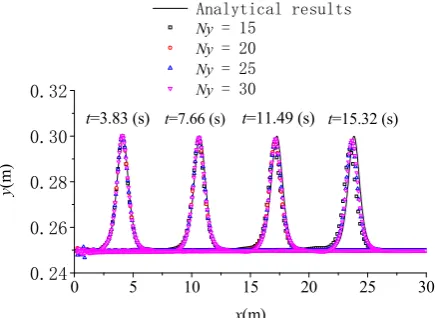
wave celerityc = √1+a. Figure10shows the computed free surface profiles with the analytical solutions for different particle numbers at different times of the wave propagation. It shows that the numerical wave surfaces approach to the analytical ones with the increasing particle number in vertical directionNy. Meanwhile, the convergence of model computations is evidenced by the close agreement among the three numerical results. Especially it is promising to note that both the wave height and wave shape are well maintained during the wave propagation even if the wave has travelled nearly 30 m over a water depth of 0.25 m. This implies that the dampening of wave height over long-distance travel could be attributed to the influence of pressure gradient calculation schemes. Moreover, in addition to the possible numerical dissipations it has also been shown in the literature that some functions to reproduce the solitary waves lead to a progressive decay in the wave amplitude along the channel as well as the presence of trailing waves due to instantaneous truncation in the motion law of the wave maker. Finally, to show the model convergence more clearly, Figure11gives the errors of wave surface elevation between C1_KI SPH results computed with different particle numbers and the analytical results at timet= 15.32 s.
Water 2017, 9, 400 12 of 17
numerical solitary wave is generated by a piston-type wave maker according to the theory given in [34], in which the motion of wave maker is defined in a dimensionless form by
( ) / [tanh ( ) tanh ]
p
x τ =a k χ τ + kλ , k= 3 / 4a and χ τ( )=k c[τ−xp( )τ λ− ] with the dimensionless
wave celerity c= 1+a. Figure 10 shows the computed free surface profiles with the analytical solutions for different particle numbers at different times of the wave propagation. It shows that the numerical wave surfaces approach to the analytical ones with the increasing particle number in vertical direction Ny. Meanwhile, the convergence of model computations is evidenced by the close agreement among the three numerical results. Especially it is promising to note that both the wave height and wave shape are well maintained during the wave propagation even if the wave has travelled nearly 30 m over a water depth of 0.25 m. This implies that the dampening of wave height over long-distance travel could be attributed to the influence of pressure gradient calculation schemes. Moreover, in addition to the possible numerical dissipations it has also been shown in the literature that some functions to reproduce the solitary waves lead to a progressive decay in the wave amplitude along the channel as well as the presence of trailing waves due to instantaneous truncation in the motion law of the wave maker. Finally, to show the model convergence more clearly, Figure 11 gives the errors of wave surface elevation between C1_KI SPH results computed with different particle numbers and the analytical results at time t = 15.32 s.
0 5 10 15 20 25 30
0.24 0.26 0.28 0.30 0.32
t=11.49 (s) t=15.32 (s)
t=7.66 (s)
y
(m)
x(m)
Analytical results
Ny = 15
Ny = 20
Ny = 25
[image:13.595.189.407.317.476.2]Ny = 30 t=3.83 (s)
Figure 10. Comparisons of wave surface profile computed by C1_KI SPH using different particle resolutions with analytical solutions at different wave propagation stages.
10 15 20 25 30 35
-3 -2 -1 0
log(
Err
) (
log(
100%)
)
Ny
[image:13.595.198.399.528.673.2]C1_KI
Figure 11. Convergence study of wave surface elevations computed by C1_KI SPH with different particle resolutions.
Figure 10. Comparisons of wave surface profile computed by C1_KI SPH using different particle resolutions with analytical solutions at different wave propagation stages.
numerical solitary wave is generated by a piston-type wave maker according to the theory given in [34], in which the motion of wave maker is defined in a dimensionless form by
( ) / [tanh ( ) tanh ]
p
x τ =a k χ τ + kλ , k= 3 / 4a and χ τ( )=k c[τ−xp( )τ λ− ] with the dimensionless
wave celerity c= 1+a. Figure 10 shows the computed free surface profiles with the analytical
solutions for different particle numbers at different times of the wave propagation. It shows that the numerical wave surfaces approach to the analytical ones with the increasing particle number in
vertical direction Ny. Meanwhile, the convergence of model computations is evidenced by the close
agreement among the three numerical results. Especially it is promising to note that both the wave height and wave shape are well maintained during the wave propagation even if the wave has travelled nearly 30 m over a water depth of 0.25 m. This implies that the dampening of wave height over long-distance travel could be attributed to the influence of pressure gradient calculation schemes. Moreover, in addition to the possible numerical dissipations it has also been shown in the literature that some functions to reproduce the solitary waves lead to a progressive decay in the wave amplitude along the channel as well as the presence of trailing waves due to instantaneous truncation in the motion law of the wave maker. Finally, to show the model convergence more clearly, Figure 11 gives the errors of wave surface elevation between C1_KI SPH results computed
with different particle numbers and the analytical results at time t = 15.32 s.
0 5 10 15 20 25 30
0.24 0.26 0.28 0.30 0.32
t=11.49 (s) t=15.32 (s) t=7.66 (s)
y
(m)
x(m)
Analytical results
Ny = 15
Ny = 20
Ny = 25
Ny = 30 t=3.83 (s)
Figure 10. Comparisons of wave surface profile computed by C1_KI SPH using different particle resolutions with analytical solutions at different wave propagation stages.
10 15 20 25 30 35
-3 -2 -1 0
log(
Err
) (
log(
100%)
)
Ny
C1_KI
Figure 11. Convergence study of wave surface elevations computed by C1_KI SPH with different particle resolutions.
Figure 11. Convergence study of wave surface elevations computed by C1_KI SPH with different particle resolutions.
5.3. Solitary Wave Impacting on Vertical and Inclined Walls
Water2017,9, 400 13 of 17
inclination angles. The physical experiment was carried out by Zheng et al. [35] in a 3-D wave flume with piston wave maker in Harbin Engineering University (HEU). The schematic diagram of the wave tank is shown in Figure12. The wave tank length isL= 10 m and the water depth isd= 0.25 m. The solitary wave height isa= 0.15 m and the wave nonlinearity isε=a/d= 0.6. As shown in Figure12,
two pressure sensor points are located on the right wall at a distance of 0.05 m and 0.15 m from the tank bottom to monitor the pressure time history, i.e.,h1=0.05 m andh2=0.10 m. Besides, two wave
elevation gauges are located at section of Set1 and Set2, which are 2.0 m away from the left and right boundaries, respectively. In the C1_KI SPH computations, the initial particle spacing is chosen to be 0.01 m and the time step is kept constant as 0.001 s.
5.3. Solitary Wave Impacting on Vertical and Inclined Walls
In order to further show the effectiveness of improved C1_KI SPH technique, an investigation is made on the numerical results of a solitary wave propagation and impact on a solid wall with different inclination angles. The physical experiment was carried out by Zheng et al. [35] in a 3-D wave flume with piston wave maker in Harbin Engineering University (HEU). The schematic diagram of the wave tank is shown in Figure 12. The wave tank length is L = 10 m and the water depth is d = 0.25 m. The solitary wave height is a = 0.15 m and the wave nonlinearity is ε=a d = 0.6. As shown in Figure 12, two pressure sensor points are located on the right wall at a distance of 0.05 m and 0.15 m from the tank bottom to monitor the pressure time history, i.e., h1= 0.05 m and
2
[image:14.595.150.449.225.329.2]h = 0.10 m. Besides, two wave elevation gauges are located at section of Set1 and Set2, which are 2.0 m away from the left and right boundaries, respectively. In the C1_KI SPH computations, the initial particle spacing is chosen to be 0.01 m and the time step is kept constant as 0.001 s.
Figure 12. Schematic view of solitary wave tank and measurement locations.
Figure 13a,b gives the comparison of wave surface elevations at Set1 and Set2, and Figure 14a,b gives the comparison of pressure time histories at P1 and P2, for the slope inclination angle α = 90°. In order to show the pressure time histories more clearly, only the dynamic parts of the pressures are provided, while the total pressure should be obtained by adding to the part of static pressure. From the results in both figures, it shows that C1_KI SPH computations can achieve good results as compared with the experimental data [35]. Since there is a reflected wave after the solitary wave impacts on the slope, it shows double peaks in the wave elevation time history at Set2 in Figure 13. Due to the wave running up and down, there are some discrepancies in the numerical results after the solitary wave reflects from the slope. The pressure time histories at point P1 in Figure 14 are not as good as those at point P2, as there are some small oscillations in the peak domain. This is due to that some small water drops hit upon the water surface and make the pressure of inner particles change rapidly. The pressure amplitude at P1 and P2 are almost the same. It should be noted that the double peak pressure patterns in Figure 14 have also been reported in a latest ISPH work [36].
For generality, Figures 15a,b and 16a,b give the comparisons of wave surface elevations at Set1 and Set2, and time histories of wave impact pressures at P1 and P2, respectively, when the slope angle is α = 120°. As there exist the overturning and re-entering waves, the amplitude of reflected waves becomes smaller than the case of Figure 13. Due to being difficult to simulate the air-pocket and small bubbles in present model, the amplitude and phase of waves demonstrate some differences between the experimental data [35] and numerical ISPH results. With the increase of slope inclinations, i.e., from α = 90° to α = 120°, the amplitude of reflected wave elevations and wave impact pressures becomes smaller, and the duration of wave impact becomes longer, following the comparisons between Figures 13 and 15, or between Figures 14 and 16. Due to the 3D effect of wave propagation and small vibrations from the piston wave maker, there is a phenomenon of trailing waves appearing in Figures 13a and 15a.
Finally, Figure 17a,b gives a snapshot of the computed wave profile with the experimental photo at time t = 6 s, including the pressure contour distributions in the fluid domain. It shows again that the wave elevation profile obtained by C1_KI SPH can achieve a good agreement with the laboratory photograph, and the pressure distribution of wave field is quite stable and noise-free.
Figure 12.Schematic view of solitary wave tank and measurement locations.
Figure13a,b gives the comparison of wave surface elevations at Set1 and Set2, and Figure14a,b gives the comparison of pressure time histories at P1 and P2, for the slope inclination angleα= 90◦. In
order to show the pressure time histories more clearly, only the dynamic parts of the pressures are provided, while the total pressure should be obtained by adding to the part of static pressure. From the results in both figures, it shows that C1_KI SPH computations can achieve good results as compared with the experimental data [35]. Since there is a reflected wave after the solitary wave impacts on the slope, it shows double peaks in the wave elevation time history at Set2 in Figure13. Due to the wave running up and down, there are some discrepancies in the numerical results after the solitary wave reflects from the slope. The pressure time histories at point P1 in Figure14are not as good as those at point P2, as there are some small oscillations in the peak domain. This is due to that some small water drops hit upon the water surface and make the pressure of inner particles change rapidly. The pressure amplitude at P1 and P2 are almost the same. It should be noted that the double peak pressure patterns in FigureWater 2017, 9, 400 14have also been reported in a latest ISPH work [36]. 14 of 17
0 2 4 6 8
0.20 0.25 0.30 0.35 0.40
0.45 900
Set1
C1_KI SPH EXP
Z
(m)
t(s) 0 2 4 6 8
0.20 0.25 0.30 0.35 0.40
0.45 90
0
Set2
C1_KI ISPH EXP
Z
(m)
t(s)
(a) (b)
Figure 13. Comparisons of wave surface elevations computed by C1_KI SPH with experimental data [35] for slope angle 90° at: (a) Set1; and (b) Set2.
0 2 4 6 8 10
-0.5 0.0 0.5 1.0 1.5 2.0 2.5
900 P1
C1_KI SPH EXP
P
(kpa)
t(s) 0 2 4 6 8 10
-0.5 0.0 0.5 1.0 1.5 2.0 2.5
900 P2
C1_KI SPH EXP
P
(k
pa
)
t(s)
(a) (b)
Figure 14. Comparisons of wave impact pressure time histories computed by C1_KI SPH with experimental data [35] for slope angle 90° at: (a) P1; and (b) P2.
0 2 4 6 8
0.20 0.25 0.30 0.35
0.40 1200 Set1
C1_KI SPH EX P
Z
(m
)
t(s) 0 2 4 6 8
0.20 0.25 0.30 0.35
0.40 1200 S et2
C 1_K I S P H E X P
Z
(m)
t(s)
(a) (b)
[image:14.595.105.496.559.697.2]Figure 15. Comparisons of wave surface elevations computed by C1_KI SPH with experimental data [35] for slope angle 120° at: (a) Set1; and (b) Set2.
Water2017,9, 400 14 of 17
0 2 4 6 8
0.20 0.25 0.30 0.35 0.40
0.45 900
Set1 C1_KI SPH EXP
Z
(m)
t(s) 0 2 4 6 8
0.20 0.25 0.30 0.35 0.40
0.45 90 Set2 C1_KI ISPH EXP
Z
(m)
t(s)
(a) (b)
Figure 13. Comparisons of wave surface elevations computed by C1_KI SPH with experimental data [35] for slope angle 90° at: (a) Set1; and (b) Set2.
0 2 4 6 8 10
-0.5 0.0 0.5 1.0 1.5 2.0 2.5 900 P1 C1_KI SPH EXP P (kpa)
t(s) 0 2 4 6 8 10
-0.5 0.0 0.5 1.0 1.5 2.0 2.5
900 P2
C1_KI SPH EXP P (k pa ) t(s)
(a) (b)
Figure 14. Comparisons of wave impact pressure time histories computed by C1_KI SPH with experimental data [35] for slope angle 90° at: (a) P1; and (b) P2.
0 2 4 6 8
0.20 0.25 0.30 0.35
0.40 1200 Set1
C1_KI SPH EX P
Z
(m
)
t(s) 0 2 4 6 8
0.20 0.25 0.30 0.35
0.40 1200 S et2
C 1_K I S P H E X P
Z
(m)
t(s)
(a) (b)
[image:15.595.118.479.86.234.2]Figure 15. Comparisons of wave surface elevations computed by C1_KI SPH with experimental data [35] for slope angle 120° at: (a) Set1; and (b) Set2.
Figure 14. Comparisons of wave impact pressure time histories computed by C1_KI SPH with experimental data [35] for slope angle 90◦at: (a) P1; and (b) P2.
For generality, Figure15a,b and Figure16a,b give the comparisons of wave surface elevations at Set1 and Set2, and time histories of wave impact pressures at P1 and P2, respectively, when the slope angle isα= 120◦. As there exist the overturning and re-entering waves, the amplitude of reflected
waves becomes smaller than the case of Figure13. Due to being difficult to simulate the air-pocket and small bubbles in present model, the amplitude and phase of waves demonstrate some differences between the experimental data [35] and numerical ISPH results. With the increase of slope inclinations, i.e., fromα= 90◦toα= 120◦, the amplitude of reflected wave elevations and wave impact pressures
becomes smaller, and the duration of wave impact becomes longer, following the comparisons between Figures13and15, or between Figures14and16. Due to the 3D effect of wave propagation and small vibrations from the piston wave maker, there is a phenomenon of trailing waves appearing in Figures13a and15a.
Water 2017, 9, 400 14 of 17
0 2 4 6 8
0.20 0.25 0.30 0.35 0.40
0.45 900 Set1
C1_KI SPH EXP
Z
(m)
t(s) 0 2 4 6 8
0.20 0.25 0.30 0.35 0.40 0.45 90 0 Set2 C1_KI ISPH EXP Z (m) t(s)
(a) (b)
Figure 13. Comparisons of wave surface elevations computed by C1_KI SPH with experimental data [35] for slope angle 90° at: (a) Set1; and (b) Set2.
0 2 4 6 8 10
-0.5 0.0 0.5 1.0 1.5 2.0 2.5
900 P1
C1_KI SPH EXP
P
(kpa)
t(s) 0 2 4 6 8 10
-0.5 0.0 0.5 1.0 1.5 2.0 2.5
900 P2
C1_KI SPH EXP P (k pa ) t(s)
(a) (b)
Figure 14. Comparisons of wave impact pressure time histories computed by C1_KI SPH with experimental data [35] for slope angle 90° at: (a) P1; and (b) P2.
0 2 4 6 8
0.20 0.25 0.30 0.35
0.40 1200 Set1
C1_KI SPH EX P
Z
(m
)
t(s) 0 2 4 6 8
0.20 0.25 0.30 0.35
0.40 1200 S et2
C 1_K I S P H E X P
Z
(m)
t(s)
(a) (b)
Figure 15. Comparisons of wave surface elevations computed by C1_KI SPH with experimental data [35] for slope angle 120° at: (a) Set1; and (b) Set2.
Figure 15. Comparisons of wave surface elevations computed by C1_KI SPH with experimental data [35] for slope angle 120◦at: (a) Set1; and (b) Set2.

![Figure 13.[35] for slope angle 90° at: ( Comparisons of wave surface elevations computed by C1_KI SPH with experimentaldata [35] for slope angle 90◦ at: (a) Set1; and (a) Set1; and (b) Set2](https://thumb-us.123doks.com/thumbv2/123dok_us/1437958.96222/14.595.105.496.559.697/figure-slope-angle-comparisons-surface-elevations-computed-experimentaldata.webp)

![Figure 16.Figure 16. Comparisons of wave impact pressure time histories computed by C1_KI SPH with experimental data [35] for slope angle 120° at: ( Comparisons of wave impact pressure time histories computed by C1_KI SPH withexperimental data [Figure 16](https://thumb-us.123doks.com/thumbv2/123dok_us/1437958.96222/16.595.94.502.279.453/comparisons-pressure-histories-computed-experimental-comparisons-histories-withexperimental.webp)