City, University of London Institutional Repository
Citation
: Arunkumar, S. (2016). Preserving Privacy in Mobile Environments. (Unpublished
Doctoral thesis, City, University of London)This is the accepted version of the paper.
This version of the publication may differ from the final published
version.
Permanent repository link:
http://openaccess.city.ac.uk/19299/Link to published version
:
Copyright and reuse:
City Research Online aims to make research
outputs of City, University of London available to a wider audience.
Copyright and Moral Rights remain with the author(s) and/or copyright
holders. URLs from City Research Online may be freely distributed and
linked to.
City Research Online: http://openaccess.city.ac.uk/ [email protected]
Preserving Privacy in Mobile
Environments
Saritha Arunkumar
A thesis submitted to
City University London, School of Engineering and Mathematical Sciences
In Fulfilment of the Requirements for the Degree
Doctor of Philosophy
in Information Engineering
List of Figures v
List of Tables vii
List of Listings viii
Declaration of Authorship ix
Acknowledgements x
Abstract xi
Abbreviations xiv
Publications xvi
1 Introduction 1
1.1 Research area and questions . . . 1
1.2 Research objectives . . . 6
1.3 Research assumption . . . 7
1.4 Contributions . . . 8
1.5 Outline . . . 9
2 Background and related work 11 2.1 Overview . . . 11
2.2 Background . . . 11
2.2.1 Access Control . . . 11
2.2.2 Privacy . . . 12
2.2.3 Policy languages . . . 12
2.2.4 Security Capsule . . . 13
2.2.5 P3P . . . 14
2.2.6 XACML . . . 15
2.2.7 Trust . . . 16
2.2.8 Fusion . . . 16
2.2.9 Subjective Logic . . . 17
2.2.10 Security Vs Privacy . . . 17
2.2.11 Crowdsourcing . . . 17
2.3 Privacy related attacks and countermeasures . . . 18
2.4.1 Profile anonymization model . . . 21
2.4.2 Identity inference protection using s-proximity in location based services . . . 22
2.4.3 Casper: Query processing without compromising privacy . . . 22
2.4.4 Casper model . . . 23
2.4.5 Encrypted data store to preserve privacy . . . 25
2.4.6 Unified framework for location privacy . . . 27
2.4.7 Authentication and key agreement for location privacy . . . 28
2.4.8 In-device spatial cloaking assisted by cloud . . . 29
2.5 Policy based access control . . . 29
2.5.1 P3P based access control . . . 31
2.5.2 XACML based access control . . . 32
2.6 Geospatial access control. . . 33
2.6.1 Geospatial access control for mobile devices . . . 33
2.6.2 Location attestation . . . 34
2.7 Trust in mobile environments . . . 36
2.7.1 Trust based solutions. . . 36
2.8 Location based mobile security . . . 39
2.8.1 Location privacy . . . 39
3 Privacy through access control and attestation 42 3.1 Overview . . . 42
3.2 P3P extension for access control . . . 44
3.3 P3P extension application . . . 45
3.3.1 Architecture . . . 45
3.3.2 Protocol implementation. . . 46
3.4 Evaluation setup for policy based access control . . . 48
3.4.1 Results for P3P access control . . . 48
3.5 XACML based access control . . . 49
3.6 Proposed solution. . . 50
3.6.1 Architecture . . . 50
3.6.2 New protocol . . . 51
3.6.3 Results for XACML based access control . . . 52
3.7 Geospatial access control. . . 52
3.8 Geospatial access control for healthcare application . . . 56
3.8.1 Architecture . . . 56
3.8.2 Protocol implementation. . . 57
3.8.3 Results for GeoXACML based access control . . . 59
3.9 Summary . . . 59
4 Global attestation of location for mobile devices 61 4.1 Overview . . . 61
4.2 Attestation of location . . . 61
4.2.1 System model. . . 62
4.2.2 Global attestation scheme . . . 63
4.3 Global location attestation application . . . 66
4.3.2 Detailed design of the solution . . . 67
4.4 Evaluation setup for global location attestation . . . 67
4.4.1 Scenario . . . 68
4.4.2 Results for global attestation . . . 72
4.5 Summary . . . 74
5 Trust assessment in mobile environments 75 5.1 Overview . . . 75
5.2 Trust. . . 77
5.2.1 Use case and system highlights . . . 79
5.2.2 Subjective Logic . . . 82
5.3 Opinion assessment framework . . . 85
5.3.1 Fact extraction . . . 87
5.3.2 Metadata extraction . . . 87
5.3.3 Opinion query . . . 89
5.3.4 Opinion analytics. . . 90
5.3.5 Forward chaining (input opinions are known) . . . 90
5.3.6 Backward chaining (input opinions are unknown) . . . 91
5.4 Spatio-temporal relevance and reasoning with location . . . 92
5.5 Fusing of assessed opinions . . . 93
5.5.1 Conflicts between opinions. . . 94
5.6 Resolving conflicts . . . 95
5.7 Trust assessment framework . . . 97
5.7.1 Architecture . . . 97
5.7.2 Detailed design . . . 98
5.8 Evaluation setup for trust assessment. . . 98
5.8.1 Results of conflicts resolution . . . 98
5.8.2 Performance . . . 100
5.8.3 Accuracy . . . 101
5.9 Summary . . . 103
6 Location and identity privacy enforcement 104 6.1 Overview . . . 104
6.2 Device Vs edge based solution . . . 106
6.2.1 Solution at the core . . . 106
6.2.2 Solution on the device . . . 107
6.2.3 Solution at the edge . . . 107
6.3 Location privacy enforcement . . . 107
6.3.1 Anonymization methods . . . 108
6.3.2 Mobile Integrated Server. . . 110
6.3.3 Registration process of mobile user with MIS . . . 111
6.3.4 Mobile user handshake with Mobile Integrated Server . . . 113
6.4 Identity privacy enforcement . . . 114
6.5 Location privacy application. . . 115
6.5.1 Architecture . . . 118
6.5.2 Detailed design of the solution . . . 119
6.7 Summary . . . 125
7 Conclusion 128
7.1 Overview . . . 128
7.2 Contributions . . . 129
7.3 Future work . . . 131
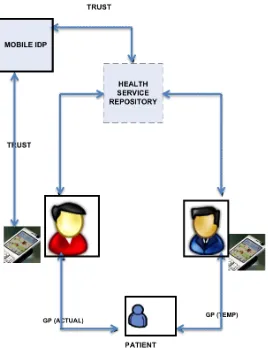
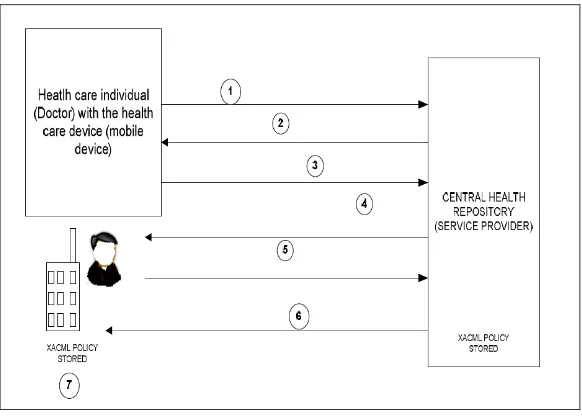
1.1 HealthCare Privacy Scenario. . . 4
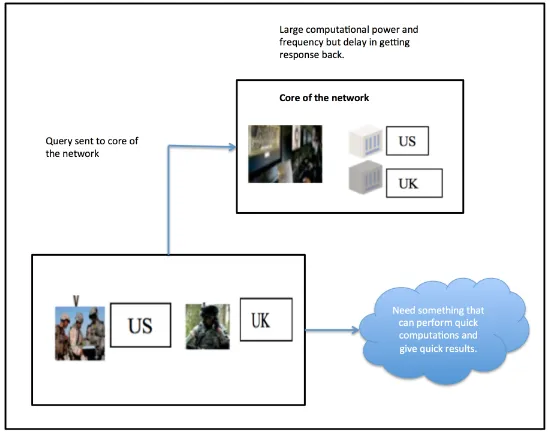
1.2 A tactical network scenario – highlighting the need for some capability other than at the core of the network. . . 5
2.1 Security capsule within a mobile device. . . 14
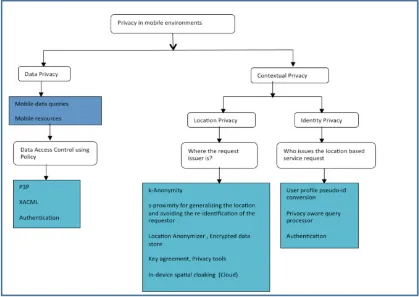
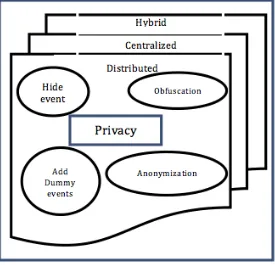
2.2 Classification of privacy preservation mechanisms in mobile environments. 21 2.3 Casper model.. . . 24
2.4 Encrypted data store model.. . . 26
2.5 Location privacy with privacy tools. . . 27
3.1 Steps involved in the proposed architecture for privacy.. . . 47
3.2 Steps involved in the proposed architecture for privacy.. . . 47
3.3 Proposed Architecture steps. . . 51
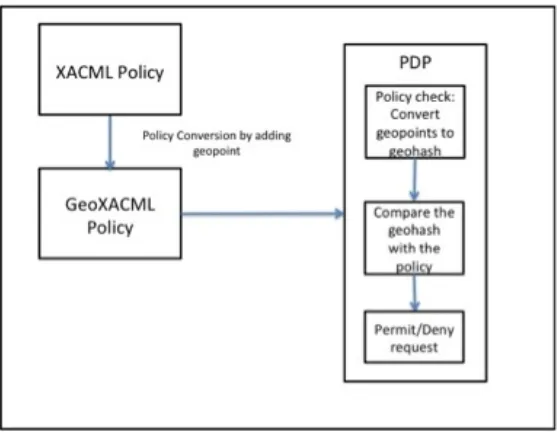
3.4 GeoSpatial Access control framework. . . 56
3.5 Architecture of the demo application. . . 57
3.6 Geopolygon showing a point inside the polygon.. . . 58
3.7 A screen shot from the mobile application.. . . 58
4.1 Trust Feedback Graph.. . . 64
4.2 Demonstration application framework. . . 66
4.3 Workflow for the demo application. . . 67
4.4 Trust Estimation Error in a Non-Collusive Setting: San Francisco, MIT Reality and Infocom06. . . 70
4.5 Trust Estimation Error in a Collusive Setting: (a) Using San Francisco dataset (b) MIT Reality (c) Infocom06. . . 71
4.6 Location Attestation Error in a Non-Collusive Setting: (a) Using San Francisco dataset (b) MIT Reality (c) Infocom06. . . 72
4.7 Location Attestation Error in a Collusive Setting: (a) Using San Francisco dataset (b) MIT Reality (c) Infocom06. . . 73
5.1 The OODA loop. . . 78
5.2 Opinion Assessment on Streaming Information. . . 81
5.3 Opinion Assessment Framework. . . 85
5.4 A Snippet of an Unstructured Report. . . 87
5.5 Opinion Assessment Framework. . . 97
5.6 Error of cumulative fusion operator in the face of liars for varying Rliar . . 99
5.7 Forward Chaining. . . 102
5.8 Consensus (Self Chaining). . . 102
6.1 A tactical network scenario – enabling efficient computations over
dy-namic networks. . . 105
6.2 k-anonymity model. . . 109
6.3 Mobile Integrated Server showing Location conealer and Profile cloner . . 110
6.4 MIS registration process of a mobile device . . . 112
6.5 MIS handshake with mobile integrated server . . . 113
6.6 MIS architecture of the end to end solution . . . 117
6.7 Deviced based solution view of the London Thames region (Blue dot is the user location). . . 119
6.8 Green dots showing search results for the device based solution. . . 119
6.9 Yellow dots showing devices that are visible to the edge server with the user location shown in blue. . . 119
6.10 Green dots showing query results from true (blue dot) and obfuscated (grey dot) location. Yellow dots are other devices, red dots are the results missed when searched from obfuscated location . . . 119
6.11 Average anonymity as the extent of obfuscation is varied for the time : 7-10am. . . 122
6.12 Average anonymity as the extent of obfuscation is varied for the time : 10am-4pm. . . 122
6.13 Average anonymity as the extent of obfuscation is varied for the time : 4-7pm. . . 122
6.14 Average anonymity as the extent of obfuscation is varied for the time : 7pm-7am. . . 122
6.15 Similarity of user profiles (based on data accesses). . . 123
6.16 False positive/false negative rates of a device based model for Shanghai dataset. . . 124
6.17 False positive/false negative rates of a device based model for Stockholm dataset. . . 124
6.18 False positive/false negative rates of a device based model for San Fran-cisco dataset. . . 124
6.19 False positive rate and location error for Shanghai dataset. . . 125
6.20 False positive rate and location error for Stockholm dataset. . . 125
6.21 False positive rate and location error for San Francisco dataset. . . 125
6.22 False positive rate and location error for Cellular dataset with Similarity threshold = 0.0.. . . 126
6.23 False positive rate and location error for Cellular dataset with Similarity threshold = 0.7.. . . 126
6.24 False positive rate and location error for Cellular dataset with Similarity threshold = 0.9.. . . 126
6.25 False positive rate and location error for Shanghai dataset with Similarity threshold = 0.7.. . . 127
6.26 False positive rate and location error for Stockholm dataset with Similar-ity threshold = 0.7. . . 127
4.1 Datasets. . . 68
5.1 Some operators for binary opinions in Subjective Logic [1]. . . 83
5.2 Performance Overhead. x/y/z. . . 100
3.1 A GeoSpatial policy example. . . 53
No portion of the work referred to in this thesis has been submitted in support of an
application for another degree or qualification of this or any other university or other
institute of learning. I hereby grant powers of discretion to the University Librarian to
allow this thesis to be copied in whole or in part without further reference to the author.
This permission covers only single copies made for study purposes, subject to normal
This thesis arose after years of research that has been done since I came to City University
London. First and foremost, I would like to express my gratitude to my supervisor
Professor Muttukrishnan Rajarajan, for his supervision, advice and guidance from the
starting of my research. With his extraordinary experience and admirable insights, he
has taught me about science, life, and encouragement. It is my pleasure to work with
you.
I would also like to acknowledge the research collaboration work done through
Inter-national Technology Alliance (ITA) project with IBM Research USA. Thanks for the
invaluable advice and patience. I am grateful to my colleagues and everyone for their
support and help on my research work.
I owe my final thanks to my beloved parents and my husband for their unconditional
Technology is improving day-by-day and so is the usage of mobile devices. Every activity
that would involve manual and paper transactions can now be completed in seconds using
your fingertips. On one hand, life has become fairly convenient with the help of mobile
devices, whereas on the other hand privacy of the data and the transactions occurring
in the process have been under continuous threat. Mobile devices connect to a number
of service providers for various reasons. These could include downloading data, online
purchasing or could be just used to browse information which may be irrelevant at a
later point. Access to critical and sensitive information may be available at a number
of places. In case of a mobile device, the information may be available with the service
provider. Service Provider could be in the form of any web portal. In all such scenarios,
passing the information or data from the service provider into the mobile device is a
major challenge, as the data/information cannot be sent in plain text format. The
confidentiality and integrity of the data needs to be protected and hence, the service
provider must convert the data into an encrypted format before passing it onto the mobile
device, to prevent risks from sniffing and unauthorized disclosure of data. Preserving
the location of the individual user of any mobile device has also been the concern for a
number of researchers.
Mobile devices have become an important tool in modern communication. Mobile and
other handheld devices such as ipads and tablets have over taken laptops and desktops
and hence there has been an increasing research interest in this area in recent years. This
includes improving the quality of communication and the overall end-to-end data security
in day-to-day transactions. Mobile devices continuously connect to different service
providers for day-to-day needs such as online purchases, online banking and endless
surfing for information. In addition to this devices could be connecting to the service
providers to receive or send sensitive information. At the Service Provider end, the data
would be stored with the provider and Service Provider would only hand over the data
if it confirms that the person requested it is authorized to receive the information. The
exchange of data from one end of the network to the other is a major challenge due to
malicious intruder mishandling of the data. Hence the confidentiality and integrity of
the data needs to be protected either by transforming the sensitive information into a
areas within the privacy realm where information and data access and sharing is a key
concern along side the key aspect of location privacy. I have also tried to address the
problems in the space of access control wherein I have proposed policy based languages
and extensions for ensuring appropriate access control methodologies. The main goal
and focus in this work has been to enforce the importance of location privacy in mobile
environments and to propose solutions that resolve the problems of where and when to
enforce location security. Another key goal of this work has been to create new access
control and trust based solutions to ensure the right level of access to the right receiver
of information. Through my research, I have explored the various privacy related attacks
and suggested appropriate countermeasures for the same. In addition to proposing and
showcasing solutions using policy languages for access control, I have also introduced
geospatial access control solutions to ensure that the right user is accessing or requesting
for the right information from the right location. This helps the appropriate and the
right use of the information by the right resource. Through my thesis I have also given
equal importance to the trust aspects of sharing information. I have created new trust
assessment models to show how fused information can be handled and how can trust be
imposed on the information provider and the information itself.
The main contribution of this thesis is to address the problems around protecting the
data and individual’s privacy and to propose solutions to mitigate these issues using
new and novel techniques. They can be detailed as the following:
In privacy, there is always a privacy versus utility tradeoff and in order to make use
of utility, trust in the location is essential. Through this research I have developed i)
novel attestation models and access control methodologies including Privacy Preferences
Platform (P3P) extensions, ii) Extensible Access Control Markup Language (XACML)
extensions and iii) Geospatial access control through GeoXACML. iv)I have created new
methodologies to enforce location privacy and shown where best to enforce privacy. v)I
have also shown that global attestation is very crucial for privacy and needs accurate
methods in place to attest user’s location information for access. vi) Fusing of location
information is very crucial as there could be a number of similar or conflicting
informa-tion produced about a common source and it is very important to assess and evaluate the
assessment module computes the trust score based on forward chaining or background
chaining scheme. The framework is used to evaluate the trust on the fused information in
a streaming setup. vii) I have created new solutions to look at the similarity profiles and
create identity enforcement through profiling. I have shown methods of anonymisation
AA Attribute Authority
AP Access Points
APPLAUS A Privacy-Preserving Location proof Updating System
ARL Army Research Laboratory
BRS Beta Reputation System
CDA Cheating Detection Authority
CDR Call Detail Records
CE Controlled English
CLDC Connected Limited Device Configuration
CNL Controlled Natural Language
CR Cloaked Region
DAML DARPA Agent Markup Language
DoS Demial of Service
DRM Digital Rights Management
GeoXACML Geospatial eXtensible Access Markup Language
GP General Practitioner
GPS Global Positioning System
GSMA Global System for Mobile communication Association
ID Identifier
IED Improvised Explosive Device
IMEI International Mobile Equipment Identity number
IMPI IP Multimedia Private Identity
IMSI International Mobile Subscriber Identity
ITA International Technology Alliance
KAoS Knowledgeable Agent-Oriented System
LA Location Anonymiser
LBSA Location Based Social Application
LSP Location Service Provider
MAC Media Access Control
MIDP Mobile Information Device Profile
MILC Mobile Instant Locator with Chatting
MPS Meta Policy Server
OASIS Organization for the Advancement of Structured Information Standards
OGC Open Geospatial Consortium
OIL Ontology Interchange Language
OODA Observe Orient Decide Act
OWL Web Ontology Language
P3P Privacy Preferences Platform
PAP Policy Adminstration Point
PDA Personal Digital Assistant
PDP Policy Decision Point
PEP Policy Enforcement Point
SL Subjective Logic
SOAP Simple Object Access Protocol
SSN Social Security Number
SSO Single Sign-On
STAMP Spatial-Temporal provenance Assurance with Mutual Proofs
SWRL Semantic Web Rule Language
SYNCOIN Synthetic Counter Insurgency
UDDI Universal Description ,Discovery and Integration
UK MoD UK Ministry of Defence
WSDL Web Services Description Language
XACML eXtensible Access Markup Language
The results of the research described in this thesis have been published in the following
papers and journals:
1. S. Arunkumar, A Raghavendra, D Weerasinghe, D Patel, M Rajarajan, “Policy
extension for Data Access Control”, In Proceedings of the 6th IEEE Workshop on
Secure Network Protocols (NPSec), pp 55 -60, October 2010.
2. S.Arunkumar, M Rajarajan, “Healthcare Data Access Control using XACML for
Handheld Devices”, In Proceedings of Developments in E-systems Engineering
(DESE) 2010, pp 35 - 38, September 2010.
3. S.Arunkumar, M. Srivatsa, D. Braines, M Sensoy, “Assessing Trust over
Uncer-tain Rules and Streaming Data”, In Proceedings of the 16th IEEE International
Conference on Information Fusion (FUSION), pp. 922-929, July 2013.
4. S.Arunkumar, M. Srivatsa, M Rajarajan, “Location Security - Where to Enforce?”,
IEEE Military Communications Conference (MILCOM), pp. 1651-1656, October
2014.
5. S.Arunkumar, M. Srivatsa, M Rajarajan, M Sensoy, B Soyluoglu, “GeoSpatial
Access Control for Mobile Devices”, International conference of IEEE Region10
on Internet of Things, pp. 86-89, May 2015.
6. S.Arunkumar, M. Srivatsa, M Rajarajan, M Sensoy, “Global Attestation of
lo-cation in mobile devices”, Military Communications Conference (MILCOM), pp.
53, 74-90, July 2015.
8. S.Arunkumar, M. Srivatsa, M Rajarajan, M Sensoy, “Reasoning with streamed
un-certain information from unreliable sources”, Elsevier Journal on Expert Systems
Introduction
1.1
Research area and questions
Ubiquitous environments are environments where one has access to devices and
com-puters with internet wherever and whenever they need it. They are the next generation
of environments, and have been discussed in a number of research papers [2], [3] and [4]. Mobile devices, Personal Digital Assistants (PDAs), and other electronic devices are used for various transactions in the ubiquitous environment and interact with each
other. Mobile devices store various sensitive data in a ubiquitous environment and
having a controlled access to these data becomes crucial for a secure ubiquitous
environ-ment. There are applications that can be installed on a mobile device for everything and
anything and devices connect to these application providers for various reasons such as
downloading data, online purchasing or could be just used to browse information which
may be irrelevant at a later stage. The importance of maintaining the privacy of the
in-formation requester and the inin-formation, is critical as all the transactions are happening
online and this could motivate the malicious users to perform malicious activities. In
case of a mobile device, the information may be available with the application provider
of the application, which the device is accessing and this could be in the form of any
web portal, database or any other equivalent form. The confidentiality and integrity of
the data needs to be protected and hence, the application provider must convert the
data into an encrypted format before passing it onto the mobile device, to prevent risks
from sniffing and unauthorised disclosure of data. Individuals trying to access sensitive
at all times. Preserving the location of the individual user of any mobile device has been
the concern for a number of researchers and people working in the area [3], [5] and [6]. Privacy related efforts have been made in the past [3]. Research has been carried out around privacy awareness systems that allow certain privileges to data collectors [7]. Karyda and Gritzalis in [4] listed some of the challenges in this area and the research directions for the future. In general, a malicious user is assumed to be very clever in
manipulating communications over the open network and his manipulation techniques
are unpredictable because they are unspecified. Also because malicious user can
repre-sent a coalition of bad guys, he may simultaneously control a number of network nodes
which are geographically far apart. In anticipation of such a powerful adversary over
such a vulnerable environment, Dolev and Yao in [8] proposed a threat model which has been widely accepted as the standard threat model for cryptographic methods.
In addition to the day-to-day needs of the devices to connect to the application providers,
devices could be connecting to the Application providers to receive or send sensitive
information. At the Application provider end, the data would be stored with the provider
and the Application provider would only hand over the data if it confirms that the
person requesting is authorised to receive the information. The exchange of data from
one end of the network to the other is a major challenge due to malicious intruder
mishandling of the data. Hence the confidentiality and integrity of the data needs
to be protected either by transforming the sensitive information into a non-readable
format or by converting into a cipher text. Some of the access control methodologies
like the standard role based access control methods existed, but the thnigs that were
used for standard desktop solutions were not the best suitable for mobile devices as
well. Mobile devices have limited bandwidth and limited computational power. Under
these restrictions, the problems of access control and information to the right resource
for right reasons needs to be addressed. Existing solutions at the time of the research
did not cater to handle the limitations on the handheld devices. The problems with
the preserving privacy are applicable to all sectors including healthcare, government,
communications and so on. Some of the key areas and questions still unanswered in the
area of preserving privacy are around preserving the location information when using
location based services. How can one preserve the identity and location information and
still get access to the information requested for ? Another open question is around the
on the accuracy of the location. To add to this, how can one trust the source or provider
of the information ? These questions have been barely looked at in the research area
and hence I have addressed these in detail and provided solution to it.
Here is an introduction to a very practical and realistic problem with Healthcare services
today in order to set the scene. From the Figure1.1, one can see that there are 2 main players in the scenario one is the permanent General Practitioner (GP) and the other is
temporary practitioner in the absence of the permanent doctor. Assuming that the trust
is established between the mobile device, the Mobile Identity Provider (IDP) and the
Health service repository, the next big question is the transfer of the information related
to health. The information needs to be passed on from the health repository on to the
GP’s handheld device. This is very crucial and is a big security issue as the data that
is to be transferred is highly sensitive information and hence needs to be received by
the right person for the right reasons. In privacy there is always a privacy versus utility
tradeoff. To make use of some kind of information, there has to be some level of trust
in the location and hence attestation of location information needs to be performed.
Access control of the data and information in the mobile environments becomes a very
big area of research. This thesis highlights the solution implemented to achieve the
access control of data and information in mobile environments.
Trust was assumed to exist in the above scenario. However it is important to understand
how trust can be assessed when information is collected from various sources and this
highlights another challenging research problem. When there is streaming information
that comes in with additional location information, fusing those location information
and deriving the right level of trust if crucial.
Another use case to show the use of location privacy in a military environment is
pre-sented here. By showing a military scenario, it is indicative that this solution is
applica-ble to mobile environments in many sectors. The scenario is as follows: Assume that one
has a number of reports that comes in from various sources reporting of an Improvised
explosive device (IED) explosion in certain location l at time t. How can one ensure the
level of trust on the information about the event occurring in that location? This needs
some kind of trust assessment framework to assess the level of trust on fusing location
Figure 1.1: HealthCare Privacy Scenario.
Here is another use case in a military scenario that shows the importance of addressing
the “where to enforce location privacy” in mobile environments. Figure 1.2 shows a tactical network where you can see device and the core of the network and the question
I am trying to address is “where to enforce location privacy?”
Mobile environments are always prone to various security vulnerabilities. A number of
papers have been written to highlight the various threats and problems due to the large
amount of transactions occurring in the mobile environments [9], [10]. A very common attack on the mobile environment is the man-in-the-middle attack. Every bit of data
that comes into the mobile device and goes out of the mobile device can be assumed
to be sniffed by a malicious user. The information can be assumed to be sniffed by
the man-in-the-middle and manipulated in order to retrieve the sensitive information.
Figure 1.2: A tactical network scenario – highlighting the need for some capability other than at the core of the network.
major challenge. The attack discussed above covers a number of attacks including
man-in-the-middle, sniffing and privacy related attacks. Another attack that is described
by some of the researchers is based on the cross service attack on the mobile devices.
Mulliner et al. have described the details of the cross service attack in [11]. Cross service attacks can occur while browsing from mobile handset sitting in a shop with
wireless connectivity. The malicious user would be monitoring the new connections to
the wireless network and using a known exploit and he gains access to the phone. [11] describes in detail the proof-of-concept to show the attack and also talks about the way
in which the vulnerability can be exploited. With the increasing availability of mobile
devices, there is a growing demand for location-based applications. In response to such
a user demand, various location based services have been emerging recently [12], [13]. In the mobile environment, it is quite common to have a man-in-the-middle trying to sniff
at the information being passed between the mobile device and the application providers
[11]. Therefore it is crucial to have data access control mechanisms in place. It would be interesting to highlight the importance of European data protection guidelines that have
recently undergone revisions to include the privacy of individuals data and personally
identifiable information. Some of the notable changes include explicit consent from the
user when data is being handled. More transparency about how the data is handled is
for complete accountability and responsibility of the service provider when personal data
is being processed [14].
1.2
Research objectives
Information and data from/to mobile devices can be misused and mishandled by
intrud-ers or malicious usintrud-ers. In order to make sure that the right individual is accessing the
data, it is very important to have appropriate access control rules and policies in place.
Hence, it was very important for this research to consider some of the key methodologies
that could be used to ensure access control of data and information.
• Consider the example from Figure 1.1 that shows a typical scenario in a health service. Providing appropriate access control for the data is a very big issue in
the health sector on its own and it is definitely the same issue in any other areas
of infrastructure. Hence data access control is one of the main research problems
today.
• In a military environment, it is very critical to preserve the location information of
the individuals out in the field but it is equally important to get access to the data
and information that they are requesting. As with any privacy solution, there is
always a privacy Vs utility tradeoff and when in need of information there has to
be a certain level of trust of the location. The objective here is to have some level
of attestation in order to ensure the right levels of access controls for information.
• Figure 1.2shows a military use case where privacy is very important and critical for all the right reasons. The core of the network has lot of computational power
and bandwidth but then information needs to be received along with the location
privacy maintained, it is not the best of the places to have the solution. The
objective here is to come up with something else that can do some quick
com-putations in the limited time and can provide accurate results to the requestor
but without revealing the sensitive identity and location information. Maintaining
location privacy in a military setup is very important for any successful operation
and when certain information is very sensitive there is a tradeoff of providing the
• When there are multiple locations being reported, it is very difficult to fuse these
information and derive a consensus from the data. The main objective with this
is to have a mechanism that could help trust decisions automatically.
• When location services are requested on the mobile devices, the location
informa-tion can be faked and can be misrepresented for meeting specific requirements.
Gathering evidences independently becomes important where each entity reports
contacts with other entities in specific locations at specific times. Some of the
reports may be not true and in order to scrutinise these, global consistency check
would be required. With a global consistency check I can ensure if a particular
entity is being dishonest about the location information.
Hence, the objectives of this thesis are to propose solutions based on attestation of
location, access control through policy extensions and geographical co-ordinates,
trust assessment through mathematical models and location privacy through edge
servers and anonymization techniques.
1.3
Research assumption
To shape the research, some assumptions were made giving some starting points and
directions to the work:
• Location is a very important factor in the mobile environments.
• Small scale mobility tracesets are human to human encounters and relatively large
scale datasets are many to many encounters but using taxicab datasets I have got
a mixture of multiple people taking the same route and hence got more data in a
larger scale both in area and time.
• By using Subjective logic, I assume that trust has beta distribution and the best
model of trust is represented in the form of a triple (b,d,u) which isbelief, disbelief,
uncertainty.
• With the Geospatial access control through GeoXACML, the main goal is not to
provide mandatory access control. The main criteria is that if the user satisfies
access control. For mandatory access control, well known solutions like Digital
Right Management (DRM) exist.
• Global attestation of location works assuming that the majority of users are honest
users and have persistent IDs like Media Access Control (MAC) address and so on.
Hence ID scheme is a requirement for this solution to work. It is also important
to have a minority count on the collusive users.
1.4
Contributions
This research is aimed to provide a solution for preserving privacy in mobile environments
and covering the aspects of how to enforce location privacy, where to enforce location
privacy and how to ensure trust when location information is fused. The overall solution
allows the ease of use of mobile devices with appropriate privacy controls in place to
ensure that the right individual, in the right place and in a controlled environment, is
accessing the data and information.
Contributions of this research work include the following:
• I have proposed and developed a solution to address the question of “How to
enforce location security” in detail.
Privacy comes with a privacy Vs utility trade-off. When a certain utility is
re-quired, it is essential to ensure a certain level of trust on the location. Through
this research I have proposed a novel method using global attestation scheme and
developed and tested it . Global attestation of location ensures the accuracy of
the location by performing global consistency checks. I have used the EigenTrust
[15] and PeerTrust [16] check methodologies to calculate global and personalised trust matrix while confirming attestation.
• I have proposed and developed new methods of access control for maintaining
privacy.
In order to address this, I introduce P3P based access control and then extend the
P3P policies to ensure that the data access control is achieved. The dependencies
are mainly on the P3P policy server and the design and architecture ensures that
A solution using XACML based access control has also been introduced through
this research. With the use of policy decision point, policy enforcement point and
policy administration point, an XACML based access control solution ensures the
information and data is accessed by the right sources. I have extended XACML
and developed a new GeoXACML implementation to ensure that access control is
achieved along with the location verification.
• I have designed a novel trust assessment model to validate fused location
informa-tion.
When there is a set of location information that is provided through streamed
information, it is difficult to derive at a consensus on the location and this could
be resolved through some level of trust assessment. In this research, a new trust
assessment model using subjective logic operators was designed to derive various
outcomes.
• I have designed a novel solution to address the “Where to enforce location privacy”
problem.
This research describes the drawbacks with implementing the solution for location
privacy at the device and the core of the network. It gives a detailed analysis
of the best place to enforce location security using the edge based solution and
implementing anonymization methods for the same.
1.5
Outline
The thesis is organised in 6 chapters as follows.
Chapter 2 presents an analysis of the existing approaches dealing with privacy related
attacks, methods of preserving privacy in mobile environments, policy based access
control, location and identity based mobile security, geospatial access control and trust
in the mobile environments. The focus is mainly on the different attacks related to
privacy and then the various methods used in order to preserve location, identity, the
drawbacks with the existing solutions, along side data access control and trust in the
In chapter 3, I highlight the importance of access control for ensuring privacy in mobile
devices and propose a mechanism for data access control using P3P policy extension and
XACML. It details each of the policy languages and the process in which access control
can be achieved by using P3P and XACML. The chapter further describes how geospatial
access control can be achieved by creating a new implementation of GeoXACML. The
chapter also covers the details about the implementation and evaluation of each of the
methods.
In Chapter 4, I address the “How to enforce location privacy” problem. Through this
chapter, I will highlight the privacy Vs utility trade-offs and show the importance of
ensuring trust in location. I then present a new model called the global attestation
model which ensures the location accuracy through global consistency checks and trust
matrix scores.
Chapter 5 describes various aspects involved when location information is fused. The
involvement of trust in the mobile environments is discussed in detail and it covers
var-ious use cases and system highlights. These showcase the significance of using trust
assessment with opinion to ensure that the fused and conflicting information is resolved.
It details the various steps in the opinion assessment framework and introduces
Sub-jective Logic which is the method used to compute the trust. The chapter shows the
detailed architecture of the trust framework with implementation and evaluation results.
It shows how to ensure trust when encountered with fused and conflicting information.
Chapter 6 describes the “Where to enforce location privacy” problem and provides
solution to show that location privacy can best be enforced at the edge. It shows the
drawbacks in implementing location privacy on the device and at the core of the network
and highlights why it is important to enforce location privacy on the edge of the network.
Anonymization methods of performing location privacy on the edge of the network is
also described in this chapter. The chapter covers the detailed design of the architecture
used for implementation and the evaluation steps with results.
Finally, in Chapter 6, I present the conclusions. In this chapter, I highlight the
contri-butions of the research, the benefits and implications of this and some topics for future
Background and related work
2.1
Overview
This chapter presents an analysis of the existing works in the field of preserving privacy
in mobile environments. It shows the various privacy attacks and the solutions that
have been designed for preserving location privacy in mobile environment. I further
highlight the drawbacks in each of the existing solutions. This chapter also includes
review work on policy based access control for mobile, location and identity security,
trust and geospatial access control.
2.2
Background
Here you can see definitions of the key words used throughout this thesis. These
defi-nitions will help the reader better understand the usage of the words in relation to the
work in privacy.
2.2.1 Access Control
Access control is a method by which a system grants or denies the right to see
cer-tain information, do cercer-tain actions. Access control can be achieved using different
mechanisms. Access control has played an important roles since the time of computer
complicated. Computers and servers have lot of bandwidth and computational power
hence can deal with lots of computations before getting access to information. In the
case of mobile device, this is slightly different. The device has limited bandwidth and
computational power, it has limited storage capability and hence using all these
con-straints access control checks have to be performed before giving access to information
on the mobile device.
2.2.2 Privacy
Privacy is a mechanism where an individual or group of people can restrict providing
information about them to the outside world. It is also a state where individuals do not
want to share personal information with public. Privacy is very important in the digital
world as information shared in the public domain can be misused.
2.2.3 Policy languages
Consumers are concerned about losing their privacy while conducting business using
computers. Studies reveal that if consumers are not comfortable with the organizational
procedure for handling their personal information, they take their business elsewhere
[17]-[18]. With the growth of Internet usage and an increase in online business, con-sumers expect high levels of online privacy [19]. In fact consumers frequently mention lack of trust as one of the reasons for not purchasing from the Internet [20]. From the organization’s perspective, the need to protect consumer privacy is a growing concern
[21]. If organizations do not follow efficient privacy practices, consumers move away from the organizations and legal consequences arise. Protecting or not protecting the
privacy of consumers can impact the business growth and revenue of the organizations.
Thus, the formalization of an organization’s promises into privacy policy is an essential
part of the organization’s customer relationship practices. Organizations express their
internal privacy practices through privacy promises as statements in the privacy policies.
Consumers are able to analyze the organization’s commitment towards protecting
con-sumers’ privacy through these privacy policies. Unfortunately, few consumers take the
time to read the complete privacy policies of all organizations with whom they interact
and difficult to understand [22], [23]. Also system administrators find it difficult to main-tain the internal access control information manually [24]. Researchers have attempted to solve this problem by developing privacy policy languages that help represent the
hu-man readable privacy policies and access control into machine-readable format [25]-[26]. These privacy policy languages enable software agents to understand privacy policies
better and help users to make informed decisions. These languages also help systems to
make decision regarding an user’s access to any data in the organization. The capability
of these languages depends on various features; one important feature is expressiveness
of the language. As a result, understanding the expressiveness of the privacy policy
languages becomes essential. Different types of languages are available to represent the
human-readable policies into machine-readable format. Some languages are designed to
help the organizations to express their privacy policies in machine-readable format and
some of the languages help users to define their privacy preferences, which can be used
to make decisions for the user. Each language has its own syntax and mechanism for
implementation. There is no one standard metric available by which one would analyze
these languages.
2.2.4 Security Capsule
The security capsule is a software application for mobile devices and it contains security
services which are used to protect the sensitive information in the mobile device. It is
a key component in the communication module of the mobile device used to interact
with the identity provider and the service provider. The very existence of the security
capsule in the mobile device is through the registration process. The registration process
has two steps namely, registration with identity provider and registration with service
provider. The first step starts with the security capsule being downloaded into the
mobile device from the identity provider. The mobile user verifies the authentication
of the Identity provider for transmitting the security capsule and the integrity of the
downloaded security capsule. In the second step, the security capsule registers with the
service provider for services. The user and service provider share a unique identification.
Therefore the user registration request will be uniquely identified by the service provider.
If an identity doesn’t exist then the Identity provider generates an identity for the mobile
Figure 2.1: Security capsule within a mobile device.
a secure communication channel. The security capsule architecture and the functionality
are described in detail in [27].
Figure2.1shows the mobile device with the security capsule obtained through registra-tion process and the interacregistra-tions between the service providers and the mobile client.
The primary challenge in a security capsule is to provide controlled and appropriate data
access control to the right user. This is based on the real time key that is received from
the service provider. The service provider sends the data/information requested by the
mobile device in an encrypted format. The real time key is used to encrypt the data and
the mobile device requires this real time key to access the data. In order to receive the
real time key, the mobile client needs to first provide the appropriate user preferences
based on the P3P policy of the service provider. The P3P policy is published in the form
of Web Services Description Language (WSDL) in the service provider. P3P Policy of
the mobile device needs to be stored in the device itself. There has to be a specific way
in which the P3P policy is stored in the mobile client. P3P file is being stored on the
mobile device is in the form of a XML file. XACML policy file can be expressed in XML
format.
2.2.5 P3P
The World Wide Web Consortium (W3C) P3P1.0 Specification [28] enables web sites to communicate their privacy practices in a standard format that can be retrieved
informed of site practices (in both machine and human-readable formats) and to
auto-mate decision-making based on these practices when appropriate. Thus users need not
read the privacy policies at every site they visit. Although P3P provides a technical
mechanism for ensuring that users can be informed about privacy policies before they
release personal information, it does not provide an automated mechanism for making
sure sites act according to their policies. Products implementing this specification may
provide some assistance in that regard, but that is up to specific implementations and
outside the scope of this specification. However, P3P is complementary to laws and
self-regulatory programs that can provide enforcement mechanisms. In addition, P3P
does not include mechanisms for transferring data or for securing personal data in
tran-sit or storage. P3P may be built into tools designed to facilitate data transfer. These
tools should include appropriate security safeguards. The standard P3P policy can be
described in the Extensible Markup Language (XML) format and is explained with
ex-ample [28]. It is important to note here that P3P relies mainly on trust. P3P policy has not been implemented in a handheld device such as mobile phone, PDA, etc. This work
introduces P3P into the mobile space and hence proposes a new architecture for data
access control using P3P policy in a mobile device. Trust between the service provider
and the user’s mobile device can be established by using the Security capsule.
2.2.6 XACML
XACML (eXtensible Access Control Markup Language), was formed by the OASIS
(Organization for the Advancement of Structured Information Standards) standards
consortium. XACML is a simple, flexible way to express and enforce access control
policies in a variety of environments, using a single language. The XACML language
in effect protects content from unauthorized use in enterprise data exchanges. XACML
is mainly derived around and written in, XML, which is understood in most global
environments. OASIS, which drives the development, convergence, and adoption of
e-business standards, has ratified XACML. XACML gives an extensive and powerful set of
features to the developers. It allows an organization to create and deploy authorization
policies to match its mix of assets and business use-cases, then plug in additional policies
as the business and its standards evolve. XACML helps in resolving issues related to
security applications and there have been a number of papers published in order to prove
solve some of the issues with mobile environment. This work introduces XACML in the
mobile environment and hence proposes a new architecture for data access control.
XACML defines three top-level policy elements: <Rulle>,<Policy>and<PolicySet>
[7]. The<Rule>element contains a Boolean expression that can be evaluated in iso-lation, but that is not intended to be accessed in isolation by a PDP (Policy Decision
Point). So, it is not intended to form the basis of an authorization decision by itself.
It is intended to exist in isolation only within an XACML PAP (Policy Administration
Point), where it may form the basic unit of management, and be re-used in multiple
policies. The <Policy> element contains a set of <Rule > elements and a specified
procedure for combining the results of their evaluation. It is the basic unit of policy used
by the PDP, and so it is intended to form the basis of an authorization decision. The
<PolicySet>element contains a set of<Policy>or other<PolicySet>elements and
a specified procedure for combining the results of their evaluation. It is the standard
means for combining separate policies into a single combined policy.
2.2.7 Trust
There are various definitions of trust. McKnight and Chervany [30] defines trust as follows: Trust is the extent to which one party is willing to depend on somebody, or
something, in a given situation with a feeling of relative security, even though negative
consequences are possible.
2.2.8 Fusion
Fusion is the process of integrating lot of data and information and making sense from
the information. It is also a process where it is represented in a consistent manner
and for useful representation. Combined process of information from the source of same
object or scene to obtain more complex, reliable and accurate information. Combination
of data from multiple sources and gather that information into discrete, actionable items
in order to achieve inferences, which will be more efficient and narrowly tailored than if
2.2.9 Subjective Logic
Subjective logic is a belief reasoning calculus that is compatible with, and an extension
of probabilistic logic. It can for example be used for modeling trust networks, for
mod-elling Bayesian networks, for Inteligence Analysis and logical argumentation. In general,
subjective logic is suitable for modeling and analysing situations involving uncertainty,
incomplete knowledge and different world views.
Beliefs are represented as opinions. A binomial opinion applies to a single proposition,
and a multinomial opinion applies to a whole frame of multiple propositions (state
space). Binomial opinions are equivalent to Beta probability density functions, and
multinomial opinions are equivalent to the more general Dirichlet probability density
functions. This makes subjective logic suitable for reasoning with evidence represented
as Beta or Dirichlet probability density functions.
2.2.10 Security Vs Privacy
There is a clear difference between Security and Privacy and it is important to
high-light that difference in the thesis here. Security is mainly confidentiality, integrity and
availability of the data. Security puts in the appropriate processes in place to ensure
that data is accurate and reliable. Privacy is the appropriate use of the data. The data
should be used according to the agreed purposes and hence this is the key differentiator
between privacy and security.
2.2.11 Crowdsourcing
Crowdsourcing information systems can be classified in many different ways. One of
the classifications can be the nature of collaboration: explicit or implicit. In explicit
collaboration systems (e.g.,Wikipedia or Linux), users collaborate explicitly to build
information artifacts. On the other hand, implicit collaboration systems let users
2.3
Privacy related attacks and countermeasures
There has been a number of privacy related attacks that have come into existence today.
One of the attacks is a sensor sniffing attack in which it assumes that the threat model is
where the attackers are able to install malicious software onto the devices. This can be
done by exploiting the software vulnerabilities or by tricking to install untrusted code.
It is also assumed that the attacker has no physical access to the device but can receive
the sensor date through voice or data channels. More details about this can be found
in the work by L Cai et al.[31]. A number of viruses have been created to exploit the vulnerabilities that exist on today’s mobile devices. One of the viruses, which originated
in Spain, sends text messages to random mobile phone numbers [9]. As mobile phones become more and more intelligent the attacks against them will keep increasing. A
number of vulnerabilities have been exploited using the Bluetooth capability of mobile
devices leading to exposure of personal data [9]. Another potential attack that has been in existence is stealing user’s personal data and downloading it without the consent of
the mobile owner [9].
As widely discussed in [32], Information sharing is key to the operational efficiency of a coalition network. From an information provider’s perspective, successful
decision-making at the consumer using the shared data, indirectly results in utility for the
provider and offers incentive for sharing. However, the act of sharing presents risks
to strategic assets. The risk arises from the possibility that the data being shared may
reveal more information to its recipient than was intended. Policies instituted at the
producer to manage this risk often negatively affects the quality of decision-making at
the consumer by introducing additional sources of uncertainty, thereby reducing the
provider’s utility.
One of the ways in which the balancing between risk and utility is achieved is through
deliberate obfuscation of data. Obfuscation is a process through which the quality of
the shared information is degraded in a controlled manner to protect against sensitive
inferences regarding strategic assets [33]. This allows the data to retain utility while lowering the associated risk.
A report highlighted that Google’s Android phones are vulnerable to privacy attacks
to log into various Google services such as contacts, calendar and services like Picasa.
When users request a digital certificate to sign into these services without re-typing
the login information, Google’s servers relay an authentication token back to the user’s
phone. This allows the user to be able to be logged into the accounts for 2 weeks without
having to re-login. This sounds like a matter of convenience to the user but it has turned
out to be a security flaw due to the fact that the authentication token is sent out in
plain text. Malicious users can track the unsecured network and capture the
authenti-cation token thus allowing access to various services leading to a total breach of privacy.
Another news has shown that some of Europe’s biggest mobile phone companies signed
up to new privacy guidelines published by the Global System for Mobile communication
Association (GSMA) [35]. Signature based methods can be easily circumvented using code obfuscation necessitating a new signature for each malware variant [36], forcing the anti-malware client to regularly update its signature database. To tackle wide variety
of new malware, a comprehensive evaluation framework incorporating robust static and
dynamic methods can be proposed on Android platform. Manual analysis has become
in-feasible due to the exponential increase in the number of unknown malware samples.
2.4
Classification of preserving privacy in mobile
environ-ments
The below architecture shows the complete classification of the different techniques used
to preserve the privacy in mobile environments. It defines the problems involved as well
as the techniques proposed to overcome these shortcomings. The privacy techniques are
classified under two main headings: (1) Data privacy and (2)Contextual privacy.
Data privacy mainly involves the data that is being transmitted to and from the
mo-bile device. This data could be in the form of a message, text or information. The
data could be sensitive information or it could even be a confirmation on some booking
that was done for an online shopping. Figure 2.2 shows the privacy classifications and within the data privacy section, it shows the 2 main areas of problems, i.e. the mobile
query and the mobile resources. The mobile query could request the service providers
for information that could be sensitive in nature. Hence this has always been a
this, the data confidentiality is guaranteed through authentication. The other area of
classification of privacy is based on the contextual privacy.
Contextual privacy can be further divided into two areas namely location privacy and
identity privacy. When mobile users request for static resources or mobile resources,
pseudo–identifiers are sent and location is anonymized. The data that is being
trans-mitted is protected against third party malicious users. Although the information can be
assumed at all times to be hijacked by malicious users, malicious users protect the data
against unauthorised access. This is achieved by using data access control mechanisms
such as P3P policy extension and XACML policies. These are described in detail in
the later sections. Location privacy mainly deals with the location of the requester. In
mobile environments, users are frequently requested for their location information when
they try to access a new online service. For example, when a user requests for nearby
restaurant information from a location-based server, the location based server needs to
know the location of the user and hence the location information is normally requested.
However, in most of the cases, the user doesn’t want to disclose the location
informa-tion to arbitrary locainforma-tion based service providers. This can be achieved by a number of
different mechanisms described later on. To briefly name the mechanisms here as shown
in Figure2.2, let’s start with k-anonymity. In this method, user’s location information is updated with pseudo-IDs and then the generalised location information is sent to the
location based service provider. Due to some groups being created that fail to provide
overall anonymity, another mechanism called s-proximity has been implemented [37]. This mechanism creates a larger number of anonymous user profiles to ensure that the
location based service provider cannot identify the location of the requester. Another
location privacy mechanism that is described in here is Casper [38]. Casper is a combina-tion of locacombina-tion anonymizer and privacy aware query processor. Few other mechanisms
like the encrypted data store [39], key agreement [40], privacy tools [41], In-device spatial cloaking assisted by cloud [42] are also part of the location privacy and are described in detail in the future sections. Contextual privacy has another classification namely
Identity privacy. Identity privacy mainly talks about the user/mobile server requester
who issues the requests. In order to preserve the identity of the user who issues the
requests, a number of mechanisms have been explored. They are mainly user profile
pseudo-identifier conversion, privacy aware query processor and authentication based
Figure 2.2: Classification of privacy preservation mechanisms in mobile environments.
2.4.1 Profile anonymization model
Preserving privacy using anonymization has been discussed in a number of research
papers [37], [43], [44], and [45]. The authors in [46] have looked at the k-anonymity in order to generalise the location. The user of a mobile device usually requests information
for 2 main types of resources namely static resources and mobile resources. In case of
static resources, pseudo-identifiers are sent and the location is anonymized. In the case
of mobile resources, IDs are updated with pseudo-ids and then the generalised location
and profile are sent back to the requester.
Although the profile anonymization model works well using the k-anonymity, there have
been a number of attacks that can be performed on the k-anonymity model that has
led to the identification of the query issuer in the location based services. To overcome
some of the shortcomings in the current k-anonymity model the s-proximity model was
proposed. The next section discusses the advantages of the s-proximity compared to
2.4.2 Identity inference protection using s-proximity in location based
services
The k-anonymity model as described in the previous section tries to hide the location of
the query issuer who tried to request for location based information from the Location
Service Provider (LSP). In [37], the author shows that the k-anonymity is not enough as it can be easily prone to attacks thus resulting in the re-identification of the query
requester. Two main attacks that have been depicted in the work are heterogeneity
attack and conformity attacks. K-anonymity can create groups that fail to provide the
overall anonymity due to lack of sufficient match among members with respect to some
sensitive user attribute. The communication between the query requester and the LSP
is as follows: Initially, the user sends a location-based query to the Location Anonymizer
(LA), which then replaces the exact location with a Cloaked Region (CR). It is then
passed on to the LSP. The attacks prove that in this process, by some combined work
by the LSP’s or an LSP can individually break down the anonymity set and prove
the identification of the specific query requester in cases where the query is specific or
not too generic. Hence, [37] proposes a solution that generalises the query and hence makes it difficult for the LSP to identify the actual query requester. This is achieved
in the s-proximity model. The work suggests that both k-anonymity and s-proximity
are needed to anonymize the query requester’s identity in a location-based service. In
the s-proximity model, the LA is replaced by context aware LA with further modules
such as query generalization, query analyser and partitioning agent. With the detailed
implementation of these modules privacy of the user is preserved and hence the privacy
preservation is achieved in location-based environments.
2.4.3 Casper: Query processing without compromising privacy
Originally, Walid and his co-authors present a new privacy-aware query processing
frame-work, Capser*, in which mobile and stationary users can obtain snapshot and/or
contin-uous location-based services without revealing their private location information. In
par-ticular, they propose a privacy-aware query processor embedded inside a location-based
database server to deal with snapshot and continuous queries based on the knowledge of
query processor is completely independent of how they compute the user’s cloaked
loca-tion. In other words, any existing location anonymization algorithms that blur the user’s
private location into cloaked rectilinear areas can be employed to protect the user’s
lo-cation privacy. The new Casper: a new framework in which mobile and stationary users
can entertain location-based services without revealing their location information. The
method addresses the issue of user having to give away the location information while
requesting for any location-based services through a location based database server.
Casper involves two main components namely, location anonymizer and privacy aware
query processor. The work [38] describes in detail how exactly the two main compo-nents perform with regard to the four novel areas of scalability, quality, efficiency and
flexibility. Casper functions mainly in the following manner. When the mobile user
sends the location information along with the query request for a particular location
based service, the location anonymizer picks it up and blurs the location information to
a spatial region along with the query and passes it to the location based database server.
The privacy aware query processor is built into the location based database server and
it looks at the request and returns a set of answers that matches the mobile users query.
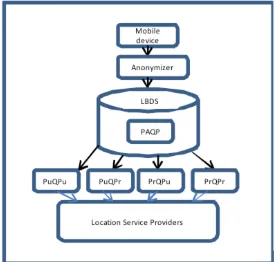
The Figure 2.3shows the mobile device making a request to the location based service provider. This is passed through the anonymizer and into the location based database
server. The anonymizer does its task and the privacy aware query processor performs
its function and the most relevant out of the four data and query would be passed on to
the location based service providers.
2.4.4 Casper model
The authors in [38] also point out to three novel types of data and query that Casper handles. According to them all the traditional anonymizers can only work on the public
query over public data. In [38], the authors propose three novel areas of transactions namely, private query over public data, public query over private data and private query
over private data. A detailed analysis of the three methods is shown and the authors
Figure 2.3: Casper model.
Casper functionality with private query over public data (PrQPu), public query over
private data (PuQPr), and private query over private data (PrQPr) can be shown as:
(qpr, dpu)(qpu, dpr),(qpr, dpr)
(Mlr)→mobile request and location
A→Anonymisation
(Clr)→Cloaking region
A(Mlr(Q, D))
Q, D→(qpr, dpu)(qpu, dpr),(qpr, dpr)(qpu, dpu)
A(Mlr(Q, D)) ={Clr(Q, D)}
{Clr,(Q, D)}=
{Clr(qpr, dpu)}{Clr(qpu, dpr)}
{Clr(qpr, dpr)}{Clr(qpu, dpu)}