Rochester Institute of Technology
RIT Scholar Works
Theses Thesis/Dissertation Collections
2-1-2013
Tree-structured small-world connected wireless
network-on-chip with adaptive routing
Andrew Benjamin
Follow this and additional works at:http://scholarworks.rit.edu/theses
This Thesis is brought to you for free and open access by the Thesis/Dissertation Collections at RIT Scholar Works. It has been accepted for inclusion in Theses by an authorized administrator of RIT Scholar Works. For more information, please [email protected].
Recommended Citation
Tree-Structured Small-World Connected
Wireless Network-On-Chip with Adaptive
Routing
by
Andrew J. Benjamin
A Thesis Submitted in Partial Fulfillment of the Requirements for the Degree of Master of Science in Computer Engineering
Supervised by
Dr. Amlan Ganguly
Department of Computer Engineering Kate Gleason College of Engineering
Rochester Institute of Technology Rochester, New York
February 2013
Approved By:
____________________________________________
Dr. Amlan Ganguly
Assistant Professor, Department of Computer Engineering Primary Advisor
____________________________________________
Dr. Jay Yang
Associate Professor and Department Head, Department of Computer Engineering
____________________________________________
Dr. Andres Kwasinski
Table of Contents
1 Abstract ... 5
2 Introduction ... 6
2.1 Multi-core Systems ... 6
2.2 NoC Paradigm ... 7
2.3 NoCs with Emerging Technologies ... 8
2.4 Security Challenges ... 9
2.5 Thesis Contributions ... 9
3 Supporting Work ... 13
3.1 Network-on-Chip ... 13
3.2 Wireless NoC Interconnects ... 14
3.2.1 Metal Zig-Zag... 15
3.2.2 Carbon Nanotubes ... 16
3.2.3 Nanophotonic Interconnects ... 16
3.3 Wireless Networks-on-Chip ... 17
3.4 NoC Security ... 19
3.4.1 Motivation ... 19
3.4.2 Methodologies ... 19
4 Fault-Tolerant Wireless NoC Architecture ... 22
4.1 Topology ... 22
4.2 Routing and Communication Protocols ... 26
4.3 Reactive, Fault-tolerant Hybrid Wireless NoC ... 31
4.4 Rerouting Precomputation... 32
4.5 Physical Implementation ... 36
4.5.1 On-Chip Antennas ... 36
4.5.2 Physical Layout ... 37
4.6 Results – Architecture Characteristics... 39
4.6.1 Small-Worldness ... 39
4.6.2 Hop Count ... 39
4.6.3 LUT Area Overhead ... 40
5 Alternative Architectures ... 41
5.1.1 Topology ... 42
5.1.2 Routing and Communication Protocol ... 44
5.1.3 Optimal Wireless Link Placement ... 44
5.1.4 Results - Simulated Annealing ... 46
5.2 Complex Network Inspired Small-World NoC (SWNoC) ... 47
5.2.1 Topology ... 48
5.2.2 Routing and Communication Protocols ... 49
6 Performance Evaluation ... 50
6.1 Resiliency Evaluation - Performance ... 53
6.2 Energy ... 58
7 Conclusions and Future Work ... 63
Figure 1. Proposed tree-structured 64-core small-world network architecture ... 24
Figure 2. TRAIN identification scheme for the proposed 64-core architecture. ... 28
Figure 3. A clear dependency cycle is formed in the case of four connected nodes using shortest-path routing. TRAIN routing forbids transmission from node A to C via B, thus preventing the formation of a graph cycle. ... 30
Figure 4. Adaptive Routing Algorithm ... 33
Figure 5. Rerouting Implementation Example... 35
Figure 6. Physical layout of primary wired links ... 38
Figure 7. Network size and corresponding small-worldness ... 39
Figure 8. Hop count comparison ... 39
Figure 9. Mesh and Ring Topologies ... 43
Figure 10. Small-world Mesh and Ring Topologies (Augmented with Wireless Links) ... 44
Figure 11. Simulated Annealing results for 64-core mesh and ring (top row, respectively), 128-core mesh and ring (center row, respectively), and 256-128-core mesh and ring (bottom row, respectively). In all cases, E fluctuates with P. Eventually, P dictates only beneficial moves, and the system converges. ... 47
Figure 12. Example Generated SWNoC Architecture ... 49
Figure 13. Achievable throughput for proposed architecture and benchmark topologies ... 51
Figure 14. Effect of scaling on performance... 52
Figure 15. Average Hop Count ... 53
Figure 16. Resiliency - 64 cores ... 54
Figure 17. Resiliency – 128 cores ... 55
Figure 18. Resiliency - 256 cores ... 56
Figure 19. Impact of Node Location on Performance ... 57
Figure 20. Dissipated energy per packet for 64-core architectures... 58
Figure 21. Effect of scaling on dissipated energy ... 59
Figure 22. Energy Resiliency - 64 cores ... 60
Figure 23. Resiliency - 128 cores ... 61
Figure 24. Energy Resiliency - 256 cores (ring energy omitted) ... 61
1
Abstract
Traditional Network-on-Chip (NoC) systems comprised of many cores suffer fromdebilitating bottlenecks of latency and significant power dissipation due to the overhead inherent
in multi-hop communication. In addition, these systems remain vulnerable to malicious circuitry
incorporated into the design by untrustworthy vendors in a world where complex multi-stage
design and manufacturing processes require the collective specialized services of a variety of
contractors.
This thesis proposes a novel small-world tree-based network-on-chip (SWTNoC) structure
designed for high throughput, acceptable energy consumption, and resiliency to attacks and node
failures resulting from the insertion of hardware Trojans. This tree-based implementation was
devised as a means of reducing average network hop count, providing a large degree of local
connectivity, and effective long-range connectivity by means of a novel wireless link approach
based on carbon nanotube (CNT) antenna design. Network resiliency is achieved by means of a
devised adaptive routing algorithm implemented to work with TRAIN (Tree-based Routing
Architecture for Irregular Networks). Comparisons are drawn with benchmark architectures with
optimized wireless link placement by means of the simulated annealing (SA) metaheuristic.
Experimental results demonstrate a 21% throughput improvement and a 23% reduction in
dissipated energy per packet over the closest competing architecture. Similar trends are observed
at increasing system sizes. In addition, the SWTNoC maintains this throughput and energy
advantage in the presence of a fault introduced into the system. By designing a hierarchical
topology and designating a higher level of importance on a subset of the nodes, much higher
network throughput can be attained while simultaneously guaranteeing deadlock freedom as well
2
Introduction
Motivation to research an on-chip network paradigm for efficient processing capabilitystems from the necessity to avoid what is termed the “power wall”. This terminology is used to
describe modern limitations of traditional CMOS technology, which is the world's most utilized
technology in the development of microprocessors. Traditionally, scaling down the supply
voltage and the threshold voltage of CMOS transistors with each consecutive technology
generation has kept power dissipation in check while increasing the frequency of the chip
provided the desired boost in performance. However, as power dissipation is directly
proportional to frequency of operation scaling up the clock frequency is no longer a viable
solution for increasing performance. Since the introduction of the 130nm feature size, Vdd has
been scaling slowly, and often not at all [1]. These factors led to the increasing exploitation of
parallelism resulting in the paradigm shift towards multicore chips.
2.1
Multi-core Systems
This research considers multi-core systems and exploiting the benefits of parallelism.
This approach is dependent on the ability to parallelize a specific problem or task. The code for
many applications cannot be effectively modified in this way, and must be executed sequentially.
There is, however, a large domain for such parallelism to be exploited, as we have seen in
modern multi-core general-purpose processors continuing to be separated into higher numbers of
cores. Continuing this trend would result in better performance at a lower energy cost, provided
both energy and delays produced as a result of the overhead of communication between the cores
is minimized. Diminished performance returns have been shown in cases where the processor
has been divided into a range of 4-8 cores when CPU power and I/O power have been
interconnections between the cores to reduce I/O delays while also minimizing the energy cost. A
system with these characteristics would be able to exploit parallelism, while effectively
marginalizing the costs of communication overhead.
2.2
NoC Paradigm
Network-on-Chip has emerged as a scalable means of integrating multiple cores on the
same chip. This paradigm focuses on a complete separation of the network from the inner
workings of the communicating cores. The standalone NoC has its own interconnects, I/O
buffers, multi-hop routing strategies, and communication protocols. Early efforts in multicore
technology established the use of a shared bus for communication. Each processor core would
contend for control of the bus based on a fair scheduling mechanism. The appeal of this simple
approach is in its simple and effective implementation for a low number of interconnected cores.
It is trivial to note that a larger, more complex bus to accommodate more processors results in
severe scalability issues due to longer latencies as a result of bus contention, as well as a
substantial increases in dynamic power consumption. Hence, the paradigm shift to NoC
architecture approach assists in obtaining a more energy-efficient design. Such topologies allow
for simultaneous transfers between cores and limited resource contention due with buffering and
multi-path routing between cores. Optimization of network switches and interconnects become
much easier since the NoC can operate independently of the processing core, and can therefore
make better routing decisions and better utilize emerging technologies.
While conventional NoC designs have shown promise in interconnecting larger numbers
of processing elements than bus-based architectures, it is only natural that systems continue to
scale to larger sizes. Attempting this large-scale integration is impractical with strictly traditional
performing too poorly to justify segmenting the system into such a large number of different
cores. For this reason, novel NoC architectures combined with advanced emerging interconnects
are required to maintain the scalability of NoC implementations while also ensuring acceptable
levels of performance and power consumption.
2.3
NoCs with Emerging Technologies
3D integration has emerged as a means of reducing the overall area of a design by
utilizing more layers to reduce the average path length between processing cores. This has the
benefit of improving bandwidth by improving overall connectivity. Challenges with this
approach include failure of vertical vias essential in interconnecting the layers, and primarily, the
difficulty in effectively dissipating heat due to the increased power density of multiple active
layers. These challenges can be mitigated with optical interconnects, another promising emerging
interconnect technology. Optical links exploit total internal reflection to transmit data as a
sequence of photonic pulses through high-speed waveguides. Such links incur no significant
power dissipation due to transport, and are therefore much more suited as long-distance links
than traditional metal wires. Challenges remain in terms of successfully integrating a large
number of small, on-chip photonic components. Finally, wireless links provide a viable option as
a novel interconnection scheme. Such links effectively reduce the hop count of a NoC by
allowing for direct point-to-point transmission from transmitter to receiver. This interconnect
method also benefits from negligible power dissipation during transport. With an effective
wireless protocol, the primary challenge is the incorporation of low power, high-speed
transceivers with reliable antennas. Some development in metal antennas for use in wireless NoC
data transfer has been proven, and Carbon Nanotube (CNT) technology has shown promise as a
CNTs onto existing silicon designs requires further study.
2.4
Security Challenges
While wireless NoC architectures make it possible to integrate an increasing number of
cores on the same die the many-core paradigm itself presents significant challenges pertaining to
hardware trust and security. As more parts of the IC design and manufacturing process are
outsourced to reduce costs, the integration of many-core chips becomes vulnerable to intrusions
by malicious circuitry. Untrustworthy vendors or fabrication processes can insert such malicious
components into the chip. Such malicious circuits are commonly known as hardware Trojans. As
systems-on-chip continue to grow in both size and complexity, more opportunities arise for
contractors to introduce malicious hardware during fabrication. Small Trojans can be effective at
evading detection by traditional manufacturing tests, yet effective in destroying the integrity of a
multiprocessor system. Many inserted Trojans do not show signs of existence until triggered by a
particular sequence of events, and sometimes after a certain specific time delay. In certain high
trust computing environments, including military or financial scenarios, such malicious circuits
are capable of inflicting significant damage.
2.5
Thesis Contributions
The research performed in this thesis deals with small-world network solutions to the
wireless on-chip network. Small-world networks are topologies that are characterized by several
short-length links connecting nodes, and fewer long-length links. The result is a network with a
low number of hops between nodes. Several types of small-world networks have been studied,
including those based on mesh and ring topologies. This thesis extends this research by
discovering a tree-based small-world network structure that results in high throughput,
yet to be considered, and could lead to a viable approach. Tree structures are inherently
beneficial in that they contain no cycles, and are thus inherently deadlock-free. A small-world
tree-based implementation with shortcuts between nodes offers potential that requires research to
observe.
This tree-based implementation was devised as a means of reducing average network hop
count, providing a large degree of local connectivity, and effective long-range connectivity by
means of the aforementioned novel wireless link approach based on CNT antenna design.
Shortcuts spanning different branches of the tree are introduced to improve connectivity, while
restrictions on these shortcuts are implemented to ensure a cycle-free structure, and therefore
ensure inherent deadlock freedom. An adaptive routing scheme is implemented to ensure near
zero delay during network recovery in the event of a single node failure.
Cycle accurate simulations were used to obtain baseline data for two types of network
topologies in terms of power consumption, network throughput, and resiliency to node failure.
These mesh and ring topologies are well-known, and are augmented with wireless links for
comparison to the devised tree-structure. This simulator was used to determine the effectiveness
of the tree-structured small-world network, the resiliency of the network and its adaptive routing
scheme, and how this scheme compared to the mesh and ring implementations. The proposed
architecture is also compared to an existing complex-network inspired small-world design.
Overall, the tree structure outperforms the competition in terms of energy consumption as well as
overall network throughput/performance. It demonstrates reliability by maintaining its energy
and performance advantage even in the event of a highly connected node being removed
regardless of system size.
paradigm has progressed over the past decade in terms of both architecture and interconnect
technologies. The growing importance of NoC security is outlined, as well as some approaches
undertaken to accomplish a more secure, reliable on-chip system. The small-world network
solution is elaborated upon as a scalable approach to NoC design, as well as an approach that is
inherently resilient to node failures/attacks. Finally, very recent work in the development of
hybrid CMOS/Wireless NoC small-world architectures is explained, to better put this thesis work
into context.
Next, the proposed tree-based small-world topology is introduced as a scalable means of
implementing the small-world paradigm with a low hop count and improved level of
connectivity, as well as total deadlock freedom. A routing scheme is implemented as an effective
means of utilizing the relative positions of the network switches within the tree. Metrics are
introduced and used to describe the architecture in terms of its small-worldness and average hop
count. Specific antenna/transceiver details are discussed, and the conceived physical layout of
the hybrid WiNoC is displayed to illustrate a potential physical implementation. Furthermore, the
competing mesh and ring architectures are described, although in less detail since they are
generic uniform structures. To promote an accurate comparison, the same wireless
links/transceivers are used in the development of these baseline small-world topologies. The
procedure for optimal placement of the wireless links is described in detail.
The adaptive routing scheme is then devised for the proposed topology. The algorithm
uses an iterative approach to locate usable remaining connections in the event that a particular
network node is disconnected from its original position within the tree by the loss of a parent
node. This approach uses one lookup table per node acting as a ROM to store precomputed
every level of the tree. This effectively bypasses the overhead required to dynamically
reconfigure the network based on analysis of remaining connections.
Experiments are then conducted to compare the tree, mesh, ring, and complex-network
inspired small-world structures at system sizes of 64, 128, and 256 cores in terms of network
throughput and energy consumption on a per message basis. A comprehensive study of the
reliability of each design is performed in the event that a single node must be removed to
eliminate the threat posed by a hardware Trojan. Nodes of increasing connectivity/importance
are removed one at a time, and the ensuing impact on overall network throughput and energy per
message is analyzed.
The thesis concludes with a section explaining the implications of this research, and the
future work required in order to design and implement novel, effective, resilient NoC
3
Supporting Work
3.1
Network-on-Chip
The simplest and most traditional Systems-on-Chip (SoCs) utilize a shared medium for
communication. This amounts to a single shared bus with appropriate arbitration hardware to
provide access to the medium for all processing cores connected to the bus [2]. This simplistic
approach generates large tradeoffs when scaled to more than a few processors. The
shared-medium approach requires the entire bus to be charged for every data transfer, resulting in a
severe scalability and dynamic power bottleneck [2].
Research trends in multiprocessor technology demonstrate the Network-on-chip (NoC)
paradigm as a scalable means of interconnecting processing cores as opposed to traditional
shared-bus methodologies [3]. The NoC concept of a standalone on-chip network allows for the
integration of a large number of asynchronous processing elements that are not necessarily
homogeneous in nature, running on a single locally synchronous clock per processing element
[2]. This scheme presents a large degree of flexibility in terms of system scale and design.
However, the multi-hop, long-distance nature of a typical transfer of data from one network
switch to another necessitates increased emphasis on the design of low-latency, low-energy
network topologies and routing schemes.
Studies have been performed on a variety of NoC architectures, including Fat-Tree
architectures, traditional mesh-based architectures, folded torus archritectures, and ring
architectures [3]. Incorporated into these designs is the concept of using wormhole routing and
virtual channels to improve network throughput and promote full channel utilization. Wormhole
routing consists of dividing a packet into multiple smaller-sized flits, consisting of a header flit
each network switch is minimal in that it must only be performed once – the header flit is used to
determine the path of the entire packet which will blindly follow the predetermined routing
decision. Several virtual channels are multiplexed to share a single physical channel between two
switches. Flits are buffered separately in each virtual channel, which are arbitrated by a fair time
distribution method. Time can be granted only to the virtual channels that have been filled with
buffered flits, thus improving the bandwidth and channel utilization while other virtual channels
are working to buffer incoming transmissions. This also has the added effect of guaranteeing
each virtual channel connected to a particular physical link some minimum amount of bandwidth
[4]. This approach is flexible to a variety of local routing decision schemes, as it is simple to
grant specific virtual channels priority use of the physical channel.
Recent publications demonstrate the flexibility and usefulness of the virtual channel
concept. It has been shown that express virtual channels eliminate the excess energy, delay and
throughput overhead associated with complex routing at intermediate nodes [5]. This concept
applies the aforementioned ability to assign virtual channel priority by designating certain virtual
channels as express virtual channels. This enables certain nodes to be effectively bypassed
during certain message exchanges. This is accomplished by providing priority to express virtual
channels over traditional virtual channels, while simultaneously eliminating the need to buffer
such messages. Since express virtual channel flits are automatically prioritized, buffers are
bypassed and the entire packet is granted access to the required port of the bypassed switch. This
setup essentially mimics a circuit-switched setup. However, dynamic assignment of express
virtual channels is also possible.
3.2
Wireless NoC Interconnects
decreasing energy consumption in a mesh architecture interconnected with traditional wired
links. However, more effective means of implementing networks with lower hop-counts have
been conceived. Multi-band RF interconnects directed by on-chip waveguide transmission lines
have proved to be promising in reducing the latency of an on-chip network. An early attempt at
implementing such technology into a network utilized metal dipole antennas 2.98 mm in length,
transmitting to a 1 mm range [6]. The MAC protocol conceived provided an effective means of
collision-free transmission over the wireless medium, although the proposed WiNoC architecture
failed to outperform traditional NoC architectures in comparison, achieving a peak bandwidth of
only 10 Gbps in a 16-core system [6]. The primary limitation of this technology is the 1 mm
range, requiring a multi-hop RF path across a typical die size of 20 mm x 20 mm. This limitation
has the potential to mitigate any benefit of a wireless link over a traditional short metal wire.
3.2.1 Metal Zig-Zag
Metal zigzag antennas have been shown to be more effective transmitters, achieving
bandwidth of around 100 kbps at a range of 10 mm [7]. It is also feasible that by using a
monopole configuration at a lower operation frequency, communication up to 30 mm is
achievable at a cost of about 30% more area [7]. The authors of [8] propose an even more
effective small-scale on-chip RF antenna design where the antenna is placed in a low-loss
dielectric polyimide layer which can be easily manufactured. This layer has the effect of
reducing attenuation such that a receiving antenna is able to detect high-frequency signals at a
range of 10 mm. This low signal loss facilitates the generation of terahertz frequencies, with
available bandwidth limited only by the underlying CMOS incorporated into the design (500
GHz at 32 nm) [8]. By achieving a longer range wireless signal, the authors were able to
demonstrate the feasibility of a full hybrid WiNoC system with a 20% decrease in latency over a
count. This improvement, however, came at a cost of a 35% increase in power consumption
compared to the baseline structure [8].
3.2.2 Carbon Nanotubes
Carbon nanotubes are a novel technology under considerable study. It has been
demonstrated that certain characteristics of such structures make a case for using CNTs as optical
antennae for wireless on-chip communication by being in agreement with conventional radio
antenna technology at very high optical frequencies [9]. The nanotubes in this study were excited
by an external laser source to demonstrate the radiation characteristics of CNTs in comparison to
conventionally-calculated radiation patterns. Experimental results showed patterns with areas of
intensity minima and maxima in nearly the exact positions calculated for wavelengths of 543.5
nm and 850 nm, frequency values that are orders of magnitude higher than traditional radio wave
transmission [9]. Possible implications include very high frequency transceivers with predictable
transmission properties at much lower power consumption than metal wires.
The authors of [10] sought to improve the radiation efficiency of single-walled CNT
antennas by proposing bundles of CNTs instead. This amounts to bundling single CNTs into
coaxial configurations of circular and rectangular cross-sections. Performance for such
configurations is dependent on the number of CNTs used, the length of the bundle, and the
operating frequency. However, it was demonstrated that an improvement of 30-40 dB can be
achieved over traditional single CNT antennas, at the manufacturing cost of adding several
additional tubes in a more complex design [10]. Despite promising characteristics for CNT use as
antennas, manufacturing and implementation difficulties remain.
3.2.3 Nanophotonic Interconnects
The authors of [11] present Nanophotonic interconnects (NIs) as another alternative to
layers driven via external laser by a layer of electro-optic transceivers combine with a traditional
CMOS implementation to form the layers of the die. Micro-ring resonators provide a means for
communication with adjacent optical layers. In addition, a reconfiguration routing algorithm is
implemented to provide additional bandwidth between optical layers experiencing an increased
transmission load. Performance analysis resulted in a speedup of 10-15% and reduced power
dissipation by 23% compared to benchmark system tests. These results can be attributed to the
inherent benefits of nanophotonic interconnects. Minimal power loss during transmission
combined with higher bandwidth achieved by multiplexing several wavelengths of light along
the same physical channel provide the performance increases to this novel architecture.
3.3
Wireless Networks-on-Chip
Very recently, novel research has been conducted on hybrid RF/CMOS Network-on-Chip
architectures to improve NoC performance in virtually all relevant facets – throughput, energy
consumption, and scalability. A 3D NoC is combined with metal zig-zag antennas 2.4 mm in
length to determine the feasibility of a hybrid wireless/wired design [12]. 6 antennas are used
with multiple frequency channels to achieve wireless communication. Dual frequency domains
are used at the receiving end to promote configurability and to minimize area overhead by
implementing only a single receiver to handle two frequency channels. This study showed
adequate transmission gains, thus proving the feasibility of a hybrid RF/CMOS implementation.
Another WiNoC implementation utilizes wireless communication atop a heterogeneous
processing architecture 0. This design handles routing across the complex topology with routing
tables at nodes designated as “entrance” nodes into a particular region of the chip. regions. a
MAC arbitration scheme is implemented to prevent collisions and distributed flow control helps
clustering of nodes balanced with congestion at RF transceivers, and wireless transmission range.
This implementation provided modest throughput under smaller-sized WiNoCs which improved
with scaling from 16 cores to 64.
The authors of [14] propose a two-tier ring to mesh subnet hierarchical topology
promoting these principles via integration of novel wireless links. 24 wireless channels constitute
a multi-band wireless network enabled by varying the length of carbon nanotubes to multiples of
the wavelength of each frequency as described in [15]. Simulated annealing is used as a means of
optimizing the layout of the wireless links on the ring to minimize the diameter of the network.
This high-performance architecture shows improvements in energy consumption by orders of
magnitude from 1,000s of nJ per transmitted packet to 10s of nJ compared to a traditional
256-core 2-D mesh topology. In addition, network throughput is improved nearly threefold, and
upward scaling of the system has a minimal impact on both throughput and energy consumed per
packet [14].
This work has since been expanded upon in [16]. A proposed Small-World Wireless
Network-on-Chip (SWNoC) is constructed based on complex network principles, establishing
links based on a power law distribution (creating an entirely unique topology). This approach
enables the incorporation of traffic pattern factors in determining the precise layout of the
interconnects. The longest resulting links are replaced with wireless interconnects to promote
lower packet latencies. This small-world approached proved to be extremely efficient,
outperforming the aforementioned hierarchical WiNoC by a slim margin, and proving to be very
3.4
NoC Security
3.4.1 Motivation
The aforementioned methods of improving network throughput, reducing latency, and
reducing the number of hops in a WiNoC are promising in terms of performance. However,
tantamount to improved performance and reduced energy costs is the need for secure, resilient
network topologies. IC security, specifically with regard to hardware Trojans, is becoming an
ever-increasing issue. The author of [17] points out the risks inherent in the increasing level of
anonymity regarding the manufacture of an integrated circuit in terms of the process being
compartmentalized to a variety of low-cost, potentially untrustworthy vendors. As
systems-on-chip continue to grow in complexity, more opportunities arise for contractors to introduce
malicious hardware during fabrication [17]. Small Trojans can be effective at evading detection
by traditional manufacturing tests, yet effective in destroying the integrity of a multiprocessor
system. Many Trojans show signs of existence only when triggered by certain rare events, and
perhaps even after a certain specific time delay [18]. In certain high trust computing
environments, including military or financial scenarios, such malicious circuits are capable of
inflicting significant damage.
3.4.2 Methodologies
Recent study has begun to focus on security of embedded systems as they grow more
complex and the origin of all included components becomes increasingly ambiguous. One
attempt focuses on developing a Trojan-resistant bus architecture [19]. With this methodology, a
secure address decoder is implemented to enforce restricted address ranges to deny a Trojan free
reign of the address space [19]. In addition, a secure bus arbiter is implemented to deny bus
ownership to known Trojan components by analyzing and determining unusual bus activity by a
so as to cut them off from the main architecture in the event of a Trojan detection, and including
redundant critical blocks as potential replacements [19]. While security measures for a bus
architecture may be effective, the architecture itself is limited in performance.
Large-scale NoC security measures are more relevant to modern multiprocessor designs.
One approach proposes a NoC security protocol involving parallel, distributed, dedicated
implementation of security functionality [20]. This work proposes a master Security and
Configuration Manager (SCM) charged with general monitoring of the entire network for
security concerns. It also describes the scalability of a NoC as being useful for secure network
interfaces by indicating the potential in locally analyzing potential denial of service and
unauthorized reading/writing in parallel at each interface over a small memory range (since each
processing element would only require a small amount of address space in larger systems). In
addition, natural delay cycles associated with buffering packets over a multi-hop network are
suggested for use in security analysis, introducing no additional overhead [20]. Other approaches
are also considered, including using dedicated virtual channels for security data, overflow and
address checking, and statistics gathering for the SCM. This approach resulted in a substantial
amount of overhead when implemented on an FPGA [20].
Another approach based off of biologically-inspired immune response principles employs
a Secure Network Interface (SNI) and a single Security Core (SC) to detect the existence of a
security threat [21]. The SNI observes local behavior at a network switch and compares the
behavior with a security check message sent from the SC. In the event of an anomaly, the SC
“remembers” the symptoms, and checks for this anomaly throughout the network with messages
sent to all nodes specific to the anomaly detected. Since the abnormality is remembered, this
core from the network. This approach introduced a relatively small overhead (3-6%) in security
checking while implemented on a traditional 4x4 mesh [21].
This thesis attempts to further improve upon NoC security measures by considering
required actions after a threat is detected. The proposed architecture is designed to be resilient in
the event that a network node is removed. Therefore, it inherently contains a means to handle a
detected security threat. The approach taken in this thesis is not to detect or monitor traffic for
Trojans, but to provide a means for the topology to sever the source of the threat and reconfigure
the network to operate without the faulty node. This procedure is effective in mitigating the
4
Fault-Tolerant Wireless NoC Architecture
In developing novel architectures based on emerging interconnects, topological layout isan aspect with a large degree of designer freedom to consider for maximizing both the
performance and resiliency. Due to the low number of hops between any two given nodes of a
small-world network, and because of the inherent resiliency of such a network to node failures, a
small-world network is an ideal candidate for an on-chip network topology. This section justifies
the use of a tree as a base structure for a small-world network. Furthermore, it explains
characteristics of the tree, and projects characteristics such as performance by computing average
hop count comparisons, and resiliency by analyzing a topological metric used to determine the
small-worldness of a network.
It has been shown that a certain classification of networks have proven to be much more
resilient and robust than such traditional architectures [22]. These small-world networks lie on
the spectrum of network topologies in between a regular pattern of repeated local connectivity
and topology defined by completely random connections [23]. As a result, small-world networks
are characterized by a low network diameter and a low average hop count between any two
nodes, with a high level of local connectivity. Local interconnects are supplemented by a fewer
number of long-range interconnects. Small-world networks can be found in naturally-occurring
scenarios. Social networks, the Internet, and genetic networks are all examples of
naturally-occurring networks that exhibit small-world characteristics.
4.1
Topology
One of the primary reasons for choosing a tree is the inherent elimination of deadlock
terminating with a large number of leaf nodes at the bottom. Since node interconnections follow
this design, the structure itself has no cycles. Therefore, deadlock becomes impossible. Paths in a
tree will never be blocked due to stalled pathways caused by deadlock, and the need to
implement one or more deadlock recovery schemes is eliminated. The result is a simplified
network, where the overhead incurred by dropped packets and resubmission techniques is
circumvented. In spite of this, it is true that congestion can occur in areas of high traffic, most
notably contained within the top of the tree in the area of the root node. This congestion must be
mitigated.
Without altering the basic tree structure, many sent messages would be required to
traverse all the way up from the leaf nodes through the root, and back down to other intermediate
or leaf nodes. Such a large number of hops between nodes is not only costly in terms of higher
energy consumed during transport and longer latency, it is also unnecessary. For this reason, trees
are not often chosen as the structure for high-performance architectures. The tree, however, like
the mesh or ring, is a grouping of nodes interconnected by several short local links. This is
expanded to conform with the property of small-world networks where several short local links
exist, supplemented by potentially longer length shortcuts. These shortcuts span across the tree,
providing a means for messages to travel without necessarily completing the voyage up to the
root and back down the tree.
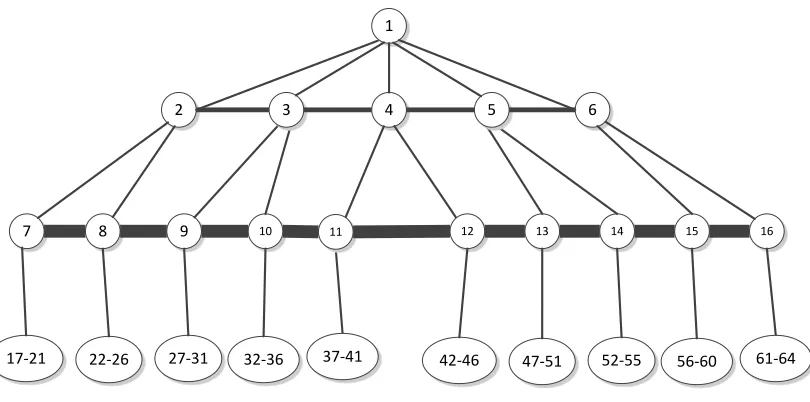
Below is an illustration of the baseline proposed 64-switch architecture for the
Small-World Tree Network-on-Chip (SWTNoC). The design is purposefully structured to be a shallow
tree, and as perfectly balanced as possible. Designing a shallow tree reduces the total hop count
from any node to its destination by eliminating unnecessary vertical hops along additional levels
interconnect the nodes at that level. Effectively, every node on the second and third level is
connected to every
1
2 6
7 8 9 10 13 14 15 16
17-21 22-26 27-31 32-36
3 4 5
12 11
[image:25.612.118.523.152.353.2]37-41 42-46 47-51 52-55 56-60 61-64
Figure 1. Proposed tree-structured 64-core small-world network architecture
other node by a shortcut that spans only one hop. The nodes placed at the lowest level of the tree
each represent 4 or 5 nodes that are the children of the level that is completely interconnected.
With this scheme, the vast majority of the network is on the bottom level of the tree. Therefore,
most of the network traversals, assuming uniform traffic patterns throughout the tree, will result
in a maximum of 3 hops. Starting on the lowest level, a message jumps to the extensively–
connected parent, followed by a hop via shortcut to the relevant parent of the final destination
node. The end result is a tree structure with a very low average hop count between nodes.
The number of links required to fully interconnect n nodes is defined by the following simple
∑ 𝑛 − 𝑘 =1
2(𝑛 − 1)𝑛
𝑛
𝑘=1
(1)
In this case, a maximum of 10 nodes are fully interconnected, resulting in 12 (10 − 1) ∗
10 = 45 links. The complete interconnection of these nodes is made possible by the emerging
interconnects mentioned in [15]. The longest 24 of the connections in this tree, be they the
shortcuts or the primary connections, can utilize the benefits of high-bandwidth, low energy,
long-distance wireless connections under a 24-channel signal. This emerging technology
provides the means to tap the potential of the proposed architecture by eliminating the negative
effects that would have been prominent with long wired shortcuts and connections.
The small worldness metric can provide a preliminary indication of the inherent
resiliency of the network. A network X with n nodes and m connections is a small-world network
if it has a similar path length and higher clustering of nodes than an Erdös-Rényi (ER) random
graph with the same m and n [24]. The metric is defined by
𝑆∆ = (𝐶𝑋∆
𝐶𝐸𝑅∆ ) (
𝐿𝐸𝑅
𝐿𝑋)
(2)
Where 𝐶𝑋∆ and 𝐶
𝐸𝑅∆ are the clustering coefficients and 𝐿𝑋 and 𝐿𝐸𝑅 are the mean average path
length of X and the corresponding ER network. The clustering coefficients are defined as the
average clustering parameter computed per each node node i such that
𝐶𝑖 = 𝐸𝐴 𝐸𝑚𝑎𝑥
(3)
where 𝐸𝐴 is the actual number of edges between the subset of nodes connected to 𝐶𝑖, and 𝐸𝑚𝑎𝑥 is
than 1 denotes the small-worldness property.
Structure plays a critical role in the performance of the network, including reducing the
energy cost by minimizing the number of hops between nodes. In addition, however, the tree
aspect of the design is crucial with regard to effective routing, and to the resiliency of the
network in the event of a failure of one of the network switches. Additional shortcut connections
can serve the purpose of ensuring that in the event of a single node failure, all unaffected nodes
remain connected. This is critical so as to not allow large sections of the tree to simply be cut off
and rendered useless. Short, low-cost shortcuts between the child nodes also help improve the
efficiency of the tree, and assist in keeping the structure connected in the event of a failure.
The inherent deadlock avoidance of the topology now comes into question, since it would
appear that with the shortcuts, cycles in the graph of the network could now become an issue.
For this reason, it is necessary to add routing restrictions onto the shortcuts. The following
section describes the adopted routing strategy, explaining how shortcuts are used only in specific
traffic directions to avoid deadlock scenarios.
4.2
Routing and Communication Protocols
The backbone of the functionality of the small-world tree-structured design resides in the
routing protocol. Specifically, the cost-effective routing technique called TRAIN is implemented
as proposed in [25]. The concept of TRAIN (Tree-based Routing Architecture for Irregular
Networks) as indicated by its name was originally designed for use in irregular networks from
which a spanning tree can be extracted as a subset of the original network. While the proposed
architecture is carefully structured, the addition of the shortcuts alters the original structure into a
network that can be considered irregular. For this reason, the concept of TRAIN routing can be
A message being routed under TRAIN is created at the source node and begins following
the tree structure towards the destination node. The options are to jump from a child node to a
parent node or from a parent to a child node, whichever move is in the direction of the
destination. In addition, the shortcut links can be used if taking the shortcut will result in the
message arriving at a node that is fewer hops from the final destination. Such shortcuts
drastically reduce the required number of hops that a message must travel from a source node to
the destination since the alternative path would often require traversal from one side of the tree
all the way up to the root and back down again to the other side of the tree. Such movement is
inefficient, and thus the inclusion of the shortcuts to create a small-world type of architecture is
critical to the performance of such a tree-based structure.
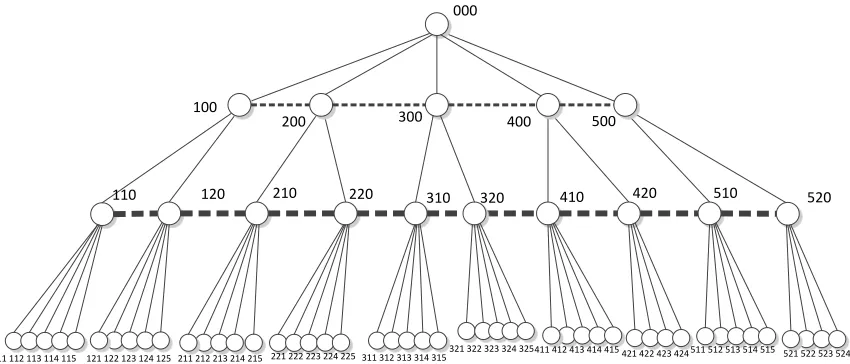
The relative location of a particular switch is known based on the particular ID number
assigned to that node. Figure 2 demonstrates this identification scheme. The number of base 10
digits assigned to the ID of each node is one less than the total number of levels in the tree. The
proposed architecture contains four levels, so the ID of the root is 000. At each successive level
of the tree, the first nonzero digit is replaced with the number of that particular child node
relative to the parent. In the example shown, the ID numbers of the two children stemming from
the root node are 100 and 200. The first child node of the latter would be labeled 210, and the
first child node of that node on the bottom level of the tree would be labeled 211 [25]. This
scheme allows for anywhere from zero to nine child nodes for any parent, as this is the range
000
100
200
110 120 220 310 410 420 510 520
111 112 113 114 115 121 122 123 124 125 211 212 213 214 215 221 222 223 224 225 411 412 413 414 415 421 422 423 424511 512 513 514 515 521 522 523 524
400 500
300
210 320
[image:29.612.96.521.75.257.2]311 312 313 314 315321 322 323 324 325
Figure 2. TRAIN identification scheme for the proposed 64-core architecture.
TRAIN avoids the need for a routing table by allowing for a very fast, simple distance
calculation. Between the ID numbers of any two nodes, the common digit sequences from left to
right of each number are removed. The distance between the nodes is the total number of
remaining non-zero digits. A simple example considering the above architecture would be the
distance from node 213 to node 240. The common digit sequence between the two ID numbers is
“2”, and of the remaining set of digits between the two numbers {1, 3, 4, 0}, there are three
non-zero digits. This is the distance along the tree from node 213 to 240.
The TRAIN algorithm itself is summarized below:
Step 1: For an arriving header flit, compute the distance from the final destination of the packet to all possible next-hop destinations.
Step 2: Choose the smallest result of the distance calculations and route the packet to this node.
Wormhole routing with virtual channels provides an effective means of moving traffic
throughout the network. If the buffer space in one virtual channel is full, another channel can be
transmitting over the physical connection between the switches. However, this alone is not
responsible for the deadlock-freedom afforded by TRAIN routing. As mentioned, a tree without
shortcuts is deadlock-free. There are no cycles in the network and therefore no means to
indefinitely interrupt the flow of messages via dependencies. To maintain this architectural
characteristic, an important restriction is placed on all shortcuts in that only traffic flowing up the
tree is able to use the shortcut.
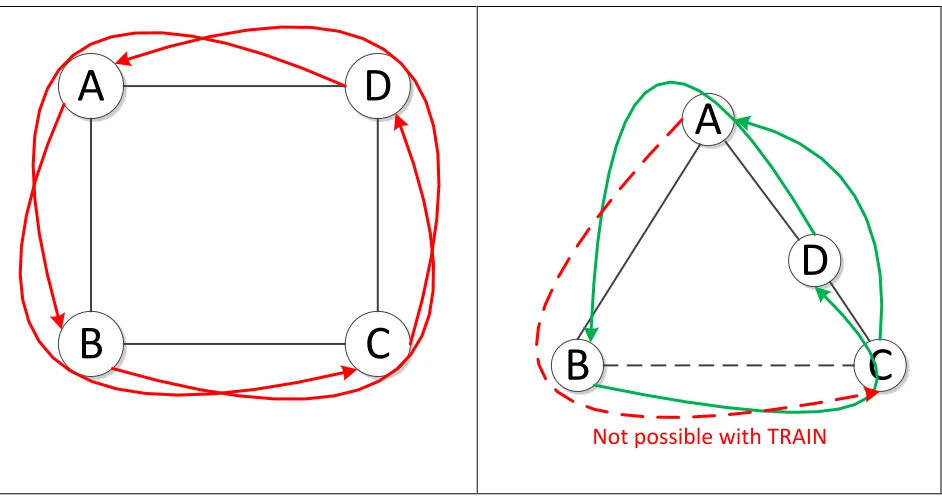
The following scenario demonstrates the deadlock-avoidance inherent with TRAIN
routing. The topology on the left is a simple mesh utilizing shortest-path routing, and the nodes
on the right use TRAIN. Node A attempts to send a packet to node C via B at the same time node
C attempts to send a packet to A via node D. In addition, node B is attempting to send a packet to
node D via C, and node D is attempting to send a packet to node B via A. A dependency cycle is
formed, and if all input buffers are filled, the nodes will wait indefinitely to retransmit their
buffered messages. Assume the same source and destination nodes with TRAIN on the right. In
this case, node A cannot transmit to node C via node B. This packet is being sent downstream,
and therefore can’t take the shortcut from B to C. Messages from A to C will always be routed
through D. Even if all input buffers are filled, this would mean that node B is consuming data
from A, thus freeing the buffer space between A and B. Similarly, node D cannot transmit to
node B via C if the flow of traffic were reversed. This again would require a shortcut to be taken
B
A
C
D
A
C
B
D
[image:31.612.75.546.69.317.2]Not possible with TRAIN
Figure 3. A clear dependency cycle is formed in the case of four connected nodes using shortest-path routing. TRAIN routing forbids transmission from node A to C via B, thus preventing the
formation of a graph cycle.
With adequate buffer space and enough virtual channels to support a network, the
likelihood of deadlock occurring is reduced. However, the threat of deadlock would still require
some form of recovery process, lest the network enter a state of deadlock and severely and
permanently be detrimental to network throughput. TRAIN routing eliminates the need for such
a recovery process, thus making implementation less complicated. This would seem to be a
significant tradeoff – the ideal routing scheme for any multi-hop network is a shortest-path
approach. Minimization of the average hop count is sound methodology to reduce latency, since
network cycles are wasted on storing messages in buffers at intermediate hops. However, the
proposed architecture was designed to minimize this tradeoff. Inspection of the structure yields
the realization that the majority of the switches are on the bottom of the tree. In addition,
utilization, since most messages will be routed up one level, take a shortcut across the tree, and
arrive at a destination one or two hops later. This results in a very low average hop count which
is very close to the ideal shortest-path result.
Novel topology and effective routing alone do not ensure the resiliency required by
conventional NoC designs. Based on the chosen design principles, the routing scheme must be
appended to include a method for the NoC to recover and continue to function in response to a
security threat, or a fault that would otherwise necessitate the disconnection of a switch from the
rest of the network.
4.3
Reactive, Fault-tolerant Hybrid Wireless NoC
With network throughput and effectiveness dependent on full connectivity, security and
fault-tolerance becomes a significant issue. As discussed, it is a true possibility that a particular
core could become corrupted by a hardware Trojan or otherwise rendered inoperable. This could
result in that network node causing a break in the connectivity of the tree, or perhaps filling the
network with useless data via a DOS attack, driving throughput and efficiency down to
impractical levels.
For this reason, the primary goal of this research is to provide the most effective and
efficient recovery scheme in the event of a node failure, or rather, in the event that a node
participating in a DOS attack must be cut off from the network. Unlike a mesh or ring structure
the loss of certain nodes can have a more severe impact on the function of the network of the
tree, such as the loss of a parent node connecting 6 or 7 child nodes to the rest of the tree. A
means of keeping such a large group connected to the rest of the structure must be implemented.
TRAIN can be used effectively for this purpose, since the routing scheme enables shortcuts to be
relationship. Recovery shortcuts are placed to guarantee that the tree remains fully connected in
the event of a single node failure. In addition, the devised rerouting algorithm provides a means
to utilize these recovery shortcuts to link nodes that would have otherwise been disconnected
from the main tree to other branches of the tree. New identification values are provided to all
affected nodes within the subtree of the failed parent to distinguish the new relative location of
the node within the hierarchical tree structure. Furthermore, the nature of the tree enables the
resulting ID and therefore the new configuration of the network to be easily precomputed.
Precomputation circumvents overhead contributed to reconfiguring the network dynamically, and
the simplistic nature of TRAIN routing feasibly allows the new ID values to be stored in a small
lookup table.
4.4
Rerouting Precomputation
The rerouting precomputation algorithm operates on a tree-oriented network topology
defined by TRAIN routing. It operates on each consecutive level L of the tree, beginning with the
root and terminating on the leaf nodes. Each node N has a lookup table LUT, to store mulltiple
ID values.
Step 1: For all nodes on this level, check whether a new ID has been computed yet by checking the corresponding entry in the lookup table.
Step 2: If the table is empty, find highest-level external connection by traversing the subtree of this node. External connections can be found via direct shortcut to unaffected subtree, or via lookup table entry of a connected shortcut that has already been computed for this level.
Step 3: If an external connection has been found, run minimum spanning tree (Prim’s algorithm)
on local AFFECTED_SUBTREE to assign new ID values based on NEW_SUBTREE.
for levels 1 to L-1 of the tree
while(LUTN(L) is not connected)
while node N of L+1 is not connected
if (L == 1) //parent is the root node
choose new root from second level of tree run MST to obtain new tree structure
else
//Locate externally-connected node
ID_CONNECTED = FindExternalConnection()
//Compute ID values for subtree with ID_CONNECTED as root
NEW_SUBTREE = MST_PRIM(ID_CONNECTED,AFFECTED_SUBTREE)
//Assign values in NEW_SUBTREE to each LUT
for (i = 1 to size(AFFECTED_SUBTREE))
LUTi(L).ID = NEW_SUBTREE(i).ID
end for end
end while end while end for
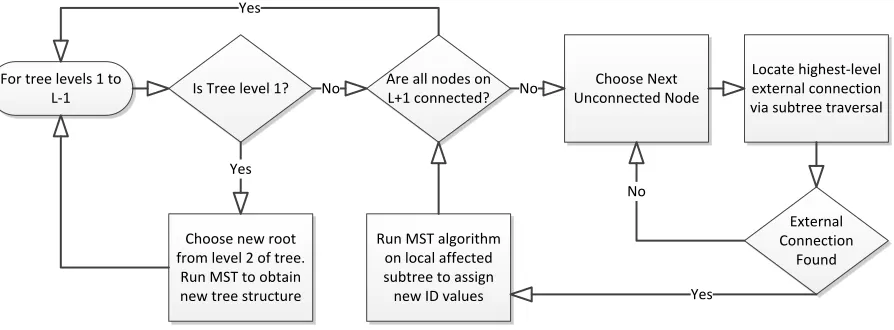
The above process is summarized in Figure 4. Note that since connectivity in the event of a
single failure is guaranteed, the process will be able to complete rather than iterating endlessly
searching for a connected state.
For tree levels 1 to
L-1 Is Tree level 1?
Choose new root from level 2 of tree.
Run MST to obtain new tree structure
Locate highest-level external connection via subtree traversal
Run MST algorithm on local affected subtree to assign new ID values
External Connection
Found Choose Next
Unconnected Node Are all nodes on
L+1 connected?
Yes
No No
Yes
No
[image:34.612.79.526.517.682.2]Yes
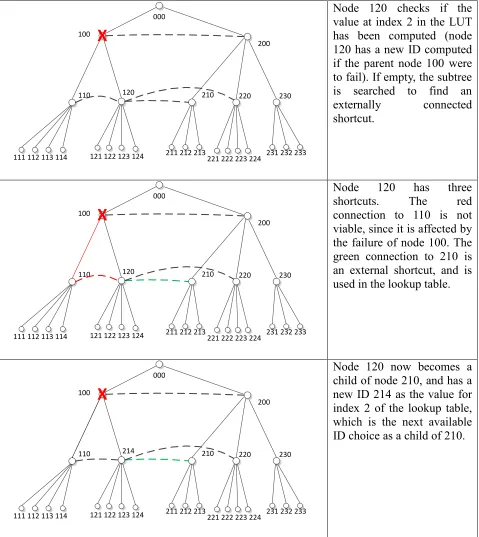
Figure 5 provides a tree topology which is a subset of the proposed architecture. It
describes the process followed by node 120 to precompute the second value for its respective
lookup table.
As stated, the algorithm is used during precomputation to avoid the unnecessary overhead
and delay associated with dynamically reconfiguring a network. Each index of the lookup table
contains the new ID value the node will possess in the event of a failure affecting it on any
particular level of the tree. Essentially, all different possible configurations of the tree are
Figure 5. Rerouting Implementation Example
000
100
200
110 120 210 220 230
111 112 113 114 121 122 123 124 211 212 213221 222 223 224 231 232 233
X
Node 120 checks if the value at index 2 in the LUT has been computed (node 120 has a new ID computed if the parent node 100 were to fail). If empty, the subtree is searched to find an
externally connected
shortcut.
000
100
200
110 120 210 220 230
111 112 113 114 121 122 123 124 211 212 213221 222 223 224 231 232 233
X
Node 120 has three
shortcuts. The red
connection to 110 is not viable, since it is affected by the failure of node 100. The green connection to 210 is an external shortcut, and is used in the lookup table.
000
100
200
110 214 210 220 230
111 112 113 114 121 122 123 124 211 212 213221 222 223 224 231 232 233
X
4.5
Physical Implementation
4.5.1 On-Chip Antennas
An effective antenna design must be chosen as the means of establishing the wireless
links for the hybrid WiNoC. The metal zig-zag antennas proposed in [7] are among more
conventional designs, and are capable of achieving impressive ranges of up to 30 mm at 100
kbps. The authors of [8] have a more suitable design which can achieve teraherz-range
frequencies (~500 GHz). Ultimately, the lowest-energy and best performance can be achieved
with CNT antennas. These antennas can achieve a similar bandwidth in the terahertz/optical
frequency range. Very low resistive loss due to high conductivity and improved current densities
permit high-power signal transmission, and therefore long-range communication. It has already
been demonstrated that characteristics of CNTs used as optical antennae for wireless on-chip
communication are in good quantitative agreement with conventional radio antenna technology
at very high optical frequencies [9]. Strong radiation patterns can be obtained by varying the
height of the CNT antenna to a multiple of the wavelength of the external laser used to drive
transmission. Since CNT antennas are such good candidates for long-range high-speed data
transfer, they are considered to be the design of choice for this work. High-speed silicon
integrated Mach-Zehnder optical modulators and de-modulators of [26] are available for use as
external sources required for high-bandwidth communication. These optical modulators can
provide a 10 Gbps data rate per communication channel, and are sufficient for integration into
the design.
The CNT antennas are essentially placed in pairs forming each wireless connection
established at a unique frequency. Therefore, interference-free communication is facilitated by
frequency division multiplexing (FDM). CNTs of varying lengths corresponding to the
this FDM scheme. A total of 24 laser sources were used in [15], and this becomes the limit on the
total number of frequencies used, and therefore the total maximum number of wireless links.
4.5.2 Physical Layout
Having designed the high-level topological structure and chosen an appropriate and
effective routing scheme, the final element of the design is the physical layout of the switches on
the chip. Figure 4 shows the layout of the wired links. Between each pair of adjacent switches is
2.5 mm in length for an overall architecture area of 20 mm x 20 mm = 306.25 mm2. The root and
upper-level nodes are placed roughly in the center of the die, and the nodes on the third level of
the tree (containing most of the shortcuts) are highlighted. These nodes contain groups of four or
22 23
24
25 27 28 29 30
21
20 8
26 9 36 35 31
17
18 7
19 10 32 33 34
11
41 2
40 3 12 46 45
37
38 Root
39 4 42 43 44
15
60 6
59 5 13 51 50
56
57 16
58 14 47 48 49
62
63 61
[image:39.612.109.529.70.442.2]64 52 53 54 55
Figure 6. Physical layout of primary wired links
Included in addition to the wired links shown in Figure 4 are the wireless shortcut links,
assigned to take the place of the longest links in the initial design. Nodes 7-16 are fully
interconnected, with wireless links being used for the longest most costly connections. This
physical layout is ultimately what was established within the simulator for testing purposes. To
obtain the best performance and lowest energy cost, wormhole routing is used in conjunction
with 16 virtual channels. Input and output buffer depths are set at 32-bytes in length. Network
4.6
Results
–
Architecture Characteristics
This section summarizes the final properties of the proposed NoC in terms of performance
metrics including small-worldness and hop count.
4.6.1 Small-Worldness
Generating a random ER network with the same m connections in the proposed topology
yields the following data for the proposed small-world tree networks with increasing number of
cores:
Network Size 𝐶𝑋∆ 𝐿
𝑋 𝐶𝐸𝑅∆ 𝐿𝐸𝑅 𝑆∆
64 0.6459 2.5347 0.4287 2.8591 1.6995
128 0.6847 2.8955 0.4016 2.8863 1.8603
[image:40.612.110.532.260.380.2]256 0.6809 3.5433 0.3709 3.2802 1.812
Figure 7. Network size and corresponding small-worldness
𝑆∆ > 1.0 in all three cases, confirming the small-world characteristics of the proposed network
for each size.
4.6.2 Hop Count
The average hop count is computed by assuming an unloaded network and computing
both the shortest path, and the default preferred path taken by TRAIN.
Average Hop Count
Train 2.5665
Shortest-path 2.5347
Figure 8. Hop count comparison
[image:40.612.238.386.580.666.2]network is virtually negligible at a difference of 0.0003 hops per switch. This high shortcut
utilization has the added benefit of more evenly distributing the network load throughout the tree
while avoiding congestion in the root and higher level nodes.
4.6.3 LUT Area Overhead
Area overhead must be considered for each node containing a single lookup table to store
adaptive routing ID values. The maximum number of LUT entries is defined as one less than the
number of levels in the tree. A single fault introduced into the proposed architecture at any node
location yields a maximum reconfigured ID length of 4, 5, and 6 digits at the implemented
system sizes of 64, 128, and 256-cores. Binary-coded decimal is a favorable encoding method
for simple ID comparisons. Under this scheme, the maximum length of any LUT entry is 4 digits
x 4 bits = 16 bits for the 64-core system, 5 digits x 4 bits = 20 bits for the 128-core system, and 6
digits x 4 bits = 24 bits for the 256 core system. Based on a relatively recent SRAM cell design
size in [27], the resulting area overhead per switch is 23.76 um2, 39.6 um2, and 59.4 um2 for 64,
128, and 256-core system sizes, respectively. These figures amount to tiny fractions of chip real
5
Alternative Architectures
5.1
Small-world Mesh and Ring
Two baseline architectures are chosen for comparison with the proposed architecture,
namely mesh and ring. These topologies are well-known and commonly researched standards. To
obtain an improved mesh network, an effort was made to exploit this benefit of the small-world
design approach by superimposing long-length links over a traditional 2-D lattice topology [28].
Longer wired links are inserted specifically to increase the clustering factor of the network, and
to decrease the average hop count. Deadlock in data routing can severely undermine the
advantages of the novel network architecture as well as wireless interconnects. To avoid a
deadlock scenario, routing is restricted only to certain directional movements to eliminate the
creation of graph cycles. In addition, only a certain amount of traffic is permitted to utilize the
limited amount of longer links to avoid congestion in these regions, and longer links are limited
to a single connection per router [28]. These links are implemented in buffer stages, using
repeaters to advance messages along the longer path towards the destination node. Results
demonstrated a significant increase in network throughput in comparison to the base mesh. The
study was conducted on relatively small mesh sizes (16-64 nodes), and optimized in each case
for the type of anticipated traffic [28]. Although the positive effect of long-rang links is apparent,
the need for repeaters and additional buffering essentially transforms the longer links into
multi-hop paths themselves, setting limitations on scalability and effectiveness for low energy
transmission.
The two-tier ring to mesh subnet hierarchical topology proposed by the authors of [14]
utilizes a small-world ring as the upper level for efficient data transfer. 24 wireless channels
multiples of the wavelength of each frequency as described in [15]. Simulated annealing is used
as a means of optimizing the layout of the wireless links on the ring to minimize the average hop
count.
As highly studied and well-known architectures, the mesh and ring base structures are used
as benchmarks in this thesis. The mesh with long-range links of [28] is instead implemented with
wireless links. Instead of a hierarchical ring-mesh structure as used in [14], the ring is considered
as a standalone small-world topology. Both baseline architectures are augmented with the same
24 wireless links as the proposed architecture. This section describes the topological layout in
addition to the routing and communication schemes implemented. Additionally, the process for
optimizing placement of the wireless links is discussed.
5.1.1 Topology
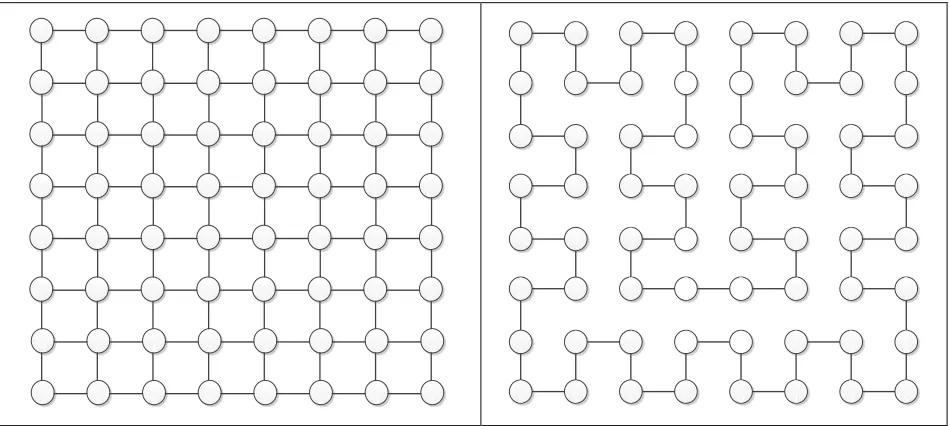
Mesh and ring architectures are common NoC architectures that have been extensively
studied. Both are simple architectures with connections governed by adjacent nodes. A network
switch of the mesh has a single interconnection between each node that is immediately adjacent