City, University of London Institutional Repository
Citation
:
Moeller, S., Appadu, N. and Sudarsanam, S. (2017). Pensions: Now something
more to worry about (for dealmakers). London: Mergers & Acquisitions Research Centre
(MARC), Cass Business School, City, University of London.
This is the published version of the paper.
This version of the publication may differ from the final published
version.
Permanent repository link:
http://openaccess.city.ac.uk/17099/
Link to published version
:
Copyright and reuse:
City Research Online aims to make research
outputs of City, University of London available to a wider audience.
Copyright and Moral Rights remain with the author(s) and/or copyright
holders. URLs from City Research Online may be freely distributed and
linked to.
City Research Online:
http://openaccess.city.ac.uk/
[email protected]
Pensions: Now something
more to worry about
(for dealmakers)
M&A Research Centre – MARC
2
© Cass Business School February 2017
MARC – Mergers & Acquisitions Research Centre
MARC is the Mergers and Acquisitions Research Centre at Cass Business School,
City, University of London – the first research centre at a major business school to
pursue focussed leading-edge research into the global mergers and acquisitions
industry.
MARC blends the expertise of M&A accountants, bankers, lawyers, consultants and
other key market participants with the academic excellence of Cass to provide fresh
insights into the world of deal-making.
Corporations, regulators, professional services firms, exchanges and universities use
MARC for swift access to research and practical ideas. From deal origination to
closing, from financing to integration, from the hottest emerging markets to the board
rooms of the biggest corporations, MARC researches the wide spectrum of mergers,
acquisitions and corporate restructurings.
The contents and views set out in this publication reflect the views of the authors at
the M&A Research Centre and are not necessarily the views of the sponsors of the
Centre, and, moreover, should be seen in the context of the time they were made.
The M&A Research Centre would like to express grateful thanks to its sponsors.
Senior Sponsors:
3
© Cass Business School February 2017
Overview
ou’ve found your target, there are obvious cost synergies, the cultural fit is compelling, it gives you access to new markets and the price looks right. But what about becoming responsible for the livelihoods of 130,000 people who don’t even work for the company you’re acquiring? This is the reality that could have faced buyers of Tata’s UK steel assets, and why government intervention was needed to remove the obstacle. At the critical moment, the pension deficit was around £700m.
At this point, the acquirer is likely to start thinking about 1) how to minimise risk, probably through the choice of acquisition currency used (cash, stock, or some mixture of each) and 2) whether pension risk, which is by its nature open ended, should be a reason not to do the deal at all. These two questions are the focus of this report.
Acquisition currency
The question of what to use to pay would usually be a function of:
- Target location (in a cross border deal shareholders of the target may not be able to hold overseas listed stock) - Management’s view of its own share
price (over-valued / under-valued) - Expectations of target management. To these we would add the pension position (of both target and acquirer).
Numerous theoretical and empirical studies have examined the impact of the method of payment in corporate takeovers on the shareholder value outcomes for bidder and target shareholders. And taking a step back from the specific issues around pension deficits, it has been found that in general cash offers create more value for both bidder and target shareholders in both the short and long term. This finding is based on numerous studies: Hansen (1987), Schlingemann (2004) and Golubov et al (2015). There is an
interesting exception to this rule in the context of pensions.
Shareholder value creation
In an acquisition, a company seeking to acquire another will have to take into account the latter’s pension scheme (e.g., whether defined benefit (DB) or defined contribution (DC), its funding position and its risk profile). Where the target firm’s pension is underfunded, it may lead to the buyer having to contribute towards eliminating that underfunding. The buyer needs to take into account how the target’s pension scheme will alter its financial risk profile, credit rating and cost of capital as well as its future investment programme. These concerns will be reflected in the takeover premium that the acquirer is willing to pay for the target and the way it finances the acquisition. Thus, the target pension scheme risk profile is likely to influence both the acquirer’s choice of payment currency and its shareholder value gains thereafter.
Hence the second leg of research in this paper on whether pension risk should be a reason not to do the deal.
Here are our conclusions on the two issues: - We find that target pension scheme type
has a significant impact on the choice of payment mix, with riskier DB schemes leading to offers with a lower cash component.
- Risk in the bidder’s own pension liabilities increases the probability of a higher proportion of cash in the offer but reduces the value gains to its own shareholders (contrary to the usual finding that cash offers provide better returns to acquiring firms).
- The target pension scheme type does not impact on the bidding shareholder’s wealth gains directly, and only have an indirect impact on payment currency choice.
4
© Cass Business School February 2017
Background
ension schemes, when offered, are of different types. In defined benefit schemes, members are guaranteed post-retirement benefits that are often a function of their length of service and final salary at the time of retirement. Both the employer and the employee contribute periodically an agreed percentage of the employee’s salary. In defined contribution schemes the sponsor contributes an agreed amount or percentage of the employee’s salary to the pension ‘pot’ to which the employee may also contribute. These contributions are invested and the accumulated assets, including investment returns, become the source of income used to fund the payment of pension benefits in the future.
The DB sponsor is liable to meet the commitment to paying the post-retirement benefits. The scheme’s liabilities towards its members are thus effectively the liabilities of the sponsor. In funded schemes the contributions made by the employer and the employees are invested and the assets so created are used to meet the pension liabilities. Where the liabilities exceed the assets, i.e., there is a pension (funding) deficit, the sponsor may have to make additional contributions to eliminate the deficit or reduce it in accordance with an agreement with the trustees of the pension scheme. In many jurisdictions, such as the US or the UK, such contributions may be mandated by a pension regulatory regime established under law. In several countries, a pension regulator has the power to mandate and enforce contributions towards deficit reduction, e.g. The Pensions Regulator in the UK (see below).
In contrast to the DB schemes, a DC scheme sponsor has no liability to pay a pre-determined level of pension benefit to the members of the scheme on retirement. Conceptually, the DB scheme is similar to a wholly owned subsidiary of the sponsor and it generally imposes a much higher liability on the employer than a DC scheme. In a DB scheme, pension liabilities accumulate, and are discharged, over several
decades, making valuation of the future pension benefit obligations to members uncertain. A DB scheme thus poses greater risk to the debt holders and shareholders of the scheme sponsor, thereby raising its cost of capital and potentially jeopardising its capital investments.
But there is also a direct cash flow impact arising from the contributions made by the sponsor, which depend on the actuarial valuation of the scheme’s pension benefit liabilities and its assets, the time scale for deficit reduction as per agreement with the trustees and any mandatory contribution imposed by the regulator.
The regulator’s role
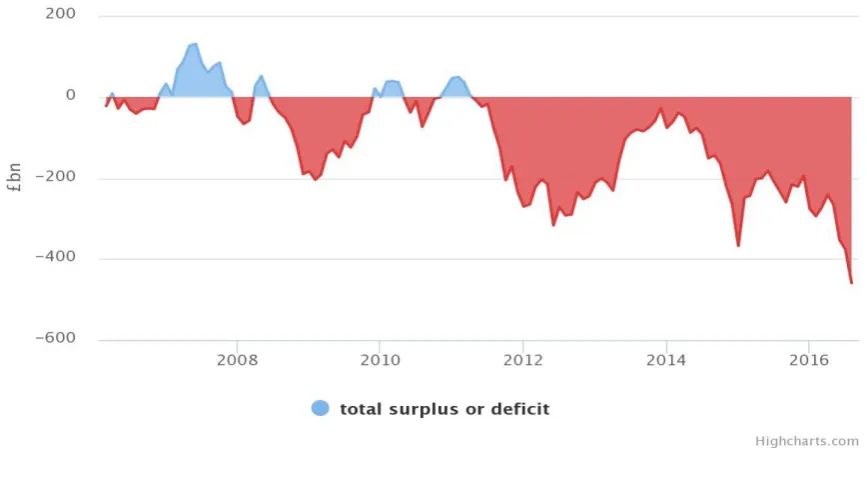
However, these consequences will also depend on what role the pension regulation in that country plays in determining how it discharges its pension benefit obligations, including contributions towards deficit reduction and any levy towards a statutory pension guarantee scheme. Debt arising from the underfunding may have been included in the company’s balance sheet in which case its stock price likely reflects the additional liability and its risk level. These deficits can be extremely large. For example, BAE Systems has a gross pension liability of 170% of market capitalisation, and a deficit of 32% of market capitalisation. In the wake of the Brexit vote in June 2016, UK DB pension schemes had an aggregate record £460bn deficit, which has since moderated given the movement in bond yields and asset prices (see Figure 1 on the next page for the growth of that deficit through early 2016). As well as impacting investment decisions, the funding status of a scheme could clearly impact M&A decisions on both the acquirer and target sides. For the bidder, the challenge is to assess, through its due diligence, whether such risk is correctly reflected in the pre-bid price of the target and what the adjustment to the offer price / premium needs to be if it believes the risk is under- or over-estimated in the pre-bid target
5
© Cass Business School February 2017
price. The bidder has also to consider that the pre-bid target price may reflect the pension scheme-related risk from the target’s perspective and not from the bidder’s should the latter’s debt covenants be impacted. And the decision could soon be taken out of the hands of those directly involved.
‘The regulator should have the right to approve or disapprove any corporate transaction that might disadvantage pensioners’ said Lady Judge, the outgoing head of the Pension Protection Fund (Financial Times, July 2016). She also said that if the regulator had had that right, it would have blocked the £1 sale of BHS by Philip Green, which at the time had a £570m deficit in that year.
The UK framework
[image:6.595.84.518.475.718.2]UK firms operate DB, DC or indeed no scheme at all. The Pensions Act 2004 (PA2004), amended by the Pensions Act 2008, is designed to protect the interests of members of occupational pension schemes (OPS). PA2004 was set up by The Pensions Regulator (TPR) who monitors such schemes and ensures compliance with pension laws. Registered schemes enjoy tax-free investment returns and sponsor contributions are tax-deductible. TPR has wide-ranging and proactive powers to impose contribution rates and moral hazard powers to direct employers and connected parties to make contributions to underfunded DB schemes. OPS are set up as trusts and trustees must act in the interests of scheme members even if nominated by the sponsor. Trustees appoint investment managers to manage the scheme assets. They have to undertake triennial actuarial valuations of scheme assets and liabilities, estimate the funding deficit and also produce annual reports. The actuary certifies the scheme funding and its solvency.
6
© Cass Business School February 2017
What we set out to investigate
Payment mix is one of the risk management tools available to acquirers since it allocates post-acquisition risk between acquirer and target shareholders. However, very few studies have examined how the pension schemes operated by target firms influence the choice of payment currency by bidders and the resultant value gains to bidder shareholders, even though pension deficits and liabilities have ballooned in recent years (see above), thereby increasing the risk profile of firms. Acquirers of targets with substantial pension scheme liabilities expose themselves to a substantial increase in leverage and financial risk.
What was known
Given the size of pension-related liabilities of some acquired firms, it is perhaps surprising that most prior studies that examined the determinants of payment currency seem to have largely ignored this potentially important factor. Although the impact of pension scheme liabilities on payment currency choice and shareholder value gains is the subject of a study by Cocco and Volpin (2013) 1, they consider the
impact only of own schemes and not of both bidders and targets, amongst other issues. Cocco and Volpin, in the only published study to date dealing with the impact of pension schemes on takeovers, find that targets with DB schemes are less likely to be acquired than those with non-DB schemes, consistent with the higher risk associated with DB schemes. They also find bidders operating DB schemes in deficit are significantly more likely to offer cash (in their view to minimise any information asymmetry that the target shareholders face given the difficulty of assessing the acquirer’s pension liabilities). They report that value gains to acquirer shareholders are lower the higher the acquirer pension scheme deficit but this negative effect is moderated when the payment mix is cash rather than stock. On the other hand, the value gains to target shareholders are
1 Cocco, J.F. and Volpin, P.F. Journal of Financial
and Quantitative Analysis, 2013
not impacted by the target’s pension scheme deficit or its interaction with the payment mix (in other words, your pension scheme deficit might hurt your chances of being bid for, but if there actually is a bid the value creation for you will not be impacted). However, they do not analyse the impact of target pension schemes on the payment mix choice of the bidders. Importantly they do not deal with the endogeneity (e.g., causality direction) of the mix currency choice in estimating shareholder gains.
Our approach
In addition to the aforementioned gaps in the analysis, Cocco and Volpin’s work modelling the bidder’s announcement period returns controls for the bidder’s own DB scheme deficit and not for the target’s. Furthermore, we believe it is necessary to take into account both the pension scheme assets and liabilities (i.e., the absolute size of the pension scheme and not just the deficit). Otherwise a major scheme that happens to be in surplus may be concealing a significant potential contingent liability.
Furthermore, they focus on only one type of pension scheme (i.e., DB), whereas we consider DB, DC and no scheme subsamples. We believe that our study therefore fills an important gap in the takeover, corporate finance and pension liabilities research and of particular interest to dealmakers.
The methodology
7
© Cass Business School February 2017
the bidder’s payment mix and the consequent shareholder value outcomes.
We estimate the market-adjusted abnormal returns with an approach in line with many recent studies. The announcement period abnormal returns are estimated using the market-relative performance. We estimate the shareholder gains (the treatment effect) using the conventional cumulative abnormal returns (CAR) methodology over the period -2 to +2 days centred on the announcement day, Day 0. Abnormal return is the excess of the return to the bidder (or target) shareholders over the corresponding return of the FTSE 350 Index, a broad-based UK stock market proxy. We then regress the estimated CARs on relevant variables including target pension scheme variables.
The usual disclaimer!
Whether short-term event studies are meaningful measures of M&A success is determined by your view of the efficiency of the stock market. Market efficiency refers to the assumption that all relevant information available is quickly incorporated in market prices that should reflect the discounted sum of the expected cash flows delivered by a particular stock. In this case the share price move upon the deal announcement is taken as representing the value destruction or value creation of the deal. Two of the obvious weaknesses of such a standpoint are the influence of merger arbitrage funds (buying the target stock, selling the acquirer, regardless of
8
© Cass Business School February 2017
Our findings
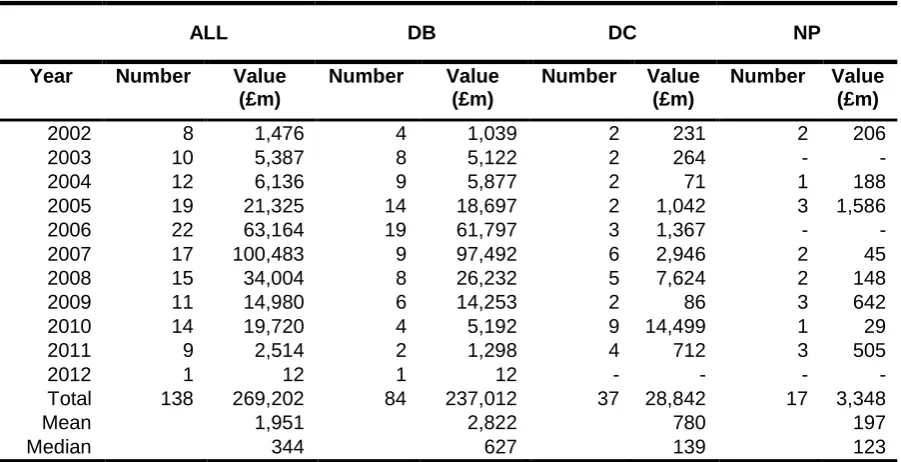
etails of the 138 deals analysed are given in the Appendix, with the type of pension scheme involved, the size of the deal and the year of transaction. It also shows the volume and value of deals by year and pension scheme type. DB scheme targets represents 61% of the sample by number but 92% by deal value. The mean (median) deal value is £2,822m (£627m) for DB targets but considerably smaller for other targets. The much larger size of DB targets is not surprising since DB schemes are often historical legacies associated with mature industrial and other companies, which tend to be larger. DC schemes are of relatively recent adoption by UK firms, which therefore tend to be smaller.
Results
We find that the target pension scheme’s risk profile has a significant impact on the payment currency choice of the bidder. The riskier, target DB schemes, reduce the likelihood of the use of cash and increase the likelihood of stock or non-cash instruments being used in the deal. We find that target pension scheme risk does not influence bidder shareholder returns directly. Their influence seems indirect, via their impact on payment mix used. However, bidder DB liabilities reduce the returns to shareholders, even as they tend to increase the cash component of bids, something contrary to the usual outcome (see the above mentioned studies: Hansen (1987) 2 , Schlingemann
(2004)3 and Golubov et al (2015)4). Ours is the
first study to focus on the implications of a wider range of target firms’ pension schemes and their risk profile for the payment mix decisions of acquirers in takeovers. Our results are consistent with our hypothesis that such schemes would have a significant impact on the financing and investment decisions of firms.
Choice of payment mix
Our primary focus is on target pension scheme and its financial risk characteristics as ‘predictor’ variables, but we control for other factors that are likely to influence the bidder’s choice of acquisition payment mix – bidder’s size, leverage, stock price run-up, stock over-valuation, cash and liquidity strength and cash flow strength. We also control for the risk reduction resulting from a diversifying acquisition which may allow the bidder to choose a ‘riskier’ payment mix by increasing the percentage of cash. We control for bidder’s pension scheme - whether DB, DC or no scheme - and the related pension liability or deficit cost variables. In addition, we include proforma variables which take into account the combined financial and liquidity strength of bidders and targets. Since choice of payment mix depends on time varying factors such as market conditions, interest rates, etc, we control for such temporal effects by including the equity issuance activity variables together with industry and year of sample.
Our results (below) show that the percentage of cash offered by bidders is significantly negatively correlated with the presence of a DB scheme at the target. Interestingly, bidder DB scheme has a positive impact on the likelihood of cash as payment currency. This positive impact is consistent with the view and evidence from Cocco and Volpin that bidders with risky pension schemes seek to reduce the information asymmetry concerns of target shareholders by offering cash in consideration.
2 Hansen, R. Journal of Business, 1987
3 Schlingemann, F P. Journal of Corporate Finance,
2004
4 Golubov, A, Petmetzas, D and Travlos, N. Review
of Finance, 2015
9
[image:10.595.68.528.98.177.2]© Cass Business School February 2017
Figure 2: Regression coefficients vs percentage of cash in takeover offer (Source: Cass Business School)
Model 1 Model 2 Target Defined Benefit pension scheme -1.032** -0.945** Target Defined Contribution pension scheme -0.598 -0.507 Bidder Defined Benefit pension scheme 0.943** 0.699* Bidder Defined Contribution pension scheme 0.44 0.39
* Significant at 10% t statistic, ** significant at 5% t statistic. No indication implies no statistical significance
Note: In Model 1 we control for bidder financial metrics, in Model 2 for pro-forma financial metrics. As you can see there is no real difference in conclusion.
Shareholder returns
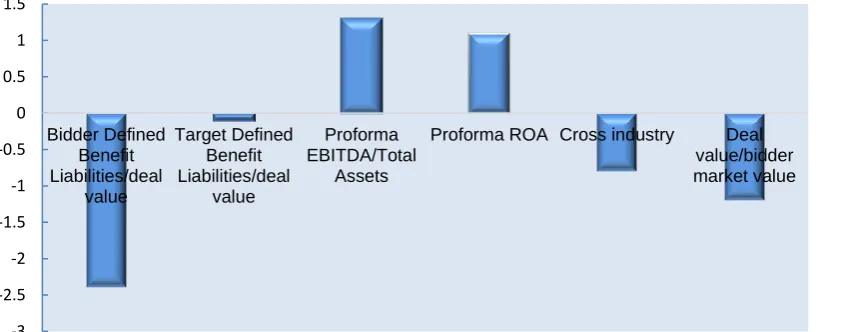
The most striking result across all the models is that target pension scheme variables and pension-related variables – DB liabilities and DB deficits – whether on their own or in interaction with the percentage of cash in consideration, are not significant drivers of returns. This is in contrast to the significant impact of pension-related variables of both bidders and targets on the payment currency choice, as shown above. Thus the impact of target pension schemes and their costs and liabilities on shareholder value gains is not direct and seems to be intermediated by the impact of these variables on the choice of payment offered by bidders. In contrast, bidder DB liabilities / deal value has a significant and negative impact on bidder
shareholder returns. The payment mix, percentage of cash offered, is uniformly significant and positive across all the models, consistent with the literature on the positive impact of cash as payment currency.
Among the control variables, we find that diversifying acquisitions lower bidder shareholder returns significantly (stick to the knitting!). Strong financial performance, reflected in high ROA or EBITDA/Total Assets increases shareholder returns significantly. Relatively large acquisitions (high DV / Bidder MV) significantly reduce shareholder returns, consistent with recent research showing the relative positive performance of bolt-on deals as contrasted with those of ‘mega-mergers’.
Figure 3: Shareholder value gains (%) as measured over (-2 to +2 days) centred on announcement day versus independent
variables(Source: Cass Business School)
Statistical significance indicated by shading density, from no shading = no significance up to full shading for significance at the
1% level.
-3 -2.5 -2 -1.5 -1 -0.5 0 0.5 1 1.5
Bidder Defined Benefit Liabilities/deal
value
Target Defined Benefit Liabilities/deal
value
Proforma EBITDA/Total
Assets
[image:10.595.92.515.543.709.2]10
© Cass Business School February 2017
Conclusions and recommendations
onsistent with what you might expect, we find that an acquisition of a company with a riskier pension scheme is likely to be financed with a lower proportion of cash and a higher proportion of stock. This implies that bidders match the risk profile of target pension schemes with a countervailing risk profile of the payment mix they offer. We also find that bidders with high risk DB pension schemes seek to assuage the valuation risk concerns that they pose target shareholders by offering more cash. However, these same high risk bidders make deals that are associated with reduced gains for their own shareholders. We do not find support for the idea of a significant impact from target pension risk on bidder shareholder returns from takeovers. It appears that the impact on shareholder returns is not significant once the primary impact on the payment mix decision is taken into account. We find that bidder shareholder wealth gains are impacted by a number of other factors that make sense from an academic literature and capital markets experience viewpoint: relatively large and diversifying acquisitions are associated with smaller bidder returns whereas the bidder’s or the bidder-cum-target’s stronger
financial performance is associated with stronger bidder returns.
Some market-related recommendations: - If you are looking for likely bidders for
targets with DB scheme issues, they may be ones you don’t expect. They may well be those who are likely to do a deal with a low cash component in the bid (i.e., this may mean corporates with weaker balance sheets, something unlikely to please a potentially hostile regulator).
- If you have issues of your own with a DB scheme you should resolve them (buyout, risk transfer to an insurance company, increase funding, etc.) before bidding for another company.
-
The status of a target’s pension scheme will not in itself impact the returns on the deal if you make the optimal payment mix choice.11
© Cass Business School February 2017
Appendix
[image:12.595.72.523.253.484.2]The initial sample includes takeover bids announced from January 2002 to the end of December 2012 for UK public companies listed on the London Stock Exchange and included in the FTSE350 index. 2002 is the first year for which pension data was to be reported in full in the company’s financial statements under the UK Financial Reporting Standard (FRS) 17. The bid announcement dates are collected from the SDC Platinum database. Further sampling criteria are the following: information on these firms, including firm financial variables, pension plan scheme status and pension scheme liabilities, must be available from public sources. Both the acquirer and the target should be publicly-listed companies.
Figure 4: Number and value of takeover bids by year and pension scheme of target
(Source: Cass Business School)
ALL DB DC NP
Year Number Value (£m)
Number Value (£m)
Number Value (£m)
Number Value (£m)
2002 8 1,476 4 1,039 2 231 2 206
2003 10 5,387 8 5,122 2 264 - -
2004 12 6,136 9 5,877 2 71 1 188
2005 19 21,325 14 18,697 2 1,042 3 1,586
2006 22 63,164 19 61,797 3 1,367 - -
2007 17 100,483 9 97,492 6 2,946 2 45
2008 15 34,004 8 26,232 5 7,624 2 148
2009 11 14,980 6 14,253 2 86 3 642
2010 14 19,720 4 5,192 9 14,499 1 29
2011 9 2,514 2 1,298 4 712 3 505
2012 1 12 1 12 - - - -
Total 138 269,202 84 237,012 37 28,842 17 3,348
Mean 1,951 2,822 780 197
Median 344 627 139 123
Deal values sourced from SDC Platinum are stated in dollars. We use Datastream’s exchange rate to convert the deal value to pounds at the date of the bid offer. DB = defined benefit scheme; DC = Defined contribution scheme; NP = No plan (scheme)
Notes on Authors
Naaguesh Appadu Research Fellow at the M&A Research Centre. Both his research and teaching at Cass focus on M&A and related topics.
Sudi Sudarsanam Emeritus Professor of Finance & Corporate Control. His research interests are corporate restructuring, mergers and acquisitions and corporate strategy.
Scott Moeller, Director of MARC and Professor in the Practice of Finance. His research and teaching focuses on the full range of mergers and acquisitions activities.
Contact: [email protected]
M&A Research Centre
Cass Business School
106 Bunhill Row London EC1Y 8TZ T: +44 (0)20 7040 5146 E: [email protected]