Typeset using LATEXtwocolumnstyle in AASTeX62
Binary Black Hole Population Properties Inferred from the First and Second Observing Runs of Advanced LIGO and Advanced Virgo
B. P. Abbott,1 R. Abbott,1 T. D. Abbott,2S. Abraham,3 F. Acernese,4, 5 K. Ackley,6 C. Adams,7 R. X. Adhikari,1V. B. Adya,8, 9 C. Affeldt,8, 9 M. Agathos,10K. Agatsuma,11N. Aggarwal,12 O. D. Aguiar,13
L. Aiello,14, 15 A. Ain,3 P. Ajith,16 G. Allen,17A. Allocca,18, 19 M. A. Aloy,20 P. A. Altin,21 A. Amato,22 A. Ananyeva,1 S. B. Anderson,1W. G. Anderson,23 S. V. Angelova,24S. Antier,25 S. Appert,1 K. Arai,1 M. C. Araya,1 J. S. Areeda,26M. Ar`ene,27N. Arnaud,25, 28 K. G. Arun,29 S. Ascenzi,30, 31 G. Ashton,6
S. M. Aston,7 P. Astone,32 F. Aubin,33 P. Aufmuth,9 K. AultONeal,34 C. Austin,2V. Avendano,35 A. Avila-Alvarez,26 S. Babak,36, 27 P. Bacon,27F. Badaracco,14, 15 M. K. M. Bader,37 S. Bae,38 P. T. Baker,39
F. Baldaccini,40, 41 G. Ballardin,28S. W. Ballmer,42S. Banagiri,43 J. C. Barayoga,1S. E. Barclay,44 B. C. Barish,1 D. Barker,45K. Barkett,46 S. Barnum,12 F. Barone,4, 5 B. Barr,44L. Barsotti,12M. Barsuglia,27
D. Barta,47J. Bartlett,45I. Bartos,48 R. Bassiri,49 A. Basti,18, 19 M. Bawaj,50, 41 J. C. Bayley,44 M. Bazzan,51, 52 B. B´ecsy,53 M. Bejger,27, 54 I. Belahcene,25 A. S. Bell,44 D. Beniwal,55 B. K. Berger,49 G. Bergmann,8, 9 S. Bernuzzi,56, 57 J. J. Bero,58C. P. L. Berry,59 D. Bersanetti,60A. Bertolini,37 J. Betzwieser,7 R. Bhandare,61 J. Bidler,26I. A. Bilenko,62S. A. Bilgili,39 G. Billingsley,1 J. Birch,7R. Birney,24 O. Birnholtz,58 S. Biscans,1, 12
S. Biscoveanu,6 A. Bisht,9M. Bitossi,28, 19 M. A. Bizouard,25 J. K. Blackburn,1 C. D. Blair,7 D. G. Blair,63 R. M. Blair,45 S. Bloemen,64 N. Bode,8, 9 M. Boer,65 Y. Boetzel,66 G. Bogaert,65 F. Bondu,67 E. Bonilla,49
R. Bonnand,33P. Booker,8, 9 B. A. Boom,37C. D. Booth,68 R. Bork,1V. Boschi,28 S. Bose,69, 3 K. Bossie,7 V. Bossilkov,63J. Bosveld,63Y. Bouffanais,27 A. Bozzi,28 C. Bradaschia,19 P. R. Brady,23A. Bramley,7 M. Branchesi,14, 15 J. E. Brau,70T. Briant,71J. H. Briggs,44 F. Brighenti,72, 73 A. Brillet,65M. Brinkmann,8, 9
V. Brisson,25,∗ P. Brockill,23A. F. Brooks,1 D. D. Brown,55 S. Brunett,1A. Buikema,12 T. Bulik,74 H. J. Bulten,75, 37 A. Buonanno,36, 76 R. Buscicchio,11D. Buskulic,33C. Buy,27R. L. Byer,49M. Cabero,8, 9
L. Cadonati,77G. Cagnoli,22, 78 C. Cahillane,1 J. Calder´on Bustillo,6T. A. Callister,1 E. Calloni,79, 5 J. B. Camp,80 W. A. Campbell,6M. Canepa,81, 60 K. C. Cannon,82 H. Cao,55 J. Cao,83 E. Capocasa,27 F. Carbognani,28 S. Caride,84M. F. Carney,59 G. Carullo,18 J. Casanueva Diaz,19 C. Casentini,30, 31 S. Caudill,37
M. Cavagli`a,85 F. Cavalier,25 R. Cavalieri,28 G. Cella,19 P. Cerd´a-Dur´an,20 G. Cerretani,18, 19 E. Cesarini,86, 31 O. Chaibi,65 K. Chakravarti,3 S. J. Chamberlin,87M. Chan,44S. Chao,88P. Charlton,89 E. A. Chase,59
E. Chassande-Mottin,27D. Chatterjee,23M. Chaturvedi,61 K. Chatziioannou,90B. D. Cheeseboro,39 H. Y. Chen,91 X. Chen,63 Y. Chen,46 H.-P. Cheng,48 C. K. Cheong,92 H. Y. Chia,48 A. Chincarini,60 A. Chiummo,28
G. Cho,93 H. S. Cho,94M. Cho,76N. Christensen,65, 95 Q. Chu,63 S. Chua,71 K. W. Chung,92 S. Chung,63 G. Ciani,51, 52 A. A. Ciobanu,55 R. Ciolfi,96, 97 F. Cipriano,65A. Cirone,81, 60 F. Clara,45 J. A. Clark,77 P. Clearwater,98F. Cleva,65 C. Cocchieri,85 E. Coccia,14, 15 P.-F. Cohadon,71 D. Cohen,25 R. Colgan,99
M. Colleoni,100C. G. Collette,101 C. Collins,11L. R. Cominsky,102M. Constancio Jr.,13 L. Conti,52 S. J. Cooper,11 P. Corban,7 T. R. Corbitt,2 I. Cordero-Carri´on,103 K. R. Corley,99N. Cornish,53 A. Corsi,84
S. Cortese,28 C. A. Costa,13 R. Cotesta,36 M. W. Coughlin,1 S. B. Coughlin,68, 59 J.-P. Coulon,65
S. T. Countryman,99P. Couvares,1 P. B. Covas,100E. E. Cowan,77 D. M. Coward,63 M. J. Cowart,7 D. C. Coyne,1 R. Coyne,104 J. D. E. Creighton,23 T. D. Creighton,105 J. Cripe,2 M. Croquette,71 S. G. Crowder,106 T. J. Cullen,2 A. Cumming,44L. Cunningham,44 E. Cuoco,28 T. Dal Canton,80 G. D´alya,107 S. L. Danilishin,8, 9
S. D’Antonio,31 K. Danzmann,9, 8 A. Dasgupta,108 C. F. Da Silva Costa,48 L. E. H. Datrier,44 V. Dattilo,28 I. Dave,61 M. Davier,25 D. Davis,42 E. J. Daw,109D. DeBra,49 M. Deenadayalan,3 J. Degallaix,22 M. De Laurentis,79, 5 S. Del´eglise,71 W. Del Pozzo,18, 19 L. M. DeMarchi,59 N. Demos,12 T. Dent,8, 9, 110 R. De Pietri,111, 57 J. Derby,26 R. De Rosa,79, 5 C. De Rossi,22, 28 R. DeSalvo,112O. de Varona,8, 9 S. Dhurandhar,3
M. C. D´ıaz,105T. Dietrich,37L. Di Fiore,5 M. Di Giovanni,113, 97 T. Di Girolamo,79, 5 A. Di Lieto,18, 19 B. Ding,101 S. Di Pace,114, 32 I. Di Palma,114, 32 F. Di Renzo,18, 19 A. Dmitriev,11 Z. Doctor,91F. Donovan,12 K. L. Dooley,68, 85
S. Doravari,8, 9 I. Dorrington,68 T. P. Downes,23 M. Drago,14, 15 J. C. Driggers,45 Z. Du,83 J.-G. Ducoin,25 P. Dupej,44 S. E. Dwyer,45 P. J. Easter,6T. B. Edo,109 M. C. Edwards,95 A. Effler,7 P. Ehrens,1 J. Eichholz,1
S. S. Eikenberry,48M. Eisenmann,33 R. A. Eisenstein,12 R. C. Essick,91 H. Estelles,100 D. Estevez,33 Z. B. Etienne,39T. Etzel,1M. Evans,12 T. M. Evans,7 V. Fafone,30, 31, 14 H. Fair,42 S. Fairhurst,68 X. Fan,83 S. Farinon,60 B. Farr,70 W. M. Farr,11 E. J. Fauchon-Jones,68 M. Favata,35M. Fays,109 M. Fazio,115 C. Fee,116
J. Feicht,1 M. M. Fejer,49 F. Feng,27 A. Fernandez-Galiana,12I. Ferrante,18, 19 E. C. Ferreira,13 T. A. Ferreira,13 F. Ferrini,28 F. Fidecaro,18, 19 I. Fiori,28D. Fiorucci,27M. Fishbach,91 R. P. Fisher,42, 117
J. M. Fishner,12 M. Fitz-Axen,43 R. Flaminio,33, 118 M. Fletcher,44 E. Flynn,26H. Fong,90J. A. Font,20, 119 P. W. F. Forsyth,21 J.-D. Fournier,65 S. Frasca,114, 32 F. Frasconi,19Z. Frei,107 A. Freise,11 R. Frey,70 V. Frey,25
P. Fritschel,12 V. V. Frolov,7 P. Fulda,48M. Fyffe,7 H. A. Gabbard,44 B. U. Gadre,3S. M. Gaebel,11 J. R. Gair,120 L. Gammaitoni,40 M. R. Ganija,55 S. G. Gaonkar,3 A. Garcia,26 C. Garc´ıa-Quir´os,100 F. Garufi,79, 5
B. Gateley,45 S. Gaudio,34 G. Gaur,121 V. Gayathri,122 G. Gemme,60 E. Genin,28 A. Gennai,19 D. George,17 J. George,61 L. Gergely,123V. Germain,33S. Ghonge,77 Abhirup Ghosh,16 Archisman Ghosh,37 S. Ghosh,23
B. Giacomazzo,113, 97 J. A. Giaime,2, 7 K. D. Giardina,7 A. Giazotto,19,† K. Gill,34 G. Giordano,4, 5 L. Glover,112 P. Godwin,87 E. Goetz,45 R. Goetz,48 B. Goncharov,6 G. Gonz´alez,2 J. M. Gonzalez Castro,18, 19 A. Gopakumar,124M. L. Gorodetsky,62 S. E. Gossan,1M. Gosselin,28 R. Gouaty,33 A. Grado,125, 5 C. Graef,44
M. Granata,22 A. Grant,44S. Gras,12 P. Grassia,1 C. Gray,45 R. Gray,44 G. Greco,72, 73 A. C. Green,11, 48 R. Green,68 E. M. Gretarsson,34P. Groot,64 H. Grote,68 S. Grunewald,36 P. Gruning,25 G. M. Guidi,72, 73
H. K. Gulati,108 Y. Guo,37A. Gupta,87M. K. Gupta,108 E. K. Gustafson,1 R. Gustafson,126 L. Haegel,100 O. Halim,15, 14 B. R. Hall,69 E. D. Hall,12E. Z. Hamilton,68G. Hammond,44 M. Haney,66 M. M. Hanke,8, 9
J. Hanks,45C. Hanna,87M. D. Hannam,68 O. A. Hannuksela,92 J. Hanson,7T. Hardwick,2 K. Haris,16 J. Harms,14, 15 G. M. Harry,127 I. W. Harry,36C.-J. Haster,90K. Haughian,44 F. J. Hayes,44 J. Healy,58 A. Heidmann,71 M. C. Heintze,7H. Heitmann,65 P. Hello,25 G. Hemming,28M. Hendry,44I. S. Heng,44 J. Hennig,8, 9
A. W. Heptonstall,1 Francisco Hernandez Vivanco,6 M. Heurs,8, 9 S. Hild,44T. Hinderer,128, 37, 129 D. Hoak,28 S. Hochheim,8, 9 D. Hofman,22 A. M. Holgado,17 N. A. Holland,21 K. Holt,7 D. E. Holz,91P. Hopkins,68 C. Horst,23 J. Hough,44E. J. Howell,63C. G. Hoy,68 A. Hreibi,65E. A. Huerta,17D. Huet,25 B. Hughey,34 M. Hulko,1 S. Husa,100 S. H. Huttner,44 T. Huynh-Dinh,7B. Idzkowski,74A. Iess,30, 31 C. Ingram,55 R. Inta,84 G. Intini,114, 32 B. Irwin,116 H. N. Isa,44J.-M. Isac,71 M. Isi,1 B. R. Iyer,16 K. Izumi,45T. Jacqmin,71 S. J. Jadhav,130
K. Jani,77N. N. Janthalur,130 P. Jaranowski,131 A. C. Jenkins,132J. Jiang,48D. S. Johnson,17 A. W. Jones,11 D. I. Jones,133 R. Jones,44 R. J. G. Jonker,37L. Ju,63 J. Junker,8, 9 C. V. Kalaghatgi,68V. Kalogera,59 B. Kamai,1
S. Kandhasamy,85 G. Kang,38 J. B. Kanner,1 S. J. Kapadia,23S. Karki,70K. S. Karvinen,8, 9 R. Kashyap,16 M. Kasprzack,1 S. Katsanevas,28 E. Katsavounidis,12 W. Katzman,7 S. Kaufer,9 K. Kawabe,45 N. V. Keerthana,3
F. K´ef´elian,65 D. Keitel,44 R. Kennedy,109J. S. Key,134 F. Y. Khalili,62 H. Khan,26I. Khan,14, 31 S. Khan,8, 9 Z. Khan,108E. A. Khazanov,135 M. Khursheed,61 N. Kijbunchoo,21 Chunglee Kim,136 J. C. Kim,137 K. Kim,92
W. Kim,55 W. S. Kim,138 Y.-M. Kim,139C. Kimball,59 E. J. King,55P. J. King,45 M. Kinley-Hanlon,127 R. Kirchhoff,8, 9 J. S. Kissel,45 L. Kleybolte,140J. H. Klika,23 S. Klimenko,48T. D. Knowles,39 P. Koch,8, 9 S. M. Koehlenbeck,8, 9 G. Koekoek,37, 141 S. Koley,37 V. Kondrashov,1A. Kontos,12 N. Koper,8, 9 M. Korobko,140
W. Z. Korth,1 I. Kowalska,74D. B. Kozak,1 V. Kringel,8, 9 N. Krishnendu,29A. Kr´olak,142, 143 G. Kuehn,8, 9 A. Kumar,130 P. Kumar,144R. Kumar,108S. Kumar,16 L. Kuo,88 A. Kutynia,142 S. Kwang,23 B. D. Lackey,36 K. H. Lai,92 T. L. Lam,92 M. Landry,45 B. B. Lane,12 R. N. Lang,145J. Lange,58B. Lantz,49R. K. Lanza,12 A. Lartaux-Vollard,25P. D. Lasky,6 M. Laxen,7 A. Lazzarini,1 C. Lazzaro,52 P. Leaci,114, 32 S. Leavey,8, 9 Y. K. Lecoeuche,45 C. H. Lee,94H. K. Lee,146 H. M. Lee,147 H. W. Lee,137 J. Lee,93 K. Lee,44 J. Lehmann,8, 9 A. Lenon,39 N. Leroy,25N. Letendre,33 Y. Levin,6, 99 J. Li,83 K. J. L. Li,92 T. G. F. Li,92 X. Li,46F. Lin,6 F. Linde,37
S. D. Linker,112T. B. Littenberg,148 J. Liu,63X. Liu,23 R. K. L. Lo,92, 1 N. A. Lockerbie,24 L. T. London,68 A. Longo,149, 150 M. Lorenzini,14, 15 V. Loriette,151 M. Lormand,7 G. Losurdo,19 J. D. Lough,8, 9 C. O. Lousto,58 G. Lovelace,26 M. E. Lower,152H. L¨uck,9, 8 D. Lumaca,30, 31 A. P. Lundgren,153 R. Lynch,12 Y. Ma,46 R. Macas,68
S. Macfoy,24 M. MacInnis,12D. M. Macleod,68 A. Macquet,65 F. Maga˜na-Sandoval,42 L. Maga˜na Zertuche,85 R. M. Magee,87 E. Majorana,32 I. Maksimovic,151A. Malik,61 N. Man,65 V. Mandic,43V. Mangano,44 G. L. Mansell,45, 12 M. Manske,23, 21 M. Mantovani,28 M. Mapelli,51, 52, 96, 154 F. Marchesoni,50, 41 F. Marion,33 S. M´arka,99 Z. M´arka,99C. Markakis,10, 17 A. S. Markosyan,49 A. Markowitz,1 E. Maros,1 A. Marquina,103 S. Marsat,36 F. Martelli,72, 73 I. W. Martin,44R. M. Martin,35 D. V. Martynov,11 K. Mason,12 E. Massera,109
A. Masserot,33 T. J. Massinger,1M. Masso-Reid,44S. Mastrogiovanni,114, 32 A. Matas,43, 36 F. Matichard,1, 12 L. Matone,99 N. Mavalvala,12 N. Mazumder,69 J. J. McCann,63R. McCarthy,45 D. E. McClelland,21
S. McCormick,7 L. McCuller,12 S. C. McGuire,155 J. McIver,1D. J. McManus,21 T. McRae,21
S. T. McWilliams,39D. Meacher,87 G. D. Meadors,6 M. Mehmet,8, 9 A. K. Mehta,16J. Meidam,37 A. Melatos,98 G. Mendell,45 R. A. Mercer,23 L. Mereni,22 E. L. Merilh,45 M. Merzougui,65 S. Meshkov,1 C. Messenger,44 C. Messick,87 R. Metzdorff,71P. M. Meyers,98 H. Miao,11C. Michel,22H. Middleton,98 E. E. Mikhailov,156
L. Milano,79, 5 A. L. Miller,48 A. Miller,114, 32 M. Millhouse,53 J. C. Mills,68M. C. Milovich-Goff,112 O. Minazzoli,65, 157 Y. Minenkov,31A. Mishkin,48C. Mishra,158 T. Mistry,109S. Mitra,3 V. P. Mitrofanov,62 G. Mitselmakher,48 R. Mittleman,12 G. Mo,95 D. Moffa,116K. Mogushi,85S. R. P. Mohapatra,12 M. Montani,72, 73
C. J. Moore,10 D. Moraru,45 G. Moreno,45 S. Morisaki,82B. Mours,33 C. M. Mow-Lowry,11
Arunava Mukherjee,8, 9 D. Mukherjee,23 S. Mukherjee,105N. Mukund,3 A. Mullavey,7 J. Munch,55 E. A. Mu˜niz,42 M. Muratore,34P. G. Murray,44 A. Nagar,86, 159, 160 I. Nardecchia,30, 31 L. Naticchioni,114, 32 R. K. Nayak,161 J. Neilson,112 G. Nelemans,64, 37 T. J. N. Nelson,7 M. Nery,8, 9 A. Neunzert,126 K. Y. Ng,12 S. Ng,55 P. Nguyen,70 D. Nichols,128, 37 S. Nissanke,128, 37 F. Nocera,28 C. North,68 L. K. Nuttall,153M. Obergaulinger,20 J. Oberling,45
B. D. O’Brien,48 G. D. O’Dea,112 G. H. Ogin,162 J. J. Oh,138 S. H. Oh,138 F. Ohme,8, 9 H. Ohta,82 M. A. Okada,13 M. Oliver,100P. Oppermann,8, 9 Richard J. Oram,7 B. O’Reilly,7 R. G. Ormiston,43 L. F. Ortega,48 R. O’Shaughnessy,58S. Ossokine,36 D. J. Ottaway,55 H. Overmier,7 B. J. Owen,84 A. E. Pace,87 G. Pagano,18, 19
M. A. Page,63 A. Pai,122 S. A. Pai,61 J. R. Palamos,70 O. Palashov,135 C. Palomba,32 A. Pal-Singh,140 Huang-Wei Pan,88 B. Pang,46P. T. H. Pang,92 C. Pankow,59 F. Pannarale,114, 32 B. C. Pant,61 F. Paoletti,19 A. Paoli,28A. Parida,3 W. Parker,7, 155 D. Pascucci,44 A. Pasqualetti,28 R. Passaquieti,18, 19 D. Passuello,19 M. Patil,143 B. Patricelli,18, 19 B. L. Pearlstone,44 C. Pedersen,68M. Pedraza,1 R. Pedurand,22, 163 A. Pele,7 S. Penn,164 C. J. Perez,45 A. Perreca,113, 97 H. P. Pfeiffer,36, 90 M. Phelps,8, 9 K. S. Phukon,3 O. J. Piccinni,114, 32
K. Prasai,49 R. Prasanna,130 G. Pratten,100 T. Prestegard,23 S. Privitera,36 G. A. Prodi,113, 97 L. G. Prokhorov,62 O. Puncken,8, 9 M. Punturo,41P. Puppo,32 M. P¨urrer,36H. Qi,23 V. Quetschke,105 P. J. Quinonez,34E. A. Quintero,1 R. Quitzow-James,70 F. J. Raab,45 H. Radkins,45N. Radulescu,65 P. Raffai,107
S. Raja,61 C. Rajan,61 B. Rajbhandari,84M. Rakhmanov,105 K. E. Ramirez,105A. Ramos-Buades,100 Javed Rana,3 K. Rao,59 P. Rapagnani,114, 32 V. Raymond,68M. Razzano,18, 19 J. Read,26 T. Regimbau,33 L. Rei,60 S. Reid,24 D. H. Reitze,1, 48 W. Ren,17 F. Ricci,114, 32 C. J. Richardson,34 J. W. Richardson,1 P. M. Ricker,17 K. Riles,126
M. Rizzo,59 N. A. Robertson,1, 44 R. Robie,44 F. Robinet,25 A. Rocchi,31 L. Rolland,33 J. G. Rollins,1 V. J. Roma,70 M. Romanelli,67 R. Romano,4, 5 C. L. Romel,45 J. H. Romie,7 K. Rose,116 D. Rosi´nska,165, 54 S. G. Rosofsky,17 M. P. Ross,166S. Rowan,44 A. R¨udiger,8, 9,‡ P. Ruggi,28 G. Rutins,167 K. Ryan,45 S. Sachdev,1
T. Sadecki,45M. Sakellariadou,132L. Salconi,28 M. Saleem,29A. Samajdar,37 L. Sammut,6 E. J. Sanchez,1 L. E. Sanchez,1 N. Sanchis-Gual,20V. Sandberg,45 J. R. Sanders,42 K. A. Santiago,35 N. Sarin,6 B. Sassolas,22 B. S. Sathyaprakash,87, 68 P. R. Saulson,42O. Sauter,126 R. L. Savage,45P. Schale,70 M. Scheel,46 J. Scheuer,59
P. Schmidt,64 R. Schnabel,140R. M. S. Schofield,70 A. Sch¨onbeck,140 E. Schreiber,8, 9 B. W. Schulte,8, 9 B. F. Schutz,68S. G. Schwalbe,34 J. Scott,44S. M. Scott,21E. Seidel,17D. Sellers,7 A. S. Sengupta,168 N. Sennett,36 D. Sentenac,28 V. Sequino,30, 31, 14 A. Sergeev,135 Y. Setyawati,8, 9 D. A. Shaddock,21T. Shaffer,45
M. S. Shahriar,59 M. B. Shaner,112 L. Shao,36 P. Sharma,61 P. Shawhan,76 H. Shen,17R. Shink,169
D. H. Shoemaker,12 D. M. Shoemaker,77 S. ShyamSundar,61 K. Siellez,77 M. Sieniawska,54 D. Sigg,45 A. D. Silva,13 L. P. Singer,80 N. Singh,74A. Singhal,14, 32 A. M. Sintes,100 S. Sitmukhambetov,105 V. Skliris,68
B. J. J. Slagmolen,21 T. J. Slaven-Blair,63 J. R. Smith,26 R. J. E. Smith,6 S. Somala,170 E. J. Son,138 B. Sorazu,44 F. Sorrentino,60T. Souradeep,3 E. Sowell,84 M. Spera,59A. P. Spencer,44 M. Spera,51, 52, 96, 154, 59
A. K. Srivastava,108 V. Srivastava,42 K. Staats,59C. Stachie,65M. Standke,8, 9 D. A. Steer,27 M. Steinke,8, 9 J. Steinlechner,140, 44 S. Steinlechner,140 D. Steinmeyer,8, 9 S. P. Stevenson,152 D. Stocks,49 R. Stone,105 D. J. Stops,11 K. A. Strain,44 G. Stratta,72, 73 S. E. Strigin,62A. Strunk,45 R. Sturani,171 A. L. Stuver,172
V. Sudhir,12 T. Z. Summerscales,173 L. Sun,1S. Sunil,108 J. Suresh,3 P. J. Sutton,68 B. L. Swinkels,37 M. J. Szczepa´nczyk,34M. Tacca,37 S. C. Tait,44 C. Talbot,6 D. Talukder,70 D. B. Tanner,48 M. T´apai,123
A. Taracchini,36 J. D. Tasson,95R. Taylor,1 F. Thies,8, 9 M. Thomas,7 P. Thomas,45 S. R. Thondapu,61 K. A. Thorne,7 E. Thrane,6 Shubhanshu Tiwari,113, 97 Srishti Tiwari,124 V. Tiwari,68 K. Toland,44 M. Tonelli,18, 19
Z. Tornasi,44 A. Torres-Forn´e,174 C. I. Torrie,1 D. T¨oyr¨a,11 F. Travasso,28, 41 G. Traylor,7 M. C. Tringali,74 A. Trovato,27 L. Trozzo,175, 19 R. Trudeau,1K. W. Tsang,37M. Tse,12 R. Tso,46 L. Tsukada,82D. Tsuna,82 D. Tuyenbayev,105 K. Ueno,82 D. Ugolini,176 C. S. Unnikrishnan,124 A. L. Urban,2 S. A. Usman,68 H. Vahlbruch,9
G. Vajente,1 G. Valdes,2 N. van Bakel,37 M. van Beuzekom,37 J. F. J. van den Brand,75, 37
C. Van Den Broeck,37, 177 D. C. Vander-Hyde,42L. van der Schaaf,37 J. V. van Heijningen,63 A. A. van Veggel,44 M. Vardaro,51, 52 V. Varma,46 S. Vass,1 M. Vas´uth,47 A. Vecchio,11 G. Vedovato,52 J. Veitch,44P. J. Veitch,55
K. Venkateswara,166G. Venugopalan,1 D. Verkindt,33 F. Vetrano,72, 73 A. Vicer´e,72, 73 A. D. Viets,23 D. J. Vine,167J.-Y. Vinet,65S. Vitale,12 T. Vo,42 H. Vocca,40, 41 C. Vorvick,45 S. P. Vyatchanin,62 A. R. Wade,1
L. E. Wade,116M. Wade,116R. Walet,37M. Walker,26 L. Wallace,1 S. Walsh,23 G. Wang,14, 19 H. Wang,11 J. Z. Wang,126 W. H. Wang,105 Y. F. Wang,92 R. L. Ward,21 Z. A. Warden,34 J. Warner,45 M. Was,33 J. Watchi,101
B. Weaver,45 L.-W. Wei,8, 9 M. Weinert,8, 9 A. J. Weinstein,1 R. Weiss,12 F. Wellmann,8, 9 L. Wen,63 E. K. Wessel,17 P. Weßels,8, 9 J. W. Westhouse,34 K. Wette,21 J. T. Whelan,58 B. F. Whiting,48 C. Whittle,12
D. M. Wilken,8, 9 D. Williams,44 A. R. Williamson,128, 37 J. L. Willis,1 B. Willke,8, 9 M. H. Wimmer,8, 9 W. Winkler,8, 9 C. C. Wipf,1 H. Wittel,8, 9 G. Woan,44J. Woehler,8, 9 J. K. Wofford,58 J. Worden,45 J. L. Wright,44D. S. Wu,8, 9 D. M. Wysocki,58 L. Xiao,1 H. Yamamoto,1 C. C. Yancey,76 L. Yang,115 M. J. Yap,21
M. Yazback,48 D. W. Yeeles,68 Hang Yu,12 Haocun Yu,12 S. H. R. Yuen,92 M. Yvert,33A. K. Zadro ˙zny,105, 142 M. Zanolin,34 T. Zelenova,28 J.-P. Zendri,52 M. Zevin,59 J. Zhang,63L. Zhang,1T. Zhang,44 C. Zhao,63 M. Zhou,59
Z. Zhou,59 X. J. Zhu,6 A. B. Zimmerman,90 Y. Zlochower,58 M. E. Zucker,1, 12 and J. Zweizig1 The LIGO Scientific Collaboration and the Virgo Collaboration
1LIGO, California Institute of Technology, Pasadena, CA 91125, USA
2Louisiana State University, Baton Rouge, LA 70803, USA
3Inter-University Centre for Astronomy and Astrophysics, Pune 411007, India
4Universit`a di Salerno, Fisciano, I-84084 Salerno, Italy
5INFN, Sezione di Napoli, Complesso Universitario di Monte S.Angelo, I-80126 Napoli, Italy
6OzGrav, School of Physics & Astronomy, Monash University, Clayton 3800, Victoria, Australia
7LIGO Livingston Observatory, Livingston, LA 70754, USA
8Max Planck Institute for Gravitational Physics (Albert Einstein Institute), D-30167 Hannover, Germany
9Leibniz Universit¨at Hannover, D-30167 Hannover, Germany
10University of Cambridge, Cambridge CB2 1TN, United Kingdom
11University of Birmingham, Birmingham B15 2TT, United Kingdom
12LIGO, Massachusetts Institute of Technology, Cambridge, MA 02139, USA
13Instituto Nacional de Pesquisas Espaciais, 12227-010 S˜ao Jos´e dos Campos, S˜ao Paulo, Brazil
15INFN, Laboratori Nazionali del Gran Sasso, I-67100 Assergi, Italy
16International Centre for Theoretical Sciences, Tata Institute of Fundamental Research, Bengaluru 560089, India
17NCSA, University of Illinois at Urbana-Champaign, Urbana, IL 61801, USA
18Universit`a di Pisa, I-56127 Pisa, Italy
19INFN, Sezione di Pisa, I-56127 Pisa, Italy
20Departamento de Astronom´ıa y Astrof´ısica, Universitat de Val`encia, E-46100 Burjassot, Val`encia, Spain
21OzGrav, Australian National University, Canberra, Australian Capital Territory 0200, Australia
22Laboratoire des Mat´eriaux Avanc´es (LMA), CNRS/IN2P3, F-69622 Villeurbanne, France
23University of Wisconsin-Milwaukee, Milwaukee, WI 53201, USA
24SUPA, University of Strathclyde, Glasgow G1 1XQ, United Kingdom
25LAL, Univ. Paris-Sud, CNRS/IN2P3, Universit´e Paris-Saclay, F-91898 Orsay, France
26California State University Fullerton, Fullerton, CA 92831, USA
27APC, AstroParticule et Cosmologie, Universit´e Paris Diderot, CNRS/IN2P3, CEA/Irfu, Observatoire de Paris, Sorbonne Paris Cit´e,
F-75205 Paris Cedex 13, France
28European Gravitational Observatory (EGO), I-56021 Cascina, Pisa, Italy
29Chennai Mathematical Institute, Chennai 603103, India
30Universit`a di Roma Tor Vergata, I-00133 Roma, Italy
31INFN, Sezione di Roma Tor Vergata, I-00133 Roma, Italy
32INFN, Sezione di Roma, I-00185 Roma, Italy
33Laboratoire d’Annecy de Physique des Particules (LAPP), Univ. Grenoble Alpes, Universit´e Savoie Mont Blanc, CNRS/IN2P3,
F-74941 Annecy, France
34Embry-Riddle Aeronautical University, Prescott, AZ 86301, USA
35Montclair State University, Montclair, NJ 07043, USA
36Max Planck Institute for Gravitational Physics (Albert Einstein Institute), D-14476 Potsdam-Golm, Germany
37Nikhef, Science Park 105, 1098 XG Amsterdam, The Netherlands
38Korea Institute of Science and Technology Information, Daejeon 34141, South Korea
39West Virginia University, Morgantown, WV 26506, USA
40Universit`a di Perugia, I-06123 Perugia, Italy
41INFN, Sezione di Perugia, I-06123 Perugia, Italy
42Syracuse University, Syracuse, NY 13244, USA
43University of Minnesota, Minneapolis, MN 55455, USA
44SUPA, University of Glasgow, Glasgow G12 8QQ, United Kingdom
45LIGO Hanford Observatory, Richland, WA 99352, USA
46Caltech CaRT, Pasadena, CA 91125, USA
47Wigner RCP, RMKI, H-1121 Budapest, Konkoly Thege Mikl´os ´ut 29-33, Hungary
48University of Florida, Gainesville, FL 32611, USA
49Stanford University, Stanford, CA 94305, USA
50Universit`a di Camerino, Dipartimento di Fisica, I-62032 Camerino, Italy
51Universit`a di Padova, Dipartimento di Fisica e Astronomia, I-35131 Padova, Italy
52INFN, Sezione di Padova, I-35131 Padova, Italy
53Montana State University, Bozeman, MT 59717, USA
54Nicolaus Copernicus Astronomical Center, Polish Academy of Sciences, 00-716, Warsaw, Poland
55OzGrav, University of Adelaide, Adelaide, South Australia 5005, Australia
56Theoretisch-Physikalisches Institut, Friedrich-Schiller-Universit¨at Jena, D-07743 Jena, Germany
57INFN, Sezione di Milano Bicocca, Gruppo Collegato di Parma, I-43124 Parma, Italy
58Rochester Institute of Technology, Rochester, NY 14623, USA
59Center for Interdisciplinary Exploration & Research in Astrophysics (CIERA), Northwestern University, Evanston, IL 60208, USA
60INFN, Sezione di Genova, I-16146 Genova, Italy
61RRCAT, Indore, Madhya Pradesh 452013, India
62Faculty of Physics, Lomonosov Moscow State University, Moscow 119991, Russia
63OzGrav, University of Western Australia, Crawley, Western Australia 6009, Australia
64Department of Astrophysics/IMAPP, Radboud University Nijmegen, P.O. Box 9010, 6500 GL Nijmegen, The Netherlands
65Artemis, Universit´e Cˆote d’Azur, Observatoire Cˆote d’Azur, CNRS, CS 34229, F-06304 Nice Cedex 4, France
66Physik-Institut, University of Zurich, Winterthurerstrasse 190, 8057 Zurich, Switzerland
67Univ Rennes, CNRS, Institut FOTON - UMR6082, F-3500 Rennes, France
68Cardiff University, Cardiff CF24 3AA, United Kingdom
70University of Oregon, Eugene, OR 97403, USA
71Laboratoire Kastler Brossel, Sorbonne Universit´e, CNRS, ENS-Universit´e PSL, Coll`ege de France, F-75005 Paris, France
72Universit`a degli Studi di Urbino ’Carlo Bo,’ I-61029 Urbino, Italy
73INFN, Sezione di Firenze, I-50019 Sesto Fiorentino, Firenze, Italy
74Astronomical Observatory Warsaw University, 00-478 Warsaw, Poland
75VU University Amsterdam, 1081 HV Amsterdam, The Netherlands
76University of Maryland, College Park, MD 20742, USA
77School of Physics, Georgia Institute of Technology, Atlanta, GA 30332, USA
78Universit´e Claude Bernard Lyon 1, F-69622 Villeurbanne, France
79Universit`a di Napoli ’Federico II,’ Complesso Universitario di Monte S.Angelo, I-80126 Napoli, Italy
80NASA Goddard Space Flight Center, Greenbelt, MD 20771, USA
81Dipartimento di Fisica, Universit`a degli Studi di Genova, I-16146 Genova, Italy
82RESCEU, University of Tokyo, Tokyo, 113-0033, Japan.
83Tsinghua University, Beijing 100084, China
84Texas Tech University, Lubbock, TX 79409, USA
85The University of Mississippi, University, MS 38677, USA
86Museo Storico della Fisica e Centro Studi e Ricerche “Enrico Fermi”, I-00184 Roma, Italyrico Fermi, I-00184 Roma, Italy
87The Pennsylvania State University, University Park, PA 16802, USA
88National Tsing Hua University, Hsinchu City, 30013 Taiwan, Republic of China
89Charles Sturt University, Wagga Wagga, New South Wales 2678, Australia
90Canadian Institute for Theoretical Astrophysics, University of Toronto, Toronto, Ontario M5S 3H8, Canada
91University of Chicago, Chicago, IL 60637, USA
92The Chinese University of Hong Kong, Shatin, NT, Hong Kong
93Seoul National University, Seoul 08826, South Korea
94Pusan National University, Busan 46241, South Korea
95Carleton College, Northfield, MN 55057, USA
96INAF, Osservatorio Astronomico di Padova, I-35122 Padova, Italy
97INFN, Trento Institute for Fundamental Physics and Applications, I-38123 Povo, Trento, Italy
98OzGrav, University of Melbourne, Parkville, Victoria 3010, Australia
99Columbia University, New York, NY 10027, USA
100Universitat de les Illes Balears, IAC3—IEEC, E-07122 Palma de Mallorca, Spain
101Universit´e Libre de Bruxelles, Brussels 1050, Belgium
102Sonoma State University, Rohnert Park, CA 94928, USA
103Departamento de Matem´aticas, Universitat de Val`encia, E-46100 Burjassot, Val`encia, Spain
104University of Rhode Island, Kingston, RI 02881, USA
105The University of Texas Rio Grande Valley, Brownsville, TX 78520, USA
106Bellevue College, Bellevue, WA 98007, USA
107MTA-ELTE Astrophysics Research Group, Institute of Physics, E¨otv¨os University, Budapest 1117, Hungary
108Institute for Plasma Research, Bhat, Gandhinagar 382428, India
109The University of Sheffield, Sheffield S10 2TN, United Kingdom
110IGFAE, Campus Sur, Universidade de Santiago de Compostela, 15782 Spain
111Dipartimento di Scienze Matematiche, Fisiche e Informatiche, Universit`a di Parma, I-43124 Parma, Italy
112California State University, Los Angeles, 5151 State University Dr, Los Angeles, CA 90032, USA
113Universit`a di Trento, Dipartimento di Fisica, I-38123 Povo, Trento, Italy
114Universit`a di Roma ’La Sapienza,’ I-00185 Roma, Italy
115Colorado State University, Fort Collins, CO 80523, USA
116Kenyon College, Gambier, OH 43022, USA
117Christopher Newport University, Newport News, VA 23606, USA
118National Astronomical Observatory of Japan, 2-21-1 Osawa, Mitaka, Tokyo 181-8588, Japan
119Observatori Astron`omic, Universitat de Val`encia, E-46980 Paterna, Val`encia, Spain
120School of Mathematics, University of Edinburgh, Edinburgh EH9 3FD, United Kingdom
121Institute Of Advanced Research, Gandhinagar 382426, India
122Indian Institute of Technology Bombay, Powai, Mumbai 400 076, India
123University of Szeged, D´om t´er 9, Szeged 6720, Hungary
124Tata Institute of Fundamental Research, Mumbai 400005, India
125INAF, Osservatorio Astronomico di Capodimonte, I-80131, Napoli, Italy
127American University, Washington, D.C. 20016, USA
128GRAPPA, Anton Pannekoek Institute for Astronomy and Institute of High-Energy Physics, University of Amsterdam, Science Park
904, 1098 XH Amsterdam, The Netherlands
129Delta Institute for Theoretical Physics, Science Park 904, 1090 GL Amsterdam, The Netherlands
130Directorate of Construction, Services & Estate Management, Mumbai 400094 India
131University of Bia lystok, 15-424 Bia lystok, Poland
132King’s College London, University of London, London WC2R 2LS, United Kingdom
133University of Southampton, Southampton SO17 1BJ, United Kingdom
134University of Washington Bothell, Bothell, WA 98011, USA
135Institute of Applied Physics, Nizhny Novgorod, 603950, Russia
136Ewha Womans University, Seoul 03760, South Korea
137Inje University Gimhae, South Gyeongsang 50834, South Korea
138National Institute for Mathematical Sciences, Daejeon 34047, South Korea
139Ulsan National Institute of Science and Technology, Ulsan 44919, South Korea
140Universit¨at Hamburg, D-22761 Hamburg, Germany
141Maastricht University, P.O. Box 616, 6200 MD Maastricht, The Netherlands
142NCBJ, 05-400 ´Swierk-Otwock, Poland
143Institute of Mathematics, Polish Academy of Sciences, 00656 Warsaw, Poland
144Cornell University, Ithaca, NY 14850, USA
145Hillsdale College, Hillsdale, MI 49242, USA
146Hanyang University, Seoul 04763, South Korea
147Korea Astronomy and Space Science Institute, Daejeon 34055, South Korea
148NASA Marshall Space Flight Center, Huntsville, AL 35811, USA
149Dipartimento di Matematica e Fisica, Universit`a degli Studi Roma Tre, I-00146 Roma, Italy
150INFN, Sezione di Roma Tre, I-00146 Roma, Italy
151ESPCI, CNRS, F-75005 Paris, France
152OzGrav, Swinburne University of Technology, Hawthorn VIC 3122, Australia
153University of Portsmouth, Portsmouth, PO1 3FX, United Kingdom
154Institut f¨ur Astro- und Teilchenphysik, Universit¨at Innsbruck, Technikerstrasse 25/8, A-6020, Innsbruck, Austria
155Southern University and A&M College, Baton Rouge, LA 70813, USA
156College of William and Mary, Williamsburg, VA 23187, USA
157Centre Scientifique de Monaco, 8 quai Antoine Ier, MC-98000, Monaco
158Indian Institute of Technology Madras, Chennai 600036, India
159INFN Sezione di Torino, Via P. Giuria 1, I-10125 Torino, Italy
160Institut des Hautes Etudes Scientifiques, F-91440 Bures-sur-Yvette, France
161IISER-Kolkata, Mohanpur, West Bengal 741252, India
162Whitman College, 345 Boyer Avenue, Walla Walla, WA 99362 USA
163Universit´e de Lyon, F-69361 Lyon, France
164Hobart and William Smith Colleges, Geneva, NY 14456, USA
165Janusz Gil Institute of Astronomy, University of Zielona G´ora, 65-265 Zielona G´ora, Poland
166University of Washington, Seattle, WA 98195, USA
167SUPA, University of the West of Scotland, Paisley PA1 2BE, United Kingdom
168Indian Institute of Technology, Gandhinagar Ahmedabad Gujarat 382424, India
169Universit´e de Montr´eal/Polytechnique, Montreal, Quebec H3T 1J4, Canada
170Indian Institute of Technology Hyderabad, Sangareddy, Khandi, Telangana 502285, India
171International Institute of Physics, Universidade Federal do Rio Grande do Norte, Natal RN 59078-970, Brazil
172Villanova University, 800 Lancaster Ave, Villanova, PA 19085, USA
173Andrews University, Berrien Springs, MI 49104, USA
174Max Planck Institute for Gravitationalphysik (Albert Einstein Institute), D-14476 Potsdam-Golm, Germany
175Universit`a di Siena, I-53100 Siena, Italy
176Trinity University, San Antonio, TX 78212, USA
177Van Swinderen Institute for Particle Physics and Gravity, University of Groningen, Nijenborgh 4, 9747 AG Groningen, The
Netherlands
We present results on the mass, spin, and redshift distributions of the ten binary black hole mergers detected in the first and second observing runs completed by Advanced LIGO and Advanced Virgo. We constrain properties of the binary black hole (BBH) mass spectrum using models with a range of parameterizations of the BBH mass and spin distributions. We find that the mass distribution of the more massive black hole in such binaries is well approximated by models with no more than 1% of black holes more massive than 45M, and a power law index ofα= 1.6+1−1..57 (90% credibility). We also show that BBHs are unlikely to be composed of black holes with large spins aligned to the orbital angular momentum. Modelling the evolution of the BBH merger rate with redshift, we show that it is flat or increasing with redshift with 88% probability. Marginalizing over uncertainties in the BBH population, we find robust estimates of the BBH merger rate density ofR= 53.2−+5828..58Gpc−3yr−1(90% credibility). As the BBH catalog grows in future observing runs, we expect that uncertainties in the population model parameters will shrink, potentially providing insights into the formation of black holes via supernovae, binary interactions of massive stars, stellar cluster dynamics, and the formation history of black holes across cosmic time.
1. INTRODUCTION
The second LIGO/Virgo observing run (O2) spanned nine months between November 2016 through August 2017, building upon the first, four-month run (O1) in 2015. The LIGO/Virgo gravitational-wave (GW) inter-ferometer network is comprised of two instruments in the United States (LIGO) (LIGO Scientific Collabora-tion et al. 2015; Abbott et al. 2016d) and a third in Europe (Virgo) (Acernese et al. 2015), the latter join-ing the run in the summer of 2017. In total, ten bi-nary black hole (BBH) mergers have been detected to date (Abbott et al. 2018). The BBHs detected possess a wide range of physical properties. The lightest so far is GW170608 (Abbott et al. 2017d) with an inferred total mass of 18.7+3−0..37M. GW170729 (Abbott et al. 2018)— exceptional in several ways—is likely to be the heaviest BBH to date, having total mass 85.2+15−11..42M, as well as the most distant, at redshift 0.48+0−0..1920. Both GW151226 and GW170729 show evidence for at least one black hole with a spin greater than zero (Abbott et al. 2016e; Ab-bott et al. 2018).
By measuring the distributions of mass, spin, and merger redshift in the BBH population, we may make inferences about the physics of binary mergers and bet-ter understand the origin of these systems. We employ Bayesian inference and modelling (Gelman et al. 2004;
Mandel 2010;Foreman-Mackey et al. 2014) which, when applied to parameterized models of the population, is able to infer population-level parameters — sometimes called hyperparameters to distinguish them from the event-level parameters — while properly accounting for the uncertainty in the measurements of each event’s pa-rameters (Mandel 2010;Hogg et al. 2010).
∗Deceased, February 2018. †Deceased, November 2017. ‡Deceased, July 2018.
The structure and parameterization of BBH popula-tions models are guided by the physical processes and evolutionary environments in which BBH are expected to form and merge. Several BBH formation channels have been proposed in the literature, each of them in-volving a specific environment and a number of physical processes. For example, BBHs might form from isolated massive binaries in the galactic field through common-envelope evolution (Bethe & Brown 1998; Portegies Zwart & Yungelson 1998; Belczynski et al. 2002; Voss & Tauris 2003;Dewi et al. 2006;Belczynski et al. 2007,
2008;Dominik et al. 2013;Belczynski et al. 2014; Men-nekens & Vanbeveren 2014; Spera et al. 2015; Tauris et al. 2017; Eldridge & Stanway 2016;Stevenson et al. 2017b; Chruslinska et al. 2018; Mapelli et al. 2017; Gi-acobbo et al. 2018;Mapelli & Giacobbo 2018; Kruckow et al. 2018;Giacobbo & Mapelli 2018) or via chemically homogeneous evolution (Marchant et al. 2016; de Mink & Mandel 2016; Mandel & de Mink 2016). Alterna-tively, BBHs might form via dynamical processes in stel-lar clusters (Portegies Zwart & McMillan 2000; Kulka-rni et al. 1993; Sigurdsson & Hernquist 1993; Grind-lay et al. 2006; O’Leary et al. 2006; Sadowski et al. 2008; Ivanova et al. 2008; Downing et al. 2010, 2011;
Clausen et al. 2013; Ziosi et al. 2014; Rodriguez et al. 2015, 2016a; Mapelli 2016; Askar et al. 2017; Banerjee 2017; Chatterjee et al. 2017) and galactic nuclei ( An-tonini & Perets 2012;Antonini & Rasio 2016;Petrovich & Antonini 2017), evolution of hierarchical triple sys-tems (Antonini et al. 2014; Kimpson et al. 2016; An-tonini et al. 2017;Liu & Lai 2018), gas drag and stellar scattering in accretion disks surrounding super-massive black holes (McKernan et al. 2012; Bartos et al. 2017;
Garc´ıa-Bellido 2017; Chen & Huang 2018; Ando et al. 2018). Each channel contributes differently to the distributions of the mass, spin, distance, and orbital characteristics of BBHs.
There are several processes common to most path-ways through stellar evolution which affect the proper-ties of the resultant BBH system. Examples include mass loss (Vink et al. 2001; Vink & de Koter 2005;
Gr¨afener & Hamann 2008) and supernovae (O’Connor & Ott 2011;Fryer et al. 2012;Janka 2012;Ugliano et al. 2012;Ertl et al. 2016;Sukhbold et al. 2016). The mass of the compact object left after the supernova is directly re-lated to its pre-supernova mass and the supernova mech-anism itself. Metallicity has been shown (Kudritzki & Puls 2000; Vink et al. 2001; Brott et al. 2011) to have important effects on stellar mass loss through winds — line-driven winds are quenched in metal-poor progeni-tors, enabling large black holes to form through direct collapse or post-supernova mass fallback (Heger et al. 2003; Mapelli et al. 2009;Belczynski et al. 2010;Spera et al. 2015). This also, in turn, might suppress super-nova kicks (Fryer et al. 2012) and hence enhance the number of binaries which are not disrupted.
Theoretical and phenomenological models of BBH for-mation are explored by population synthesis. This re-quires modelling not only of stellar evolution but also the influence of their evolutionary environments. For instance, isolated evolution in galactic fields requires prescriptions for binary interactions, such as common envelope physics, as well as mass transfer episodes (see reviews in Kalogera et al. (2007); Vanbeveren (2009);
Postnov & Yungelson (2014)), and more recently, the effects of rapid rotation de Mink et al. (2009); Mandel & de Mink (2016); Marchant et al.(2016). Meanwhile, BBH formation in dense stellar clusters (Ziosi et al. 2014;Rodriguez et al. 2015,2016a;Mapelli 2016;Askar et al. 2017;Banerjee 2017) is impacted primarily by dy-namical interactions within the cluster (Fregeau 2004;
Morscher et al. 2013), but also by cluster size and ini-tial mass functions (Scheepmaker et al. 2007;Portegies Zwart et al. 2010;Kremer et al. 2018). GW observations provide an alternative to sharpen our understanding of those processes.
Electromagnetic observations and modeling of sys-tems containing black holes have led to speculation about the existence of potential gaps in the black hole mass spectrum. Both gaps may be probed using data from current ground-based gravitational-wave interfer-ometers, and as such, have been the target of paramet-ric studies. At low masses, observations of X-ray bi-naries (XRB) combined via Bayesian population mod-eling (Bailyn et al. 1998; Ozel et al. 2010¨ ; Farr et al.
2011b) suggest a minimum black hole mass well above the largest neutron star masses. While the existence and nature of this gap is still uncertain (Kreidberg et al. 2012), it is proposed to exist between the most massive neutron stars (Ozel & Freire 2016¨ ; Freire et al. 2008;
Margalit & Metzger 2017) (2.1−2.5M) and the lightest black holes∼5M. It is possible to constrain the exis-tence of this lower mass gap with GW observations ( Lit-tenberg et al. 2015; Mandel et al. 2015; Kovetz et al. 2017; Mandel et al. 2017). In Section 3, we find our current GW observations do not inform the upper edge of this gap, inferring a minimum mass on the primary black hole atmmin.9 M. Our volumetric sensitivity to BBH systems with masses less than 5 M is small enough that we expect (and observe) no events in the lower gap region. Thus, our ability to place constraints in this region is severely limited.
Recently, there have been claims of an upper cutoff in the BBH mass spectrum based on the first few LIGO de-tections (Fishbach & Holz 2017;Talbot & Thrane 2018;
Wysocki et al. 2018; Roulet & Zaldarriaga 2018; Bai et al. 2018). This might be expected as a consequence of a different supernova type, called the (pulsational) pair-instability supernova (Heger & Woosley 2002; Belczyn-ski et al. 2016b; Woosley 2017; Spera & Mapelli 2017;
Marchant et al. 2018). These processes should leave no black hole remnants between∼50−150M, because the progenitor star is partially or entirely disrupted by the explosion. Pulsational pair-instability supernovae may also contribute a build-up of black holes near the lower edge of the gap. Consistent with prior work, we find that all our mass models have almost no merging black holes above∼45M.
Black hole spin measurements also provide a powerful tool to discriminate between different channels of BBH formation (Mandel & O’Shaughnessy 2010;Abbott et al. 2016a; Rodriguez et al. 2016c; Vitale et al. 2017; Farr et al. 2017,2018). For example, BBHs formed in a dy-namic environment will have no preferred direction for alignment, producing isotropically oriented spins ( Sig-urdsson & Hernquist 1993;Portegies Zwart & McMillan 2000; Mandel & O’Shaughnessy 2010; Rodriguez et al. 2015, 2016c; Stone et al. 2017). By contrast, isolated binaries are expected to preferentially produce merg-ers with alignment between the spins of the constituent black holes and the orbital angular momentum of the system (Tutukov & Yungelson 1993; Kalogera 2000;
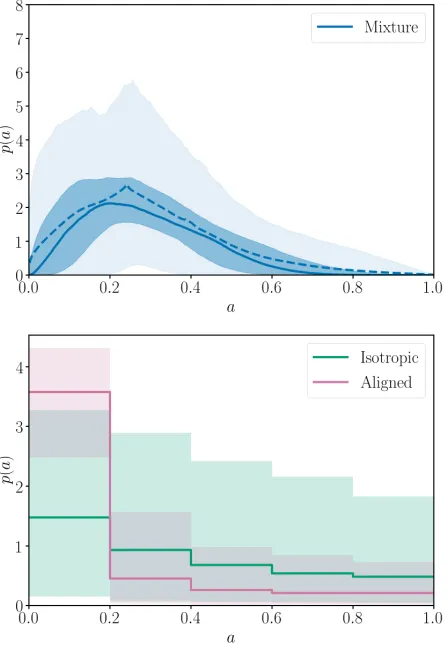
pro-duce a weak preference for certain spin-orbit misalign-ments (Rodriguez & Antonini 2018). All of our param-eterized models point to preferences against high spin magnitudes when the spin tilts are aligned with the or-bital angular momentum. In Section5, we find that the dimensionless spin magnitude inference prefers distribu-tions which decline as the spin magnitude increases from zero, but our ability to distinguish between assumed dis-tributions of spin orientation is very limited.
Observational constraints on the BBH merger rate ( Ab-bott et al. 2016b;Abbott et al. 2018) generally assume a rate density which is uniform in the comoving volume. As first shown inFishbach et al.(2018), it is also possible to search for redshift evolution in the rate density using current data. Different redshift-dependent evolutionary behavior is possible (Dominik et al. 2013; Mandel & de Mink 2016; Rodriguez et al. 2016a; Mapelli et al. 2017; Rodriguez & Loeb 2018) with different environ-ments and stellar evolution scenarios (O’Shaughnessy et al. 2010; Belczynski et al. 2016a). For instance, theoretical models of isolated evolution through com-mon envelope lead to a distribution of times to merger
p(tGW) ∝ t−GW1 (Dominik et al. 2012; Belczynski et al.
2016a). This would imply that many isolated binaries will coalesce near their formation redshift and produce a BBH merger rate that approximately tracks the star formation rate, peaking near z ∼ 2. We find in Sec-tion 4 that the current sample of BBH mergers does not provide enough information to confidently constrain any but the most extreme models. While we place more posterior mass on merger rates that increase with in-creasing redshift than those that decrease, the scenario of a uniform rate in comoving volume is comfortably within our constraints.
GW170817, the first binary neutron star merger ob-served through GW emission (Abbott et al. 2017e), was detected by GW observatories and associated with a short GRB (Abbott et al. 2017b)) in August of 2017. A subsequent post-merger transient (AT 2017gfo) was observed across the electromagnetic spectrum, from ra-dio (Alexander et al. 2017), NIR/optical (Coulter et al. 2017; Soares-Santos et al. 2017; Chornock et al. 2017;
Cowperthwaite et al. 2017;Nicholl et al. 2017;Pian et al. 2017), to X-ray (Troja et al. 2017;Margutti et al. 2017) and γ-ray (Abbott et al. 2017b; Goldstein et al. 2017;
Savchenko et al. 2017). Unfortunately, with only one confident detection, it is not yet possible to infer de-tails of binary neutron star populations more than to note that the gravitational-wave measurement is mostly compatible with the observed Galactic population (Ozel¨ et al. 2012). However, if GW170817 did form a black
hole, it would also occupy the lower mass gap described previously.
We structure the paper as follows. First, notation and models are established in Section2. Section3describes our modeling of the black hole mass distribution, fol-lowed by rate distributions and evolution in Section4. The black hole spin magnitude and orientation distribu-tions are discussed in Section 5. We conclude in Sec-tion 6. Studies of various systematics are presented in Appendix A. In Appendix B we present additional studies of spin distributions with model selection for a number of zero-parameter spin models and mixtures of spin orientations. To motivate and enable more detailed studies, we have established a repository of our samples and other derived products1.
2. DATA, NOTATION, AND MODELS
In this work, we analyze the population of 10 BBH merger events confidently identified in the first and sec-ond observing run (O1 and O2) (Abbott et al. 2018). We do not include marginal detections, but these likely have a minimal impact our conclusions here (Gaebel et al. 2018). Ordered roughly from smallest to most massive by source-frame chirp mass, the mergers considered in this paper are GW170608, GW151226, GW151012, GW170104, GW170814, GW170809, GW170818, GW150914, GW170823, and GW170729.
The individual properties of those 10 sources were in-ferred using a Bayesian framework, with results sum-marized inAbbott et al.(2018). For BBH systems, two waveform models have been used, both calibrated to nu-merical relativity simulations and incorporating spin ef-fects, albeit differently: IMRPhenomPv2 (Hannam et al. 2014;Husa et al. 2016;Khan et al. 2016), which includes an effective representation (Schmidt et al. 2015) of pre-cession effects, and SEOBNRv3 (Pan et al. 2014; Tarac-chini et al. 2014;Babak et al. 2017), which incorporates all spin degrees of freedom. The results presented in this work use IMRPhenomPv2; a discussion of potential systematic biases in our inference are discussed in Ap-pendixA. We also refer to Appendix B in (Abbott et al. 2018) for more details on comparisons between those two waveform families.
To assess the stability of our results to statistical ef-fects and systematic error we focus on one modestly exceptional event. Both GW151226 and GW170729 exhibit evidence for measurable black hole spin, but GW170729 in particular is an outlier by several other metrics as well. In addition to spins, it is also more
1 The data release for this work can be found athttps://dcc.
massive and more distant than any of the other events in the catalog. All events used in the population analysis have confident probabilities of astrophysical origin, but GW170729 is the least significant, having the smallest odds ratio of astrophysical versus noise origin (Abbott et al. 2018). As we describe in Sections 3 and 4, this event has an impact on our inferred merger rate versus both mass and redshift. To demonstrate the robustness of our result, we present these analyses twice: once using every event, and again omitting GW170729.
2.1. Binary Parameters
A coalescing compact binary in a quasi-circular or-bit can be completely characterized by its eight intrinsic parameters, namely its component massesmi and spins Si, and its seven extrinsic parameters: right ascension, declination, luminosity distance, coalescence time, and three Euler angles characterizing its orientation (e.g., inclination, orbital phase, and polarization). While bi-nary eccentricity is also a potentially observable quan-tity in BBH mergers, our ability to parameterize (Huerta et al. 2014, 2017;Klein et al. 2018;Hinder et al. 2018) and measure (Coughlin et al. 2015;Abbott et al. 2016a,
2017a; Lower et al. 2018) eccentricity is an area of ac-tive development. For low to moderate eccentricity at formation, binaries are expected to circularize (Peters 1964;Hinder et al. 2008) before entering the bandwidth of ground-based GW interferometers. We therefore as-sume zero eccentricity in our models.
In this work, we define the mass ratio asq=m2/m1 where m1 ≥ m2. The frequency of gravitational wave emission is directly related to the component masses. However, due to the expansion of spacetime as the grav-itational wave is propagating, the frequencies measured by the instrument are redshifted relative to those emit-ted at the source (Thorne 1983). We capture these ef-fects by distinguishing between masses as they would be measured in the source frame, denoted as above, and the redshifted masses, (1 +z)mi, which are measured in the detector frame. Meanwhile, the amplitude of the wave scales inversely with the luminosity distance (Misner et al. 1973). We use the GW measurement of the lumi-nosity distance to obtain the cosmological redshift and therefore convert between detector-frame and source-frame masses. We assume a fixed Planck 2015 (Planck Collaboration et al. 2016) cosmology throughout to con-vert between a source’s luminosity distance and its red-shift (Hogg 1999).
We characterize black hole spins using the dimension-less spin parameter χi =Si/m2
i. Of particular interest
are the magnitude of the dimensionless spin,ai =|χi|, and the tilt angle with respect to the orbital angular momentum, ˆL, given by costi = ˆL·χiˆ . We also de-fine an overall effective spin,χeff (Damour 2001;Racine
2008; Ajith et al. 2011), which is a combination of the individual spin components along to orbital angular mo-mentum:
χeff=
(χ1+qχ2)·Lˆ
1 +q . (1)
χeff is approximately proportional to the lowest order contribution to the GW waveform phase that contains spin for systems with similar masses. Additionally,χeff is conserved throughout the binary evolution to high accuracy (Racine 2008;Gerosa et al. 2015).
2.2. Model Features
To present general results, and to allow us to vary small subsets of parameters influencing the mass and spin distributions while leaving others fixed, we adopt the union of the parameterizations presented in Tal-bot & Thrane(2017);Fishbach & Holz(2017);Wysocki et al. (2018); Talbot & Thrane (2018); Fishbach et al.
(2018). The general model family has one parameter de-scribing the local merger rate,R0;8parameters to char-acterize the mass model; 3 to characterize each black hole’s spin distribution; and one parameter character-izing redshift dependence. We refer to the set of these population parameters as θ. All of the population pa-rameters introduced in this section are summarised in Table1.
2.3. Parameterized Mass Models
The power-law distribution considered previously ( Ab-bott et al. 2016b,2017c) modeled the BBH primary mass distribution as a one-parameter power-law, with fixed limits on the minimum and maximum allowed black hole mass. With our sample of ten binaries, we extend this analysis by considering three increasingly complex models for the distribution of black hole masses. The first extension, Model A (derived fromFishbach & Holz
(2017); Wysocki et al. (2018)), allows the maximum black hole mass mmax and the power-law index α to vary. In Model B (derived from Kovetz et al. (2017);
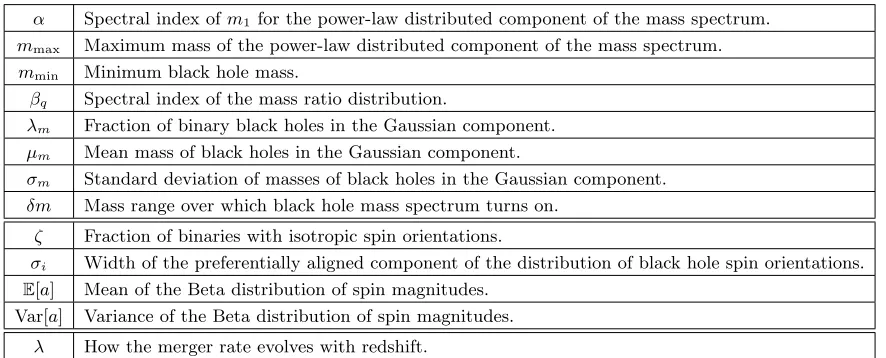
α Spectral index ofm1 for the power-law distributed component of the mass spectrum.
mmax Maximum mass of the power-law distributed component of the mass spectrum.
mmin Minimum black hole mass.
βq Spectral index of the mass ratio distribution.
λm Fraction of binary black holes in the Gaussian component.
µm Mean mass of black holes in the Gaussian component.
σm Standard deviation of masses of black holes in the Gaussian component.
δm Mass range over which black hole mass spectrum turns on.
ζ Fraction of binaries with isotropic spin orientations.
σi Width of the preferentially aligned component of the distribution of black hole spin orientations.
E[a] Mean of the Beta distribution of spin magnitudes. Var[a] Variance of the Beta distribution of spin magnitudes.
[image:11.612.85.528.60.239.2]λ How the merger rate evolves with redshift.
Table 1. Parameters describing the binary black hole population. See the text for a more thorough discussion and the functional forms of the models.
p(m1, m2|mmin, mmax, α, βq)∝
C(m1)m−α1 qβq ifm
min≤m2≤m1≤mmax
0 otherwise
, (2)
whereC(m1) is chosen so that the marginal distribution is a power law inm1: p(m1|mmin, mmax, α, βq) =m−α1 . Model A fixes mmin = 5M and βq = 0, whereas Model B fits for all four parameters. Equation2implies that the conditional mass ratio distribution is a power-law with p(q | m1) ∝ qβq. When β
q = 0, C(m1) ∝ 1/(m1 −mmin), as assumed in Abbott et al. (2016b,
2017c).
Model C (fromTalbot & Thrane(2018)) further builds upon the mass distribution in Equation2by allowing for a second, Gaussian component at high mass, as well as introducing smoothing scalesδm, which taper the hard edges of the low- and high-mass cutoffs of the primary
and secondary mass power-law. The second Gaussian component is designed to capture a possible build-up of high-mass black holes created from pulsational pair instability supernovae. The tapered low-mass smooth-ing reflects the fact that parameters such as metallicity probably blur the edge of the lower mass gap, if it exists. Model C therefore introduces four additional model pa-rameters, the mean, µm, and standard deviation, σm, of the Gaussian component,λm, the fraction of primary black holes in this Gaussian component, and δm the smoothing scale at the low mass end of the distribution.
The full form of this distribution is
p(m1|θ) =
(1−λm)A(θ)m−α1 Θ(mmax−m1) +λmB(θ) exp
−(m1−µm)
2
2σ2 m
S(m1, mmin, δm),
p(q|m1, θ) =C(m1, θ)qβqS(m2, mmin, δm).
(3)
The factors A, B, and C ensure each of the power-law component, Gaussian component, and mass ratio distri-butions are correctly normalized. Sis a smoothing func-tion which rises from zero atmminto one atmmin+δm as defined inTalbot & Thrane(2018). Θ is the Heaviside step function.
2.4. Parameterized Spin Models
The black hole spin distribution is decomposed into independent models of spin magnitudes,a, and orienta-tions,t. For simplicity and lacking compelling evidence to the contrary, we assume both black hole spin magni-tudes in a binary,ai, are drawn from a beta distribution (Wysocki et al. 2018):
p(ai|αa, βa) =
aαia−1(1−ai)βa−1 B(αa, βa)
We can alternatively parameterize the beta distribution using the mean (E[a]) and variance (Var[a]) of the dis-tribution, given by
E[a] = αa
αa+βa ;
Var[a] = αaβa
(αa+βa)2(αa+βa+ 1)
. (5)
We adopt a prior on the spin magnitude model param-eters which are uniform over the values of E[a] and
Var[a] which satisfy αa, βa ≥ 1, avoiding numerically-challenging singular spin distributions.
To describe the spin orientation, we assume that the tilt angles between each black hole spin and the orbital angular momentum, ti, are drawn from a mixture of two distributions: an isotropic component, and a prefer-entially aligned component, represented by a truncated Gaussian distribution in costipeaked at costi = 1 (
Tal-bot & Thrane 2017)
p(cost1,cost2|σ1, σ2, ζ) =
(1−ζ) 4
+2ζ
π
Y
i∈{1,2}
exp −(1−costi)2/(2σ2i)
σierf(
√
2/σi)
.
(6)
The parameterζdenotes the fraction of binaries which are preferentially aligned with the orbital angular mo-mentum; ζ = 1 implies all black hole spins are prefer-entially aligned andζ= 0 is an isotropic distribution of spin orientations. The typical degree of spin misalign-ment is represented by the σi. For spin orientations we explore two parameterized families of models:
• Gaussian (G):ζ = 1.
• Mixture (M): 0≤ζ≤1.
The Gaussian model is motivated by formation in iso-lated binary evolution, with significant natal misalign-ment, while the mixture scenarios allow for an arbi-trary combination of this scenario and randomly ori-ented spins, which arise naturally in dynamical forma-tion.
2.5. Redshift Evolution Models
The previous two subsections described the probabil-ity distributions of intrinsic parametersp(ξ) (i.e. masses and spins) that characterize the population of BBHs. In addition, we also measure the value of one extrin-sic parameter of the population: the overall merger rate
density R. The models described in the previous two subsections assume that the distribution of intrinsic pa-rameters is independent of cosmological redshift z, at least over the redshift range accessible to the LIGO and Virgo interferometers during the first two observing runs (z . 1). However, we consider an additional model in which the overall event rate evolves with redshift. We followFishbach et al.(2018) by parameterizing the evolving merger rate densityR(z) in the comoving frame by
R(z|λ) =R0(1 +z) λ
, (7)
where R0 is the rate density at z = 0. In this model,
λ= 0 corresponds to a merger rate density that is uni-form in comoving volume and source-frame time, while
λ∼3 corresponds to a merger rate that approximately follows the star-formation rate in the redshift range rel-evant to the detections in O1 and O2 (Madau & Dick-inson 2014). Various BBH formation channels predict different merger rate histories, ranging from rate densi-ties that will peak in the future (λ <0) to rate densities that peak earlier than the star-formation rate (λ&3). These depend on the formation rate history and the dis-tribution of delay times between formation and redshift. In cases where we do not explicitly write the event rate density asR(z), it is assumed that the rate densityRis constant in comoving volume and source-frame time.
2.6. Statistical Framework
The general model family, including the distributions of masses, spins and merger redshift, is therefore given by the distribution
dN
dξdz(θ) =R(z)
dV c dz (z)
T obs
1 +zp(ξ|θ), (8)
where N is the total number of mergers that occur within the detection horizon (i.e. the maximum red-shift considered) over the total observing time,Tobs, as measured in the detector-frame, θ is the collection of all hyper-parameters that characterize the distribution, anddVc/dzis the differential comoving volume per unit redshift. The merger rate densityR(z) is related toN
by
R(z) = dN dVcdt
(z), (9)
where t is the time in the source-frame, so that Eq. 8
can be written equivalently in terms of the merger rate density:
dR
dξ (z|θ) =R0p(ξ|θ)(1 +z)
λ. (10)
(Loredo 2004;Abbott et al. 2016b;Wysocki et al. 2018;
Fishbach et al. 2018;Mandel et al. 2018;Mortlock et al. 2018). The likelihood of the observed GW data given the population hyperparametersθthat describe the gen-eral astrophysical distribution,dN/dξdz, is given by the inhomogeneous Poisson likelihood:
L({dn}|θ)∝
e−µ(θ)
Nobs
Y
n=1 Z
L(dn|ξ, z)
dN
dξdz(θ) dξdz, (11)
where µ(θ) is the expected number of detections as a function of the population hyper-parameters,Nobsis the number of detections, and L(dn|ξ, z) is the individual-event likelihood for thenth detection having parameters
ξ, z. In practice, we sample the likelihood L(dn|ξ, z) using the parameter estimation pipeline LALInfer-ence (Veitch et al. 2015). Since LALInference gives us a set of posterior samples for each event, we first di-vide out the priors used in the individual-event analyses before applying Eq.11(Hogg et al. 2010;Mandel 2010). We note that the hyperparameter likelihood given by Eq. 11 reduces to the likelihood used in the O1 mass distribution analysis (Eq. D10 of Abbott et al. 2016b), which fit only for the shape, not the rate/ normalization of the mass distribution, if one marginalizes over the rate parameter with a flat-in-log prior p(R0)∝1/R0 (
Fish-bach et al. 2018; Mandel et al. 2018). For consistency with previous analyses, we adopt a flat-in-log prior on the rate parameter throughout this work.
The normalization factor of the posterior density in Bayes’ theorem is the evidence — it is the probability of the data given the model. We are interested in the preferences of the data for one model versus another. This preference is encoded in the Bayes factor, or the ratio of evidences. The odds ratio is the Bayes factor multiplied by their ratio of the model prior probabilities.
In all cases presented here, the prior model probabilities are assumed to be equal, and odds ratios are equivalent to Bayes factors.
In order to calculate the expected number of detec-tionsµ(θ), we must understand the selection effects of our detectors. The sensitivity of GW detectors is a strong function of the binary masses and distance, and also varies with spin. For any binary, we define the sen-sitive spacetime volumeV T(ξ) of a network with a given sensitivity to be
V T(ξ) =Tobs Z ∞
0
f(z|ξ)dVc dz
1
1 +zdz, (12)
where the sensitivity is assumed to be constant over the observing time,Tobs, as measured in the detector-frame and f(z|ξ) is the detection probability of a BBH with the given parameter setξat redshiftz (O’Shaughnessy et al. 2010). The factor of 1/(1 +z) arises from the dif-ference in clocks timed between the source frame and the detector frame. For a given population with hyper-parametersθ, we can calculate the total observed space-time volume
hV Tiθ=
Z
ξ
p(ξ|θ)V T(ξ)dξ, (13)
wherep(ξ|θ) describes the underlying distribution of the intrinsic parameters. We performed large scale simula-tion runs wherein the spacetime volume in the above equation is estimated by Monte-Carlo integration ( Ti-wari 2018) — these runs are restricted to have no BH less massive than 5 M. We then use a semi-analytic prescription, calibrated to the simulation results, to de-rive thehV Tiθ for specific hyper-parameters.
Allowing the merger rate to evolve with redshift, the expected number of detections is given by
µ(θ) =Tobs Z
ξ Z ∞
0
p(ξ|θ)f(z|ξ)R(z)dVc dz
1
1 +zdzdξ. (14)
If the merger rate does not evolve with redshift, i.e.,
R(z) =R0, this reduces toµ(θ) =R0hV Tiθ.
Where not fixed, we adopt uniform priors on popu-lation parameters describing the models. Unless oth-erwise noted, for the event rate distribution we use a log-uniform distribution in R0, bounded between [10−1,103]. While this is a different form than the priors adopted in Abbott et al. (2018), we note that similar results are obtained on the rates (see Sec. 4),
power law index) over the posteriors obtained for the model parameters:
p(ξnew|ξobserved) = Z
p(ξnew|θ)p(θ|ξobserved)dθ (15)
It is a predictor for future merger valuesξnew given ob-served dataξobservedand factors in the uncertainties im-posed by the posterior on the model parameters. Note that the PPD does not incorporate the detector sensi-tivity, and therefore is not a straightforward predictor of the properties of futureobserved mergers.
3. THE MASS DISTRIBUTION
For context, Figure 4 in Abbott et al. (2018) illus-trates the inferred masses for all of the significant BBH observations identified in our GW surveys in O1 and O2. Despite at least moderate sensitivity to total masses be-tween 0.1 – 500 M, current observations occupy only a portion of the binary mass parameter space. Notably, we have not yet observed a pair of very massive (e.g., 100
M) black holes, a binary which is bounded away from equal mass in its posterior, or a binary with a component mass confidently below 5M. In our survey, we also find a preponderance of observations at higher masses: six with significant posterior support above 30M. In this section, we attempt to reconstruct the binary black hole merger rate as a function of the component masses us-ing parameterized models. Table2summarizes the mass models adopted from Section2.3and the prior distribu-tions for each of the parameters in those models.
3.1. Parameterized Modeling Results
Figure 1 shows our updated inference for the com-pact binary primary mass m1 and mass ratio q distri-butions for several increasingly general population mod-els. In addition to inferring the mass distribution, all of these calculations self-consistently marginalize over the parameterized spin distribution presented in Section 5
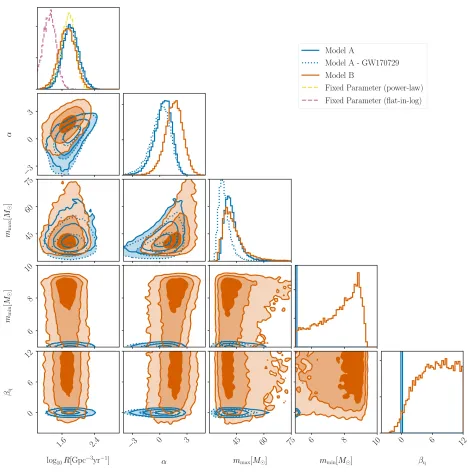
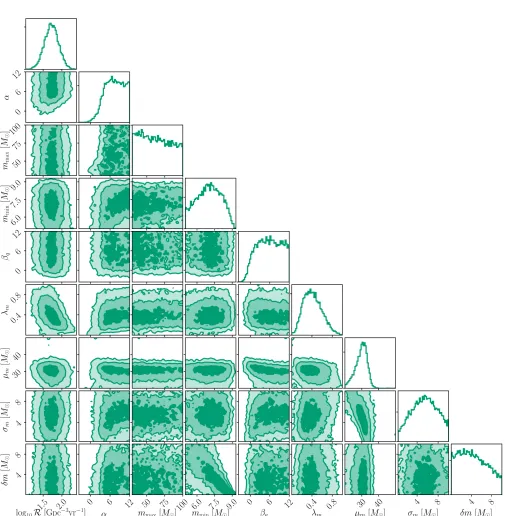
and the merger rate. Figures2and3show the posterior distribution on selected model hyperparameters.
If we assume the black hole masses follow a power-law distributed and fix the minimum black hole mass to be mmin = 5M (Model A), we find α = 0.4+1−1..39 and
mmax = 41.6+9−4..05M. In Model B we infer the power-law index of the primary mass to be α= 1.6+1−1..57 with corresponding limits mmin = 7.9−+12..25M and mmax = 42.0+15−5.7.0M (unless otherwise stated all credible inter-vals are symmetric 90% interinter-vals).
Figure3, shows the posterior over the population pa-rameters present in A and B, as well as a second, Gaus-sian population parameterized withmmax andσm. λm
is the mixing fraction of binaries in the Gaussian pop-ulation versus the power law, with λm = 0 indicating only the power law component. The Gaussian com-ponent is centered at µm = 30.1+4−6..59M, has a width
σm = 5.5+3−4..80M, and is consistent with the parame-ters of the seven highest mass events in our sample as seen in Figure4. Also as a consequence of this mixture, the inferred power-law is much steeperα= 7.3+4−4..26than Models A or B with and the posterior distribution re-turns the prior for α&4. This in turn means that we cannot constrain the parametermmax in Model C since the power-law component has negligible support above
∼45M (see the upper panel of Figure 1). In the in-termediate regime, ∼15M−25M, Model C infers a smaller rate than Models A or B as a consequence of the steeper power-law behavior. The low mass smoothing allowed in this model also weakens constraints we can place on the minimum black hole mass, in this model we findmmin= 7.0+1−1..67M.
All models feature a parameter, mmax, which defines a cutoff of the power law. However, the interpretation of that parameter within Model C is not a straightforward comparison with Models A and B, due to the presence of the Gaussian component at high mass and the large value of the power-law spectral index. Instead, to com-pare those two features, we compute the 99th percentile of the mass distribution inferred from the model PPDs (see Equation15). Model A obtains 43.8 M, Model B obtains 42.8M, and Model C obtains 41.8M. There-fore, all models self-consistently infer a dearth of black holes above∼45M. This is determined by the lower limit for the mass of the most massive black hole in the sample becausemmaxcan beno smallerthan this value. Similarly, the models which allowmmin to vary (B and C) disfavor populations withmminabove '9M. This parameter is close to the largest allowed mass for the least massive black hole in the sample, for similar rea-sons.
The lower limits we place on mmin are dominated by our prior choices that constrain mmin ∈[5,10]M (see Table 2). For example, in Figure 2, the posterior on
mminbecomes flat asmminapproaches the prior bound-ary at 5M. Given current sensitivities, this is to be expected (Littenberg et al. 2015; Mandel et al. 2015). In the inspiral-dominated regime, the sensitive time-volume scales asV T ∼m15/6 (Finn & Chernoff 1993); extending our inferred mass distributions and merger rates into the possible lower black hole mass gap from 3–5M (Ozel et al. 2010¨ ; Farr et al. 2011b; Kreidberg
Mass Parameters Spin Parameters Model α mmax mmin βq λm µm σm δm E[a] Var[a] ζ σi
[image:15.612.70.546.62.129.2]A [-4, 12] [30, 100] 5 0 0 N/A N/A N/A [0, 1] [0, 0.25] 1 [0, 10] B [-4, 12] [30, 100] [5, 10] [-4, 12] 0 N/A N/A N/A [0, 1] [0, 0.25] 1 [0, 10] C [-4, 12] [30, 100] [5, 10] [-4, 12] [0, 1] [20, 50] (0, 10] [0, 10] [0, 1] [0, 0.25] [0, 1] [0, 4]
Table 2. Summary of models used in Sections3, 4, and5, with the prior ranges for the population parameters. The fixed parameters are in bold. Each of these distributions is uniform over the stated range. All models in this Section assume rates which are uniform in the comoving volume (λ = 0). The lower limit on mmin is chosen to be consistent with Abbott et al. (2018).
Figure 1. Inferred differential merger rate as a function of primary mass,m1, and mass ratio,q, for three different assumptions. For each of the three increasingly complex assumptions A, B, C described in the text we show the PPD (dashed) and median (solid), plus 50% and 90% symmetric credible intervals (shaded regions), for the differential rate. The results shown marginalize over the spin distribution model. The falloff at small masses in models B and C is driven by our choice of the prior limits on themmin parameter (see Table2). All three models give consistent mass distributions within their 90% credible intervals over a broad range of masses, consistent with their near-unity evidence ratios (Table3); in particular, the peaks and trough seen in Model C, while suggestive, are not identified at high credibility in the mass distribution.
constraints on the presence or absence of a mass gap at low black hole mass.
Models B and C also allow the distribution of mass ra-tios to vary according to βq. In these cases the inferred mass-ratio distribution favors comparable-mass binaries (i.e., distributions with most support near q ' 1), see panel two of Figure 1. Within the context of our pa-rameterization, we find βq = 6.7+4−5..89 for Model B and
βq = 5.8+5−5..58 for Model C. These values are consistent with each other and are bounded above zero at 95%
con-fidence, thus implying that the mass ratio distribution is nearly flat or declining with more extreme mass ra-tios. The posterior on βq returns the prior for βq &4. Thus, we cannot say much about the relative likelihood of asymmetric binaries, beyond their overall rarity.
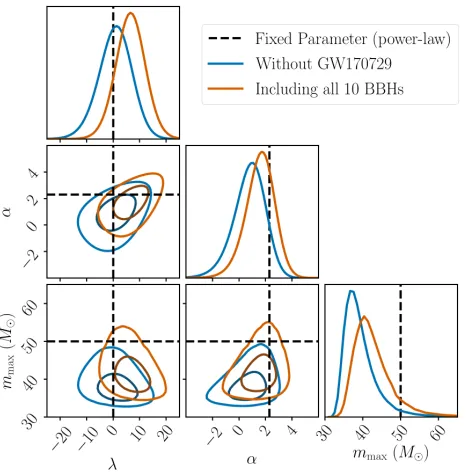
[image:15.612.58.527.204.493.2]ad-Figure 2. One- and two-dimensional posterior distributions for the hyperparameters describing Models A and B. Large values ofαcorrespond to a mass distribution which rapidly decays with increasing mass. Large values ofβcorrespond to a mass-ratio distribution which prefers equal mass binaries. Also shown is the one-dimensional posterior distribution for the merger rate discussed inAbbott et al.(2018), and the stability of Model A to the removal of the GW170729 event.
dition to the power laws modeled in A and B. To deter-mine preference amongst the three models presented in this Section, we compute the Bayes factors comparing the mass models using a nested sampler (Skilling 2004),
CPNest (Veitch et al. 2017). These are shown in Ta-ble 3. Model B, which allows mmin and βq to vary is preferred over Model A (ln BFAB = −0.97). To isolate the contributions of the Gaussian component and low mass smoothing in Model C, we compute the
Savage-Dickey density ratio, p(θ= 0)/pprior(θ= 0), equivalent to the Bayes factor comparing without and with the fea-ture. The model including a Gaussian component in ad-dition to the power-law distribution is preferred over the pure power-law models (ln BFλC=0 =−2.12); neverthe-less, all models infer mass distributions that agree within their 90% credible bounds (see Figure1). We are unable to distinguish between a gradual or sharp cutoff at low mass (ln BFδm=0
[image:16.612.54.527.71.544.2]