0022-538X187/051609-06$02.00/0
CopyrightX 1987, AmericanSocietyfor Microbiology
Mutations
within the Proteolytic
Cleavage
Site of the
Rous
Sarcoma
Virus
Glycoprotein
That Block
Processing
to
gp85
and
gp37
LAUTARO G. PEREZAND ERIC HUNTER*
DepartmentofMicrobiology, Universityof Alabama atBirmingham, Birmingham,Alabama 35294 Received 8October 1986/Accepted 5 February 1987
We have investigated the specificity of the proteolytic cleavage ofthe Rous sarcoma virus glycoprotein
precursorbyintroducingtwomutations into the putative cleavage region (Arg-Arg-Lys-Arg). We show that neither a deletion of the cleavage sequence nor a glutamic acid for lysinesubstitution altered intracellular transportorsurfaceexpressionof theenvgeneproducts. However,both the four-amino-acid deletionandthe glutamic acid substitution block processing of theenvprecursor.Susceptibility oftheglutamic acid-substituted
envprecursortoproteasesindicated that tertiary proteinstructurewasunaffected. While inhibitor experiments
suggested thatmorethanoneendopeptidase might be capable of mediating the proteolyticcleavage,the results
presentedherepointtothepresencein the Golgiapparatusofanovelendopeptidase, required for retroviral
glycoprotein cleavage, that hasa highspecfficity for lysine-containing peptides.
The primary product of the Rous sarcoma virus (RSV)
envelopegene (env)isa precursorprotein of 95 kilodaltons
(Pr95env). During biosynthesis, this precursoris
proteolyti-cally cleavedto yield thetwoglycoproteinsgp85 and gp37, whichremain associated by disulfide bondsasacomplexon theviralmembrane (3, 5, 6, 12, 17, 21, 26, 27). InPr95efVthe cleavage site occurs after a sequence of four basic amino
acids,arginine-arginine-lysine-arginine,which resembles the cleavage site ofmany hormoneprecursors and other
retro-virus env precursors (9, 11, 14, 16, 28, 32, 36). Inprevious
studieswith radioactivelylabeled sugarsand asimian virus
40(SV40) expression vector,wefound that the cleavage of
pr95envoccurred in the absence of theremainder of the viral proteins in alate Golgi compartment in CV-1 cells (39), in
agreementwith previous studies of RSV-infected avian cells (21).
The processing of precursor polypeptides to produce biologically active proteins occurs even in unicellular eucaryotes,andatleasttwoeucaryotic endopeptidases,with specificity forapair of basicamino acids (lysine-arginineor
arginine-lysine) similarto thosepresentin thecleavage site of the RSV env precursor, have been identified in Golgi
compartments (8, 15). We have, therefore, investigated whether a protease with similar biological specificity is involved in the processing of the Pr95env. Using synthetic oligonucleotides andasubclone of the RSV envgeneinthe bacteriophage M13, we have constructed two mutants. In
onethecodon forlysineinthecleavage sitewaschangedto a glutamic acid, and in the second the 12 nucleotides
encoding the four basic amino acids of this region were
deleted. Theresulting mutantenvgenes have been inserted
intoanSV40late-replacementvectorforanalysisof
expres-sion and transport. We have found that neither of these
mutations altered biosynthesis, intracellular transport, or
surface expression ofthe RSVglycoproteins in CV-1 cells.
The deletion of the cleavage site results in a precursor
protein that is not cleavable either intracellularly or by
addition of extracellularproteases. The replacement of ly-sine forglutamicacid results in greater than 90% reductionin
intracellular proteolytic processing of the env precursor,
eventhoughtheuncleavedprecursorishighlysusceptibleto
*Correspondingauthor.
cleavage by extracellular proteases. Our results show that thelysinepresentin the cleavage site of theenvprecursoris
essential for the intracellular processing by the Golgi endopeptidase. This enzyme, unlike those described
previ-ously, appears to be specific for lysine-containing basic dipeptides and unable to cleave thosecontaining only
argi-nine.
MATERIALS AND METHODS
DNAs, viruses, and cells. The subcloning of the RSV env gene in the bacteriophage M13, the propagation of the clones, and the SV40 expression system for the glycopro-teins has been described elsewhere (39; G. L. Davis and E. Hunter, J. Cell Biol., in press). African green monkey
kidney cells(CV-1) weregrownin Dulbeccomodified Eagle
medium supplemented with 10% fetal calf serum. All the
DNA plasmids were propagated in the DH-1 strain of
Escherichia coli.
Oligonucleotide site-directed mutagenesis and expression of themutantgenesinCV-1 cells from the late promoter ofSV40. The procedure used for the mutagenesis of the cleavage region was essentially that described by Zoller and Smith
(40), with the following modifications. Purification of the
full-length double-stranded DNA from the single-stranded template was not made; instead, dilutions of the priming reaction were directly used to transform the CaCl2-treated JM 101 strain of E. coli. Theplaques obtained were
trans-ferred to nitrocellulose filters, and the bound phage DNAs
were hybridized to the mutagenic primerlabeled with 32p. The phage of those plaquesthatremained as strongsignals
afterthe filterswere washedat60°Cweresequencedbythe
chain-terminator method of Sanger et al. (33, 34). The
EcoRI-XbaI restrictionfragment containingthe3' end ofthe
RSV env gene was recovered from the replicativeform of mutant phage and substitutedfor the wild-type fragmentin
the SV40 expression vector. CV-1 cells were transfected
with themutantRSVenvgenesandahelper SV40DNAas
described previously (39). The viral stocks obtained were
usedto infect CV-1 cells and monitor theexpressionofthe
RSV envmutantglycoproteins.
Immunofluorescence staining of the infected cells,
radio-labeling, immunoprecipitation, and sodium dodecyl
sulfate-polyacrylamidegelelectrophoresis. Rabbitantibodiesagainst
1609
on November 10, 2019 by guest
http://jvi.asm.org/
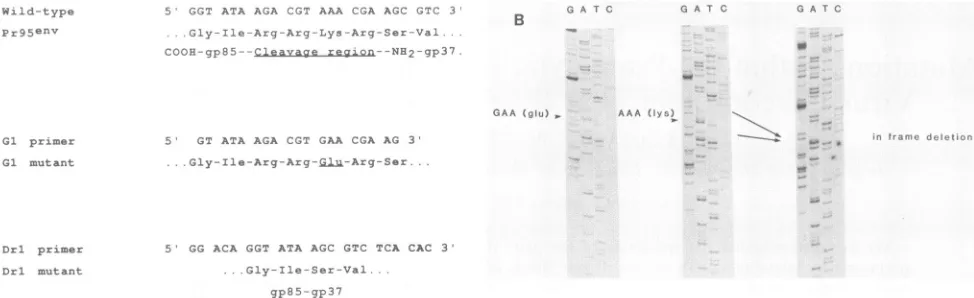
5 GGT ATA AGA CGT AAA CCA AGC GTC 3 .. Gly--I le Arg-Arg-Lys-Arq Ser-Val COOH-gp85 -Cleiavage region--NH2 gp37
5 GT ATA AGA CGT GAA CGA AG 3' ...Gly- Ile-Arg-Arg-gjl-Arg-Ser...
5 GG ACA GGT ATA AGC GTC TCA CAC 3
Gly-Ile-Ser-Val
gp85 qp3?
B C A T C
GAA (aIu) ,
GA T C Ci AT C
[image:2.612.68.555.70.219.2]AAA (lys)
FIG. 1. (A)Proteinsequenceof thecleavage regioninwild-typeandmutantPr95envpolypeptides. Whilethe amino terminus ofgp37has beendetermined experimentallytobeaserine(14),theprecise carboxyterminus ofgp85isnotknown but ispredictedto beanisoleucine
residue since with both the orthomyxovirus HAs and peptide hormones the basic residues within the cleavage site are removed by carboxypeptidaseaction(4,15, 18).Thesequencesof themutagenic primersGlandDrlused tomodifythisregionand therespectivemutant polypeptide sequences are shown. (B)Dideoxy sequencingof the M13 envclones carrying envgenes in which the cleavage regionwas
mutatedbyoligonucleotide-directed mutagenesis. Left,GImutantsequence(a singlebasechangesubstituteslysineforglutamic acid); center,
sequenceoftheenvwild-type cleavage region; right, Drlmutant(in-framedeletion of thecleavage region).
gp85 and gp37 were used for staining of fixed cells and for
immunoprecipitation of the 3H-labeled proteins in the in-fected cells, asdescribed previously (14, 39). For
immuno-fluorescencestaining of unfixed cells,achickenantiserum of
RSVwasused.
Treatment of infected cells with protease inhibitors. The lysosomal protease inhibitors chloroquine and leupeptin, and soybean trypsin inhibitor (SBTI) were added to the
culturemedium of infected cells insomeexperiments.
Chlo-roquine and leupeptin werepresent at 100 and 20 ,uM final concentrations, respectively (1, 10, 22, 29). SBTIwasadded at a 100-,ug/ml final concentration. The inhibitors were present in the cell medium 2 h before the [3H]leucine pulse-labelingand maintainedduring the chase period (Davis andHunter, in press).
External protease treatment of infected cells. At 48 h postinfection, CV-1 cells in 35-mm plateswerepulsed for 15
min with [3H]leucine and then chased for 3 h in complete mediumtoallowthe accumulation of labeled proteinsonthe
cellsurface. After thisperiod, cell monolayerswerewashed
threetimes with serum-freemedium, before the addition of 5, 10, or 20 jig of trypsin (Worthington Diagnostics, Free-hold, N.J.)perml,in serum-free mediumatpH 9.Thecells
were incubated in the presence oftrypsin at 4°C for 1 h.
SBTI(200 jig/ml)wasaddedto stopthedigestions, and then cells were lysed and immunoprecipitated as described
above.
RESULTS
Site-directed mutagenesis ofthecleavage region inPr95e"v. During biosynthesis of the RSV env gene products, the
precursor polypeptide Pr95env is proteolytically cleaved to
gp85 and gp37. Although the carboxy-terminal sequenceof gp85 has not been determined experimentally,
amino-terminal sequencing ofgp37located the cleavage site aftera
sequenceof four basicamino acids:
arginine-arginine-lysine-arginine (14; Fig. 1A). To modify the cleavage region of
Pr95env two synthetic oligonucleotides were designed. A 20-merwas used to change the firstA (nucleotide 6264) of
the codon for lysine (AAA) to a G, creating a codon for glutamic acid (GAA). Accordingtoproteinstructure
predic-tions, this change does notalter either the protein confor-mation (a turn), or the hydrophilicity of this region. This
mutantwasdesignated Gi (Fig. 1A). A 23-merwasused to
delete the 12 nucleotides that encode the four basic amino acids adjacentto the cleavage site. Thismutant was
desig-natedDrl (Fig. 1A).Figure 1B shows the DNAsequenceof the mutated and wild-type regions. The env gene EcoRI-XbaIrestrictionfragments containing the modifiedcleavage region were substituted for the wild-type fragment in the
SV40envexpressionvector, asdescribed elsewhere (Davis
andHunter, inpress).
Intracellular and surface expression of the modified env
glycoproteincomplexes inCV-1cells.The recombinantSV40 vector DNAs carrying the modified RSV env genes were
cotransfected into CV-1 cells with helper SV40 DNA (dl1055) to obtain viral stocks. Expression was initially
measuredby indirect immunofluorescence staining of CV-1 monolayers infected with these viral stocks. Figure 2 (left) shows thepatternof intracellular fluorescence displayedby cells infected with SV40 vectors containing the wild-type and modified envgenes. A similarfluorescencepatternwas
observed in bothmutantandwild-type infected cells; bright reticulated cytoplasmic staining together with a clear ring
around nucleus defined the rough endoplasmic reticulum, and thebrightareaadjacenttothenucleus defined theGolgi complex(39). These results indicate that the modificationsto
thecleavage site donotalter theexpression andintracellular
transport of the RSV env complex to the Golgi apparatus.
Surface immunofluorescence staining of unfixed infected cells with chicken anti-RSV Prague C antiserum showed immunofluorescence of equal intensity to that of the wild
type(Fig. 2,right), proving that the modified viral glycopro-teinswereexpressedonthecellsurface inasimilarmanner tothewild-type viral complex. Thus, the changes created in the cleavage site of Pr95efV did not affect intracellular
transport or surface expression of the RSVenvgene
prod-ucts.
Processing of themodifiedPr95env in CV-1 cells. To com-parethe rate ofprocessing of the pr95env proteins carrying changes in the cleavage region with that of the wild-type
precursor, CV-1 cells were pulse-labeled with
[3H]leucine
for 15 min and chased for periods of0 to8 h. The labeled
A Wild-type
Pr9senv
GI primer Gl mutant
Dr1 primer Dr1 mutant
on November 10, 2019 by guest
http://jvi.asm.org/
glycoproteins were immunoprecipitated with an anti-env rabbit antiserum and electrophoresed in a sodium dodecyl sulfate-polyacrylamide (10%) gel. Figure 3 shows the fluorogram of such an experiment. It can be seen that in wild-type-infected cells only the precursor protein Pr95env was labeled after a 15-min pulse. This was processed to the final products (gp85 and gp37) during the chase periods (Fig. 3, left). An identically sized Pr95efV precursor was labeled duringthe 15-min pulse of mutant Gl-infected cells, but in contrast to the wild type this precursor was processed to a higher-molecular-weight product during the chase (Fig. 3, center). A minor fraction of the Gl mutant protein was processed to gp85 and gp37, but most of it remained uncleaved, as the slower migrating form. The higher-molecular-weight form of the env gene product (approxi-mately120,000) would be expected if the unprocessed pre-cursor were terminally glycosylated to yield a molecule equivalentin size to the sum of the terminally glycosylated gp85 and gp37 molecules. Indeed, unlike Pr95efV, the 120-kDa product can be labeled with [3H]fucose, a terminal sugar that is normally only added to the env gene products after cleavage (39; data not shown). This result, therefore, constitutesthe first evidence that lysine plays a critical role in the recognition of the cleavage site by the cellular endopeptidasethatprocessesPr95env.
Ananalysis of the processing of the Drl mutant Pr95efV, in
rnte- na Su r a c e
W Id-type
G1
Dr1
FIG. 2. Indirectimmunofluorescence of CV-1 cells infected with
anSV40vectorcontaining wild-type, Gl,andDrlmutantenvgenes.
Left, Internal immunofluorescence observed when ethanol-acetic acid-fixed cellswerereacted first witharabbitantibodytogp85and then withafluorescein-labeled goat anti-rabbit immunoglobulin G
antibody. Right, Cell-surface immunofluorescence observed when unfixed cells were reacted sequentially with chicken antibody to RSVPragueC and rabbitantibodytochickenimmunoglobulinG. In both setsof immunofluorescence stainingexperiments, themutant envgene-expressing cellswere indistinguishable from those of the
wild-typeenvgene.
Wild - type G1 mutant Drl mutant
p PfC p P/C p p/ c
1 5 2 4 6 8 15 2 4 6 8 15 2 4 6 8
_40 m
Pr95
9p85 "
gp37
FIG. 3. Comparison ofthe rateof synthesisandprocesing of the wild-type and mutant env gene products expressed from the late promoterof SV40 in CV-1 cells. The fluorogram ofasodiumdodecyl sulfate-polyacrylamide gel electrophoresis (10% polyacrylamide) usedtoseparatetheimmunoprecipitated labeled proteins is shown. Left, Synthesis and processing ofenvwildtype; center, synthesis
and processing of mutant Gl; right, synthesis and processing of mutant Drl. P, 15-min pulse with [3H]leucine; P/C, 15-min pulse with[3H]leucinefollowed byachaseof2, 4, 6, or 8 h, as shown.
which the cleavage site is deleted, revealed that this precur-sor was similarly processed to theterminally glycosylated, slowly migrating form observedwith mutantGl. However, in contrast tothelatter, cleavagewascompletely abolished, and nogp85orgp37wasobserved(Fig. 3, right). This result indicatesthat theproteolytic cleavage of pr95envoccurs at a highly specific sequence that is defined by the four deleted
amino
acids.
Mutant Gl glycoprotein is susceptible to cleavage by an externalprotease. Surface immunofluorescence staining and theterminallyglycosylated size ofthechaseproducts in cells expressing the Gl mutant
polypeptide
showed that this mature uncleavedglycoprotein
was present on the cell surface. Todetermine
whether the lack of cleavage wasbecause of an alteration in a
specific recognition of
the cleavageregion
orbecause ofanalterationintertiary
struc-ture that sterically
prevented
cleavage, we tested whether the matureproteinwas susceptibletothe addition ofexter-nal proteases. While the
glutamic
acid substitutionreduces the length oftheuninterrupted
basic residues it does notabolishthepresenceofthree
potential trypsin cleavage
sites. Thus, cells infected with both mutant andwild-type
con-structions were
pulsed
with[3H]leucine
for 15 min and chased for 3htoallowaccumulation of the labeledproducts
atthecell surface. After this
period, trypsin
at5, 10, and 20 ,ug/mlwasadded,and the cellswereincubatedat4°C
for1h. After the addition ofSBTI,
cells werelysed
andim-munoprecipitated.
Theresultsof
thisexperiment
areshowninFig. 4. Treatmentof
wild-type
gp85
andgp37
withtrypsin
has noeffectonthe
migration
of thesematureviralproteins
at any of the concentrations
used, indicating
that on thesurfacesofinfected cells
they
are not substratesfortrypsin
(Fig. 4,lanes 1to4).The
higher-molecular-weight product
of0
0
0
so11
lw
on November 10, 2019 by guest
http://jvi.asm.org/
[image:3.612.333.540.68.287.2] [image:3.612.57.296.341.621.2]t 2 3 4 5 6 7 8 9 10
Pr95 a
s,
to * *gp85
gp37 > 4 4
FIG. 4. Extracellularprocessing ofmutantGlPr95envafter treat-ment withtrypsin.Infectedcells werepulse-labeled for15min with
[3H]leucine and then chased in complete medium for 3 h, as described in Materials and Methods,toallow surfaceexpression of thelabeled protein. Lanes;1to4,wild-typeenvproduct;5to8,Gl mutantPr95env; 9 and 10, Drl mutant. The cells werethen overlaid with 2 ml ofserum-free medium containing 0, 5, 10, or20 ,ugof trypsin perml(lanes 1and5;2and6; 3, 7, and9;or4, 8,and 10, respectively. Wild-type gp85 and gp37werecompletely resistantto trypsindigestion even at the highest concentration (lane 4), whereas the Glprg95envwascleaved at the lowest(5-,ug/ml)concentration of trypsin (lane 6).
mutantGi (Fig. 4, lane 5),on theotherhand, iscleavedto
gp85-andgp37-sizedproductseven atthelowest
concentra-tion of trypsin used (Fig. 4, lanes 6 to 8). These results support the idea that the substitution of glutamic acid for lysine in thecleavage region, rather than a lack of accessi-bility of the enzyme to the site, is responsible for the Gl phenotype. The Drl mutant polypeptide, in contrast, is completely resistantto trypsin digestionatthehighest con-centration(20,ug/ml), supporting the concept that the cleav-age site is the sole trypsin-sensitive region in the mature glycoprotein.
Residual cleavage of the mutant Gl polypeptide occurs intracellularly. Because the mutant GlPr95env is accessible
to external proteases (as demonstrated above), we were interestedindetermining the nature of the residual cleavage observed with this mutant protein. Three possibilities ex-isted: the cleavage was mediated by extracellular serum protease, the normalprotease possessed a broad specificity andwascutting atthe remaining basic amino acid residues,
or an alternative microsomal enzyme was involved. The following experiments were therefore carried out. Infected cells were pulse-labeled with[3H]leucine and chased in the presenceof chloroquine, leupeptin, and SBTI, as described in Materials and Methods. Even when all three of these protease inhibitors were present during the pulse-chase period,thewild-typePr95envwasprocessed normally to gp85 andgp37 (Fig. SA), although an increase in the mobility of
both
gp85
andgp37
was observed. The smallerapparent
molecularweightofthesetwopolypeptides probably reflects
an inhibition ofsome terminalglycosylation events as it is
seenwith theionophoremonensin(2).Incontrast tothe wild type, residual cleavage of the Gl polypeptide was not
observed in the presence of all threeproteaseinhibitors
(Fig.
5A). No
gp85/gp37
bands were visible, and the terminalglycosylateduncleaved precursor showedasimilar decrease in molecular weight to the wild-type cleaved products, so
that itnowcomigratedwith thePr95efVband(Fig.5A).In the absence of inhibitors or in the presence of leupeptin and SBTI alone, the residual cleavage was observed (Fig. 5), suggestingthat its inhibition was due to
chloroquine.
Thisdrug
doesnotaffect cell-surface expressionof the envgene products (Davis and Hunter, in press), but because it is permeable tobiologicalmembranes andbecause it is knownto inhibit the protease cathepsin B (22, 38), these results suggest that the residualprocessing of theGlPr95efVoccurs
intracellularly rather thanonthe cell surface. Furthermore, the fact that the wild-type Pr95env is normally processed in the presence of all the protease inhibitors suggests that a
proteolytic activity distinct from thatinvolved in wild-type cleavage is responsible for the partial processing of Gl pr95env
DISCUSSION
In this study, we have attempted to define the cleavage recognition sequence for the cellular protease involved in the processing of the RSVPr95env to the viral glycoproteinsgp85 andgp37.Theputative cleavage site in the RSVenv
precur-sorthat isdetermined by the sequence of four basic amino acids(arginine-arginine-lysine-arginine)wasmodifiedby oli-gonucleotide-directed mutagenesis. Introducing a single base change, wechanged the lysine residue presentat the cleavage regionto a glutamic acid. An oligonucleotide that looped out the 12 nucleotidesencoding the four basic amino acid residues was used to delete the
region.
A computerA wilj-tvy,, (i 1 B Wild-type GI
PF95 _ l "*
\Rli-85 S; is
W-p c cl P C Ci
SF 6
[image:4.612.78.279.70.324.2]P3 77 4
FIG. 5. Inhibitionofthe residualcleavage observed with mutant Gl. CV-1 cells infected with SV40 vectors carrying the wild-type and mutant env genes were pretreated with either chloroquine, leupeptin, andSBTI (A) or leupeptin and SBTI alone (B) for 2 h beforepulse-labeling with[3H]leucine and during the 3-h chase. P, 15-min pulse-labeling with[3H]leucine; C, chase in the absence of inhibitors; CI, chaseinthepresence ofinhibitors.
on November 10, 2019 by guest
http://jvi.asm.org/
[image:4.612.330.542.454.652.2]RSV
MuLV1
MMTV MPMV HIV
FeLV
HTLV- I BLV
FPV
Thr-Gly-Ile-Arg-Arg-Lys-Arg-Ser-Val-Ser
Arg-Ser-Asn-Arg-Ris-Lys-Arg-Glu-Pro-Val
Asn-Leu-Ile-Arg-Ala-Lys-Arg-Phe-Val-Ala
Phe-Leu-Gly-Lys-Ala-Lys-Arg-Ala-Ile-Gln Val-Val-Gln-Arg-Glu-Lys-Arg-Ala-Val-Gly
Lys-Ala-Val-Arg-Phe-Arg-Arg-Glu-Pro-Ile
Leu-Gly-Ser-Arg-Ser-Arg-Arg-Ala-Val-Pro
Pro-Pro-Thr-Arg-Val-Arg-Arg-Ser-Pro-Val
Ser-Lys-Lys-Arg-Glu-Lys-Arg-Gly-Leu-Phe
Influenza2 Ile-Glu-Ser-Arg---Gly-Leu-Phe
FIG. 6. Cleavage recognition sequences for the env gene
prod-ucts ofthe major retrovirus groups and for the HA of avian and human influenza viruses.Thebasictetrapeptide that constitutes the
proposedcleavage recognition sequence is shown foreach virusin boldface type; flanking structural protein sequences are shown in lightface type. The virus names are abbreviated as follows: RSV,
Rous sarcoma virus; MuLV' Moloney murine leukemia virus;
MMTV,mouse mammarytumorvirus; MPMV, Mason-Pfizer
mon-key virus(35); HIV, human immunodeficiency virus; FeLV,feline leukemia virus;HTLV-I, human Tlymphotropic virustypeI;BLV, bovine leukemia virus; FPV, fowl plague (avian orthomyxovirus, Rostock strain [30]); Influenza2, human orthomyxovirus (H2
sub-type, A/Jap/307/57 [7]). The sequences shown are excerpted from Weissetal. (37)exceptwhere indicated otherwise.
analysis of the predicted protein structure of the Pr95env
indicated that the amino acid substitution did not alter the protein structure ofthe cleavage region of the precursor or
its hydrophobicity (13, 31). On the otherhand, thedeletion
of the fourbasicresidues from theenvprecursorchangedthe
predicted protein structure ofthatregion fromahydrophilic
turn toa morehydrophobicP sheetwhile conserving therest
ofthe protein in its native structure. The above predictions
were confirmed by the expression studies thatindicatedthat
biosynthesis, intracellulartransport, and surface expression
of these modified precursors were notimpaired. However, processing of the modified env precursors expressed under
the control ofthe late promoter ofSV40 in CV-1 cells was
significantlyreduced. This finding provesthatthe
posttrans-lational processing ofpr95env is not an essential step in its intracellulartransport.
The resultsof theexperiments presentedherehighlightthe importanceof the aminoacidlysine in signallingrecognition of the cleavage site by the cellular protease. They also
provide evidence for an endopeptidase, present in Golgi,
with high specificity for lysine-containing peptides. Thus, the endopeptidase that processes pr95env in CV-1 cells appearstobedifferentfromthoseGolgi-associatedenzymes
previously reported toprocesshormone precursor
polypep-tides containingarginine-lysine orlysine-arginine dipeptides
(8, 15) or anenkephalin-generatingtrypsinlike enzyme
asso-ciated with bovine chromaffin granules (23, 24), since the
latter proteases are able to process peptides containing an
arginine-arginine pair as well as lysine-arginine dipeptide.
The requirement of the protease for a lysine residue is
consistent with the fact that most retroviral glycoprotein
precursors possess alysine-arginine pair at the junction of
the outer membrane protein and the membrane-spanning
protein (Fig. 6). Only four retroviruses do not follow this
rule,feline leukemia virus,humanT-cell lymphotropicvirus types I and II, and bovine leukemia virus, which possess onlyarginine residues in the cleavage region. Whether the nature of the target cell or the pathway of maturation of these viral glycoproteins differs from the remainder of the retroviral family remains to be determined; viruses of the orthomyxovirus family that lack the lysine-arginine dipep-tide demonstrate glycoprotein cleavage in only a limited number of cell types (18-20). In the interpretation of our results, we cannot rule out the possibility that the substitu-tionofanegative charge (glutamic acid) for a positive charge (lysine) results in an inhibitory effect on the activity of the enzyme rather than in a lack of recognition of the lysine-deficient region. However, the presence ofaglutamic acid residue within the tetrapeptide cleavage region of human immunodeficiency viruses (Fig. 6) makes this unlikely.
The fact that chloroquine, an inhibitor of cathepsin B protease activity in lysosomes, is able to block the residual cleavage of the mutant Gl Pr95"eV but does not block the processing of the wild-type env precursor suggests that more than one endopeptidase may be involved in the processing of
Pr95efV,
the chloroquine-resistant endopeptidase activitybe-ing the most important. Leupeptin, a protease inhibitor also known to block cathepsin B activity oflysosomes (22), was unable to block the residual processing of Gl Pr95en,. However, this probably reflects a more restricted access of leupeptin tocellular compartments thanthat of chloroquine, which is known to enter the Golgi compartments (22) in which processing ofpM95env occurs (39).
The hemagglutinin (HA) glycoprotein of avian influenza viruses is alsoproteolytically processed to HA1 and HA2 in a region of basic amino acids, an event that is required for full infectivity of virions but not for virus assembly or receptor-bindingactivity (4, 19). The effect of the mutations described here on the assembly ofinfectiousRSVremainsto be determined. Linial et al. (25) have reported on a nonconditional replication-defective mutant of RSV (SE521), with amutation that affects the processing of the viralglycoproteinprecursor. InSE521-infected cells,pr95env remained uncleaved on the cell surface and was not incor-porated into the viral particles released. However, the location of the mutation in the env gene of themutant SE521 was notclearly defined and couldhave involved more than one region. Thus, the question of a requirement for proteolytic processing of the envelope precursor for incor-poration of theglycoproteincomplex into viralparticlesalso remains to be answered. The RSV processing-deficient mu-tant envgenes described here will allow us to address these problems bysubstituting them for the wild-type env gene in an infectious provirus genome.
ACKNOWLEDGMENTS
We thank K. Shaw for excellenttechnicalassistance and J.Engler
for the synthesis of theoligonucleotides. Forcritical comments on
this manuscript we thank G. Air, S. Chatterjee, R. W. Compans,
and B. Suddath. We are grateful to M. Pollard for assistance in preparing thismanuscriptforpublication.
This work was supported by Public Health Service grant CA-29884 from the National Institutes of Health. L.P. is a
predoctoral trainee supportedby an ODEPLAN-Chile fellowship.
E.H. was the recipient of Research Career Development Award CA-00685from the NationalCancer Institute.
LITERATURE CITED
1. Ahlberg, J., A.Berkenstam, F.Henell, andH. Glauman. 1985. Degradation of short andlonglivedproteins inisolatedratliver lysosomes. Effects of pH, temperature, and proteolytic
on November 10, 2019 by guest
http://jvi.asm.org/
[image:5.612.59.299.66.246.2]tors. J. Biol. Chem. 260:5847-5854.
2. Alonzo-Capl,en, F., and R. W. Compans. 1983. Modulation of glycosylation andtransport of viral membraneglycoproteinsby a sodiumionophore. J.Cell Biol. 97:659-668.
3. Bolognesi, D. P., H.Bauer,H.Gelderblom, and G. Huper. 1972. Polypeptides of avian RNA tumor viruses. IV. Components of theviral envelope. Virology 47:551-566.
4. Bosch, F. X., W. Garten, H.-D. Kienk, and R. Rott. 1981. Proteolytic cleavage of influenza virus hemagglutinins: primary structure of the connecting peptide between HAl and HA2 determines proteolytic cleavability and pathogenicity of avian influenza viruses. Virology 113:725-735.
5. Buchhagen, D. L., and H. Hanafusa. 1978. Intracellular precur-sors tothe majorglycoprotein of avian oncoviruses in chicken embryo fibroblasts. J. Virol. 25:845-851.
6. England, J. M., D. P. Bolognesi, B. Dietzschold, and M. S. Halpern. 1977. Evidence that a precursor glycoprotein is cleavedtoyield the major glycoproteins of aviantumorvirus. J. Virol. 21:810-814.
7. Gething,M.J.,J. Bye, J. J. Kethel,andM.D.Waterfield.1980. Cloning and DNA sequence of double-stranded copies of haemagglutinin genes from H2 and H3 strains elucidates anti-genic drift and shift in human influenza virus. Nature (London) 287:301-306.
8. Gluschankof, P., A. Morel, S. Gomez, P. Nicolas, C. Fahy, and P. Cohen. 1984. Enzymes processing somatostatin precursors: anarg-lys esteropeptidase from the rat brain cortex converting somatostatin-28 into somatostatin-14. Proc. Natl. Acad. Sci. USA81:6662-6666.
9. Gregory, R. A., and H. J. Tracy. 1972. Isolation of two big gastrin from Zollinger-Ellison tumor tissue. Lancett ii:797-799.
10. Grinde, B., and P. 0. Selgen. 1980. Differential effects of proteinase inhibitors and amines on the lysosomal and non-lysosomal pathways of protein degradation in isolated rat hepatocytes. Biochim. Biophys. Acta 632:73-86.
11. Habener, J. H., H. T.Chang, and J. T. Potts, Jr. 1977. Enzymic
processing ofproparathyroid hormone by cell-free extracts of parathyroid glands. Biochemistry 16:3910-3917.
12. Hayman, M. 1978. Synthesis and processing of avian sarcoma virusglycoproteins. Virology 85:475486.
13. Hop, T. P., and K. R. Woods. 1981. Predictions of protein antigenic determinants from amino acid sequences. Proc. Natl. Acad. Sci. USA 78:3824-3828.
14. Hunter, E., E. Hill, M. Hardwick, A. Bhown, D. E. Schwartz, andR. Tizard. 1983. Complete sequence of the Rous sarcoma virus env gene: identification of structural and functional regions of its product. J. Virol. 46:920-936.
15. Julius, D., A. Brake, L. Blair, R. Kunisawa, and J. Thorner. 1984. Isolation of the putative structural gene for the lysine-arginine-cleaving endopeptidase required for processing of yeastprepro-a-factor. Cell 37:1075-1089.
16. Kemmler, W., D. F. Steiner, and J. Borg. 1973. Studies on the conversion of proinsulin to insulin. III. Studies in vitro with crude secretion granule fraction isolated from rat islets of Langerhans. J. Biol. Chem. 248:45444551.
17. Klemenz, R.,and H.Digglemann. 1978. The generation of the two envelope glycoproteins of Rous sarcoma virus from a commonprecursor polypeptide. Virology 85:63-74.
18. Klenk,H. D.,and R. Rott. 1980. Cotranslational and posttrans-lational processing of viral glycoproteins.Curr. Top. Microbiol. Immunol.90:1948.
19. Klenk,H. D., W.Wollert, and C. Scholtissek. 1974. Association ofinfluenza virus prpteins with cytoplasmic fractions. Virology 57:28-41.
20. Lazarowitz, S. G., R. W. Compans, and P. W. Choppin. 1971. Influenza virus structural and non structuralproteinsininfected
cells andtheir plasmamembranes. Virology 46:830-843. 21. Leamnson, R. N., and M. S. Halpern. 1976.Subunitstructureof
the glycoprotein complex of avian tumor virus. J. Virol. 18:956-968.
22. Libby, P., S. Bursztain, and A. L. Goldberg. 1980. Degradation of theacetylcholine receptor in cultured muscle cells: selective inhibitors and thefate of undegraded receptors.Cell 19:481-492. 23. Lindberg, I., H.-Y. T. Yang,and E. Costa.1982.An
enkephalin-generating enzyme in bovine adrenal medulla. Biochem. Bio-phys. Res. Commun. 106:186-193.
24. Lindberg, I., Y. T. Yang, and E. Costa. 1984. Further charac-terization of an enkephalin-generating enzyme from adrenal medullarychromaffin granules. J. Neurochem. 42:1411-1419. 25. Linial, M., J. Fenno, W. N. Burnette, and L. Rohrschneider.
1980. Synthesis and processing of viral glycoproteins in two
nonconditional mutants of Rous sarcoma virus. J. Virol. 36:280-290.
26. Moelling, K., and M. Hayami. 1977. Analysis of precursors to the envelope glycoproteins of avian RNA tumor viruses in chicken and quail cells. J.Virol. 22:598-607.
27. Montelaro, R. C., S. J. Sullivan, and D. P. Bolognesi. 1978. An analysis of the type C retroviruspolypeptides and their associ-ationsinthe virion. Virology84:19-31.
28. Nakanishi, S., A. Inoue, T. Kita, M. Nakamura, A. C. Y. Chang, S. N. Cohen, and S. Numa. 1979.Nucleotide sequence ofcloned cDNA for bovine corticotropin-B-lipotropin precursor. Nature (London) 278:423-427.
29. Neff, N., G. N. DeMartino, and A. L. Goldberg. 1979. The effect of protease inhibitors and decreased temperature on the degra-dation of different classes of proteins in cultured hepatocytes.J. Cell. Physiol. 101:439-457.
30. Porter, A. G., C. Barber, N. H. Carey, R. A. Hallewell, G. Threlfall, and J. S. Emtage. 1979. Complete nucleotide se-quence of an influenza virus hemagglutinin gene from cloned DNA. Nature (London) 282:471-477.
31. Queen, C., and C. J. Korn. 1984. Acomprehensive sequence analysis program for IBM personal computer. Nucleic Acids Res. 12:581-599.
32. Russel, J. H., and D. M. Geller. 1975. the structure of rat proalbumin. J. Biol. Chem. 250:3409-3413.
33. Sanger, F., R. Coulson, B. G. Barrel, A. J. Smith, and B. A. Roe. 1981. Cloning in single-stranded bacteriophage as an aid to rapid DNAsequencing. J. Mol. Biol. 143:161-178.
34. Sanger, F., S. Nicklen, and A. R. Coulson. 1977. DNA sequenc-ing with chain terminating inhibitors. Proc. Natl. Acad. Sci. USA 74:5463-5467.
35. Sonigo, P., C. Barker, E. Hunter, and S. Wain-Hobson. 1986. Nucleotide sequence of Mason-Pfizer monkey virus: an im-munosuppressive D-type retrovirus. Cell45:375-385.
36. Tager, H. S., and D. F. Stainer. 1973. Isolation of a glucagon-containing peptide: primary structure of a possible fragment of proglucagon. Proc.Natl. Acad. Sci. USA 70:2321-2325. 37. Weiss, R., N. Teich, H. Varmus, and J. Coffin (ed.) 1985.
Appendix B, p. 567-1142. In Molecular biology of tumor vi-ruses, vol. 2. Supplements and appendixes. Cold Spring Harbor Laboratory, Cold Spring Harbor, N.Y.
38. Wibo, M., and B. Poole. 1974. Protein degradation in cultured cells. II. The uptake of chloroquine by rat fibroblasts and the inhibition of cellular protein degradation and cathepsin
B,.
J. Cell Biol.63:430-440.39. Wills, J. W., R. V. Shrinivas,and E. Hunter. 1984. Mutations of the Roussarcoma virus env gene that affect the transport and subcellular location of the glycoprotein products. J. Cell Biol. 99:2011-2023.
40. Zoller, M. J., and M. Smith. 1983. Oligonucleotide-directed mutagenesis of DNA fragments cloned into M13 vectors. Meth-odsEnzymol. 100:468-500.