JOURNAL OF VIROLOGY, Dec. 1990. p. 5823-5832 0022-538X/90/125823-10$02.00/0
Copyright © 1990, American
Society
for MicrobiologyVol.64, No. 12
Polyomavirus
Late Pre-mRNA
Processing: DNA
Replication-Associated Changes in Leader
Exon
Multiplicity
Suggest
a
Role
for
Leader-to-Leader Splicing in the Early-Late Switch
ROBIN P. HYDE-DERUYSCHERt AND GORDONG. CARMICHAEL*DepartmentofMicrobiology, UniversityofConnecticutHealth Center, Farmington, Connecticut06030 Received 6 June 1990/Accepted 28 August 1990
Polyomavirus late mRNAs contain at their 5' ends multiple, tandem repeats of a 57-base noncoding
sequence, the late leader, whosesequence appears only oncein the viralgenome. Pre-mRNA molecules are
processed by a pathway that includes the splicing of late leaderexons to each otherin giant, multigenome-length precursors which are the result of inefficient transcription termination. We have devised a method
involving reverse transcription and the polymerase chain reaction to determine the number of tandem late leader unitsonpolyomaviruslate RNA molecules. Using this technique,wehave shown that each class of late
viral mRNA(mVP1, mVP2, and mVP3) consists of molecules with between 1 and 12 tandem leader unitsat their5' ends. Importantly, single-leader RNAsareunderrepresentedin both the cytoplasm and the nucleus,
suggesting that single-leader primary transcripts arepreferentially degraded in the nucleus. In addition, the
average numberofleaderson late RNAs increases in thepresence of DNA replication. Taken together with
previousworkfromourlaboratory, the results presented hereare consistent withamodelfor the control of
lategene expression atthe level of RNA splicing and stability which is inturncontrolled by theefficiencyof transcriptiontermination.
Polyomavirus is a small, double-stranded DNA virus whose genome consists of two transcription units and an intergenic regulatory region. Gene expression during lytic
infection of permissive mouse cells proceeds in a
well-defined temporally regulated manner (7, 24, 32, 36).
Imme-diately afterinfection, RNA from the early transcription unit (E-RNA)beginstoaccumulate; however, RNAfromthe late
transcriptionunit (L-RNA)accumulates more slowly. At 12 hafterinfection, theratioof E-RNA to L-RNA is about 4:1 (7, 22, 24, 32, 36). At 12 to 15 h postinfection, viral DNA replication commences and L-RNA begins to accumulate rapidly while E-RNA accumulates more slowly. This switch resultsinadramatic change in the relative abundances of E-and L-RNA; by 24 h postinfection, the ratio of E-RNA to L-RNA is about 1:50 (7, 22, 24, 32, 36). The switch is
dependent on viral DNA replication; ifreplication is
inhib-ited, E-RNA accumulates to abnormally high levels, with minimal accumulation of L-RNA (12, 14, 21-23).
How is the early-late switch controlled? LargeT-antigen autoregulation ofE-RNA accumulation certainly plays an important role (14, 35). However, L-RNA processing and
stabilityarealsoimportant(22). To learnmoreabout the role of L-RNA processing in the early-late switch, we have examined theevents which are required for the production
ofpolyomavirus late mRNAs, concentrating on the differ-ences observed between infections under conditions where L-mRNA will (with DNA replication) or will not (without DNA replication) accumulate.
We have previously shown, by using a nuclear run-on assay, that the relative rates ofearly and latetranscription do not change significantly throughout infection, even though the relative rates of RNA accumulation undergo dramaticchanges (22). Therefore, the major control point for
*Correspondingauthor.
tPresent address: Lewis Thomas Laboratory, Department of MolecularBiology, Princeton University, Princeton, NJ 08544.
theaccumulation of both E-RNA and L-RNA islikely tobe at the posttranscriptional level. Although the relative strengths of the early and late promoters did not vary significantly throughout infection, one dramatic change in the late-strand transcription pattern was detected near the latepoly(A)site: ahigherleveloftranscription downstream
of the late poly(A) site was found after the onset of DNA
replication. One interpretation of this finding is that the
change in run-on patterns is indicative of a decrease in
transcription termination efficiency that is associated with 3'-endprocessing.
Inadditiontothetranscriptionresults,wefoundaparallel
increase in theefficiencyofoneof thesplicesthatisrequired
for the production ofmature mRNAs coding for the major
structural protein, VP1 (22). This resultwas interpretedas suggestive ofa change in the stability of the primary tran-scripts because extensive workonthe splicing of
polyoma-virus late pre-mRNAsindicated thatstability ofL-RNAs is
directlylinkedtotheirabilitytoundergoRNAsplicing (4-6;
N. L.Barrett, G. G. Carmichael,andY. Luo, submitted for
publication).
Inthisstudy,wewishedto concentrate on asplicingevent involved in the production ofL-RNA, the leader-to-leader
splice.Transcriptionfrom the late promoter ofpolyomavirus
is unusual in that termination andpolyadenylation areboth inefficientatlate timesduringinfection (1, 2). This allows for the production of large multigenome-length transcripts
which are resolved by the splicing of untranslated 57-nucleotide late leader exons to each other (3, 29, 37, 38).
Previous work by us suggested that the termination
effi-ciencyfor latetranscription might change duringthecourse of infection (22). This should result in the
production
of primary transcripts thatarelongeratlatetimes thanatearlytimes. Since giant transcripts can be resolved
only by
leader-to-leader splicing, we set out to compare leadermultiplicity and distribution in RNA isolated from infected cells grown in the absence and presenceofaDNA
synthesis
5823
on November 10, 2019 by guest
http://jvi.asm.org/
inhibitor,
1-P-D-arabinofuranosylcytosine
(araC). The inhi-bition of replication essentially holds the virus in a earlyphase of infection, allowing RNA produced duringthisphase to accumulate to detectable levels. The results presented
here show a dramatic change in leader multiplicity before
and after DNA replication: in the absence of replication, most L-RNAs contain a single late leader unit at their 5' ends;however, in thepresenceofreplication,most L-RNAs contain two or more leaders. In addition, analysis of the
distribution of leaders inboth nuclear and cytoplasmicRNA from productively infected cells reveals that single-leader RNAs are present in smaller than expected amounts. This finding is consistent with the hypothesis that single-leader primary transcripts arelessstable than multiple-leader
tran-scripts, ashas been suggested previously by investigators in ourlaboratory (4-6, 22). All of these results are consistent
with amodel which we presentfor the control ofL-mRNA accumulation atthe level of nuclearRNA stability.
MATERIALS AND METHODS
Cells and viruses. NIH 3T6 cells and polyomavirus 59RA
were grown as described previously (22). Infections were
carriedout atamultiplicity of infection (MOI) of 1 or20and
areindicated below and inthefigurelegends. In experiments
in which DNA synthesis was inhibited, araC was added to
theculturemediatoafinal concentrationof 20 pLg/mland the
medium wasreplaced every 6hours.
RNA PCR.Total nuclear andtotal cytoplasmicRNAwere
isolated by using guanidine isothiocyanate as described
previously (22). Oligonucleotides specific foreach late splice junction were synthesized by using a Milligen Biosearch
Cyclone DNA synthesizer. Oligonucleotide 275 (5'-TATCA CCGTACAGCCTTG) is specific formVP1. Oligonucleotide 276 (5'-TGAAAATTCACTTACTTG) is specific for mVP2. Oligonucleotide 277 (5'-GGTACCGCTGTATTCTTG) is specific for mVP3. Oligonucleotide 278 (5'-CTTGACATTT TCTATTTTAAG) will bind just upstream of the late leader and is complementary to cDNA synthesized for mVP1, mVP2, and mVP3. Reverse transcription with oligonucleo-tides275, 276, 277, or anequimolar mixture ofall three was
carried outasfollows. Theappropriate amountofRNAwas
added toan extension mix to create final concentrations of
lx Taq polymerase buffer (10 mM Tris [pH 8.3], 50 mM KCl, 1.5 mM MgCl2, 0.001% gelatin), 1 mM
deoxynucleo-sidetriphosphates, and 10 ngof each oligonucleotide per
RI
in10
RI.
Just priortothe additionof RNA, the extension mixwas UV irradiated in a tissue culture hood for 5 min as
described previously (34) to eliminate background signals due to any contaminating DNA or RNA in the mix. The
RNA was added, and the tubes were heated at 90°C for 2 min, held at room temperature for5 min, andfinally cooled
on ice foratleast2min. Then 11 Uof avian myeloblastosis virusreversetranscriptase(11U/LI;Dupont, NENResearch Products)wasadded,and themixturewasincubatedatroom
temperature for 5 min and then at 50°C for 30 min. An additional 11 U ofreverse transcriptasewas added, and the
mixture was incubated for 30 min more at 50°C. A 40-,u volume of polymerase chain reaction (PCR) mix (lx Taq
polymerase buffer containing 2.5 U of AmplitaqDNA
poly-merase [Cetus] and 1 ng of32P-end-labeled oligonucleotide
278, irradiatedasabove just beforeuse)wasthen added, and
each tubewastopped withmineral oil. Temperature cycling wascarriedoutinaCoytemperaturecycler forthefollowing times: 90°C,2min; 15 cycles of 90°C for1min, 30-srampto
45°C for 2min, 72°C for2min. " ramp backto90°C, 15
cycles of 90°C for 1 min, 30-s ramp to 45°C for2 min, 72°C for 5 min, 30-s ramp back to 90°C, 72°C for 10 min. The mixture was then held at 4°C. One-tenth of the amplified
mixture was then analyzed bydenaturingelectrophoresison 6% acrylamide-7 M ureagels.
Sucrose gradients. Nuclear RNA was fractionated essen-tially asdescribedby Treisman and Kamen (38). Linear 5to 20% sucrose gradients containing 50% deionized formamide wereprepared for a BeckmanSW41 rotor. A
100-[Lg
portion of total nuclear RNA was resuspended in 50 ,ul of RNase-free H20, 50[L of deionizedformamide wasadded, and the sample was heated to 90°C for 2min and thenquick-chilled on ice. The sample was then carefully layered over the gradient and spun at 28,000 rpm at 20°C for 17 h. Fractions of 0.4 ml were collected from the topof thegradientbyusingan Isco model 640 density gradient fraction collector. The refractive index of each fraction was monitored, and a parallel gradient of cytoplasmic RNA was analyzed by agarose gelelectrophoresis for the positions of18S and 28S rRNA. The fractions were then analyzed by usingPCR as described above.
RESULTS
Experimental design. The objective of this study was to examine themultiplicity (the number of leaders on individual L-mRNAs) anddistribution (the percentage of the L-mRNA population with one, two, etc., leaders) of the 57-nucleotide lateleader exon on polyomavirus L-RNA in the absence or presence of DNA replication. To accomplish this, we de-signed the strategy outlined in Fig. 1. This stepwise analysis was necessary because of numerous unusual features of polyomavirus L-mRNAs. The late promoter does not pos-sess a TATAbox,which results in the use of at least 15 start sites which span >150 bases (10, 13, 15, 16, 37-39). Primer extension analysis cannot be used to quantitate leader mul-tiplicity because this technique gives a complex repeating pattern with heterogeneous start sites appearing with a spacing of 57 nucleotides (G. Adami and G. Carmichael, unpublished data). Our attempts to useSi nuclease mapping or RNase protection with probes containing three tandem lateleader exons have yielded unreliable and variable results
owing to artifactual full-length probe protection by single-leader transcripts (C. Marlor and G. Carmichael, unpub-lished data). To circumvent these difficulties, we adopted a modified strategy containing an additional step outlined in Fig. 1. First, a 15-base oligonucleotide specific for a leader-to-body splice junction was hybridized and extended by reverse transcription. Next, a 21-base 32P-5'-end-labeled oligonucleotide was hybridized to this cDNA and extended by using a DNA-dependent DNA polymerase. The second
oligonucleotide hybridizes downstream of most of the start sites for the late promoter and removes the 5'-end heteroge-neity. Theresulting products were separated on denaturing
polyacrylamidegels. RNAswith a single leader resulted in a band at 93 nucleotides; RNAs with multiple leaders gener-ated a ladder with successive bands at intervals of 57 nucleotides.
The method outlined above proved ideal for further am-plification of the DNA products by using the PCR. Such amplification would allow the examination of leader multi-plicity in the absence of DNA replication. Also, the high temperatureofextension (72°C) increased the specificity of the hybridization, lowered the background, and increased sensitivity. However, to verify that short DNA fragments (i.e., single-leader RNAs) are not preferentially amplified
on November 10, 2019 by guest
http://jvi.asm.org/
POLYOMAVIRUS LATE PRE-mRNA PROCESSING 5825
I I % I
I late leader(s) I
:-...0...4...
i1llillllWllllhii15-+
R-tionprimer
Reverse
transcription
I
lateleader(s)I
PCRprimer
PCR
* lateleader(s) l
Product
number of leadersizeindicates
units in mRNA FIG. 1. Strategy used to determine the number of tandem late leader exons on the 5' ends of polyomavirus mRNAs. The top line represents L-mRNAmolecules. The dots represent the major start sites found for RNAproducedfrom thelate promoter, with the relative abundances(10,13, 15, 16, 37-39) indicated by dot size. The large open rectanglerepresentsthelate leader structure, which can contain one ormoretandemleader exons. The narrowopen-endedrectanglerepresentsoneof the coding exons attached to the leader exon. The short line labeled R-tion primer represents an oligonucleotide specific for one of the leader-to-body splices (see Materials and Methods for sequences). The box labeledPCRprimer represents an end-labeledoligonucleotide complementarytothe cDNA. See text for details of the method.1 2 3 4 5
ofleaders
-8
7
_e -6
_ - 5
221
220
so d_ -3
154- _
s-1
under these conditions and that the PCR conditions yield reliable quantitative comparisons of mRNAs with different leader structures, we performed a test ofvalidity by using Sequenase, a modified form of T7 DNApolymerase known tobeextremely processive (30). Inthisexperiment, temper-aturecycling (andhenceamplification)was notused.Results comparingtheamplification procedure withTaqDNA poly-meraseand oneroundofsynthesiswith T7 DNApolymerase areshownin Fig. 2, andquantitation of thegel is shown in Table 1. Thepatterns areextremely similar. Thus, under the conditions usedhere,the leadermultiplicityofpolyomavirus L-mRNAscanbe accurately determined by usingthe PCR. Multiple leader structures on mVP1, mVP2, and mVP3.
Cytoplasmic RNA isolated at 36 h postinfection was ana-lyzedfor the presence of multiple leaders by using oligonu-cleotides specificformVP1, mVP2,ormVP3. Each class of
polyomavirus L-mRNAs contains members with multiple leaders, and the distribution of leaders on each class of mRNAs is virtually identical (Fig. 3). This is animportant
point because although mVP1 and mVP3 contain a
leader-to-body splice, mVP2 does not. Therefore, all three poly-omavirus L-mRNAs appear to be processed in a similar mannerandleader-to-leader splicingappearstobe
[image:3.612.65.569.78.281.2]indepen-dent of mRNA bodysplicing. mRNAswith upto 12leaders havebeen detected in severalexperiments (datanotshown).
FIG. 2. Comparison of late leadermultiplicity anddistribution detected by using SequenaseorAmplitaq. RNAwasisolatedfrom infectedormock-infected cells and subjectedtoreverse
transcrip-tion, asdescribedinMaterials andMethods, by using oligonucleo-tide 275, which is specific for the mVP1 splice. Lanes: 1, DNA
molecularsize markers(innucleotides);2,Sequenasereaction with RNA from mock-infected cells; 3, Sequenase reaction with RNA
fromcells infected for 24 hatanMOI of20;4,PCRwith RNAfrom mock-infectedcells; 5,PCR with RNA from cells infected for 24h at
anMOIof 20. See Table 1 forquantitation.
RNA
5'
VP1. VP2.orVP3DolyA
517 506-
_0
396- *
344
-298- ^
VOL.64,1990
r9
on November 10, 2019 by guest
http://jvi.asm.org/
[image:3.612.108.252.387.725.2]5826 HYDE-DERUYSCHER AND CARMICHAEL TABLE 1. Leaderdistribution determined by using
SequenaseorPCR
Distribution (% of total)" from: No. of leaders
Sequenaseb Amplitaq
1 39' 26
2 30 35
3 17 17
4 9 14
5 5 7
aTocalculatethe percentageof the total, thesignal for each band (after subtractingoutthe corresponding signal in the mock lane) wasdividedby the
total signal detected.
bThe leaderdistributionobtained by using Sequenase wasquantitatedby
densitometryin a Bio-Rad model 620densitometer.
'This numbermay be an overestimate as a result of the highbackgroundin
thisregion of thegel.
Calculationof termination
efficiency by using
leader distri-bution. To quantitate the distribution of leaders on mVP1, mVP2,and mVP3, the gel shown in Fig. 3 was analyzed by using a Betagen Betascope 603 Blot Analyzer. The percent-age of eachspecies is shown in Table 2. Assuming that theA
VP1 VP2
#otieaders
relative level of each species is a direct result of transcription termination, and using the percentage of each species of RNA present (with one, two, three, etc., leaders), the termination efficiency for each traverse ofthegenomecanbe calculated. Forthe first round oftranscription, the termina-tion efficiency should be equal to the percentage of RNAs containing one leader. For the second and succeeding rounds, the termination efficiency should be equal to the percentageof RNAs in thatround dividedbythe percentage of molecules containing a greater number ofleaders. The termination efficiency for each round of transcription was calculated by using the leader distribution from mVP1, mVP2, and mVP3 and is presented in Table 2. The use of leaderdistribution to calculate the termination efficiency for mRNAscontaining two ormoreleaders generates numbers which are very similar foreach traverse of the genome. In addition, this efficiency is the same in any given infection regardless which of the mRNAs (mVP1, mVP2, or mVP3)is examined. This number is characteristic for RNA isolated from cells infected at a particular MOI: infection at a low MOI results in a higher termination efficiency, whereas infection at a high MOI yields a lower calculated efficiency. In addition, termination efficiency calculated from nuclear
B
VP1 VP3
#of leaders
- 5
-6
-5
__E-ElA 3
*Ufr - 4
*.il
Q.L-3
S-1FIG. 3. Allthree classesof polyomavirus L-mRNAs contain members with multiple leaders. Analyses were carried out as described in Materials and Methods. (A) Cytoplasmic RNA from cells infected at an MOI of 1 for 36 h. Lanes: M, mock RNA;I,RNA from infected cells; VP1, Reactions carried out with oligonucleotide 275, which is specific for themVP1splice; VP2, reactions carried out with oligonucleotide 276, whichisspecificfor mVP2. Following electrophoresis, bands were revealed by autoradiography. (B) RNA from cells infected at an MOI of 20for24h. Lanes: M, mock RNA;I,RNA from infected cells; VP1, reactions carried out witholigonucleotide 275, which is specific for themVP1splice; VP3, reactions carriedoutwith oligonucleotide 277, which is specific for the mVP3 splice. Following electrophoresis, bands werevisualized and quantitated by using a Betagen Betascope 603 Blot Analyzer.
J. VIROL.
on November 10, 2019 by guest
http://jvi.asm.org/
POLYOMAVIRUS LATE PRE-mRNA PROCESSING 5827 TABLE 2. Leaderdistribution of polyomavirus late cytoplasmic RNAs
% Totaldistributiona
No. ofleaders Infectionlb Infection2b Mix Mix Nuclear
mVP1 mVP2 mVPl mVP3 -araCd +araCd (fraction7)E
1 34(34) 31(31) 30 (30) 19(19) 74 35 72 53(53)
2 49(74) 45 (66) 29(42) 28(35) 19 37 16 33(70)
3 12(69) 15(64) 19 (46) 23(43) 5 17 7 9(64)
4 4(79) 7(78) 15(66) 19(62) 1.3 7 3 4(80)
5 1 2 8 11 0.3 3 1 1
a The percentage ofeach species was calculated as in Table 1. Values in parentheses represent thecalculated termination efficiencyof that roundof
transcription.Thetermination efficiencyfor eachsample was calculatedby usingtheformula%T,,=percentage oftotalRNAwith nleaders/[100-1(percentage of total in single-leader RNAtopercentageoftotalinRNAs containingn -1leaders)], wheren is awhole number between1 and5.
bmVP1andmVP2infection1 isfromFig. 3A;mVP1and mVP3infection2 isfromFig.3B. Infection1 wascarriedoutatan MOI of 1, andinfection2 was
carriedout at anMOIof 20.
cCalculated by assuminga 74% termination efficiency, whichwas the average determined frommVP1, infection 1.At each round, thetotalremaining percentagewasmultiplied by0.74 todetermine the fractionpredictedwhich shouldbepresent in eachspecies.
dFig. 5 (Mix +araC).
Fig.6(nuclear; lane7only).Quantitation was carried outbyusingaBetagen BetascopeBlotAnalyzer.
run-onanalysis gives comparablenumbers to those obtained here(compareinfection 2 with results in reference 22) and is inthe samerange calculated by using in vivo pulse-labeling
of nascentlate transcripts (27, 28, 35, 39). Thus, this appears to be a validmethod of determining theefficiencyof
termi-nation inthe polyomavirus system.
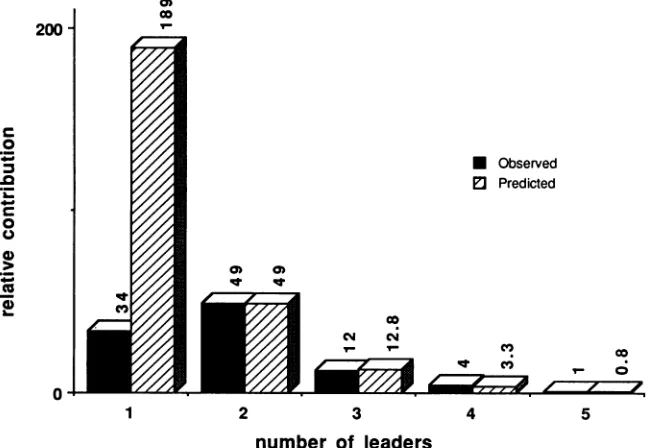
Underrepresentationofsingle-leader mRNAs. When using theleaderdistributionfrommVP1 in infection 1, an average of74% of the polymerases terminate each traverse of the genome twotofivetimes. Byusing this average and assum-ing a simplemodel for transcription termination inwhich a constantpercentageof polymerasemoleculesstop eachtime
aterminator element is encountered, apredicted distribution of leaders was calculated and is presented along with the
observed distributions in Table 2. To better illustrate the close correlation betweenthepredictedandobserved
distri-200
-0
.0
-._ 0
._
C.)
I=
0 -I
os
co
I
1
butions in RNAs containing two to five leaders, we
artifi-ciallymatched therelative contribution of two-leader RNAs by multiplying all of the predicted distribution percentages by 2.57. The results are shown graphically in Fig. 4. It is apparentthatfor RNAs containing two or more leaders, the predicted and observed distributions were nearly identical. However, the relative contribution of one-leader mRNAs was depressed approximately 5.5-fold from the predicted
level. This dramatic difference between the predicted and observed amounts is consistent with the hypothesis that RNAs containing one leader are less stable than
multiple-leader RNAs or are derived from less-stableprecursors (6).
Changes in leader multiplicity in the absence of DNA replication.The main objective of this study was to look for anychanges in the processing of late transcripts during the course ofinfection, with the hope that any differences might
* Observed El Predicted
co eJ C/
1' 1
2 3
C.,c C
AgQW
7~
4
cu '-l 0
5
number of leaders
FIG. 4. Observed andpredicted leader distributions for mVP1 molecules. The observed distribution of mVP1 molecules with different numbers of late leadersanalyzed inFig.3Aisplottedalongwith thepredicteddistribution,assumingnobiasagainstsingle-leadermRNAs and a 74% termination efficiency. To best illustrate the congruence ofthe observed and predicted distributions, the percentages ofthe predicteddistributions were multiplied by2.57tomatchexactlytherelativecontributions oftwo-leader RNAs.
VOL.64, 1990
0) 0 v Rt
4 A
Nov.,-lz/l
on November 10, 2019 by guest
http://jvi.asm.org/
[image:5.612.145.474.465.689.2]AraC: - - +
# of leaders
- 6
-5
_m
- 4_ - 3
- 2
Si-4
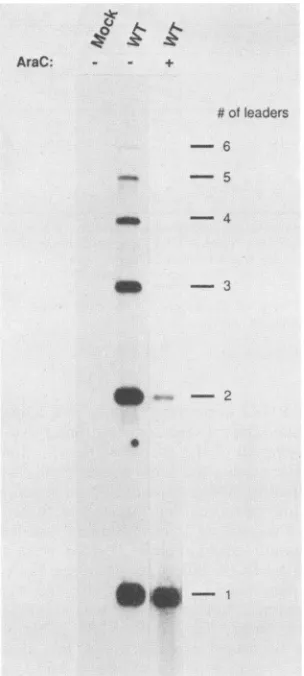
FIG. 5. Leadermultiplicity in thepresence orabsence of DNA
replication. Analyseswerecarriedoutasdescribed in Materialsand
Methods, with anequimolar mixture of oligonucleotides 275, 275,
and277, which will detect all L-mRNAs.Lanes: Mock,RNAfrom mock-infected cells; WT, RNA isolated from cells infectedat an
MOI of 1 for 36h. + and- indicate whether cellsweremaintained
afterinfection inthepresence orabsence of 20 pgof araCperml.
shed lightontheearly-late switch. A usefulway to amplify the difference between the early stage ofinfection (before DNAreplication) and late stages (after DNAreplication) is to infectcells and toisolate RNA36h afterinfection from cultures maintained in either the absence or presence of araC,aDNAsynthesis inhibitor. WithoutDNAreplication,
theearly phase of infectionisextended, allowing forahigher
level ofaccumulation of early-phase RNA.
ByusingtheRNAPCR technique described above, leader multiplicity was determined for polyomavirus cytoplasmic
RNA isolated from infected cells grown for 36 h in the
absence or presence of araC. An equimolar mixture of oligonucleotides 275, 276, and 277wasusedtoassessleader
distribution on all three polyomavirus L-mRNAs. The
re-sultsshown inFig.5and Table2clearly demonstrate that in theabsence of DNAreplication, most ofthe L-RNAs that accumulate have a single late leader at their 5' ends. In contrast,ifDNAreplicationisnotblocked,amajority of the
polyomavirusmRNAscontaintwoor moreleaders. Underrepresentation of single-leader L-RNAs in the
nu-cleus.Itwaspossiblethatthedeficit of single-leaderRNAsin
the cytoplasm was due to less efficient transportfrom the nucleus. Alternatively, single-leaderRNAs might be
prefer-entiallydegraded. Todistinguishbetweenthesemodels,we examined the distribution of leaders on polyomavirus nu-clear RNAs. However, wewishedtolookatmolecules that hadbeenprocessedtomaturesize:giantprimary transcripts
and anysplicingintermediates would cloudanalysisbecause unspliced late leader exons would be detected as RNAs
containinga single leader.Toassessleadermultiplicityand
distributiononmature-sizednuclearpolyomavirus mRNAs,
nuclear RNAisolated 36 hafterinfection(from infection 1)
wasseparated on linear 5 to20%sucrosegradients contain-ing 50% formamide. Thirty 0.4-ml fractions were collected andanalyzed for multipleleadersbyusingan
oligonucleotide
specific formVP1.The resultsare showninFig. 6. Leader-to-leadersplicingand leader-to-VP1splicingcanbedetected
throughout thegradient. Whether these representtrueRNA
processing intermediates or are only RNAs smeared down the gradient in the process of collection awaits further
experimentation. Importantly, however,
quantitation
ofRNAs that are the sizeofmaturemVP1 (fraction 7) shows that the level ofsingle-leaderRNAs is still lower than that
predicted by termination efficiency (Table 2). Thus, both
cytoplasmicandnuclearRNAs displayrelativelylowlevels
ofsingle-leaderRNAs.This isconsistentwith the
hypothesis
that primary transcripts that cannot be spliced leader-to-leaderarepreferentially degradedin the nucleus (6).DISCUSSION
Inthis work we have examined in detail the multiplicity
and distribution of late leader exons on
polyomavirus
L-RNAs. We have developed a method to determine thenumber of late leaders on mRNAs by using reverse tran-scription andthe PCR. Acomparison of this method
involv-ing 30 cycles of thePCRandasingleroundofsecond-strand synthesis with Sequenase shows that under the conditions
used here, PCR does notpreferentially amplify short mole-cules (100 nucleotides versus 500 nucleotides). Therefore,
this is aconvenient, rapid,andsensitive methodof examin-ingleaderstructures onpolyomavirus L-RNAs.
Anexamination ofcytoplasmic RNAfrom
polyomavirus-infected cells reveals that all three L-mRNA types (mVP1,
mVP2, and mVP3) can contain between 1 and 12 tandem
leader units attheir 5' ends. This is the first direct demon-stration that mVP2 contains multipleleaders. Treisman(37)
showed by sequencing cDNAs that mVP1 and mVP3 can bothcontain multiple leaders; however, a cDNAfor mVP2 wasnotfound. Legonetal. (29) determined that the average numberof leadersoneachof the three L-mRNAswasthree to five by usingRNase T1 fingerprinting oflabeled species
isolated after a high-multiplicity infection. Owing to the
difficulty in separating mVP3 and mVP2, it was not clear whether the multiple leaders detected in these experiments
were frommVP2orfrom contaminating mVP3. The use of
oligonucleotides specific for the splice junctions of each mRNA inthe originalreverse transcription step and in the PCR circumvents this problem. Inthisstudywefound that under the conditions used in our laboratory, the average leadermultiplicityoneachof the three L-mRNAsduringthe latephaseof infectionwas two tothree. Although theuseof Taq DNApolymerase and Sequenase led to similarresults, it is still possible that reverse transcriptase converts short mRNAs(single-leaderRNAs)toDNA more efficiently than itconvertslonger mRNAs(multiple-leadermRNAs),biasing
the results toward single leaders. If this were true, the
underrepresentation ofsingle-leader RNAs late after infec-tion would beevenmore dramatic than shown here.
on November 10, 2019 by guest
http://jvi.asm.org/
[image:6.612.112.264.78.416.2]POLYOMAVIRUS LATE PRE-mRNA PROCESSING 5829
fractionnumber
_ _ _m _ _
-._
f* 4 g *
-FIG. 6. Leadermultiplicity in size-fractionated nuclearRNA.Nuclear RNAfrom infected NIH3T6cellswasseparatedonlinear5to20% sucrosegradients, and fractionswereanalyzed for multipleleaders,asdescribed in Materials and Methods, with oligonucleotide275,which
isspecific for theleader-to-VP1 splice junction. Cyto indicates cytoplasmicRNAfrom thesameinfection;mock indicatesthe analysiscarried
outon nuclearRNAfrommock-infected cells. Fraction 1 is thetopof thegradient, andfraction 29 is the bottom. MaturemVP1molecules sedimentedtofractions 7to9.
Thedistribution of lateleaderscan be usedtocalculate a
termination efficiency for late transcription. Assuming that the stability of the RNAs is the same, the percentage of single-leader RNAs representsthe fraction of transcription complexes terminatingthe firsttime around thegenome,the
percentageof RNAscontainingtwoleadersrepresentthose that terminated the second time around, and so on. For
polyomavirus, the termination efficiency calculated in this
manner yields efficiencies which are similar regardless of
which mRNA (mVP1,mVP2, ormVP3) isusedtocalculate this efficiency. A comparison of the termination efficiency calculated by using the RNA PCR method gives results in agreement with the efficiency calculated by using nuclear
run-onanalysis (compare infection 2 in Table 2with results
in reference 22) and with results of the sensitivemethod of Tseng and Acheson (39). A polyomavirus mutant with a
moreefficient latepoly(A)site(about90%efficient)hasbeen
constructedbyLanoixetal.(28).We have tested thismutant inourPCRassay(R.Hyde-DeRuyscherandG. Carmichael,
unpublished results), and our results show a 90% drop
between successive leader bands, again arguing for the validity of the method. Therefore, this method could be a
rapid, sensitive assay to investigate the sequence require-ments oftermination orpolyadenylation.
Interestingly, there appears to be a correlation between
leader multiplicity and MOI. In RNA isolated from cells infectedatanMOI ofapproximately 1,thegreatestnumber of leadersthat could be detected wassixtoseven(Fig. 3A).
However, infection at an MOI of 10 to 20 allowed for the
production ofupto12 leadersonthe 5' end ofpolyomavirus
L-RNAs (Fig. 2, lane 5). This has been a reproducible
finding. Thus, infecting cells at a lower MOI appears to resultinmoreefficienttermination, afindingthat is consist-entwith theproposal thatalimiting factoris titratedout at late times afterinfection(26, 28).
Regardless of the efficiency ofreverse transcription, the
distribution of leaders on polyomavirus RNAs show that
cytoplasmic mRNAs containing only one leader are less abundant thanpredicted byasimple model oftranscription
termination. However, the distribution ofmRNAs contain-ing two to five leaders fits this predicted distribution
ex-tremely well. The distribution of leaders on mRNA-sized transcripts in the nucleus also reveals a paucity of single-leader mRNAs. One way to account for the observed distnrbutions istoassume thatthe splicing ofpolyomavirus
L-mRNAs occurs in arandom fashion where leaderexons
can splice to other leaders (or coding body exons) far downstream. Other studiesfrom thislaboratory, tobe
pre-sentedelsewhere (Y.Luo andG. Carmichael,submitted for publication),have indicated that thevastmajorityofsplicing for polyomavirus L-mRNAs is sequential; leaders splice to thenearestdownstreamleader,andcodingexons arespliced tothenearestupstream leader. Inaddition, the distribution of leaders on mVP2 cannot be explained by a
random-splicingmodel becausethese RNAs donotcontaina leader-to-body splice.TheonlywayasingleleadermVP2molecule
can be generated is by the use of first the poly(A) site downstreamof the 5' end of the mRNA.Therefore,the data
0
I-a
0
0 0
0
to
#of leaders
- 5
-4
4.
I:
S
-3
- 2
- 1 VOL. 64, 1990
V% A, V.. -%
P% ft 4f) A.. 40) P% ". " Z eV 4;. * 4. N
on November 10, 2019 by guest
http://jvi.asm.org/
[image:7.612.142.474.74.369.2]LL ..o5'
LL vP1
5,{1
Primary transcript degradedin nucleus
leader-leadersplice leader-bodysplice
LL LL VP1
5' =.
Efficientprocessing
5' AAAAAA
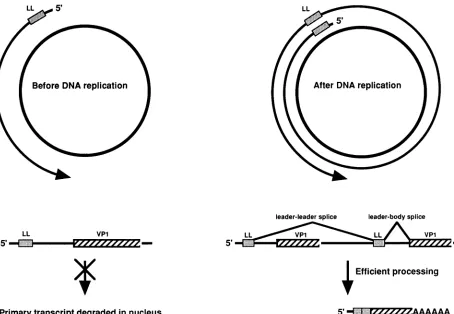
FIG. 7. Model for the control of polyomavirus L-mRNA accumulation. At the top is shown a schematic representation of the polyomavirus late transcriptionunit. The shaded box(LL) near the 5' end of the latetranscriptionunitrepresentsthe 57-nucleotidenoncoding late leaderexon(not toscale). Thearrow atthe end ofthetranscriptionunit represents thepoly(A) site. Inthismodel,latetranscription is efficiently terminated beforeDNAreplication, producing primarytranscripts which contain onlyonelateleaderexon.Thesemoleculesare
inefficiently spliced,and most aredegradedinthenucleus.Afterthe onsetofDNAreplication, termination efficiency decreases, allowingfor theproduction of multigenome-length primary transcripts. This allows leader-to-leader splicing, which stabilizesthe RNAs. In theexample shown here, the 3'-terminal leaderexonsplicesto a VP1codingexon toproducea maturemRNAwith twotandemleaderunitsatits5'end. Following splicing and polyadenylation, mature mRNAs aretransportedtothecytoplasm.
presented here cannot be explained by a random-splicing modelforthe processingof polyomavirus late pre-mRNAs. A more complicated modelfor transcription termination,
in which a polymerase must encounter a terminator twice
beforeefficiently terminating,mayalsoexplaintheobserved
distribution. This possibility seems unlikely in light of the
studyonduplicatedpoly(A) regions, which do not appear to
increasetheefficiency ofterminationfor polyomavirus (28);
however, itis still aformal possibility that an element not present inthe duplicated constructs is responsible for this
effect.
The simplest model which can account for the observed
distribution oflate leaders is that primary transcripts
con-tainingoneleader arepreferentially degraded in the nucleus.
Studiesin several systems have indicated that the splicing or at least the competence to splice can be important for the efficient accumulation of RNA (8, 9, 11, 17-20, 31, 33). Our
laboratoryhasdemonstrated that any mutation which blocks
leader-to-leadersplicing interferes with the accumulation of L-RNA in both the cytoplasm and the nucleus (4-6). In addition, Kern etal. (25, 26) have shown that cells
contain-ingasingle integrated copy of polyomavirus do not produce a detectable amount of L-RNA; however, a line which contains multiple genomes inserted in tandem, allowing for the production ofprimary transcripts which can be spliced
leader-to-leader, produces a high level of polyomavirus L-RNA containing multiple leaders. Thus, evidence froma number of different approaches has indicated that the pro-duction oflarge, multigenome-length transcripts which can be spliced leader-to-leader is aprerequisite for theefficient accumulation ofpolyomavirus L-mRNA.
An examination of leader multiplicity in the absence or presenceofDNAreplication reveals that in the absence of DNA replication there are fewer tandem leader units on L-mRNAs. This result can be interpreted in one of two ways: either the splicing ofleaders isaregulated eventand
is very inefficient in the absence ofDNA replication,orthe termination efficiency of late transcription is changing and the leader distribution reflects this change. Our previous work, using nuclear run-on transcription, suggested that termination for late transcription becomes less efficient as infection proceeds (22). This would predict that longer pre-mRNA molecules would be produced at late times during infection. These molecules would then be resolved by thesplicing of late leaderexons toeach other. The finding,
using twodifferent methods (run-ontranscription and RNA
PCR), that the efficiency of transcription termination for
polyomaviruslatetranscriptiondecreases in the presence of DNA replication, coupledwith the datasummarized above on the requirement for leader-to-leader splicing for the
on November 10, 2019 by guest
http://jvi.asm.org/
[image:8.612.88.542.73.387.2]POLYOMAVIRUS LATE PRE-mRNA PROCESSING 5831 efficient accumulation of L-RNA, is strong supporting
evi-dence that these events areinvolved in the accumulation of
L-RNA afterthe onset ofviral DNA replication.
Modelfor the control of polyomavirus late-geneexpression.
Figure7is aschematicrepresentationofourworkingmodel for the regulation ofpolyomavirus late-gene expression. In
this model, before DNA replication,
transcription
termina-tion is efficient, allowing for the production of mostly half-genome-lengthprimarytranscripts. This is basedon nuclear run-on transcription (22) and the leadermultiplicity
of mRNAsin the absenceofDNA replication presented here. Theseprimarytranscriptsare inefficiently spliced, andmost arenottransported to thecytoplasm andaredegradedin thenucleus. This is supported by the change in splicing
effi-cienciesobserved beforeand after DNA
replication
(22)and by the leader multiplicity analysis of nuclear RNA andcytoplasmicRNAshown here
(Fig.
3, 5,and6). Inaddition,
otherstudies fromourlaboratoryhaveshown thatsplicing
is required for stabilization of L-RNA (4-6; Barrett etal.,
submitted). Therefore, before
replication,
the small amount of L-RNA that accumulates ispredominantly unspliced
RNA(single-leader mVP2) that haspresumablyescaped
thedegradation pathway.
Once replication begins,
transcription
termination be-comesless and less efficient. Thismightbe dueto atitrationof a limiting
polyadenylation
or terminationfactor,
as has been suggested by others (26, 27). This model is consistentwith the correlation between MOI and leader
multiplicity
shown here. A decrease in terminationefficiency
wouldallow the production of large,
multigenome-length
tran-scripts. Leader-to-leader
splicing
would then stabilize thesepre-mRNAs, allowing 3'-end
processing
and mRNAbody
splicing to occur. This model is
supported by
transcription
studies (both run-on
transcription [22]
andpulse-labeling
[35]), studies of leader
multiplicity
in the presence and absence ofDNAreplication (shown
above),
work onlate-leader-splicing mutants (4-6; Barrett et
al.,
submitted),
andanalyses of viral RNAs found in cells
containing
integrated
polyomavirus
genomes(25, 26).
In addition tothe stabiliza-tion of mRNAs after DNAreplication,
the increase in the number oftemplatesbeing
transcribed would increase the rate at which L-RNA accumulates.Our model is consistent with all of the data available on
the accumulation and
regulation
ofpolyomavirus
L-RNA and provides the virus with a mechanismby
which theproduction of capsid
proteins
iscoupled
to the extent of DNA replication. Thismodel, however,
does not address another important aspect oftheearly-late
switch: the downregulation of E-RNA accumulation.
Although
levels ofE-RNA maybe influenced
by large
T-antigen
autoregulation
of theearlypromoter(36), somestudies have
suggested
that E-RNAlevels may be controlled aftertranscription
initiation(14, 35). We are currently
investigating
thepossibility
thatgiant late primary
transcripts
themselves contribute to the downregulation
of E-RNAatlatetimes, perhaps
by
forming
RNA-RNA
duplexes
in thenucleus. ACKNOWLEDGMENTSWe thank N. Barrett, Y. Luo, and A. Roome forhelpful
com-ments onthemanuscript.
This work was supported by Public Health Service grant CA 45382 from the National Cancer Institute.
LITERATURE CITED
1. Acheson, N. 1976. Transcription during productive infection withpolyomavirus andSV40. Cell8:1-12.
2. Acheson, N.,E. Buetti, K. Scherrer, and R. Weil. 1971.
Tran-scription
ofthepolyoma
virus genome:synthesis
andcleavage
ofgiant
latepolyoma
specific
RNA. Proc.Natl.Acad.Sci. USA 68:2231-2235.3. Acheson, N. H. 1978.
Polyoma
giant
RNAs contain tandem repeats ofthe nucleotide sequence ofthe entireviral genome. Proc. Natl. Acad. Sci. USA 75:4754-4758.4. Adami, G. R., andG. G. Carmichael. 1986.
Polyomavirus
late leaderregion
serves anessentialspacerfunctionnecessaryfor viabilityand late geneexpression.
J. Virol. 58:417-425. 5. Adami,G.,andG. G. Carmichael. 1987.Thelength
butnotthesequenceofthe
polyoma
virus lateleaderexonisimportant
forboth late RNA
splicing
andstability.
Nucleic Acids Res. 15: 2593-2610.6. Adami, G. R., C. W. Marlor, N. L. Barrett, and G. G. Carmichael. 1989. Leader-to-leader
splicing
isrequired
forthe efficientproduction
and accumulation ofpolyomavirus
late mRNAs. J. Virol. 63:85-93.7. Beard, P., N. H. Acheson, and I. H. Maxwell. 1976.
Strand-specific
transcription
ofpolyoma
virus DNAearly
inproductive
infectionand in transformed cells.J. Virol. 17:20-26.8. Brinster,R.L.,J.M.Allen,R. R.
Behringer,
R. E.Gelinas,and R. D.Palmiter. 1988. Intronsincreasetranscriptional efficiency
in
transgenic
mice. Proc. Natl.Acad. Sci. USA 85:836-840. 9. Buchman, A. R., and P.Berg.
1988.Comparison
ofintron-dependent
andintron-independent
geneexpression.
Mol. Cell. Biol. 8:4395-4405.10. Cahill, K. B., A. J. Roome, and G. G. Carmichael. 1990.
Replication-dependent
transactivation ofthepolyomavirus
late promoter.J. Virol. 64:992-1001.11. Callis, J., M. Fromm, and V. Walbot. 1987. Introns increase gene
expression
in cultured maize cells. Genes Dev. 1:1183-1200.12. Cogen, B. 1978.
Virus-specific early
RNA in 3T6cellsinfectedby
a tsAmutantofpolyoma
virus.Virology
85:222-230. 13. Cowie, A., C. Tyndall, andR. Kamen. 1981.Sequences
atthecapped
5'-endsofpolyoma
viruslateregion
mRNAs: anexam-ple
of extreme terminalheterogeneity.
Nucleic Acids Res. 9:6305-6322.14. Farmerie,W.G.,and W. R.Folk.1984.
Regulation
of polyoma-virustranscription by large
tumorantigen.
Proc. Natl. Acad. Sci. USA 81:6919-6923.15. Flavell, A., A. Cowie, J. R. Arrand, and R. Kamen. 1980. Localizationof three
major capped
5'endsofpolyoma
viruslate mRNAs within asingle
tetranucleotide sequence in the viral genome. J. Virol. 33:902-908.16. Falvell,A.J.,A.Cowie,S.Legon,and R. Kamen.1979.
Multiple
5'-terminal cap structures in latepolyoma
virus RNA. Cell 16:357-372.17. Gasser, C. S., C. C. Simonsen, J. W.
Schilling,
and R. T. Schimke. 1982.Expression
ofabbreviatedmousedihydrohydro-folate reductase genes in cultured hamster cells. Proc. Natl. Acad. Sci. USA79:6522-6526.
18. Gruss, P.,and G.
Khoury.
1980.Rescueofasplicing
defectivemutantbyinsertionofan
heterologous
intron. Nature(London)286:634-637.
19. Gruss, P., C.Lai,R. Dhar,andG.Khoury. 1979.
Splicing
as arequirement
forbiogenesis
of functional 16S mRNAofsimian virus 40. Proc. Natl. Acad. Sci. USA76:4317-4321.20. Hamer, D., K. Smith, S. Boyer, and P. Leder. 1979. SV40 recombinants
carrying
rabbitbeta-globin coding
sequences.Cell 17:725-735.21. Heiser,W.C., and W. Eckhart. 1982. Polyomavirusearlyand late mRNAsin
productively
infectedmouse3T6cells. J. Virol.44:175-188.
22.
Hyde-DeRuyscher,
R.,andG. G.Carmichael. 1988.Polyomavi-rus
early-late
switch isnotregulated
attheleveloftranscription
initiation and is associated with changes in RNA
processing.
Proc.Natl. Acad. Sci. USA 85:8993-8997.23. Kamen, R., P.Jat, R. Treisman,J. Favaloro,and W. R. Folk. 1982. 5' Termini of polyoma virus early
region
transcriptssynthesized
in vivoby
wild-type
virus and viable deletionmutants.J. Mol. Biol. 159:189-224.
VOL.64, 1990
on November 10, 2019 by guest
http://jvi.asm.org/
24. Kamen, R., D. M. Lindstrom, H. Shure, and R. W. Old. 1974. Virus-specific RNA in cells productively infected or trans-formed by polyomavirus. Cold Spring Harbor Symp. Quant. Biol. 39:187-198.
25. Kern, F. G., P. D. Bovi, and C. Basilico. 1987. A reiterated leader sequence is present in polyomavirus late transcripts produced by a transformed rat cellline. J. Virol. 61:4055-4059. 26. Kern, F. G., S. Pellegrini, and C. Basilico. 1986. Cis and trans-acting factors regulating gene expression from the poly-omavirus late promoter. Cancer Cells 4:115-124.
27. Lanoix, J., and N. Acheson. 1988. A rabbitf3-globin polyadenyl-ation signal directs efficient termination of transcription of polyomavirus DNA.EMBO J. 7:2515-2522.
28. Lanoix, J., R. W. Tseng, and N. H. Acheson. 1986. Duplication of functional polyadenylation signals in polyomavirus DNA does not alter efficiency of polyadenylation or transcription termination. J. Virol. 58:733-742.
29. Legon, S., A. J. Flavell, A. Cowie, and R. Kamen. 1979. Amplification in the leader sequence of late polyoma virus mRNAs.Cell 16:373-388.
30. Maniatis, T., E. F. Fritsch, and J. Sambrook. 1982. Molecular cloning: alaboratory manual.Cold Spring Harbor Laboratory, ColdSpringHarbor, N.Y.
31. Neuberger, M. S., and G. T. Williams. 1988. The intron require-ment for immunoglobulin gene expression is dependent upon
the promoter. Nucleic Acids Res. 16:6713-6724.
32. Piper, P. 1979.Polyomavirustranscription earlyduring produc-tive infectionofmouse 3T6cells. J. Mol.Biol. 131:399-407. 33. Ryu, W.-S., and J. E. Mertz. 1989. Simian virus 40 late
transcripts lacking excisable intervening sequences are defec-tive in both stability in the nucleus and transport to the cytoplasm.J. Virol. 63:4386-4394.
34. Sarkar, G., and S. S. Sommer. 1990. Shedding light on PCR contamination. Nature(London)343:27.
35. Skarnes, W. C., D. C. Tessier, and N. A. Acheson.1988. RNA polymerases stall and/or prematurely terminate nearby both early and latepromoters on polyomavirus DNA. J.Mol. Biol. 203:153-171.
36. Tooze, J. (ed.).1980.DNAtumorviruses: molecularbiology of tumorviruses, 2nd ed. Cold Spring Harbor Laboratory, Cold Spring Harbor, N.Y.
37. Treisman, R. 1980. Characterization of polyoma late mRNA leader sequences by molecular cloning and DNA sequence analysis. Nucleic AcidsRes.8:4867-4888.
38. Treisman, R., and R. Kamen. 1981.Structureofpolyomavirus late nuclearRNA.J. Mol. Biol. 148:273-301.
39. Tseng, R. W., and N. H. Acheson. 1986. Use ofa novel S1 nuclease RNA-mapping technique to measure efficiency of transcription termination on polyomavirus DNA. Mol. Cell. Biol.6:1624-1632.