
Rochester Institute of Technology
RIT Scholar Works
Theses Thesis/Dissertation Collections
8-13-2015
Statistical Study of Interplanetary Coronal Mass
Ejections with Strong Magnetic Fields
Matthew E. Murphy
Follow this and additional works at:http://scholarworks.rit.edu/theses
Recommended Citation
Statistical Study of Interplanetary Coronal Mass Ejections with Strong Magnetic Fields
by
Matthew E. Murphy
B.S., Seattle University, 2010
A thesis submitted in partial fulfillment of the
requirements for the degree of Master of Science
in the Chester F. Carlson Center for Imaging Science
College of Science
Rochester Institute of Technology
August 13, 2015
Signature of the Author
Accepted by
CHESTER F. CARLSON CENTER FOR IMAGING SCIENCE
COLLEGE OF SCIENCE
ROCHESTER INSTITUTE OF TECHNOLOGY
ROCHESTER, NEW YORK
CERTIFICATE OF APPROVAL
M.S. DEGREE THESIS
The M.S. Degree Thesis of Matthew E. Murphy has been examined and approved by the
thesis committee as satisfactory for the thesis required for the
M.S. degree in Imaging Science
Dr. Roger Dube, Thesis Advisor Date
Dr. Joel Kastner, Committee Member Date
Contents
List of Figures 7
Acronyms 12
Abstract 15
1 Introduction 21
2 Background and Motivation 27
2.1 Space Weather . . . 27
2.1.1 Effects of Space Weather . . . 27
2.1.3 Coordinate System . . . 33
2.2 Space Weather Prediction Center . . . 34
2.2.1 Initial parameters . . . 35
2.3 Space Weather Research Center and CCMC . . . 38
2.4 Spacecraft and Instrumentation Overview . . . 39
2.4.1 STEREOs A and B . . . 41
2.4.2 Earth directed events . . . 47
2.5 Empirical Relationships . . . 50
2.5.1 Travel time and Initial Speed Literature Review 50 2.5.2 In Situ Magnetic field and Speed Literature Review . . . 56
2.6 Problem Statement . . . 60
3 Theory 62 3.1 Relationships between solar storm parameters . . . . 62
3.1.1 Speed and Magnetic field . . . 63
3.1.3 SHARP Solar source Magnetic field . . . 64
3.2 Geoeffectiveness (and magnetic field Bz) . . . 65
3.3 CME Groups . . . 66
3.4 Summary . . . 72
4 Method 74 4.1 Plan of Study Overview and Eureqa . . . 74
4.2 Data Collection . . . 80
4.2.1 Matching ICMEs to Strong IMFs and Data Sources . . . 80
4.3 Analysis . . . 83
4.3.1 Groupings and the Magnetic Cloud Relationship 83 4.3.2 Validation of Eureqa . . . 84
4.3.3 Multi-dimensional analysis and trends using Eureqa . . . 86
5.1 Collection and Preparation of Data . . . 87
5.1.1 Collected Data Summary and Discussion . . . 91
5.2 Analysis results . . . 92
5.2.1 Groupings and the Magnetic Cloud Relationship 92
5.2.2 Validation of Eureqa . . . 97
5.2.3 Multi-Dimensional analysis: Initial CME Speed
and SHARP parameters using Eureqa . . . 101
6 Summary and Suggested Further Study 107
List of Figures
1.1 CME carrying the Sun’s magnetic field. This figure
from a space physics article by Zhou et al. (2012) . . 22
2.1 Space Weather effects. Figure is courtesy of NASA . 29
2.2 Effects of Space Weather on Satellites. Figure from a
report by D. Baker et al. (2006) [1] . . . 30
2.3 Stonyhurst Heliographic longitude and latitude
ori-entation on the Sun. Figure is from a paper by W.
Thompson [2]. . . 33
2.4 Coronagraph image observed from STEREO B.
2.5 Positions of SOHO (and ACE) and STEREO A and
B on November 24, 2009. Figure from the The Sun
Today website [3]. . . 40
2.6 STEREO A and B spacecraft and instrumentation.
Figure is from a user manual by A. Davis [4]. . . 41
2.7 Positions STEREO A and B on August 1, 2010.
Fig-ure courtesy of NASA [5]. . . 42
2.8 Positions STEREO A and B on July 1, 2012. Figure
courtesy of NASA [5]. . . 44
2.9 Positions STEREO A and B on July 1, 2014. Figure
courtesy of NASA [5]. . . 45
2.10 Positions STEREO A and B on February 18, 2015.
Figure courtesy of NASA [5]. . . 46
2.11 HARP regions on SDO/HMI imagery. From a paper
2.12 In situ Max Magnetic Field and Speed. From a paper
by Cane and Richardson [7]. . . 59
3.1 Group 1 CME example. From paper by Jian et al.
(2006) [8] . . . 68
3.2 Group 2 CME example. From paper by Jian et al.
(2006) [8] . . . 69
3.3 Group 3 CME example. From paper by Jian et al.
(2006) [8] . . . 70
3.4 Interpretive sketch of all groups. From paper by Jian
et al. (2006) [8] . . . 71
4.1 Eureqa enter data window. Screen shot from Eureqa
software [9]. . . 75
4.2 Eureqa prepare data window. Screen shot from
Eu-reqa software [9]. . . 76
4.3 Eureqa prepare data window. Screen shot from
4.4 Eureqa results window. Screen shot from Eureqa
soft-ware [9]. . . 79
5.1 Relative Locations on Sun for each event. The blue
markers are STEREO B, the orange are ACE and the
red are STEREO A. . . 90
5.2 Group 1 in 2013 max CME speed and magnetic field
at 1 AU. The line is y = 0.0362x − 1.495 with an
R2 = 0.696 . . . 93
5.3 Group 2 in 2013 max CME speed and magnetic field
at 1 AU. The line is y = 0.0375x − 3.486 with an
R2 = 0.209 . . . 94
5.4 Group 3 in 2013 max CME speed and magnetic field
at 1 AU. With a line of y = 0.0264x+ 1.134 and an
R2 = 0.165 . . . 95
5.5 Group 1 CMEs over the years 2010 to 2013. With a
5.6 The blue unfilled circles represent the Gopalswamy
ESA approximation for events with V > 500km/s
[10]. The red filled squares are the new model found
using Eureqa. Both use the speed and travel time
data seen in subsection 5.1.1. . . 100
5.7 The predicted magnetic field at ACE versus the actual
measured magnetic field. . . 103
5.8 The predicted magnetic field at ACE versus the actual
Acronyms
ACE Advanced Composition Explorer. 23
ADAPT Air Force data assimilative photospheric flux transport.
108
AU astronomical unit. 24
B magnetic field. 16
Bz Z component of the magnetic field (B). 23
CAT CME Analysis Tool. 81
CME Coronal Mass Ejection. 16
DONKI Database Of Notifications, Knowledge, Information. 81
ECA Estimated CME Arrival. 52
ESA Estimated Shock Arrival. 52
EUVI extreme ultraviolet. 39
GOES Geostationary Operational Environmental Satellites. 25
HMI Helioseismic and Magnetic Imager. 25
IMF Interplanetary Magnetic Field. 41
IMPACT In situ Measurements of Particles and CME Transients.
24
IPS interplanetary shocks. 54
nT nanoteslas. 16
PLASTIC Plasma and Suprathermal Ion Composition. 82
SDO Solar Dynamics Observatory. 25
SECCHI Sun Earth Connection Coronal and Heliospheric
Investi-gation. 24
SEP Solar Energetic Particle. 16
SHARP Space-Weather HMI Active Region Patches. 48
SOHO Solar and Heliospheric Observatory. 23
STEREO A and B Solar TErrestrial RElations Observatory Ahead
and Behind. 23
SWPC Space Weather Prediction Center. 34
WSA-Enlil Wang, Sheeley, and Arge-Sumerian god of storms and
Statistical Study of Interplanetary Coronal Mass Ejections with Strong Magnetic Fields
by
Matthew E. Murphy
Submitted to the
Chester F. Carlson Center for Imaging Science in partial fulfillment of the requirements
for the Master of Science Degree at the Rochester Institute of Technology
Abstract
Coronal Mass Ejections (CMEs) with strong magnetic fields (B)
enable the development of more accurate CME magnetic field pre-dictions and should help scientists develop better forecasts thereby helping to prevent damage to humanity’s space and Earth assets.
Acknowledgements
I would like to acknowledge my adviser Dr. Roger Dube who first
introduced me to this fascinating topic at a presentation on the 1859
Carrington event and solar storms. He also introduced me to the
software analysis tool Eureqa which was a huge part of this research.
He also provided great guidance during my studies. I’d also like to
acknowledge my committee members Dr. Joel Kastner and Dr. Tony
Vodacek. Also my contact at NASA/SWRC Dr. Yihua Zheng was
very helpful in my research and gave me the idea to study strong
magnetic field CMEs from all around the Sun. She also provided
guidance and information during weekly phone calls and emails.
Attending the Space Weather Workshop in Boulder, CO was very
helpful. While there, Captain William Frey, Captain Paul Domm,
other attendees and presenters provided lots of insight. Captain Frey
also gave me a tour of the SWPC which was very educational,
a lot of insight (so thanks also to SWPC). Also thanks to all the
members of the space weather community that helped me along the
way.
I would also like to acknowledge all the folks (faculty, colleagues
and staff) at RIT Chester F. Carlson Center for Imaging Science that
were helpful such as Cindy Schultz, Beth Lockwood and Sue Chan.
I would like to thank the US Air Force and my AF RIT colleagues
such as Captain Doug Macdonald and our AFIT CIP Liaison Officer
Major Oesa Weaver. Big thanks to Sara Smith and her Yorkshire
Terrier Kenzie. Also big thanks to my mother Teresa, father John
and brother William. Thanks to all my other family and friends that
I would like to especially dedicate this work to my mother Teresa, the
best mom ever! And also to the best dad and bro, to my father John
and my brother William. Thank you so much for always being there
Chapter 1
Introduction
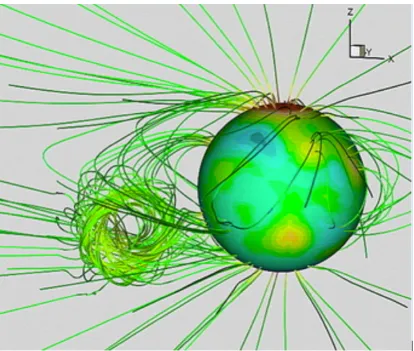
CMEs are massive solar storms that are difficult to predict. When
a CME occurs it carries with it the magnetic field of the Sun as can
Figure 1.1: CME carrying the Sun’s magnetic field. This figure from a space physics article by Zhou et al. (2012)
Earth directed CMEs and related events (SEPs and flares) can
cause severe issues to power grids on Earth, and adverse effects on
spacecraft and astronauts. Power grid issues on Earth happen when
the CME storm is geoeffective. The more geoeffective the CME, the
geoeffec-tive particularly when the magnetic field is oriented predominantly
southward (negative Bz)[12]. CMEs with southward pointing
mag-netic fields are further attracted to the Earth as they encounter the
Earth’s northward pointing magnetic field, so the effect of the storm
is not mitigated in any way as they are for CMEs with
northward-oriented magnetic fields.
Data related to CME events can be obtained from a variety of
sources. Remote sensing is used on coronagraphic images to get
pa-rameters such as speed, width and direction of these large plasma
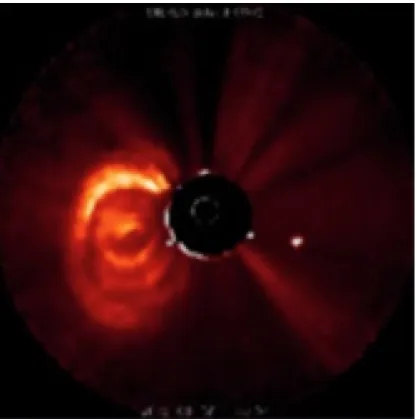
clouds when they first emerge from the sun. A coronagraph image
can be seen in section 2.2.1 in figure 2.4. In situ measurements can
also be made at spacecraft in the path of the CMEs. The Solar
TEr-restrial RElations Observatory Ahead and Behind (STEREO A and
B) spacecraft [13] combined with the Advanced Composition
Ex-plorer (ACE) [14] and Solar and Heliospheric Observatory (SOHO)
pro-vide a 360◦ view of the sun. A Lagrangian point (as applied in this
study) is a gravitational point in interplanetary space in which a
spacecraft can orbit around. L1 is at a point between the Sun and
the Earth (at approximately 0.1 astronomical unit (AU) away from
the Earth) where the Sun’s and Earth’s gravity is balanced by the
centripetal force of the spacecraft. One AU is the distance between
the Sun and Earth.
The magnetic field strength measurements originate from
magne-tometer sensors on the ACE and STEREO spacecraft. On STEREO
A and B (described later in this thesis), the instrument is known as
the In situ Measurements of Particles and CME Transients
(IM-PACT) [13]. This IMPACT instrument also monitors SEP levels
[13]. Also on-board the STEREO spacecraft is the Sun Earth
Con-nection Coronal and Heliospheric Investigation (SECCHI)
instru-mentation. SECCHI has coronagraph cameras and extreme
from the solar source. This imagery was studied to provide the
aforementioned information about the CME source region, speed,
direction and etc. The combined capabilities of the ACE and SOHO
spacecraft at L1 can match the aforementioned capabilities of the
STEREO A and B spacecraft. Additional spacecraft and
capabili-ties for Earth directed events include the Geostationary Operational
Environmental Satellites (GOES) which can give a measure of solar
flare strength and the Solar Dynamics Observatory (SDO) spacecraft
which has the Helioseismic and Magnetic Imager (HMI) instrument
on board. The HMI instrument can give measurements of the solar
source magnetic field.
More research is needed to analyze past solar storm event
param-eters from the aforementioned spacecraft in order to better predict
and understand future solar storm events. Better prediction allows
for preventative safeguarding with minimal mission interruption of
power outages on Earth. Additionally, better forecasting of these
events will reduce solar storm related health and safety hazard risks
Chapter 2
Background and
Motivation
2.1
Space Weather
2.1.1
Effects of Space Weather
CMEs with strong magnetic fields are typically associated with SEP
can damage spacecraft, cause geomagnetic storms that can knock
out power grids on Earth, cause radio blackouts, and threaten the
health and safety of astronauts [16]. This is especially true of CMEs
with strong magnetic fields. The magnetic field strength of a CME is
linked to the strength of a geomagnetic storm on Earth, particularly
(as previously explained) when the magnetic field is predominantly
southward [12] Some of the effects of space weather can be seen in
Figure 2.1: Space Weather effects. Figure is courtesy of NASA
Space weather storms can cause multiple problems on Earth as
can be seen in figure 2.1. Spacecraft can be affected as seen in figure
Figure 2.2: Effects of Space Weather on Satellites. Figure from a report by D. Baker et al. (2006) [1]
There have been a number of storms that have hit earth. One
power issues in North America, satellites lost control and
experi-enced anomalies [18]. The Halloween storms of 2003 caused a power
outage in Sweden and interfered with satellite communications [19].
A stronger storm (which have occurred in recent history such as the
Carrington event in 1859) could cause much more damage and chaos.
If a Carrington sized event happened today, widespread power
out-ages and damage to satellites could occur, GPS could be interrupted,
the damages could cost 1 to 2 trillion dollars and the effects could
be felt for years [19].
2.1.2
CMEs, SEPs, Solar Flares and Sources
CMEs are large bursts of solar plasma from the Sun’s corona [20].
CMEs can be described by a number of parameters such as magnetic
(B) field, speed, direction, width and others. CMEs are associated
with SEPs, solar flares, and the history of their solar source regions.
the Sun sends out bursts of X-rays, gamma rays and etc. SEPs are
radiation events. Charged particles from the Sun travel on the Sun’s
magnetic field lines. There are three main kinds of solar sources:
2.1.3
Coordinate System
Stonyhurst Heliographic coordinate system
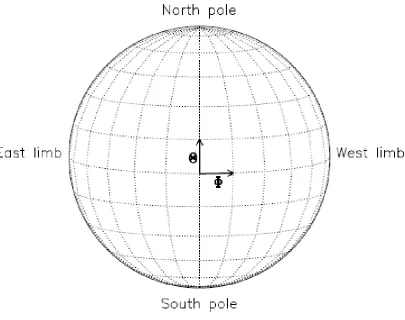
The coordinate system used in this paper is the Stonyhurst
Helio-graphic coordinate system. Figure 2.3 [2] gives the positive
[image:34.595.96.502.329.649.2]orienta-tion of the latitude and longitude used in this coordinate system.
The solar equator and the Earth’s central meridian are at the
origin [2]. Thus, it remains fixed with respect to the Earth while the
sun rotates underneath [2]. One thing to note is that different
lati-tudes on the Sun rotate at different rates. This differential rotation
of the Sun as a function of latitude complicates the development of
models and the analysis of CME data.
2.2
Space Weather Prediction Center
The Space Weather Prediction Center (SWPC) is a 24/7 manned
op-erational center that monitors the sun. SWPC will send out warnings
when a severe Space Weather event is predicted. In order to make
these predictions, observations and measurements are taken of solar
2.2.1
Initial parameters
As soon as a CME becomes visible on a coronagraph the analysts
at SWPC (and other solar observatory stations) can measure the
speed, direction and width of a CME using a CME analysis tool.
The STEREO and SOHO spacecraft have coronagraph instruments
on board. A coronagraph is a telescope that has an occulting disk
in it that blocks out the bright sun (making an artificial eclipse) to
make coronal mass ejections visible. The STEREO spacecraft use
Figure 2.4: Coronagraph image observed from STEREO B. Figure courtesy of NASA.
Once the observations are made, these initial parameters are
entists Wang-Sheeley-Arge (WSA) and the Sumerian god of storms
and wind (Enlil) [23] The model consists of two parts. The first part
uses observations of the solar surface magnetic field to make an
ap-proximation of the ambient solar wind [24]. The second part consists
of inputting the initial CME parameters (speed, size, and direction)
[24].
The CME parameters are input into the existing solar wind
ap-proximation to give an estimate of the CME’s arrival time, duration
and intensity [24]. An accurate magnetic field intensity prediction
for 1 AU is not known at this time as magnetic field relationships
are an active area of research. The magnetic field of the CME is
not known until the CME passes through the ACE spacecraft at 0.1
AU away from the Earth. This distance provides only a 30 minute
warning. An example of the in situ magnetic field measurements of
a CME as it passes ACE can be seen in section 3.3 in figures 3.1
field of a CME and the initial parameters (speed, width, direction
etc.) would provide a considerably larger amount of lead-time to
space weather forecasters (and provide an additional input into the
WSA-ENLIL model).
2.3
Space Weather Research Center and
CCMC
The Space Weather Research Center (SWRC) is part of NASA and
is dedicated to improving our understanding of space weather events.
One important aspect of this center is to improve forecasting
abil-ities. SWRC is a sub-team of the Community Coordinated
Model-ing Center (CCMC) and provides space weather services to NASA
and prototypes new models, procedures and forecasting techniques
2.4
Spacecraft and Instrumentation Overview
There are a number of spacecraft whose data are considered in this
study. Each spacecraft has a suite of instrumentation on board. The
following sensors (used in this study) measure in situ parameters as
the CME passes the spacecraft: magnetic field sensors, SEP particle
flux sensors and solar wind velocity sensors. The following are
imag-ing instruments that observe the CME or the CME’s solar source
region: white-light coronagraph cameras (observe CMEs), and
ex-treme ultraviolet (EUVI) light cameras of multiple wavelengths
(serve CME source regions). Wavelengths used in this study to
ob-serve the CME solar source regions are: 193/195 ˚A (Fe XII), 304 ˚A
(He II), and 6173 ˚A (Fe I). The 193/195 ˚A (Fe XII) wavelength
ob-serves the Sun’s corona. The 304 ˚A (He II) wavelength observes the
light that is emitted from the chromosphere and transition region
on the Sun. The 6173 ˚A (Fe I) wavelength observes the photosphere
The spacecraft that provide the data used in this paper are at
various positions orbiting the sun. Figure 2.5 [3] summarizes most
[image:41.595.91.506.241.494.2]of the spacecraft considered in this work.
Figure 2.5: Positions of SOHO (and ACE) and STEREO A and B
on November 24, 2009. Figure from the The Sun Today website [3].
SOHO and ACE are at L1. The positions of STEREO A and
B change relative to the Earth through out this study. Figures 2.6
2.4.1
STEREOs A and B
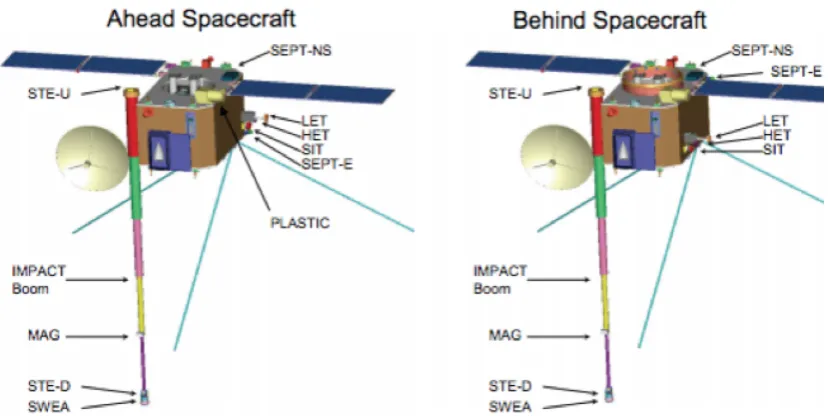
[image:42.595.93.509.217.425.2]The STEREO spacecraft can be seen in figure 2.6 [4]
Figure 2.6: STEREO A and B spacecraft and instrumentation. Fig-ure is from a user manual by A. Davis [4].
The MAG instrument as seen on figure 2.6 is what detects the
Interplanetary Magnetic Field (IMF) events. STEREO A and B are
almost identical and have the same capabilities. The main purpose
of the STEREO spacecraft is to understand the three-dimensional
nature of the Sun’s corona and in particular the eruptions of the
far-side of the Sun (from such instruments as IMPACT as previously
described in chapter 1) and views of the far-side Sun (from SECCHI
also as previously described in chapter 1) previously only taken from
[image:43.595.93.510.277.612.2]the Earth’s (near-side) perspective
Figure 2.7 [5] is the position of the spacecraft at the first (greater
than 30 nT) event of this study. On August 3, 2010, a greater than
30nT interplanetary magnetic field event measured at STEREO B
was also seen at the ACE spacecraft. It is interesting to note that
the ACE spacecraft did not observe a magnetic field greater than
Figure 2.8: Positions STEREO A and B on July 1, 2012. Figure courtesy of NASA [5].
Figure 2.8 [5] shows the positions of the spacecraft at roughly the
midpoint of the study. STEREO B would measure a greater than
30nT event in roughly this position. Approximately 20 days after
this point, STEREO A observed the largest magnetic field event of
Figure 2.9: Positions STEREO A and B on July 1, 2014. Figure courtesy of NASA [5].
This figure shows the positions of the spacecraft STEREO A
and B during observable events near the end of the time covered in
this study. A few months after the date of this figure, STEREO
B observed a > 30nT event. In October 2014, contact was lost
with STEREO B and the last > 30nT event at STEREO A was
due to interference because STEREO A had moved to a position in
which the Sun was near the line of sight between STEREO A and
[image:47.595.91.507.240.574.2]Earth.
Figure 2.10: Positions STEREO A and B on February 18, 2015. Figure courtesy of NASA [5].
writing of this thesis paper. STEREO A at this point was in safe
mode and STEREO B has been (and still is at this point) out of
contact.
2.4.2
Earth directed events
One limitation to this study is that the STEREO A and B do not
have all the capabilities of their counterparts observing the nearside
(Earth-side) of the sun. In particular, STEREO A and B do not
have HMI or flare sensors (which are described in the next sections).
ACE
ACE is situated at L1 (see figure 2.5). It contains the
magnetome-ter sensor data that measures in situ inmagnetome-terplanetary magnetic fields
(IMF). This sensor is essentially the same as those on STEREO A
GOES
GOES are a number of weather spacecraft orbiting earth at
geosta-tionary orbits. These spacecraft provide in situ information on solar
flare intensities by measuring the flare’s X-ray flux.
SOHO
The SOHO spacecraft is at L1 (see figure 2.5). SOHO has
white-light coronagraph cameras on board which are used in conjunction
with STEREO A’s and B’s white-light coronagraph cameras to get
the initial parameters (speed, width, and etc.) of CMEs.
SDO and SHARP
SDO is at geostationary orbit. SDO has the HMI instrument on
board. Space-Weather HMI Active Region Patches (SHARPs) are
calculated from the HMI data. [6]. The SHARPs are used to measure
gradient, free energy proxy, unsigned flux and others [6]. See figure
[image:50.595.104.492.216.621.2]2.11 [6].
These parameters have been used for determining the possibility
of a flare or CME occurring [6] but not used in conjunction with
coronagraphic parameters to predict B field strength at 1 AU.
2.5
Empirical Relationships
2.5.1
Travel time and Initial Speed Literature
Review
For fast CMEs (which are what are studied in this paper) the
rela-tionship found by Vandas et al. (1996) [27] was
Tshock(h) = 43–0.006Vi (2.1)
Gopalswamy [28], [29] included a relationship that involved the
effective acceleration which includes the speed at 1 AU:
a = α−βu, S = ut+ 0.5at2 (2.2)
where S is the distance traveled, u is initial CME speed near the
Sun, t is travel time, a is acceleration, and α and β are constants.
The acceleration of CMEs can be described by
a = −0.0054(u−uc) (2.3)
where uc = 406km/s is the average solar wind speed and u is the
initial speed of the CME in the coronagraph images. This is a simple
means to get the acceleration using basic kinematic relationships
[29]. This acceleration can be positive or negative depending on the
initial speed. When the CME speed is slower than the ambient solar
acceleration occurs when the CME is faster than the solar wind and
the CME is slowed due to drag. For the purposes of this study,
all accelerations are negative due to the high speeds of the studied
CMEs. Equation 2.4 is the Estimated CME Arrival (ECA) model
and is given as
t1 = −u+ √
u2 + 2ad 1
a , t2 =
d2
√
u2 + 2ad 1
(2.4)
where t is travel time, u is initial speed of a CME, a is
accelera-tion of the CME and d is distance. Usually (for slower CMEs) the
CME will slow to the speed of the solar wind at some distance d1
[30]. However, the CMEs in this study are assumed to continue to
decelerate through 1 AU due to their high initial speeds. For the
Es-timated Shock Arrival (ESA) Gopalswamy developed a relationship
for estimating speeds at 1 AU for the associated CME interplanetary
The ESA relationship is approximated as [10]
T = ABu+C (2.5)
where T is travel time, u is initial speed, A=151.002, B=0.998623
andC=11.598. This model is for CME speeds greater than 450km/s.
Wang et al. (2002) found [32]
T = 27.98 + 2.11×10
4
V (2.6)
Zhang et al.(2003) found [33]
T = 96− V
21 (2.7)
where T is travel time and V is the initial speed of the CME.
According to Zhang el al. (2003), equation 2.7 works best for CMEs
Srivastava et al. (2004) found [34]
T = 86.9−0.026V (2.8)
Manoharan et al. (2004) made a polynomial fit between travel
time in days between start time and the arrival of the interplanetary
shocks (IPS) and the initial coronagraph speed of the associated
CME. There were 91 IPS utilized in this study. Manoharan et al.
(2004) found that
tshock = 3.9−2×10⁻³VCM E + 3.6×10⁻⁷VCM E2 (2.9)
In a similar study by Kim et al. (2007) a linear relationship was
found [35] to be
T = 78.86−0.02VCM E (2.10)
where travel time (T) is given in hours.
How the in situ CME shock (or magnetosheath) speed and in situ
CME magnetic obstacle speed relate varies depending on the CME.
Also, the speeds vary as the CME passes the spacecraft solar wind
speed sensors. In section 3.3 in figures 3.1 thru 3.3 on pages 68 thru
70 the chart Vp on each figure shows the in situ solar wind speeds
for three types of CMEs. On each of the figures, the points from a
to b show the CME shock (or magnetosheath). The points b to c
2.5.2
In Situ Magnetic field and Speed
Litera-ture Review
In a current status of CME/shocks, Zhao and Dryer do not provide
an overview of the research of interplanetary magnetic field
predic-tions (especially their north or south polarity) due to how uncertain
they are [30]. This is one indication that more research into IMF
predictably is required. The geoeffectiveness of a CME is largely
de-termined by the magnetic polarity of the CME so more information
on this is of great value to space forecasters (see section 3.2).
Gonzalez et al.(1998) found that magnetic cloud CMEs in situ
magnetic field correlated to the in situ CME max speed and is given
as
|B|max(nT) = 0.047Vmax(km/s)−1.1 (2.11)
Equation 2.11 uses data from events directed only at Earth. A
temper-ature, has increased magnetic field, and has a smooth and rotating
magnetic field direction as observed by in situ spacecraft. [36]. A
Considering a number of CME events directed only at the ACE
spacecraft (and Earth) Owens and Cargill developed an empirical
relationship which is described by
|B|max(nT) = 0.047Vmax(km/s) + 0.0644 (2.12)
where V is the initial maximum speed of the CME and B is the
maximum observed in situ magnetic field. No consideration was
made for magnetic cloud and non-cloud events. Events were included
that had a greater than 18nT magnetic field at ACE for 3 hours or
Cane and Richardson compared max magnetic fields and speeds
from 1996 to 2009 as can be seen in figure 2.12 [7].
Figure 2.12: In situ Max Magnetic Field and Speed. From a paper by Cane and Richardson [7].
The equation of the magnetic cloud line is
Bmax(nT) = 0.0439V −1.8019 (2.13)
The equation of the non-cloud line is
From figure 2.12, the correlation coefficient found for magnetic
field (cc = 0.600) correlated to the in situ max speed much better for
cloud than for non-cloud CMEs (cc = 0.277). The Eureqa program
(which is explained in section 4.1) will be used to fit a linear trend
to the same data found in figure 2.12. Eureqa is validated by
com-paring the correlation coefficients found by Eureqa to the correlation
coefficients found by Cane and Richardson.
2.6
Problem Statement
The arrival time and strength of strong B field CME events are
difficult to predict; this prediction is critical in preventing possible
damage to people, infrastructure, and technological instrumentation.
The current correlations between strong B field events and other
so-lar parameters are not well understood. This work will lead to a
would be very useful to space weather forecasters if a correlation can
be made between Bz and any of the other solar storm parameters
Chapter 3
Theory
3.1
Relationships between solar storm
parameters
The size of the in situ magnetic field strength should be related to the
other parameters of a particular CME. In situ magnetic field strength
is the B field measured by magnetometer instruments on the ACE
be seen in figure 3.1 in section 3.3.
3.1.1
Speed and Magnetic field
As shown in section 2.5.2, there is a relationship between the in situ
speed of the CME and the in situ magnetic field.
3.1.2
Distance, Time, velocity and acceleration
As seen in equation 2.2 in chapter 2 the kinematic equation
(repro-duced here again as equation 3.1 for readability) is given as
S = ut+ 0.5at2 (3.1)
where the distance (S) is approximately 1 AU for all three
space-craft (ACE and STEREOS A and B), t is travel time, u is initial
speed of the CME, and a is acceleration.
a software data analysis tool (Eureqa) used in this study which is
further explained in section 4.3.2. Using Eureqa, a relationship is
found using data for CME coronagraph initial speed and CME travel
time. As seen in chapter 5, Eureqa is able to find the acceleration
relationship as seen in equation 3.1. Eureqa is described in section
4.1
3.1.3
SHARP Solar source Magnetic field
Unsigned flux
Bobra et al. (2014) provide a definition for a parameter known as
unsigned flux in units of Maxwells (Mx) [6] and is given as
Φ = Σ|Bz|dA (3.2)
It makes intuitive sense that the Bz at the CME solar source should
Another parameter from Bobra et al. (2014) is known as the
horizontal gradient of the horizontal field and is units of Gauss per
mega-meter (GM m−1) [6] and is given as
|Bh| =
1
NΣ
s
(∂Bh
∂x )
2 + (∂Bh ∂y )
2 (3.3)
This parameter is related to total magnetic field in chapter 5.
3.2
Geoeffectiveness (and magnetic field
B
z)
The main driver of the geoeffectiveness of the CME storm on Earth
is negative Bz, although high solar wind speed can also be a factor
[12]. A CME with a negative (or southward) Bz is more geoeffective
because the southward Bz couples with Earth’s northward pointing
magnetosphere. The strength of the negative Bz is not known until
this does not bring much lead time (only about 30 minutes). If
a correlation can be made between Bz and any of the other solar
parameters that would be very useful to space weather forecasters.
3.3
CME Groups
Jian et al.(2006) describe three different types of CME groups [8].
These groups are based on the in situ measurements of pressure
ver-sus time. Group 1 CMEs are classified as CMEs in which the
pres-sure in the magnetosheath of the CME increases gradually, Group
2 remain at a relatively stable value, and Group 3 increase quickly
and then fall off. Each group can be seen in figures 3.1, 3.2 and 3.3
for group 1,2 and 3 respectively [8]. The bottom chart of each figure
shows pressure versus time (Pt). Also included areBx/B,By/B, and
Bz/B which are the x, y and z magnetic field with total magnetic
beta. Group 1 CMEs are usually associated with magnetic clouds
and tend to have similar traits [8]. Utilizing the Jian et al. (2006)
group identification is superior to using the cloud and non-cloud
identification in that group identification has a geometric physical
meaning and is also easier to work with (since only one type of in
situ observation is considered instead of three). Furthermore, the
Figure 3.4 shows an interpretive sketch of the geometry of the
[image:72.595.104.481.228.609.2]groups [8].
As shown in chapter 2 in situ magnetic field and in situ speed
have been related based on whether the CME exhibited traits of
a magnetic cloud. Using STEREO data organized into groups from
Jian et al.(2013) [37] over the years of 2010 to 2013, the in situ speed
and magnetic field relationship based on these groups was explored
as shown in chapter 5.
3.4
Summary
It has been shown in subsection 2.5.1 on page 50 that the initial CME
speed can be correlated to the in situ CME speed due to acceleration.
Furthermore, it has been shown in subsection 2.5.2 on page 56 that
the in situ speed at 1 AU can be related to the in situ magnetic field.
The speed at 1 AU is related to the initial (coronagraphic) speed
(by acceleration), thus the in situ magnetic field and initial speed
be related in some way. By matching a CME’s source magnetic field
information, speed (from coronagraphic observations) and the in situ
magnetic field observations of those same CMEs one should be able
to correlate to make a prediction of the 1 AU magnetic field. Using a
multidimensional analysis software (Eureqa) a prediction model for
in situ magnetic field of CMEs using solar source magnetic field and
Chapter 4
Method
4.1
Plan of Study Overview and Eureqa
Eureqa is a sophisticated analysis tool that can find previously
un-known correlations and relationships between various data variables.
This tool is potentially very valuable in developing empirical
The first step in using Eureqa is to enter tabulated data into the
program with each variable as a single column and provide a name
[image:76.595.91.509.250.580.2]for each variable. See figure 4.1
The data can then be prepared before analysis by removing
[image:77.595.91.505.213.466.2]out-liers or missing values. See figure 4.2
Next, a model target is set by describing which variables are
independent or dependent. Additionally, a relationship between the
[image:78.595.91.505.249.491.2]variables can be entered into the model target. See figure 4.3
Figure 4.3: Eureqa prepare data window. Screen shot from Eureqa software [9].
Next the program is started by the user and Eureqa then
au-tomatically discovers models from the given data using algorithms
that are evolutionary and sophisticated [38]. Eureqa uses symbolic
finding equations to fit to the given data [39].
Once the Eureqa program has been run, different models found by
the program can be viewed and the user can select the best model/s
Figure 4.4: Eureqa results window. Screen shot from Eureqa soft-ware [9].
In order to validate Eureqa’s use for solar storm CME
literature were found using Eureqa and CME data. Once Eureqa
was shown to reproduce relationships found in literature, other new
relationships were explored.
4.2
Data Collection
4.2.1
Matching ICMEs to Strong IMFs and Data
Sources
The CME data collection began by first finding in situ magnetic
fields above the 30 nT threshold from the ACE and STEREO
space-craft. For comparison the Earth’s magnetic field is about 1000 times
stronger than this threshold. Magnetometer instruments on each
spacecraft provided this data. This study was done from 2010 to
October 2014 (until the STEREO data became unreliable or
unavail-able, see chapter 2). On the STEREO spacecraft this instrument is
was most likely the cause of these events was found; this data can
be seen in chapter 5 in table 5.1. The CME list from the NASA
Space Weather Database Of Notifications, Knowledge, Information
(DONKI) site [40] was used for this. This site provided a speed,
time, width and sometimes a solar source location.
The speed, width and etc. were found by space weather
forecast-ers using the STEREO SOHO CME Analysis Tool (CAT) [41]. This
tool uses three dimensional projection (from the three spacecraft) to
get accurate speeds, widths and etc. The speed, width and
direc-tion of each CME is shown on table 5.2. Addidirec-tionally, informadirec-tion
regarding an accompanying solar flare was sometimes provided. In
addition to the information about the magnetic field the strength of
any SEP event was also collected (from the IMPACT instrument).
The source location of the CME was found by forecasters (and by
the author if not available) by using the extreme ultraviolet light
loca-tions on the Sun can be seen in chapter 5 in figure 5.1. In addition
to the speed near the Sun (within 30 Solar Radii) the solar wind
speed at (or near) 1 AU was also gathered using the Plasma and
Suprathermal Ion Composition (PLASTIC) instrument [42].
A table used for reference and comparison to the NASA CCMC
DONKI site is updated on another NASA site [43]. The full catalog
is described by Gopalswamy et al (2009).[21]. This site provided
information on a subset CMEs and is useful because it also includes
backside CMEs (not just those directed at Earth) many of which
are those that were selected as mentioned previously. This table
includes CME coronagraph and solar source location information
among other things.
Another table used for reference is found online at a Caltech
website [44]. This catalog only includes ACE in situ measurements
but is useful in that in provides information as to whether the CME
and Richardson [7].
A table that was used for a separate analysis and reference is
updated on a UCLA website [45]. This table is discussed by Jian et
al.(2013)[37]. This table has STEREO CME event in situ
measure-ments from 2006 to December 2013 for Behind and to June 2014 for
Ahead. It includes what group each event belongs to as described
in section 3.3. It also has max in situ magnetic field, in situ
pres-sure, in situ solar wind speed measurements and some other CME
parameters.
4.3
Analysis
4.3.1
Groupings and the Magnetic Cloud
Rela-tionship
Jian et al. (2006) pointed out that group 1 CMEs as compared to
most features with magnetic cloud CMEs [8]. The data catalog as
described by Jian et al.(2013) with in situ STEREO event
informa-tion was used to compare max magnetic field and max solar wind
speed of the CME events from 2010 to 2013 (same time period has
the selected CME events) [37]. The magnetic field and speed
rela-tionship is described in subsection 2.5.2 and is supported by Owens
et al.(2002) [46], [47] and others. It will be investigated to see how
Group 1, 2 and 3 max speed at 1 AU compares to the magnetic field
at 1 AU measurements.
4.3.2
Validation of Eureqa
As described in section 4.1, Eureqa is a useful data analysis tool.
However, it is important to first validate Eureqa to see if it can find
the relationships already described in literature. The data from the
figures 2.12 in subsection 2.5.2 was run using Eureqa to verify that
the trend found using Eureqa for this paper’s data set for velocity
and travel time is compared to the ESA shock model described by
Gopalswamy et al.(2005) [10]. The trend to be used is similar to
equation 3.1 and is known as the kinematic relationship.
Rewrit-ing equation 3.1 from page 63 in preparation for use in the Eureqa
program:
a
t = u+bu
ct (4.1)
where u is initial speed of the CME, t is travel time of the CME,
a, b and c are constants to be found using Eureqa. This equation
relates distance, time, speed and acceleration. The variables u and
t are from STEREO and ACE data over 2010 to 2014 as described
4.3.3
Multi-dimensional analysis and trends
us-ing Eureqa
The validation of Eureqa’s capabilities is presented in section 5.2.2.
Once the Eureqa software [9] had been validated, three dimensional
relationships were explored. Variables such as magnetic field at the
solar source, speed near the sun and in situ magnetic field were
Chapter 5
Results and Discussion
5.1
Collection and Preparation of Data
Tables 5.1 and 5.2, show the CME data collected for this thesis.
Table 5.1 shows which CME was matched to each in situ CME
mag-netic field measurement. Table 5.2 shows the details of the CMEs
from table 5.1.
The relative locations on the Sun for each of the greater than
Table 5.1: IMF max in situ measurement with corresponding iden-tified CMEs
IMF Date IMF Time, UT Spacecraft Max B(nT) CME date CME time
8/3/10 4:59 Behind 33.9 8/1/10 8:20
2/17/11 23:53 ACE 31.6 2/15/11 1:56
8/5/11 17:06 ACE 36.1 8/2/11 5:19
9/24/11 9:03 Behind 34.3 9/22/11 11:24
9/26/11 11:50 ACE 34.6 9/24/11 12:33
10/3/11 22:23 Behind 35.1 10/1/11 20:48
1/22/12 5:14 ACE 31.1 1/19/12 15:10
1/24/12 14:21 ACE 36.3 1/23/12 4:00
1/29/12 13:04 Ahead 49.6 1/27/12 16:39
3/8/12 10:42 ACE 40.6 3/7/12 0:36
3/19/12 23:37 Ahead 35.3 3/18/12 0:39
3/28/12 21:37 Behind 37.3 3/26/12 23:12
5/28/12 2:48 Ahead 45.4 5/26/12 22:54
6/16/12 8:56 ACE 41.6 6/14/12 12:52
7/4/12 6:56 Behind 40.5 7/2/12 8:36
7/23/12 21:00 Ahead 109.4 7/23/12 2:36
9/23/12 9:20 Behind 30.6 9/20/12 15:24
5/16/13 9:42 Ahead 30.3 5/13/13 17:24
7/25/13 6:28 Ahead 41.8 7/22/13 6:24
10/2/13 1:17 ACE 32.7 9/29/13 20:39
10/8/13 19:37 ACE 35.8 10/6/13 14:39
11/6/13 1:52 Behind 31.3 11/4/13 5:09
3/14/14 23:00 Behind 29.3 3/12/14 14:39
7/1/14 11:20 Behind 33.3 6/29/14 12:39
9/12/14 15:21 ACE 31.7 9/10/14 18:18
9/25/14 14:09 Behind 68.9 9/22/14 9:12
Table 5.2: Initial parameters of CMEs identified as seen in table 5.1
CME date CME time CME Speed (km/s)
Direction
(LON/LAT) Width
8/1/10 8:20 1000 -34/24 96
2/15/11 1:56 900 0,-20 70
8/2/11 5:19 900 15/4 35
09/22/11 11:24 1000 -90/10 140
9/24/11 12:33 1507 -45/12 100
10/1/11 20:48 1500 -120/20 90
1/19/12 15:10 1020 -21/46 138
1/23/12 4:00 2211 26/41 62
1/27/12 16:39 2200 75/40 110
3/7/12 0:36 2200 -60/30 100
3/18/12 0:39 1450 105/25 120
3/26/12 23:12 1450 -105/15 100
5/26/12 22:54 1650 -110/5 70
6/14/12 12:52 1364 -9/-20 100
7/2/12 8:36 1100 -130/-10 70
7/23/12 2:36 3400 138/-10 160
9/20/12 15:24 2319 -138/-28 112
5/13/13 17:24 1050 80/10 72
7/22/13 6:24 1000 157/30 70
9/29/13 20:39 1100 8/26 70
10/6/13 14:39 790 6/-15 50
11/4/13 5:09 1950 -178/-25 134
3/12/14 14:39 1150 -154/30 120
6/29/14 12:39 750 138/-10 60
9/10/14 18:18 1400 10/15 45
9/22/14 9:12 795 -165/13 92
Sun is for illustrative purposes only. It is a 360◦ Stonyhurst
com-posite map of EUVI/AIA 304 ˚A images taken from STEREO A,
[image:91.595.94.500.247.496.2]STEREO B and ACE on November 14, 2013.
Figure 5.1: Relative Locations on Sun for each event. The blue mark-ers are STEREO B, the orange are ACE and the red are STEREO A.
On figure 5.1 it is important to note that the STEREO A events
get progressively further west (positive HEEQ) and the STEREO
pro-gressives. Also note that all the source locations are within +/- 30◦
latitude from the solar equator.
5.1.1
Collected Data Summary and Discussion
All CME events in this study had initial speeds above 750km/s.
Additionally, 88% of the events studied had associated SEP events.
One event that stands out as being odd is the 68.9 nT at STEREO
B which occurred on September 25, 2014. This event had one of
the slowest CME speeds for this data group (795km/s) and yet the
second highest magnetic field measurement. It may be that
mea-surement took into account multiple CMEs and not just the one it
5.2
Analysis results
5.2.1
Groupings and the Magnetic Cloud
Rela-tionship
Groups 1, 2 and Group 3 CMEs during 2013 were compared using
the max CME magnetic field and max in situ CME speed from the
database from Jian et al. (2013) [37]. Figures 5.2 thru 5.4 show
Figure 5.2: Group 1 in 2013 max CME speed and magnetic field at
Figure 5.3: Group 2 in 2013 max CME speed and magnetic field at
Figure 5.4: Group 3 in 2013 max CME speed and magnetic field at
Figure 5.5: Group 1 CMEs over the years 2010 to 2013. With a line
of y = 0.0326x−0.4253 and a R2 = 0.452.
Equation 5.1 below shows the magnetic cloud trend found by
Cane and Richardson [7] (on the left) and that found using group 1
data (on the right). These equations show that the magnetic cloud
These groups proposed by Jian et al.(2006) [8] could prove useful for
1 AU magnetic field prediction. The two equations are given as
Bmax,M C(nT) = 0.0439V −1.8019, Bmax,1(nT) = 0.0326V −0.4253 (5.1)
The Group 1 correlation coefficient of the best fit trend (cc =
0.672) is better than correlation coefficient found by Richardson et
al. (2010) (cc = 0.600) [7].
5.2.2
Validation of Eureqa
Validation of Magnetic fields and speed
Eureqa was validated using the method described in chapter 4 and
The cloud CME equation was found to be
B = 0.0403V −0.903 (5.2)
whereB is magnetic field and V is in situ speed of the CME. The
Eureqa program found a correlation coefficient ofcc = 0.638 which is
better than that found by Richardson et al. (2010) (cc = 0.600)[7].
The non-cloud CME equation was found to be
B = 0.0187V + 3.184 (5.3)
The Eureqa program found a correlation coefficient ofcc = 0.332
which is actually again better than that found by Richardson et al.
Validation of Travel time and speed model
The new speed and travel time model found using the Eureqa tool
[9] is
31997.7
T = V −7.79×10
−6T V1.997 (5.4)
where T is CME travel time and V is initial speed.
Solving equation 5.4 for T we have
T = 6.418×10−41.000×10
8V −6324√2.500×10⁸V2−2.492×10⁸V1.997
V1.997 (5.5)
The new speed and time model found using Eureqa and the data
as found in subsection 5.1.1 is compared to the Gopalswamy ESA
Figure 5.6: The blue unfilled circles represent the Gopalswamy ESA
approximation for events with V > 500km/s [10]. The red filled
squares are the new model found using Eureqa. Both use the speed and travel time data seen in subsection 5.1.1.
As can be seen by figure 5.6 the two models are very similar.
The empirical Eureqa model however is more easily explained
phys-ically than the Gopalswamy ESA approximation model because the
Eureqa equation came directly from the kinematic relationship as
shown in chapter 3 in equation 3.1. In contrast, the Gopalswamy
proven it can be given a set of CME data and find the physical
relationship that relates the CME data parameters.
5.2.3
Multi-Dimensional analysis: Initial CME
Speed and SHARP parameters using
Eu-reqa
Using the freshly validated tool, Eureqa was then applied to study
various solar source SHARP magnetic field parameters for possible
correlation use in 1 AU (at ACE) magnetic field prediction. Two
pa-rameters that stood out as possible predictors were (1) the unsigned
flux (Φ) for the Bz 1 AU prediction and (2) the mean magnetic field
horizontal gradient(|Bh|) for the 1 AU total magnetic field (B)
pre-diction. These parameters stood out due to their high correlation to
the parameters of interest. These parameters were combined with
the initial speed of the CME to create models to predict magnetic
The empirical model found to predict total magnetic field (B) is
B = 28.51 + 0.00389V + 1.79
|Bh| −56.56
(5.6)
where V is the initial speed of the CME and |Bh| is mean magnetic
field horizontal gradient. This equation is compared to the actual
B and this comparison is shown in figure 5.7. Eureqa’s ability to
predict observables (“predicted”) should appear as a straight line
with reasonable correlation coefficients when compared to the actual
Figure 5.7: The predicted magnetic field at ACE versus the actual measured magnetic field.
The fit of the line in figure 5.7 is
y = 0.324x+ 22.77 (5.7)
this trend line has a R2 = 0.406. The mean of the differences
deviation is 2.86.
The empirical model found to predict minimum Bz is
Bz = 0.00764V −20.58−1.97×10⁻²²Φ (5.8)
where V is the initial speed of the CME and Φ is the unsigned
flux. This equation is compared to the actual predicted Bz and this
Figure 5.8: The predicted magnetic field at ACE versus the actual measured magnetic field.
The fit of the line in figure 5.8 is
y = 0.5664x−7.1073 (5.9)
This line has an R2 = 0.60606. The mean of the differences
deviation is 3.36.
Relationships 5.8 and 5.6 can be understood from a physics
per-spective in that the magnetic field source information describes how
much potential energy is on the sun. Additionally, the speed
rep-resents how much of that energy escapes the sun. When these
pa-rameters are combined as done in this work, the CME magnetic
field strength can be predicted. This can dramatically increase the
lead time (from approximately 30 minutes to approximately a day
or more) for CME magnetic field prediction; in other words instead
of waiting for the CME to get close to Earth a prediction can be
made close to the Sun.
Other parameters were investigated but not included in this
the-sis due to the complexity required in the interpretation, or the
use-fulness and low-impact of these other parameters. Such parameters
were the SEP proton flux, the solar flare flux, the area of the NOAA
Chapter 6
Summary and
Suggested Further
Study
The groups proposed by Jian et al. (2006) [8] have been shown in
this paper that they can be used in relating in situ magnetic field
Owens et al. (2002) [46], [7].
Using Eureqa, previously unknown functional relationships
be-tween solar storm parameters were found by relating SHARP solar
source magnetic field parameters and coronagraph CME speed to
CME 1 AU magnetic field data. Up to now (as shown in chapter
2) SHARP data has only been used for the prediction of the
prob-ability of a flare or CME event occurring on a certain part of the
Sun. Now, SHARP data has been shown that it can be used for 1
AU CME magnetic field prediction. The relationships found using
Eureqa were given to the SWRC and could potentially be very useful
to the SWPC and other space weather forecasters.
For this study it was unfortunate that HMI/SDO SHARP data
was only available for Earth facing events. Future study could
in-volve the Air Force data assimilative photospheric flux transport
(ADAPT) model [48]. ADAPT provides far side magnetic field
al-teration to the SHARP code in order to calculate far-side HARP
regions from these maps. From this, far side magnetic field
param-eters would be generated. These paramparam-eters (with the knowledge
of CME STEREO source locations) could then be correlated to the
STEREO CME parameters to see if the relationships found at ACE
still hold true (as seen in chapter 5). Additionally, other solar storm
parameters could be investigated. For instance, instead of predicting
the CME magnetic field, the amount of X-ray flux from solar flares
Chapter 7
Bibliography
[1] D. Baker, L. Barby, S. Curtis, J. Jokipii, W. Lewis, J. Miller,
W. Schimmerling, H. Singer, L. Townsend, R. Turner, et al.,
“Space Radiation Hazard and the Vision for Space Exploration:
Report of a Workshop,” 2006.
[2] W. Thompson, “Coordinate Systems for Solar Image Data,”
Astronomy & Astrophysics, vol. 449, no. 2, pp. 791–803, 2006.
thesuntoday.org/tag/cor1/.
[4] A. Davis, “STEREO IMPACT SEP Sensor Suite Commanding
and Users Manual.” http://www.srl.caltech.edu/STEREO2/
docs/SEP_CommandingUserManual_J.pdf.
[5] J. Gurman, “Where is STEREO Today?.” http:
//stereo-ssc.nascom.nasa.gov/where.shtml.
[6] M. G. Bobra, X. Sun, J. T. Hoeksema, M. Turmon, Y. Liu,
K. Hayashi, G. Barnes, and K. Leka, “The Helioseismic
and Magnetic Imager (HMI) vector magnetic field pipeline:
SHARPs–space-weather HMI active region patches,” Solar
Physics, vol. 289, no. 9, pp. 3549–3578, 2014.
[7] I. Richardson and H. Cane, “Near-Earth Interplanetary Coronal
Mass Ejections during Solar Cycle 23 (1996–2009): Catalog and
Summary of Properties,” Solar Physics, vol. 264, no. 1, pp. 189–
[8] L. Jian, C. Russell, J. Luhmann, and R. Skoug, “Properties of
Interplanetary Coronal Mass Ejections at one AU during 1995–
2004,” Solar Physics, vol. 239, no. 1-2, pp. 393–436, 2006.
[9] M. Schmidt and H. Lipson, “Eureqa (version 0.98
beta)[software],” 2013.
[10] N. Gopalswamy, S. Yashiro, Y. Liu, G. Michalek, A. Vourlidas,
M. Kaiser, and R. Howard, “Coronal Mass Ejections and other
extreme characteristics of the 2003 October–November Solar
Eruptions,” Journal of Geophysical Research: Space Physics
(1978–2012), vol. 110, no. A9, 2005.
[11] Y. Zhou, X. Feng, S. Wu, D. Du, F. Shen, and C. Xiang, “Using
a 3-D Spherical Plasmoid to Interpret the Sun-to-Earth
Propa-gation of the 4 November 1997 Coronal Mass Ejection Event,”
Journal of Geophysical Research: Space Physics (1978–2012),
[12] E. Kilpua, Y. Li, J. Luhmann, L. Jian, and C. Russell, “On
the Relationship between Magnetic Cloud Field Polarity and
Geoeffectiveness,” in Annales Geophysicae, vol. 30, pp. 1037–
1050, Copernicus GmbH, 2012.
[13] J. Luhmann, D. Curtis, P. Schroeder, J. McCauley, R. Lin,
D. Larson, S. Bale, J.-A. Sauvaud, C. Aoustin, R. Mewaldt,
et al., “STEREO IMPACT investigation goals, measurements,
and data products overview,” Space Science Reviews, vol. 136,
no. 1-4, pp. 117–184, 2008.
[14] K. Erickson, “ACE.” http://science.nasa.gov/missions/
ace/.
[15] K. Erickson, “SOHO.” http://science.nasa.gov/missions/
soho/.
[16] V. Bothmer and I. A. Daglis, Space Weather: Physics and
[17] J. Rumburg, “Solar Storm and Space Weather.” http:
//www.nasa.gov/mission_pages/sunearth/spaceweather/
#.VJTLvF4AKA.
[18] S. Odenwald, “The Day the Sun Brought Darkness.”
http://www.nasa.gov/topics/earth/features/sun_
darkness.html.
[19] R. Lovett, “What If the Biggest Solar
Storm on Record Happened Today?.” http:
//news.nationalgeographic.com/news/2011/03/
110302-solar-flares-sun-storms-earth-danger-carrington/.
[20] A. Hundhausen, “Coronal Mass Ejections,” in The Many Faces
of the Sun, pp. 143–200, Springer, 1999.
[21] N. Gopalswamy, S. Yashiro, G. Michalek, G. Stenborg, A.
Catalog,” Earth, Moon, and Planets, vol. 104, no. 1-4, pp. 295–
313, 2009.
[22] “STEREO CME Analysis Tool.” http://ccmc.gsfc.nasa.
gov/analysis/stereo/.
[23] C. Bailey, “What is the WSA-ENLIL Model?.” http://swc.
gsfc.nasa.gov/main/enlilvideo.
[24] A. Parsons, D. Biesecker, D. Odstrcil, G. Millward, S. Hill, and
V. Pizzo, “Wang-Sheeley-Arge–Enlil Cone Model Transitions to
Operations,” Space Weather, vol. 9, no. 3, 2011.
[25] M. Mays, A. Taktakishvili, A. Pulkkinen, P. MacNeice,
L. Rast¨atter, D. Odstrcil, L. Jian, I. Richardson, J. LaSota,
Y. Zheng,et al., “Ensemble Modeling of CMEs Using the WSA–
ENLIL+ Cone Model,” Solar Physics, pp. 1–40, 2015.
[26] A. Chulaki, “Community Coordinated Modeling Center.”http:
[27] M. Vandas, S. Fischer, M. Dryer, Z. Smith, and T. Detman,
“Parametric Study of Loop-like Magnetic Cloud Propagation,”
Journal of Geophysical Research: Space Physics (1978–2012),
vol. 101, no. A7, pp. 15645–15652, 1996.
[28] N. Gopalswamy, A. Lara, R. Lepping, M. Kaiser,
D. Berdichevsky, and O. St Cyr, “Interplanetary
Acceler-ation of Coronal Mass Ejections,” Geophysical research letters,
vol. 27, no. 2, pp. 145–148, 2000.
[29] N. Gopalswamy, A. Lara, S. Yashiro, M. L. Kaiser, and R. A.
Howard, “Predicting the 1-AU Arrival Times of Coronal Mass
Ejections,” Journal of Geophysical Research: Space Physics
(1978–2012), vol. 106, no. A12, pp. 29207–29217, 2001.
[30] X. Zhao and M. Dryer, “Current Status of CME/Shock Arrival
Time Prediction,” Space Weather, vol. 12, no. 7, pp. 448–469,
[31] N. Gopalswamy, A. Lara, P. Manoharan, and R. Howard, “An
Empirical Model to Predict the 1-AU Arrival of Interplanetary
Shocks,” Advances in Space Research, vol. 36, no. 12, pp. 2289–
2294, 2005.
[32] Y. Wang, P. Ye, S. Wang, G. Zhou, and J. Wang, “A
Statis-tical Study on the Geoeffectiveness of Earth-directed Coronal
Mass Ejections from March 1997 to December 2000,” Journal
of Geophysical Research: Space Physics (1978–2012), vol. 107,
no. A11, pp. SSH–2, 2002.
[33] J. Zhang, K. Dere, R. Howard, and V. Bothmer, “Identification
of Solar Sources of Major Geomagnetic Storms between 1996
and 2000,” The Astrophysical Journal, vol. 582, no. 1, p. 520,
2003.
[34] N. Srivastava and P. Venkatakrishnan, “Solar and
Journal of Geophysical Research: Space Physics (1978–2012),
vol. 109, no. A10, 2004.
[35] K.-H. Kim, Y.-J. Moon, and K.-S. Cho, “Prediction of the 1-AU
arrival times of CME-associated Interplanetary Shocks:
Evalua-tion of an Empirical Interplanetary Shock PropagaEvalua-tion Model,”
Journal of Geophysical Research: Space Physics (1978–2012),
vol. 112, no. A5, 2007.
[36] L. Burlaga, E. Sittler, F. Mariani, and R. Schwenn, “Magnetic
Loop behind an Interplanetary Shock: Voyager, Helios, and
IMP 8 Observations,” Journal of Geophysical Research: Space
Physics (1978–2012), vol. 86, no. A8, pp. 6673–6684, 1981.
[37] L. Jian, C. Russell, J. Luhmann, A. Galvin, and K. Simunac,
“Solar wind observations at stereo: 2007-2011,” in AIP Conf.
Proc, vol. 1539, p. 191, 2013.
http://www.nutonian.com/products/eureqa-desktop/
quick-start/.
[39] M. Schmidt and H. Lipson, “Distilling Free-Form Natural Laws
from Experimental Data,” Science, vol. 324, no. 5923, pp. 81–
85, 2009.
[40] M. Kuznetsova, “Space Weather Database Of Notifications,
Knowledge, Information.” http://kauai.ccmc.gsfc.nasa.
gov/DONKI/.
[41] G. Millward, D. Biesecker, V. Pizzo, and C. Koning, “An
op-erational software tool for the analysis of coronagraph images:
Determining CME parameters for input into the WSA-Enlil
he-liospheric model,” Space Weather, vol. 11, no. 2, pp. 57–68,
2013.
[42] A. Galvin, L. Kistler, M. Popecki, C. Farrugia, K. Simunac,
Plasma and Suprathermal Ion Composition (PLASTIC)
Investi-gation on the STEREO Observatories,” Space Science Reviews,
vol. 136, no. 1-4, pp. 437–486, 2008.
[43] “SOHO/LASCO Halo CME Catalog.” http://cdaw.gsfc.
nasa.gov/CME_list/halo/halo.html.
[44] I. Richardson and H. Cane, “Near-Earth Interplanetary
Coro-nal Mass Ejections Since January 1996.” http://www.srl.
caltech.edu/ACE/ASC/DATA/level3/icmetable2.htm#.
[45] L. Jian, “List of Interplanetary Coronal Mass Ejections
(ICMEs) Observed by STEREO A/B.” http://ssc.igpp.
ucla.edu/forms/stereo/stereo_level_3.html.
[46] M. J. Owens a


![Figure 2.5: Positions of SOHO (and ACE) and STEREO A and Bon November 24, 2009. Figure from the The Sun Today website [3].](https://thumb-us.123doks.com/thumbv2/123dok_us/41692.3533/41.595.91.506.241.494/figure-positions-soho-stereo-november-figure-today-website.webp)
![Figure 2.7: Positions STEREO A and B on August 1, 2010. Figurecourtesy of NASA [5].](https://thumb-us.123doks.com/thumbv2/123dok_us/41692.3533/43.595.93.510.277.612/figure-positions-stereo-b-august-figurecourtesy-nasa.webp)
![Figure 2.8: Positions STEREO A and B on July 1, 2012. Figurecourtesy of NASA [5].](https://thumb-us.123doks.com/thumbv2/123dok_us/41692.3533/45.595.91.507.99.421/figure-positions-stereo-b-july-figurecourtesy-nasa.webp)
![Figure 2.9: Positions STEREO A and B on July 1, 2014. Figurecourtesy of NASA [5].](https://thumb-us.123doks.com/thumbv2/123dok_us/41692.3533/46.595.91.509.99.430/figure-positions-stereo-b-july-figurecourtesy-nasa.webp)