City, University of London Institutional Repository
Citation
:
Gartner, R. (2018). Intermediary XML schemas. (Unpublished Doctoral thesis, City, University of London)This is the accepted version of the paper.
This version of the publication may differ from the final published
version.
Permanent repository link: http://openaccess.city.ac.uk/20288/
Link to published version
:
Copyright and reuse:
City Research Online aims to make research
outputs of City, University of London available to a wider audience.
Copyright and Moral Rights remain with the author(s) and/or copyright
holders. URLs from City Research Online may be freely distributed and
linked to.
1
Intermediary XML schemas
Ian Richard Mark Nansen Gartner
PhD by Prior Publication
City, University of London
Department of Library and Information Science
2
Table of Contents
Acknowledgements ... 5
Declaration of right to copy ... 6
Abstract ... 7
Glossary ... 8
Chapter 1 Introduction ... 12
Intermediary schemas: the methodology and its significance ... 12
Intermediary schemas: methods ... 14
This submission ... 15
Research questions ... 18
Structure of this critical summary ... 19
Chapter 2 Themes and threads in the submitted articles ... 22
Introduction ... 22
Constraint, interoperability and interchange (Methods 1 and 2) ... 23
Method 1 ... 26
Method 2 ... 31
Templating and reusability (Method 3) ... 34
Conclusion ... 39
Chapter 3 The research in context ... 41
Introduction ... 41
Method 1 ... 41
Method 2 ... 47
Method 3 ... 49
Conclusion ... 52
Chapter 4 The strengths and limitations of these methods ... 54
Method 1 ... 54
Method 2 ... 58
Method 3 ... 60
Conclusion ... 63
Chapter 5 Contemporary relevance of this research ... 65
Introduction ... 65
Digital ecosystems ... 65
3
Linked Open Data in digital asset management and preservation ... 70
Conclusion ... 73
Chapter 6 Directions and implications for future research ... 74
Introduction ... 74
Enhancing the methods: Method 1 ... 74
Enhancing the methods: Method 2 ... 75
Enhancing the methods: Method 3 ... 76
Enhancing digital preservation ... 77
Synthesizing the methods ... 78
Conclusion ... 80
Chapter 7 Conclusion ... 82
Research questions ... 84
Concluding remarks ... 89
Article 1 Intermediary schemas for complex XML applications: an example from research information management ... 90
Article 2 METS as an intermediary schema for a digital library of complex scientific multimedia. ... 100
Article 3 The digital object in context: using CERIF with METS. ... 113
Article 4 Intermediary schemas and semantic linkages: an integrated architecture for complex digital archives ... 134
Article 5 An XML schema for enhancing the semantic interoperability of archival description. ... 151
4
List of figures
Figure Page
1 Components of proposed digital ecosystem model for CENDARI
67
2 Model for proposed synthesis of three intermediary schema methods
5
Acknowledgements
I would like to acknowledge with thanks my supervisor David Bawden for guiding me through my work for this PhD by Prior Publication.
6
Declaration of right to copy
The author of this thesis grants powers of discretion to the University Librarian to allow it to be copied in whole or in part without further reference to the author. This
7
Abstract
The methodology of intermediary XML schemas is introduced and its application to complex metadata environments is explored. Intermediary schemas are designed to mediate to other ‘referent’ schemas: instances conforming to these are not generally intended for dissemination but must usually be realized by XSLT transformations for delivery. In some cases, these schemas may also generate instances conforming to themselves.
Three subsidiary methods of this methodology are introduced. The first is application-specific schemas that act as intermediaries to established schemas which are problematic by virtue of their over-complexity or flexibility. The second employs the METS packaging standard as a template for navigating instances of a complex schema by defining an abstract map of its instances. The third employs the METS structural map to define templates or
conceptual models from which instances of metadata for complex applications may be realized by XSLT transformations.
The first method is placed in the context of earlier approaches to semantic interoperability such as crosswalks, switching across, derivation and
application profiles. The second is discussed in the context of such methods for mapping complex objects as OAI-ORE and the Fedora Content Model Architecture. The third is examined in relation to earlier approaches to templating within XML architectures.
The relevance of these methods to contemporary research is discussed in three areas: digital ecosystems, archival description and Linked Open Data in digital asset management and preservation. Their relevance to future research is discussed in the form of suggested enhancements to each, a possible synthesis of the second and third to overcome possible problems of interoperability presented by the first, and their potential role in future developments in digital preservation.
This methodology offers an original approach to resolving issues of
8
Glossary
AIP Archival Information Package
BRIL Biophysical Repositories in the Lab
CASPAR Cultural, Artistic and Scientific knowledge for Preservation,
Access and Retrieval
CCS CENDARI Collection Schema
CDWA Lite Categories for the Description of Works of Art Lite
CENDARI Collaborative European Digital Archive Infrastructure
CERIF Common European Research Information Format
CERIF4REF Common European Research Information Format for the Research
Excellence Framework
CMA Content Model Architecture (Fedora)
CRIS Current Research Information System
DARIAH Digital Research Infrastructure for the Arts and Humanities
DC Dublin Core
DEFRA Department for Environment, Food and Rural Affairs
DESIRE Development of a European Service for Information on Research
and Education
DIDL Digital Item Declaration Language
DIP Dissemination Information Package
DSpace An open-access repository system developed at the Massachusetts
Institute of Technology and Hewlett-Packard Labs
DTC Demonstration Test Catchments
DTD Document Type Definition
EAD Encoded Archival Description
EAD3 Encoded Archival Description 3
ECHODep Exploring Collaborations to Harness Objects with a Digital
Environment for Preservation
e-GMS e-Government Metadata Standard
EHRI European Holocaust Research Infrastructure
ePrints An open-access repository system developed at Southampton
University
9
Fedora Flexible Extensible Digital Object Repository Architecture, a
commonly-used digital asset management architecture
Fedora CMA Fedora Content Model Architecture
FleXML Flexible eXtensible Markup Language
GLAM Galleries, Libraries, Archives and Museums
ICA International Council on Archives
ICA-ATOM International Council on Archives - Access to Memory (software
package)
ID Identifier (XML)
IDREF Identifier Reference (XML)
IPR Intellectual Property Rights
ISAD(G) General International Standard Archival Description
Jisc Joint Information Systems Committee
LOD Linked Open Data
MADS Metadata Authority Description Schema
MARC Machine Readable Cataloging
MARC Lite Machine Readable Cataloging Lite
METS Metadata Encoding and Transmission Standard
MICE Measuring Impact under CERIF
MODS Metadata Object Description Schema
NoSQL Non SQL, a database architecture which avoids the use of
relational tables
OAD Ontology of Archival Description
OAI-ORE Open Archives Initiative Object Reuse and Exchange
OAI-PMH Open Archives Initiative Protocol for Metadata Harvesting
OAIS Open Archival Information System
OCLC Online Computer Library Center
OWL Web Ontology Language
PERICLES Promoting and Enhancing Reuse of Information Throughout the
Content Lifecycle Taking Account of Evolving Semantics
PLANETS Preservation and Long-term Access Through Networked Services
PORSCHE Performance Orientated Schema Mediation
10
R4R Readiness for REF
RAE Research Assessment Exercise
RDF Resource Description Framework
RDF/XML Resource Description Framework/eXtensible Markup Language
REF Research Excellence Framework
ReLoad Repository for Linked Open Archival Data
RELS-EXT Relationships – External (Fedora)
RELS-INT Relationships – Internal (Fedora)
Renardus Academic Subject Gateway Service Europe (academic subject
gateway project)
RXL Relational to XML Transformation Language
SAN Ontology Ontology for archival description produced by the Italian Sistema
Archivistico Nazionale
Schematron Validation language for XML which extends XML’s validation
criteria by incorporating assertions about patterns in instances
SGML Standard Generalized Markup Language
SilkRoute Publishing software for relational data in XML (AT&T Labs)
SIP Submission Information Package
SQL Structured Query Language
SWAP Scholarly Works Application Profile
TEI Text Encoding Initiative
TEI Lite Text Encoding Initiative Lite
ToXgene Toronto XML Server Generator
URI Uniform Resource Identifier
W3C World Wide Web Consortium
WGBH Television station, user of Fedora CMA for metadata modelling
XCSL XML Constraint Specification Language
XINTOR Project that devised an automated method for integrating
heterogeneous XML sources into a synthetic schema (2011)
XLink XML Linking Language
XMediator Project that devised an automated method for integrating multiple
XML sources into a synthetic schema (2009)
XML eXtensible Markup Language
11
XPERANTO Middleware for publishing relational database data as XML
XPointer A language for referencing XML-based data or metadata
components
XQuery XML Query
XSLT eXtensible Stylesheet Language Transformations
Xyleme Project that devised prototype for dynamic data warehousing in
12
Chapter 1
Introduction
Intermediary schemas: the methodology and its significance
This submission for the PhD by Prior Publication details a methodology
termed ‘Intermediary XML schemas’. These are schemas which mediate
either to others or to alternative instances of metadata conforming to
themselves. They generally do not act as the final metadata container for
archiving or delivery, but as mediating encoding mechanisms from which
metadata in these final forms can be generated by XSLT transformations. The
term ‘referent schema’ is used throughout this summary to describe the target
schemas to which these intermediaries mediate.
The rationale behind this methodology is the resolution of certain significant
problems which have been noted in employing XML architectures in digital
asset management. These issues, which are discussed in detail throughout this
critical summary, include the over-rigidity and lack of flexibility of the XML
architecture and the impediments to discovery options which the hierarchical
structures of these architectures present. Further problems arise from specific
XML schemas which are over-flexible in their design and so of limited
interoperability.
RDF-based models are frequently presented as alternative approaches to
alleviate these problems but they themselves present significant problems for
13
issues (such as defining the boundaries of ownership) and digital preservation
concerns (including incompatibility with common package-based
preservation standards such as OAIS). There are, therefore, significant
advantages if, as the methodology advocated here attempts to do, the most
useful features of RDF, including its flexibility and the ease with which its
components can be reused, may be emulated in XML.
The constituency to which this research is most relevant is that of
practitioners of digital asset management, particularly those concerned with
digital preservation. The methodology described here aims to enable key
benefits of RDF-based metadata to be realized in XML, a robust,
application-independent and well-established medium on which much digital asset
management practice has been built. In particular, it should enhance digital
preservation operations as it will allow these benefits to be retained within
the package-based models of XML on which much preservation practice is
designed.
The most significant contribution to knowledge of the methodology
advocated here is the manner in which it allows some reconciliation of the
conflicting requirements of flexibility and interoperability within XML
architectures. This in turn enables a degree of accommodation between new
developments and existing practices in metadata management by allowing
rapidly changing environments to be centred on standards-based, stable cores.
As a consequence, and most importantly, it should strengthen XML as a
viable format for digital asset management compared to RDF-based
14
Intermediary schemas: methods
This overall methodology of intermediary schemas can be subdivided into
three subsidiary methods:-
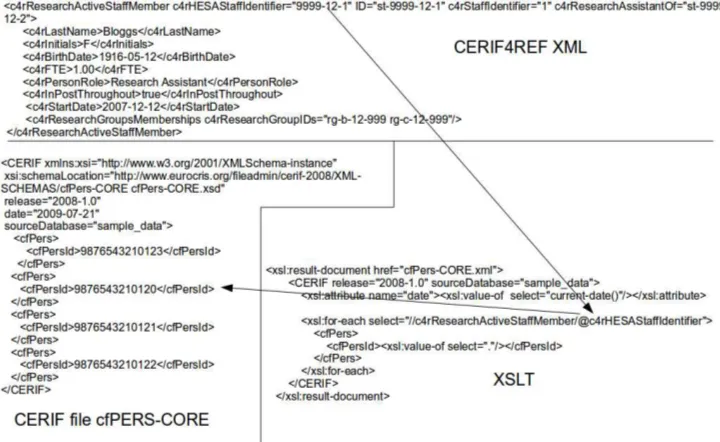
Method 1: the creation of application-specific intermediary schemas
which are more constrained, easier to manage and potentially more
interoperable than their referent schemas: metadata conformant to
these may be converted by XSLT transformations to generate
instances conforming to the referent schemas. This method is
described in Article 1 (an intermediary to CERIF) and Article 5 (an
intermediary to EAD).
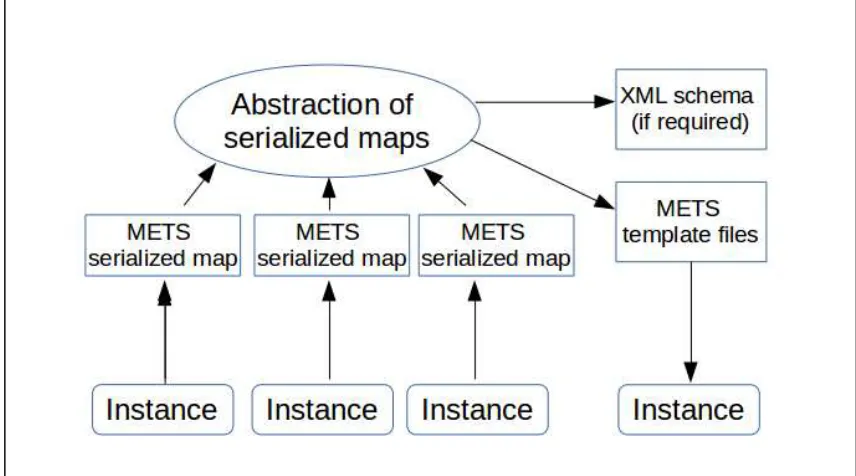
Method 2: an intermediary schema is employed as a means of
serializing a template for navigating a complex XML schema by
defining an abstraction of selective components from its instances.
Article 3 describes the use of the structural map within the METS
metadata packaging standard to serialize the semantic linkages within
CERIF instances in this way; this produces a heavily constrained map
of a complex application of greater interoperable potential than the
raw instances themselves.
Method 3: a pre-existing schema is employed as a templating
mechanism or as a conceptual model in which the structure of the
metadata of a compound digital object is separated from that of its
constituent components and the two combined by XSLT
transformations in order to generate an instance to enable its delivery.
15
this way for the delivery of complex objects: here METS is employed
as an intermediary to itself, the skeletal METS template acting as a
mediator to fully-realized instances of the dissemination metadata.
The terms Method 1, Method 2 and Method 3 are used throughout this
summary to refer to these three methods: the term methodology is used to
describe the overall concept of intermediary schemas.
This critical summary proposes a synthesis of these three methods as a way
of standardizing the overall methodology and enhancing its overall
applicability: this is elaborated on page 78 of Chapter 6.
This submission
This submission for the PhD by Prior Publication consists of five
peer-reviewed articles and this critical summary, which together define and
elaborate the potential uses of the methodology of intermediary XML
schemas. The articles submitted are as follows:-
Gartner, R. (2011) Intermediary schemas for complex XML applications: an example from research information management.
Journal of Digital Information. 12 (3) [online]. Available from:
https://journals.tdl.org/jodi/Article/view/2069 (Accessed 27 February
16
Gartner, R. (2012a) METS as an intermediary schema for a digital library of complex scientific multimedia. Information Technology and
Libraries. 31 (3), 24–35. [Article 2]
Gartner, R. (2012b) The digital object in context: using CERIF with METS. Journal of Library Metadata. 12 (1), 39–51. [Article 3]
Gartner, R. (2014) Intermediary schemas and semantic linkages: an integrated architecture for complex digital archives. International
Journal of Metadata, Semantics and Ontologies. 9 (4), 289-298.
[Article 4]
Gartner, R. (2015) An XML schema for enhancing the semantic interoperability of archival description. Archival Science. 15 (3),
295-313. [Article 5]
Each is referenced throughout this summary by its Article number (Article 1,
Article 2 etc.). References to these articles employ the page numbers of this
critical summary, not those in the works as published.
These articles were written as outputs to four research projects undertaken in
the Centre for eResearch and the Department of Digital Humanities at King’s
College London between 2009 and 2015:-
Readiness for REF (R4R) (Articles 1 and 3): a Jisc-funded project
which aimed to devise new methods for facilitating data gathering in
the 2014 REF exercise, particularly the use of the CERIF standard for
this purpose (Centre for e-Research, 2011b)
Biophysical Repositories in the Lab (BRIL) (Article 2): a
17
nanoimaging to enable research in live cell protein studies (Centre for
e-Research, 2011a)
Demonstration Test Catchments (DTC) (Article 4): a
DEFRA-funded project which sought to create a digital archive of
environmental data in order to investigate the effects of pollution on
the ecosystems of river catchments (National Demonstration Test
Catchment Network, 2011)
Collaborative European Digital Archive Infrastructure
(CENDARI) (Article 5): a European Commission-funded project
which aimed to establish infrastructures for integrating European
archival resources (CENDARI Project, 2013a).
I acted as Principal Investigator for the R4R project and as metadata
specialist/investigator on the remaining projects.
All of the articles appeared in peer-reviewed journals. Articles 1 and 2 were
included in the submission by the Department of Digital Humanities to the
2014 REF exercise (Higher Education Funding Council for England et al.,
2015).
Reference is also made in this summary to one further article (Gartner et al.,
2013) and one conference paper (Gartner and Hedges, 2013), both
co-authored by myself, which illustrate later developments arising from the
methods described within the submitted articles. These are not included in the
18
intermediary schemas on later research, they do not address centrally or
develop further the methodology of intermediary schemas.
Literature searches for this critical summary were carried out using Google
Scholar (keyword and citation searches), Library, Information Science and
Technology Abstracts (keyword searches) and Web of Science (keyword and
citation searches).
Research questions
This critical summary aims to address answer two overarching research
questions:-
Research question 1: in what ways, and to what extent, may
intermediary XML schemas be employed to facilitate the
management, preservation and dissemination of metadata for complex
digital objects?
Research question 2: How may intermediary schemas enhance
metadata interoperability within XML architectures?
The discussions throughout this summary will aim to illuminate these
questions and they will be addressed directly in the conclusion.
For the purposes of this critical summary, the concepts ‘digital object’ and
‘complex digital object’ are assumed to be defined in terms of function rather
than materiality: following Briet’s notion of documents as enumerated by
19
organized as evidence. The latter concept may be distinguished from the
former by its composition from multiple files, but it is still to be considered a
unitary object by reason of its conformance to three of Briet’s ‘rules’ for
identifying a ‘document’ as cited by Buckland, namely intentionality, process
and phenomenological position (1997, p.806; 1998, p.224): Briet’s fourth
‘rule’, materiality, is irrelevant to defining the concept within the digital
context.
Structure of this critical summary
The remainder of this critical summary takes the following form:-
Chapter 2 summarizes the five submitted articles and attempts to
elaborate the links between them in order to establish the coherence of
the research that they document. The chapter differentiates
intermediary schemas by their respective functions and discusses each
in turn: one category of schema enforces constraints on complex
metadata architectures to facilitate interoperability and interchange
(Methods 1 and 2), the other uses templating to simplify the delivery
of complex digital objects and enable the flexible reuse of their
components (Method 3).
Chapter 3 attempts to establish a context for the research documented
in the articles by relating it to the research environment at the time
that they were written (2011-2015) and referring to the literature of
the period as required. It also assesses critically how this research
20
Chapter 4 assesses critically the strengths and limitations of the research documented in the submitted articles. This assessment
includes a discussion of the relative success of each method in the
context of the project within which it originated in addition to that of
the wider research environment.
Chapter 5 provides a critical assessment of the relevance of this research to the contemporary research environment. It examines three
areas in which it is particularly relevant: the development of digital
ecosystems, current developments in archival description and research
relating to the application of Linked Open Data in digital asset
management and preservation.
Chapter 6 assesses critically the potential implications of this work for future research. It examines how each of the methods may be
developed further in future work, discusses the possibility of
synthesizing the methods and points out how they may contribute to
future work on digital preservation.
Chapter 7 forms a conclusion to this critical summary in which the
main threads are drawn together and the research questions elaborated
above are addressed and answered.
Articles 1-5 appear after these seven chapters and before the bibliography which lists works cited in this critical summary.
The term schema is used throughout to refer only to XML schemas
conforming to the XML Schema Language; this is in contrast to the term
scheme which is employed to refer generically to metadata standards and
21
All acronyms used within this critical summary are expanded within the
22
Chapter 2
Themes and threads in the submitted articles
Introduction
This chapter attempts to summarize the five articles submitted for this PhD
by Prior Publication and to draw out the threads that link the research they
document. To set them in context, reference is made to the literature cited
within the articles and to other contemporaneous work.
All of these articles are concerned with XML schemas which are in some
sense ‘intermediary’, that is they generally act as mediators to other schemas
(which I term ‘referent schemas’). Metadata that conforms to these schemas
usually requires processing by XSLT transformations to achieve its final,
often complex, delivery format. In some cases, an intermediary schema’s
referent may be itself: here the metadata generated by these XSLT
transformations conforms to the same schema.
The articles detail the three subsidiary methods of intermediary schemas that
were enumerated in the introduction to this critical summary. Methods 1 and
2 (Articles 1, 3 and 5) aim to enhance the potential interoperability (syntactic,
structural and semantic) of complex XML applications by constraining
over-flexible schemas in order to facilitate the management of their metadata and
23
Method 3 (Articles 2 and 4) also aims to facilitate the management of
complex applications but does so by employing intermediary schemas as
templating mechanisms; these are designed to simplify the delivery of
compound digital objects and to enable the flexible reuse of their constituent
components, in a manner akin to such RDF-based digital library architectural
models as the Fedora Content Model Architecture (CMA).
Method 1 employs bespoke, project-specific schemas which are designed to
act as mediators to their other, more established counterparts: in these articles
CERIF4REF (Article 1) and CCS (Article 5) conform to this model. Methods
2 (Article 3) and 3 (Articles 2 and 4) employ the digital library packaging
standard METS as an intermediary to alternatively realized instances
conforming to the same schema.
This chapter introduces the three methods proposed in the submitted articles
in the context of their intended functions. Methods 1 and 2 are discussed
within the perspective of issues of constraint, interoperability and interchange
and Method 3 within those of templating and the reusability of components.
Constraint, interoperability and interchange (Methods 1 and 2)
The use of intermediary schemas outlined in Methods 1 and 2 attempts to
ameliorate frequently documented problems in the interoperability of
XML-encoded data and metadata. Interoperability is variously defined as the ability
to exchange and use data without manipulation (Taylor, 2004, p.369) or to
24
should ideally require no human intervention to use it in processes other than
the ones for which it was created (Bauman, 2011). As Veltman points out, to
achieve this effectively requires the co-ordination of semantics between
systems and some degree of negotiation so that shared meaning is established
before data is exchanged (Veltman, 2001, p.167).
Interoperability is more difficult to achieve than interchange, that is the
exchange or transmission of metadata after some initial processing or
conversion to render it comprehensible to the receiving system (Schmidt,
2014). Bauman highlights that human intervention is required to achieve
interchange, whether or not this involves communication with those
providing the data (‘negotiated’ or ‘blind’ interchange respectively)
(Bauman, 2011). The requirement of human intervention, whether this
involves developer time or data editing, inevitably inhibits the flow of data
and the quantity that can be exchanged.
XML has been justifiably criticized for the limits to its interoperability,
despite its credentials as a readily exchangeable format independent of any
given software application. Its inherent interoperability is primarily syntactic
and structural (Gradmann, 2010, p.159) (Article 4, p.138) and its standard
validation techniques test only the conformance of an XML instance to the
syntactic and structural requirements of a schema (Jacinto et al., 2004, p.2)
(Article 1, p.94). XML and its validation mechanisms aim primarily to
describe a document’s structure and do not attempt to interpret the data it
contains (Decker et al., 2000, p.67). Semantic control within XML is very
25
enumerated lists of element content (Jacinto et al., 2004, p.2) (Article 1,
p.94)) but is otherwise not achievable with standard XML validation
techniques.
Even at the level of the syntactic and structural, interoperability in XML can
be difficult to realize. McDonough casts doubt on the interoperability of
structural metadata in XML because of the ‘flexibility, extensibility,
modularity and use of abstraction’ introduced to many schemas to enhance
their take-up (McDonough, 2008). Problems have particularly been found in
exchanging METS documents (for example, DiLauro et al. (2005), Maslov et
al. (2010)) which can be attributed to its adherence to these four principles in
much of its design.
When schemas are over-flexible, extensible, modular or abstract in the ways
described by McDonough, enhancing their interoperability requires some
degree of constraint. He recommends, for instance, restricting the ways in
which the structure of objects can be described, the use of additional schemas
within a document instance, formal rules to constrain those elements of
encoding an object which cannot be validated through standard mechanisms
and the strict use of controlled vocabularies for otherwise uncontrolled
schema semantics (such as the TYPE attribute of <div> elements within
METS) (McDonough, 2009b).
Other approaches attempt additional validation of XML instances beyond that
achievable through the standard techniques of XML parsers. XCSL (Jacinto
26
methodologies which allow the additional validation of XML instances
beyond that provided by these parsers. Schematron is used, for instance, to
enable the further validation of METS files in the Library of Congress’s
National Digital Newspaper Program (Littman, 2006). Both are useful tools
but the extra validation stages required to implement them rapidly become
cumbersome in the case of complex applications spanning multiple XML
instances (such as CERIF, the subject of Article 1).
Method 1
Method 1 attempts to find ways to introduce additional degrees of constraint
in order to facilitate greater interoperability without resorting to other
validation techniques than those available as standard within XML. It does so
by the design of project-specific XML schemas which represent a
syntactically, structurally and often semantically constrained intermediary to
a more complex and flexible established schema. CERIF4REF, designed to
act an intermediary to the research information management format CERIF
(Article 1) and CCS, the CENDARI Collection Schema, which can perform a
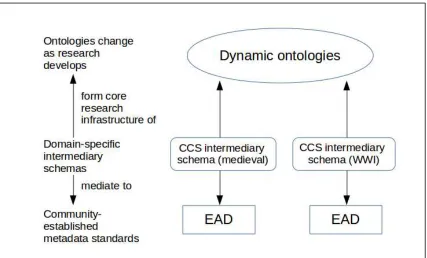
similar function in relation to the archival standard EAD (Article 5), are
examples of this type of intermediary schema.
CERIF4REF, introduced in Article 1, is an intermediary schema which
attempts to extend the technique of architectural processing, originally a
feature of SGML. This methodology allows for the construction of a bespoke,
highly constrained, DTD which is mapped architecturally to an established
27
for a small, highly focused set of elements to be constructed to meet the
needs of a specific project but, when processed, for these to generate a
document instance conforming to a more widely-used but overly flexible and
complex standard. This technique was advocated by Simons to create
bespoke DTDs for the construction of dictionaries which could then be used
to generate instances conforming to the TEI (Simons, 1998) and also to
convert TEI documents to object-orientated databases (Simons, 1999).
CERIF4REF attempts to emulate and enhance the functionality of
architectural processing by the use of XSLT transformations. CERIF4REF is
designed to mediate to CERIF, a widely-established standard for recording a
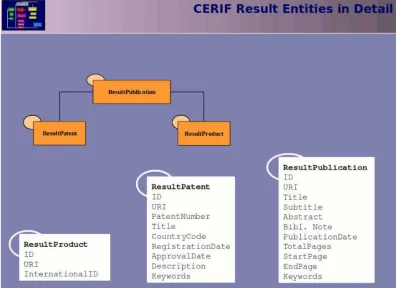
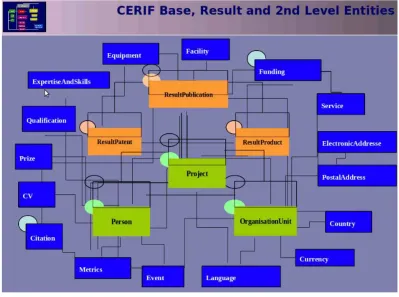
variety of information required for research management (EuroCRIS, 2010).
At the time Article 1 was written CERIF (version 1.3) was available as XML
in 192 separate schemas that replicated the tables of the SQL database in
which it was originally conceived (EuroCRIS, 2012a); a later version (1.4)
simplified this architecture into a more hierarchical model better attuned to
potential of XML (EuroCRIS, 2012b). CERIF4REF was designed as part of
a project named Readiness for REF (R4R) (Centre for e-Research, 2011b)
which was tasked with examining the compatibility of the CERIF standard
with the data structures used in the Research Assessment Exercise of 2008
(Higher Education Funding Council for England, 2007); specifically it
investigated its compatibility with an XML schema, RAE, produced for the
2008 exercise.
The incongruities between the two standards and the difficulties that they
28
approach of CERIF to data components which contrasts with the tendency of
RAE to encode aggregations of these (p.96): for instance, the RAE would
record the number of research assistants attached to a project, while CERIF
would list them individually and aggregate them in processing. In addition,
RAE and CERIF both use element content instead of internal XML
ID/IDREF pairs to establish linkages between components: this requires the
use of supplementary validation techniques such as Schematron or XCSL in
addition to an XML parser (p.97). Designing systems to accommodate 192
interlinked schemas could potentially be difficult and complex, a problem
compounded by the flexibility with which they can be applied and the
extensive set of external semantics to which they must be linked if they are to
function (p.93).
CERIF4REF attempts to alleviate these problems by offering a highly
constrained schema specific to the requirements of the R4R project. The
element set is limited to those required to generate the 19 (out of 192) CERIF
instances previously identified as needed to encode the information recorded
in the RAE schema (Gartner and Grace, 2010) (p.95). As is required by
CERIF, metadata components are listed individually rather than by
aggregation (p.95), and XML ID/IDREF pairs are used extensively to map
out the internal linkages necessary to express relationships between
components (p.96). Semantic components that are essential for CERIF but
are not part of the metadata encoded within a CERIF4REF instance, for
example the identifier of the semantic scheme used within CERIF’s extensive
set of linking files, are encoded in the XSLT files used to generate the CERIF
29
A second example of a constrained project-specific schema which mediates a
problematic widely-established standard is presented in Article 5. Here the
mediating schema is the CENDARI Collection Schema (CCS) which can act
as an intermediary to Encoded Archival Description (EAD), the XML
schema used throughout the archival community for the encoding of finding
aids (Library of Congress, 2017). The interoperable potential of EAD has
been questioned in the archival literature, for such reasons as its document-
rather than data-centric design (Dow, 2009, p.111), the multiple approaches
that it allows to encoding the same concept (Shaw, 2001, p.123) and the
inconsistencies in markup that inevitably arise because of this flexibility
(Prom, 2002). Proposals to alleviate these problems include regularizing
tagging practices though clearer guidelines (Prom and Habing, 2002, p.172),
the creation of more prescriptive schemas and the design of linked
constrained standards for archival description (Shaw, 2001, p.128).
The CCS schema elaborated in Article 5 represents an attempt to devise an
intermediary to EAD which is more data-like, more prescriptive and more
constrained than its more established referent schema. The article, originally
published in the journal Archival Science and so aimed at introducing the
schema to the archival community, examines the facet analysis which
produced the top-level components of the schema (p.156), the pervasive use
of URIs to define sub-facets at fine levels of granularity (p.157), its potential
for machine-readable analysis (p.160), its compatibility with the Semantic
30
demonstrates how CCS can function as an intermediary schema to EAD
(p.166).
In its current form and using the XSLT stylesheet devised at the time the
article was written, CCS can only support a constrained and relatively basic
EAD instance. The CENDARI Project’s guidelines for applying the schema
include a mapping from CCS to EAD which demonstrates that most
significant components of the latter standard are present (CENDARI Project,
2013b, p.[75]): those which are notably absent are text-centric elements such
as <acquinfo>, <arrangement> or <creation>. The XSLT assumes a simple
CCS instance in which basic dependencies (such as required attributes)
(CENDARI Project, 2013b, p.[43]) are met but the schema’s extensive set of
optional components, which allow descriptions at fine levels of granularity,
are not present. The article presents the possibility that the limited EAD
instance that can be generated from CCS might conform to the then-planned
EAD-Strict element set (Society of American Archivists, 2014), although
such a limited subset of EAD has not been included in the recently published
Version 3 of the standard (Library of Congress, 2017).
Both CERIF4REF and CCS demonstrate the use of intermediary schemas for
constraining highly flexible and (in the case of CERIF) complex or
compound XML applications in order to enable highly focused applications
to be devised which nonetheless offer compatibility with widely-used
established standards. They also offer the potential to enhance the
interoperability of the metadata that they encode by restricting the flexibility
31
multiple ways in which similar concepts can be encoded: in this, they
particularly implement the recommendations made by such authors as
McDonough (2009b) and Shaw (2001).
Method 2
Method 2, introduced in Article 3, is a more specialized form of intermediary
schema. In this case, the structural encoding features of the METS schema
are used to serialize and so constrain the otherwise flexible syntactic,
structural and semantic relationships of a complex CERIF application.
Instead of encoding metadata within the confines of an instance of the
intermediary schema itself, this approach seeks instead to encode a map of
the structures of its referent metadata. This map can render the referent
metadata more readily interoperable and can also form the basis of alternative
realizations for final delivery which can be generated using XSLT
transformations.
The article advocates this method as an alternative to using CERIF as an
extension schema within METS (p.120), or as a more standard intermediary
schema such as CERIF4REF (p.122), primarily in order to reconcile the
divergent architectures of METS and CERIF. Here METS operates as an
intermediary schema to CERIF in the sense that it acts as a template for
navigating the semantic links within CERIF instances and imposes a
constrained, selective map for interpreting them within an application. It
performs a similar constraining function to CERIF4REF and CCS but at a
32
a complex CERIF application instead of its metadata content. In this way, it
is something of a bridge towards the usage of METS in Article 2 and Article
4 where the schema acts as a templating intermediary for the delivery of
digital content.
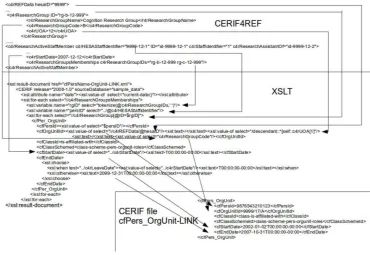
The mechanism by which this is achieved is to serialize CERIF linkages
within the structures of <div> elements in the METS structural map. This is
done by the use of a striped syntax in which at least three nested <div>s are
used, the first of which expresses the subject of a link, the second the link
itself and the third the object (p.126). This syntax is advocated by Habing and
Cole as a method for implementing RDF-based OAI-ORE resource maps
within the structures of a METS file (Habing and Cole, 2008). The tripartite
structure in their proposal is intended to emulate the subject-predicate-object
structure of an RDF ‘triple’, the form in which OAI-ORE resource maps are
commonly represented.
The methodology advocated in Article 3 extends Habing and Cole’s approach
of using TYPE attributes to describe the semantics of linkages. Instead the
METS <area> sub-element is used to delineate the metadata component that
is referenced by its parent <div>: this is done by the use of a simple XPointer
syntax which navigates down the hierarchy of elements and sub-elements in
the CERIF XML file (the diagram on Page 126 demonstrates this). The
metadata itself remains within the CERIF files, the METS structural map
33
This tripartite <div> structure is designed to emulate the RDF triples
commonly used to encode OAI-ORE resource maps but more complex
structures than these may readily be accommodated within the METS
architecture. The structural map itself may incorporate any number of nested
<div> elements to express deeper hierarchical relationships and these may be
supplemented by METS <structLink> linkages which can cut across the strict
hierarchies of the map. The network of relationships that can be expressed by
the methodology is, therefore, potentially richer and more complex than the
RDF triple on which Habing and Cole base their model.
Although the article concerns itself primarily with employing this method as
a means of reconciling the divergent architectures of METS and CERIF, it
has significant potential to fulfil similar functions to Method 1 in relation to
interoperability and interchange. As is the case with CERIF4REF and CCS, it
allows for a heavily constrained, and so potentially more interoperable,
representation of a complex CERIF application to be constructed. A
structural map of this type can be selective in the components that it
serializes, limiting them to those required for a given application and
rendering them more explicit and potentially easier to process. Using the
relatively simple template of a structural map as a way of navigating the
complex semantic structures within a set of CERIF files renders them more
interoperable: such a template could act as a machine-actionable method of
semantic navigation to enable CERIF-encoded metadata to be transferred and
34
Templating and reusability (Method 3)
The two remaining articles in this submission, Article 2 and Article 4,
introduce a further application of intermediary schemas as templating
mechanisms for the delivery of compound digital objects of some degree of
complexity. The method proposed here employs intermediary schemas as
mediators to instances conforming to the same schema, in these cases the
METS standard. They act here as templates, intermediaries to fully-realized
instances of themselves after their internal components are populated by
XSLT transformations. The rationale behind this mechanism is to allow XML
architectures to realize some of the flexibility of RDF-based approaches to
representing compound objects, particularly their potential for facilitating the
reuse of their constituent components.
The overarching distinction between these two approaches is detailed in
Article 2 (p.101): structured packaging XML schemas such as METS or
DIDL aim to create aggregations of the components of compound digital
objects, usually in rigid hierarchical structures, whereas RDF models, such as
the Fedora CMA (Fedora Commons, 2002), tend to disaggregate these
objects into atomistic units which are recombined as required (Lagoze et al.,
2005, p.130). Within a Fedora repository, for instance, compound objects are
disaggregated in this way into individual datastreams which are recombined
for delivery by invoking a series of RDF triples expressing their mutual
35
semantically as well as syntactically at multiple levels of granularity (Lagoze
et al., 2005, p.135) (Article 2, p.101).
The advantages of the approach taken by the CMA architecture have been
enumerated particularly by those who have built their repositories on the
Fedora Common repository system. Lagoze et al. cite the flexible reusability
of components as a key advantage: splitting a compound object into its
constituent datastreams allows them to be treated as discrete units which can
be recombined with ease in different contexts (Lagoze et al., 2005, p.130).
This can allow, for instance, the same components to appear in multiple
contexts and simple/composite objects and parent-child relationships to be
neatly and elegantly expressed (Gorman and Prater, 2009). Fluid definitions
of the relationships between a ‘work’ and its ‘carrier’ are also possible: the
WGBH Media Library, for instance, uses the fluidity offered by CMA to
express complex relationships between television news items and the video
tapes on which they are physically recorded (Beer et al., 2009).
As is the case with XML schemas such as CERIF or EAD, however, this
flexibility can impede interoperability. Although interoperability and
reusability are cited by the designers of the CMA as one of its key rationales
(Fedora Commons, 2014), they have often been difficult to achieve in
practice because of this flexibility. An interoperability review of Fedora
carried out at King’s College London, for instance, found multiple problems
associated with transferring content models across systems owing to
36
The method described in Article 2 attempts to address some of these issues
by replicating the templating functions of a Fedora Content Model within the
METS structural map. The context of the article is a digital library of
complex image and video objects derived from biological nanoimaging
experiments (p.102). The dissemination of these objects requires the
combination of images in flexible ways following models which differ
according to the experiment in which their constituent images were originally
captured.
Achieving this within the METS architecture as it is generally employed
would be problematic. The article discusses two ways in which it can be
done, one which uses the METS <mptr> element to reference a separate
METS file whose constituent metadata is intended to fill a <div> element in
the structural map, the other which uses OAI-ORE aggregations to express
more complex inter-component relationships (p.105). Neither is wholly
satisfactory: the first is limited by <mptr>’s circumscribed place within the
schema (only as a direct child of a <div>, not, for instance, within the <par>
or <seq> elements used to delineate parallel or sequential processing for
components), the second by the constraints that it imposes on the use of the
METS behavior and structural linkage sections (McDonough, 2009a, p.328).
The method proposed in Article 2 and extended in Article 4 attempts to
emulate within the METS framework some of the flexibility of the Fedora
CMA model, particularly in its potential for enabling the flexible reuse of
components of compound digital objects. It does this by using METS as an
37
transformations on the fly for the dissemination of a complex object. In doing
this it aims, in a manner analogous to the CMA, to separate the conceptual
models underlying the metadata structures of a complex object from the
metadata itself (Article 4, p.141): the former is used to structure the latter
(and its referent data) for delivery to the end user.
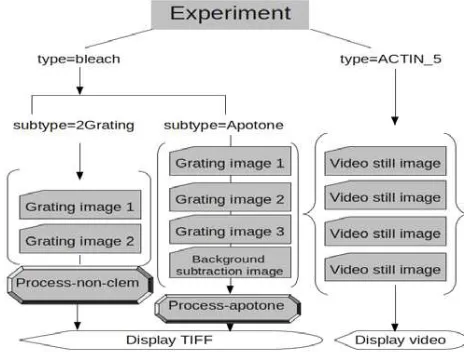
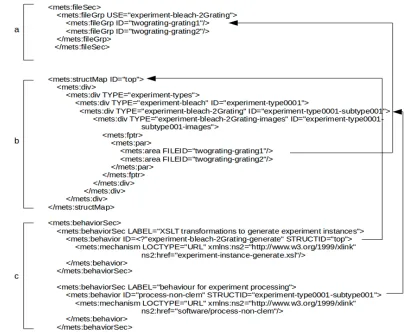
In Article 2, the delivery of a set of complex biological nanoimaging still
images is achieved by encoding a model or template for each type of object
within a METS structural map: a hierarchy of types and sub-types of these
models can be expressed within its hierarchies (p.107). At the bottom of these
hierarchies are the models for the combination of components used when a
complex object is assembled and delivered; each of these contains a <fptr>
(file pointer) element which would normally reference a data file listed in the
METS file section. Instead of this, it here acts as a pointer to an empty <file>
element, a placeholder for digital content which is only realized when the
METS template is processed by XSLT for delivery. Small subsidiary METS
files, essentially containing only lists of the component files that need to be
assembled into the compound object for delivery, are used to populate these
empty <file> elements during XSLT processing.
An even more skeletal METS template is used to generate video files where
the exact number of images required will vary from sample to sample and so
cannot be modelled directly in the structural map. In this case both the
structural map and the file section act as placeholders only and the templating
model is recorded within the subsidiary file for each video (p.109). In both
38
necessary to generate the METS file in its fully-realized form and to identify
any software needed to process and render the final object for delivery.
A similar method of employing METS as a templating mechanism is
proposed in Article 4 although here a higher-level structure for defining
conceptual models and their relations is employed which allows for some
degree of recursion. The article advocates an integrated XML architecture for
a complex archive of environmental data in which the use of METS as an
intermediary templating schema is complemented by the use of METS and
MADS schemas for the construction of semantic concept maps. The
templating function of intermediary schemas is discussed in section 4 (p.
140) which examines their use in defining conceptual models for data types
and user personae.
This article introduces a new layer of abstraction to the definition of
templates or ‘conceptual models’ as they are here called (p.140). The
conceptual model for each data type is defined, as in Article 2, within a
METS file’s structural map. This is then invoked for delivery by a
higher-level METS file which uses an <mptr> element to associate it with a <div>
corresponding to its data type. As in Article 2, the METS behavior section
links each desired realization of these intermediary schemas with the tools
(specifically the XSLT transformations) required to produce it. The same
device is also used to associate multiple personae to a data type in order to
allow varying input mechanisms for different classes of users within the
heterogeneous community of data providers for this archive. A skeletal
39
Using the <mptr>element in this way allows for a greater degree of
abstraction than the method described in Article 2 alone. The METS file here
records the highest-level architecture of an application, the second-level
intermediary schemas of Article 2 the detailed content models for compound
objects, and third-level files the constituent components of these objects. This
tripartite model enables a separation of structure, metadata and data, all of
which can be combined and reused as necessary in a manner analogous to the
flexibility of such models as the Fedora CMA.
Conclusion
The five articles summarized here demonstrate the applicability of
intermediary schemas to two primary functions, the first for constraining
complex and flexible XML applications in order to enhance their
interoperability (syntactic, structural and semantic), the second as a
templating mechanism to allow conceptual models to be created for complex
applications which separate their metadata structures from the metadata of
their constituent objects. Both functions attempt to reconcile the potentially
contradictory requirements of interoperability and flexibility within XML
architectures.
Constrained, project-specific schemas such as CERIF4REF and CCS, which
revive the ideas behind SGML architectural processing, have the potential to
constrain and so render more interoperable problematic schemas, such as
40
compatibility with these community-established standards. A similar degree
of constraint, which avoids the use of bespoke schemas, may be achieved by
the technique of using the structural map of the METS schema as a template
for the navigation of semantic links within a referent schema by explicitly
serializing their relationships.
The second function of an intermediary schema, as a templating mechanism
for encoding a conceptual map of a complex application, offers a viable
alternative to RDF-based architectures, such as Fedora CMA, which
disaggregate the components of complex objects for flexible recombination
on delivery. Using these schemas as mediators to fully-realized instances
conforming to themselves allows the metadata structures for a complex
object to be separated from the metadata itself and for its constituent
components to be recombined and reused with a high degree of flexibility.
Complex structures can readily be encoded using mechanisms which allow
multiple METS files to act as intermediaries, each at a differing level of
abstraction.
Although conceived for a variety of projects, the intermediary schemas
documented here all address similar issues, how complex and (from a
systems design standpoint) messy metadata can be rendered tidier, and so
easier to design applications for, without forgoing the expressive power
required of it. As these articles often stress, the approaches advocated here
are only initial attempts at addressing these issues: further research (some
ideas for which are discussed later in this critical summary) will be needed
41
Chapter 3
The research in context
Introduction
This chapter attempts to place the research discussed in the submitted articles within the
overall context of preceding or concurrent work and also to assess critically the extent to
which it extends or enhances this work. It aims to do so by reference to the literature
that precedes or is contemporaneous with the articles.
The first section examines the intermediary schemas of Method 1 in the context of
previously established techniques for employing mediating mechanisms between
metadata schemes. The second relates the serialized metadata structures of Method 2 to
previous work that attempted similar approaches to handling complex, disaggregated
metadata. The final section relates the use of the METS schema for templating or
conceptual modelling of Method 3 to previous work and attempts to assess the extent to
which it represents an original advance on its antecedents.
Method 1
By function and, to a certain extent, technique, Method 1 can legitimately be compared
to previously established approaches to enabling metadata interoperability and
standardization. Chan and Zeng’s much-cited study (159 citations on Google Scholar)
(2006) highlights a number of techniques for interoperability at the schema level with
42
‘crosswalks’, ‘semantic and/or technical mapping[s] (sometimes both) of one metadata framework to another metadata framework’ (Patel et al., 2005, p.21),
one-to-one mappings such as EAD to MODS (Bountouri and Gergatsoulis,
2009) or Dublin Core to MODS (Library of Congress, 2012)
‘switching-across’, synthetic switching schemes, often based on unqualified Dublin Core, to which multiple metadata schemes can be mapped (Chan, 2005);
these include the OAI-PMH schema for metadata harvesting (Lagoze and Van
de Sompel, 2015) and schemes that formed the core of OCLC’s Metadata
Switch (Godby et al., 2003) and Crosswalk Web (Godby et al., 2008) services
‘derivation’, a new schema derived from an existing one, usually in a simplified form, which retains a similar basic structure to its source schema but allows for
variations in depth and detail (Chan and Zeng, 2006): examples of these include
TEI Lite (Burnard and McQueen, 1995; Burnard and
Sperberg-McQueen, 2006), MARC Lite (Library of Congress, 2008) and CDWA Lite
(Stein and Coburn, 2008)
‘application profiles’, schemes which synthesize terms from diverse vocabularies or other schemes and are customized for specific applications
(Heery and Patel, 2000): when initially conceived, although not always applied
later, application profiles were designed to enhance interoperability by imposing
restrictions on a base standard, so allowing any system that can handle this base
to understand a profile derived from it (Duval et al., 2006, p.242). Examples of
these include the early DESIRE project (UKOLN, 2000), the DC Library
Application Profile (Dublin Core Metadata Initiative, 2004), the e-Government
profile e-GMS (UK Government, 2006), the Scholarly Works Application
Profile (SWAP) (Allinson et al., 2007) and the Renardus project profile for
43
In a very basic sense, intermediary schemas may be considered forms of crosswalks or
switching schemes, as they provide a mechanism for mapping between schemas, that is
‘the process of associating elements of one set with elements of another set’ (Semantic
World, n.d.). They could also, and more accurately, be described as a variant of derived
schemas as they are designed specifically to constrain a single established schema,
usually of considerable complexity and flexibility. They might also be seen as at least
partially congruent with the technique of application profiles, which similarly construct
their element sets from outside schemes, although, unlike derived schemas, usually
from more than a single source.
Although these four techniques for schema interoperability offer a useful framework for
initial considerations of the context within which intermediary schemas can be located,
there are significant ways in which the methods proposed here differ from or extend
these established approaches. The following could be highlighted as the most important
of these:-
The relationships of intermediary schemas to their referent schemas are more fluid and complex than those of derived schemas, crosswalks or switching
schemes: in many cases their elements do not have a one-to-one match with
their counterparts in their referents nor do they attempt in most cases to
replicate their basic structures (as derived schemas do)
Intermediary schemas do not follow the ‘mixing and matching’ (Heery and Patel, 2000) approach of many application profiles: they do not attempt to
create new schemes which extend beyond the semantic boundaries of their
referent schemas, as application profiles often do (for instance the DC
44
incorporates additional elements to DC). They are also subsidiary to their
referents, unlike application profiles which are often intended to act as
independent schemes
Intermediary schemas offer more sophisticated mechanisms to accommodate incongruities between schemas where no one-to-one semantic match exists
between elements (for instance, the CERIF element <cfOrdUnitId> in Figure
8 of Article 1 (p.98), which has no equivalent in RAE). Associating an
intermediary schema with an XSLT transformation as an integral
complement allows the relatively simple construction of synthetic elements
which can incorporate metadata components already present in but
distributed throughout the source schema and additional ones created during
processing
Intermediary schemas provide a mechanism for reconciling divergent schema architectures, for example, the aggregated approach of the RAE
schema and the disaggregated methods that predominate in CERIF (Article
1, p.95): the XSLT transformation provides a mechanism for this
reconciliation by allowing aggregations, counts and other syntheses to be
incorporated into the realization of the intermediary schema to its referent.
This mechanism is, however, limited to translation from more specific,
disaggregated, metadata to its aggregated form
Intermediary schemas allow descriptions at more specific levels of
granularity than may be allowed in an established schema, for instance in the
more data-centric architecture of CCS as compared to the document-centric
focus of its referent schema EAD (Article 5, p.152): once again, the XSLT
transformation acts as a mediator between divergent granularities, although,
45
translating from the more to the less specific, from the data-like components
of CCS to the more flexible document-like structures of EAD
The constraining mechanisms of intermediary schemas also extend beyond those of derived schemas and application profiles (at least when these follow
their early guiding principle of restriction). When attempting to impose
constraints, these two methods are limited to reducing element sets to a more
confined semantic environment than their sources. CERIF4REF, by
contrast, uses such techniques as enumerated lists or ID/IDREF pairings to
enable constraints on an application which extend well beyond those of a
employing a more confined element set alone.
From the above discussion, it seems clear that intermediary schemas find only a
relatively limited place within these traditional models and certainly extend them in a
number of distinctive ways. In addition to these approaches, a very small number of
projects that preceded those documented in the submitted articles have adopted
approaches in which they created bespoke XML schemas explicitly labelled
‘intermediate’, ‘intermediary’ or ‘mediating’. The following discussion highlights those
documented in the literature up to 2011, the date of Article 1, which most closely
resemble the intermediary schemas in the submitted articles.
Some attempted schema mediation by creating synthetic schemas into which sources
could be merged:these include an XML data integration system proposed by Almarimi
and Pokorny which utilized a common ‘global’ schema created by the merger of source
schemas (2005, p.26), the PORSCHE project which constructed an ‘intermediate
mediated schema’ by merging input schemas (Saleem et al., 2008, p.638) and the
XMediator and XINTOR projects which aimed to automate the integration of diverse
46
Others used intermediate XML schemas for data integration, for instance, the National
Institute of Health which employed ‘a common XML intermediate’ (Shaker et al.,
2002, p.693) for merging XML query results from heterogeneous sources or the Xyleme
project which used such schemas to host abstract models of heterogeneous XML data
sources in order to enable the construction of views across them (Abiteboul et al., 2001,
p.46; Abiteboul et al., 2002, p.238; Cluet et al., 2001, p.273). A further application used
them as nodes within a peer-to-peer data management system mediating between XML
and OWL sources (Halevy et al., 2003, p.764). Another employed them as a conversion
mechanism from XML to ontology instances (Bohring et al., 2005, pp.150–151); here
the schemas were generated from source instances to enable the definition of an OWL
ontology to which instances could be mapped.
All of these projects are essentially mapping mechanisms, most of which follow the
model of switching across (particularly Abiteboul et al. (2002), Halevy et al. (2003),
Almarimi and Pokorny (2005), Saleem et al. (2008), Nguyen et al. (2009) and Nguyen
et al. (2011)). They do not attempt the constraining functions of CERIF4REF or CCS,
nor, as they function as mediators between a number of heterogeneous schemes, do they
share their integral relationship with a single scheme (even if this scheme is embodied
in multiple schemas). They do not attempt any reconciliation of disjoint architectures as
CERIF4REF endeavours to do in translating between the aggregated components of
RAE and their disaggregated equivalents in CERIF. Nor do schemas derived from
source instances, such as in Bohring et al. (2005), achieve the level of abstraction of a
Method 1-type intermediary schema which allows them to enable this reconciliation.
To sum up, while intermediary schemas such as CERIF4REF and CCS can be aligned
in a basic sense with some established approaches to schema interoperability, such as
derived schemas or application profiles, they differ in significant ways in terms of the
47
employ to enable this. They also differ significantly from other approaches to
employing ‘intermediate’, ‘intermediary’ or ‘mediating’ XML schemas that preceded
them in their overall purposes (constraining their referent schemas and reconciling
divergent architectures) and the mechanisms that they deploy.
Method 2
Method 2, in which a complex set of semantic relationships in a diverse set of XML
metadata instances is structured by serializing it within the METS structural map, has
no direct analogue in the preceding or contemporaneous literature. Similarly, the
primary technique employed for encoding these serializations, using the XPointer
syntax within the BEGIN attribute of the METS <area> element to address the location
of metadata components, is also without precedent.
It is valid, however, to compare this method with mechanisms for modelling the internal
structures of compound objects in such packaging standards as OAI-ORE (Open
Archives Initiative, 2008; Open Archives Initiative, 2011) or METS as it is
conventionally employed. Both the OAI-ORE resource map and the METS structural
map, when used to describe logical structures such as the internal contents of a
compound object (a digitized book, for example), attempt to impose a constrained
representation of its referent object and to define a single view of it in preference to
others that could be conceived. It then maps pathways to its constituent data objects so
allowing the construction of a synthetic version of the representation for delivery.
The rationale for this method also bears comparison with the Fedora data model,