JOURNAL OFVIROLtOGY, Sept. 1987. p.2816-2822 0022-538X/87/092816-07$02.00/0
Copyright © 1987, American SocietyforMicrobiology
Analysis of
RNA
Synthesis
of
Type
1Poliovirus
by
Using
an
In
Vitro Molecular
Genetic
Approach
HARUKATOYODA,'t CHEN-FU YANG,' NAOKAZU TAKEDA,'T AKIO NOMOTO,2 AND ECKARDWIMMERl* Department ofMicrobiologv, School of Medi(ine, State University ofNewt York at Stony Brook, Stony Brook, New York
11794-8621,' and Departmenit ofMicrobiology, The Tokyo Metropolitacn Institite ofMedicalScience, Honkomagome, Biunkyo-Ki, Tokvo 113, Japan2
Received 23 April 1987/Accepted 1June 1987
Membranous crude replication complexes (CRC) were isolated from poliovirus-infected HeLa cells as
recently described (N. Takeda, R.J. Kuhn, C.-F. Yang, T. Takegami, and E. Wimmer, J. Virol. 60:43-53, 1986). Viruses used to produce the CRC were poliovirus type 1 (Mahoney), [PV-1(M)], poliovirus type 1
(Sabin) [PV-1(S)], and four in vitro recombinants thatwereconstructed from infectious cDNA clones. RNA synthesisinCRCwasstudied.Noend-linked, full-lengthdouble-strandedpoliovirusRNAwasdetectedinCRC regardlessofwhethernonionic detergent (NonidetP-40)wasadded priortoincubation. SynthesisofVPg-pU andVPg-pUpU,twonucleotidyl proteins presumedtobe involved in the initiation of RNAsynthesis,wasslower
at30°C in CRC induced by PV-1(S) than by PV-1(M). This observation was used to design a pulse-chase
experimentwhose resultsuggestedthatsynthesisofVPg-pUpUoccurredbyuridylylationofVPg-pU. Synthesis ofVPg-pU(pU) was thermosensitive in CRC induced by PV-1(S). With CRC of recombinant viruses, the thermosensitive blockcovaried tonucleotidesubstitutions in PV-1(S) that mappedtothevirus-induced RNA polymerase 3DPJ0. We conclude that plus-stranded RNA synthesis in CRC does not proceed via hairpin structures. The results ofVPg-pU-> VPg-pUpU synthesisareconsistent withamodel in whichVPg-pUisthe
primer ofRNAsynthesis mediatedby3DP01.ThedatasuggestthaturidylylationofVPgor aprecursorthereof
maybecatalyzed by 31Y°' itself, a mechanism resemblingeventsoccurring inadenovirus DNA replication.
The mechanism ofgenomereplication ofeucaryotic RNA viruses has not been solved, and that of poliovirus is no
exception. As reviewed recently (14a, 39; B. L. Semler, R. J. Kuhn, and E. Wimmer, in E. Domingo, P. Ahlquist, and J. J. Holland, ed., Replication of the Polioviirls
Genome, in press), two strategies have been followed to
decipher, by biochemical means, the components involved and the mechanisms functioning in poliovirusRNA synthe-sis. The first is an attempt to reconstitute a replication
system with isolated virion RNA and individual protein components. This has led to the extensive characterization of the virus-encoded polymerase 3DP!". Two host cellular polypeptides have also been implicated in poliovirus RNA replication. Whereas the function of3DP'lin the elongation of RNA strands has beenfirmly established, the role of the twohost cellular proteins(host factor and terminal uridylyl transferase), if any, is unclear (1, 13, 14a, 17, 34, 41, 43;
Semleretal., inpress). The second strategy isbased onthe
observation that all poliovirus-specific RNA synthesis is found associated with membranous fractions when infected HeLa cellextractsareanalyzed (4, 34, 35, 36). Infact, only
a membranous replication complex (called the crude
repli-cationcomplex [CRC]) isolated frominfected HeLa cellshas
so farproduced authentic, VPg-linked viral RNA (34). The mechanism of initiationremainsamajorpuzzle in the
study of poliovirus RNA synthesis. Two facts must be accommodated. First, the viral RNA polymerase 3DP"' is a
* Corresponding author.
tPresent address: Department of Public Health, School of
Phar-maceutical Sciences. Kitasato University. Minato-Ku. Tokyo 108.
Japan.
tPresentaddress: Central VirusDiagnostic Laboratory. National
Institute ofHealth, Gakuen 4-7-1. Musashimurayama, Tokyo 190,
Japan.
primer-dependent transcriptase (10, 11) and in that respect resembles DNApolymerasesandreversetranscriptase.
Sec-ond, all newly formed RNA molecules (including minus-strand RNA) are covalently linked to VPg, a small protein (22amino acids)encoded bythe virus(16, 21).
Twomechanismsof initiation ofpoliovirusRNAsynthesis have beenproposed.One dictates the formation ofahairpin,
the3'-terminalend of whichservesasprimerfor
3DP"l
(1, 2,42).The hairpinsare supposedlycutby VPg (oraprecursor thereof), wherebyVPg is linked tothe RNA. In the second mechanismauridylylated derivative of VPgis the primerof 3D"Yo (10, 21, 31, 34, 35, 36),amechanism resembling thatof
adenovirus DNA replication (5; see discussion by Wimmer
[40]). Indeed, the in vitro synthesisofVPg-pU(pU)in CRC
hasbeen achieved(34, 35),andevidencehasbeenpresented
suggestingthatpreformed VPg-pUpUcanbe "chased" into
longerRNA molecules (34).
Thepurposeofthe study reported herewastoinvestigate whether hairpins are synthesized in the CRC. Moreover,
using genetic elements of the attenuated Sabin derivative [PV-1(S)] (29) ofpoliovirustype 1, Mahoney [PV-1(M)], we
constructed in vitrorecombinant clones, expressed them in HeLacells, andexaminedtheir RNAsynthesis in CRC. This allowed usto implicate poliovirus genetic information
map-pingatthe 3' end ofthe genome, mostlikelyto3DP"" itself, in the synthesis of VPg-pU(pU).
MATERIALS ANDMETHODS
Construction of recombinantviruses. The construction of cDNAclones ofrecombinantviruseswasdone essentiallyas
described by Omata et al. (23). The genome structures of PV1(SM)IC-13a, PV1(SM)IC-13b, PV1(SM)IC-2b, and PV1(SM)pT7-30a are shown in Fig. 5. Viruswas recovered
2816
Vol. 61,No. 9
on November 10, 2019 by guest
http://jvi.asm.org/
from DNA-transfected HeLa cells for
PV1(SM)IC-13a,
-IC-13b, and -IC-2b (23. 32) or fromRNA-transfected HeLa cells for PV1(SM)pT7-30a (38). The plasmid specifying PV1(SM)pT7-30a was a derivative of a clone containing the promoter for the phage T7 RNA polymerase and was thus transcribed to yield infectious RNA, as published by van der Werf et al. (38). Recovered viruses were grown initially in HeLa R19 monolayer cells infected at a multiplicity of infection of approximately 10-3. After incubation for 3 to 4 days at 33.5°C, virus was recovered by preparing a cytoplas-mic extract. High-titer virus stocks were subsequently pre-pared in HeLa S3 suspension cells (20 PFU/cell, 7.5 h of incubation at 35.5°C postinfection).Preparation of CRC. The CRC were prepared from HeLa cells infected with recombinant viruses or their parental viruses, PV-1(M) and its attenuated derivative PV-1(S), as described previously (34). In most cases the HeLa cells were incubated at 35.5 to 36°C and harvested 4.5 h after infection. Standard conditions forsynthesis of VPg-pU(pU) and RNA in vitro. The synthesis of VPg-pU(pU) was carried out in a mixture (40 pd) containing 50 mM HEPES
(N-2-hydroxy-ethylpiperazine-N'-2-ethanesulfonic acid. pH 8.0), 3.5 mM
magnesium acetate, 10 mM dithiothreitol, 50 mM KCl, 2.5 mM phosphoenolpyruvate (Calbiochem-Behring), 2 p.g of pyruvate kinase (Boehringer Mannheim Biochemicals), 50
pLCi of
[(x-3'P]UTP
(New England Nuclear Corp.; 3,000 Ci/ mmol), and a suspension of 10pldofDEAE-cellulose-treated CRCcontaining 40 pLgof protein (34). In vitro RNA synthe-sis was performed in a similar reaction mixture containing 1 mM ATP, 1 mM GTP, 1 mM CTP, and 10 p.M UTP. For RNA synthesis, however, it was found not to be necessary to treat the CRC with DEAE-cellulose. The reactions were stopped by adding sodium dodecyl sulfate (SDS) to a final concentration of 0.5%. RNA in the reaction mixture was recovered by extraction with phenol-chloroform and ana-lyzedby0.8%agarose gelelectrophoresis (34). Denaturation ofRNAwith glyoxal was performedasdescribedpreviously(18).
Immunoprecipitation of32P-labeled VPg-pU(pU) with
an-ti-VPg immunoglobulin G (IgG) (20to 30 p.lofIgG solution
to each reaction) was carried out as described previously (34) except that 5 mg of protein A-Sepharose CL-4B (Pharmacia) was added to each reaction in place of fixed
Staphylococcus tillureu(s.
Analyses of immunoprecipitated VPg-pU(pU) molecules
in 13.5% SDS-polyacrylamide gels were carried out by the
method of Laemmli (15). The running buffer, however,
containedtwotimes the concentration of Trishydrochloride
and glycine to achieve better separation of smaller
mole-cules, particularly ofVPg-pU fromVPg-pUpU. It should be
noted that thequality of SDSstronglyaffected theseparation
of these nucleotidyl peptides. SDS obtained from Bethesda Research Laboratories provedto be satisfactory.
RESULTS
Absence ofhairpin formation in CRC. Takeda et al. (34)
provided evidence that VPg-linked poliovirus RNA is syn-thesized intheCRC and that this RNAis initiated de novo. We and others (8) had observed earlier, however, that the synthesis ofsingle-stranded RNA (ssRNA) in CRC is abol-ished if thereaction is carriedout inthepresenceof nonionic
detergent (0.5% Nonidet P-40
[NP401).
Under thesecondi-tions only double-stranded RNA (replicative form [RF]) or
possiblysomereplicative intermediate(RI)isformed(8. 34).
2 3 4 5 6 7 8
Detergent Detergent
_ _ ± 1-- - .+
0 120 0 120 0 120 0 120
RF-
_-1! ssN!^~~s
cssRN'A- ^
-FIG. 1. Analysis of RF molecules synthesized in the presence of detergent.Thecrudemembrane complexwasincubated with[s-32P] UTP at30(Cfor10minin the absence or presence of0.5%NP40andi chased for either 0 or 120 min with 10 mM cold UTP. RNAs contatinedinthecomplex were recovered by extraction with phenol-chloroform, heated at50'C for 60 min in theatbsence(lanes1 to 4) or presence (lanes 5 to 8) of glyoxal, and then analyzed by 0.8%/c agarose gel electrophoresis. Unlabeled poliovirus RF and virion RNA (ssRNA) werecoelectrophoresed as markers and visualized byethidium bromide staining prior to autoradiography.
One explanation of this phenomenon could be thefollowing. Synthesis of RNAmayproceed via hairpinsasintermediates in genomic replication. Release of ssRNA is preceded by cleavage of the hairpins, and this is accompanied by the concomitant linkageofVPgtothe 5' endofnascent RNA(1, 2, 44). Detergent, in turn, might prevent cleavage of the hairpins but not elongation of RNA strands. If so, the products of synthesis in the presence of NP40 would be predicted to be heterogeneous in length. Some ofthe prod-ucts should be full-length double-stranded RNA covalently linkedat one end, that is, twice the size ofpoliovirus RNA (44).Ouranalysisof the RNAsynthesizedinCRC, however, revealed no evidence of hairpin structures regardless of whether detergent was added (Fig. 1). RNA was labeledwith
Ka-32P]UTP
(Fig.
1. lanes 0). In a portion of the reaction mixturethe incorporated radiolabeled nucleotidewas subse-quently chased for 120min (Fig. 1. lanes 120). As expected, incorporation inthe absence of NP40resultedinthe synthe-sis of RF and ssRNA (Fig. 1, lane 1), although in this experimentthe yieldof the products was relatively low(for higher yields see, for example, Fig. 3). Labeled material migratingjust above the RFwas considered to be RI (8, 12,19, 34). During the chase the amount of RI was reduced,
whereas thatofRF and ssRNAincreased(lane 2). When the productsofsynthesis in theabsence ofNP40wereanalyzed after denaturation with glyoxal, very heterogeneous RNA wasfound priorto the chase(lane5), whereaspredominantly ssRNA wasobserved after the chase(lane 6).Thiswastobe expected if RNA chains were synthesized to full length during the chase. Note that no RNA molecules migrating slowerthan ssRNA wereapparentineither lane 5or6.In the presence of 0.5% NP40, only RF and RI molecules were synthesized (lane 3), and the amount of RI was greatly
reduced after the chase (lane 4). Denaturation of the RNA products synthesized in the presence of detergent yielded RNAs that migrated either faster than ssRNA (lane 7, no chase) orjust as fast as ssRNA (lane 8, after chase). This resultdemonstrated thathairpin structures twice the sizeof
on November 10, 2019 by guest
http://jvi.asm.org/
[image:2.612.337.528.75.242.2]2818 TOYODA ET AL.
M
_
*.
-_W.
2 3 4 5
PI*
P3.
*2f'i~,)
I.-3D
--2BC;
3f(:9,
t...2C
VP--: 33U'C)'f..W/",
VP3
---V3C
3AB-X ..
Vb r)T_ .:
V-\Wet pl !.
FIG. 2. Pulse-chase analysis of formation of VPg-pUpU from VPg-pU. CRC(S)wasincubated with[o-32P]UTPat300Cfor10min under standard conditions as described inMaterialsand Methods. The chasewascarriedoutinthe presenceof10 mMcold UTPfor0, 1, 2, 5, and 15 min(lanes 1 to 5,respectively)at300C.Synthesized VPg-pUand VPg-pUpU wererecoveredfrom the reaction mixture by immunoprecipitation and analyzed by 13.5% SDS-polyacryl-amide gel electrophoresis. Lane M, Lysate of
[35S]methionine-labeledpoliovirus-infected HeLacells.
poliovirus RNAcould notbe detected among the products
synthesized in CRC, regardless ofwhether nonionic
deter-gentwas added. Very small amountsof end-linked double-stranded RNA, however, would not have been observable by this assay.
Synthesis of VPg-pUinCRC. Ourworking hypothesishas been thatavirus-specific nucleotidylprotein functionsasthe
primerin poliovirus RNA replication (21, 40). This
hypoth-esis fits well to the properties of
3DPol,
which is aprimer-dependent transcriptase. It was also supported by (i) our
observationthatVPg-pUpU canbe synthesizedinCRC (34,
35) and (ii) a report that this nucleotidyl protein can be isolated from poliovirus-infected HeLacells (6). Moreover,
using a CRC that was depleted of endogenous nucleoside
triphosphates by treatment with DEAE-cellulose and
incu-bating the CRC with [o-32P]UTP and an ATP-generating
system, Takeda et al. (34) could synthesize
VPg-pU/VPg-pUpU, ofwhich allVPg-pU could be chased with unlabeled
UTPinto VPg-pUpU. CRC derived from PV-1(M)-infected
HeLa
cells,
however,
never produced only VPg-pU, theproposed primer in viral RNA synthesis. CRC derived from a temperature-sensitive strain of poliovirus, on the other hand, allowed us to observe the synthesis ofjust VPg-pU, as will be discussed below.
Viral replication in HeLa cells infected with PV-1(S), the attenuated derivative of PV-1(M) isolated by Sabin (30), has
long been known to be temperature sensitive (9), and this temperature sensitivity maps to some degree to the regions ofthegenome specifyingthe nonstructural proteins (23). We therefore isolated CRC from PV-1(S)-infected HeLa cells
[CRC(S)] and
studied
its ability to synthesize VPg-pU(pU)and full-length RNA. As will be shown in a later section,
formation of
VPg-pU(pU)
in CRC(S) was temperaturesen-sitive, whereasthat ofelongation products mightnotbe. In regardtothe uridylylation of VPg,weobservedthatCRC(S) synthesized only VPg-pU (Fig. 2, lane1)whenlabelingwas carriedoutfor 10min with [o-32P]UTPat300C. When chased with 10 mM unlabeled UTP for 1, 2, 5, or 15 min (Fig. 2, lanes 2 to 5, respectively), all VPg-pU was converted to VPg-pUpU. Note that during the chase some ofthe radio-activity seen in VPg-pU was lost; the band in lane 5 (VPg-pUpU)wasless dense than that in lane 1. It ispossible that somelabeled product was degraded during incubation. Nevertheless, CRC ofpoliovirus-infected cells can synthe-size VPg-pU, and thisnucleotidyl proteincan subsequently beuridylylatedtoVPg-pUpU. Thisresultstronglyarguesfor the ability of CRC to elongate preformed VPg-pU.
Temperature sensitivity of VPg-pU(pU) synthesis in vitro. Miyamura et al. (20) observed that a CRC isolated from enterovirus 70-infectedLLC-MK2monolayer cells exhibited atemperature effect on in vitro transcription. We therefore analyzed RNA synthesis in CRC isolated from cells infected with PV-1(S) that had accumulated numerous nucleotide substitutions during attenuation (22). Labeling of RNA in CRC(M) and CRC(S) at 30 and 39°C with [oa-32P]UTP was followed by a chase for 60 min in the presence of 10 mM UTP. Total RNAwas isolated andanalyzed by agarose gel
electrophoresis. As can be seen in Fig. 3, all three
virus-specific RNA species (RI, RF, and ssRNA) were
synthe-sized during the pulse regardless of whether the CRC was isolated from Mahoney- or Sabin 1-infected cells. As
ex-pected, the number of RI molecules decreased during the
chase, concomitant with an increase of ssRNA. We
con-clude that theelongation reaction inCRC(S)and the release of ssRNAcanproceedat 39°C.
Adifferent picture emerged when the formation of
VPg-pU and VPg-pUpU in CRC(M) and CRC(S) was analyzed
(Fig. 4). CRC(M) clearly could synthesize VPg-pU and
VPg-pUpU at all temperatures tested, whereas in CRC(S)
thesynthesisof bothnucleotidyl proteinswas nearlyabsent
at39.5°C. The temperature sensitivity ofVPg-pUsynthesis
was very reproducible in experiments carried out with
differentpreparationsof CRC. Weconclude that the forma-tion ofVPg-pU in CRC(S) is temperature sensitive. As a
Mahoney 300C 390C
0 60 0 60
SabinI
30°C 39°C
0 60 0 60
RF-_
__5
_ w5
v [image:3.612.80.286.74.288.2]ssRNA-~e , q
FIG. 3. Agarose gel electrophoresis of the products ofCRC(M) and CRC(S) synthesizedat twodifferent temperatures. The crude membrane complexes were incubated with [a-32P]UTP at 30 and 39°Cfor 15min,and the products were chased at 30 or39°C for 0 or 60minwith 10 mM cold UTP. Thelabeled in vitro RNA products wererecoveredbyextraction with phenol-chloroform and analyzed by 0.8%agarosegelelectrophoresis.Thetemperatures and incuba-tionperiods (in minutes)foreach chaseare shownaboveeach lane. J. VIROL.
on November 10, 2019 by guest
http://jvi.asm.org/
[image:3.612.366.517.508.652.2]IN VITRO POLIOVIRUS RNA SYNTHESIS 2819
30tC 36t 37t 381C 39.5t
Mahoney g
w
d A -vpg-pupSabin
0
l
-Vpg-pupU-VPg-pU
FIG. 4. Nucleotidyl-VPg formation in CRC(M) and CRC(S) at differenttemperatures. The VPg-pU- andVPg-pUpU-forming activ-ities at different temperatures in CRC of Mahoney- and Sabin 1-infected cells were measured. VPg-pU(pU) was synthesized and recovered by immunoprecipitation as described in Materials and Methods, but each reaction mixture was preincubated at the indi-catedtemperature for 15min before adding[a-32P]UTP. Incubation withthe labeled precursor at different temperatures was for 120min; products were then immunoprecipitated and analyzed by 13.5% SDS-polyacrylamidegel electrophoresis, as shown for Fig. 2. Only theportionsof the autoradiogram in which the nucleotidyl proteins migratedare shown.
consequence, verylittle if any VPg-pUpU is seen in CRC(S) at the nonpermissive temperature of 39.5°C under the
con-ditions of thisexperiment.
Construction of recombinant viruses. Thedifference in the synthesis of VPg-pU and VPg-pUpU between the two
rep-licationcomplexes,CRC(M)and CRC(S), must be due to the
genetic makeup of the viral strains that were used to
gener-atethereplicationcomplexes. Sequence analysis of genomic
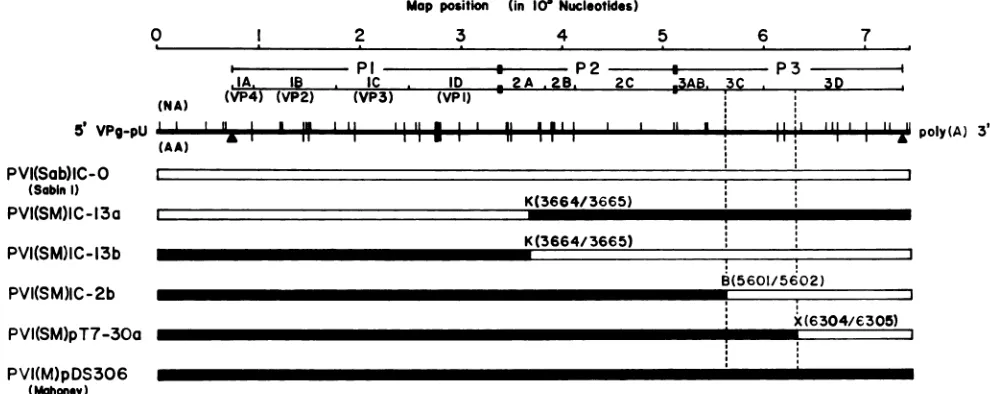
RNA of the Mahoney and Sabin 1 strains (14, 22, 27) revealed 55 nucleotide substitutions within a total of 7,441 heteropolymeric bases. These nucleotide changes occur in all regions of the genome and result in 21 amino acid replacements within the viral polyprotein (Fig. 5), (22, 37).
By using in vitro recombinants constructed from infectious cDNA clones ofPV-1(M) (27, 32) and PV-1(S) (24), itwas found that the phenotype oftemperature sensitivity of the Sabin 1 vaccine viruscorrelated with mutations mappingto multiple regions of thegenome (23). Thatis,the thermosen-sitive block for viral growth resides in different gene seg-ments and not solely in the capsid polypeptide region, as originally proposed (9).
We used one in vitro recombinant virus [PV1(SM)IC-2b]
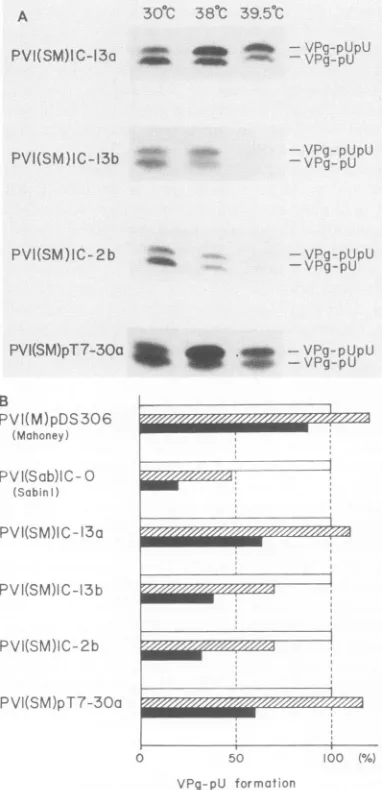
isolated by Omata et al. (23), and in addition constructed further recombinants with the objective of localizing the region responsible for the thermosensitive block in the formation of VPg-pU(pU) in vitro. The structures of the clones are shown in Fig. 5. Recombinant viruses with the junction roughly in the center of the genome [PV1(SM)IC-13aand -13b] should permit us to decide in which half ofthe genome the temperature sensitivity of VPg-pU(pU) synthe-sis resides. The right half of the genome carried the muta-tion(s) responsible for diminished VPg-pU(pU) synthesis in CRC at elevated temperatures (Fig. 6A). Since no amino acid substitutions were found in those segments of Sabin 1 RNA coding for polypeptides 2C, 3AB, and 3C (Fig. 5), these viral gene products were identical in PV-1(M) and PV-1(S) andwere therefore notresponsible for the temper-ature-sensitive phenotype in vitro. CRC derived from PV1(SM)IC-2b-infected cells also showed diminished VPg-pU(pU) synthesis at 39.5°C, an observation suggesting that this in vitro phenotype must map to 3DPIl and notto2A or 2B (Fig. 6A).
3DPol
encoded by PV-1(S) carried fouramino acid substitutions (Fig. 5). To assess the extent to which these amino acid substitutions influence the synthesis of VPg-pU,we constructed a clone that eliminated two ofthe amino acid substitutions[PV1(SM)pT7-30a].When a CRC of thecorrespondingvirus wasisolated,we observed thatthis CRC showedsynthesisofVPg-pUandVPg-pUpUat39.5°C (Fig. 6A). Quantitative evaluation of the results in Fig.6A isMap position (in I0 Nucleotldes)
3 4
PVI(Sab)IC-0 (SabinI)
PVI(SM)IC-13a PVI(SM)IC-13b PVI(SM)IC-2b PVI(SM)pT7-30a
m P2 * P3
ID - 2A .B. 2C .3AB. 3C . 3D
I ;,
-~~~~~~~~~~~~~~~~~~~~~~~~~~~~~~~~~~~~~~~~~~~~~~~~~~~~~~~~~~~~~~~~~~~~~~~~~~~~~~
K(3664/3665) IK(3664/3665) I___
B(5601/5602)
x(6304/e305)
I~~~~~~~~~~~~~~~~~~~~~~~~~~~~~~~~~~~~~~~~~~~~~~~~~~~~~~~~~~~~~~~~~~~~~~~~~~
PVI(M)pDS306
(Mahoney)
FIG. 5. Genomestructuresandgeneticmapsofpoliovirus type1(Mahoney)andpoliovirus type1(Sabin)and recombinantsthereof.The map positionofgene products, designated by the nomenclature of Rueckert andWimmer(28),is shown above thegenome (heavy line);
numbersatthe toparenucleotides(in thousands). Theapproximatesites ofinitiation and termination ofpolyprotein synthesisareshownby
the solidtriangles. P1, P2,and P3aregeneticsegmentsofpoliovirus;P1representstheprecursorregionfor thecapsid proteins, and P2and
P3arenonstructuralproteins. VPg-pUis the5'end of the RNA. Bars above(NA)and below(AA)thegenomeindicate nucleotidedifferences
and amino acid differences, respectively, between PV-1(M)and PV-1(S). Below the genome line are shown the recombinants andtheir
parental strains. Open bars, PV-1(S); solid bars, PV1-(M). K(Kpnl), B (BglIl), and X (Xbal) with nucleotide numbers (in parentheses)
indicate the restriction sitesused to construct the recombinants.
0 2
i I . P
.IA. la IC~
(NA) tvr4
5' VPg-pU I " (AA)
(VPZ) (VP3) (VP 1)
5 6
11 I 1 I I I
7 VOL.61, 1987
I
fvDA
I,.
III 11 If poly(A) 3'
A
on November 10, 2019 by guest
http://jvi.asm.org/
[image:4.612.66.284.73.158.2] [image:4.612.54.549.453.650.2]2820 TOYODA ET AL.
30°C 38°C 39.5t DISCUSSION
PVI(SM)lC-13a 5
PVI(SM)IC-13b
PVI(SM)IC-2bb
t IFq-ptU)pU
b4 "I~~pq-pU
--.VPI-PUPUJ
.-V cg-PU
--V-VPg-pLJpU
vpg-PUJ
PVI(SM)pT7-30o a S1 VPg-pUpLJ
B 1
PVI(M)pDS3066 (Mahoney)
PVI(Scb)I C-O
(Sabin l)
PVI(SM)IC-13a
PVI(SM)IC-13b
PVI(SM)IC-2b
PVI(SM)pT7-30a
...Z1
7" K--- --.---1
0 50 00 1%)
VPg-pU format;orn
FIG. 6. VPg-pU(pU)formation in CRC ofrecombinant viruses at different temperatures. (A) Analysis of nucleotidyl-VPg synthesis
wascarried outasdescribed in thelegendtoFig. 4. Synthesiswas
carried outat threedifferenttemperaturesasindicated.(B)Thedata shown in A as well as nucleotidyl-VPg synthesis in CRC(M) and
CRC(S) (Fig. 4) were quantitated asfollows. Theareascontaining
VPg-pU and VPg-pUpU were cutout, and the radioactivity was determined separately by scintillation countingin 15 mlof Ecosin (NewEngland Nuclear).VPg-pU-forming activityateach
tempera-ture was calculated as the total reactivity ofa VPg-pU spot plus
one-halfof the corresponding VPg-pUpU spot. The yieldat 30°C
wasset at 100%(open bars);thatobtained at 38and39.5°Cisshown
asdashedand solidbars,respectively.
showninFig.6B. Asisapparent, theCRCcorrespondingto
PV1(SM)IC-13a and PV1(SM)pT7-30a revealed a pattern
very similarto that observed with the wild-type CRC
[cor-respondingto PV1(M)pDS306]. Thetemperature sensitivity ofVPg-pU synthesisinreplication complexes corresponding
to viruses PV1(SM)IC-13b and-2b, on the otherhand, was
muchmoresimilarto thatofCRC(S).Inthispresentationthe
thermoblock was apparent not only at 39.5°C but also at
38°C. Itshould benoted thattheyieldofVPg-pUindifferent experimentsmaybe somewhatvariable;theoverallpattern, however, wasas depictedin Fig. 6B.
In spite of numerous attempts to use a reconstituted in
vitro RNA replication system, only the membranous CRC isolated from poliovirus-infected cells has been found to
synthesizeauthenticpoliovirusRNA
(14a,
41;
Semleretal.,
in press), that is, ssRNA covalently linked to VPgatthe 5'
end(34)andpolyadenylylatedatthe 3' end
(7).
This ledustobelieve that themembranous CRC providesanenvironment
for RNA synthesis resembling in vivo conditions. Conse-quently, the mechanisms of RNA synthesis functioning in CRC in vitro mayreflect those functioningin vivo.
Our failure to observe end-linked double-stranded RF molecules during RNA synthesis in CRC under standard conditions argues against a mechanism of RNA
replication
involving 3'-terminal uridylylation by terminal uridylate
transferase, snapback, and self-priming. CRC did noteven
synthesizeend-linked RF in the presenceof nonionic
deter-gent, conditions in which intact membranes are absent and
neither VPg-pU(pU)norssRNAis synthesized. Itshouldbe
keptin mind, however, that CRCsynthesize predominantly
plus-stranded RNA (8, 34).Thus, allconclusionsdrawn from studieswith CRCareapplicabletoplus-strandRNA
synthe-sisonly. Indeed, werecently entertained thepossibility that
in the early stages of replication minus-strand synthesis
occurs via hairpin structures in anonmembranous
environ-ment, and we proposed a mechanism that does notinvolve
cleavage of the end-linked RF molecules (34). In view of
recent observations presented by Lubinski et al. (17) and
Hey et al. (13), however, the involvement of snapback
structuresinanypoliovirus RNAsynthesis has become less
likely.
Ourworking model (36) predicts that VPgor its assumed precursor, the membrane-associated viral polypeptide 3AB
(3, 31),is firsturidylylatedtoformanucleotidylpolypeptide.
If uridylylation of VPg precedes elongation, one would
expect to find VPg-pU synthesized in CRC in a
pulse-labeling experiment with [o-32P]UTP. Using a mutant of PV-1(M), the attenuated Sabin 1 strain, we generated
con-ditions under which VPg-pU was the sole product of
uridylylation ofanyvirus-specific protein containingtheVPg sequence,and this product could be quantitatively chasedto
yieldVPg-pUpU. These dataaredifficulttoreconcile witha
hairpin model. Previous evidencesuggeststhat someof the
preformed VPg-pUpU can be chased into elongation
prod-ucts(asmeasured by the formationofanRNase
Tl-resistant
oligonucleotide, VPg-pUUAAAACAGp [34]).Thereaction, however, was relatively slow, and intermediates, such as
VPg-pUU(A),,(n = 1 to4) have yetto be found. Thus, the
efficient utilization of preformed VPg-pUpU for elongation has not been achieved. As has been observed also by Vartapetianetal. (39),whostudiedthe in vitro formationof VPg-pUpUinanencephalomyocarditis virus-induced CRC, the nucleotidyl protein may be a poor primer for 3DP01 in
vitro. Thiscould be dueto structuralrearrangementsofthe true replication complex occurring during its isolation.
The nature of the activity catalyzing the phosphoester
synthesis betweenthe04-hydroxylgroupof tyrosine inVPg
and pU remainsunknown. The datapresented here suggest that 3D1001 is directly involved in thisevent. Sucha
conclu-sion is not unreasonable, since the adenovirus-encoded
DNA polymerase is known tocatalyze deoxycytidylylation of the precursor of the terminal protein of adenovirus
genomic DNA(33).
The experimentsshown in Fig. 6A andBimplicate3DPOIin VPg-pU synthesis by an in vitro geneticapproach. 3DIYo in A
J. VIROL.
Nk.
on November 10, 2019 by guest
http://jvi.asm.org/
[image:5.612.91.282.73.468.2]PV-1(S) has four amino acid mutations, of which the two
mapping
inthe N-terminal half(Asp
-*AsnandTyr
-* His)appear to strongly influence in vitro synthesis of VPg-pU but not the elongation of RNA chains. The thermosensitive block in VPg-pU(pU) synthesis observed here may contrib-ute to the attenuation phenotype of the Sabin 1 vaccine strain, since virus isolated from transfections with PV1(SM)IC-2b showed a significantly reduced incidence of
paralysisin experimental animals (23).
As canbe seen in Fig. 5, several silent nucleotide substi-tutions mapped in 3DPOI and two nucleotide substisubsti-tutions occurredalso in the 3' noncoding region (3' NCR) of PV-1(S)
(22). In vitro mutagenesis in the 3' NCR led to PV-1(M)
mutantswith astrongtemperature-sensitive phenotype (30).
Bycomparison, itcould be argued that nucleotide
substitu-tionsin the PV-1(S) genome that do not lead to amino acid
substitutions may influence the phenotype of RNA synthe-sis. Whereas this might be thecaseforone or more steps in
PV-1(S)genome replication yet unknown to us, the
nucleo-tide substitutions mapping to the 3' end of the PV-1(S) genome cannotbe responsible for thein vitro temperature-sensitive phenotype described here [VPg-pU synthesis in
CRC(S)]. This we conclude because (i) CRC synthesizes
predominantly plus-strands by transcription of minus-strand
RNA,(ii)thesynthesis ofVPg-pU(pU) in CRC is dependent
onthe presenceofviral RNAs(N. Takeda, C.-F. Yang, R. J. Kuhn, and E. Wimmer, VirusRes., in press), and(iii) the 3' end oftemplate RNA in CRC, that is, that portion of the
minus-strandtemplate thatmightbe involved in theinitiation
ofplus-strands has the wild-type genotype in recombinants
PV1(SM)IC-13b and -2b, yet RNA synthesis in CRCs
iso-latedfromcellsinfectedwith theserecombinants shows the
temperature-sensitive phenotypeofVPg-pU synthesis.
ACKNOWLEDGMENTS
We are grateful to Aniko Paul, Steven E. Pincus, Richard J. Kuhn, and Martin J. H. Nicklin for helpful discussions, Atsuko Kamedafor technicalassistance, and PhyllisLederforthe prepa-ration of the manuscript.
This workwassupportedin partby Public HealthService grants AI-15122 and CA-28146 to Eckard Wimmer from the National Institutes of Health andbyagrantfromtheMinistry of Education, Science and Culture of JapantoAkioNomoto.
LITERATURE CITED
1. Andrews, N.C., and D. Baltimore. 1986. Purification of a
terminal uridylyltransferase that acts as host factor in the in vitropoliovirus replicase reaction.Proc. Natl. Acad. Sci. USA 83:221-225.
2. Andrews, N.C.,D. Levin, and D. Baltimore. 1985. Poliovirus replicase stimulation by terminal uridylyl transferase. J. Biol. Chem. 260:7628-7635.
3. Baron, M. H., and D. Baltimore. 1982. Anti-VPg antibody inhibition of poliovirus replicase reaction and production of covalent complexes of VPg-related proteins and RNA. Cell 30:745-752.
4. Caliguiri,L.A.,andI. Tamm. 1970.Characterization of polio-virus-specific structures associated with cytoplasmic
mem-branes. Virology42:112-122.
5. Challberg, M. D., and T.J. Kelly. 1982. Eukaryotic DNA replication: viral and plasmid model systems. Annu. Rev. Biochem.51:901-934.
6. Crawford,N. M.,and D. Baltimore. 1983.Genome-linked pro-teinVPg ofpoliovirusispresentasfreeVPgandVPg-pUpU in poliovirus-infectedcells. Proc. Natl. Acad. Sci. USA 80:7452-7455.
7. Dorsch-Hasler, K.,Y.Yogo,andE.Wimmer.1975. Replication
ofpicornaviruses.I.Evidence from in vitro RNAsynthesisthat
poly(A) of the poliovirusgenomeis genetically coded.J.Virol. 16:1512-1527.
8. Etchison, D.,and E. Ehrenfeld. 1981.Comparison of replication complexes synthesizing poliovirusRNA.Virology111:33-46. 9. Fiszman,M. Y., M. Reynier, D. Bucchini, and M. Girard. 1972.
Thermosensitive blockoftheSabin strain ofpoliovirustype 1. J. Virol. 10:1143-1151.
10. Flanegan, J. B., and D. Baltimore. 1977. Poliovirus-specific primer-dependentRNApolymeraseable to copypoly(A).Proc. Natl. Acad. Sci. USA74:3677-3680.
11. Flanegan, J. B., and D. Baltimore. 1979.Polioviruspolyuridylic acidpolymerase and RNAreplicase have thesame viral poly-peptide. J.Virol. 29:352-360.
12. Girard,M. 1969. Invitrosynthesis of poliovirusRNA: roleof thereplicative intermediate. J.Virol. 3:376-384.
13. Hey, T. D., 0.C. Richards, and E. Ehrenfeld. 1987. Host factor-inducedtemplate modification during synthesis of polio-virusRNAinvitro.J. Virol.61:802-811.
14. Kitamura, N., B. L. Semler, P. G. Rothberg, G. R. Larsen, C.J. Adler,A.J. Dorner,E. A.Emini,R.Hanecak, J. J.Lee,S. vanderWerf,C. W.Anderson,and E. Wimmer. 1981.Primary structure, gene organization, and polypeptide expression of poliovirusRNA. Nature(London)291:547-553.
14a.Kuhn, R. J., and E. Wimmer. 1987. The replication of picor-naviruses,p. 17-51. In D. J.Rowlands,B. W. J. Mahy, andM. Mayo (ed.), The molecular biology of positive strand RNA viruses. AcademicPress, Inc. (London), Ltd.,London. 15. Laemmli,U. K. 1970.Cleavage ofstructuralproteinsduringthe
assembly of the head ofbacteriophage T4. Nature (London) 227:680-685.
16. Lee,Y.F.,A.Nomoto,B. M.Detjen,and E. Wimmer.1977. The genome-linked protein of picornaviruses. I. A protein
cova-lently linkedtopoliovirusgenome RNA. Proc.Natl.Acad. Sci. USA74:59-63.
17. Lubinski, J. M.,G.Kaplan,V. R.Racaniello,andA.Dasgupta. 1986. Mechanism of in vitro synthesis of covalently linked dimeric RNA molecules by the poliovirus replicase. J. Virol. 58:459-467.
18. Maniatis, T., E. F. Fritsch,andJ. Sambrook. 1982. Molecular cloning: alaboratory manual.ColdSpringHarborLaboratory, ColdSpring Harbor,N.Y.
19. McDonnel, J. P.,and L. Levintow.1970.Kinetics ofappearance ofthe productsofpoliovirus-inducedRNApolymerase. Virol-ogy42:999-1006.
20. Miyamura, K.,N.Takeda,andS. Yamzaki. 1984. Characteriza-tionofatemperature-sensitivedefect of enterovirus70:effect of elevated temperatureonin vitrotranscription.J.Virol. 51:192-198.
21. Nomoto, A.,B.Detjen,R.Pozzatti,and E. Wimmer. 1977. The location of the polio genome protein in viral RNAs and its implicationfor RNAsynthesis.Nature(London)268:208-213. 22. Nomoto, A., T. Omata, H. Toyoda, S. Kuge, H. Horie, Y. Kataoka,Y.Genba,Y. Nakano,and N. Imura. 1982. Complete
nucleotidesequenceoftheattenuatedpoliovirusSabin 1strain genome. Proc. Natl.Acad. Sci. USA 79:5793-5797.
23. Omata, T., M. Kohara, S. Kuge, T. Komatsu, S. Abe, B.L.
Semler, A. Kameda, H. Itoh, M. Arita, E. Wimmer, and A. Nomoto.1986.Geneticanalysisoftheattenuationphenotypeof poliovirustype 1. J. Virol. 58:348-358.
24. Omata,T.,M.Kohara,Y.Sakai,A.Kameda,N.Imura,and A.
Nomoto. 1984. Cloned infectiouscomplementary DNA of the
poliovirusSabin 1genome: biochemicalandbiological proper-ties oftherecoveredvirus. Gene 32:1-10.
25. Pincus, S.E., D. C. Diamond, E. A. Emini, and E. Wimmer. 1986. Guanidine-selected mutants of poliovirus: mapping of pointmutations topolypeptide2C. J. Virol. 57:638-646. 26. Pincus,S. E., andE. Wimmer. 1986. Production of
guanidine-resistant and-dependentpoliovirusfrom cloned cDNA: demon-stration that mutations in polypeptide2Caredirectly
responsi-ble for alteredguanidine sensitivity.J. Virol. 60:793-796. 27. Racaniello,V.R.,andD.Baltimore. 1981. Molecularcloningof
polioviruscDNAanddeterminationof thecompletenucleotide sequenceofthe viral genome. Proc. Natl.Acad. Sci. USA 78:
on November 10, 2019 by guest
http://jvi.asm.org/
2822 TOYODA ET AL.
4887-4891.
28. Rueckert, R. R., and E. Wimmer. 1984. Systematic
nomencla-tureof picornavirus proteins. J. Virol. 50:957-959.
29. Sabin, A. B., and C. R. Boulger. 1973. History of Sabin
atten-uated poliovirus oral live vaccine strains. J. Biol. Standards 1:115-118.
30. Sarnow, P., H. D. Bernstein, andD. Baltimore. 1986. A polio-virus temperature-sensitive RNA synthesis mutantlocated ina
noncoding region of thegenome. Proc. Natl. Acad. Sci. USA 83:571-575.
31. Semler,B. L., C. W. Anderson, R. Hanecak, L. F. Dorner,and E. Wimmer. 1982. A membrane-associated precursorto polio-virus VPg identified by immunoprecipitation with antibodies directed against asynthetic heptapeptide. Cell 28:405-412. 32. Semler, B. L.,A.J.Dorner, and E.Wimmer.1984. Production
of infectious poliovirus from cloned cDNA is dramatically increasedbySV40 transcription and replication signals. Nucleic Acids Res. 12:5123-5141.
33. Stillman, B. W. 1983. Thereplication of adenovirus DNA with purified proteins. Cell 35:7-9.
34. Takeda, N., R.J. Kuhn, C.-F. Yang, T. Takegami, and E.
Wimmer.1986. Initiation of poliovirus plus-strand RNA
synthe-sis in a membrane complex of infected HeLa cells. J. Virol.
60:43-53.
35. Takegami, T., R. J. Kuhn, C. W. Anderson, and E. Wimmer. 1983. Membrane-dependent uridylylation of the genome-linked protein VPg of poliovirus. Proc. Natl. Acad. Sci. USA 80: 7447-7451.
36. Takegami,T., B. L.Semler, C.W.Anderson, and E. Wimmer. 1983.Membranefractions active inpoliovirus RNA replication containVPgprecursorpolypeptides. Virology 128:33-47.
37. Toyoda, H., M. Kohara, Y. Kataoka, T. Suganuma, T. Omata, N. Imura, and A. Nomoto. 1984. The complete nucleotide sequence of all threepoliovirus serotype genomes: implication for the genetic relationship, gene function and antigenic deter-minants. J. Mol. Biol. 174:561-585.
38. van der Werf, S., J. Bradley, E. Wimmer, F. W. Studier, and J. J. Dunn. 1986. Synthesis of infectious poliovirus RNA by purifiedT7 RNApolymerase. Proc. Natl. Acad. Sci. USA 83: 2330-2334.
39. Vartapetian, A. B., E. V. Koonin, V. I. Agol, and A. A. Bogda-nov. 1984. Encephalomyocarditisvirus RNAsynthesis in vitro isprotein-primed. EMBO J. 3:2583-2588.
40. Wimmer, E. 1982.Genome-linked proteins of viruses. Cell28: 199-201.
41. Wimmer, E., R. J. Kuhn, S. Pincus, C.-F. Yang, H. Toyoda, M.J. H. Nicklin, and N. Takeda. 1987. Molecular events lead-ingtopicornavirusgenomereplication.J. Cell Sci. Suppl. 7, p. 1-26.
42. Young, D. C., B. M. Dunn, G. S. Tobin, and J. B. Flanegan. 1986.Anti-VPgantibody precipitationof product RNA synthe-sized in vitrobythepoliovirus polymerases and host factor is mediated by VPg on the poliovirion RNA template. J. Virol. 58:715-723.
43. Young, D. C., G. J. Tobin, and J. B. Flanegan. 1987. Charac-terizationofproduct RNAs synthesizedin vitro by poliovirus RNApolymerasepurifiedby chromatography on hydroxylapa-tite orpoly(U)-Sepharose. J. Virol.61:611-614.
44. Young, D. C., D. M. Tuschall, and J. B. Flanegan. 1985. Polio-virus RNA-dependent RNA polymerase and host cell protein synthesize product RNAtwice the size ofpoliovirus RNA in vitro. J. Virol. 54:256-264.
J. VIROL.
![FIG.1.agarosechasedcontatinedchloroform,detergent.bypresenceRNAUTP ethidium Analysis of RF molecules synthesized in the presence of The crude membrane complex was incubated with [s-32P] at 30(C for 10 min in the absence or presence of 0.5% NP40 andi for ei](https://thumb-us.123doks.com/thumbv2/123dok_us/1354015.88989/2.612.337.528.75.242/agarosechasedcontatinedchloroform-detergent-bypresencernautp-analysis-molecules-synthesized-membrane-incubated.webp)
![FIG. 2.TheVPg-pU.underVPg-pUbyamidelabeled1, 2, 5, Pulse-chase analysis of formation of VPg-pUpU from CRC(S) was incubated with [o-32P]UTP at 300C for 10 min standard conditions as described in Materials and Methods](https://thumb-us.123doks.com/thumbv2/123dok_us/1354015.88989/3.612.366.517.508.652/undervpg-pubyamidelabeled-formation-incubated-conditions-described-materials-methods.webp)