Theses
Thesis/Dissertation Collections
8-2014
Design and Cryptanalysis of a Customizable
Authenticated Encryption Algorithm
Matthew Joseph Kelly
Follow this and additional works at:
http://scholarworks.rit.edu/theses
This Thesis is brought to you for free and open access by the Thesis/Dissertation Collections at RIT Scholar Works. It has been accepted for inclusion in Theses by an authorized administrator of RIT Scholar Works. For more information, please [email protected].
Recommended Citation
Authenticated Encryption Algorithm
by
Matthew Joseph Kelly
A Thesis Submitted
in
Partial Fulfillment of the
Requirements for the Degree of
Master of Science
in
Computer Engineering
Supervised by
Alan Kaminsky
Department of Computer Science
&
Marcin Łukowiak
Department of Computer Engineering
Kate Gleason College of Engineering
Rochester Institute of Technology
Rochester, New York
The thesis “Design and Cryptanalysis of a Customizable Authenticated Encryption Algorithm”
by Matthew Joseph Kelly has been examined and approved by the following Examination
Commit-tee:
Alan Kaminsky
Professor, Department of Computer Science
Primary Advisor
Marcin Łukowiak
Associate Professor, Department of Computer Engineering
Primary Advisor
Michael Kurdziel
Harris Corporation
Reza Azarderakhsh
Rochester Institute of Technology Kate Gleason College of Engineering
Title:
Design and Cryptanalysis of a Customizable Authenticated Encryption Algorithm
I, Matthew Joseph Kelly, hereby grant permission to the Wallace Memorial Library to reproduce
my thesis in whole or part.
Matthew Joseph Kelly
Dedication
Acknowledgments
It seems so obvious now - to pursue a master’s degree in cryptography, a discipline so elegantly bal-anced at the intersection of subjects I hold dear: engineering, mathematics, and computer science. However, the thought never crossed my mind until a suggestion from a professor nudged me in the right direction. That suggestion has since expanded into a deep passion of mine, and I hope that this thesis is merely the start of it. For this and much more, I thank Marcin Łukowiak.
I have had the opportunity to work with an incredible team throughout the duration of this research. The success of this thesis is due in very large part to help from Alan Kaminsky, who has provided excellent guidance and developed critical tools and design ideas used for this work. He has somehow managed to repeatedly accomplish tasks in a day that would have taken me far longer. I believe that some of his drive for excellence has rubbed off on me, and for that I’m thankful.
I owe great thanks to Mike Kurdziel, who has continually provided support and given me invalu-able insight into the cryptographic industry. This work would be far less compelling without ties to the real world. Thanks also to Harris Corporation for the financial support that helped make this research possible. I’m also very grateful for the teaching and guidance of Staszek Radziszowski, who is a primary source of my inspiration in the academic world. I only wish that I was able to spend more time with him, but I trust that this will not be the end of our conversations. I would also like to thank David Barth-Hart for generating and advancing my interest in algebra. It is easily the most beautiful subject I’ve ever studied and I cannot imagine a better professor to teach it. His pas-sion for mathematics is highly contagious. Reza Azarderakhsh has also provided useful suggestions throughout this work.
I’m incredibly grateful to Megan Gallo for taking on the world with me; together we’ve accom-plished far more than I could have ever achieved by myself. I look forward in excitement to what the future holds. Thanks also to her family for their continued support over the past years. I would also like to thank Norman Joyner, the greatest of friends, for helping keep me sane for as long as I can remember. He is an unstoppable force in the technology industry and I look to him for inspiration as I transition from academia. If I had room I’d personally thank all of the other people I’m fortunate to call my friends, new and old, who have supported me throughout college.
Abstract
Design and Cryptanalysis of a Customizable Authenticated Encryption Algorithm
Matthew Joseph Kelly
Supervising Professors: Alan Kaminsky & Marcin Łukowiak
It is common knowledge that encryption is a useful tool for providing confidentiality. Authentica-tion, however, is often overlooked. Authentication provides data integrity; it helps ensure that any tampering with or corruption of data is detected. It also provides assurance of message origin. Au-thenticated encryption (AE) algorithms provide both confidentiality and integrity / authenticity by processing plaintext and producing both ciphertext and a Message Authentication Code (MAC). It has been shown too many times throughout history that encryption without authentication is gener-ally insecure. This has recently culminated in a push for new authenticated encryption algorithms.
There are several authenticated encryption algorithms in existence already. However, these algorithms are often difficult to use correctly in practice. This is a significant problem because misusing AE constructions can result in reduced security in many cases. Furthermore, many existing algorithms have numerous undesirable features. For example, these algorithms often require two passes of the underlying cryptographic primitive to yield the ciphertext and MAC. This results in a longer runtime. It is clear that new easy-to-use, single-pass, and highly secure AE constructions are needed. Additionally, a new AE algorithm is needed that meets stringent requirements for use in the military and government sectors.
Contents
Dedication . . . iv
Acknowledgments . . . v
Abstract . . . vi
1 Introduction. . . 1
1.1 Motivation . . . 1
1.2 Overview of Authenticated Encryption . . . 2
1.2.1 AE Through Generic Composition . . . 2
1.2.2 AE Modes of Operation . . . 2
Patent-Encumbered Modes . . . 2
Patent-Free Modes . . . 3
1.2.3 Other Existing AE Constructions . . . 3
Stream Cipher Based . . . 3
Duplex Constructions . . . 4
1.3 Our Contributions . . . 4
2 Mathematical Foundation and Notation . . . 5
2.1 Algebraic Structures . . . 5
2.1.1 Groups . . . 5
2.1.2 Rings . . . 5
2.1.3 Fields . . . 6
2.1.4 Galois Fields . . . 6
2.2 Bitstrings . . . 6
2.2.1 Operations . . . 7
2.3 Shannon’s Information Theory . . . 7
2.3.1 Entropy . . . 7
2.3.2 Transformations . . . 8
3 Sponge and Duplex Constructions . . . 9
3.1 Sponge Construction . . . 9
3.1.1 Sponge Parameters . . . 9
Simplified Sponge . . . 10
3.1.2 Applications . . . 11
Hashing . . . 11
MAC Generation . . . 11
Bitstream Encryption . . . 11
3.1.3 Generic Security . . . 12
3.1.4 Security of Keyed Sponges . . . 12
3.2 Duplex Construction . . . 13
3.2.1 Duplex Parameters . . . 13
Simplified Duplex . . . 13
3.2.2 Duplex for Authenticated Encryption . . . 14
3.2.3 Security . . . 16
4 Algorithm Specification. . . 17
4.1 Duplex Parameters . . . 17
4.2 Permutationf . . . 17
4.2.1 Substitution Step . . . 17
4.2.2 Bitwise Permutation Step . . . 21
4.2.3 Mix Step . . . 22
4.2.4 Add Round Constant Step . . . 23
4.3 Number of Rounds . . . 24
4.4 Customization . . . 24
4.4.1 State Initialization . . . 24
4.4.2 S-boxes . . . 26
4.4.3 Bitwise Permutations . . . 26
4.4.4 Mixers . . . 26
4.4.5 Round Constants . . . 26
5 Cryptanalysis . . . 28
5.1 Differential Cryptanalysis . . . 28
5.1.1 Overview . . . 28
5.1.2 Algorithm Resistance . . . 29
5.2 Linear Cryptanalysis . . . 30
5.2.1 Overview . . . 30
5.3 Differential and Linear Cryptanalysis Variants . . . 32
5.3.1 Differential-Linear Cryptanalysis . . . 32
5.3.2 Truncated and Higher-Order Differentials . . . 32
5.4 Algebraic Attacks . . . 33
5.4.1 XL and XSL Attacks . . . 33
5.4.2 Cube Attacks . . . 34
5.5 Other Cryptanalysis . . . 34
5.5.1 Slide Attacks . . . 34
5.5.2 Integral Attacks . . . 34
6 Statistical Testing . . . 36
6.1 NIST STS Testing . . . 36
6.1.1 Overview . . . 36
6.1.2 STS Test Descriptions . . . 37
6.1.3 Results . . . 38
P-valueProportions . . . 39
P-valueDistribution . . . 39
6.2 Avalanche Testing . . . 41
7 Conclusions and Future Work . . . 43
7.1 Conclusions . . . 43
7.2 Future Work . . . 43
Bibliography . . . 45
A PRESENT Trail Illustration . . . 51
B Bitwise Permutation Listing . . . 52
C ARX-Based Mixers . . . 53
D Known Answer Tests . . . 57
E Source Code Listings . . . 61
E.1 AE Algorithm Software Implementation . . . 61
E.1.1 State.h . . . 61
E.1.2 MixerGF.h . . . 64
E.1.3 SboxGF.h . . . 66
E.1.4 Sbox16.h . . . 68
E.1.6 Sponge.h . . . 75
E.1.7 Duplex.h . . . 76
E.1.8 TestPermutation.cpp . . . 77
E.1.9 DuplexKAT.cpp . . . 78
E.2 Permutation Analyzer . . . 80
Chapter 1
Introduction
The overarching goal of cryptography is to enable people to communicate privately over an inse-cure channel in the presence of adversaries. This notion may be abstracted further; for example, the sending and receiving party may be the same person writing to and reading from a storage medium over time. Two requirements for achieving this goal are encryption and authentication. Encryp-tion providesconfidentialitywhile authentication provides dataintegrityand assurance of message origin.
Encryption without authentication has been shown to be insecure in practical instances several times in recent history. For example, Wireless Equivalence Privacy (WEP), an algorithm for “se-curing” communications over wireless networks, is badly broken due (in part) to a lack of proper authentication [1]. In fact, it is so badly broken that people with no cryptographic expertise can use existing tools on standard consumer machines to break into networks that use104-bit WEP in less than60seconds [2].
Another example of a flaw in prevalent systems due to a lack of proper authentication came in 2002. An attack was found on the CBC mode of encryption employed by protocols such as SSL and IPSEC. The attack could have been avoided had an authenticated encryption scheme been used [3].
1.1
Motivation
Many authenticated encryption algorithms are in existence today, but they are often unsatisfactory in terms of performance, security, or ease of use. Some algorithms require two passes per block of plaintext to encrypt and authenticate. This is generally undesirable because it often means a much slower algorithm. Other algorithms have been shown to be insecure or difficult to use properly. Many algorithms, such as the ones based on generic composition, require two keys. This should be avoided when possible because key management is a difficult problem.
Furthermore, a new authenticated encryption algorithm is required that meets the stringent re-quirements of government and military applications. Such algorithms are not typically in the public domain. The goal of this is partially to reduce or eliminate academic interest in cryptanalyzing the algorithm and publishing results. This stance is highly controversial. Still, the security of such algorithms depends entirely on the secrecy of the key and not on the secrecy of the algorithm. The assumption is still made that the enemy knows the details of the algorithm being used at any time [4].
result is an algorithm which can be made unique on a per-user or per-application basis without the effort of cryptanalyzing every specific instantiation. We present such an algorithm here. First, it is important to understand how authenticated encryption has been evolving over the years.
1.2
Overview of Authenticated Encryption
1.2.1 AE Through Generic Composition
The na¨ıve approach to authenticated encryption is generic composition. In this construction, one simply computes the ciphertext under a given key and computes the MAC under a different key. These operations can be done in any order or at the same time. There are thus three generic compo-sition types: Encrypt-and-MAC,MAC-then-Encrypt, and Encrypt-then-MAC. The names here are straightforward and describe exactly the order of operations. In Encrypt-and-MAC, the encryption and authentication operations are performed in parallel and the ciphertext and MAC are concate-nated together at the end. MAC-then-Encrypt computes the MAC, appends it to the plaintext, and then encrypts the result. Encrypt-then-MAC computes the ciphertext first and then computes the MAC over the ciphertext.
There is much ongoing debate about which generic composition method is best and each method has pros and cons in terms of security and performance. As a simple example, consider the perfor-mance of each method at a high level of abstraction. In Encrypt-and-MAC, the encryption (de-cryption) and authentication can happen in parallel. If using MAC-then-Encrypt, decryption must be performed before the MAC can be verified. The MAC can be checked before decryption in the case of Encrypt-then-MAC, thus saving the performance hit of decryption for messages in which authentication fails [5].
1.2.2 AE Modes of Operation
There are many existing block cipher modes of operation that provide authenticated encryption. The main difference between a generic composition and a mode of operation for authenticated encryp-tion is that a generic composiencryp-tion always requires two keys, while a mode of operaencryp-tion generally requires only one. This is a huge benefit because key management is a difficult task, so it is desirable to limit the number of keys required for a cryptographic algorithm.
Patent-Encumbered Modes
In 2001, Rogaway et al. [7] introduced a new AE mode called Offset Codebook (OCB) mode. This mode is based on IAPM, but with many added features. OCB requires only a single key and provides support for additional authenticated data. Furthermore, it is highly parallelizable and also a single-pass mode. The main disadvantages of OCB are that it also requires the block cipher decryption mode and that it is also patent encumbered.
Patent-Free Modes
Counter with CBC-MAC (CCM) mode was created by Whiting et al. in 2003 as a response to OCB’s patented status [8]. CCM mode is patent-free but has many disadvantages. Like all of the patent-free modes that will be discussed here, it requires two passes under a single key. It does not, however, require the decryption mode of the underlying block cipher since it is built on Counter mode. CCM mode does not support block sizes other than128bits and does not support stream processing. This is a significant disadvantage because stream processing is often exactly what a AE construction is used for (e.g. streaming network traffic). Rogaway and Wagner present a detailed analysis of all of the disadvantages of CCM mode in [9].
Carter-Wegman + Counter (CWC) mode was introduced by Kohno et al. in 2004 as an attempt to improve upon the deficiencies of CCM mode [10]. Like CCM mode, it is a single-key mode that requires two passes. Unlike CCM, the second pass does not consist of any invocations of the underlying block cipher. It instead uses what is called a Carter-Wegman (CW) universal hash function. This CW hash function operates over a prime field and thus requires integer multipliers which consume a large amount of area when implemented in hardware.
McGrew and Viega created Galois/Counter Mode (GCM) in 2004 in an effort to improve upon the efficiency of CWC mode [11]. Instead of operating in a prime field, GCM performs multipli-cation in a binary Galois field. As a result, it consumes much less area in hardware. Like all other patent-free modes described here, it is single-key and two-pass. It should be noted that some people may argue that GCM is single-pass because only the first pass calls the underlying block cipher. GCM has seen widespread adoption by the cryptographic community. It is arguably the most used mode of operation for AE in existence today. Indeed, GCM is a main reason for the advent of Intel’s carry-less multiplication instruction (PCLMULQDQ) in their 2010 line of processors [12].
EAX mode was introduced in 2004 by Bellare et al. as another alternative to CCM mode [13]. Like CCM mode, it is not parallelizable. Like all other modes listed here, it is single-key and two-pass. EAX mode is derived from a generic composition called EAX2 by the authors. EAX2 mode leaves the Pseudorandom Function (PRF) used for MAC computation and the underlying block cipher mode used for encryption unspecified. EAX2 uses two keys. EAX is a specific instantiation of EAX2 that uses only a single key. Like GCM, EAX mode has also seen widespread adoption.
1.2.3 Other Existing AE Constructions
Stream Cipher Based
misuse of the stream cipher. Still, new stream cipher based AE constructions are probable in the future.
Duplex Constructions
The duplex construction is based on a sponge construction and has promising applications to au-thenticated encryption. This construction has many extremely desirable features. It is single-key, single-pass, and supports additional authenticated data and intermediate MACs. For these reasons, the duplex construction forms a foundation for this thesis; see Chapter 3 for an in-depth treatment.
At the time of writing there is a new AE competition going on called CAESAR (Competition for Authenticated Encryption: Security, Applicability, and Robustness). Of the57first-round candi-dates, there are nine duplex-based submissions that are not withdrawn: Artemia, Ascon, ICEPOLE, Ketje, Keyak, NORX, PRIMATEs, STRIBOB, andπ-Cipher [17]. It is far too early to tell which of these, if any, will be found to be secure and efficient enough for practical use. Furthermore, none of these submissions are readily customizable at an algorithmic level. Therefore they are not suitable for our purposes.
1.3
Our Contributions
The main contribution of this thesis is a novel, customizable authenticated encryption algorithm based on the duplex construction. This construction is suitable for hardware (e.g. FPGA) imple-mentation. An itemized list of specific contributions is listed here:
1. Authenticated encryption algorithm specification
(a) Includes customization suggestions and guidelines
2. Software model of the algorithm (C/C++)
(a) Includes various tests and test data generators (b) IncludesGF(216)library for algorithm verification
3. Tool for finding suitable bitwise permutations for algorithm customization (Python)
4. Survey of relevant cryptanalysis techniques and cryptanalysis results
5. Statistical test results
6. Tool for ensuring acceptable distribution ofP-values(Python)
Chapter 2
Mathematical Foundation and Notation
There are several mathematical concepts central to this research that we will briefly explain here. The notation used in the rest of this thesis is also explained here for clarity.
2.1
Algebraic Structures
2.1.1 Groups
An algebraicgroupis a set of elementsGtogether with a binary operation∗(e.g. multiplication or addition) that satisfies the following properties:
1. Associativity. The operation is associative, i.e.(a∗b)∗c=a∗(b∗c)for alla, b, c∈G.
2. Closure.Gis closed under∗; that is,a∗b∈Gfor alla, b∈G.
3. Identity. There is an elemente ∈G(called theidentity) such thata∗e=e∗a =afor all
a∈G.
4. Inverses. For each elementa∈Gthere exists an elementa−1 ∈G(called theinverseofa)
such thata∗a−1=a−1∗a=e.
A group may also have the property that a∗ b = b∗a for all a, b ∈ G. In other words, it is commutative. We call these groups abelian groups. The most common example of a group is probablyZ, the set of integers under addition, where the identitye= 0.
2.1.2 Rings
An algebraicringis a set of elementsRtogether with two binary operations·(called multiplication, witha·bdenotedabfor brevity) and+(called addition) that satisfies the following properties:
1. Ris an abelian group under addition; its identity is called0.
2. Associativity. Multiplication and addition are both associative.
3. Distributivity. a(b+c) =ab+acand(b+c)a=ba+ca; that is, multiplication distributes
over addition.
2.1.3 Fields
An algebraicfieldis a set of elementsFtogether with the operations·and+such that: 1. Fis an abelian ring.
2. Fis an abelian group under multiplication; its identity is called1.
Groups, rings, and fields (all of which are algebraic structures) may be of finite or infinite cardinality. The cardinality of an algebraic structureGis called itsorderand is denoted|G|.
We use an exponential representation as shorthand for applying an operation ∗ to the same element. For example, a∗a∗a = a3. For some structure G, the orderof an element a ∈ G
is the smallest integerksuch thatak = e. For structures of finite order, it is a well-known result (Lagrange’s theorem) that the order of an element divides the order of the structure [18].
2.1.4 Galois Fields
Finite fields are also commonly referred to as Galois fields (GFs). It is another well-known result that all Galois fields are of prime power order. A Galois field of orderpkis denoted GF(pk) orFpk, wherepis prime.pis called thecharacteristicof the field and it is the smallest positive integer such thatap = 0. Fields withp = 2 are typically of the most interest to cryptographers, and they are
often called binary Galois fields. kis called thedegreeof the field.
When the degree of a field is greater than one, its elements can be represented as polynomials belonging to the set of equivalence classes modulo an irreducible polynomialf(x). The degree of this polynomial, denoteddeg(f(x)), is equal to the degree of the field. We denote a GF of order
pkalong with its irreducible polynomial asGF(pk)/hf(x)i. Elements in the field are represented using a polynomial basis in the indeterminatexwith the form
a=αk−1xk−1+αk−2xk−2+. . .+α1x+α0,
whereαi ∈Zp. For example, in a binary Galois field we haveαi∈Z2. Since operations in the GF
are done modulof(x), any elementa∈GF(pk)must satisfydeg(a)< k.
For a binary Galois field we often represent elements in binary or hex format, as this is how they will be implemented in practice. For example, consider the element x15 +x3 +x2 + 1 in GF(216). This element can be represented in hex as0x800d, where the most-significant bit (MSB) corresponds tox15.
Addition in finite fields is done by performing element-wise addition over Zp. In a binary
Galois field, this is equivalent to the bitwise XOR operation. Multiplication is performed by doing polynomial multiplication as usual and then reducing modulof(x)if needed. There are methods of optimizing this operation in both software and hardware.
Interpreting binary strings as elements of a binary Galois field is only useful for certain opera-tions. Other times, we interpret portions of our state as arbitrary bitstrings for which certain other operations are defined.
2.2
Bitstrings
Bitstrings are strings of elements in Z2; in other words, they are binary strings. We says ∈ Zn2
bitstrings of infinite length.
2.2.1 Operations
There are several relevant operations we define for bitstrings:
• bsc`indicates the truncation of a bitstringsto`bits
• s||tindicates the concatenation of bitstringssandt, with the resulting length being|s|+|t|
• s≪rindicates the logical left rotation of bitstringsbyrbits
• s≫rindicates the logical right rotation of bitstringsbyrbits
• s⊕tindicates the exclusive-or (XOR, or bitwise addition modulo 2) of bitstringssandt, where|s|=|t|is assumed
• HW(s)indicates the Hamming weight of bitstrings
• HD(s, t) indicates the Hamming distance between bitstrings s and t, where |s| = |t|is assumed
TheHamming weightof a string is defined as the number of nonzero elements it contains. The
Hamming distancebetween two strings is the number of elements that differ between them. Note
that for elements ofZn2,
HD(s, t) =HW(s⊕t).
For this work, a bitstring of length16is called aword. The state of our cryptosystem, as we will see, is an element ofZ5122 that may be considered at times as the concatenation of32 contiguous
words. Where it matters, the MSB will be specified for a given operation.
2.3
Shannon’s Information Theory
It is widely recognized that Claude Shannon laid the foundation for modern symmetric key cryp-tography in the late 1940s through two seminal papers on information theory and secrecy systems. His major relevant contributions include the notions of entropy, confusion, and diffusion [19][20].
2.3.1 Entropy
Entropy, as defined by Shannon, is the measure of the amount of information in some messageM.
It is denoted asH(M)and is quantitatively defined as
H(M) = log2n,
Entropy also measuresuncertainty. The uncertainty of a messageM is the number of plaintext bits needed to be recovered from ciphertext in order to learn the plaintext. For example, if we know that the plaintext is either “HEADS” or “TAILS” when provided with the ciphertext “ASDFQJWE”, then the uncertainty is unity. We need only learn one bit (if chosen correctly) to learn the plaintext. We often discuss the entropy of cryptosystems with respect to their key space. For example, a symmetric key system with a128-bit key should have an entropy of128bits.
2.3.2 Transformations
Atransformationis simply a function
t:X→Y,
where X is the domain and Y is the codomain. Some transformations on a space are
entropy-preserving; that is, if an input x has entropy H(x) before the transformation, it has the exact
same entropy (and thus uncertainty) after the transformation. An obvious requirement for entropy-preserving transformations is that they are bijective. We call a bijective transformation in which the domain is equal to the codomain a permutation. This notion is of central importance to the remainder of this thesis.
2.3.3 Confusion and Diffusion
Chapter 3
Sponge and Duplex Constructions
Our algorithm is based on the duplex construction, a highly flexible new cryptographic primitive derived from the sponge construction with promising applications to authenticated encryption. We describe both the sponge and duplex constructions in this chapter and provide details about resis-tance to generic attacks.
3.1
Sponge Construction
The sponge construction is a relatively new cryptographic primitive that has gained popularity since KECCAK won the Secure Hash Algorithm (SHA-3) competition in 2013 [22][23]. Essentially, it provides a way to generalize hash functions (which normally have outputs of fixed length) to func-tions with arbitrary length output. This generalization allows cryptographic sponges to be used for applications other than hashing. We present a few here but there are numerous more possibilities. The sponge construction is stateless; there is no information stored between calls to it.
Sponges are based on the iteration of an underlying functionf. This function can either be a generaltransformationor apermutation. A transformation need not be bijective; that is, it may not be invertible. A permutation is bijective and thus invertible by definition. The security proofs are different for transformations versus permutations, and there are advantages and disadvantages for each choice of a function type [24].
3.1.1 Sponge Parameters
The outputZof the parameterized sponge construction is given as
Z =sponge[f,pad, r](M, `),
where padis a padding function for the input, r is therate of absorption,M is the message (or other input) data, and`is the desired output length.
Figure 3.1 shows the sponge construction. It is split into two distinct phases: theabsorbing
phase and thesqueezingphase. This is where the term “sponge” comes from. Inputs (e.g. message and/or key material) are absorbed in the first phase and the output (e.g. a MAC or keystream) is squeezed out in the second phase.
Figure 3.1: The sponge constructionsponge[f,pad, r][24]
b =r+c. The speed of the construction partially relies on the rate, while the security is partially dependent on the capacity (see Section 3.1.3).
The padding functionpadis first applied toM to make it a multiple ofr. M is then absorbed
r bits at a time. More concretely, absorption is the process of XORingr-bit blocks into the state while interleaving with applications of the underlying sponge function f. If the rate is increased, then more bits are absorbed at a time and thus the construction runs faster. However, increasing the rate means that the capacity must decrease and so there is a clear trade-off between speed and security. Squeezing consists of concatenatingrbits at a time to an output bitstringZthat is truncated to`bits. The sponge functionfmust be called once for eachrbits of output after the first full block.
Simplified Sponge
A padding function is required for the classical sponge construction in order to ensure that inputs can be reformed into bitstrings with length equal to a multiple of r. Two basic requirements of a padding function are that it be reversible and that it never produce identical outputs for different inputs. We omit the lower level details of good padding functions here for brevity and refer the interested reader to [24] instead.
It is also useful, as we will see, to consider a sponge construction in which no padding function
padis required. The parameterized interface for such a construction becomes
Z=sponge[f, r](M, `).
Alternatively, we can say thatpadexists but it is trivially given as
This lets us remain aligned with the original definition. In either case, we assume that any necessary padding is performed at some higher level in the overall system. This simplification allows us to focus more design effort towards the underlying sponge functionf and ignore the details of padding.
3.1.2 Applications
Hashing
The sponge construction was originally envisioned as a generalization of hash functions to functions with arbitrary length output. Using the sponge construction for hashing is straightforward. We denote a hash function by
H:Z∗2→Z`2,
where `is the desired length of the message digest. In this case, the message M is padded and absorbed as usual. After absorption completes, the construction switches to squeezing mode and the state is squeezed until a message digest of length`is acquired.
Without any structural changes, several other applications can be derived from the sponge con-struction. These following applications are of considerable relevance to the ultimate goal of authen-ticated encryption.
MAC Generation
A Message Authentication Code (MAC) function is essentially a keyed hash function. We denote a MAC function under a given keyKand initialization vectorIV by
MACK,IV:Zk2 ×Zv2×Z
∗
2 →Z`2,
where k is the length of the key, v is the length of the IV, and ` is the desired length of the tag (MAC). In this case,K||IV is absorbed first and then the padded message is absorbed directly after as usual. Squeezing works the same as in a hash computation. Note that the sponge construction is particularly attractive here (and in general with keyed modes) because to the sponge, there is no differentiation between the key, IV, and message data. All input data is treated exactly the same, and thus the design remains simple. This is in great contrast to traditional symmetric key cryptosystem design in which a key schedule is required.
Bitstream Encryption
The previous two direct applications of the sponge construction were characterized by long absorb-ing phases (assumabsorb-ing a long message) and short squeezabsorb-ing phases. Bitstream encryption, i.e. usabsorb-ing the sponge as a stream cipher, is characterized oppositely: absorbing is quick while squeezing is likely a much longer process. We denote a stream cipher under a given key K and initialization vectorIV by
STREAMK,IV :Zk2×Zv2 →Z
∞
2 ,
The keystream is XORed with the message to produce the ciphertext. Notice again how the overall structure of the algorithm remains the same as it was for its original application of hashing.
3.1.3 Generic Security
It is typical to employ Kerckhoffs’ principle when discussion the security of a cryptosystem. This principle states that a cryptosystem should be secure regardless of any knowledge the adversary may have about the system (excluding the key). Stated in a different way, the adversary is assumed to know every detail of the system except for the key [25]. Indeed, we even presume that an attacker has access to the cryptosystem. In the case of a sponge construction, the adversary knows f (and
f−1 iff is a permutation). The easiest way for him or her to gain knowledge about f that may differentiate it from a random transformation is to simply make calls to it (andf−1if a permutation) [24].
Arandom oracle model is often useful as a framework for security proofs. A random oracle
(RO), which lies at the core of most sponge security proofs, is a theoretical ideal function
RO:Z∗2 →Z∞2
such that every bit of the output, for every possible input, is chosen uniformly and independently. We state security proofs in the context ofindistinguishabilityin the random oracle model. We sup-pose that an adversary is able to query both a random oracle and the pseudorandom function (PRF) that we are testing. The adversary then decides which of the systems is the PRF. If it is “hard” for the adversary to do this, then the PRF is called indistinguishable from random. This is what we desire. Hardness is given in terms of computational complexity and is subject to interpretation. For example, if the adversary is able to accurately distinguish the two systems after only240 queries, then the PRF is not indistinguishable from random since a complexity of 240is computable with today’s technology. If, however, it takes a minimum of2128queries, then the systemis indistinguish-able from random since this is not computindistinguish-able (i.e. such a computation would not finish within any reasonable time frame) and will not be computable in the foreseeable future [25].
The security of the sponge construction is based on the assumption that the underlying sponge functionf is secure. That is, iff is indistinguishable from random then so should be the sponge construction it is instantiated within. Consequently, cryptographers designing a system based on the sponge construction need only be concerned with designing and cryptanalyzing a secure underlying function. The sponge construction, when used properly, is said to be secure againstgeneric attacks
– attacks which do not exploit any specific properties of the underlying sponge function. We call this thegeneric securityof the construction [24].
3.1.4 Security of Keyed Sponges
The generic security of keyed constructions is higher than unkeyed. For our purposes we are inter-ested only in the security of the keyed sponge construction where a permutation is used forf.
In [26] it is proven that theadvantageof distinguishing a keyed permutation-based sponge from a random oracle is
max 1−exp − M2
2 + 2M N
2c !
, N
2|K|
whereM is the data complexity,N is the time complexity,cis the capacity, and|K|is the size of the key. The advantage is the probability of success of a generic attack.
We can takeN as the number of queries to the permutationf and its inverse. The data com-plexityMis typically considered to be upper bounded by the implementation under a given keyK. For example, it is very reasonable and common practice to enforce that no more than, say,M = 240 operations be performed under a given key. In [26] this exponent is called ausage exponentand is denoted asa. The assumption is made thata c/2and the requirement (as is typical) is that no attacks are faster than a brute force search on the keyspace. This ultimately leads to our metric of interest: a lower bound on the capacityc such that there are no generic attacks (that allow differ-entiation from a random oracle) that are faster than exhausitive search. This lower bound is given as
c≥ |K|+a+ 1.
Jovanovic et. al [27] further improved on these results in 2014 by proving that the generic security level of keyed sponge constructions is lower bounded by
min(2(r+c)/2,2c,2|K|).
3.2
Duplex Construction
The duplex construction is highly related to the sponge construction. The main differences are that the duplex construction maintains state between calls and that there no longer exists a clear separa-tion between the absorbing and squeezing phases. Absorbing and squeezing happen essentially at the same time, hence “duplexing”. Other than this, switching from the sponge to the duplex con-struction is simply a matter of adjusting how inputs and outputs are handled. The duplex mode has several applications, with authenticated encryption being the one of obvious interest to us.
3.2.1 Duplex Parameters
Parameters for the duplex construction are mostly the same as for the sponge construction. However, since the duplex construction maintains state, we build aduplex objectDand make calls to it. The function which processes inputs and produces outputs is calledduplexing:
Zi=D.duplexing(σi, `i)
Figure 3.2 shows the duplex construction. Thei-th input is denotedσi and thei-th output is
denotedZi, which is truncated to`i bits. Inputs are absorbed and processed at the same time that
outputs are squeezed. For a duplex object it is possible to have an empty input or to not request an output. Ablank callis a call toduplexingfor which no input is provided (|σi|= 0). Amute call
is a call for which no output is requested (`i = 0). The reasons for these types of calls will soon be
apparent.
Simplified Duplex
Figure 3.2: The duplex constructionduplex[f,pad, r][24]
between varying types of inputs (e.g. between header and body data). In other words, it eliminates ambiguity on the receiving end that naturally arises from support for arbitrary length inputs. The KECCAKdesigners use aframe bitappended to the end of every input (see Figure 3.3) in their orig-inal definition of the duplex construction [28]. The value of this bit toggles for every input type so that the receiver can differentiate between outputs. Since the order of the inputs (and thus outputs) is always the same, a single frame bit is sufficient.
We also note that a frame bit is not the only way to achieve domain separation. In general one can append aframe string, denotedγi, to the end of every input. The only requirements are that |γi| ≥ 1andγi 6=γi+1for alli. For example, each frame string could be a byte instead of a single
bit.
For the simplified duplex construction, we can make the assumption that both the padding and domain separation are accomplished at some higher level if needed. This again allows us to focus more design effort towards the underlying sponge function.
3.2.2 Duplex for Authenticated Encryption
Authenticated encryption is easily achieved using the duplex construction. It can be modeled under a given keyKas
AEK:Zk2 ×(Z∗2)2 →Z∗2×Z`2,
wherekis the length of the key and`is the length of the MAC desired.
are absorbed using one or more mute calls to D.duplexing. B inputs are absorbed in a similar fashion and then the keystream Z is XORed withB to produce the ciphertext C. The tag T is produced using a blank call toD.duplexingafter all header and body inputs have been processed.
Figure 3.3: The duplex construction as used for authenticated encryption [29]
A more general case is shown in a slightly modified view in Figure 3.4. In this view, the duplex objectDis shown as a block and the different header and body inputs (Ai andBirespectively) are
absorbed over a series of calls toD.duplexing. For example, the bodyBconsists of three blocks of sizerand so it requires three calls to be completely absorbed. An intermediate tag is requested after the first header and body pair is processed and before the next header begins. This is a very typical use case for e.g. network traffic. The tag can be of arbitrary length.
Figure 3.4: The duplex construction as used for authenticated encryption (general case) [29]
[image:26.612.97.525.522.639.2]using the duplex construction for authenticated encryption provides the following advantages:
1. Easy to use
2. Single key required
3. Single-pass for encryption and authentication
4. Support for intermediate tags
5. Support for Additional Authenticated Data (AAD, or headers)
6. Secure against generic attacks
7. Ability to trade off speed and security by adjustingr
The main disadvantage to using the duplex construction for AE is that it is not easily parallelizable as given here. This should not be a concern most of the time since data (e.g. IP traffic) is often received and sent in a serial fashion for AE applications. Compared to other methods of achieving AE, the duplex construction is clearly superior in the majority of applications.
3.2.3 Security
A reduction is used to prove the security of the duplex construction. Any calls made to the duplex construction can be reduced to calls to the keyed sponge construction. Therefore the security of the duplex depends on the security of the corresponding sponge, which can be shown to be secure against generic attacks. For a concrete example, consider thei-th duplexing call to a duplex object
D:
Zi =D.duplexing(σi, `i)
=sponge(pad(σ0)||pad(σ1)|| . . . ||pad(σi))
Or in the case of a simplified duplex objectD, we have:
Zi =D.duplexing(σi, `i)
=sponge(σ0||σ1|| . . . ||σi),
whereσimay be key, header, or body material. Since this is true in general, it is clear that the duplex
Chapter 4
Algorithm Specification
Our authenticated encryption algorithm is based on the simplified duplex construction. Padding and domain separation are assumed to be done at some higher level in the overall system if needed. For this reason, it is sufficient to specify only the duplex parameters and the sponge functionf.
For Known Answer Tests (KATs) corresponding to this specification, see Appendix D.
4.1
Duplex Parameters
We allow two key sizes: 128bits and256bits. These are the NIST recommended symmetric key sizes as of 2011 [30]. Our construction uses a512-bit internal state, so we haveb= 512. The rate
r is128bits for both key lengths, which means that the capacity cis384. Keeping the rate at a constant128bits for both instantiations means that switching between key lengths is a trivial task.
The capacity c = 384 provides sufficient security against generic attacks for both 128- and 256-bit keys. As explained in Chapter 3, we know from [27] that the generic security level is
min(2(r+c)/2,2c,2|K|).
For a128-bit key, the security level is2128. For a256-bit key, the security level is2256.
4.2
Permutation
f
Our underlying sponge functionf is a permutation, so it has the advantage of being fully entropy-preserving. Since it is bijective,f−1 exists by definition. We specify bothf andf−1here. While
f−1is never used in practice, it may be useful for cryptanalysis and verification purposes.
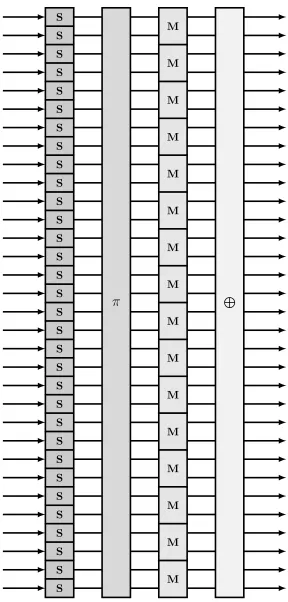
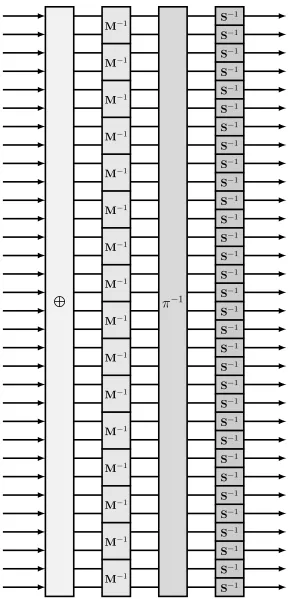
The permutation consists of a number of rounds. Figure 4.1 shows a diagram of a single round of the forward permutation. Figure 4.2 shows a single inverse round. Each round can be represented as the composition of several subfunctions orsteps: a substitution, a bitwise permutation, a mixing layer, and the addition of a round constant. These are represented respectively asS,π,M, and⊕in the diagrams.
4.2.1 Substitution Step
S S S S S S S S S S S S S S S S S S S S S S S S S S S S S S S S
π
M
M
M
M
M
M
M
M
M
M
M
M
M
M
M
M
[image:29.612.165.453.83.685.2]L
L
M−1
M−1
M−1
M−1
M−1
M−1
M−1
M−1
M−1
M−1
M−1
M−1
M−1
M−1
M−1
M−1
π
−1S−1
S−1 S−1 S−1
S−1 S−1 S−1 S−1 S−1 S−1 S−1 S−1
S−1 S−1 S−1
S−1 S−1 S−1 S−1 S−1 S−1 S−1 S−1 S−1 S−1 S−1
[image:30.612.165.453.84.683.2]S−1 S−1 S−1 S−1 S−1 S−1
To the best of our knowledge this is the first cryptosytem to use such large S-boxes. We believe that, at the time of writing, the largest S-boxes used in the literature are the8×8bijective S-boxes used by the Advanced Encryption Standard (AES) [31][32].
Our S-box is an AES-inspired design taken directly from Wood’s thesis on the subject [33]. The primary reason for using this particular class of 16-bit S-boxes is that they are efficiently imple-mentable in hardware. Rather than being based on a random mapping, they are based on multiplica-tive inversion in a finite field followed by an affine transformation. This allows us to implement an actual circuit which performs the operations rather than use the corresponding (and prohibitively large) look-up table.
Specifically, we use the reference C implementation provided in Appendix C of the aforemen-tioned thesis. This S-box is based on multiplicative inversion inGF(216)/hp(x)iwhere
p(x) =x16+x5+x3+x+ 1.
We represent an input to the S-box (and inverse S-box) as a16-bit column vector
x= x15 x14 . . . x1 x0 T
,
wherex15is the MSB. Using this notation, the forward S-box function is given as
S(x) =
0 0 1 0 0 0 0 1 0 0 1 1 1 1 1 0
1 1 0 0 0 0 0 1 0 1 1 0 1 0 1 0
1 1 0 0 1 0 1 1 0 1 0 1 0 0 1 1
1 1 1 0 0 0 1 0 0 1 1 0 0 0 0 0
1 1 0 0 0 1 1 0 0 1 1 1 1 0 1 1
0 1 0 0 0 0 1 1 0 1 1 1 1 1 0 1
0 0 1 0 1 0 1 0 1 1 0 0 1 1 0 0
1 0 1 1 1 0 1 1 0 0 0 1 0 1 1 1
0 1 0 0 0 0 0 0 1 0 0 1 1 1 0 1
1 0 1 1 0 0 0 1 0 0 1 0 1 0 0 0
1 0 1 0 0 1 1 1 0 0 1 1 0 1 0 0
1 0 1 1 1 0 1 1 1 1 0 1 1 0 0 1
1 0 1 0 0 1 0 1 1 0 0 1 0 0 0 1
0 1 0 0 0 1 1 1 1 0 0 0 0 0 0 1
1 0 0 0 1 1 0 1 0 1 1 1 1 0 0 0
1 1 0 1 0 1 1 0 1 0 0 1 1 0 0 0
x15 x14 x13 x12 x11 x10 x9 x8 x7 x6 x5 x4 x3 x2 x1 x0 −1 ⊕ 0 1 0 0 0 1 0 1 1 0 1 1 0 1 1 1
and the inverse is
S−1(x) =
0 1 0 1 0 1 1 1 0 0 1 0 0 0 0 1
1 1 0 1 0 0 1 0 1 0 1 1 1 1 0 1
1 0 1 1 1 1 0 1 0 1 1 0 0 0 0 0
0 0 1 0 1 1 1 0 1 0 1 1 1 0 1 0
1 1 1 1 1 0 0 0 1 0 0 0 0 1 0 0
0 0 0 1 0 1 0 0 0 0 1 1 1 1 1 1
1 0 1 0 0 0 0 0 0 1 1 0 1 0 1 1
0 0 1 0 1 1 1 0 0 1 0 1 1 1 1 0
0 0 0 0 0 0 1 0 0 0 1 0 0 0 1 0
1 1 1 0 0 1 1 1 1 0 1 1 1 0 0 0
0 1 1 0 1 1 1 1 0 0 1 0 1 1 1 1
1 0 0 1 1 0 0 0 1 0 0 1 1 0 1 1
1 0 0 0 0 1 0 1 1 1 0 0 1 0 1 0
1 0 0 0 0 1 1 1 1 1 0 1 1 1 1 1
1 1 1 0 0 1 1 0 1 0 0 1 1 1 1 1
0 1 0 0 1 0 1 0 1 0 0 1 0 0 0 1
x15 x14⊕1
x13 x12 x11 x10⊕1
x9 x8⊕1 x7⊕1
x6 x5⊕1 x4⊕1
x3 x2⊕1 x1⊕1 x0⊕1
A hardware implementation for this particular S-box requires just 1238XOR gates and 144 AND gates. However, No concrete implementation (e.g. in VHDL) is provided; this is an area for future work.
4.2.2 Bitwise Permutation Step
Bitwise permutations are easily implementable in hardware via a simple rerouting of wires. Com-pared to a permutation on the words of the state, a bitwise permutation intuitively provides much better diffusion. The bitwise permutation step is the main source of long-range (i.e. across the entire state) diffusion in the algorithm.
The bitwise permutation also helps maximize the minimum number of active S-boxes by being subject to certain constraints. We use a permutation that satisfies the following properties:
1. All outputs of a given S-box go to16different mixers
2. The permutation is aderangement; it has no fixed points
3. High order; it does not repeat within the number of rounds
4. No low order bits; the order of any bit equals the order of the overall permutation
5. Easily definable by some function
There is obviously no cryptographic significance to how “easy” it is to express a bitwise permuta-tion. This is merely to cut down on the search space and to avoid having to provide a table with512 entries to express the permutation.
We denote the bitwise permutation function
π:Z512 →Z512,
where it operates on theindexof a given bit,x∈Z512.
To understand our specific choice ofπ, it is useful to consider a poor choice first. For this we can turn our attention to the lightweight block cipher PRESENT which operates on a64-bit state over31rounds. PRESENT uses the bitwise permutation
πP:Z63→Z63
given by the linear function
πP(x) = 16xmod 63.
Since it operates inZ63, an augmented mappingπP(63) = 63is required for the last bit [34].
The particular structure ofπP led to an attack on PRESENT in 2009 [35]. The attack leverages
the following undesirable properties ofπP:
1. There are four fixed points:x= 0,21,41,63
The combination of these properties results in a decrease in the lower bound on the number of active S-boxes across four rounds since it is possible to construct a trail that branches back into itself after
πP is iterated only three times. See Figure A.1 for a diagram that illustrates this trail.
A simple way to avoid fixed points is to use an affine function rather than a linear function. An affine function overZ512is of the form
π(x) =αx+β mod 512.
For πto be bijective, we requiregcd(α,512) = 1. Since the prime factorization of512is simply 29, it is equivalent to say thatαmust be odd [25].
A low order bit is defined as a bit that has order less than the order of the overall bitwise permu-tation. It is cumbersome to mathematically characterize all permutations that satisfy the property that no bits have low order. Instead, we wrote a script (see Appendix E) to search for such per-mutations. The script also identifies if a given permutation satisfies all other properties that we require. We found384permutations defined by affine functions overZ512that satisfy all properties.
A complete listing is provided in Table B.1.
We chose the following permutation to use for our algorithm since it is the first function to satisfy all properties:
π(x) = 31x+ 15 mod 512
This particular bitwise permutation has order32and its inverse is given by
π−1(x) = 479(x−15) mod 512
since31−1 ≡479inZ512.
4.2.3 Mix Step
The purpose of the mix step is to provide local diffusion (i.e. across two words) and increase the linear and differential branch numbers of a round from two to three. See Chapter 5 for more detail on branch numbers. We use a mixer based on multiplication by a2×2matrix inGF(216)modulo the irreducible polynomial
p(x) =x16+x5+x3+x2+ 1.
The mixer takes two wordsAandBas input and produces outputsA0andB0 as follows:
A0 B0
=
1 x
x x+ 1
A B
The mix step is invertible because the matrix is invertible; its inverse is given by
A B
=
a b b c
A0 B0
where
a=x15+x14+x12+x11+x9+x8+x6+x5+x4+x+ 1
b=x14+x13+x11+x10+x8+x7+x5+x4+x3+ 1
c=x15+x13+x12+x10+x9+x7+x6+x3+x.
This can be verified by using the provided GF(216)C library. The MSB of each word is taken as the leftmost bit and is represented byx15.
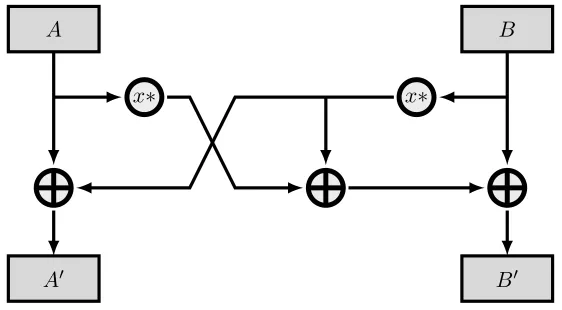
The forward mixer is efficiently implementable in hardware. Notice that the outputsA0 andB0
can be written as
A0 =A⊕Bx B0 =Ax⊕Bx⊕B
since addition inGF(216)is simply the XOR operation. Figure 4.3 shows how this matrix multipli-cation is implemented.
A B
x∗ x∗
[image:34.612.168.449.317.472.2]A0 B0
Figure 4.3: Hardware implementation of the forward mixer function.
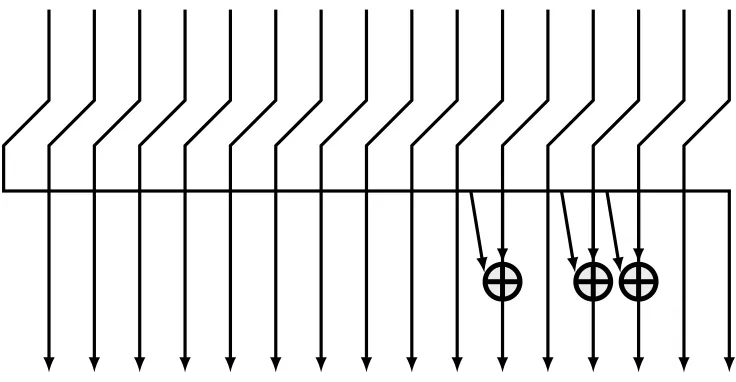
Thex∗operation is a multiplication byxinGF(216). Its implementation, which is shown in Figure 4.4, is very simple. Notice that a multiplication byxis simply a left rotation followed by a reduction if the MSB was one. The reduction is derived from the fact that
x16≡x5+x3+x2+ 1 modp(x)
for our particular irreducible polynomialp(x), and it is implementable using just three XOR gates.
4.2.4 Add Round Constant Step
The add round constant step is the simplest by far, and it is its own inverse. A constant512-bit value is added to the state using bitwise XOR in order to disrupt symmetry and prevent slide attacks. The round constantRCifor roundiis given by the formula
Figure 4.4: Hardware implementation of thex∗function. The leftmost bit is the MSB.
where ASCII(i) is a function that provides the one or two byte ASCII representation ofi and
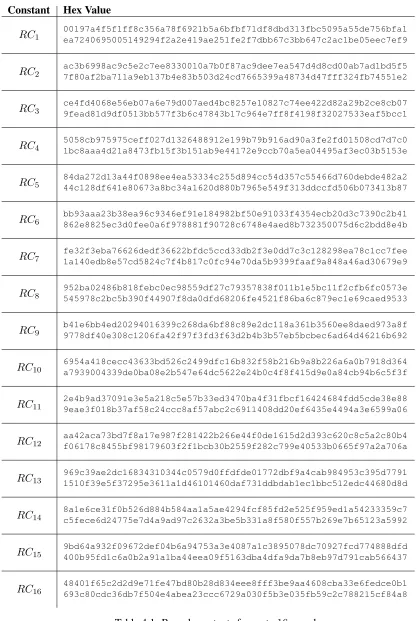
SHA3-512is the SHA-3 hash function that outputs a512-bit message digest. Table 4.1 provides the values ofRCiup toi= 16.
4.3
Number of Rounds
This algorithm uses 10rounds for a 128-bit key and16 rounds for a256-bit key. The number of rounds is determined, as is typical with block ciphers and permutations, by calculating the number needed for resistance to linear and differential cryptanalysis and adding some buffer to increase the security margin. For a more in-depth treatment, refer to Chapter 5.
4.4
Customization
While a specific instantiation is specified here, our algorithm is highly customizable within our security margin. This could be useful in the case that different users want unique, proprietary algorithms. We list several possible customizations here.
4.4.1 State Initialization
Constant Hex Value
RC1
00197a4f5f1ff8c356a78f6921b5a6bfbf71df8dbd313fbc5095a55de756bfa1 ea7240695005149294f2a2e419ae251fe2f7dbb67c3bb647c2ac1be05eec7ef9
RC2
ac3b6998ac9c5e2c7ee8330010a7b0f87ac9dee7ea547d4d8cd00ab7ad1bd5f5
7f80af2ba711a9eb137b4e83b503d24cd7665399a48734d47fff324fb74551e2
RC3
ce4fd4068e56eb07a6e79d007aed4bc8257e10827c74ee422d82a29b2ce8cb07 9fead81d9df0513bb577f3b6c47843b17c964e7ff8f4198f32027533eaf5bcc1
RC4
5058cb975975ceff027d1326488912e199b79b916ad90a3fe2fd01508cd7d7c0
1bc8aaa4d21a8473fb15f3b151ab9e44172e9ccb70a5ea04495af3ec03b5153e
RC5
84da272d13a44f0898ee4ea53334c255d894cc54d357c55466d760debde482a2 44c128df641e80673a8bc34a1620d880b7965e549f313ddccfd506b073413b87
RC6
bb93aaa23b38ea96c9346ef91e184982bf50e91033f4354ecb20d3c7390c2b41 862e8825ec3d0fee0a6f978881f90728c6748e4aed8b732350075d6c2bdd8e4b
RC7
fe32f3eba76626dedf36622bfdc5ccd33db2f3e0dd7c3c128298ea78c1cc7fee
1a140edb8e57cd5824c7f4b817c0fc94e70da5b9399faaf9a848a46ad30679e9
RC8
952ba02486b818febc0ec98559df27c79357838f011b1e5bc11f2cfb6fc0573e 545978c2bc5b390f44907f8da0dfd68206fe4521f86ba6c879ec1e69caed9533
RC9
b41e6bb4ed20294016399c268da6bf88c89e2dc118a361b3560ee8daed973a8f
9778df40e308c1206fa42f97f3fd3f63d2b4b3b57eb5bcbec6ad64d46216b692
RC10
6954a418cecc43633bd526c2499dfc16b832f58b216b9a8b226a6a0b7918d364 a7939004339de0ba08e2b547e64dc5622e24b0c4f8f415d9e0a84cb94b6c5f3f
RC11
2e4b9ad37091e3e5a218c5e57b33ed3470ba4f31fbcf16424684fdd5cde38e88
9eae3f018b37af58c24ccc8af57abc2c6911408dd20ef6435e4494a3e6599a06
RC12
aa42aca73bd7f8a17e987f281422b266e44f0de1615d2d393c620c8c5a2c80b4 f06178c8455bf98179603f2f1bcb30b2559f282c799e40533b0665f97a2a706a
RC13
969c39ae2dc16834310344c0579d0ffdfde01772dbf9a4cab984953c395d7791
1510f39e5f37295e3611a1d46101460daf731ddbdab1ec1bbc512edc44680d8d
RC14
8a1e6ce31f0b526d884b584aa1a5ae4294fcf85fd2e525f959ed1a54233359c7 c5fece6d24775e7d4a9ad97c2632a3be5b331a8f580f557b269e7b65123a5992
RC15
9bd64a932f09672def04b6a94753a3e4087a1c3895078dc70927fcd774888dfd 400b95fd1c6a0b2a91a1ba44eea09f5163dba4dfa9da7b8eb97d791cab566437
RC16
48401f65c2d2d9e71fe47bd80b28d834eee8fff3be9aa4608cba33e6fedce0b1
[image:36.612.92.511.84.705.2]693c80cdc36db7f504e4abea23ccc6729a030f5b3e035fb59c2c788215cf84a8
4.4.2 S-boxes
The AES-inspired S-box used here is efficiently implementable in hardware. There are certainly many other cryptographically secure16-bit S-boxes, but randomly generated ones may not be suit-able for hardware implementation due to size constraints. This is an area for further research. Still, several other AES-like 16-bit S-boxes are presented in [33]. Any new S-box introduced into the algorithm shall be analyzed to determine its linear and differential characteristics and the number of rounds should be adjusted accordingly if necessary.
4.4.3 Bitwise Permutations
The bitwise permutation provided in the specification is subject to the constraints explained before. There are many permutations that satisfy these constraints. We chose to use a permutation that is easily definable by an affine function as obtained by our script; this is not a requirement. A user could generate their own bitwise permutation subject to the given constraints via exhaustive search.
4.4.4 Mixers
Our mixer is based on a specific2×2matrix multiplication inGF(216)modulo a specific irreducible
polynomial p(x). Many matrices are expected to satisfy the constraints that we impose. These constraints are:
1. The matrix should be invertible inGF(216)/hp(x)i
2. The matrix should have differential and linear branch number equal to three (the maximum possible; see Chapter 5)
3. The transformation should be efficiently implementable in hardware
Note that the inverse transformation need not be efficiently implementable. Like the addition of a new S-box, any new mixer (i.e. matrix) introduced to the algorithm should be analyzed to ensure it meets these constraints. A transformation defined by2×2matrix multiplication that does meet the second requirement, for example, would lower our security margin and possibly require increasing the number of rounds significantly.
It should be noted that before settling on a mixer based on matrix multiplication, many mixers based on modular addition, XOR, and rotation operations were tested. Systems or operations that rely mainly on these operations are typically called ARX-based. None of the ARX-based mixers we tested met our requirement of increasing the branch number from two to three. However, for completeness, we enumerate all of the mixers examined in this work in Appendix C.
4.4.5 Round Constants
The round constants presented here are based on SHA-3 hash values. However, they could be any values that satisfy the following constraints. Round constants should be:
1. Unique for each round; to prevent against slide attacks
The round constants are not expected to have any cryptographic significance outside of this. Differ-ent users can generate their own unique set of round constants without difficulty.
Chapter 5
Cryptanalysis
We have already discussed the security of this construction against generic attacks in Chapter 3. The only requirement remaining is to assess the security of the underlying sponge permutationf.
We present a survey of potentially relevant cryptanalysis techniques here. Focus is placed on differential and linear cryptanalysis since these techniques are so general, powerful, and prevalent. Resistance against these techniques should result in resistance against many other less general tech-niques. There is far too much to be said about various cryptanalysis techniques, and there are far too many to discuss here. Our aim is to provide intuitive explanations of prevalent methods and simply explain why our permutation should be resistant. Further cryptanalysis, as with all cryptosystems, is always welcome for future work.
5.1
Differential Cryptanalysis
Differential cryptanalysis was publicly introduced by Biham and Shamir in 1991 in their landmark paper on the subject, [36]. Since then, it has been applied with varying degrees of success to a great number of cryptosystems. As such, it is a fundamental requirement of symmetric key cryptosystem design to prove resistance to differential cryptanalysis.
5.1.1 Overview
The goal of differential cryptanalysis is to exploit non-random behavior of a system (in our case, a permutation) with regard to the propagation of differences. Adifference, denoted∆X, is the bitwise XOR (for our case) of two bitstrings. For example,
∆X =X0⊕X00
is the difference between bitstrings X0 and X00. For differential cryptanalysis, a difference ∆X
is fed through a system and a resulting difference ∆Y is obtained. The pair of these two related differences is called adifferentialand is denoted(∆X,∆Y).
Differentials occur with some associated probability. For an ideal system the probability of a given differential is1/2nwherenis the length of the bitstrings involved. A system is said to exhibit non-random behavior if the magnitude of the probability pD for some differential(∆X,∆Y) is
much greater than the ideal value. This information could be used to mount an attack on the system [37].
probability 1-bit-to-1-bit differentials are of most interest since these will likely be the easiest to propagate through the overall system.
Adifferential trail orcharacteristic is the propagation of non-zero differentials throughout a
system (i.e. across rounds). Figure A.1 shows an example trail through four rounds of PRESENT.
Adifferentially activeS-box is an S-box that has a non-zero difference at its input during an attack;
it is part of a differential trail. For example, if Figure A.1 shows a differential trail, then there are six differentially active S-boxes.
Proving resistance against differential cryptanalysis for a substitution-permutation network re-quires coming up with a lower bound on the minimum number of active S-boxes across some num-ber of rounds. The more active S-boxes there are, the less likely an attack is to succeed since exponentially more chosen plaintexts will be needed for additional each active S-box. Thebranch
numberof an operation is of particular importance here. It can be simply defined as the minimum
number of active S-boxes across just two rounds of a system (e.g. our permutation). The technique of maximizing the branch number of a round is known as thewide trail design strategy. It is the main design strategy behind AES, which has a round branch number of five [38][31].
The number of plaintext/ciphertext pairs required to mount a successful differential attack should exceed the number required for a brute force attack. As the differential probability reduces across rounds, more pairs are required for a successful attack. We loosely refer to the number of pairs required as the complexityof the differential attack. The number of rounds is increased until this complexity exceeds that of a brute force method.
5.1.2 Algorithm Resistance
To determine the resistance of our algorithm to differential cryptanalysis, we first have to determine the maximum differential probability of our S-box. We determined this value to bepD,max = 2−14
using an S-box evaluation program calledEval16BitSboxwritten with Kaminsky’s Parallel Java 2 library [39][40].
Next, it is necessary to determine the branch number of a round. For this, we only need to analyze the mixer. We purposefully designed a mixer with differential branch number equal to three, meaning that minimally three S-boxes will be differentially active between two rounds. This is in fact the maximum achievable branch number for a transformation defined by multiplication by a 2×2 matrix. To verify this, we used a SAT solver called CryptoMiniSat [41]. This SAT solver takes as input a Boolean equation in conjunctive normal form (CNF) and determines if it is
satisfiable; that is, if it can ever produce an output of ‘1’ for any set of input values. Our CNFs were
generated using Kaminsky’sSatProblemJava class [39]. The Boolean satisfiability problem is known to be NP-complete [42]; however, our CNFs were small enough that it finished within a minute for all cases tried (see Appendix C for failed mixer designs).
The CNFs generated are unsatisfiable if and only if the mixer has differential branch number equal to three since it answers the following question:is it possible to have a difference in only one
input and only one output?Through SAT solver analysis we determined that this is not possible for
With all of this information, it is possible to calculate the number of rounds needed for resistance to differential attacks. The worst-case probability of successfully propagating a difference over two rounds is given by
(pD,max)BD·pD,out,
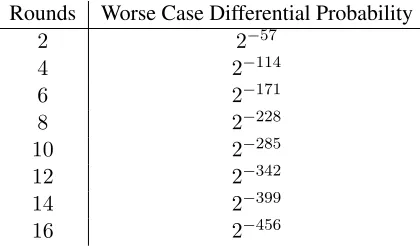
whereBD = 3is the differential branch number. From this we constructed Table 5.1, which shows the worst-case differential probabilities for higher numbers of rounds.
Rounds Worse Case Differential Probability
2 2−57
4 2−114
6 2−171
8 2−228
10 2−285
12 2−342
14 2−399
[image:41.612.204.414.189.312.2]16 2−456
Table 5.1: Worst case differential probabilities over increasing rounds
Therefore the complexity of a differential attack exceeds the complexity of a brute force search of a 128-bit keyspace at six rounds. To increase our security margin significantly, we require10 rounds for a 128-bit key. For a 256-bit key,16 rounds are required to achieve a similar security margin.
5.2
Linear Cryptanalysis
Linear Cryptanalysis was first introduced by Matsui in 1993 in his landmark paper, [43]. As with differential cryptanalysis, it is a fundamental requirement of symmetric key cryptosystem design to prove resistance against linear attacks.
5.2.1 Overview
Linear cryptanalysis is surprisingly similar to differential cryptanalysis in many ways. However, for linear cryptanalysis we are concerned with estimating the behavior of a system using linear ex-pressions rather than highly probable differential characteristics. As with differential cryptanalysis, the first step is to analyze the S-boxes involved in the substitution-permutation network. An S-box, by definition, should be highly nonlinear to provide sufficient confusion. However, it is possible to uncover linear approximations of S-box outputs that occur with high (or low) probability. We can represent our S-box as a vectorial Boolean function
S:Z162 →Z162
in which the inputXand outputY are represented as row vectors, e.g.
X= X1 X2 ... X15 X16
where Xi ∈ Z2. Favoring typical convention found in the literature, X1 is the MSB [37]. This
notation allows us to easily represent linear approximations in the form
16 M i=1 Xi ! = 16 M i=1 Yi ! or equivalently 16 M i=1 Xi ! ⊕ 16 M j=1 Yj
= 0.
The ideal linear probability p that such an approximation holds true is exactly equal to 1/2. We are concerned with deviations from this ideal probability, known as thelinear bias,. Clearly,
=p−1/2. We found the maximum linear bias of our particular S-box to beL,max = 2−8using
the same program as previously described.
S-boxes that are involved in a linear approximation of a system are calledlinearly active S-boxes. A linear approximation across rounds is called a linear trail; it involves several linearly active S-boxes. Our goal, as with differential cryptanalysis, consists of trying to maximize the minimum number of linearly active S-boxes. Thelinear branch numberBLis the minimum number
of linearly active S-boxes across two rounds of our permutation. As with differential cryptanalysis, it depends solely on our mixer.
5.2.2 Algorithm Resistance
Recall that we have verified via SAT solver analysis that the differential branch number of our mixer is three. In [31], Daemen and Rijmen prove the following result: the linear branch number of a linear transformation specified by multiplication by a matrixMis equal to the differential branch number of the linear transformation specified by the transpose of that matrix. Therefore, a sufficient condition for the differential and linear branch numbers to be equal is that the matrix is symmetric. Our matrix is symmetric, and therefore we knowBD =BLwithout the need for further analysis.
The final step to prove the resistance of our algorithm against linear cryptanalysis involves determining the linear bias of two complete rounds of our permutation. To combine linear biases, we use Matsui’s Piling-Up Lemma from [43]:
= 2n−1
n Y
i=1 i,
wheren= 3is the number of linearly active S-boxes across two rounds andi =L,max = 2−8is
the worst case linear bias of those S-boxes. Note that we need not consider the mixer since, being a linear function, it must have a maximum linear probabilitypmix= 1, corresponding to a maximum
bias ofmix= 1/2. This gets cancelled out. Also from Matsui’s paper, we know that the number of
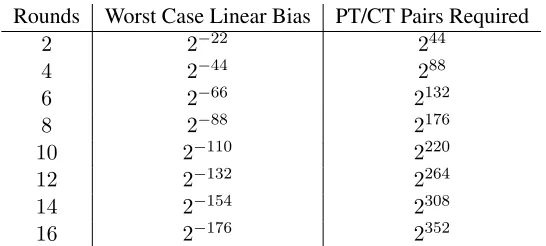
plaintext/ciphertext pairs (again referred to loosely as thecomplexity) needed to exploit the overall biasis approximately−2. Using this information, we constructed Table 5.2.
Rounds Worst Case Linear Bias PT/CT Pairs Required
2 2−22 244
4 2−44 288
6 2−66 2132
8 2−88 2176
10 2−110 2220
12 2−132 2264
14 2−154 2308
[image:43.612.174.447.88.211.2]16 2−176 2352
Table 5.2: Worst case linear biases and linear attack complexities over increasing rounds
5.3
Differential and Linear Cryptanalysis Variants
There have been numerous efforts to extend on the foundations of differential and linear cryptanal-ysis over the years in order to produce attacks that are potentially more powerful. We present a brief overview of the some of the most prevalent variants here.
5.3.1 Differential-Linear Cryptanalysis
As the name suggests, differential-linear cryptanalysis is a combination of differential and linear cryptanalysis in which a differential trail is followed by a linear trail. It was introduced in 1994 by Langford and Hellman [44], who demonstrated a differential-linear attack on 8-round DES that requires far fewer plaintexts than previous attacks. The attack is based on a differential trail over the first three rounds that holds with probability1followed by a high magnitude bias linear approxima-tion for the following rounds. While it was a requirement for this attack to use a unity probability differential trail over the initial rounds, Biham et al. [45] were able to generalize differential-linear attacks in 2002 to differential trails with probability less than1. Recall from Chapter 1 that these results
![Figure 3.1: The sponge construction sponge[f, pad, r] [24]](https://thumb-us.123doks.com/thumbv2/123dok_us/42548.3809/21.612.94.526.85.299/figure-sponge-construction-sponge-f-pad-r.webp)
![Figure 3.2: The duplex construction duplex[f, pad, r] [24]](https://thumb-us.123doks.com/thumbv2/123dok_us/42548.3809/25.612.96.525.93.297/figure-duplex-construction-duplex-f-pad-r.webp)
![Figure 3.3: The duplex construction as used for authenticated encryption [29]](https://thumb-us.123doks.com/thumbv2/123dok_us/42548.3809/26.612.97.525.522.639/figure-duplex-construction-used-authenticated-encryption.webp)