City, University of London Institutional Repository
Citation
: Maiden, N., Zachos, K., Lockerbie, J., Hoddy, S. and Camargo, K. (2017).
Establishing Digital Creativity Support in Non-Creative Work Environments. In: Proceedings
of the 11th ACM Creativity and Cognition Conference. (pp. 222-231). New York, USA: ACM.
ISBN 978-1-4503-4403-6
This is the accepted version of the paper.
This version of the publication may differ from the final published
version.
Permanent repository link:
http://openaccess.city.ac.uk/17021/
Link to published version
:
Copyright and reuse:
City Research Online aims to make research
outputs of City, University of London available to a wider audience.
Copyright and Moral Rights remain with the author(s) and/or copyright
holders. URLs from City Research Online may be freely distributed and
linked to.
City Research Online:
http://openaccess.city.ac.uk/
[email protected]
Establishing Digital Creativity Support in
Non-
Creative
Work Environment
s
Neil Maiden, Konstantinos Zachos, James Lockerbie
City, University of London
Northampton Square, London
EC1V 0HB, UK
[email protected]
Kasia Camargo, Sean Hoddy
CNH Industrial, Cranes Farm Road
Basildon SS14 3AD, UK
[email protected]
ABSTRACT
This paper reports the results of new research that sought the long-term uptake of digital support for human creativity to improve health-and-safety in 3 manufacturing plants over an 18-month period. The systematic risk detection and reso-lution processes of each plant were extended with digital support for employees to think creatively about resolutions to encountered health-and-safety risks. The different uses, successful and unsuccessful, revealed which digitized crea-tivity techniques were effective, different enablers for and barriers to the uptake of the digital creativity support in complex work places, and the importance of aligning work practices and digital capabilities to support creative think-ing.
Author Keywords
Creativity; health-and-safety; risk management; mobile
ACM Classification Keywords
D.5.2 [User Interfaces]: User-centered design, voice I/O
General Terms
Design, human factors
INTRODUCTION
Case studies that report the long-term uptake of digital crea-tivity support in places of work, with both positive and neg-ative outcomes, are scarce. Although advances in the use of digital support for human creative activities in disciplines recognized as creative, such as music, and film and televi-sion [1] have been made, most empirical validations of this support are restricted to smaller-scale experiments and stud-ies [19], with only a few available exceptions available [18, 24]. Moreover, in spite of the considerable potential of digi-tal creativity support to improve work not always framed as creative – work such as care of older people with dementia [18] – few support tools or evaluations have been reported. One probable reason for the scarcity is the scale of the chal-lenge facing organisations that seek to adopt digital crea-tivity support in the daily work of employees. Not only must the support be usable and effective [8], but also at
least some of the work must be reframed as creative. Previ-ous research reveals that successful creative thinking often requires managed changes to practices and press (e.g. [9]) as well as climate (e.g. [4, 13] for this creative thinking. Another probable reason for this scarcity is the duration of the studies that are needed to investigate the effects of changes on work – studies that require continuous access to work environments over a long period. In this paper, and to fill the gap, we report for the first time the deployment and evaluation of new digital support for human creative think-ing durthink-ing work in one organisation in one domain over 18 months – the production lines for the manufacture of large vehicles – in 3 different manufacturing plants.
There has been little reported support for creative thinking on production lines. The few available reports describe the use of tried-and-tested techniques such as brainstorming, for example in BMW to improve health awareness [12] and Toyota to engage employees to improve their work envi-ronments [23]. No digital support has been reported. There-fore, this paper reports our first longitudinal deployment and uptake of new digital creativity support on the produc-tion lines of 3 manufacturing plants of one global organisa-tion – CNH Industrial – over an 18-month period. The new digital support was designed to support employees to think more creatively during the resolution of health-and-safety risks encountered on production lines. Increasing the health and safety of people remains an aim of many organisations, in order to avoid workplace injuries and deaths [5, 17]. The next sections describe the health-and-safety risk problem, the digital creativity support, and the design science ap-proach adopted. The paper then reports both successful and unsuccessful deployments of the support in the 3 CNH In-dustrial plants. The paper ends with an analysis of the re-sults to answer 3 research questions, and outlines emerging challenges to deliver digital creativity support for daily use in workplaces.
DIGITAL CREATIVITY SUPPORT FOR CNH INDUSTRIAL
CNH Industrial is a global organisation that manufactures agricultural and construction equipment, commercial vehi-cles, buses and special-purpose transport. Four of its busi-ness brands are Case IH and New Holland Agriculture, which manufactures tractors and agricultural machines in the United Kingdom, and Astra and Iveco, which manufac-ture commercial vans and civil protection vehicles in Italy.
Paste the appropriate copyright/license statement here. ACM now supports three different publication options:
• ACM copyright: ACM holds the copyright on the work. This is the historical approach
This text field is large enough to hold the appropriate release statement assuming it is single-spaced in Times New Roman 8-point font. Please do not change or modify the size of this text box.
In spite of the different products and manufacturing pro-cesses in these plants, CNH Industrial implements an estab-lished and common health-and-safety process across them, both to minimise the potential dangers of this manufactur-ing to employees, and to facilitate the sharmanufactur-ing of good prac-tices. The process seeks to engage all employees in the sys-tematic detection, reporting and resolution of risks. It used paper forms that capture then guide structured thinking with techniques such as the 5 Ws to discover the underlying causes of each risk, Ishikawa Diagrams (e.g. [10]) to inves-tigate and categorize these causes, and reusable tried-and-tested solutions to resolve risks. Different plants imple-mented different versions of the process – variations that, for example, require different levels of causal risk analysis and forms of exploration of different resolution spaces. However, some plants have identified that this process, alt-hough fit for purpose, was slow to generate risk resolutions, and often resulted in the same types of resolution being recommended for different types of risk, most of the time in the form of short and incomplete descriptions. Reasons for this that were reported included a lack of sufficient en-gagement by plant employees in the risk resolution process, too much focus on exploring the causes of the risk, and in-sufficient support for recording complete creative risk reso-lutions. Therefore, new digital support was co-developed with CNH Industrial to increase both employee engagement with the process and creative thinking about resolutions to health-and-safety risks encountered on its production lines. The support was co-developed to support little-c creativity – everyday activities in which the non-expert may partici-pate each day [11], to generate novel and useful risk resolu-tions.
A DESIGN SCIENCE APPROACH
To develop and evaluate this new digital creativity support, the project adopted a design science approach [21]. Design science is an iterative method that seeks to design an arti-fact to improve a real-world problem in context, and to an-swer questions about the artifact in this context using a ra-tionale cycle of problem investigation, research design, design validation, research execution and results evaluation [21]. Our real-world problem was the health-and-safety risk management on production lines in CNH Industrial manu-facturing plants, and the research artifact was a new digital creativity support application. A pilot plant was selected for the first deployment of the digital creativity support, before rolling out the support to other plants.
The pilot plant site, and hence first problem in context, was in the New Holland Agriculture plant in the United King-dom, can produce up to 20,000 tractors each year at a rate of 1 every 4 minutes. Whenever an unsafe act or condition was encountered, the employee who discovered it complet-ed a paper form, which employees often kept blank copies of on their person during shifts, in order to facilitate risk recording. The form offered limited space for an employee
to write the risk location, description and recommended resolution, as well as to sketch the risk and/or resolution to supplement the text description. Periodically, a member of the health-and-safety team picked up all completed forms from collection points, and used a desktop computer to transfer the text information from the forms to a database, then assigned each incident to a manager or team leader. The assigned manager or leader then investigated and re-solved the risk, often based on the employee’s original rec-ommendation that was documented on the form, then up-dated the form with the implemented resolution. Communi-cation of these risk resolution implementations to the em-ployees across the plant was simple – after the successful resolution of a risk, the health-and-safety team updated each form, generated A4 photocopies of it, and placed the photocopies on physical noticeboards across the plant. A detailed description of this process is reported in [25]. The new digital creativity support, called the Risk Hunting
application, was co-developed with stakeholders at the UK plant to achieve 3 requirements that were specified as part of the design science approach: R1: employees shall engage more in the risk description and resolution process; R2: employees shall document more complete descriptions of risk resolutions, and; R3: employees shall document de-scriptions of more creative resolutions. The support was then deployed in 3 different problem contexts in 3 different plants. The research reported in this paper sought to vali-date the design of the application, execute its deployment in the 3 plants, and evaluate results from these deployments to answer 3 research questions:
RQ1 What digitized creativity techniques were effective in the 3 manufacturing plants?
RQ2 What were the enablers and barriers to the use of the digital creativity support in the plants?
RQ3 To what extent did the digital creativity support need to align with the work practices in the plants?
THE WINTER OF 2014: DEVELOPED FIRST VERSION OF
THE RISK HUNTING APPLICATION
1. Ideas from new risk: short lists of creative clues, gener-ated automatically from 85 patterns of creative manu-facturing outcomes and instantiated with information extracted from the entered description of the new risk; 2. Ideas from previous risks: descriptions of sets of 5
pre-vious successful risk resolutions, retrieved each time from a repository of over 9000 previous risk resolutions; 3. Ideas from superheroes: descriptions of up to 26
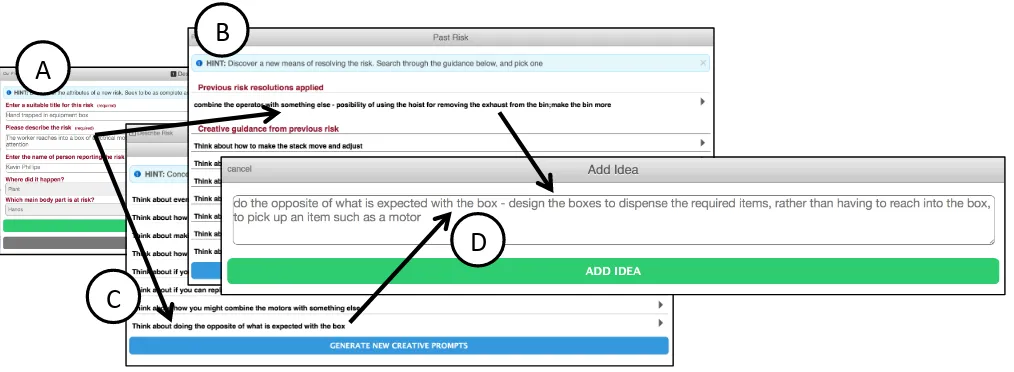
super-heroes and their powers, retrieved from a digital library. To demonstrate the support provided by these techniques, consider a risk in which a worker traps his hand inside a
box of items described with the application in Figure 1(a).
From this description, the application automatically gener-ates a short list of creative clues such as think about doing
the opposite of what is expected with the box (see Figure
1(b)), which might lead the employee to create ideas from the new risk, such as a boxthat dispenses items. The appli-cation also retrieves 5 previous risk resolutions, such as when an operator had trapped his hand in a bin of exhaust
pipes, to generate reusable creative clues such as using a
hoist to collect items, from which the employee might
cre-ate other new ideas, as demonstrcre-ated in Figure 1(c). At any step in the interaction, the user can document new ideas directly into the application using textboxes (see Figure 1(d)). To encourage more effective creative thinking, these textboxes were prefilled with text automatically generated from the selected creative clue with the Ideas from new risk
and Ideas from previous risks techniques, which the
em-ployee could then extend, edit or overwrite. Figure 1(d) shows one example of this text – Do the opposite of what is
expected – which the employee has extended with the new
resolution idea – to design the boxes to dispense items to workers. At the end of the interaction, after ideas have been generated, the employee can compose a new risk resolution from these ideas, and share it digitally with other employees and the health-and-safety advisors.
The co-development of this first version of the application was informed by paper-based prototyping of 2 of the crea-tivity techniques in a training session. Eighteen plant em-ployees worked in teams with the Ideas from new risk and
Ideas from superheroes techniques to generate new
resolu-tions to known risk using the new support. All used the techniques with limited training in a short period of time, and most generated risk resolutions that were noticeably different to the original resolution applied. Subsequent formative evaluations of the application revealed that plant employees were able, with minimum training, to use it to document risks and generate and document resolutions to these risks. Several changes to the application were made before final deployment, including redesign of the final generated risk resolutions to resemble the paper forms.
THE SPRING OF 2015: DEPLOYMENT IN FIRST PLANT
[image:4.612.55.562.59.245.2]This first version of the Risk Hunting application was made available for employee use in the UK plant over 66 consec-utive working days. A potential user of the application was any employee who detected a new health-and-safety risk. Before the start of the deployment, the researchers trained 2 health-and-safety advisors and 7 health-and-safety captains who were responsible for health-and-safety on the plant’s 7 production lines to use the application and the plant’s Sam-sung Galaxy tablets that the application ran on. A limited budget at the plant meant that only 3 tablets were made available for application training and use, so some employ-ees also used the application on workplace desktop comput-ers. The captains and advisors provided the same training to employees in different roles on their production lines – mainly team leaders, assembly operators, repair operators and electricians. Although incentivized to use the applica-tion to record and to resolve risks, all of the employees were free to also use the paper forms. No other changes to work practices in the plant were made to accommodate use of the application. All employees had email and telephone access to the research team for help and support throughout
Figure 1. Demonstration of the Risk Hunting application, showing description of a new risk, automatically-generated support from the Ideas from new risk and Ideas from previous risk techniques, and use of creative clue stem texts to generate a new idea
A"
B"
C"
the deployment. Researchers visited the plant twice during the deployment to collect qualitative feedback about the use of application from captains available during the visit, and facilitated a final 35-minute focus group with 4 captains and 1 advisor after the end of the deployment period. During the deployment, 33 employees used the Risk Hunt-ing application to document resolutions to 115 discovered risks. No major usability problems were reported. A rigor-ous comparison of these 115 risk resolutions to a similar number of risk resolutions documented by the same em-ployees 12 months earlier with the paper forms, and report-ed at length in [14], revealreport-ed that the risk resolutions docu-mented with the application were rated by risk analysts to be both more novel and more useful. Unlike with the paper forms, use of the application was associated with all risks having documented resolutions, and these resolutions were documented with more words than the ones on the forms. Employees generated most risk resolutions using the Ideas
from new risk technique, whereas the Ideas from
superhe-roes technique was rarely used. Inclusion of the text auto-matically generated by the application from its creative clues was associated with risk resolutions described with more words. Full results from the risk resolution analysis are reported in [14]. This paper now reports, for the first time, who used the application, durations of application use, and what barriers to successful use were encountered. The documented authors of the risk resolutions revealed that individuals rather than groups of employees resolved most risks. This result was explained by 2 of the health-and-safety captains, who reported that this was primarily because of work constraints imposed by the production line. The application needed “release from the production line to
use it, otherwise it had to be done in overtime”. Individual
employees in different roles used the application to differ-ent degrees – the 7 health-and-safety captains and 2 advi-sors generated 68 of the 115 (59.1%) risk resolutions. An-other 16 risk resolutions came from 1 assembly operator in training to become a health-and-safety captain. In contrast, 18 other employees documented only 1 risk resolution each. The captains reported one major reason for this pattern of use – the limited access that other employees had to the tablet devices, compared with the near limitless blank paper forms carried by employees that they would complete im-mediately: “I would think that this is down to availability of
the tablets, only two on site”. Moreover, the tablets were at
some times in secure storage, at other times unusable due to the lack of tablet chargers. Most other employees also re-ceived less training, and therefore had less practice with the application, whereas the captains had time “to be able to
play with the app”. Nonetheless, in spite of these reported
barriers to use, one of the health-and-safety advisors claimed: “noticing an increase in unsafe acts reporting” during the deployment period, with “stronger ownership and a focused world class manufacturing approach to
prob-lem solving” – feedback that the team agreed was evidence
of an increase in employee engagement with creative think-ing about the resolution of risks.
Employees in the plant also recorded risks on paper forms during the deployment period – 106 risks in total. Six of the health-and-safety captains recorded risks with both the ap-plication and the paper forms, and 13 employees only rec-orded risks on paper forms, again down to the absence of sufficient numbers of charged tablets in the plant that could be accessed quickly. One captain reported that employees just “…need to be able to pick it up and use it”. The limited number of available tablets meant that this result was not a surprise to the plant’s health-and-safety team.
Log data recorded about employee use of the application revealed that the average time from starting to describe a new risk to completing the risk resolution was 4m46s, and employees completed 80 of the 115 (69.6%) risk resolu-tions within the 5-minute constraint imposed by the produc-tion lines. Analysis of the times per calendar week revealed that the average time to complete risk resolutions fell from 12m30s in the first week to just 1m30s in the last, indicat-ing a possible learnindicat-ing curve to use the application for em-ployees.
In contrast, 19 (16.6%) of the risk resolutions took more than 8 minutes to complete. However, these resolutions also tended to contain more content. An analysis of all 115 risk resolutions with a Spearman Rank Correlation revealed that employees used more time to complete risk resolutions with more words, r=.41, p<0.0001. One conclusion drawn from this result was that increasing the engagement and creative thinking of employees might require more than 5 minutes on the production lines. Results from the final focus group provided corroborating evidence that employees on the production lines often lacked time to use the application as planned.
In spite of some of the risk resolutions not being completed within the required time, the health-and-safety team be-lieved that the adoption of the application led to more pro-ductive risk management. One reported: “the tablets al-lowed for time saving, using the wireless connection on the spot instead of submitting paper forms, waiting for the re-porting boxes to be opened, and entered on the online sys-tem”. The health-and-safety team identified a trade-off be-tween more upstream work for production line employees to use the Ideas from new risk and Ideas from previous risks
techniques, work which also increased employee engage-ment in plant’s health-and-safety, and less downstream work in the health-and-safety process for advisors. In con-trast, the little-used Ideas from superheroes technique was perceived to be “a bit around the houses”, i.e. not focused, but potentially useful for training, to encourage people to think “out of the box” about health-and-safety.
more novel, more useful and more complete than risk reso-lutions generated with the paper system. The application was used more by the health-and-safety captains than other employees. The insufficient numbers of charged tablets and lack of time to become familiar with the application were the primary reasons reported by other employees for not using the application. The employees documented most risk descriptions and resolutions in less than 5 minutes, but more detailed risk resolutions needed longer to document. At the end of the deployment period, the plant’s health-and-safety captains made 4 recommendations to increase use of the application across the plant:
A. Run the application on digital touchscreens as well as tablets, to increase employee confidence with it;
B. Also run the application on tablets on each of the plant’s 30 production groups, to increase access to it;
C. Redesign work practices on the production lines to facil-itate application use, so that team leaders work off line with the application with each employee on the line to describe then resolve the detected risk;
D. Redesign the application’s interface so that it resembles the paper form more closely, and simplifies the uptake of the application by more employees.
AUTUMN 2015 TO SUMMER 2016: ADAPTING FOR THE UK PLANT
Use of the Risk Hunting application continued in the plant until November 2015. The application was then withdrawn, and a new version was developed that implemented some of the recommendations (A-D) from the first deployment. Dig-ital touchscreens were installed at key locations in the plant, in order to provide employees with faster access to the ap-plication (A). Use of one of these touchscreens is depicted in Figure 2. The application was re-implemented to be usa-ble on the touchscreens and desktop computers situated on the production lines and in staff offices (A). Application interactions were simplified to optimize creativity technique use (D). However, it was not possible to change the web application’s interface to resemble the paper forms (D), and the plant decided to invest financially in new digital touchscreens rather than more tablets (B). The little-used technique Ideas from superheroes was removed.
Controversially, the health-and-safety team also decided to remove the Ideas from new risk technique from the applica-tion, although employees had used this technique success-fully to generate at least 51 of the 115 risk resolutions in the first deployment period. Instead, the team sought to encour-age employees to work with reusable resolutions generated with the Ideas from previous risks technique, for 2 reasons. Not only did the team want to encourage employees to re-use resolutions in order to support sharing of good resolu-tion practices between employees, but also it believed – incorrectly – that reducing the number of application fea-tures would reduce the operating costs of the application to the plant. As a consequence, this unanticipated decision by the team provided an opportunity to investigate the
effec-tiveness of alternative versions of the Risk Hunting applica-tion that were implemented with different, digitized creativ-ity techniques.
Figure 2. Use of the Risk Hunting application on a touchscreen installed in the UK plant
Furthermore, the plant decided against making changes to the work practices on the production lines, to allow team leaders to use the application off each line (C). Instead, in-dividual employees were encouraged to use the application off as well as on the production lines – a change which pro-vided them, when needed, more than 5 minutes to complete risk resolutions. However at the start of the period, a reduc-tion in the number of employees working in the plant, due to a change in the economic climate, was perceived to be a potential threat to this solution. It reduced opportunities for the health-and-safety captains and team leaders, who were the employees most skilled with the Risk Hunting applica-tion, to step off the production lines and use the application. Nonetheless, the new and more simplified version of the
Risk Hunting application was released for employee use in
appren-tices and Cab drop team rather than individuals, making the precise final number of users difficult to compute. Howev-er, the result revealed that over twice as many employees used the Risk Hunting application, compared with the first deployment period.
Number of different employees using the application 74
Number of documented risk resolutions 370
Mean word length of risk descriptions 7.8
Mean word length of risk resolutions 11.2
Average time to document risk description/resolution 6m44s
Table 1. Summarized log data for the second deployment peri-od from the Risk Hunting application
Analysis of the application log data revealed that employees from 2 of the plant’s 7 production lines – Pedestal Line and
RTC Garage – were the most frequent users of the
applica-tion. Two reasons for this were identified. The health-and-safety captains who worked on these lines championed use of the application on these lines more than did the captains on other lines, and the health-and-safety team reported that this championing role was an important contributor to ap-plication uptake. Furthermore, the RTC Garage line existed to fix faults that were generated on the other lines, and em-ployees who worked on it actively sought to discover faults including health-and-safety risks. The use of the application appeared to align more effectively with the work environ-ment of the employees on this particular line.
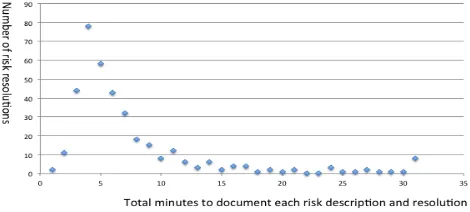
[image:7.612.317.558.425.591.2]The plant employees documented 370 new risk descriptions and resolutions with the application in the deployment peri-od. Compared to the first period [14], however, the mean numbers of words reported in Table 1 to describe each risk (7.8 to 15.2) and resolution (11.2 to 29.8) were both lower, the mean time to describe a risk and resolution was higher (6m44s to 4m46s), and the percentage (52.2%) of risk reso-lutions completed within the 5-minute constraint was lower. Indeed, the distribution of the total numbers of risks re-solved within each one-minute period, depicted graphically in Figure 3, revealed that many risks took more than 10 minutes to resolve, and 8 required more than 30 minutes.
Figure 3. Distribution of total numbers of risk resolved within each one-minute period
The health-and-safety advisors offered 2 possible explana-tions for these increased resolution times. The first was the emergence of collaborative working. The advisors observed that up to 3 health-and-safety captains at a time would col-laborate to use the application on the touchscreens, and this
collaborative work, although perceived to be a positive if unplanned outcome of application use, took longer than individual work. The second offered explanation was that the employees in the RTC Garage, who often used the ap-plication on desktop computers in their staff offices, were sometimes interrupted by e-mails or fault reports – inter-rupts that required immediate attention. Therefore the aver-age time needed to complete risk resolutions was longer. In spite of this result, the health-and-safety team claimed an overall effort saving from application use for the plant, sim-ilar to the claim reported for the first deployment. To man-age the paper forms, one member of the team spent up to 2 hours per day collecting them from locations across the 40-hectare site and typing the reported risk descriptions and resolutions into the digital system. Application use removed this collection effort, and the average time that employees spent per day (6m44s at on an average of 3.46 risk resolu-tions) to document half of the risks uncovered daily in the plant was lower, resulting in an effort saving for the plant. Analysis of application log data related to the description and resolution of each of the 370 risk resolutions (see Table 2) revealed that only 135 (36.5%) of the risk resolutions were generated using the Ideas from previous risks tech-nique with creative clues. By inference, most risk resolu-tions were not generated and documented with the applica-tion as designed. Furthermore, most of the designed-for uses of the application – 121 – took place in the last 2 months of the period, indicating that employees might have needed time and experience with the application to use its capabilities effectively.
Log data patterns of Risk Hunting appli-cation use
Number of risk resolutions
Ideas generated after invoking Ideas from previous risk technique and using the crea-tive clues
135
Ideas generated after invoking Ideas from previous risk technique but without using
the creative clues 91
Ideas generated after invoking Ideas from previous risk technique both with and with-out using the creative clues
4
Ideas generated without invoking Ideas
from previous risk technique 134
Risks recorded without any resolution ideas 6
Table 2. Log data patterns of Risk Hunting application use during the second deployment period
Another 134 of the 370 (35.9%) risk resolutions were gen-erated and documented when the application was used only as a digital version of the paper forms, without invoking the
Ideas from previous risks technique. Of these 134, 102 were
[image:7.612.56.291.521.627.2]risks. By comparison, risk descriptions recorded in the first deployment were, on average, described with almost twice as many words, and this additional content was sufficient for the service to retrieve relevant previous risk resolutions. A content analysis of the 370 risk resolutions revealed that these resolutions were compositions of 527 different and discrete ideas that employees generated with the applica-tion. Of these 527 ideas, 330 (62.6%) were identical to at least one other idea documented in the period, and a total of 57 of these different ideas were reused at least once. Exam-ples were Put a check in place, which was documented in 18 different risk resolutions, the similar idea Put check in
place, which was in 8 resolutions, and the more substantial
idea Refresh operators in correct methods to connect pipes
to avoid damage in 9 resolutions. Therefore, although the
log data revealed that most risks were not resolved as the application was designed using all capabilities developed to support use of the Ideas with previous risks technique, the content analysis provided evidence that employees still re-used ideas from previous risk resolutions to resolve risks that they encountered.
By the end of the period, the change in the number of em-ployees working on production lines was perceived to have impacted on application use. One health-and-safety advisor reported that this change had, as predicted, reduced oppor-tunities for the health-and-safety captains and team leaders – the employees most skilled with the application – to step off the lines to use the application. This claim was corrobo-rated with data from the application log, which revealed that a lower percentage of risks were resolved by employ-ees in these roles during the second deployment period, compared with the first.
To conclude, the new version of the Risk Hunting applica-tion was used throughout the deployment. The increased time needed by employees to generate and document risk resolutions with the application was offset by substantial reductions in the effort needed to collect paper forms. How-ever, the risk resolutions were described with fewer words than in the first period, and only 36.5% were generated us-ing the digitized creativity support as designed. The results revealed several new enablers to application use – increased access using the digital touchscreens and desktop comput-ers, champions who encouraged use of the application on their production lines, and alignment of the application’s use with more diagnostic work environment on one line. Use of the touchscreens also encouraged collaborative crea-tive working to resolve risks.
However, the deployment also revealed new barriers to use. The application was not designed to support collaborative creative work. Use of it off the production lines meant that employees were sometimes interrupted during idea genera-tion. Employees appeared to use the application’s digital creativity support more at the end than the beginning of the period, indicating that time and practices was needed to use this support effectively. No expert comparison of the risk
resolutions documented in this period was undertaken, but the absence of the Ideas from new risk technique and in-creased resolution reuse with the Ideas from previous risks
technique was associated with shorter and more repetitive resolutions to health-and-safety risks. Results indicated that the version of the application with fewer digitalized creativ-ity techniques was less effective than the one with more techniques. Finally, changes in the plant’s work practices between the 2 deployments, which led to fewer employees able to work off the production lines, became a new barrier to application use. Employees who were most skilled with the application were less able to step off the lines to use it, and this reduction in skilled use is one possible explanation for the shorter risk descriptions and alternative uses of the application, which occurred perhaps because the shorter risk descriptions led to less accurate retrieval of previous resolutions than in the first period.
After the end of the deployment, another new version of the
Risk Hunting application was co-developed with CNH
In-dustrial – one that supported both the Ideas from previous
risks and Ideas from new risk techniques. This version was
deployed in the plant with the same work practices as the second deployment period, on touchscreens and desktop computers in October 2016, and data is again being collect-ed about its use.
PROPOSED DEPLOYMENT IN FIRST ITALIAN PLANT
Based on the UK plant deployments, CNH Industrial’s cen-tral health-and-safety team in Torino sought to roll out the
Risk Hunting application at other manufacturing plants, and
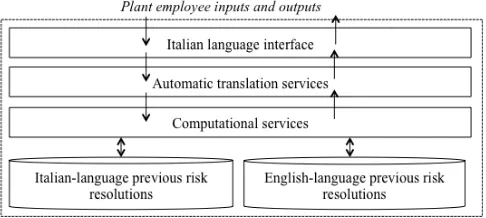
2 in Italy asked to adopt and trial the application. The first was the Iveco Astra plant in northern Italy. It was smaller than the UK plant. It constructed specialized construction and transporter vehicles for use in the military on 2 produc-tion lines. To meet the needs of the plant’s health-and-safety team, a new Italian-language version of the applica-tion, called the Caccia al Rischio, was developed. But to use the Risk Hunting application’s original 3 computational services, which manipulated English syntax and semantics using online thesauri such as WordNet [15], a new solution was needed.
from the UK plant. The second database contained 1450 Italian-language risk resolutions from the Iveco Astra plant. The new Caccia al Rischio application was demonstrated to, then experimented with by the plant manager and health-and-safety team at the plant in the spring of 2016. Although potential benefits from the application were reported, the team also identified one barrier to the uptake of the digital creativity support in the Iveco Astra plant – a lack of align-ment between the digital support for early creative thinking about new resolutions, and the plant’s requirement to com-plete a causal analysis of each risk before selecting and re-using existing risk resolutions.
Figure 4. The extended architecture of the Caccia al Rischio
Therefore, the plant made a decision not to trial the Caccia
al Rischio application. The perceived misalignment
be-tween the problem-focus of the plant’s existing risk analysis process and more solution-focused creativity techniques of the application could not be fixed. Lessons drawn from this rejection informed the deployment of the application to the second Italian plant.
PROPOSED DEPLOYMENT IN SECOND ITALIAN PLANT
The IVECO plant in northern Italy was the largest and most
automated of the 3 plants. It constructed commercial vehi-cles. The Italian-language Caccia al Rischio application from the Iveco Astra plant was adapted to meet one new need expressed by the new plant, which was to be able to retrieve all risk resolutions from the UK plant’s database of 9,000+ resolutions using the Ideas from previous risk tech-nique. This extended version of the application was demon-strated to the plant manager and health-and-safety team in the summer of 2016, and a decision was made at that meet-ing to trial the application for 3 months from September 2016. Therefore, the application was delivered to the health-and-safety team in August 2016 to experiment with and request further changes. During this experimentation, the team identified 3 barriers to be overcome before release to employees on the plant’s production lines:
1. The application generated creative clues that the health-and-safety team feared the employees would consider ir-relevant and/or frivolous, and reject the application; 2. Mistranslation of English-language creative clues into
Italian by the Google Translate service, for example (in English) Place the object in a vacuum cleaner, rather than Place the object in a vacuum. The team believed
that presentation of these clues would also lead to appli-cation rejection by the plant employees, because their confidence in it would be undermined by perceived bugs in the software;
3. The application retrieved risk resolutions across risk categories such as unsafe acts and near misses. This de-cision had been made originally with the UK plant to guide creative thinking about new risks with as much re-trieved knowledge as possible. However, the plant more used the risk categorisations as strict constraints, and whereas the UK plant supported cross-category reuse for creative thinking, the Italian plant perceived it to be a violation of the risk management process.
In response, the Caccia al Rischio application was modified further, in order to increase its chances of acceptance by the plant’s employees. The set of creative clues generated with
the Ideas for new risk technique was reduced by removing
clues considered to be irrelevant and frivolous. Use of the translation services was modified to remove incorrect trans-lations. And the computational service that underpinned the
Ideas from previous risk technique was modified to restrict
it to retrieve only risk resolutions of the same type as the new entered risk.
However, during a second round of experimentation by the plant’s team, even this modified digital creativity support was deemed challenging for employees on the plant’s pro-duction lines to use, and hence too likely to be rejected by them. Therefore, through the autumn of 2016, the research-ers and plant’s team collaborated again to redesign the ap-plication, in order to align it more closely with the plant’s health-and-safety process. New features currently emerging from this redesign include new interactive support for a first-cut causal analysis of the risk when it is described with the application, use of risk cause descriptions entered as a result of this analysis to refine creative search underpinning
the Ideas from previous risks technique, and the
develop-ment of a new service that will impledevelop-ment the plant’s risk resolution guidelines alongside existing computational ser-vices. This new version of the Caccia al Rischio application is due to be trialled in the first quarter of 2017, and the au-thors also look forward to reporting results in the future.
ANSWERING THE RESEARCH QUESTIONS
The answer to RQ1, and determine which digitized creativi-ty techniques were effective in the plants, employee use of
the Ideas from new risk technique was associated with
higher numbers of creative risk resolutions. In contrast, the health-and-safety team reported that the Ideas from
super-heroes technique was too time-consuming to use on
produc-tion lines. Used in isolaproduc-tion, the Ideas from previous risks
technique resulted in the direct reuse of risk resolutions to generate new risk resolutions that were less novel and com-plete than the resolutions generated with the Ideas from new risk technique. In the first deployment however, employees combined use of the Ideas from new risk and Ideas from
previous risks techniques to generate more novel and
com-plete risk resolutions, and the Risk Hunting application is now configured again to support creative thinking with combinations of these 2 techniques.
To answer RQ2, the 4 deployments uncovered enablers and barriers to the effective use of the digital creativity support. The enablers included use of digital touchpoints that users were familiar with, immediate access to these touchpoints without the need to set up or charge them, senior employees who championed support use, and digital creativity support that delivered productivity as well as creativity benefits. Results from the 2 successful deployments revealed a trade-off between more upstream work for employees on lines to use the digital creativity support, and less downstream work for the health-and-safety advisors. The digital creativity support was also used more frequently on one production line that sought to diagnose faults, i.e. when the work envi-ronment and creativity support were more aligned. Barriers to the effective use of the digital creativity support included use of the support on technologies unfamiliar to employees, insufficient time for employees to learn how to use it to its maximum effect, and collaborative creativity using support that was not designed for it. The first deployment revealed that employees needed more time than was originally made available to create more complete risk resolutions, so more flexible work procedures were implemented in the second deployment. The second deployment also revealed that, if there were fewer employees available to undertake during work tasks, more experienced employees who were also the most effective users of the digital creativity support, were less available to find the time to use the support.
To answer RQ3, the 2 unsuccessful deployments revealed the extent of alignment needed between the digital support and work processes for regular effective creative thinking to take place in workplaces. The 2 Italian plants rejected the support because of relatively small misalignments between it and the environment, perceptions that the support ren-dered the serious work frivolous and/or imprecise, and an unwillingness by the plants to adapt existing structures to exploit the affordances of the support for creative thinking. Future digital creativity applications for use in such work environments need to support effective idea generation and learning in employees who, due to other more regular work tasks, can only commit limited cognitive resources and time
to creative tasks. Therefore, aligning the creativity support and work environment to reduce barriers, no matter how small, will be key to future take-up.
Of course, because the results were generated using a de-sign science approach, they are open to many potential threats to validity, and some of these threats are highlighted here. Threats to internal validity of the results arose from other influences that might have affected how the inde-pendent variable – the use of the Risk Hunting application – related to causality [20]. Other possible influences included alternative forms of creativity support delivered in the plant and employee motivations to use the Risk Hunting applica-tion. To mitigate these threats, the UK plant provided nei-ther alternative creativity support to its employees, nor bo-nuses for reporting risks after the start of the second de-ployment. Potential threats to the external validity of the results were conditions that limited our ability to generalize these results, and there are many such threats. For example, the paper reports the successful deployment of the Risk
Hunting application to just 100 employees in 1 plant, so
care needs to be taken, even to extrapolate the results to other manufacturing domains. However, given the absence of published digital creativity research that has been applied to non-creative industries such as manufacturing, the results offer both challenges to overcome and hypotheses to inves-tigate.
RELATED RESEARCH
Most related research has been targeted at domains in which people are trained to have creative skills, for example the performing arts, music, and film and television [1], and this support has been developed using different types of algorithm from, for example computational linguistics [16] and case-based reasoning to support innovation [6]. Beyond the creative industries, interactive creativity support is lim-ited. Some has been developed to support creative thinking in science and engineering, for example in the forms of new tabletop visualizations to support biological discoveries [22] and social media to support collaborative creativity in education [3]. Businesses often seek to support the creativi-ty of their employees, but most of this support has been delivered as methods [9] rather than interactive software. The limited creativity support for healthcare work also re-lies on techniques to encourage creative problem solving by nursing administrators [2].
DISCUSSION AND FUTURE WORK
This paper reports the evaluation of new digital support for human creative thinking over 18 months in the production lines for the manufacture of large vehicles in 3 plants. It reports results from 3 new evaluations and new results from a 4th evaluation. These evaluations revealed the creativity
up-take of the digital creativity support in workplaces – factors such as human champions for creativity support and simple access to the support in the workplace. However, and per-haps most importantly, the evaluation revealed the im-portance of aligning the digital creativity support with the work environment – its processes, structures and climate. The barriers identified in the deployments revealed that uptake of digital creativity support in work environments where creative thinking is not a norm may be sensitive to even simple misalignments between the support and the environment. Our next challenge is to explore principles of socio-technical design to ensure the effective uptake of digital creativity support in everyday work practices.
ACKNOWLEDGEMENTS
The research reported in this paper was supported in part by the EU-funded FP7 COLLAGE project 318536.
REFERENCES
1. Alaoui S.F., Schlphorst T., Cuykendall S., Carlson K., Studd K. & Bradley K., 2015, ‘Strategies for Embodied Design: The Value and Challenges of Observing Movement’, Proc. 10th ACM Conf. Creativity and Cognition, ACM Press, 121-130. 2. Arbesman M. & Puccio G., 2001. Enhanced Quality Through
Creative Problem Solving. Journal of Nursing Administration 31(4), 176 -178.
3. Aragon C.R., Poon S.S. & Aragon A. M-H. D., 2009, ‘A Tale of Two Online Communities: Fostering Collaboration and Creativity in Scientists and Children’, Proc. 7th ACM Conf. on
Creativity and Cognition, ACM Press, 9-18.
4. Doorley S. & Witthoft S., 2012, ‘Make Space’, Wiley, Hobo-ken, New Jersey
5. Eurostat 2014, available at: appsso.eurostat.ec.europa.eu. 6. Goel A.K. & Craw S., 2006, ‘Design, Innovation and
Case-Based Reasoning’, The Knowledge Engineering Review, 20(3), 271–276.
7. Google 2017, ‘Google Cloud Translation API Documenta-tion’, accessed https://cloud.google.com/translate/docs/, 03/01/2017.
8. Greene S.L., 2002, ‘Characteristics of Applications that Sup-port Creativity’, Communications of ACM, 45(10), 100-104. 9. Isaksen, S.G. Brian, K. Dorval, Treffinger, D.J. 2011, Creative
Approaches to Problem Solving: A Framework for Innovation and Change. Sage Publications, Inc; Third Edition.
10.Ishikawa K., 1976, ‘Guide to Quality Control’, Asian Produc-tivity Organization.
11.Kaufman, J. C., and Beghetto, R. A., 2009, ‘Beyond big and little: The four c-model of creativity’, Review of General Psy-chology 13, 1.
12.Loch C.H., Sting F.J. & Bauer N., 2010, ‘How BMW is De-fusing the Demographic Time Bomb’, Havard Business Re-view 88(3), 99-102.
13.McCoz J.M. & Evans G.W., 2002, ‘The Potential Role of the Physical Environment in Fostering Creativity’, Creativity Re-search Journal 14(3/4), 409–426
14.Maiden N., Zachos K., Lockerbie J., Levis S., Camargo K., Allemandi G. & Hoddy S,, 2017, ‘Evaluating Digital Creativi-ty Support To Improve Health-and-SafeCreativi-ty in a Manufacturing Plant’, accepted for publication in CHI’2017.
15.McCarthy D., Koeling R., Weeds J., Carroll J., 2004, ‘Using Automatically Acquired Predominant Senses for Word Sense Disambiguation’, Proc. ACL 2004 Senseval-3 Workshop Bar-celona, Spain.
16.Monfort N., Perez y Perez R., Fox Harrell D., Campana A., 2013, ‘Slant: A Blackboard System to Generate Plot, Figura-tion, and Narrative Discourse Aspects of Stories’. Proc. 3rd In-ternational Conference on Computational Creativity, Sydney Australia, June 2013, 168-175.
17.OSHA, 2014, ‘All about Occupational Safety and Health Ad-ministration’, US Department of Labor, accessible from https://www.osha.gov/Publications/all_about_ OSHA.pdf 18.Rees Lewis D., Harburg E., Gerber E. & Easterday M., 2015,
‘Building Support Tools to Connect Novice Designers with Professional Coaches’, Proc. 10th ACM Conf. on Creativity
and Cognition, ACM Press, 43-54.
19.Siangliulue P., Chan J., Gajos K.V. &Dow S.P., 2015, 'Provid-ing Timely Examples Improves the Quantity and Quality of Generated Ideas', Proc. 10th ACM Conf. on Creativity and
Cognition, ACM Press, 83-92.
20.Wohlin C. Runeson P., Host M., Ohlsson M.C., Regnell B. & Wesslen A., 2000, ‘Experimentation in Software Engineering: An Introduction’, Kluwer Academic Publishers, Bos-ton/Dordrecht/London.
21.Wieringa R., 2014, ‘Design Science Methodology for Infor-mation Systems and Software Engineering’, Springer-Verlag, Berlin-Heidelberg.
22.Wu A., Yim J.B., Caspary E., Mazalek A. Chandrasekharan S. & Nersessian N.J., 2011, ‘Kinesthetic Pathways: A Tabletop Visualization to Support Discovery in Systems Biology’, Pro-ceedings 8th ACM Conference on Creativity and Cognition,
ACM Press, 21-30.
23.Yasuda Y., 1991, ‘40 Years, 20 million ideas: The Toyota Suggestion System’, Productivity Press.
24.Zachos K., Maiden N.A.M., Pitts K., Jones S., Turner I., Rose M., Pudney K. & MacManus J., 2013, 'A Software App to Support Creativity in Dementia Care', Proc. 9th ACM Creativ-ity and Cognition Conference, ACM Press, 124-131.
25.Zachos K., Maiden N., Levis S., Camargo K. & Allemandi G., 2015, ‘Creativity Support to Improve Health-and-Safety in Manufacturing Plants: Demonstrating Everyday Creativity’, Proc. 10th ACM Conf. on Creativity and Cognition, ACM