White Rose Research Online URL for this paper:
http://eprints.whiterose.ac.uk/148509/
Version: Published Version
Article:
Colloff, Matthew J., Lavorel, Sandra, van Kerkhoff, Lorrae E. et al. (10 more authors)
(2017) Transforming conservation science and practice for a postnormal world.
Conservation Biology. pp. 1008-1017. ISSN 0888-8892
https://doi.org/10.1111/cobi.12912
[email protected] https://eprints.whiterose.ac.uk/ Reuse
This article is distributed under the terms of the Creative Commons Attribution (CC BY) licence. This licence allows you to distribute, remix, tweak, and build upon the work, even commercially, as long as you credit the authors for the original work. More information and the full terms of the licence here:
https://creativecommons.org/licenses/
Takedown
If you consider content in White Rose Research Online to be in breach of UK law, please notify us by
Essay
Transforming conservation science and practice
for a postnormal world
Matthew J. Colloff,
1,2∗Sandra Lavorel,
3Lorrae E. van Kerkhoff,
1Carina A. Wyborn,
4Ioan Fazey,
5Russell Gorddard,
2Georgina M. Mace,
6Wendy B. Foden,
7,8Michael Dunlop,
2I. Colin Prentice,
9John Crowley,
10Paul Leadley,
11and Patrick Degeorges
121Fenner School of Environment and Society, The Australian National University, Canberra, ACT 2601, Australia 2Enabling Adaptation Pathways Project, CSIRO Land and Water, Canberra, ACT 2601, Australia
3Laboratoire d’Ecologie Alpine, CNRS – Universit´e Grenoble Alpes, 38041 Grenoble cedex 9, France
4Luc Hoffmann Institute, WWF International and College of Forestry and Conservation, University of Montana, 32 Campus Drive,
Missoula, MT 59801, U.S.A.
5Centre for Environmental Change and Human Resilience (CECHR), School of the Environment, University of Dundee, Perth Road,
Dundee DD1 4HN, Scotland, U.K.
6Department of Genetics, Evolution and Environment, University College London, Gower Street, London, WC1E 6BT, U.K.
7Climate Change Specialist Group, Species Survival Commission, International Union for the Conservation of Nature, 28 rue
Mauver-ney, Gland CH-1196, Switzerland
8Global Change and Biodiversity Group, Department of Botany and Zoology, Stellenbosch University, Private Bag X1, Matieland 7602,
South Africa
9Grand Challenges in Ecosystems and the Environment and Grantham Institute – Climate Change and the Environment, Department
of Life Sciences, Silwood Park Campus, Buckhurst Road, Ascot, Berkshire SL5 7PY, U.K.
10Social and Human Sciences Sector – Division of Social Transformations and Intercultural Dialogue, UNESCO, 7 place de Fontenoy,
75352 Paris 07 SP, France
11Laboratoire Ecologie, Syst´ematique et Evolution, Universit´e Paris-Sud, 91405 Orsay cedex, France 12Minist`ere de l’´Ecologie, du D´eveloppement durable et de l’´Energie, 92055 Paris cedex 15, France
Abstract: We examine issues to consider when reframing conservation science and practice in the context of global change. New framings of the links between ecosystems and society are emerging that are changing peoples’ values and expectations of nature, resulting in plural perspectives on conservation. Reframing con-servation for global change can thus be regarded as a stage in the evolving relationship between people and nature rather than some recent trend. New models of how conservation links with transformative adaptation include how decision contexts for conservation can be reframed and integrated with an adaptation pathways approach to create new options for global-change-ready conservation. New relationships for conservation science and governance include coproduction of knowledge that supports social learning. New processes for implementing adaptation for conservation outcomes include deliberate practices used to develop new strategies, shift world views, work with conflict, address power and intergenerational equity in decisions, and build consciousness and creativity that empower agents to act. We argue that reframing conservation for global change requires scientists and practitioners to implement approaches unconstrained by discipline and sectoral boundaries, geopolitical polarities, or technical problematization. We consider a stronger focus on inclusive creation of knowledge and the interaction of this knowledge with societal values and rules is likely to result in conservation science and practice that meets the challenges of a postnormal world.
Keywords: adaptation pathways, adaptation services, adaptive governance, coproduction, global change, learn-ing, transformation, values-rules-knowledge
∗email [email protected]
Paper submitted May 10, 2016; revised manuscript accepted February 17, 2017.
This is an open access article under the terms of the Creative Commons Attribution-NonCommercial License, which permits use, distribution and reproduction in any medium, provided the original work is properly cited and is not used for commercial purposes.
1008
Conservation Biology, Volume 31, No. 5, 1008–1017
C
Transformaci´on de la Ciencia y la Pr´actica de la Conservaci´on para un Mundo Pos-Normal
Resumen: Examinamos cuestiones para considerar cu´ando se deben modificar los marcos de trabajo de la ciencia y la pr´actica de la conservaci´on en el contexto del cambio global. Nuevos marcos de trabajo sobre las conexiones entre los ecosistemas y la sociedad est´an emergiendo y est´an cambiando los valores de las personas y las expectativas de la naturaleza, lo que resulta en perspectivas plurales sobre la conservaci´on. La modificaci´on de los marcos de trabajo de la conservaci´on para el cambio global puede por lo tanto ser considerado como una fase de la relaci´on en evoluci´on entre la gente y la naturaleza, en lugar de una tendencia reciente. Los nuevos modelos sobre sobre la relaci´on de la conservaci´on con la adaptaci´on transformativa incluyen la forma en que los contextos de las decisiones pueden ser re-enmarcados e integrados dentro de una estrategia de v´ıas de adaptaci´on para crear nuevas opciones para la conservaci´on lista para el cambio global. Las nuevas relaciones para la ciencia de la conservaci´on y la gobernanza incluyen la co-producci´on de conocimiento que apoye el aprendizaje social. Los nuevos procesos para la implementaci´on de la adaptaci´on para resultados de conservaci´on incluyen pr´acticas deliberadas usadas para desarrollar estrategias nuevas, cambiar las visiones globales, trabajar con el conflicto, dirigirse al poder y a la equidad intergeneracional en las decisiones, y construir conciencia y creatividad que empodere a los agentes para actuar. Argumentamos que la modificaci´on de los marcos de trabajo de la conservaci´on para el cambio global requiere que los cient´ıficos y los practicantes implementen estrategias que no est´en restringidas por disciplina ni fronteras sectoriales, polaridades geopol´ıticas, o problemas t´ecnicos. Consideramos que un mayor enfoque en la creaci´on inclusiva del conocimiento y la interacci´on de este conocimiento con los valores y las reglas sociales probablemente resulten en una ciencia y pr´actica de la conservaci´on que cumpla con los retos de un mundo pos-normal.
Palabras Clave:aprendizaje, cambio global, conocimiento-reglas-valores, co-producci´on, gobernanza adaptativa, servicios de adaptaci´on, transformaci´on, v´ıas de adaptaci´on
Introduction
Conservation science and practice originated in an era when ecological systems were perceived as coherent and predictable and that changed gradually. In such so-called normal times, problems were considered discrete and were addressed using theoretical-analytical foundations in the natural sciences derived through principles of pos-itivism and deduction. Contemporary times are different. The postnormal world of rapid change is characterized by complexity, chaos, and contradictions. In these times, “nothing is definite, truly guaranteed or totally safe,” and change is pervasive (Sardar 2010). Knowledge is ambiva-lent, values and interests are contested, stakes are high, the need for decisions is always urgent, and there is a real danger of highly interdependent global systems running out of control (Helbing 2013).
Some authors consider the postnormal concept implies normal science no longer works because the world it-self has changed. The world has always been a complex adaptive system: it is how people interpret it that has changed. Thus, in proposing “science for the post-normal age” Funtowicz and Ravetz (1993) emphasized that dis-ciplinary science applied outside a systems framework is of little use for solving problems in social-ecological systems. Given these systems are dynamic and complex, “the science appropriate to this new condition will be based on the assumptions of unpredictability, incom-plete control and a plurality of legitimate perspectives” and “requires an ‘extended peer community’ consisting
of all those with a stake in the dialogue on the issue” (Funtowicz & Ravetz 1993:739).
Climate change and other global drivers have major impacts on ecosystems and biodiversity, although future changes for particular locations and ecosystems are un-clear. Conserving ecosystems and biodiversity as they are may be credible and legitimate under gradual ecological change but not when change is rapid and widespread (Mori et al. 2013). Understanding the consequences of historical change on social-ecological systems may im-prove capacity to address current and future change. Eco-logical change occurs on multiple and large scales and is unpredictable and irreversible. Conservation of biodiver-sity and ecosystems is moving away from small changes at local scales (Hagerman & Satterfield 2014). Incremental changes to current conservation approaches could prove ineffective; thus, a transformative adaptation approach is likely needed (Stafford Smith et al. 2011; Wise et al. 2014; Colloff et al. 2016a, 2017). Bytransformative,we mean “fundamental changes in structural, functional, relational and cognitive aspects of socio-technical-ecological sys-tems that lead to new patterns of interactions and out-comes” (Patterson et al. 2016).
1010 Conservation for a Postnormal World
valued by society (Dunlop et al. 2013; Heller & Hobbs 2014). A transformative approach to addressing climate change has generic value for global-change adaptation.
A global-change-ready approach involves reframing the purpose and objectives of conservation: whom and what conservation is for and what it can achieve (e.g., Cole & Yung 2010; Hagerman et al. 2010). A transformative adap-tation approach to conservation under major ecological change acknowledges that some ecosystems are undergo-ing, or will undergo, permanent climate-change-induced transformation. Transformative shifts in current decision contexts for adaptation and adaptive governance to sup-port transformative adaptation will be required to re-spond to changes in ecosystems Bydecision context,we mean the cultural-political setting of the decision process, including interconnected systems of values, rules, and knowledge that form how that process is framed (Gord-dard et al. 2016). Byadaptive governance,we mean the structures and processes societies use to deal with change and uncertainty in social-ecological systems that address short-term perturbation and longer term transformation and integrate knowledge systems and learning into inclu-sive, decentralized decision making and action (Wyborn 2015a).
Transformative adaptation differs from adaptive man-agement because it involves fundamental changes to gov-ernance to support continuous improvements in deci-sion making and learning (Abson et al. 2017). Although such improvements are components of adaptive man-agement in principle (Roux & Foxcroft 2011), goals are often not achieved because of insufficient monitoring and inadequate stakeholder engagement (Aceves-Bueno et al. 2015). Although adaptive management and adap-tive governance are often cited in discussions of climate adaptation, their durability under transformative change has been questioned (Wyborn et al. 2016). Progress re-quires decision makers to shift their world views from current conservation to global-change-ready conserva-tion and provide new ways to navigate governance, power, and political constraints to change (Hagerman et al. 2010).
We aim to further discussions on reframing of con-servation objectives in the context of global change (e.g., Cole & Yung 2010; Stein et al. 2013; Wyborn et al. 2016). Previous authors considered what objectives might look like, but less attention has been paid to pro-cesses and structures for reframing them. We present a case for a transformative approach to conservation and a framework that links global-change-ready conserva-tion with transformative adaptaconserva-tion, the TARA approach (Transformative Adaptation Research Alliance [https:// research.csiro.au/tara/]). Setting objectives for global-change-ready conservation needs coproduction: engage-ment between decision makers and “those with a stake in the dialogue” to learn and generate effective, legitimate, ethical solutions (van Kerkhoff & Lebel 2015).
New Framings of the Links Between Ecosystems
and Society
Changes in ecosystem structure, function, and uses are generating new relationships between people and the en-vironment via changes in peoples’ expectations, values, and perspectives of nature. Authors have stressed the need for an extended peer community to be engaged in collaborative planning (Schultz 2011; Cross et al. 2012) and reframing of conservation in ways that reevaluate naturalness and societal values associated with it (Hobbs et al. 2009; Cole 2012). The postnormal perspective does not imply that conservation science and practice were static during perceived normal times. Mace’s (2014) ty-pology of changing ideologies on conservation over the last 50 years identifies 4 approximate eras: “nature for itself” (pre-1970s), “nature despite people” (1970s–late 1990s), “nature for people” (late 1990s–mid 2000s), and “people and nature” (mid 2000s–present day). The short period in which these shifts emerged has resulted in the plurality of perspectives represented in current conser-vation science and practice. Reframing conserconser-vation in the context of global change is thus the next stage in the evolving relationship between people and nature rather than a recent trend.
Many studies project large-scale biodiversity loss under global change (e.g., Dawson et al. 2011; Foden et al. 2013; Urban 2015), but few consider the potential of conser-vation practices to mitigate impacts. Drivers of change other than climate are likely to be at least as significant as climate drivers, so that regular contingent analysis can ensure the interacting effects of multiple drivers are con-sidered. Conservation strategies that reduce pressures, facilitate species adaptation (Colls et al. 2009), and main-tain ecosystem processes are likely to have positive ben-efits for biodiversity. In a postnormal world, conserva-tion faces unprecedented challenges from the conflict between maintaining ecosystem integrity and increasing demands placed on natural resources by a rising human population. Climate change imposes additional stressors on ecosystems already altered by land-use change and intensification (Oliver & Morecroft 2014).
Ecosystems and biodiversity are threatened by poorly understood interactions between climate change and al-tered land use that can lead to regime shifts (Leadley et al. 2014). These interacting stressors occur rapidly and are nonlinear and transformational (IPCC 2014). Yet, impacts on biodiversity, and efforts to address them, are inextrica-bly linked with sustainable development challenges “to protect human well-being and life-supporting ecosystems simultaneously and in ways that are socially inclusive and equitable” (ISSC 2013).
Global-change-ready conservation can be enabled by regarding climate change as an amplifying stressor to other drivers likely to cause large-scale, nonlinear, undesirable change and by considering the interaction
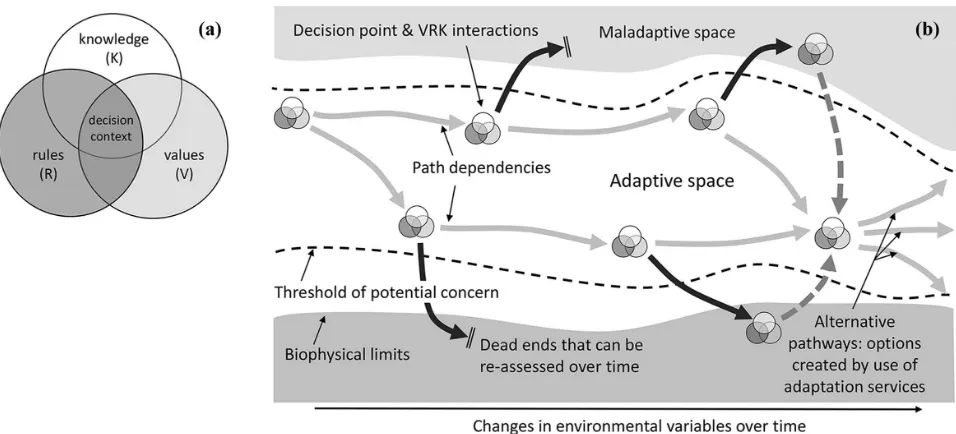
Figure 1. (a) Linkages between the values, knowledge, and rules concept (VRK) and (b) an adaptation pathway incorporating VRK and the use and future-option value of adaptation services.
between what people need from nature and what they might actualize under future constraints on ecosystems. Standard practices such as habitat restoration and pro-tected areas will remain important, but new approaches are needed given the rate and extent of anthropogenic change (Dunlop et al. 2013; Dickinson et al. 2015). The challenge is to factor plausible scenarios of change into conservation and shift from maintaining ecosystems in their current state to managing for dynamic responses to multiple drivers of change. Where these drivers cause transitions to alternative ecosystem states, emphasis will be on facilitating transitions, preserving ecosystem func-tions, and minimizing species losses.
The choice between incremental and transformative adaptation presents a double bind for decision makers that relates to decision lifetimes (Stafford Smith et al. 2011). Transformative adaptation may be deemed too difficult or unacceptable, so incremental approaches are selected instead. But by the time it becomes clear that in-cremental adaptation is inadequate to address biophysical change, it may be too late for a transformative approach. This problem is similar to time-inconsistency, whereby a long-term plan is compromised by the incentive of short-term gains (Underdal 2010). For conservation, incremen-tal changes to current strategies may prove inadequate and require subsequent transformative approaches in re-sponse to major ecosystem change and biodiversity loss. Resolving this double bind requires broadening plan-ning and decision making to consider not only longer decision lifetimes (Stafford Smith et al. 2011), but also how short-term gains can be reframed as disincentives because they may limit future options. Adaptive, de-liberate sequencing of decisions and actions as part of the adaptation-pathways approach (Wise et al. 2014)
ad-dresses time-inconsistency problems. There is no general-ized blueprint. Researchers, practitioners, and communi-ties engaged in transformative change have to coproduce approaches relevant to their particular circumstances.
New Models of How Conservation Links with
Transformative Adaptation
To diversify options for adaptation, changes are needed to decision making and implementation. The TARA ap-proach can be used to position adaptation in coproduc-tion and learning processes that help diagnose constraints on decision making and develop new approaches to con-servation under global change (Colloff et al. 2017). The 3 elements of the TARA approach are the values, rules, and knowledge (VRK) perspective, adaptation pathways, and adaptation services (Fig. 1).
The VRK perspective enables analysis of how decisions are influenced by social-cultural circumstances. It high-lights that a mandated decision-making group (e.g., local environmental managers or a national agency) uses sys-tems of values, knowledge, and rules when defining and selecting options for adaptation. Thus, current conser-vation objectives are underpinned by normative values (held and assigned) (Seymour et al. 2008), knowledge, and rules, but interactions between them tend not to be considered by decision makers. The VRK perspective enables analysis of the particular VRK systems used by the decision-making group and how these systems shape the decision context for adaptation (Gorddard et al. 2016) (Fig. 1a).
[image:5.594.60.538.52.269.2]1012 Conservation for a Postnormal World
rules, and values are excluded. For example, current con-servation paradigms (e.g., reserves and habitat restora-tion) focus on maintaining or enhancing existing species, habitats, and ecosystems, consistent with perceived cul-tural values of society (e.g., NRMMC 2010). However, this focus may not be an appropriate values system under climate change and biodiversity decline. Also, a maintain-and-enhance values system may be embedded in rules (e.g., threatened species legislation) and knowledge sys-tems (e.g., methods for prioritizing objectives) of an es-tablished decision-making process and is thus difficult to change.
Gorddard et al. (2016) applied the VRK perspective in an 8-step process to change decision contexts for adaptation. The process can be adapted to specific needs of practitioners. By changing the decision context, con-servation objectives may shift as new knowledge on ecosystem change emerges: goals may be unattainable for species or ecosystems likely to undergo irreversible loss (Cole & Yung 2010; Hagerman et al. 2010) and positive societal values may be conferred on immigrant species (Hobbs et al. 2009), modified ecosystem rem-nants (Colloff et al. 2016b), or novel ecosystems (Collier 2015). Rules, such as conservation laws and practices, would then need realigning to conform to shifts in values and knowledge.
The adaptation-pathways approach is a process for designing and implementing sequenced adaptation de-cisions based on uncertain changes over time (Wise et al. 2014). Adaptation-pathways planning involves assessing trade-offs between benefits of preserving flexibilities to respond to future uncertainties against costs of maintain-ing business as usual. The VRK perspective is used to ana-lyze the decision context and options at each point on the pathway (Fig. 1b). Assessment by decision makers of pre-dicted or actual changes to the social-ecological system determines whether decisions are likely to prove adap-tive or maladapadap-tive. For example, a decision to conserve alpine ash (Eucalyptus delegatensis) forest in southeast-ern Australia by reseeding after fire may be adaptive in the short term but maladaptive in the long-term under more frequent, intense wildfires (Colloff et al. 2016a; Doherty et al. 2017). Resources to service the increasing area that requires reseeding may become prohibitive: an opportunity cost of other adaptation options forgone. There is also the likelihood that reseeded areas may burn again before trees reach maturity.
An adaptation-pathways approach involves learning and engagement, considers path dependency (i.e., how past decisions constrain future options), time frames over which decisions remain valid, sequencing of decisions to avoid maladaptation, and shifting societal interests and values (Wise et al. 2014). In Australia, adaptation path-ways have been used in the Eyre Peninsula (Siebentritt et al. 2014), Southern Slopes region (Bosomworth et al. 2015), and Murray-Darling Basin (Abel et al 2016;
Dun-lop et al. 2016). Publications on these projects include guidelines for practitioners on setting objectives, scop-ing futures, developscop-ing adaptation pathways, monitorscop-ing, evaluating, and learning.
Adaptation services are the set of ecosystem services that provide options for people to adapt to environmen-tal change (Lavorel et al. 2015; Colloff et al. 2016a, 2016b). The relationship between ecosystem services needed for future livelihoods and well-being and what changing ecosystems can supply determines the adapta-tion challenge. Biophysical change then becomes a cue for discussions on adaptation options, the future sup-ply of adaptation services, and the governance arrange-ments regarding their use (G´omez-Baggethun et al. 2013; Collier 2015). The balance of social demands and eco-logical limits can then form a basis for exploring future options, including trade-offs among ecosystem services (Howe et al. 2014). With the TARA approach, identify-ing and explicitly managidentify-ing adaptation services is cen-tral to reframing of values, rules, and knowledge systems that underpin conservation and ecosystem management because adaptation services provide future options for adaptation. Options can be actualized by managing for services from those ecosystems that are likely to persist in the future and using new ecosystem services from those ecosystems that transform. As such, the concept of adaptation services is critical for designing adaptation pathways that incorporate social benefits derived from ecosystems. The identification of adaptation services rep-resents new knowledge, but realizing benefits requires shifts in values and rules and trade-offs between distribu-tion of costs and benefits over the short and long term that involve deep engagement with the politics of adaptation (Wyborn et al. 2016).
Lavorel et al. (2015) described a 4-step process for incorporating adaptation services into adaptation path-ways planning based on characterizing current ecosys-tems drivers and ecosystem services; predicting effects of climate change on ecosystems and services; identify-ing adaptation services related to ecosystem persistence or transformation; and scoping management options for adaptation services.
New Relationships for Conservation Science and
Governance
Conservation agencies have begun to recognize the need for conservation science, policy, and practice to be co-produced (Schuttenberg & Guth 2015; Wyborn 2015a, 2015b). This new approach involves reconsideration of major science questions in order to shift knowledge gen-eration away from a knowledge-deficit model, whereby “a linear, unidirectional flow of knowledge from experts to users” is assumed (Young et al. 2014; Fern´andez 2016).
Coproduction of knowledge between researchers, practi-tioners, and citizens then “supports collective action and reflection directed towards improving the management of human and environmental interrelations,” which rep-resents the social-learning approach (Keen et al. 2005). Social learning provides an ethical basis for supporting new forms of knowledge for adaptation (Collins & Ison 2009; ISSC 2013). Integrating coproduction with nature-based solutions (use of ecosystems and their processes to improve human well-being) is becoming a priority under climate change via ecosystem-based adaptation (Vignola et al. 2009).
Coproduction processes can be applied to diverse and difficult situations. One example is the World Wildlife Fund (WWF) REDD+ participatory scenarios of land-cover change in Tanzania (Capitani 2015). Implementing forest conservation for carbon stocks and creating mon-etary value for them provided incentives to reduce emis-sions from forested land and to invest in low-carbon path-ways for sustainability and poverty alleviation. In another example, collaboration between WWF Colombia and the Luc Hoffmann Institute is building capacity of protected-area managers to conceptualize transformational change and incorporate responses into management frameworks (Wyborn et al. 2016). This effort includes a learning framework on how coproduction processes can shift be-haviors and capacities of all project partners, scientists, and practitioners alike.
Using the VRK perspective to focus on social, polit-ical, and cultural dynamics of the decision context can highlight opportunities for, and constraints on, coproduc-tion. This focus enables targeted activities that build on existing strengths, such as good relationships between re-searchers and decision makers, or alerts project designers to social-political power dynamics that affect the scale at which research can make the greatest contribution (van Kerkhoff & Lebel 2015). For example, Wyborn (2015b) showed how histories of trust between conservation agencies and landowners strongly shape the possibilities for coproduction. The dialogue critical to coproduction can identify where capacity development can best sup-port collaboration between practitioners and researchers in ways that reframe power relations so that activities are not dominated by scientists, who instead of assuming control become important but equal participants (van Kerkhoff & Lebel 2015).
However difficult and time-consuming, coproduction is happening; tacit knowledge held by stakeholders en-gaged in adaptation is increasingly being recognized and is conferring legitimacy to scientific processes (Fern´andez 2016). Coproduction is not straightforward, partly because it is caught in a bind between the driver of urgency (i.e., facilitation of stronger relationships be-tween researchers and practitioners to speed up action and change) and the driver of deliberation (i.e., need for such collaborations to learn and evolve, where learning
takes time). Both drivers emphasize the need for skills and opportunities that can drive stronger engagement between science and governance (Diaz et al. 2015; van Kerkhoff & Lebel 2015).
New Processes for Implementing Adaptation
for Conservation
A rapidly changing world requires greater emphasis on understanding and implementing the practice of inten-tional responses to change. Research on conservation and adaptation has rarely addressed how capacities for change can be implemented. Knowledge that is abstract or teachable tends to dominate, rather than practical knowledge for implementation. Practical knowledge is typically developed experientially, is implicit, and quite different from research-based knowledge (Boiral 2002; Fazey et al. 2005). We argue that scientific research needs to be complimented by experiential knowledge to imple-ment transformative adaptation for conservation.
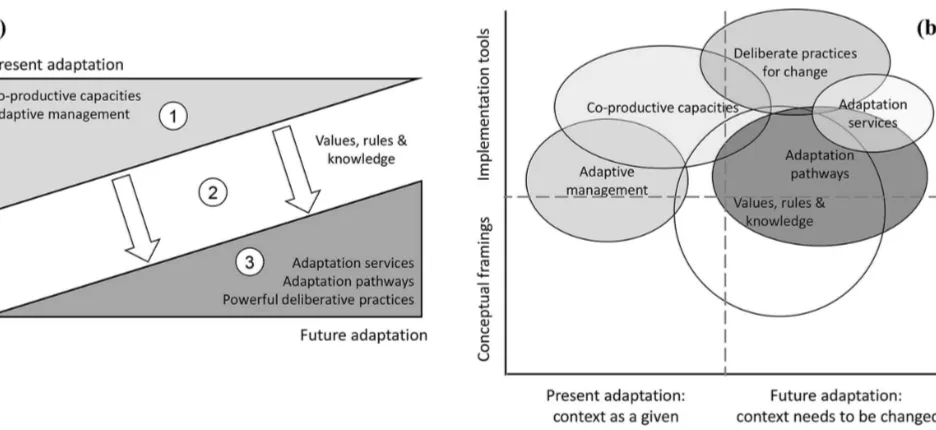
Intentional change includes learning from deliberate practices used to develop new strategies, shift world views, work with conflict, consider power and intergen-erational equity in decisions, and build consciousness and creativity that empower agents to act (Page et al. 2016). For example, the Three Horizons practice facilitates di-alogue on moving from what is known to new ways of thinking and acting (Fig. 2). This practice can be used to implement the TARA approach, whereby Horizon 1 rep-resents current modes of conservation, including norms, framings, and practices. Horizon 3 represents new ways of operating, and Horizon 2 represents the intermediate steps that facilitate emergence of new approaches. The Three Horizons practice involves working with groups of agents to shape transitions toward transformation and can be used in situations of high contestability and di-verse world views by empowering participants to plan for change together (Sharpe et al. 2016).
1014 Conservation for a Postnormal World
Figure 2. Two representations of the relationships between the concepts and tools for conservation and
adaptation to global change: (a) Three Horizons framing (1, what is happening now in conservation; 2, changes needed to achieve adaptation; 3, successful conservation in the future through adaptation to global change) and (b) application of the concepts and tools outlined in this paper as conceptual framings or implementation tools and their uses in understanding how the past has shaped present adaptation-decision contexts or how decision contexts can be shaped in the future. Positions on the quadrat indicate how concepts and tools are intended to be applied and are used currently. Over time, positions may change and some concepts and tools merge.
A Synthesis of Concepts, Tools, and Approaches
The concepts and tools of adaptive management, adapta-tion pathways, VRK, adaptaadapta-tion services, coproducadapta-tion, and deliberate practices for change are related via a tem-poral perspective and their value as a basis for adapting conservation to global change (Fig. 2). Some concepts and tools inform understanding of how past changes and adaptations have shaped the present (adaptive manage-ment, coproduction, and VRK in part). Others shape con-texts into the future (VRK in part and adaptation path-ways and services). An understanding of how present adaptation-decision contexts have emerged informs what needs to change in the future.
Adapting to global change requires new ways of learn-ing and thinklearn-ing. Humanity has not had to address such pressing challenges before and is yet to realize what these new ways might be. The VRK perspective provides a bridge between current and future conservation con-cepts and practice (Fig. 2a). Ways forward can emerge from deliberate practices based on interactions of evolv-ing knowledge, rules, and values. Thus, new knowledge focuses on the nature and extent of global change and ways for conservation to adapt. Emerging values reflect preferences for different conservation outcomes based on evolving interests and world views. Changes in rules involve new governance arrangements, consistent with new knowledge and values, which can facilitate agree-ment on preferred conservation outcomes.
Contestation is inevitable among stakeholders because of uncertainties about biophysical change and resistance to the need for transformative adaptation. Such con-flicts cannot be reconciled with a set of guidelines. We therefore provide pointers to transformative conserva-tion approaches based on coproducconserva-tion and deliberate practices. The emphasis is on experimentation, learning, and discovery. Abel et al. (2016) detailed processes for transformative adaptation that could be “inserted into stakeholders’ long-held and strongly established environ-mental discourses, each one representing the continu-ing values, understandcontinu-ing, and aspirations of a particular group. The processes are intended to develop and ex-pand debates and negotiations among those groups and lead toward transformations.”
Society may not yet know how to learn and adapt to global change but can start by deliberating on likely consequences of various adaptation approaches, avoid-ing maladaptation, and identifyavoid-ing future options via the VRK perspective, adaptation pathways, and adaptation services. Although trade-offs cannot be avoided, success is likely if adaptation is framed as a social-learning chal-lenge rather than as an attempt to resolve contestation. For conservation science to remain relevant to the rapidly changing nature of conservation practice, reflexive ap-proaches to research are required. The knowledge gaps for conservation identified by Velasco et al. (2015) focus on people and nature and involve transdisciplinary re-search collaboration, inclusion of indigenous and local
ecological knowledge, and engagement in knowledge coproduction. Similar calls have been made for more re-flexive approaches to climate adaptation research (Fazey et al. 2010; Preston et al. 2015).
By reframing adaptation to change in social-ecological systems from reformist to transformative approaches (Bassett & Fogelman 2013), conservation no longer needs be constrained by discipline and sectoral boundaries or geopolitical polarity or haunted by the ghost of technical problematization, whereby every issue is a dilemma to be solved using specialist scientific content knowledge (Funtowicz & Ravetz 1993). Science that can exorcise the spectre of technical specialization will be based on ethi-cal virtues of humility and accountability (Jasanoff 2003). Processes of coproduction involve reframing the relation-ship between science and society as one of coevolution and deliberate engagement with the normative elements that shape decisions about what actors do and how they do it (Jasanoff 2004). In postnormal times, accountabil-ity and responsibilaccountabil-ity are needed for the production and use of scientific knowledge. Humility is needed to ac-knowledge the limits of understanding and capacity for prediction, control, and management of the environment (Clark et al. 2016).
To be effective and relevant into the future, tion needs to change. This does not mean that conserva-tion professionals need to become experts in integraconserva-tion and transdisciplinarity. Rather, they may benefit from en-gaging with the changing environmental, political, and social circumstances in which they operate in order for their research to find effective application. The map they may choose to follow is still being drawn and is subject to continual revision. Processes that bring together and value diverse knowledge and perspectives of conserva-tion biologists, social scientists, transdisciplinary scien-tists, communities, policy makers, and practitioners may enable the conservation community to collectively deter-mine the pathways.
Acknowledgments
This paper was developed from presentations and dis-cussions in the session Climate-ready Adaptation for Con-servation and Ecosystem Services at the international conference Our Common Future Under Climate Change (CFCC15). We thank the organizers of CFCC15 for the opportunity to draw together contributors with diverse perspectives on conservation and adaptation. This paper is a contribution of TARA, an international network of re-searchers and practitioners dedicated to the development and implementation of novel approaches to transforma-tive adaptation to global change. We thank participants in the second TARA workshop (July 2015) for their in-sights and critique of the TARA framework. Finally, we thank N. Abel (Fenner School of Environment and
Soci-ety, Australian National University) and the anonymous referees for their constructive and insightful reviews of the manuscript.
Literature Cited
Abel N, et al. 2016. Building a resilient pathway towards transforma-tion when “no-one is in charge”: insights from Australia’s Murray– Darling Basin. Ecology and Society 21 https://doi.org/10.5751/ ES-08422-210223.
Abson DJ, et al. 2017. Leverage points for sustainability transformation. Ambio46:30–39.
Aceves-Bueno E, et al. 2015. Citizen science as an approach for over-coming insufficient monitoring and inadequate stakeholder buy-in buy-in adaptive management: criteria and evidence. Ecosystems
18:493−506.
Bassett TJ, Fogelman C. 2013. D´ej`a vu or something new? The adapta-tion concept in the climate change literature. Geoforum48:42–53. Boiral O. 2002. Tacit knowledge and environmental management. Long
Range Planning35:291–317.
Bosomworth K, Harwood A, Leith P, Wallis P. 2015. Adaptation path-ways: a playbook for developing robust options for climate change adaptation in natural resource management. RMIT University, Mel-bourne, University of Tasmania, Hobart, and Monash University, Melbourne.
Capitani C, editor. 2015. Participatory scenarios of land cover changes in Tanzania. WWF-REDD+project. University of York, WWF Tanza-nia, Dar es Salaam, and Sokoine, University of Agriculture, Morogoro. Clark W, van Kerkhoff L, Lebel L, Gallopin G. 2016. Crafting us-able knowledge for sustainus-able development. Proceedings of the National Academy of Sciences of the United States of America
113:4570–4578.
Cole DN. 2012. Beyond naturalness: adapting wilderness stewardship to an era of rapid global change. International Journal of Wilderness
18:9−14.
Cole DN, Yung L, editors. 2010. Beyond naturalness: rethinking park and wilderness stewardship in an era of rapid change. Island Press, Washington, D.C.
Collier M. 2015. Novel ecosystems and social-ecological resilience. Landscape Ecology30:1363−1369.
Collins K, Ison R. 2009. Jumping off Arnstein’s ladder: social learning as a new policy paradigm for climate change adaptation. Environmental Policy and Governance19:358−373.
Colloff MJ, Doherty MD, Lavorel S, Dunlop M, Wise RM, Prober SM. 2016a. Adaptation services and pathways for the management of temperate montane forests under transformational climate change. Climatic Change138:267−282.
Colloff MJ, Lavorel S, Wise RM, Dunlop M, Overton IC, Williams KJ. 2016b. Adaptation services of floodplains and wetlands under trans-formational climate change. Ecological Applications26:1003–1017. Colloff MJ, et al. 2017. An integrative research framework for enabling transformative adaptation. Environmental Science and Policy68:87– 96.
Colls A, Ash N, Ikkala N. 2009. Ecosystem-based adaptation: a natural response to climate change. International Union for Conservation of Nature, Gland, Switzerland.
Cross MS, McCarthy PD, Garfin G, Gori D, Enquist CAF. 2012. Acceler-ating adaptation of natural resource management to address climate change. Conservation Biology27:4–13.
Dawson TP, Jackson ST, House JI, Prentice IC, Mace GM. 2011. Beyond predictions: biodiversity conservation in a changing world. Science
332:53−58.
Diaz S, et al. 2015. The IPBES Conceptual Framework—connecting nature and people. Current Opinion in Environmental Sustainability
1016 Conservation for a Postnormal World
Dickinson M, Prentice IC, Mace GM. 2015. Climate change and chal-lenges for conservation. Briefing paper 13. Grantham Institute, Im-perial College, London.
Doherty MD, Lavorel SA, Colloff MJ, Williams RJ. 2017. Moving from autonomous to planned adaptation in the montane forests of south-eastern Australia under changing fire regimes. Austral Ecology
42:309−316.
Dunlop M, Gorddard R, Ryan P, MacKenzie J, Waudby H, Skinner A, Bond T. 2016. Exploring adaptation pathways in the Murray Basin. CSIRO Land and Water, Canberra.
Dunlop M, Parris H, Ryan P, Kroon F. 2013. Climate-ready conservation objectives: a scoping study. National Climate Change Adaptation Research Facility, Southport, Queensland.
Fazey I, Fazey JA, Fazey DMA. 2005. Learning more effectively from ex-perience. Ecology and Society10:http://www.ecologyandsociety. org/vol10/iss2/art4/.
Fazey I, Gamarra JGP, Fisher J, Reed MS, Stringer LC, Christie M. 2010. Adaptation strategies for reducing vulnerability to future environmental change. Frontiers in Ecology and the Environment
8:414−422.
Fern´andez RJ. 2016. How to be a more effective environmental scientist in management and policy contexts. Environmental Science and Policy64:171−176.
Foden WB, et al. 2013. Identifying the world’s most climate change vulnerable species: a systematic trait-based assessment of all birds, amphibians and corals. PLOS ONE8(6):e65427 https://doi.org/10. 1371/journal.pone.0065427.
Funtowicz SO, Ravetz JR. 1993. Science for the post-normal age. Futures
25:735−755.
G´omez-Baggethun E, Kelemen E, Mart´ın-L´opez B, Palomo I, Montes C. 2013. Scale misfit in ecosystem service governance as a source of environmental conflict. Society and Natural Resources26:1202−
1216.
Gorddard R, Colloff MJ, Wise RM, Ware D, Dunlop M. 2016. Values, rules and knowledge: adaptation as change in the decision context. Environmental Science and Policy57:60−69.
Hagerman SM, Dowlatabadi H, Chan KMA, Satterfield TS. 2010. Integra-tive propositions for adapting conservation policy to the impacts of climate change. Global Environmental Change20:351–362. Hagerman SM, Satterfield T. 2014. Agreed but not preferred: expert
views on taboo options for biodiversity conservation, given climate change. Ecological Applications24:548−559.
Helbing D. 2013. Globally networked risks and how to respond. Nature
497:51−59.
Heller NE, Hobbs RJ. 2014. Development of a natural practice to adapt conservation goals to global change. Conservation Biology
28:696−704.
Hobbs RJ, et al. 2009. Guiding concepts for park and wilderness stew-ardship in an era of global environmental change. Frontiers in Ecol-ogy and the Environment8:483−490.
Howe C, Suich H, Vira B, Mace GM. 2014. Creating win-wins from trade-offs? Ecosystem services for human well-being: a meta-analysis of ecosystem service trade-offs and synergies in the real world. Global Environmental Change-Human and Policy Dimensions28:263−275. IPCC (Intergovernmental Panel on Climate Change). 2014. Climate change 2014: impacts, adaptation and vulnerability. Part A: global and sectoral aspects. Contribution of Working Group II to the fifth assessment report of the Intergovernmental Panel on Climate Change. Cambridge University Press, Cambridge.
ISSC (International Social Science Council). 2013. World social science report 2013: changing global environments. UNESCO (United Na-tions Educational, Scientific and Cultural Organisation), ISSC, and Organisation for Economic Co-operation and Development, Paris. Jasanoff S. 2003. Technologies of humility: citizen participation in the
governing of science. Minerva41:223−244.
Jasanoff S. 2004. States of knowledge: the co-production of science and social order. Routledge, New York.
Keen M, Brown VA, Dyball R. 2005. Social learning: a new approach to environmental management. Pages 3−21 in Keen M, Brown VA, Dyball R, editors. Social learning in environmental management: towards a sustainable future. Earthscan, London.
Lavorel S, Colloff MJ, McIntyre S, Doherty MD, Murphy HT, Metcalfe DJ, Dunlop M, Williams RJ, Wise RM, Williams KJ. 2015. Ecologi-cal mechanisms underpinning climate adaptation services. Global Change Biology21:12−31.
Leadley P, et al. 2014. Interacting regional-scale regime shifts for biodi-versity and ecosystem services. BioScience64:665−679.
Lundmark C, Matti S. 2015. Exploring the prospects for deliber-ative practices as a conflict-reducing and legitimacy-enhancing tool: the case of Swedish carnivore management. Wildlife Biology
21:147−156.
Mace GM. 2014. Whose conservation? Changes in the perception and goals of nature conservation require a solid scientific basis. Science
345:1558−1560.
Mori AS, Spies TA, Sudmeier-Rieux K, Andrade A. 2013. Reframing ecosystem management in the era of climate change: issues and knowledge from forests. Biological Conservation165:115−127. Newell B. 2012. Simple models, powerful ideas: towards effective
inte-grative practice. Global Environmental Change22:776–783. NRMMC (Natural Resource Management Ministerial Council). 2010.
Australia’s Biodiversity Conservation Strategy 2010–2030. Australian Government Department of Sustainability, Environment, Water, Population and Communities, Canberra.
Oliver TH, Morecroft MD. 2014. Interactions between climate change and land use change on biodiversity: attribution problems, risks, and opportunities. WIRES Climate Change5:317−335.
Page GG, Wise RM, Lindenfeld L, Moug P, Hodgson A, Wyborn C, Fazey I. 2016. Co-designing transformation research: lessons learned from research on deliberate practices for transformation. Current Opinion in Environmental Sustainability20:86–92.
Patterson J, Schulz K, Vervoot J, van der Hel S, Widerberg O, Adler C, Hurlbert M, Anderton K, Sethi M, Barau A. 2016. Explor-ing the governance and politics of transformations towards sus-tainability. Environmental Innovation and Societal Transitions24:
1−16.
Preston BL, Rickards L, F¨unfgeld H, Keenan RJ. 2015. Toward reflex-ive climate adaptation research. Current Opinion in Environmental Sustainability14:127−135.
Roux DJ, Foxcroft LC. 2011. The development and application of strategic adaptive management within South African National Parks. Koedoe53(2):Art. #1049, 5 pp.
Sardar Z. 2010. Welcome to post-normal times. Futures42:435−444. Schultz WP. 2011. Conservation means behavior. Conservation Biology
25:1080–1083.
Schuttenberg HZ, Guth HK. 2015. Seeking our shared wisdom: a framework for understanding knowledge coproduction and co-productive capacities. Ecology and Society 20 https://doi.org/ 10.5751/ES-07038-200115.
Seymour E, Curtis A, Pannell D, Roberts A, Allan C. 2008. Exploring community values assigned to natural assets on the Moolort Plains, Victoria. Institute for Land, Water and Society, Charles Sturt Univer-sity, Albury.
Sharpe B, Hodgson A, Leicester G, Lyon A, Fazey I. 2016. Three horizons: a pathways practice for transformation. Ecology and Society 21
https://doi.org/10.5751/ES-08388-210247.
Siebentritt M, Halsey N, Stafford Smith M. 2014. Regional climate change adaptation plan for the Eyre Peninsula. Seed Consulting Services, Adelaide.
Stafford Smith M, Horrocks L, Harvey A, Hamilton C. 2011. Rethinking adaptation for a 4°C world. Philosophical Transactions of the Royal Society A369:196–216.
Stein BA, et al. 2013. Preparing for and managing change: climate adap-tation for biodiversity and ecosystems. Frontiers in Ecology and the Environment11:502–510.
Stirzaker RI, Biggs H, Roux D, Cilliers P. 2010. Requisite simplicities to help negotiate complex problems. Ambio39:600–607.
Underdal A. 2010. Complexity and challenges of long-term environmen-tal governance. Global Environmenenvironmen-tal Change20:386−393. Urban MC. 2015. Accelerating extinction risk from climate change.
Science348:571–573.
van Kerkhoff LE, Lebel L. 2015. Coproductive capacities: rethinking science–governance relations in a diverse world. Ecology and Soci-ety20https://doi.org/10.5751/ES-07188-200114.
Velasco D, Garc´ıa-Llorrente M, Alonso B, Dolera A, Palomo I, Iniesta-Arandia I, Mart´ın-L´opez B. 2015. Biodiversity conservation research challenges in the 21st century: a review of publishing trends in 2000 and 2011. Environmental Science and Policy54:90−96.
Vignola R, Locatelli B, Martinez C, Imbach P. 2009. Ecosystem-based adaptation to climate change: What role for policy-makers, society and scientists? Mitigation and Adaptation Strategies for Global Change14Article 691 https://doi.org/10.1007/s11027-009-9193-6.
Wise RM, Fazey I, Stafford Smith M, Park SE, Eakin HC, Archer Van Gardenen ERM, Campbell B. 2014. Reconceptualising adaptation to
climate change as part of pathways of change and response. Global Environmental Change28:325−336.
Wyborn C. 2015a. Co-productive governance: a relational framework for adaptive governance. Global Environmental Change 30:56– 67.
Wyborn CA. 2015b. Connecting knowledge with action through coproductive capacities: adaptive governance and connectivity conservation. Ecology and Society20 https://doi.org/10.5751/ES-06510-200111.
Wyborn CA, Dunlop M, Dudley N, van Kerkhoff L, Guevara O. 2016. Future oriented conservation: knowledge governance, un-certainty and learning. Biodiversity and Conservation 25:1401– 1408.
Young JC, et al. 2014. Improving the science-policy dialogue to meet the challenges of biodiversity conservation: having conversations rather than talking at one-another. Biodiversity and Conservation
23:387–404.