SUPERVISOR’S APPROVE
‘I hereby declared that I had read through this report and in my opinion that this thesis is adequate in terms of scope and quality which fulfil the requirements for the
award of Bachelor of Technology Management (High-Tech Marketing)
Signature :
Supervisor’s Name : PM DR NORFARIDATUL AKMALIAH BINTI OTHMAN
Date :
Signature :
Panel’s Name : MADAM MARIAM MIRI BINTI ABDULLAH
i
FACTORS INFLUENCING THE MOBILE APPLICATION UTILISATION AMONG GENERATION Y
AMIR RASYID BIN MOKHTAR
This report is submitted in fulfilment of the requirements for the Bachelor of Technology Management (High-Tech Marketing)
Faculty of Technology Management and Technopreneurship (High Technology Marketing)
UNIVERSITI TEKNIKAL MALAYSIA MELAKA
ii
DECLARATION OF ORIGINAL WORK
“I declare that this project is the result of my own research except as cited in the references. The research project has not been for any degree and is not concurrently
submitted in candidature of any other degree”
Signature : ………. Name : AMIR RASYID BIN MOKHTAR
iii
DEDICATION
iv
ACKNOWLEDMENT
Syukur Alhamdulilah. Thank You Allah swt, whom with His willing giving me an opportunity to complete this research paper “Factors Influencing The Mobile Applications Utilisation Among Generation Y” to fulfil the compulsory requirements of Universiti Teknikal Malaysia Melaka (UTeM) and the Faculty of Technology Management and Technopreneurship (FPTT). I would like to thank, without implicating, to my fellow classmates, supervisor, lectures, family and friends, for helping me and teach me a few method on this research project.
I would like to express my deepest thanks to PM. DR Norfaridatul Akmaliah Othman (Dr Farrie) a lecturer at FPTT and also assign as my supervisor who had guided me for the task during two semesters in session 2016/2017. Special appreciation and thanks to Dr Juhaini Jabar (Dr J) for sharing their experience and knowledge in the Research Methodology subject that really helped me through the writing of this research.
Last but not least, thanks and appreciation to my family member, their endless support, encouragement, and full support during the report completion the beginning till the end.
v
ABSTRACT
Advances in technology led to the globalization of the broad and powerful technology advanced from time to time without limitation. Thus progress in the use of mobile phone or now called as mobile application of smartphones increasingly sophisticated and multifunctional usability as a mobile application for consumers to easily use and quickly handle. The main objective of this study was to identify factors influencing the mobile application utilisation among Gen Y in scope of study. Therefore, this study will identify factors of problems, interests and objectives in terms of smartphone apps for youngsters or even known as Generation Y or more precisely Gen Y. For the first place, the survey will be conducted in several stages to identify more clearly and broadly about the role in understanding smartphone application itself and the Gen Y in the interest of utilisation in the phone application in everyday life. Through all this research, the factors of mobile apps utilisation among Gen Y manage to detect with questionnaires among Gen Y. The researcher manage to find the answer of this research, mostly Gen Y utilisation the mobile apps because the benefit of mobile apps and attraction of mobile apps itself. But, the mobile apps of education tools didn’t give any impact to Gen Y to utilisation the mobile apps.
vi
ABSTRAK
Kemajuan dalam bidang teknologi globalisasi yang luas menyebabkan teknologi semakin canggih dan hebat dari semasa ke semasa tanpa batasan. Oleh itu kemajuan dalam penggunaan telefon bimbit atau masa sekarang di panggil sebagai telefon mudah alih iaitu telefon pintar yang semakin canggih dan mempunyai pelbagai fungsi kepenggunaan seperti menawarkan aplikasi mudah alih kepada pengguna dengan mudah dan cepat. Tujuan utama kajian ini dijalankan adalah untuk mengenalpasti faktor mempengaruhi kepenggunaan aplikasi telefon di dalam kalangan generasi muda menyeliputi di dalam likungan kajian sahaja. Oleh itu, kajian ini akan mengenalpasti faktor-faktor masalah, kepentingan dan objektif utama dalam aspek aplikasi telefon pintar dalam kalangan generasi muda atau pun dikenali sebagai generasi y atau pun lebih tepat Gen Y. Sebagai pembuka bicara, kaji selidik dapat dijalankan dalam beberapa tahap untuk mengenalpasti secara lebih jelas dan luas mengenai kefahaman dalan aplikasi telefon pintar itu sendiri dan golongan Gen Y dalam kepentingan kepenggunaan dalam aplikasi telefon tersebut dalam kehidupan mereka seharian. Melalui semua kajian ini, faktor-faktor penggunaan aplikasi mudah alih di kalangan Gen Y berjaya dikesan melalaui dengan soal selidik di kalangan Gen Y. Penyelidik berjaya mencari jawapan kajian ini, kebanyakannya Gen Y menggunakan aplikasi mudah alih kerana manfaat aplikasi mudah alih dan tarikan aplikasi mudah alih itu sendiri. Tetapi, aplikasi mudah alih sebagai alat pendidikan tidak memberi apa-apa kesan kepada Gen Y untuk penggunaan aplikasi mudah alih tersebut.
vii
TABLE OF CONTENT
CHAPTER TITLE PAGES
DECLARATION ii
DEDICATION iii
ACKNOWLEDGMENT iv
ABSTRACT v
ABSTRAK vi
TABLE OF CONTENT vii
LIST OF TABLES x
LIST OF FIGURES xii
LIST OF SYMBOLS xiii
LIST OF APPENDICES xiv
CHAPTER 1 INTRODUCTION
1.1 Background of Study 1 1.2 Problem Statement 3 1.3 Research Question 4 1.4 Research Objectives 4 1.5 Scope, Limitation and Key of the Study 5 1.6 Importance of the Study 6
viii
CHAPTER TITLE PAGES
CHAPTER 2 LITERATURE REVIEW
2.1 Introduction 8
2.2 Mobile Application or Mobile Apps 8 2.3 Generation Youth or Gen Y 12 2.4 Benefit of Mobile Application 13 2.5 Attraction of Mobile Application 16 2.6 Mobile Application of Education Tools 18 2.7 Free and Paid Mobile Application 21 2.8 Theoretical Framework 24
2.9 Hypothesis 25
2.10 Summary 27
CHAPTER 3 RESEARCH METHODS
3.1 Introduction 28
3.2 Research Design 29
3.3 Scientific Canons 32 3.4 Primary and Secondary Data Sources 33 3.5 Research Instrument 37 3.6 Reliability Test 37 3.7 Method Data Analysis 41
ix
CHAPTER TITLE PAGES
CHAPTER 4 RESULT AND ANALYSIS
4.1 Introduction 43
4.2 Pilot Test 44
4.3 Respondent Profile 49
4.4 Response Rate 59
4.5 Descriptive Statistics for Variable 60 4.6 Reliability and Validity 61 4.7 Descriptive Analysis 65 4.8 Pearson Correlation Coefficient 70 4.9 Hypothesis Testing 78
4.10 Summary 81
CHAPTER 5 CONCLUSION AND RECOMMENDATION
5.1 Introduction 82
5.2 Summary of Statistical Analysis 83 5.3 Discussion (Relate RQ & RO) 85 5.4 Contribution of the Research 88 5.5 Summary of Key Finding Discussion 89 5.6 Limitation of the Research 90 5.7 General Recommendation 91 5.8 Recommendation for Future Research 92
5.9 Conclusion 93
REFERENCES 94
x
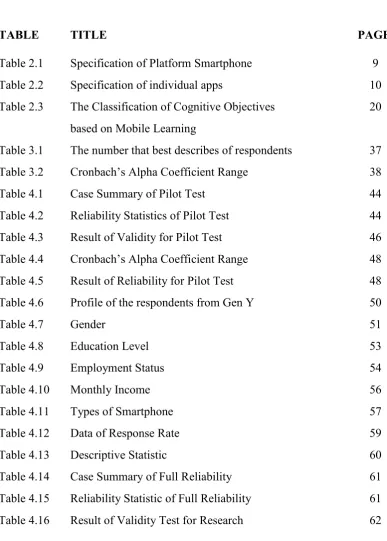
LIST OF TABLES
TABLE TITLE PAGES
Table 2.1 Specification of Platform Smartphone 9 Table 2.2 Specification of individual apps 10 Table 2.3 The Classification of Cognitive Objectives 20
based on Mobile Learning
Table 3.1 The number that best describes of respondents 37 Table 3.2 Cronbach’s Alpha Coefficient Range 38 Table 4.1 Case Summary of Pilot Test 44 Table 4.2 Reliability Statistics of Pilot Test 44 Table 4.3 Result of Validity for Pilot Test 46 Table 4.4 Cronbach’s Alpha Coefficient Range 48 Table 4.5 Result of Reliability for Pilot Test 48 Table 4.6 Profile of the respondents from Gen Y 50
Table 4.7 Gender 51
Table 4.8 Education Level 53
Table 4.9 Employment Status 54
Table 4.10 Monthly Income 56
[image:11.595.115.503.229.771.2]xi
TABLE TITLE PAGES
Table 4.17 Result of Reliability for Research 64 Table 4.18 Descriptive Analysis for the Benefit of Mobile Apps 65 Table 4.19 Descriptive Analysis for the Attraction of 66
Mobile Apps
Table 4.20 Descriptive Analysis for the Mobile Apps of 67 Education Tools
Table 4.21 Descriptive Analysis for the Free and Paid of 68 Mobile Apps
Table 4.22 Descriptive Analysis for the Factors of Mobile 66 Apps Utilisation
Table 4.23 Rules of Thumb for interpreting Correlation 70 Table 4.24 Correlation (DV is Y) 71 Table 4.25 Strength of Pearson Correlation Coefficient 72
Table 4.26 Model Summary 73
Table 4.27 Anovaa 74
Table 4.28 Coefficienta 75
xii
LIST OF FIGURES
FIGURE TITLE PAGES
Figure 2.1 The free apps based on iPhone apps store 22 Figure 2.2 The paid apps based on iPhone apps store 23 Figure 2.3 Theoretical Framework 24
Figure 4.1 Gender 52
Figure 4.2 Education Level 53
Figure 4.3 Employment Status 55
Figure 4.4 Monthly Income 56
xiii
LIST OF SYMBOLS
Symbol Meaning
± = Plus minus sign
% = Percentage
Β = Beta
H0/H1 = Hypothesis
N = Number of Sample
t = t-test
f = Frequency
xiv
LIST OF APPENDICES
NO TITLE PAGES
A.1 Rating Scale of Likert Scale 98
A.2 Questionnaire (By Paper) 102
A.3 Google Form (Questionnaires) 108
A.4 Data from SPSS 109
A.5 Gantt Chart PSM I 113
1
CHAPTER 1
INTRODUCTION
1.1 Background of Study
This research focuses the factors influencing the mobile application utilisation among Generation Y or Gen Y in scope of research. The purpose of this research just focuses on elements which divided into few parts independent variables which are benefits, attraction, mobile apps of education tools also with free and paid in mobile application utilisation among generation youth. This chapter covers the background, objectives, research question, scope and significant of this research.
2
Furthermore, the technology of smart phone more advance because all the need of customer wants and needs are already had based on application or apps their provided. Talking about smart phone, more to mobile phone built on a mobile operating system, with more advanced computing capability and connectivity than a usual mobile phone. The combination of the functions of a personal digital assistant (PDA) with a mobile phone make the first smart phone is in existence. After that, the smart phones have been added the functionality of portable media players, low-end compact digital cameras, pocket video cameras, Google search, Colour Note to keep some information, Office Suite, and GPS navigation units to form one multi-use device. All the mode smart phones also include high resolution touch screens and web browsers that display standard web pages as well as mobile optimized sites. The quick development of mobile application utilisation randomly with so many apps have been drivers of smart phone adoption.
3
phone networks other than voice services, including short message, games, entertainments, web surfing, software applications and functions for achieving specific purposes (Kuo, et al, 2009).
The effect and benefit of utilisation of smart phone among generation y give a big impact in their daily life on how they used that mobile application. The challenge for designers and research studying new mobile applications are that robust scientific methods exist for evaluates applications ‘perceived QoE in the user’s name and environments (Selim Ickin, et al, 2012). This shown everything has a pro and contrast between user and mobile application. Comprehensive and in depth study will be describes in the literature review.
1.2Problem Statement
4
1.3Research Question
This research explored the following key questions:
1.3.1 What is the attraction allocated on mobile apps among Gen Y? 1.3.2 What the factors of mobile apps utilisation among Gen Y? 1.3.3 What the benefit of mobile among Gen Y?
1.4 Research Objectives
This research has three objectives to be achieved, namely:
5
1.5Scope, Limitation and Key of the Study
1.5.1 Scope
The scope of this research is to identify the element of mobile application know as apps benefit, attraction from that apps, capability and mobile apps of education tools that may learn from that mobile application and the different between free apps and payable apps in medium of smart phones also to examine a little different between play store and apps store in android and iOS system. The research more to investigate the factors that affect from mobile application to generation y in the daily life and some of relationship between usable that mobile application as social platform or field in the job. This research just more focus to generation y handle and utilisation that variable of apps and function that mobile application among them and to measure the level of satisfaction among Gen Y in scope of research
1.5.2 Limitation
6
1.5.3 Key Assumptions
This research describes the factors that affect the mobile application utilisation among Gen Y in scope of research and also identify the relationship between the benefit mobile application, the important of that apps among generation y nowadays and the new knowledge that generation y will learn and get from that mobile apps in the daily life especially Gen Y. Last but not least, this research more to explore and evaluate the element of every mobile application benefit, usable, knowledge, capability and important among generation y and which will be the most significant that contributes to the mobile application utilisation among Gen Y.
1.6Importance of the Study
7
1.7Summary
8
CHAPTER 2
LITERATURE REVIEW
2.1 Introduction
This chapter discussed about the overview of mobile application know as apps utilisation and among Gen Y in scope of research. The mobile application in smart phone apps based on benefits, attraction, mobile apps of education tools will learn and the different from free apps and paid apps also being discussed in this chapter which each of the variable are explained on how it will affect the mobile application utilisation among Gen Y. Lastly, theoretical framework of the research had been drafted in this chapter.
2.2 Mobile Application
9
(UPDATED) palmtops and mobile phone, as well as tablets and smart phones, which are being more and more frequently. All these devices come with an operating system and several basic preinstalled applications (Piotr Nieradka, 2016).
Mostly, mobile applications are developed directly for a wide variety of platforms and by best programming languages. The best programming language does not exist, because of language has its application, advantages, disadvantages and vulnerabilities. Each program is within a certain range served, while in other less accessible. But depending on the application operating environment in which it will operate, there are several preferred programming languages (Raento, 2005) and the same way of mobile platform market, once a strong relationship between a platform and developers is established, a platform provider can also attract more customers, device vendors, and mobile carries-a “virtuous circle” can be created in its ecosystem (Basole and Karla, 2011).
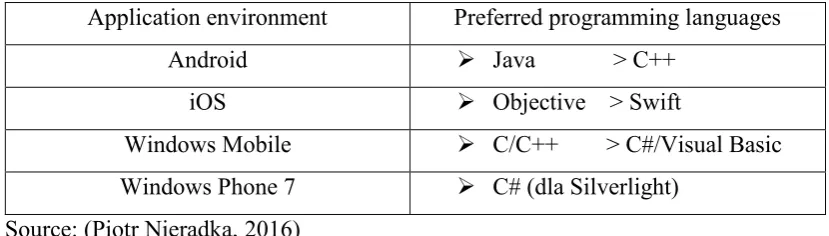
[image:24.595.111.526.504.622.2]The short summary is presented in Table 2.1 is given specification of platforms and preferred programming languishes.
Table 2.1: Specification of platform smartphone
Application environment Preferred programming languages Android Java > C++
iOS Objective > Swift
Windows Mobile C/C++ > C#/Visual Basic Windows Phone 7 C# (dla Silverlight)
Source: (Piotr Nieradka, 2016)