
An occupational perspective of wellbeing: a case study of homelessness in Townsville
28
0
0
Full text
(2) Appendix D - Participation in Occupation: Using Meta-synthesis. Participation in occupation: Using meta-synthesis to reframe evidence regarding the value of occupation with homeless persons (16 words) Abstract Background: The importance of engaging homeless people into community through participation and social inclusion is currently being recognized by the Australian government’s policy on homelessness. Occupational therapists have specific knowledge and skills to work toward social participation through occupation. The purpose of this article is to review the qualitative occupational therapy evidence of the value of occupation to people experiencing homelessness. Method: A systematic search and critical appraisal process of the evidence related to occupational therapy and homelessness identified eight qualitative research studies in occupational therapy journals that formed the basis of this review. Using the process of meta-synthesis the findings of these qualitative papers were analysed and integrated to reframe and develop theoretical knowledge of how occupation assists homeless people to participate in community life. Results: The article describes the results of a meta-synthesis of the qualitative evidence around this topic. Four themes emerged that show the benefits of occupational engagement for people experiencing homelessness; 1) occupational routines and choices; 2) meaningful occupations link past, present and future; 3) Constructing identity and making connections; 4) being occupations allow time out. Conclusions and Significance: Literature shows that engagement in meaningful occupation can provide a mechanism for survival and coping with homelessness, through enhancing individual control, sense of coherence, mastery and resilience. Re-engaging marginalised people into communities through meaningful occupation enhances opportunities for homeless people to improve their well-being and rebuild their lives. Keywords: Abstract: 232 words Main Body: 5095 words 2 Figures 2 tables References: 52. 320.
(3) Appendix D - Participation in Occupation: Using Meta-synthesis. Introduction In Australia one person in every 200 is without safe, secure and permanent housing on any night of the year (Homelessness Australia, n.d.). Disasters such as fires, flood and cyclones, which have occurred across the country in recent years place more people, who were previously housed, at risk of homelessness. The Australian Government has responded to concerns regarding homelessness with the development of a national approach to end homelessness (Homelessness Taskforce, 2008). The aim of the response is to prevent and reduce homeless by moving people into long-term housing and ‘reconnecting them with education, employment and community’ (Homelessness Taskforce, 2008, p ix). The strategies outlined clearly identify the importance of social inclusion and the need for encouraging social participation for people who have experienced longer periods of homelessness.. Occupational therapists have specific expertise and skills to work with people who ‘are restricted in their participation or are socially excluded’ and aim to ‘enable people to participate in the activities of everyday life’ (World Federation of Occupational Therapists Website, 2010). The application of occupational therapy to people experiencing homelessness is expanding internationally, as the profession broadens its role with increasingly diverse populations. Opportunities to develop occupational therapy roles in this field exist, although there is an urgent need to establish an evidence base for future practice. A review of the quantitative occupational therapy literature was undertaken to discover the evidence of the effectiveness of occupational therapy interventions with homeless individuals (Thomas, Gray & McGinty, 2011). The previously published systematic review of quantitative research between 1990 and 2008 demonstrated a lack of high quality evidence on the effectiveness of occupational therapy with homeless people. The findings identify the importance of life skills training and productive occupations to people experiencing homelessness (Thomas, et al., 2011). In contrast the current paper provides a review of qualitative evidence related to occupational therapy and homelessness.. Occupational therapy interventions are frequently and appropriately investigated through qualitative research methods. The rationale for qualitative approaches in occupational therapy research include: the complexity of factors that contribute to occupational. 321.
(4) Appendix D - Participation in Occupation: Using Meta-synthesis. performance, the uniqueness of the individual’s narrative and environment and the importance of collaboration between the participant and the occupational researcher (Curtin & Fossey, 2007; Luborsky & Lysack, 2006; Whiteford, 2005). Qualitative research methods stem from a range of disciplines and include ethnography, phenomenology and narrative enquiry, amongst others, and generally aim to understand peoples’ constructions and meaning of their lives and experiences (Kielhofner & Fossey, 2006). Evidence from qualitative research in occupational therapy serves to answer important questions related to the lived experience of our clients in relation to their occupational performance and the efficacy of therapy interventions.. Meta-synthesis is the term used to describe a range of “…methods directed toward the systematic review and integration of findings from qualitative studies” (Sandelowski, 2006, p.10). As with the systematic review and meta-analysis of quantitative research findings, meta-synthesis is itself a research process which draws on the findings of previous researchers (Zimmer, 2006). In contrast to both the systematic review process and to traditional literature reviews, meta-synthesis is a qualitative interpretive process, rather than an aggregation of the previous studies (Jensen & Allen, 1996). Through the process of meta-synthesis research evidence from different sources can be compared, translated and analysed to develop new interpretations, reframe the evidence and develop theoretical understandings (Zimmer, 2006).. There have been a number of examples of published meta-syntheses in recent times. Previous meta-synthesis topics include; relationship in home health care (Lindahl, Lidén, & Lindblad, 2011), the experiences of homeless women (Finfgeld-Connett, 2010), doctoral student attrition and persistence (Bair & Haworth, 2005), postpartum depression (Beck, 2002), experiences of being a teenage mother in the UK (McDermott, Graham & Hamilton, 2004), diabetes and diabetes care (Campbell et al.,, 2003) and motherhood in HIV positive women (Sandelowski & Barroso, 2003). To date, there have been few publications of meta-synthesis conducted by occupational therapists. Three recent exceptions are; Fossey and Harvey’s (2010) review of mental health consumers views on finding employment, Classen, Winter and Lopez’s, (2009) review of older driver safety and mobility and Hammell’s (2007) review of quality of life after spinal cord injury. The use of meta-synthesis as a method to advance evidence based practice and inform policy in. 322.
(5) Appendix D - Participation in Occupation: Using Meta-synthesis. occupational therapy has previously been supported (Gewurtz, Stergiou-Kita, Shaw, Kirsh & Rappolt, 2008).. The purpose of this current paper is to review the qualitative occupational therapy evidence though a meta-synthesis process, to develop new interpretations, reframe and expand knowledge on the use of occupation with people experiencing homelessness. This review aims to identify the value of engagement in occupation and occupational therapy to people experiencing homelessness through the synthesis of findings of previously published qualitative research.. Methodology There are four stages to this review: a search strategy to identify appropriate studies; selection of the evidence through the application of an inclusion/exclusion criteria; quality appraisal using common criteria; and the synthesis of study findings (McDermott et al., 2004). A search of electronic data bases CINAHL, OTDBASE, PsycINFO, MEDLINE, and FirstSearch was conducted from 1990 to 2008 using the search terms occupational therapy and homelessness and their synonyms. Additional data was obtained through reading reference lists and hand searching recent journals. Searching continued until no new articles were identified.. We set the following inclusion for all the articles: (1) Described a research project with a clearly recognizable research methodology and that supported the results and conclusions of the study; (2) Included participants who were either currently or recently homeless; and (3) Evaluated an occupational therapy program implemented for homeless people or the occupations or identified occupational needs of homeless people.. Articles were excluded from the review if the content (1) described services without providing an evaluation of their effectiveness, (2) only included expert opinion or narrative reviews, and (3) was based on the perspectives of occupational therapists rather than homeless people.. A total of eight qualitative studies not included in the previous systematic review (Thomas et al., 2011) were appraised using the McMasters University Guidelines and Appraisal. 323.
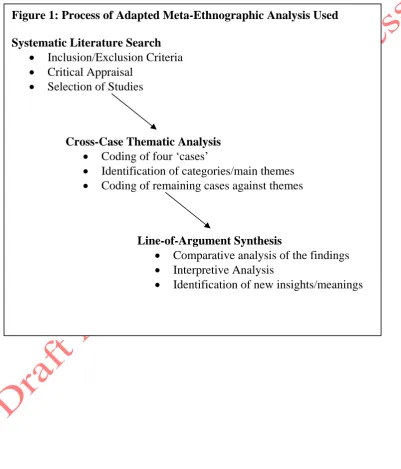
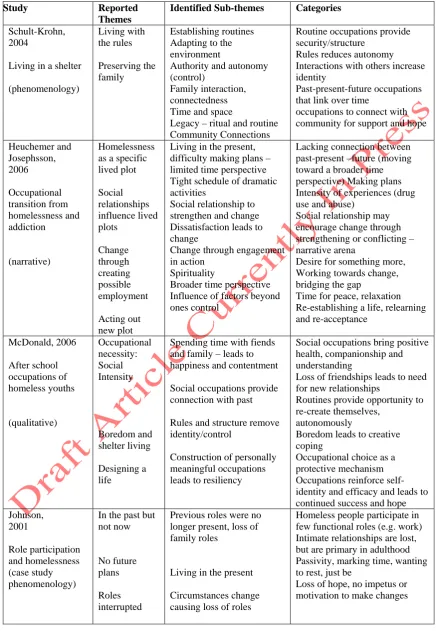
(6) Appendix D - Participation in Occupation: Using Meta-synthesis. Forms for Critical Review for Qualitative Research (Law et al.., 1998) by the first author. Three articles were appraised independently by the second and third author (Gray and McGinty) to ensure consensus was achieved on the scoring process. The processes of searching, selection and appraising the quality of the articles used in this study have previously been described in full (Thomas et al., 2011).. Several authors have previously described processes used to conduct a meta-synthesis, however there is no prescribed analysis process to date. The chosen method for this metasynthesis was based on the adapted meta-ethnographic process outlined by McDermott et al., (2004). The importance of clarifying the analysis process is imperative, in order to ensure credibility of the meta-synthesis and the interpretations and implications of the study, through openness and transparency (Sandelowski, 2006; Walsh & Downe, 2005). The process of analysis undertaken is represented in Figure 1.. [Place Figure 1 about here]. Firstly cross-case thematic analysis (Miles & Huberman, 1994; Mays, Pope & Popay, 2005) was undertaken to avoid premature aggregation and maintain individuality of each study. The four highest quality articles were identified through the appraisal score, and each was considered as a single ‘case’, with specific contexts and multiple findings. These articles were read repeatedly to ensure that the specifics of each case were thoroughly understood. Notes were made regarding general categories under which the main findings could be grouped or coded. Comparison of categories between the four cases allowed for the identification of similarities and differences and interpretation of the meanings of concepts within each individual case context and across the four studies. Categories were grouped together in order to identify main themes. Using these themes, the findings of the remaining four lower scoring studies were coded. Additional notes were made of any other findings that were not accounted for in the original themes.. [Insert Table 1 here]. 324.
(7) Appendix D - Participation in Occupation: Using Meta-synthesis. The second stage of the synthesis was based on the development of interpretations that allowed for ‘line-of-argument’ synthesis (Noblitt & Hare, 1988; Mays et al., 2005). Consideration of each theme and its interpretations allows for a further level of synthesis that draws together the findings of the review. The development of line of argument synthesis involves comparative analysis of the themes or findings and interpretations of the meaning of these findings to allow overarching themes to be drawn out. This process assists in theory development by reframing themes to better understand how engagement in occupation promotes social participation for people experiencing homelessness.. Results Search and critical appraisal results The determination of adequate quality using a critical review tool (Law et al., 1998) resulted in the eight selected studies being included in this meta-synthesis. The results of the critical appraisal are shown in Table 1. The qualitative studies included; •. 6 exploratory/phenomenological studies (Schultz-Krohn, 2004; Heuchemer & Josephsson, 2005; Van Leit, Starrett & Crowe, 2006; MacDonald, 2006; Svenson Miller, Bunch-Harrison, Brumbaugh, Kutty & Fitzgerald, 2005; Aviles & Helfrich, 2004);. •. 1 qualitative study using case studies (Johnson, 2001);. •. 1 mixed method descriptive survey (Tryssenaar, Jones & Lee, 1999).. [Insert Table 2 about here]. The critical appraisal of the qualitative studies included in this review, demonstrates adequate quality of evidence used for this meta-synthesis. The appraisal process determined the quality of the eight studies as moderate, scoring from 15 -22, out of a possible 27 scores. In relation to the criteria many authors failed to clearly outline data collection and procedural rigour criteria including a description of the participants, site and the researcher and procedures used for data gathering. Some studies failed to adequately outline the sampling methods and one study did not adequately describe the study design. Only one study adequately addressed the issues of trustworthiness and achieved the highest score in the appraisal process (Schultz-Kron, 2004).. 325.
(8) Appendix D - Participation in Occupation: Using Meta-synthesis. Cross Case Thematic Analysis Results Four main themes were synthesised from the findings of the review: 1) occupational routines and choices; 2) meaningful occupations link past, present and future; 3) constructing identity and making connections; 4) ‘being’ occupations allow time out. Examples of quotes from the studies that relate to each theme are given and discussed below.. Occupational Routines and Choices. “we’ve established a routine here, and that’s something that gets him [her partner] out there and gets me out there” (parent 9 in: Schulz-Krohn, 2004, p. 536). “…just to go to the NA [Narcotics Annonymous] meetings doesn’t do anything. You have to work on your change. You have to practice, practice and practice” (Eva: Heuchemer & Josephsson, 2006, p. 166). Quotes from the articles reviewed, demonstrate that while people experiencing homelessness have limited occupational choice, the establishment of simple routines provide opportunities to regain a sense of control and purpose. Moreover, positive experiences of meaningful occupations lead to a desire to increase occupational opportunities.. “Church is very important to me, I wish I could be more involved” (Unnamed in: Tryssenaar et al., 1999, p. 191). Swenson-Miller et al. (2005) reported that six of the seven participants in a work-readiness program including computer skills training intended to continue to access computers at the library at the end of the course.. The occupational routines of homeless people are often dictated by external factors, such as shelter rules and the availability of other services. In contrast to most of the population,. 326.
(9) Appendix D - Participation in Occupation: Using Meta-synthesis. what homeless people do, and when they do it, is frequently out of their control and may lead to a sense of helplessness and resignation.. “I have no where to go so I’d rather put up with this stuff, ya know… it’s gonna be rules wherever you go…” (Aviles and Helfrich, 2004, p. 336). For some, living in a shelter discourages independence or normal routine domestic occupations and does little to optimise occupational performance in any area (Tryssenaar et al.., 1999; Van Liet et al.., 2006).. Conversely the shelter routines offer predictability and therefore safety and consistency for some;. “I’m grateful I’m here, I’m not sleeping in a lane or on the street, or matter of fact in a jail, there’s worse things for sure. This is heaven compared to being on a river bed” (Unnamed: Tryssenaar et al., 1999, p. 191). The synthesis shows that the establishment of occupational routines, when these routines are consistent with the goals of the individual provides a tangible foundation for homeless people to rebuild a sense of purpose through ‘doing’. Being able to make choices about occupational routines is consistent with regaining control and personal autonomy.. Meaningful Occupations Link Past, Present and Future “I guess I am just repeating what my parents did with me you know. I had a good relationship with my parents. We had a very large family and we did a lot of family closure… blocking out the rest of the world and it was all about us. We did that and that’s what I try to do with them as well. That’s important…” (parent 5: Schultz-Kronh, 2004, p. 538). “Traditional Native customs and spirituality are important to me and passing them on to the kids” (unnamed: Trysenaar et al., 1999, p. 191). 327.
(10) Appendix D - Participation in Occupation: Using Meta-synthesis. Knowledge and skills from previous occupations are drawn on to adapt to new situations and provide the impetus for initiating new occupations. People experiencing homelessness engage in occupations that they recognise are helpful, either for themselves or for others that they care for. Parents pass on a family legacy by maintaining occupations from the past, in order for these to be carried on in the future (Shultz-Kron, 2004).. In contrast, for some, an inability to pursue plans or reflect on the past resulted in living for the present, with little consideration for the future. In the case for one participant, who was dealing with drug addiction, the same occupations were repeated on a daily basis with little expectation that this would change;. “…chasing money, chasing drugs, getting high, and trying to find a place to sleep”. (Sara: Heuchemer, 2006, p. 164).. Later in this paper, Heuchemer & Josephsson (2006) describes Sara’s transition from homelessness. Sara developed future plans to become a drug addiction therapist as a way to give a sense of meaning to her previous life and homelessness. In this way occupations can provide a sense of consistency with the past and hope for the future.. Constructing Identity and Making Connections “Volunteering at the shelter helps me feel I am contributing” (unnamed participant, Tryssenaar et al., 1999, p. 191). “…[computers] lifted my self-esteem, gave me a positive outlook. Now I can do a number of things on computers… [computers] raised my expectations of myself” (Participant 3, Swenson-Miller et al., 2005, p. 195). This theme reiterates the previously recognised dimensions of occupation as doing, being, becoming and belonging (Wilcock, 2006; Hammell, 2004). The research demonstrates that engaging in meaningful occupations provides opportunities to construct new identities and build relationships. Engaging in productive occupations that require the use of new skills promotes self-esteem and a sense of mastery that influences the individuals’ self-belief. 328.
(11) Appendix D - Participation in Occupation: Using Meta-synthesis. and ability to orchestrate their own life. A sense of personal identity and knowledge of personal strengths can be used to cope with problems. For instance participants in studies state “My own sense of determination is my biggest asset” and “I’m a patient man I can live day by day” (Tryssenaar et al.., 1999, p. 191) and “I am my own boy” (McDonald 2006, p.123).. Homeless people have few opportunities to engage in occupations that promote valued social interaction, and this leads to feeling of extreme isolation, particularly evident for women who have left social supports in order to escape domestic violence. Women in this situation feel entirely alone, without supports from other adults and the estrangement results in a sense of worthlessness or not mattering (VanLiet et al., 2006; Tryssenaar et al., 1999). Engagement in social occupations provides much needed opportunities to meet new people and develop new relationships, which in turn generates a feeling of belonging. There is considerable evidence to suggest that group involvement and relationships with rehabilitation professionals can provide compensatory social supports, to meet this need.. “It’s [the NA meeting] a new gang: I didn’t feel ashamed any more when I understood that I am not alone in this situation, there are people existing that have experienced exactly the same things” (Sara: Heuchemer & Josephsson, 2006, p. 165). “Because I feel like people here care about me, they don’t down me, and …I feel comfortable. I feel better about myself, because sometimes when I was depressed or down, I can go and talk to them (staff) about my problems and they make me happy about myself” (Angie: Aviles & Helfrich, 2004, p. 334). ‘Being Occupations’ Allow ‘Time Out’ The final theme emerging from this synthesis demonstrates the value of being occupations in providing people experiencing homelessness with ‘time out’.. “I need to relax and be at peace with myself, I have to increase my self-esteem” (Unnamed: Trysenaar et al.,1999, p. 191). 329.
(12) Appendix D - Participation in Occupation: Using Meta-synthesis. “Being able to have your peace, that’s wonderful. Sometimes I just take it easy and do nothing, and enjoy that” (Sara: Heuchemer & Josephsson, 2006, p. 166). Homeless people experience everyday life as a demanding and sometimes frightening experience, from which there is no escape. The importance of being able to relax when life is hectic is well recognised and commonly features in stress management programs. The frequency with which ‘being occupations’ were associated with positive feelings by study participants, suggests that for many, opportunities to relax and take ‘time out’ are rare. ‘Being occupations’ provide for recuperation and relief from the ongoing stress, which is in itself health promoting. The ‘unmet need for exercise, relax, read, sleep or just be alone’ allows homeless people to respond more effectively to the changes and stress in their lives (Van Liet et al., 2006:55).. “To me [personal health] means keeping yourself strong. You need to have like time to yourself … and someone to talk to because if you just keep things inside they’ll just stay there… like it effects your health and you’re really sad and angry.” (Mary: McDonald, 2006, p. 120). “… no matter how bad things are I know that when I go to church I don’t have to worry about it” (parent 2: Schultz-Krohn, 2004, p. 539). ‘Time out’ (and engaging in occupations that allow people to relax and enjoy the moment) is associated with maintenance of good health. Living with stress is detrimental to an individuals’ wellbeing but opportunities to ‘de-stress’ are rare for people experiencing homelessness. An inability to manage stress may be linked to high levels of mental illness and substance abuse in the homeless population. The relationship between stress, mental illness, substance abuse and homelessness are worthy of further exploration.. Line of Argument Analysis. 330.
(13) Appendix D - Participation in Occupation: Using Meta-synthesis. The purpose of this review was to reframe and develop theoretical knowledge using existing evidence on the value of occupation and occupational therapy to people experiencing homelessness, through a process of meta-synthesis (Thorne et al., 2004; Zimmer, 2006). Through line of argument synthesis of the thematic results it is clear that engagement in occupation provided individuals opportunities to rebuild lives. The overall finding of this meta-synthesis suggests that homelessness is experienced as a process over time, rather than an outcome. The process of homelessness is substantially greater than an accommodation crisis, resulting in the loss of a safe place to live. People who experience homelessness also experience abrupt changes to their occupations, their social networks and their ability to take control of their own lives. Over time this affects the individuals’ sense of identity, self esteem and meaning in life. It is clear that homelessness creates numerous stressors for the individual and the cumulative effects of these stressors impact on the individuals’ ability to plan for the future.. A common experience of people who are homeless is the sense of hopelessness and perceived inability to change their circumstances. In one study this feeling was explained by Tryssenaar et al. (1999) as a choice to be satisfied with the present circumstances. The synthesis contributes to the evidence that meaningful occupations are a source of identity and hope, for example: “staying in school is my way out of this life….” (unnamed woman, VanLiet et al., 2006, p. 53). Similarly employment is frequently associated with getting out of the homeless situation and rebuilding a life: “The main thing is a job. If I were employed, that would be my leeway right there, I do believe … it would give me enough money getting my own apartment, getting me most of my goals” (unnamed youth, Aviles & Helfrich, 2004, p. 335). The review demonstrates how positive experiences of socially valued and meaningful occupations provide the building blocks for moving out of homelessness.. Previous research involving people with disabilities has demonstrated the link between occupation and identity and hope (Iannelli & Wilding, 2007; Norweg, Bose, Snow, & Berkowitz, 2008; Reynolds, 2003; Stone, 2005). The current findings illustrates the power of participation in occupations as a medium through which individuals can move out of their homeless circumstances by regaining a sense of hope necessary to rebuild their lives. The value of establishing occupational routines and making choices to engage in occupations that are personally meaningful is linked in this current paper to a sense of. 331.
(14) Appendix D - Participation in Occupation: Using Meta-synthesis. control and autonomy; “I have built up a kind of life again. I have to continue doing that” (Sarah: Heuchemer & Josephsson, 2006, p. 165). People who have positive occupational experiences look for more opportunities to participate and this includes opportunities to be part of established groups within the community (Swenson-Miller et al., 2005; Tryssenaar et al., 1999).. One new finding of the meta-synthesis illustrates that participation in occupation provides a link between what has been in the persons past, what is now and what might be in the future (Heuchemer & Josephsson, 2006; Schultz-Kronh, 2004). This temporal aspect of occupation is a powerful agent which enhances a sense of meaning in life for people experiencing homelessness. Linking past, present and possible futures through occupations, provides people experiencing homelessness with a sense of coherence (Antonovsky, 1979). In this way occupation increases resilience to the inarguably stressful experience of homelessness, and acts as a resource with which to project into the future possible alternatives for living differently. Engagement in meaningful occupation can provide a mechanism for survival and coping with homelessness, through enhancing resilience (Christiansen, 2007; Wilcock, 2006).. [Insert Figure 2 here]. Discussion. With increasing numbers of homeless people especially youth and women with young children, the need for appropriate interventions aimed at protecting and reestablishing people experiencing homelessness in mainstream society is apparent. This meta-synthesis included studies of youths, families and single homeless adults, and suggests that occupations are valued consistently across the age range. However, the importance of designing interventions that are individually relevant and meaningful cannot be overemphasized. Such relevance is achieved through collaboration with the consumers of services and clinical reasoning. Occupational therapists working in this area should consider the value of ‘being’ occupations to provide opportunities for self-exploration and strengthening identity (Lyons, Orozovic, Davis & Newman, 2002; Stone, 2005). While an emphasis on productive roles and occupations increases the potential for independent. 332.
(15) Appendix D - Participation in Occupation: Using Meta-synthesis. living and financial security, providing opportunities to reflect on “… current circumstances within the broader context of their lives” (Lyons et al., 2002, p. 292) through ‘being’ occupations increases self knowledge and positive mental health (Wilcock, 2006).. The result of this meta-synthesis highlights the importance of occupation, not only as a means to survive through meeting basic human needs, but as a process and a product of daily life through which people sustain or promote wellbeing (Polgar & Landry, 2004). For people who are homeless occupational engagement is linked, in this meta-synthesis, to strategies for rebuilding lives and participation in society. The value of the occupations identified in the review is the degree to which participation in occupation strengthens or enhances the individual by regaining control, autonomy, a sense of coherence, identity, hope and resilience in order to rebuilding lives away from homelessness. An analysis of peoples occupational narratives has demonstrated two distinct patterns of occupations (Jonsson, 2008); those that have high significance to wellbeing includes engaging, relaxing and social activities while occupational patterns which have low significance to wellbeing include time killing basic and irregular occupations (Jonsson, 2008). Although this research was based on the narratives of retirees, there is relevance to the experience of people who are homeless and may have limited opportunities to participate in engaging occupations i.e. highly meaningful, intense, structured, shared and provide identity.. Similarity between the identified benefits of occupations in this paper and the ‘occupational needs’ outlined by Dobel and Santha (2008); accomplishment, affirmation; agency; coherence; companionship, pleasure and renewal is worthy of further discussion. Drawing on a range of literature regarding occupational participation these authors state that “individuals are more likely to experience occupational well-being when they choose and engage in occupations … that enable them to consistently meet their occupational needs” (Dobel & Santha, 2008, p. 186). The connection between occupational engagement and wellbeing is dependant on the extent to which the individual is able to orchestrate their occupational lives, those with few occupational opportunities will be limited in terms of achieving occupational well-being. In essence the evidence suggests that a least for some homeless people occupation provides a mechanism to experience wellbeing, however the experience of being homeless frequently results in limited opportunities for occupational engagement.. 333.
(16) Appendix D - Participation in Occupation: Using Meta-synthesis. The findings of this meta-synthesis provide theoretical development for the value of occupation and/or occupational therapy for homeless people (Thorne et al., 2004; Zimmer, 2006). The themes confirm the relevance of doing, being, becoming and belonging to people experiencing homelessness (Hammell, 2004; Wilcock, 2006). Engaging in occupational routines, in work and social occupations which are personally meaningful enables individuals to assert choices and control over their lives. However the structural and social marginalisation of people experiencing homelessness results in limited opportunities for occupational engagement. The review supports the need for occupational therapists to embrace the goals of social justice by addressing inequality and disadvantage experienced by homeless people (Pollard, Skellariou & Kronenberg, 2009; Thomas, Gray and McGinty, 2010). Providing opportunities for homeless people to engage in occupations such a work, education and self advocacy requires collaboration with both policy makers and clients.. The evidence supports the need for provision of occupation based programmes specifically designed to mediate against the marginalisation and alienation of homelessness and increase social and community participation (Petrenchik, 2006; Thomas, et al., 2010; Van Leit, et al., 2006). In comparison with the results of a previous systematic review of quantitative homelessness literature (Thomas, et al., 2011), which identifies the value of occupational interventions utilised, this synthesis of qualitative research demonstrates the way that occupational engagement is perceived to be beneficial by the individual consumer of occupational therapy services. Homelessness and inadequate housing is synonymous with the poorest social, economic circumstances associated with those who experience the greatest health disadvantage across all societies (Wilkinson & Marmot, 2003). There is a need for future research to determine the health promoting effects of occupation based interventions aimed towards people experiencing homelessness.. Limitations of the Study The study involved a meta-synthesis of qualitative research focusing on occupation and homelessness between 1990 and 2008. Despite an extensive search strategy for this review a limitation of this synthesis is the possibility of missed publications outside the. 334.
(17) Appendix D - Participation in Occupation: Using Meta-synthesis. occupational therapy literature. Further evidence of the value of occupation may exist from a range of disciplines that has not been included in this review. However, the usefulness of meta-synthesis to determine an evidence base for occupational therapy has been supported, although this method presents a number of challenges (Fossey & Harvey, 2010; Gewurzt et al., 2008). The diversity of multiple approaches or epistemologies utilised in qualitative research as well as the contextual nature of findings is a challenge when integrating findings (Sandelowski, 2006; Zimmer, 2006). However, this current review restricted the inclusion of studies to those emanating from the occupational therapy profession with a shared philosophy and understanding, in order to increase the homogeneity of the research in this meta-synthesis.. Methods of interpreting and integrating findings in the meta-synthesis process vary, the method used in this review was based on that used by McDermott et al. (2004). The clarity of the process and the previous experience of the authors in qualitative analysis influenced the decision to use this particular method. To date there have been multiple meta-synthesis processes used with no consensus regarding the most effective method. Therefore, the validity of the results of this meta-synthesis relates only to the method used and may not be replicated if an alternative approach were used. Regardless the process of synthesis as described here allows for new interpretations of the existing evidence through cross case analysis and comparison.. Conclusion This meta-synthesis of the qualitative occupational therapy evidence aims to develop new interpretations, reframe and expand knowledge on the use of occupation with people experiencing homelessness. The results of the study clearly confirm the necessity of providing occupational experiences to people who are homeless and would otherwise be deprived of opportunities for engagement (Thomas, et al., 2010; Van Liet et al., 2006). Moreover this review identifies the way that engagement in occupations assist individuals to rebuild their lives and mitigate against social deprivation and alienation experienced within the homeless population (Thomas, et al., 2010).. Few occupational therapists work directly with people who are homeless and those that do are primarily involved in either hostels or sheltered workshops. People who are homeless rarely come into contact with these services and consequently do not benefit from the. 335.
(18) Appendix D - Participation in Occupation: Using Meta-synthesis. limited service provision of the occupational therapy profession. Opportunities exist to expand the role of occupational therapists to include the provision of services for vulnerable people experiencing homelessness at all ages, particularly for children, youth, those with mental illness and to an increasing aging homeless population. Further research is needed to determine the range and effectiveness of occupation based interventions with people of all ages who experience homelessness.. The results of this review support the value of occupation in promoting wellbeing at a personal level, strengthening a sense of identity and sense of coherence, increasing social wellbeing through community participation, and engaging in productive activities that are socially valued. These elements are not seen to be mutually exclusive. Working with homeless people and those that have little or no access to health services requires occupational therapists to focus on promoting health through occupations (Wilcock, 2006). This meta-synthesis of the qualitative literature has shown that participation in occupation can effectively be used to re-engage marginalised people into communities and provide supports that enhance opportunities for homeless people to maintain and improve their well-being.. 336.
(19) Appendix D - Participation in Occupation: Using Meta-synthesis. Figure 1: Process of Adapted Meta-Ethnographic Analysis Used Systematic Literature Search • Inclusion/Exclusion Criteria • Critical Appraisal • Selection of Studies. Cross-Case Thematic Analysis • Coding of four ‘cases’ • Identification of categories/main themes • Coding of remaining cases against themes. Line-of-Argument Synthesis • Comparative analysis of the findings • Interpretive Analysis • Identification of new insights/meanings. 337.
(20) Appendix D - Participation in Occupation: Using Meta-synthesis. Establishing Routines. Control and Autonomy. Linking Past Present and Future. Sense of Coherence. Constructing Identity and Connections Time Out. Identity and Hope. Rebuilding Lives. Occupational Engagement. Figure 2: Rebuilding Lives: Occupational Engagement for People Experiencing Homelessness. Resilience. 338.
(21) Appendix D - Participation in Occupation: Using Meta-synthesis. Table 1: The Development of Categories from four studies for Cross-Case Analysis Study Schult-Krohn, 2004 Living in a shelter. Reported Themes Living with the rules Preserving the family. (phenomenology). Heuchemer and Josephsson, 2006. Homelessness as a specific lived plot. Occupational transition from homelessness and addiction. Social relationships influence lived plots. (narrative). McDonald, 2006 After school occupations of homeless youths. Change through creating possible employment Acting out new plot Occupational necessity: Social Intensity. Identified Sub-themes. Categories. Establishing routines Adapting to the environment Authority and autonomy (control) Family interaction, connectedness Time and space Legacy – ritual and routine Community Connections Living in the present, difficulty making plans – limited time perspective Tight schedule of dramatic activities Social relationship to strengthen and change Dissatisfaction leads to change Change through engagement in action Spirituality Broader time perspective Influence of factors beyond ones control. Routine occupations provide security/structure Rules reduces autonomy Interactions with others increase identity Past-present-future occupations that link over time occupations to connect with community for support and hope. Spending time with fiends and family – leads to happiness and contentment. Social occupations bring positive health, companionship and understanding Loss of friendships leads to need for new relationships Routines provide opportunity to re-create themselves, autonomously Boredom leads to creative coping Occupational choice as a protective mechanism Occupations reinforce selfidentity and efficacy and leads to continued success and hope Homeless people participate in few functional roles (e.g. work) Intimate relationships are lost, but are primary in adulthood Passivity, marking time, wanting to rest, just be Loss of hope, no impetus or motivation to make changes. Social occupations provide connection with past. (qualitative) Boredom and shelter living Designing a life. Rules and structure remove identity/control Construction of personally meaningful occupations leads to resiliency. Johnson, 2001. In the past but not now. Role participation and homelessness (case study phenomenology). No future plans. Living in the present. Roles interrupted. Circumstances change causing loss of roles. Previous roles were no longer present, loss of family roles. Lacking connection between past-present –future (moving toward a broader time perspective) Making plans Intensity of experiences (drug use and abuse) Social relationship may encourage change through strengthening or conflicting – narrative arena Desire for something more, Working towards change, bridging the gap Time for peace, relaxation Re-establishing a life, relearning and re-acceptance. 339.
(22) Appendix D - Participation in Occupation: Using Meta-synthesis. Evaluation Criteria. Aviles and Helfrich (2004). Heuchemer & Josephsson (2006). Johnson (2001). MacDonald (2006). Schultz-Kron (2004). Swenson Miller et al. (2005). Tryssenaar et al. (1999). Van Liet et al. (2006). Table 2: Critical Review of Qualitative Articles. Study Purpose (1) Literature (2) Study Design (3) Sampling (3) Data Collection (6) Data Analysis (5) Trustworthiness (5) Conclusions (2) Total (possible 27). 1 2 2 1 3 4 1 2 16. 1 2 3 2 3 5 2 2 20. 1 2 3 2 4 3 1 1 17. 1 2 3 1 3 4 3 2 19. 1 2 2 2 3 5 5 2 22. 1 2 2 0 2 4 2 2 15. 1 2 2 2 2 4 0 2 15. 1 1 1 2 4 3 1 2 15. 340.
(23) Appendix D - Participation in Occupation: Using Meta-synthesis. References Antonovsky, A. (1979). Health, stress and coping. San Francisco: Jossey-Bass.. Aviles, A. & Helfrich, C. (2004). Life skills service needs: Perspective of homeless youth. Journal of Youth and Adolescence, 32(4), 331-338.. Bair, C.R., & Haworth, J.G. (2005). Doctoral student attrition and persistence: A metasynthesis of research. In Smart, J.C. (Ed), Higher education: Handbook of theory and research, Volume 19, (pp. 481–534). Netherlands: Springer.. Beck, C. (2002). Postpartum depression: A meta-synthesis. Qualitative Health Research, 12, 453-472.. Campbell R., Pound, P., Pope, P., Britten, N., Pill, R., Morgan, M., Donovan, J. (2003). Evaluating meta-ethnography: A synthesis of qualitative research on lay experiences of diabetes and diabetes care. Social Science & Medicine, 56, 671–684.. Christiansen, C. (2007). Adolf Meyer revisited: Connections between lifestyles, resilience and illness. Journal of Occupational Science, 14(2), 63-76.. Classen, S., Winter, S., & Lopez, E. (2009). Meta-synthesis of qualitative studies on older driver safety and mobility. OTJR: Occupation, Participation and Health, 29(1), 2431.. Curtin, M. & Fossey, E. (2007). Appraising the trustworthiness of qualitative studies: Guidelines for occupational therapists. Australian Occupational Therapy Journal, 54(2), 88-94.. Dobel, S. & Santha, J. (2008) Occupational well-being: Rethinking occupational therapy outcomes. Canadian Journal of Occupational Therapy, 75(3), 184-190.. 341.
(24) Appendix D - Participation in Occupation: Using Meta-synthesis. Finfgeld-Connett, D. (2010). Becoming homeless, being homeless, and resolving homelessness among women. Issues in Mental Health Nursing, 31(7), 461-469. doi:10.3109/01612840903586404. Fossey E., & Harvey, C. (2010). Finding and sustaining employment: A qualitative metasynthesis of mental health consumer views. Canadian Journal of Occupational Therapy, 77, (5), 303-314. doi: 10.2182/cjot.2010.77.5.6. Gewurtz, R., Stergiou-Kita, M., Shaw, L., Kirsh, B., & Rappolt, S. (2008). Qualitative meta-synthesis: Reflections on the utility and challenges in occupational therapy. Canadian Journal of Occupational Therapy, 75(5), 301-308. _. Hammell, K. (2004). Dimensions of meaning in the occupations of daily life. Canadian Journal of Occupational Therapy, 71(5), 296-305.. Hammell, K. (2007). Quality of life after spinal cord injury: a meta-synthesis of qualitative findings. Spinal Cord, 45, 124-136.. Heuchemer, B. & Josephsson, S. (2005). Leaving homelessness and addiction: Narratives of an occupational transition. Scandinavian Journal of Occupational Therapy, 13, 160-169.. Homelessness Australia (n.d.). Homelessness in Australia. Retrieved from http://www.homelessnessaustralia.org.au/UserFiles/File/Homelessness%20in%20Au stralia%202010%20lr(1).pdf. Homelessness Taskforce. (2008). The Road Home: a national approach to reducing homelessness. Dept. of Families, Housing, Community Services and Indigenous Affairs, Canberra, A.C.T. retrieved from http://www.fahcsia.gov.au/housing/homelessness_white_paper/the_road_home.pdf. Iannelli, S. & Wilding, C. (2007). Health enhancing effects of engaging in productive occupations: Experiences of young people with mental illness. Australian Occupational Therapy Journal, 54, 285-293.. 342.
(25) Appendix D - Participation in Occupation: Using Meta-synthesis. Jensen, L. & Allen, M. (1996). Meta-synthesis of qualitative findings. Qualitative Health Research, 6, 553-560.. Johnson, J. (2001). Re-framing homelessness: An occupational adaptation perspective. (Unpublished Doctoral Thesis). Texas Womens’ University: USA.. Jonsson, H. (2008). A new direction in the conceptualization and categorization of occupation. Journal of occupational Sciences, 15(1), 3-8.. Kielhofner, G.& Fossey, E. (2006). The range of research. In Kielhofner, G. (Ed). Research in occupational therapy: Method of inquiry for enhancing practice. (pp 2035). Philadelphia: F.A. Davis.. Law, M., Stewart, D., Letts, L., Pollock, N., Bosch, J., Westmorland, M., & Philpot, A. (1998). Guidelines for critical review of the literature: Qualitative studies. Retrieved from McMasters University, Hamilton, ON.. Lindahl, B., Lidén, E. & Lindblad, B. M. (2011). A meta-synthesis describing the relationships between patients, informal caregivers and health professionals in homecare settings. Journal of Clinical Nursing, 20, 454–463. doi: 10.1111/j.13652702.2009.03008.x. Luborsky M. & Lysack, C. (2006). Overview of qualitative research. In Kielhofner, G. (Ed). Research in occupational therapy: Method of inquiry for enhancing practice. (pp 326-340). Philadelphia: F.A. Davis.. Lyons, M., Orozovic, N., Davis, J. & Newman, J. (2002). Doing-Being-Becoming: Occupational experiences of persons with life –threatening illnesses. American Journal of Occupational Therapy, 56(3), 285-294.. Mays, N., Pope, C., & Popay, J. (2005). Systematically reviewing qualitative and quantitative evidence to inform management and policy making in the health field. Journal of Health Services Research & Policy, 10(S1), 6-20.. 343.
(26) Appendix D - Participation in Occupation: Using Meta-synthesis. McDermott, E., Graham, H. & Hamilton, V. (2004). Experiences of Being a Teenage Mother in the UK: A Report of a Systematic Review of Qualitative Studies. Published by the Medical Research Council at: http://www.sphsu.mrc.ac.uk/Evidence/Research/Review10/SRExecutiveSummary.p df. McDonald, A. (2006). The after-school occupations of homeless youth: Three narrative accounts. Occupational Therapy in Health Care, 20(3/4), 115-133.. Miles, B.M. & Huberman, A.M. (1994). Qualitative Data Analysis: An Expanded Sourcebook, 2nd ed., Sage, Thousand Oaks, CA.. Noblitt, G. & Hare, D. (1988). Meta-Ethnography: Synthesising Qualitative Studies. London: Sage. Norweg, A., Bose, P., Snow, G., & Berkowitz, M.E, (2008). A pilot study of a pulmonary rehabilitation programme evaluated by four adults with chronic obstructive pulmonary disease. Occupational Therapy International, 15 (2), 114-32.. Petrenchik, T. (2006). Homelessness: Perspectives, misconceptions and considerations for occupational therapy. Occupational Therapy in Health Care, 20(3/4), 9-30.. Polgar, J. & Landry, J. (2004). Occupation as a means for individual and group participation in life. In Christiansen, C. and Townsend, E. (Eds). Introduction to occupation: The art and science of living. (pp. 198-220). New Jersey: Pearson. Pollard, N., Skellariou, D. & Kronenberg, F. (2009). Political competence in occupational therapy. In Pollard, N., Skellariou, D. and Kronenberg, F. (Eds). A political Practice of Occupational Therapy (pp. 21-38). Edinburgh: Elsevier. Reynolds, F. (2003). Reclaiming a positive identity in chronic illness through artistic occupation. OTJR: Occupation, Participation and Health, 23(3) 118-127.. 344.
(27) Appendix D - Participation in Occupation: Using Meta-synthesis. Sandelowski, M. (2006). Meta-Jeopardy: The crisis of representation in qualitative metasynthesis. Nursing Outlook, 54(1), 10-16.. Sandelowski, M. & Barroso, J. (2003). Toward a Metasynthesis of Qualitative Findings on Motherhood in HIV-Positive Women. Research in Nursing & Health, 26, 153– 170.. Schultz-Kron, W. (2004). The meaning of family routines in a homeless shelter. American Journal of Occupational Therapy, 58(5), 531-542. Stone, S. D. (2005). Being as doing: Occupational perspectives of women survivors of hemorrhagic stroke. Journal of Occupational Science, 12(1), 17-25.. Swenson-Miller, K., Bunch-Harrison, S., Brumbaugh, B.,. Kutty, R., & Fitzgerald, K. (2005). The meaning of computers to a group of men who are homeless. American Journal of Occupational Therapy, 59(1), 191-197.. Thomas, Y., Gray, M., & McGinty, S. (2011). A systematic review of occupational therapy interventions with homeless people. Occupational Therapy in Health Care, 25 (1), 38–53.. Thomas, Y., Gray, M., & McGinty, S. (2010). Homelessness and the right to occupation and inclusion: An Australian perspective. WFOT Bulletin, 62, 19-20.. Thorne, S., Jensen, L., Kearney, M., Noblit, G. & Sandelowski, M. (2004). Qualitative metasynthesis: Reflections on methodological orientation and ideological agenda. Qualitative Health Research, 14: 1342-1356. Tryssenaar, J., Jones, E., & Lee, D. (1999). Occupational performance needs of a shelter population. Canadian Journal of Occupational Therapy, 66(4), 188-196.. Van Leit, B., Starrett, R., & Crowe, T. (2006). Occupational concerns of women who are homeless and have children: An occupational justice critique. Occupational Therapy in Health Care, 20(3/4), 47-62.. 345.
(28) Appendix D - Participation in Occupation: Using Meta-synthesis. Walsh. D. & Downe, S. (2005). Meta-synthesis method for qualitative research: A literature review. Journal of Advanced Nursing, 50(2), 204-211.. Wilcock, A. (2006). An Occupational Perspective of Health. Thorofare: Slack.. Wilkinson R. & Marmot, M. (2003). The solid facts, (2nd ed). Copenhagen:World Health. Organization Regional Office for Europe.. Whiteford, G. (2005). Knowledge, power, evidence: A critical analysis of key issues in evidence based practice. In G. Whiteford & V. Wright-St. Clair (Eds). Occupation and practice in context (pp34-50). Sydney: Elsevier.. World Federation of Occupational Therapists, (2010). What is Occupational Therapy. Retrieved from http://www.wfot.org/information.asp. Zimmer, L. (2006). Qualitative meta-synthesis: A question of dialoguing with texts. Journal of Advanced Nursing, 53(3), 311-318.. 346.
(29)
Figure


Related documents