Soft Matter
www.softmatter.orgISSN 1744-683X
PAPER Y. T. Gu et al.
A particle based model to simulate microscale
morphological changes of plant tissues during
drying
H. C. P. Karunasena,abW. Senadeera,aR. J. Brownaand Y. T. Gu*a
Fundamental understanding on microscopic physical changes of plant materials is vital to optimize product quality and processing techniques, particularly in food engineering. Although grid-based numerical modelling can assist in this regard, it becomes quite challenging to overcome the inherited complexities of these biological materials especially when such materials undergo critical processing conditions such as drying, where the cellular structure undergoes extreme deformations. In this context, a meshfree particle based model was developed which is fundamentally capable of handling extreme deformations of plant tissues during drying. The model is built by coupling a particle based meshfree technique: Smoothed Particle Hydrodynamics (SPH) and a Discrete Element Method (DEM). Plant cells were initiated as hexagons and aggregated to form a tissue which also accounts for the characteristics of the middle lamella. In each cell, SPH was used to model cell protoplasm and DEM was used to model the cell wall. Drying was incorporated by varying the moisture content, the turgor pressure, and cell wall contraction effects. Compared to the state of the art grid-based microscale plant tissue drying models, the proposed model can be used to simulate tissues under excessive moisture content reductions incorporating cell wall wrinkling. Also, compared to the state of the art SPH–DEM tissue models, the proposed model better replicates real tissues and the cell–cell interactions used ensure efficient computations. Model predictions showed good agreement both qualitatively and quantitatively with experimentalfindings on dried plant tissues. The proposed modelling approach is fundamentallyflexible to study different cellular structures for their microscale morphological changes at dehydration.
1.
Introduction
Drying is one of the most popular and generally used food preservation techniques which is currently used on about 20% of the world's perishable crops.1Since plant food materials can
originally contain water even up to 90% by weight,2 moisture
removal is the key driving factor which causes food preservation during drying. As a result of such extensive moisture removal from the tissue structures of these food materials, they undergo excessive deformations which lead to signicant changes of numerous food properties.
Studying the fundamentals which govern such property changes largely benet the food industry in order to improve the product quality and the process performance. For this purpose, many areas are currently researched and particularly when it comes to material and process related characterization,
different experimental studies have identied strong relation-ships between bulk scale deformations and microscale defor-mations of food materials during drying.3–6 Further, such
deformations are found to be mainly driven by the moisture content of plant tissue,3–7the drying temperature8–10and the cell
turgor pressure.11To relate such governing parameters,
micro-scale empirical5,6 and theoretical models12 are frequently
involved. However, numerical modelling and simulation of these material deformations under drying conditions are still a considerable challenge for the research community and there-fore we identied this as a research gap to belled through a novel modelling approach.
In this context, several plant cell numerical models can be found that are mainly based on grid-based techniques such as Finite Element Methods (FEM) or Finite Difference Methods (FDM), which are primarily developed for basic cell micro-mechanical behaviour studies rather than drying.13–16Recently,
a FEM based microscale tissue drying model is reported which couples water transport phenomenon and cellular deforma-tions.17 In this particular model, there are several key
limita-tions such as the limited moisture content range that the model can simulate (only 30% of normalized moisture content reduction) and inability to represent the wrinkling effects that aSchool of Chemistry, Physics and Mechanical Engineering, Faculty of Science and
Engineering, Queensland University of Technology, 2-George Street, Brisbane, QLD 4001, Australia. E-mail: [email protected]; Fax: +61 7 31381469; Tel: +61 7 31381009
bDepartment of Mechanical and Manufacturing Engineering, Faculty of Engineering, University of Ruhuna, Hapugala, Galle, Sri Lanka. E-mail: [email protected]
Cite this:Soft Matter, 2014,10, 5249
Received 9th March 2014 Accepted 2nd April 2014
DOI: 10.1039/c4sm00526k
www.rsc.org/softmatter
PAPER
Open Access Article. Published on 04 April 2014. Downloaded on 21/07/2016 03:13:21.
This article is licensed under a
Creative Commons Attribution-NonCommercial 3.0 Unported Licence.
View Article Online
the actual cell walls undergo during drying. Further, it appears that their main focus is on the turgor loss based cellular deformations rather than the moisture content based defor-mations, where the latter one is actually more critical to industrial drying applications. Also the hybrid numerical simulation approach they have involved is fairly complicated to implement. In addition to such models on drying, there are several vertex cell models reported in literature which are specically developed to study division and reproduction of cells during tissue development.18,19Also, there are gel material
models used to simulate bulk level deformations of plant leaves during dehydration.20
However, considering the technical challenges and various limitations, these models have limited applicability in the scope of this research. Such fundamental shortcomings are: poor representation of multiphase phenomena existing in plant materials consisting of liquid, solid and gas phases, use of over-simplied continuum approximations for the tissue materials by neglecting the discrete nature of the cellular structure and its microscale mechanisms, inability to model the excessive cellular level deformations (cell wall wrinkling in particular) at excessive moisture content reductions, and limitedexibility to model the multiscale effects of plant material deformations during dying. These shortcomings need to be well addressed in order to get a clearer understanding on the underlying physics involved in real industrial drying processes. When considering these challenges of conventional grid-based modelling approaches, meshfree methods seem to be more applicable since they fundamentally do not use any interconnected grids as in case of FEM and FDM, which are entirely based on grids.21
When considering meshfree methods, Smoothed Particle Hydrodynamics (SPH) is a popular particle-based technique, which was originally developed for astrophysical applications.22
The technique discretises a given problem domain as a set of non-interconnected particles (without any mesh generation), where the particles own system properties which can evolve with time. SPH is also particularly adaptive such that the basic formulations can easily be combined with new physics and mechanics in order to solve different problems of interest.21
Using these capabilities, SPH has been successfully used for plant cell and tissue models recently by coupling with a Discrete Element Method (DEM) to simulate compression, tension, shear of fresh cells and tissues23,24and even cell breakage.25We
have further improved the modelling technique in a way it can be used to simulate dried plant cells.26–28In those models we
mainly focused on two-dimensional (2-D) single cells and in this work we present how a 2-D tissue structure can be developed with the use of such single cell models along with several improvements, in order to simulate morphological changes of tissues during drying. Also, we believe that, these proposed methods and ndings will contribute to the development of meshfree methods itself and their applications towards devel-oping novel modelling techniques particularly applicable to criticalelds such as food drying.
This paper begins with the modelling concepts and formu-lations used in a single cell model. Then, we discuss how the tissue model can be developed using such individual cells. Next,
the approach used to simulate tissue dryness states is pre-sented. Then the experimental ndings on dried tissues are compared with simulation results for validation of the model and several other simulations are provided along with a sensi-tivity analysis of several model parameters. Finally, we present key insights drawn from the study along with prospective future improvements.
2.
The particle based model
2.1 2-D representation of plant cells in a tissue
A plant tissue was approximated to an aggregate of cylindrical shaped cells as shown in Fig. 1(a), where the top surfaces were taken as a 2-D model representing each cell. To facilitate this approximation, axial deformations of each cell in theZ direc-tion were assumed to be uniform and theZdirectional velocity components and plane stresses of the top and bottom surfaces (in the XY plane) were neglected.24 Accordingly, as shown in
Fig. 1(b), each of the individual cells were modelled assuming two basic model components: celluid and cell wall, such that theuid hydrodynamic pressure is counter balanced by the cell wall tension as observed in real plant cells.7,14,16,29–32Following a
SPH–DEM based fresh cell modelling approach proposed by some researchers,24the celluid was treated as a low-Reynolds
number incompressible viscousuid and modelled with SPH. Further, the cell wall was modelled using a DEM considering the nature of the solid-dominatedbrous cell wall structure. A particle scheme was used to represent both the celluid and the cell wall, and governing equations were applied to these parti-cles. In addition to those basic concepts, we further improved both the cell wall model (see Fig. 2) and celluid model (see Fig. 3) in our previous works,26–28,33so that the single cell model
could be used to simulate dried conditions. The sections below summarise these schemes and concepts along with the new improvements done in this work.
2.2 DEM modelling of the cell wall
The cell wall was assumed to be a visco-elastic solid material and a neo-Hookean elastic model was used with a supplemen-tary viscous term.24Several additional features were introduced
by us to improve the model performance and to account for drying related physical changes.28,33As presented in Fig. 2, the
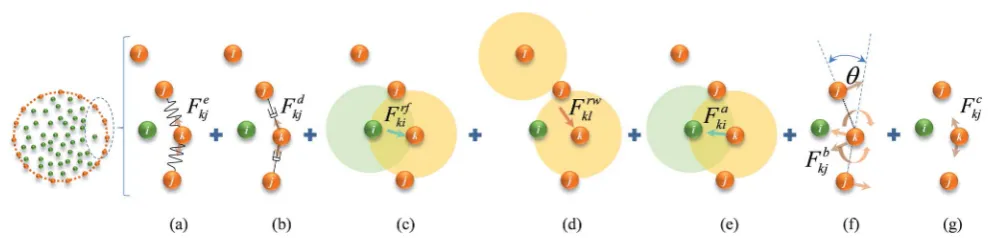
cell wall model accounts for seven types of force interactions: cell wall stiffforces (Fe), wall damping forces (Fd), wall–uid repulsion forces (Frf), non-bonded wall–wall repulsion forces (Frw), wall–uid attraction forces (Fa), forces due to bending stiffness of the cell wall (Fb) and forces to produce contractions of the cell wall during drying (Fc). Thereby, the total force (F
k) on any wall particlekis derived using these force interactions as:
Fk¼Fekj+Fdkj+Frfki+Frwkl +Faki+Fbkj+Fckj, (1)
where:iis any neighbouringuid particle,jis any bonded wall particle andlis any non-bonded wall particle. Here, the stiff force on any wall particlekdue to any bonded wall particlejis dened using a spring model24as:
Open Access Article. Published on 04 April 2014. Downloaded on 21/07/2016 03:13:21.
This article is licensed under a
Fe
kj¼GZ0T0 lq 1
a2lq5
!
; (2)
where,Gis the shear modulus (zE/3) withEbeing the Young's modulus of the wall material,Z0is the initial cell height,T0is the initial cell wall thickness,lq¼L/L0is the extension ratio of
any cell wall element at the current time step,Lis the width of the wall element at the current time step (distance between particlekandj) andL0is its initial un-deformed width. Further, the parameterais calculated withb¼0.5 for cylindrical cells as follows:24
a¼
ffiffiffiffiffiffiffiffiffiffiffiffiffiffiffiffiffiffiffiffiffiffiffiffiffiffiffiffiffiffiffiffiffiffiffiffiffiffiffiffiffiffiffiffiffiffiffiffiffiffiffiffi bþ ffiffiffiffiffiffiffiffiffiffiffiffiffiffiffiffiffiffiffiffiffiffiffiffiffiffiffiffiffiffiffiffiffiffiffiffib2
4ðb1Þlq6
q
2
v u u t
: (3)
In eqn (1), viscous forces acting on any wall particlekdue to the neighbouring wall particlesjare dened by using a linear dashpot model as:24
Fd
kj¼ gvkj, (4)
where,gis the cell wall damping constant andvkjis the velocity of particlekrelative to particlej. In eqn (1), theFrf,FrwandFa forces are used to dene the wall–uid interactions and the boundary conditions. To avoid anyuid particle penetrations through the wall, the Frf forces are used to create repulsive forces between the cell uid and wall particles which act through the centre of any interacting wall–uid particle pair of interest, in an equal and opposite manner. Therefore, the repulsion forcesFrfon any wall particlekfrom any otheruid particleiare dened as:21,24
Frf
ki¼frfkixki, (5)
where,frfkiis the magnitude of the repulsion force andxkiis the position vector of particle k relative to particle i. The frfki is dened based on a Lenard-Jones (LJ) force type as:24
Fig. 1 2-D representation of a plant tissue: (a) a plant tissue is approximated to an aggregate of individual cylindrical cells. (b) Top surface of each cylindrical cell is taken as a 2-D representation of the whole cell which consists of two basic components: cellfluid and cell wall. (c) The problem domain is discretized and represented as two sets of particles: SPH particles for the cellfluid and DEM particles for the cell wall. (d) Individual elements of the discretized cell wall.
Fig. 2 Force interactions used in the DEM-based cell wall model: (a) stiffforces. (b) Damping forces. (c) Wall–fluid repulsion forces. (d) Non-bonded wall–wall repulsion forces. (e) Wall–fluid attraction forces. (f) Wall bending stiffforces. (g) Wall contraction forces. (i:fluid particles;j,k&l: wall particles).
Fig. 3 Force interactions used in the SPH-based cellfluid model: (a) pressure forces. (b) Viscous forces. (c) Wall–fluid repulsion forces. (d) Wall– fluid attraction forces (i & i0:fluid particles;j&k: wall particles).
Open Access Article. Published on 04 April 2014. Downloaded on 21/07/2016 03:13:21.
This article is licensed under a
[image:4.595.50.546.196.315.2]frf ki ¼ 8 > > > > < > > > > : frf 0 r0 rki 8 r0 rki 4 " # 1
rki2
r
0 rki $1
0 rr0
ki \1
; (6)
where,r0is the initial gap between the two particles,rkiis the current gap between them and frf
0 is the strength of the LJ contact. Further, in eqn (1), self-penetration of the non-bonded wall–wall particles are prevented using a similar repulsion force:Fklrwwith a LJ contact strength off0rw. In order to limit cell wall–uid detachments during drying, wall–uid attraction forceFkiawas introduced by us,28which was also dened using the above LJ interactions with a contact strength off0a.
Next, in order to account for the resistance that a plant cell wall creates when it experiences local bending and wrinkling, bending stiffforcesFbkjwere used and are dened on any wall particlekwithin thekandjparticle pair as:28,34–36
Fb kj¼ kb Ltan Dq 2 ; (7)
where,kbis the cell wall bending stiffness,Lis the width of any given wall element at any given time step,qis the external angle between the particular wall element and the adjacent wall element as shown in Fig. 2 andDqis the change of theqangle during time evolution.
Next, as given in eqn (1), to incorporate experimentally observed cell perimeter reductions,6,7,37,38cell wall contraction
forces (Fc) were used in the model and are dened as:33
Fc
kj¼kwc
LL0
0
1ab
1XX
0
; (8)
where,kwcis the force coefficient of wall contractions,Lis the current width of any particular wall element (see Fig. 1(d)),L00is the width of the wall element at fully turgid condition,aandb are empirical factors, and X/X0 is the normalized moisture content of the dried cell to be simulated. Theaandbfactors were set to 0.2 and 0.9 by considering the normalized cell perimeter trends of our experiments37(Fig. 13(c) in Section 3),
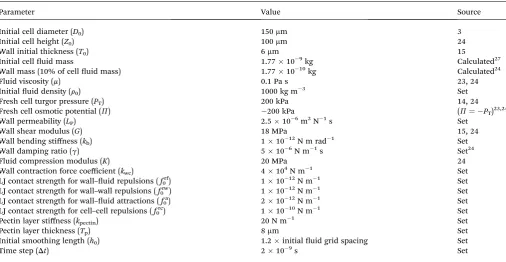
where the overall normalized perimeter reduction is about 0.2 when the overall normalized moisture content reduction is about 0.9. Then the appropriate value forkwcwas determined aer a series of trial simulations in order to replicate the normalized perimeter observed from our experiments (see Table 1). Furthermore, we hypothesized that the cell wall itself will also undergo moisture reductions during drying and we simply considered such reductions to be proportional to the uid mass reduction of the cell (see Section 2.5 for details). For fresh cells, the initial cell wall mass was taken as 10% of the uid mass (see Table 1), which was calculated using the cell volume anduid density.24,28
2.3 SPH modelling of the celluid
Cell uid was modelled using SPH by treating it as a high viscosity incompressible Newtonian uid with low Reynolds number ow characteristics.23,24,39Additionally, the cell uid–
wall attraction forces were used to ensure the celluid is well attached to the cell wall when simulating dried cells.27As shown
[image:5.595.44.551.472.734.2]in Fig. 3, the cell uid model involves four types of force interactions:uid pressure forces (Fp),uid viscous forces (Fv), wall–uid repulsion forces (Frw) and wall–uid attraction forces (Fa). The resultant of these forces: Fion anyuid particleiis dened as:
Table 1 Key physical parameters used for the model
Parameter Value Source
Initial cell diameter (D0) 150mm 3
Initial cell height (Z0) 100mm 24
Wall initial thickness (T0) 6mm 15
Initial celluid mass 1.77109kg Calculated27
Wall mass (10% of celluid mass) 1.771010kg Calculated24
Fluid viscosity (m) 0.1 Pa s 23, 24
Initialuid density (r0) 1000 kg m3 Set
Fresh cell turgor pressure (PT) 200 kPa 14, 24
Fresh cell osmotic potential (P) 200 kPa (P¼ PT)23,24
Wall permeability (LP) 2.5106m2N1s Set
Wall shear modulus (G) 18 MPa 15, 24
Wall bending stiffness (kb) 11012N m rad1 Set
Wall damping ratio (g) 5106N m1s Set24
Fluid compression modulus (K) 20 MPa 24
Wall contraction force coefficient (kwc) 4104N m1 Set
LJ contact strength for wall–uid repulsions (f0rf) 11012N m1 Set
LJ contact strength for wall–wall repulsions (f0rw) 11012N m1 Set
LJ contact strength for wall–uid attractions (f0a) 21012N m1 Set
LJ contact strength for cell–cell repulsions (frc
0) 11010N m1 Set
Pectin layer stiffness (kpectin) 20 N m1 Set
Pectin layer thickness (Tp) 8mm Set
Initial smoothing length (h0) 1.2initialuid grid spacing Set
Time step (Dt) 2109s Set
Open Access Article. Published on 04 April 2014. Downloaded on 21/07/2016 03:13:21.
This article is licensed under a
Fi¼Fpii0+Fvii0+Frwik +Faik. (9)
Here, the momentum equation of the standard Lagrangian type SPH formulation that is used to model weakly compressible low Reynold's numberuidows24,40was used to dene the
pres-sure forces (Fp) and viscous forces (Fv). Accordingly, for any givenuid particlei,FpandFvare dened using the properties of the neighbouringuid particlesi0as:
Fp
ii0¼ mi X
i0 mi0
Pi ri2þ
Pi0 ri02
1
Z
ViWii0; (10)
Fv
ii0¼ mi X
i0
mi0ðmiþ mi0Þvii0 riri0
1 Z
1
rii0 vWii0
vrii0
; (11)
where at any given time,m,P,r,m,ZandWare the particle mass, pressure, density, dynamic viscosity, cell height and the smoothing kernel. For the smoothing kernel W, the quartic smoothing kernel was used which is calculated for any given uid particleias:21
Wij¼ 15
7ph2
8 > < > : 2 3 9 8S
2þ19
24S
3 5
32S
4
0#S#2
0 S.2
; (12)
where,his the smoothing length at the current time step,Sis the ratio ofrii0/handrii0 is the gap between particleiand any surroundinguid particlei0within the inuence domain of the particle i (0 # S # 2). In order to improve computational accuracy, thehshould be such that approximately 20 particles are maintained within the inuence domain of any uid particle i of this 2-D model.28 Considering the cellular
shrinkage, to maintain the above condition on particle number, the smoothing length h was dynamically adopted using a geometrical relationship as:28
h¼
D D0
h0; (13)
where,Dis the average cell ferret diameter at the current time step, D0 is the initial cell diameter and h0 is the initial smoothing length (see Table 1). During the time evolution of the model,uid particle pressure was evolved using a standard SPH state equation:21,24
Pi¼PTþK
"r i r0 7 1 # ; (14)
where, PT is the initial cell turgor pressure, K is the uid compression modulus that ensures theuid behaves in a fairly incompressible manner,24r
iis the current density of eachuid particle, andr0is its initial density assumed to be equal to the density of water. Next, the density of anyuid particlei was evolved as:24
dri
dt ¼
1
Z
dr*
i dt r* i Z2 dZ
dt þ
ri mi
dmi
dt : (15)
Therst term in eqn (15) accounts for slight density changes of the celluid as the cell deforms inXYplane andr*iis the 2-D
density ofuid particleidened asr*i¼Zri. Ther*iuctuations are dened using the standard SPH continuity equation as:
dr*
i
dt ¼mi
X
i0
vii0ViWii0: (16)
The second term in eqn (15) ensures the density evolution compensates for any cell volume changes due to cell height variations and is dened as24:
dZ
dt ¼
ZtþDt Zt
Dt ; (17)
where, at any given time,Zt+DtandZtare the cell heights at the current and previous time steps, andDtis the time step size. Cell height used in these equations were updated in each time step by considering the incompressibility property of the cell wall material as:24
Z¼(alq)Z0. (18)
The third term in eqn (15) accounts for the slight density changes within the SPH scheme as a result of the celluid mass transfer through the semi-permeable cell wall and is dened as:24,32
dmi
dt ¼
AcLpri nf
ðPiþPÞ; (19)
whereAc,Lp,nf andPrepresent the total surface area of the cylindrical cell at any given time, cell wall permeability, total number ofuid particles used and the osmotic potential of the celluid at a given dried cell state, respectively (see Section 2.5 for details). In eqn (9), the remaining two terms are the repul-sion forcesFrwik and attraction forcesFaikthat act on a givenuid particle which are dened using the LJ force type as:
Frw
ik ¼ X
k frw
ik xik; (20)
Fa
ik¼ X
k fa
ikxik: (21)
2.4 Modelling of a tissue
In the literature, researchers initially developed a tissue model by aggregating SPH–DEM based individual cells which was used primarily to study mechanical responses of fresh tissues to external loading conditions.23,24The model is based on a simple
concept and can be implemented fairly easily within a particle scheme. However, the model inherits several conceptual and computational shortcomings which led us to develop a novel tissue model. When considering the limitations of that model, rstly, it is based on a brick-like cell arrangement where each individual cell is initiated as a square in 2-D. As a result, the contacts between adjacent cells are not isotropic and the overall tissue does not fairly replicate an actual tissue. Further, their tissue model does not involve the actual thickness of the middle lamella (model is initiated such that the neighbouring cells have coinciding cell walls). However, they have hypothetically incorporated a middle lamella effect by using a stiff force
Open Access Article. Published on 04 April 2014. Downloaded on 21/07/2016 03:13:21.
This article is licensed under a
interaction between cell–cell contacts, incorporating a spring model with a stiffness replicating the stiffness of pectic mate-rials. This method of middle lamella treatment has eventually resulted in coincident steady state cell wall orientations in their model, which we believe are not quite realistic. Furthermore, the LJ repulsion force concept that they have used in order to avoid adjacent cell penetrations during model evolution is computationally costly. There, just to prevent cell–cell pene-trations using cell–cell repulsive LJ forces, they have used the full array ofuid particles of each interacting cell, which is computationally not efficient. Considering all these limitations, we developed a new tissue model which is detailed next.
Firstly as shown in Fig. 4(a) and (b), 2-D cells in the tissue were initiated as hexagons which closely resemble the commonly observed honeycomb arrangement of real cells in tissues. This arrangement also ensures an isotropic cell–cell contact in contrast to the brick-like arrangement of the previous authors. Additionally, a positive initial gap is kept between adjacent cells representing the middle lamella of real tissues. Now, as shown in Fig. 4(c) and (d), the cell–cell contact can be dened using two force interactions: stiff forces due to the pectic materials in the middle lamella (i.e.pectin layer stiffness) and a LJ type repulsion forces in order to avoid interpenetra-tions of adjacent cells. The pectin layer stiffforce was dened as a linear spring model23acting between the initially adjacent cell
wall particles of any two adjacent cells. When the gap between such two interacting wall particles differ from the initially set pectin layer gap, the stiff force always act as a one-to-one contact-force only between the corresponding two particles. Accordingly, the pectin layer stiffforce on any wall particlekdue to its initial neighbouring particlemon the adjacent cell wall is dened as:
Fe_pectin
km ¼ kpectinDxkm, (22)
wherekpectinis the pectin layer stiffness and Dxkmis the gap difference of the two particles compared to their initial gap. This force helps to maintain the gap between the wall particle pair equal to the initially set pectin layer thickness. Further, this is the only force acting in between cells if they try to separate each other beyond the initial pectin layer gap.
In case if the interacting cells become closer, pectin stiffness creates a repulsion force to separate the cells and tries to return them back to their initial relative positions. The intensity of this
force is usually insufficient to fully prevent the cells become interpenetrated. Therefore, a LJ type force is used for this purpose.23However, compared to the approach of the previous
researchers,23we propose a computationally far better LJ force
eld in this work. Here, the cells are repulsed only using wall particles rather than using the full array ofuid particles. Since the computational cost for SPH–DEM calculations increase nonlinearly with the particle number,28our proposed method
should be computationally superior since the size of the involved wall particle array is far smaller compared to the cell uid particle array. When implementing this LJ forceeld, the initial particle gap (r0) used for LJ force calculations is set to half of the initial pectin layer gap (Fig. 4(d)). Accordingly, when the particlemapproaches particlek, until their gap is equal to half of the initial pectin layer gap, only the pectin layer stiffforce acts on the two particles to separate them. However, in case if the two particles become further closer (beyond half of the pectin layer thickness), the LJ forces start to act, since ther0is set equal to half of the initial pectin layer gap. Thereby, since the LJ force is much stronger compared to the pectin layer repulsive stiff force, when the cells are about to penetrate, the LJ forces become stronger and tends to effectively separate the two approaching particles. Accordingly, the cell–cell repulsive LJ forces are dened as:
Frc
km¼ X
j frc
kmxkm; (23)
where, fkmrc is the strength of the LJ forceeld and xkmis the position vector of particlekrelative to particlem. Here, thefrckmis dened similar to that of the cell wall LJ forceeld. It should be noted that, in order to effectively prevent cell–cell penetrations, frckmis set comparatively higher than that of the other LJ force elds used in the cell wall model (see Table 1). Using these two force interactions, individual cells were aggregated and the tissue model was developed. The sections below describe how the model was computationally setup and time evolved.
2.5 Computational setup and time evolution of the model
Firstly, in the case of a single cell,uid particles were placed inside a hexagonal cell wall. The hexagon size was set such that its surface area is equal to the surface area of a circle equal to the cell diameter given in Table 1. Then the model was time evolved using a Leapfrog integrator21with a time step dened
Fig. 4 Tissue model and cell–cell force interactions: (a) hexagonal shaped cells are used for tissue initialization with a positive pectin layer gap. (b) Interacting wall particle pairs of adjacent cells. (c) Pectin layer stiffforces. (d) Cell–cell repulsion forces. (i:fluid particles;k&m: wall particles).
Open Access Article. Published on 04 April 2014. Downloaded on 21/07/2016 03:13:21.
This article is licensed under a
using the Courant–Friedrichs–Lewy (CFL)21,41 criteria. For the
wall, a set of virtual particles were also used in order to avoid any undesirable uid particle penetrations through the wall boundary and also to limit unrealistic uid–wall separa-tions.24,28During fresh cell simulations, according to eqn (19),
depending on the difference of the cell turgor pressure and the magnitude of the osmotic potential, the celluid mass varies in a similar way as observed in real cells that have semi-permeable cell walls. Theseuid massuctuations result in slight uid density variations as dened by eqn (15), which eventually cause signicant turgor pressureuctuations as dened by eqn (14). These turgor pressureuctuations cause the cell wall to move inwards or outwards which produce cellular geometric changes. Now, as a result of such dimensional changes of the cell, the turgor pressureuctuates again and it leads to celluid mass gains or losses according to eqn (19). This cycle of model evolution repeats until the cell reaches steady state condition where the celluid turgor pressure reaches the magnitude of the initially set osmotic potential, and thereaer any further moisture exchanges through the cell wall cease. By now, the cell shape is fairly circular which fairly replicates the top surface of a turgid cylindrical cell. This steady state particle arrangement is considered as the fresh cell state and is used to evaluatenal celluid mass, turgor pressure and cell dimensions which are eventually used to characterise the fresh cell state in the analysis described in Section 4.
For single cell dried state simulations, instead of a time-domain based approach, we used a moisture-content-time-domain based approach which was introduced in our previous works.28
Further, based on the experimental evidence of moisture content dependent positive turgor pressure existence in cells when they are subjected moisture deciencies,3,38,42–44 we
hypothesised that the turgor pressure would remain positive during drying and simply assumed that it would linearly reduce with the reduction of the cell uid mass.33 So, for
example, when 200 kPa is used as the fresh cell turgor pres-sure, the dried cells of:X/X0¼0.8,X/X0¼0.6,X/X0¼0.4 andX/ X0 ¼ 0.3 were simulated by initially setting the turgor pres-sures to: 160 kPa, 120 kPa, 80 kPa and 60 kPa. At the same time, the magnitude of the osmotic potential was also set equal to the corresponding initial turgor pressure in each case and kept constant during the model evolution. As a result, when the model is time evolved as explained above, thenal steady state turgor pressure of each dried cell state reaches the corresponding initial turgor pressure value. In addition to this, the cell wall drying effects were also incorporated in the model such that, for each moisture content case mentioned above, the initial cell wall mass was set to 0.8, 0.6, 0.4 and 0.3 of the cell wall mass corresponding to the fresh condition.33
During the time evolution, the cell wall mass was kept constant at these initially set values. Aer time evolution, the nal cell physical properties and other geometrical parameters were used to characterise each of the dried cell states and compared with the experimental results.
The above mentioned single cell model was used as a building block and the tissue model was setup by aggregating such cells according to the methodology presented in Section
2.4, with the model parameters given in Table 1. For each cell, the corresponding osmotic potential, initial turgor pressure and initial moisture content are set identically and allowed to undergo simultaneous ination processes according to the time evolution cycle explained above. Since the cells are bonded by the pectin stiff forces, now the steady state 2-D cell shapes becomes quite closer to inated hexagonal shapes, which reasonably replicate real cells in tissues. As a hexagonal initial shape was used for the cells, fundamental tissue models were produced by simply aggregating 7, 19 and 37 cells (see Section 4 for more details). Further, in order to ensure stability of the model, each simulation run was performed with an initial particle settling phase that runs for about a quarter of the total simulation time, in which the individual cells in the tissue are evolved by temporarily omitting cell wall bending forces and the cell wall contraction forces. The bending force omission is particularly important since the initial cell hexagonal shape has got sharp edges and straight sides which lead to higher initial bending forces that can result in model instability during initial time evolution. Additionally, the cell wall contraction forces can also restrict smooth initial evolution of the model by applying excessive forceelds. Therefore, the initial settling phase was involved in order to ensure the time evaluation of the model starts smoothly. Further, an optimum particle scheme was used for each of the cells by considering the model consistency and computational cost according to the method proposed in our previous work.28 Accordingly, 96 wall particles were used and
the corresponding uid particle number was 656 to ensure equal spacing between wall–wall anduid–uid particles, when the uid particles are placed in a square grid. The selected particle scheme was such that the steady state model consis-tency errors were within 3% and density uctuations were within 0.1%. These values are in good agreement with the state of the art SPH–DEM pant cell models reported in literature.24
The model was programmed in a parallel C++ code and all the simulations were run on a high performance computer (HPC). The C++ source code was developed partly by referring to an existing FORTRAN based SPH source code.21Model
visualiza-tions were performed using Open Visualization Tool (OVITO).45
In each case, at the end of time evolution, the dry basis moisture contentX(¼kgwater/kgdry material) was computed and related with steady state cell deformations in the tissue which were quantied using a set of cellular geometrical parameters: cell area (A), ferret diameter†(D), perimeter (P), roundness‡(R), elongation§ (EL) and compactness{ (C). Further, in order to facilitate analysis and comparison of the model performances, normalized parameters (X/X0,A/A0,D/D0,P/P0,R/R0, EL/EL0and C/C0) werenally used. For model validation, these results were compared with experimental data for apple cells obtained from our experiments37(see Section 3) and literature.6
†pffiffiffiffiffiffiffiffiffiffiffi4A=p:
‡4pA/P2.
§pffiffiffiffiffiffiffiffiffiffiffi4A=p=ðmajor axis lengthÞ:
{Major axis length/minor axis length.
Open Access Article. Published on 04 April 2014. Downloaded on 21/07/2016 03:13:21.
This article is licensed under a
3.
Experimental studies
In order to investigate the real cellular deformations experi-enced by plant tissues during drying, a series of experiments were conducted by us on the Galla Apple variety (Malus ‘Domestica’).37The samples were obtained from a local
super-market in Brisbane–Australia and the initial wet basis moisture content (kgwater/kgwet solid) was measured to be 0.84 0.01. Firstly, ring shaped slices were cut from the middle parenchyma region of the fruit such that the inner diameter was 25 mm and outer diameter was 60 mm. Prior to the drying phase conducted in a hot air oven dryer, a 3% citric acid solution was used to pre-treat the slices for about 1 minute. The dryer was set to maintain a temperature of 70C with a constant air velocity of 1.5 m s1. Then, dried tissue samples corresponding to 30, 60, 90, 120, 150, 180 and 210 minutes of dying were obtained by drying independent samples individually. Aer each of the drying experiments, one half of obtained samples was used to quantify the dry basis moisture content and the other half was used for microstructural investigations. To determine the dry basis moisture content, weights of the oven-dried samples were recorded and those samples were further dried for about 18 hours at 100C in order to obtain the complete dry mass. These mass values were then used to calculate the dry basis moisture content of each sample. All the experiments were repeated once to obtain average results.
Samples used for microstructural investigations wererstly cut in to cubic specimens of 10 mm5 mm5 mm. These were initially coated with axative solution containing 2.5% glutaraldehyde, 4% paraformaldehyde and 0.1 M cacodylate buffer (pH 7.2) and then kept stored for about 12 hours at 4C. A 0.1 M cacodylate buffer (pH 7.4) was used to rinse the samples before post xing with cacodylate-buffered 1% osmium tetroxide at room temperature for 4 hours. Then, ethanol solutions of incremental concentrations of 50%, 70% and 90% were used twice for 10 minutes in each case in order to dehy-drate the samples. These werenally dehydrated with a 100% ethanol solution for 10 minutes. Next, a Critical Point Drying46,47
apparatus was used to dry these dehydrated samples and it was
conducted for 30 minutes, twice. To obtain fresh-open cross sections for microscopic examinations, these samples were fractured by freezing in liquid Nitrogen. This method of frac-turing helps to prevent mechanical damages to the tissue surface which can disrupt clear viewing of the microstructure. These samples were then mounted on metal stubs and sputter coated with gold up to 10 mm using an automated sputter coater. These were then examined using a FEI Quanta 200 Environmental Scanning Electron Microscope (SEM) at 20 kV and imaged at 200magnication with an image size of 885 1022 pixels. These images were processed by ImageJ soware (version 1.46) and the cell-wise average area, ferret diameter, perimeter, roundness, elongation and compactness were quantied. These cellular geometrical variations were then analyzed against the variation of the dry basis moisture content of the samples. The model was validated by comparing its predictions against thesendings.
As can be seen from Fig. 5, the tissue morphology strongly depends on the material moisture content. When the fresh tissue is considered as shown in Fig. 5(a), the cells are fairly circular compared to the dried states. This is mainly due to the presence of higher turgor pressure and moisture content in the cells, which apply higher forces on cell walls to make them stretched and thereby undergoing minimum wrinkling.7,14,16,32
When the material gets gradually dried, since the moisture content and the turgor pressure reduces considerably, cells become shrinked and cell walls experience a higher degree of wrinkling or warping (Fig. 5(b) and (c)). Further, it is observed that the deformations are irregular and the cell wall structure undergoes minimum damage or breakage.4,7,8 In summary,
these ndings imply that the numerical modelling of plant tissues during drying should particularly account for excessive moisture removal and cell wall wrinkling. However, according to the best of our knowledge, even the most recent FEM based plant tissue drying model17suffers from both of these
capabil-ities, which should be due to the fundamental limitations of the grid-based techniques involved. Section below describes how the meshfree model proposed in this work was used to simulate plant tissues by overcoming such limitations.
Fig. 5 SEM images of apple cells at different states of dryness: (a)X/X0¼1.0. (b)X/X0¼0.5. (c)X/X0¼0.2.
Open Access Article. Published on 04 April 2014. Downloaded on 21/07/2016 03:13:21.
This article is licensed under a
4.
Results and discussion
4.1 Simulation of deformations during drying: single cell
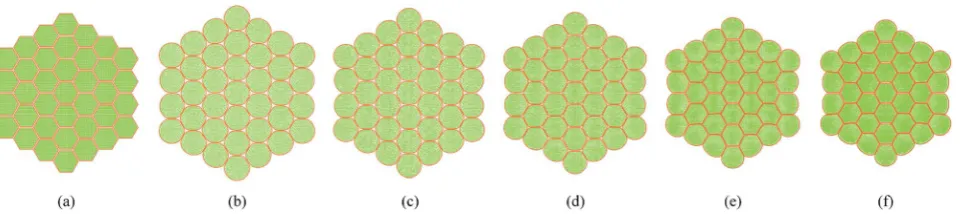
Fig. 6 shows the fundamental model behaviour of a single cell in a tissue at fresh and dry conditions. Fig. 6(a) shows the initial hexagonal single cell model used and Fig. 6(b) corresponds to a fully turgid fresh cell. The dried cell conditions are presented in Fig. 6(c)–(f). When comparing Fig. 6(a) and (b), the ination and size increment of the fresh single cell can be clearly observed. Further, the dried cell conditions indicate a clear reduction of the cell size which fundamentally agrees with the cellular shrinkage observed in plant cells during drying. This model behaviour is mainly inuenced by three factors: lower turgor pressure, lower cell uid and wall mass and higher cell wall contraction forces. Since the turgor pressure remains positive during drying (see Section 2.5 for details), a fairly circular cell shape is maintained throughout the drying phases. Also since the cell is not externally restricted by any other cells or inter-cellular inuences, this circular shape characteristic is further guaranteed (see Section 4.2–4.3 for intercellular inuence in bonded cells in tissues).
[image:10.595.46.553.450.549.2]4.2 Simulation of deformations during drying: dense tissue (7 cells)
Fig. 7 shows the initial particle placement, fresh tissue condi-tion and dried tissue condicondi-tions of the 7-cell tissue. Fig. 8 shows enlarged views of these 7-cell tissue congurations. From Fig. 8(a), the initial pectin layer gap is clearly observed. When the fresh tissue condition is considered as seen from Fig. 7(b) and 8(b), the cell shape has differed to a hexagonal shape from the previously mentioned full-circular shape observed in the
single cell fresh condition. This is mainly due to the intercel-lular interactions. Further, it is observed that the pectin layer is stretched particularly at the cell wall positions which corre-spond to initial hexagon edges. This is mainly due to the resistance created by the pectin layer for the fresh cell ination that occurs at a higher turgor pressure. When considering the dried tissue states from both Fig. 7 and 8, a gradual cellular shrinkage pattern is clearly observed. Further, as the tissue gets further dried, the pectin layer tends to experience lower stretch conditions compared to the moist samples. This indicates that the tissue is more prone to deformations mainly due to the lower moisture content and turgor pressure.
4.3 Simulation of deformations during drying: dense tissue (19, 37 cells)
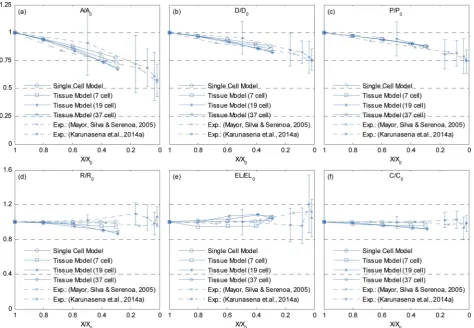
When considering the 19-cell and 37-cell tissues as seen from Fig. 9–12, similar shrinkage patterns can be observed during drying. But, it is clearly seen that the 37-cell tissue tend to experience some extensive shrinkage, which is due to the large number of intercellular interactions present in such models that cause cells to be more packed and attached to each other. Further, when referring to Fig. 10(f) and 12(f), the cell wall has experienced some local wrinkling or warping. This clearly resembles the wrinkled cell walls of realistic dried cells in tissues (see Fig. 5(b) and (c)). Also, when referring to Fig. 9 and 11, the interior and exterior cells of the tissues have undergone different and irregular deformations, which should be due to the differences of intercellular contacts and force elds that they experience. To elaborate these trends quantitatively, the geometric parameters introduced in Section 2.5 were studied and are presented in Fig. 13. It should be noted here that only
Fig. 6 Single cell model: (a) initial condition before simulations. (b) Turgid condition:X/X0¼1.0 &PT¼200 kPa. Dried conditions: (c)X/X0¼0.8 &
PT¼160 kPa. (d)X/X0¼0.6 &PT¼120 kPa. (e)X/X0¼0.4 &PT¼80 kPa. (f)X/X0¼0.3 &PT¼60 kPa.
Fig. 7 7-cell tissue model: (a) initial condition before simulations. (b) Turgid condition:X/X0¼1.0 &PT¼200 kPa. Dried conditions: (c)X/X0¼0.8
&PT¼160 kPa. (d)X/X0¼0.6 &PT¼120 kPa. (e)X/X0¼0.4 &PT¼80 kPa. (f)X/X0¼0.3 &PT¼60 kPa.
Open Access Article. Published on 04 April 2014. Downloaded on 21/07/2016 03:13:21.
This article is licensed under a
[image:10.595.47.552.596.703.2]the internal cells of the tissues were used for the analysis in order to calculate average cellular geometrical parameters, and therefore the outer most cell layer was omitted in each case. It is because, the internal cells are the ones that fully experience the intercellular interactions, which would fairly represent actual cells in a realistic tissue. As seen from Fig. 13(a), (b) and (d), the
[image:11.595.63.545.49.140.2]cell area, ferret diameter and roundness trends further conrm that the bigger tissues experience higher level of shrinkage. Further, the model predictions are fairly in a good agreement with the experimentalndings. Particularly the 19-cell tissue and 37-cell tissue shows a slightly rapid shrinkage during the latter part of drying (X/X0 < 0.6) which replicates what is
Fig. 10 19-cell tissue model (enlarged view): (a) initial condition before simulations. (b) Turgid condition:X/X0¼1.0 &PT¼200 kPa. Dried
conditions: (c)X/X0¼0.8 &PT¼160 kPa. (d)X/X0¼0.6 &PT¼120 kPa. (e)X/X0¼0.4 &PT¼80 kPa. (f)X/X0¼0.3 &PT¼60 kPa.
Fig. 11 37-cell tissue model: (a) initial condition before simulations. (b) Turgid condition:X/X0¼1.0 &PT¼200 kPa. Dried conditions: (c)X/X0¼
0.8 &PT¼160 kPa. (d)X/X0¼0.6 &PT¼120 kPa. (e)X/X0¼0.4 &PT¼80 kPa. (f)X/X0¼0.3 &PT¼60 kPa.
Fig. 8 7-cell tissue model (enlarged view): (a) initial condition before simulations. (b) Turgid condition:X/X0¼1.0 &PT ¼200 kPa. Dried
conditions: (c)X/X0¼0.8 &PT¼160 kPa. (d)X/X0¼0.6 &PT¼120 kPa. (e)X/X0¼0.4 &PT¼80 kPa. (f)X/X0¼0.3 &PT¼60 kPa.
Fig. 9 19-cell tissue model: (a) initial condition before simulations. (b) Turgid condition:X/X0¼1.0 &PT¼200 kPa. Dried conditions: (c)X/X0¼
0.8 &PT¼160 kPa. (d)X/X0¼0.6 &PT¼120 kPa. (e)X/X0¼0.4 &PT¼80 kPa. (f)X/X0¼0.3 &PT¼60 kPa.
Open Access Article. Published on 04 April 2014. Downloaded on 21/07/2016 03:13:21.
This article is licensed under a
[image:11.595.58.544.191.299.2] [image:11.595.61.548.346.444.2] [image:11.595.61.543.498.605.2]observed from the experimental curves. When the cell perimeter is considered, all models seem to experience almost identical cell perimeter reduction trends. This is because, the cell perimeter variation is less inuenced by the tissue scale inter-actions, and as dened in eqn (8), the perimeter reduction was taken to be directly governed by the moisture content of the cell. The selected parameters used in the cell wall contraction force formulations have ensured a good agreement between simula-tions and experimental ndings. The cell elongation trends reconrm that the 19-cell and 37-cell tissues can better mimic the real tissue drying behaviours rather than the single cell model and 7-cell tissue model. Further, as observed from experimental curves, the elongation increases during drying, which implies that the cells are subjected to non uniform deformations along major and minor axes. This is clearly observed from the experiments (Fig. 5) and from the simulated tissue models (Fig. 10 and 12). Next, in the case of cell compactness, bigger tissues generally indicate a fairly good agreement with the gradually reducing compactness trend of experimental curves. All these observations highlight the capa-bility of the proposed tissue model to replicate realistic tissue deformations during drying.
Further, we should mention here that in actual tissue drying, the cells that are located in the periphery of the tissue undergo intense moisture removal compared to the interior cells, leading to a case hardening phenomenon. This is particularly evident in tissues withnite size that involve a large number of cells, which undergo a rapid drying process such as in the case of forced convective drying. However, in our simulations, we simply assumed all the cells in the tissue undergo similar moisture removal, since our main objective was to demonstrate how the cells in a tissue would fundamentally deform when the moisture and turgor pressure varies. Although such a simplied approach was used in this work, the general tissue model introduced here is fully capable of simulating such case hard-ening effects and can easily be achieved by separately time evolving the interior and exterior cells with customized mois-ture content and turgor pressure values.
4.4 Simulation of deformations during drying: tissues with cellular voids (19, 37 cells)
In addition to the dense tissues simulations, another set of simulations were conducted in order to predict how the tissues with voids would deform during drying. For this purpose, only
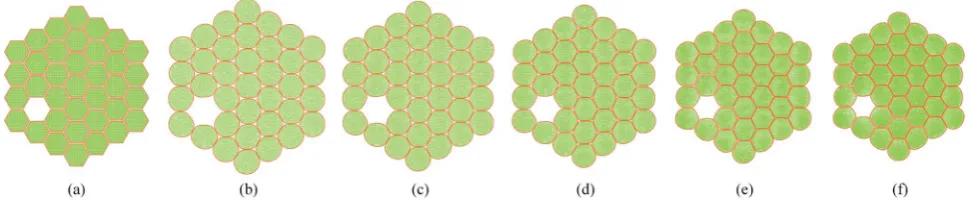
the 19-cell and 37-cell tissues were used and the voids were created by removing one cell from each tissue. The qualitative results are presented in Fig. 14–17. From Fig. 14 and 16, it is evident that the void geometry also experiences shrinkage in a fairly similar manner to that of the cells, which fundamentally agrees with experimentalndings.12,21,23Also it is observed that
the cells that are located in the periphery of the voids, tend to deform in a different manner compared to the normal cells within the dense regions of the tissues. This is due to the difference of the intercellular interactions, where cells in the periphery of the void have no intercellular contacts towards the void. Further, the enlarged views shown in Fig. 15 and 17 indicate that the cells in the 36-cell tissue tend to undergo limited irregular deformations compared to the 18-cell tissue. It should be due to the higher number of intercellular interactions present in the larger tissue which resist irregular local defor-mations. In addition to these qualitative analysis, the geometric parameter trends were also studies as presented in Fig. 18. The cell area and roundness trends indicate this particular defor-mation difference up to some extent. However, due to the averaging of the parameters, the localized changes observed in tissue images are not clearly reected from cell elongation and compactness trends. These ndings imply that the overall deformation characteristics of tissues are inuenced by local voids, but in bigger tissues the effect is not so signicant both qualitatively and quantitatively, provided that the void percentage is not very high (in this case it is 2–5%). Also, as described in Section 4.3, the different boundary conditions can be used in case of the voids also, by having customized moisture content and turgor pressures for the cells in the periphery of the tissue and around the void. However, considering the scope of this work, these potentially interesting developments were not further studied, but will be addressed in our future works.
4.5 Sensitivity analysis
[image:12.595.66.544.48.140.2]The tissue model involves a number of physical and non-physical parameters. A sensitivity analysis was conducted for three parameters that mainly inuence the model behaviour. For easy interpretation of results, only a 19 cell tissue model was used for this analysis. Also, in order to better illustrate the model sensitivity to each parameters of interest, both the fresh cell condition (i.e. X/X0¼1.0) and the critically dried condition (i.e. X/X0 ¼ 0.3) are presented as tissue images. Additionally, Fig. 12 37-cell tissue model (enlarged view): (a) initial condition before simulations. (b) Turgid condition:X/X0¼1.0 &PT¼200 kPa. Dried
conditions: (c)X/X0¼0.8 &PT¼160 kPa. (d)X/X0¼0.6 &PT¼120 kPa. (e)X/X0¼0.4 &PT¼80 kPa. (f)X/X0¼0.3 &PT¼60 kPa.
Open Access Article. Published on 04 April 2014. Downloaded on 21/07/2016 03:13:21.
This article is licensed under a
Fig. 13 Influence of moisture content reduction for cellular geometric property variations of dense tissues: (a)A/A0. (b)D/D0. (c)P/P0. (d)R/R0.
[image:13.595.59.541.426.536.2](e) EL/EL0. (f)C/C0. (Error bars indicate one standard deviation.)
Fig. 14 18-cell tissue model with voids: (a) initial condition before simulations. (b) Turgid condition:X/X0¼1.0 &PT¼200 kPa. Dried conditions:
(c)X/X0¼0.8 &PT¼160 kPa. (d)X/X0¼0.6 &PT¼120 kPa. (e)X/X0¼0.4 &PT¼80 kPa. (f)X/X0¼0.3 &PT¼60 kPa.
Fig. 15 18-cell tissue model with voids (enlarged view): (a) initial condition before simulations. (b) Turgid condition:X/X0¼1.0 &PT¼200 kPa.
Dried conditions: (c)X/X0¼0.8 &PT¼160 kPa. (d)X/X0¼0.6 &PT¼120 kPa. (e)X/X0¼0.4 &PT¼80 kPa. (f)X/X0¼0.3 &PT¼60 kPa.
Open Access Article. Published on 04 April 2014. Downloaded on 21/07/2016 03:13:21.
This article is licensed under a
[image:13.595.59.550.605.702.2]Fig. 16 36-cell tissue model with voids: (a) initial condition before simulations. (b) Turgid condition:X/X0¼1.0 &PT¼200 kPa. Dried conditions:
[image:14.595.64.541.216.307.2](c)X/X0¼0.8 &PT¼160 kPa. (d)X/X0¼0.6 &PT¼120 kPa. (e)X/X0¼0.4 &PT¼80 kPa. (f)X/X0¼0.3 &PT¼60 kPa.
Fig. 17 36-cell tissue model with voids (enlarged view): (a) initial condition before simulations. (b) Turgid condition:X/X0¼1.0 &PT¼200 kPa.
Dried conditions: (c)X/X0¼0.8 &PT¼160 kPa. (d)X/X0¼0.6 &PT¼120 kPa. (e)X/X0¼0.4 &PT¼80 kPa. (f)X/X0¼0.3 &PT¼60 kPa.
Fig. 18 Influence of moisture content reduction for cellular geometric property variations of tissues with voids: (a)A/A0. (b)D/D0. (c)P/P0. (d)R/
R0. (e) EL/EL0. (f)C/C0. (Error bars indicate one standard deviation.)
Open Access Article. Published on 04 April 2014. Downloaded on 21/07/2016 03:13:21.
This article is licensed under a
[image:14.595.49.546.364.701.2]quantitative data on cell area, perimeter and roundness are presented for all states.
4.5.1 Model sensitivity to cell wall Young's modulus (E).
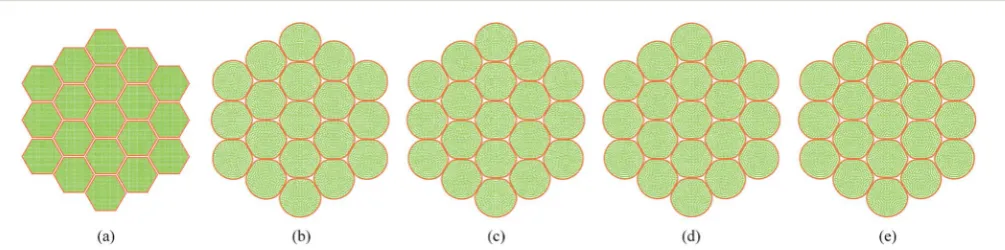
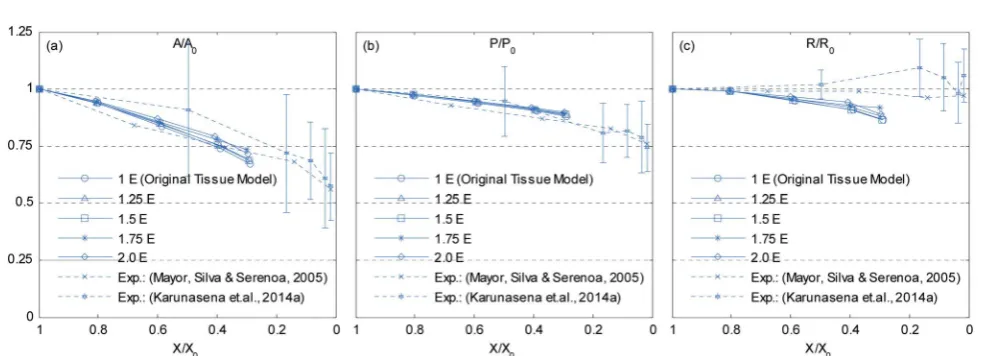
Depending on the biological variability and maturity level of materials, the cell wall Young's modulus (E) can vary. Since the Emainly governs how the cell wall responds to different force interactions, it can highly inuence the model behaviour. In order to study the model sensitivity for the cell wallE, a series of simulations was conducted by varyingEfrom 1Eto 2Ein steps of 0.25E. From Fig. 19–22, it is observed that the inuence ofEis dominant in dried tissues than fresh tissues. Further, when comparing 1Eand 2Ecases from Fig. 21 and 22, it is clearly observed that the dried tissue deformations are resisted by stiffer cell walls and the resulting dried tissue are comparatively larger. Additionally, the 1Eand 1.25Etissues have undergone considerable local wrinkling compared to 2Etissue, which also
supports the above mentioned behaviour of stiffer cell walls. This is further evident from Fig. 23 where cell area and roundness of 1.75Eand 2Emodels in particular are subjected to limited shrinkage compared to other less stifftissue models.
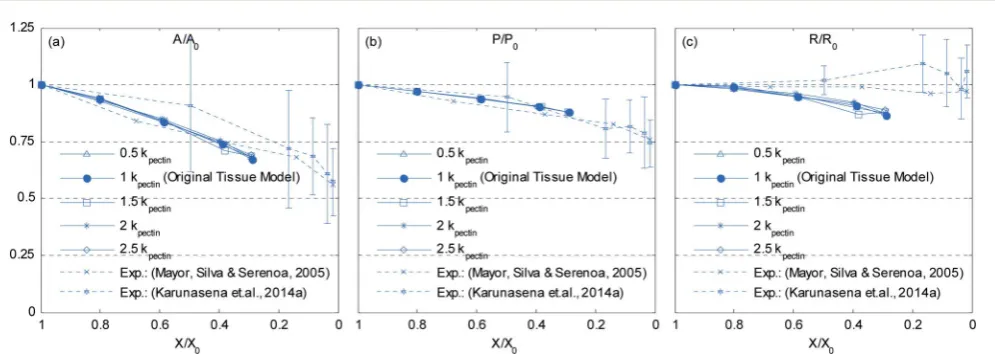
[image:15.595.48.551.263.388.2]4.5.2 Model sensitivity to pectin layer stiffness (kpectin). Pectin layer stiffness mainly governs the extent to which the cells are bonded to each other. It is clearly evident from Fig. 24 and 25, that the fresh cells are tightly bonded to each other in case of higherkpectin. When comparing Fig. 25(a) and (e), it is observed that the cell shape also tend to be fairly hexagonal when higherkpectinvalues are used. Further, when referring to Fig. 26 and 27, it is observed that higherkpectinvalues tend to have the cells in dried tissues attached to each other with fairly consistent gaps between them. This is clearly observed from Fig. 26(e) and 27(e), where the spacing around the centre-most cell is almost equal to the initially set pectin layer gap. Fig. 26
[image:15.595.58.547.422.537.2]Fig. 19 Sensitivity of 19-cell tissue atX/X0¼1.0 for cell wall Young's modulus (E): (a) 1E(¼54 MPa). (b) 1.25E. (c) 1.5E. (d) 1.75E. (e) 2E.
Fig. 20 Sensitivity of 19-cell tissue atX/X0¼1.0 for cell wall Young's modulus (E) (enlarged view): (a) 1E(¼54 MPa). (b) 1.25E. (c) 1.5E. (d) 1.75E.
[image:15.595.57.550.582.713.2](e) 2E.
Fig. 21 Sensitivity of 19-cell tissue atX/X0¼0.3 for cell wall Young's modulus (E): (a) 1E(¼54 MPa). (b) 1.25E. (c) 1.5E. (d) 1.75E. (e) 2E.
Open Access Article. Published on 04 April 2014. Downloaded on 21/07/2016 03:13:21.
This article is licensed under a
Fig. 25 Sensitivity of 19-cell tissue atX/X0¼1.0 for pectin layer stiffness (kpectin) (enlarged view): (a) 0.5kpectin. (b) 1kpectin(¼20 N m1). (c) 1.5
[image:16.595.52.547.192.370.2]kpectin. (d) 2.0kpectin. (e) 2.5kpectin.
Fig. 22 Sensitivity of 19-cell tissue atX/X0¼0.3 for cell wall Young's modulus (E) (enlarged view): (a) 1E(¼54 MPa). (b) 1.25E. (c) 1.5E. (d) 1.75E.
[image:16.595.47.552.421.549.2](e) 2E.
Fig. 23 Effects of cell wall Young's modulus (E) on normalized cellular parameters of a 19-cell tissue: (a)A/A0. (b)P/P0. (c)R/R0. (Error bars
indicate one standard deviation.)
Fig. 24 Sensitivity of 19-cell tissue atX/X0¼1.0 for pectin layer stiffness (kpectin): (a) 0.5kpectin. (b) 1kpectin(¼20 N m 1
). (c) 1.5kpectin. (d) 2.0kpectin.
(e) 2.5kpectin.
Open Access Article. Published on 04 April 2014. Downloaded on 21/07/2016 03:13:21.
This article is licensed under a
[image:16.595.56.547.588.701.2]and 27 further indicate that kpectin particularly inuences localized changes of cell shapes in dried tissue rather than global tissue shape changes (Fig. 26(a) and (e) has almost same tissue geometry even the used kpectin values are signicantly different). The qualitative results are presented in Fig. 28 and only the cell area and the roundness indicate some level of a difference between different kpectin models. This should be mainly due to the cancellation of the effects during the aver-aging and normalisation process.
4.5.3 Model sensitivity to cell wall contraction force
[image:17.595.55.542.50.167.2]coef-cient (kwc).As described in Section 5.1, the cell wall contrac-tions are directly inuenced by thekwcand four differentkwc values were tested in this study against the original model. By referring to the eqn (8), it is clearly evident that the model is not inuenced by kwc when X/X0 ¼ 1.0. This is reconrmed by Fig. 29 and 30, where fresh tissues are having identical geom-etries even at differentkwcvalues. However, in case of dried tissues, as seen from Fig. 31 and 32, a clear difference is observed. Fig. 31 implies that higherkwcvalues tend to increase Fig. 26 Sensitivity of 19-cell tissue atX/X0¼0.3 for pectin layer stiffness (kpectin): (a) 0.5kpectin. (b) 1kpectin(¼20 N m1). (c) 1.5kpectin. (d) 2.0kpectin.
[image:17.595.64.547.211.325.2](e) 2.5kpectin.
Fig. 27 Sensitivity of 19-cell tissue atX/X0¼0.3 for pectin layer stiffness (kpectin) (enlarged view): (a) 0.5kpectin. (b) 1kpectin(¼20 N m1). (c) 1.5
kpectin. (d) 2.0kpectin. (e) 2.5kpectin.
Fig. 28 Effects of pectin layer stiffness (kpectin) on normalized cellular parameters of a 19-cell tissue: (a)A/A0. (b)P/P0. (c)R/R0. (Error bars indicate
one standard deviation.)
Open Access Article. Published on 04 April 2014. Downloaded on 21/07/2016 03:13:21.
This article is licensed under a
[image:17.595.51.549.523.700.2]Fig. 29 Sensitivity of 19-cell tissue atX/X0¼1.0 for cell wall contraction force coefficient (kwc): (a) 0 .kwc(b) 0.5 .kwc(c) 1kwc(¼4104N m1).
[image:18.595.65.545.218.332.2](d) 1.5kwc. (e) 2kwc.
Fig. 30 Sensitivity of 19-cell tissue atX/X0¼1.0 for cell wall contraction force coefficient (kwc) (enlarged view): (a) 0kwc. (b) 0.5kwc. (c) 1kwc(¼4
104N m1). (d) 1.5
kwc. (e) 2kwc.
Fig. 31 Sensitivity of 19-cell tissue atX/X0¼0.3 for cell wall contraction force coefficient (kwc): (a) 0kwc. (b) 0.5kwc. (c) 1kwc(¼4104N m1).
(d) 1.5kwc. (e) 2kwc.
Fig. 32 Sensitivity of 19-cell tissue atX/X0¼0.3 for cell wall contraction force coefficient (kwc) (enlarged view): (a) 0kwc. (b) 0.5kwc. (c) 1kwc(¼4
104N m1). (d) 1.5kwc. (e) 2kwc.
Open Access Article. Published on 04 April 2014. Downloaded on 21/07/2016 03:13:21.
This article is licensed under a
[image:18.595.45.549.400.534.2] [image:18.595.49.550.584.701.2]tissue shrinkage that can even lead to bulk level tissue shape changes. This is particularly evident when comparing Fig. 31(a) and (e), where the former tissue geometry is fairly hexagonal and the latter one is quite circular. Further, when referring to Fig. 32, we can argue that the cell-wise shrinkage differences should be the main cause for these bulk level shrinkage differences of the tissue. Also in Fig. 32, cells which have higher kwc have undergone signicant local wrinkling and warping, which resemble actual cell deformations during drying. These differences are further evident from the geometric parameters as shown in Fig. 33, where the cell area, perimeter and the roundness trends indicate that, higher kwc models tend to experience lower shrinkage. Also, particularly in cell perimeter trends as shown in Fig. 33(b), thekwc¼0 model only subjects to very limited cell perimeter reductions and deviates signicantly from experimental curves, indicating a general decreasing trend. This highlights the importance of usingkwcin the drying model, which should be carefully tuned in order to ensure better model performance.
5.
Conclusions and outlook
A 2-D meshfree particle based model has been developed by coupling SPH with DEM in order to simulate microscale morphological changes of plant tissues during drying. We specically used a hexagonal cell shape and a positive pectin layer gap in the tissue model in order to represent the frequently observed honeycomb cellular structure of plant tissues, which also owns middle lamella of anite thickness. The main nd-ings of this work can be summarized as:
Using a meshfree approach, this work has clearly overcome the key shortcomings of grid-based plant tissue drying models17
that have limited capability to account for excessive moisture reduction during drying as well as cell wall wrinkling. Also, the simulation approach in this work is comparatively straight forward.
Compared to the state of the art SPH–DEM based plant tissue models,23,24the hexagonal initial cell arrangement and
the positive gap used for the middle lamella in this work resulted in a more realistic tissue structure with improved cell– cell contacts.
In order to ensure the stability of this novel model, a careful selection of cell wall pectin layer and LJ repulsion force parameters are recommended as is the proposed smooth time evolution approach which initially omits the cell wall bending stiffness effects and the cell wall contraction force effects.
In order to avoid cell–cell penetrations in the tissue model, only the cell wall particles can be used rather than the large array ofuid particles which was used by the state of the art SPH–DEM based tissue models. By this means, the computa-tional cost can be signicantly reduced, as a result of lower number of particle interaction calculations.
We introduced a means of simulating dried tissues using a SPH–DEM particle scheme by varying the cell moisture content and turgor pressure. A series of simulations were conducted on different size tissues (7-cell, 19-cell and 37-cell) using a generic dense arrangement and it was observed that the tissue model undergoes cellular and bulk level shrinkage. Particularly in critically dried states, cell wall wrinkling and warping was clearly observed. Both effects were found to be in close agree-ment with experiagree-mentalndings of dried plant tissues.
Qualitative studies on several key cellular geometric parameters indicated that the bigger tissue models are fairly capable of replicating most of the realistic cellular geometrical changes during drying.
Tissue models with voids resembled a basic porous cellular structure which can be observed in real tissues and it was observed that the voids undergo similar deformation as of actual cells, which is in good agreement with the experimental ndings in the literature.
The model is highly sensitive to the cell wall Young's modulus particularly in dried conditions than fresh conditions. Stiffer walled cells tend to resist shrinkage and resulted in larger dried tissue dimensions.
[image:19.595.57.541.50.217.2]Stiffer pectin layers tend to produce strong cell–cell contacts which cause fresh cell shapes in tissues to become Fig. 33 Effects of the cell wall contraction force coefficient (kwc) on normalized cellular parameters of a 19-cell tissue: (a)A/A0. (b)P/P0. (c)R/R0.
(Error bars indicate one standard deviation.)
Open Access Article. Published on 04 April 2014. Downloaded on 21/07/2016 03:13:21.
This article is licensed under a
more hexagonal. Also, higher pectin layer stiffness tends to maintain fairly uniform gaps between cells, particularly in dried tissues.
The model is also highly sensitive to the force coefficient of cell wall contractions and it mainly inuences the dried tissue deformations by enhancing cellular shrinkage and cell wall warping.
Considering all these, we conclude that the proposed SPH– DEM tissue model provides a reliable means of numerically studying the cellular drying phenomena which involves complex physics. The model can be further improved by using advanced cell wall models,uid–wall interaction models and incorporating multiscale techniques to model bulk tissues in a computationally efficient manner. Tissue porosity effects, bulk material deformations and shape changes can be further studied and related with product and process parameters in the drying industry. Also, 3-D models can be developed using the fundamental conceptual framework proposed in this work. This model can be regarded as a generic model valid for most of the plant materials and could be used to predict deformation characteristics during drying upon the availability of relevant model parameters. Also, temperature variations can be funda-mentally incorporated into the SPH–DEM formulations in order to account for temperature inuence for dried plant tissue deformations.
Acknowledgements
This research was conducted at the experimental facilities of the Queensland University of Technology (QUT)– Brisbane, Aus-tralia and the authors extend their thanks to the graduate student Ms Parva Hesami for the contributions in experiments. The research studies werenancially supported by QUT, Inter-national Postgraduate Research Scholarship (IPRS) and Australian Postgraduate Award (APA) scholarship. Support from the ARC Future Fellowship Grant (FT100100172) and the High Performance Computer resources provided by the QUT are also gratefully acknowledged as is the support by University of Ruhuna–Sri Lanka.
References
1 S. Grabowski, M. Marcotte and H. S. Ramaswamy, in Handbook of postharvest technology: cereals, fruits, vegetables, tea, and spices, ed. A. Chakraverty, A. S. Mujumdar, G. S. V. Raghavan and H. Rawaswamy, Marcel Dekker, New York 2003, ch. 23, pp. 653–695.
2 S. V. Jangam,Drying Technol., 2011,29, 1343–1357.
3 B. P. Hills and B. Remigereau,Int. J. Food Sci. Technol., 1997,
32, 51–61.
4 P. P. Lewicki and J. Drzewucka, Effect of drying on tissue structure of selected fruits and vegetables, Greece, 1998. 5 I. N. Ramos, C. L. M. Silva, A. M. Sereno and J. M. Aguilera,
J. Food Eng., 2004,62, 159–164.
6 L. Mayor, M. A. Silva and A. M. Sereno,Drying Technol., 2005,
23, 2261–2276.
7 P. P. Lewicki and G. Pawlak,Drying Technol., 2003,21, 657– 683.
8 Y. Bai, M. S. Rahman, C. O. Perera, B. Smith and L. D. Melton,J. Agric. Food Chem., 2002,50, 3179–3185. 9 M. S. Rahman, I. Al-Zakwani and N. Guizani, J. Sci. Food
Agric., 2005,85, 979–989.
10 T. Funebo, L. l. a. Ahrn´e, S. Kidman, M. Langton and C. Skj¨oldebrand,J. Food Eng., 2000,46, 173–182.
11 M. K. Bartlett, C. Scoffoni and L. Sack,Ecol. Lett., 2012,15, 393–405.
12 G. H. Crapiste, S. Whitaker and E. Rotstein,Chem. Eng. Sci., 1988,43, 2919–2928.
13 H. X. Zhu and J. R. Melrose,J. Theor. Biol., 2003,221, 89–101. 14 C. X. Wang, L. Wang and C. R. Thomas,Ann. Bot., 2004,93,
443–453.
15 N. Wu and M. J. Pitts,Postharvest Biol. Technol., 1999,16, 1– 8.
16 Q. Gao and R. E. Pitt,Trans. ASABE, 1991,34, 0232–0238. 17 S. W. Fanta, M. K. Abera, W. A. Aregawi, Q. T. Ho,
P. Verboven, J. Carmeliet and B. M. Nicolai, J. Food Eng., 2014,124, 86–96.
18 T. Rudge and J. Haseloff, inAdvances in Articial Life, ed. M. Capcarr`ere, A. Freitas, P. Bentley, C. Johnson and J. Timmis, Springer, Berlin, Heidelberg, 2005, vol. 3630, ch. 9, pp. 78– 87.
19 H. Honda, M. Tanemura and T. Nagai,J. Theor. Biol., 2004,
226, 439–453.
20 Z. Liu, W. Hong, Z. Suo, S. Swaddiwudhipong and Y. Zhang, Comput. Mater. Sci., 2010,49, S60–S64.
21 G. R. Liu and M. B. Liu,Smoothed Particle Hydrodynamics: A Meshfree Particle Method, World Scientic Publishing Co., Singapore, 2003.
22 R. A. Gingold and J. J. Monaghan,Mon. Not. R. Astron. Soc., 1977,181, 375–389.
23 P. Van Liedekerke, P. Ghysels, E. Tijskens, G. Samaey, D. Roose and H. Ramon,SoMatter, 2011,7, 3580–3591. 24 P. V. Liedekerke, P. Ghysels, E. Tijskens, G. Samaey,
B. Smeedts, D. Roose and H. Ramon, Phys. Biol., 2010, 7, 026006.
25 P. Van Liedekerke, E. Tijskens, H. Ramon, P. Ghysels, G. Samaey and D. Roose,Phys. Rev. E: Stat., Nonlinear, So Matter Phys., 2010,81, 061906.
26 H. C. P. Karunasena, W. Senadeera, Y. T. Gu and R. J. Brown, A Coupled SPH–DEM Model for Fluid and Solid Mechanics of Apple Parenchyma Cells During Drying, Launceston, Australia, 2012.
27 H. C. P. Karunasena, W. Senadeera, Y. T. Gu and R. J. Brown, A particle based micromechanics model to simulate drying behaviors of vegetable cells, Gold Coast, Australia, 2012. 28 H. C. P. Karunasena, W. Senadeera, Y. T. Gu and R. J. Brown,
Appl. Math. Model., 2014, DOI: 10.1016/j.apm.2013.12.004. 29 A. E. Smith, K. E. Moxham and A. P. J. Middelberg,Chem.
Eng. Sci., 1998,53, 3913–3922.
30 M. C. Jarvis,Plant, Cell Environ., 1998,21, 1307–1310. 31 M. A. J. Chaplain,J. Theor. Biol., 1993,163, 77–97.
32 L. Taiz and E. Zeiger, inPlant Physiol., Sinauer Associates, Sunderland, USA, 2010, ch. 3, pp. 73–84.
Open Access Article. Published on 04 April 2014. Downloaded on 21/07/2016 03:13:21.
This article is licensed under a