Immunodeficiency Virus and Human Immunodeficiency Virus
Lineages
Will Fischer,aCristian Apetrei,b,cMario L. Santiago,dYingying Li,eRajeev Gautam,cIvona Pandrea,b,cGeorge M. Shaw,e,f Beatrice H. Hahn,e,fNorman L. Letvin,g†Gary J. Nabel,hand Bette T. Korbera,i
Theoretical Biology, Los Alamos National Laboratory, Los Alamos, New Mexico, USAa; University of Pittsburgh Center for Vaccine Research, Pittsburgh, Pennsylvania, USAb;
Tulane National Primate Research Center, Covington, Louisiana, USAc; Division of Infectious Diseases, University of Colorado School of Medicine, Aurora, Colorado, USAd;
Departments of Microbiologyeand Medicine,fPerelman School of Medicine, University of Pennsylvania, Philadelphia, Pennsylvania, USA; Beth Israel Deaconess Medical
Center, Boston, Massachusetts, USAg; Vaccine Research Center, Bethesda, Maryland, USAh; and The Santa Fe Institute, Santa Fe, New Mexico, USAi
Simian immunodeficiency virus (SIV) infection of rhesus macaques causes immune depletion and disease closely resembling human AIDS and is well recognized as the most relevant animal model for the human disease. Experimental investigations of viral pathogenesis and vaccine protection primarily involve a limited set of related viruses originating in sooty mangabeys (SIVsmm). The diversity of human immunodeficiency virus type 1 (HIV-1) has evolved in humans in about a century; in con-trast, SIV isolates used in the macaque model evolved in sooty mangabeys over millennia. To investigate the possible conse-quences of such different evolutionary histories for selection pressures and observed diversity in SIVsmm and HIV-1, we iso-lated, sequenced, and analyzed 20 independent isolates of SIVsmm, including representatives of 7 distinct clades of viruses isolated from natural infection. We found SIVsmm diversity to be lower overall than HIV-1 M group diversity. Reduced positive selection (i.e., less diversifying evolution) was evident in extended regions of SIVsmm proteins, most notably in Gag p27 and Env gp120. In addition, the relative diversities of proteins in the two lineages were distinct: SIVsmm Env and Gag were much less diverse than their HIV-1 counterparts. This may be explained by lower SIV-directed immune activity in mangabeys relative to HIV-1-directed immunity in humans. These findings add an additional layer of complexity to the interpretation and, potentially, to the predictive utility of the SIV/macaque model, and they highlight the unique features of human and simian lentiviral evolu-tion that inform studies of pathogenesis and strategies for AIDS vaccine design.
T
he potential efficacy of human immunodeficiency virus type 1(HIV-1) interventions, including vaccines, can be investigated by using the macaque/simian immunodeficiency virus (SIV)
model of infection, wherein rhesus macaques (Macaca mulatta)
are exposed to a macaque-adapted simian immunodeficiency vi-rus (SIVmac). The SIV isolates in common use as vaccine and
challenge strains originated in U.S. primate centers (2, 29) via
accidental, incidental, or experimental transmission of
retrovi-ruses from captive sooty mangabeys (Cercocebus atys) to rhesus
macaques, often followed by additional macaque passages. The endemic sooty mangabey virus (SIVsmm) is not overtly patho-genic in its natural host, but many SIVsmm-derived SIVmac strains cause AIDS in Asian macaques, as can native SIVsmm, SIVagm from African green monkeys, SIVmnd from mandrills, and SIVlho from L’Hoest monkeys, although adaptation may be
required for full virulence (reviewed in reference41). Natural SIV
infections are often considered to be nonpathogenic in general, and indeed, there is little overt disease in the best-studied natural host/SIV pairings. We note, however, that the natural histories of most of the 40-some SIV strains have not been studied and are essentially unknown, that SIVcpz infection can cause AIDS-like
disease in free-ranging chimpanzees (39), and that AIDS has, in
fact, been reported to have occurred in a few “natural-host”
Afri-can primates (reviewed in references65and82), including a sooty
mangabey (54). SIV-induced pathogenesis is therefore possible,
albeit rare, in putatively well-adapted hosts.
The similar pathologies of HIV infection of humans and SIV
infection of macaques (reviewed in references9and41) are
char-acterized by an initial high peak viremia, massive depletion of
CD4⫹T cells in the gastrointestinal tract during acute infection
(10,58,83), lowering of viremia by 2 to 4 logs during chronic
infection, progressive loss of CD4⫹T cells, and eventual
progres-sion to AIDS. Furthermore, and critical to the relevance of vaccine studies in the macaque model, the dynamics of infection in low-dose SIV vaccine challenge models are similar to those of natural
HIV infection of humans (40). These striking parallels, in both
infection and disease, make SIV infection of macaques a powerful and informative animal model for HIV infection in humans. An-imal models are extremely useful for vaccine studies, allowing control of the mode, dose, and timing of viral exposure, permit-ting any desired tissue sampling, and enabling efficacy tespermit-ting via viral challenge to compare vaccine design strategies. Recent
het-Received18 July 2012 Accepted28 September 2012
Published ahead of print10 October 2012
Address correspondence to Will Fischer, [email protected], or Bette T. Korber, [email protected].
† Deceased.
This article is dedicated to the memory of Norm Letvin, whose many questions originally stimulated our efforts on this project.
Supplemental material for this article may be found athttp://jvi.asm.org/. Copyright © 2012, American Society for Microbiology. All Rights Reserved. doi:10.1128/JVI.01862-12
The authors have paid a fee to allow immediate free access to this article.
on November 7, 2019 by guest
http://jvi.asm.org/
erologous-challenge studies with macaques have provided new hope and direction for the HIV vaccine field: vaccine-elicited
an-tibodies correlated with protection from infection (4), and
persis-tent CD8⫹effector memory cells localized in lymph nodes can
provide protection from infection, in some cases, and stringent control of viremia and protection from disease in challenged
an-imals that do become infected (20,26). Nevertheless, despite the
many similarities in the biology noted above, and the clear value of new insights the macaque vaccine model provides, simian viruses and simian immune responses differ significantly from their
hu-man counterparts (64), and the direct applicability of
SIV/ma-caque challenge models to human vaccine studies is a matter of
long-standing debate (29,85).
In this study, we examined a potential complicating factor of the SIVmac/macaque model that could affect the interpretation of heterologous-challenge results as they relate to cross-reactive pro-tection against the extraordinary population diversity of HIV
(44). It has been noted that the genetic diversity of naturally
cir-culating SIVsmm strains is roughly comparable to the diversity of
the HIV-1 M group (1), and the predictive utility of SIV
heterol-ogous-challenge models rests in part on this observation. How-ever, SIVsmm in sooty mangabeys represents a far more ancient lineage than HIV-1 in humans: the global diversity of the current HIV-1 epidemic harks back to a common ancestor about a
cen-tury ago (43,89), while SIVsmm origins in sooty mangabey go
back many millennia (90). Additionally, the immunological
envi-ronments of SIVsmm and HIV-1 are quite different: in sooty mangabeys, anti-SIV antibody titers, cytotoxic T lymphocyte (CTL) responses, and immune activation are lower than in
HIV-1-infected humans or SIVmac-infected macaques (21,35,77; see
also Discussion). Thus, although the levels of protein diversity observed in the two lineages are roughly comparable, they have
evolved under different selective forces over different timescales, which could in principle give rise to patterns of amino acid diver-sity that reflect these distinct biological histories. We therefore investigated patterns of natural selection in HIV-1 and SIVsmm, finding distinct evolutionary patterns that could potentially affect vaccine-induced immune responses. Here we present new ural-isolate SIVsmm sequences and compare signatures of nat-ural selection (both diversifying and stabilizing selection) to a comparable set of viral sequences drawn from the global HIV-1 pandemic.
MATERIALS AND METHODS
[image:2.585.41.548.78.304.2]Viral cDNA isolation and sequencing.Near-complete genomes were amplified by limiting dilution, cloned, and sequenced for 20 new SIVsmm isolates (Table 1), representing seven of the nine SIVsmm lineages previ-ously recovered from U.S. primate centers (2), and for 4 previously iso-lated viruses (Table 2). Of the new isolates, 17 SIVsmm strains (represent-ing lineages 1 to 6) were amplified from tissue culture supernatants (TC) of short-term sooty mangabey peripheral blood mononuclear cell (PBMC) cultures, in which primary SIVsmm isolates were propagated (23), while the remaining 3 (representing lineage 7) were amplified from uncultured sera (see Table S1 in the supplemental material). The latter TABLE 1Origins of newly reported SIVsmm isolatesa
Isolate
ID Source facility
Host age (yr) Sex
Viral lineage
Infection
durationb Viral load
CD4⫹T
cell count GenBank accession no.(s)
G078 TNPRC 19 M 1 12 47,363 899 JX860415
M919 TNPRC 13 F 1 7 181,553 880 JX860417
M922 TNPRC 15 F 1 9 88,954 474 JX860418
M923 TNPRC 16 F 1 11 1,909,700 1002 JX860419
M935 TNPRC 16 M 1 13 279,283 506 JX860422
M947 TNPRC 15 M 1 8 19,073 670 JX860425
M926 TNPRC 16 M 2 9 126,374 842 JX860420
M934 TNPRC 15 M 2 7 127,900 467 JX860421
M946 TNPRC 13 F 2 9 30,823 1124 JX860424
M950 TNPRC 15 M 2 8 49,692 1043 JX860427
M952 TNPRC 13 F 2 6 54,147 886 JX860429
M940 TNPRC 15 M 3 8 1,870 850 JX860423
M949 TNPRC 14 M 3 6 16,267 852 JX860426
M951 TNPRC 20 M 3 14 28,747 588 JX860428
G932 TNPRC 30 F 4 21 128,846 1218 JX860416
FTq YNPRC 13 M 5 7 113,000 890 JX860414
D215 TNPRC 24 F 6 21 20,393 480 JX860413
CFU212 NIRC NA NA 7 NA NA NA JX860407
CFU226 NIRC NA NA 7 NA NA NA JX860408, JX860409
CFU233 NIRC NA NA 7 NA NA NA JX860410, JX860411, JX860412
aAll animals were sampled during chronic infection; all infections were natural except for the New Iberia Primate Center (NIRC) samples, deemed “accidental”; the NIRC viral
nucleic acids were isolated from serum from chronically infected sooty mangabeys. Tulane National Primate Research Center (TNPRC) and Yerkes National Primate Research Center (YNPRC) isolates were derived from tissue culture supernatant from short-term-infected sooty mangabey PBMC cultures. ID, identity; M, male; F, female; NA, not available.
bIn years between the first positive test and sampling for DNA sequencing.
TABLE 2Origins of newly sequenced genomes from previously published SIVsmm isolates
Isolate name
Country of
origin Reference(s)
GenBank accession no.
SIVsmCI2 Côte D’Ivoire 69 JX860430 SIVsmLIB1 Liberia 59 JX860431 SIVsmSL92A Sierra Leone 11,12 JX860432 SIVsmSL92B Sierra Leone 11,12 JX860433
Fischer et al.
on November 7, 2019 by guest
http://jvi.asm.org/
[image:2.585.298.545.656.724.2]had been sampled between 1980 and 1986, most probably during chronic infection. Using standard procedures (38,68,69), viral RNA purified from tissue culture supernatants or serum was reverse transcribed, and single-genome amplification (SGA) was performed by limiting dilution of cDNA followed by nested PCR. Nucleotide sequences of single-half-ge-nome amplicons (HGAs) were determined by direct sequencing. One sequence per isolate was used for the study. For the 17 isolates of lineages 1 to 6, nucleotide sequences of HGAs overlapped in integrase by 49 bp (D215, FTq, and G932) or 65 bp extending from U5 in the 5=long terminal repeat (LTR) to U3 in the 3=LTR, thus including the complete viral pro-teome excepting the carboxyl-terminal amino acid and stop codon of Nef. When multiple HGA-derived sequences were available from a single ani-mal, we favored inclusion of sequences with identity in the overlap be-tween corresponding 5=and 3=HGA sequences and with intact open read-ing frames. For lineage 7, only sread-ingle HGAs have been obtained to date for CFU212 (3=HGA) and CFU226 (5=HGA). Therefore, additional attempts were made to obtain SGA-derived subgenomic fragments ingag(1.4 kb), pol(2.5 kb), andgp41-nef(1.1 kb). Individual SGA-derived amplicons are identified in Table S1 in the supplemental material.
Sequence selection, alignment, and phylogenetic analysis.To assem-ble a data set of HIV-1 sequences to compare with the SIVsmm sequence set, a subset of sequences was selected from the Los Alamos National Laboratory (LANL) HIV database’s web reference alignments (2007 edition [http://www .hiv.lanl.gov/content/sequence/NEWALIGN/align.html]). Starting with se-quences with complete reading frames for Gag, Pol, Env, and Nef, sese-quences were down-sampled to the point where simple neighbor-joining trees of the
HIV-1 sequences were superficially similar in clade size and distribution to trees inferred from the SIVsmm data set. A full-genome codon-based align-ment of HIV-1, SIVsmm, and SIVmac sequences was constructed using cu-rated sequence alignments from the LANL HIV database (http://hiv.lanl.gov) as a starting point; individual genes were extracted as needed from the final alignment. Phylogenetic trees were constructed from both nucleotide and amino acid data sets using Garli (95) with GTR and WAG models, respec-tively; for both amino acids and DNA, site-to-site rate variation was modeled with a gamma distribution with invariant positions (GTR⫹ ⌫ ⫹I; WAG⫹
⌫ ⫹I). Base frequencies were estimated, and amino acid frequencies were fixed; random starting trees were used, with 16 replicates for DNA trees and 4 replicates for amino acid analyses. Programs from the Newick Utilities pack-age (33) were used to process phylogenetic trees for presentation (e.g., root-ing, scalroot-ing, and branch coloring).
Selection analysis. Codon-aligned nucleotide sequence sets were checked for recombination using genetic algorithm recombination detec-tion (GARD) (49). Alignments with putative recombinants were divided into phylogenetically coherent partitions that were submitted individually to MEME (48,62), FEL, and IFEL (47) analyses on the Data Monkey web server (http://www.datamonkey.org).
Mosaic sequence generation.Mosaic sequences were generated from sets of SIV isolates derived from naturally infected sooty mangabeys (or viruses minimally removed from such isolates). Mosaics were generated using a slight modification of our previously reported method (19): in-stead of generating a multiple-sequence mosaic cocktail in a single step, we first generated a single mosaic sequence and then sequentially added SIVsmCI2
SIVsm92A
SMM.SL.1992.SL92B.AF334679 SIVsmLIB1
STM.US.x.STM.M83293 D215 D7 D8 CFU212 D10 A2
CFU226 F5 C7 CFU233 F1 F11 F6
FTq F9 E5 G078 A12 A10
M940 B2 E11 M949 D3 B2 M951 H10 D5 M926 A9 D6 M934 F3 A12 M946 A12 C12
M950 E4 D4 M952 C11 C2
G932 A12 E1 MNE.US.1982.MNE 8.M32741 MNE.US.x.MNE027.U79412
MAC.US.-.MM142 IVMXX.Y00277 MAC.US.-.251 32H PJ5.D01065 MAC.US.x.251 BK28.M19499 MAC.US.x.251 1A11.M76764 MAC.US.-.MAC239-87801.AY587015 MAC.US.x.239.M33262 M919 F2 A2
SMM.US.x.PGM53.AF077017 M922 E12 B1 M935 G10 C6
SMM.US.-.F236 H4.X14307 SMM.US.-.SME543.U72748 SMM.US.x.SIVsmH635F L3.DQ201172 CG7G
CG7V M947 C11 A8 M923 B4 B11 SMM.US.-.PBJ 143.M80193
SMM.US.x.H9.M80194 SMM.US.-.PBJA.M31325 SMM.US.-.PBJ14 15.L03295 SMM.US.-.PBJ 6P12.L09211
0substitutions/site 0.1 0.2 0.3 0.4
SIVmac239/251 lineage
SIVmacE660
(a) SIVsmm with representative SIVmac lineages
H.CF.1990.056.AF005496 J.SE.1993.SE9280 7887.AF082394 J.SE.1994.SE9173 7022.AF082395
G.SE.1993.SE6165 G6165.AF061642 04 cpx.CY.1994.94CY032 3.AF049337
A2.CY.1994.94CY017 41.AF286237 01 AE.TH.1990.CM240.U54771 02 AG.NG. .IBNG.L39106 A.SN.1996.DDJ360.AY521630 A.SN.2001.DDI579.AY521629 A1.RW.1992.92RW008.AB253421 A1.UG.1999.99UGA07072.AF484478 C.IN.1995.95IN21068.AF067155 C.ZA.2004.04ZASK164B1.DQ056405 C.BR.2004.04BR013.AY727522 C.ET.1986.ETH2220.U46016 C.ET.2002.02ET 288.AY713417 K.CM.1996.96CM MP535.AJ249239 F1.BE.1993.VI850.AF077336 F1.ES. .P1146.DQ979023 F2.CM.1997.CM53657.AF377956 F2.CM.2002.02CM 0016BBY.AY371158 D.CM.2001.01CM 0009BBY.AY371155 D.YE.2002.02YE516.AY795907 D.CD.1983.ELI.K03454 D.ZA.1990.R1.EF633445 D.KE.2001.NKU3006.AF457090 D.YE.2001.01YE386.AY795903 03 AB.RU.1997.KAL153 2.AF193276
B.BO.1999.BOL0122.AY037270 B.GE.2003.03GEMZ010.DQ207942 B.CN.2005.05CNHB hp3.DQ990880 B.TH.2000.00TH C3198.AY945710 B.US.1999.PRB959 03.AY331296 B.CA.1997.CANB3FULL.AY779553 B.AU.1987.MBC925.AF042101 B.FR.1983.HXB2 LAI IIIB BRU.K03455
0.05 0.15
0substitutions/site 0.1 0.2
(b) HIV-1 M group
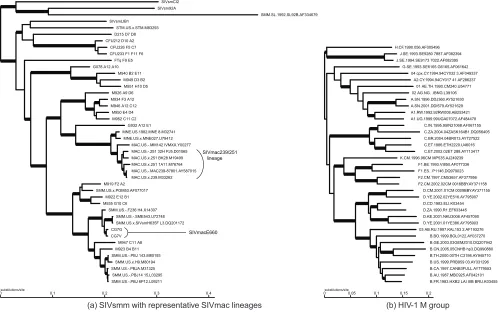
FIG 1Whole-genome maximum likelihood phylogenetic trees inferred from nucleotide data for HIV-1 and SIVsmm data sets. Trees were inferred using Garli (95); both trees are drawn to the same scale (number of expected substitutions per site). The SIVsmm tree (a) is rooted on SMM.SL.1992.SL92B.AF334679⫹ SIVsm92A; the HIV-1 tree (b) is rooted at the midpoint. Branches with⬎95% bootstrap support are thickened. Tree files were processed with Newick Utilities (version 1.6 [33]) and sumtrees (version 3.3.1; DendroPy, version 3.11.0 [81]). GenBank accession numbers are included in sequence names, with the exception of the two SIVmacE660 isolates CG7G and CG7V (JX648291 and JX648292, respectively [M. Lopker and G. M. Shaw, unpublished data]) and sequences newly reported in this work (Tables 1and2).
on November 7, 2019 by guest
http://jvi.asm.org/
[image:3.585.44.545.68.380.2]Fischer et al.
on November 7, 2019 by guest
http://jvi.asm.org/
three more sequences, at each step using the sequence(s) from the previ-ous step as a “fixed” sequence(s), i.e., preexisting cocktail members. The intent of this alteration was to allow incremental testing of increasing mosaic cocktail size. The first generated mosaic alone would be compara-ble to a single consensus sequence; adding cocktail sequences in order would increase coverage in a stepwise manner. Compared to that of si-multaneously generated mosaics, the incremental cocktails’ 9-mer cover-age was reduced very slightly (data not shown). Incremental cocktails containing 4 sequences were generated for each ofgag,pol,env, andnef; coverage data are presented here for 2-sequence cocktails only.
Nucleotide sequence accession numbers.All sequences have been submitted to GenBank (accession numbersJX860407toJX860433[Tables 1and2]).
RESULTS
Extended sampling of SIVsmm diversity. Previous studies of
SIVsmm diversity and evolution (2,93) suggested that the levels of
within-group sequence diversity were roughly comparable be-tween SIVsmm and HIV-1 M group viruses, implying that SIVsmm vaccine efficacy models could approximate real-world conditions for HIV-1. We performed full-length sequencing of 20
new SIVsmm strains from sooty mangabeys (Table 1) and 4
exist-ing isolates (Table 2) and combined these with previously
avail-able sequence data. This data set was assembled with the intent of exploring the evolutionary pressures on SIVsmm and of designing
SIVsmm mosaic vaccine inserts (19) to enable efficacy testing of
mosaic vaccines in the rhesus macaque model (mosaic proteins are artificial proteins produced by a computational design strategy that optimizes coverage of potential epitope variants in a diverse population of viruses). To exclude effects of evolution in nonnat-ural hosts (i.e., evolution during pathogenic passage in ma-caques), and so that standard laboratory stocks could serve as heterologous challenges, we excluded macaque-adapted challenge strains (such as SIVmac239, SIVmac251, and SIVmacE660) and their derivatives from the mosaic design input data sets.
For comparisons of HIV-1 and SIVsmm evolution, and of po-tential epitope coverage of various popo-tential vaccines, we selected a set of HIV-1 M group sequences comparable in size and diversity to the SIVsmm set, including a cross-section of clades (see Materials and Methods). Like HIV-1, SIVsmm has a well-defined
clade structure with phylogenetically distinct lineages (Fig. 1),
though this may be due in part to founder effects (since U.S. pri-mate center sooty mangabey populations represent a small, nonrandom sampling of wild African populations). Of note, a single SIVsmm sequence with a very long branch length, SMM.SL.1992.SL92B.AF334679, isolated from a sooty mangabey, is typical of SIVsmm in Env and Nef but highly divergent in Pol
and Gag (Fig. 2a); it is therefore thought to have originated via
recombination between an SIVsmm strain and an SIV of un-known lineage (P. Sharp, personal communication).
Distinct evolutionary pressures in SIV and HIV lineages.We
inferred maximum likelihood phylogenetic trees for the Gag, Pol, Env, and Nef genes for both the SIVsmm and HIV lineages, using
both DNA and amino acid data (Fig. 2a). Overall differences
be-tween the two viral groups were evident in this simple visualiza-tion, suggestive of distinct selective pressures acting on the differ-ent coding regions over evolutionary time. The inferred evolutionary rates differed between the two viruses. Moreover, the ratios of amino acid branch lengths to DNA branch lengths varied
from gene to gene and between the two viral groups (Fig. 2). There
are distinct patterns of relative branch length between the four different genes in the two lineages: for HIV-1, amino acid branch lengths exceeded DNA branch lengths for Gag, Nef, and Env, while Pol amino acid branch lengths were slightly shorter than DNA branch lengths. This contrasted with SIVsmm: Pol, Gag, and Env all had amino acid branch lengths shorter than DNA branch lengths (substantially so for Pol and Gag), and Nef had amino acid branch lengths only slightly longer than DNA branch lengths. At the amino acid level, as well, SIVsmm did not match HIV-1 ste-reotypes: Env protein diversity in SIVsmm is much lower than in HIV-1, and while HIV-1 Gag is more diverse than HIV-1 Pol,
SIVsmm Pol is more diverse than SIVsmm Gag (Fig. 2b). These
distinctions in phylogenetic patterns prompted us to investigate and compare the selective regimes that gave rise to the high diver-sity in these two retroviral lineages.
Codon-based selection analysis. (i) SNAP.To explore the
po-tential overall differences in pressure on different genes, we ana-lyzed the spatial occurrences of synonymous and nonsynonymous
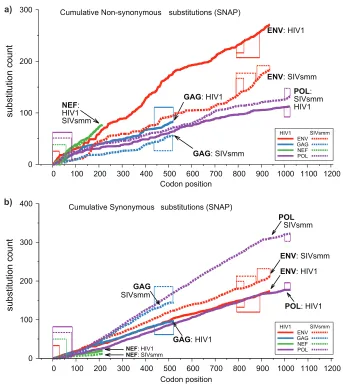
mutations using SNAP (45,46), which plots the cumulative
oc-currence of each type of substitution from start to end of a gene. In the absence of regional differences in selective pressure, the slope is linear (as is generally the case for synonymous substitutions [Fig. 3b]). Regions of positive pressure (diversifying selection)
yield a steeply rising curve in the nonsynonymous plot (Fig. 3a),
showing mutation accumulation, while regions under strong neg-ative (stabilizing) selection are level. SIVsmm Pol, Env, and Gag genes have accumulated many more synonymous substitutions
than their HIV counterparts (Fig. 3b), as would be expected in a
much older epidemic, in which silent mutations may be nearly saturated. Nonsynonymous substitutions, on the other hand, ap-pear to have accumulated much more rapidly, relatively speaking,
in HIV-1 Env than in SIVsmm Env (Fig. 3a): compared to HIV-1
Pol, SIVsmm Pol appears to be subject to slightly reduced stabi-lizing selection, while SIVsmm Gag has both fewer
nonsynony-FIG 2Comparisons of four genes in HIV-1 and SIVsmm based on phylogenetic trees inferred from amino acid and nucleotide data. (a) Maximum likelihood trees (95). Each panel contains 4 trees for a single gene (two viruses, HIV-1 and SIVsmm, and two data types, amino acid and nucleotide sequences); all trees in all panels are drawn to the same scale (number of expected substitutions per site). HIV-1 trees are midpoint rooted, SIVsmm trees are rooted on SMM.SL.1992.SL92B.AF334679⫹SIVsm92A. The distributions of intertaxon distances within trees are presented using box-and-whisker plots, with interquar-tile ranges (25th to 75th perceninterquar-tile) as heavy bars, medians as white lines, and extreme values as thin vertical lines; a heavy red line is drawn between the median of each AA tree branch-length distribution to the median of the DNA tree branch-length distribution. The median value for all HIV/HIV and SIV/SIV pairwise intertaxon distances (0.2646 expected substitution per site) is shown with a dotted line; a thin gray solid line marks zero. The long branches in the SIV Gag and Pol trees (which are broken into two additive pieces) represent sequence SMM.SL.1992.SL92B.AF334679, which is possibly recombinant with an unknown viral lineage in these genes (Sharp, personal communication). HIV clades with more than 2 taxa are identified by a letter at the base of the clade or with a bracket if not recovered as monophyletic; clades represented by 1 or 2 taxa are labeled at the branch tips. Small stars mark the HIV-1 reference sequence HXB2/K03455 and the two SIVsmm E660 sequences that are most closely related to the prospective SIV challenge strain. (b) Branch length distributions for each tree (kernel density estimates based on all pairwise intertaxon distances). Intertaxon pairwise distances are represented by solid lines for DNA trees, and dotted lines for amino acid (AA) trees.
on November 7, 2019 by guest
http://jvi.asm.org/
mous substitutions and more synonymous substitutions than its HIV-1 counterpart. In several regions of the genes in this study, overlapping reading frames impose additional selective con-straints, complicating the analysis (such regions are retained but
indicated with horizontal bars inFig. 3and4); despite these
com-plications, some potential local regional differences in the non-synonymous mutation rates between gene regions in HIV and
SIVsmm are apparent (Fig. 3a).
(ii) MEME. We next compared patterns of selection at a
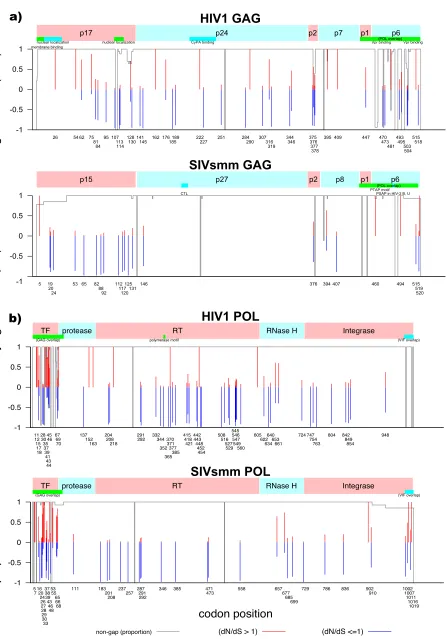
codon-by-codon level, measuring phylogenetically corrected
ra-tios of nonsynonymous to synonymous changes (dN/dSratios) by
codon in SIVsmm versus HIV-1 in Gag, Pol, Env, and Nef using a mixed-effects model of evolution (MEME) developed by
Kosak-ovsky Pond and colleagues (http://www.datamonkey.org/help
/meme.php). MEME provides a statistical framework to iden-tify positive selection in particular positions in sublineages within a phylogenetic tree even when positive selection is not
evident across the entire tree (48, 62). To highlight regional
differences in selection within each protein, we represent this
analysis in a site-by-site graphic (Fig. 4) rather than averaging
across entire genes.
Several patterns emerge from these analyses. In general, except for some regional hot spots, positive selection is far less common in SIVsmm than in HIV-1. Of the four proteins studied, Nef was the only one that had evidence of comparable selective pressures
in HIV-1 and SIVsmm (Fig. 3and4d). There are sites scattered
throughout HIV-1 Gag that show recurrent selection throughout the phylogenetic tree (i.e., support for positive selection on a high
proportion of branches [Fig. 4a]), while the SIV capsid gene, p27,
showed no sites with statistical evidence for selection (see Discus-sion). Similarly, other relatively conserved proteins in these vi-ruses (reverse transcriptase [RT] and protease) showed multiple sites evolving under positive selection in HIV but little or no evi-dence of selection in SIV.
FIG 3Gene-by-gene comparisons of nonsynonymous (a) and synonymous (b) nucleotide changes in HIV-1 and SIVsmm Env, Pol, Gag, and Nef genes. SNAP analysis (http://hiv.lanl.gov/content/sequence/SNAP/SNAP.html) indicates cumulative codon changes progressing from 5=(N terminus [left]) to 3=(C terminus [right]) of individual genes. Local regions with higher rates of accumulating mutations have a larger positive slope. Synonymous substitutions accumulate steadily across the genes (b); regions under strong negative (stabilizing) selection are level in the nonsynonymous graph (a), and regions that are under stronger positive selection have a steeper slope. While substitution rates track similarly between the same proteins in HIV and SIVsmm, there are some distinctive regions, particularly in Env (a) (in red). Horizontal lines with dropped verticals delimit gene regions that are also translated in alternate reading frames. Solid lines, HIV-1; dashed lines, SIVsmm.
Fischer et al.
on November 7, 2019 by guest
http://jvi.asm.org/
[image:6.585.120.463.62.449.2]FIG 4Continued on following page
on November 7, 2019 by guest
http://jvi.asm.org/
[image:7.585.75.522.56.695.2]Fischer et al.
on November 7, 2019 by guest
http://jvi.asm.org/
In contrast, the upstream transframe (TF) region of Pol poly-protein, which precedes protease and overlaps with Gag in a dif-ferent reading frame, has many sites with strong selective signals in
both SIV and HIV (Fig. 4b); it is also subject to length variation.
This small stretch of protein is autocatalytically cleaved by pro-tease and is not very constrained in terms of mutational fitness
costs (51), so many changes might be tolerated; however, the
se-lective signal from MEME may be an artifact caused by overlap-ping reading frames (see Discussion below).
Overall, HIV-1 Env appears to be under greater selective pres-sure than SIVsmm Env, with apparent exceptions of V1 and two
regions in the SIVsmm cytoplasmic tail (Fig. 4c). The region
span-ning V1 is hypervariable and in HIV-1 is more commonly mu-tated via insertions and deletions (indels) than via base
substitu-tions (88). Frequent indels in V1 introduce extensive length
variation and overlays of nonhomologous regions. Therefore, the apparently regional increase in variation in SIVsmm relative to
HIV-1 is likely to be misleading, since thedN/dSratio as a measure
of evolutionary selective pressure is based on aligned codons and hence does not take into account indels and length variation. While SIVsmm V1 also shows length variation, it is to a much lesser degree and the region is much more readily aligned. Conse-quently, selective pressure on the HIV-1 V1 region is likely to be underestimated relative to SIVsmm by this measure. In contrast, the focused regions of positive selection in the cytoplasmic do-main of SIVsmm gp41 are in regions that are readily aligned; like the Pol TF region, the cytoplasmic tail of Env may tolerate change,
though it is subject to structural constraints (79).
It is likely that some regionally focused MEME-detected in-creases in positive selection are spurious: when reading frames overlap, stabilizing selection in one reading frame will suppress apparently synonymous substitutions in the other frame(s) and thereby give rise to a false signal of positive selection. Most regions of strongly elevated SIVsmm selection detected by MEME in these analyses, including the Pol TF region and the Env cytoplasmic tail, do in fact map to areas with active genes in multiple overlapping
reading frames (Fig. 4), supporting this hypothesis.
Coverage of potential epitopes by candidate SIVsmm and
HIV-1 immunogens.Coverage of potential T cell epitopes based
on sequence substrings (i.e., k-mers) provides a metric of
se-quence diversity that is likely to be both immunologically and epidemiologically relevant: the overlap of amino acid 9-mers be-tween vaccine candidates and target viral populations provides a rough indication of the potential for broad CTL-mediated
protec-tion (19,53). Thus, 9-mer coverage of the different genes of the
SIVsmm and HIV-1 provides a metric for the possible breadth and depth of potential vaccine-induced epitope responses. As we have
seen before (19), we find that in comparisons of within-clade,
cross-clade, and overall lineage coverage by different putative
vac-cine immunogens (Fig. 5and6; see also Fig. S1 in the
supplemen-tal material), single-natural-sequence immunogens are very lim-ited in terms of population coverage of potential epitope diversity
in natural strains; polyvalent mosaic designs can provide dramatic increases in coverage of natural circulating strains. Theoretical
k-mer-based estimates have consistently translated to
cross-reac-tive potential of immune responses in macaque models, as well as in mice (5,42,71,72).
As there is a particular interest in Gag and Env as potential
immunogens (44), we compared potential epitope coverage for
these two proteins, simulating homologous and heterologous challenge experiments in SIV and within-clade and cross-clade vaccination/exposure in HIV-1. For evaluation of coverage in challenge experiments, we used SIVmac sequences obtained
fol-lowing low-dose infection of macaques (40). InFig. 5, we present
9-mer coverage distributions based on target virus populations, showing the potential coverage of a given population by a given vaccine. For HIV-1, we compared coverage of groups of B-clade and C-clade sequences and of a diverse HIV M group sequence set by, in turn, a single B-clade sequence, a single C-clade sequence, or
a 2-sequence mosaic HIV cocktail (Fig. 5aandc). For SIV, we
calculated coverage of swarm sequences of SIVmac239/251 and of SIVmacE660, as well as our diverse SIVsmm population sequence
set (as a comparison to the HIV-1 M group [Fig. 5]), evaluating
SIVmac239, SIVmacE660, and a 2-sequence mosaic SIV cocktail as candidate vaccine inserts.
In HIV-1, for both Env and Gag, cross-clade coverage is poor, within-clade coverage is moderate, and mosaic coverage is
supe-rior to within-clade coverage (Fig. 5aandc). For both SIVmac239
and SIVmacE660 swarm sequences, coverages of cross-clade (“heterologous challenge”) and within-clade (“homologous chal-lenge”) are both considerably higher (and more tightly peaked) than the corresponding HIV-1 coverages: within-clade coverage is very high, cross-clade coverages are moderate, and mosaic cover-age values for SIVmac239 and SIVmacE660 are between cross-clade and within-cross-clade values. Compared to mosaic single-cross-clade coverage values for HIV-1, SIVsmm mosaic coverage values are
equivalent for Gag and much higher for Env (Fig. 5band d).
SIVsmm mosaic coverage of the diverse SIVsmm data set is sub-stantially greater than the comparable mosaic coverage of the HIV-1 M group.
The greatest potential for high-coverage optimized vaccine im-munogens appears to be at moderate levels of variability, e.g., for SIVsmm and HIV-1 Gag, SIVsmm Pol, and the more conserved SIVsmm Env (see Fig. S1c, d, g, k, and l in the supplemental ma-terial). The highly conserved HIV-1 Pol gene, which is reasonably well covered by HXB2 (see Fig. S1i), is more broadly covered by the 2-sequence mosaics (see Fig. S1k), but the advantage is more dramatic for Gag and SIVsmm Pol. The much more variable HIV-1 Env and both Nef proteins are covered at only a moderate level by the mosaics (see Fig. S1h, o, and p), though there is still a substantial improvement compared to the single-sequence im-munogens.
Intriguingly, the potential epitope diversity that has evolved in HIV-1 in less than 100 years is more extensive than the diversity
FIG 4Evidence of episodic diversifying selection in HIV-1, SIVsmm, and SIVmac Gag, Pol, Env, and Nef genes. Codon alignments for each gene were analyzed using the mixed-effects model of evolution (MEME) (12,48) via the DataMonkey website (http://www.datamonkey.org) (13). Thin red and blue bars indicate codon positions with statistically significant evidence of positive selection: the relative lengths of the red and blue portions of each bar denote the relative proportions of branches with positive selection (red) or neutral/stabilizing selection (blue). A thin gray line indicates the proportion of sequences with bases present (in contrast to gaps inserted to maintain the alignment) at each codon position in the alignments used for analysis. Regions where alternate reading frames are present and other regions of interest are denoted by colored bars in the upper plot. Env residues involved in CD4 binding (94) are marked with orange circles.
on November 7, 2019 by guest
http://jvi.asm.org/
found in SIVsmm, which has evolved over thousands of years. An SIVmacE660/SIVmac239 vaccine/heterologous-challenge pair
provides better potential T cell epitope coverage for both Env (Fig.
5b, top and center) and Gag (Fig. 5d, top) than either within- or
between-clade single HIV immunogens. In contrast, a 2-sequence mosaic cocktail yields potential epitope coverage above 60% for
SIVmac239/251 Gag (Fig. 5d, top), a value that is typical of
2-se-quence mosaic coverage of M group isolates.
Potential epitope coverage of individual viral isolates by a sin-gle natural sequence is limited; essentially, the only viral strains well covered by single natural sequences are those to which they are most closely related. In addition to the distributions of
cover-age values within sequence sets (Fig. 5), we also present the
phy-logenetic distribution of coverage for different candidate
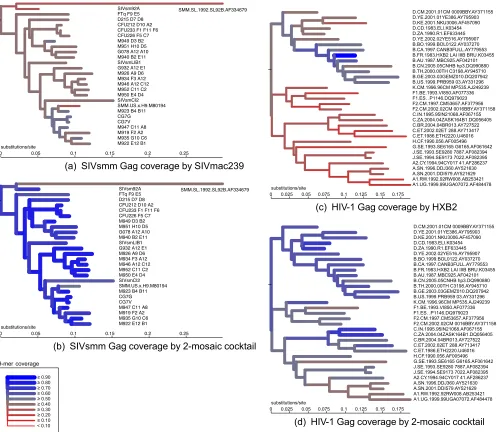
im-munogens for all four genes (Fig. 6features Gag as an example;
Fig. S1 in the supplemental material also includes Env, Pol, and Nef). As expected, there are striking gene-to-gene differences in the proportion of well-covered viral isolates in terms of amino acid 9-mer coverage: Gag and Pol are much more broadly covered than Env or Nef. Notably, the high autologous coverage of natural sequences decays rapidly with increased phylogenetic distance: HXB2 has only moderate coverage of even closely related B-clade
sequences and poor coverage of viruses from other clades (Fig. 6c;
see also Fig. S1i, j, m, and n in the supplemental material). The HIV-1 ENV
0 0.1 0.2
0 20 40 60 80 100
Density function
Coverage of HIV-1 B-clade ... by 2-mosaic cocktail ... by a single B-clade isolate ... by a single C-clade isolate
0 0.1 0.2
0 20 40 60 80 100
Density function
Coverage of HIV-1 C-clade ... by 2-mosaic cocktail ... by a single B-clade isolate ... by a single C-clade isolate
0 0.1 0.2
0 20 40 60 80 100
9-mer Coverage of Individual Sequences (percent) Coverage of HIV-1 M-group
... by 2-mosaic cocktail ... by a single B-clade isolate ... by a single C-clade isolate
(a) SIVsmm ENV
0 0.1 0.2 0.3
0 20 40 60 80 100
Density function
Coverage of SIVsmm Mac239/251 ... by 2-mosaic cocktail
... by a single mac239 ... by a single E660
0 0.1 0.2 0.3 0.4
0 20 40 60 80 100
Density function
Coverage of SIVsmm E660 ... by 2-mosaic cocktail
... by a single mac239 ... by a single E660
0 0.1
0 20 40 60 80 100
9-mer Coverage of Individual Sequences (percent) Coverage of SIVsmm full set
... by 2-mosaic cocktail ... by a single mac239 ... by a single E660 (b)
HIV-1 GAG
0 0.1
0 20 40 60 80 100
Density function
Coverage of HIV-1 B-clade ... by 2-mosaic cocktail ... by a single B-clade isolate ... by a single C-clade isolate
0 0.1 0.2
0 20 40 60 80 100
Density function
Coverage of HIV-1 C-clade ... by 2-mosaic cocktail ... by a single B-clade isolate ... by a single C-clade isolate
0 0.1
0 20 40 60 80 100
9-mer Coverage of Individual Sequences (percent) Coverage of HIV-1 M-group
... by 2-mosaic cocktail ... by a single B-clade isolate ... by a single C-clade isolate
(c) SIVsmm GAG
0 0.1 0.2 0.3 0.4
0 20 40 60 80 100
Density function
Coverage of SIVsmm Mac239/251 ... by 2-mosaic cocktail
... by a single mac239 ... by a single E660
Density function
0 0.1
0 20 40 60 80 100
9-mer Coverage of Individual Sequences (percent) Coverage of SIVsmm full set
... by 2-mosaic cocktail ... by a single mac239 ... by a single E660 (d)
FIG 5Potential epitope coverage by candidate immunogens of different sequence populations: simulated homologous/heterologous or within-clade/interclade challenge using single-sequence and mosaic Env and Gag immunogens. Exact 9-mer coverage is calculated by counting the number of 9-mer amino acid subsequences in each sequence in the “target” group that are present in the candidate immunogen (“vaccine”). Each panel shows a smoothed distribution of coverage values for the sequences in various target sets or challenge populations by three potential immunogens: two natural sequences, used singly, and a bivalent (2-sequence) mosaic. In the case of SIV challenges, the inoculum sequences are not cloned, and so we consider coverage of sets of sequences samples from the complex inoculum. (a) HIV-1 Env (sequences from the LANL HIV-DB 2010 web and subtype reference HIV-1 M group alignments [http://hiv.lanl.gov]): coverage of B-clade sequences (top), C-clade sequences (middle), and the complete M group alignment; coverage by single sequences sampled from B-clade (B.US.1999.PRB959_03.AY331296 [blue]) and C-clade (C.IN.1995.95IN21068.AF067155 [green]) HIV-1; and coverage by a 2-mosaic M group cocktail (5) (red). (b) SIVsmm Env (all SIVsmm isolates fromFig. 1a; swarm E660 and Mac239/251 sequences from reference40): coverage of SIVmac239 and SIVmac251 sequences (top), SIVmacE660 sequences (middle), and the diverse SIVsmm sequence set fromFig. 1a; coverage by single SIVmac sequences SIVmac239 (GenBank accession numberM33262[blue]), E660 (isolate CG7V [green]), and a 2-sequence mosaic cocktail (red). (c) coverage of HIV-1 Gag gp120 by potential immunogens analogous to those in panel c. (d) SIVsmm Gag coverage by potential immunogens analogous to those in panel d; in contrast to Env, there are too few E660 Gag sequences available for meaningful homologous-virus comparisons. As the E660 sequences from this study were missing 42 amino acids at the N terminus, the corresponding amino acids from the closely related H4 isolate (GenBank accession numberX14307) were used for coverage calculations.
Fischer et al.
on November 7, 2019 by guest
http://jvi.asm.org/
[image:10.585.46.546.67.438.2]2-sequence mosaic cocktails, in contrast, maintain a moderate
level of coverage over disparate clades (Fig. 6d; see also Fig. S1k, l,
o, and p in the supplemental material and discussion of isolate breadth below).
DISCUSSION
Our original purpose in sequencing this collection of SIVsmm viruses was to provide a diverse set of SIV sequences to enable the
design of SIV mosaic vaccine antigens (19) to allow efficacy testing
of the mosaic T cell vaccine concept in an SIV vaccine/SIV chal-lenge animal model. Since HIV-1 itself does not infect macaques, protective-efficacy tests of the mosaic HIV-1 vaccine concept re-quire either an SIV mosaic vaccine or the use of a SHIV (HIV Env
cloned into in a SIV backbone) challenge, which is limited and only enables the study of Env vaccine antigens. The strikingly dis-tinct evolutionary pathways of SIVsmm and HIV-1 we present here became evident during sequence analysis for the SIV mosaic design. The caveats we raise should be considered when interpret-ing more traditional heterologous-challenge/vaccine approaches as well as when using the SIV-mosaic strategy we were interested in testing. To assess the potential impact of distinct HIV-1 and SIVsmm evolutionary trajectories in the context of vaccines of experimental interest, we assessed, for both SIVsmm and HIV-1, the 9-mer coverage of two natural sequences and a two-sequence mosaic immunogen. For SIVsmm, we compared the common SIV
FIG 6Maximum likelihood amino acid trees for HIV-1 and SIVsmm Gag (fromFig. 2), showing 9-mer coverage of each sequence by mosaics and by single natural sequences. All trees are drawn to the same scale. The color and line weight of each terminal branch indicate the proportion of each sequence’s amino acid 9-mers that are also present in a candidate vaccine: SIV single natural sequence (SIVmac239) (a), SIVsmm two-sequence mosaic immunogens (b), HIV-1 single natural sequence (HXB2) (c), or HIV-1 two-sequence mosaic immunogens (d). 9-mer coverage is indicated by branch color and thickness: shading from thick blue lines (high coverage) through thin red lines (low coverage). Internal branch colors and weights indicate the arithmetic means of their descendants’ coverages. HIV and SIV sequences that were previously published are named as in the Los Alamos Database, with the subtype indicated as the first letter and then the standard 2-letter country code, year of isolation, name, and accession number.
on November 7, 2019 by guest
http://jvi.asm.org/
[image:11.585.45.542.65.497.2]vaccine/challenge strains SIVmacE660 and SIVmac239 and our newly designed SIV mosaic vaccine set against our collection of diverse natural SIVsmm isolates (the most comprehensive whole-genome sequence set currently available). For HIV-1, we com-pared a single natural B-clade and single natural C-clade se-quences and a set of HIV-1 mosaic vaccine immunogens that are now approaching human phase I safety and immunogenicity trials against a set of HIV-1 M group isolates.
Genetic (DNA-based) distances were roughly comparable be-tween the two viruses, excepting SIVsmm Pol, which has larger
distance values (Fig. 2). At the protein level, however, the SIVsmm
lineage is generally less diverse, and apparently under less positive selective pressure (or under greater fitness constraints), than the HIV-1 M group. Furthermore, inferred positions subject to posi-tive selection were distributed differently among and within dif-ferent proteins in SIVsmm and HIV. The differences in positive selection between HIV-1 and SIVsmm Gag were particularly strik-ing: there are sites scattered throughout HIV-1 Gag that show recurrent selection throughout the phylogenetic tree (i.e., support
for positive selection on a high proportion of branches [Fig. 4a]).
In contrast, SIVsmm Gag was under substantially weaker positive selection (or stronger negative selection, i.e., greater fitness con-straints) than Pol: the SIVsmm p27 capsid (equivalent to HIV-1 p24) showed very little variation at the amino acid level and no
evidence of positive selection at all (Fig. 4a). Capsid (p24/p27) is
one of the more conserved proteins in both HIV and SIV, and certain HIV p24 epitopes are targets for HLA-restricted T cell
responses associated with viral control and long-term survival (67,
80). Despite the overall conservation of HIV-1 p24, these epitopes
still vary under CTL-mediated immune pressure, and it has been hypothesized that immune escape from these epitopes comes at a high fitness cost for the virus, contributing to the beneficial effect
associated with particular HLAs (60). The lack of inferred
selec-tion in SIVsmm p27 suggests either that the SIVsmm capsid pro-tein is generally less tolerant of mutation than the HIV-1 capsid or that mangabeys lack the potent Gag-directed immune responses
seen in humans (67, 80) and in macaques (55, 86). The latter
explanation appears probable: although sooty mangabeys make CTL responses to SIV infection that are strong enough to drive
viral escape (34,36), and although Gag-directed CTL responses in
particular do indeed exist in sooty mangabeys (59,84), both the
magnitude and breadth of CTL responses are reduced in SIVsmm-infected sooty mangabeys compared with those in HIV-SIVsmm-infected
humans (15). Furthermore, SIVsmm-infected sooty mangabeys
have lower neutralizing antibody titers than HIV-infected
hu-mans (35,52) or SIVmac-infected rhesus macaques. In
SIVagm-infected African green monkeys (56), another “natural host,”
anti-p27 antibody responses are also much weaker than in rhesus macaques; this may be a general feature of nonpathogenic primate
lentiviral infections (28,35). Finally, CD8⫹T cell depletion
exper-iments with SIVsmm-infected sooty mangabeys (6) showed
smaller effects on viral load than cognate experiments with
ma-caques (32,57,75) and African green monkeys (22). These
com-bined data suggest that immunological pressure on SIVsmm p27 is much lower than on HIV-1 p24. Therefore, the observed varia-tion in SIVsmm more likely results from gradual accrual of muta-tions over time (i.e., genetic drift) than from rapid selection for immune evasion. In contrast, rapid immune escape is a major aspect of positive selection in HIV-1: most early mutations are
concentrated within T cell epitopes (17,18,25,27), viruses within
individuals continually evolve to escape from neutralizing
anti-bodies during chronic infection (3,61,91), and HLA imprinting is
evident in viruses circulating in different human populations (37,67).
The HIV-1 M group has likely been evolving in the human
population for on the order of 100 years (43, 89). The much
greater age of the “natural host” epidemics in African monkeys,
and in sooty mangabeys in particular (90), is consistent with the
greater extent of silent mutations we observed in SIVsmm, and it would furthermore allow the evolution of higher degrees of viral tolerance (virus/host coevolution for reduced pathogenicity). Sooty mangabeys, like African green monkeys, rarely progress to AIDS despite high-intensity SIVsmm infection; one mechanism by which tolerance is achieved in mangabeys is reduced immune
activation (8,15,16,74). Rates of progression to AIDS are
associ-ated with chronic immune activation (24), and the failure to
downregulate interferon-stimulated genes after acute infection appears to be restricted to the pathological infections that occur in
macaques and humans (8). In any case, the combined
immuno-logical and natural selection data argue strongly that the non-pathogenicity of SIVsmm in mangabeys is not due to a more ef-fective immune response, and SIVsmm diversity appears to have evolved under lower immune pressure than HIV-1 diversity.
Diversity is of course a central problem in HIV vaccine design. A vaccine that protects against (or mitigates) HIV-1 infection must induce cross-reactive immunity against pandemic variants. We have proposed mosaic vaccines as a strategy for inducing suf-ficient numbers of T cell immune responses that cross-react with
many different HIV-1 variants (19).
To quantify T cell cross-reactivity, we previously distinguished
between breadth and depth of T cell responses (5), breadth
refer-ring to the summed quantities (counts) of different epitope loci recognized and depth referring to the recognition of multiple
vari-ants at individual epitope loci. In previous experimental work (70,
71, 72), we assessed the cross-reactivity of vaccine-induced
re-sponses by comprehensively testing peptides derived from diverse HIV-1 isolates. We here introduce the theoretical counterpart, the concept of “isolate breadth,” meaning the proportion of viral iso-lates from a given population for which a vaccine candidate has potential epitope coverage above a given threshold. A vaccine im-munogen (or imim-munogen set) with high isolate breadth will match large portions of many sequences in a target population, and hence the responses it induces are more likely to cross-react with epitopes of an infecting virus. As expected based on earlier findings, a stark contrast in isolate breadth is evident between the 2-mosaic immunogen cocktails and the single “standard strain”
sequences (Fig. 6; see also Fig. S1 in the supplemental material).
The contrast is consistent within both viruses and all four genes tested, not only in the highly variable Env and Nef genes but also in the relatively more conserved Pol and Gag. Since multiple vac-cine-induced epitope responses per gene appear to be correlated with protection against stringent heterologous challenge in
ma-caques (55,86), and the potential epitope overlap of any single
natural sequence with any likely infective strain is low (72),
opti-mized high-coverage immunogens such as mosaics are much more likely than single-sequence natural immunogens to have protective efficacy against HIV-1 exposure “in the wild.”
The importance of sufficient diversity in SIV heterologous-challenge studies must be emphasized: although SIVmac239 and SIVmac251 have been described by some authors as heterologous
Fischer et al.
on November 7, 2019 by guest
http://jvi.asm.org/
challenge pairs, an SIVmac251 challenge of
SIVmac239-vacci-nated animals (for examples, see references14and31), or vice
versa, cannot be considered heterologous. SIVmac239 and SIVmac251 originated in the same individual macaque (Mm251-79) and are far more closely related than circulating HIV-1
se-quences even within the same clade (Fig. 1); SIVmac239 is a clone
isolated after additional macaque passages of SIVmac251 (11,30,
63). For a heterologous challenge to resemble the distances
ob-served in the HIV circulating population, more distant viruses must be used as vaccine/challenge pairs (for instance, SIVmac239/
SIVmac251 vaccination followed by SIVmacE660 challenge [7,50,
66, 92]). SIVmacE660 is phylogenetically distinct from the
SIVmac251/239 lineage (Fig. 1), and the genetic distance between
the SIVmacE660 and SIVmac239/251 lineages is roughly compa-rable to the distances between HIV-1 strains circulating in the
human population (93); the criteria of phylogenetic distinctness
and genetic distance should always be evaluated for proposed vac-cine/challenge pairs.
Using natural variation from SIV-infected sooty mangabeys
(1) enables comparisons between polyvalent design strategies that
attempt to more comprehensively address diversity and other, more traditional, polyvalent or monovalent natural-strain im-munogens. Based on this premise, we gathered and sequenced novel SIVsmm strains, combined the results with existing data, and, using the full data from this augmented set, designed an SIVsmm polyvalent mosaic vaccine, which will be tested for effi-cacy in macaques (G.J.N., study in progress). Mosaic vaccines have been shown to induce greater numbers of epitope responses
and enhanced cross-reactivity of responses (5,71,72) compared
to those of monovalent immunogens; the mosaic design presented here will enable us to test whether either or both of these improve-ments in immunological response may result in effective T cell responses to pathogenic heterologous viral challenge.
Considerable thought has been applied to evaluating the dif-ferences between the macaque and human immune responses to immunodeficiency viruses in the context of vaccine development
(reviewed in reference76). In contrast, we are here attempting to
highlight the potential importance of the viral component in as-sessing the applicability of the SIV/macaque model. The differ-ences between the immune responses of both macaque and human nonnatural hosts are of course significant, but while ma-caques’ immune responses to SIVsmm may indeed be more hu-man-like than those of mangabeys, the diversity against which they are challenged appears to be derived from a much different set of selective pressures, and such differences may affect heterol-ogous challenge. For instance, as we discuss above, SIVsmm cap-sid (p27), Pol RT, and Env gp120 appear to have evolved under low immunological pressure in sooty mangabeys, and they show reduced signatures of selection. The corresponding HIV-1 pro-teins, in contrast, have been subjected to intense immune pres-sure, and HIV-1 population diversity has adapted, to some degree,
to the immunological diversity of its human host populations (67,
73). Vaccine-induced CTL responses in macaques (e.g., to the
SIVmac CM9 Gag epitope [92]) can be correlated with reduced
viral load; furthermore, the overall number of Gag-directed CTL
responses is correlated with viral control (55,86), and CTL
re-sponses can control viral replication in the absence of neutralizing
antibodies (87). However, the relative benefits of a Gag-directed
response against SIV in macaques (e.g., versus Nef- or Env-di-rected responses) might not be paralleled in a human population:
whether particular benefits of particular responses to particular proteins observed in SIV/macaque heterologous-challenge mod-els will translate to HIV in humans remains an open question. This is because the sequence diversity in SIVsmm-derived heterolo-gous macaque challenges is not adapted to the macaque immune system, so even if the immune responses were qualitatively similar between macaques and humans, the viral diversity is not. Identical considerations apply to neutralizing antibody responses, since SIVmac Env protein diversity has largely evolved in the absence of strong antibody responses.
In short, the origin of interstrain diversity in macaque-adapted SIV strains is different from the origin of interclade and within-clade HIV diversity. HIV-1 diversifies under immune pressure and selection for rapid transmission; as we discuss above, SIVsmm appears to have diversified under reduced immune pressure, as
well as long-term selection for low pathogenicity (78).
Through-out the spread of the HIV-1 pandemic, the initial low diversity of small viral founder populations has expanded dramatically (both within and outside Africa) via continuous passage in hosts with highly active immune systems. Laboratory SIVmac variants orig-inated from sooty mangabey-adapted lineages, with a history of reduced immune pressure, and they have not been continuously passaged in a host with strong immune responses. Therefore, even if sequence diversity between two SIVsmm or SIVmac isolates arithmetically approximates the diversity between two HIV-1 iso-lates, it may not be functionally equivalent in terms of induced immune responses, and the degree of heterology against which a vaccine might be protective (i.e., the breadth of protection) may not be easily predicted from a macaque model.
Nonhuman primate models are nevertheless an invaluable tool for studying immune responses to HIV, and careful use of the various SIV/macaque models will advance the imperative goal of a protective HIV vaccine. However, the differences in immunology,
pathogenesis, and diversity (29,85), as well as the distinctive
evo-lutionary pressures in the SIVsmm and HIV-1 M groups discussed here, should be considered when extrapolating from SIV/ma-caque experimental results to HIV/human vaccine applications.
ACKNOWLEDGMENTS
Many of the full-length SIVsmm sequences listed inTable 1and in Table S1 in the supplemental material were generated by the late Matthias Kraus; other viral isolates (Table 2) were kindly provided by Martine Peeters and Preston Marx. We thank Michael Worobey and Paul Sharp for useful comments on the manuscript.
This research was supported by the National Institutes of Health via the following grants: AI-067854 (CHAVI) from the Division of AIDS, NIAID (W.F., B.T.K., G.M.S., B.H.H., M.L.S., and Y.L.), R01 AI-065325 (C.A., I.P., and R.G.), and R37 50529, R21 087383, and P01 AI-088564 (G.M.S., B.H.H., M.L.S., and Y.L.), as well as by the Los Alamos National Laboratory Directed Research and Development program (W.F. and B.T.K.), the Bill and Melinda Gates Foundation (G.M.S., B.H.H., M.L.S., and Y.L.), and the intramural research program of the Vaccine Research Center, NIAID, NIH, through NIH/DOE interagency agree-ment NIH Y1-A1-8309 (W.F. and B.T.K.).
REFERENCES
1.Apetrei C, et al.2007. Virus subtype-specific features of natural simian immunodeficiency virus SIVsmm infection in sooty mangabeys. J. Virol. 81:7913–7923.
2.Apetrei C, et al.2005. Molecular epidemiology of simian immunodefi-ciency virus SIVsm in U.S. primate centers unravels the origin of SIVmac and SIVstm. J. Virol.79:8991–9005.
on November 7, 2019 by guest
http://jvi.asm.org/
3.Bar KJ, et al.2012. Early low-titer neutralizing antibodies impede HIV-1 replication and select for virus escape. PLoS Pathog.8:e1002721. doi: 10.1371/journal.ppat.1002721.
4.Barouch DH, et al.2012. Vaccine protection against acquisition of neu-tralization-resistant SIV challenges in rhesus monkeys. Nature482:89 –93. 5.Barouch DH, et al.2010. Mosaic HIV-1 vaccines expand the breadth and depth of cellular immune responses in rhesus monkeys. Nat. Med.16: 319 –323.
6.Barry AP, et al.2007. Depletion of CD8⫹cells in sooty mangabey mon-keys naturally infected with simian immunodeficiency virus reveals lim-ited role for immune control of virus replication in a natural host species. J. Immunol.178:8002– 8012.
7. Berry N, et al. 2011. Early potent protection against heterologous SIVsmE660 challenge following live attenuated SIV vaccination in Mau-ritian cynomolgus macaques. PLoS One 6:e23092. doi:10.1371/ journal.pone.0023092.
8.Bosinger SE, Jacquelin B, Benecke A, Silvestri G, Müller-Trutwin M. 2012. Systems biology of natural simian immunodeficiency virus infec-tions. Curr. Opin. HIV AIDS7:71–78.
9.Brenchley JM, Paiardini M.2011. Immunodeficiency lentiviral infections in natural and non-natural hosts. Blood118:847– 854.
10. Brenchley JM, et al.2004. CD4⫹T cell depletion during all stages of HIV disease occurs predominantly in the gastrointestinal tract. J. Exp. Med. 200:749 –759.
11. Daniel MD, et al.1985. Isolation of T-cell tropic HTLV-III-like retrovirus from macaques. Science228:1201–1204.
12. Delport W, Poon A, Frost SD, Kosakovsky Pond SL.2011. Mixed Effects Model of Evolution (MEME).http://www.datamonkey.org/help/meme .php.
13. Delport W, Poon AFY, Frost SDW, Kosakovsky Pond SL.2010. Data-monkey 2010: a suite of phylogenetic analysis tools for evolutionary biol-ogy. Bioinformatics26:2455–2457.
14. Dubie RA, et al.2009. Co-immunization with IL-15 enhances cellular immune responses induced by avif-deleted simian immunodeficiency virus proviral DNA vaccine and confers partial protection against vaginal challenge with SIVmac251. Virology386:109 –121.
15. Dunham R, et al.2006. The AIDS resistance of naturally SIV-infected sooty mangabeys is independent of cellular immunity to the virus. Blood 108:209 –217.
16. Estes JD, et al.2008. Early resolution of acute immune activation and induction of PD-1 in SIV-infected sooty mangabeys distinguishes non-pathogenic from non-pathogenic infection in rhesus macaques. J. Immunol. 180:6798 – 6807.
17. Ferrari G, et al.2011. Relationship between functional profile of HIV-1 specific CD8 T cells and epitope variability with the selection of escape mutants in acute HIV-1 infection. PLoS Pathog.7:e1001273. doi:10.1371/ journal.ppat.1001273.
18. Fischer W, et al.2010. Transmission of single HIV-1 genomes and dy-namics of early immune escape revealed by ultra-deep sequencing. PLoS One5:e12303. doi:10.1371/journal.pone.0012303.
19. Fischer W, et al.2007. Polyvalent vaccines for optimal coverage of po-tential T-cell epitopes in global HIV-1 variants. Nat. Med.13:100 –106. 20. Fukazawa Y, et al.2012. Lymph node T cell responses predict the efficacy
of live attenuated SIV vaccines. Nat. Med. [Epub ahead of print.] doi: 10.1038/nm.2934.
21. Fultz PN, et al.1990. Humoral response to SIV/SMM infection in ma-caque and mangabey monkeys. J. Acquir. Immune Defic. Syndr.3:319 – 329.
22. Gaufin T, et al.2010. Experimental depletion of CD8⫹cells in acutely SIVagm-infected African green monkeys results in increased viral replica-tion. Retrovirology7:42.
23. Gautam R, et al.2007. In vitro characterization of primary SIVsmm isolates belonging to different lineages. In vitro growth on rhesus macaque cells is not predictive for in vivo replication in rhesus macaques. Virology 362:257–270.
24. Giorgi JV, et al.2002. Predictive value of immunologic and virologic markers after long or short duration of HIV-1 infection. J. Acquir. Im-mune Defic. Syndr.29:346 –355.
25. Goonetilleke N, et al.2009. The first T cell response to transmitted/ founder virus contributes to the control of acute viremia in HIV-1 infec-tion. J. Exp. Med.206:1253–1272.
26. Hansen SG, et al.2011. Profound early control of highly pathogenic SIV by an effector memory T-cell vaccine. Nature473:523–527.
27. Henn MR, et al.2012. Whole genome deep sequencing of HIV-1 reveals the impact of early minor variants upon immune recognition during acute infection. PLoS Pathog.8:e1002529. doi:10.1371/journal.ppat.1002529. 28. Hirsch VM.2004. What can natural infection of African monkeys with
simian immunodeficiency virus tell us about the pathogenesis of AIDS? AIDS Rev.6:40 –53.
29. Hirsch VM, Johnson PR.1994. Pathogenic diversity of simian immuno-deficiency viruses. Virus Res.32:183–203.
30. Hunt RD, et al.1983. Transmission of naturally occurring lymphoma in macaque monkeys. Proc. Natl. Acad. Sci. U. S. A.80:5085–5089. 31. Hutnick NA, et al.2012. An optimized SIV DNA vaccine can serve as a
boost for Ad5 and provide partial protection from a high-dose SIVmac251 challenge. Vaccine30:3202–3208.
32. Jin X, et al.1999. Dramatic rise in plasma viremia after CD8(⫹) T cell depletion in simian immunodeficiency virus-infected macaques. J. Exp. Med.189:991–998.
33. Junier T, Zdobnov EM.2010. The Newick Utilities: high-throughput phylogenetic tree processing in the UNIX shell. Bioinformatics26:1669 – 1670.
34. Kaur A, et al.2001. Emergence of cytotoxic T lymphocyte escape muta-tions in nonpathogenic simian immunodeficiency virus infection. Eur. J. Immunol.31:3207–3217.
35. Kaur A, et al.1998. Diverse host responses and outcomes following simian immunodeficiency virus SIVmac239 infection in sooty mangabeys and rhesus macaques. J. Virol.72:9597–9611.
36. Kaur A, et al.2000. Identification of multiple simian immunodeficiency virus (SIV)-specific CTL epitopes in sooty mangabeys with natural and experimentally acquired SIV infection. J. Immunol.164:934 –943. 37. Kawashima Y, et al.2009. Adaptation of HIV-1 to human leukocyte
antigen class I. Nature458:641– 645.
38. Keele BF, et al.2008. Identification and characterization of transmitted and early founder virus envelopes in primary HIV-1 infection. Proc. Natl. Acad. Sci. U. S. A.105:7552–7557.
39. Keele BF, et al.2009. Increased mortality and AIDS-like immunopathol-ogy in wild chimpanzees infected with SIVcpz. Nature460:515–519. 40. Keele BF, et al.2009. Low-dose rectal inoculation of rhesus macaques by
SIVsmE660 or SIVmac251 recapitulates human mucosal infection by HIV-1. J. Exp. Med.206:1117–1134.
41. Klatt NR, Silvestri G, Hirsch V.2012. Nonpathogenic simian immuno-deficiency virus infections. Cold Spring Harb. Perspect. Med.2:a007153. doi:10.1101/cshperspect.a007153.
42. Kong W-P, et al.2009. Expanded breadth of the T-cell response to mosaic human immunodeficiency virus type 1 envelope DNA vaccination. J. Vi-rol.83:2201–2215.
43. Korber B, et al.2000. Timing the ancestor of the HIV-1 pandemic strains. Science288:1789 –1796.
44. Korber BT, Letvin NL, Haynes BF.2009. T-cell vaccine strategies for human immunodeficiency virus, the virus with a thousand faces. J. Virol. 83:8300 – 8314.
45. Korber BTM.2000. HIV signature and sequence variation analysis, p 55–72.InRodrigo AG, Learn GH (ed), Computational analysis of HIV molecular sequences. Kluwer Academic Publishers, Dordrecht, Nether-lands.
46. Korber BTM.2000. SNAP: Synonymous Non-synonymous Analysis Pro-gram.http://www.hiv.lanl.gov/content/sequence/SNAP/SNAP.html. 47. Kosakovsky Pond SL, et al.2006. Adaptation to different human
popu-lations by HIV-1 revealed by codon-based analyses. PLoS Comput. Biol. 2:e62. doi:10.1371/journal.pcbi.0020062.
48. Kosakovsky Pond SL, et al.2011. A random effects branch-site model for detecting episodic diversifying selection. Mol. Biol. Evol.28:3033–3043. 49. Kosakovsky Pond SL, Posada D, Gravenor MB, Woelk CH, Frost SDW.
2006. Automated phylogenetic detection of recombination using a genetic algorithm. Mol. Biol. Evol.23:1891–1901.
50. Lai L, et al.2012. SIVmac239 MVA vaccine with and without a DNA prime, similar prevention of infection by a repeated dose SIVsmE660 chal-lenge despite different immune responses. Vaccine30:1737–1745. 51. Leiherer A, Ludwig C, Wagner R.2009. Uncoupling human
immuno-deficiency virus type 1 Gag and Pol reading frames: role of the transframe protein p6* in viral replication. J. Virol.83:7210 –7220.
52. Li B, et al.2010. Nonpathogenic simian immunodeficiency virus infec-tion of sooty mangabeys is not associated with high levels of autologous neutralizing antibodies. J. Virol.84:6248 – 6253.
Fischer et al.