DATABASE NARRATIVES
Possibility Spaces: Shape-shifting and interactivity in
digital documentary
by Janet Marles
Any new medium must resolve its place in relation to narrative (Toffs 2005, 104).
Working digitally allows the “conventional” documentary narrative form to shift from temporal to spatial, from horizontal to vertical, from sequential to concurrent. Digitality also provides interactivity. With interactivity comes a potentially spontaneous, engaged and active audience able to choose how they receive the content. Yet, documentaries need to convey crucial pieces of their narrative for their story to be comprehensible to their audience. The critical question for documentary makers, then, is how to incorporate these new digital technologies, with their potential for innovative narrative structures, and still make a factual story understandable to their audience.
Identifying the Internet as the primary site that has opened up space for digital storytelling Lundby (2008) says,
(The Internet) offered new options to share the “classical” small-scale stories created in story circles at various corners of the globe. The World Wide Web also gave rise to new forms, Blogging, in text only or with video, as well as the social networking sites on the web offer new opportunities to share short personal stories (3).
Examples of these online story spaces will be explored in this paper, along with early television forms, computer specific forms, gallery specific forms and performative forms. This selection of work illustrates the experimentation with digital form that Manovich in “The Language of New Media” (2001) terms “database narrative” and Hayles (2005) calls “possibility space”. Both terms help to define the territory in which the form of documentary is shape-shifting as a result of the revolution in digital technology.
Shape-shifting: documentary”s changing form
By the end of the 1990s the aesthetics of interaction, grounded in the video game paradigm, had become a familiar way of doing things in the name of culture. The age of interaction had arrived (Toffs 2005, 8).
Documentary form is being radically re-shaped as it responds to the digital revolution in recording, editing and the emergence of new media platforms that have allowed for more diverse uses of documentary production and distribution. Hight (2008) suggests with increased capacity, cheaper costs, and faster production of digital recording and editing and the subsequent explosion of content distribution and exhibition networks via the Internet, documentary has begun to be quintessentially transformed.
Similarly, historian and new media researcher, Paul Arthur (2008) has identified digital history productions, as benefiting from the “diversification of modes of public access and delivery” (187) brought about by the digital revolution. Further, he claims that digital technologies have facilitated a “democratization of history enabling everyone to become possible contributors to the ongoing process of shaping and reshaping history” (188).
Sorenssen (2008) also advocates the democratic potential of digital media. Citing the example of an eighty-two year old British man who became a YouTube® sensation with his regular video blog geriatric1927. Sorenssen shows how this octogenarian, regularly engaging with a medium considered by many to be the domain of the young fulfills Alexandre Astruc”s belief from 1948 that new media forms would democratise, rejuvenate and liberate media forms, especially film.
Specifically, as digital documentary changes in form and audience members become active participants in the process of viewing the production, can the documentary producer be confident that their audience will receive vital aspects of the documentary content? If the audience is able to skip around the story space, cherry picking the pieces they want to access, how can the documentary maker be certain they will access crucial parts of the story?
The challenge for producers is to engage with the new skills of the digital revolution yet ensure their audience receives the parts of the narrative that makes their story comprehensible. Documentary makers must adapt and stay in tune with the shape-shifting taking place in the digital documentary form.
“We are entering an age of narrative chaos, where traditional frameworks are being overthrown by emergent experimental and radical attempts to remaster the art of storytelling in developing technologies” (Rieser and Zapp 2002, xxv).
Perhaps what is needed for digital documentary to take advantage of the new spatial forms and interactivity that the digital and online platforms provide, whilst also remaining understandable to audiences, is a combination of narrative modes - linear and non-linear, temporal and spatial, interactive and passive.
Traditional temporal linear narrative
Classical narratives predominantly follow the Aristotelian model of revealing dramatic events, whether they are factual or fictitious, in a realistic fashion using characters as tools to create identification in the audience. As Zapp (2002) says,
The viewer is taking on the role of a voyeur, witness or emotional judge. He or she is immersed in the story by emotional means of identification, as the plot aims to provoke sympathy or antipathy with the characters or draws possible parallels to the viewer”s subjective reality (78).
Dovey (2002) describes this audience identification as a type of transportation, which is achieved
through structural temporal devices. “Linear succession, cause-and-effect, is what allows the reader/user to “relax” into the tale. … The reader/ user is left with the satisfaction of an experience with beginnings, middles and ends” (143-4). Le Grice (2001) also acknowledges the importance of temporal form in linear narrative and says “narrative is a method by which events – real or imaginary – are given coherence through the representation of sequential connections”(290). Manovich (2002) agrees, stating “cinema … replaced all other modes of narration with a sequential narrative; an assembly line of shots which appear on the screen one at a time”(69).
Consequently, temporal linear narrative became the primary mode of cinematic story telling, yet representing sequential linear time in film does not necessarily equate to chronological story telling. As Rieser (2002) explains “the very linearity of film stimulated a number of conventions to counteract its effect. Flashbacks, jump-cuts, etc. reintroduced fluidity to a rigid medium” (147-8). These conventions may have varied the order of time in the narrative. However, they did not change the intrinsic temporality of the product. The linear, horizontal, sequential and temporal features nevertheless remain.
Emerging spatial non-linear narrative
In our digital era this linear temporality is now being challenged in a more significant way. As Le Grice (2001) points out, the very essence of digital forms is non-linear and in addition the way a computer stores data does not require a linear process or understanding. He says “the computer, which is fundamentally based on what is called Random Access Memory … is the designation of the non-sequentiality of memory addressing – intrinsically opens up the condition of non-linearity”(296). Further,
medium (both film and video are locked into the mechanics of the linear sequence of the recording medium). Through the Random Access Memory (RAM) structure of the computer, the sequence of retrieval does not have to match the sequence of storage and all address locations are effectively equidistant (282).
Yet Le Grice (2001) also recognises that simply because a film is produced using digital processes, this does not necessarily make it non-linear. He claims, “the current fashionability of the term non-linear creates some problem of definition” (289), because although film-makers are now using non-linear systems more and more, particularly non-linear editing systems, these systems are only non-linear in the way they store and retrieve data, however, “the principles on which they (the edited segments) are combined in the finished product conform to linear narrative concepts. The technology allows non-linearity – the concepts remain linear”. As Hales (2002) puts it “in this case the technology is not leading to a change in thinking simply a way of getting things done more efficiently and more economically”(105).
Cubitt (2002) highlights the increase in narrative forms through “the rise of the popular press, film, radio and television”, yet marvels at the longevity of linear narratives in this digital era stating,
The remarkable persistence of narrative in twentieth-century media can only be apprehended as remarkable if we apprehend the environment in which it is now performed, a landscape of other modes of documentation and dissemination. Crucial among them are forms of data storage and retrieval that are not structures in time, as is the narrative, but in space (105).
Manovich (2006) explains this perseverance of traditional narrative as the predisposition for new technology to mirror the technology it is replacing. He says “one way in which change happens in nature, society, and culture is inside out. The internal structure changes first, and this change affects the visible skin only later” (2). Hence the first car resembled a horse drawn carriage and new media forms continue the use of temporal linear narrative within their spatial non-linear domain. Manovich refers to the inside out phenomenon
as “uneven development” and claims it hinders our appreciation “that new media does represent a new avant-garde of information society even though it often uses old modernist forms”. Further he says,
If the 1920s avant-garde came up with new forms for new media of their time (photography, film, new printing and architectural technologies), the new media avant-garde introduces radically new ways of using already accumulated media. In other words, the “new avant-garde” is the computer-based techniques of media access, manipulation and analysis (2).
Manovich gives as an early example of this new media avant-garde the work of a group of graduate students from Helsinki’s University of Art and Design. He describes their interactive late-night television program Akvaario (Aquarium) (2000), created for the Finnish national broadcasting company Channel 1, as a “database narrative”
It is … a narrative, which fully utilizes many features of a database’s organization of data. It relies on our
abilities to classify database records according to different dimensions, to sort through records, to quickly retrieve any record, as well as to “stream” a number of different records continuously one after another (Manovich 2002, 66-7).
So a work does not become non-linear simply by using digital applications or digital storage and retrieval systems, there has to be a change in the structure of the work from one based on time to one based on space. It is the added ability to move around within the work, to navigate vertically as well as horizontally, to explore spatial relationships as well as temporal relationships and to have access to media components in a simultaneous as well as a sequential way that changes it from linear to non-linear. As Dovey (2002) says,
Hypertextual ways of working… invite us both as authors and users to experience information as a spatial arrangement. We are called upon to navigate the database in order to make sense of what is stored within. Knowledge that may once have been transmitted in narrative form, as a story, novel, report, essay or article, can now be
accessed through a network of links in which a spatial relation between component parts can be preserved (140).
In “The Language of New Media Manovich” (2001) explains the conflict between database and narrative; databases are spatial and concurrent, narratives are linear and sequential. He claims all new media works are primarily databases and that while a database “can support narrative, there is nothing in the logic of the medium itself which would foster its generation” (201).
Hayles (2005) challenges Manovich’s analysis explaining neither database, nor narrative are terms that are adequate to explain the phenomenon of interactive digital media. For Hayles both terms, individually and in combination, are too confined. She prefers the term “possibility space”, which opens up the arena for “a flexible, wide-ranging framework” through which to position such interactive digital works (1).
Hayles’ thesis is that computer generated, database narratives (non-linear and linear) are not at odds with each other or considered to be in a competitive relationship with one another, despite Manovich declaring “why do narratives still exist in digital media?” (cited in Hayles 2005, 2). Hayles argues that the definition of narrative needs to be expanded to the concept of “possibility space” allowing for “known-knowns, known-unknowns, and unknown-unknowns” to coexist within the same project space (4-5).
Database Narratives/Possibility Spaces
The following discussion uses both Manovich’s and Hayles’ terms as an overarching category to analyse a range of projects representative of shape-shifting in documentary form. All of the selected productions are taking advantage of the spatial dimensions of non-linear narrative, and all are maintaining a dimension of temporal linear narrative, even if this is regarded as quite small.
The delivery and exhibition platforms vary from project to project. However, all productions are digital and all organise their content from an originating database. While some of the producers
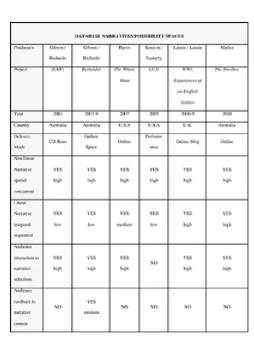
may not consider themselves to be documentary producers, all the selected projects have a factual documentary basis on which their content depends. For a comparative breakdown of each project see Table 1.
Ross Gibson and Kate Richards “(LAW) Life After Wartime” (2003) and “Bystander” (2004-9) Australia
Ross Gibson and Kate Richards constitute an example of collaborative artists engaging with Cubitt’s (2002) new “forms of data storage and retrieval” within landscapes “of documentation and dissemination” (2) and Manovich’s (2004) “new ways of using already accumulated media” (2).
Accessing an archive of crime scene photographs taken between 1945 and 1960 by the New South Wales Police Service in Sydney Australia, Gibson, Richards and their team have created five distinct works between 1998 and the present. These include live performances; gallery installations; web portals; and a CD-ROM with the intriguing titles of Darkness Loiters, Crime Scene, (LAW) Life After Wartime, LAW Live with the Necks, and Bystander. In this instance I shall refer only to the CD-ROM (LAW) Life After Wartime (2003) and the gallery installation Bystander (2004-9).
(LAW) Life After Wartime (2003), referred to here as (LAW), is a computer specific work that combines portions of the database of crime scene photographs with haiku-like texts, sound effects, and music files into random sequences initiated by the user. Ross Gibson (2005, 5) says the operating system underpinning (LAW) is designed as a “speculation engine… throwing batches of pictures forward in turbulent patterns” and that “the system gains cohesion according to the history of each investigator”s interaction with the database”.
will tend toward a larger story in idiosyncratic and personally stamped ways (Gibson 2005, 5).
(LAW) is what Gibson calls a “dramatic database” which explores the non-linear, vertical, spatial relationships opened up by the digital revolution. Additionally, he sees the user/viewer engaging with (LAW) as “not a reader or a receiver of this artwork” rather as “implicated as an investigator” whose interactivity enables them to participate in the pace and delivery choice of the process.
This random accessing of images, sound effects, and poetic texts works to place (LAW) as an artwork partially using historical, documentary content rather than a documentary production per se. This may have been the creative choice of the producers who had access only to the crime scene photographs. Most of the narrative details useful to documentary makers - the who, when, where, what and how descriptors - were not filed with the photographs. Gibson (2005) explains,
…(The) crime-scene images are filed in small manila envelopes full of variously-sized negatives; registered on every envelope there are the names of an investigating detective and a police photographer plus a date and description for the particular crime being documented. And that”s it; that”s the extent of the interpretive cues offered by the archive. Although each image is full of stories, hardly any files are “authenticated” with official interpretations. There are no detectives” notebooks, no court reports, no charge sheets, judgements or newspaper articles. The archive is therefore an unruly almanac of Sydney, a jumble of evidence associated with actual people who have been caught in painfully real outbreaks of fate, desire or rage. The pictures lie there awaiting their users. But how to use them when they tell so little that is conclusively true (5)?
Using the same database of crime scene photographs and haiku-like texts as (LAW), Bystander (2004-9) shape-shifts the concepts initiated in (LAW) into an interactive installation form within a gallery space. The work morphs into an “immersive environment” with rear and front projection onto multiple screens positioned to create an enclosed viewing space that the audience can occupy.
The two-way digital mechanism of Bystander responds to the presence of audience members. As the number of people situated within the installation space increases the faster the images are delivered. Additionally, as the audience members move through the space their actions are fed-back into the computer system, which responds by sending samples of data to match the activity of the audience. If audience members are moving slowly data will be sent to them slowly, if they increase their pace the computer responds likewise. Bystander is a good example of an interactive digital documentary production that fulfills both Manovich’s database narrative criteria as well as Hayles’ definition of possibility space.
Jonathan Harris “The Whale Hunt” (2007) U.S.A. Jonathan Harris approaches the temporal and spatial dimensions of database narrative/ possibility space from another tangent. Describing his work The Whale Hunt (2007) as “experimental interface of human storytelling” Harris combines elements of computer science, anthropology, visual art, and narrative in this online documentary photographic work.
Harris and his collaborator, Andrew Moore, recor-ded on large format (Moore) and digital (Harris) still cameras the experience of participating in a whale hunt with an Inupiat Eskimo family in Bar-row, Alaska. The annual whale hunt is a thousand-year-old tradition for the Inupiat whom today are permitted by international law to hunt twenty-two whales per year.
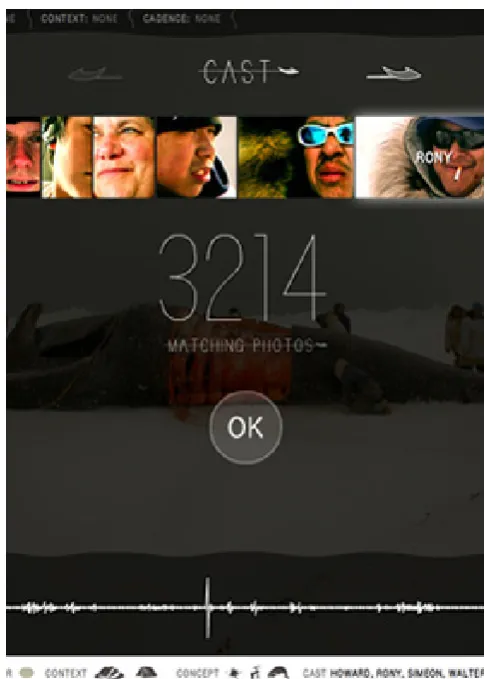
The Whale Hunt database is organized into an online platform around four themed subsets, the cast, the concept, the context, the cadence. Each subset al-lows the viewer to filter the database through the chosen constraint. Cast selects photographs that contain subjects such as Abe, Ahmakak, 1st whale and so on.
City, Barrow, Alaska, the Patkotak family house and so on. Finally, cadence filters the photographs based on the excitement level experienced at the time the photograph was taken such as slow, re-laxed, fast, frantic, and racing.
Shot over a continuous seven-day period at no more than five-minute intervals (with the use of a chronometer while sleeping) the database con-sists of 3,214 still images. The emphasis on conti-nuous recording enables this database narrative/ possibility space to
con-tain a tangible tempo-ral element. Meadows (2003) claims such in-clusions are critical for any narrative to be re-adable and understan-dable to other people. Speaking about interac-tive narrainterac-tive Meadows says,
Stories seem to be a way in which we report to one another on the events of life. We don’t need machines to do that. We need individual opinion and perspective (29-30).
Fig: The Whale Hunt, Jonathan Harris and Andrew Moore, 2007, a storytelling experiment.
With the temporal layer in The Whale Hunt we
are given Harris’ point of view (literally) at least twelve times an hour over seven consecutive days. During situations of heightened excitement or activity Harris’ perspective is provided even more frequently.
Accentuating this approach the entire database of photographs is represented by a human heartbeat graphic along the bottom edge of the screen. The more excitement experienced during the wha-le hunt event corresponds to more photographs
taken, and consequently the higher the heartbeat graphic to illustrate this activity.
The Whale Hunt interface can also be viewed in ano-ther three modes; mosaic, timeline, or pinwheel. Each mode gives a tiny thumbnail of each image – represented as the average pixel colour for that photograph. In mosaic mode every photograph is arranged simultaneously, in chronological order, as one large coloured grid. Rolling over the grid a magnifier effect isolates individual images, which when clicked can to be viewed as a full image on the screen.
Timeline mode displays all the photograph’s thumbnails, chronologi-cally, in a column repre-senting each thirty-mi-nute period of time. The height of each column indicates the number of photographs taken du-ring that half hour period. Selecting any coloured box by clicking retrieves a full sized version of that photograph.
Similar to timeline mode, pinwheel mode displays all 3,214 photographs chronologically separa-ted into twenty-minute intervals.
[image:8.595.177.420.237.577.2]S.W.A.M.P. Matthew Kenyon and Douglas
Easterly “Improvised Empathetic Device - I.E.D” (2005) U.S.A.
Another project to add to this list of database narratives/possibility spaces as an example of shape-shifting documentary is a performance piece I observed at the first international conference of Digital Interactive Media Entertainment and Arts (DIME Arts) held at Rangsit University Bangkok, Thailand in October 2006.
Selected to present at the conference under the category of human computer interaction I.E.D. is included here as a documentary in the sense that the primary data for the work is “evidence” which has been “data mined” from the United States of America casualty statistics of US soldiers killed in the war in Iraq. Specifically, the data refers to soldiers killed by I.E.Ds. (Improvised Explosive Devices) which commonly use a cellular phone or text pager as a remote trigger for ignition.
The performance piece named I.E.D. (Improvised Empathetic Device) uses similar technology and
mimics the name as a means to emphasise this connection.
The data is “mined” from icasulaty.org, which collates casualty data from the United States Department of Defence, sitcom, and other sources. Each time a US soldier’s name is added to the casualty database a text message is sent to a receiver embedded in the I.E.D. armband. The armband is equipped with a needle poised above the skin of the upper arm of the wearer. With each casualty name the performer/documentarist/ new-media-artist wearing the armband is jabbed once by the needle indicating the death of one US soldier in Iraq. Simultaneously a computer screen displays personal information concerning the casualty - the individual’s name, rank, cause of death, location of death, and hometown in the U.S. One surprising outcome of this performative piece has been the performers’ growing awareness of when the data of U.S. soldiers would be released into the public realm. Matthew Kenyon says,
So just like with some of our other projects some patterns began to emerge which became visible,
became evident in tangible ways for instance the timing of the release of casualty statistics… we became aware very quickly, finding that the government tends to release this information late on Fridays to avoid the news cycle. So we would find that on Friday afternoon we would feel a growing apprehension and anxiety of the potential of receiving the injections.
The collaborators of S.W.A.M.P., Matthew Kenyon and Douglas Easterly, may be surprised to be included in a discussion of digital documentary narrative forms however I regard this work as a performative documentary using database and non-linear narrative and as a clear illustration of Hayles’ notion of “possibility space”. Hayles says,
I cannot imagine a human world without narrative, but I can imagine narratives transformed and enriched by their interactions with possibility space in the complex ecologies of contemporary media and culture (29).
The data or content of I.E.D. is documentary evidence mediated through electronic and mechanical devices
that connect the human subject directly to the data and from that human computer interaction a narrative is performed.
Bill Lamin and Harry Lamin “WWI, Experiences of an English Soldier” (2006-12) U.K.
An example of documentary adapting to the online distribution platform of the Internet blog is the remarkably well thought through blogsite of Harry Lamin, a British soldier in WWI, who regularly wrote letters home to his family in England. Each of Harry’s letters is transcribed and appears as a blog entry exactly ninety years (to the day) after Harry wrote them. Harry’s blogsite explains,
The first letter is dated from the postmark as 7th February 1917. As promised, the letter from the training camp will be published on the evening of Wednesday 7th February 2007 - Exactly 90 years after it was written. (7th February 1917 was also a Wednesday, so the days of the week will coincide.)
Harry Lamin’s blogsite is the creation of Harry’s grandson Bill Lamin.
A retired teacher, Bill, uploads entries, maintains the website, replies to comments, and makes additions to the content of the letters for historical accuracy and clarity. Bill sees himself as a facilitator for Harry’s story. Because the audience can read Harry’s blog in any order they choose, even skipping whole sections, a brief synopsis on the front page of Harry”s blog ends with the following suggestion,
To find out Harry’s fate, follow the blog!
This sentence states Harry’s blogsite intention to be read as a journey, for the reader to follow in real-time the unfolding of events as they happened to British Private Harry Lamin during WWI, just as Harry’s relatives would have followed via Harry’s letters home ninety years earlier.
The by-line of each entry identifies the blog author as Harry. Bill Lamin’s involvement is as facilitator. Hartley (2008) describes a similar relationship between facilitator and blog subject in the production of the blogsite The Life of Riley.
Created by documentary filmmaker Mike Rubbo The Life of Riley is the blogsite of 107-year-old blogger Olive Riley. Olive’s blog is a flow on project from the documentary film All About Olive (2006) that Mike Rubbo made about Olive Riley’s life. Mike refers to himself on Olive’s blogsite as “Mike the helper”; he records Olive’s dialogue, transcribes it, uploads the text onto the blogsite interspersed with old and new photographs, and video clips. Mike also replies to readers’ comments and provides additional information for clarity in italics. Olive died in 2008, aged 108-years-old. Mike continued to update and maintain Olive’s blogsite until 2010. Hartley (2008) identifies this type of Rubbo/Riley collaboration as a new hybrid form, part blog (since it uses first person although it is written by someone else), part DST (digital storytelling) transcript, part multiplatform publishing (205).
This approach appears to be very popular with readers, both Olive’s and Harry’s blogsites receive a high volume of audience feedback. Harry’s “Introduction” blog entry, alone, has received eighty-seven comments from readers. The first comment on Harry’s blog is dated 22 August 2006
and the last comment (at the time of writing) is dated 29 August 2012, indicating the audience for Harry’s blog has been ongoing and increasing over time. In fact, the whole blogsite has received so much audience interest Bill Lamin, and more recently his daughter Catherine, have created a secondary blogsite just to handle feedback and comments.
As a further testament to its popularity, Harry’s blog has been picked up as a news worthy item by traditional media outlets. Bill Lamin has been interviewed for newspapers, radio, and television in Canada, U.S.A., Germany and the U.K. Some of these media stories have lead new readers to Harry’s blog. Other readers have stumbled onto Harry’s blog through Web surfing, as I did while researching information regarding World War I. People from New Zealand, Australia, Argentina, Spain, Portugal, Holland, the United States, and the United Kingdom have all commented on Harry’s blog, a testament to its truly global appeal.
In May 2009 Bill Lamin published a book based on Harry’s blog. Titled Letters From The Trenches, A Soldier of the Great War it is an expanded version of Harry’s blog with additions of further information and historical research. The book is a tangible indication of the continued slippage of Harry’s blog back into mainstream media.
Yet the book publication has created an interesting situation for some of Harry’s blog readers who have purchased the book. They are placed in a dilemma regarding the temporal nature of the blog. Many do not want to read the book until it is revealed by the blog in real-time what becomes of Harry. The majority of Harry’s blog readers appear to have subscribed wholeheartedly to the daily diary unfolding of the narrative of Harry’s blog.
Louise Lewis said...The problem is that we book buyers have been following the blog in “real tima” (sic) for some years, and we don”t wnat (sic) to learn the ending in “advance”. My book is waiting on the shelf ready to be read and appreciated in the future when the blog finishes. Nevertheless, I can say how much I appreciate the work and effort you have put into the project and a glance at the book shows it to be handsome indeed. Thank you for all you have done.
May 07, 2009
Anonymous said...You just keep this going. I have been watching this from almost the beginning here in Illinois USA. I will buy the book for my son AFTER this blog is finished because I don”t want to know the end, yet. This is part of my morning ritual. BTW, I looked up the General Beauman, ...interesting dude. April 23, 2009
Harry’s blog exemplifies how non-linear spatial narrative, audience interaction, and linear temporal narrative forms may not simply coexist in the same production, but may, each in their own way, actually contribute exponentially to the entire narrative.
Janet Marles’ “The Shoebox” (2010) Australia.
My exploration of shape shifting in digital documentary is “The Shoebox” (2010) a recreation of a memory story complete with gaps and absences, inconsistencies and mysteries prompting the user/ viewer to engage as both a participant and a spectator.
“The Shoebox” uses six 360-degree panoramic scenes to place the documentary elements in time and place. Each scene describes a location as well as an era from the protagonist’s story. Styled as a biography that employs interviews, voice-over narration, re-enactments, animated stills, and primary source documents “The Shoebox” compels the user/viewer to engage with fragments of memory embedded in each panoramic scene that become the threads from which the life story is woven. The user/viewer is able to navigate between these scenes and can randomly choose embedded clips to view.
Once a clip has been viewed an icon representing the visited clip drops into a timeline at the base of the screen. After a precise number of clips have been accessed the timeline fills with the remaining icons and becomes active. The timeline can now be played as a traditional linear movie with scripted beginning, middle and end. This interactive architecture, named “memoradic narrative”, was designed to mimic our process of autobiographical memory recall.
Susan Engel (1999) describes memory as a reconstructive process whereby “one creates the memory at the moment one needs it, rather than merely pulling out an intact item, image or story” (6). This implies says Engel “that each time we say or imagine something from our past we are putting it together from bits and pieces that may have, until now, been stored separately.”
Researchers such as Engel (1999) and McNally (2003) have found that memory is an amalgamation of activities that utilize a number of sites and cognitive processes in the brain, and these processes are much more complicated, more fragmented, and more subjective than we are inclined to presume. Whilst we tend to think of the process of memory as being similar to recording and playing back a scene in the same way a video camera operates, it is in fact more akin to the processes of capture, storage, and retrieval that a hypermedia platform such as memoradic narrative employs.
Selected Database Narrative / Possibility Space comparative breakdown
The following table (Table 1) breaks down the components of each of the previous examples of database narrative/possibility space indicating whether, and to what degree (high, medium, low), each project has employed non-linear and linear narrative devices.
Table 1 also identifies the type of interactivity each project has
em-ployed, if any. It divides this interaction into two types. Firstly, audience interaction into the nar-rative selections or the audience member’s abi-lity to navigate through the project at will. The second type of interac-tion I have identified is audience feedback to the narrative content or the ability for audience members to have input into the narrative con-tent.
The only project (from my selection) that incorpo-rates this second type of interaction is Ross Gib-son and Kate Richards’ Bystander (2004-9). In this case this interaction only changes the delive-ry speed of data to the audience. The audience
do not have any input into the type of data they will receive and likewise they cannot change the narrative content itself.
Conclusion
These examples of shape-shifting documentaries are a selection of works by documentary makers and digital media artists experimenting with non-linear narrative, non-linear narrative, and interactivity. Much discussion has taken place as to whether
non-linear and linear narratives are binary oppo-sites cancelling each other out and whether nar-ration and interactivity are antithetical (Manovich 2001; Wand 2002). Also, there has been debate as to whether these modes are new or, in fact, have been displayed in different mediums throughout time. Rieser (2002) gives a concise summary when he says:
The frequent assertion that interactive narrative is “a contradiction in terms” centres on the
ar-gument that the diege-tic space of narrative is compromised or de-stroyed by interactive engagement with the story; … this argument is based on a misunder-standing of narrative mechanisms. The acti-ve participation of au-dience is not new nor is it disruptive of narrative diegesis; it is merely in-compatible with certain narrative conventions, which have become un-duly emphasised by hi-storical accident (146).
What is becoming cle-ar to commentators, documentary producers, and digital media artists alike, is that interactive media is most under-standable to users when it incorporates a mixture of non-linear and line-ar nline-arrative devices. This is especially true when the story content is factual and key aspects of the narrative must be conveyed to the audience for the story to be comprehensible.
[image:13.595.170.425.235.573.2]at the academy of Film and Television Studies in Potsdam, who says, “Linear media are becoming part of the content of the world of non-linear entertainment” (167). Ross Gibson (2004) explaining his process with (LAW) states;
Most of my work entails finding historical fragments in the aftermath of some cultural “breakage” or violence and then offering narrative or dramatic “backfill” to explain the existence of the evidence. More and more, I am interested in how searchable databases, as well as, linear storytelling, can be used for such imaginative rather than didactic experiences.
For Hayles, (2005) incorporating all the variations available means the definition of narrative needs to be expanded into the concept of “possibility space” which allows for “known knowns, known unknowns, and unknown unknowns to coexist within the same production space” (4-5).
In describing the structural difference between linear and non-linear narrative and demonstrating that the linear is based on temporal and the
non-linear is based on spatial arrangements using examples from documentary makers and digital media artists we can see how these producers have engaged with temporal, horizontal and sequential as well as spatial, vertical and concurrent narratives and how these two seemly opposed techniques, rather than acting as binary opposites are in fact operating in a complimentary way within the same piece.
The non-linear techniques provide the hypertextual nodes and links that permit the spatial domain to be navigated interactively by the user, while the linear sections provide the traditional narrative devices to bring together the fragments into an understandable story.
References
Arthur, Paul Longley. 2008. “Participating in the past: Recording lives in digital environments” Cultural Studies Review 14(1): 187-201.
Cubitt, Sean. 2002. “Spreadsheets, Sitemaps and Search Engines: Why Narrative is Marginal to Multimedia and Networked Communication, and Why Marginality is More Vital than Universality” in ed. Martin Rieser and Andrea Zapp, 3-8. New Screen Media: Cinema / Art / Narrative, London: British Film Institute.
Cubitt, Sean. 2001. “Preface: The Colour of Time” in ed. Martin Le Grice, vii – xvii. Experimental Cinema in the Digital Age, London: British Film Institute.
Dolan, Ethel Avery and Shawn Pease. 2007-12. Soldier”s Mail: Letters Home From A Yankee Doughboy 1916 – 1919, accessed October 2012 http://worldwar1letters.wordpress.com/about-sgt-samuel-e-avery/.
Dovey, Jon. 2002. “Notes Towards a Hypertextual Theory of Narrative” in ed. Martin Rieser and Andrea Zapp, 135-145. New Screen Media: Cinema / Art / Narrative, London: British Film Institute.
Engel, Susan. 1999. Context is Everything: The Nature of Memory, New York: W.H. Freeman and Company.
Gibson, Ross, and Kate Richards 2004-9. Bystander, Interactive Gallery Installation, The Performance Space, Sydney Australia http:// katerichards.net/art/bystander/
Gibson, Ross. 2005. The Rise of Multimedia Systems, Accessed June 2012, www.tate.neat. tas.edu.au/word/gibson2.doc 2005.
Gibson, Ross. 2004. Dramatic Databases: Life After Wartime-Crime Scenes 1945-1960, lecture at COFA Sydney, ACM SIGGRAPH.
Gibson, Ross, and Kate Richards. 2003. Life After War Time. (LAW), Interactive CD-ROM. www. lifeafterwartime.com Sydney, Australian Film Commission.
Hales, Christopher. 2002. “New Paradigms < > New Movies - Interactive Film and Narrative Interfaces” in ed. Martin Rieser and Andrea Zapp, 105-119. New Screen Media: Cinema / Art /
Narrative, London: British Film Institute.
Harris, Jonathan. 2007. The Whale Hunt,
Interactive Online Narrative. www.thewhalehunt. org
Hartley, John. 2008. “Problems of expertise and scalability in self-made media” in, ed. Knut Lundby, 197-211. Digital Storytelling, Mediated Stories: Self Representations in New Media, New York: Peter Lang Publishing.
Hayles, N. Katherine. 2005. “Narrating Bits: Encounters between Humans and Intelligent Machine”, Vectors (1): 1-38.
Hight, Craig. 2008. “The field of digital documentary: a challenge to documentary theorists”, Studies in Documentary Film 2(1): 3-7.
Kenyon, Matthew. 2006. “Conference
Presentation” to First International Conference of Digital Interactive Media in Entertainment and Arts (DIMEA 2006) Rangsit University Bangkok Thailand.
Kenyon, Matthew, and Douglas Easterly 2005. Improvised Empathetic Device (I.E.D.), S.W.A.M.P. http://www.swamp.nu
Lamin, Bill. 2009. Letters from the Trenches: A Soldier of the Great War, Michael O”Mara Books.
Lamin, Bill, and Harry Lamin 2006-9. WW1: Experiences of an English Soldier, accessed October 2012. http://wwar1.blogspot.com/
Le Grice, Malcolm. 2001. Experimental Cinema in The Digital Age, London: British Film Institute.
Lundby, Knut. 2008. “Introduction: Digital storytelling, mediated stories” in ed. Knut Lundby, 1-20. Digital Storytelling, Mediated Stories: Self Representations in New Media, New York: Peter Lang Publishing.
McNally, Richard, J. 2003. Remembering
Manovich, Lev. 2006. “Uneven Development” in Image Future, accessed October 2012 http:// www.manovich.net/articles.html.
Manovich, Lev. 2004. “Info-Aesthetics” accessed October, 2012. http://www.manovich.net/IA/.
Manovich, Lev. 2002. “Spatial Computerisation and Film Language” in ed. Martin Rieser and Andrea Zapp, 64-76. New Screen Media: Cinema / Art / Narrative, London: British Film Institute.
Manovich, Lev. 2001. The Language of New Media, Cambridge: MIT Press.
Marles, Janet. 2010. “The Shoebox” accessed October, 2012. http://www.memoradicnarrative. com
Meadows, Mark Stephen. 2003. Pause and Effect: the art of interactive narrative, Indianapolis: New Riders.
Oakley, Peter. 2009. “geriatric1927” accessed October 2012. http://www.youtube.com/user/ geriatric1927 and http://www.askgeriatric.com/.
Pellinen, Teijo. 2000. Akvaario (Aquarium), www.mlab.uiah.fi Helsinki, Finnish National Broadcasting Company Channel 1
Rieser, Martin and Andrea Zapp. 2002. “Forward: An Age of Narrative Chaos?” in ed. Martin Rieser and Andrea Zapp, xxv-xxxii. New Screen Media: Cinema / Art / Narrative, London: British Film Institute.
Rieser, Martin. 2002. “The Poetics of Interactivity: The Uncertainty Principle” in ed. Martin Rieser and Andrea Zapp, 146-162. New Screen Media: Cinema / Art / Narrative, London: British Film Institute.
Rubbo, Michael. 2004. Personal Documentary Forum. Sydney: 51st Sydney Film Festival.
Rubbo, Michael. 2006-10 “All About Olive” accessed January 8, 2010, http://www. allaboutolive.com.au
Sorenssen, Bjorn. 2008. “Digital video and
Alexandre Astruc’s camera-stylo: the new avant-garde in documentary realized?” Studies in Documentary Film 2(1): 47-59.
Toffs, Darren. 2005. Interzone: Media Arts in Australia. Victoria: Craftsman House.
Zapp, Andrea. 2002. “net.drama://myth/mimesis/ mind_mapping/” in ed. Martin Rieser and Andrea Zapp, 77-89. New Screen Media: Cinema / Art / Narrative, London: British Film Institute.
_______________
Janet Marles