105
TEXTILE MATERIAL FORMS FOR REINFORCEMENT MATERIALS – A REVIEW
M.I. Misnon1, 2, M.M. Islam1,J.A. Epaarachchi 1 and K.T. Lau1
1
Centre of Excellence in Engineered Fibre Composites (CEEFC),
Faculty of Health, Engineering and Sciences, University of Southern Queensland, Toowoomba, Queensland 4350, Australia
E-mail: [email protected] 2
Faculty of Applied Sciences, Universiti Teknologi MARA, 40450, Shah Alam, Selangor, Malaysia
E-mail: [email protected]
ABSTRACT
This paper intended to give an insight of the textile material utilization as reinforcement in the composite materials. The discussion on textile definition and categorization will give some ideas for the reader to recognize textile materials and its role in this system. Simple categorization is referred to which textile materials are clustered into fibre, yarn and fabric regardless whether it is made synthetically or naturally. For every basic textile material form, few selected recent works have been discussed to show the utilization of textile material in research and industry. Composite made of textile fibres form is limited to low and medium load bearing application due to the difficulties of controlling the alignment, dispersion and distribution of fibres. Whereas yarn reinforcement gives more control on the composite materials due to the fibres is aligned in a yarn but the issue is more on the limited fabrication method. Utilization of textile fabric in composite as reinforcement is well recognized for high performance fabric so it is with natural fabric. Nonetheless, there is a limit of work considering fabric properties or parameters when characterize its composite to understand the fabric contribution in composite material.
Keywords: Composite; textile material; fibre; yarn; fabric.
INTRODUCTION
106
dimensions. Therefore, some other good definition, more specific and emphasize the general composite structure is needed. Bader (1997) in his work came out with useful and neat definition for composite as a material is characterized by being multiphase materials (one or more substances, including matrix) within which the phase distribution and geometry have been deliberately tailored to optimize one or more properties.
This is clearly an appropriate definition for textile composite or textile-reinforced composites (TCRM) for which there is one phase, called the matrix, reinforced by a fibrous reinforcement in the form of a textile. Due to a major of textile material involvement in composite material, regardless whether it is synthetic or natural derivation, utilization various versions of materials in the form of fibres, yarns, fabrics, their hybrids and many other combinations since about millennia ago has established their own cluster and definition. Textile composite can be defined as a combination of fibrous material (textile) either fibre, yarn, or fabric embedded in a resin system, and it can be in the form of flexible or quite rigid materials (Scardino, 1989).
Properties of textile composites are strongly influenced by the properties of their reinforcement distribution and the interaction among them (reinforcement and matrix). The geometry of the reinforcement may be described by the shape, size, and size distribution. The reinforcement in the systems may differ in concentration, distribution and orientation. Therefore, all of these factors may be important in determining the properties of the textile composites. To understand the reinforcement concentration, distribution and orientation of textile composite, knowledge of textile material should be taken into account.
The intention of this paper is to give insight of the textile material utilization as reinforcement in the composite materials. Definition of textile material has been discussed in order to give some ideas to the reader of what textile is all about and how these materials were clustered into basic categories. Simple categorization is referred to which textile materials are clustered into fibre, yarn and fabric regardless whether it is made synthetically or naturally. Some figures have also been included to provide a better understanding of the forms of the material being discussed. For each basic textile material form, several research or recent research has been discussed to show the utilization of textile material in research and industry and then followed by the authors’ opinion and suggestion related to the textile materials' utilization.
TEXTILE MATERIALS
107
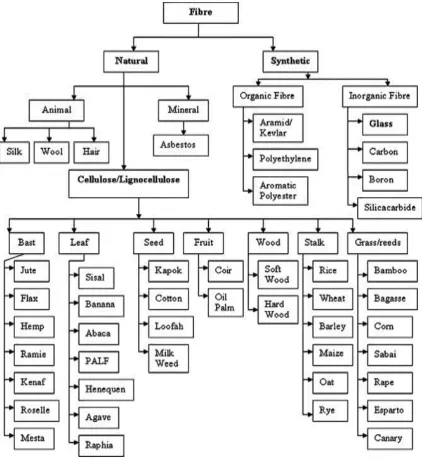
Figure 1. Textile fibre types and their classification (Kadolph & Langford, 2001).
A group of fibres with or without twist is called yarn and it has substantial length and relatively small cross-section. Monofilament is the yarn containing only one fibre for example, nylon. Untwisted, thick yarns are termed tows and this term is usually applied for high performance yarn such glass, aramid and carbon. In twisted yarns, the friction resulting from twist consolidates fibres. A twist is introduced to a continuous filament yarn by twisting. For a twisted yarn made of staple fibres, the process is called spinning and involves a long chain of preparatory operations. There is different yarn spinning processes (ring spinning, open-end spinning, friction spinning) leading to yarns with distinctive internal distributions of fibres. Figure 3 shows some example of yarns.
R
a(
m)
Number of Experiments Exp.
RSM 2nd
108
(a) (b)
[image:4.595.110.487.83.485.2](c) (d)
Figure 2. Examples of textile fibre; (a) Aramid, (b) Glass, (c) Cotton and (d) Wool (Kadolph & Langford, 2001).
.
109
[image:5.595.139.470.83.282.2](a) (b)
Figure 3. Example of yarn, (a) Carbon tows and (b) Dyed cotton yarns (Kadolph & Langford, 2001).
(a) (b) (c)
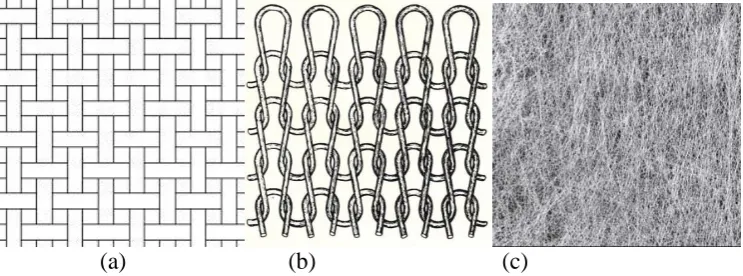
Figure 4. Types of common fabric; (a) woven, (b) knitted and (c) non-woven fabrics (Sondhelm, 2000).
A nonwoven is a textile structure produced by the bonding or interlocking of fibres, or both, accomplished by mechanical, chemical, thermal or solvent means and combinations thereof. It has to be admitted that this definition is not very precise, but it has been chosen because it includes many important fabrics which most people regard as nonwovens. One of the major advantages of nonwoven manufacture is that it is generally done in one continuous process directly from the raw material to the finished fabric, although there are some exceptions to this (Smith, 2000). Fabric types mentioned are the usual single plane structures also known as 2-D fabrics which high performance fibres are available. However, beyond of that, fabric in multi-plane structures or 3-D fabrics can as well be manufactured by weaving, warp knitting, braiding, non-woven and other specially modified techniques. The diverse techniques on fabric manufacturing allow more flexibility on tailoring the textile material which could be used in diverse of applications.
[image:5.595.113.485.339.477.2]110
according to their hierarchical and several notations for broaden the scope of textile materials (Lomov, Verpoest, & Robitaille, 2005). However, this topic is not the main concern, thus it will not be discussed in this paper.
COMPOSITE REINFORCEMENT Fibres
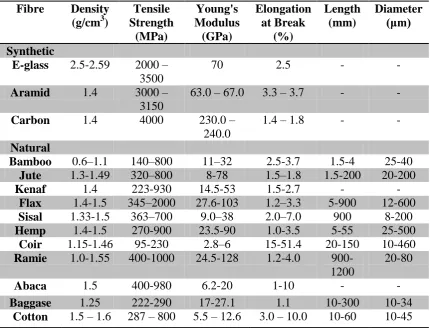
Fibre is the basic textile material form for composite reinforcement and with the various types of textile fibre ranging from synthetic and natural, with ranges of properties, ranges of polymers as well as several methods of processing, they offer more possibilities to suit the purposes of end products. Table 1 shows the mechanical properties of some common synthetic and natural textile fibres (Bledzki & Gassan, 1999; Dittenber & GangaRao, 2012; Faruk, Bledzki, Fink, & Sain, 2012). Synthetic fibres are meant for high performance and load bearing application while utilizations of natural fibres are more to serve non-load bearing applications. As for natural fibres, even though they possess lower mechanical properties than traditional fibres (high performance fibres), for some type of natural fibres, their young's modulus range can be considered high. For instance, young's modulus of jute, flax, hemp and ramie are within the range of aramid and carbon. Therefore, they are presumably can be used to replace traditional performance fibres in some of the application which need for similar young's modulus (Dittenber & GangaRao, 2012; Koronis, Silva, & Fontul, 2013; Schuh & Gayer, 1997; Ticoala, Aravinthan, & Cardona, 2010).
Application of textile fibres embedded in polymer has long ago been established and there are many workers worked and still working on it. Akonda, Lawrence, and Weager (2012) used short recycled carbon fibres embedded in polypropylene thermoplastic matrix. Their composites possess high tensile and flexural strength, which were 160 and 154 MPa respectively, and this is good enough to be used as low cost material for much non-structural application. Bao, Liang, and Tjong (2012) worked also on short carbon fibre to reinforced polymer to investigate its fracture behaviour.Serna Moreno, Martínez Vicente, and López Cela (2013) fabricated a composite from chopped glass and polyester resin to study its failure strain and stress fields under biaxial loading. From this study, they came out with several failure models, which are taken as a reference. Employing pre-peg and vacuum bagging, Choi and Lee (2013) used short aramid fibres to reinforced carbon/epoxy composite to find a cheaper composite manufacturing process while Sun, Hu, Sun, and Chen (2013) used short aramid reinforced carbon-fibre aluminium foam sandwich to study the energy absorptions and peak loads sandwich beam. It is clear, that even with the short/chopped of high performance fibre, the workers' intention is to use them in medium and high performance applications.
111
[image:7.595.83.514.250.578.2]Bajwa, Bajwa, Holt, Coffelt, & Nakayama, 2011; Bertini, Canetti, Patrucco, & Zoccola, 2013; Cheng, Lin, & Huang, 2011; Conzatti et al., 2013; Dobircau et al., 2009; Hardy & Scheibel, 2010; S.-J. Kim, Moon, Kim, & Ha, 2008; G. Li, Yu, Zhao, Li, & Li, 2003; J. Li et al., 2009; Mahdi, Mokhtar, Asari, Elfaki, & Abdullah, 2006; Paiva Júnior, de Carvalho, Fonseca, Monteiro, & d’Almeida, 2004; Prachayawarakorn, Sangnitidej, & Boonpasith, 2010; Reddy & Yang, 2009; Rockwood et al., 2011; Shubhra & Alam, 2011; Shubhra, Alam, & Beg, 2011; Sionkowska & Płanecka, 2013; Sutivisedsak, Cheng, Dowd, Selling, & Biswas, 2012; Yuan, Yao, Chen, Huang, & Shao, 2010; Zou, Reddy, & Yang, 2011).
Table 1. Mechanical and physical properties of natural fibres.
Fibre Density (g/cm3)
Tensile Strength
(MPa)
Young's Modulus
(GPa)
Elongation at Break
(%)
Length (mm)
Diameter (μm) Synthetic
E-glass 2.5-2.59 2000 – 3500
70 2.5 - -
Aramid 1.4 3000 – 3150
63.0 – 67.0 3.3 – 3.7 - -
Carbon 1.4 4000 230.0 – 240.0
1.4 – 1.8 - -
Natural
Bamboo 0.6–1.1 140–800 11–32 2.5-3.7 1.5-4 25-40
Jute 1.3-1.49 320–800 8-78 1.5–1.8 1.5-200 20-200
Kenaf 1.4 223-930 14.5-53 1.5-2.7 - -
Flax 1.4-1.5 345–2000 27.6-103 1.2–3.3 5-900 12-600
Sisal 1.33-1.5 363–700 9.0–38 2.0–7.0 900 8-200
Hemp 1.4-1.5 270-900 23.5-90 1.0-3.5 5-55 25-500
Coir 1.15-1.46 95-230 2.8–6 15-51.4 20-150 10-460
Ramie 1.0-1.55 400-1000 24.5-128 1.2-4.0 900-1200
20-80
Abaca 1.5 400-980 6.2-20 1-10 - -
Baggase 1.25 222-290 17-27.1 1.1 10-300 10-34
Cotton 1.5 – 1.6 287 – 800 5.5 – 12.6 3.0 – 10.0 10-60 10-45
112
Ma and Joo (2011) studied on the effect of different fabrication conditions, such as fibre content, processing temperatures and alkali treatment on the mechanical properties and structure of jute fibre reinforced PLA using the film-stacking method. Goriparthi, Suman, and Mohan Rao (2012) also working with jute fibre to reinforce PLA but their focus was to improve the adhesion of jute fibre by surface modification using alkali, permanganate, peroxide and silane treatments. Reddy and Yang (2011) developed biodegradable composite using jute fibre and soyprotein using water without using any chemical as plasticizer using prepeg method to produce their composite. Many researches have been conducted by using sisal fibre as the reinforcement for biodegradable composites (Alvarez & Vazquez, 2004; Cyras, Vallo, Kenny, & Vazquez, 2004; Mishra, Tripathy, Misra, Mohanty, & Nayak, 2002). There are also a number of reports that focus on using one type of fibre such as hemp (Hu & Lim, 2007; Lopez et al., 2012), ramie (D. Chen, Li, & Ren, 2010), silk (Yuan et al., 2010), coir (Nam, Ogihara, Tung, & Kobayashi, 2011), kenaf (Ibrahim, Yunus, Othman, Abdan, & Hadithon, 2010), baggase (Cao, Shibata, & Fukumoto, 2006), flax (Ouagne et al., 2010) and bamboo (Huang & Netravali, 2009; Shih, Huang, & Chen, 2010).
Utilization of textile fibres in composite material has long been established. However, even utilization of high performance fibre is meant for medium load bearing. Even there is research used this high performance in high performance application, the distribution and contribution of this high performance fibre is just small. More so if the natural fibres use in composite material, it is usually catered for the low and medium load bearing application. A factor that could lead to this scenario is because the dispersion and distribution of fibre in composite material. The method of fabrication usually does not take into account the alignment of fibre which the fibres are not interconnected. It is also difficult to control the uniformity of fibres' distribution, which could lead a failure when a place with less fibre is subjected to any destruction force. There are still researches carried out to improve the properties of composite material reinforced with fibre forms so it can be used in many applications.
Yarns
Usual fabrication method of applying fibre in the form of yarn is filament winding. This process is primarily used to produce hollow, generally circular or oval sectioned composites such as pipes and tanks. For this purpose of fabrication, thermoset resin like polyester and epoxy is preferred.
113
machine and this machine able to produce glass, carbon and aramid yarns/tows reinforced polymer.
Recent works have also shown the utilization of natural textile yarn as reinforcement in composite material.. Huang and Netravali (2007) in their research to fabricate environment-friendly ‘green’ composite used flax yarn to reinforced soy protein concentrate. During composite fabrication, they used metal frame to wind the hemp yarns and applied small tension to minimize the yarn shrinkage and misalignment during the drying of resin. J. T. Kim and Netravali (2011) used similar method of fabrication with Huang and Netravali (2007). However, they used hemp yarn to reinforced soy protein concentrate resin processed at various pH values, and they intended to study the effect of pH on mechanical and interfacial properties. George et al. (2012) investigated the fabrication process of jute yarn reinforced, bidirectional thermoplastic commingled composite for treated and untreated samples. Using polypropylene yarn as a resin, jute yarn were wound onto a metal plate in a specific layer pattern using a fibre winding machine specifically designed for commingling. This commingled jute and polypropylene were then pressed under hot presser in different parameters. Even though, these workers using a different method of composite fabrication when dealing with yarns and tows, their method principle is quite similar with filament winding. In both method, yarns have to be straight and this could only be achieved by applying small tension on it. This is important to make sure the uniformity of fibres/yarns distribution and density in the composite material.
Other methods than filament winding can also be used for yarn form reinforcement which believably needs some alteration and assumption. For example, Shah, Schubel, Clifford, and Licence (2013) fabricated his sample by employing vacuum infusion to produce composite made of jute, hemp and flax yarns. Using unsaturated polyester resin as a matrix, he studied the fatigue data on natural fibre composites and this is an important parameter which limits their prospective use in fatigue critical components. From this study, he established the fatigue data of fabricate materials and compared with the e-glass/polyester composites. Utilization of textile yarn gives more control of the properties of composite materials. This is because the scattered fibres are combined and aligned in a group with or without twist given. Nevertheless, there is less of work considering the effect of yarn parameters such as yarn size, yarn twist and twist angle on composite material. Working with these parameters will gives us more input and knowledge on how the composite will react because the yarn properties change with the change of its parameters.
114
Fabric
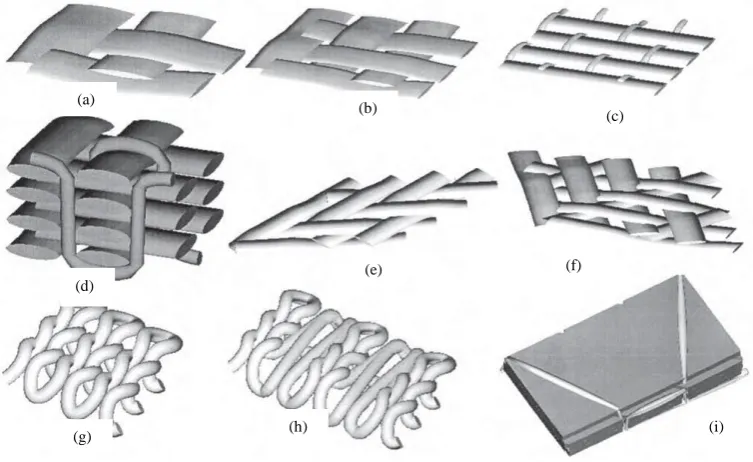
Scardino (1989) divided the textile structures or reinforcement forms into four categories; discontinuous chopped fibres, continuous filament yarns, simple fabrics (2-D) and advanced fabrics (3-(2-D) systems. An interesting part to be discussed here is the usage of simple fabric and advanced fabric systems as reinforcement in composite materials. These kinds of reinforcement are preferably used by manufacturer or researcher due to it physical which easy to handle. Figure 5 shows some common textile fabric used as composite reinforcement (Lomov et al., 2005). Producing simple or 2-D fabrics of high performance fibres is commonly used either interlacing (weaving) or interloping (knitting) method. In weaving method, the fabric consists of interlacement of warp (length wise) and weft yarn (width wise). Knitted fabric consists of interloping yarns either in weft (weft knitting) or warp direction (warp knitting) directions.
[image:10.595.109.486.416.647.2]There are a lot works done on using 2-D fabrics as reinforcement in composite material either for thermoset or thermoplastic resin. High performance fabrics usually dominate high performance application. Choi, Kim, Lee, and Seo (2011) used aramid fabric to replace E-glass for low-observable radomes since it has lower dielectric constant and higher strength than E-glass and it should have better electromagnetic wave transmission characteristics. This material is usually used in aircrafts, warships and missiles functioning to protect the radar antennas. In his work low-observable radome was constructed with a sandwich construction composed of aramid/epoxy. The mechanical properties were measured by means of 3-point bending test and then compared to those of the conventional which made of e-glass/epoxy.
Figure 5. Structure of textile fabric; (a-c) 2-D woven fabrics, (d) 3-D fabric, (e-f) braided fabrics, (g-h) knitted fabric and (i) multiaxial multiply warp-knitted fabrics
(Lomov et al., 2005).
Aramid fabric is very well known in protective industries due to its high strength and high impact resistance. It is also light and suitable to be used as lightweight ballistic protection or soft armour. Carrillo, Gamboa, Flores-Johnson, and Gonzalez-Chi (2012) in his work used aramid fabric reinforced polypropylene in composite laminate form as
(a)
(b) (c)
(d)
(e) (f)
115
a new material for soft armour. He found that the thermoplastic polypropylene increases the ballistic performance of composite laminates. This is due to the existence of polypropylene which has good elongation properties when it subjected to tensile force. This enables Carrillo’s material to have additional energy to absorbance hence improve its performance. In another work, Othman and Hassan (2013) investigate the role of aramid layer in soft armour emphasized on the different direction (0º and 90º) on fabric alignment. He found that the cross-ply aramid laminates could dissipate the impact energy up to 17% and also have the capability to stop the projectile at the minimum layer compared to the aramid which layered in one direction. There is a lot more researches in his area, yet there is still no assessment on the internal injury for the wearer. Aktaş, Aktaş, and Turan (2013) study the effect of stacking method of woven/knitted fabric of glass /epoxy hybrid composites on its impact behaviour while Russo, Acierno, Simeoli, Iannace, and Sorrentino () studied on the flexural and impact response of woven glass fabric reinforced polypropylene employing stacking film method fabrication. Glass fabric was also been used in construction fields. Gopinath, Iyer, Gettu, Palani, and Murthy (2011) used glass fabric to study its confinement effect when bonded with cementitious and organic binders. It was found that the existence of glass fabric enhances the load carrying capacity and ductility for both bonding materials (cementitious and organic binders). This material could be used as a confining system for retrofitting applications.
Fei, Li, Huang, and Fu (2012) studied the effect of phenolic resin on friction and wear performance of the composites using four kinds of carbon fabric using impregnation technique. His analysis has very close relation to the resin content of the composite fabricated and he found that the dynamic friction coefficient decreased with the increase of resin content, but the friction coefficient ratio increased. The sample with 25 wt% resin content possessed the best wear resistance due to the moderated combination between the carbon fibres and the matrix and good friction surface formation. This is one of the researches to enhance the performance of the carbon composite especially in automotive industry since this material has been used widely in a clutch system.
In sports fields, application of carbon fabric reinforced polymer had been studied by Ullah, Harland, and Silberschmidt (2013). This type of material is always exposed to various modes of damage and fracture under impact bending loads. Therefore, they studied these failure modes using experimental material characterization and numerical simulations and managed to developed numerical models which capable of simulate all damage mechanisms as well as their subsequent interaction observed. This is good research and it should be expanded to other high performance materials such as glass and aramid which could lead to very interesting results. Application of 3-D fabric is quite common for synthetic fibre especially in high performance fibre and this structure with natural fibre is almost none may be due to high cost on fabricating 3-D fabrics. Weaving, warp knitting, braiding, nonwoven and other specially modified techniques can manufacture a fabric with multi-plane structures. Woven fabric in the form of 3-D architecture employs multilayer and pile structures. However, it cannot produce thick structures as its shedding limits the number of layers possible. Thick structures are usually made using braiding technique, but it is limited in width. Knitted structures are normally made using warp knitting, but again, it is limited in thickness (Lomov, Verpoest & Robitaille 2005).
116
application of thick 3-D orthogonal weave reinforcement is fast growing. Bogdanovich et al. (2011) studied to enhance the performance of 3-D orthogonal woven e-glass composite's joint. A comprehensive experimental study was performed to determine the strength of several co-cured and adhesively bonded joints of composite panels. He found that stitching and stapling dry preforms resulted in a significant increase of the co-cured single-lap joint strength and tapering strap ends to as a small angle as possible was found to be the most effective method of increasing break force of double butt-strap bonded joints.
Carvelli, Pazmino, Lomov, and Verpoest (2012) worked on deformability a single-ply E-glass non-crimp 3D orthogonal woven reinforcement by comparing its properties to 2-D fabrics obtained from several deformation test modes while Cherif, Krzywinski, Lin, Schulz, and Haasemann (2013) suggested new process chain for producing complex 2-D/3-D weft knitted fabrics using glass yarn for thermoplastic composite applications. By using flatbed knitting that usually used for producing weft knitted fabric, he managed to produce near-net-shape or fully fashion multilayer weft knitted fabrics. This is very interesting work, since; the shapes of composite are limited and follow the available 2-D planar material. Using this knitting method, the reinforcement could be designed according to shape that we want seamlessly and this could result to good properties of composites.
Application of natural fibre (except those that are used for garment and apparel) in fabric form is also well established aligned with high performance fabric. However, their utilization is limit for non/low load bearing and semi structural application. There are many researches done on using natural fabric as composite reinforcement. However, there is a limit of choices on natural fabric because not all types of fibre can be converted into fabrics, especially in woven and knitted fabric. In order to convert a natural fibre into fabric, the diameter and length of fibre play important roles. This is because most of the weaving and knitting machine cannot process a fibre that too coarse and too short. Even it can be done, the method could not offer cost advantage and this remain a challenge for fabric manufacturers. Another way on converting natural fibre into fabric is by turn it into non-woven fabrics. A famous method on fabricating this is by using needle punch machine. A product from this method also calls fleece or felt but the real problem with this method is on how to make sure the homogeneity of fibre distributions because the uneven distribution will results to uneven mechanical properties of fabric and to some extent, to composite properties as well.
Jute fabric was used by Huang and Netravali (2007) to reinforced soy protein concentrate resin in their efforts to innovate fully environment-friendly, sustainable and biodegradable green composite. Their green composite exhibits excellent flexural properties in warp and weft directions. Unlike Huang and Netravali, Behera, Avancha, Basak, Sen, and Adhikari (2012) used jute felt o reinforced soy milk based resin and he found that composite having 60 % jute felt possessed the best mechanical properties and the novelty of his work is the resin preparation. Jawaid, Abdul Khalil, Hassan, Dungani, and Hadiyane (2013), by employing hand lay-up, prepared a composite made of epoxy resin reinforced with hybrid jute fabric and oil palm fibre and he expected this material to have a good potential in automobiles and building industry in near future. Barkoula et al. (2010) focused on short flax fabric reinforced composites based on polyhydroxybutyrate (PHB) and its copolymer with hydroxyvalerate (HV) employing compression moulding to study its biodegradability.
117
(2012) examined the physical behaviour of hemp/poly(lactic acid) (PLA) composites, particularly the thermal properties and viscoelastic behaviour. He used twill and plain woven hemp fabrics as reinforcements by stacking film method. The twill structure was found to be suitable for reinforcing a PLA resin with higher impact strength and better mechanical properties than the plain woven. Hemp fabrics were also been used by Kabir, Wang, Lau, Cardona, and Aravinthan (2012) to form composite skins while short hemp fibres with polyester as a core for making composite sandwich structures, while Christian and Billington (2012) fabricated hemp fabric composite to reinforce poly(b-hydroxybutyrate) biopolymer in order to evaluate its feasibility for construction applications as replacements for wood or petroleum based composites. Michel and Billington (2012) claimed that biobased polymer composites have been shown to have suitable initial specific strength and stiffness for use in commercial applications yet the long-term performance of these materials under variable environmental conditions is largely unknown. Therefore, using fabricated composite made of hemp fabric poly-hydroxybutyrate (PHB) they performed accelerated weathering test.
There are a lot of work on using natural fabrics that have been published in many journals and academic writings. The work that was discussed above is just a small part in natural fabric composites. Nevertheless, there is a limit of work which considering the fabric parameters when dealing with natural fabrics such as, fabric density, fabric structure, arial density etc. These factors are very important to determine as the fabric properties will change with the changes of its parameter. Basically, fabric parameters are used to determine fabric properties which relate to its fibre direction, orientation as well as the fibre mass. Therefore, a work on considering these factors is necessary in order to understand their relationship with composite properties.
CONCLUSION
The definition of textile gives the understanding of the types and forms of textile materials. This is very important to understand and acknowledge the contribution of textile material as composite reinforcement. Even for fibre, yarn and fabric, the research is still carried out to enhance its composite material thus suit various applications. It is good to highlight several matters regarding to usage of textile material as reinforcement. The application of composite material reinforced with textile fibres forms basically limit to low and medium load bearing applications. Thus, research emphasized to improve the fibre reinforced composite to suit the purpose of application should be and will be continued. Whereas yarn reinforcement gives more control on the composite materials due to the fibres is aligned in a yarn regardless the twist is given or not. However, the established method of fabrication limits the usage of yarn and there is a need of fabrication process using this kind of textile material other than filament winding to ensure the varieties of end product of yarn reinforced composite. Utilization of textile fabric in composite as reinforcement is well recognized for high performance fabric so it is with natural fabric. Nonetheless, there is a limit of work considering fabric properties or parameters when characterize its composite to understand the fabric contribution in composite material.
118
far as anisotropic material is concern, research and development of this kind of material will keep continuing due to variation of possibilities when utilizing textile reinforcement forms, matrices and applications.
ACKNOWLEDGEMENT
The authors would like to thank Research Management Institute (RMI), UiTM, Malaysia for supporting this project and those who direct and indirectly involved in this project.
REFERENCES
Abdalla, F. H., Mutasher, S. A., Khalid, Y. A., Sapuan, S. M., Hamouda, A. M. S., Sahari, B. B., and Hamdan, M. M. 2007. Design and fabrication of low cost filament winding machine. Materials & Design, 28(1), 234-239.
Akonda, M. H., Lawrence, C. A., and Weager, B. M. 2012. Recycled carbon fibre-reinforced polypropylene thermoplastic composites. 1), 79-86.
Aktaş, A., Aktaş, M., and Turan, F. 2013. The effect of stacking sequence on the impact and post-impact behavior of woven/knit fabric glass/epoxy hybrid composites. Composite Structures, 103(0), 119-135.
Alomayri, T., Shaikh, F. U. A., and Low, I. M. 2013. Characterisation of cotton fibre-reinforced geopolymer composites. Composites Part B: Engineering, 50(0), 1-6. Aluigi, A., Vineis, C., Ceria, A., and Tonin, C. 2008. Composite biomaterials from fibre wastes: Characterization of wool–cellulose acetate blends. Composites Part A: Applied Science and Manufacturing, 39(1), 126-132.
Alvarez, V. A., and Vazquez, A. 2004. Effect of Water Sorption on the Flexural Properties of a Fully Biodegradable Composite. Journal of Composite Materials, 38(13), 1165-1182.
Anand, S. C. 2000. Technical fabric structures – 2. Knitted fabrics. In A. R. Horrocks & S. C. Anand (Eds.), Handbook of Technical Textiles. North and South America: Woodhead Publishing Limited and The Textile Institute.
Arvin, A. C. and Bakis, C. E. 2006. Optimal design of press-fitted filament wound composite flywheel rotors. Composite Structures, 72(1), 47-57.
Bader, M. G. 1997. Short course notes; An introduction to composite materials. University of Surrey. University of Surrey.
Bajwa, S. G., Bajwa, D. S., Holt, G., Coffelt, T. and Nakayama, F. 2011. Properties of thermoplastic composites with cotton and guayule biomass residues as fiber fillers. Industrial Crops and Products, 33(3), 747-755.
Bao, S. P., Liang, G. D. and Tjong, S. C. 2012. Part II: Polymer-Polymer Composites with Premade Fibrous Reinforcement: Fracture Behavior of Short Carbon Fiber Reinforced Polymer Composites. In B. Debes & F. Stoyko (Eds.), Synthetic
Polymer–Polymer Composites (pp. 117-143): Hanser.
Barkoula, N. M., Garkhail, S. K. and Peijs, T. 2010. Biodegradable composites based on flax/polyhydroxybutyrate and its copolymer with hydroxyvalerate. Industrial
Crops and Products, 31(1), 34-42.
119
Bertini, F., Canetti, M., Patrucco, A. and Zoccola, M. 2013. Wool keratin-polypropylene composites: Properties and thermal degradation. Polymer
Degradation and Stability, 98(5), 980-987.
Bledzki, A. K. and Gassan, J. 1999. Composites reinforced with cellulose based fibres.
Progress in Polymer Science, 24(2), 221-274.
Bodros, E., Pillin, I., Montrelay, N. and Baley, C. 2007. Could biopolymers reinforced by randomly scattered flax fibre be used in structural applications? Composites
Science and Technology, 67(3–4), 462-470.
Bogdanovich, A. E., Dannemann, M., Döll, J., Leschik, T., Singletary, J. N. and Hufenbach, W. A. 2011. Experimental study of joining thick composites reinforced with non-crimp 3D orthogonal woven E-glass fabrics. Composites
Part A: Applied Science and Manufacturing, 42(8), 896-905.
Cao, Y., Shibata, S. and Fukumoto, I. 2006. Mechanical properties of biodegradable composites reinforced with bagasse fibre before and after alkali treatments.
Composites Part A: Applied Science and Manufacturing, 37(3), 423-429.
Carrillo, J. G., Gamboa, R. A., Flores-Johnson, E. A. and Gonzalez-Chi, P. I. 2012. Ballistic performance of thermoplastic composite laminates made from aramid woven fabric and polypropylene matrix. Polymer Testing, 31(4), 512-519. Carvelli, V., Pazmino, J., Lomov, S. V. and Verpoest, I. 2012. Deformability of a
non-crimp 3D orthogonal weave E-glass composite reinforcement. Composites
Science and Technology, 73(0), 9-18.
Chen, D., Li, J. and Ren, J. 2010. Study on sound absorption property of ramie fiber reinforced poly(l-lactic acid) composites: Morphology and properties.
Composites Part A: Applied Science and Manufacturing, 41(8), 1012-1018.
Chen, W., Yu, Y., Li, P., Wang, C., Zhou, T. and Yang, X. 2007. Effect of new epoxy matrix for T800 carbon fiber/epoxy filament wound composites. Composites
Science and Technology, 67(11–12), 2261-2270.
Cheng, A., Lin, W.-T. and Huang, R. 2011. Application of rock wool waste in cement-based composites. Materials & Design, 32(2), 636-642.
Cherif, C., Krzywinski, S., Lin, H., Schulz, C. and Haasemann, G. 2013. New Process Chain for Realisation of Complex 2D/3D Weft Knitted Fabrics for Thermoplastic Composite Applications. Procedia Materials Science, 2(0), 111-129.
Choi, I., Kim, J. G., Lee, D. G. and Seo, I. S. 2011. Aramid/epoxy composites sandwich structures for low-observable radomes. Composites Science and Technology, 71(14), 1632-1638.
Choi, I. and Lee, D. G. 2013. Surface modification of carbon fiber/epoxy composites with randomly oriented aramid fiber felt for adhesion strength enhancement.
Composites Part A: Applied Science and Manufacturing, 48(0), 1-8.
Christian, S. J. and Billington, S. L. 2012. Moisture diffusion and its impact on uniaxial tensile response of biobased composites. Composites Part B: Engineering, 43(5), 2303-2312.
Conzatti, L., Giunco, F., Stagnaro, P., Patrucco, A., Marano, C., Rink, M. and Marsano, E. 2013. Composites based on polypropylene and short wool fibres. Composites
Part A: Applied Science and Manufacturing, 47(0), 165-171.
120
Dittenber, D. B. and GangaRao, H. V. S. 2012. Critical review of recent publications on use of natural composites in infrastructure. Composites Part A: Applied Science
and Manufacturing, 43(8), 1419-1429.
Dobircau, L., Sreekumar, P. A., Saiah, R., Leblanc, N., Terrié, C., Gattin, R. and Saiter, J. M. 2009. Wheat flour thermoplastic matrix reinforced by waste cotton fibre:
Agro-green-composites. Composites Part A: Applied Science and
Manufacturing, 40(4), 329-334.
Faruk, O., Bledzki, A. K., Fink, H.-P. and Sain, M. 2012. Biocomposites reinforced with natural fibers: 2000–2010. Progress in Polymer Science, 37(11), 1552-1596.
Fei, J., Li, H.-J., Huang, J.-F. and Fu, Y.-W. 2012. Study on the friction and wear performance of carbon fabric/phenolic composites under oil lubricated conditions. Tribology International, 56(0), 30-37.
George, G., Tomlal Jose, E., Jayanarayanan, K., Nagarajan, E. R., Skrifvars, M. and
Joseph, K. 2012. Novel bio-commingled composites based on
jute/polypropylene yarns: Effect of chemical treatments on the mechanical properties. Composites Part A: Applied Science and Manufacturing, 43(1), 219-230.
Gopinath, S., Iyer, N. R., Gettu, R., Palani, G. S. and Murthy, A. R. 2011. Confinement Effect of Glass Fabrics Bonded with Cementitious and Organic Binders.
Procedia Engineering, 14(0), 535-542.
Goriparthi, B. K., Suman, K. N. S. and Mohan Rao, N. 2012. Effect of fiber surface treatments on mechanical and abrasive wear performance of polylactide/jute composites. Composites Part A: Applied Science and Manufacturing, 43(10), 1800-1808.
Hardy, J. G. and Scheibel, T. R. 2010. Composite materials based on silk proteins.
Progress in Polymer Science, 35(9), 1093-1115.
Hu, R. and Lim, J.-K. 2007. Fabrication and Mechanical Properties of Completely Biodegradable Hemp Fiber Reinforced Polylactic Acid Composites. Journal of
Composite Materials, 41(13), 1655-1669.
Huang, X. and Netravali, A. 2007. Characterization of flax fiber reinforced soy protein resin based green composites modified with nano-clay particles. Composites
Science and Technology, 67(10), 2005-2014.
Huang, X. and Netravali, A. 2009. Biodegradable green composites made using bamboo micro/nano-fibrils and chemically modified soy protein resin. Composites
Science and Technology, 69(7–8), 1009-1015.
Ibrahim, N. A., Yunus, W. M. Z. W., Othman, M., Abdan, K. and Hadithon, K. A. 2010. Poly(Lactic Acid) (PLA)-reinforced Kenaf Bast Fiber Composites: The Effect of Triacetin. Journal of Reinforced Plastics and Composites, 29(7), 1099-1111.
Jawaid, M., Abdul Khalil, H. P. S., Hassan, A., Dungani, R. and Hadiyane, A. 2013. Effect of jute fibre loading on tensile and dynamic mechanical properties of oil palm epoxy composites. Composites Part B: Engineering, 45(1), 619-624. Kabir, M. M., Wang, H., Lau, K. T., Cardona, F. and Aravinthan, T. 2012. Mechanical
properties of chemically-treated hemp fibre reinforced sandwich composites.
Composites Part B: Engineering, 43(2), 159-169.
121
Kadolph, S. J. and Langford, A. L. 2001. Textiles (9th ed.). New Jersey: Prentice Hall. Kim, J. T. and Netravali, A. N. 2011. Development of aligned-hemp yarn-reinforced
green composites with soy protein resin: Effect of pH on mechanical and interfacial properties. Composites Science and Technology, 71(4), 541-547. Kim, S.-J., Moon, J.-B., Kim, G.-H. and Ha, C.-S. 2008. Mechanical properties of
polypropylene/natural fiber composites: Comparison of wood fiber and cotton fiber. Polymer Testing, 27(7), 801-806.
Koronis, G., Silva, A.V and Fontul, M. 2013. Green composites: A review of adequate materials for automotive applications. Composites Part B: Engineering, 44(1), 120-127.
Li, G., Yu, Y., Zhao, Z., Li, J.V and Li, C. 2003. Properties study of cotton stalk fiber/gypsum composite. Cement and Concrete Research, 33(1), 43-46.
Li, J., Li, Y., Li, L., Mak, A. F. T., Ko, F. and Qin, L. 2009. Fabrication and degradation of poly(l-lactic acid) scaffolds with wool keratin. Composites Part B:
Engineering, 40(7), 664-667.
Lomov, S. V., Verpoest, I. and Robitaille, F. 2005. Manufacturing and internal geometry of textiles. In A. C. Long (Ed.), Design and Manufacture of Textile
Composites (pp. 1-61): CRC Press, Woodhead Publishing Ltd, Cambridge,
England.
Lopez, J. P., Vilaseca, F., Barberà, L., Bayer, R. J., Pèlach, M. A. and Mutjé, P. 2012. Processing and properties of biodegradable composites based on Mater-Bi® and hemp core fibres. Resources, Conservation and Recycling, 59(0), 38-42.
Ma, H. and Joo, C. W. 2011. Structure and mechanical properties of jute—polylactic acid biodegradable composites. Journal of Composite Materials, 45(14), 1451-1460.
Mahdi, E., Mokhtar, A. S., Asari, N. A., Elfaki, F. and Abdullah, E. J. 2006. Nonlinear finite element analysis of axially crushed cotton fibre composite corrugated tubes. Composite Structures, 75(1–4), 39-48.
Maloney, T. M. 1996. The family of wood composite materials. Forest Production
Journal, 46(2), 19-26.
Michel, A. T. and Billington, S. L. 2012. Characterization of poly-hydroxybutyrate films and hemp fiber reinforced composites exposed to accelerated weathering.
Polymer Degradation and Stability, 97(6), 870-878.
Mishra, S., Tripathy, S. S., Misra, M., Mohanty, A. K. and Nayak, S. K. 2002. Novel Eco-Friendly Biocomposites: Biofiber Reinforced Biodegradable Polyester Amide Composites—Fabrication and Properties Evaluation. Journal of
Reinforced Plastics and Composites, 21(1), 55-70.
Misnon, M. I. 2007. Cotton waste for composite reinforcement. (Master of Science), Universiti Teknologi MARA, Universiti Tekologi MARA, Shah Alam, Selangor, Malaysia.
Nam, T. H., Ogihara, S., Tung, N. H. and Kobayashi, S. 2011. Effect of alkali treatment on interfacial and mechanical properties of coir fiber reinforced poly(butylene succinate) biodegradable composites. Composites Part B: Engineering, 42(6), 1648-1656.
Othman, A. R. and Hassan, M. H. 2013. Effect of different construction designs of aramid fabric on the ballistic performances. Materials & Design, 44(0), 407-413. Ouagne, P., Bizet, L., Baley, C. and Bréard, J. 2010. Analysis of the Film-stacking
Processing Parameters for PLLA/Flax Fiber Biocomposites. Journal of
122
Paiva Júnior, C. Z., de Carvalho, L. H., Fonseca, V. M., Monteiro, S. N. and d’Almeida, J. R. M. 2004. Analysis of the tensile strength of polyester/hybrid ramie–cotton fabric composites. Polymer Testing, 23(2), 131-135.
Prachayawarakorn, J., Sangnitidej, P. and Boonpasith, P. 2010. Properties of thermoplastic rice starch composites reinforced by cotton fiber or low-density polyethylene. Carbohydrate Polymers, 81(2), 425-433.
Reddy, N. and Yang, Y. 2009. Properties and potential applications of natural cellulose fibers from the bark of cotton stalks. Bioresource Technology, 100(14), 3563-3569.
Reddy, N. and Yang, Y. 2011. Completely biodegradable soyprotein–jute biocomposites developed using water without any chemicals as plasticizer.
Industrial Crops and Products, 33(1), 35-41.
Rockwood, D. N., Gil, E. S., Park, S.-H., Kluge, J. A., Grayson, W., Bhumiratana, S. and Kaplan, D. L. 2011. Ingrowth of human mesenchymal stem cells into porous silk particle reinforced silk composite scaffolds: An in vitro study. Acta
Biomaterialia, 7(1), 144-151.
Rousseau, J., Perreux, D. and Verdière, N. 1999. The influence of winding patterns on the damage behaviour of filament-wound pipes. Composites Science and
Technology, 59(9), 1439-1449.
Rowell, R. M. 1990. Material science of lignocelluosics. In D. F. Caulfield, J. D. Passaretti & S. F. Sobczynski (Eds.), Materials interactions relevant to the pulp,
paper, and wood industries (Vol. 197, pp. 3-9). Pittsburgh: PA: Material
Research Society.
Russo, P., Acierno, D., Simeoli, G., Iannace, S. and Sorrentino, L. Flexural and impact response of woven glass fiber fabric/polypropylene composites. Composites
Part B: Engineering(0).
Scardino, F. 1989. An Introduction to Textile Structures and their Behaviour. Textile
Structural Composite, 3, 1-26.
Schuh, and Gayer, U. 1997. Automotive applications of natural fiber composites. Benefits for the environment and competitiveness with man-made materials.
Lignocellulosic-plastics composites, 181-195.
Serna Moreno, M. C., Martínez Vicente, J. L. and López Cela, J. J. 2013. Failure strain and stress fields of a chopped glass-reinforced polyester under biaxial loading.
Composite Structures, 103(0), 27-33.
Shah, D. U., Schubel, P. J., Clifford, M. J. and Licence, P. 2013. Fatigue life evaluation of aligned plant fibre composites through S–N curves and constant-life diagrams. Composites Science and Technology, 74(0), 139-149.
Shih, Y.-F., Huang, C.-C. and Chen, P.-W. 2010. Biodegradable green composites reinforced by the fiber recycling from disposable chopsticks. Materials Science
and Engineering: A, 527(6), 1516-1521.
Shubhra, Q. T. H. and Alam, A. K. M. M. 2011. Effect of gamma radiation on the mechanical properties of natural silk fiber and synthetic E-glass fiber reinforced polypropylene composites: A comparative study. Radiation Physics and
Chemistry, 80(11), 1228-1232.
Shubhra, Q. T. H., Alam, A. K. M. M. and Beg, M. D. H. 2011. Mechanical and degradation characteristics of natural silk fiber reinforced gelatin composites.
123
Sionkowska, A. and Płanecka, A. 2013. Preparation and characterization of silk fibroin/chitosan composite sponges for tissue engineering. Journal of Molecular
Liquids, 178(0), 5-14.
Smith, P. A. 2000. Technical fabric structures – 3. Nonwoven fabrics. In A. R. Horrocks & S. C. Anand (Eds.), Handbook of Technical Textiles. North and South America: Woodhead Publishing Limited
The Textile Institute.
Sondhelm, W. S. 2000. Technical fabric structures – 1. Woven fabrics. In A. R. Horrocks & S. C. Anand (Eds.), Handbook of Technical Textiles. North and South America: Woodhead Publishing Limited and The Textile Institute.
Song, Y. S., Lee, J. T., Ji, D. S., Kim, M. W., Lee, S. H. and Youn, J. R. 2012. Viscoelastic and thermal behavior of woven hemp fiber reinforced poly(lactic acid) composites. Composites Part B: Engineering, 43(3), 856-860.
Sun, Z., Hu, X., Sun, S. and Chen, H. 2013. Energy-absorption enhancement in carbon-fiber aluminum-foam sandwich structures from short aramid-carbon-fiber interfacial reinforcement. Composites Science and Technology, 77(0), 14-21.
Sutivisedsak, N., Cheng, H. N., Dowd, M. K., Selling, G. W. and Biswas, A. 2012. Evaluation of cotton byproducts as fillers for poly(lactic acid) and low density polyethylene. Industrial Crops and Products, 36(1), 127-134.
Ticoala, Aravinthan, T. and Cardona, F. 2010. A review of current development in natural fiber composites for structural and infrastructure applications. Southern Region Engineering Conference 11-12 November 2010, Toowoomba, Australia
SREC2010-F1-5.
Ullah, H., Harland, A. R. and Silberschmidt, V. V. 2013. Damage and fracture in carbon fabric reinforced composites under impact bending. Composite Structures, 101(0), 144-156.
Yuan, Q., Yao, J., Chen, X., Huang, L. and Shao, Z. 2010. The preparation of high performance silk fiber/fibroin composite. Polymer, 51(21), 4843-4849.