The Implementation of OLASS
An assessment of its impact one year on
Karen Halsey, Kerry Martin, Richard White
National Foundation for Educational Research
The Implementation of OLASS
An assessment of its impact one year on
Karen Halsey, Kerry Martin, Richard White
National Foundation for Educational Research
The views expressed in this report are the authors’ and do not necessarily reflect those of the Department for Education and Skills.
© NFER Trading Ltd 2006 ISBN 978 1 84478 842 2
Contents
Executive Summary
i
1
Introduction
1
1.1 Background to the evaluation 1
1.2 Aims of the evaluation 2
1.3 Methodology 2
1.4 About this report 3
2
Main impact of OLASS
5
2.1 Enhancements to the provision available to offenders 5
2.2 Improvements to partnership working 5
2.3 Greater integration of services 6
2.4 Raised awareness of learning and skills for offenders 6
2.5 Negative impacts 6
2.6 Summary 7
3
Assessment
8
3.1 Improvements in the assessment of learners 8 3.2 No improvements in the assessment of learners 10
3.3 Summary 12
4
Monitoring
13
4.1 Improvements in the monitoring of offenders’ progressand achievements 13
4.2 No improvements in the monitoring of offenders’progress and achievements 15
4.3 Summary 17
5
Information, advice and guidance
18
5.1 Improvements in the delivery of IAG 18
5.2 No improvements in the delivery of IAG 21
5.3 Summary 23
6
Impact on the workforce
24
6.1 Positive workforce impacts 24
6.2 Negative impacts on the workforce 25
7.1 Improvements to provision in custody 27 7.2 No improvements to provision in custody 28 7.3 Improvements to the employment focus of provision incustody 30
7.4 No improvements to the employment focus of provisionin custody 31 7.5 Improvements to provision in the community 31 7.6 No improvements to provision in the community 32 7.7 Improvements to the employment focus of provision inthe community 33
7.8 No improvements to the employment focus of education
in the community 34
7.9 Summary 35
8
Integration of services
36
8.1 Improvements to the integration of services 36 8.2 No improvement to the integration of services 37
8.3 Summary 39
9
The future development of OLASS
40
9.1 Development of provision for offenders 40
9.2 Contract related developments 41
9.3 Data collection and transfer 41
9.4 IT systems 42
9.5 Awareness of OLASS and awareness of agencies 42
9.6 Funding 42
9.7 Integration 43
9.8 Partnership 43
9.9 Summary 43
10
Conclusion
45
10.1 Assessing the overall impact of OLASS 45 10.2 Key factors affecting the impact of OLASS 46
11
References
49Appendices
50
1 Regional profiles 50
Executive Summary i
Executive Summary
1
Introduction
This is the third and final report from the evaluation of the new Offenders’ Learning and Skills Service (OLASS). The evaluation examined the
implementation of OLASS in three development regions (North West, North East and South West), prior to a national roll out in July 2006.
For the third phase of the evaluation representatives from each of the three development regions took part in a telephone interview, focusing on the impact of OLASS one year after its initial launch (August 2005). In total 51 telephone interviews were conducted with representatives from a range of agencies (including prisons, probation, LSC, Jobcentre Plus, Connexions, Youth Justice, providers and also Regional Offender Managers (ROMs)).
The interview invited comment on the following areas:
• the main impact of OLASS
• impact on assessment
• impact on monitoring procedures
• impact on information, advice and guidance (IAG)
• impact on the offender learning/criminal justice workforce
• impact on provision for offenders (in custody and community)
• areas for further development/improvement.
Where appropriate, interviewees were asked to assign a rating indicating the extent of improvements in different areas e.g. no change to assessment procedures, some improvement, much improved, less effective and unable to comment. They were then asked to elaborate on their reasons for the rating given.
2
Main impact of OLASS
The majority of interviewees (41 out of 51) described the main overall impact of OLASS in positive terms. Most commonly mentioned in their accounts were enhancements to the provision available to offenders, improvements to partnership working, a greater integration of services and a raised awareness of learning and skills for offenders.
learners) or had so far, failed to develop further (e.g. no additional hours or extension of the curriculum). One area for development may be provision in the community, as there were probation staff in all three regions who felt that this had not benefited since the arrival of OLASS.
3
Assessment
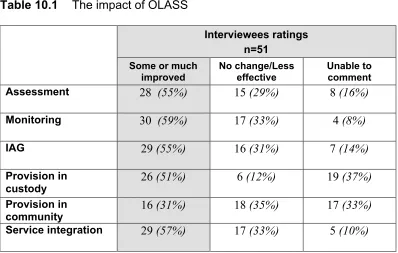
Just over half of interviewees from across the three regions reported that there had been improvements in the assessment process in the first year following the implementation of OLASS. Improvements included the systematic
administering of assessments; increased standards of assessment and increased assessment personnel as well as the implementation of new assessment
tools/facilities and new assessment requirements.
Just over a quarter of interviewees expressed the view that there had been no improvements in assessment processes since the introduction of OLASS. Reasons for a lack of improvement included the continuation of effective services and procedures (therefore, assessment procedures had remained the same, rather than declined in quality), a lack of funding to improve
assessments, the need for new assessment tools and low staffing levels and the introduction of inexperienced/unqualified staff.
4
Monitoring
Nearly three fifths of interviewees from across the three regions reported that there had been improvements in the monitoring of offenders’ progress and achievements in the first year following the implementation of OLASS.
Improvements were linked to enhanced Individual Learning Plans (ILPs), improved data collection and data transfer as well as more systematic monitoring procedures and increased collaboration and communication amongst key partners. It should be noted here, that whilst interviewees expressed there had been improvements, some were keen to stress that the improvements were influenced by the effectiveness of monitoring systems in individual prisons prior to OLASS and that improvements had occurred in some establishments but not others within the same region.
Despite acknowledging improvements in monitoring, many interviewees also acknowledged there was still some way to go (particularly with implementing Maytas) until effective and efficient data exchange could be achieved across custody and community. Around a third of interviewees who reported
Executive Summary iii
5
Information, advice and guidance
Overall, when comparing existing services to those prior to the implementation of OLASS, interviewees reported that there has been improvements, with over half of interviewees (28) reporting that IAG had become some/much improved. This included improved standards and delivery of IAG; an increase in staff/hours of IAG provision available to offenders; improved multi-agency working and coordination of IAG services; an increase in staff development and a greater recognition and prioritisation of IAG.
Nearly one third of interviewees rated that there had been no improvements in the delivery of information, advice and guidance. Reasons for this included continuation of IAG services/staff (thus the service had remained at the same level). Where IAG had been found to be less effective, the main reasons were related to a decline in quality of IAG delivered; a reduction in the quality and experience of IAG personnel; funding arrangements for IAG provision and the coordination of IAG services.
6
Impact on the workforce
Feedback from interviewees suggests that there was a balance of positive and negative impacts on the workforce as a result of OLASS. Whilst some
problems were reported, such as increased workload, a decline in morale and staff anxiety about the TUPE process, these may be perceived as temporary impacts arising from a period of change. In time, staff would hopefully adjust to the new service and some of the reported difficulties may subside.
Meanwhile, positive repercussions for the OLASS workforce included greater partnership working (facilitated by the regional boards) and increased
opportunities for professional development (for out-of-scope staff, college tutors, workshop instructors and even prison officers).
7
Impact on provision
Around half of the interviewees (26) in each of the three development regions commented that there had been ‘some’ or ‘much’ improvement in the range
and quality of provision available to offenders in custody settings. Τhey
attributed these improvements to reviews of the provision (which led to more targeted provision, which was better suited to the needs of offenders); an increase in funding (leading to additional teaching hours); the approach to provision (e.g. more offender led); and greater communication and partnership working (such as links with employers).
emphasis on employability skills (where offenders had other learning needs). It should be noted that a sizeable proportion of interviewees (19) (the majority from community based services/organizations) felt unable to give a rating due to a lack of knowledge surrounding custodial provision.
The ratings given by interviewees suggests that so far OLASS has made a much stronger impression on provision available in prison settings, compared to community. For example, when asked to assess the progress of community provision 15 interviewees registered a ‘no change’ (compared to just 4 for provision in custody). Meanwhile, 16 interviewees reported some or much improvement in community provision, whilst a larger number (26) gave these same ratings in terms of custody provision. Again, a number of interviewees (17) (the majority of whom were custody based) felt they could not comment because they did not have sufficient knowledge about provision available in the community. Where developments were reported these were connected to the approach of new providers (e.g. training for staff, tailored courses for offenders). A lack of progress meanwhile was said to be related to a lack of funding for community provision, mainstream colleges failing to engage offenders (e.g. inflexibility regarding commencement dates for courses) and no extension of contractual requirements for community provision.
Interviewees were also asked to assess the degree to which provision in custody and community was more employment focussed. For custody provision, 25 interviewees considered that it was ‘some’ or ‘much more focussed’ on employment, whilst a lower number of interviewees (20) gave the same ratings for community provision. Progress was generally associated with an increase in vocational courses, greater employment engagement and new providers with a stronger emphasis on employability.
8
Integration of services
Almost three-fifths of interviewees (29) regarded the integration of services for offenders (across custody, community and mainstream) to have improved since the start of OLASS. Greater integration was associated with: the
development of relationships, links and partnerships (e.g. which facilitated continuity of provision after release); involvement of a lead provider (e.g. enabling a more unified approach to provision), improvements to monitoring (e.g. to assist the continuity of provision, in terms of matching courses to offenders needs once in the community) and increased awareness of other agencies (which promoted the more integrated working).
Executive Summary v
arising from bringing different working cultures together (e.g. mainstream providers working in prison environments).
9
The future development of OLASS
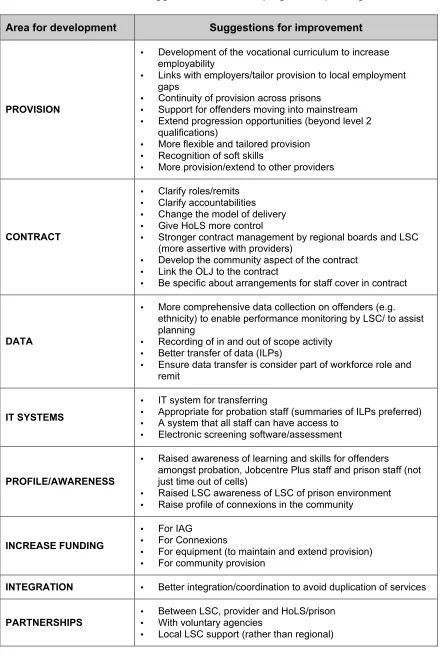
Interviewees proposed several ways in which OLASS could benefit from further development or improvement. Most often mentioned (by around 60 per cent of interviewees) were developments to the provision available to
offenders, especially a greater focus on employability, vocational courses and establishing links with local employers. Similar numbers of interviewees highlighted improvements in relation to the OLASS contract, namely, more attention given to community provision, stronger contract management by the LSC and clarification of different agencies roles and remits in relation to OLASS. The collection and transfer of data was another aspect pinpointed for development – specifically mentioned was the collection of more
comprehensive data on offenders (to assist planning and performance monitoring) and IT systems for enabling the exchange of data between agencies. Other nominations for development included: further integration of services (to prevent duplication), additional funding (for IAG, Connexions, capital equipment and provision in the community), greater partnership working between OLASS agencies and raising the profile of OLASS generally.
10
Conclusion
The purpose of this final report was to establish the overall impact of OLASS one year on from its initial launch. Each chapter examines a different
dimension of OLASS, ranging from assessment to the integration of services. In nearly all areas (with the exception of provision in the community), OLASS was considered to have brought about ‘some’ or ‘much improvement’ by over half of interviewees. In addition, when given the chance to freely nominate the main impact of OLASS, the majority of interviewees (41 out of 51) described the main impact in positive terms, lending further evidence to its effects. At the same time, for five out of the six areas, around a third of interviewees registered a ‘no change’ or ‘less effective’ rating (of these, most reported a ‘no change’, rather than a decline in standards).
When invited to provide reasons for the ratings given, interviewees pinpointed a number of factors which had either facilitated or hindered the successful implementation of OLASS. From these factors, a series of recommendations are made:
• Testimonies from the three regions suggest that appointing the right
• With a suitable electronic data transfer system in place, it was felt that
there will be a much greater chance that information about an offender will be recorded, monitored and made available to different agencies
throughout the criminal justice system.
• In moving forward, interviewees advised that OLASS now direct more
attention towards provision in the community and for young offenders to address a perceived imbalance.
• To ensure that relations between partners remain harmonious and
productive, it was recommended that contracts/OLASS documentation should be specific about the roles, remits and expectations of the key partners (e.g. in relation to data recording, staff cover, etc).
• Partners in OLASS need to invest time in learning about the work, roles
and cultures of each other’s organisation. For example, staff new to prisons were felt to benefit from induction and support to acclimatise to a more unusual working environment.
• In order to meet some interviewees’ desire to increase the vocational
content of provision, steps may need to be taken to ensure the availability of funding and greater engagement of employers, an aspiration already
expressed by the Government in its Green Paper ‘Reducing Re-offending
Though Skills and Employment,’ 2005.
• A specific development for community provision, suggested by
Introduction 1
1
Introduction
This is the third and final report from the evaluation of the new Offenders’ Learning and Skills Service (OLASS). The evaluation examined the
implementation of OLASS in three development regions (North West, North East and South West), prior to a national roll out in July 2006.
1.1 Background to the evaluation
Historically, learning and skills for offenders in custody has been provided by a mix of contractors, largely further education colleges under contract to the Prison Service, and in-house Prison Service staff (‘Instructional Officers’). After the establishment of the Offenders’ Learning and Skills Unit in 2001, it and the Prison Service took the opportunity, at the ending of those contracts, to develop and introduce a new delivery arrangement in prisons, joining together the education and vocational training elements of the service for the first time. This was to be implemented by Project REX. In 2004 and following the publication of the Carter Report (2003) that led to the establishment of the National Offender Management Service, the government announced that Project REX was to end and be replaced by a new Offenders’ Learning and Skills Service (OLASS).
There were two key changes in the transition from REX to OLASS. OLASS was to cover offenders in both custody and community, and this integrated service was to introduce delivery arrangements planned and funded by the Learning and Skills Council (LSC), the agency responsible for all non-higher post-16 learning in England. OLASS builds on the partnership arrangements in place since April 2004 between the National Probation Service and the LSC to address the learning needs of offenders in the community.
The main focus of OLASS is an early, intense focus on assessment, advice and guidance, leading to the production of an individual learning plan that will cover the offender as s/he passes through the criminal justice system. A
broader, deeper curriculum offer is outlined in The Offender’s Learning
Journey (DfES, 2004) of which there are separate adult and under 18 versions. This is focussed on developing the skills necessary to improve significantly an offender’s employability so that employment chances are greatly increased on release, leading to reduced reoffending. The aim is to develop an educational system, with an emphasis on quality improvement, that offenders can pursue through custody and in the community.
in August 2005. The third phase saw the new service introduced to the remaining six developing regions in England at the end of July 2006.
1.2 Aims of the evaluation
The evaluation was intended to inform the national delivery of OLASS by identifying the main challenges encountered during implementation in the three development regions (documented in Halsey, et al, 2006) as well as measuring the overall impact of the new service (the focus of this final report).
Through the evaluation, the research team was asked to explore five key areas:
• initial assessment of learners
• monitoring of offender achievements
• the delivery of information, advice and guidance
• workforce issues (including impact on the workforce)
• the integration of services (including the extent to which services are
coherent and continuous across the criminal justice system).
1.3 Methodology
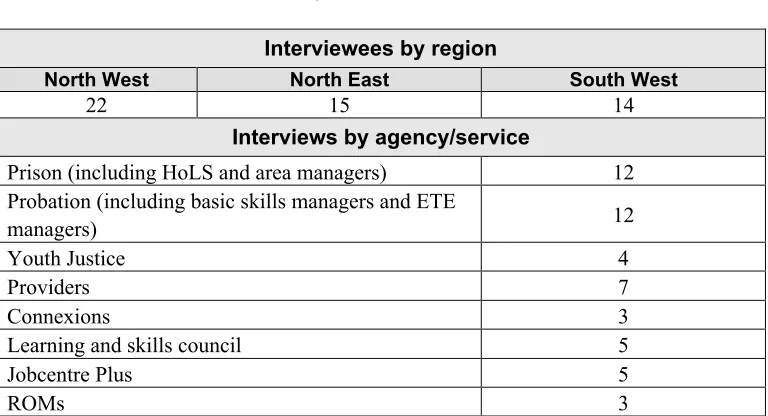
[image:13.595.128.512.524.732.2]For the third phase of the evaluation representatives from each of the three development regions were re-contacted and invited to take part in a final interview, focusing on the impact of OLASS one year after its initial launch (August 2005). Subsequently, 51 telephone interviews were conducted with representatives from a range of agencies. Table 1.1 shows the distribution of interviews across the three regions and by interviewee type.
Table 1.1 Interviewee sample
Interviewees by region
North West North East South West
22 15 14
Interviews by agency/service
Prison (including HoLS and area managers) 12 Probation (including basic skills managers and ETE
managers) 12
Youth Justice 4
Providers 7
Connexions 3
Learning and skills council 5
Jobcentre Plus 5
Introduction 3
It should be noted that the research team was unable to re-interview 14 representatives who previously contributed to the research. There were a variety of reasons for this, such as a change of personnel, retirement, interviewees stating that they were too busy to take part or simply not responding to requests for an interview. It was originally intended that
interviewee numbers should be approximately equal across regions, but for the reasons listed above, this was not achieved in the final phase.
The interview invited comment on the following areas:
• the main impact of OLASS
• impact on assessment
• impact on monitoring procedures
• impact on information, advice and guidance
• impact on the offender learning/criminal justice workforce
• impact on provision for offenders (in custody and community)
• areas for further development/improvement.
For most areas, interviewees were asked to assign a rating indicating the extent of improvements e.g. no change, some improvement, much improved, less effective and unable to comment. They were then asked to elaborate on their reasons for the rating given.
In order to capture the offenders’ experience of OLASS a short questionnaire was also administered to 36 offenders during case study visits earlier in the evaluation. This aspect of the research sought to collect offenders’ views on:
• the assessment process
• individual learning plans
• information, advice and guidance
• the courses and training available to them.
1.4 About this report
The chapters in this report are presented as follows:
Chapter 2 Main impact of OLASS
Chapter 3 Assessment
Chapter 4 Monitoring
Chapter 5 Information, advice and guidance
Chapter 6 Impact on the workforce
Chapter 7 Impact of provision
Chapter 8 Integration of services
In order to convey a sense of OLASS in each of the three regions, Appendix 1 includes regional profiles which have been compiled to highlight specific issues (successes, challenges, areas for development) within a region.
Main impact of OLASS 5
2
Main impact of OLASS
When asked to assess the overall main impact of OLASS, the majority of interviewees (41) chose to nominate positive outcomes. Their responses were categorised into four main areas of impact:
• enhancements to the provision available to offenders
• improvements to partnership working
• greater integration of services
• raised awareness of learning and skills for offenders.
2.1 Enhancements to the provision available to
offenders
Across all three development regions, interviewees (14) reported that the arrival of OLASS had led to improvements to the provision available to offenders. Extension of the curriculum, a greater focus on the learner,
improvements to IAG and an increase in provision hours were cited as various ways in which the provision was deemed to have progressed. These
developments were more often noted by prison representatives, but also by probation staff and the providers themselves.
2.2 Improvements to partnership working
The following three main areas of impact were all cited by a fifth of interviewees. Starting first with improvements to partnership working, one important aspect of OLASS was that it had brought together all the key agencies with a role to play in offender education and training. The regional boards, in particular, were regarded as important structures for discussions and inter-agency planning:
It’s got people around the table, the key strategic players to talk about the real issues…. I’ve been speaking to people I never would have met or spoke to before.
Connexions, North West
However, creating forums for interagency collaboration did not necessarily lead to advancements in partnership working as this impact was not cited by any interviewees in the South West. This perhaps reflects some of the
2.3 Greater integration of services
Related to improvements to partnership working between the key agencies, it
follows that another main impact was a better integration of servicesand
progress towards offering a seamless service to offenders.Interviewees, for
example, suggested that there was now greater coordination of provision and better links between custody and community.
2.4 Raised awareness of learning and skills for
offenders
The fourth main area of impact concerned an increased awareness of learning and skills for offenders. OLASS was felt to have heightened the profile of offender education amongst key partners generally; to have raised awareness in mainstream about their learning needs (due to the involvement of the LSC); and, in the case of prisons, widened their conception of the learning
opportunities for offenders (beyond standard assessment and education opportunities traditionally offered in prison).
Interviewees also put forward a number of other main impacts, although less frequently reported than the four described above. These included:
• improved information exchange and data transfer between agencies
• a heightened focus on employability (particularly in the NE)
• improved assessments
• increase in the numbers of learners engaged (in prison)
• development of the LSC role.
2.5 Negative impacts
Main impact of OLASS 7
expertise in adult education and their arrangements for the professional development of their staff.
Three probation interviewees across the three different regions contended that offender education in the community had lost out since OLASS. One
individual believed that funding had been diverted away from community into custody. Another felt that the transfer of education from probation to
mainstream colleges meant that it was now less of a priority for probation officers and this would also be to the detriment of offenders because ‘it’s been taken out of the hands of the people who knew how to do it’. In the third region, there was a feeling that OLASS had not been implemented as well in the community as it had been in the custodial setting. The fact that these concerns were expressed by probation staff in all three regions implies that next stage of OLASS development may require a stronger focus on provision in the community, to bring it in line with the developments emerging in custody.
2.6 Summary
The majority of interviewees (41 out of 51) described the main overall impact of OLASS in positive terms. Most commonly mentioned in their accounts were enhancements to the provision available to offenders, improvements to partnership working, a greater integration of services and a raised awareness of learning and skills for offenders.
3
Assessment
This chapter focuses on assessment processes and how they have been affected by the implementation of OLASS. Interviewees were asked to compare the assessment of learners prior to August 2005 to assessment procedures one year on. They were then asked to assign a rating of how procedures had changed using a four point scale, ranging from ‘less effective’ to ‘much improved’. This section presents the ratings given by interviewees and goes on to discuss the reasons for the ratings given.
3.1 Improvements in the assessment of learners
Just over half of interviewees (28) from across the three regions reported that there had been improvements in the assessment process. Of these, 11
interviewees rated assessments as ‘much improved’. Improvements were linked to:
• systematic undertaking of assessments
• increased standards of assessment
• increased assessment personnel and staff professional development
• implementation of new assessment tools/facilities
• new assessment requirements.
3.1.1 Systematic undertaking of assessments
Of the interviewees who rated assessment procedures as being ‘some’ or ‘much improved’ since the introduction of OLASS, the most common reason related to procedures becoming more systematic (stated by 14 interviewees). Indeed, a range of interviewees from across the three regions reported that assessments carried out by providers were less ‘ad hoc’ (resulting in an increase in the number of assessments) and more were consistently applied. Furthermore, interviewees acknowledged that there was a greater structure to the assessment process (i.e. initial assessments were made more quickly on the arrival of an offender, assessments were followed by IAG interventions that linked to assessment results and ILPs were produced more systematically). In the North West, there was also evidence of greater standardisation in
assessment procedures across prisons. For example, one interviewee
commenting on improvements to the assessment process, noted a change in the way provision was contracted. Having one lead provider across a
Assessment 9
We're actually bringing the six prisons together and discussing issues. The improvement has been in that we are beginning to standardise approaches to things and actually share good practice.
HoLS, North West
Increased collaboration and closer working amongst key partner staff was also highlighted as leading to more efficient assessments. An example of this was provided by a Jobcentre Plus representative in the North East who reported that advisors working in prisons were able to feed information already
obtained from individuals who had participated in Jobcentre Plus initiatives in the community e.g. ‘New Deal’ to staff undertaking assessments in prison, reducing the need to re-assess.
3.1.2 Increase in standards of assessments
The next most common reason for improvements (cited by interviewees in the North East and North West) related to increased standards of assessment. This included fuller evaluations of offender needs, particularly through the
implementation and increase in diagnostic testing as well as the production and increased effectiveness of ILPs (see Chapter 4 on monitoring for further details on ILPs). Here, one of the main ways in which increased standards of assessment had been achieved was through the introduction of new providers and the sharing of good practice. Such contractors were said to have extensive knowledge and experience in the area of assessment and brought with them mainstream standards and quality expectations. Furthermore, providers were thought to be prioritising assessments more. A number of interviewees
(including ROMs and LSC representatives) acknowledged that the assessment of learners, prior to OLASS, had been carried out to a much lower standard. This was highlighted by a prison representative in the North East who referred to poor quality assessments that were comprised of basic skills scores without any full evaluation. Interviewees acknowledged that providers had to carry out much more preparatory work (e.g. staff training) prior to making progress in this area.
3.1.3 Increased assessment personnel and professional
development
Interviewees across the three regions but particularly in the North East,
standards. Meanwhile, a Connexions representative in the North West reported that improvements had resulted from the fact that guidance workers carried out both assessments and IAG. It was felt that this allowed staff to establish better relationships with offenders, as well as providing personnel with better understanding of offenders’ situations and capabilities.
A small number of interviewees across the three regions acknowledged that professional development undertaken by assessment personnel had led to ‘some/much improvement’ in the assessment process. Staff training in the areas of initial and diagnostic testing and production of effective ILPs had been implemented. Indeed, improvements in ILPs (as a result of such training) were reported to have been commended by ALI inspectors in the North East.
3.1.4 Implementation of new assessment tools/facilities
Seven interviewees mainly from the North West reported that improvements were due to the introduction of new assessment tools, including online assessments (rather than paper-based versions) as well as improved assessment facilities in prisons such as ICT suites. A Jobcentre Plus representative in the North West reported that assessment was ‘much improved’ due to the introduction of online testing. This meant that assessment results and test certificates were returned more quickly to offenders which enhanced their motivation. In addition to this, a YJB representative from the South West who gave a ‘no change’ rating
acknowledged that better diagnostic tools, that were more appropriate to under 18s, were being used in a young offenders unit in the region.
3.1.5 New assessment requirements
In the North East and North West, a small number of interviewees cited that
the assessment requirements set out in the new Offender’s Learning Journey
were more comprehensive than previous requirements and this had led to improvements. Moreover, contracting requirements and delivery plans had produced a clear specification detailing what was expected and what would be provided in terms of assessment.
3.2 No improvements in assessment of learners
Just over a quarter of interviewees (15) rated that there had been no improvements in assessment processes since the introduction of OLASS. Reasons for the lack of improvement reported by interviewees who had given assessment procedures a ‘no change’ or a ‘less effective’ rating included:• continuation of previous assessment procedures
Assessment 11
• the need for new assessment tools
• low staffing levels and inexperienced/unqualified staff.
The most common reason cited by interviewees was due to the continuation
of effective assessment processes and procedures, noted particularly by HoLS in the North West, and Probation Service representatives in both the North East and South West. Interviewees from Probation acknowledged there had been ‘no change’ in assessments as the provision had continued to be outsourced to the same providers. Hence, there was a continuation of personnel and a maintenance of pre-existing assessment procedures. For example, a Probation Service representative in the South West reported that ‘Next Steps’ provision had been offered though the Probation Service prior to OLASS and that this provision had been of a high standard.
Of the remaining interviewees who believed that there had been no change in assessment a year on from the introduction of the new service, three
interviewees cited funding as a limiting factor. Namely, that there had been no
additional funding in the community for services to improve assessment procedures and that there was no additional funding for increased hours/staff to undertake assessments in custody. Two interviewees in the North West also
cited the lack of assessment tools/software to carry out electronic screening
as a limiting factor.
The only interviewee who rated assessment procedures as less effective felt this was due to a decrease in the standard of initial assessments and a reduction in the volume of diagnostic tests since the introduction of OLASS and new providers. Further, that enhanced assessment procedures could not be
achieved with current staffing and funding levels. In addition, other
interviewees (one who did not give a rating and another who rated that there had been ‘no change’ in the assessment process) believed this was due to
untrained/unqualified provider staff carrying out assessments. Previously qualified personnel with an education background had carried out assessments and such staff were felt to have greater empathy with learners and increased competence in promoting courses to learners.
Other reasons given for the lack of improvements included:
• the delayed availability of a fully operational electronic data sharing
system and electronic/‘live’ ILPs
• poor quality ILPs – no smart targets
• a perception that the LSC placed a greater emphasis on outcomes achieved
(e.g. qualifications) than the initial assessment process.
• a greater focus placed on IAG than assessments by new providers
3.3 Summary
Just over half of interviewees from across the three regions reported that there had been improvements in the assessment process in the first year following the implementation of OLASS. Improvements included the systematic
administering of assessments; increased standards of assessment and increased assessment personnel as well as the implementation of new assessment
tools/facilities and new assessment requirements.
Just over a quarter of interviewees rated that there had been no improvements in assessment processes since the introduction of OLASS. Reasons for the lack of improvement reported by interviewees included the continuation of
effective services and procedures, a lack of funding to improve assessments, the need for new assessment tools and low staffing levels and
Monitoring 13
4
Monitoring
This section considers the impact of OLASS on the monitoring of learners’ progress and achievements. Interviewees were asked to compare the
monitoring of learners prior to August 2005 to existing monitoring procedures following the introduction of OLASS and rate the progress made on a four point scale from ‘less effective’ to ‘much improved’. This section presents the ratings given by interviewees and goes on to discuss the reasons for the ratings given.
4.1 Improvements to the monitoring of offenders’
progress and achievements
Three fifths of interviewees (30) from across the three regions reported that there had been improvements in the monitoring of offenders progress and achievements in the first year following the implementation of OLASS. Improvements were linked to:
• enhanced Individual Learning Plans (ILPs) and improved data collection
• improved data transfer
• systematic monitoring procedures
• increased collaboration and communication.
4.1.1 Improvements in ILPs and data collection
The most common reasons for improvements in the monitoring of learners’ progress and achievements related to ILPs. Not only did interviewees report that there was a greater awareness of ILPs among key partner staff, ILPs were also felt to have become more widely produced, more consistent and more rigorous a year on from the introduction of OLASS. For example, a
Connexions representative in the North West felt that development work on ILPs, so that all services were able to contribute to the plan, had led to improvements. ILPs had also improved because they were completed, reviewed and maintained by appropriately trained and qualified staff. In relation to this, a provider in the North East reported how ILPs had become more effective as staff were now beginning to include more ‘SMART targets’. A small number of interviewees referred to offenders’ use of ILPs in the community, for example, a JCP representative reported that a small number of offenders had taken their ILPs with them to initial meetings with JCP advisors.
greater awareness of offenders’ progress, which in turn meant that staff were able to identify learner needs and target provision accordingly, as well as identify when gaps in provision became available and fill spaces when they were required.
4.1.2 Improved data transfer
Of the 30 interviewees who rated the monitoring of learners progress and achievements as being ‘some’ or ‘much improved’, nearly half reported that this was due to improved data transfer. Indeed, several interviewees (mainly custody based) across all three regions felt that there had been some
improvement in the transfer of individual learning plans. For example, a prison representative in the South West reported that there was now electronic transfer of records and hard copies of plans sent to other regions when an offender moved. In the North East, a prison representative noted that they were receiving data from one or two establishments and that data was
transferred more systematically and quickly to other establishments than it had been previously. Indeed, a Youth Justice representative reported that ILPs were ‘starting to come through to the community’ and be used by YOTs. The lead provider in the region acknowledged that there had been a substantial increase in administrative staff to facilitate data recording and transfer. Other interviewees reported that improvements in monitoring were anticipated, and related to the implementation of Maytas.
4.1.3 Monitoring more systematic/ procedures tighter
A further improvement as a result of the new service was that monitoring and data collection procedures had become more consistent and systematic. There were three reasons for this. Firstly, interviewees in the North West
acknowledged that increased consistency was related to the fact that there were fewer providers and that all providers were working to the same requirements to produce the same level and quality of data. Similarly, the existence of one lead provider was said to have led to increased consistency in the monitoring process. Interviewees also believed that new providers had brought with them mainstream experience, as well as higher expectations and increased quality in data monitoring and recording. Finally, it was felt that the
monitoring requirements outlined in the Offender’s Learning Journey, along
with new contracting arrangements between the LSC and providers had led to greater accountability for monitoring. Indeed, OLASS generally was said to have prioritized the reporting of learner information amongst providers (e.g. the number of ILPs transferred and received etc).
4.1.4 Increased collaboration and communication
Monitoring 15
partners. For example, a representative from the YJB in the North West reported that education representatives within the YOTs had an increased knowledge of ILPs due to their attendance at OLASS partnership meetings. Interviewees also reported that it was the expectation of the OLASS contract that monitoring was a shared responsibility. Finally, an LSC representative from the region noted that the prisons which had made the most progress in terms of monitoring, were those that had developed a good relationships with the provider and where there were clearly defined roles and responsibilities.
4.2 No improvements in the monitoring of offender
progress and achievements
A third of interviewees (17) rated that there had been no improvements in the monitoring of offenders learning and achievements including nine
interviewees reporting that monitoring had become less effective. Reasons for the lack of improvement reported by interviewees who had given monitoring procedures a ‘no change’ or a ‘less effective’ rating included:
• inadequacies of data collection and recording
• poor data transfer and the delayed availability of a fully operational
electronic data sharing system
• reduced quality of offender data
• new provider, staff and procedures.
The responses of interviewees who rated monitoring as less effective are discussed first, followed by the responses of those interviewees who felt there had been no change.
4.2.1 Reason for less effective monitoring
When asked to compare the monitoring processes prior to August 2005 to the current monitoring procedures, nine interviewees across the three regions rated the provision as less effective. One of the main reasons for this was the
inadequacies of data collection and recording in custody, in particular the
non-recording of learners’ progress and achievements in out of scope activity1.
For several interviewees this was a major concern and was felt to result in an incomplete picture of offender learning. Indeed, one custody based
interviewee from the North West highlighted how differing remits for the recording of offender data had led to the education department becoming isolated and un-integrated from the rest of the prison.
1 The decision not to include out of scope activity was made by the DfES because Maytas was created
Other reasons for monitoring processes becoming ‘less effective’ cited by
interviewees particularly in the South West related to providers, namely the
poor communication and relationships between providers and contractors, poor quality provider staff responsible for monitoring and poor management of the project. In the North West, a probation representative noted receiving incomplete data on commencement and awards from the lead provider. This was due to the delay in local colleges transferring records to the lead provider and the lack of requirements in contracts identifying when such data will be delivered and how data will be shared.
A range of other interviewees who did not give a rating of less effective (e.g. instead indicated ‘some improvement’) also highlighted concerns in relation to the type and level of offender data collected. For example, a ROM in the North West reported that the data collected through OLASS focussed only on learning and skills and this data alone did not meet the needs of custody and
community where data on other offender needs are also required2.
Furthermore, a representative from the same region reported specific
difficulties for their organisation in relation to the data collected (e.g. YJB has a target for engagement in ETE for all young people from 10 to 17 so do not specifically measure as a discrete group the engagement figures for 15 plus, yet LSC and OLASS focuses on 15 plus).
Additional issues were raised by interviewees (who did not give a ‘less effective’ rating), included:
• inadequate specification of what data will be collected in contractual
arrangements
• limitations of the ILPs – the ILP to be used with Maytas was felt to be
inadequate3.
4.2.2 Reasons for no change in monitoring
Of the eight interviewees who reported that there had been no change in the monitoring of learners’ progress and achievements, the main reason was due
to issues relating to data transfer particularly between custody and
community (and visa versa). Associated with this was the delayed availability of a fully operational electronic data sharing system (i.e. Maytas) which meant that learner information could not be transferred, resulting in the continuation of repeat assessments. In addition, several other interviewees who did not give this rating (e.g. indicated some improvement) also cited difficulties with information transfer due to the lack of an effective MIS, indeed this was felt to be a significant limiting factor to improvements in monitoring. Interviewees also highlighted technical difficulties, security issues, and training needs as delaying the commencement of Maytas.
2 This is to be addressed by C-Nomis.
Monitoring 17
Other reasons given for the lack of improvements included:
• a lack of clear guidance about ILPs
• other key partner agencies such as Jobcentre Plus not included in data
sharing agreements
• the need for staff training – to become accustomed to new provider
paperwork and monitoring procedures
• OLASS’ perceived focus on custody – limiting community developments.
4.3 Summary
Nearly three fifths of interviewees from across the three regions reported that there had been improvements in the monitoring of offenders’ progress and achievements in the first year following the implementation of OLASS.
Improvements were linked to enhanced Individual Learning Plans, improved data collection and data transfer as well as more systematic monitoring procedures and increased collaboration and communication amongst key partners. It should be noted here, that whilst interviewees expressed there had been improvements, some were keen to stress that the improvements were influenced by the effectiveness of monitoring systems in individual prisons prior to OLASS and that improvements had occurred in some establishments but not others within the same region.
Despite acknowledging improvements in monitoring, many interviewees also acknowledged there was still some way to go (particularly with implementing Maytas) until effective and efficient data exchange could be achieved across custody and community. Around a third of interviewees who reported
5
Information, advice and guidance
This chapter examines the impact of OLASS on the integrated delivery of Information, Advice and Guidance (IAG). Interviewees were asked to compare the delivery of IAG prior to August 2005, to the IAG that was available one year on from the implementation of the new service. They then gave a rating of the current provision on a four point scale from ‘less effective’ to ‘much improved’. This section presents the ratings assigned by interviewees and goes on to discuss the reasons for the ratings given.
5.1 Improvements in the delivery of IAG
Over half of interviewees (28) from across the three regions reported that there had been improvements in the delivery of information, advice and guidance. Of these, around one third suggested that IAG provision was ‘much
improved’. Improvements were linked to:
• improved standards and delivery of IAG
• increase in staff/hours of IAG provision available to offenders
• improved multi-agency working and coordination of IAG services
• increase in staff development and training opportunities
• greater recognition and prioritisation of IAG.
5.1.1 Improved standards and delivery of IAG services
Of the interviewees who rated IAG provision as being ‘some’ or ‘much improved’, the most common reason related to enhanced IAG delivery and increased standards.
Information, advice and guidance 19
there was evidence that offenders were better informed. For example, a JCP representative in the North East reported that offenders were making more informed choices about courses rather than choosing to attend the same courses as their friends.
Other interviewees suggested that as new providers were experienced in the delivery of IAG they had improved the standards and rigor in the provision of advice and guidance. Moreover, interviewees from both the North West and South West described how the IAG provision was working towards or had
achieved the matrixstandard (a national quality standard for organisations that
deliver information, advice and/or guidance on learning and work).
5.1.2 Increase in IAG hours/staff
One of the main ways in which interviewees’ believed there had been an improvement in IAG as a result of the new service was due to an increase in personnel/staff time dedicated to delivering IAG. Around a fifth of
interviewees including prison based staff, LSC representatives and providers from across the three regions reported that additional IAG staff had been recruited to fill gaps in provision and to increase provision where necessary. Interviewees noted that the increase in qualified IAG staff was a significant development particularly in establishments which, prior to OLASS, had little or no IAG provision. Indeed, one interviewee from the North East noted that in some cases the numbers of IAG staff in establishments had doubled or tripled. It was reported that there were now IAG teams where previously IAG provision had been the responsibility of an individual member of staff. Other interviewees reported that the number of IAG hours had increased with existing part time IAG personnel increasing to full time and this, along with the recruitment of new staff, meant that more time could be dedicated to the delivery of IAG and thus the extent and focus of provision could be expanded.
We’re not just doing inductions, which is what we were doing before, we’re doing real guidance like would happen in the community, so yes that’s one of the things that has improved.
HoLS, North West
5.1.3 Improved coordination of IAG services
each other’s roles and remits and there was more of a shared vision between the various IAG providers.
In terms of community provision, in both the North West and North East interviewees reported that OLASS has tightened multi-agency working between IAG agencies and other services/organisations. For example, one interviewee noted that IAG organisations were represented on OLASS boards and this had led to different services becoming more aware of each other and had led to an improvement in cross referrals etc.
Other ways in which IAG was felt to have become more coordinated was through the standardisation of IAG materials across establishments and through more systematic procedures for referral in the community. For example, in the North West region, a process map of the different services for offenders in the community was developed. Each member of staff delivering the different services were aware of their own and each others responsibilities and how that it fitted together with the provision offered by other services.
5.1.4 Staff development
Provider, prison and LSC representatives from the North West and North East cited that one of the main reasons for the improvement in IAG services was an increase in training and support provided to IAG personnel. Indeed
interviewees believed that the workforce as a whole were now more
competent as a result of the training IAG personnel had received and through the recruitment of appropriately qualified and experienced staff. In addition, interviewees reported that IAG staff had a clearer idea of what was expected of them in terms of information and advice and what constitutes IAG.
In addition to this, interviewees reported that IAG staff were now being better managed. For example, in the North East, the lead provider had introduced a management structure and in each establishment a curriculum lead with a focus on IAG had been employed to supervise IAG personnel, this along with positive staff attitudes was said to have led to increased effectiveness in IAG services.
5.1.5 Prioritisation of IAG
In the North West in particular, it was noted that OLASS had led to
some/much improvement in the IAG services available to offenders due to the increased recognition and prioritisation of IAG in new contracting
arrangements, as well as within the Offender’s Learning Journey. Indeed, this
documentwas recognised as being a critical factor in conveying the value and
Information, advice and guidance 21
Having identified IAG as one of the key elements of the OLJ gives me a lot of sway with HoLS. At the end of the day they determine what we can do within the prison, if the HoLS doesn’t see the need for IAG then you’re struggling. So, having that fantastic gold mine of saying, ‘look you’ve got to follow the Offender’s Learner Journey, there’s got to be IAG offered at these four stages’.
IAG Provider, North West
5.2 No improvements in the delivery of IAG
Nearly one third of interviewees (16) rated that there had been noimprovements in the delivery of information, advice and guidance. Reasons for the lack of improvement reported by interviewees who had given IAG delivery a ‘no change’ or a ‘less effective’ rating included:
• decline in quality of IAG delivered
• reduction in the quality and experience of IAG personnel
• funding arrangements for IAG provision
• coordination of IAG services.
The responses of interviewees who rated IAG as less effective will be discussed first followed by those who felt there had been no change.
5.2.1 Reasons for less effective delivery of IAG
When asked to compare the delivery of information, advice and guidance prior to August 2005 to the current delivery of IAG a small number of interviewees (5) rated the provision as less effective.
One of the reasons cited by interviewees was a perceived decline in quality of
IAG delivered. This included the belief by one interviewee that the IAG now offered by advisors was based on availability of courses rather than offender need. Another interviewee felt that IAG was ‘front end heavy’ (e.g. focussed on induction and not pre/post release) and another interviewee questioned the accountability of IAG provision and noted that there was a lack of evidence in relation to the range and effectiveness of IAG now being offered to offenders.
In the South West, two interviewees felt that there had been a reduction in
A particular concern for probation representatives was funding. One interviewee in the North West felt that IAG was less effective as s/he perceived that funds for IAG had been withdrawn and they believed that the new funding arrangements for OLASS did not include IAG for offenders in the community. Another interviewee in the North East reported that sub-contractors received less funding for the delivery of IAG than they had done
when the service was funded through NPS4. In turn, this had led to a
restriction of IAG advisors and increased waiting times for offenders following a referral. This was felt to have significant impacts on motivating offenders to engage with ETE.
Other concerns related to the coordination of IAG services, in particular that
there were less effective links between new IAG personnel and other departments and with services in other geographical areas. Further, IAG provided under OLASS was duplicating provision offered by other services based within custody (e.g. resettlement teams).
5.2.2 Reasons for no change in the delivery of IAG
One fifth of interviewees reported a lack of development in the delivery of
IAG. This was due, in the most part, to the continuation of IAG services by
the same provider and/or existing IAG personnel, delivering the same level and focus of IAG as they had done prior to the implementation of the new service. Indeed, it should be noted here that many interviewees acknowledged that existing IAG services were effective prior to the introduction of OLASS, particularly those services delivered to offenders in the community.
Interviewees also noted that IAG services had not developed further as there
had been no increase in staff (or funding for additional hours) required to
expand or improve delivery further, (yet OLASS was creating a demand for more IAG). In one case, an interviewee reported that even though staff had been employed, progress had been halted due to the recruitment of untrained IAG staff. Another interviewee referring to a remand centre reported that much of the IAG time was spent on induction. Due to the high turn over of offenders, development in IAG could not be made until provision had been expanded. YJB representatives also noted that IAG for young offenders under 16 years old was limited and no progress had been made in this area.
4 The decision to withdraw funds was made by the NPS and these funds were utilised to provide
Information, advice and guidance 23
5.3 Summary
Overall, when comparing existing services to those prior to the implementation of OLASS, interviewees reported that there has been improvements, with over half of interviewees (28) reporting that IAG had become some/much improved. This included improved standards and delivery of IAG; an increase in staff/hours of IAG provision available to offenders; improved multi-agency working and coordination of IAG services; an increase in staff development and a greater recognition and prioritisation of IAG.
Nearly one third of interviewees suggested that there had been no
6
Impact on the workforce
The evaluation of the OLASS involved seeking views from seven different agencies - prisons, probation, the LSC, youth justice, connexions, providers and Jobcentre Plus. All were asked how their workforce had been affected by the new service. In organising their responses, it is possible to report that almost equal number of interviewees highlighted positive and negative impacts. Comparing responses across the regions, proportionately, it was the North East region where interviewees were most likely to speak of positive workforce impacts, where as in the South West, assessments of impact were predominately negative (just two interviewees highlighted positive outcomes here).
6.1 Positive impacts on the workforce
OLASS was regarded as having had a positive impact on the workforce in the following ways:
• improved partnerships and communication between agencies
• enhanced opportunities for professional development
• poor quality staff challenged by provider
• a better understanding and knowledge of offenders
• heightened profile for offender education.
One of the most commonly stated positive impacts revolved around improved
partnerships and communication between agencies. Often this outcome was linked to regional boards and other opportunities for key players to come together. In doing so, it was felt that agencies were learning from others, they were no longer working in isolation and there were now channels for sharing good practice. Others felt that generally there was an increasing willingness to working together and as a result, the dialogue between agencies had opened out. Another form of greater partnership was observed between in-scope and out-of-scope prison tutors. Because of an increase in tutor hours, in-scope staff were able to offer skills for life in workshop settings, alongside instructional tutors.
Seven interviewees reported enhanced opportunities for professional
development since OLASS. This offer pertained to out-of-scope staff, college tutors, workshop instructors (to be trained as assessors) and even prison officers (basic skills awareness training).
Impact on the workforce 25
North East) was said to be challenging their performance which would
eventually improve overall standards. A Jobcentre Plus representative explained how greater inter-agency involvement meant that their
understanding and knowledge of offenders had benefited: ‘It’s enabled us to get the bigger picture for the offender agenda and cascade that out to our teams’. Meanwhile, the transfer of instructors from the prison service to the college was deemed by the provider to have ‘professionalised’ the workforce due the support they now received. Within probation and Jobcentre Plus, interviewees felt that OLASS had given offender education a boost and
generally raised its profile amongst their workforce. Some interviewees
simply felt that the workforce was now able to offer a better service - they attributed this to tighter management on the part of the provider, such that ‘the bare minimum isn’t acceptable anymore’
6.2 Negative impacts on the workforce
As indicated earlier, equal numbers of interviewees mentioned ways in which the workforce had been negatively impacted by OLASS. However, when examined in closer detail it would appear that many of these impacts could be regarded as temporary difficulties, associated with a period of change, rather than lasting conditions.
For example, two of the most frequently mentioned negative impacts were an
increase in workload/stress and problems associated with the TUPE process. Interviewees though acknowledged that the extra workload came from implementing a new service, developing systems and adapting to new environments (e.g. the experience of working in prisons for Connexions staff). Similarly the TUPE process was problematic in terms of dealing with different working terms and conditions and reassuring staff involved in the process. But again, in time, these issues would hopefully be resolved. The overall speed of implementation though was criticised and this was possibly a contributory factor to the stress reported by some interviewees. It would be important to recognise therefore, the significant adjustment that OLASS represents and ensure that the organisations affected are allowed time to implement the necessary changes.
The third main negative impact concerned the role of the HoLS. HoLS in all
three regions were particularly vocal about a perceived loss of control. There was a sense that they had much less influence over the provision and where they were unhappy with the service, they did not feel adequately empowered to challenge the provider:
The result was that HoLS felt like they were ‘bystanders’ in the process rather than strategic managers. Clearly, this is an issue which requires attention as uncertainty about their role was said to have left a number of HoLS feeling frustrated and demotivated.
Low staff morale surfaced as a negative workforce impact. This was said to be an issue for prison administrators who felt torn between data collection for Maytas and administration for the education department. Clarification of the role and duties would go some way towards tackling this particular concern. Elsewhere, a lack of support from the provider was said to be the source of low morale amongst staff transferred over from probation and prisons. Providers perhaps need to invest more time in smoothing the transition for staff moving from one employer to another.
6.3 Summary
Feedback from interviewees suggests that there was a balance of positive and negative impacts on the workforce as a result of OLASS. Whilst some
problems were reported, such as increased workload, a decline in morale and staff anxiety about the TUPE process, these may be perceived as temporary impacts arising from a period of change. In time, staff would hopefully adjust to the new service and some of the reported difficulties may subside.
Meanwhile, positive repercussions for the OLASS workforce included greater partnership working (facilitated by the regional boards) and increased
Impact on provision 27
7
Impact on provision
This chapter looks at the impact of OLASS on the range and availability of provision for offenders. Interviewees were asked to rate separately the impact on community and custody provision using a four point scale ranging from ‘less effective’ to ‘much improved’. For both sectors, interviewees were also asked to assess whether provision had become any more employment-focussed since the start of OLASS.
7.1 Improvements to provision in custody
In terms of provision in custody, around half of the interviewees (26) in each of the three development regions concluded that there had been ‘some’ or ‘much improvement’ since OLASS. (It should be noted that 19 interviewees, (most working in a community setting) stated that they were unable to comment because they had no knowledge or awareness of custody-based provision.)
The following factors were identified as contributing to improvements:
• reviews of the provision
• approach to provision
• increase in funding
• communication and partnership working.
7.1.1 Reviews of the provision
In terms of improvements in the quality and range of provision available, the opportunity to review and reconsider provision was highlighted most
frequently as a significant impact of OLASS. Thirteen interviewees, including LSC, HoLS, ROM, Jobcentre Plus, Connexions and provider representatives across each region made such comments. These reviews were felt to be
7.1.2 Approach to the provision
Eleven interviewees (from a range of organizations) suggested that OLASS had impacted positively as a result of developments in the approach to, and nature of, the provision on offer. Over half of these respondents were from the North West region. The presence of new providers, coupled with a new approach to offender learning and skills was cited as another factor
contributing towards advancements in the provision. Several identified the change in providers as underpinning improved provision through more effective delivery of the curriculum and the drive to explore opportunities for delivering education in more innovative ways. In addition, a move towards offender led provision, which focussed more closely on the needs of individual offenders, was also highlighted. The development and use of ILPs was felt to promote a culture shift from ‘prison education’ to more mainstreamed
‘offender education’.
7.1.3 Increase in funding
OLASS was said to have brought additional funding to offender education, manifested predominantly as additional teaching hours to enhance existing core and vocational provision, as well as newly identified curriculum areas. In addition, issues around waiting lists and course capacities were now being addressed.
7.1.4 Communication and partnership working
Two interviewees in the North West specifically identified issues of
communication and partnership working as underpinning the improvements in provision. Within this, in terms of strategic oversight, it was contended that the development of structures and mechanisms, such as Quality Improvement Groups, HoLS meetings and OLASS Forums, served to bring relevant parties together to focus on enhancing the quality of provision offered.
The development of links and securing the involvement of other agencies and institutions, including local employers was also identified as a key factor in successful provision. For instance, moves to encourage prison visits by local employers was seen as particularly important, as this would serve to raise their awareness of the quality of training and skill acquisition opportunities
available to offenders. Similarly, links between prison establishments were said to be developing through audits of provision and these highlighted further ways of linking resources and service delivery.
7.2 No improvements to provision in custody
Impact on provision 29
Four interviewees (all from the North West) indicated that there had been no change.
Reasons for a lack of improvement included:
• provision that was provider, rather than offender, led
• removal of specific provision (arts related)
• staffing capacity
• a perceived over-emphasis on the delivery of employability skills.
7.2.1 A decline in provision
Two interviewees considered that the range and availability of provision in custody had actually worsened since OLASS.
It was suggested in one particular establishment that despite extra tuition hours, the number of offenders accessing courses and achievements obtained had dropped. This was said to have arisen from an approach to provision
which was provider-led, rather than offender-led. Suggestions were made that
the way in which certain providers approached delivery was counterproductive as far as mainstreaming was concerned. The presence of a specialised offender learning department was said, by one interviewee, to mean that offenders would not receive the same provision, or have access to the same resources and support as would those in the mainstream FE sector. Specialisation was thus seen as imposing restrictions on the range and quality of provision.
One interviewee commented that provision quality and range had declined as a
result of the removal of certain arts-related courses, in favour of others with
a greater employment-related focus.
It should be noted that amongst those interviewees who gave overall positive ratings (e.g. ‘some improvement’ or ‘much improvement’), there were several who signaled ways in which the provis