Taking Post-16 Citizenship Forward:
Learning from the Post-16 Citizenship
Development Projects
Rachel Craig, David Kerr, Pauline Wade
Taking Post-16 Citizenship Forward:
Learning from the Post-16 Citizenship
Development Projects
Rachel Craig, David Kerr, Pauline Wade
and Graham Taylor, NFER
© Queen’s Printer and Controller of HMSO 2004. Published with the permission of DfES on behalf of the Controller of Her Majesty's Stationery Office. Applications for reproduction should be made in writing to The Crown Copyright Unit, Her Majesty's Stationery Office, St Clements House, 2-16 Colegate, Norwich NR3 1BQ.
CONTENTS
page
EXECUTIVE SUMMARY i
1. INTRODUCTION 1
1.1 Background and policy context 2
1.2 Research aims and method 5
1.3 Context: key findings from the Year 2 evaluation 7
1.4 Report structure 8
2. ORGANISATION AND MANAGEMENT OF THE PILOT PROJECTS 11
2.1 Structure of Round 1 and Round 2 projects 12
2.2 Support for organisations 20
2.3 Staff development and training 23
2.4 Young people: numbers and profile 26
2.5 Implications for the future 27
3. DEFINITION AND UNDERSTANDING OF CITIZENSHIP 29
3.1 The view at Project Coordinator and Consultant level 30 3.2 The three strands of citizenship in case-study organisations 31
3.3 Active citizenship 33
3.4 Implications for the future 34
4. INTEGRATION AND LINKING OF CITIZENSHIP 37
4.1 Integration into programmes, curriculum and ethos 38
4.2 Links with pre-16 citizenship 41
4.3 Links with the 14-19 education review 43
4.4 Integration with external agencies 44
4.5 Implications for the future 45
5. TEACHING AND LEARNING approaches to CITIZENSHIP 47
5.1 Successful approaches to teaching and learning 48 5.2 Large scale provision: delivery through a tutorial programme 48
5.3 Resources 51
5.4 Implications for the future 53
6. OUTCOMES FROM THE PILOT PROJECTS 55
6.1 Progress against objectives 56
6.2 Assessing and recognising citizenship learning 57
6.3 Outcomes for young people 61
6.4 Successes and challenges 65
6.5 Implications for the future 67
7. REQUIREMENTS AND IMPLICATIONS FOR EXTENDING POST-16 CITIZENSHIP PROVISION 69
7.4 Requirements for extending post-16 citizenship 80 7.5 Organisations leaving the citizenship pilot programme 82
8. CONCLUDING COMMENTS – TAKING STOCK AND MOVING
FORWARD 85
8.1 What has been learned from the programme of pilot projects and national evaluation about developing citizenship in post-16 settings? 85
APPENDICES
A Partner organisations in case-study consortia 93
B Management Information about programme participants 95
C Progress against action plan objectives 109
EXECUTIVE SUMMARY
Background
This is a summary of findings from the final year report of a three year evaluation of the post-16 citizenship development projects undertaken by the National Foundation for Educational Research (NFER) on behalf of the Department for Education and Skills (DfES). It is based upon qualitative interviews with 67 individuals and 26 groups of young people across 20 case-study organisations from the Round 1 and Round 2 projects, and upon management information (MI) data supplied by the projects. It sets these findings within the context of findings from the first two years of the evaluation. The aims of the evaluation are to:
® Assess the extent to which the development projects were progressing in
line with their action plans, and working towards their own objectives.
® Identify the conditions necessary for the success of post-16 citizenship.
® Identify the forms of citizenship provision that appear the most effective.
® Examine the apparent impact of involvement in post-16 citizenship on
young people’s knowledge, understanding and skills.
In this final year of the evaluation, there is a specific focus on the sustainability of the development projects, and issues that need to be addressed in any period of expansion leading to eventual national roll-out of post-16 citizenship entitlement for all young people.
Key findings
The evaluation has provided evidence that the projects have been successful in developing a range of innovative approaches to active citizenship in a range of post-16 education and training settings. There are a number of key factors that appear to underlie the most successful post-16 citizenship provision, including.
® A flexible, yet rigorous, framework which recognises that projects are
developing citizenship programmes in a wide variety of ways, from taught to more active approaches, according to the specific needs and circumstances of their organisations, staff and young people.
® A clear definition of what citizenship means, and what the programme
seeks to achieve, tailored to the needs, skills, interests and experiences of young people.
® Dedicated and enthusiastic staff with sufficient resources and development
opportunities. Senior management support and a supportive cultural ethos within the institution are also important.
® An emphasis on combining knowledge, understanding and skills with
® Involvement and participation of young people in decisions about their
learning, and the development of a student voice.
Policy background
Citizenship education has been at the centre of a major debate and review over the past decade. In 1998 the Advisory Group on Education for Citizenship and the Teaching of Democracy in Schools, chaired by Professor (now Sir) Bernard Crick, recommended in its report1 that citizenship education be developed around three separate but interrelated strands: social and moral responsibility, community involvement and political literacy. Citizenship has since become a statutory component of the National Curriculum at key stages 3 and 4 (students aged 11-16).
In 1999, a separate Advisory Group on Citizenship for 16-19 year olds in Education and Training was established, also chaired by Professor Crick. Its report in 20002 recommended that citizenship should become an entitlement for all young people aged 16-19, who should be given effective opportunities to develop their citizenship skills, and suggested that citizenship should be recognised as a key life skill alongside the six key skills already identified. The post-16 recommendations built on the principles embedded within the pre-16 report, whilst recognising the specific context of post-16 education and training, and the need for skills development and ‘active citizenship’ opportunities.
The development projects
A three year developmental phase of post-16 citizenship started in September 2001, when a first round of pilot projects began exploring ways of delivering citizenship in organisations providing education and training to 16-19 year olds. In September 2002, a new group of pilot projects began a second wave of development. The Round 1 projects consisted of 11 consortia, each with a Consortium-level Project Manager (CLPM) overseeing the development of a range of programmes across partner organisations. The Round 2 projects were organised rather differently, with no CLPM, but a Project Manager within each individual organisation.
According to MI data, 79 organisations were involved in developing post-16 citizenship projects in 2003-4, including school sixth forms (22), sixth form colleges (13), FE colleges (16), Training Providers (14), Youth Services (9) and other organisations (5).
Methodology
The evaluation adopts a largely qualitative methodology, with this third annual report based upon the following research methods:
1 QUALIFICATIONS AND CURRICULUM AUTHORITY (1998). Education for Citizenship and
the Teaching of Democracy in Schools: Final Report of the Advisory Group on Citizenship, 22 September 1998. London: QCA.
2 FURTHER EDUCATION FUNDING COUNCIL (2000). Citizenship for 16-19 Year Olds in
® In-depth strategic interviews with 11 CLPMs across the 11 Round 1
consortia in the autumn term of 2003, and with nine LSDA consultants across the 10 Round 2 consortia between March and April 2004.
® In-depth interviews with staff and young people across 20 case-study
organisations (one per consortium). These included discussions with project managers (20), staff delivering programmes (23), young people (26 groups, involving around 150 young people) and, where relevant, external partners (4). Interviews took place between April and June 2004.
® Analysis of data from the consortia through termly management
information (MI) returns to the LSDA, giving details of young people's participation rates, project action plans and progress.
Main findings
Participation
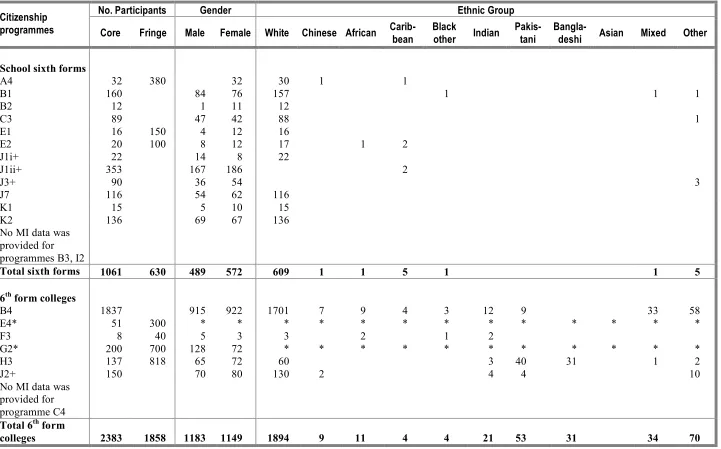
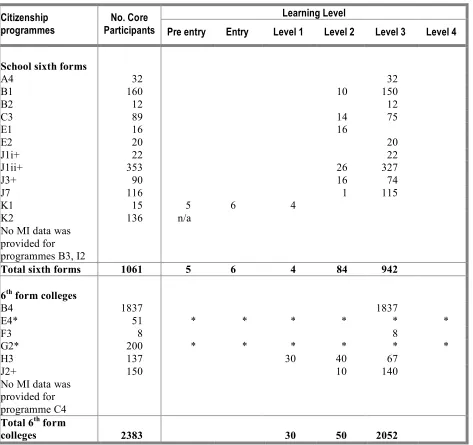
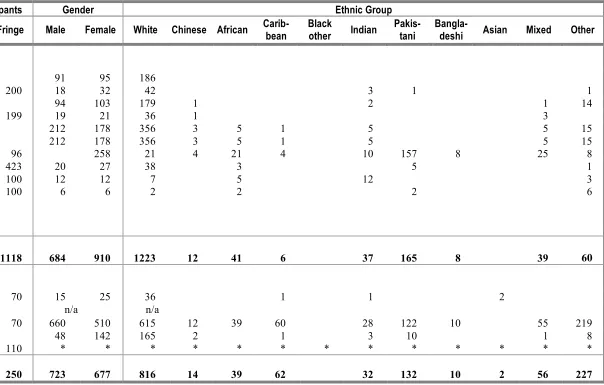
The number of young people participating in post-16 citizenship projects had increased substantially in 2003-2004, compared with the previous year, according to MI data. The reported number of participants across Round 1 projects rose from 5860 to 7760, and across Round 2 projects from 3043 to 4581. There appeared to be a fairly even split between male and female participants, and the majority were classified as white, with Pakistanis and Bangladeshis being the largest ethnic groups among the remaining participants. Three fifths of Round 1 participants were level 3 learners, while in Round 2 projects half were learning at level 3, and a third at level 2.
Management and status of citizenship
From the evidence of the case-studies, the organisational model adopted for Round 2 projects was very successful. While project managers at organisational level handled day to day issues, the Consultants were able to take a more strategic perspective, and to facilitate networking and liaison between partner organisations. Overall, it would seem that the Round 2 model streamlined management structure would be appropriate for a national roll out of post-16 citizenship provision.
There was a high level of senior management support for post-16 citizenship within the case-study organisations, although some felt that this was more in principle than in terms of real time and funding. The following factors were also considered crucial to ensuring that post-16 citizenship had high status:
® A ‘champion’ to promote the importance of citizenship to staff and young
people.
® Genuine enthusiasm on the part of delivery staff, and a desire to work in
partnership with young people. This was felt by most interviewees to outweigh the need for specific expertise or knowledge.
® Ring-fenced time for coordinators to plan and organise, and for deliverers
® Good opportunities for staff development and training. This is still an
underdeveloped area in most organisations, where informal development activities prevail rather than formal training courses.
Definition and understanding of citizenship
Most of the development projects have established a clear understanding of the principles of citizenship, and many have been able to link these to specific learning outcomes for their young people. Consultants felt that understanding was developing particularly in terms of the active, participative element of citizenship. While there was still some concern about covering political literacy, many of the case-study projects provided coverage of all three strands of citizenship, even if project managers were not always aware of the balance they had achieved.
Active citizenship has been achieved across the range of case study organisations, with many young people being given the opportunity to put their citizenship understanding and skills into practice and participate in a community or public context. Young people had derived great satisfaction from their involvement, and most demonstrated some understanding of citizenship education, and active citizenship. However, at this stage in many organisations the most active engagement has been available to a small and highly motivated group who had chosen to become involved in their citizenship programme. Issues still remain about how to extend the same opportunities to larger groups in a range of different organisational settings.
As post-16 citizenship is extended nationally, it will be important to find ways to communicate clearly and concisely what post-16 citizenship means, and how this can be translated into practice in individual organisations. There will be a need for systematic training and development, and for ongoing support and reinforcement once programmes are established.
Integration and linking of citizenship
It was clear from interviews with young people that experiential learning programmes and discrete taught courses were the most popular, and also helped young people to develop the most comprehensive understanding of what citizenship meant. Those with experiential or project-based programmes were often either stand-alone activities, or integrated seamlessly into the wider ethos of the organisation, typically involving small numbers of young people; they were mainly in youth work and training providers, and also some schools. Less positive views and poorer citizenship learning experiences were apparent in some of the tutorial programmes, which were most common in school and college settings.
® The development of local networking groups, involving key citizenship
coordinators from a range of organisations.
® The provision of baseline data from schools to post-16 providers on
students’ experiences and understanding of citizenship issues.
® Independent guidance on the development of post-16 citizenship
programmes, taking into account the baseline of pre-16 activity
® An individual or agency to facilitate links between post-16 organisations
and schools, to assist with the flow of information, and to offer advice and guidance on developing citizenship across the 14-19 continuum.
The implementation of the Tomlinson proposals for 14-19 education may also help to provide a cohesive framework, at least for a basic core element of citizenship entitlement.
Teaching and learning approaches to citizenship
A variety of teaching, learning and facilitation approaches have been developed across the projects. Case-study evidence suggests that the most successful approaches included the following features:
® Negotiation of key issues of interest with the young people.
® Development of a critically reflective learning environment, with scope for
discussion and debate.
® Use of a variety of experiential learning experiences, including project
work, drama, role play, art, photography and exhibition work.
® Use of varied and interesting resources, ideally related to, or growing out
of, current events that have relevance for young people.
® Facilitation of activities based on the active involvement of young people
rather than the teaching of knowledge, understanding and skills.
® Links with the wider community through off site visits, the use of external
speakers, and the allocation of responsibility to young people for working and negotiating with external partners.
® Involving young people in active participation in large-scale assemblies
such as youth fora and student parliaments.
Outcomes from the development projects
Few projects had established rigorous systems for assessment, mostly relying on informal review and reflection at the end of sessions or major events. All project managers agreed on the importance of recognising young people’s achievements and efforts in their citizenship programmes, though views on formal accreditation were mixed. While some project managers did not favour examined qualifications, there were those who felt that examination results provided a tangible outcome that young people could use for university or job applications. Most young people were keen to receive recognition of their citizenship achievements, and while a few favoured qualifications that might help with university applications, most would not welcome examinations or additional written work, and felt that certificates would be appropriate.
In terms of what young people had gained from their citizenship activities, confidence and communication skills were those most frequently mentioned both by project staff and young people themselves, and these were coupled with gaining greater knowledge and awareness of issues and ‘wider horizons’. Some also identified gaining deeper understanding of issues, and feelings of empowerment.
Project managers perceived the main challenges to the future of the projects as being the lack of time and resources for developing and sustaining programmes, motivating staff (especially when citizenship was delivered through tutorial programmes), and engaging students.
The following factors appeared to underlie the most successful citizenship projects
Factors for success: Management factors
® A flexible, yet rigorous, framework which recognises that projects are
developing citizenship programmes in a wide variety of ways, from taught to more active approaches, according to the specific needs and circumstances of their organisations, staff and young people.
® Sufficient funding for local management of projects to be effective,
including support for relevant agencies to act as brokers of information between pre- and post-16 citizenship providers.
® Encouragement of local networking and dialogue between those
developing citizenship programmes, without establishing an imperative.
Factors for success: Institution-level
® A clear definition of what citizenship means, and what the programme
seeks to achieve.
® Senior management support and a supportive organisational ethos.
® Sufficient time for staff to develop aims and objectives, teaching and
learning strategies, assessment approaches and preferred outcomes.
® Sufficient funding, especially if citizenship is to be introduced on a wider
® Dedicated and enthusiastic staff (these need not be specialists, but ideally
should be willing volunteers) who would act as ‘champions’ to promote citizenship to staff and students.
® Appropriate and sufficient staff development and training opportunities.
® The tailoring of citizenship to the needs, skills, interests and experiences of
young people.
Factors for success: Learning context-level
® Dedicated and enthusiastic staff, with the skills to facilitate as well as
teach.
® A dedicated time slot for citizenship (whether as a discrete course, a
module within a programme, or a specific project). The integration of citizenship into a wider tutorial scheme was generally regarded to have been a less effective approach, although there were examples of successful provision in this respect.
® An emphasis on combining knowledge, understanding and skills with
practical action – what is termed a ‘political literacy in action’ approach, as opposed to a narrower political knowledge approach.
® Involvement and participation of young people in decisions about their
learning, and the development of a student voice.
® A focus upon critically active forms of learning, including discussion,
debate, dialogue and reflection. The best examples were where young people were helped to think, reflect and take action.
® The use of a variety of experiential learning approaches, including project
work, drama, role play, art, photography and exhibition work.
® The use of varied and interesting resources, ideally with relevance to the
interests and experiences of young people.
® Links with the wider community through off site visits, the use of external
speakers, and giving young people responsibility for working and negotiating with external partners.
® The involvement of young people in active participation in large-scale
assemblies such as conferences, youth fora and student parliaments.
® Assessment strategies that are effective and realistic, based upon the needs,
skills and capabilities of the young people.
The way forward: a ten point plan of action
® A clear statement of policy from DfES and LSDA about the principles
and aims underpinning post-16 citizenship provision. This should include a campaign to raise awareness about post-16 citizenship
® Adequate lead time for planning and preparation of post-16 citizenship
programmes, particularly in institutions that are new to the area.
® A visible and viable support structure at regional and national level to
sustain and develop appropriate networks for developing citizenship ‘champions’.
® Dedicated project managers at institution level with sufficient time
allocated for their citizenship programme, and for networking with others.
® ‘Serious resources’ in terms of funding, time and staffing, and a range of
easily accessible materials.
® Systematic and ongoing training at all levels for staff and young people
involved in post-16 citizenship programmes.
® Flexibility of approach to programme design, assessment and
accreditation, with different methods and approaches for different organisations and groups of young people.
® Guidance on good practice, to ensure that programmes remain dynamic
and actively involve young people in order to maintain their interest and commitment.
® Minimal bureaucracy from government and central agencies so that
valuable time is not taken from developing post-16 citizenship programmes.
® Stronger pre and post-16 citizenship link to ensure continuity and
progression of citizenship experiences for young people as they move from the National Curriculum citizenship to post-16 education and training settings.
Taking post-16 citizenship forward
The majority of the twenty case-study organisations who contributed to the evaluation were keen to continue with their post-16 citizenship projects, and several of them had plans for further expansion or extension. Staff were unanimous in their belief that post-16 citizenship entitlement should be extended to more young people in more organisations, though they identified a number of key issues which require further consideration and development. These include issues relating to the nature and scale of provision and assessment; flexibility to accommodate the diversity of post-16 provision; the status of and support for citizenship in organisations, and its distinctiveness compared to other programmes and courses; staff attitudes, training and turnover; and issues relating to adequate resources, time and funding.
Concluding comment
1. INTRODUCTION
In September 2001, an innovative programme of pilot projects was established by the Department for Education and Skills (DfES) to explore a range of ways of developing citizenship in post-16 settings. At the same time, DfES commissioned the National Foundation for Educational Research (NFER) to carry out a detailed evaluation of this new programme of post-16 citizenship development projects in England. The evaluation had four main aims, which were to:
® Assess the extent to which the development projects have progressed in
line with their agreed action plans, and are meeting their own objectives.
® Identify the conditions necessary for the success of post-16 citizenship.
® Identify the forms of citizenship provision that appear to be most effective.
® Examine the impact of involvement in post-16 citizenship on young
people’s skills, attitudes and knowledge.
This third annual report marks the end of the evaluation, though the programme of pilot projects continues with a phased expansion in 2004 – 05, leading to an eventual national roll out. It builds upon previous annual reports (Nelson et al., 2003;3 20044) as well as interim reports circulated to the DfES and LSDA in February and June 2004.5 The report presents an overview of the progress of both Round 1 (begun in September 2001) and Round 2 (begun in September 2002), mainly in relation to the third year of the pilot programme (2003–04). This focus is deliberate given that the progress in the first two years of the pilot programme (2001-03) had been covered in detail in the second annual report. There is little therefore to be gained at this juncture in repeating previously published findings. Instead, the report focuses specifically on issues concerning the sustainability of the existing pilot projects, the extent of the transferability of their post-16 citizenship experiences to other post-16 institutions, and the mechanisms required for such transfer and continuity. These are issues of most relevance both to those involved in the pilot phase and to the future progress of post-16 citizenship as
3 NELSON, J., KERR, D. and MORRIS, M. (2003). Evaluation of Post-16 Citizenship
Development Projects: First Year of Operation in the Round 1 Consortia. DfES Research Report 397
4 NELSON, J., WADE, P., KERR, D. and TAYLOR, G. (2004). National Evaluation of Post-16
Citizenship Development Projects: Second Annual Report. DfES Research Report 507.
5 NELSON, J., WADE, P., TAYLOR, G. and KERR, D (2004). Evaluation of the post-16
Citizenship Development Projects: Seventh Termly Report. February 2004. Unpublished report. WADE, P., TAYLOR, G., CRAIG, R and KERR, D (2004). Evaluation of the post-16 Citizenship
it moves into a period of expansion leading to eventual national roll out of post-16 citizenship entitlement to all young people.
This opening chapter sets out the policy background to post-16 citizenship, and the mechanics of the pilot programme of development projects. This is followed by a review of the overall research aims and methods of evaluation, and details of the structure of the report.
1.1 Background and policy context
Citizenship education has been at the centre of a major debate and review concerning its purpose, location and practice over the past decade. The review centred on the work of the Advisory Group on Education for Citizenship and the Teaching of Democracy in Schools, set up in 1997 and chaired by Professor (now Sir) Bernard Crick. The final report of the Advisory Group6 recommended that citizenship education be developed around three separate but interrelated strands: social and moral responsibility, community involvement and political literacy. Citizenship has since become a statutory component of the National Curriculum at key stages 3 to 4 (students aged 11-16) from September 2002.
In 1999, a separate Advisory Group on Citizenship for 16-19 Year Olds in Education and Training was established, also chaired by Professor Crick. It reported in 20007 and recommended that citizenship should become an entitlement for all young people aged 16-19, who should be given effective opportunities to participate in activities relevant to the development of their citizenship skills. The report recommended that citizenship should be recognised as a key life skill alongside the six key skills already identified. The principles embedded within the pre-16 report provided a foundation on which to build the post-16 recommendations, whilst recognising the specific context of post-16 education and training and the need for skills development and ‘active citizenship’ opportunities.
The pilot projects, which began exploring a range of ways of delivering post-16 citizenship in September 2001, consisted of 11 consortia, representing a broad spectrum of organisations involved in post-16 education and training. They included schools, sixth form colleges and FE colleges as well as Training Providers and work based organisations. Each consortium has an overall Coordinator (originally called a Project Manager) and action plan as
6 QUALIFICATIONS AND CURRICULUM AUTHORITY (1998). Education for Citizenship and
the Teaching of Democracy in Schools: Final Report of the Advisory Group on Citizenship, 22 September 1998. London: QCA.
7 FURTHER EDUCATION FUNDING COUNCIL (2000). Citizenship for 16-19 Year Olds in
well as project level objectives. These consortia are referred to as Round 1 Projects throughout the report. They have now had three years in which to develop a range of post-16 citizenship programmes that best suit the needs and interests of their young people.
Meanwhile, in September 2002, citizenship became a statutory component of the National Curriculum at key stages 3 to 4 (students aged 11 to 16). This has given some urgency to the issue of progression between pre- and post-16 citizenship and has created an expectation in some of the post-16 projects, that as from September 2003, young people entering post-16 education and training would have greater knowledge, understanding and active experience of citizenship. At the same time (September 2002), a new group of post-16 pilot projects, organised into ten partnerships and referred to throughout the report as Round 2 Projects, began a second wave of development of post-16 citizenship provision. Originally 39 organisations were involved in Round 2, with 33 continuing into their second year of operation. These projects had a quite different method of organisation to those involved in Round 1. They have an LSDA Consultant who works with them, but no Coordinator and their action plans have always been produced at individual organisation and not consortium level.
A further significant development has been the publication of the White Paper
14-19 Opportunity and Excellence,8 which has implications for the future organisation of secondary education and the place of citizenship education within it. In particular, it will make the issue of continuity between pre- and post-16 citizenship more urgent and could change the basis of how schools, colleges and Training Providers are organised and the ways in which they currently operate and collaborate.
Thus, the post-16 development projects have found themselves caught up in a much wider policy review of education and training in the 14-19 sector, which has, to a certain extent, shaped external expectation of what they might, and might not, achieve. In spite of the growing focus on a 14-19 curriculum, and on continuity between pre- and post-16 citizenship provision, it is important that citizenship developments within the post-16 sector should be considered within a context which is quite distinct from that at pre-16. The post-16 sector differs from the pre-16 in three particular respects:
® Diversity of provision – There is huge diversity amongst the institutions
that make up the post-16 education and training sector. There are considerable differences even between school sixth forms, Sixth Form Colleges and Further Education (FE) Colleges, in the types of courses offered, staffing levels and experience, tutorial systems and links with external organisations. Training Providers and Youth and Community
8 DEPARTMENT FOR EDUCATION AND SKILLS (2003). 14-19: Opportunity and Excellence.
groups, with their completely different structures, add still further to the complexity of this sector.
® Non-compulsory provision – As citizenship is not a compulsory
requirement, the numbers of young people involved vary widely from one institution to another and citizenship courses are often not curriculum-based. Participation in citizenship activities is frequently voluntary and often done in the young person’s own time and with variable degrees of supervision.
® Diversity of aims and objectives – The nature of the post-16 projects,
which is exploratory and developmental, means that their aims and objectives have also been extremely diverse. Depending on the nature of the institution and the type of young people involved, some have been small-scale and very specific, others large-scale and ambitious, some have linked with other post-16 initiatives such as key skills and some have involved visits abroad or links with different age groups and organisations. There has also been a variety of assessment methods, and a mixture of accredited courses and non-accredited schemes.
Thus, although there is some overlap and similarity between pre-and post-16 citizenship provision, particularly in schools, there are also key differences. The distinct nature of the Round 1 and Round 2 projects also needs to be taken into consideration in interpreting the findings of this third year evaluation report. The 11 Round 1 consortia have now had three years in which to develop citizenship programmes and to try and deal with any particular problems that have arisen as a result of the way in which they are organised, whereas the Round 2 projects have only had two years of development. Additionally, the looser partnership arrangement in Round 2 means that some operate entirely individually, only meeting their project partners for occasional steering committees, while in other areas there have been much closer links between the partners.
The fluidity of the situation in both Round 1 and 2 projects is also an important contextual factor to their development. A number of new organisations joined the Programme during the second and third years while others withdrew after one or two years of participation. There have also been changes of personnel among the Coordinators and also within project organisations. At the same time projects have had to deal with uncertainties about the future of the post-16 citizenship programme at national and institutional level.
It is in part, as a result of the changing contextual factors that this third and final annual report focuses, in particular, on significant developments during the third year of the development programme. In doing so, it draws on previous reports and findings, in attempting to reach overall conclusions about what has been successful in the post-16 citizenship development programme and why. Finally it uses the combined findings from the three years to explore the issue of what conditions are necessary to ensure the sustainability of the current post-16 projects, and perhaps, more strategically, to encourage the future expansion of post-16 provision within a revised 14-19 framework.
1.2 Research aims and method
The evaluation upon which this, and previous reports, is based has been commissioned by the DfES in order to:
® Assess the extent to which the development projects have progressed in
line with their agreed action plans, and are meeting their own objectives.
® Identify the conditions necessary for the success of post-16 citizenship.
® Identify the forms of citizenship provision that appear to be most effective.
® Examine the impact of involvement in post-16 citizenship on young
people’s skills, attitudes and knowledge.
In order to address these objectives, this report builds upon the first and second annual reports and the interim reports circulated to the DfES and LSDA in February and June 2004,9 which were based on two earlier rounds of interviewing in 2001-2 (Round 1 Projects) and 2002-3 (Round 1 and 2 Projects). This report is based upon strategic interviews with Round 1 Consortium-level Coordinators and the LSDA Post-16 Citizenship Development Manager, in the Autumn Term 2003, and with Round 2 LSDA Consultants in March and April 2004. It also draws upon in-depth interviews
9 NELSON, J., WADE, P., TAYLOR, G. and KERR, D (2004). Evaluation of the post-16
Citizenship Development Projects: Draft Seventh Termly Report. February 2004. Unpublished report.
and discussions conducted between April and June 2004 across 20 case-study organisations that have been developing post-16 citizenship programmes (ten in Round 1, and ten in Round 2, with one organisation selected in each consortium or partnership). The same case-study organisations have been visited throughout the evaluation as far as possible (reorganisation in two areas necessitated changes, and one of the Round 1 case-study organisations left the project in July 2003 and was not replaced), and where the same Coordinators and project managers have remained in post they have been interviewed each time. All of the Round 2 Consultants have been involved since their partnerships joined the programme in 2002, and have been interviewed annually.
The research methodology for this evaluation was primarily qualitative, where interviews were based around a semi-structured questionnaire, which allowed for in-depth investigation of issues as they arose, and provided flexibility to explore the individual circumstances in each case-study organisation. Such an approach elicits great depth and richness of information, and gives a detailed picture of the range of experiences, views and attitudes of those involved in post-16 citizenship. However, it should be noted that it does not seek to provide a quantified measure of prevalence across projects. The twenty case-study organisations were selected at the start of Round 1 and Round 2 to represent the diversity of post-16 provision, with different combinations of type of organisation, size, courses or training offered and target groups of young people, as well as very varied approaches to post-16 citizenship. In this context each case-study provided a unique perspective on the pilot programme, representing the views, perceptions and beliefs of those interviewed; issues raised by only one or two individuals may still contribute importantly to understanding and evaluation of the overall pilot programme. Thus while the report highlights issues where there was consensus among many interviewees, it also identifies key points which may have been mentioned by only a small minority of respondents.
The profile of case-study organisations visited during the course of the evaluation is shown in the table below; the final column shows the total number of each type of organisation in the post-16 Citizenship Development Programme pilot in 2003-4:
Case-study organisations
Round 1 Round 2 Total
Total no. organisations
in pilot
School Sixth Forms 2 3 5 23
Sixth Form Colleges 3 1 4 12
FE Colleges 1 4 5 16
Training Providers 3 1 4 14
Interviews were undertaken with individuals involved with the projects as outlined below:
Round 1 Round 2 Total
Consortium Coordinators 11 11
LSDA Consultants10 9 9
Citizenship project managers 10 10 20
Delivery/facilitation staff 9 14 23
External partners 3 1 4
Groups of young people 14 12 26
In addition informal discussions, using a semi-structured questionnaire, were held with groups of young people taking part in citizenship activities in all but two of the case-study organisations. A total of 26 such discussions took place, usually involving between two and six young people although some groups included up to fifteen young people. Overall just under 150 young people took part in the discussions.
The evaluation also drew upon data received from the projects through their termly management information (MI) returns to LSDA, and on information received from the Eurydice education information network in Europe, of which the UK unit is based at NFER. The latest European update is shown in Appendix D.
1.3 Context: key findings from the Year 2 evaluation
By the end of the second year of the pilot programme, projects had made considerable progress in addressing and providing answers to the key challenges involved in developing citizenship programmes for young people involved in a variety of education, training and work-based routes. While the Round 1 projects had made more progress than Round 2 projects, which had been operating for only a year, the Round 2 projects had been able to benefit from the experience of the first round, and most were already well established.
Some key issues remained for development during the third year of the programme.
® There were questions about the ideal management structure, with
comparisons possible between the Round 1 and Round 2 models, and proposed changes to the Round 1 structure.
® Networking and liaison between projects was beginning to develop,
particularly between Round 1 organisations, but this was an area needing further development.
® There was still a need for more consistent and formal staff development
and training, rather than the informal activities that most organisations were undertaking.
® There was no single, unified view of what constitutes post-16 citizenship,
and practitioners welcomed the flexibility to interpret citizenship in a way to suit their organisations.
® Most organisations did not feel that they were covering all three strands of
citizenship, with political literacy often seen as the weakest area.
® Few organisations had developed rigorous systems for assessing learning
outcomes, and for evaluating the effectiveness of their programmes.
1.4 Report structure
As the three year pilot phase of the programme has now been completed, this final report attempts to draw out, based upon available evidence, indications of what enables or hinders successful development of post-16 citizenship provision. It also presents some suggested approaches to effective provision.
The report is structured around key themes that have emerged through interviews with Consultants, Coordinators, practitioners and young people. These provide a timely and useful framework within which to evaluate and assess:
® The degree of effectiveness of individual projects and the development
project as a whole.
® Generic factors which appear to enable successful practice and outcomes
across all projects.
® Specific factors which aid development within particular organisational
settings, with certain groups of young people and/ or across particular types of programme.
® Specific factors which have hindered development, or made programmes
less effective.
The themes around which the report is based are each addressed in a separate chapter. They are:
® organisation and management of the projects and the extent of continuity
and change (Chapter 2)
® the extent to which citizenship is integrated into the organisation,
programme or community, and linked to pre-16 and 14-19 developments (Chapter 4)
® approaches to the teaching, learning and facilitation of citizenship (Chapter
5)
® the impact on and outcomes of citizenship on organisations and for young
people (Chapter 6).
Throughout the report the factors which appear to underlie successful provision of post-16 citizenship are highlighted. With the prospect of an eventual national roll out of post-16 citizenship entitlement, the penultimate chapter of the report (Chapter 7) seeks to identify key issues in taking the programme forward, maintaining the momentum of the existing projects and building on their experiences and successes for the benefit of larger numbers of post-16 institutions and young people who may become involved in the future. Concluding comments in Chapter 8 take stock of the achievements of the post-16 citizenship programme so far, and consider how these can be sustained and taken forward in the context of wider educational policy developments.
2. ORGANISATION AND MANAGEMENT
OF THE PILOT PROJECTS
Summary of findings
® From the evidence of the case-study organisations, the streamlined
organisational and management model adopted for Round 2 projects seemed to be very successful, with Consultants working directly with project managers at organisational level. While the project managers handled day to day management issues, and were responsible for providing their own management information as required, the Consultant was also able to take a more strategic perspective, and to facilitate networking and liaison between partner organisations which would be difficult for individual organisations to arrange. The external support of the Consultant was also important particularly at times of staff change or turnover in project organisations.
® Though there was disruption in some Round 1 projects during the third
year of the programme as they changed to an organisational structure closer to the Round 2 model, overall, it would seem that the Round 2 model would be more appropriate for a national roll out of post-16 citizenship provision.
® There was a high level of senior management support for post-16
citizenship within the case-study organisations, although some felt that this was more in principle than in terms of actual time and funding. The following factors were also considered crucial to ensuring that post-16 citizenship had high status. However, they were not always in place across the projects:
ÿ A ‘champion’ to promote the importance of citizenship to staff and young people.
ÿ Genuine enthusiasm on the part of delivery staff, and a desire to work in partnership with young people. This was felt by most interviewees to outweigh the need for specific expertise or knowledge.
ÿ Ring-fenced time for coordinators to plan and organise, and for deliverers to develop their understanding of citizenship and to design interesting programmes. Lack of real time remains an issue across many of the projects at present.
ÿ Good opportunities for staff development and training. This was a fairly underdeveloped area across the projects at present, with most organisations undertaking informal development activities, rather than providing formal training courses.
ÿ Strong commitment and enthusiasm from senior management, who are also able to allocate sufficient time and resources to the programme.
Post-16 Citizenship Development Programme, and with perceived levels of support, development of networking and progress of staff development and training. It draws on information contained in the seventh and eighth termly reports and on the case-study visits to partner organisations between May and July 2004.
2.1 Structure of Round 1 and Round 2 projects
When Round 1 projects were initially set up, they were operated by a Consultant providing strategic direction and a Consortium Level Project Manager (CLPM) liasing directly with project organisations in the consortium. This CLPM produced Management Information (MI) data at the consortium, rather than the organisational level. At that time, the CLPMs had considerable ‘power and influence’, as described by the LSDA Programme Manager in 2003. They channelled funding from the LSDA to the Projects, selected the core partner organisations and assisted in the development and monitoring of the partners’ projects. In the third year of the programme, from September 2003, the management structure of the Round 1 projects was altered, to bring them more into line with the organisational approach adopted for Round 2. Whilst the former CLPMs remained in post, retaining responsibility for the overall coordination of projects within their respective consortia, their job title was changed to Project Coordinator, and a ceiling of £10,000 was placed on the amount of funding that they could personally claim from the post-16 citizenship budget. The individual projects became responsible for producing their own MI data and the Coordinators were expected to spend less time on administration and give more time to strategic support of their projects as they entered the final phase of development.
Round 2 projects started out in September 2002 with a different organisational structure from Round 1 projects. They had an LSDA Consultant working with them again primarily giving strategic advice and direction, but no Project Coordinator and their action plans and MI data have always been produced at organisation level. The changes to the Round 1 Projects’ organisational structure were introduced to remove an extra layer of management (the CLPMs in Round 1) and allow the LSDA and the Consultants more direct contact with the project organisations themselves. This structure facilitated closer liaison, and ensured that better quality data about the projects was collected.
2.1.1 Changes in the role of Round 1 Coordinators
Interviews with 11 Round 1 Project Coordinators, conducted between October and December 2003, revealed a mixed response in terms of the effects of their changed role and reduced funding. The picture was further complicated by personnel changes at Coordinator level in four consortia, with new post- holders appointed, or sharing Coordinator responsibilities between individuals. Those who were new to their posts found it difficult to judge the extent to which the role had changed, but one commented that although he had far less time than his predecessor, he knew that he was not expected to carry out the same detailed level of support and development. Instead, he saw his role as being, ‘to tidy up the final phase’, and especially, to give direct support to the partner organisations. However, he had some concerns about the impact of the burden of compiling the MI returns being shifted onto partners.
In two areas where the Coordinator role was being shared, those who had recently taken over thought that their new responsibilities fitted well with what they had already been doing, and that the main addition to their work would be facilitating networking between the partners. In another area, where two Coordinators shared the role, they had divided administrative and developmental work between them. However, they did admit to some confusion about the role of the LSDA. They had assumed that the agency would now deal directly with the partners, yet all the information going to and coming from the partners still went via them. As the interviewee described it: ‘I’m still at the centre, filtering stuff backwards and forwards’.
Meanwhile, in the seven areas where the original Coordinator was still in post:
® Two said that their workload had increased rather than diminished during
this final year. In one case this was due to staffing problems across the consortium, where one organisation was now on its fourth Project Manager, another was on the third and in a third organisation the Project Manager was on long-term sick leave. As a result, this Coordinator was heavily involved in trying to ‘keep the organisations on track’. The other reported a complicated situation in one organisation which required much support, and also felt that the administrative burden had increased and that (despite some streamlining of data requirements) there was still ‘too much form-filling’.
® One Coordinator no longer felt sure what his role was supposed to be. He
had always thought that it should be mainly developmental, yet although his funding had been reduced, his administrative duties appeared not to have changed. However, another felt that administration was definitely less of a burden now that organisations were responsible for compiling their own MI returns, and that this gave more scope for involvement in more adventurous projects.
® Two Coordinators reported that their time was divided about 80:20
interviewee felt that she now had far less time for coordination. Consequently the Youth Parliament, which had been a successful feature of the consortium’s programme, had been discontinued.
® One Coordinator felt that although his role had not changed, less money
meant ‘less time to devote to the job’, as well as ‘less money going through to the running of the projects’ because of the rather complicated structure of the consortium.
The range of responses on the effects of the changes in Round 1 Project Coordinators’ role and funding can be explained partly by regional variations in consortium structure and access to alternative funding sources, as well as by staffing changes amongst core partner organisations. However, they probably also reflect the variety of different approaches taken by Coordinators and the extent to which they had originally been responsible for overseeing administration and networking.
2.1.2 The role of Round 2 Consultants
The nine LSDA Consultants to the ten Round 2 projects (one Consultant was responsible for two areas), were interviewed between March and April 2004 and provided an overview of developments across their projects. With the different structure of Round 2 projects, and a direct relationship between Consultants and their projects, the Consultant role was set up with the expectation that it would be more strategic from the start. Although there had been no formal changes to their role during the second year of the Round 2 projects, Consultants were asked their opinions on whether their role had altered in any way now that their partner organisations had become more established in their citizenship programmes.
Three Consultants felt that their role had not changed at all and still combined the same mixture of administrative and strategic responsibilities. However, the other six felt that there had been some shift in their responsibilities. In one case, this had been a negative development and the Consultant expressed some surprise and disappointment at how much time he had still had to spend on tasks such as chasing reports. What he described as ‘chivvying’ left little time for developing networking between the organisations or encouraging project development: ‘I feel I have had to move from being a Consultant to being more confrontational’.
back and be a Consultant’. Another described how, as the organisation level Project Managers had gained experience; she had been able to get them ‘to think strategically, not just operationally’. Generally, therefore, there was some sense of satisfaction amongst these Consultants that there were clear signs of development in partner organisations, and this had impacted on their role in a positive way, even though it may have made it more complex. As one explained, ‘As people gain confidence in you, they tend to ask you deeper, less superficial things’.
Although the progress was by no means uniform across the Round 2 organisations, there was a perception among a number of Consultants that their projects had a clearer sense of what they were trying to achieve and were moving towards their goals.
2.1.3 Structures at organisation level
Visits were made to 20 case-study organisations between May and July 2004, ten in Round 1 and ten in Round 2 (one case-study organisation in Round 1 had left the Project). Interviews were carried out with project managers, members of senior management teams and staff delivering citizenship programmes, as well as with groups of young people involved in the projects. The project managers and staff were asked first about the continuity of their aims and objectives and if there had been significant changes to their programmes, and the following sections describe developments taking place over the previous year.
Structures of Round 1 projects
Two Round 1 organisations reported changes to both their aims and their programme during the third year of the Project. In one, the project manager had not changed, but only one of the original three delivery staff remained. The two new staff were also new to the college and had no knowledge of the citizenship programme, a situation which, as the project manager said, gave rise to staff development concerns. There had been a new emphasis in the organisation’s project aims on measurable outcomes and the citizenship programme had therefore been extended to include two accredited courses at GCSE and AS level. These were now additional to the enrichment activities which had been the focus of the programme in the previous two years. In the words of the project manager, experience had shown that, ‘it is easier to run anything if it’s timetabled weekly and with a tutor in charge’. The new programme was also intended to give better coverage of the political literacy strand of citizenship.
across the whole organisation, rather than focusing on certain departments. Due to staff sickness, the project had not made much progress the previous year, and it was now seen as important to relaunch it with a new impetus. The young people involved had also been given more autonomy, so they could decide on what activities they wished to do.
In three institutions, there had been a change in how the programme was organised, rather than the actual content, as all three had moved into delivering Entry to Employment (E2E) courses. The project manager from one of these organisations felt that it was easier to include citizenship within the new framework and it linked in better with other topics. Another project manager also felt that the change had helped the citizenship programme to develop. He did however, also point out that some of the young people were now only with them for four or five months, so it was difficult for them to participate in joint consortium projects or to be representatives on the local steering group.
Three organisations reported additional elements to their programmes, although their underlying aims remained the same. In one of these, the continuing projects were making good progress and a peer-led citizenship mentoring programme had been added. This involved Year 12 students giving support to Year 10 students, particularly with the GCSE citizenship course, and was especially interesting as the only example of developing links between pre and post-16 citizenship.
The second organisation had added substantially to its original programme, which had been strongly focused on community involvement. As well as a continuing tutorial element, these community-based projects had expanded further and now involved a wide variety of external agencies. There had also been more emphasis on reflection and recognition of achievement and a decision had been made to introduce an accredited course for those who wanted it in the next academic year (2004-2005). This programme expansion had taken place despite a reduction in the amount of time the project manager had been able to spend on citizenship. In fact, he said that much of the organisational work had been taken over by the students themselves.
The remaining two organisations reported that there had been no major changes to either the aims or content of their programmes. In the first of these, the project manager was responsible for running a college-wide tutorial programme, which involved producing a staff handbook with the tutorial plans, and meeting with tutors on a regular basis. Staff turnover and the need to support tutors who were less experienced or less committed to the citizenship programme, meant that the task of overseeing it had not become any easier, even in the third year of operation. The project manager also said that the programme was undergoing review, with the intention of introducing a more active element in the following year (2004-5), although this would have staff training implications.
In the second organisation where the aims had not changed, the project manager described the citizenship programme as ‘remaining central to our whole organisation’. The programme, which was reported to be progressing very well, involved a number of projects delivering services to young people in the local community and had brought in additional participants during its third year. The project manager explained that as part of their monitoring process, they were also now looking more closely at the process of involvement, as well as the outcomes for the young people.
Structures of Round 2 projects
There had been fewer changes to the aims and content of post-16 citizenship programmes amongst Round 2 organisations, but this was probably to be expected, as they were only in their second year of operation. Four organisations reported that there had been no real changes, two said that their aims and objectives had been ‘tightened’, with some additions to their programmes, and four reported the same aims, but with expanded, or more developed programmes.
Those organisations which had expanded their original programmes, had done so in a number of ways. One had introduced an assessed element, and tried to raise their young people’s awareness of local community issues. Another described how they had built on the foundations laid in the first year and how their young people had successfully completed their project and used it as part of their submission for a City and Guilds award.
deliver a programme with a strong emphasis on active citizenship. The project leader described how they had adopted a more radical approach in the second year, attempting to ‘change the culture of the college’, so the students could take on real responsibilities, such as involvement in selecting staff and strategic planning. Although this presented many challenges, the project manager felt it would give a much greater sense of achievement to their students and would assist retention rates. A third FE college had also decided to work towards making its programme more student-led, by allowing the young people to have more input into the content of the tutorial sessions and more choice in their citizenship activities.
While some organisations had clearly been developing their programmes with some success, there were others where planned expansion had not succeeded, or where there had been regression since the first year. In one FE college, an attempt to extend the citizenship programme across more of the vocational departments had been unsuccessful, because of the time constraints of the NVQ courses. In the departments where citizenship was being delivered, the staff interviewed had not been given any designated time to prepare the tutorial programme, and also felt that their students were hard pressed to fit in the extra work with their main course commitments. In addition, while integrating the programme into the key skills element of the vocational course was seen as the best way of delivering citizenship, there was a perception that many of the older (19+) students found it ‘a bit patronising’.
In another organisation, the scope of the citizenship programme had shrunk, with an admission that the attempt to engage an entire year group had not succeeded and only ‘the really committed’ were still involved. The Student Council was also described as having ‘a lower profile’, in the second year. While the enthusiasm and hard work of the committed students was undeniable, the numbers involved were small and they were struggling against considerable apathy.
A third organisation reported fewer candidates for the accredited citizenship course in the second year and continued challenges to the delivery of the tutorial programme. The taught element of the programme was delivered through the tutorial system, but only began during the second academic term, when it encountered some resistance from students, who were already heavily burdened with academic studies. Nor did all the tutorial staff support the principle of delivering a citizenship programme, so the project manager had faced the challenge of tutors who questioned whether they should be trying to influence young people’s lives.
2.1.4 Staffing changes
delivery staff. In addition one of the continuing project managers had taken on other responsibilities, which reduced the amount of time for citizenship, and one of the organisations with a new project manager had also undergone considerable restructuring. By comparison, amongst Round 1 organisations, there had been two new project managers, one organisation had different delivery staff and two project managers had taken on additional responsibilities. As earlier reports have noted, a change of project manager, or long-term absence, can make a major difference to the continuing success of citizenship in an organisation, especially where that person has been working as a lone ‘citizenship champion’ without the active involvement and assistance of other staff. This makes it very difficult to ensure any continuity of citizenship provision in the organisation.
2.1.5 Comparison of Round 1 and Round 2 organisational models
From the evidence of the case-study organisations, the organisational model adopted for Round 2 projects seemed to be very successful, with project managers receiving the advice, guidance and support they needed from their Consultants while handling day to day management issues, and being responsible for providing their own management information as required. The external support of the Consultant was important particularly at times of staff change or turnover in project organisations, and the Consultant was also able to take a more strategic perspective, and to facilitate networking and liaison between partner organisations which would be difficult for individual organisations to arrange. The absence of the CLPM role from the Round 1 organisational model did not appear to cause any problems or to leave any gaps in coverage of responsibilities, and there was the advantage for Consultants that they were more closely in touch with the organisations in their partnerships.
The change in structure in Round 1 organisations in 2003 had caused a mixed response among the Coordinators (formerly CLPMs). Some recognised the objective of moving to a more strategic role with the project organisations taking more responsibility for detailed management and provision of data, although the transition had not always worked smoothly in practice. Some found that they were still heavily involved in detailed project administration because of staffing issues at some of their project organisations. Problems experienced reflected in part the particular circumstances in individual organisations or consortia, and in part the disruption and adjustment brought about by changing from the original structure.
2.2 Support for organisations
Project managers held very mixed views about the amount of support they received, both externally and from within their own institutions.
2.2.1 External support
Within the Round 1 organisations, reflecting the structural reorganisation, there was a general perception that project managers had not received the same level of support from their consortium Coordinators in the third year as they had previously. In certain cases, this was for a particular reason, such as long-term sick leave or because the Coordinator had left. However, three project managers said that their Coordinators did not have the same amount of time for them, and although they were always available for consultation, the relationship was not as active as it had been. In two areas, there was quite a negative view of the external support provided. In one of these, the interviewee made no actual reference to the Coordinator or the consortium Consultant, and said that she did not feel any particular need for support, but said, ‘I get lots of e-mails from the LSDA, which I have to work my way through. It’s more about us doing things for them, rather than them doing things for us, I have to say’. In the other, the management of the consortium was described as ‘problematic’, with changes of role and difficulty in knowing who had ultimate responsibility. The project manager, who was also new to the role, described the situation as ‘a bit of a mess’, but added that the consortium Consultant had been extremely helpful and they went to him for support if it was needed.
Only in two Round 1 areas was there a strongly positive response to the question about external support. In one, the project manager said that both the consortium Coordinator and the Consultant gave excellent support, and in the other it was reported that contact with both Consultant and Coordinator had actually increased over the third year. It should also be pointed out that there were a lot of positive comments about consortium Consultants generally, and even the two project managers who at the time of interv