1 THE RANDOMISATION OF TERRORIST ATTACKS
By Dr Peter J Phillips1
University of Southern Queensland
Purpose:
The purpose of this paper is to explore the economic theoretical foundations of the idea that rational terrorist organisations deliberately randomise their attacks (by type, timing, location and targets) to generate uncertainty and intimidation. A choice theoretic framework is applied to the analysis of the terrorist organisation’s behaviour to determine whether welfare (utility) gains from the randomisation of terrorist attacks are plausible and feasible. The results present a challenge to the idea that the randomisation of terrorist attacks is the preferred approach for a rational terrorist organisation. Whilst the randomisation of attacks can, on first inspection, appear to promise higher amounts of political influence for each resource input, it turns out that randomisation cannot, under most circumstances, manufacture a situation where higher amounts of political influence are obtained for each resource input. The results imply that, rather than randomisation and instability, the rational terrorist organisation is more likely to prefer stability. The findings and the associated implications provide a theoretical explanation for the non-randomness of terrorist attacks. This may be one small step towards explaining the patterns—non-randomness—in the time-series of terrorist incidents.
Key Words:
Terrorist, terrorist attacks, randomisation, random, stability
JEL Codes:
H56, D74, D81
1 Corresponding Author: Peter J Phillips, School of Accounting, Economics and Finance, University of Southern
2 I. INTRODUCTION
The purpose of this paper is to explore the economic theoretical foundations of the idea that rational terrorists or terrorist organisations deliberately randomise their attacks, presumably to create more uncertainty and intimidation. The rational terrorist organisation undertakes its operations in a manner calculated to maximise some objective function. The randomisation of attacks is a tactic that the terrorist organisation may deploy in pursuit of its goals. Whether or not the rational terrorist organisation can be expected to randomise attacks depends on whether the randomisation of terror attacks by the terrorist organisation contributes to the achievement of higher expected utility for the terrorist organisation and, what is somewhat more important, whether any potential improvements in expected utility are feasible. Analysis reveals that randomisation can produce welfare gains. However, it can only do so on the basis of infeasible ‘price-of-terrorism vectors’i. There are, in general, no welfare gains available for the terrorist organisation that deliberately distorts the pattern of equilibrium by randomising the type, timing, location and target of its terrorist attacks.
It seems, at first, that the idea that the rational terrorist organisation randomises its attacks to create more uncertainty and intimidation can be accepted almost axiomatically. However, to do so relegates to the background a number of subtleties that characterise the terrorist organisation as a rational agent, the behaviour of the organisation in pursuit of the maximum of its objective function and the constraints that the environment confronts the organisation with. In this paper, the economic foundations of the idea that the rational terrorist organisation randomises its attacks are explored. It is shown that there is good reason to suspect that randomisation may yield utility gains for the rational terrorist organisation. This is only a preliminary result. When the matter is explored more fully it is discovered that whilst the rational terrorist organisation might experience welfare gains from attack randomisation, these gains can only be generated by infeasible price-of-terrorism vectors. Considering only the locus of feasible price-of-terrorism vectors, non-randomisation and stability is superior to randomisation and instability.
3 vectors. The unstable price vectors that permit welfare gains are not feasible. Among the feasible price vectors, the stable equilibrium price vector is superior to any price vector that can be reached by distorting the pattern of equilibrium by the randomisation of terrorist attacks. In Section V, the implications of this finding are discussed and future areas for research are listed. Section VI concludes the paper.
II. THE LITERATURE
The randomisation (or non-randomisation) of terrorist attacks is salient to theoretical work that explores the behaviour of terrorists and terrorist organisations and empirical work that explores the time series of terrorist data. In this section, the relevant literature is surveyed and discussed with reference to the randomisation of terrorist attacks by terrorist organisations. The analysis contained in this paper does not represent a complete theoretical explanation for the cyclical structure of terrorist incidences that has been detected in empirical analyses. It might, however, represent a small first step towards such an explanation, particularly if an important prerequisite of a theoretical explanation for the structure exhibited by the time series of terrorist incidences is to provide an economic theoretical foundation for the proposition that rational terrorist organisations will not, in general, prefer the randomisation of attacks or experience welfare gains from the instability that may attend the randomisation of terrorist attacks.
Terrorist organisations may randomise their attacks such that each attack (type, timing, target, location) is independently and identically distributed or, at least, appears to be distributed as such. According to Arce M. and Sandler (2005, p.183), “By simulating randomness, terrorists create an atmosphere of fear where everyone feels vulnerable, thereby extending their sphere of influence as far as possible.” Enders and Sandler (2002, p.146) note, “Terrorists choose their targets to appear to be random, so everyone feels at risk—when getting on a plane, entering a federal building, or strolling a market square.” If terrorist organisations are both willing (because doing so contributes to the achievement of some objective) and able to randomise their terrorist attacks, the time series of terrorist attacks would exhibit a randomness of attack type, timing, target and location. A terrorist incidences time series that is characterised by a unit root or random walk implies that attack numbers could drift high or low with no tendency towards an equilibrium related to resource constraints, the political environment and the objectives of the terrorist organisation.
4 targets. A number of studies have detected structure in the time series of terrorist incidences. Mickolus (1980; 1983) argued that the terrorist incident time series is characterised by 24-month cycles and particular attack types are characterised by long-wave cycles. Im, Cauley and Sandler (1987) detected 28-month cycles for terrorist incidences and cycles of varying duration for particular terrorist attack types. Weimann and Brosius (1988) argued that there is a cycle or wave structure within the monthly terrorism incidences data. These earlier studies are augmented by the empirical analysis of Enders, Parise and Sandler (1992) and Enders and Sandler (2002). Both of the investigations present evidence of structure within the terrorism time series data. They do so by deploying some more advanced econometric tools.
Using spectral analysis, Enders, Parise and Sandler (1992) detected a cycle of 7.2 quarters duration in the terrorist incidences time series. This cycle was repeated for terrorist bombings while cycles of 18 quarters were found to characterise hostage events and assassinations. Cycles of 3.6 quarters characterise threats and hoaxes. Some attack types, especially hostage-taking, exhibit linear trend. Non-linear trend characterises assassinations. Enders and Sandler (2002) deploy threshold auto-regression (TAR) and Fourier analysis to investigate patterns in the terrorist incidences time series data. These more advanced econometric techniques generated important insights regarding nonlinearities, persistence and ‘turning-points’ that characterise the terrorist incidences time series data. For example, the persistence of regime switches or shocks, perhaps created by a change to security policy, depends upon whether the shock occurs during a time when terrorist incidences are ‘running high or low’. Although the analysis of terrorism time series data is an ongoing research program, defence economists have been able to provide significant evidence of cycles and structure. It is likely that future investigations will refine rather than overturn this finding.
5 expect the terrorist attacks perpetrated by the rational terrorist organisation to be more likely to exhibit structure rather than be characterised by randomness.
Both theoretical and empirical analysis of terrorist behaviour implies or lends support to the proposition that the defence economist can expect to find structure in the time series of terrorist attacks. Empirical studies have detected a cyclical structure in the aggregate terrorist attack time series data and within the data for particular types of attack. Other empirical facts support this finding. For example, Enders and Sandler (2002, p.151) state, “If this randomness of victims was great, then the large number of U.S. victims—who are the intended target on average of about 40% of all transnational acts—would not consistently characterise the data totals each year.” This sits slightly uneasily with the apparently logical and seemingly common-sense proposition that the rational terrorist organisation will randomise attacks in order to create uncertainty and intimidation. In the subsequent sections of this paper, the economic theoretic foundations of the randomisation of terrorist attacks by terrorist organisations are explored.
This paper represents a contribution to the literature that has been surveyed in this section. This paper presents an analysis that builds on the utility-theoretical foundations of the analysis of terrorist behaviour that were established in papers by Landes (1978) and, especially, Sandler, Tschirhart and Cauley (1983) and deployed in many subsequent studies such as Enders and Sandler (2002) and Frey and Luechinger (2003). The basic question that motivates this analysis is whether terrorist organisations that randomise their attacks generate higher utility across two periods than if their attacks remain stable at the pattern of equilibrium. By deploying a utility-theoretical framework similar to the one used by Frey and Luechinger (2003), the two-period utility of a terrorist or terrorist organisation is analysed to determine whether the randomisation of terrorist attacks has economic-theoretical foundation. Whilst welfare gains might be generated by randomisation and instability, the terrorist organisation cannot feasibly manufacture these welfare gains by randomising their attacks. Among the feasible price-of-terrorism vectors, the stable equilibrium vector is superior to unstable price vectors.
III. THE RATIONALE FOR RANDOM ATTACKS
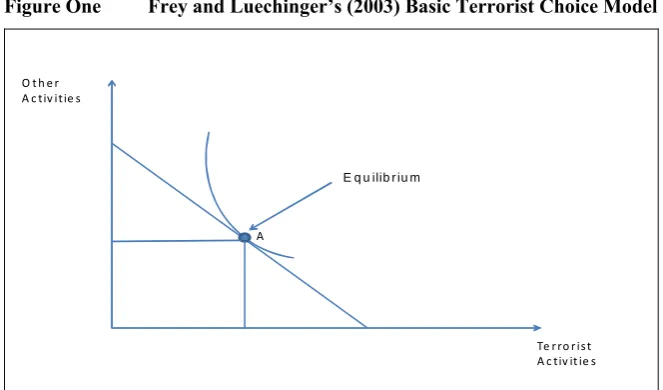
6 equilibrium choices between ‘other activities’ and terrorism. By analysing changes to the indifference curve and the budget constraint, the model can be used to analyse the reactions of the terrorist organisation to changing incentives and costs. For example, if terrorism becomes more costly relative to legal activities, the terrorist organisation may switch its attention to non-terrorist activities in order to achieve their political and economic objectives.
INSERT FIGURE ONE ABOUT HERE
For the purposes of this investigation, a model similar to the Frey and Luechinger (2003) model is used to describe the behaviour of a representative terrorist organisation. The terrorist organisation has an indifference curve depicting preferences for political influence in two periods. The terrorist organisation faces a constraint on the amount of political influence that is available to it in either period. The slope of the constraint in two-period space depicts the relative prices confronting the terrorist organisation. The relative prices indicate to the organisation the amount of resources that must be given up to acquire political influence in either period. In essence, then, the model is very similar to the one constructed by Frey and Luechinger (2003). However, the model deployed in the analysis undertaken in this section is extended to a two period (intertemporal) construction and the terrorist organisation’s choice involves intertemporal allocation of resources to terrorist activities in order to obtain an amount of political influence in each period. This will be made explicit as the analysis proceeds.
Within a basic choice theoretic framework similar to the one described by Frey and Luechinger (2003), the rationale for the randomisation of terrorist attacks, from the terrorist organisation’s point of view, may be formally stated. The terrorist organisation exchanges resources for political influence by undertaking terrorist attacksiii. A price vector, describes the ‘prices’ (measured in terms of the resources given up) at which the terrorist organisation initially exchanges resources for political influence in periods 1 and 2
[ ]
,
=
1
,
2
=
P
t
P
a taThere is a political influence vector that describes the quantity of political influence acquired by the terrorist organisation in periods 1 and 2
[ ]
Z
ta,
t
=
1
,
2
The terrorist organisation gives up resources for political influence, paying =
∑
a t a t aa
Z P Z
P . This is
7 under conditions of perfect price stability is depicted geometrically by a 45◦-sloped line in two-period space.
INSERT FIGURE TWO ABOUT HERE
Under these conditions and with no exogenous shocks, equilibrium established at the tangency of the budget frontier and the terrorist organisation’s indifference curve is stable. Any other point of intersection between the terrorist organisation’s indifference curve and the budget frontier is characterised by an unstable price vector (because of the tendency towards equilibrium). In the absence of exogenous destabilising shocks, stability or instability of the price vector is then generated (endogenously) by the actions of the terrorist organisation. Stability is the case where the price vector
a
P
is a stable price vector(
p1 = p2)
and the political influence vectorZ
amust, under such conditions, represent equal quantities of political influence(
z1 =z2)
acquired by the terrorist organisation. The terrorist organisation may manufacture instability in the price vector by randomising the type, timing, location and targets of its terrorist attacks. That is, by distorting the pattern of equilibrium and moving up and down the budget frontier.INSERT FIGURE THREE ABOUT HERE
The question is whether the stable price vector a
P
where(
p1 = p2)
(point A in Figure Three) or an unstable price vector bP
where(
p1 ≠ p2)
makes the terrorist organisation better off. To arrive at an answer to this question requires an application of Samuelson’s (1972, pp.476-477) theorem. Assume that the stable price vector confronting the terrorist organisation is replaced with a new unstable price vector with a mean that is the same or lower as that which characterises the stable price vector. A simple calculation using arbitrary prices and quantities reveals that the terrorist organisation will be better off (provided that a a b bZ
P
Z
P
=
)iv becausea a b b b b a b
Z
P
Z
P
Z
P
Z
P
<
=
1
implies that the bZ
from the unstable price vector b8 IV. FEASIBLE BENEFICIAL RANDOMISATION
The theorem, for which a proof was provided (Samuelson’s 1972 theorem and proof) in the previous section, is analogous to the classic and controversial price stability theorem first presented by Waugh (1944). Unfortunately, the theorem suffers from a serious weakness. This weakness is that at feasible points—points within or on the budget frontier—of price instability (such as points B and C in Figure Three but any point other than point A), the unstable prices must average out to a higher amount than the prices of the stable price vector. The instability manufactured by the distortion of the pattern of equilibrium by the randomisation of terrorist attacks must result in a situation where the terrorist organisation is required to exchange a greater amount of resources for each unit of political influence than if the price vector had been characterised by stability. The randomisation of terrorist attacks cannot feasibly manufacture a situation where less or the same amount of resources can be exchanged for an equal or greater amount of political influence. The stable price vector with no randomisation is the superior situation for the rational terrorist organisation.
The unstable prices generated by randomisation cannot be superior to the stable price vector even when the stable price is a simple mean of the unstable prices. A situation where the unstable prices generated by randomisation are superior to the stable price vector is not feasible. Consider the simple geometry presented in Figure Four. The diagram depicts an intertemporal budget constraint where the terrorist group obtains a quantity of political influence in Period One and Period Two. The terrorist organisation can create instability by randomisation of attacks and move away from the stable Point A. Only at a point such as Point B, which fulfils the condition a a b b
Z
P
Z
P
=
, does the terrorist organisation experience an unstable situation where resource inputs yield a higher amount of political influence per unit of input. Only at a point such as Point B do the unstable prices average out at a mean equal to the price that characterises the stable price vector. Point B, of course, is not feasible because it lies beyond the budget frontier. Another point, Point C, is also characterised by instability but is feasible. However, a point such as Point C, which is unstable and feasible, is inferior to the stable equilibrium point A (lies on a lower indifference curve) and cannot result in the terrorist organisation obtaining more political influence with the same amount of resource input. This is Samuelson’s Figure One (1972, p.479).INSERT FIGURE FOUR ABOUT HERE
9 exchanges resources for political influence via terrorist attacks. Upon first inspection, this formal statement appears to add support to the idea that the rational terrorist organisation randomises its attacks. However, closer inspection reveals that, whilst manufactured instability of the price vector through randomisation may generate a situation where the terrorist organisation can exchange the same amount of resources for a higher amount of political influence (or obtain more political influence with the same amount of resources), the points of instability where this result prevails are not feasible. Feasible points of instability are inferior to the equilibrium characterised by stability. There are no welfare gains to instability through randomisation.
V. DISCUSSION AND IMPLICATIONS
Within the simple choice theoretical framework developed in this paper, the randomisation of attacks by terrorist organisations will not result in welfare gains for the terrorist organisation. The rational terrorist organisation will not pursue a policy of randomising its attacks. The randomisation of attacks and the consequent disturbance of the pattern of equilibrium promises to generate welfare gains—a situation where the terrorist organisation obtains more political influence with a given endowment of resources. However, welfare gains of this nature only attend unstable price vectors that are not feasible. When only the feasible set of unstable price vectors are considered, the terrorist organisation will not, in the analytical context expounded herein, obtain welfare gains by manufacturing price instability by randomising its terrorist attacks. The implication of this analytical-theoretical result is that both defence economists and security agencies can expect the evolution of terrorist attacks to exhibit structure, however subtle and seemingly random it may first appear.
10 The provision of theoretical structure to the empirical findings arising out of research into the terrorist incidences time series data represents an important ongoing research program. There are many avenues for future research. Focussing solely on extensions to the analysis presented in this paper, some potential areas for future research may be stated as follows. First, the model can be extended to incorporate uncertainty and the risk preferences of the terrorist organisation. In general, the basic conclusion will hold. Newbery and Stiglitz (1979; 1982) show that the presence of exogenous shocks may result in a situation where destabilisation makes the economic agents better off. This could be
explored in the context of terrorism by introducing the government security agencies as a ‘destabilisation authority’. It is unclear, however, whether the Newbery and Stiglitz analysis will apply analogously to terrorism without introducing a production function for political influence to extend the exchange economy construction presented in this paper. This may be particularly difficult to achieve. The second, and likely more fruitful avenue for future research, lies in the extension of the model presented in this paper to T time periods and the introduction of multiple heterogeneous attack
types. The objective of such research is to construct a model of intertemporal equilibrium and a more general proof of the conclusion that the rational terrorist organisation will not distort the pattern of equilibrium by randomising its attacks.
VI. CONCLUSIONS
11
References
Arce M., D.G. and Sandler, T. (2005), “Counterterrorism: A Game-Theoretic Analysis,” Journal of
Conflict Resolution, 49, No.2, pp.183-200.
Enders, W., Parise, G.F. and Sandler, T. (1992), “A Time-Series Analysis of Transnational Terrorism: Trends and Cycles,” Defence Economics, 3, pp.305-320.
Enders, W. and Sandler, T. (2002), “Patterns of Transnational Terrorism, 1970–1999: Alternative Time Series Estimates,” International Studies Quarterly, 46, pp.145-165.
Frey, B.S. and Luechinger, S. (2003), “How to Fight Terrorism: Alternatives to Deterrence,” Defence
and Peace Economics, 14, No.4, pp.237-249.
Im, E.I., Cauley, J. and Sandler, T. 1987, “Cycles and Substitutions in Terrorist Activities: A Spectral Approach,” Kyklos, 40, No. 2, pp.238-255.
Landes, W.M. (1978), “An Economic Study of U.S. Aircraft Hijackings 1961–1976,” Journal of Law
and Economics, 21, No.1, pp.1-31.
Mickolus, E.F. (1980), Transnational Terrorism: A Chronology of Events 1968-1979, Greenwood
Press, Westport, Connecticut.
Mickolus, E.F. (1983), “International Terrorism,” in The Politics of Terrorism, Edited by M. Stohl,
Marcel Dekker, New York, New York, pp.221-253.
Newbery, D.M.G. and Stiglitz, J.E. (1979), “The Theory of Commodity Price Stabilisation Rules: Welfare Impacts and Supply Responses,” Economic Journal, 89, pp.799-817.
Newbery, D.M.G. and Stiglitz, J.E. (1982), “Risk Aversion, Supply Response, and the Optimality of Random Prices: A Diagrammatic Analysis,” Quarterly Journal of Economics, 97, No. 1,
pp.1-26.
Phillips, P.J. (2009), “Applying Portfolio Theory to the Analysis of Terrorism,” Defence and Peace
Economics, 20, No. 3, June, pp.193-213.
Phillips, P.J. (2005), “The ‘Price’ of Terrorism,” Defence and Peace Economics, 16, No.6, December,
pp.403-414.
Samuelson, P.A. (1972), “The Consumer Does Benefit From Feasible Price Stability,” Quarterly
Journal of Economics, 86, No. 3, pp.476-493.
Sandler, T., Tschirhart, J.T. and Cauley, J. (1983), “A Theoretical Analysis of Transnational Terrorism,” American Political Science Review, 77, No.1, pp.36-54.
Sandler, T. and Arce M., D.G. (2003), “Terrorism and Game Theory,” Simulation and Gaming, 34,
No.3, pp.319-337.
Sandler, T. and Arce, D.G. (2007), “Terrorism: A Game Theoretic Approach,” Handbook of Defense
Economics, 2, Edited by T. Sandler and K. Hartley, 2007, pp.775-813.
Waugh, F.V. (1944), “Does the Consumer Benefit from Price Instability,” Quarterly Journal of
12 Weimann, G. and Brosius, H.B. (1988), “The Predictability of International Terrorism: A Time-Series
13 Figure One Frey and Luechinger’s (2003) Basic Terrorist Choice Model
Te r ro r is t
A c tiv it ie s O t h e r
A c tiv itie s
A
[image:13.595.69.398.86.474.2]E q u ilib r iu m
Figure Two 45◦ Intertemporal Budget Frontier
Period Two Period One
Q1
Q2
Figure Three Distorting the Pattern of Equilibrium
Period Two Period One
14 Figure Four Superiority of Stability of the Price Vector
Period Two Period One
A B
C
i The ‘price-of-terrorism’ vectors are those that describe the rate at which the terrorist organisation can exchange
resources for political influence.
ii Game theoretical analysis of terrorist behaviour also implies the rational pursuit of objectives and strategic
manoeuvring by the terrorist organisation in response to various security measures (see, for example, see Sandler, Tschirhart and Cauley (1983); Sandler and Arce M. (2003); Arce M. and Sandler (2005); and Sandler and Arce M. (2007)).
iii This is similar to Phillips (2005). However, in Phillips’ (2005) analysis, a high price of terrorism is favourable
for the terrorist organisation because it is associated with a higher value of terrorist resources as contingent claims on political influence. In this paper, a low price is favourable because a terrorist organisation exchanges fewer resources for political influence.
iv When a a b b
Z
P
Z
P
=
, the terrorist organisation always acquires a greater amount of political influence with