Community, Domain, Practice:
Facilitator catch cry for revitalising
learning and teaching through
communities of practice
Final Report 2014
ALTC Teaching Fellowship
Associate Professor Jacquie McDonald
Community, Domain, Practice: Facilitator catch cry for revitalising learning and teaching through CoPs
2
Support for the production of this report has been provided by the Australian Government Office for Learning and Teaching. The views expressed in this report do not necessarily reflect the views of the Australian Government Office for Learning and Teaching.
With the exception of the Commonwealth Coat of Arms, and where otherwise noted, all material presented in this document is provided under Creative Commons Attribution-ShareAlike 4.0 International License http://creativecommons.org/licenses/by-sa/4.0/. The details of the relevant licence conditions are available on the Creative Commons website (accessible using the links provided) as is the full legal code for the Creative Commons Attribution-ShareAlike 4.0 International
License http://creativecommons.org/licenses/by-sa/4.0/legalcode.
Requests and inquiries concerning these rights should be addressed to: Office for Learning and Teaching
Department of Education GPO Box 9880,
Location code N255EL10 Sydney NSW 2001
2014
Community, Domain, Practice: Facilitator catch cry for revitalising learning and teaching through CoPs
3
Acknowledgements
Associate Professor Jacquie McDonald, Learning and Teaching Support, University of Southern Queensland (USQ), wishes to acknowledge the following people for their contribution towards her ALTC Teaching Fellowship:
University of Southern Queensland Community of Practice Facilitators and members, who through their engagement in communities of practice have created a ground-swell of energy and enthusiasm round learning and teaching at the University of Southern Queensland.
University of Southern Queensland Community of Practice Project Officer Ms Sandy
Sharman for project officer support to the operation of communities of practice at USQ, and operational support to Fellowship activities, including workshop organisation and
preparation of the web resources
The Reference Group members were an extremely valuable source of information and encouragement, providing feedback and direction at critical times. The members included:
• Professor Milton D. Cox, PhD, Centre for the Enhancement of Learning, Teaching, and University Assessment, Miami University, Oxford OH, USA
• Associate Professor Judy Nagy, Associate Dean Teaching and Learning, Centre for Regional Engagement, University of South Australia Wireless Road West, Mount Gambier
• Professor Geoffrey Crisp, Dean, Learning and Teaching, RMIT University
• Dr Cassandra Star, Faculty of Social and Behavioural Sciences, Flinders University
• Associate Professor Michele Scoufis, Associate Dean Learning and Teaching and Director Learning and Teaching Unit, Business School, University of Sydney
Workshop presenters A number of workshops were delivered by the Fellow to develop Facilitator capacity. Some involved external presenters and the Fellow thanks Professor Milton Cox (Miami University, USA) and Mr Ari Palani (Arts Faculty, USQ) for their discipline expertise and engaging workshops. Workshop video and web resources are available on the Fellowship web site.
University of Southern Queensland Senior Leaders and staff who supported the Teaching Fellowship activities and provided an environment where USQ communities of practice can thrive. Vice-Chancellor, Professor Bill Lovegrove, Professor Phil Candy, Professor Allan Layton, Professor Lynne Hunt, Associate Deans Learning and Teaching, Media Services, Ms Jen Bundy (who acted in the Boal workshop video), and Heads of Departments and sections, who supported staff involved in communities of practice.
The external evaluator Jon Edwards, Senior Evaluation Officer in the Evaluation Unit, Teaching and Educational Institute at the University of Queensland for his expert evaluation contribution, including a number of perspectives on CoP evaluation.
Community, Domain, Practice: Facilitator catch cry for revitalising learning and teaching through CoPs
4 Australian Learning and Teaching Council (ALTC) I am extremely grateful to ALTC staff, who organised Fellowship workshops and forums and promptly assisted with Fellowship
Community, Domain, Practice: Facilitator catch cry for revitalising learning and teaching through CoPs
5
List of acronyms used
CP2 Online Community of Practice about Communities of Practice CQUni Central Queensland University
CoP Community of Practice CoPs Communities of Practice EU Evaluation Unit
FLC Faculty Learning Community HR Human Resources
TEDI Teaching and Educational Development Institute, Queensland University USQ University of Southern Queensland
UQ Queensland University
Community, Domain, Practice: Facilitator catch cry for revitalising learning and teaching through CoPs
6
Executive summary
This Australian Learning and Teaching Council (ALTC) Teaching Fellowship ‘Community, Domain, Practice: Facilitator catch cry for revitalising learning and teaching through communities of practice’ contributes to ALTC’s aim to advance learning and teaching in higher education through a program of activities designed to build the capacity of Facilitators of Communities of Practice at the University of Southern Queensland. Communities of practice (CoPs) are cited in higher education literature and ALTC
applications as a successful way of building and sharing a scholarly approach to enhancing learning and teaching practice. This fellowship builds on the Teaching Fellow, Associate Professor Jacquie McDonald’s, CoP leadership role at the University of Southern Queensland (USQ), where the first CoP started in 2006 to provide a space for academic staff to build a community, increase their knowledge and share learning and teaching practice.
Wenger, McDermott and Snyder (2002) describe communities of practice as:
Groups of people who share a concern, a set of problems, or a passion about a topic, and who deepen their knowledge and expertise in this area by interacting on an ongoing basis. Over time... [t]hey become a community of practice (pp. 4-5).
CoPs operate differently from institutionalised higher education work groups, as they are located in the immediate practice field, usually membership is voluntary, and the agenda and outcomes are member driven. The CoP Facilitator role differs from the familiar chairperson roles, so investigation of the complexity and different aspects of the role and development of activities and resources to support and grow the Facilitator role were the focus of the Fellowship. CoPs epitomise distributed leadership (Jones, Lefoe, Harvey & Ryland, 2012), and investigation of, and capacity building of leadership within CoPs contributes to this ALTC priority area.
Aims and deliverables
The Fellowship was designed to build on USQ CoP Facilitators and the Teaching Fellow’s knowledge of USQ CoP processes to:
• Identify of the key aspects of a USQ CoP Facilitator role
• Increase the knowledge and capacity of existing USQ CoP Facilitators through workshops and resources
• Establish a Facilitator CoP for the USQ Facilitators to share and grow their practice
• Develop resources to provide a sustained Fellowship legacy
• Engage with national and international CoP practitioners to develop and evaluate activities and resources for CoP Facilitators
• Disseminate Fellowship knowledge and resources across the sector
• Promote ALTC Fellowship activities across the sector
Community, Domain, Practice: Facilitator catch cry for revitalising learning and teaching through CoPs
7
(CoPs). An action research approach used qualitative date collected through semi structured interviews (2010) with fifteen USQ CoP facilitators to identify roles, experience and critical incidents. Grounded theory analysis of the interviews identified key features and issues of the role and a comparative analysis with USA data (2009) identify themes to inform subsequent workshop and resource design. Within the action research cycle, ongoing collaboration with the external evaluator and analysis of summative evaluation feedback informed the planned Fellowship activities. USQ CoP Facilitator capacity was built through these workshops, resources, the establishment of a community of practice for Facilitators and ongoing interaction with the Teaching Fellow.
Dissemination
The Fellow has engaged in round table discussions, seminars and workshops to both develop CoP Facilitator capacity and to disseminate activities to a wide audience. These included:
• Engagement with senior management and CoP champions
• Seminars, round table discussions and workshops
• Refereed conference papers
• ALTC sponsored Fellowship and Leadership forums
• Media releases
• Fellowship resources website <http://www.usq.edu.au/cops/resources/altcfellowship>
The Fellowship web resources include links to the workshop resources, workshop videos and interview audios. The links to the contents page the Miami Facilitator’s Handbook, distributed at the February 2011 two and half day facilitator workshop, Designing,
Implementing, and Leading CoPs, provide a significant resource and Fellowship outcome. Additional Facilitator resources for establishing and sustaining CoPs are linked to the Phases and Key Issues of a Nurtured Higher Education CoP developed by Star & McDonald
(accepted for publication). These resources provide CoP facilitators with ideas and practical resources at different CoP phases <www.usq.edu.au/cops/resources/altcfellowship>.
Recommendations
Significant changes are continuing to occur in the ways universities are governed and
managed, moving to more corporate and business-like structures, with significant flow-on in terms of academic roles, their working arrangements and staff morale. Within this context, it is recommended to cultivate CoPs as a way of creating a bottom-up, member-driven approach to engage in generative dialogue around learning and teaching practice. Further research is recommended into both the practical aspects of growing and sustaining Higher Education CoPs, and the best approach for identifying and cultivating the leadership role of CoP facilitors. The ALTC Fellowships and leadership grants have generated many excellent resources and academics and institutional leaders are encouraged to make the time and rewards available to ensure their application across the sector.
Community, Domain, Practice: Facilitator catch cry for revitalising learning and teaching through CoPs
8
Table of Contents
Acknowledgements ... 3
List of acronyms used ... 5
Executive summary ... 6
Table of Contents ... 8
List of Tables ... 10
Tables ... 10
1 Introduction ... 11
2 Teaching Fellowship Context ... 13
2.1 Communities of Practice as a context for sustained learning and teaching inquiry . 13 2.2 The issue: Build capacity for effective facilitation of communities of practice ... 13
Chapter 3 Fellowship activities, outcomes and impacts ... 15
3.1 Identification of the importance of the CoP facilitator role ... 15
3.2 Planned Fellowship outcomes ... 15
3.3 Approach and Methodology ... 15
3.4 How the Fellowship uses and advances existing knowledge and aligns to ALTC priorities ... 17
3.6 Application and adaptation of Fellowship approach to other institutions ... 23
4 Dissemination ... 25
5 Linkages ... 28
5.1 Influence on ALTC Fellowships and Grant projects ... 28
5.2 Other disciplinary, national and international linkages ... 28
6 Evaluation... 31
6.1 Executive summary... 31
6.3 Introduction to evaluation approach, audience and structure ... 32
6.4 Data collection and analysis process ... 36
6.5 Findings ... 46
6.6 Concluding remarks from the evaluator ... 49
7 Conclusion ... 50
References ... 51
Appendix A - University of Southern Queensland Community of Practice Facilitators and Co-Facilitators ... 53
Appendix B – USQ Teaching Fellowship Launch ... 55
Appendix C – Teaching Fellowship Launch ... 56
Appendix D - CQUniversity Communities of Practice launch ... 58
Community, Domain, Practice: Facilitator catch cry for revitalising learning and teaching through CoPs
9
agenda ... 60
Appendix F - Brisbane workshop invitation ... 63
Appendix G - Brisbane workshop agenda ... 65
Appendix H - Community of Practice Start-up Considerations ... 67
Appendix I - How is a CoP different from other academic meetings? Ways of working together in the CoP ... 69
Community, Domain, Practice: Facilitator catch cry for revitalising learning and teaching through CoPs
10
List of Tables
Tables
Community, Domain, Practice: Facilitator catch cry for revitalising learning and teaching through CoPs
11
1 Introduction
This ALTC Teaching Fellowship contributes to ALTC’s aim to advance learning and teaching in higher education through a program of activities designed to build the capacity Facilitators of Communities of Practice at the University of Southern Queensland. Communities of practice (CoPs) are cited in higher education literature and ALTC applications as a successful way of building and sharing a scholarly approach to enhancing learning and teaching
practice. This fellowship builds on the Teaching Fellow, Associate Professor Jacquie
McDonald’s, CoP leadership role at the University of Southern Queensland, which initiated a pilot CoP in 2006 as an institutional model for engaging academic staff in situated
professional development. This role was recognised through an ALTC citation (2009) and USQ CoPs received a 2009 Australian Universities Quality Agency (AUQA) commendation. The USQ CoP AUQA Good Practise database entry is now located on the Tertiary Education Quality and Standards Agency (TEQSA) web site.
The term “communities of practice” emerged from Lave and Wenger’s (1991) study that explored learning in the apprenticeship model, where practice in the community enabled the apprentice to move from peripheral to full participation in community activities. Wenger, McDermott and Snyder (2002) describe communities of practice as:
Groups of people who share a concern, a set of problems, or a passion about a topic, and who deepen their knowledge and expertise in this area by interacting on an ongoing basis. Over time... [t]hey become a community of practice (pp. 4-5).
CoPs operate differently from institutionalised higher education work groups and the Facilitator role differs from the familiar chairperson roles, so investigation of the complexity and different aspects of the role and development of activities and resources to support and grow the facilitator role were the focus of the Fellowship. CoPs epitomise distributed
leadership (Jones, Lefoe, Harvey & Ryland, 2012), and investigation of, and capacity building of leadership within CoPs contributes to this ALTC priority area. An action research approach identified key aspects of the Facilitator role, three USQ workshops and several workshops at other universities were conducted, and a number of audio, video and web resources are available on the Fellowship web site <www.usq.edu.au/cops/resources/altcfellowship>. USQ CoP Facilitator capacity was built through these workshops, resources, the
establishment of a community of practice for Facilitators and ongoing interaction with the Teaching Fellow.
The flow on effects of this teaching fellowship have strengthened communities of practice at USQ, breaking down academic isolation and creating dynamic communities that share practice and build knowledge and capacity around learning and teaching. The Facilitators’ CoP has started dialogue with Human Resources (HR) to establish HR processes for
Community, Domain, Practice: Facilitator catch cry for revitalising learning and teaching through CoPs
12
established during the Fellowship, with twenty-two academic, institutional and across institution CoPs operational at the end of 2012. Interest in establishing student and digital CoPs has been flagged and the Fellow looks forward to extending CoPs to embracing students in the success of CoPs. The Fellowship has considerable impact across the sectors, with invitations to present workshops at a number of universities, key notes at Learning and Teaching Weeks and contribute to other ALTC projects and fellowships.
Fellowship aims:
The Fellowship was designed to build on USQ CoP Facilitators and the Teaching Fellow’s knowledge of USQ CoP processes to:
• Identify of the key aspects of a USQ CoP Facilitator role
• Increase the knowledge and capacity of existing USQ CoP Facilitators through workshops and resources
• Establish a Facilitator CoP for the USQ Facilitators to share and grow their practice
• Develop resources to provide as a sustained Fellowship legacy
• Engage with national and international CoP practitioners to develop and evaluate activities and resources for CoP Facilitators
• Disseminate Fellowship knowledge and resources across the sector
• Promote ALTC Fellowship activities across the sector
Community, Domain, Practice: Facilitator catch cry for revitalising learning and teaching through CoPs
13
2 Teaching Fellowship Context
2.1 Communities of Practice as a context for sustained learning and
teaching inquiry
There has been significant discourse about communities of practice (CoPs) in higher education revealing a confused sense of meaning and usefulness of such groups. At the University of Southern Queensland (USQ) CoPs provide a context for academics to engage in sustained learning and teaching inquiry in supportive communities situated in their practice. However, CoPs operate differently from institutionalised higher education work groups or project teams and the facilitator role differs from familiar chairperson, course leader or lecture role (McDonald & Star, 2008). CoPs provide a process and context for engaged academic debate which is often stifled by increasingly corporate management styles (Nagy & Birch, 2009). Many institutional meetings do not to foster participation, as this generates too many questions and raises issues of power and control. CoPs are different! At USQ CoPs are engaging staff in generative learning and teaching dialogue (Parboosingh 2010) and redefining professional development by providing bottom-up, participant driven, sharing and building of learning and teaching expertise. Use of the three CoP elements, developing community, sharing practice and growing domain knowledge, as an organising structure at USQ is distinctive (Wenger, 2008; Wenger, 2008 & 2009, personal conversations) and provides a robust working model for CoP operation and facilitation. CoPs provide a special kind of professional development and community founded on collegial, collaborative and personal contact. Thus, the role of the facilitator in community building, orchestrating the sharing of practice and organising the building of knowledge are important role for the success of CoPs.
2.2 The issue: Build capacity for effective facilitation of communities
of practice
The Fellowship applicant, Associate Professor Jacquie McDonald had four years experience leading the CoP initiative at USQ, and had identified the role of the CoP Facilitator as an important aspect for the successful CoPs. This was based on reflective practitioner practice (Schön, 1983; 1987), knowledge of the literature, engagement with CoP leaders through an international online CoP, CP2 The Community of Practice on Communities of Practice
<http://cpsquare.org/> and qualitative interviews with Etienne Wenger (2009), Professor Cox, Faculty Learning Community (FLC) Program Leader (Miami) and Facilitators at USQ and Miami University, USA. The importance of the role is supported by the literature which notes that effective facilitation is essential to creating and sustaining an environment in which CoPs can thrive (Ortquist-Ahrens, 2009; Cox, 2004, 2006; Star & McDonald, accepted for publication).
Community, Domain, Practice: Facilitator catch cry for revitalising learning and teaching through CoPs
14
Community, Domain, Practice: Facilitator catch cry for revitalising learning and teaching through CoPs
15
Chapter 3 Fellowship activities, outcomes and impacts
3.1 Identification of the importance of the CoP facilitator role
As noted in Chapter 2, the Fellow, Associate Professor Jacquie McDonald had considerable experience around the nature of Higher Education Communities of Practice (CoPs) and had identified the role of the CoP Facilitator as an important aspect for the success of CoPs. The role of the facilitator in community building, orchestrating the sharing of practice, organising the building of knowledge, reading and positing the CoP within the institutional context, are important if CoPs are to lead change and transform teaching and learning practice (Ortquist-Ahrens, 2009; Cox, 2004, 2006). When applying for the Teaching Fellowship, four years of experience and research around CoPs in the Australian context had confirmed this crucial element in CoP success and sustainability (McDonald & Star, 2006, 2007, 2008). The ALTC Teaching Fellowship provided an opportunity to focus on development of facilitator capacity and increase the profile of CoPs across the Higher Education sector.
3.2 Planned Fellowship outcomes
The Fellowship was designed to build on USQ CoP Facilitators and the Fellow’s knowledge of USQ CoP processes to:
• Identify of the key aspects of a USQ CoP Facilitator role
• Increase the knowledge and capacity of existing USQ CoP Facilitators through workshops and resources
• Establish a Facilitator CoP for the USQ Facilitators to share and grow their practice
• Develop resources to provide as a sustained Fellowship legacy
• Engage with national and international CoP practitioners to develop and evaluate activities and resources for CoP Facilitators
• Disseminate Fellowship knowledge and resources across the sector
• Promote ALTC Fellowship activities across the sector
Fellowship activities aimed to identify key aspects of the Facilitator role, build on USQ CoP Facilitators and the Fellow’s knowledge of USQ CoP processes, and use International CoP expertise to develop activities and resources to build facilitator capacity. Activities were not top down ‘training’ which creates an inbound trajectory targeted at competence in a
specific practice (Ortquist-Ahrens, 2009). Rather, the activities aimed to explore the dimensions involved in CoP facilitation, building an outbound trajectory of new levels of expertise so the process is transformative rather than informative.
3.3 Approach and Methodology
ApproachCommunity, Domain, Practice: Facilitator catch cry for revitalising learning and teaching through CoPs
16
A distributed leadership approach (Jones, Lefoe, Harvey & Ryland, 2012) is a basic operating principal that is the foundation of how the Fellow engaged with, and continues to engage with, both academic and professional staff evolved in Communities of Practice (CoPs). A community of practice approach is almost the antithesis of top-down, institutionalised implementation of initiatives to improve learning and teaching practice. At USQ CoPs are usually generated someone who has an idea, challenge or issue that triggers the ‘spark’ to establish a CoP. Members within the practice field are invited to join, with activities, goals and planned outcomes determined by the members. The Fellow’s approach was to consult with the Facilitators, identify the key aspects and issues of a USQ CoP Facilitator role, and move forward together to resolve issues and create opportunities and resources to grow the capacity of USQ CoP
Method
An action research approach used qualitative date collected through semi structured interviews (2010) with fifteen USQ CoP facilitators to identify roles, experience and critical incidents. Grounded theory analysis of the interviews identified key features and issues of the role and a comparative analysis with USA data (2009) identify themes to inform subsequent workshop and resource design. Within the action research cycle, ongoing collaboration with the external evaluator, Jon Edwards, (Senior Evaluation Officer in the Evaluation Unit, Teaching and Educational Institute at the University of Queensland) and analysis of summative evaluation feedback informed the planned Fellowship activities.
Action research (Elliott, 1991) involves a spiral or cycle of planning, action, monitoring and reflection and the Teaching Fellowship approach of planning based on CoP experience, conversations, and literature, CoP activity and interaction with Facilitators, monitoring of implementation of actions and resources and reflection in and on action, provided the stages for the Action research approach to Fellowship activities.
Activities
In order to develop CoP knowledge and leadership capacity, the Fellow worked with Professor Milt Cox in 2009 as a distinguished visiting fellow at Miami University (USA), interviewed Professor Cox and several Miami facilitators and participated in a Miami Facilitator’s workshop. Professor Cox has worked with Faculty Learning Communities (FLCs) since 1980 at university, state and national level. The Fellow identified the benefit of recruiting Professor Cox to work with the Fellow and USQ CoP Facilitators. The aim was to engage USQ facilitators in a two and a half day Facilitator’s workshop, provide the
comprehensive Miami Facilitator’s Handbook and related web sources as a significant activity and provide resources as a concrete Fellowship outcome. Professor Cox spent two weeks working with CoPs at USQ and, with the Fellow, presenting the 2.5 day facilitator workshop, Designing, Implementing, and Leading CoPs to USQ staff, an International partner and reference group members. A one day Introduction to CoPs workshop was also
Community, Domain, Practice: Facilitator catch cry for revitalising learning and teaching through CoPs
17
In collaboration with a lecturer from USQ’s School of Creative Arts, Ari Palani, a “Rehearsal for Life” workshop was designed that combined the techniques of the theatre practitioner, Augusto Boal, with the theories and practices of CoPs. The workshop examined the central role of what Boal calls the Joker in his Theatre of the Oppressed (Boal, 2002), and the links that it has with a CoP Facilitator. Both roles focus on building and sharing information, empowering communities and enhancing learning and teaching practice. Many different solutions are enacted in a single forum – resulting in the pooling of knowledge, tactics and experience – what Boal calls a ‘rehearsal for reality’. The Boal workshop video explores and shares the experience of engaging with some different forms of communication and
interaction, and is designed to be a tool for members of other Communities and educators to learn about how they can use these techniques to explore the role of a CoP Facilitator.
Data was collected throughout the Fellowship, as described in the Evaluation chapter, and this informed the planning and focus of Fellowship as it progressed. Early in the Fellowship qualitative data was collected through semi structured interviews with fifteen USQ CoP facilitators, in order to identify roles, experience and critical incidents. Grounded theory analysis of the interviews identified key features and issues of the role and a comparative analysis with USA data (2009) identify themes to inform subsequent workshop and resource design. A Senior Evaluator from the Evaluation Unit of TEDI, University of Queensland acted as the external evaluator, and evaluation details are outlined in evaluation chapter.
A key outcome of the Fellowship was the establishment of CoP for the USQ CoP Facilitators. Prof Milt Cox suggested the idea when interviewed (Miami 2009) and USQ CoP Facilitators agreed to the proposal at the Fellowship launch. The Facilitator’s CoP has been operational since the March 2011 and is instrumental in achieving Fellowship outcomes. It provides a model for facilitating CoPs, opportunities to share practice, identify and resolve issues, recognition of an informal leadership role and a forum to influence institutional culture and policy. The Fellowship activities aimed to explore the dimensions involved in CoP facilitation, building an outbound trajectory of new levels of expertise so the process is transformative rather than informative.
3.4 How the Fellowship uses and advances existing knowledge and
aligns to ALTC priorities
The Australian Learning and Teaching Council’s Fellowships Scheme is one of the core programs described in Transforming Learning and Teaching in Australian Higher Education: ALTC Strategic Plan 2010-2013. The aim of the scheme is to advance learning and teaching in higher education by supporting a group of leading educators to undertake strategic, high profile activities in areas of importance to the sector. Through their activities, it is intended that ALTC Fellows have a positive and lasting influence on higher education practice in Australia.
ALTC Teaching Fellows devise and undertake fellowship activities that promotes and
Community, Domain, Practice: Facilitator catch cry for revitalising learning and teaching through CoPs
18 • identify learning and teaching issues, within or across disciplines, and facilitate an approach
to addressing these issues;
• show leadership in promoting and enhancing learning and teaching in higher education, within and beyond their home institutions;
• establish and build on national partnerships in learning and teaching in higher education; and
• foster networks with recipients of ALTC Teaching Awards and with other ALTC Fellows and educators in higher education.
This ALTC Teaching Fellowship - Community, domain, practice: facilitator's catch-cry for revitalising learning and teaching through communities of practice – aimed to identify key aspects of the CoP Facilitator role, build on USQ CoP Facilitators and the Fellow’s knowledge of USQ CoP processes, and use International CoP expertise to develop activities and
resources to build facilitator capacity. As CoPs provide time and space for generative conversations (Parboosingh, 2010) to address learning and teaching issues, the building of CoP Facilitator leadership capacity directly addresses ALTC’s priority to promote learning and teaching at USQ – the Fellow’s home institution.
The Fellow used and advanced existing knowledge about the implementation of CoPs at USQ, and was informed by the Fellow’s doctoral research into the role of online discussion forums in supporting learning in higher education (McDonald, 2007). The doctoral research identified communities of practice as a way of fostering communities and sharing tacit knowledge; thus cutting across the isolated academic silos to build dynamic communities engaged in sharing learning and teaching practice. CoPs take a variety of forms depending on their context; however they all share a basic structure. A community of practice is a unique combination of three fundamental elements (Wenger, 1998). These elements are a domain of knowledge that creates a common ground and sense of common identity, a community of people who care about the domain and create the social fabric of learning, and a shared practice that the community develops to be effective in its domain.
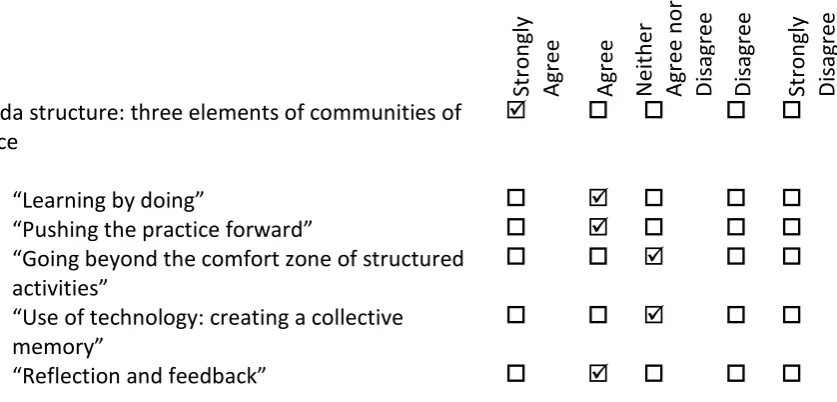
Based on her doctoral research into online learning communities (McDonald, 2007) and knowledge of the CoP literature, the Fellow collaborated with a Faculty of Business course leader, Dr Cassandra Star, and adapted the community of practice model proposed by Wenger (1998) to suit USQ’s higher education context. The three CoP elements, building community, sharing practice and growing domain knowledge were identified as an organising framework for USQ CoPs to meet the needs of time poor academics. This structure was chosen to provide a consistent framework for monthly meetings to ensure that each of the essential elements of a CoP was addressed at meetings and to provide clear direction, outcomes and value adding for member. This framework is captured in the USQ Community of Practice Agenda Template available on the Fellowship web page
<www.usq.edu.au/cops/resources/altcfellowship/facilitator-resources> and Appendix B. The structure, community support, and outcomes have assisted in addressing initial scepticism about “just another meeting” and the need to make best use of the time committed, for time poor tertiary educators (McDonald & Star, 2006).
Community, Domain, Practice: Facilitator catch cry for revitalising learning and teaching through CoPs
19
Mitchell 2006). An online search to identify CoPs in Australian higher education institutions found limited evidence of reported CoPs on institutional web sites, although literature searches and personal contacts identified the existence of informal or planned
implementation of CoPs at a number of Australian Universities, including the Australian National University, Griffith and Deakin University the University of New South Wales.
CoPs are also well established in business as a means of facilitating the growth and implementation of new knowledge (Wenger, McDermott & Snyder 2002). In business contexts there has been recognition of the importance of more subtle, tacit types of
knowledge that needs to be shared, and CoPs have been identified as being a framework or approach where such types of knowledge are nurtured, shared and sustained (Hildreth & Kimble 2004). Tacit knowledge is highly personal, and is understood without being
articulated. It is hard to formalise and therefore difficult to communicate to others as it is unvoiced or unspoken. Lave and Wenger (1991) and Vygotsky (1978) have identified the acquisition of knowledge as a social process.
A community of practice approach to teaching and learning in higher education provides a space for staff to collaboratively reflect, review and regenerate their current teaching and learning practices. Within higher education, the organisational structures and culture of individualism (Laurillard, 2006), produce a situation where individuals are often isolated and unaware of the practices of others. CoPs provides a ‘safe space’ for sharing war stories, what works and failed, and to engage in generative dialogue around various aspects of learning and teaching practice and innovation. Communities of practice provide the opportunity to share and articulate tacit knowledge that is often not shared in the
individualistic and isolated approach to learning and teaching in Higher Education (Star & McDonald, accepted for publication).
USQ experience indicates that there needs to be flexibility around what is defined at a CoP in Higher Education. Star & McDonald (accepted for publication) propose that there are three types or categories of communities of practice that can be discerned: organic,
nurtured and intentional and these have the potential to change over time. Most USQ CoPs operate as nurtured CoPs, with a formal, but bottom-up structure that negotiates
institutional awareness and support, but is careful to retain a member-initiated agenda and focus. Star & McDonald adapted Wenger’s (1998) community of practice phases of
development for a nurtured community of practice and these provide an organising structure for Fellowship resources <www.usq.edu.au/cops/resources/altcfellowship>. It is argued that this model provides a bridge between early CoP theory and current CoP
practice. It also provides a framework for understanding CoPs in higher education and how they require a different approach from the use of CoPs in other contexts (Star & McDonald, accepted for publication).
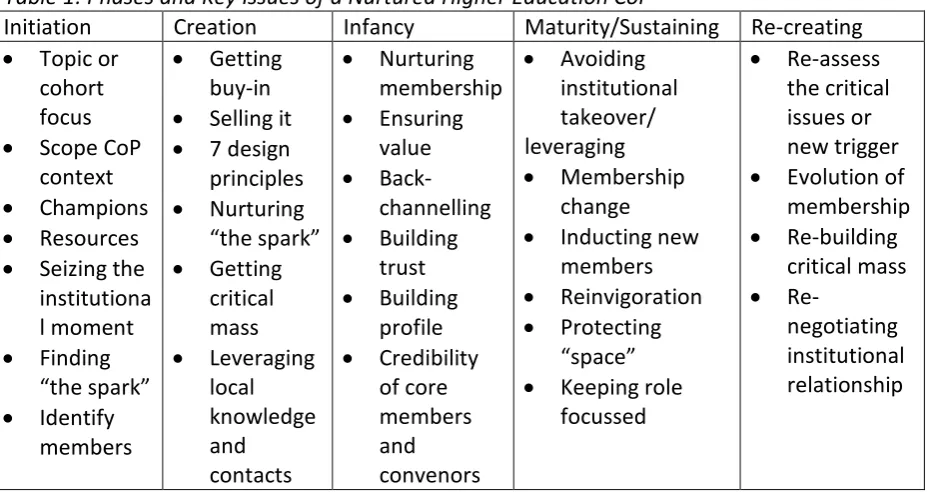
The Fellow built on and advanced knowledge around the operation of nurtured CoPs in Higher Education as she worked with Facilitors at USQ and across the sector. The Phases and Key Issues of a Nurtured Higher Education CoP (Table 1), developed by Star & McDonald (accepted for publication) were used as an organising structure for Fellowship web
Community, Domain, Practice: Facilitator catch cry for revitalising learning and teaching through CoPs
[image:20.595.70.534.96.342.2]20 Table 1: Phases and Key Issues of a Nurtured Higher Education CoP
Initiation Creation Infancy Maturity/Sustaining Re-creating
• Topic or cohort focus
• Scope CoP context
• Champions
• Resources
• Seizing the institutiona l moment • Finding “the spark” • Identify members • Getting buy-in
• Selling it
• 7 design principles • Nurturing “the spark” • Getting critical mass • Leveraging local knowledge and contacts • Nurturing membership • Ensuring value • Back-channelling • Building trust • Building profile • Credibility of core members and convenors • Avoiding institutional takeover/ leveraging • Membership change
• Inducting new members
• Reinvigoration
• Protecting “space”
• Keeping role focussed
• Re-assess the critical issues or new trigger
• Evolution of membership • Re-building critical mass • Re-negotiating institutional relationship
Star, C., & McDonald, J. (accepted for publication), CoPping it sweet: the state of play of CoPs in higher education, Higher Education Quarterly, Wiley-Blackwell, West Sussex, United Kingdom.
On the Fellowship web resource site, brief overviews of the key considerations are provided for each of the CoP phases, with links to more detailed resources.
The Fellow promoted and enhanced learning and teaching at USQ and in the wider sector, through building Facilitator capacity, implementing communities of practice, and alerting staff of ALTC activities that related to, and could contribute to, USQ learning and teaching initiatives. The Fellow has had several invitations to join ALTC grant and Fellowship reference groups and activities and fostered networks with other with other ALTC Fellows and educators in higher education to shared CoP ideas and resources.
3.5 Factors impacting on the Teaching Fellowship
3.5.1 Analysis of critical success factors
The ALTC Fellowship selection process is based on Fellows’ demonstrated leadership
capacity in higher education, with Fellows providing evidence of expertise and influence and recognition of their educational leadership ability. This fellowship leveraged off the Fellow’s developing CoP activities, and provided the funding for the Fellow to concentrate on CoP activities and develop resources to support USQ CoP facilitators. The prestige of the Fellowship also had a very positive impact on the implementation of USQ CoPs of by affirming their value to facilitators and members, as noted in the many unsolicited
Community, Domain, Practice: Facilitator catch cry for revitalising learning and teaching through CoPs
21
high level promotion of CoPs to stakeholders, as well as resources and profiling the importance of the CoPs across the university.
The fellowship was launched by Professor Philip Candy in October 2010 and at the launch facilitators were provided an outline of planned workshops, invited to participate in the Facilitors CoP and contributed ideas they would like addressed during the Fellowship. The launch was an effective communication tool and clarification of planned activities and the opportunity for Facilitators to provide their input increased engagement and owner of Fellowship activities. This public launch by a Senior USQ Leader demonstrated institutional support for the Fellowship and a media release increased its
visibility. <www.usq.edu.au/newsevents/news/jacquiemcdonaldfellowship10>.
Professor Philip Candy congratulates Dr Jacquie McDonald during the fellowship launch.
The two and a half day Facilitator’s workshop, Designing, Implementing, and Leading CoPs for USQ facilitators with Professor Cox, and the associated comprehensive Miami
Facilitator’s Handbook and related web sources, provided generated a great deal of
knowledge and enthusiasm around the Facilitator role, and made a significant contribution to the Fellowship success <www.usq.edu.au/cops/resources/altcfellowship>. Likewise, the one day Introduction to CoPs workshop conducted in Brisbane provided CoP facilitator training and the comprehensive FLC Facilitator’s Handbook to people outside USQ, thus widening the Fellowship impact across the sector.
Participants receiving their certificates from Professor Milt Cox and the PVC Pro Vice-Chancellor (Academic Enterprise) and Dean (Faculty of Sciences) Professor Janet Verbyla. Professor Milt Cox at the USQ workshop, Designing, Implementing, and Leading CoPs.
Community, Domain, Practice: Facilitator catch cry for revitalising learning and teaching through CoPs
22
This workshop engaged participants in activities quite different from content driven
workshops, and provided participants with activities to explore and discuss a range of ways to engage with CoP members in their Facilitor role. As noted earlier, activities were not top down ‘training’ which creates an inbound trajectory targeted at competence in a specific practice (Ortquist-Ahrens, 2009). Rather, the activities aimed to explore the dimensions involved in CoP facilitation, building an outbound trajectory of new levels of expertise so the capacity building process is transformative rather than informative.
Ari Palani and Jacquie McDonald at the USQ Boal workshop, video resource at <www.usq.edu.au/cops/resources/altcfellowship/boal>
The contribution of an external evaluator right from the start of the Fellowship, with a focus on formative and well as summative evaluation provides valuable insights and feedback that indicated the success (or not) of activities and informed the design and implementation of subsequent activities and resources.
The Fellow’s awareness of CoP literature and her knowledge gained through national and international CoP colleagues informed the implementation of CoPs and the resources to support facilitors. For example, the Fellow advised Facilitators to consider the CoP context and articulate the alignment with institutional goals and priorities, such as student retention to stakeholders. This process was modelled by the Fellow, and at the start-up of each CoP Facilitators were advised to approach senior leaders to act as champions for their CoP. The Fellow, Jacquie McDonald, invited USQ’s VC, Professor Bill Lovegrove to attend the
Facilitator’s CoP for a two way discussion around ideas to support USQ CoPs. A video interview with Jacquie McDonald and Professor Bill Lovegrove around the role of CoPs champions is on the Fellowship resource web
page <www.usq.edu.au/cops/resources/altcfellowship>.
Community, Domain, Practice: Facilitator catch cry for revitalising learning and teaching through CoPs
23
Promotion of the Fellowship workshop on the ALTC web site and 2010 and 2011 HERSDA conference presentations increased the visibility and impact of the Fellowship. As a result of this dissemination, several universities contacted the Fellow and workshops were conducted at Sunshine Coast, Queensland, Griffith and CQU universities. ALTC Fellowships are viewed as very prestigious by other academics and senior leaders, so Fellowship activities can be used to promote both ALTC and the Fellowship initiatives.
3.5.2 Analysis of factors impeding the Fellowships success
Fellows need to be aware of the lengthy process involved in the signing of the ALTC and institutional legal agreements. This needs to be factored into timeline planning as it can delay start-up and allocation of resources for up to a month.
The Fellow did not budget for a project officer or manager, and subsequent experience of working with a project manager in an ALTC Leadership project demonstrates the value of that assistance to support Fellowship activities. Although three months full time was allocated to Fellowship activities, time consuming administrative tasks can distract from higher level goals.
Fellows new to conducting institutional wide activities will need to allocate time to
overcome lack of knowledge of institutional processes and protocols. For example, there are very time consuming processes around organising visiting scholar travel, institutional
preferred provider status for external workshop venues, costing and ordering of resources and interaction and reporting through the Legal and Finance office. These activities are usually outside academics usual activities, particularly if the Fellow is located in a Faculty rather than a central unit.
Applicants are advised to consult with institutional finance officers when preparing the budget. They can then align the ALTC budget items with internal budget line items, thus simplifying the monitoring and reporting of budget expenditure. Knowledge of fringe benefits tax essential for costing functions and should have been included in budget.
If the Fellowship activities are across the institution, sensitivity and flexibility are required when working across disciplines, e.g. academics from Arts and Sciences responded very differently to some workshop activities.
Unplanned for institutional changes, such as internal reviews, personal changes, availability of support resources, such as media services, can impact of the Fellow’s workload and cause delays in the best-planned programs. These can all impact on Fellowship timelines so early discussion with ALTC staff, and if necessary, revision of timelines is the best approach to dealing with such issues.
3.6 Application and adaptation of Fellowship approach to other
institutions
Community, Domain, Practice: Facilitator catch cry for revitalising learning and teaching through CoPs
24
activities that has proven robust over five years implementation at USQ, for academic, professional and blended CoPs. During the Fellowship this three element framework has been presented at HERDSA 2010 conference and at workshops at several universities. When the three element framework was presented at another institution a comment was made that it was “the piece that puts the jigsaw together for the operation of CoPs.”
The nurtured CoP approach provides a bottom-up, participant driven, CoP approach to sharing and building of learning and teaching practice. This approach can be applied to topic, cohort, Faculty or across institutional CoPs and is readily adapted to different Higher Education contexts. The community of practice approach cuts across academic silos and creates a space in the academics’ professional lives to discuss, reflect on and transform their teaching practice. The comment of a CoP member ‘I know I’m not alone’ captures the
Community, Domain, Practice: Facilitator catch cry for revitalising learning and teaching through CoPs
25
4 Dissemination
As a Teaching Fellowship, planned activities were focused on supporting USQ CoP Facilitators, with many activities USQ based, however one external workshop and two conference presentations were planned. The Fellow has engaged in round table discussions, presented seminars and workshop to both develop CoP Facilitator capacity and to
disseminate activities to a wide audience. Resources are available on the Fellowship web site < http://www.usq.edu.au/cops/resources/altcfellowship>.
A variety of strategies were used to disseminate the fellowship activities and outcomes to stakeholders and the Australian and international scholarly communities. These included:
• Engagement with senior management and CoP champions
• Seminars, round table discussions and workshops
• Refereed conference papers
• ALTC sponsored Fellowship and Leadership forums
• Media releases
• Fellowship CoP website < http://www.usq.edu.au/cops/resources/altcfellowship> is located within the USQ CoP web site, on ALTC advice
4.1.1 Seminars, workshops roundtable discussions
Seminars
• Implementing CoPs at USQ; Leicester University Learning and Teaching Centre UK – 15 June, 2010
• ALTC Fellowship applications; Information for potential applicants, Uni Sunshine Coast, 23 July, 2010, Noosa
• Communities of Practice – making them work, CQUni, 20 August, 2010, Rockhampton
• CoPs for Learning and Teaching in Higher Education, CQUni, 20 August, 2010, Rockhampton
• Official launch of ALTC Teaching Fellowship by USQ Professor Phil Candy, DVC Global Learning, 7 October 2010, Toowoomba
• USQ Learning and Teaching seminar - The Scholarship of Teaching and Learning:
Recommendations for Development, Presentation, and Publication - Professor Milton Cox, Toowoomba
• Invited key note speaker at CQUni launch of CoPs, to support CoP initiative and promote the role of CoPs in Learning and Teaching, CQUni, 12 August, 2011, Rockhampton
• Role of communities of practice in engaging change, Australian Business Dean's Council (ABCN) Learning & Teaching Network, 9 February, 2012, Adelaide University
Workshops, roundtable discussions and USQ Facilitator’s CoP
• CoP Facilitators workshop, Uni Sunshine Coast, 23 July, 2010, Noosa
• Roundtable discussions - The Role of the CoP Facilitator in Engendering Engagement; University of Queensland, 6 August, 2010, Brisbane
• Roundtable discussion - Learning and Teaching at USQ, Heads of Program Network, CQUni, 20 August, 2010, Rockhampton
• Boal – ‘Rehearsal for Life’ workshop for USQ CoP Facilitators, 30 November, 2010, Toowoomba
Community, Domain, Practice: Facilitator catch cry for revitalising learning and teaching through CoPs
26
• ALTC Teaching Fellowship workshop - Introduction to Designing, Implementing and
Facilitating Communities of Practice: Australian Learning and Teaching Council Workshop, 25 February, 2011 University of Queensland
• Roundtable discussions - CQUni CoP champions workshop – Managing up and Facilitating down, CQUni, 12 August, 2011, Rockhampton
• Key note and workshop - Establishing and Sustaining Communities of Practice, Celebrating Excellence in Teaching week, Griffith University, 4 November 2011, Brisbane
• USQ Facilitator’s CoP, monthly CoPs to share practice and build the facilitation capacity of USQ Facilitators, Toowoomba
Refereed Conference presentations
• Communities of practice: Redefining approaches to academic professional development for changing practice; HERDSA 2010 Conference, 7 July, 2010, Melbourne
• Building Leadership Capacity for Community of Practice Facilitators: Edgy Professional Development, 8 July, 2011, HERDSA 2010 Conference, Gold Coast
4.1.2 Fellowship resources
The Fellowship resources, including links to the workshop resources, workshop videos and interview audios are available at <www.usq.edu.au/cops/resources/altcfellowship>. There are links to the contents page and sections of Miami Facilitator’s Handbook distributed at the February 2011 two and half day facilitator workshop, Designing, Implementing, and Leading CoPs, which provides a significant resource and outcome of the Fellowship.
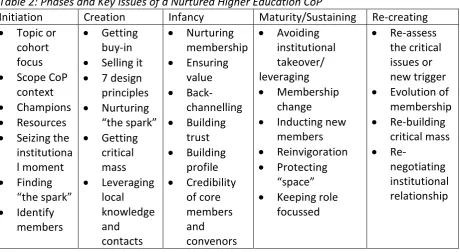
A second set of CoP Facilitator resources for establishing and sustaining CoPs are linked to the Phases and Key Issues of a Nurtured Higher Education CoP (Table 2), developed by Star & McDonald (accepted for publication). These resources provide CoP facilitators with ideas and practical resources at different phases of a CoP
[image:26.595.73.534.498.750.2]<www.usq.edu.au/cops/resources/altcfellowship>.
Table 2: Phases and Key Issues of a Nurtured Higher Education CoP
Initiation Creation Infancy Maturity/Sustaining Re-creating
• Topic or cohort focus
• Scope CoP context
• Champions
• Resources
• Seizing the institutiona l moment • Finding “the spark” • Identify members • Getting buy-in
• Selling it
• 7 design principles • Nurturing “the spark” • Getting critical mass • Leveraging local knowledge and contacts • Nurturing membership • Ensuring value • Back-channelling • Building trust • Building profile • Credibility of core members and convenors • Avoiding institutional takeover/ leveraging • Membership change
• Inducting new members
• Reinvigoration
• Protecting “space”
• Keeping role focussed
• Re-assess the critical issues or new trigger
Community, Domain, Practice: Facilitator catch cry for revitalising learning and teaching through CoPs
27 Star, C., & McDonald, J. (accepted for publication), CoPping it sweet: the state of play of CoPs in
higher education, Higher Education Quarterly, Wiley-Blackwell, West Sussex, United Kingdom.
On the Fellowship web resource site, brief overviews of the key considerations are provided for each of the CoP phases, with links to more detailed resources. These web resources also provide cross links to the web version of the comprehensive Miami Facilitator’s Handbook distributed at the 2.5 day facilitator workshop, Designing, Implementing, and Leading CoPs. An example of resources from the “Initiation page is copied
below www.usq.edu.au/cops/resources/altcfellowship/facilitator-resources/initiation>.
Initiation
The spark is the idea, challenge or opportunity that triggers the plan to establish your CoP and will determine if the CoP is topic based, such as “Tablet PC CoP”, or cohort, “Faculty of Business First Year Course Leaders CoP”. The Miami University Faculty Learning Community (FLC) Facilitator's Handbook contains a wealth of ideas and resources to draw on for CoP implementation. Review the ideas presented in Recommendations for Initiating and Implementing an FLC at Your Campus as you begin to plan your CoP. There are many CoP resources available on the web including Etienne Wenger’s Cultivating communities of practice: a 'quick start-up guide' andJohn Parboosingh’s Tools for CoP Facilitators (*PDF 527KB).
Consider the CoP context and articulate the alignment with institutional goals and priorities, such as student retention. Activity: populate the ‘Community of Practice Start-up
Considerations (*PDF 91KB) ’ file. Recruit your champion by articulating CoP goals and alignment to institutional priorities, benefits and outcomes. The champion can provide administrative and consumable resources, high level promotion of your CoP, time release for members and profile the importance of the CoPs to all stakeholders. Once you have identified potential members, people interested in the topic or members of the cohort, send an invitation inviting them to the CoP. The invitation (see model document in resources) from the champion and his/her attendance at CoP launch adds impact and prestige. Resources:
• Community of Practice Start-up Considerations(*PDF 91KB)
• The Distance Consulting Company (2000) Community of Practice Start Up Kit, A concise set of tools and diagrams for conceptualizing, building, supporting and evaluating communities of practice
• The FLC Program Director's and FLC Facilitator's Handbook, Sixth Edition, Recommendations for Initiating and Implementing an FLC at Your Campus
• Model invitation from CoP Champion to potential members to join the Community of Practice
• Parboosingh, John (2010), Tools for CoP Facilitators (*PDF 527KB), Getting Started with CoPs – how to foster CoPs, University of Calgary
Community, Domain, Practice: Facilitator catch cry for revitalising learning and teaching through CoPs
28
5 Linkages
The Fellow collaborated with colleagues to leverage off this Fellowship Community, domain, practice: facilitator’s catch-cry for revitalising learning and teaching through communities of practice, to successfully submit a grant application for an Australian Learning and Teaching Council (ALTC) Leadership Project - McDonald, J., Star, C., Nagy, J., Burch, T., Cox, M. (2010-12), “Identifying, building and sustaining leadership capacity for communities of practice in higher education.” The Leadership team members have been involved in CoPs and working collaboratively for a number of years, and saw significant synergies and effective
mobilisation of in-kind resources can be achieved by undertaking the projects concurrently. Both of these projects address CoP leadership questions and build leadership capacity.
5.1 Influence on ALTC Fellowships and Grant projects
Fellowship activities contributed to Professor Wageeh Boles National Fellowship. Professor Boles came to know Professor Milton Cox personally through A/Professor Jacquie
McDonald’s fellowship, when he made a presentation at the ALTC Fellows Forum in
Brisbane. This triggered a visit to Miami University (USA) to meet with Professor Cox and the outcome of this collaboration is a planned visit to Australia to work with Professor Boles in his Fellowship, and to conduct workshops at James Cook University and Queensland University of Technology, Brisbane. Professor Cox is also a member of the reference group of Wageeh's fellowship.
The Fellow collaborated with ALTC Fellow, Professor Sylvia Rodger, University of
Queensland, though networking at the ALTC Fellows Forum Sydney July 2010. She provided ideas and assistance for the implementation of CoPs for Professor Rodgers Fellowship, and sent links to the HERDSA papers and Fellowship resources. Professor Rodger’s build on her fellowship to develop an Occupational Therapy Academic Learning Network (OTALN) involving the emerging leaders from the fellowship and broadening out to other academics across Australian and New Zealand. The Fellow (J McDonald) has been invited to present a CoP workshop at the forthcoming workshop series in Sydney in June 2012.
Professor Susan Jones, requested the Fellow to provide CoP expertise as a member of the reference group for a 2011 ALTC Leadership project LE11-2000. Project title is ‘ Evidence-based benchmarking framework for a distributed leadership approach to capacity building in learning and teaching’.
The Fellow is a committee member of the Australian Learning and Teaching Fellows (ALTF) which has replaced the ALTC Fellows Alumni, and will establish and fill the role of
Community of Practice Convener.
5.2 Other disciplinary, national and international linkages
Community, Domain, Practice: Facilitator catch cry for revitalising learning and teaching through CoPs
29
Professor Milton Cox, key note speaker and participant, Brisbane ALTC Fellows Forum, 20-22nd February, 2011. Presentation arranged through my Fellowship activities, with thirty five Fellows registered for this event.
Professor Etienne Wenger, expert review of Facilitators workshops
Dr Lisa Tan, SEGi University College, Malaysia, attended the USQ February workshop and in collaboration with the USQ’s International Office established seven CoPs to support USQ and SEGi partnership learning and teaching at SEGi College.
Ms Jane Black, Learning, Work and Career Development, Victoria University, Melbourne, facilitator of a Community of Practice at Victoria University with a focus on Learning in Workplace and Community (Work Integrated Learning), sharing of resources, as follow-up contact triggered by February workshop notice on ALTC website.
Associate Professor Janelle Rose, Faculty of Law, Business and Creative Arts, James Cook University, Cairns, phone consultation and email exchange for establishing CoPs at James Cook University.
ALTC Fellows Alumni Association, Vanguard Newsletter, CQUniversity Communities of Practice launch – 12 August 2011.
Dr Linda Keesing-Styles, Dean, Teaching and Learning, Unitec, New Zealand. The Fellow is an invited member of their Community of Practice, with discussion of Fellowship activities through to online discussion on CoP Ning site. Fellow had meetings with Unitec CoP members at HERDSA 2010 and 2011.
Contribution to Ms Juliana Ryan, Deakin University, PhD research, ‘Narrativity and identity in university teaching and learning’ including hosting a visit to USQ, and USQ forum 14th July, 2011, facilitation of data collection in USQ CoPs, and external member dissertation
examination panel.
Ms Kylie Lipscombe, Masters Student at La Trobe University and a casual lecture/tutor at the University of Wollongong. She was referred by Professor Etienne Wenger to contact the Fellow to discuss and share resources for her Master’s Thesis on the role that professional dialogue plays in professional learning communities, using the community of practice as the theoretical framework. Activities included discussion and resources sharing, plus contact with other PhD students, July 2011.
Meeting 13 April 2011 at the RAAF Amberley base, Brisbane, with Jan Drobik, leader of Aero engineering Communities of Practice, Australian Defence Organisation, Fishermans Bend, Melbourne and Mr Ray Hingst, USQ Business CoP, to share Fellowship CoP activities and ideas to sustain CoPs.
Community, Domain, Practice: Facilitator catch cry for revitalising learning and teaching through CoPs
30
Distributed Leadership theory to CoPs. My activities include exchange of publications and letters of support and introduction for PhD survey with USQ and CQUni CoPs.
Linkedin http://www.linkedin.com/myGroups?trk=hb_side_grps_top, Community of Practice discussion forum, with 486 members. The Fellow contributes to international discussion about CoPs and direct participants to ALTC Fellowship activities and site.
Presentation on the "Role of communities of practice in engaging change" to Australian Business Dean's Council (ABCN) Learning & Teaching Network, on Thursday, 9 February, 2012, Adelaide University, triggered contact with colleagues at UTAS, with sharing of resources and planned invitation to present as key note at UTAS Learning and Teaching week (Teaching Matters) at the end of 2012.
Dr Nick Herd, Director, Research and Strategic Analysis, Australia Council for the Arts, made contact based on my national CoP activities to discuss practical application and ideas of how CoPs can assist with the communication of Australia Council research and promote
discussion, debate and knowledge transfer. Email exchange and phone conference February, 2012
Community, Domain, Practice: Facilitator catch cry for revitalising learning and teaching through CoPs
31
6 Evaluation
The external evaluation was commissioned by Associate Professor Jacquie McDonald, University of Southern Queensland as the client. The evaluation plan was submitted to, and agreed by, the client and the reference group that has overseen the Fellowship. The
evaluation was conducted by Jon Edwards, the Senior Evaluation Officer of the TEDI Evaluation Unit (EU) in the Teaching and Educational Development Institute (TEDI) at The University of Queensland. The external evaluation report for the project is commensurate with Section G, Final Report part e “Evaluation” in the document Fellowship management information, Fellowships Scheme Version 4.0 – October 2010.
6.1 Executive summary
Support to those in receipt of Australian Learning and Teaching Council (ALTC) funded programs includes access to resources that both help in, and are required for, the delivery of the aims of the program. One of these is a resource on evaluating projects. In evaluating an ALTC Fellowship the guidance and assistance provided by the resource is sufficient and perfectly adequate to make judgements about a project.
In planning for and managing the conduct of the Fellowship however, Associate Professor Jacquie McDonald determined that an external evaluation of the program be undertaken. The final form of the external evaluation not only takes these requirements into account, but also applies a broader evaluation framework that includes data collection and analysis by an independent evaluator.
This evaluation framework is grounded in well-established and recognised techniques in evaluation theory and practice; the theory of change, logic models and the Key Evaluation Checklist.
Investigation questions were established which then guided the identification of the data required for the evaluation. These data comprise a pre- and post-survey of participants in the major workshop activity of the Fellowship, testimony by two recognised experts in the field of Communities of Practice, examples of the impact of the Fellowship both locally and further afield and the level of the achievement of stated deliverables and conformance to the requirements of the ALTC. The data, collected and analysed independently were then used as criteria for making judgements that are presented in this report’s findings.
Based on the data collected it can be said that, overall, the ALTC Fellowship “Community, domain, practice: facilitator's catch-cry for revitalising learning and teaching through communities of practice”, conducted by Associate Professor Jacquie McDonald met the goals that it set out to achieve, in particular:
• The skills of Communities of Practice facilitators have been enhanced;
• Resources that encourage the development of Communities of Practice and enhance the skills of Communities of Practice facilitators have been created and made accessible;
Community, Domain, Practice: Facilitator catch cry for revitalising learning and teaching through CoPs
32
• There is evidence of the reach of the Fellowship in providing support to others in the area of Communities of Practice;
• Levels of quality required by the ALTC have been achieved.
6.3 Introduction to evaluation approach, audience and structure
An external evaluation that was undertaken for the Fellowship. The focus of the evaluation was on gathering evidence of the achievement of the aims and outcomes of the Fellowship. The fellowship project seeks to identify key aspects of the facilitator’s role in communities of practice, critically analyse the role and further develop workshops that serve to buildcapacity in the skills required of communities of practice facilitators.
The adopted external evaluation strategy aimed to support the success of achieving these objectives by providing an independent assessment of the impact of the proposed
workshops and a summative assessment of the lifecycle of the Fellowship.
6.3.1 Evaluation objectives
In answer to the question, “What is evaluation?” the Evaluation Trust, a UK-based,
charitable body that supports voluntary sector and community organisations in evaluating their activities and programs proposes the answer “… what difference does the work make…” This is the key principle that has guided the evaluation of the ALTC fellowship “Community, domain, practice: facilitator's catch-cry for revitalising learning and teaching through communities of practice” conducted by Associate Professor Jacquie McDonald, University of Southern Queensland. The primary objective of this evaluation has been therefore to answer the question “… what difference did the Fellowship make…?”
In order to achieve this objective the evaluation process sought to gather evidence in two areas; firstly evidence that the suite of activities envisaged by the terms of reference of the Fellowship had created opportunities for Communities of Practice facilitators to engage in facilitation skills development and secondly evidence of activities consistent with the requirements of an ALTC fellowship.
NB Reference made in this document to “program” is derived from evaluation theory for which, in this particular case, the term “Fellowship” can be substituted.
6.3.2 Investigation questions
This evaluation has aimed to investigate the following broad questions:
• In what ways has the fellowship met or not met the aims and objectives it set out to achieve?
• To what extent has the fellowship met or not met the evaluation requirements of the ALTC?
Community, Domain, Practice: Facilitator catch cry for revitalising learning and teaching through CoPs
33
reporting requirements for the ALTC as the Fellow’s Final Report – Part 1 provides for self assessment of the Fellowship under the headings “Dissemination of fellowship Outcomes” and “Potential for Systemic Change”.
6.3.3 Evaluation approach
The selection of a particular evaluation approach reflects two important considerations; timing and practicality. An external evaluation report is required at the end of the fellowship period. This limits the scope of assessment to “activities” and “short-term results” (see Appendix 1). Ideally an evaluation would extend to “medium-term results” and ultimate impacts” but this is precluded by the requirement to report at a specified time.
Furthermore, the reach of the Fellowship and budgetary constraints place limits on the number of consumers that can be approached in order to provide evidence for the
evaluation. In seeking to meet its objective an evaluation approach was used which draws on three underpinning concepts in evaluation theory and practice:
• Theory of Change
• Logic Model
• Key Evaluation Checklist
Theory of Change
This concept “… refers to the ideas or underlying/tacit assumptions about how the activity … designed will bring about the changes … hope[d] for” (Saunders yyyy). It presupposes that the activities are not only worthwhile in themselves but that benefits will result subsequent to the provision of these activities.
Such an approach has been used by Hegedus and Jernigan (2010) in the evaluation of communities of practice (CoPs) themselves and by the University of Sheffield (Levy et al 2007). The latter draws on the EPO (enabling, process, outcome) approach to performance indicators of Helsby and Saunders (1993). It uses the following three questions to establish the relationship between activities and change as follows:
Question Descriptor
What is needed to undertake the activities leading to the desired
outcomes? Resources and Enablers
What steps need to be taken to achieve the desired outcomes? Activities and Processes
What will the program have achieved by its end? Desired Outcomes
Theory of change concerns itself with the “what”, i.e. in order to create desired outcomes, what activities and processes need to be produced through the use of resources and enablers.
Logic Model
The logic model initially occupies similar territory to the theory of change. It is used however to provide the “how” of change.
Community, Domain, Practice: Facilitator catch cry for revitalising learning and teaching through CoPs
34
The model developed by the University of Wisconsin Extension can be found in Appendix 1. This graphical representation begins by showing the logical relationships between the resources that go into a program, the activities the program undertakes and the changes or benefits that result, or alternatively stated Inputs, Outputs, Outcomes-Impact. These three headings are expanded to enable a more detailed exposition of the connections between the interdependent parts that together make up a systemic whole. The logic model provides a lens through which to engage with the evaluation of th