Research Report No 350
Implementing the Foundation
Stage in Reception Classes
Taylor Nelson Sofres:
Susannah Quick
Clare Lambley
Emma Newcombe
University of Warwick
Professor Carol Aubrey
The views expressed in this report are the authors' and do not necessarily reflect those of the Department for Education and Skills.
© Queen’s Printer 2002. Published with the permission of DfES on behalf of the Controller of Her Majesty's Stationery Office. Applications for reproduction should be made in writing to The Crown Copyright Unit, Her Majesty's Stationery Office, St Clements House, 2-16 Colegate, Norwich NR3 1BQ.
1 SUMMARY ... 1
2 BACKGROUND, OBJECTIVES AND METHODOLOGY ... 11
2.1 BACKGROUND ... 11
2.1.1 The Foundation Stage ... 11
2.1.2 The National Literacy and Numeracy Strategies (NLS/NNS) ... 12
2.1.3 Background to the survey ... 13
2.2 OBJECTIVES ... 15
2.3 METHODOLOGICAL APPROACH ... 16
2.3.1 Data collection ... 16
2.3.2 Sample source and structure ... 17
2.3.3 Response rate ... 18
2.3.4 Questionnaires ... 19
2.3.5 Reporting ... 20
3 SCHOOL AND RECEPTION CLASS CHARACTERISTICS ... 21
3.1 NUMBERS OF RECEPTION CLASSES AND RECEPTION-AGED CHILDREN ... 21
3.2 SPECIAL EDUCATIONAL NEEDS ... 23
3.3 ENGLISH AS AN ADDITIONAL LANGUAGE ... 23
3.4 MIXED-AGE CLASSES ... 24
3.5 NURSERY CLASS PROVISION FOR CHILDREN BELOW RECEPTION-AGE ... 25
3.6 PHYSICAL LOCATION OF RECEPTION CLASSES ... 26
3.7 SUMMARY OF SCHOOL AND RECEPTION CLASS CHARACTERISTICS ... 27
3.8 CONCLUSIONS ... 28
4 HEADTEACHER AND RECEPTION CLASS TEACHER EXPERIENCE, QUALIFICATIONS AND TRAINING ... 29
4.1 HEADTEACHER AND RECEPTION CLASS TEACHER EXPERIENCE ... 29
4.2 QUALIFICATIONS OF HEADTEACHERS ... 30
4.3 TRAINING OF HEADTEACHERS IN THE FOUNDATION STAGE ... 32
4.4 QUALIFICATIONS OF RECEPTION CLASS TEACHERS ... 35
4.5 ADDITIONAL QUALIFICATIONS OF RECEPTION CLASS TEACHERS ... 36
4.6 TRAINING OF RECEPTION CLASS TEACHERS IN THE FOUNDATION STAGE... 37
4.7 SUFFICIENCY OF TRAINING FOR RECEPTION CLASS TEACHERS ... 39
4.8 TRAINING OF OTHER TEACHERS ... 41
4.9 CONCLUSIONS ... 42
5.2 FACILITIES FOR RECEPTION-AGED CHILDREN ... 45
5.3 THE SCHOOL IMPROVEMENT PLAN ... 47
5.4 CONCLUSIONS ... 49
6 THE EARLY YEARS DEVELOPMENT AND CHILDCARE PARTNERSHIP ... 51
6.1 EXTENT OF CONTACT ... 51
6.2 CLOSENESS OF THE PARTNERSHIP RELATIONSHIP ... 52
6.3 CONCLUSIONS ... 53
7 THE FOUNDATION STAGE TEAM ... 54
7.1 FOUNDATION STAGE CO-ORDINATOR ... 54
7.2 FOUNDATION STAGE GOVERNOR ... 54
7.3 ADDITIONAL RESPONSIBILITIES OF RECEPTION CLASS TEACHERS ... 55
7.4 CONCLUSIONS ... 56
8 SUPPORT STAFF ... 57
8.1 NUMBERS OF SUPPORT STAFF ... 57
8.2 QUALIFICATIONS OF SUPPORT STAFF ... 57
8.3 CONCLUSIONS ... 58
9 ADMISSION PROCEDURES ... 59
9.1 POINTS OF ADMISSION ... 59
9.2 CONTACT AND INFORMATION GATHERING BEFORE ADMISSION ... 61
9.3 CONCLUSIONS ... 62
10 GENERAL EXPERIENCE OF THE FOUNDATION STAGE ... 63
10.1 GENERAL REACTIONS TO THE FOUNDATION STAGE ... 63
10.2 COMMITMENT TO THE FOUNDATION STAGE ... 65
10.3 BENEFITS AND PROBLEMS ... 67
10.4 PROGRESS MADE IN IMPLEMENTING THE FOUNDATION STAGE ... 74
10.5 CHANGES IN WORK AS A RESULT OF THE FOUNDATION STAGE ... 76
10.6 CONCLUSIONS ... 77
11 IMPLEMENTATION OF THE FOUNDATION STAGE ... 79
11.1 PLANNING TO TEACH THE FOUNDATION STAGE IN RECEPTION CLASSES ... 79
11.2 CURRICULUM ORGANISATION IN RECEPTION CLASSES ... 83
11.3 CHILD-LED AND SPONTANEOUS LEARNING ... 85
11.4 GROUPING PUPILS ... 86
11.5 LITERACY AND NUMERACY ... 88
11.9 CONCLUSIONS ... 94
12 NATIONAL LITERACY AND NUMERACY STRATEGIES ... 97
12.1 IMPLEMENTING THE NATIONAL LITERACY STRATEGY ... 97
12.2 IMPLEMENTING THE NATIONAL NUMERACY STRATEGY ... 98
12.3 CONCLUSIONS ... 99
13 MIXED-AGE CLASSES ... 100
13.1 PROBLEMS WITH TEACHING RECEPTION-AGED CHILDREN ALONGSIDE OLDER CHILDREN ... 100
13.2 CONCLUSIONS ... 103
14 TRANSITION TO KEY STAGE 1 ... 104
14.1 WHETHER THE FOUNDATION STAGE HAS MADE THE TRANSITION TO KEY STAGE 1 PROBLEMATIC .. 104
14.2 COMMUNICATION BETWEEN RECEPTION CLASS TEACHER AND KEY STAGE 1 TEACHER ... 105
14.3 CONCLUSIONS ... 106
15 PARENTAL INVOLVEMENT AND UNDERSTANDING ... 107
15.1 MEETINGS WITH PARENTS TO RAISE AWARENESS OF THE FOUNDATION STAGE ... 107
15.2 TEACHER PERCEPTION OF PARENTS’ UNDERSTANDING OF THE SIX AREAS OF LEARNING OF THE FOUNDATION STAGE ... 108
15.3 CONCLUSIONS ... 110
16 CONCLUSIONS ... 111
16.1 HEADTEACHERS’ AWARENESS AND UNDERSTANDING OF THE FOUNDATION STAGE AND STEPS TAKEN TO IMPLEMENT IT IN SCHOOL ... 111
16.2 CHILD AND SCHOOL CHARACTERISTICS ... 112
16.3 STAFFING, QUALIFICATIONS AND TRAINING ... 112
16.4 THE FOUNDATION STAGE TEAM AND SUPPORT STAFF ... 113
16.5 RESOURCES ... 113
16.6 ADMISSION PROCEDURES ... 114
16.7 IMPLEMENTATION OF THE FOUNDATION STAGE ... 114
16.8 MEETING LITERACY AND NUMERACY STRATEGY REQUIREMENTS ... 116
16.9 MIXED-AGE CLASSES ... 116
16.10 TRANSITION TO KEY STAGE 1 ... 116
16.11 PARENTAL INVOLVEMENT ... 117
16.12 EARLY YEARS DEVELOPMENT AND CHILDCARE PARTNERSHIPS ... 117
16.13 GENERAL EXPERIENCE OF THE FOUNDATION STAGE ... 117
1 SUMMARY
Background
In September 2000 the Foundation Stage was implemented for children aged three to the end of the reception year in primary school. For the first time, this phase of education had a distinct identity with explicit intended outcomes – that by the end of the Foundation Stage, most children should achieve the Early Learning Goals in six areas of learning :
• personal, social and emotional development;
• communication, language and literacy;
• mathematical development;
• knowledge and understanding of the world;
• physical development;
• creative development.
A series of conferences held by the Qualifications and Curriculum Authority (QCA) in autumn 2000 raised a range of particular challenges for those seeking to implement the Foundation Stage in reception classes. Additionally, Early Years Development and Childcare Partnerships (EYDCPs), Local Education Authorities (LEA), teacher associations and the Foundation Stage Working Group (a group of early years experts and academics from whom the DfES Minister with responsibility for the early years seeks advice on Foundation Stage issues) persistently reported anxieties about the successful implementation of the Foundation Stage in reception classes, reflecting those identified by the headteachers and governors who attended the QCA conferences. Taylor Nelson Sofres (TNS) was commissioned by the DfES to undertake a nationally representative survey of schools in consultation with Professor Carol Aubrey at the University of Warwick, to investigate and quantify these issues, covering provision and teacher characteristics, different reception class practices, and headteachers’ and reception class teachers’ views, attitudes and concerns.
Methodology
England’ with a lower statutory age below 6 years (this includes special schools). 799 primary school headteachers and 752 reception class teachers in England were interviewed between 29th October and 23rd November 2001. In 702 cases, the headteacher and reception class teacher were from the same school. The final response rate for headteachers was 67%.
School characteristics
Two thirds of schools surveyed had just one class containing reception-aged children. The average school had 29 reception-aged children in the autumn term, most of whom were attending school full time.
Almost half (44%) of schools had nursery classes, although this varied depending on the characteristics of the area. Schools in urban areas and those with high levels of deprivation among pupils were most likely to have nursery provision in school. 27% of reception class teachers also taught older children in the same class, and 5% taught reception year alongside younger children.
The average proportion of reception-aged children with Special Educational Needs (SEN) across all schools was 12%, although a third of schools reported having no children of this age with SEN. On average (across all schools) 6% of reception-aged children were identified as having English as an Additional Language (EAL), although two thirds of headteachers reported having no children with EAL in their reception classes.
Headteacher and reception teacher qualifications and training
Approximately two thirds of headteachers had undertaken specific training in the Foundation Stage; over half had received training on Curriculum guidance for the foundation stage, and two fifths had received training on reception class literacy and numeracy. Headteachers who were initially trained to teach reception-aged children were the most likely to have received training in the Foundation Stage. 19% of headteachers had neither been early years trained initially nor received Foundation Stage training.
The vast majority (86%) of reception class teachers had received some specific training in the Foundation Stage. Three quarters (74%) had been trained on Curriculum guidance for the foundation stage, 60% in reception class literacy and 55% in reception class numeracy. However, only a third felt that they had received enough training to help them deliver the Foundation Stage, the general view being that some extra training would be useful. In particular those with less than three years experience in teaching reception classes wanted additional training. Specific areas highlighted for extra training were planning, assessment, Foundation Stage guidance, literacy, numeracy and Information and Communications Technology (ICT).
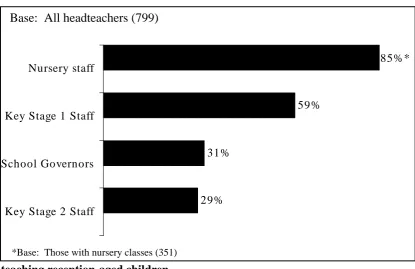
85% of nursery staff and 59% of Key Stage 1 staff had received Foundation Stage training. Training for Key Stage 2 staff and governors was much less common (29% and 31% respectively).
Resourcing
Three quarters (77%) of headteachers reported spending more money on reception classes as a result of the Foundation Stage, including 38% who felt they had spent ‘a lot more’. When asked about the adequacy of facilities in their school, ICT, indoor areas for practical activity and indoor quiet areas were assessed to be at least ‘adequate’ by three quarters or more of headteachers. However, almost half (43%) of the headteachers interviewed felt that outdoor learning facilities for reception-aged children in their school were ‘inadequate’.
Schools tended to receive regular written information from the EYDCP (three quarters received written information at least once a term), but beyond this there was little face to face involvement with the Partnership. Less than a third of headteachers described their relationship with the EYDCP as ‘close’.
The Foundation Stage team
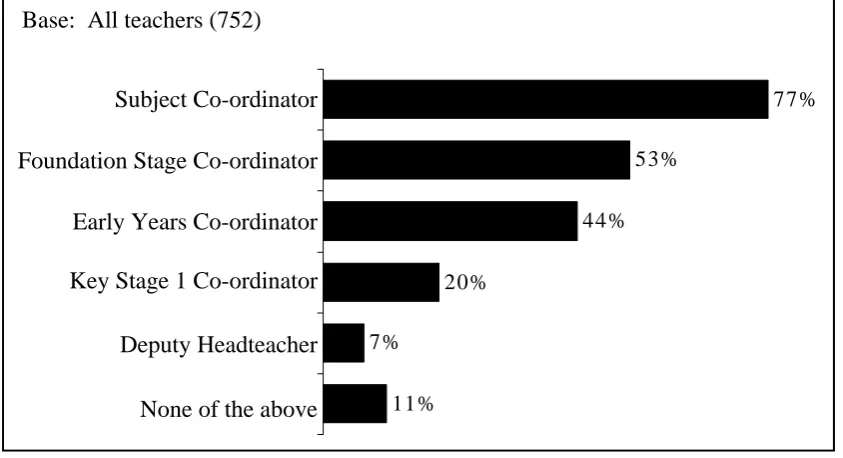
The vast majority (86%) of schools had an identified Foundation Stage co-ordinator, although only 37% had designated a Foundation Stage governor. Staff often took on a range of additional responsibilities, and most Foundation Stage co-ordinators were also the Early Years co-ordinator.
Support staff
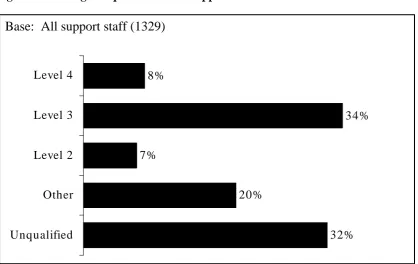
The vast majority (97%) of schools had general classroom support staff for reception classes (i.e. not assigned to specific children). About half of classroom support staff worked part-time. 29% of support staff had no relevant childcare or early years qualifications. The most common qualifications, held by a third of support staff, were CACHE or BTEC Diploma in Nursery Nursing or NVQ Level 3 in Early Years Care and Education.
Admission procedures
In 60% of schools, all children entered the reception class in September. A quarter (24%) of schools had two admission points per year, and 12% admitted children to reception classes at three points. Two fifths (41%) of schools took reception-aged children full-time from their first day, and a further 29% started children part-time, but for less than half a term. Reception class teachers tended to be relatively well informed about their children before they began school. 82% always met with the child’s parents mostly in school, although 13% carried out home visits. Half (53%) always received written records from the nursery or other pre-school provider, and similar proportions met with nursery staff or pre-school providers. 31% both received records from, and met with, nursery or pre-school staff.
General experience of the Foundation Stage
headteachers and reception class teachers were less positive, with 73% and 58% respectively assessing commitment as high.
The main benefits of the Foundation Stage that were described by headteachers and reception class teachers (in response to an open question) were as follows:
• Defines the reception year – mentioned by 37% of headteachers and 30% of reception class teachers. The Foundation Stage creates a bridge between the nursery and Key Stage 1, gives structure to the reception year, recognises that reception-aged children have different needs to older/younger children, and highlights the importance of the reception year.
• Flexibility and informality of the reception year – mentioned by 27% of headteachers and 34% of reception class teachers. A less formal teaching style than Key Stage 1, not as rigidly structured as the National Curriculum, and encourages integrated learning rather than segmenting by subject.
• Focuses on child development – mentioned by 26% of headteachers and 26% of reception class teachers. Emphasises personal, social and emotional development, encourages child centred learning and child led activities, puts more focus on verbal communication, and puts less pressure on the child.
• Focuses on practical play and outdoor activity – mentioned by 25% of headteachers and 38% of reception class teachers.
• Benefits for teachers – mentioned by 27% of headteachers and 28% of reception class teachers. The Foundation Stage provides good guidance for teachers, helps with lesson planning, improves the focus of training and puts less pressure on teachers.
The main problems of the Foundation Stage that were described by headteachers and reception class teachers (in response to an open question) were as follows:
• Timing – mentioned by 19% of headteachers and 16% of reception class teachers. The Foundation Stage was introduced too quickly. There was insufficient time for planning or to cover all the Early Learning Goals.
• Cost – mentioned by 18% of headteachers and 16% of reception class teachers. Increased staffing or resourcing costs and lack of facilities, equipment and materials.
• Unclear guidance – mentioned by 10% of headteachers and 15% of reception class teachers. Mixed message about structured vs. unstructured work, training was provided too late, and the Foundation Stage is difficult to explain to parents.
• Disrupts children by being so distinct from Key Stage 1 – mentioned by 8% of headteachers and by 8% of reception class teachers. The Foundation Stage is not felt to prepare the child sufficiently for, or fit in with, Key Stage 1. It holds children back who are ready for more formal learning.
• Buildings and grounds are inadequate for activities – mentioned by 16% of headteachers and 15% of reception class teachers.
• Mixed classes using two different curricula – mentioned by 12% of headteachers and 14% of reception class teachers.
The vast majority (86%) of headteachers felt that they had made ‘a lot of progress’ in implementing the Foundation Stage in their school. Reception class teachers were divided over whether work in their class had changed as a result of the Foundation Stage. Where changes had occurred, they tended to be in the reduction of formality and an increase in child focused and ‘hands-on’ activities.
Implementation for the Foundation Stage
About half of headteachers reported experiencing problems in fitting the Foundation Stage into the whole school approach to planning, but only 14% described it as a ‘big problem’. On the whole, the problem was that the Foundation Stage requires planning in a different way to Key Stages 1 and 2, therefore new planning forms were created, and teachers who have not been trained in the Foundation Stage were less able to be involved. There was also concern that the Foundation Stage should be tailored to ensure that children are ready for the requirements of Key Stage 1, and/or that Key Stage 1 teachers plan for a smooth transition from the reception year.
headteachers/deputies were involved in long term planning, but only a quarter (26%) were involved in short term planning for the reception class. Similarly 43% of reception class teachers reported that Key Stage 1 teachers were involved in long term planning for the reception class, but only 23% in short term planning. Less than one in five reception class teachers reported that Key Stage 2 teachers were involved in any planning for the reception class.
The majority (70%) of schools organised teaching in reception classes in the same way throughout the year, in terms of the balance struck between structuring teaching by Foundation Stage areas of learning, or integrating learning across the curriculum. Almost half of reception class teachers used a combination of these methods rather than relying on a single style. Around one in three teachers reported using different groupings of children for different activities. Among the remainder, ability was the most frequently mentioned factor, increasing from 23% in term 1 to 40% in term 2 and 47% in term 3.
The majority of reception class teachers implemented both the National Literacy Strategy and National Numeracy Strategy flexibly in terms 1 and 2, but used a Literacy Hour and daily mathematics lesson in term 3. Most teachers felt that the Foundation Stage had ‘got it about right’ in terms of the emphasis placed on verbal skills (90%), taking a developmental approach to learning (90%), play (89%), formal learning (74%) and written skills (69%). However, a sizeable minority expressed concerns that too little emphasis was placed on formal learning and written skills (20% and 25% respectively). It is concerning that creative development and physical development were regarded as slightly, yet significantly, less important than literacy and numeracy.
National Literacy and Numeracy Strategies
Around two thirds of both headteachers and reception class teachers felt that implementing the National Literacy and Numeracy Strategies with a more flexible approach for reception-aged children had not been a problem. Less than 10% of each group felt that it had been a big
problem.
Mixed-age classes
57% of headteachers and 60% of teachers with reception-aged children in mixed-age classes reported experiencing some difficulties in teaching from both the Curriculum guidance for foundation stage and the Key Stage 1 Programmes of Study in the same classroom. Problems tended to be about the increased planning required, and ensuring that work was tailored appropriately to both age groups. The different teaching styles of the phases were also thought to be problematic in a single classroom, as reception-aged children would spend less time at tables, and make more noise than Year 1 children.
Transition to Key Stage 1
72% of headteachers felt that the transition of children to Key Stage 1 had not been a problem since the introduction of the Foundation Stage. Just 7% felt that it had been a big problem in their school. Where problems had been encountered, they were generally concerned with adjusting to a more formal teaching method and having the skills required by Key Stage 1. Three quarters (77%) of reception class teachers always discussed each child’s progress with their future Year 1 teacher before they moved on.
Parental involvement
The majority of schools were keen to make parents aware of the Foundation Stage, with 69% of schools having held meetings to explain it. However, parents’ understanding of the Foundation Stage and the six areas of learning was generally described by reception class teachers as moderate (56%), with more describing it as low or very low (25%) than high or very high (16%).
Foundation Stage training, and whose Foundation Stage and other staff have continued early years training, tended to have had positive experiences of implementing the Foundation Stage in reception classes. The survey also shows that the majority of reception class teachers would welcome some additional training in the Foundation Stage, and that there are large numbers of Key Stage 1 and Key Stage 2 teachers, and governors that have not received specific training in the Foundation Stage. One third of classroom support staff are unqualified (more in rural areas). This highlights the need for Foundation Stage training to be extended to support staff, especially in rural areas. Understanding and commitment of all staff is necessary for the smooth implementation of a curriculum for 3 to 11 year-olds. Raising the general understanding and awareness of the teaching community as a whole through Foundation Stage training is likely to enhance whole school curriculum planning, teaching and assessment, as well as facilitate the transition between the Foundation Stage and Key Stage 1. Progression and continuity across the primary years is, thus, ensured.
That those headteachers most strongly endorsing the Foundation Stage are most likely to report spending a lot of additional money on the reception year, and identify the Foundation Stage as a key priority in the School Improvement Plan provides further evidence of the importance of positive school leadership.
Headteachers’ views on the challenge of incorporating the Foundation Stage within the school’s overall curriculum planning for Key Stage 1 and 2 varied, but the greatest concerns were expressed in schools with mixed-age classes, teaching from two curricula. Whilst teachers were divided as to whether there had been much change to their work, there was a perception by a minority (10% of headteachers and 15% of reception class teachers) that ‘mixed messages’ and unclear guidance with respect to structure of the reception year had been given, and a feeling that the Foundation Stage teaching style does not fully prepare children for Key Stage 1. However, it is heartening to find that almost three quarters of headteachers did not perceive that transition of reception-aged children to Key Stage 1 to be a problem.
at the beginning of the year to a greater degree of differentiation later in the year, and an increasing use of the Literacy Hour and daily mathematics lessons. Despite the call from a number of headteachers and reception class teachers for more and clearer information about the Foundation Stage (including additional training for reception class teachers), and some initial planning difficulties, the vast majority of both headteachers and reception class teachers had positive overall views of the Foundation Stage and tended to believe that much progress had been made in implementing it in their school.
2 BACKGROUND, OBJECTIVES AND METHODOLOGY
2.1 Background
2.1.1 The Foundation Stage
In September 2000, the Foundation Stage was implemented for children aged from three to the end of reception year in primary school, by which time most children are of statutory school age. For the first time, this phase of education had a distinct identity with explicit intended outcomes – that most children should achieve the Early Learning Goals by the end of the Foundation Stage in six areas of learning:
• personal, social and emotional development;
• communication, language and literacy;
• mathematical development;
• knowledge and understanding of the world;
• physical development;
• creative development.
Curriculum guidance for the foundation stage (CGFS) was written to support practitioners in all early years settings in planning a curriculum that would help all children make good progress towards, and where appropriate beyond, the Early Learning Goals. Alongside structured teaching planned by adults (both indoors and outdoors), it was envisaged that there should also be opportunities for children to learn through play, to experiment, plan and initiate activities themselves. The guidance was developed by the Qualifications and Curriculum Authority (QCA), working with early years practitioners and experts. The DfES, the National Literacy and Numeracy Strategies and OFSTED were also closely involved throughout.
phase in Year 1 at the age of 5 or 6. Recommendations of the House of Commons Education and Employment Committee and Education Sub-Committee First Report Early Years (2000: paragraph 53) supported the CGFS approach that “more structured learning should be introduced very gradually so that by the end of the reception year, children are learning through more formal, whole-class activities for a small proportion of the day”. (Further information on the Foundation Stage and the Key Stages of schooling can be found at www.qca.org.uk).
2.1.2 The National Literacy and Numeracy Strategies (NLS/NNS)
One of the first acts of this government was to announce national targets for literacy and numeracy, and the National Literacy and Numeracy Strategies were implemented in order to raise standards and help schools meet these targets. As part of these strategies, all primary schools have available to them specially devised frameworks for teaching literacy and mathematics and now teach a daily, dedicated Literacy Hour (since September 1998) and a daily mathematics lesson (since September 1999). These lessons follow a specific format.
The Literacy Hour has four elements:
• Whole class working on a shared text
• Word-level or sentence work
• Independent work
• Plenary session to consolidate and think about next steps.
The daily mathematics lesson is broken down into three elements:
• Oral work and mental calculation using whole class teaching
• Main lesson for new topics and consolidating previous work
• Plenary session to draw together what has been learned.
class teachers may choose to cover the elements of the Literacy Hour and daily mathematics lesson across the day rather than in a single unit of time. In order to ensure a smooth transition to the Literacy Hour and daily mathematics lesson in Year 1, both should be in place by the end of the reception year.
2.1.3 Background to the survey
A series of conferences held by QCA in autumn 2000, and attended by around 1,100 primary school headteachers and governors, raised a range of particular challenges for those seeking to implement the Foundation Stage in reception classes. Many reception class teachers and the support staff who work with them were not early years trained. Staffing ratios were less generous than in nursery classes (which tend to take 3 and younger 4 year- olds). Accommodation was often less than ideal, with provision for outdoor learning particularly problematic. In curriculum and organisation, many reception classes had previously followed similar patterns to Key Stage 1 classes, where the focus had been on the introduction of the Literacy Hour and daily mathematics lesson. Other subjects had been given a lesser priority and time allocation, and there had been a strong steer towards teacher directed and whole class teaching. Some felt that the implementation of the National Literacy and Numeracy Strategies did not sit easily alongside following CGFS, which placed a strong emphasis on children’s personal, social, emotional and physical development, and which promoted a broader pedagogical approach with play as a key way of learning. The 30 class-size limit directive for 5, 6, and 7 year-oldshad meant that, increasingly, both reception and Key Stage 1 children were taught together in the same classes. This had added to the differentiation required of teachers to meet the differing expectations of the Foundation Stage and Key Stage 1.
It was clear from the QCA conferences that, in many local authorities, the EYDCP’s relationship with maintained sector schools and Local Education Authority (LEA) staff was weaker than with the voluntary and private early years sectors. Reception class teachers were reported to feel that they were not always seen as part of their local EYDCP and often did not see themselves as part of that group. The same was felt to be true of headteachers. They felt that, as a result of this, the training and support needs of teachers and support staff in primary schools were not given sufficient emphasis by EYDCPs, and schools were not playing an active role in their EYDCP.
EYDCPs, LEAs, teacher associations and the Foundation Stage Working Group (a group of early years experts and academics from whom the DfES Minister with responsibility for the early years seeks advice on Foundation Stage issues) persistently reported anxieties about the successful implementation of the Foundation Stage in reception classes, reflecting those identified by the headteachers and governors who attended the QCA conferences. The then Minister, therefore, asked that research should take place to quantify the following issues:
• headteachers who are uninformed / do not see the need to change existing practice;
• problems as a result of teachers who are not early years trained;
• tensions between CGFS and NLS/NNS expectations;
• inadequate staffing;
• inadequate accommodation and/or resources;
• tensions between Foundation Stage / Key Stage 1 curriculum when reception children are taught in mixed-age classes.
2.2 Objectives
The overall objective of the research was to measure the extent of provision, teacher characteristics, different practices, and headteachers’ and reception class teachers’ views, attitudes and concerns in England in relation to:
• the implementation of the newly established Foundation Stage in reception classes;
• transition from reception classes to the Key Stage 1 curriculum in Year 1;
• to inform a DfES cascade programme of training planned for LEA advisers, for them to use with headteachers and reception class teachers.
More specifically, the research was to collect information on the following in relation to reception classes:
• headteacher awareness and understanding of the Foundation Stage and steps taken to implement it in school;
• children and school characteristics including number, ages, pre-reception provision, pattern of attendance (part-time/full-time), special educational needs, free school meals, English as an Additional Language, and organisation/ grouping in class;
• staffing, including use of support staff, their qualifications and amount of time spent in class:
• reception class teacher characteristics, qualifications, training, experience and knowledge including initial and ongoing training, and experience of early years age group;
• training on Foundation Stage guidance and NLS/NNS teaching frameworks/ guidance;
• accommodation, including outdoor space, and other resources;
• links to nursery classes / early years settings;
• curriculum planning, including coverage of areas of learning and Early Learning Goals; teaching approaches used; sources of planning; monitoring, assessing and recording; emphasis on play and on whole class teaching;
• parental interest/involvement;
• headteachers’ and reception class teachers’ perceptions of good/effective practice and poor/ineffectual practice;
• headteachers’ and reception class teachers’ general view of the Foundation Stage.
2.3 Methodological approach
2.3.1 Data collection
The research was designed to provide a snapshot of both practices and opinions regarding the Foundation Stage during the Autumn of 2001. It comprised structured interviews with a representative sample of both primary school headteachers and reception class teachers in England. A total of 1,551 interviews were conducted - 799 with headteachers and 752 with reception class teachers. In 702 cases, the headteacher and reception class teacher were from the same school.
All interviews were conducted by telephone. This method was chosen because it allowed data collection to be conducted over a short period of time, minimised the administrative burden placed on schools and should raise the response rate over that from a postal survey.
As basic statistics from the survey were required at an early stage, the fieldwork was conducted in two stages, each lasting two weeks. During the first two weeks, the objective was to achieve a total of 500 interviews with each of headteachers and reception class teachers, which would allow a basic analysis of the data to be undertaken. During the second two weeks, the objective was to ‘top up’ each of the two samples with an additional 250 interviews, which would allow for a more detailed analysis of the data. In practice, these targets were exceeded at both stages, as a result of the high level of co-operation from both headteachers and reception class teachers.
All telephone interviewing was conducted using Computer Assisted Telephone Interviewing (CATI) at the Taylor Nelson Sofres telephone interviewing centre in Manchester, under the controls of the IQCS (Interviewer Quality Control Scheme) and the MRS (Market Research Society) Code of Conduct. All interviewers working on the project received a personal briefing on the study.
2.3.2 Sample source and structure
The sample of schools was selected from the DfES’ register of educational establishments. The universe (population of schools within the scope of this survey, including special schools) comprised ‘all maintained primary schools in England’ with a lower statutory age below 6 years. Schools that had recently taken part in DfES’ research were excluded from the survey.
The sample was stratified by Local Education Authority to ensure a nationally representative sample. In so doing, this also controlled well for urban/rural/mixed areas. After this stratification, the sample was selected on a ‘one in n’ basis. Therefore there was no clustering, so ensuring the maximum reliability of the sample. Bearing in mind the two stages of the fieldwork, the sample was then divided into two, and a representative sample of schools issued for each of the fieldwork stages.
A letter was sent to all of the selected schools prior to telephone contact being made. The letter was addressed to the headteacher and explained the background and rationale for the research, the importance of participation, and gave details of what the survey would involve. Also included was a short form, which asked headteachers to gather together some basic factual information about the school before the interview actually took place. This approach worked well, and almost all headteachers who were contacted had prepared the relevant information on the form provided. A copy of the introductory letter can be found in Appendix A and a copy of the factual data form can be found in Appendix B at the back of this report.
each school. In these cases, the headteacher was asked to provide details of the names of all permanent reception class teachers at the school and then the computer made a random selection from this list. This approach was designed to avoid any possible bias in the headteacher’s choice of nominee for interview, and worked well in practice, with interviews only being carried out with the selected reception class teachers.
2.3.3 Response rate
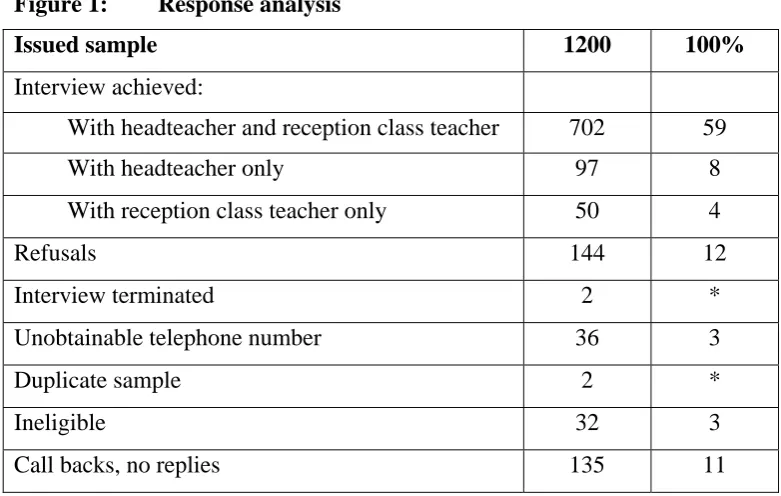
A high response rate was considered very important for the success of the survey. The amount of sample issued to interviewers was therefore carefully controlled, and repeated calls made to selected schools in order to make contact with the headteacher. Over the two fieldwork periods, a total of 1200 sampled schools were released to interviewers. From these, 799 interviews with headteachers were achieved, representing a response rate of 67%. In the majority of cases where an interview with a headteacher was achieved, an interview with a reception class teacher was also achieved.
This is a very good and pleasing response rate, which was attributed to the following factors:
• The subject matter of the survey was regarded as extremely relevant to respondents, who were therefore very keen to participate. Indeed, once they had received the introductory letter, many headteachers contacted Taylor Nelson Sofres asking to participate in the survey.
• The letter was well targeted and provoked an interest in and co-operation with the research.
• The method of interviewing the headteacher initially and then the reception class teacher worked well, as once the headteacher had committed to the survey the reception class teacher usually followed suit.
• The sample of schools was up-to-date and accurate.
Figure 1: Response analysis
Issued sample 1200 100%
Interview achieved:
With headteacher and reception class teacher 702 59
With headteacher only 97 8
With reception class teacher only 50 4
Refusals 144 12
Interview terminated 2 *
Unobtainable telephone number 36 3
Duplicate sample 2 *
Ineligible 32 3
Call backs, no replies 135 11
Non-response was fairly evenly divided between refusals and failure to schedule an appointment for interview.
After each phase of fieldwork, the achieved samples were examined in detail against the profile of the universe of schools (population of schools within the scope of this survey) to check that they were representative in terms of LEA, level of deprivation in the area, type of establishment, school size, and whether or not there was nursery provision. On all of these measures, the achieved samples were found to closely match the universe of schools. The achieved samples slightly under-represented special schools. This was mainly because many special schools have only very small numbers of reception-aged children and, therefore, did not feel that they had sufficient experience to take part in the survey. Many of those classified as ‘ineligible’ in Figure 1 are special schools.
2.3.4 Questionnaires
representatives of the DfES listened in to the pilot interviews. In general the pilot interviews went well, and it was clear that respondents were keen to co-operate and were interested in the subjects covered by the survey. As a result of the pilot, small adjustments were made to the questionnaires. Copies of the final questionnaires can be found in Appendices B and C at the back of this report.
Interviews took an average of 20 minutes to administer for both headteachers and reception class teachers.
2.3.5 Reporting
The figures shown in the text, tables and graphs in this report have been rounded to the nearest percentage point. The cumulative effect of this rounding is that percentage figures may not always total exactly to 100%.
Where an asterisk (*) is used in a table or graph instead of a percentage, this means less than 1%, but not zero.
3 SCHOOL AND RECEPTION CLASS CHARACTERISTICS
3.1 Numbers of reception classes and reception-aged children
At the start of the headteachers’ interview factual data was collected about the composition of reception classes1 at the school. As headteachers might not have had this information immediately to hand, they were asked to prepare some of the figures in advance of the interview.
Two thirds (66%) of schools surveyed had just one class with reception-aged children (see Section 3.4), with 26% having two. This left 7% of schools with three reception classes, and 2% with four or more.
The majority of schools (57%) only had one teacher with reception class responsibility. 32% had two, and 10% had three or more. The average number of teachers per school with class responsibility for the reception year was 1.5. This was almost exclusively made up of full-time teachers: only 13% of schools employed part-time reception class teachers.
Overall, schools had an average of about 29 reception-aged children (note that this figure refers to October/November 2001, i.e. the autumn term, when fieldwork took place). The vast majority of these children were full-time – accounting for just over 24 of the 29 children on average. (Figure 2)
The number of reception-aged children varied considerably between schools. At one end of the scale, 18% of schools had between one and ten reception-aged children, while at the other end of the scale, 17% had more than 50 children of that age (Figure 2).
1
The smallest numbers of reception-aged children tended to be in rural areas (average of 12 reception children per school) and, to some extent, in schools with the lowest levels of deprivation amongst pupils (as measured by the percentage of children receiving free school meals2). There was an average of 24 reception children in these schools. Schools with a large number of reception children tended to be in urban areas (average of 34).
Figure 2: Number of reception-aged children in school (Oct/Nov2001)
Base: All headteachers 799
Mean number of reception-aged children 28.5
Mean number of full-time 24.5
Mean number of part-time 4.1
Distribution of total number of reception-aged children (i.e. full-time plus part-time):
%
1 – 10 18
11 – 20 25
21 – 30 24
31 – 40 9
41 – 50 6
51 or more 17
2
3.2 Special Educational Needs
According to headteachers, overall the average proportion of reception-aged children with Special Educational Needs (SEN) across all schools was 12% (not necessarily with a Statement, but identified by the headteacher as having SEN). One third (34%) of headteachers indicated that they did not have any reception-aged children with SEN at the time of the survey.
Reception classes with the highest percentage of SEN children tended to be in the schools with the highest levels of deprivation among pupils. In those schools (more than 25% of children eligible for free school meals), only 15% of headteachers reported that they did not have any reception-aged children with SEN, and, on average, headteachers reported 23% of children in their reception classes had SEN. This compares to an average of just 6% in the schools with the least deprivation. Linked to this is the finding that the average level of SEN was more than 13% in urban areas, compared to just 7% in rural areas. Interestingly above average levels of SEN (17%) were also recorded in schools where headteachers indicated that no additional resources had been spent on the reception year as a result of the introduction of the Foundation Stage.
3.3 English as an Additional Language
Overall, across all schools, the average percentage of reception-aged children identified by headteachers as having English as an Additional Language (EAL) was 6%. Two thirds of headteachers stated that there were no reception-aged children in their school with EAL. Where schools had reception-aged children with EAL, they tended to have a relatively small percentage of such children - usually not more than 10%.
3.4 Mixed-age classes
Mixed-age classes, where reception-aged children are taught alongside older or younger children, were relatively common.
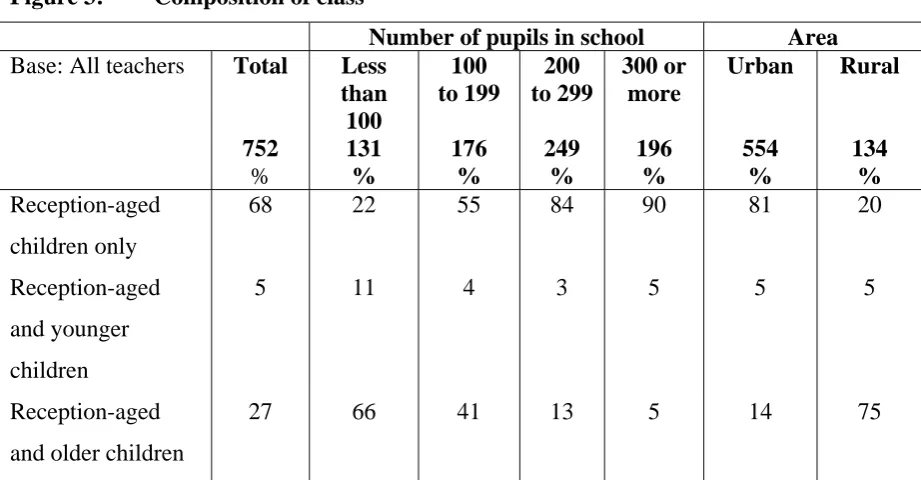
[image:29.595.67.528.288.528.2]Of the reception class teachers surveyed, 68% taught classes comprised exclusively of reception-aged children, 27% taught reception-aged children alongside older children, and 5% taught reception-aged children with younger children in the same classroom. Mixed-age classes were particularly common in small, rural schools (as shown in Figure 3).
Figure 3: Composition of class
Number of pupils in school Area Base: All teachers Total
752 % Less than 100 131 % 100 to 199 176 % 200 to 299 249 % 300 or more 196 % Urban 554 % Rural 134 % Reception-aged children only
68 22 55 84 90 81 20
Reception-aged and younger children
5 11 4 3 5 5 5
Reception-aged and older children
27 66 41 13 5 14 75
From headteachers, the proportion indicating that they had classes in their school where older children were taught together with reception-aged children was 36%. This is slightly higher than the proportion of teachers reporting that they actually taught such classes and could be due to some reception-aged children in the school being in dedicated reception classes and others being in mixed-age classes.
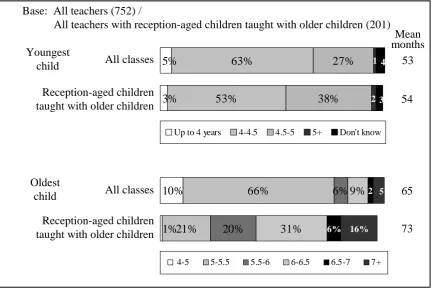
classes where reception-aged children were taught with older children, there were children aged 79 months or more, with some cases of children up to the age of 93 months.
Figure 4: Ranges of the youngest and oldest children in classes including reception-aged children
3.5 Nursery class provision for children below reception-age
44% of headteachers reported that they had nursery classes at their school (Figure 5). Nursery provision for children below reception-age was associated with factors such as geographical location and level of deprivation. The proportion of the most deprived schools (26%+ of children receiving free school meals) that had their own nursery classes was more than three times higher than the proportion of the least deprived schools (0-5% of children receiving free school meals): 70% of the most deprived schools had nursery provision for children below reception-age, as opposed to just 22% of the least deprived schools. Similarly, schools in urban areas were almost three times as likely to have nursery provision than those in rural areas: 52% of schools in urban areas had nursery classes at their school, compared with just 19% of those in rural areas. This may reflect a long tradition of provision of nursery
5% 3% 63% 53% 27% 38% 2 1 4 3
Up to 4 years 4-4.5 4.5-5 5+ Don't know
All classes
Reception-aged children taught with older children
Mean months 53 54 Youngest child Oldest
child All classes 10%
1% 66% 21% 6% 20% 9%
31% 6% 16%
2 5
4-5 5-5.5 5.5-6 6-6.5 6.5-7 7+
Reception-aged children taught with older children
65
73 Base: All teachers (752) /
Figure 5: Percentage of schools with nursery provision for children below
reception-age
3.6 Physical location of reception classes
In schools that did not provide nursery classes for children below reception-age, nearly all reception classes were located with the main school (Figure 6). Nine out of ten schools without a nursery class had the reception class located with the main school.
In schools with nursery provision, a more complex picture emerged. The most common practice (52% of schools) was for a totally integrated site, with reception classes located with
both the main school and the nursery, which might be expected to facilitate joint curriculum planning and implementation and shared resources (staff and equipment). In the remainder of schools, it was much more common for the reception classes to be located with the main school (35%) rather than with the nursery (11%). Here, there may be more challenges to be met in providing integrated early years education for 3 to 6 year-olds.
A fully integrated provision was most likely to occur in schools with the highest deprivation among pupils.
44%
56% 52%
48% 19%
81% Yes
No
Total
3.7 Summary of school and reception class characteristics
In summary, two thirds of schools surveyed had just one class with reception-aged children and therefore the majority of schools had just one reception class teacher. These teachers were almost exclusively full-time.
The average school had 29 reception-aged children in the autumn term. There was a strong difference in the characteristics of urban and rural schools and of deprived and more affluent schools. Urban schools tended to be in the most deprived areas: these were generally large schools with relatively high numbers of reception-aged children. They also tended to have the highest proportions of children with SEN and EAL. Rural schools tended to be relatively small and tended to have low levels of deprivation among children. They had smaller numbers of reception-aged children and relatively low proportions of children with SEN and EAL.
Overall, 27% of reception class teachers indicated that they taught reception-aged children alongside older children. These mixed-age classes were particularly common in the small, rural schools, with low levels of deprivation.
44% of headteachers reported that they had nursery classes at their school. Schools in urban 52%
35%
11%
1%
Base: All with nursery classes (351)
With both nursery and main school
With main school but away from nursery
With nursery but away from main school
rural areas and with low levels of pupil deprivation to indicate that they had nursery provision.
3.8 Conclusions
4 HEADTEACHER AND RECEPTION CLASS TEACHER EXPERIENCE, QUALIFICATIONS AND TRAINING
4.1 Headteacher and reception class teacher experience
As background to the survey, both headteachers and reception class teachers were asked about their length of experience in the teaching profession. In addition, headteachers were asked how many years’ experience they had as a headteacher, and reception class teachers were asked about their experience of teaching reception-aged children.
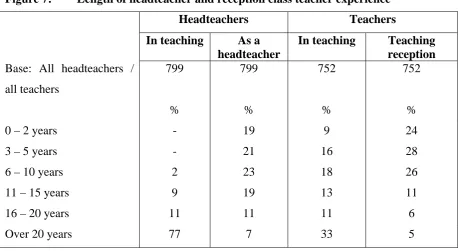
[image:34.595.67.526.453.704.2]In terms of general teaching experience, the table below (Figure 7) shows that both headteachers and reception class teachers surveyed were generally very experienced, having many years service in the teaching profession. Indeed, 77% of headteachers and 33% of reception class teachers had more than 20 years experience in teaching. Among reception class teachers, however, there were also reasonable proportions at the other end of the scale – 9% had less than three years experience in teaching.
Figure 7: Length of headteacher and reception class teacher experience
Headteachers Teachers In teaching As a
headteacher
In teaching Teaching reception Base: All headteachers /
all teachers
799 799 752 752
% % % %
0 – 2 years - 19 9 24
3 – 5 years - 21 16 28
6 – 10 years 2 23 18 26
11 – 15 years 9 19 13 11
16 – 20 years 11 11 11 6
In terms of specific experience as a headteacher, it is a much more mixed picture. Indeed, one in five headteachers had less than three years experience in this role, and only 7% had been working as a headteacher for more than 20 years.
Substantial proportions of reception class teachers had only been teaching reception classes for a relatively short period of time. A quarter had less than three years experience, and about another quarter had just 3 – 5 years experience.
The length of experience in the teaching profession both among headteachers and among reception class teachers did not vary much by area type (urban/rural/mixed) nor by level of deprivation of the children attending the school. However, those teachers whose original training was for children from the age of three tended to have less experience (both in total and in teaching reception-aged children) than those who had trained to teach children from the age of four, five or seven and over. This may reflect the introduction of initial teacher training (ITT) courses covering the 3 to 8 age range in Circular 4/98 (DfEE, 1998) which allowed trainees to take additional advanced study of early years as an alternative to a specialist subject across Key Stage 1 and Key Stage 2.
4.2 Qualifications of headteachers
Figure 8: Original teaching qualification of headteachers
Nine out of ten headteachers were originally trained to teach primary-aged children, although not necessarily including the youngest primary-aged children in nursery and reception classes (Figure 9). In total, 22% of headteachers were initially trained to teach children from three years of age, 33% were trained to teach primary from four or five years of age, and 35% trained originally to teach primary from seven years of age. This means that, in all, more than two in five headteachers had not originally been trained to teach Foundation Stage aged children. While both those originally trained to teach Foundation Stage aged children and those trained to teach other ages had similar levels of overall experience, it is the latter group who tended to have slightly more years experience as headteachers.
Figure 9: Age group for which initially trained
Base: All headteachers
Total 799
%
Level of deprivation (% of children receiving free school meals)
0-5% 247 % 6-25% 367 % 26%+ 178 %
Primary from 3 yrs 22 18 22 25
Primary from 4 or 5 yrs 33 36 36 25
Primary from 7 yrs 35 37 33 35
Secondary 6 7 5 7
57% 26% 12% 3% 2% Teaching Certificate
BA(QTS) or B Ed
PGCE
Certificate of Education
Other/Don’t know 4 2 4 8
Schools with the lowest levels of deprivation were more likely to have headteachers who had been initially trained to teach older primary children from four, five or seven years old than headteachers who had trained to teach younger children from three years old. Conversely, headteachers teaching in the most deprived areas were more likely to have been trained to teach children from aged three.
Accordingly, a greater proportion of headteachers in urban areas (23%) had been trained originally to teach children from the age of three than headteachers in rural areas (18%).
4.3 Training of headteachers in the Foundation Stage
The Foundation Stage awareness training was a DfES’ training resources pack that focused on the principles outlined in QCA's Curriculum guidance for the foundation stage. Staff were introduced to the material at a series of cascade events at regional and EYDCP level. Representatives from settings who attended the latter were expected to cascade this training to their colleagues.
The majority of headteachers (62%) had undertaken specific training in the Foundation Stage, but this still left a large minority (37%) who had not.
Figure 10: Headteacher training specifically in the Foundation Stage
There appears to be a link between the age group that headteachers initially trained to teach and the percentage of headteachers who had followed training specifically in the Foundation Stage. Those who were originally trained to teach younger children (from three, four or five) are more likely to have undertaken training in the Foundation Stage. Specifically, 72% of headteachers who originally trained to teach children from three years had undergone Foundation Stage training, 63% of headteachers initially trained to teach primary pupils from four or five had undertaken training, and only 57% of those trained to teach older children had been trained in the Foundation Stage. This suggests that those headteachers with the least qualifications for work with the youngest children are also the least likely to have sought further training in this area.
The following chart (Figure 11) gives a summary of headteachers’ qualifications and training, in terms of whether or not they had initially been trained to teach children from three, four or five and whether or not they have received Foundation Stage training. It shows that overall, 36% of headteachers were both initially trained to teach the youngest children and had received Foundation Stage training. A further 19% had the initial training with the youngest age group, but had yet to receive specific Foundation Stage training. 26% were initially trained for an older age group but had received Foundation Stage training, and the remaining 19% fell into the ‘worst case scenario’ of having neither had initial training with the relevant age group, nor having received Foundation Stage training.
54%
41%
41%
37%
Base: All headteachers (799)
Training on Curriculum guidance for the foundation stage
Training in reception class literacy
Training in reception class numeracy
Figure 11: Summary of headteachers’ training
Those in the first group identified in Figure 11 tended to come from small schools, establishments with a nursery provision and have between 3 and 5 years experience as a headteacher (the middle category). They tended to strongly endorse the Foundation Stage as a ‘very good thing’ and had made it a priority in a School Improvement Plan. Conversely, those in the fourth group identified above tended to have up to 2 years experience as a headteacher and were based in establishments without nurseries. They were less likely to strongly endorse the Foundation Stage and less likely to identify it as a priority in their School Improvement Plan.
Aside from the specific Foundation Stage training, 59% of headteachers reported that they have had some sort of training that helped them teach reception-aged children and 60% have had some other form of training in early years education. Once again, a higher proportion of headteachers of schools with a nursery had undertaken additional early years training than headteachers of schools with no nursery provision.
In the overwhelming majority of schools with a deputy headteacher in post, this deputy had
not been trained as a Foundation Stage teacher. Just 16% of deputy headteachers were also Foundation Stage teachers.
36%
19%
26%
19% Base: All headteachers (799)
Initially trained in 3-5s and have received Foundation Stage training Initially trained in 3-5s but have not
received Foundation Stage training Not initially trained in 3-5s but have
4.4 Qualifications of reception class teachers
While the majority of headteachers had originally qualified with a Teaching Certificate, the picture among reception class teachers was rather different, reflecting the period when each of the two groups qualified. Reception class teachers were fairly evenly split with 42% having obtained a BA(QTS) or BEd and 37% having qualified with a Teaching Certificate (Figure 12).
Figure 12: Original teaching qualification of reception class teachers
Total No. of years’ experience in teaching reception-aged children
Base: All teachers 752
%
Up to 2 yrs 180 % 3-10 yrs 403 % 10+ yrs 168 %
BA(QTS) or BEd 42 62 45 15
Teaching Certificate PGCE
Certificate of Education Diploma in Education
37 17 1 1 11 26 - 1 33 20 1 - 76 2 2 2
Reception class teachers working in schools in schools with the highest level of deprivation were more likely to have initially gained a BA(QTS) or BEd (47%) than those teaching in schools with less deprivation (41%).
In those schools that have nursery provision, a much higher proportion of reception class teachers (57%) were originally trained to teach children from age three than those in schools without nurseries (48%).
The age group for which reception class teachers originally trained seemed to be linked to the number of years’ teaching experience they had (see Figure 13). The less experienced the teacher, the more likely they were to have originally trained to teach children from the age of three. As noted earlier, this may reflect the recent introduction to ITT courses of an Early Years specialism as an alternative to a subject specialism across Key Stage 1 and Key Stage 2.
Figure 13: Age group for which initially trained
Total No. of years’ experience in teaching reception
Base: All teachers 752 %
Up to 2 yrs 180
%
3-10 yrs 403
%
10+ yrs 168
%
Primary 3 yrs + 51 63 51 40
Primary 4 or 5 yrs + 31 25 29 43
Primary 7 yrs + 12 8 14 11
Secondary 2 1 2 2
4.5 Additional qualifications of reception class teachers
Reception class teachers were asked whether they had completed or were currently working on any additional qualifications which would help them deliver the Foundation Stage. The vast majority (83%) said no.
Respondents mentioned a range of qualifications: 4% had completed/were working on an Advanced Certificate, 4% an Advanced Diploma, and 4% a Masters degree. Smaller proportions mentioned a Certificate, Diploma or BA in Early Years, or a Certificate or Diploma in Special Needs.
Relevant additional qualifications were most likely to be undertaken by teachers who had the
most experience in teaching reception classes.
4.6 Training of reception class teachers in the Foundation Stage
Although additional qualifications were relatively rare, the vast majority of reception class teachers have had specific training in the Foundation Stage. A total of 86% of reception class teachers had undergone specific training; 74% had been trained in Curriculum guidance for the foundation stage, 60% had received training in reception class literacy and 55% in reception class numeracy (Figure 14).
The age group for which teachers had originally been trained had very little association with whether they were likely to have gained any additional qualifications or received any training specifically in the Foundation Stage.
Figure 14: Reception class teacher training specifically in the Foundation Stage 7 4 %
6 0 %
5 5 %
1 4 % Base: All teachers (752)
Training on Curriculum Guidance for the Foundation Stage
Training in reception class literacy
Training in reception class numeracy
There was no relationship between whether or not a headteacher had undergone Foundation Stage training and whether or not the reception class teacher in the same school had done so.
In contrast to specific Foundation Stage training among headteachers (where the headteachers were more likely to have had Foundation Stage training if they worked in deprived areas), there is an indication that reception class teachers were more likely to have followed specific Foundation Stage training in the less deprived areas. It is encouraging to find that in the type of schools where headteachers were less likely to have undertaken Foundation Stage training, the reception class teachers were more likely to have done so. In these areas, 87% of reception class teachers had undertaken specific training, whereas in the most deprived schools, 83% had followed this training. A similar pattern was observed with regard to urban and rural areas, reception class teachers in the former being more likely to have undergone this specific training.
Reception class teachers with less than three years experience were the least likely to have had any additional training specifically in the Foundation Stage (81%), while practically all (94%) of those with more than ten years experience had already followed training specific to the Foundation Stage.
Figure 15: Summary of reception class teachers’ training
Of reception class teachers who had undertaken other courses of any kind related to the Foundation Stage in the last 12 months, 56% had attended a course based on Information and Communication Technology, 38% on Special Educational Needs, 62% on assessing children, and 13% on other types of training.
4.7 Sufficiency of training for reception class teachers
Only a third (34%) of reception class teachers felt that they had received ‘enough training’ to help them to deliver the Foundation Stage (Figure 16). The most common view (51%) was that they had received nearly enough training, but that a little more would be helpful. The remaining 15% of reception class teachers felt that they had received ‘not nearly enough training’.
Those who complained of not having nearly enough training tended to be those with less than three years experience and those who had not been trained specifically in the Foundation Stage. There were also some smaller indications in the data of links between a view of not having enough training and having originally been trained to teach children above the age of 6 and working in the largest schools. Reception class teachers were equally likely to feel that they had received sufficient training in the Foundation Stage whether the school they taught at had a high level of deprivation or low level deprivation.
70%
12%
15%
2% Base: All teachers (752)
Initially trained in 3-5s and have received Foundation Stage training
Initially trained in 3-5s but have not received Foundation Stage training
Not initially trained in 3-5s but have received Foundation Stage training
Figure 16: Sufficiency of reception class teachers’ training in the Foundation Stage
Figure 17 shows areas highlighted for more training by at least one in ten reception class teachers who believed that they had not received nearly enough training or that a bit more training would have been helpful. The most commonly mentioned areas were:
• Planning
• Assessment
• Foundation Stage guidance to eliminate current mixed messages and confusion
• Literacy (including speech/language – though not English as a second language)
• Numeracy
• ICT
34%
51%
15% Base: All teachers (752)
Enough training
Nearly enough training - but a bit more would be helpful
Figure 17: Areas where reception class teachers said they needed more training
Requests for the mixed messages to be eliminated or issues to be clarified by additional guidance include:
‘We’d just like guidance as to how much we are allowed to implement. There are so many mixed messages with it [the Foundation Stage], there’s not a uniform approach.’
‘We need to know exactly what is expected of us and what will be required when we’re inspected. I’m still doubtful as to what it is that we really have to do – I’ve visited other schools, but they don’t seem too sure either.’
‘The assessment is contradictory. The curriculum is an extremely informal one, yet the assessment is very formal. If anything, they could change the huge gap, or train us to deal with this aspect better, as it’s generally quite confusing as to what the objectives are.’
4.8 Training of other teachers
20%
16%
12%
12%
11%
10%
8%
6%
5%
5%
Base: All teachers who felt they had not received enough training (493)
Planning
Literacy
ICT
Outdoor activities Assessment
FS guidance to eliminate confusion
Numeracy
Teaching FS in mixed environment
Knowledge and understanding of world
Aside from the headteacher and the reception class teacher, the main people to participate in training in the Foundation Stage were nursery staff and Key Stage 1 staff (Figure 18). In the vast majority of cases where the school had a nursery, the nursery staff had received Foundation Stage training (85%). Regarding Key Stage 1 staff, 59% of headteachers indicated that their Key Stage 1 staff had participated in Foundation Stage training. However, training for Key Stage 2 staff and governors was reported by headteachers as much less common (29% and 31% respectively).
Figure 18: Specific training about the Foundation Stage for staff other than those
teaching reception-aged children
Foundation Stage training for staff other than those teaching reception-aged children was much more likely to have occurred in schools where the headteacher had been trained in the Foundation Stage.
4.9 Conclusions
59%
31%
29%
85%* Nursery staff
Key Stage 1 Staff
School Governors
Key Stage 2 Staff
Base: All headteachers (799)
5 RESOURCES
5.1 Money spent on the Foundation Stage
About three-quarters of headteachers (77%) reported that they had spent more money on reception classes as a result of the Foundation Stage (Figure 19). In 38% of cases headteachers assessed this as being ‘a lot more’ and in 39% of cases ‘a little more’ money.
Figure 19: Whether headteachers spent more money
Those headteachers who stated that they had spent ‘a lot more’ money as a result of the Foundation Stage were equally likely to come from both rural/urban areas and deprived/affluent areas. The very largest schools (more than 300 pupils) were a little more likely than smaller schools to have spent a lot more on reception classes as a result of the Foundation Stage.
However, the factors which were most likely to be linked to whether or not ‘a lot more’ money had been spent, were more to do with the headteacher than with the characteristics of
Base: All headteachers (799)
38%
39%
21%
2% Lot more
Little bit more
No more