14–19:
extending opportunities,
raising standards
consultation document
Cm 5342 £13.50
Presented to Parliament by the Secretary of State for the Department for Education and Skills
© CCrroowwnn CCooppyyrriigghhtt 22000022
The text in this document may be reproduced free of charge in any format or media without requiring specific permission. This is subject to the material not being used in a derogatory manner or in a misleading context. The source of the material must be acknowledged as Crown copyright and the title of the document must be included when being reproduced as part of another publication or service.
Foreword by Estelle Morris, Secretary of State for Education and Skills 3
Chapter 1 The vision for the 14–19 phase 7
Chapter 2 14–19: marking the start of the phase 16
Chapter 3 The content of the 14–19 curriculum 20
Chapter 4 Recognising achievement – a new award 40
Chapter 5 Pace and progression 45
Chapter 6 Advice, guidance and support for young people 51
Chapter 7 Drivers and support for change 58
Chapter 8 Implementation 68
Chapter 9 Next steps 77
Appendix 1 Illustrative timetable 80
Appendix 2 Key facts 82
In the last Parliament we said that we would get the basics right in primary schools. We have made an excellent start. Standards of literacy and numeracy have risen sharply. The pledge to reduce infant class sizes to no more than 30 has been delivered. There is further progress to make in primary and early years provision, but the foundations are now secure.
The drive for world-class performance demands that we now modernise secondary education, as we consolidate and extend the growing success of the primary sector.
Bringing about a step-change in
performance at secondary level is the top priority for us in the next five years. This Paper on how we deliver education for 14–19 year olds underpins our
commitment to this cause. We want to ensure that every secondary school and college is excellent in providing the central core of learning, but also has a distinctive mission and ethos.
In the 20th century the education system was too often a one-size-fits-all structure. It neither demanded nor provided
excellent standards in education for everyone. Nor did the education system adequately target the needs of the individual pupil.
In the 21st century, to be prosperous, the economy will depend heavily on the creativity and skills of its people. In a knowledge economy it is vital that we tap the potential of every one of our citizens.
So what young people need from our education system is changing rapidly. We must build a flexible system around the needs and aspirations of individual pupils.
The reforms of the last four years have laid the foundations for this shift:
■ we have reached, a year early, our target
that half of our young people should get five or more good GCSEs, and A Level standards continue to improve;
■ individual pupil-level targeting is now
accepted practice in many primary and secondary schools;
Foreword by Estelle Morris,
Secretary of State for Education
and Skills
■ Learning Mentors provide assistance to
individual pupils;
■ subject by subject setting enables
teachers to meet the talents of individual pupils more effectively;
■ ICT allows pupils to take greater control
of their own learning.
The 14-19 phase builds on this transition towards greater flexibility and, by
modernising the curriculum, puts the needs of the individual learner at the heart of the education system.
The policies we outline in this document have the potential to transform the learning experience of every pupil in secondary education. For too long,
vocational studies and qualifications have been undervalued. This must change – we must introduce qualifications and pathways that are of an excellent standard, that deserve and are accorded high status, that are not a sink option for failed
students, but which can lead the bright and able through into higher education and beyond.
The need for reform of the 14-19
curriculum in our secondary schools has never been more urgent. There are four central challenges that our country must address if we are to guarantee economic prosperity and social justice for all in this new century.
Our first challenge is to build an
education system in which every young person and every parent has
confidence. It must demand excellence of all, and offer and reward high standards. The choices we are offering must not determine a young person's future irrevocably at 14, but should be flexible enough to allow young people to choose from both academic and vocational routes and switch between options as new interests and aptitudes become apparent. Greater flexibility in the curriculum will also be used to stretch the most able, allowing them to accelerate at 14 and beyond.
Whether young people choose academic, vocational or a mixture of options at 14, there will be a clear ladder of progression. Our aim is clear – keeping young people in education and training at 16, academic excellence, high-quality vocational routes and increased participation in higher education. This will build the foundations for lifelong learning among future
generations. It will be a system in which all are valued and all can have confidence.
Secondly, we must ensure that no
young person is denied the chance of a decent education. Every passing day when a child is unable to fulfil their potential is another day lost, not only to that child but also to the whole
Our proposals should engage those young people who have traditionally been
alienated and disaffected from school. This year around 5% of our young people did not get any GCSEs at all, and although the proportion of young people getting five or more A*–C grades at GCSE has risen dramatically since 1997, it remains only 50% of the cohort.
No society can tolerate under-achievement on this scale. School must engage every young person. Social inclusion as well as economic prosperity remains a key objective of our 14–19 proposals.
Thirdly, we must reap the skills benefits of an education system that matches the needs of the knowledge economy. It is estimated that by 2004 the UK
economy will have a skill shortage of 150,000 network ICT workers alone. If our education system does not quickly respond to this demand for new skills the damage to national economic
performance will be considerable.
And fourthly, we must promote education with character. Academic achievement is essential, but education must also be a basis for citizenship and inclusion. It is important that young people learn to know right from wrong; get along with their fellow students; work in teams; make a contribution to the school or college as a community; and develop positive attitudes to life and work. This is important not only
for their own personal development, but also because employers increasingly emphasise not just academic
qualifications, but skills and attitudes such as enterprise, innovation, teamwork, creativity and flexibility.
We want every young person to have the chance to be involved in sport, music and the arts, and to play a role in their local community, as well as achieving academically. We have taken steps to increase the opportunities for secondary school children in these areas, and put forward here our proposal for an
overarching award which could be used to recognise and reward participation in wider activities.
Taken together, our 14–19 proposals offer a coherent vision for the transformation of secondary education: higher standards; greater diversity of provision; high-quality vocational education; every school and college improving; and every young person able to achieve their potential in education and life.
Our young people are entitled to nothing less.
1.1 Half a century ago, at the time of the 1944 Education Act, it was clear that the nation needed to develop better
vocational and technical education to meet the needs of a rapidly changing post-war society. It did not happen. During the last sixty years, the pace of social and economic change has increased
dramatically and successive attempts have been made to improve vocational
education and raise its standing in society. In practice most of these changes were piecemeal and enjoyed limited or no more than short-term success, while a long tradition of apprenticeship training was allowed to go into decline. There is no economic basis for undervaluing
vocational education and qualifications. Yet this is precisely England’s post-war legacy. We need now to rectify the
traditional neglect of vocational education as a route to success and encourage far more young people to stay on in learning after age 16. We must also continue to break down the divide between education and training and emphasise that all
pathways contribute to employability and responsible citizenship.
1.2 More people need to be better
educated than ever before if we are to be a successful high-skills economy. The decline in semi-skilled and unskilled jobs is
irreversible. To make a significant impact on national competitiveness and
productivity we need to focus on the full range of abilities and skills. All, not just some, young people need to continue their education and training beyond the compulsory years. There will be rapid changes in the knowledge and skills required for particular jobs, so everybody needs to be motivated to engage in lifelong learning. At least half our young adults should at some stage enter higher education if our economy is to have enough people with higher-level skills.
1.3 In these circumstances we have to design a truly coherent education system that runs from the early years to adulthood. Sixteen has been a traditional break point in education. We need to transform it from a point at which young people divide into those who stay on and those who leave into a point where every young person is committed to continuing to learn.
Chapter 1
The vision for the 14–19 phase
1.4 Our aim is that the 14–19 phase of education and training in England should:
■ raise the levels of achievement of all
young people in both general and vocational qualifications and increase participation in post-16 education and training, including higher education;
■ meet the needs and aspirations of all
young people, so that they are motivated to make a commitment to lifelong learning and to become socially responsible citizens and workers;
■ broaden the skills acquired by all young
people to improve their employability, bridge the skills gap identified by employers, and overcome social exclusion;
■ be delivered through flexible,
integrated and innovative networks of collaborative providers committed to achieving ambitious new goals for all young people in the 14–19 phase of their lives and their education.
This is ambitious but essential to our overall mission of building a modern Britain based on economic success and social justice.
1.5 It is not only a matter of raising levels of achievement and skill, though the need to raise performance is pressing. It is also about the development of the whole
person and making sure our young people are prepared for a world that is very
different from the one in which their parents grew up. The present generation of young people needs the skills to enable them to be confident of long-term
employability and to respond flexibly to the unknown challenges ahead. And they must be prepared for an adult life in which they are involved as active, responsible citizens in their communities and in which they can contribute to the country’s economic and social well-being.
THE CHALLENGE
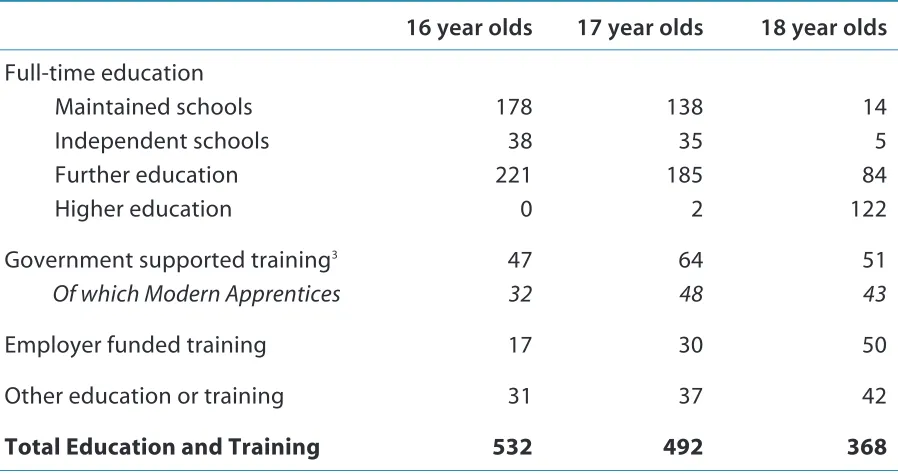
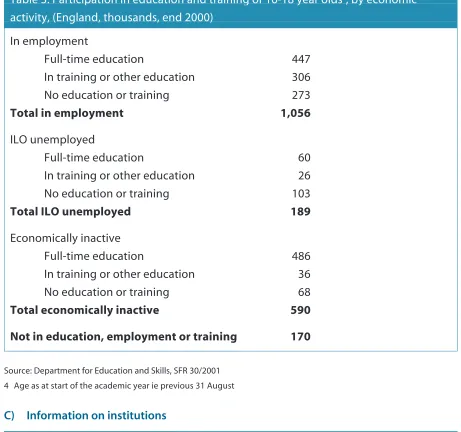
1.6 Only three out of four 16–18 year olds in England were in education and training at the end of 2000 and, although this figure has been rising, it is of serious concern that it remains well below European and OECD averages. This situation can no longer be tolerated.
1.7 A recent report1found that, overall, the
proportions of the workforce holding Level 22and Level 33qualifications in the UK are
below those in France and Germany. Although the gap between the UK and the best of the rest of the world is narrowing in terms of the achievement of Level 2
qualifications, the majority of these gains are made by rising attainment at GCSE.
1.8 The impact of a skills shortage was demonstrated in a series of studies4that
compared UK firms with similar firms in
1 Campbell et al, Skills in England 2001: research report:Department for Education and Skills
2 5 or more GCSEs at A*–C, an intermediate GNVQ, NVQ Level 2 or other equivalent qualification
Qualifications at NVQ Level 2+ or equivalent in UK, France and Germany, 1998
Source: Steedman in DTI 2001 as quoted in Campbell et al, Skills in England 2001: research report: Department for
Education and Skills *Germany data is 1997
Qualifications at NVQ Level 3+ or equivalent in UK, France and Germany, 1998
Source: Steedman in DTI 2001 as quoted in Campbell et al, Skills in England 2001: research report: Department for
competitor countries. A clear connection was found between higher skills and higher productivity. UK Gross Domestic Product (GDP) per head, although close to EU and OECD averages, is 21% below the G7 average.5
Productivity is a key determinant of GDP per head and needs to improve if our economic performance is to improve. We want to close the productivity gap with international economies. This requires fundamental improvement to our skills base. We must therefore increase retention and achievement post-16.
1.9 Across the OECD successful completion of post-16 education and training programmes is becoming the norm. What is common to other OECD countries is the esteem in which both vocational and general studies are held and the ability of students to progress to higher education from either of them. The lack of high-quality vocational pathways in the UK explains in part why far too many young people do not reach or move beyond Level 2, or fall out of education and training before they are 19. The case for improving skills, and especially intermediate and technical skills, is irrefutable, as many employers have insisted and the Skills Task Force6
has demonstrated.
1.10 The recent report from the OECD7
on the study of how well schools had
equipped young people with the skills for adult life showed the UK performance to be world-class. But the study also showed that there was too big a gap between high and low attainers in the UK and that
socio-economic background remained a barrier to educational success. This has to be overcome in our national interest: social justice and economic success mean we must do all we can to remove the notorious long tail of under-performance that mars our record in education.
1.11 At present, less than 20% of young people under 21 from the lower socio-economic groups go to university compared with over 70% from the highest8
. The key factor that determines whether or not young people enter higher education is their achievement at age 18/19. If they have achieved Level 3 then in the vast majority of cases they will progress to higher education. That is the importance and challenge of 14–19 education and training. One of our major targets is to increase and broaden
participation in higher education so that by the end of the decade 50% of those aged between 18 and 30 will participate, with access widened for those whose families have no previous experience of higher education. Getting the proper representation of students from
low-income families in higher education
4 Prais, S. (1995), Productivity, Education and Training: An International Perspective, Cambridge: Cambridge University Press
5 OECD data quoted in a 2001 DTI Report: UK Competitiveness Indicators: second edition. G7 countries are Canada,
France, Germany, Italy, Japan, UK and US
6 DfEE (2000), Skills for All: Research Report from the National Skills Task Force
7 Knowledge and Skills for Life– First Results from PISA 2000
depends heavily on transforming their experience of the 14–19 phase in school, college or workplace.
1.12 There is another, equally important, 50%: those who do not enter higher education. Their needs are very varied and sometimes highly specialised and so will be met only through a diverse but co-ordinated system of education and training. Designing the system, so that it will attract and retain these young people in worthwhile education and training between 16 and 19, is as great a challenge as expanding higher education. But it is a challenge we have started to meet. Further foundations are laid in this Green Paper.
1.13 Today young people aged between 14 and 19 may be more independent and autonomous than were their parents and grandparents. They also demand more from their education and training and are quicker to reject what they do not like and what does not meet their immediate needs. At the same time, they can find the world and their lives more complex and more confusing. Between 14 and 19 young people are striving to develop their
personal and social identities: they are assertive yet lacking self-confidence and vulnerable in their inexperience. They need and deserve better education and training. They also need support and guidance to help them to take best advantage of the opportunities available.
1.14 Making 14–19 education and
training into a coherent phase means that all learners should have appropriate and challenging programmes that will help
them achieve their ambitions. Coherence also means that learners should be offered choice and progression in learning, with continuity and stability. The existing 14–16 curriculum and the different content and structure in the post-16 curriculum, the institutional break that occurs at some point for most students and the relative weakness of vocational pathways mean that it will take time and effort to create such coherence for all.
1.15 The proposals in this document to improve the coherence of the 14–19 phase build on existing measures – such as Education Maintenance Allowances, the Curriculum 2000 reforms and improved Modern Apprenticeships – which aim to increase participation in, and broaden, post-16 education and training. We have undertaken to evaluate the effect of these reforms when sufficient information is available, in order to ensure that students’ participation and experiences in post-16 education and training prepare them well for their future careers.
1.16 We need some changes: we have to decide what needs to be done and how to do it and then put it into practice over a carefully planned period of change.
THE OPPORTUNITIES
1.17 Over the past five years significant progress has been made to raise
grasp of the basics and a good general education. We must build on these strong foundations to transform our post-14 education and training.
1.18 The outline proposals for a coherent 14–19 phase in England were included in the White Paper Schoolsachieving success. These were strongly endorsed: three out of every four respondents supported or strongly supported the proposal to introduce new pathways for all from age 14.
1.19 Our proposals also respond to what young people themselves are saying. The evidence on their views9
about what they would like to see suggests that:
■ there is significant interest in vocational
options, but, since they are aware that vocational courses are often held in lower esteem than general ones, they are not attracted to them;
■ work experience is valuable and
enjoyable, but for some it is a missed or inadequate opportunity because it is irrelevant or unchallenging to the individual young person;
■ a flexible curriculum can help to combat
the disaffection and boredom currently felt by some pupils, by giving them more choice and providing a better match between learning programmes and individual aspirations;
■ young people need more support to
make their choices, with family and friends having the strongest influence;
■ qualifications are seen as important for
progression.
1.20 The best education is far more than the acquisition of knowledge, skills and qualifications. It also helps young people to develop attitudes and values that provide the basis for a successful and rewarding life in the home, at work and in the community. Young people in this new century should have self-confidence, the ability to be self-critical, the drive to take on new challenges and take risks and the capacity to relate to others in positive, constructive ways. Today’s generation of young people needs these skills.
1.21 In short, all those with a stake in the 14–19 phase, and not least the young people themselves, believe the time is right for us to take further action to
address the coherence of 14–19 education and training.
OUR PROPOSALS
1.22 If young people are to continue in learning after the age of 16, they must be able to follow courses that meet their aspirations and match their abilities. It is not a matter of fitting students into a rigid and inflexible educational system, but of offering greater choice within education and training in the 14–19 phase. It means devising equally-valued pathways, both
general and vocational, which allow young people to switch pathways in the light of their emerging needs and aspirations. We will increase the level of investment in future years to sustain further
development, as resources permit. Announcements about future funding will be made in the summer.
1.23 The objectives of our proposed reforms are:
■ the curriculum needs to become more
flexible and responsive to students’ individual needs. It must motivate them so they stay in learning and it must challenge the most able. For some this entails providing more and better vocational opportunities. For others it means beginning advanced level study early, either alongside GCSE
programmes or by skipping GCSEs in some subjects. For yet another group it may mean taking more time to reach a higher level of attainment. All pathways should potentially lead to an overarching award at age 18/19 that recognises and records young people’s achievements;
■ we need to build a world-class system of
education which delivers the technical and vocational skills of an advanced economy so that every young person has a pathway to success. It will be a one-tier system with many different pathways which all provide progression. Technical and vocational education should become a positive and fulfilling choice, not a second-class fallback for the less able or disaffected.
Collaborative working between schools and colleges, supported by the Learning and Skills Council (LSC), local education authorities (LEAs) and employers, is beginning to break down the barrier between general and vocational education. We need to ensure that vocational options and programmes are coherent, so that they equip young people both with broad knowledge and skills and with the specialist expertise and competences needed for the workplace. They must also be as rigorous as the traditional academic pathway. We need stronger involvement of employers, including small and
medium-sized enterprises, in supporting the curriculum and in offering more opportunities for effective learning in the workplace, so that young people can see how they are gaining skills relevant to their future careers;
■ if young people are to make choices
they need good, reliable information and strong pastoral support, from their schools and colleges as well as their parents and carers. Impartial advice and guidance will be vital;
■ the 14–19 phase must become more
in the curriculum, offering broader and more tailored opportunities for
learning, should help schools and colleges to encourage and support young people in regaining their
enthusiasm for learning and for staying on in education or training. It also gives a chance to remotivate young people who may have become disaffected with school and consequently display
challenging behaviour which can disrupt both their and others’ learning;
■ much closer collaboration and
innovative working between schools, colleges and training providers will be essential. This can build on the best of what is already being developed. In those circumstances some students may have to attend more than one institution at some point in their programmes. Every student in this phase needs the security of an
educational base; the home institution, whether school or college, should be responsible for securing the welfare of the students on its roll and for ensuring continuity and progression for all. Teachers in 11–16 schools will need to help students plan for the whole 14–19 phase, not just the initial part that ends at 16. Over time, the focus on
achievement at 16 will shift to age 19;
■ flexible access and delivery through
Information and Communications Technology (ICT) and e-learning will be needed. This applies especially to dispersed groups of learners, such as those in rural areas and those choosing minority options. Curriculum Online will
support these choices by making access to a wide range of digital resources easier and offering a coherent,
consistent and comprehensive service, regardless of location.
GETTING THERE
1.24 Our detailed proposals are in the following chapters. They apply to England only. We have talked to individual teachers, headteachers, college principals and other providers, employers, young people and others with a stake in 14–19 learning, as well as to organisations representing 14–19 providers, higher education and business. We have found wide-ranging support for the objectives and broad thrust of our 14–19 proposals. Many of those we have talked to have offered examples of existing effective practice and made valuable suggestions about how 14–19 learning can be improved. We have sought to reflect these in our proposals. We have taken especial note of those who have emphasised that changes must be carefully paced and tested.
opportunity to share ideas and to identify best practice in line with our aims. Along the way, the proposals can be refined and turned into action plans. There are radical implications for relationships between institutions.
1.26 Both schools and colleges are central to our vision of delivering a coherent 14–19 phase. Many are now collaborating with each other, for example to provide vocational opportunities at Key Stage 4 or through joint curriculum planning to extend the range of choices available to young people. Our proposals build on the work already under way in schools and colleges across the country and will encourage the spread of best practice.
1.27 The consultation on this Green Paper must involve its participants in debate and dialogue and we shall provide sufficient time for this to take place. We will involve young people in the consultation.
1.28 We will try out different models as the basis for planning further
developments and providing guidance on best practice. Changes must be tested and proved to be robust before they are
introduced more widely. The pace of change must be matched to the capacity of those involved to be confident that every change is an improvement. Our proposals will encourage institutions to innovate, but we also recognise that they will want to move at different rates to develop the 14–19 phase. We shall plan carefully to avoid overload on those who will implement the changes and to make sure that each development dovetails with
previous improvements. An illustrative timetable is suggested in Appendix 1.
THE OUTCOMES OF THE 14–19 PHASE
1.29 Our ambitious aim, which we are continuing to pursue through the
development of a coherent 14–19 phase in England, will be to achieve:
■ higher levels of participation and higher
standards of attainment for all young people by age 19;
■ a commitment by all young people to
lifelong learning;
■ increased employability for all young
people, whether before or after higher education;
■ more rounded students with a broader
education, who will be more motivated and more responsible citizens and workers, able to contribute to a productive economy;
■ a reduction in the numbers of those
who truant from school and drop out of education and training after the age of 16, because we cannot afford to waste the lives of any of the nation’s young people;
■ a greatly improved 14–19 system of
education and training which is of world-class standard and of which we can be proud.
2.1 Our proposals for a new 14–19 phase start from the notion that it should be marked by a clear beginning, middle and end:
■ the 14–19 phase should begin with a
review of progress between the pupil, his or her parents or carers and teachers in the school. In the case of young people at risk of disengaging from learning or those who are
underachieving, the Connexions Service will be involved where it can add value to the work of schools. This review should identify longer-term goals and aspirations on a provisional basis. It would inform the selection of options for study and wider activities in the initial period after age 14. The start of the new phase might be marked by the preparation of a plan setting out goals and how they will be pursued;
■ the core of the phase contains the
learning leading to qualifications; other learning undertaken for personal development, for example in
citizenship; and wider activities, often outside the school or college environment;
■ the end of the phase would be marked
by a new overarching award – the Matriculation Diploma – which would recognise young people’s
achievements.
2.2 GCSEs and equivalent qualifications will continue to have an important role but will over time evolve into a progress check around the midpoint of the 14–19 phase. We make proposals later for greater flexibility over the timing of GCSEs and for other qualifications to be recognised as suitable for some 16 year olds.
Chapter 2
14–19: marking the start of the phase
Summary:The 14–19 phase of learning should be marked by a clear beginning, middle and end. The phase should start with a review of achievement towards the end of Key Stage 3. This will provisionally identify longer-term career and learning goals, including the
MOVING ON FROM KEY STAGE 3
2.3 We acknowledged in the White Paper Schools achieving successthat there had been growing concern about the slow progress children make between the ages of 11 and 14 and we set out our agenda for raising standards for this age group – the Key Stage 3 strategy. As it achieves its goals the vast majority of young people will, by the age of 14, have:
■ reached a good standard (level 5 or
above in the National Curriculum) in the basics of English, mathematics, science and ICT;
■ benefited from a broad curriculum,
including studying each of the National Curriculum subjects; and
■ learned how to reason, think logically
and creatively, and take increasing responsibility for their own learning.
The strategy is intended to stretch all pupils. Catch-up materials and classes will help pupils who are falling behind. Special programmes are available for children with special educational needs and to help schools meet the needs of gifted and talented pupils. Young people who have fallen behind their peers by age 14 will need particular support to make the transition to the 14–19 phase. The strategy will provide a firm platform of achievement from which to launch significant
improvements to the experiences of young people after the age of 14.
MAKING THE RIGHT CHOICES AT AGE 14
2.4 Support for young people towards the end of Key Stage 3 will be crucial in raising their aspirations and in providing advice and guidance on the choice of pathways. The wider range of options from age 14 and the focus on outcomes at 19 rather than 16 mean that choices made towards the end of Key Stage 3 will assume a greater significance. However, choices made then should not constrain young people to particular pathways if later it becomes clear that it is in their best interests to change. Chapter 6 offers a discussion of the range of support that young people will need before and during the 14–19 phase.
2.5 Much effective practice exists to help young people plan their learning. The end of Key Stage 3 is already a significant point, when schools have arrangements in place to help young people consider their learning goals and make their choices wisely. For young people aged 13 and over, Progress File10
has been developed to help them plan and review their learning transitions.
Progress File materials are currently used by about a third of secondary schools and we intend to make them more widely available later this year to all providers of 13–19 education who want to make use of them. The materials will be revised as necessary in the light of evaluation.
2.6 We want to help schools build on existing good practice in preparing and motivating young people for entry to the
10 Progress File is a set of guidance and working materials to help young people from age 13 and adults to record,
14–19 phase and helping them to manage their subsequent learning with an eye to their eventual careers. This will include guidance on good practice in careers education and guidance throughout Key Stage 3 (see chapter 6). The aim is to:
■ mark the end of Key Stage 3 and entry
into the 14–19 phase;
■ raise young people’s aspirations
towards staying on in learning post-16, the Matriculation Diploma, higher education and their eventual careers;
■ ensure that young people are equipped
with the skills to plan, manage and review their learning and to set personal targets; and
■ help them to choose the most suitable
options from age 14, and to identify the learning and other development they need to gain the Matriculation Diploma at age 19.
2.7 We do not propose a single model for achieving these aims. For the purpose of this Paper, we are using the term
‘individual learning plan’. We should welcome suggestions on how this should be developed. For pupils with special educational needs, we suggest that transition plans11
should stand in the place of individual learning plans. Teachers will of course continue to play an important
role in providing advice and guidance to their students, who will also have access to external, impartial careers advice. Models may need to be developed in different ways in different places. The work already done in connection with Progress File provides a possible basis for development. We should like to know what sort of
support will be helpful to schools in achieving the aims listed above, in particular from the Connexions Service as this is rolled out. We could also offer guidance on how different models might be developed and prepare a toolkit for use by schools, but invite views on whether schools would welcome these.
2.8 We want to encourage more students, particularly from disadvantaged
backgrounds, to aim for higher education. Choices at 14 will offer a chance to
encourage them to raise their aspirations, help them to appreciate the benefits of higher education, and give them the opportunity to visit higher education institutions. The Excellence Challenge, which aims to increase the number of young people from disadvantaged backgrounds who apply for and enter higher education, is providing support in some areas.
Q: Do you agree that the aims set out in paragraph 2.6 are the right ones to mark the start of the phase?
11 Transition plans must be drawn up for young people with statements of special educational needs following the
Q: Do you support the proposal that pupils should draw up an individual learning plan towards the end of Key Stage 3 to plot how they would achieve their planned goals by age 19?
Q: What support should be available to prepare young people for entry to the 14–19 phase:
■ from the school?
■ from the Connexions Service?
Q: Would you welcome guidance on how different models of marking the start of the 14–19 phase might be developed?
Q: Would it be helpful for schools to have access to a toolkit based on the approaches, materials and processes developed for Progress File?
3.1 The purpose of the National Curriculum is to ensure that all young people during the period of compulsory education follow a broad and balanced programme. This is a principle to which we remain committed as we strive for ever higher standards of attainment. However, the current construction of Key Stage 4 positions it as the final stage of
compulsory education, ending in GCSEs. We believe it needs to be seen as the beginning of a more coherent phase through to age 19, leading to employment or higher education and setting the scene for continued lifelong learning.
Chapter 3
the content of the 14–19 curriculum
Summary: We reaffirm our belief that up to age 19 all young people should be entitled to experience breadth and balance in their learning. We acknowledge, however, that the current structure of the curriculum at Key Stage 4 can be a barrier to student motivation and the flexibility of individual programmes.
We propose a new structure for the National Curriculum at Key Stage 4. We believe there should be a core of compulsory subjects that are essential for progression and development beyond the end of compulsory schooling. All pupils should study mathematics, English, science and ICT, alongside citizenship, religious education, careers education, sex education, physical education (PE) and work-related learning.
We propose a new statutory entitlement of access to a subject within each of modern foreign languages, design and technology, the arts and the humanities.
We intend to develop more vocational qualifications and new hybrid qualifications that combine traditional general subjects with their vocational applications. We will ensure that new qualifications are robust and high-quality. We intend to call all GCSEs and A levels by a subject title, without any vocational label. We propose to enable the most able students to demonstrate a greater depth of understanding at advanced level through introducing more demanding questions into A2 papers, leading to a new distinction grade for the higher achievers. The new generation of Modern Apprenticeships will form an important part of a 14–19 vocational pathway.
KEY STAGE 4: THE 14–16 AGE GROUP – THE CURRENT POSITION
3.2 After a review in 1999, revisions to the National Curriculum were introduced in 2000. At Key Stage 4 the core and foundation subjects currently comprise English, mathematics, science, design and technology, modern foreign languages, ICT, and PE. Citizenship will be added from 2002. Religious education, sex education and careers education are also
compulsory.
3.3 For each National Curriculum subject at Key Stage 4, programmes of study specify what is to be taught to pupils of different abilities and maturity. Pupils are then entered for qualifications; for the vast majority of pupils these are GCSEs. The GCSE serves a range of important purposes and functions:
■ it provides a clear and worthwhile goal
for students at the end of Key Stage 4;
■ it provides a progress check in subjects
and helps young people choose what they want to study after age 16;
■ it is a record of what has been achieved
in subjects that will not be pursued further;
■ it is a common requirement for entry to
FE and Modern Apprenticeships;
■ it is an important accountability
measure for the outcomes of 11–16 schools; and
■ it is a known qualification that provides
a benchmark for other qualifications at Levels 112
and 2.
3.4 However, we expect the GCSE to evolve over time (see paragraph 3.30 and chapter 5). Teaching and learning in Key Stage 4 tend to be driven by the GCSE requirements. The statutory requirements typically absorb about 80% of curriculum time. There is general agreement that these requirements are insufficiently flexible to accommodate individual choice, particularly for those who may wish to pursue predominantly vocational options or those who wish to progress more
quickly. In Key Stage 4 the current National Curriculum is sometimes seen as a barrier rather than as a valued entitlement for all. Evidence of this is seen in the extent of disapplication.
3.5 Schools can disapply, for any one pupil, up to two National Curriculum subjects in order to:
■ provide wider opportunities for
work-related learning;
■ allow pupils making significantly less
progress than their peers to consolidate other learning;
■ allow pupils with individual strengths to
emphasise a particular curriculum area.
3.6 The monitoring of disapplication in 2000/01 by the Qualifications and
Curriculum Authority (QCA) suggests that
around a third of schools were using the regulations in respect of 5% of pupils nationally. Figures for 2001/02 are expected to be considerably higher. Such figures may in any case understate the use of disapplication.
3.7 The disapplication arrangements are not satisfactory. They are complicated and poorly understood by schools and parents. The language of disapplication is negative, and, despite their intention, the
arrangements are widely perceived as remedial, and so undermine attempts to establish vocational provision as a high-quality option for a wide spectrum of pupils. Schools most commonly use disapplication to provide for an extended period of work-related learning, followed by consolidating learning across the curriculum. In terms of the pupils affected, the largest number benefit from the arrangement allowing schools to emphasise a particular curriculum area. The subject most frequently disapplied is modern foreign languages, followed by design and technology, with science being disapplied in a very small number of cases.
A NEW, FLEXIBLE 14–16 CURRICULUM
3.8 The route to higher standards means building on the success of the Key Stage 3 strategy and providing greater flexibility in Key Stage 4. As we said in the White Paper Schoolsachieving success, in order to increase choice for young people from the age of 14, it is necessary to create greater space in Key Stage 4 of the National Curriculum. Our proposals are designed to ensure rising standards of
attainment among young people who are better prepared to contribute to a fair society and a productive economy. We aim to ensure that there is sufficient flexibility to allow students to pursue their talents and aspirations while maintaining a strong focus on the basics. We do not propose to change the statutory minimum school leaving age. We will use the framework of the National Curriculum to ensure that essential learning is protected until age 16. A core of subjects will therefore remain compulsory. However, we now propose a radical way forward and we want to hear the views of others on where the balance should lie.
3.9 The new 14–16 requirements should have a clear and transparent rationale. Subjects should be mandatory at this stage only if they meet one of two overlapping criteria:
■ they provide an essential basis for
progression, across all areas of learning and for keeping young people’s options open; or
■ they are essential for personal
development, contributing to young people’s spiritual, cultural, social and moral development as they begin to take their place in society and in the world of work.
breadth and depth of content should be no less than at present. For many pupils this would also be the case for science. Most pupils would continue to sit GCSEs in mathematics, English and science (a single or double award in balanced science). We would expect pupils to continue to use ICT in many subjects and to take a
qualification in it.
3.11 We considered the position of science very carefully. It is at present one of the subjects which may be disapplied at Key Stage 4 to allow wider opportunities for work-related learning; in 2000/01 this was the case for some 2000 pupils. On the other hand science is a core subject in Key Stages 1, 2 and 3, along with mathematics and English; it is important for our
economy; and careers in many areas increasingly need an underpinning of science. Over 80% of pupils now follow a course leading to a double award GCSE which provides a secure base for
progression to more advanced study in a range of science subjects. In the light of those considerations we have retained science in the core of compulsory subjects. Our proposals should permit sufficient flexibility in the Key Stage 4 curriculum to enable the relatively small number of pupils for whom science is currently disapplied still to undertake work-related learning. We recognise the need to ensure that science GCSEs provide a range of choices relevant to all abilities and aptitudes. The double award will remain the preferred option for many. An additional GCSE in applied science, one of the eight new GCSEs in vocational subjects, will be introduced in September
2002. QCA is to pilot from 2003 an
innovative and flexible structure for GCSE science. This will engage pupils with contemporary scientific issues and focus on their role as users and consumers of science. The National Curriculum programme of study for science will be reviewed and updated, to achieve a core of science relevant to all learners. This smaller programme of study could be built into a wider range of qualifications.
3.12 Citizenship is to become statutory within the National Curriculum from September 2002. Religious education, careers education, sex education, and PE are all within the National Curriculum or otherwise required. All are essential for personal development. We are committed to 2 hours of high-quality PE and sport each week provided in and out of school for all up to age 16. We propose that in PE there should be an emphasis on physical fitness, health and well-being during the 14–19 stage. An effective programme of personal, social and health education (PSHE) often provides the framework for some of these areas, and is particularly important in equipping young people, especially the more vulnerable ones, to maintain their engagement in learning.
working life and learning through activities and challenges set in work-related
contexts. We should also like young people to have opportunities to develop their enterprise capability, enabling them to handle uncertainty, and make reasonable risk/reward assessments and act upon them. Research is under way into effective ways of doing this.
3.14 Work-related learning can be delivered in a variety of ways. These
include not only direct experience through work and community placements and, indeed, part-time jobs, but also learning about the world of work through
vocational courses and enterprise activity in schools. For some students, work-related learning will be built into their subject learning, citizenship and PSHE, supplemented by careers education and work experience. For others it will be provided largely through a course leading to a vocational qualification for which there will now be space in the curriculum. Some students will follow an extended work-related learning programme with an FE college, training provider or employer.
3.15 The learning essential for personal development (listed in the paragraphs above) will provide a sound basis for young people’s participation and progress in a range of wider activities that young people will pursue throughout the 14–19 phase. These could be recognised in the new Matriculation Diploma we propose in chapter 4. But we make no presumption that learning and experience in these areas should lead to formal examinations or qualifications. Much of the content of the
subjects – particularly citizenship, careers education and work-related learning – can be taught across a number of subject areas and we would not expect them to take up more curriculum time than they do now.
3.16 Currently all pupils must study modern foreign languages and design and technology at Key Stage 4, unless their schools have used the disapplication procedures. We believe this is too constraining. For some students it is demotivating in the short term and has consequences for their eventual
achievement of qualifications. At the same time we are determined to preserve access to a broad and balanced curriculum for all. We therefore intend to introduce a new statutory entitlement to access that would require schools to make these subject areas available to any pupil wishing to study them. We also propose that there should be the same entitlement to a subject in the humanities and a subject in the arts. Pupils would not be statutorily obliged to study these subjects, but schools would be obliged to make them available.
16–19 collaboration
Beaumont, Sandringham and Verulam Schools with Oaklands FE College, St Albans
These collaborative arrangements provide post-16 students with a wide range of subjects to choose from: vocational qualifications in art and design, health and social care, recreation and leisure and business are available at advanced and intermediate levels.
They also ensure that minority subjects including German, music, music technology, government and politics, further mathematics, Spanish, food technology and physical education are available to all and that students’ aspirations can be met. Currently almost half the students take at least one subject in another institution. Achievement and retention rates are high and are consistently above the national average.
Students value the opportunities which the collaborative arrangements offer and are clear about the benefits. As one said:
“By going to another school in our consortium I was able to fit in all four of the subjects that I wanted without any timetable clashes. It gave me the chance to experience a different learning environment. The teaching is different and works well for me. I have also enjoyed mixing with new people, staff and students, and so the arrangements have social as well as academic benefits.”
PHOTO REDACTED DUE TO THIRD PARTY RIGHTS OR OTHER LEGAL ISSUES
3.18 Design and technology develops a range of creative, practical and applied skills that contribute to adult and working life. From its craft base it has moved forward significantly in recent years, enabling pupils to experience modern industrial practice at first hand. Over £1 million has been invested in training teachers in CAD/CAM , following its introduction in the 2000 revised National Curriculum. Teacher and curriculum development projects in, for example, textiles software, primary food technology, ‘future’ design and electronics, will, over time, provide more opportunities for teachers to update their skills. Science and Engineering Ambassadors from industry will offer their own expertise to teachers in support of the curriculum and out of school activities.
3.19 Design and technology is studied by all pupils from the age of 5 and has a range of sub-disciplines at Key Stage 4 leading to a variety of GCSEs, but for many pupils it is not seen as central to their programmes. Disapplication provisions are used for more than 23,000 pupils. We recognise that in around 20% of schools the quality of resources and accommodation are issues affecting the teaching of design and technology, and we will be looking to see how schools and LEAs can be encouraged to address these needs as a priority. We also recognise that new technologies have made considerable demands on design and technology teachers, and we encourage schools to enable them to update their skills. As increased numbers of pupils opt for more substantial work-related learning programmes from the age
of 14, we want to see the creative and practical skills fostered by design and technology playing a key role. But we do not think that design and technology should be required study for all pupils.
3.20 The teaching of modern foreign languages needs to reflect the reality of the world in which we live. Our position at the heart of Europe places a particular emphasis on a number of European
languages, but our global and cultural links extend much wider. Over 300 languages are in use in London alone, making it one of the most linguistically diverse cities in the world. The ability to understand and communicate in other languages
contributes to community cohesion and educational inclusion, two of our key goals. We have not in the past taught languages as successfully as many other countries. A Level entries in both French and German have declined steadily since 1991/92.
3.21 We need to ensure that children, young people and adults all have
need to find ways of enabling and encouraging adults to start or re-start learning a language if we are to participate successfully in the global economy.
3.22 We want to develop a new approach to the teaching of modern foreign
languages. We are publishing alongside this Green Paper our outline plans for improving opportunities for young people, especially primary-aged children, to learn languages, both in and out of school. This will lead to our producing a national languages strategy in the autumn. Our long-term goal, subject to resources, is that every primary-aged pupil should have the opportunity to learn a foreign language. The Key Stage 3 strategy, with its
dedicated strand of work on improving standards in modern foreign languages, will support the drive to motivate young people to continue to acquire language skills. At Key Stage 4, all young people will be entitled to be taught modern foreign languages. The move to an entitlement will reflect the reality of large-scale disapplication in schools and should help us to focus on languages at Key Stage 3 and, in the longer term, at Key Stage 2. Creating more space at Key Stage 4 will also make it easier for those who so wish to study more than one language.
3.23 This repositioning of these National Curriculum subjects is a radical proposal and is likely to attract arguments from those with firmly-held views about the imperative for particular subjects to be taught to all pupils in this age group. But it will not be possible to offer young people more customised, and to them more
relevant, programmes from 14 in a more coherent 14–19 phase if we do not create sufficient space in the curriculum. The movement of some subjects from a requirement to an entitlement to access will make curriculum time available for those whose programmes need it, while ensuring that the subjects remain available for the majority who are likely to continue to want them. The increased flexibility in Key Stage 4 is a major contribution to our deregulation drive. It reflects our trust in the capacity of schools, working together and with FE providers, to offer a broad and balanced experience to young people aged 14–19. The current curriculum typically absorbs about 80% of pupils’ school day but its minimum requirements could be delivered in 60%. We think that the compulsory elements within the revised curriculum we propose could be delivered in about 50% of pupils’ time, so creating significant space for greatly increased choice by pupils and schools.
3.24 A direct consequence of redefining the curriculum as we propose is that the disapplication arrangements should become redundant and disappear.
However, the necessary changes cannot be introduced to take effect until September 2004. Meanwhile we intend to amend and simplify the current disapplication
Collaboration between Leek College and Meadows Special School
The employment opportunities for young people with Moderate Learning Difficulties have greatly improved as a result of collaboration between Leek College and Meadows Special School.
The Honeycomb Project provides a unique opportunity for the students to develop employment skills. It offers them not only craft and vocationally based opportunities but also the chance for social and emotional development. The heart of the project is a furniture recycling and wood manufacturing business. Pupils experience a real work environment in which they are making a full contribution to the business.
College-based links support Meadows’ pupils in extending their social and work based skills. This provision includes hair and beauty/self-presentation, art, use of the College multi-gym and a wide range of ICT activities. Pupils can gain ICT certification and accredited vocational qualifications. Subject specialists at the college and school staff teach the pupils as part of a team-teaching arrangement.
PHOTO REDACTED DUE TO THIRD PARTY RIGHTS OR OTHER LEGAL ISSUES
3.25 We do not intend to change the existing arrangements for disapplication through statements of special educational need. However, the proposals for freeing up Key Stage 4 may result in a reduced need for wholesale disapplication of the provisions for those pupils with special educational needs for whom this is the case at present. ICT provides a valuable tool to enable effective access to the curriculum for many such pupils.
Vocational options for young people with special educational needs must be of good quality, and not detract from the provision of a broad curriculum and the acquisition of any necessary basic skills.
3.26 The more we treat the 14–19 period as a single phase, the greater the scope for students to move at a pace best suited to their abilities and preferred ways of learning. Students and their advisers will be able to plan on the basis of a four-year rather than a two-year programme of learning. This will offer them both greater flexibility and greater coherence between the various elements of their individual programmes. Not everything they regard as important for their personal
development needs to be completed before the age of 16. For example, students who begin to study a modern foreign language or design and
technology before 16 need not complete the relevant qualification by 16,
particularly if their 14–16 studies also include a large work-related element.
3.27 These changes to the curriculum and disapplication arrangements, and the development of planning and guidance
support at the end of Key Stage 3, would together pave the way for the introduction of real choice for young people between distinct learning pathways from age 14. GCSEs and equivalent qualifications would continue to provide an important progress check at age 16, with choices from age 16 leading to further qualifications and achievements recognised at the age of 19 by the new Matriculation Diploma proposed in chapter 4.
DEVELOPING THE VOCATIONAL OPTIONS
3.28 Many young people will continue as now with predominantly general programmes. But increasingly we would expect others to extend the work-related element of their programme – beyond the minimum core we are suggesting for all – to pursue genuinely mixed programmes of study. The involvement of employers, including small and medium-sized
enterprises, will be crucial. Too often in the past work-related learning has been seen as an inferior alternative to general study and appropriate only for less able pupils. High-quality and well-respected courses and qualifications should become attractive to the full spectrum of ability, including many young people who aspire to entry to higher education. For those who so wish, it will also be possible to pursue predominantly vocational
programmes which provide a sound basis for progression to a Modern
we want to be sure that programmes are sufficient to ensure a broad-based
education and that choices made at 14 are not so narrow as to restrict the ability to change direction at age 16 or beyond.
3.29 The first new GCSEs in vocational subjects are to be available from September 2002 in some schools. We expect they will be far more widely
available from September 2003. These new GCSEs will initially be available in Applied Art and Design; Applied Business;
Engineering; Health and Social Care; Applied ICT; Leisure and Tourism; Manufacturing; and Applied Science. Each will be a double award, equivalent to two GCSEs. As these take hold, and subject to resources, we would like to extend the range of areas in which subjects are available to reflect the greater range of subjects offered at Vocational A Level. We would like the first of those additional titles to be available for teaching from
September 2004. We also hope to meet the needs of a larger range of pupils by considering the case for some new GCSEs in vocational subjects equivalent in weight to existing single subject titles.
3.30 In the longer term parity of esteem between the general, mixed and
vocational pathways could be enhanced through the redesign of existing GCSEs. New hybrid qualifications could be produced that, through the use of a common core and optional general or vocational units, allow single specifications for general, mixed or largely vocational options. Such qualifications would maximise students’ access to a range of
different progression routes and help to bridge the gap between the general and vocational options. The content of each qualification could be signalled through the qualification title so, for example, within the geography-related areas of study, the qualifications might be: general – geography; a mixed general and vocational – geography: land and environment; and a vocational option –
leisure and tourism.
3.31 We also believe choice and parity of esteem would be better served by no longer attaching labels to signal that GCSEs are general or vocational, and instead simply naming them all GCSEs. At present the two types of GCSE sit in different parts of the national qualifications framework and have different criteria. We will ask the QCA to advise how and when we can move to a more simple approach which preserves the robustness and high standard of the qualifications, but in which both sorts can be referred to simply as GCSEs.
14–19 Collaboration
Tamar Valley Consortium
Tamar Valley Consortium is a partnership in the Plymouth area between schools, colleges, training providers and employers which enables 14–19 year olds to follow a wide range of accredited vocational courses.
All students follow NVQs or units towards them. Typically they spend two days a week with a training provider, two days at school or college and one day with an employer. There is a strong emphasis on Key Skills thoughout the delivery of students’ programmes, and on students negotiating the components of their individual programmes.
The Consortium now offers vocational courses for 14–16 year olds, taking advantage of the greater flexibilities available at Key Stage 4. In 2001/02, there are 605 post-16 and 149 14–16 year olds registered with the Consortium. It offers 70 different courses.
PHOTO REDACTED DUE TO THIRD PARTY RIGHTS OR OTHER LEGAL ISSUES
agents to put these initiatives into effect. Partnerships will benefit from a
comprehensive programme of training and support from the Learning and Skills Development Agency. Local LSCs will have a key role to play in monitoring and
evaluation and the allocation of funding.
3.33 This emphasis on greater variety for young people from age 14 will pose challenges for institutions and teachers. The reforms we propose are likely to entail a different approach to curriculum planning and timetabling as well as to wider issues such as monitoring attendance and
behaviour management. Individual schools will still be able to make subjects outside the core compulsory at Key Stage 4, but we nonetheless expect schools to secure a wider range of options for their pupils than at present, and to include some vocational learning. This may entail collaboration with other institutions. We would expect OFSTED inspections to assess whether the available programmes and courses were meeting the needs of all pupils, while recognising the particular circumstances of some schools such as specialist schools. There will be pressure for even closer working between subject departments; for the development of new partnerships between institutions to meet the student entitlement at 14–16; for the development of new partnerships with employers to support the greater emphasis on work-related learning both within the institution and through work and community placements; and for a greater level of pastoral care for students whose programme of learning takes them outside their home institution (see chapter 6). Individual teachers, whether already in the profession or under
initial training, will need to be equipped (and confident) to teach their subjects to a wider age range, across a potentially greater range of qualifications and through a wider range of teaching styles. Many teachers will need to teach changed specifications in their subjects. We will use evidence from the pathfinders to explore all these potential issues and assess what support might be needed.
3.34 We recognise that the reforms will mean further changes in schools and colleges. For these changes to be
introduced successfully we must provide timely and effective support to institutions and teachers. We are committed in the White Paper Schools achieving success
to providing a range of support for partnership working, for professional development, and for reducing
administrative burdens on institutions and the individual classroom teacher. We are acting on teacher supply and on teacher workload. We are removing obstacles to collaborative working between institutions (see chapter 8). Most importantly we are not proposing to make these changes immediately or all at once: an illustrative timetable is set out in Appendix 1.
credibility. Our emphasis here on GCSE as a progress check and our suggestion in chapter 5 that students should sit qualifications at a time best suited to their individual needs should both help to reduce assessment pressures. If our proposals for new qualifications are agreed, then we will ask QCA to consider carefully the impact on students when developing the qualifications and their associated assessment regimes.
Q: Do you agree with the rationale for the 14–16 compulsory curriculum set out in paragraph 3.9?
Q: Do you agree that mathematics,
English, science and ICT should form the core of the 14–16 curriculum?
Q: Do you agree that the areas set out in paragraphs 3.12–3.14 should also be compulsory at 14–16?
Q: Do you support the proposal for the new statutory entitlement to a subject within modern foreign languages, design and technology, the arts and the humanities set out in paragraphs 3.16–3.23?
Q: Do you support the changes to the disapplication arrangements proposed in paragraph 3.24?
Q: Do you support the extension of vocational options proposed in paragraphs 3.28–3.29?
Q: Do you support the development of hybrid qualifications as proposed in paragraph 3.30?
Q: Do you agree that in future all GCSEs should be called simply that as proposed in paragraph 3.31?
Q: Are there other ways in which you think GCSEs might evolve?
THE 16–19 YEARS IN A MORE COHERENT 14–19 PHASE
3.36 We are still in the initial
implementation stage of the Qualifying for Success reforms (Curriculum 2000). The first students will complete their full advanced level programmes next summer. Despite the acknowledged difficulties last summer, we are confident that the reforms are now working well. Many more young people are undertaking larger and more varied programmes of learning than before; 60% of students are studying four or more subjects in their first year of advanced level study, compared with 10% before. We shall be monitoring the extent to which the reforms have led to greater breadth in the subjects studied. The new A Level structure, divided into AS and A2, has proved successful both in encouraging progression to the full A Level and
ensuring that those who decide not to continue with a particular subject into the second year are still able to gain a
3.37 Curriculum 2000 is therefore
providing a sound pathway for many of the 50% of young people who should be
aspiring to higher education. It includes also the Advanced Extension Awards (AEAs), which the first students will be sitting in summer 2002. The AEA was introduced to stretch the most able advanced level students by requiring greater depth of understanding than A Level. It will ensure that the most able students in this country are tested against standards comparable with the most demanding to be found in other countries. The AEA was also designed to differentiate between able students who can achieve an A grade at A Level.
3.38 The AEA is a paper taken separately from the main A Level papers, but based on the same body of knowledge. In the eyes of some students and teachers, it may seem to demand additional teaching and adds to their perception of the burden of assessment at A Level. We intend to introduce, as soon as practicable, some more demanding questions into the A2 papers which are taken at the end of A Level courses. In this way, the A Level papers themselves would allow high achievers to demonstrate a greater depth of knowledge, skill and understanding without the need for a separate
examination paper. The AEA has just two grades, merit and distinction. With harder questions incorporated into the A2, it would be possible for students to gain an A grade “with distinction” as well as a simple A grade. In order to ensure that A Level standards are maintained over time, the existing grades A to E would continue to be set at their present levels.
3.39 Such a change would produce a simpler and leaner A Level structure. It would also meet concerns that A Level is too easy for some very able students. Unlike the simple addition of an A* grade, as was adopted for GCSE, able students would be challenged by the opportunity to tackle more demanding questions. The introduction of the AEA will help us to make sure that this new approach is tested carefully with schools and colleges. In particular, we will be asking QCA to work with the awarding bodies on the design principles so as to ensure that existing A Level standards are maintained.
3.40 We propose to ask QCA for advice on how this might be taken forward across all A Levels, including those in vocational subjects, with a timescale for development. Meanwhile, the AEA will remain in place in 17 subjects and will provide students with an opportunity to answer demanding questions of the kind which could eventually appear in the strengthened A Levels.
Q: Do you agree that more opportunities should be provided at A Level for the most able students to demonstrate greater depth of understanding?
Q: Do you agree that the existing grade range at A Level should be extended to provide greater differentiation between more able candidates?