2007
Genesis of gene structures and computational
analysis of U12-type introns
Matthew Devin Wilkerson
Iowa State University
Follow this and additional works at:https://lib.dr.iastate.edu/rtd
Part of theBioinformatics Commons,Genetics and Genomics Commons, and theMolecular Biology Commons
This Dissertation is brought to you for free and open access by the Iowa State University Capstones, Theses and Dissertations at Iowa State University Digital Repository. It has been accepted for inclusion in Retrospective Theses and Dissertations by an authorized administrator of Iowa State University Digital Repository. For more information, please [email protected].
Recommended Citation
Wilkerson, Matthew Devin, "Genesis of gene structures and computational analysis of U12-type introns" (2007).Retrospective Theses and Dissertations. 15615.
by
Matthew Devin Wilkerson
A dissertation submitted to the graduate faculty
in partial fulfillment of the requirements for the degree of
DOCTOR OF PHILOSOPHY
Major: Bioinformatics and Computational Biology
Program of Study Committee: Volker Brendel, Co-major Professor Thomas Peterson, Co-major Professor
Adam Bogdanove David Fernández-Baca
Carolyn Lawrence
Iowa State University
Ames, Iowa
2007
3289423
2008
UMI Microform
Copyright
All rights reserved. This microform edition is protected against unauthorized copying under Title 17, United States Code.
ProQuest Information and Learning Company 300 North Zeeb Road
P.O. Box 1346
Ann Arbor, MI 48106-1346
TABLE OF CONTENTS
CHAPTER 1: GENERAL INTRODUCTION 1
Introduction 1 References 3
Thesis Organization 4
CHAPTER 2: TRACEMBLER – SOFTWARE FOR IN-SILICO CHROMOSOME
WALKING IN UNASSEMBLED GENOMES 6
Abstract 6
Background 8 Implementation 9
Results and discussion 11
Conclusions 15
Availability and requirements 15
Authors' contributions 16
Acknowledgements 16
Appendix 16 References 16
Figures 19
CHAPTER 3: yrGATE: A WEB-BASED GENE-STRUCTURE ANNOTATION TOOL FOR THE IDENTIFICATION AND DISSEMINATION OF EUKARYOTIC GENES 20
Abstract 20 Rationale 21
Annotation Tool 23
Community Annotation Utilities 27
Implementations and case studies 28
Community Annotation at PlantGDB 29
yrGATE with DAS input 31
Usability and availability 33
Conclusions 34
Acknowledgements 35
References 35
Figures 38
CHAPTER 4: COMPUTATIONAL ANALYSIS OF U12-TYPE INTRONS WITHIN
ORTHOLOGOUS GENES 45
Abstract 45 Introduction 46 Methods 51
Results 61
Database Summary and Tools 61
U12-type Intron Identification and Gene Structure Annotation 61
Evolutionary Dynamics of U12-type Introns 64
Genes Enriched with U12-type Introns 68
Evolution of Genes with U12-type introns 70
Analysis of Phase in U12-type introns 73
Discussion 77 References 81
Figures 84
Tables 100
CHAPTER 5: GENERAL CONCLUSIONS 110
Conclusions 110 References 112
CHAPTER 1: GENERAL INTRODUCTION
Introduction
Completely sequenced genomes provide a wealth of information that has allowed the
exploration of large scale biological questions and continues to provide a critical resource for
the advancement of biological research. Previously, the number of completely sequenced
genomes was small and was generally limited to the model organisms. Currently, the
number of genomes completely or partially sequenced is rapidly increasing, with 338
different eukaryotic genomes available as of October 2007 [1]. With a genome sequence in
hand, the typical first step is gene structure annotation, or identifying the location and
structural features of genes within the genome sequence, after which functional descriptions
of the genes, relationships to homologous genes and other higher level research questions can
be investigated. Annotation, then, imparts the biology of the organism onto the genome
sequence [2]. The goal of this thesis is to provide useful computational tools for gene
annotation in emerging and mature genomes and to analyze a particularly
difficult-to-annotate gene feature.
The process of gene structure annotation requires a genomic sequence of sufficient
size so that it can contain a full gene, which in eukaryotes can be thousands of nucleotides.
The popular method of whole genome shotgun sequencing to furnish genomic sequences
produces small sequence fragments of hundreds of nucleotides, which are eventually
assembled into chromosome sequences, and can take several years from start to finish. In
the interim, these small sequence fragments are deposited into repositories [3] for historical
fragments are not particularly useful for gene structure annotation purposes. I have
developed a web-based tool, Tracembler, which facilitates dynamic gene annotation of these
fragments through on-the-fly sequence similarity searching and assembly. Hence,
Tracembler allows biologists and interested scientists to immediately create gene annotations
upon the latest sequences from emerging genomes without having to wait for the completion
of the genome sequencing project.
On the other end of the genome maturity spectrum, accurate gene structure
annotation, which includes the biologically-correct specification of exons, introns,
untranslated regions, protein coding regions, and alternatively spliced variants of a gene,
remains a challenge for completely sequenced genomes [4-6]. Pure computational
approaches are excellent for providing an approximate initial summary of an organism’s gene
space, but they are not completely accurate or comprehensive [4-6]. Manual annotation by a
human curator, who inspects and reviews the available evidence to make decisions in
constructing a gene structure annotation, is considered the highest quality method [4].
Hindrances to manual annotation are that it is time consuming, has restricted participation,
and is not easy to conduct. To remove these limitations of manual annotation, I developed
the yrGATE (“your Gene structure Annotation Tool for Eukaryotes”) software, which
enables individuals to create gene structure annotations using high quality evidence through
an easy-to-use dynamic web browser interface and submit their annotations to a community
database.
A particular category of often mis-annotated genes is those containing U12-type
introns. U12-type introns are a class of introns that have highly conserved sequence features,
comprise less than 1% of the introns in any studied eukaryotic organism [7, 8]. One reason
for their mis-annotation is most gene prediction programs are not designed to specifically
recognize them [9], which is likely caused by U12-type introns’ unique sequence features
and rare occurrence. Apart from their mis-annotation, U12-type introns are intriguing due to
their unique proposed evolutionary history [8] and due to their maintenance in organisms at
very low frequencies in a seemingly functional redundancy with the major splicing system
[10]. In order to further the understanding of this intriguing gene feature, a large-scale
annotation and computational investigation of U12-type introns in the context of their host
genes and evolution was completed.
References
1. Entrez Genome Project [http://www.ncbi.nlm.nih.gov/genomes/static/gpstat.html] 2. Stein L: Genome annotation: from sequence to biology.Nat Rev Genet 2001,
2:493-503.
3. NCBI Trace Archive [http://www.ncbi.nlm.nih.gov/Traces/trace.cgi]
4. Ashurst JL, Collins JE: GENE ANNOTATION: PREDICTION AND TESTING.
Annual Review of Genomics and Human Genetics 2003, 4:69-88.
5. Schlueter SD, Wilkerson MD, Huala E, Rhee SY, Brendel V: Community-based gene structure annotation.Trends Plant Sci 2005, 10:9-14.
6. Guigo R, Flicek P, Abril JF, Reymond A, Lagarde J, Denoeud F, Antonarakis S, Ashburner M, Bajic VB, Birney E, et al: EGASP: the human ENCODE Genome Annotation Assessment Project.Genome Biol 2006, 7 Suppl 1:S2 1-31.
7. Sheth N, Roca X, Hastings ML, Roeder T, Krainer AR, Sachidanandam R:
Comprehensive splice-site analysis using comparative genomics.Nucleic Acids Res 2006, 34:3955-3967.
8. Burge CB, Padgett RA, Sharp PA: Evolutionary fates and origins of U12-type introns.Mol Cell 1998, 2:773-785.
9. Sparks ME, Brendel V: Incorporation of splice site probability models for non-canonical introns improves gene structure prediction in plants.Bioinformatics
2005, 21 Suppl 3:iii20-30.
Thesis Organization
This thesis consists of five chapters. Chapter 1 provides a general introduction.
Chapters 2 and 3 present papers published in peer-reviewed journals. Chapter 4 presents a
manuscript prepared for submission to a journal. Chapter 5 provides a general conclusion.
Chapter 2, 'Tracembler - software for in silico chromosome walking in unassembled
genomes', has been published in BMC Bioinformatics in 2007, Volume 8, Number 151. The
authors of this publication provided the following contributions. Qunfeng originated the
initial idea for the project, contributed to the software, performed analysis, and was
responsible for the majority of the writing. Matthew Wilkerson contributed central ideas of
the project, wrote the majority of the software, and contributed to the writing and analysis.
The contributions of Qunfeng Dong and Matthew Wilkerson were deemed equal, which is
the cause for co-first authorship between the authors. Volker Brendel provided supervision,
feedback for the project, and contributed to the writing.
Chapter 3, 'yrGATE: a web-based gene-structure annotation tool for the identification
and dissemination of eukaryotic genes', has been published in Genome Biology in 2006,
Volume 7 electronic release 58. The authors of this publication provided the following
contributions. Matthew Wilkerson designed and wrote the software, provided the usage
cases, and wrote the majority of the manuscript. Shannon Schlueter contributed useful ideas
and contributed to an earlier version of the software. Volker Brendel contributed to the
writing and provided supplementary ideas for the project.
Chapter 4, ‘Computational analysis of U12-type introns within orthologous genes' has
been prepared for submission to PLoS Computational Biology. The authors of this paper
designed and wrote the software, performed analysis, and wrote the manuscript. Volker
CHAPTER 2: TRACEMBLER – SOFTWARE FOR IN-SILICO
CHROMOSOME WALKING IN UNASSEMBLED GENOMES
A paper published in BMC Bioinformatics1
Qunfeng Dong*2, Matthew D. Wilkerson*2, and Volker Brendel2,3,4
Abstract
Background: Whole genome shotgun sequencing produces increasingly higher coverage of a
genome with random sequence reads. Progressive whole genome assembly and eventual
finishing sequencing is a process that typically takes several years for large eukaryotic
genomes. In the interim, all sequence reads of public sequencing projects are made available
in repositories such as the NCBI Trace Archive. For a particular locus, sequencing coverage
may be high enough early on to produce a reliable local genome assembly. We have
developed software, Tracembler, that facilitates in silco chromosome walking by recursively
assembling reads of a selected species from the NCBI Trace Archive starting with reads that
significantly match sequence seeds supplied by the user.
____________________
1Reprinted with permission of BMC Bioinformatics, 2007, 8:151
* These authors contributed equally to this work
2Department of Genetics, Development and Cell Biology, Iowa State University, Ames, IA
50011-3260, USA
3Department of Statistics, Iowa State University, Ames, IA 50011-3260, USA
Results: Tracembler takes one or multiple DNA or protein sequence(s) as input to the NCBI
Trace Archive BLAST engine to identify matching sequence reads from a species of interest.
The BLAST searches are carried out recursively such that BLAST matching sequences
identified in previous rounds of searches are used as new queries in subsequent rounds of
BLAST searches. The recursive BLAST search stops when either no more new matching
sequences are found, a given maximal number of queries is exhausted, or a specified
maximum number of rounds of recursion is reached. All the BLAST matching sequences are
then assembled into contigs based on significant sequence overlaps using the CAP3 program.
We demonstrate the validity of the concept and software implementation with an example of
successfully recovering a full-length Chrm2 gene as well as its upstream and downstream
genomic regions from Rattus norvegicus reads. In a second example, a query with two
adjacent Medicago truncatula genes as seeds resulted in a contig that likely identifies the
microsyntenic homologous soybean locus.
Conclusions: Tracembler streamlines the process of recursive database searches, sequence
assembly, and gene identification in resulting contigs in attempts to identify homologous loci
of genes of interest in species with emerging whole genome shotgun reads. A web server
hosting Tracembler is provided at http://www.plantgdb.org/tool/tracembler/, and the software
Background
Comparative genomics is based on the identification and alignment of homologous genes
across multiple species and has become a standard, powerful approach in molecular biology
for many purposes, including characterization of structurally and functionally important
motifs in gene families. Typically, this approach starts with a set of query sequences as input
to sequence similarity-based database search programs such as BLAST [1] to identify
significantly similar matches in the sequence databases of species of interest. If the species
of interest are fully sequenced and evolutionarily close enough to the query species, then this
approach will yield the homologous genes in their genomic context. However, the
comparative genomics approach is currently limited by the sparse sampling of eukaryotic
species from the tree of life that have been sequenced as model organisms. For example, so
far only three species (Arabidopsis thaliana, Oryza sativa, and Populus trichocarpa) from
the entire plant kingdom have been completely sequenced. At the same time, a large number
of on-going sequencing projects (see, e.g., [2, 3]) are generating large numbers of short (yet
unassembled) genomic sequences through strategies such as whole-genome shotgun or
BAC-by-BAC minimum tiling path sequencing. These sequence reads are continuously made
available through the NCBI Trace Archive [4]. In the summer of 2006 the archive topped
one billion reads [5].
Because the deposited sequenced reads are short (400-800 bp), a simple query of the
repository with a DNA or protein seed (e.g., NCBI’s Trace Archive discontiguous Mega
BLAST Server [6] or Ensembl’s Trace Server [7]) will typically only tag this gene as present
redundant and overlapping tags. Analysis of the resulting set of reads without the help of an
assembly program could become very tedious, particularly if one wishes to obtain the
genome context of the tagged gene further upstream or downstream, which would require
additional rounds of repository searches.
To facilitate the task of homolog identification in the trace archive repository of an ongoing
genome sequencing project, we have developed software that seamlessly integrates recursive
database searches and contig assembly and interpretation. Depending on the depth of the
current sequencing effort, the final results returned by Tracembler will ideally be full-length
genomic sequences that are homologs of the user-supplied query sequences.
Implementation
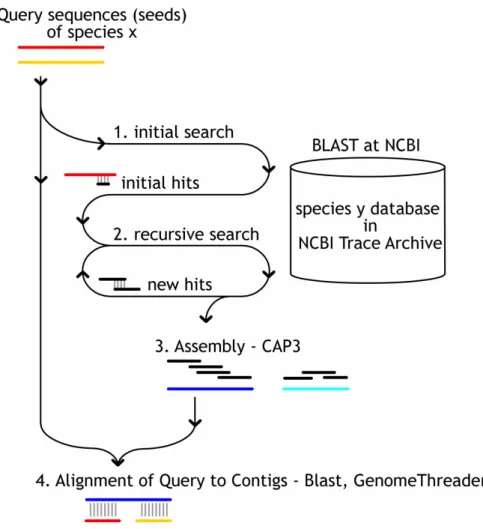
The Tracembler algorithm is illustrated in Fig. 1. As input, the program takes a single or
multiple user-supplied query sequences (either nucleotide or protein), an E-value cutoff, and
a user selected Trace Archive database, which contains sequence reads from a particular
species deposited at the NCBI Trace Archive. An initial search is then initiated via the
remote BLAST service provided by NCBI [6] [8]. Because the searches are always
performed directly at NCBI (conducted transparently to the user), users are assured to search
against the most up-to-date sequence read repository. If the initial BLAST search returns
significant matching sequences (based on the user-specified E-value cutoff), these matching
sequences are considered as queries for further database searches, which can potentially
This process is automatically iterated until either no more new matching sequences are
found, a given maximal number of queries is exhausted, or a specified maximum number of
rounds of recursion is reached. Only newly identified non-redundant matching sequences
from the previous round are used as queries for the next round BLAST search. The ceiling on
the number of rounds of recursion is imposed to prevent assembly of more than the local
regions surrounding the genes of interest, thus protecting the intellectual properties of the
whole-genome sequencing project by preventing large-scale assembly (e.g., [9]).
Additionally, Tracembler has the following rules for polite dynamic NCBI data requests:
mandatory pauses between data requests and BLAST job submissions, a maximum number
of requests for an individual BLAST result, fixed limits on the BLAST parameter values.
All the obtained BLAST matching sequences are considered as potential genomic
constituents of homologous regions of the original user-supplied query sequence and are
assembled with the CAP3 program [10]. In addition to the actual sequences, quality scores
and mate-pair distance constraints are also critical for high-quality assembly. Therefore, the
quality score and mate-pair distance constraint information for each read are dynamically
retrieved from the Trace Archive and used in the assembly to evaluate the significance of
sequence overlaps. Multiple contigs may result from coverage gaps in one locus or represent
duplicated loci. The CAP3-generated contigs are compared with the original user-supplied
query sequences using BLAST [1] and GenomeThreader [11] to assess and display the extent
of similarity and coverage. After completion of the analysis, an email is sent to the user
indicating URLs to view all the results, including the assembled contig sequences, the
between the original query and the contigs. In addition, the intermediate files (matching
sequences, quality scores, and mate-pair distance constraints), the recursive BLAST output,
the CAP3 output files, and a log file are included in the result. These additional files permit
interested users to download and locally analyze their data further, such as using a different
assembly program.
Results and discussion
Validation
To validate Tracembler, we first tested the software by trying to re-assemble a published
genome region from trace reads matching an annotated gene. Our test case used the rat
(Rattus norvegicus) Chrm2 gene sequence (cholinergic receptor, muscarinic 2; 2,072 bp;
[12]) as query against the entire rat whole-genome shotgun sequence reads. The gene was
picked randomly. The rat genome has already been fully sequenced and assembled [13], and
thus Tracembler was expected to assemble a contig that matches the published genome. As
shown in Appendix Figure 2, Tracembler produced a single contig of length 5,068 bp. This
contig covers the entire, perfectly matched Chrm2 gene. The entire contig matches very well
to chromosome 4 (GenBank accession# NC_005103.2) from base positions 63,909,839 to
63,914,888 (99% identity over the entire match as reported by bl2seq [14]). The Chrm2 gene
maps from base positions 63,911,288 to 63,913,359 [15], and thus the contig generated by
Tracembler not only recovered the full-length annotated Chrm2 gene but also successfully
Application
Next, we discuss a Tracembler application that revealed microsynteny between Medicago
truncatula and Glycine max, which are thought to have diverged through speciation around
50 MYA [16]. M. truncatula is an established model organism for the legumes, with a nearly
complete sequencing and annotation effort [17]. Whole genome shot-gun sequencing of G.
max (soybean) has only recently been initiated [18], with currently more than 1.3 million
unassembled and unannotated sequence reads deposited in the NCBI Trace Archive. Soybean
is the most valuable legume crop [19], and establishing its syntenic relationship with M.
truncatula is critical for transferring knowledge from this model organism.
In M. truncatula, the “SWIM zinc finger” gene (AC146590g10v2) is annotated on a BAC
clone (mth2-145p10) from position 50,413 to 49,886 [20]. 3' downstream of this gene, there
is another “hypothetical” gene (AC146590g11v2) annotated from positions 52,448 to 50,777.
According to the current M. truncatula genome annotation, the “SWIM zinc finger” gene and
its neighboring “hypothetical” gene are only 364 bp apart. In order to investigate whether
such close distance is likely a result of mis-annotation (“hypothetical” genes are often
wrongly predicted by gene-finding software), we took the protein sequences encoded by
these two M. truncatula genes as input and used Tracembler to search against soybean
sequence reads at NCBI Trace Archive. Interestingly, one 4,172 bp soybean genomic contig
obtained from the assembly does match well to both the “SWIM zinc finger” and the
“hypothetical” protein from positions 1,459 to 1,950 and from positions 2,299 to 2,839 of
this contig, respectively (see Appendix Figure 3: Tracembler validation and applications).
proximity (349 bp apart) as on the Medicago genome. Our result provides compelling
evidence that the two genes are highly conserved between M. truncatula and soybean. In
particular, the high conservation of the “hypothetical” gene suggests that it is a true gene.
Performance
The performance of Tracembler is mainly determined by three factors. The first is the
sequencing depth of the target genome, which provides a boundary of the expected extent of
read overlaps and therefore assembled contig length. The second factor is the abundance of
gene duplications in the genome of interests. For plant genomes, in which many gene
duplications have occurred through tandem or whole genome duplication events, multiple
homologs of genes of interests may have been sampled by the deposited sequence reads and
show up as close BLAST matching sequences in the initial stage of Tracembler. If the
multiple gene copies are sufficiently diverged, the CAP3 program will split them into
different contigs. The pairwise comparison between the original user-supplied queries and
the final contigs in the final step of Tracembler may identify the likely ortholog of the query
based on highest match score. Third, because Tracembler relies on the up-to-date NCBI
Trace Archive BLAST search engine over the Web, the response time for users will be
affected by network traffic as well as the current work-load at the search engine. Various
parameter settings deal with the stringency of matching and extent of the search, which will
Other programs
During the preparation of this manuscript, we became aware of a published software
package, GENOTRACE, from Berezikov et al. [21] that is similar to our Tracembler. In
addition to the choices of embedded external computer programs (e.g., BLAST vs. SSAHA
[22] for database searching; CAP3 vs. Phrap [23] for assembly) that likely produce different
final outputs, there are several subtle yet important differences between Tracembler and
GENOTRACE that matter to the general biology user community. First, GENOTRACE
requires maintaining a local copy of NCBI Trace Archive. Although this approach improves
the search speed, the required amount of disk space is enormous (currently more than 1.2
TBytes in compressed format at NCBI), which is beyond a typical user's resources and is
superfluous for the task of exploring just a few genes of interest. By contrast, Tracembler
takes advantage of the dynamic API provided by NCBI and sends query sequences via the
internet to directly search the Trace Archive at NCBI. This not only eases the installation and
maintenance for the users, but also ensures that users are always searching the most
up-to-date version of Trace Archive. Furthermore, because trace sequences can often accumulate in
amounts of hundreds of thousands of sequences per organism per week [24],
GENOTRACE's requirement of a local copy of NCBI's Trace archive necessitates frequent
downloading and processing of local files, which is an obstacle for widespread use. Second,
only DNA sequence can be used as query for GENOTRACE, whereas Tracembler can take
either DNA or protein sequences as input (the program automatically detects the type of
sequences and performs appropriate BLAST-searches, MEGABLAST or TBLASTN,
demonstrated by our application example above, there are instances where it is more
convenient to allow multiple seeds spanning one region of interest in one genome to search
another genome.
Conclusions
Biologists are often left with an eager sense of anticipation when their species of interest are
in the process of being sequenced but the sequencing reads have not yet been assembled.
Our Tracembler server, although algorithmically simple, provides an elegant solution for
biologists to recover genomic regions of interest from species with on-going sequencing
project before the whole genome assemblies are published.
Availability and requirements
The Tracembler program is freely accessible, using a web browser at
http://www.plantgdb.org/tool/tracembler. The software, written in Perl and designed for use
on Linux machines, is also freely available for local installation by download from
http://gremlin1.gdcb.iastate.edu/bgroup/download/tr/download.html. Instructions on
obtaining the required external free programs (in particular, CAP3 [10]) are provided with
Authors' contributions
VB designed and supervised the project. QD and MW implemented the computer program.
QD analyzed the results and prepared the manuscript. All authors read and approved the final
manuscript.
Acknowledgements
This work was supported in part by NSF grant DBI-0606909 and by a Specific Cooperative
Agreement with the Agricultural Research Service, U.S. Department of Agriculture (no.
58-3625-5-124) awarded to VB. QD is currently supported by the Indiana METACyt Initiative,
funded by the Lilly Endowment, Inc. We are grateful for constructive suggestions from two
anonymous reviewers.
Appendix
http://www.pubmedcentral.nih.gov/picrender.fcgi?artid=1876249&blobname=1471-2105-8-151-S1.htm
References
1. Altschul SF, Madden TL, Schäffer AA, Zhang J, Zhang Z, Miller W, Lipman DJ: Gapped BLAST and PSI-BLAST: a new generation of protein database search programs.Nucleic Acids Res 1997, 25:3389-3402.
2. NCBI Entrez Genome Project
[http://www.ncbi.nlm.nih.gov/entrez/query.fcgi?db=genomeprj] 3. JGI Sequencing Plans and Progress
4. NCBI Trace Archive [http://www.ncbi.nlm.nih.gov/Traces/trace.cgi]
5. National Center for Biotechnology Information Newsletter 15(1), Summer 2006 [http://www.ncbi.nlm.nih.gov/Web/Newsltr/V15N1/trace.html]
6. NCBI Trace Archive discontiguous Mega BLAST Server [http://www.ncbi.nlm.nih.gov/blast/tracemb.shtml]
7. Ensembl Trace Server [http://trace.ensembl.org/cgi-bin/tracesearch]
8. McGinnis S, Madden TL: BLAST: at the core of a powerful and diverse set of sequence analysis tools.Nucleic Acids Research 2004, 32:W20-W25.
9. NHGRI Rapid Data Release Policy [http://www.genome.gov/10506376] 10. Huang X, Madan A: CAP3: A DNA sequence assembly program.Genome Res
1999, 9:868-877.
11. Gremme G, Brendel, V., Sparks, M.E. & Kurtz, S.: Engineering a software tool for gene structure prediction in higher organisms.Information Software Technol
2005, 47:965-978.
12. Rattus norvegicus Chrm2, cholinergic receptor muscarinic 2 gene sequence [http://www.ncbi.nlm.nih.gov/entrez/viewer.fcgi?val=NC_005103.2&from=6391128 8&to=63913359&dopt=fasta]
13. Gibbs RA, Weinstock GM, Metzker ML, Muzny DM, Sodergren EJ, Scherer S, Scott G, Steffen D, Worley KC, Burch PE, et al: Genome sequence of the Brown Norway rat yields insights into mammalian evolution.Nature 2004, 428:493-521.
14. NCBI bl2seq Web Server [http://www.ncbi.nlm.nih.gov/blast/bl2seq/wblast2.cgi] 15. NCBI Entrez Gene Chrm2 Region
[http://www.ncbi.nlm.nih.gov/entrez/query.fcgi?db=gene&cmd=Retrieve&dopt=full_ report&list_uids=81645]
16. Mudge J, Cannon SB, Kalo P, Oldroyd GE, Roe BA, Town CD, Young ND: Highly syntenic regions in the genomes of soybean, Medicago truncatula, and
Arabidopsis thaliana.BMC Plant Biol 2005, 5:15.
17. Young ND, Cannon SB, Sato S, Kim D, Cook DR, Town CD, Roe BA, Tabata S: Sequencing the genespaces of Medicago truncatula and Lotus japonicus.Plant Physiol 2005, 137:1174-1181.
18. Department of Energy Press Release [http://www.energy.gov/news/2979.htm] 19. Wilson RF, Stalker HT, Brummer C (Eds.): Legume Crop Genomics. Champaign,
IL, U.S.A.: Am. Oil Chem. Soc. Press 2004.
20. Medicago truncatula IMGAG Genome Annotation [http://www.tigr.org/tigr-scripts/medicago/IMGAG/tab_delimited_output?word=&locus=AC146590_10.2&ac cession=]
21. Berezikov E, Plasterk RH, Cuppen E: GENOTRACE: cDNA-based local GENOme assembly from TRACE archives.Bioinformatics 2002, 18:1396-1397.
22. Ning Z, Cox AJ, Mullikin JC: SSAHA: a fast search method for large DNA databases.Genome Res 2001, 11:1725-1729.
23. Phrap [http://www.phrap.org] 24. NCBI Trace Archive Statistics
25. NCBI QBlast's URL API. User's Guide
Figures
Figure 1. Schematic overview of the Tracembler algorithm.
Tracembler accepts as input one or more user-supplied query sequences and parameter specifications. The query sequence(s) and associated parameters are submitted using the QBLAST URL API to NCBI [25] (1). Tracembler analyzes these results, and if there are new sequences matching at a significance level below the user supplied E-value parameter, these sequences are used as queries in a new BLAST search (2). One round consists of BLAST searches of all acceptable matching sequences from the previous round. This
CHAPTER 3: yrGATE: A WEB-BASED GENE-STRUCTURE
ANNOTATION TOOL FOR THE IDENTIFICATION AND
DISSEMINATION OF EUKARYOTIC GENES
A paper published in Genome Biology1
Matthew D. Wilkerson2, Shannon D. Schlueter2, and Volker Brendel2,3,4
Abstract
Your Gene structure Annotation Tool for Eukaryotes (yrGATE) provides an Annotation Tool
and Community Utilities for web-based community genome and gene annotation.
Annotators can evaluate gene structure evidence derived from multiple sources to create gene
structure annotations. Administrators regulate the acceptance of annotations into published
gene sets. yrGATE is designed to facilitate rapid and accurate annotation of emerging
genomes as well as to confirm, refine, or correct currently published annotations. yrGATE is
highly portable and supports different standard input and output formats. The yrGATE
software and usage cases are available at http://www.plantgdb.org/prj/yrGATE.
____________________
1Reprinted with permission of Genome Biology 2006, 7, R58
2Department of Genetics, Development and Cell Biology, Iowa State University, Ames, IA
50011-3260, USA
3Department of Statistics, Iowa State University, Ames, IA 50011-3260, USA
Rationale
Complete and accurate gene structure annotation is a prerequisite for the success of many
types of genomic projects. For example, gene expression studies based on gene probes
would be misleading unless the gene probes uniquely labelled distinct genes. Identification
of potential transcription signals relies on correct determination of transcriptional start and
termination sites. Characterization of orthologs or paralogs and other studies of molecular
phylogeny are also compromised by incomplete or inaccurate gene structure annotation.
Gene structure determination is particularly difficult for eukaryotic genomes. Here, we focus
on protein-coding genes. In higher eukaryotes, most of these genes contain introns, and a
large fraction of the genes appear to permit alternative splicing [1-3]. High-throughput
computational gene structure annotation has been highly successful in providing a first
glimpse of the gene content of a genome, but current methods fall short of the goal of
complete and accurate gene structure annotation (e.g., [4-6]). Recent research has focused on
improving prediction sensitivity and specificity by combining multiple sources of evidence
[7-9]. However, complexities of transcription and pre-mRNA processing such as introns in
non-coding regions, non-canonical splice sites, and utilization of alternative splice sites still
pose formidable challenges for merely computational methods. Re-annotation efforts for
most eukaryotic model genomes have therefore relied in large part on manual inspection of
gene structure evidence [5, 10, 11]. However, manual annotation also has shortcomings,
such as being typically time-consuming, having exclusive participation, and providing
A policy of ‘open annotation’, using the internet as the forum for annotation, and bringing
annotation into the mainstream has been suggested as a means to eliminate the restraints of
manual annotation and to develop high quality gene annotation [13-15]. Several systems
have successfully adopted this policy for prokaryote gene annotation (ASAP [16], PeerGAD
[17], PseudoCAP [18]). Eukaryotic gene annotation projects have not been able to reap the
full benefits of community manual annotation because of the absence of an open online
community gene annotation system. Here, we describe newly developed software, yrGATE,
which seeks to compensate for the inadequacies of traditional manual annotation and to
provide a community alternative and/or companion to computational gene annotation,
specialized for eukaryotes. yrGATE provides similar functionality as the Apollo annotation
tool [19] and NCBI’s ModelMaker [20], but includes community utilities, specialized portals
to external gene finding and annotation software, and web browser accessibility.
The yrGATE package consists of a web-based Annotation Tool for gene structure annotation
creation and Community Utilities for regulating the acceptance of the annotations into a
community gene set. The yrGATE Annotation Tool can be used without the Community
Utilities for analysis of gene loci independent of a community. The Annotation Tool
presents pre-calculated exon evidence in several summaries with different selection
mechanisms and provides other methods for specifying custom exons, allowing thorough
analysis and quick annotation of loci. Annotators access the tool over the web, where they
create an annotation, decide to save the annotation in their personal account, or submit the
annotation for review for acceptance into the community gene set. The online nature of
professional curators to students [21]. This also provides a continuous timeframe for gene
annotation, allowing annotators to examine new sequence evidence as it becomes available
and eliminating the delays of periodic annotation. yrGATE is particularly well suited for
emerging genomes that are in the process of being sequenced, such as maize. Additionally,
the user-friendly character of the yrGATE system contributes to its accessibility and to its
potential for community adoption.
Annotation Tool
The Annotation Tool of the yrGATE package is a web-based utility for creating gene
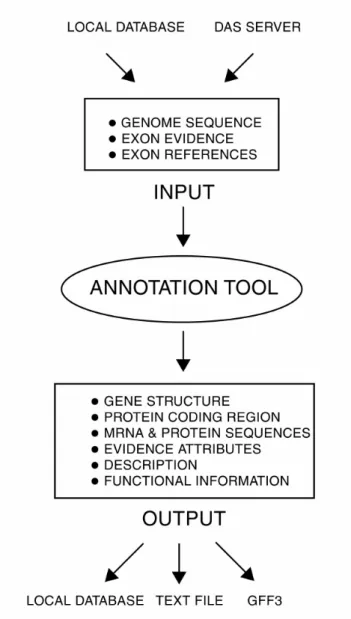
structure annotations. The inputs and outputs of the Annotation Tool are depicted in Figure
1. The input consists of a genomic sequence, exon evidence, and evidence references. The
output of the Annotation Tool is a gene annotation, which consists of a gene structure
(coordinates of exons and introns), the inferred mRNA sequence, a corresponding protein
coding region and its associated translation product, evidence attributes, description, and
functional information. The input and output can be in several formats (indicated in Figure
1), which will be described in detail in the Implementation Section.
Defining a gene’s exon-intron structure is the central step in creating a eukaryotic gene
annotation. The Annotation Tool provides two general categories to specify exons:
pre-defined evidence-supported exons and novel user-pre-defined exons. Pre-pre-defined exons are
provided by the Annotation Tool from prior computations and are supported by evidence
of sources. The evidence is filtered by stringent thresholds to provide exons suggestive of
authentic genes. User-defined exons are exons not contained in the pre-defined evidence and
are individually specified by the user. Annotators have several channels to designate both
categories of exons.
The Annotation Tool contains three representations of the evidence: the Evidence Plot, the
Evidence Table, and links to evidence reference files. The Evidence Plot is a clickable
graphic that presents evidence in a colour-coded schematic (Fig. 2.A.8). The Evidence Table
(Fig. 2.A.11) groups exons into mutually exclusive groups of exon variants. For each exon,
the table lists its genomic coordinates, the maximum score from the method that generated
the exon, and the evidence sources that support the exon. The evidence identifiers are
hyperlinked to reference files for the exon, which could be an alignment or other program
output. Annotators can select pre-defined exons by clicking on exon diagrams in the
Evidence Plot or clicking on buttons in the Evidence Table. The annotator’s developing gene
structure is graphically displayed below the Evidence Plot for visual comparison (Fig.
2.A.10).
User-defined exons are specified through portals to exon-generating programs or through
entry of the genomic coordinates of an exon. As these exons are defined, they are listed in
the User Defined Exons Table (Fig. 2.A.2). Acting as a type of web service, portals deliver
the genome sequence of the annotation region to an online exon-generating program, with
appropriate default parameters specified while allowing the user to change these parameters.
the program’s output window into the current gene structure displayed in the yrGATE
Annotation Tool window. Currently, portals are available to the gene prediction programs
GENSCAN [22] and GeneMark [23] and to the GeneSeqer spliced alignment web server
[24]. Administrators can easily add new portals for other exon-generating programs or
sequence analysis programs, such as folding programs for non-coding RNA annotations. A
template portal is provided with the package.
As an additional channel provided for designating gene structures, the tool allows pasting a
coordinate structure into the mRNA structure field (Fig. 2.A.6). The format for specifying an
mRNA structure follows the conventional notation of designating exons by start and end
coordinates separated by non-digits, with multiple exons separated by commas (e.g., the Perl
regular expression for a two-exon gene structure is [\d+\D+\d+,\d+\D+\d+]). This channel is
appropriate for comparing external gene structures with the evidence. Exons not found in the
pre-defined evidence are given an ‘unknown’ source in the User Defined Exons table.
To document the annotator’s procedure and parameters, the Exon Origins attribute of an
annotation record automatically stores information about the source of each exon. The
following information is stored: the method of exon-generation, a score associated with the
method and exon, sequence identifiers used in the method, unique database identifiers to the
specific output file or record, and a hyperlink to the program output yielding the exon. Exon
Origins allows for complete re-creation of the gene structure annotation and for analysis of
manual annotation procedures that could aid in future manual annotation efforts and
After a gene structure has been defined, a user can specify the protein coding region of the
annotation through entry of genomic coordinates (Fig 2.A.4) or by using the ORF Finder [20]
portal. The ORF Finder portal (Fig 2.B), operating similar to the User Defined Exons
portals, allows a user to select an open reading frame, which upon selection is imported into
the Annotation Tool window and is graphically represented in the Preview Structure.
Coordinately with gene structure and protein coding region designation and edits, the mRNA
and protein sequence fields are updated (Fig. 2.A.3 and 2.A.5). Hyperlinks, attached to the
appropriate sequence, are provided to BLASTN, TBLASTX, BLASTX, TBLASTN and
BLASTP at NCBI [20] for an annotator to find similar sequences and/or assign a putative
function. Additional pieces of information that can be added to a gene annotation are a
description and alternative identifiers.
For cases in which genomic sequence requires editing, such as correction of sequencing
errors or annotation of genes undergoing mRNA editing, the Sequence Editor Tool (Fig
2.A.7) enables annotators to insert, delete, or change bases through a web interface. These
changes are incorporated into the Annotation Tool and stored with the annotation record.
At the conclusion of a gene annotation session, an annotator decides the outcome of their
annotation record (Fig 2.A.1). Annotation records can be saved in the annotator’s personal
account, which limits access of the annotation to the owner of the annotation. Annotations
decide to accept or reject the annotation into a community database for sharing with the
community. Alternatively, annotations can be saved locally on the annotator’s machine by
displaying the annotation in a simple text or GFF3 [25] format. Annotators are also able to
delete stored annotations, which have not been accepted.
Community Annotation Utilities
The yrGATE package includes Community Annotation Utilities for sharing annotations
among a public or private community. These utilities form a process for annotation
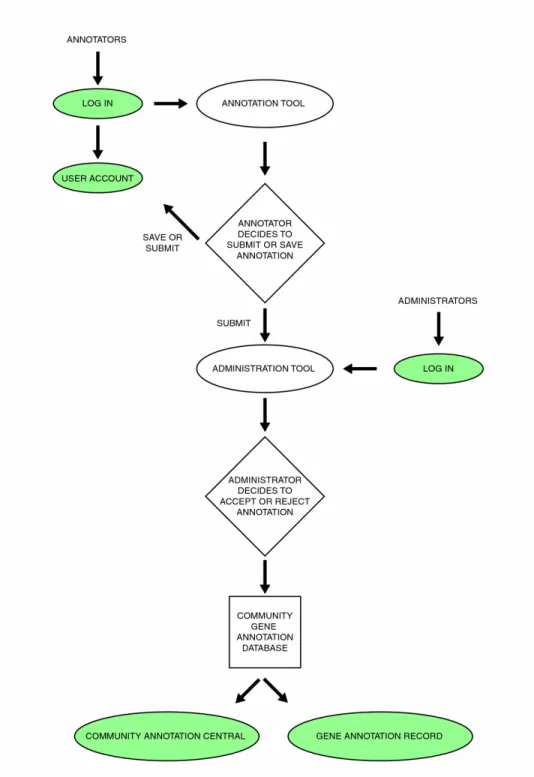
management and review (diagrammed in Figure 3) for two different types of users,
annotators and administrators. The types of users are distinguished by their actions:
annotators create annotations and administrators review these annotations for acceptance into
a community gene set. The Community Annotation Process will be described from the
perspective of a new annotation submission and review.
A typical annotation submission begins with an annotator logging in to their private account,
which contains all of the annotations created by the annotator. Then, the annotator creates a
new annotation using the Annotation Tool and decides to submit the annotation to the
community.
This newly submitted annotation is listed in the Administration Tool, where an Administrator
can ‘check out’ this annotation for review, so that other administrators do not review this
version of the Annotation Tool. Then, the administrator reviews the annotation and is able to
edit any attributes of the record. When satisfied with their analysis, the administrator accepts
or rejects the annotation. If a decision cannot be reached, the annotation is returned to the
to-be-reviewed group. Accepted annotations are added to the public community gene
annotation database, where they are presented through the Community Annotation Central
and Annotation Record facilities. Rejected annotations can be edited by the annotator to be
resubmitted for review.
For specific implementations, the described Community Annotation Process can be adjusted
by dropping any of the steps, such as eliminating the user log in or eliminating the review
process so that all submitted annotation are published. New steps can also be added to the
review process, such as a voting utility for submitted annotations.
Implementations and case studies
The yrGATE package can be implemented in different configurations depending on the input
and output (Fig.1) and on the annotation review process (Fig 3). The input can be either
from a local database or a DAS server. The output can be an entry in a local database or to a
simple text or GFF3 file. The optional Community Utilities provide annotation review and
community maintenance facilities. Two yrGATE implementations, having different
Community Annotation at PlantGDB
PlantGDB includes a family of species-specific databases: AtGDB [26, 27] for Arabidopsis,
ZmGDB [28] for maize, and OsGDB [29] for rice. These species-specific databases each
have an annotation community and an implementation of yrGATE. Input to the yrGATE
annotation tool is supplied by the respective PlantGDB database. Pre-calculated exon
evidence consists of spliced alignments of EST and cDNA sequences generated by the
GeneSeqer program [30]. Evidence references consist of hyperlinks to GeneSeqer output
files, which are a part of the respective databases. Genome sequence segments are also
supplied by the database. In these PlantGDB implementations, yrGATE Community
Utilities regulate user management and annotation curation according to the described default
configuration (Fig. 3). We illustrate yrGATE use at PlantGDB with two gene annotation
case studies.
The first case study is a novel maize annotation using the ZmGDB yrGATE implementation.
An unannotated genome region, 158659-162032 of BAC 51315585, was chosen by the
annotator using the genome browsing function of ZmGDB. A screenshot of the Annotation
Tool shows the completed annotation (Fig. 2). Exons were initially selected from the
pre-computed evidence. The evidence, though, consists of two separate groups of ESTs (Fig
2.A.9) with no spanning evidence in the region 160260-160664. The annotator decided to
use the GENSCAN and the GeneSeqer@PlantGDB portals to explore potential exons in this
region (Fig 2.A.2). After adding three User Defined Exons, a gene structure connecting both
to define a protein-coding region, which spanned all eight exons of the putative transcript.
Terminal exons, supported by ESTs 71435182 and 32859895, were selected to maximize the
untranslated regions. The final step of the annotation session was a BLASTP search at NCBI
to compare the novel gene annotation and to assign a putative gene product function. The
protein of the annotation had high similarity over most of its length to rice protein
NP_915525 and to Arabidopsis protein NP_190282. These proteins provided a putative
functional assignment of ‘sugar transporter’ for the annotation. The annotator was satisfied
with the annotation and submitted it for review. Administrators reviewed the annotation and
accepted it because it was novel and of good quality. The Annotation,
ZM-yrGATE-sugar_transporter, is now accessible from the ZmGDB Community Annotation Central [31].
The second PlantGDB case study concerns alternative splicing and correction of an
inaccurate published annotation of an Arabidopsis gene model using the yrGATE
implementation at AtGDB. A screenshot of the Transcript View of AtGDB presents two
accepted community annotations (green structures in interior window, Figure 4). The
annotator decided to investigate this genome region (chromosome 1, segment
30370180-30373939) because, upon visual inspection, the first exon of the published annotation
At1g808010.1 conflicts with EST and cDNA evidence (Figure 4.A.3). Initially, the
annotator used cDNA 23270370 to define the gene structure and EST 496433 to extend the
3'-untranslated region. Through the Evidence Table and evidence reference links to
GeneSeqer output of the Annotation Tool, the annotator recognized exon 11 has an alternate
size supported by EST 507078. The annotator examined open reading frames of both
for the 5'-most untranslated exon, decided to create two annotations for this locus. An
AtGDB administrator reviewed the annotations and accepted both into the community
database because they corrected an inaccurate published annotation and captured alternative
splicing variants. These alternative splicing variants are displayed in the Transcript View of
AtGDB (Fig 4.1), which displays sequence alignments coordinated to a diagram. In the
Transcript View, the green vertical rectangle (Fig 4.2) relates the diagram to the multiple
sequence alignment, where nucleotides in introns are represented by ‘>’ symbols.
Comparing alignments for sequences 23270370 and 507078, a three base difference in the
start of the exon 11 is apparent (Fig 4.4). The upstream intron sequences reveal that both
intron variants terminate with the standard AG dinucleotide, which suggests this is a probable
alternative splicing event. The Transcript View of AtGDB makes such minute differences
distinguishable, which were previously concealed in the diagram.
yrGATE with DAS input
DAS servers provide sequence and annotation information that is queryable and in a standard
format [32, 33]. The abundance of DAS servers for a variety of organisms provides rich and
diverse sources of input for the yrGATE Annotation Tool. An implementation of yrGATE
using input data from DAS servers is provided for general use [34]. This implementation,
‘yrGATE with DAS input’, does not have a community aspect, although a different
configuration could add community functionality. The ‘yrGATE with DAS input’ Selection
Page allows an annotator to specify a DAS reference server and DAS evidence sources (Fig.
selections. After these selections are stored, the Annotation Tool can be accessed with the
selected input DAS data (Fig. 5.B).
Figure 5 represents a case study of a novel chicken gene structure annotation. The Selection
Page specifies the chicken genome chromosome 3 segment 86850000 – 86990000 as the
genome entry point [35, 36]. The selected evidence sources include primary evidence of
mRNA and EST BLAT alignments and, for comparison, annotations of types RefSeq [37,
38], TWINSCAN [39], Ensembl [40], Geneid [41], and SGP [42]. The published annotation
evidence sources are selected so that the annotator can compare primary evidence against
existing annotations. Inspection of the primary evidence in the Evidence Plot of the
Annotation Tool suggests one gene on the forward strand (approximately 86887000 –
86934000; Fig. 5.B.1) and another gene on the reverse strand (approximately 86853000 –
86975000; Fig. 5.B.2). The gene on the forward strand (Fig 5.B.1; e.g., RefSeq Gene
angiopoietin-2, dark blue, labelled NM_204817.1) is accurately annotated based on mRNA
and EST evidence. Additional alternative variants are also accurately annotated.
The primary evidence also suggests an annotation on the reverse strand that contains the
angiopoietin-2 gene within one of its introns. However, current annotations on the reverse
strand are inaccurate and incomplete based on mRNA and EST evidence (Fig 5.B.3). The
first half of this potential gene is represented in some annotations (Fig 5.B.2; SGP:
chr3_982.1, Geneid: chr3_1361.1, Ensembl: ENSGALT00000026345.2; TWINSCAN:
chr3.87.019.a). Alignments of other species' RefSeq Genes [43] (not pictured) indicate a
compared to the primary evidence and does not contain all of the exons supplied by the
primary evidence. A novel gene annotation was created on the reverse strand by selecting
compatible exons from primary evidence using the Annotation Tool. An open reading frame
was designated, and the protein sequence was used to find homologous genes in related
species. Based on BLASTP results, this gene was assigned the putative function
microcephalin. Interestingly, several species (including human and mouse) have an
annotated microcephalin gene with high protein sequence similarity and also maintain the
local genome structure of angiopoietin-2 within an intron of the microcephalin gene on the
opposite strand.
Links to these case study annotations are provided on the yrGATE website [44].
Usability and availability
The Annotation Tool was designed with emphasis on usability for annotators. Annotators
can immediately select from high quality evidence that has a high likelihood of yielding an
accurate annotation and can specify new custom evidence for cases where the evidence is
inadequate. The two categories provide for a good annotation process where high quality
evidence is first examined and then additional evidence is checked, which is completed in a
minimal amount of mouse clicks and screen display, achieved by the Tool’s design.
The main components of the tool are contained in one standard 1024x768 resolution screen.
which allows annotators to quickly evaluate the impact of different exon variants and
combinations of exons on the gene structure, mRNA sequence, and protein sequence.
yrGATE is compatible with several major operating systems, including Linux, Windows and
Macintosh, on several web browsers, of which Mozilla Firefox has the best performance in
terms of speed.
yrGATE is available for download [44]. The package consists of Perl, Javascript, HTML,
and a MySQL schema. Required Perl libraries for a full implementation are CGI, DBI,
LWP, HTTP, PHP::Session, GD, Bio::Graphics, Bio::SeqFeature::Generic, and Bio::Das.
Template data is provided for testing and evaluation.
Conclusions
yrGATE opens gene structure annotation to a large, nonexclusive community. The
characteristics of yrGATE contribute to its potential for user appeal and community
adoption. Among other applications, it is particularly useful for annotating emerging
genomes and for correcting inaccurate published annotations. yrGATE is easily adaptable to
different input data and can support a community using the Community Utilities.
List of abbreviations
Acknowledgements
This work was supported by the National Science Foundation Plant Genome Research
Projects grant DBI-0321600 to V.B. Matthew Wilkerson worked in part under a cooperative
agreement with University of Missouri, SCA #58 3622-3-152.
References
1. Lareau LF, Green RE, Bhatnagar RS, Brenner SE: The evolving roles of alternative splicing.Curr Opin Struct Biol 2004, 14:273-282.
2. Stamm S, Ben-Ari S, Rafalska I, Tang Y, Zhang Z, Toiber D, Thanaraj TA, Soreq H: Function of alternative splicing.Gene 2005, 344:1-20.
3. Wang B-B, Brendel, V.: Genome-wide comparative analysis of alternative splicing in plants.Proc Natl Acad Sci USA 2006, in press.
4. Misra S, Crosby MA, Mungall CJ, Matthews BB, Campbell KS, Hradecky P, Huang Y, Kaminker JS, Millburn GH, Prochnik SE, et al: Annotation of the Drosophila melanogaster euchromatic genome: a systematic review.Genome Biol 2002, 3:RESEARCH0083.
5. Ashurst JL, Collins JE: GENE ANNOTATION: PREDICTION AND TESTING.
Annual Review of Genomics and Human Genetics 2003, 4:69-88.
6. Schlueter SD, Wilkerson MD, Huala E, Rhee SY, Brendel V: Community-based gene structure annotation.Trends Plant Sci 2005, 10:9-14.
7. Allen JE, Salzberg SL: JIGSAW: integration of multiple sources of evidence for gene prediction.Bioinformatics 2005, 21:3596-3603.
8. Howe KL, Chothia T, Durbin R: GAZE: a generic framework for the integration of gene-prediction data by dynamic programming.Genome Res 2002, 12: 1418-1427.
9. Foissac S, Schiex T: Integrating alternative splicing detection into gene prediction.BMC Bioinformatics 2005, 6:25.
10. Haas BJ, Wortman JR, Ronning CM, Hannick LI, Smith RK, Jr., Maiti R, Chan AP, Yu C, Farzad M, Wu D, et al: Complete reannotation of the Arabidopsis genome: methods, tools, protocols and the final release.BMC Biol 2005, 3:7.
11. Yuan Q, Ouyang S, Wang A, Zhu W, Maiti R, Lin H, Hamilton J, Haas B, Sultana R, Cheung F, et al: The institute for genomic research Osa1 rice genome annotation database.Plant Physiol 2005, 138:18-26.
12. Ashurst JL, Chen CK, Gilbert JG, Jekosch K, Keenan S, Meidl P, Searle SM, Stalker J, Storey R, Trevanion S, et al: The Vertebrate Genome Annotation (Vega)
database.Nucleic Acids Res 2005, 33:D459-465.
14. Brinkman FS HR, Stover CK.: Sequencing solution: use volunteer annotators organized via Internet.nature 2000, 406:933.
15. Stein L: Genome annotation: from sequence to biology.Nat Rev Genet 2001, 2:493-503.
16. Glasner JD, Liss P, Plunkett G, 3rd, Darling A, Prasad T, Rusch M, Byrnes A, Gilson M, Biehl B, Blattner FR, Perna NT: ASAP, a systematic annotation package for community analysis of genomes.Nucleic Acids Res 2003, 31:147-151.
17. D'Ascenzo MD, Collmer A, Martin GB: PeerGAD: a peer-review-based and community-centric web application for viewing and annotating prokaryotic genome sequences.Nucleic Acids Res 2004, 32:3124-3135.
18. Winsor GL, Lo R, Sui SJ, Ung KS, Huang S, Cheng D, Ching WK, Hancock RE, Brinkman FS: Pseudomonas aeruginosa Genome Database and PseudoCAP: facilitating community-based, continually updated, genome annotation.Nucleic Acids Res 2005, 33:D338-343.
19. Lewis SE, Searle SM, Harris N, Gibson M, Lyer V, Richter J, Wiel C, Bayraktaroglir L, Birney E, Crosby MA, et al: Apollo: a sequence annotation editor.Genome Biol
2002, 3:RESEARCH0082.
20. Wheeler DL, Barrett T, Benson DA, Bryant SH, Canese K, Church DM, DiCuccio M, Edgar R, Federhen S, Helmberg W, et al: Database resources of the National
Center for Biotechnology Information.Nucleic Acids Res 2005, 33:D39-45. 21. Annotation for Amateurs [http://www.plantgdb.org/tutorial/annotatemodule] 22. Burge C, Karlin S: Prediction of complete gene structures in human genomic
DNA.J Mol Biol 1997, 268:78-94.
23. Besemer J, Borodovsky M: GeneMark: web software for gene finding in prokaryotes, eukaryotes and viruses.Nucleic Acids Res 2005, 33:W451-W454. 24. Schlueter SD, Dong Q, Brendel V: GeneSeqer@PlantGDB: Gene structure
prediction in plant genomes.Nucleic Acids Res 2003, 31:3597-3600. 25. Generic Feature Format Version 3 [http://song.sourceforge.net/gff3.shtml] 26. Zhu W, Schlueter SD, Brendel V: Refined annotation of the Arabidopsis genome
by complete expressed sequence tag mapping.Plant Physiol 2003, 132:469-484. 27. An Arabidopsis thaliana Plant Genome Database
[http://www.plantgdb.org/AtGDB]
28. A Zea mays Plant Genome Database [http://www.plantgbd.org/ZmGDB] 29. An Oryza Sativa Genome Database [http://www.plantgdb.org/OsGDB]
30. Brendel V, Xing L, Zhu W: Gene structure prediction from consensus spliced alignment of multiple ESTs matching the same genomic locus.Bioinformatics
2004, 20:1157-1169.
31. yrGATE @ ZmGDB: Community Annotation Central
[http://www.plantgdb.org/ZmGDB_yrGATE-cgi/CommunityCentral.pl]
32. Dowell RD, Jokerst RM, Day A, Eddy SR, Stein L: The distributed annotation system.BMC Bioinformatics 2001, 2:7.
35. Karolchik D, Baertsch R, Diekhans M, Furey TS, Hinrichs A, Lu YT, Roskin KM, Schwartz M, Sugnet CW, Thomas DJ, et al: The UCSC Genome Browser
Database.Nucleic Acids Res 2003, 31:51-54.
36. The UCSC Genome Database [http://genome.cse.ucsc.edu/]
37. Pruitt KD, Tatusova T, Maglott DR: NCBI Reference Sequence (RefSeq): a curated non-redundant sequence database of genomes, transcripts and proteins.
Nucleic Acids Res 2005, 33:D501-504.
38. UCSC Genome Browser RefSeq Genes Track [http://genome.ucsc.edu/cgi-bin/hgTrackUi?hgsid=73356660&c=chr3&g=refGene]
39. Korf I, Flicek P, Duan D, Brent MR: Integrating genomic homology into gene structure prediction.Bioinformatics 2001, 17 Suppl 1:S140-148.
40. Hubbard T, Barker D, Birney E, Cameron G, Chen Y, Clark L, Cox T, Cuff J, Curwen V, Down T, et al: The Ensembl genome database project.Nucleic Acids Res 2002, 30:38-41.
41. Guigo R: Assembling genes from predicted exons in linear time with dynamic programming.J Comput Biol 1998, 5:681-702.
42. Parra G, Agarwal P, Abril JF, Wiehe T, Fickett JW, Guigo R: Comparative gene prediction in human and mouse.Genome Res 2003, 13:108-117.
43. UCSC Genome Browser Non-Chicken RefSeq Genes Track. [http://genome.ucsc.edu/cgi-bin/hgTrackUi?db=galGal2&g=xenoRef Gene]
Figures
Figure 1. The applications interface of yrGATE.
(Figure 2 continued)
Figure 2. Novel Gene Annotation.
This yrGATE implementation at ZmGDB presents the region 158659-162032 of Zea mays BAC gi 51315585. The main Annotation Tool window (A) contains a completed gene structure annotation. The provided transcript evidence consists of two groups of ESTs (circled as A.9) separated by a region with no spanning evidence, 160260 – 160664 (A.8). User Defined Exons have been designated in this region. The User Defined Exons Table (A.2) lists each exon by coordinates and source. Exon 5, 160575..160721, was defined using portals to GENSCAN (B) and GeneSeqer@PlantGDB (not shown). Yellow buttons in the GENSCAN portal (B) add exons to the gene structure in the Annotation Tool (A.6), which are presented pictorially (A.10) for comparison with the Evidence Plot. A protein-coding region was evaluated using the portal to the ORF Finder (C) and imported into the
Figure 3. Community annotation review process.
Figure 4. Community implementation of yrGATE at the PlantGDB Arabidopsis genome browser, AtGDB, for correction of a public annotation and for alternative splicing.
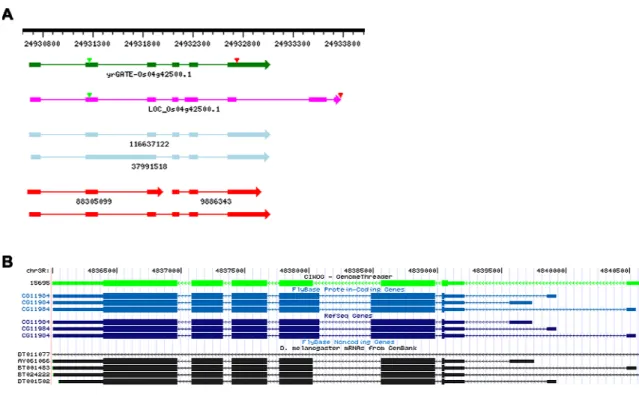
This two-window screenshot depicts yrGATE annotations in the AtGDB browser. The outer window contains a genome context view of AtGDB, which has links to the yrGATE
Annotation Tool and to AtGDB’s Transcript View (A.1). The inner window contains the Transcript View, which presents a genome context graphic and sequence alignments represented in the graphic. The graphic has the following color assignments: yrGATE annotations - green, the public annotation - blue, cDNAs - light blue, ESTs – red, annotation protein coding regions – green and red triangles. The multiple sequence alignment in the lower panel of the Transcript View corresponds to the region of graphic contained within the green rectangle (A.2). The first exon (A.3) of the public annotation, At1g80810.1, is not supported by expressed sequence evidence, which instead suggests a downstream exon. There are two yrGATE community annotations, At1g80810-1 and
(Figure 5 continued)
Figure 5. yrGATE with DAS input Implementation.
CHAPTER 4: COMPUTATIONAL ANALYSIS OF U12-TYPE INTRONS
WITHIN ORTHOLOGOUS GENES
A paper prepared for submission to PLoS Computational Biology
Matthew D. Wilkerson1, and Volker Brendel1,2,3
Abstract
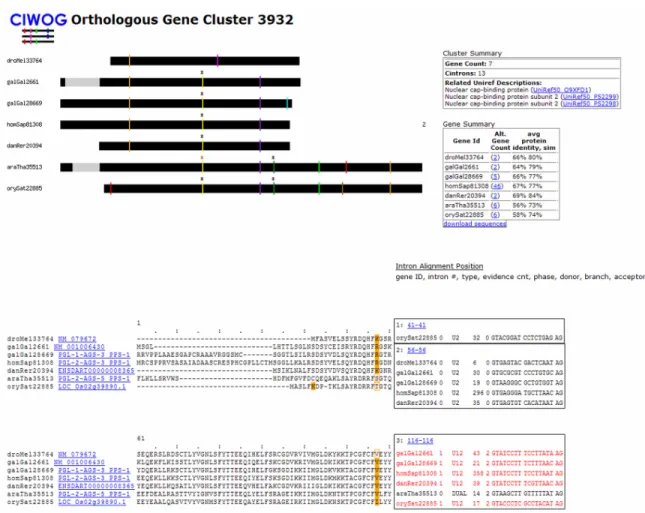
The CIWOG (Common Introns within Orthologous Genes, http://ciwog.gdcb.iastate.edu)
database was constructed for the purpose of analyzing U12-type introns in the context of
orthologous genes. A large number of U12-type introns were identified in human, mouse,
zebrafish, chicken, Drosophila, Arabidopsis, and rice. Novel gene structure annotations were
constructed for U12-type introns supported by transcript evidence but lacking an accurate
host gene structure annotation relative to published annotation sources. Intron sites were
derived from protein sequence multiple alignments and compared by their intron type. The
results from this study provide confirmatory support for ancestral genes rich with U12-type
introns and for the process of subtype switching. This study provides the first instances of
intron type conversion between vertebrate, between plant, and between plant and animal
orthologous genes. Between plants and animals, U12-type intron conservation, conversion
and loss were detected in an approximate 1:2:4 ratio. Orthologous gene clusters with
____________________
1Department of Genetics, Development and Cell Biology, Iowa State University, Ames, IA
50011-3260, USA
2Department of Statistics, Iowa State University, Ames, IA 50011-3260, USA
conserved U12-type introns are shown to experience reduced gene structure, global protein
sequence, and local protein sequence evolution. The phase distribution of U12-type introns
was found to be strictly conserved in orthologous introns, suggesting that the modern phase
distribution was present in the last common ancestor of at least plants and animals. Also, the
phase distribution was found to correlate with exonic nucleotide sequence conservation.
Introduction
Among the population of introns in eukaryotic genomes, the minor class of introns,
U12-type, has unique characteristics compared to the major class of introns, U2-type. U12-type
introns have highly conserved donor site and branch site consensus sequences,
/[GA]TATCCTT and TCCTTAAC/, respectively, where the exon-intron boundary is
indicated by / and [GA] indicates G or A [1, 2]. U12-type introns with a /AT donor site
typically have an AC/ acceptor site and those with a /GT donor site typically have an AG/
acceptor site, which are called the AT-AC and GT-AG subtypes, although other terminal
dinucleotide combinations have been found [2-6]. In contrast, U2-type introns have less
conserved sequences at the donor and branch sites, typically have /GT and AG/ terminal
dinucleotides, and have an additional sequence element, the polypyrimidine tract [2, 7].
Comprising less than 1% of the introns of any organism studied [2, 6], U12-type introns have
a dramatic difference in abundance compared to U2-type. U12-type introns are spliced from
pre-mRNA by a spliceosome that is structurally and mechanistically similar to the U2-type
spliceosome (reviewed in [8]). Another distinctive feature of U12-type introns is that their