International Journal of Innovative Technology and Exploring Engineering (IJITEE) ISSN: 2278-3075,Volume-8 Issue-8S2, June 2019
Abstract: Several nuclear power plant accidents that occurred in the past cause not only great damage to us, but also the aftereffects persist for a long time. The purpose of this study is to protect the lives and property of individuals from radiation accidents by predicting the radiation diffusion path and the arrival time at nuclear power plant accidents. Oil prices, which have hovered around $50~60 per barrel for many years, rose to $75again. Therefore, experts are expected to maintain nuclear power plants as part of an energy policy due to soaring oil prices. In addition, countries are pushing to build nuclear power plants to meet the global energy shortage. With an increasing number of nuclear power plants worldwide, the possibility of accidents is also increased. In this paper, we analyze the current status of nuclear power plants in Korea and abroad and the accidents of nuclear power plants in the past. In this paper, we analyze the expected diffusion path of radiation contaminants using the Big Data on the homepage of the Korea Meteorological Administration and the weather data on the homepage of KHNP (Korea Hydro & Nuclear Power) at the time of radiation accident. For this purpose, this paper explains how to develop radiation protection apps using embedded system. By using this system, it is possible to evacuate quickly by anticipating the time when radioactive pollutants spread from the accident point to the point where the person is active in the case of a radiation accident at a nuclear power plant through his own smartphone. People can take quick precautionary measures, such as preparing protective masks and protective clothing. By using the radiation protection application based on the embedded system developed in this study, it is possible to more quickly grasp the spreading time of the radiation pollutant in the case of radiation accident at the nuclear power plant, and by taking preventive measures promptly and safely, people can protect his property.
Index Terms: Embedded app, nuclear power plant, pollution spreading, radiation accident
I. INTRODUCTION
In recent years, countries around the world have been pursuing nuclear power reduction policies, such as halting the nuclear power plant under construction and publicizing it, in order to pursue nuclear zero policy. However, as shown in figure 1, the price of oil, which has hovered around $5~60 per barrel in recent years, has risen to $75 again, and experts are now expected to maintain energy policies due to jumping oil prices, including the construction of nuclear power plant [1].
In addition, countries are pushing to build nuclear power
Revised Manuscript Received on May 23, 2019.
Choon-Soo Lee, I&C team, Korea Hydro & Nuclear Power Co., Ltd, Busan, Korea
Shin-Hyeong Choi, Division of Electrical, Control & Instrumentation Engineering, Kangwon National University, Samcheok, Korea
[image:1.595.313.538.284.403.2]plants to meet the global energy shortage. As shown in table 1, Britain plans to build 16 more nuclear power plants by 2030, India will build 30, China will build 20, Sweden 10 and Russia will build one nuclear power plant annually by 2030 [2]. Regardless of our wishes, as the probability of accidents increases as the number of nuclear power plants increases globally, countermeasures against radiation accidents at nuclear power plants are urgently needed.
Fig. 1 International oil price trend
Table 1. Worldwide Nuclear Power Plants Forecast (Gwe: Gigawatt electrical)
Division 2014 2020 2030 2050
North America 112.1 108.3/118.2 92.0/139.7 60/157
Central
America 4.8 4.5/5.8 6.8/13.4 13/55
Western
Europe 113.7 99/111.9 62.7/112.7 27/121 Eastern
Europe 49.7 55.2/62.7 64.1/93.5 63/126
Africa 1.9 1.9/1.9 1.9/6.5 7/38
Middle East 6.9 12.0/17.4 25.9/43.8 48/94
South Asia
Pacific Region 0/4 5.0/18
Far East Asia 87.1 98.7/122.9 131.8/219.0 149/355
Total 376.2 379.5/440.9 385.3/631.8 371/964
II. RELATEDWORKS
The path that enters the human body in the event of a radiation accident of nuclear power plant is an internal exposure due to the respiration of the radiation material caused by the radiation fallout and an external exposure falling outside the human body. As seen in Chernobyl and Fukushima, the path of radiation pollution spreads in the wind [3]. Therefore, if you know the direction and intensity of the wind from the point of
accident when the radiation accident occurs in the
Radiation Protection using Embedded
Application
[image:1.595.302.552.439.627.2]nuclear power plant, you can move out of the area where contamination is expected in advance, prepare the radiation mask, wear the raincoat You will be able to protect yourself and your family's health and property from radiation exposure and disaster. In recent years, due to the development of the Internet and communication networks, smartphone based apps are in full swing and everyone in the country owns one smartphone. Therefore, if a radiation protection program using an embedded using such a smart phone is installed and the radiation path and the time of arrival are confirmed, it will be possible to protect life and safety from radiation accident.
A. Current Status and Prospect of Nuclear Power Generation
[image:2.595.305.550.489.606.2]Despite the Fukushima nuclear power plant accident in 2011, the global nuclear power market is being formed in new emerging economies. In addition, the company plans to introduce new nuclear power plants in the United States, Russia, the UK and India. In particular, China is expected to become the largest nuclear power plant country in accordance with the energy securing policies needed for industrialization. In Fukushima, after the Fukushima accident, the two reactors have restarted since August 2015, and they are shifting to a policy of maintaining 20-22% of the nuclear power in 2030.Nuclear power industry expanded from the early growth period (1955-1973) to the nuclear power leading countries (USA, Russia, Canada, France, Germany) to South of Korea and many countries (1973-1990) (1990-2000) due to the collapse of fossil fuel prices. However, since 2000, the construction of nuclear power plants has been gradually increasing due to the countermeasures against climate change and has been showing a low growth trend. Nuclear power generation is due to the energy and environmental policies of each country, the outlook of electric power demand, the availability of energy resources, and the regulatory environment. Countries with mature nuclear power plants focus on plant improvement and long-term operation. Emerging developing countries, it is faced with the problem of securing a skilled workforce.
Fig. 2 World nuclear power reactors
The number of countries that are introducing nuclear power plants is also increasing. It plans to introduce nuclear power plants in Southeast Asia, the Middle East and Eastern Europe, including the UAE and Belarus, which are already under construction, and Jordan, Poland, Lithuania,
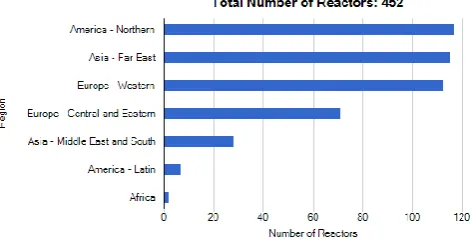
Indonesia, Bangladesh, Egypt, Kazakhstan, Malaysia, Thailand, Turkey and Israel. Saudi Arabia and Chile are also considering plans to build nuclear power plants. In the future, nuclear power plants will be built around emerging countries with large-scale introduction of China. Figure 2 shows total number of reactors in operation all over the world [4], [5].
B. Major Accidents of Radiation Accidents at Nuclear Power Plants
1. Chernobyl accident
[image:2.595.52.290.572.691.2]On April 26, 1986, an accident occurred at the Chernobyl nuclear power plant in Ukraine. The accident occurred as a night shift with insufficient experience tested the safety system of the reactor in violation of safety procedures. As the reactor exploded, the giant reactor lid flew into the air, and a cloud of deadly radioactive contaminants flowed into the atmosphere. A total of 31 people were killed directly due to the explosion, and it is estimated that hundreds of thousands to millions of people were killed if the radiation-related diseases such as cancer were combined. At that time, the radioactive fallout flew to the eastern United States, as well as Europe, as well as neighboring countries such as Belarus. The Chernobyl nuclear accident site has been abandoned with controlled access to people, and people in the surrounding area cannot escape from the economic and radiation aftereffect. A large amount of radioactive material leaked to the outside after the explosion, due to the upward airflow caused by the fire in the reactor for ten days until the reactor fire was suppressed. The radioactive fallout that occurred at the time of the accident spread to not only Russia, Belarus, and Ukraine around Chernobyl but also Europe and polluted many areas. Figure 3 shows the radioactive spread across Europe after the Chernobyl nuclear accident [6], [7].
Fig. 3 Radiation pollution condition around Chernobyl
2. Fukushima accident
On March 11, 2011, a radioactive spill occurred at the Fukushima nuclear power plant in Japan. The accident was triggered by a major earthquake of 9.0 magnitude and a tsunami that hit the northeastern part of Japan. As the power plant flooded, the power and cooling systems were destroyed, resulting in a hydrogen explosion in the reactor, and a large amount of gases including radioactive materials leaked to the outside. The radioactivity leaked into the air and into the ocean due to an accident at
International Journal of Innovative Technology and Exploring Engineering (IJITEE) ISSN: 2278-3075,Volume-8 Issue-8S2, June 2019
[image:3.595.47.289.178.378.2]the accident, the wind blew to the east, and the radioactive material returned to the Arctic Circle or turned around the Northern Hemisphere without being blown directly, and reached the Republic of Korea about 20 days after the accident(around March 31, 2011). Distances were diluted and deposited during air movement, resulting in lower concentrations. Figure 4 shows the high-level radioactive contamination situation extended to the northwest after the Fukushima nuclear power plant accident [3], [8]-[11].
Fig. 4 The belt of high-level radioactive contamination that extended to the northwest of Fukushima
A. Radioactive material contamination route and spread status
The Chernobyl Nuclear Emergency Response Route was flown from Chernobyl, the dead ash, to the jet stream, flying to Japan at 8,000 kilometers. When the explosion broke out in Chernobyl, the ascending current had a tremendous amount of power, so it ran up to the jet stream of over 10,000 meters and carried it to Japan. The atmosphere on the earth is about 10,000 meters, and the fierce air current passing through it is the jet stream. Europe was polluted by radioactive fallout due to wind. At first, the wind blew to Northern Europe, and then it changed its direction to the south. In fact, after that, there were quite a lot of death ashes to Iran, Iraq, Turkey and Asia. When we look at a picture taken ten days after the wind blowing from Chernobyl the next day, the radiation fallout completely covers the southern Middle East side [6].
In Fukushima nuclear power plant accident, calculated as the average wind speed (7m/s), the radioactive cloud will appear in the city center in just 5 hours, so gamma rays penetrate everything and affect Tokyo residents. If an average wind speed of 7 meters on a Japanese map is flying with radioactivity, it will reach all over Japan in three days regardless of where the accident occurs, regardless of the center [8]-[10].
III. RADIATEDPROTECTIVEEMBEDDEDAPP USINGBIGDATA
With the increasing use of computers, data is being generated in various places, and the amount of data is rapidly
increasing. Experts predict that worldwide data volume will continue to increase rapidly, from 1.2 zeta bytes in 2010 (1ZB = 1,000EB) to 35.2 zeta bytes in 2020 and 44 times in 10 years. Big data focuses on the accuracy of future predictions or outcomes rather than current analysis. In particular, it is expected that the amount of unstructured data, such as web application data, will stand out more than formal data such as business process data. Unstructured data from diverse sources such as SNS, and YouTube is expected to provide valuable new information, which is driving expectations for big data analytics. The Big Data focuses on the accuracy of future predictions or outcomes rather than current analysis [12], [13]. In addition, Big Data Analysis should immediately produce the required results in data processing speed. In some cases, it can provide real time response with fast processing speed. Weather is the field where Big Data first started. Since observed weather forecasts began long ago, the observed data gathered to form big data. The meteorological office has enormous amounts of data and processes more than 1.7 terabytes of data for accurate forecasts every day [14]. The Meteorological Agency has a total of four supercomputers with the best capability, and has introduced new supercomputers every five years since 2000. Weather Climate Big data is widely used in public institutions and allows for preparation and preparation before a natural disaster such as a crisis occurs [15].
Table 2(a). KHNP weather report
Kori Shinkori Hanbit
Wind speed(m/s) 1.7 2.1 1.1
Wind direction NNW NNW ESE
Atmospheric
stability G G E
Condition Instability Severe Instability Instability slightly
Pasqual rating A B C
Temperature rate
(ΔT/Δz,℃/100m) ΔT/Δz ≤ -1.9 -1.9〈ΔT/Δz ≤ -1.7 -1.7〈ΔT/Δz ≤ -1.5
Table 2(b). KHNP weather report
Hanwool Wolsong Saewool
Wind speed(m/s) 2.1 1.4 2.3
Wind direction W NNW NNW
Atmospheric
stability D F G
Condition neutrality weak
stability Stability
[image:3.595.302.551.411.842.2]Temperature rate
(ΔT/Δz,℃/100m)-1.5〈ΔT/Δz ≤ -0.5 -0.5〈ΔT/Δz ≤ 1.5 1.5〈ΔT/Δz ≤ 4.0
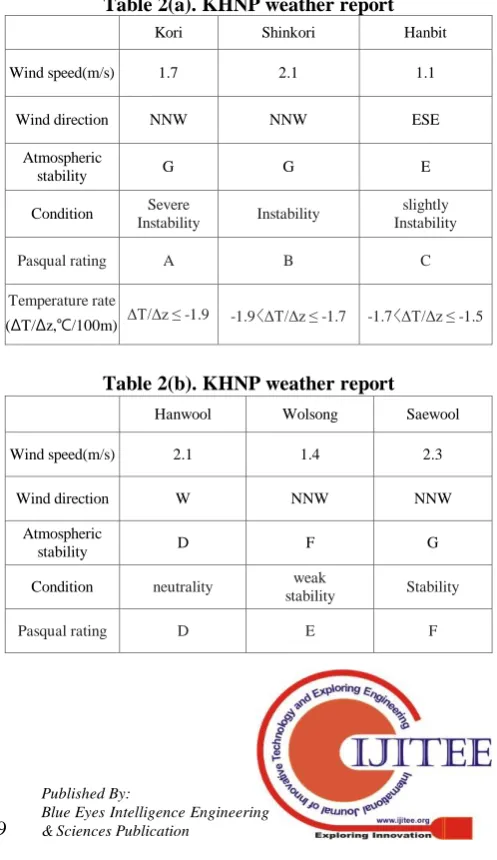
We developed an embedded-based radiation protection app using the Big Data of the Korea Meteorological Administration and the weather data registered at KHNP during the radiation accident. By installing this on a smartphone, it is possible to confirm when the radiation contaminant from the accident spot to the area where the radiation activity occurs is spreading in the nuclear power plant. If we use it, we can preserve the life and property of ourselves and family through prompt preventive measures such as rapid evacuation and preparation of protective mask and protective clothing. Table 2(a), (b) show weather information of KHNP for each nuclear power plant [16]. Table 3 shows the location and weather information for each nuclear power plant [17].
Table 3. Meteorological Agency homepage weather document
Headquarters
name Latitude Longitude
Average annual wind speed(m/s)
Average yearly wind direction
Kori Nuclear power headquarters
35.3262 129.2866 4.76 344
Saeul Nuclear power headquarters
35.3353 129.3116 4.3 318
Wolsong Nuclear power headquarters
35.7142 129.4757 5.32 307
Hanbit Nuclear power headquarters
35.40979 126.4164 4.84 356
Hanwool Nuclear power headquarters
37.09779 129.3724 4.05 300
In order to inform the real time of pollution route and spreading status of radioactive materials in case of nuclear accident, current position confirmation, weather information collection and pollutant diffusion forecast are performed in order. Table 4 shows the process of confirming the current location information. First, as a process of confirming the current position information of the user, the position information provided through the GPS and the network is used. And then, user' location information is converted to address information using the Geocoder class. And the location information is updated after a period of time.
Table 4. Procedure for collecting current location information
1. Detect the user's current location
① Call LocationManager to check the location information provided by the GPS and the Network - LocationManager.NETWORK_PROVIDER - LocationManager.GPS_PROVIDER
② Get location information from the Location object, including latitude and longitude
- double longitude = location.getLongitude();
- double latitude = location.getLatitude();
2. Convert location information to address information using the Geocoder class
- addresses = geoCoder.getFromLocation(latitude, longitude, 1);
3. Set the timer and update the location information after a certain period of time
- requestLocationUpdates
(LocationManager.GPS_PROVIDER, 100, 1, aLocationListener);
- public void onLocationChanged(Location location)
[image:4.595.45.293.49.87.2]Table 5 shows the process of collecting weather information. This process consists of five steps, from the process of collecting API from public data portal to the parsing process.
Table 5. Procedure for collecting weather information
1. Apply for Public Institution Data Portal API 2. Allow Internet access (androidManifest)
3. Set AsyncTask to fetch public data in the background 4. Enter the public API's xml address and the
issuedauthentication key in url 5. Parsing with XmlPullParser
① Start parsing
② Separate one data item ③ Run when START tag
④ Set to True if the tag name is checked
⑤ Read text of tag-specific element and store it in string buffer
⑥ When the last tag is encountered, the result of the first search is terminated and the text value of the tag-specific element is read repeatedly
⑦ Return a string object when parsing is complete
We collect the current location information of the user through the process of Table4, and then, based on analysis of wind direction, wind speed, and atmospheric stability obtained through the process of Table 5, it is possible to predict when the radiation contaminant spreads from a nuclear power plant to a user's location in a radiation accident.
IV. CONCLUSION
In this paper, we develop a radiological protection app using an embedded device to protect the life and property of an individual from a nuclear power plant accident. Recently, international oil prices, which have been going on for many years, have skyrocketed and dozens of nuclear power plants have been built around the world in order to meet the energy
demand for
industrialization. In
International Journal of Innovative Technology and Exploring Engineering (IJITEE) ISSN: 2278-3075,Volume-8 Issue-8S2, June 2019
dozens of nuclear power plants on the east coast to meet the energy demand for rapid economic growth. China is not only close to Korea, but also has a direct impact on Korea in case of a nuclear power plant accident due to the effect of westerly wind caused by the rotation of the earth. In Korea, the government is implementing the nuclear power reduction policy. However, in accordance with the international climate agreement to prevent the energy security problem due to oil price rise and the generation of carbon dioxide by fossil fuel, it is necessary to maintain the current nuclear power ratio and construct a nuclear power plant in the future. As the number of nuclear power plants increases, the probability of accidents increases. For this purpose, we explain how to develop radiation protection apps using embedded system. By using this system, it is possible to evacuate quickly by predicting the diffusion time of radioactive pollutants from the accident point to the point where the person is active in the case of a radiation accident at a nuclear power plant through his own smartphone. People can take quick precautionary measures, such as preparing protective masks and protective clothing.
REFERENCES
1. Macrotrends LLC. (2018, Sep 01), International oil price trend. Available:
https://www.macrotrends.net/2516/wti-crude-oil-prices-10-year-daily-cha rt
2. KHNP, Nuclear power plant white paper. Korea Hydro & Nuclear Power Co., Ltd, 2016, pp. 65-77.
3. H. Takeshi, Stop nuclear power plant. Eum publisher, 2011, pp. 18-203. 4. M. Schneider, J. Hazemann, T. Katsuta, A. Stirling, B. Wealer, A.
Froggatt, P. Johnstone, M.V. Ramana, C.V. Hirschhausen, A. Stienne. (2018 Dec 21). The world nuclear industry status report 2018. Available:
https://www.worldnuclearreport.org/IMG/pdf/20180902wnisr2018-hr.pd f
5. IAEA.org. (2018 Dec 21). World nuclear power reactors. Available:
https://pris.iaea.org/PRIS/WorldStatistics/OperationalReactorsByRegion. aspx
6. S.Y. Lee, N.S. Kim, J.S. Kim, I.S. Shin, M.N. Ha, S.H. Lee, Y.I. Oh. (2011 Aug 1). Effects of nuclear accidents in Japan on the health of Koreans and countermeasures. Available:
https://www.kihasa.re.kr/common/filedown.do?seq=16251
7. David Moon. (2019 Jan 11). A Postcard from Chernobyl. Available:
http://origins.osu.edu/connecting-history/postcard-chernobyl
8. M. Nadesan. (2014 Sept 1). Fukushima and the Politics of Risk by Majia Nadesan. Available:
https://www.researchgate.net/publication/268804426
9. Tokyo Electric Power Company. (2012 May 29), Estimation of Radioactive Material Released to the Atmosphere during the Fukushima Daiichi NPS Accident. Available:
http://www.tepco.co.jp/en/press/corp-com/release/betu12_e/images/1205 24e0205.pdf
10. IRSN. (2012 Feb 28). Summary of the Fukushima accident's impact on the environment in Japan, one year after the accident. Available:
https://www.irsn.fr/en/publications/thematic/fukushima/documents/irsn_f ukushima-environment-consequences_28022012.pdf
11. World nuclear.org. (2018 Oct 01). Fukushima Daiichi Accident. Available:
http://www.world-nuclear.org/information-library/safety-and-security/saf ety-of-plants/fukushima-accident.aspx
12. S. Vijayarani1, S. Sharmila, “Research in Big Data-an overview”, Informatics Engineering, an International Journal (IEIJ), vol. 4, no. 3, Sept. 2016, pp. 1-20.
13. D. P. Acharjya, Kauser Ahmed P, “A Survey on Big Data Analytics: Challenges, Open Research Issues and Tools”, International Journal of Advanced Computer Science and Applications (IJACSA), vol. 7, no. 2, 2016, pp. 511-518.
14. H.S. Chou, Meteorological Structure. Chonnam University Press, 2010, pp. 129-153.
15. S.B. Ryu, J.S. Park, Meteorological statistics. Chonnam University Press, 2012, pp. 14-187.
16. Korea Hydro & Nuclear Power Co., Ltd. (2018 Dec 11). KHNP weather report. Available:
http://www.khnp.co.kr/eng/kori/realTimeMgr/list.office?mnCd=EB0202 01&brnchCd=BR0302
17. Korea Meteorological Administration. (2018 Dec 11).Meteorological Agency homepage weather document. Available: