Abstract: The Optimized Link State Routing (OLSR) is one of the Internet Routing Protocol that make perfect for mobile ad hoc networks, which is also a table driven protocol. Over a period of time, the wireless technologies advancement which gave rise to evolution to vehicular ad hoc networks (VANETs). The high mobility of the nodes creates frequent topology changes, the finite coverage of WiFi and the fragmentation comes in the vehicular ad hoc networks. Thus, and taking into account that there is no focal administrator substance, steering bundles through the system is a testing assignment. Thusly, advertising an effective steering system is critical to send VANETs. This work manages the ideal parameter setting of the OLSR,a understood versatile specially appointed system directing convention, by characterizing an enhancement issue.To control the topology information of the whole network OLSR swap messages from time to time for every presence of the mobility and failures. The parameters such as Energy efficiency and Delay with meta heuristic algorithm creates a problem in OLSR. The parameters will be decreased by we need to make use genetic algorithm to achieve more efficient parameters
Index Terms: Vehicular ad hoc networks (VANET), OLSR, Metaheuristics, Optimization Algorithms. Mobile ad hoc networks (MANETs), QoS, OLSR, GA, PSO
I. INTRODUCTION
Vehicular Adhoc Network(VANET) is a network that supports the communication of one vehicle with other vehicles that are near to it or roadside units that are installed in centralized locations and is major improvement in intelligent transportation system. In VANET each vehicle going about as nodes acts like a router to transfer information between various hubs in the system. VANETs are intended to give correspondence of vehicles[9]. In VANET two sorts of correspondence is conceivable i.e. vehicle-to-vehicle and roadside-to-vehicle communication. In VANET there are lasting system hubs which are utilized as a part of the type of roadside units. WiFi (IEEE 802.11 based) and wave are used for conveying data[2].This innovation presents the chance to grow effective auto frameworks fit for social occasion, preparing, and disseminating data.Optimized link state routing (OLSR) which is a protocol used on network layer interchanges messages in order to find out paths.Due to proactive characterstics of OLSR the paths are available only when they are required[5]. OLSR is now reffered as optimized real link state protocol because it bilittles traffic
Revised Manuscript Received on June 2, 2019.
Ramneet kaur , Computer Science,Shri Guru Granth Sahib World University , fatehgarh Sahib, India.
Dr.Navdeep Kaur, Computer Science,Shri Guru Granth Sahib World University , fatehgarh Sahib, India.
Dr.Satwinder Singh, Computer Science,central University of Punjab,Bathinda,India .
flooding and minimize the size of control packet[4].In the network a path to destination is preserved in each node. Road topology with more number of vehicles [50 nodes] is created using VANET mobisim and output of VANET is fed as input to ns2 for mobility of nodes with default VANET node configurations and packet transmission will be done based on OLSR PROTOCOL (OPTIMIZED LINKED STATE ROUTING PROTOCOL) WITH META HEURISTIC METHOD and QOS performance metrics like end to end delay, energy spent, packet delivery ratio, network latency values are calculated and output is shown using xgraph[1]. Genetic algorithm in routing process selects the optimal path for the data flow between source and destination. Hence with the help of it we can make the parameters more efficient[8]. Features of OLSR are:
VANETs consist of nodes that rapidly changes its topology and are highly mobile,OLSR being proactive in nature is suitable for VANET.
The current devices such as smart phones etc.allows conjuction of OLSR into it as OLSR is quite simple inoperation without altering the IP message nad header format.
The status of nodes is known immediatly if we use OLSR protocol.
In OLSR protocol as the communication is centralized among a large numbers of nodes so it is appropriate for networks with high density.
II. RELATEDSTUDY
Anusha Bandi et. al[1] have dealt with an optimization strategy with different parameters by configuring the OLSR protocol using metaheuristic method. While using OLSR they have chosen the parameters such as packet delivery ratio, latency, throughput and fitness value for fine tuning OSLR protocol. After simulation the comparison of swarm optimization algorithm using QoS with the genetic algorithm has been made.A network with elevated mobility and no focal administrator poses a great difficulty in allowing the data packets to travel through the network.One of the important feature of VANET is to interchange the current information between the vehicles.VANETs is operated on by routing protocols,to exchange data packets between nodes by finding the path between them.The naturally fine tuned Optimized Link State Routing performs better than the standard OLSR, because it uses metaheuristic approach which is more flexible than the normal version since they are less feasible to congestion problems and medium access
problem. Using an
automatic optimization
device OLSR routing
Analysis of Optimization Parameters of OLSR
Protocol for VANETs
protocol is to be used in VANETs.
Jamal Toutouh et. al [2] have studied various metaheuristic algortihms such as SA,PSO and found out the most optimal configuration of OLSR protocol.In order to evaluate the precise network performance,a VANET scenario has been defined considering the optimized OLSR protocol.The results shows that optimized OLSR configuration has better QoS and can be utilized in VANET configuration.
Enrique Alba et. al [3] have discussed the limitation of the wireless technology used , changes in topology as often as possible,outlining effective steering conventions for VANETs. Here,a multi-target enhancement meta heuristic is connected,Bearing in mind,for the improvement of QoS of OLSR,the target is to find out suitable OLSR configurations. Therefore the enhanced arrangement acquired essentially diminishes OLSR versatility issues keeping aggressive bundle conveyance rates. By using the optimized approach the OLSR parameters such as delivery rates are 38% and 32% times lesser whereas there is reduction of 47% and 76% in overhead of routing which indicates that it has been largely affected.The network scalability issue is also tackled with the optimzed approach.
Kunal V. Patil et. al [4] have studied OLSR protocol performance in VANET.The functioning of communication is based on the fact how well the network system allows routing and routing is based on the protocol that a network uses. The city and highway scenario contributes in performance of routing protocols.The normal greedy approach is replaced by optimized routing protocol.With the use of proposed protocol the traffic pressure of data packets is diminished.In OLSR protocol as the communication is centralized among a large number of nodes so it is appropriate for networks with high density. The proposed routing protocol gives better results and is more suitable for Vehicular network with more load.
Theofanis P. lambruo et. al[5] Hybrid Tabu search (TS) and PSO were proposed to generate fuzzy controller with three rules proposed in this research. The algorithm dynamically adjusts membership functions and Fuzzy Rules according to environments. PSO Algorithm calculates best solution and best neighbor by TS at every iteration and this minimizes iterations and computation time while ensuring accuracy and minimum response time. The algorithm was tested on the inverted pendulum’s control angle.Integration of route life prediction algorithm and PSO algorithm to select reliable MANET routes was introduced.
Edward et. al[6] a Bee Swarm Intelligence simulated survey algorithm was proposed . Bee Swarm’s intelligent behavior inspired researchers to develop new algorithms.The work presents survey of algorithms based on Bee Swarm’s Intelligence and its applications. In this research routing optimization techniques using swarm intelligence introducing preliminary MANET studies, and a Routing Optimization technique inspired by Swarm Intelligence’s (SI) biological concept.
Himani rana et al. It is basically multipath routing algorithm. Vehicles are divided into zones. Reactive routing is applied between zones whereas proactive routing is applied within zone. The algorithm produced better delivery ratio and reduced end to end delay and significant improvement in packet delivery ratio . The algorithm is more suitable for dense scenario. They have used the vehicle position and speed to make predictions on the mobility of the vehicles. NS2 is used to simulate mobility aware zone ant colony optimization routing Hence it is concluded that hybrid ACO
algorithm is scalable and achieves good connectivity of network.
III. PROBLEMREVIEW
The problem in OLSR with meta heuristic algorithm is with the parameters. Energy efficiency and Delay will be reduced but somehow the problem is with packet delivery ratio. Though it was very good comparing with all other protocols we need to make use of genetic algorithm to get more efficient parameter.The scopes of values every parameter can acquire have been defined at this point by subsequent Optimized Link State Routing limitations with the intention of avoiding useless configurations[4].
IV. OPTIMIZEDFRAMEWORK
Two different stages are combined together in order to get optimized routing protocol:(1)an optimization procedure which includes various metaheuristic approaches such as Genetic algorithms etc. are computed to get optimal results in search space[5]. These methods were conceived to find optimal (or quasi-optimal) solutions in continues search spaces, which is the case in this work.Simulation process is used to attribute fitness value to the performance of OLSR protocol of counted structure in terms of communication cost[7].Road topology with more number of vehicles [50 nodes] is created using VANET mobisim and output of VANET is fed as input to ns2 for mobility of nodes with default VANET node configurations and packet transmission will be done based on OLSR protocol with Enhanced Genetic Algorithm (Optimized Linked State Routing Protocol) with Meta Heuristic Method and QOS performance metrics like end to end delay, energy spent, packet delivery ratio, network latency are calculated and output is shown using xgraph[1]. A flow chart is a graphical representation of OLSR protocol using VANETS.
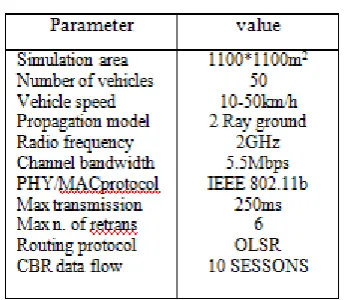
Table I. parameters defined for NS2 simulation
this method, first of all base file created the source. Transmission of packets is done by OLSR protocol and in the middle of the simulation the genetic calculation of the nodes and implementation of algorithm is done. Genetic algorithm in routing process selects the optimal path for the data flow between source and destination[8]. Hence with the help of it we can make the parameters more efficient.TCL Script,Default configurations of VANET, VANET mobility changes to tcl, procedure will be written for Genetic Algorithm,OLSR protocol, NAM window, awk file execution, graph plot.The simulation procedure is evoked using the configuration of OLSR over VANET scenario, Whenever assessment of method is expected by metaheuristic approach[10].
A. OLSR Automation
In this paper,an OLSR model has been designed to store information about every node in the network.OLSR has characterstic of saving updated structure knowledge and it sends it to the whole network.Information about delivery of packet and path establishment is presented by route table and every node updates its routing table according to the information given in the message recieved[12]. Every routing table has:
Nodes addresses.
Number of hops from the current nodes till the end node.
Saves the last series number of destination node.This entry indicates that TC message has not been sent before and it is fresh .
Ags2 that depicts whether their TC message that is recieved was sent before.Values are set to 1,when TC messages are sent again.
Destination nodes one hop neighbor which hepls in updatation of destination nodes two-hop neighbors that are getting HELLO messages
Destination nodes one hop neighbor while TC messages are recieved
.
B. GeneticAlgorithm
Initialization: Here,BSS(Base station set) which is collection of all base stations representing the cluster.We consider all vehicles to be homogeneous so base station to each cluster is allocated randomly.Direction vector(DV) is the movement of vehicles in various directions.DV consists of n elements,each depicts the node movement in n_i
direction and they are sum up to 1.0. BSS and DV represents chromosomes from GA prospective.Coveragetarget depicts the coverage user tries to achieve.Tm represents the algorithms run time
.
Sensor Vector: sensor vector is responsible for the sensing of network from time to time in order to collect various information about the node.
SV =(id of node,remaining energy,coverage readings,power recieved)
if n nodes covers an area then 𝑐𝑜𝑣𝑒𝑟𝑎𝑔𝑒 𝑜𝑓 𝑛𝑜𝑑𝑒𝑠 = 𝑐𝑜𝑣𝑒𝑟𝑒𝑑 𝑎𝑟𝑒𝑎/𝑛
Selection: In this phase Direction Vector(DV)of the favourable nodes are selected to reconstitute.To calculatethe probability of fitness, fitness function is applied to each node.
FITNESS FUNCTION
DV and BSS acts as chromosomes and these are chosen and discarded on the basis of data provided by sensor vector.while the decrement in energy conservation is discarded ,whereas the combination of coverage hike and reduction in recieving power is chosen.
Mutation and Termination: After a certain equilibrium is reached,DV and BSS of nodes are randomly mutated and base stations would be randomly assigned.The upper bound tm is the total time of simulation and after a generation passess,tm is decremented to tdelta.For the optimum coverage,we can allocate infinite value to tm but it is not possible because there is some limit to energy level of nodes.when tm=0,the algorithm stops.
STEPS OF ALGORITHM: Initialization:
Direction Vecor [DV] Base station Set [BSS]
Tm; default; infinity;Coveragetarget; default;
𝑐𝑣𝑏𝑙𝑒[𝑖]
𝑛𝑖 ,field area
Sensor Data collection: After time instant tm every node transmits the sensor vector to its router. Sensor_vector=( id, rx_power, energy, coverage)
Recombination:
fitness(i) = (coverage[i][r] - coverage[i][r-1]) + (rx_power[i][r-1] - rx_power[i][t])- (energy[i][r-1] + energy[i][r-1] - energym) for rx_power[i][t] ≥ rx_power Where:
coverage is the coverage area,
rx_power is the receiver power,
energy is the remaining energy. Mutation:
if 𝒄𝒗𝒈 𝒊 𝒓 − 𝒄𝒗𝒈 𝒊 𝒓 − 𝟏 ≤𝒓 𝒊
𝒏 𝒊
𝒄𝒐𝒗𝒆𝒓𝒂𝒈𝒆
deltamutate DV and BSS and decrement tm by tdelta Termination:
V. RESULTS
The NS-2 network simulator and blend optimized algorithm is used to evaluate the OLSR protocol on VANET scenario. In conclusion the outcomes of the optimized OLSR configurations of GA with the PSO algorithm are compared.
End to End Delay: It is the average time a packet takes to reach the destination.sometimes due to link failure,packet is not able to reach its destination and causes delay.
[image:4.595.49.287.198.585.2]𝑒𝑛𝑑 𝑡𝑜 𝑒𝑛𝑑 𝑑𝑒𝑙𝑎𝑦 = 𝑟𝑒𝑐𝑒𝑝𝑡𝑖𝑜𝑛 𝑡𝑖𝑚𝑒 − 𝑠𝑒𝑛𝑡 𝑡𝑖𝑚𝑒
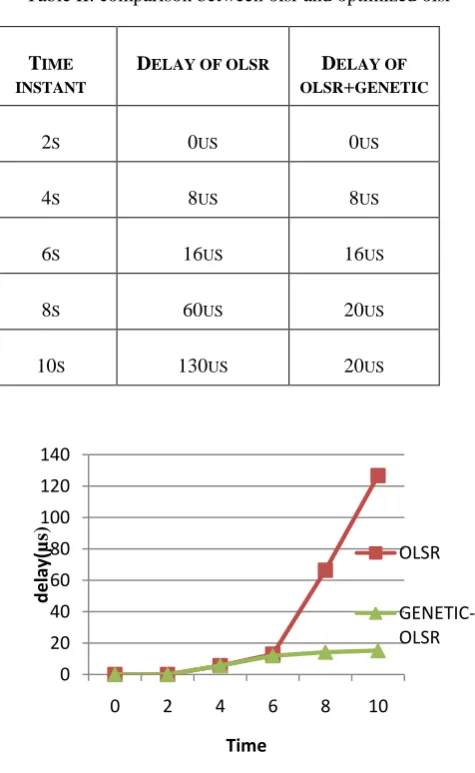
Table II. comparison between olsr and optimized olsr
Figure.1 Comparison of delay
As observed from the Figure1, it is clear that the delay that is experienced in the scenario of OLSR is 130us wherein the delay in the case where OLSR+Genetic is used is 20us that makes a huge difference. The reason behind this is the time saving in the process of sensing.With the use of genetic algorithm,coverage data is collected in the simulator from the record of displacement of nodes generated by the software.Using min_coverage and max_coverage values,an accurate loaction of the nodes can be found out which results in decrease in the end to end delay.Table II shows that at 0s,4s,6s the end to end delay for OLSR and optimized OLSR is same which is 0us,8us and 16us respectively because OLSR protocol takes 1.5s to execute its functionality. Energy Spent: Energy spent is consumption of energy or battery power.As we know in vehicle to vehicle.
communication,battery power is used to conduct various operations so saving the battery power is one of the major issue.The formula of energy spent is:
𝐸 𝐾𝑊
𝑑𝑎𝑦 = 𝑃 𝑊 ∗ 𝑡(/𝑑𝑎𝑦)/1000(𝑊/𝑘𝑊) 1kWh=3600000 Joule
where,E is energy in kilowatt-hours,t is hours per day,P is power in watts.
TableIII. comparison between olsr and optimized olsr
Figure.2 Comparison of energy spent
As depicted in Figure2 energy spent is quite clear that the energy spent in the case where OLSR and genetic are used is less than OLSR. The energy consumption in the proposed algorithm is 1.5 J wherein the energy consumed in OLSR is 1.8 J.
Energy consumotion is based on the nodes initial energy level.We have set initial energy as 90J.Once the simulation starts, after 1.5s the nodes start transmitting packets and emits radiations.It emits more energy if nodes are moving hence gradually the energy decreases.In case of optimized OLSR algorithm nodes with excellent energy level gets selected and a path for the packet transmission is made among these nodes and has less chnaces of link breakage and hence energy will be conserved
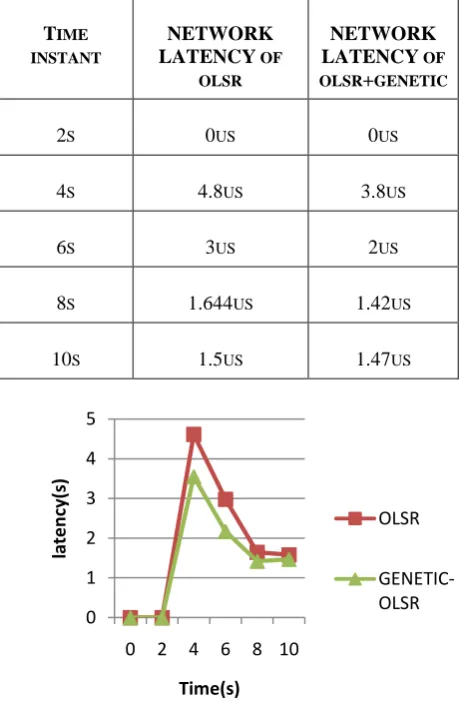
Network Latency:It is delay between cause and effect of network.Similar to the delay,
latency of the proposed algorithm is also lower than the OLSR algorithm by 0
20 40 60 80 100 120 140
0 2 4 6 8 10
d
e
lay
(
µs)
Time
OLSR
GENETIC-OLSR
0 1 2 3 4 5
0 2 4 6 8 10
e
n
e
rg
y
sp
e
n
t(
jou
le
)
Time(s)
OLSR
GENETIC-OLSR TIME
INSTANT
DELAY OF OLSR DELAY OF OLSR+GENETIC
2S 0US 0US
4S 8US 8US
6S 16US 16US
8S 60US 20US
10S 130US 20US
TIME INSTANT ENERGY SPENT OF OLSR
ENERGY SPENT OF OLSR+GENETIC
2S 1J 0J
4S 4.813J 3.8J
6S 3.22J 2.4J
8S 1.9J 1.7J
0.3us that is clearly depicted in the Figure 3 below.
Table IV. comparison between olsr and optimized olsr
Figure.3 Comparison of latency
[image:5.595.42.274.94.446.2]Throuhput: It is defined as the total number of packets delivered over the total simulation time.
Table V. comparison between olsr and optimized olsr
Figure.4 Comparison of latency
Packet Delivery Ratio(PDR): Packet delivery ratio= is defined/ as the ratio of data packets received by the destinations to those generated by the sources.
[image:5.595.314.562.301.688.2]where P1 is the number of data packets got by destination and P2 is the packets sent by source
Table VII. comparison between olsr and optimized olsr
Figure.5 Comparison of PDR
As per the Figure5 it is crystal clear that the proposed algorithm performs better in regards to PDR that is packet delivery ratio. The value of PDR differs by 0.2789s.It is due to the fact that exact location
is known by using optimized algorithm and there is less 0
1 2 3 4 5
0 2 4 6 8 10
late
n
cy
(s)
Time(s)
OLSR
GENETIC-OLSR
0 10 20 30 40
0 2 4 6 8 10
th
ro
u
gh
p
u
t(
k
bp
s)
Time
OLSR
GENETIC-OLSR
0 0.1 0.2 0.3 0.4 0.5 0.6 0.7 0.8 0.9
0 2 4 6 8 10
p
ac
ke
t
d
e
liv
e
ry
r
atio
Time(s)
OLSR
GENETIC-OLSR TIME
INSTANT
NETWORK LATENCY OF
OLSR
NETWORK LATENCY OF OLSR+GENETIC
2S 0US 0US
4S 4.8US 3.8US
6S 3US 2US
8S 1.644US 1.42US
10S 1.5US 1.47US
TIME INSTANT THROUGHPUT OF OLSR
THROUGHPUT OF OLSR+GENETIC
2S 0BPS 0BPS
4S 8.04BPS 10.29BPS
6S 15.79BPS 20.35BPS
8S 25.69BPS 27.90BPS
10S 31.23BPS 32.37BPS
TIME INSTANT PDR OF OLSR PDR OF
OLSR+GENETIC
2S 0 0
4S 0.1342 0.1439
6S 0.2650 0.4299
8S 0.4289 0.6615
Author-1 Photo
Author-2 Photo
Author-3 Photo link breakage which paves a way to almost full transmission
of packets. Genetic algorithm in routing process selects the optimal path for the data flow between source and destination. Hence with the help of it we can make the parameters more efficient
.
It selects two paths for the same source and destination.
Then it applies crossover between two paths followed by mutation process in which a new node replaces the existing node in the routing path.
The replaced node will be misbehavior node or congested node in the network.
VI. CONCLUSIONANDFUTUREWORK In this paper OLSR has addressed the optimal routing protocol with an optimization tool used in the VANETs. For this work, we have used appropriate strategy based on coupling optimization algorithms (PSO, DA, GA and SA) and the ns2 network simulator. The blending metaheuristic approach and NS-2 simulator demonstrated in this paper has ability to modify any method according to VANET settings. The optimized algorithm helps in achieving maximum coverage with less amount of energy spent.In future we have to broaden our analysis by considering examples of bigger expressway and city VANET.Here, the issue has been handled with parallel variants of meta heuristic approach keeping in mind the end goal to solve tedious issues getting
from expansive recreations.Information of
sensors,geographic positioning sysyem,security protocols,nodes deployment are considered keeping in mind the betterment of QoS of the structure.To confirm the simulation ,valid tests are required which has moving vehicles on various kinds of roads.
REFERENCES
1. A.Bandi, ''Parameters Tuning of OLSR Routing Protocol with
Metaheuristic Algorithm for VANET",Advance computing confrence
IEEE,2015,pp.1207-1212.
2. J. Toutouh, J. Garcıa-Nieto, and E. Alba, ,''Intelligent OLSR Routing
Protocol Optimization for VANETs'', IEEE Transactions On Vehicular
Technology,Vol.4,2012,pp.1884-1894.
3. J. Toutouh, E. Alba,'' Multi-objective OLSR optimization for
VANETs'',Wireless and Mobile computing,Networking and
Communications,2012,pp.571-578.
4. K.V.Patil, M.R. Dhage,''The Enhanced Optimized Routing Protocol for
Vehicular Ad hoc Network'', International Journal of Advanced
Research in Computer and Communication Engineering ,Vol.2, 2013.
5. G.Edward,C.Yeison,E.Paola,''Hybrid approaches in Network Optical
Routing with QoS based on Genetic Algorithms and Particle Swarm
Optimization'',ACEEE International Journal on Network
Security,Vol.4,2011,pp.15-18.
6. T. P. Lambrou and C. G. Panayiotou,''A Survey on Routing Techniques
supporting Mobility in Sensor Networks'',Fifth International
Conference on Mobile Ad-hoc and Sensor Networks,2009,pp.78-85.
7. L.Junhai, Y. Danxia, X. Liu,F.Mingyu,A Survey of Multicast Routing
Protocols for Mobile Ad-Hoc Networks, IEEE communications
surveys & tutorials,Vol.11,2009,pp.78-91.
8. S. Mohseni, R. Hassan, A. Patel, R. Razali ,''Comparative Review
Study of Reactive and Proactive Routing Protocols in MANETs'', 4th
IEEE International Conference on Digital Ecosystems and Technologies,2010,pp.304-309.
9. P. Vadodara, D. Gorana,'' A survey of Energy Efficient Routing
Protocol in manet'', IEEE sponsored 2nd international conference on
electronics and communication system,2015,pp.953-957.
10. P. Kaur, D. Kaur, R. Mahajan,''The Literature Survey on Manet,
Routing Protocols and Metrics'', Global Journal of Computer Science
and Technology,Vol.1, 2015.
11. P. Thakur, M.V. Raju ,'' survey on routing techniques for manets and
wireless sensor networks: a comparison'', International Journal of
Computer Engineering and Technology,Vol.4,2013,pp.275-283.
12. M. Sanchez, P. Manzoni, and Z H. Hass, ''Determination of Critical
Transmission Range in Ad-Hoc Networks'',Multiaccess, mobility, and
Teletraffic for Wireless Communication, Vol.4,1999,pp.293-304.
13. M.V. Kumaramangalam, K. Adiyapatham, C.
Kandasamy,''Zone-Based Routing Protocol for Wireless Sensor
Networks'', International Scholarly Research Notices.,2014.
14. M.Gunasekar,S.J.Hinduja,''Automatic Tuning Of OLSR Routing
Protocol Using IWD in VANET'', International Journal of Innovative
Research in Computer and Communication Engineering.,Vol.2,2014.
15. Rana, Hemant, P. Thulasiraman, and R. Thulasiram,
"MAZACORNET: Mobility aware zone based ant colony optimization
routing for VANET." Evolutionary Computation (CEC), IEEE,
Cancun,2013,pp.2948-2955.
AUTHORSPROFILE
Ramneet kaur is a research scholar at sri guru granth
sahib world university.
Dr.Navdeep kaur is a professor at sri guru granth sahib world university.