SCALABLE HIGH PERFORMANCE MULTIDIMENSIONAL
SCALING
Seung-Hee Bae
Submitted to the faculty of the University Graduate School
in partial fulfillment of the requirements
for the degree
Doctor of Philosophy
in the Department of Computer Science
Indiana University
Accepted by the Graduate Faculty, Indiana University, in partial fulfillment of the
require-ments of the degree of Doctor of Philosophy.
Doctoral Committee
Geoffrey C. Fox (Principal Advisor)
Randall Bramley
David B. Leake
January 17, 2012 David J. Wild
Copyright c
2012
Seung-Hee Bae
I dedicate this dissertation to my wife (Hee-Jung Kim) and my children (Seewon and Jian).
Acknowledgements
First of all, I am sincerely grateful to my advisor, Dr. Geoffrey C. Fox, for his insightful guidance and
cheerful encouragement to this dissertation as well as my research projects. On the basis of his guidance and
encouragement, it could be possible to complete Ph.D. degree. While I have been working with him, I could
learn how to research as a scientist.
I would like to thank my research committee members: Dr. Randall Bramley, Dr. David Leake, and Dr.
David Wild for their help, guidance, and invaluable comments to this dissertation. I would like to thank Dr.
Sun Kim, who was my former advisor and had been my research committee member before he left Indiana
University, for his valuable advices and encouragement.
It has been a pleasant time to work with those friendly and brilliant colleagues at Pervasive Technology
Institute (PTI) for five years. I am thankful to Dr. Judy Qiu for her support and discussions for my research.
I am also thankful to SALSA group members: Dr. Jaliya Ekanake, Thilina Gunarathne, Saliya Ekanayake,
Ruan Yang, Hui Li, Tak-Lon Wu, Bingjing Zhang, Yuduo Zhou, Jerome Mitchell, Adam Hughes, and Scott
Beason, for being fantastic lab mates. I am particularly thankful to Dr. Jong Youl Choi for countless valuable
discussions on various research topics as well as non-technical topics during my time at PTI.
I would like to thank administrative staffs of the School of Informatics and Computing and PTI for their
valuable helps to do my study at Indiana University (IU). I am grateful to Ms. Cathy McGregor Foster for
her helpful advice for Ph.D. study completion, and to Ms. Mary Nell Shiflet and Mr. Gary Miksik for their
administrative support at PTI. Because of their supports, I could focus on my Ph.D. study while I has been at
IU.
Last but not least, I am very much indebted to my family for their generous support and encouragement
throughout my Ph.D. study at IU. My parents and my mother-in-law have been my big supporters during
my Ph.D study, and their encouragement is always cheerful to finish this degree. I cannot fully explain my
gratitude with any words to my lovely wife, Hee-Jung, for her endurance, encouragement, and support with
love for my life as well as my study. Without her support and cheers, I would not make complete this long
journey. Since I met her at Handong, she is the only perfect companion for my life. I would like to thank to
my daughter (Seewon) and son (Jian) for being wonderful children to me. They are the source of my joy and
happiness even though I was in a difficult time.
I am a debtor of love. Thank you, all!
vii
Seung-Hee Bae
SCALABLE HIGH PERFORMANCE MULTIDIMENSIONAL SCALING
Today is so-called data deluge era. A huge amount of data is flooded in many domains of modern society based on the advancements of technologies and social networks. Dimension reduction is a useful tool for data visualization of such high-dimensional data and abstract data to make data analysis feasible for such large-scale high-dimensional or abstract scientific data. Among the known dimension reduction algorithms, multidimensional scaling (MDS) is investigated in this dissertation due to its theoretical robustness and high applicability. For the purpose of large-scale multidimensional scaling, we need to figure out two main challenges. One problem is that large-scale multidimensional scaling requires huge amounts of computation and memory resources, because it requires O(N2) memory and computation. Another problem is that multidimensional scaling is known as a non-linear optimization problem so that it is easy to be trapped in local optima if EM-like hill-climbing approach is used to solve it.
Contents
Acknowledgements v
Abstract vii
1 Introduction 1
1.1 Introduction . . . 1
1.2 Multidimensional Scaling (MDS) . . . 3
1.3 Motivation . . . 5
1.4 The Research Problem . . . 7
1.5 Contributions . . . 8
1.6 Dissertation Organization . . . 9
2 Backgrounds 11 2.1 Classical Multidimensional Scaling . . . 11
2.2 Scaling by a MAjorizing of a COmplicated Function (SMACOF) . . . 14
2.3 Message Passing Interface (MPI) . . . 16
2.4 Threading . . . 18
2.5 Deterministic Annealing (DA) . . . 19
3 High Performance Multidimensional Scaling 21 3.1 Overview . . . 21
3.2 High Performance Visualization . . . 22
3.2.1 Parallel SMACOF . . . 23
3.3 Performance Analysis of the Parallel SMACOF . . . 30
3.3.1 Performance Analysis of the Block Decomposition . . . 31
3.3.2 Performance Analysis of the Efficiency and Scalability . . . 34
3.4 Summary . . . 38
4 Interpolation Approach for Multidimensional Scaling 47 4.1 Overview . . . 47
4.2 Related Work . . . 48
4.3 Majorizing Interpolation MDS . . . 49
4.3.1 Parallel MI-MDS Algorithm . . . 54
4.3.2 Parallel Pairwise Computation Method with Subset of Data . . . 55
4.4 Analysis of Experimental Results . . . 57
4.4.1 Exploration of optimal number of nearest neighbors . . . 58
4.4.2 Comparison between MDS and MI-MDS . . . 66
4.4.2.1 Fixed Full Data Case . . . 66
4.4.2.2 Fixed Sample Data Size . . . 68
4.4.3 Parallel Performance Analysis of MI-MDS . . . 72
4.4.4 Large-Scale Data Visualization via MI-MDS . . . 77
4.5 Summary . . . 78
5 Deterministic Annealing SMACOF 80 5.1 Overview . . . 80
5.2 Related Work . . . 81
5.2.1 Avoiding Local Optima in MDS . . . 81
5.3 Deterministic Annealing SMACOF . . . 83
5.3.1 Temperature Cooling Mechanism . . . 87
5.4 Experimental Analysis . . . 88
5.4.1 Iris Data . . . 91
5.4.2 Chemical Compound Data . . . 93
5.4.3 Cancer Data . . . 95
5.4.4 Yeast Data . . . 97
5.4.5 Running Time Comparison . . . 98
5.5 Experiment Analysis of Large Data Sets . . . 99
5.5.1 Metagenomics Data . . . 100
5.5.2 ALU Sequence Data . . . 103
5.5.3 16sRNA 50k Data . . . 104
5.5.4 16sRNA 100k Data . . . 106
5.5.5 Comparison of the STRESS progress . . . 109
5.5.6 Running Time Analysis of Large Data Sets . . . 111
5.6 Summary . . . 117
6 Conclusions and Future Works 119 6.1 Summary of Work . . . 119
6.2 Conclusions . . . 120
6.2.1 High-Performance Distributed Parallel Multidimensional Scaling (MDS) . . . 121
6.2.2 Interpolation approach for MDS . . . 122
6.2.3 Improvement in Mapping Quality . . . 124
6.3 Future Works . . . 126
6.3.1 Hybrid Parallel MDS . . . 126
6.3.2 Hierarchical Interpolation Approach . . . 127
6.3.3 Future Works for DA-SMACOF . . . 127
6.4 Contributions . . . 128
Bibliography 131
List of Tables
3.1 Main matrices used in SMACOF . . . 23
3.2 Cluster systems used for the performance analysis . . . 31
3.3 Runtime Analysis of Parallel Matrix Multiplication part of parallel SMACOF with 50k data
set in Cluster-II . . . 36
4.1 Compute cluster systems used for the performance analysis . . . 59
4.2 Analysis of Maximum Mapping Distance between k-NNs with respect to the number of
near-est neighbors (k). . . . 62
4.3 Large-scale MI-MDS running time (seconds) with 100k sample data . . . 70
List of Figures
1.1 An example of the data visualization of 30,000 biological sequences by an MDS algorithm,
which is colored by a clustering algorithm. . . 5
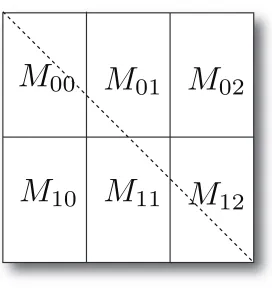
3.1 An example of an N×N matrix decomposition of parallel SMACOF with 6 processes and
2×3 block decomposition. Dashed line represents where diagonal elements are. . . 25
3.2 Parallel matrix multiplication of N×N matrix and N×L matrix based on the decomposition
of Figure 3.1 . . . 27
3.3 Calculation of B(X[k−1])matrix with regard to the decomposition of Figure 3.1. . . 29
3.4 Overall Runtime and partial runtime of parallel SMACOF for 6400 and 12800 PubChem data
with 32 cores in Cluster-I and Cluster-II w.r.t. data decomposition of N×N matrices. . . . . 40
3.5 Overall Runtime and partial runtime of parallel SMACOF for 6400 and 12800 PubChem data
with 64 cores in Cluster-I and Cluster-II w.r.t. data decomposition of N×N matrices. . . . . 41
3.6 Overall Runtime and partial runtime of parallel SMACOF for 6400 and 12800 PubChem data
with 128 cores in Cluster-II w.r.t. data decomposition of N×N matrices. . . . 42
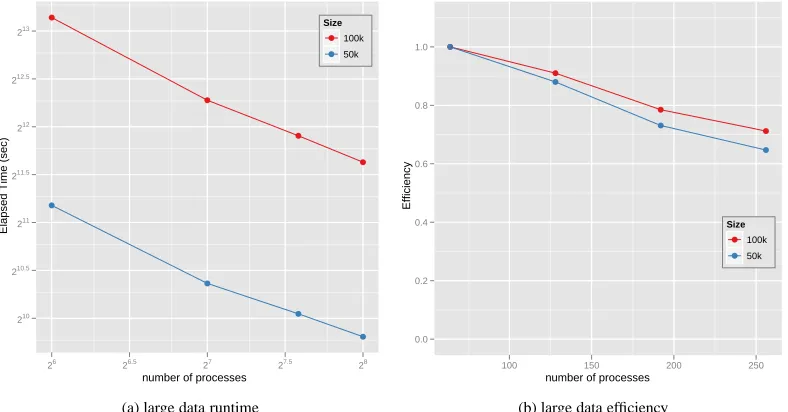
3.7 Performance of parallel SMACOF for 50K and 100K PubChem data in Cluster-II w.r.t. the
number of processes, i.e. 64, 128, 192, and 256 processes (cores). (a) shows runtime and
efficiency is shown at (b). We choose balanced decomposition as much as possible, i.e. 8×8
for 64 processes. Note that both x and y axes are log-scaled for (a). . . 43
3.8 Efficiency of tMatMult and tMM Computing in Table 3.3 with respect to the number of
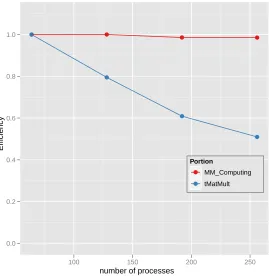
processes. . . 44
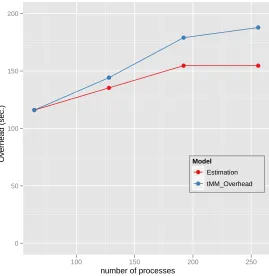
3.9 MPI Overhead of parallel matrix multiplication (tMM Overhead) in Table 3.3 and the rough
Estimation of the MPI overhead with respect to the number of processes. . . 45
3.10 Performance of parallel SMACOF for MC 30000 data in Cluster-I and Cluster-II w.r.t. the
number of processes, i.e. 32, 64, 96, and 128 processes for Cluster-I and Cluster-II, and
extended to 160, 192, 224, and 256 processes for Cluster-II. (a) shows runtime and efficiency
is shown at (b). We choose balanced decomposition as much as possible, i.e. 8×8 for 64
processes. Note that both x and y axes are log-scaled for (a). . . 46
4.1 Message passing pattern and parallel symmetric pairwise computation for calculating STRESS
value of whole mapping results. . . 56
4.2 Quality comparison between interpolated result of 100k with respect to the number of nearest
neighbors (k) with 50k sample and 50k out-of-sample result. . . . 60
4.3 The illustration of the constrained interpolation space when k=2 or k=3 by initialization at
the center of the mappings of the nearest neighbors. . . 61
4.4 The mapping results of MI-MDS of 100k Pubchem data with 50k sample data and 50k
out-of-sample data with respect to the number of nearest neighbors (k). The sample points are
shown in red and the interpolated points are shown in blue. . . 63
4.5 Histogram of the original distance and the pre-mapping distance in the target dimension of
50k sampled data of 100k. The maximum original distance of the 50k sampled data is 10.198
and the maximum mapping distance of the 50k sampled data is 12.960. . . 64
4.6 Quality comparison between the interpolated result of 100k with respect to the different
sam-ple sizes (INTP) and the 100k MDS result (MDS) . . . 67
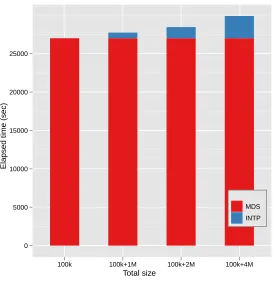
4.7 Running time comparison between the Out-of-Sample approach which combines the full
MDS running time with sample data and the MI-MDS running time with out-of-sample data
when N=100k, with respect to the different sample sizes and the full MDS result of the 100k
data. . . 68
4.8 Elapsed time of parallel MI-MDS running time of 100k data with respect to the sample size
using 16 nodes of the Cluster-II in Table 4.1. Note that the computational time complexity of
MI-MDS isO(Mn)where n is the sample size and M=N−n. . . . 69
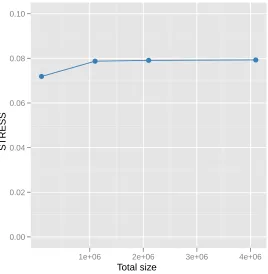
4.9 The STRESS value change of the interpolation larger data, such as 1M, 2M, and 4M data
points, with 100k sample data. The initial STRESS value of MDS result of 100k data is
0.0719. . . 70
4.10 Running time of the Out-of-Sample approach which combines the full MDS running time
with sample data (M=100k) and the MI-MDS running time with different out-of-sample
data sizes, i.e. 1M, 2M, and 4M. . . 71
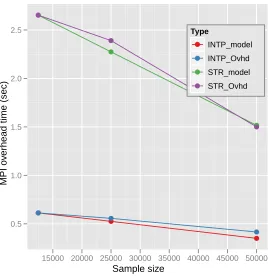
4.11 Parallel overhead modeled as due to MPI communication in terms of sample data size (m)
using Cluster-I in Table 4.1 and message passing overhead model. . . 73
4.12 Parallel overhead modeled as due to MPI communication in terms of sample data size (m)
using Cluster-II in Table 4.1 and message passing overhead model. . . 74
4.13 Efficiency of the interpolation part (INTP) and the STRESS evaluation part (STR) runtimes
in the parallel MI-MDS application with respect to different sample data sizes using Cluster-I
in Table 4.1. The total data size is 100K. . . 75
4.14 Efficiency of the interpolation part (INTP) and the STRESS evaluation part (STR) runtimes in
the parallel MI-MDS application with respect to different sample data sizes using Cluster-II
in Table 4.1. The total data size is 100K. . . 76
4.15 Interpolated MDS results of total 100k PubChem dataset trained by (a) 12.5k and (b) 50k
sampled data. Sampled data are colored in red and interpolated points are in blue. . . 77
4.16 Interpolated MDS results. Based on 100k samples (a), additional 2M PubChem dataset is
interpolated (b). Sampled data are colored in red and interpolated points are in blue. . . 78
5.1 The computational temperature movement with respect to two different cooling temperature
mechanisms (exponential and linear). . . . 89
5.2 The normalized STRESS comparison of the iris data mapping results in 2D space. The bar
graph illustrates the average of 50 runs with random initialization, and the corresponding error
bar represents the minimum and maximum of the normalized STRESS values of SMACOF,
MDS-DistSmooth with different smoothing steps (s=100 and s=200) (DS-s100 and -s200
hereafter for short), and DA-SMACOF with different cooling parameters (α=0.9, 0.95, and
0.99) (DA-exp90,-exp95, and -exp99 hereafter for short). The x-axis is the threshold value
for the stopping condition of iterations (10−5and 10−6). . . . . 90
5.3 The 2D median output mappings of iris data with SMACOF (a), DS-s100 (b), and DA-exp95
(c), whose threshold value for the stopping condition is 10−5. Final normalized STRESS
values of (a), (b), and (c) are 0.00264628, 0.00208246, and 0.00114387, correspondingly. . . 92
5.4 The normalized STRESS comparison of the chemical compound data mapping results in
2D space. The bar graph illustrates the average of 50 runs with random initialization, and the
corresponding error bar represents the minimum and maximum of the normalized STRESS
values of SMACOF, DS-s100 and -s200, and DA-exp90, DA-exp95, and DA-exp99. The
x-axis is the threshold value for the stopping condition of iterations (10−5and 10−6). . . 94
5.5 The normalized STRESS comparison of the breast cancer data mapping results in 2D space.
The bar graph illustrates the average of 50 runs with random initialization, and the
corre-sponding error bar represents the minimum and maximum of the normalized STRESS values
of SMACOF, DS-s100 and -s200, and DA-exp90,DA-exp95, and DA-exp99. The x-axis is
the threshold value for the stopping condition of iterations (10−5and 10−6). . . 96
5.6 The normalized STRESS comparison of the yeast data mapping results in 2D space. The bar
graph illustrates the average of 50 runs with random initialization, and the corresponding error
bar represents the minimum and maximum of the normalized STRESS values of SMACOF,
DS-s100 and -s200, and DA-exp90,DA-exp95, and DA-exp99. The x-axis is the threshold
value for the stopping condition of iterations (10−5and 10−6). . . 97
5.7 The average running time comparison between SMACOF, MDS-DistSmooth (s=100), and
DA-SMACOF (DA-exp95) for 2D mappings with tested data sets. The error bar
repre-sents the minimum and maximum running time. EM-5/EM-6 reprerepre-sents SMACOF with
10−5/10−6threshold, and DS-5/DS-6 and DA-5/DA-6 represents the runtime results of
MDS-DistSmooth and DA-SMACOF, correspondingly, in the same way. . . 98
5.8 The normalized STRESS comparison of the metagenomics sequence data mapping results in
2D and 3D space. The bar graph illustrates the average of 10 runs with random initialization,
and the corresponding error bar represents the minimum and maximum of the normalized
STRESS values of SMACOF and DA-SMACOF withα=0.95. The x-axis is the threshold
value for the iteration stopping condition of the SMACOF and DA-SMACOF algorithms
(10−5and 10−6). . . 101
5.9 The normalized STRESS comparison of the ALU sequence data mapping results in 2D and
3D space. The bar graph illustrates the average of 10 runs with random initialization, and the
corresponding error bar represents the minimum and maximum of the normalized STRESS
values of SMACOF and DA-SMACOF withα=0.95. The x-axis is the threshold value for
the iteration stopping condition of the SMACOF and DA-SMACOF algorithms (10−5and
10−6). . . 102
5.10 The normalized STRESS comparison of the 16s RNA sequence data with 50000 sequences
for mapping in 2D and 3D space. The bar graph illustrates the average of 10 runs with random
initialization, and the corresponding error bar represents the minimum and maximum of the
normalized STRESS values of SMACOF, DA-SMACOF withα =0.95 (DA-exp95), and
DA-SMACOF with linear cooling with 100 steps (DA-lin100). The x-axis is the threshold
value for the iteration stopping condition of the SMACOF and DA-SMACOF algorithms
(10−5, 10−6, and hybrid approach). . . 104
5.11 The mapping progress of DA-SMACOF with RNA50k data set in 2D space with respect to
computational temperature (T ) and corresponding normalized STRESS value (σ). . . 107
5.12 The normalized STRESS comparison of the 16s RNA sequence data with 100000 sequences
for mapping in 2D and 3D space. The bar graph illustrates the average of 10 runs with random
initialization, and the corresponding error bar represents the minimum and maximum of the
normalized STRESS values of SMACOF, DA-SMACOF withα =0.95 (DA-exp95), and
DA-SMACOF with linear cooling with 100 steps (DA-lin100). The x-axis is the threshold
value for the iteration stopping condition of the SMACOF and DA-SMACOF algorithms
(10−5, 10−6, and hybrid approach). . . 108
5.13 The normalized STRESS progress comparison of MC 30k data in 2D and 3D space by
SMA-COF and exp95. The x-axis is the cummulated iteration number of SMASMA-COF and
DA-SMACOF algorithms. . . 110
5.14 The normalized STRESS progress comparison of RNA50k data in 2D and 3D space by
SMA-COF and exp95. The x-axis is the cummulated iteration number of SMASMA-COF and
DA-SMACOF algorithms. . . 112
5.15 The average running time comparison between SMACOF and DA-SMACOF (DA-exp95) for
2D and 3D mappings with MC30000 and ALU50058 data sets. The error bar represents the
minimum and maximum running time. EM-5/EM-6 represents SMACOF with 10−5/10−6
threshold, and DA-5/DA-6 represents the runtime results of DA-SMACOF, correspondingly,
in the same way. . . 113
5.16 The average running time comparison between SMACOF, DA-SMACOF (DA-exp95), and
DA-SMACOF with linear cooling (DA-lin100) for 2D and 3D mappings with 16s RNA
data sets. The error bar represents the minimum and maximum running time. EM-5/EM-6
represents SMACOF with 10−5/10−6threshold, and DA-e5/DA-e5,6/DA-6 and
DA-l5/DA-l5,6/DA-l6 represents the runtime results of DA-exp95 and DA-lin100, correspondingly, with
10−5/hybrid(10−5and 10−6)/10−6. . . 115
1
Introduction
1.1
Introduction
Because of the advancements of technology, a huge amount of data are produced in many domains of
modern society, from digital personal information to scientific observation, and experimental data to medical
records data. The current era could be referred to as the so-called data deluge era. In many scientific domains,
the volumes of data are on the tera-scale and even the peta-scale. For the study of large-scale sky surveys
in astronomy, about 20 terabytes of sky image data are collected by the Large Synoptic Survey Telescope1
per night, and this phenomenon has led to about 60 petabytes of raw data over ten years of operations. In
addition to large-scale sky survey data, biological sequence data has been produced in unimaginable volumes.
Although the Human Genome Project2, which was finished in 2003, was completed in 13 years and cost
billions of dollars, now genome sequencing for an organism can be done much faster and more cheaply due
to cost-effective high-throughput sequencing technologies. In fact, innovative sequencing technologies and
the microarray technique have increased the volumes of biological data enormously.
1LSST: Large Synoptic Survey Telescope (http://www.lsst.org/lsst/)
2Human Genome Project (http://www.ornl.gov/sci/techresources/Human Genome/home.shtml)
1. Introduction 2
In 2005, Intel proposed the Recognition, Mining, and Synthesis (RMS) [24] approach as a killer
ap-plication for the next data explosion era. Machine learning and data mining algorithms were suggested as
important algorithms for the data deluge era by [24]. Mining some meaningful information from these large
volumes of raw data requires a huge amount of computing power which exceeds a single computing machine.
To make matters worse, the asymptotic time complexities of most of the data mining algorithms are larger
than a simpleO(N), in that they require a significant amount of processing capability for analyses over large
volumes of data. Thus, parallel and distributed computing is a critical feature of performing such data
analy-ses. The efficiency and the scalability should be achieved in a parallel implementation of algorithms in order
to maximize the effects of parallel and distributed computing.
One of the innovative inventions that has emerged in the computer hardware community during the last
decade was the invention of multi-core architecture. The classical method of improving the computing power
of computing processing units (CPUs), such as increasing clock speed, has been limited by physical obstacles;
therefore, the CPU companies changed the focus of improving computing power from increasing the clock
speed of a CPU to increasing the number of cores in a CPU chip. Since multicore architecture as invented,
multicore architecture has become important in software development with effects on the client, the server
and supercomputing systems [5, 23, 24, 66]. As mentioned in [66], the parallelism has become a critical issue
for developing software for the purpose of effectively using multicore systems.
From the above statements, the necessary computation will be enormous for data mining algorithms in the
future, and classical sequential programming schemes will not be suitable for multicore systems any more,
so that implementing in scalable parallelism these algorithms will be one of the most important procedures
for the coming many-core and data explosion era.
Among the many data mining areas which exist, such as clustering, classification, and association rule
mining, and so on, dimension reduction algorithms are used to visualize high-dimensional data or abstract
1. Introduction 3
which can be applied to usage to fulfill the following purposes: (1) representing unknown data distribution
structures in human-perceptible space with respect to the pairwise proximity or topology of the given data;
(2) verifying a certain hypothesis or conclusion related to the given data by showing the distribution of the
data; and (3) investigating relationship among the given data by spatial display.
Among the known dimension reduction algorithms, such as Principal Component Analysis (PCA),
Multi-dimensional Scaling (MDS) [13, 45], Generative Topographic Mapping (GTM) [11, 12], and Self-Organizing
Maps (SOM) [43], to name a few, multidimensional scaling (MDS) has been extensively studied and used
in various real application areas, such as biology [48, 71], stock market analysis [33], computational
chem-istry [4], and breast cancer diagnosis [46]. This dissertation focuses on the MDS algorithm, and we investigate
two ultimate goals: (1) how to achieve the scalability of the MDS algorithm to deal with large-scale data; and
(2) how to improve the mapping quality of MDS solutions as well as the scalable MDS. This dissertation also
describes some detailed performance analyses and experiments related to the proposed methodologies.
1.2
Multidimensional Scaling (MDS)
Multidimensional scaling (MDS) [13, 45, 68] is a general term that refers to techniques for constructing a
map of generally high-dimensional data into a target dimension (typically a low dimension) with respect to
the given pairwise proximity information. Mostly, MDS is used to visualize given high dimensional data or
abstract data by generating a configuration of the given data which utilizes Euclidean low-dimensional space,
i.e. two-dimension or three-dimension.
Generally, proximity information, which is represented as an N×N dissimilarity matrix (∆= [δi j]),
where N is the number of points (objects) andδi jis the dissimilarity between point i and j, is given for the
1. Introduction 4
technique is to construct a configuration of a given high-dimensional data into low-dimensional Euclidean
space, where each distance between a pair of points in the configuration is approximated to the
correspond-ing dissimilarity value as much as possible. The output of MDS algorithms could be represented as an N×L
configuration matrix X, whose rows represent each data point xi (i=1, . . . ,N) in L-dimensional space. It is
quite straightforward to compute the Euclidean distance between xiand xjin the configuration matrix X , i.e.
di j(X) =kxi−xjk, and we are able to evaluate how well the given points are configured in the L-dimensional
space by using the suggested objective functions of MDS, called STRESS [44] or SSTRESS [67]. Definitions
of STRESS (1.1) and SSTRESS (1.2) are following:
σ(X) =
∑
i<j≤N
wi j(di j(X)−δi j)2 (1.1)
σ2(X) =
∑
i<j≤N
wi j[(di j(X))2−(δi j)2]2 (1.2)
where 1≤i< j≤N and wi jis a weight value, so wi j≥0.
As shown in the STRESS and SSTRESS functions, the MDS problems could be considered to be
non-linear optimization problems, which minimizes the STRESS or the SSTRESS function in the process of
configuring an L-dimensional mapping of the high-dimensional data.
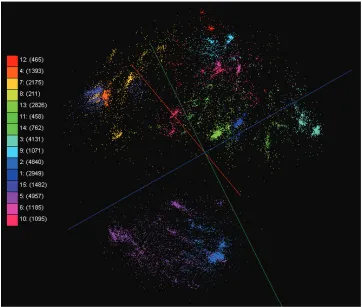
Figure 1.1 is an example of the data visualization of 30,000 biological sequence data, which is related to
a metagenomics study, by an MDS algorithm. The colors of the points in Figure 1.1 represent the clusters
of the data, which is generated by a pairwise clustering algorithm by deterministic annealing [36]. The data
visualization in Figure 1.1 shows the value of the dimension reduction algorithms which produced lower
dimensional mapping for the given data. We can see clearly the clusters without quantifying the quality of
1. Introduction 5
Figure 1.1: An example of the data visualization of 30,000 biological sequences by an MDS algorithm, which is colored by a clustering algorithm.
1.3
Motivation
The recent explosion of publicly available biological gene sequences, chemical compounds, and various
scientific data offers an unprecedented opportunity for data mining. Among the various available data mining
algorithms, dimension reduction is a useful tool for information visualization of high-dimensional data to
make analysis feasible for large volume and high-dimensional scientific data. It facilitates the investigation
of unknown structures of high dimensional data in three (or two) dimensional visualization.
In contrast to other algorithms, like PCA, GTM, and SOM, which generally construct a low dimensional
1. Introduction 6
dimension on the basis of pairwise proximity (typically dissimilarity or distance) information; as a result, it
does not require feature vector information of the underlying application data to acquire a lower dimensional
mapping of the given data. Hence, MDS is an extremely useful approach for data visualization of a certain
type of data, which would prove impossible or improper to represent by feature vectors but tat has pairwise
dissimilarity, such as a biological sequence data. MDS, of course, is also applicable to data represented by
feature vectors as well. MDS provides more broad applicability than other dimension reduction methods in
terms of the given format of the data.
In the past, the data size given dealt with by machine learning and data mining algorithms was usually
small enough to be executed on a single CPU or node without any consideration of parallel computing. On the
other hand, in the modern data-deluged world, we can find many interesting data sets with large amounts of
units which are impossible to run as sequential programming on a single node due, not only to the prohibitive
computing requirements but also, because of the required memory size. Therefore, we have to figure out
how to increase the computational capability of the MDS algorithm in order to manage large-scale
high-dimensional data sets. In addition to the increase of data size, the invention and emergence of multi-core
architectures has also required a change in the programming paradigm, so as to be able to utilize the maximal
performance of the multi-core chips.
In general, there are two different approaches with which to improve the computing capability of MDS
algorithm. One is to increase the available computing resources, i.e. CPUs and main memory size, and the
other method is to reduce the computational time complexity.
In addition to the motivation of increasing computational capability because of the large scale of the
data, another motivation of this thesis is based on the fact that the MDS problem is a non-linear optimization
problem, which means it might have many local optima, so the avoidance of non-global local optima is an
essential property needed in order to obtain a better quality of MDS outputs. Also, if we achieve the local
1. Introduction 7
output, than the output of the MDS algorithm which suffers from being trap in local optima. Thus, this
dissertation also investigates how to avoid local optima effectively and efficiently.
1.4
The Research Problem
The explosion of data and the invention of multi-core architecture has brought forth interesting reseach
issues in the data mining community as well as other computer science areas. We reviewed the interesting
research motivations in relation to the MDS algorithm in Section 1.3. As we discussed in Section 1.3, two
main goals of this dissertation are: (1) examining the scalability of the MDS algorithm due to the large-scale
of the given data, i.e. millions of points; and (2) the local optima avoidance issue of MDS, which is a
non-linear optimization problem. These motivations of this dissertation have lead us to the following research
problems:
Parallelization
Applying distributed parallelism to the MDS algorithm is a natural process for achieving an increase in
the computational capability by using distributed computing nodes. This makes it possible to acquire
more computing resources and to utilize the full power of multi-core systems. Several issues should
be covered to implement an algorithm in parallel, such as the load-balance, efficiency, and scalability
issues.
Reduction of Complexity
Since the time complexity and memory requirements of the MDS algorithm is O(N2)due to the use
of an N by N pairwise dissimilarity matrix, where N is the number of points, and the distributed
paral-lel implementation of MDS algorithm is still limited to the number of available computing resources,
1. Introduction 8
requirement, is required to reach the goal of scalability of the MDS algorithm. The parallel
implemen-tation of the proposed MDS approach will be highly encouraged because the size of the data could be
enormous.
Optimization Method
Trapping in a local optima problem is a well-known problem of the non-linear optimization methods,
including MDS problem. This is a very important issue for the non-linear optimization problems to
avoid local optima. However, it is difficult to avoid local optima by using simple heuristics, which
are based on the hill-climbing optimization method. Various non-determinstic optimization methods,
such as the Genetic Algorithms (GA) [37] and Simulated Annealing (SA) [40], were proposed as
solutions of local optima avoidance problems. They have been used for many non-linear optimization
problems. As with other data mining algorithms, various optimization methods have been applied to
the MDS problem for the purpose of avoiding local optima. It is true that the GA and SA algorithms
are very successful for avoiding local optima, which is the goal of these algorithms. These algorithms,
however, are also known to suffer from long running times due to their non-deterministic random
walking approach. By taking the above statements into consideration, we would like to solve the local
optima issue of the MDS problem by applying a deterministic optimization method, which is not based
on a simple gradient descent approach.
1.5
Contributions
We can summarize the contributions of this dissertation as being the purpose of improving MDS
algo-rithms in relation to computational capability and mapping quality such as the following:
• [Parallelization] Efficient parallel implementation via the Message Passing Interface (MPI) in order to
1. Introduction 9
systems, i.e. cluster systems.
• [Reducing Complexity] Development of an innovative algorithm, which reduces the computational
complexity and memory requirement of MDS algorithms, and which produces acceptable mapping
results; this step will be taken for the purpose of scaling the MDS algorithm’s capacity up to millions
of points, a step which is usually intractable for generating a mapping via normal MDS algorithms.
• [Local Optima Avoidance] Providing an MDS algorithm which could comprehend out the local
op-tima avoidance problem in a deterministic way so that it generates better quality mapping in a
reason-able amount of time.
1.6
Dissertation Organization
This dissertation is composed of several chapters and each chapter describes a unique part of this thesis
as follows:
In Chapter 2, we describe some background methodologies related to this dissertation. First, we discussed
the well-known MDS algorithm which is named Scaling by a MAjorizing of a COmplicated Function
(SMA-COF). This is implemented in distributed parallel fashion in Chapter 3. Also, we summarize the optimization
method, named Deterministic Annealing (DA), which aims at avoiding local optima and which is used in this
dissertation. The Message Passing Interface (MPI) standard is briefly mentioned in this chapter as well.
How to achieve distributed parallel implementation of the SMACOF algorithm is illustrated in detail
in Chapter 3. Since the load balance has a critical impact on the efficiency of the parallel implementations, we
discuss how to decompose and spread out the given data to each process; this approach is directly connected
to the load balance issue. Furthermore, we described the message passing patterns of each components of
1. Introduction 10
on the testing results on two different cluster systems, follows the explanation of the parallel implementation
in Chapter 3.
Chapter 4 describes the interpolation algorithm of the MDS problem which reduces computational
com-plexity fromO(N2)toO(nM), where N is the full data size, n is the sampled data size, and M=N−n.
Furthermore, we introduce how to parallelize the proposed interpolation algorithm of MDS due to the huge
amounts of data points. This section is followed by a discussion of a quality comparison between the
pro-posed interpolation algorithm and the full MDS algorithm, as well as parallel performance analysis of the
parallelized implementation of this algorithm.
In contrast to Chapter 3 and Chapter 4, which focus on scaling up the computing capability of MDS
algorithms, we propose the step of applying the deterministic annealing (DA) [62, 63] optimization method
to the MDS problem; this approach will result in an avoidance of local optima in a deterministic way. This
information is presented in Chapter 5. In Chapter 5, we also compare the DA applied MDS algorithm with
other MDS algorithms, with respect to the mapping quality and running time.
Finally, in Chapter 6, we present the conclusions of this dissertation and future research interests related
2
Backgrounds
2.1
Classical Multidimensional Scaling
The classical scaling (Classical MDS) was the first practical technique available for MDS, which was
proposed by Torgerson [68, 69] and Gower [31]. The linear algebraic theorems mentioned by Eckart and
Young [25] and Young and Householder [75] are the bases of the classical MDS. The main idea of the classical
MDS is that, if the dissimilarities are represented by Euclidean distances, then we can find the configurations
which represent the dissimilarities by using some matrix operations. Here, we briefly introduce the classical
MDS algorithm, and the algorithm is explained in detail in Chapter 12 of [13].
The matrix of squared Euclidean distances of the given coordinates (D(2)(X)or simply D(2)) can be
expressed by a simple matrix equation with respect to the coordinate matrix (X), as shown in (2.1) and (2.2):
D(2) = c1t+1ct−2XXt (2.1)
= c1t+1ct−2B, (2.2)
2. Backgrounds 12
where c is the diagonal elements of XXt, 1 is the one vector whose elements are all ONE, 1t, ct, and Xt
are transpose of 1, c, and X, correspondingly, and B=XXt. (2.1) illustrates the relation between the squared
distances and the scalar products of the coordinate matrix (X).
The centering matrix (J) can be defined as J=I−n−111t, where I is the identity matrix, which translates
a matrix to a column centered matrix by multiplying them. By multiplying the left and the right sides by the
centering matrix J, a process called the double centering operation, we can introduce the following equations:
JD(2)J = J(c1t+1ct−2XXt)J (2.3)
= Jc1tJ+J1ctJ−J(2B)J (2.4)
= Jc0t+0ctJ−2JBJ (2.5)
= −2JBJ (2.6)
= −2B. (2.7)
Since the centering of a vector of ones turns out to be a vector of zeros (1tJ=J1=0), the first two
terms are elliminated. Without a loss of generality, we can assume that the coordinate matrix (X) is a column
centered matrix. Then, the result of the double centering operation on the B matrix is equal to B itself, since
X is a column centered matrix. Therefore, we can define the relation between B and D(2)as in (2.8).
B=−12JD(2)J. (2.8)
2. Backgrounds 13
Algorithm 2.1 Classical MDS algorithm
1: Calculate the matrix of squared dissimilarity∆(2).
2: Compute B∆by applying double centering: B∆=−1 2J∆
(2)J.
3: Compute the eigendecomposition of B∆=QΛQt.
4: /* Q+is the first L eigenvectors of Q */
5: /*Λ+is the first L eigenvalues ofΛwhich is greater than ZERO. */ 6: Calculate L-dimensional coordinate matrix X by X=Q+Λ1+/2.
7: return X.
B = QΛQt (2.9)
= QΛ1/2Λ1/2Qt (2.10)
= QΛ1/2(Λ1/2)tQt (2.11)
= (QΛ1/2)(QΛ1/2)t=XXt. (2.12)
By (2.12), we can find the coordinate matrix from the given squared distance matrix. The classical MDS
is very close to the above method, and the only difference is that it uses the squared dissimilarity matrix (∆(2)) instead of the matrix of squared distances (D(2)).
Algorithm 2.1 describes the classical MDS procedure, and its computational time complexity isO(N3)
due to the eigendecomposition. Note that, if∆is not a Euclidean distance matrix, some eigenvalues could be negative. The classical MDS algorithm ignores those negative eigenvalues as errors. Since the classical MDS
is an analytical solution, it does not require iterations to get a solution as shown in Algorithm 2.1. Another
merit of the classical MDS is that it provides nested solutions, in that the two dimensions of a 2D solution
are the same as the first two dimensions of a 3D result. The objective function of the classical MDS is called
2. Backgrounds 14
Algorithm 2.2 SMACOF algorithm
1: Z⇐X[0];
2: k⇐0;
3: ε⇐small positive number;
4: MAX⇐maximum iteration;
5: Computeσ[0]=σ(X[0]);
6: while k=0 or (∆σ>εand k≤MAX ) do
7: k⇐k+1;
8: X[k]=V†B(X[k−1])X[k−1]
9: Computeσ[k]=σ(X[k])
10: Z⇐X[k];
11: end while
12: return Z;
S(X) =||XXt−B∆||2. (2.13)
2.2
Scaling by a MAjorizing of a COmplicated Function (SMACOF)
There are a lot of different algorithms which could be used to solve the MDS problem, and Scaling by
MAjorizing a COmplicated Function (SMACOF) [20, 21] is one of them. SMACOF is an iterative
majoriza-tion algorithm used to solve the MDS problem with the STRESS criterion. The iterative majorizamajoriza-tion
proce-dure of the SMACOF could be thought of as an Expectation-Maximization (EM) [22] approach. Although
SMACOF has a tendency to find local minima due to its hill-climbing attribute, it is still a powerful method
since the algorithm, theoretically, guarantees a decrease in the STRESS (σ) criterion monotonically. Instead
of a mathematically detail explanation of the SMACOF algorithm, we illustrate the SMACOF procedure in
this section. For the mathematical details of the SMACOF algorithm, please refer to [13].
Algorithm 2.2 illustrates the SMACOF algorithm for the MDS solution. The main procedure of the
SMACOF are its iterative matrix multiplications, called the Guttman transform, as shown in Line 8 in
Al-gorithm 2.2, where V†is the Moore-Penrose inverse [52, 54] (or pseudo-inverse) of matrix V . The N×N
2. Backgrounds 15
V = [vi j] (2.14)
vi j =
−wi j if i6=j
∑i6=jwi j if i=j
(2.15)
B(Z) = [bi j] (2.16)
bi j =
−wi jδi j/di j(Z) if i6=j
0 if di j(Z) =0,i6=j
−∑i6=jbi j if i=j
(2.17)
If the weights are equal to one (wi j=1) for all pairwise dissimilarities, then V and V† are simplified as
follows:
V = N
I−ee
t
N
(2.18)
V† = 1
N
I−ee
t
N
(2.19)
where e= (1, . . . ,1)tis one vector whose length is N. In this thesis, we generate mappings based on the equal
weights weighting scheme and we use (2.19) for V†.
As in Algorithm 2.2, the computational complexity of the SMACOF algorithm is O(N2), since the
Guttman transform performs a multiplication of an N×N matrix and an N×L matrix twice, typically N≫L
(L=2 or 3), and the computation of the STRESS value, B(X[k]), and D(X[k])also takeO(N2). In addition,
the SMACOF algorithm requiresO(N2)memory because it needs several N×N matrices, as in Table 3.1.
Due to the trends of digitization, data sizes have increased enormously, so it is critical that we are able to
2. Backgrounds 16
single node computer due to the memory requirement increases inO(N2). In order to remedy the shortage
of memory in a single node, we illustrate how to parallelize the SMACOF algorithm via message passing
interface (MPI) for utilizing distributed-memory cluster systems in Chapter 3.
2.3
Message Passing Interface (MPI)
The Message Passing Interface (MPI) [27,73] standard is a language-independent message passing
proto-col, and is the one of the most widely used parallel programming methods in the history of parallel computing.
MPI is a library specification for a message passing system, which aims at utilizing distributed computing
resources, i.e. computer cluster systems, for the purpose of increasing the computing power to deal with the
large scale problem caused by the communication between processes via messages.
MPI specification is composed of the definitions of a set of routines used to illustrate various
paral-lel programming models effectively, such as point-to-point communication, collective communication, the
topologies of communicators, derived data types, and parallel-IO. Since MPI uses language-independent
specifications for calls and language bindings, MPI runtimes are available for many programming languages,
for instance, Fortran, C, C++, Java, C#, Python, and so on.
MPI communication procedures can be categorized by two different mechanisms: (i) a point-to-point
communication procedure in which a communication is operated between two processes; and (ii) a collective
communication procedure, in which all processes within a communication group should invoke the collective
communication procedure.
A point-to-point communication can occur with a pair of send and receive operations. The MPI send
and receive operations are divided into: (i) a blocking operation and (ii) a nonblocking operation. In [27],
2. Backgrounds 17
blocking If a return from the procedure indicates the user is allowed to re-use resources specified in the call.
nonblocking If the procedure may return before the operation completes, and before the user is allowed to
re-use resources (such as buffers) specified in the call.
In addition to a standard mode, MPI also proposes three more communication modes: the (i) buffered,
(ii) synchronous, and (iii) ready modes. In the standard communication mode, MPI decides whether the
outgoing message will be buffered or not, not by users, so that a stardard mode send operation can be started
regardless of posting of the matching receive; this command may be complete before a maching receive is
posted, or it will not complete until a maching receive has been posted and the data has been moved to the
receiver. A buffered mode send operation is defined as a local procedure so that it depends only on the local
process and can complete without regard to other processes. In fact, MPI must buffer the outgoing message
of a buffered mode send operation so it can complete in the local region. In the synchronous communication
mode, a send operation can be started regardless of posting of the matching receive, similar to the standard
and buffered modes. However, it will not complete successfully until a matching receive operation is posted
and the receive operation has started to receive the message of the synchronous send. A send in the ready
mode may be started only if the matching receive operation is already posted, unlike a send operation in
other communication modes. Both blocking and nonblocking send operations can use these four different
communication modes explained above.
Several collective communication procedures are defined in the MPI standard [27]: barrier
synchroniza-tion, broadcast, scatter, gather, allgather, scatter/gather (which is complete exchange or all-to-all), and
reduc-tion/allreduction operations i.e. sum, min, max, or user defined functions. A collective operation requires
that all processes in the communication group call the communication routine.
MPI is highly used under distributed cluster systems, which connected via a high-speed network; it is
2. Backgrounds 18
large-scale data-intensive or computing-intensive applications. MPI also supports various communication
topologies, such as 2D or 3D grids and general graphs topologies, as well as dynamic communiation groups.
In addition, new types of functionality, such as dynamic processes, one-sided communication, parallel I/O,
and so on, are added to MPI standard 2 [26]. MPI provides flexible fine-grained parallel programming
environment based on various features of MPI.
2.4
Threading
Emerging multicore processors places a spotlight parallel computing, including threading, since it is able
to supply many computing units in a single node and even in a single CPU. Threading is used to investigate
parallelism within shared memory systems, such as graphics processors, multicore systems, and Symmetric
Multiprocessor (SMP) Systems.
Threading supports fine grained task parallelism, which could be effective for various applications
with-out message passing overhead. For the correct use of threading, however, we have to consider the following:
(i) dealing with critical sections, which should be mutually exclusive between threads; and (ii) cache false
sharing overhead and cache line effects. There are a lot of threading libraries, which suppport parallelism
via threads, such as POSIX Threads [15], OpenMP [3], the Task Parallel Library (TPL) [47], Intel Threading
Building Blocks (TBB) [2, 60], and the Boost library [1, 39], to name a few. The Concurrency and
Coordi-nation Runtime (CCR) [18, 61] library supports a more complicated threading parallelism through message
passing via Port, which can be thought of as a way to queue messages. In addition to these libraries, most
programming languages also support threading in various forms.
Since multicore technology has been invented, multicore CPUs have become universal and typical, in that
most cluster systems are multicore cluster systems. Multicore cluster systems are distributed memory systems
2. Backgrounds 19
programming paradigms, which combine distributed memory parallelism via MPI for inter-node
communi-cations and shared memory parallelism via threading libraries, i.e. OpenMP and TPL, within each node, have
been investigated [56, 59]. In this dissertation, I have used the hybrid parallel paradigm in Chapter 4 as well.
2.5
Deterministic Annealing (DA)
Since the simulated annealing (SA) was introduced by Kirkpatrick et al. [40], people widely accepted
SA and other stochastic maximum entropy approaches to solve optimization problems for the purpose of
finding global optimum instead of hill-climbing deterministic approaches. SA is a Metropolis algorithm [51],
which accepts not only the better proposed solution but even the worse proposed solution than the previous
solution, based on a certain probability which is related to the computational temperature (T ). Also, it is
known that the Metropolis algorithm converges to an equilibrium probability distribution known as the Gibbs
probability distribution. If we denoteH(X)as the energy (or cost) function andF as a free energy, then
Gibbs distribution density as follows:
PG(X) =exp
−T1(H(X)−F)
, (2.20)
F =−T log Z
exp
−T1H(X)
dX. (2.21)
and the free energy (F), which is a suggested objective function of SA, is minimized by the Gibbs probability
density PG. Also, free energyF can be written as follows:
FP=<H >P−TS(P) (2.22)
≡ Z
P(X)H(X)dX+T Z
2. Backgrounds 20
where<H>Prepresents the expected energy and S(P)denotes entropy of the system with probability
density P. Here, T is used as a Lagrange multiplier to control the expected energy. With a high temperature,
the problem space is dominated by the entropy term which makes the problem space become smooth so
it is easy to move further. As the temperature is getting cooler, however, the problem space is gradually
revealed as the landscape of the original cost function which limits the movement within the problem space.
To avoid being trapped in local optima, people usually start with a high temperature and slowly decrease the
temperature in the process of finding a solution.
SA relies on random sampling with the Monte Carlo method to estimate the expected solution, e.g.
ex-pected mapping in target dimension for MDS problem, so that it suffers from a long running time.
Deter-ministic annealing (DA) [62, 63] can be thought of as an approximation algorithm of SA which tries to keep
the merits of SA. The DA [62, 63] method actually tries to calculate the expected solution exactly or
approx-imately with respect to the Gibbs distribution as an amendment of SA’s long running time, while it follows
3
High Performance Multidimensional Scaling
3.1
Overview
Due to the innovative advancements in science and technology, the amount of data to be processed or
analyzed is rapidly growing and it is already beyond the capacity of most commodity hardware we are using
currently. To keep up with such fast development, study for data-intensive scientific data analyses [28] has
been already emerging in recent years. It is a challenge for various computing research communities, such as
high-performance computing, database, and machine learning and data mining communities, to learn how to
deal with such large and high dimensional data in this data deluged era. Unless developed and implemented
carefully to overcome such limits, techniques will face soon the limits of usability. Parallelism is not an
optional technology any more but an essential factor for various data mining algorithms, including dimension
reduction algorithms, by the result of the enormous size of the data to be dealt by those algorithms (especially
since the data size keeps increasing).
Visualization of high-dimensional data in low-dimensions is an essential tool for exploratory data
anal-ysis, when people try to discover meaningful information which is concealed by the inherent complexity of
the data, a characteristic which is mainly dependent on the high dimensionality of the data. This task is also
3. High Performance Multidimensional Scaling 22
getting more difficult and challenged by the huge amount of the given data. In most data analysis with such
large and high-dimensional dataset, we have observed that such a task is no more CPU bounded but rather
memory bounded, in that any single process or machine cannot hold the whole data in its memory any longer.
In this chapter, I tackle this problem for developing a high performance visualization for large and
high-dimensional data analysis by using distributed resources with parallel computation. For this purpose, we will
show how we developed a well-known dimension-reduction-based visualization algorithm, named
Multidi-mensional Scaling (MDS), in the distributed fashion so that one can utilize distributed memories and be able
to process large and high dimensional datasets.
In this chapter, we introduce the details of our parallelized version of an MDS algorithm, called parallel
SMACOF, in Section 3.2. The brief introduction of SMACOF [20, 21] can be found at Section 2.2 of
Chap-ter 2. In the next, we show our performance results of our parallel version of MDS in various compute clusChap-ter
settings, and we present the results of processing up to 100,000 data points in Section 3.3 followed by the
summary of this chapter in Section 3.4.
3.2
High Performance Visualization
We have observed that processing a very large dataset is not only a cpu-bounded but also a
memory-bounded computation, in that memory consumption is beyond the ability of a single process or even a single
machine, and that it will take an unacceptable running time to run a large data set even if the required
memory is available in a single machine. Thus, running machine learning algorithms to process a large
dataset, including MDS discussed in this thesis, in a distributed fashion is crucial so that we can utilize
multiple processes and distributed resources to handle very large data which usually will take a long time and
even not fit in the memory of a single process or a compute node. The memory shortage problem becomes
3. High Performance Multidimensional Scaling 23
Table 3.1: Main matrices used in SMACOF Matrix Size Description
∆ N×N Matrix for the given pairwise dissimilarity[δi j]
D(X) N×N Matrix for the pairwise Euclidean distance of mapped in target dimension[di j]
V N×N Matrix defined by the value vi jin (2.14)
V† N×N Matrix for pseudo-inverse of V
B(Z) N×N Matrix defined by the value bi jin (2.16)
W N×N Matrix for the weight of the dissimilarity[wi j]
X[k] N×L Matrix for current L-dimensional configuration of N data points x[ik](i=1, . . . ,N)
X[k−1] N×L Matrix for previous L-dimensional configuration of N data points x[ik−1](i=1, . . . ,N)
process large data with efficiency, we have developed the parallel version of MDS by using a Message Passing
Interface (MPI) fashion. In the following, we will discuss more details on how we decompose data using the
MDS algorithm to fit in the memory limit of a single process or machine. We will also discuss how to
implement an MDS algorithm, called SMACOF, by using MPI primitives to get some computational benefits
of parallel computing.
3.2.1
Parallel SMACOF
Table 3.1 describes frequently used matrices in the SMACOF algorithm. As shown in Table 3.1, the
memory requirement of SMACOF algorithm increases quadratically as N increases. For the small dataset,
memory would not be any problem. However, it turns out to be a critical problem when we deal with a large
data set, such as hundreds of thousands or even millions. For instance, if N=10,000, then one N×N matrix
of 8-byte double-precision numbers consumes 800 MB of main memory, and if N=100,000, then one N×N
matrix uses 80 GB of main memory. To make matters worse, the SMACOF algorithm generally needs six
N×N matrices as described in Table 3.1, so at least 480 GB of memory is required to run SMACOF with
3. High Performance Multidimensional Scaling 24
temporary buffers.
If the weight is uniform (wi j=1,∀i,j), we can use only four constants for representing N×N V and V†
matrices in order to saving memory space. We, however, still need at least three N×N matrices, i.e. D(X),∆, and B(X), which requires 240 GB memory for the above case, which is still an unfeasible amount of memory
for a typical computer. That is why we have to implement a parallel version of SMACOF with MPI.
To parallelize SMACOF, it is essential to ensure load balanced data decomposition as much as possible.
Load balance is important not only for memory distribution but also for computational distribution, since
parallelization implicitly benefits computation as well as memory distribution, due to less computing per
process. One simple approach of data decomposition is that we assume p=n2, where p is the number of
processes and n is an integer. Though it is a relatively less complicated decomposition than others, one major
problem of this approach is that it is a quite strict constraint to utilize available computing processors (or
cores). In order to release that constraint, we decompose an N×N matrix to m×n block decomposition,
where m is the number of block rows and n is the number of block columns, and the only constraint of the
decomposition is m×n=p, where 1≤m,n≤p. Thus, each process requires only approximately 1/p of
the full memory requirements of SMACOF algorithm. Figure 3.1 illustrates how we decompose each N×N
matrix with 6 processes and m=2,n=3. Without a loss of generality, we assume N%m=N%n=0 in
Figure 3.1.
A process Pk,0≤k<p (sometimes, we will use Pi j for matching Mi j) is assigned to one rectangular
block Mi jwith respect to the simple block assignment equation in (3.1):
k=i×n+j (3.1)
where 0≤i<m,0≤j<n. For N×N matrices, such as∆,V†,B(X[k]), and so on, each block Mi jis assigned
3. High Performance Multidimensional Scaling 25
M
00
M
01
M
02
[image:44.612.187.459.119.407.2]M
10
M
11
M
12
Figure 3.1: An example of an N×N matrix decomposition of parallel SMACOF with 6 processes and 2×3 block decomposition. Dashed line represents where diagonal elements are.
dimension, each process has a full N×L matrix because these matrices have a relatively smaller size, and this
results in reducing the number of additional message passing routine calls. By scattering decomposed blocks
throughout the distributed memory, we are now able to run SMACOF with as huge a data set as the distributed
memory will allow concerning the cost of message passing overheads and a complicated implementation.
Although we assume N%m=N%n=0 in Figure 3.1, there is always the possibility that N%m6=0 or
N%n6=0. In order to achieve a high load balance under the N%m6=0 or N%n6=0 cases, we use a simple
modularoperation to allocate blocks to each process with at most ONE row or column difference between
them. The block assignment algorithm is illustrated in Algorithm 3.1.
At the iteration k in Algorithm 2.2, the application should acquire up-to-date information of the following
3. High Performance Multidimensional Scaling 26
Algorithm 3.1 Pseudo-code for block row and column assignment for each process for high load balance.
Input: pNum, N, myRank
1: if N%pNum=0 then
2: nRows = N / pNum;
3: else
4: if myRank≥(N%pNum)then
5: nRows = N / pNum;
6: else
7: nRows = N / pNum + 1;
8: end if
9: end if
10: return nRows;
feature of the SMACOF algorithm is that some of matrices are invariable, i.e.∆and V†, through the iteration. On the other hand, B(X[k−1])and STRESS (σ[k]) value keep changing at each iteration, since X[k−1]and X[k]
are changed in every iteration. In addition, in order to update B(X[k−1])and the STRESS (σ[k]) value in
each iteration, we have to take the N×N matrices’ information into account, so that related processes should
communicate via MPI primitives to obtain the necessary information. Therefore, it is necessary to design
message passing schemes to do parallelization for calculating the B(X[k−1])and STRESS (σ[k]) values as
well as the parallel matrix multiplication in Line 8 in Algorithm 2.2.
Computing the STRESS (Eq. (3.2)) can be implemented simply by a partial error sum of Di j and∆i j
followed by anMPI_Allreduce:
σ(X) =
∑
i<j≤N
wi j(di j(X)−δi j)2 (3.2)
where 1≤i< j≤N and wi jis a weight value, so wi j≥0. On the other hand, calculation of B(X[k−1]), as
shown at Eq. (2.16), and parallel matrix multiplication are not simple, especially for the case of m6=n.
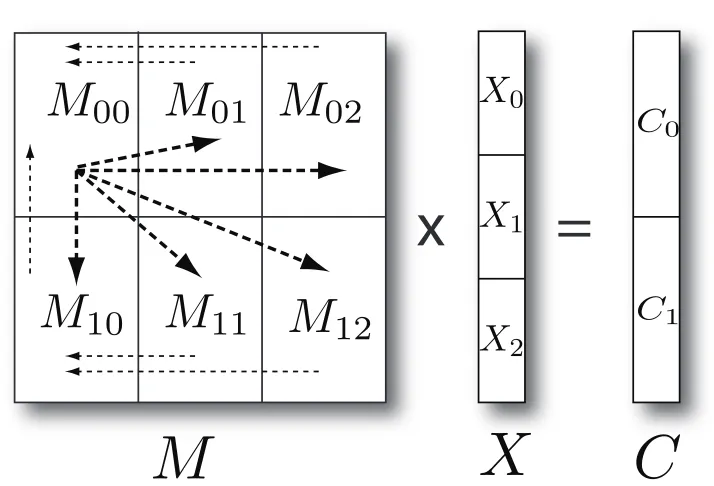
Figure 3.2 depicts how parallel matrix multiplication applies between an N×N matrix M and an N×L
matrix X. Parallel matrix multiplication for SMACOF algorithm is implemented in a three-step process
![Figure 3.3: Calculation of B(X[k−1]) matrix with regard to the decomposition of Figure 3.1.](https://thumb-us.123doks.com/thumbv2/123dok_us/8134797.243217/48.612.187.459.120.405/figure-calculation-b-x-matrix-regard-decomposition-figure.webp)