1-1-1993
Development of a low-cost personal computer
speech recognition system
Gary Lee Ayers
Iowa State University
Follow this and additional works at:
https://lib.dr.iastate.edu/rtd
Part of the
Engineering Commons
This Thesis is brought to you for free and open access by the Iowa State University Capstones, Theses and Dissertations at Iowa State University Digital Repository. It has been accepted for inclusion in Retrospective Theses and Dissertations by an authorized administrator of Iowa State University Digital Repository. For more information, please [email protected].
Recommended Citation
Ayers, Gary Lee, "Development of a low-cost personal computer speech recognition system" (1993).Retrospective Theses and Dissertations. 18013.
by
Gary Lee Ayers
A Thesis Submitted to the
Graduate Faculty in Prutial Fulfillment of the Requirements for the Degree of
MASTER OF SCIENCE
Interdepartmental Program: Biomedical Engineering Major: Biomedical Engineering
Signatures have been redacted for privacy
Iowa State University Ames, Iowa
TABLE OF CONTENTS
Page
INTRODUCTION
LITERATURE REVIEW 5
Voice Recognition Technology 5
History 5
Speech characteristics 6
Technology of the past decade 13
Applications for the Physically Disabled 15
PURPOSE OF PROJECT 20
SYSTEM COMPONENTS 22
System Overview 22
The Computer 22
The 1571 Disk Drive 23
The VOICE MASTER 23
Hardware 23
Recognition concepts 24
Software 25
ADC-1 BSR Controller 31
1750 RAM Expansion Unit 34
RES UL TS AND DISCUSSION 36
Project Results 36
Product 36
Procedures and Design Features 38
Software Developed 40
VOICEMANAGER 40
Environmental controller option 43
Application interface 45
Summary 46
REFERENCES 48
ACKNOWLEDGEMENTS 50
APPENDIX A 51
MEMORYSWAPl 51
MEMORYSW AP2 52
VOICEINTERPRETER 54
APPENDIX B 55
VOICEMANAGER 55
LIST OFT ABLES
Page
Table 1. General American phonemes
9
Table 2. Results of a frequency spectrum analysis of speech 11
Table 3. Major vowel sounds with formant frequency resonances 11
Table 4. Switch settings for house codes 33
LIST OF FIGURES
Figure 1. Flow chart of the speech process Figure 2. REC internal registers
Page
7
INTRODUCTION
Computer speech recognition has been a popular area for study, research, and applications development. Although there are more difficulties associated with developing a useful
recognition system than there are for applications involving the related technology of speech synthesis, major computer manufacturing companies as well as smaller non-computer manufacturers have delved into the speech recognition market throughout the 1980s and into the 1990s.
Costs and the present level of recognition technology appear to be holding back the large scale integration of voice recognizers into om society. The ultimate achievement in voice
recognition would be the ability of any person to converse with a computer or other machine
with recognition capability as if the person was talking to another human. The enormity of this
task can be realized when one thinks of how hard it can be for human beings to understand each other's spoken messages. The ultimate speaker independent, connected speech
recognition system would require that the recognizer overcome a host of difficulties, such as dialects, accents, distinguishing between homonyms (to, too, and two, for instance), and understanding both grammatical and semantic content of received input. For a voice
recognition system to intuitively begin to extract meanings from spoken phrases and sentences.
it must have some knowledge and capabilities in natmal language processing. This complex
task not only involves the science of computers. but also philosophy, linguistics, and
semantics. What the computer must do as it solves the problem of understanding speech is to
determine the intended motive behind the message, the emotive content that was intended and, from that, the true meaning of what was spoken (Cater, 1984).
If the problems for the ultimate speaker independent, connected speech recognition system
answer to the question of how one can go about identifying those areas where speech
recognition might be advantageous. Then a determination must be made as to whether the
voice technology used to gain a certain level of efficiency for a task, at a feasible cost, provides enough advantages to warrant its use over the current method of performing the task. Certain indicators can be useful when judging applications to be potential beneficiaries of speech recognition technology (Vaissiere, 1985). One indicator would be the amount of close hand-eye coordination required by a task. If a computer operator has very little time to be distracted
by a computer keyboard, then his task might be a candidate fo r speech input. A second
indicator is the degree of mobility required by the computer operator. An example of a task that would require mobility is the job of taking inventory in a large warehouse. Again, it might be more conve nient to have alternative methods of input to the computer, other than a keyboard. Another indicator of potential use of speech input is when the computer operator is unskilled
and possibly doesn 't know how to type, and the reliability of entered data must be high. If any
one or more of the above conditions exist in a situation, then speech recognition might be given strong consideration for the task (Vaissiere, 1985). The key is whether the task is made
simpler by speech input to the computer. If it is not, then success is not likely.
Another important factor is the commitment made to the use of recognition in a particular
application. If a hobbyist is involved, the commitment is made based on curiosity and a desire
to have or create something unique and there is normally sufficient motivation to Ca.IT)' out the
implementation. For a corporation, this commitment would be extensive because of the
man-hours necessru)' for implementation and the interruption of the cunent process that is being replaced. Ample motivation and capital would be needed prior to the integration of speech recognition into the process to insure that the implementation succeeds and that the system is accepted (Vaissiere. 1985).
implemented. If speech input driven tasks are to occur in environments where the noise level is
above 85 to 95 dB, then speech recognition becomes a more difficult task Gust as it would for humans) and the chances of successful recognition are minimal (Vaissiere, 1985). NASA has researched the relationship of noisy environments and recognition accuracy. It was generally thought that of the four possible combinations of training and usage: (I) quiet training and quiet recognition, (2) quiet training and noisy recognition, (3) noisy training and quiet recognition, (4) noisy training and noisy recognition, the best combination was the first.
followed by 4 and 3, in that order, with condition number 2 providing the least desirable situation for accuracy (Vaissiere, 1985). It was found that total recognition accuracy variance
from combination 1 to combination 2, the best and the worst combinations, was on the order of 18%. Later research with voice recognition systems has indicated very little difference in the way these systems respond to the four environments (Vaissiere, 1985).
Voice input typewriters, vocal data entry systems, and speech controlled systems are some
application areas to which development effo11s have been extended (Vaissiere, 1985). Voice-activated typewriters that would be able to recognize speech from a multitude of different speakers and have a big enough vocabulary to make them practical will most likely not be found until the late 1990 's or possibly even the next century. One of the goals of the Fifth Generation Computer project of Japan was a voice-activated typewriter with a vocabulary of ten thousand words and the ability to recognize the voice patterns of hundreds of users without retraining (Vaissiere, 1985).
Another area which will probably see a shift toward voice input is the automated business office (Vaissiere, 1985). Accountants and ce11ain types of office workers who view column after column of numbers and then input these numbers into a machine would certainly benefit by being able to enter the data into a computer by speech. Other current and potential uses are
dimensions into a computer by a draftsman while visually reviewing blueprints, and systems in
the home for balancing checkbooks or ta.king inventory of household goods (Vais iere, 1985).
Finally, speech recognition could be used in speech conrrolled systems in aircraft,
spacecraft, automobiles, elevators, hospital rooms, and in aids for the physically handicapped.
Voice input has been tried and used in a variety of situations for the disabled who have or retain
some vocal ability. This use should continue and expand as speech technology progresses.
Speech recognition could allow conrrol of devices that were either very difficult or impossible
to control otherwise. Numerous projects and studies have been reported in which speech
recognition has been applied to help those who are disabled. Thus, this expanding area of
technology could be a great boost to a number of the approximately 500.000 Americans and the
LITERATURE REVIEW
Voice Recognition Technology
History
Interest in automatic speech recognition began about 35 years ago with the increased availability of elecrronic hardware to perform specrral analysis of signals. There were two
primary reasons for the early interest in speech recognition: 1) a desire for automatic rranscription of the input speech into stenographic-like symbols of phonemes; and 2) direct identification of words or phrases to command or conrrol machines by voice. The first purpose
would result in the so-called phonetic typewriter and the second would bring into being an isolated word speech recognizer. This first phonetic typewriter, also called the " phonotograph" was meant to translate the voice input directly into shon-hand-like symbols, to eventually be
changed into words by a reader. Subsequent phonetic typewriters were supposed to n·anscribe speech input directly into phoneme-like segments (Vaissiere, 1985).
Most early word recognition systems involved the concept of template matching, in which the frequency spectrum of the incoming signal was matched against a set of standard
spectrum patterns for each phoneme. The systems were based on matching whole input
patterns against expected word templates received from prior n-aining samples. These devices
recognized digits spoken by one individual at a normal rate with between 95 and 97 percent accuracy (Vaissiere, 1985). Other approaches were proposed at this time, including one based on the principle of distinctive features (features-based method). This approach involved
making several binary classifications based on different features of the input speech signal.
Interest in the speech field was renewed around 25 yea.rs ago when the influence of
input attracted attention once again. Computers also opened up the means for applying a wide variety of digital signal processing techniques and for U)'ing expanded, complex recognition
algorithms. The first isolated word recognizer using a computer appeared in the early 1960s, along with proposals for continuous speech recognizers. Improved algorithms were
continually being proposed. New technology continued to be introduced, such as dynamic time warping techniques which compensate for the differences in the duration of input words.
The ARPA (Advanced Research Project Agency) project from 1971co1976 sparked much
activity in the field of continuous speech systems, although many scientists feel this project did
not contribute as much to state-of-the-an speech sciences as it did to artificial intelligence (Vaissiere, 1985). Technology is at a level such that successful speaker-dependent isolated word recognition systems are in use today in industry and offices. Some systems have been
expanded to handle the recognition of up to three connected words, to recognize sentences
composed of words separated by pauses, or to recognize a very limited number of words spoken by those unknown to the system. Recognizers are now available that aUow for continuous or full y connected speech recognition without the associated pau es usually
necessary in discrete word recognition systems (Vaissiere, 1985).
Speech characteristics
Circumstances which prevent human understanding of spoken words are the same factors that affect a listening computer's ability to understand speech (Cater, 1984). Therefore,
understanding voice recognition technology requires knowledge of the properties of speech.
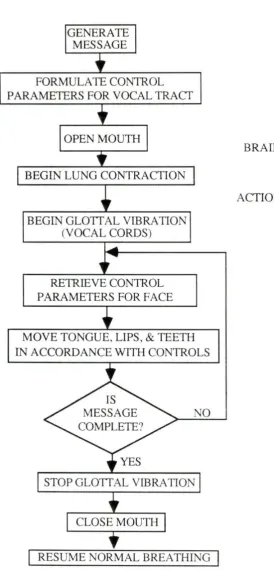
The features of speech communication and their associated emantic content are
GENERATE MESSAGE
FORMULA TE CONTROL PARAMETERSFORYOCALTRACf
OPEN MOUTH
BEGIN LUNG CONTRACTION
BEGIN GLOTTAL VIBRATION (VOCAL CORDS)
RETRIEVE CONTROL PARAMETERS FOR FACE
MOYE TONGUE, LIPS, & TEETH
IN ACCORDANCE WITH CONTROLS
NO
STOP GLOTTAL VIBRATION
CLOSE MOUTH
[image:12.572.156.431.60.633.2]RESUME NORMAL BREA THING
I
Figure 1. Flow chart of the speech process (Cater. 1984)
BRAIN
Although the order in which some of these seeps occurs may be debated, these
components will occur sometime during the speech event. The true event order may depend on the particular word being spoken. Cena.in words have a nasal beginning; in this case the mouth
is not opened until after the lungs have concracted and glottal vibrations have begun with the first sounds coming through the nose (Cater. 1984).
Linguists refer to the close to 40 distinct sounds that make up our language as
phonemes. These comprise a set of distinguishable, mutually exclusive. speech sounds that
are present in almost any spoken language, shown in Table 1 (Cater. 1984). The range of frequencies generated during vocalization distinguishes between the independent phonemes of
the General American dialect. Phonemes can be categorized into special groups. such as the continuants, based upon spectral characteristics. Because of lesser vocal tract motion, the
continuants have a more stable and sustained frequency spectrum throughout their production.
Vowels, semivowels, nasals. and fricatives are included in this group. The plosives and the
glides. the other classes of phonemes, are more dynamic sounds that normally couple to
surrounding phonemes in a manner resembling diphthongs (Cater. 1984).
Diphthongs are speech sounds characterized by much vocal tract motion when coupling two phonemes together, and they occur as one goes from phoneme to phoneme during speech.
If we spoke phonemes without any anempt to join the sounds, there would be no diphthong,
but normal talking produces many of these diphthongs (Cater. 1984).
A great difference exists between the frequency specm1m produced from a glottal vibration and that produced outside of the vocal u·act. The glottal vibration is a vibration in the
Table 1. General American phonemes (Cater, 1984)
Minimum Phoneme Set From General American Dialect
Phoneme Type
Phoneme
"as
in"
Vowels* Consonants Fricatives (Voiced)* Fricatives (Unvoiced)* Plosives (Voiced) Plosives (Unvoiced) Nasals* Glides Semivowels* *Continuants ah
ae
awa
eh uh ee I oh 00 00 er v thz
zh f ths
sh h g d b k t p n m ng y w 1 r father tap talk bay step run beep lift tone moon book stir very there zebra beige fastThis glottal frequency spectrum, by itself, is not very useful as a speech signal. When
the frequency spectrum is taken from speech recorded outside the vocal cract. near the lips, it
gives a different appearance and is said to carry true speech info1mation. This occurs because
of the physical effect of resonance in the nose, throat, and mouth (Cater, 1984). The speech
spectrum at this point shows three primary frequencies of resonance, called formant
frequencies. Normal human speech has been shown to have more than three main formant
frequencies, but those frequencies above the third formant contain relatively linle energy and
may be effectively disregarded when considering the total spectrum. Of the three primary
formants, the lowe t frequency is formed by the th.roar resonance, the next formant is produced
by the nasal resonator, and the highest frequency fo1mant is identified with the mouth (Cater,
1984).
The keys to reliable speech recognition are the identifiable categories in which the
relationship and ratio of the formants remain. This is true even though the precise positioning
of the formants can vary from person to person. The position of the formants in the speech
spectrum can be directly related to individual phonemes. This is an important link between the
spectrum and any actual information contained within the spoken message that might be used
for speech recognition (Cater, 1984).
Analysis of frequency spectra for the speech of a large number of randomly chosen
speakers has been done numerous times by speech researchers. One such compilation is given
in Table 2 (Cater, 1984). This co1Telates the spoken phonemes and the related formant
frequencies, and indicates resonant frequency ranges specific to each semivowel and nasal.
Speech recognition depends on the fact that none of the sounds in the table shares exactly
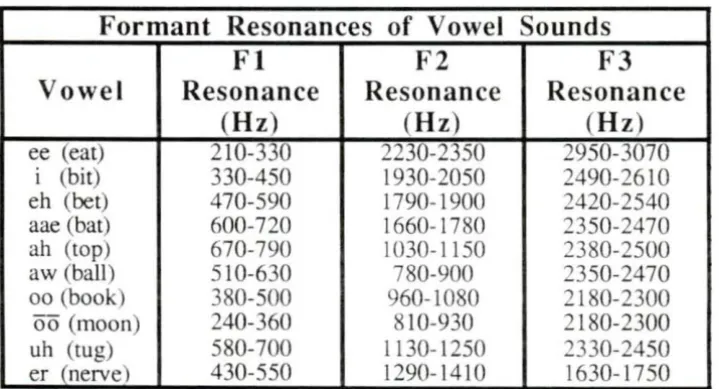
overlapping resonances. Table 3 (Cater, 1984) has the major vowel sounds with the
accompanying formant frequency resonances. The vowel parameters. like the previous
Table 2. Results of a frequency spectrum analysis of speech (Cater, 1984)
Characteristic Resonances of Nasals and
Semi vowels
Throat
Nasa l
Mouth
Sound
Resonance
Resonance
Resonance
(Hz)
(Hz)
(H z)
I 250-400 600 2000-3000
r 500-700 100- 1600 1800-2400
n
200-250 600 1400-2000ng
200-250 600 2300-2600m 250-300 600 900-1700
Table 3. Major vowel sounds with formant frequency resonances (Cater. 1984)
Formant Resonances of Vowel Sounds
F l
F2
F3
Vo we l
Resonance
Resonance
Resonance
(Hz)
(Hz)
(H z)
ee (eat) 210-330 2230-2350 2950-3070
i (bit) 330-450 1930-2050 2490-2610
eh (bet) 470-590 1790-1900 2420-2540
aae (bat) 600-720 1660-1780 2350-2470
ah (top) 670-790 1030-1 150 2380-2500
aw (ball) 510-630 780-900 2350-2470
oo (book) 380-500 960-1080 2180-2300
oo (moon) 240-360 8 10-930 2180-2300
uh (tug) 580-700 1130-1250 2330-2450
er (nerve) 430-550 1290- 1410 1630- 1750
[image:16.575.81.440.120.262.2] [image:16.575.85.445.350.544.2]first resonance, and the third formant might be from one-half to one-thirtieth the amplitude of
the second resonance (Cater, 1984 ).
Two classes of phonemes, fricatives and plosives, are produced by vocal tract
occurrences other than glottal vibrations. The major characteristic of these phonemes is a rapid
burst of air through a constriction, such as the lips, teeth, or tongue. The fricatives sustain a high frequency noise characteristic that spreads over the spectrum from 3 kHz to as high as 30 or 40 kHz. The fricatives do not usually display formant frequency resonance since they are
initiated toward the front of the vocal tract, at the lips and teeth (Cater, 1984).
The plosives differ from the fricatives as they are noncontinuant but still characterized
by high frequency noises generated from a constricted air passage. One of the main qualities of these phonemes is the absence of speech right before their utterance. This is obvious when
pronouncing plosives such as " p", " t", or
•·ct."
If a speca-ogram of a whole spoken sentencewas viewed, the plosive phonemes would be easy to identify. The preceding zero energy
characteristic is the identifier as that characteristic does not usually occur between words in
natural connected speech (Cater, 1984 ).
Speech is a dynamic phenomenon and this must be considered when attempting speech recognition. Speech analysis by frequency discrimination must take into account this dynamic nature, as normal speech does not consist of single continuant phoneme words. If a
recognition system is to accept more than a few single phoneme words. it must be programmed
to accept dynamic spectral input (Cater, 1984). If such a system is to work reliably, it must not only have the capacity to recognize the main phonemes of the word, but also have the ability to
recognize the coupling diphthongs which bind the e sounds together.
Other variables that enter into the analysis of dynamic speech are pitch frequency, the 50 millisecond pause produced by the plosives or stop consonants. and the stresses or accents
the formant position in the frequency spectrum (because the shape and volume of the vocal tract are not changing), it does carry contextual infonTiation. The pauses that are produced in the
pronunciation of the plosives make it impossible for a recognition system to separate words in
continuous speech by looking for these pauses (Cater, 1984).
Variations in normal speech are also a problem for recognition. A person's speech
changes when the speaker has a head cold or allergy reactions. These problems primarily affect
the nasal passage, making it difficult to pronounce the nasal phonemes (Cater, 1984). The
vocal cords can also be affected with ailments such as laryngitis, which mainly affect the pitch
frequency of the afflicted person's speech (Cater, 1984).
There are also external factors that cause difficulties for speech recognition. These
include room acoustics, ambient noise, and microphone quality. Room resonances may
interfere with the speech signal and create a condition known as "room presence." External noise, including bmsts of air from the mouth itself, creates the possibility of interference with the speech waveform. The best solution to these problems presently is the use of a high quality
noise cancelling microphone and locating it near the speaker's mouth. To deal with the small
bursts of wind from the spoken plosives, the microphone should be covered with an
acoustically transparent material which dissipates the wind velocity (Cater, 1984). The
microphone that is marketed with the Covox speech recognizer used for this project is covered with such a material. Covox recommends positioning the microphone about one inch from the
lips and slightly to one side (Covox, Inc ..
1985).
Technology of the past decade
International Business Machines Corporation (IBM) has done much work in the area of
voice recognition. Among their products is a system designed to con e1ve memory while recognizing human speech and placing the words spoken onto a screen. This speech system
Heights and again at the national Computer Conference in Las Vegas, Nevada (IBM
Information Systems Group, 1986).
This experimental system was developed at the Watson Research Center and used a specially built IBM Personal Computer AT. The system was purported to have a 95%
transcription accuracy and base vocabulary of 5000 words (IBM Infotmation Systems Group,
1986). It had undergone some experimentation in office senings to determine its adaptability to
different speakers and varying background noise.
The main challenges that faced IBM researchers in improving this system included the
following (IBM Information Systems Group. 1986):
1) eliminating the need to pause between words
2) increasing the vocabulary size
3) improving the system's resistance to background noise
An example of an applied computerized speech recognition system is EARS (Entry to the Anesthesia Record by Speech), a system developed to simplify data entry for automated
anesthesia record keeping at the Department of Anesthesiology, University of California. San Diego (Smith, 1986; Sarnat, 1983). Experimental speech recognition was used as a means of
input to the automated anesthetic record (AAR) because of the ever-increasing demands for record keeping and the need to record some of the data at inoppon une times, uch as when the patient needed attention. EARS was developed to overcome some of the disadvantages in entering these data to the computer by keyboard or other manual means (Sarnat, 1983).
EARS had a vocabulary of about 350 words, with about 120 syntax rules. The syntax created some flexibility. For instance, "monitor precordiat stethoscope" and ··monitor
stethoscope precordial" were equally valid. Another example is "drug morphine four" and
simplified most drug enrries (Sarnat, 1983).
Accuracy of the speech recognition process was important because the error correction procedure made errors very costly in terms of over-all throughput. In a preliminary study of computerized speech recognition for application to anesthesia record keeping, recognition accuracy was measured on a few large subsets of a 240-word vocabulary. Users trained five rimes and then recognition was attempted several times. Overall accuracy in these studies was
95.9% ranging from 90% to 99% for individuals (Sarnat, 1983). However, the results were
not obtained from the EARS system and therefore cannot be applied to it. The performance of EARS in the operating room seemed satisfactory, but its accuracy was not measured. It was intended that the redesign of the EARS system would include the capability to measure accuracy and other performance statistics during use (Sarnat, 1983).
Applications for the Physically Disabled
There have been numerous attempts to apply voice recognition technology to the needs of the physically disabled in recent years.
Cohen and Graupe ( 1980) developed a prototype, microprocessor-based, speech recognition and control system for rehabilitation applications. It was designed to be an
interface between the disabled person and the different devices that enabled more mobility and
functionality. The system recognized isolated words which easily accommodated the short
commands required by the application. It responded automatically by activating cona·ols for the various assist devices.
The following design c1iteria were imposed on the system (Cohen and Graupe, 1980):
1 . Small size, low weight for attachment to a conventional wheel chair.
3. Vocabulary size of 100 commands to accommodate the different tasks.
4. Recognition time fast enough to faci litate a one second interval between commands.
5. Recognition accuracy requiring a maximum substitution (fal se recognition) error of one percent and maximum rejection (no recognition) of ten percent. The restriction on substitution errors was due to the high accuracy necessary for wheel chair concrol.
6. Flexibility in additions to and changes in the vocabulary in order to accommodate
special assist devices and functions for specific users.
An initial session was required to train the system for the particular individual. The system was designed to provide concrol over four tasks, running an electric wheel chair, operation of a touch-tone phone, activation of an electric typewriter, and operation of an Environmental Concrol Unit (E.C.U.). This unit pe1m itted activation of a vaiiety of devices, includ ing a
television, radio, light, and alaim. The system used the MIPROC-16 microcomputer, a 16-bit
machine. Recognition accuracy was somewhat less than what has been demonstrated by more elaborate systems, but those systems didn 't meet the constraints imposed by the rehabilitation appl ication (Cohen and Graupe, 1980).
Devaney and Rastgar (l 983) also attempted speech recognition for wheel chair control.
Their system was tested with a vocabulary consisting of the words NO, YES, STOP, START, LEFT, RIG HT , NORTH, SOUTH, EAST, and WEST. Three different protocols were used.
Within the first protocol, each word was entered just once during a-aining. Each word was then tested ten times with the result of an average recognition rate of 49%.
In the third protocol, the data from the second were maintained to test the system in a
multi-user environment. Testing was done by two male and two female subjectS with a resultant average recognition rate of 20% for both cases. This low race could be explained by the diversity in human speech pattern between the trainers and the actual users. The fact that
accuracy rates were the same for both male and female indicates the success of the pitch
normalization process (Devaney and Rastgar, 1983).
The project used a time averaged model for recognition of isolated words. 111e results suggested that the model would be suitable in a single user/a-ainer situation, which would meet the needs of the wheelchair user. Another set of commands was suggested, including
FORWARD, REVERSE, LEFf, RIGHT, ON, OFF, HALF, FULL, (SPEED), START, and
STOP, to provide for wheel chair control (Devaney and Rastgar, l 983).
Grooms ( l 986) developed applications for a speech input system that was used as a
vocational training tool. For this project, individuals were chosen to participate on the basis of
being developmentally disabled and having severe hand dysfunction. 111e participants were
then required to understand their work and perform in a manner that would likely be acceptable to a prospective employer.
Grooms made use of a speech recognition product manufactured by Texas Insrruments (TI)
Incorporated called the Texas Instruments Speech Command System (TISCS), which included
the hardware and software necessary to al low voice recognition using linear predictive coding
(LPC). The hardware chip was not a pecialized LPC chip; instead it was the more general-purpose digital processing chip made by TI. Since the speech recognition algorithm is
changeable by software, this hardware should not become obsolete as new and better speech
algorithms appear (Grooms. 1986).
system, the action can be a single keyboard stroke or a series of keystrokes. These keystrokes are defined by the user prior to beginning the appl ication and are accomplished through a
controlling program called Vocabulary Manager which creates and then manages the vocabulary of utterances and actions.
A single vocabulary for the system can contain no more than 60 utterances. When the
system is in use, the vocabularies that have been formed are loaded into random access memory (RAM). However, the speech hardware only acrs on one vocabulary, the active vocabulary, at a time. When this vocabulary is in use, the computer responds to a poken word
or phrase by attempting a statistical best-fit to the utterances that are srored in memory. If a poor fit results, no recognition occurs. and the computer does nothing. If the statistical best-fit
exceeds a cenain threshold value, the action that was paired with the spoken phrase is carried out. Important concepts investigated were vocabulary definitions and switching patterns
(Grooms, 1986). If an application required utterances and actions from more than one
vocabulary, a means of switching to that other vocabulary was accomplished without hanging up or terminating the application program.
The previous efforts represented auemptS to respond to needs of the physical ly disabled user by development of speech recognition systems or applications that met a particular need or
combination of needs. Each system was also subject to design constraints based on the demands of the application and the constrain rs of the particular technology used.
This present project was also attempted to respond to the needs of certain users, those who
desire access to a personal computer but also desire or need an alternative to the traditional methods of input such as the keyboard. The major constraint applied in this case was the use of lower cost technology. The requirement wa to upply the same basic functioning as the
TISCS but at reduced cost. This would result in a system useful at home and preferably in
PURPOSE OF PROJECT
Speech recognition technology may be still in its growing stages but, as previously discus ed, there has been no lack of initiative in applying what is presently available to the
needs of the physically clisabled. A number of computer manufacturers have developed recognition systems for their own computers and compatibles. Small microcomputer and microprocessor based systems have also been developed when greater ponability was a
necessity.
The overall pw-pose of this project was to gain knowledge about some specific products and accompanying concepts in order to provide a useful computer system for chose desuing access to the computer while bypassing the computer keyboard. This knowledge was then
applied to the development of specific programs to enhance the computer's value as an immediately useful assistive device. With this overall purpose in mind, the following were
more specific objectives:
1. To develop a personal computer based system utilizing speech as the means of input to the extent that it would be of real benefit to the user and not create overwhelming hindrances.
2. To develop a system that, for what it could offer, would be cost advantageous over
other recognition systems.
3. To implement the above as a Commodore 64 based system which would afford the possibility of using hundreds of software produces written for this computer. There would al o exist the potential for conversion to the Commodore 128, an enhanced version with more power and memory capacity, which can also operate as a C64 machine. The Commodore 64 and 128 are relatively inexpensive personal computers
4. To gain a greater understanding of the Commodore operating system and memory configurations so that the machine could eventually be fully exploited in its capabilities for speech input applications.
5. To develop a voice-operated system dedicated to running two particular applications, word processing and environmental control, which would serve as initial demonstrators
of the potential for Commodore programs to respond to speech input. One application, environmental control, would demonsrrate the ease of creating and running a
user-written BASIC application program. The other, word processing, would demonstrate
the interface necessary to allow off-the- helf user-purchased software to also be
operated by voice.
There are more sophisticated voice units (hardware and software) available which give the programmer more options and greater capacity for conve11ing applications to voice input. But the cost can be prohibitive. It is important to note also that the applications chosen for this project are of immediate practical benefit to the disabled, and word processing capability could
SYSTEM COMPONENTS
System Ovetview
The system used was composed of a Commodore 128 (C128) personal computer (used in
C64 mode), a Commodore 1571 disk drive, a Commodore 1750 512K RAM Expansion Unit (REU) or Module (REM), and a VOICE MASTER speech and music processor manufactured by Covox, Inc. of Eugene, Oregon. The BSR Controller, a feature of the ADC-1 Data
Acquisition System made by Remote Measurements Systems, Inc., was attached to the C128 user pon to enable environmental control. The ADC-1 system was not a requisite item; another compatible controUer system could have been substituted, depending on availability and the features desired by the user.
The Computer
One of the advantages of the Commodore 64 (C64) and pe1ipherals is the low cost relative
to other personal computer systems. The Central Processing Unit for the C64 is the 8-bit 6510
microprocessor which has an internal architecture and instruction set identical to the MOS
Technology 6502. The C64 has been the target of hundreds and possibly thousands of
existing software products; with the availability now of expansion RAM products for the Commodore 128 (64 mode as well as 128 mode) and the C64, these same C64 programs are
candidates for speech input on either machine. This requires no adaptation to the software
interface to accommodate the particular expansion RAM (1764 for the C64) in use. The C128's natural 128 mode can also become a host for voice input applications; Covox's voice
straightforward entry of assembly language programs and viewing of RAM locations or ROM routines.
The 1571 Disk Olive
The 1571 disk drive provides double-sided. double density recording for a 339K storage capacity per disk ( l 69K per side). The 1571 al o offers special high-speed burst commands,
used for machine language programs. which transfer data several times faster than the standard or fast serial races. However, for the C64, the 1571 disk drive functions at standard 1541
speed only, that which meets Commodore 64 compatibility requirements.
The VOICE MASTER
Hardware
The VOICE MASTER produced by Covox, Lnc. of Eugene. Oregon actually has three
different functions - speech recognition, speech recording and playback. and voice production
of music, in which the computer either plays or composes music that an individual hum or
whistles. For this project, only the speech recognition function was used.
The VOICE MASTER comes as a complete hardware and software system ready for accomplishing the functions previously mentioned. The hardware includes the
digitizing/processing system enclosed in a hard case, a headset with microphone and earphone.
and all necessary cables. The VOICE MASTER was designed to plug into the rear control port
(port number 2) on the Commodore 64 or 128. Instructions are given for adjusting the gain control and properly calibrating the instrument to the individual computer. The VOICE MASTER also has an audio input jack which. when connected by cable to one of the audio
computer's sound outputs. The earphone connects to an earphone jack located immediately next to the microphone jack on the VOICE MASTER.
Reco2nition concepts
A template for a spoken phrase is fonned when the spoken phrase is reduced to a set of
characteristics and each characteristic is transfonned to a graphical va.iiation of time. Several different phrases fonned into templates make up a vocabulary or catalog which can be matched,
one by one, against the template of the unknown word. Recognition results from the best fit of the unknown template with one in the vocabulary. To accomplish this. the unknown must be compared with each template in the catalog. Recognition refusal occurs when no comparison
yields a match defined as acceptable by the user through the VOICE/RECOG software. If the
comparisons of two or more words with the unknown phra e each produces an acceptable match, then a decision is not made and this condition is made known to the user.
These facts apply to almost all types of pattern recognition, including speech and vision. Differences in different pattern recognition algmithms a.iise in the nature of the characteristics
used to fonn the templates and in the error criteria used to measure closeness of a match. If
some clues exist early in the recognition processing which nan-ow down the choices. it won't
be necessary to complete the processing with every member of the vocabulary. This process that narrows choices sequentially is often called a tree pattern search. The VOICE MASTER 's
recognition algorithm involves a limited tree search in that the process for a panicular template may not be completed due to a poor match being indicated before the process is fini shed.
When this happens. the process jumps to the template. Another
fo1m
of tree search is appliedwith the use of sub-vocabularies of words. The poken phrase in this case is only searched for within the sub-group. even if it happens to be elsewhere in the larger vocabulary.
designated to a pattern. A second operation involves time normalization in which all the patterns are reduced to 12 of these 8-number setS. Templates for the candidate set and templates for the unknown phrase are normalized in the same manner. The quantity of numbers in each template is 96 (12 x 8) with four additional bytes of RAM used for each to store the memory location data.
Taking the difference between corresponding numbers of the unknown phrase and each
template of the vocabulary or group begins the process of matching. The sum of the
differences in root-mean-square magnitudes forms a computed closeness score. If various
parts of the pattern are relatively more imponant than others, then weightings are applied to
those parts. The lowest score then pointS to the best match for the unknown. A large lowest
score might indicate no match - a threshold value must be decided upon to determine if that
score is a probable match or if it is a probable mismatch. Two or more low scores indicate uncenainty and a difference value between the candidates must be established so that one sufficiently lower than the others is considered the probable match.
A variation of dynamic time warping is used in the VOICE MASTER algorithm, to account for minor differences in the way the word is pronounced. The characteristics or cues as
functions of time can be moved slightly; thus the template could be compared to a rubber sheet. Words should continue to give a good match even if a syllable is su·etched in compari on to the
way the original trained pattern was made, as discussed earlier.
Software
The software marketed with the VOICE MASTER includes a main DEMO program which
demonstrates its different features. There are other application program written in
The most important programs are the ones wrinen in 6502 machine language to facilitate the recognition and recording/playback functions. These programs have characteristics which place them into one or more of the foUowing categories:
* Enable recording/playback - YM3.0, YM3.0N, YM3.0R, PLA Y/FlND
* Contains FFIND (FFIND is a software routine which loads in a saved speech vocabulary
from disk faster than the standard method) - YM3.0
*
Enable speech recognition - YR3.0, YM3.0R, YOICE/RECOG*
Allow both recognition and recording/playback - YM3.0R* Contain wedges (a wedge is a new programmer defined BASIC command which supplements the Commodore BASIC command set) - YM3.0, YM3.0N, YR3.0, YM3.0R
YM3.0R enables both the recording/playback and recognition featw-es.
Covox created wedged BASIC commands in most of its software to simplify use of the VOICE MASTER for users who are not machine language programmers. These new programmer defined commands allow a user to write a speech input application in simpler BASIC without
having to learn how to access machine language programs from a BASIC program. A
technique to create wedges and also minimize extra execution time can be executed by
specifying a character(@ for example) that will occur before any new wedged-in commands. The Kemal (operating system) routine CHRGET, used by BASIC to get each program character or token, is preempted by a new programmer substituted routine which will search for the special character. If the special character is not present. control is passed to the normal
BASIC CHRGET routine. If the character is present, the new command is accepted and
Therefore the Covox programs with wedges use much more memo1y than the YOICE/RECOG (enables speech recognition) and PLAY /FIND (enables speech playback) programs which do
not. For this reason, YOICE/RECOG was the only Covox program used to enable voice input for this project. It is easily accessed from either machine language or BASIC.
The wedged in commands allow statements that enable speech input to be easily written
into BASIC programs. A summary of the e commands implemented in YR3.0 and VM3.0R, and a description of the functions of the VOICE MASTER software follow:
1. TRAIN N. This command construct a template using 96 bytes of memory for the word N. N can be computed as well as specified directly. Recognition programs reserve space for a vocabulary of 32 words: N i in the range of 0 to 31. Retraining the
same phrase N creates an average template for that N. TRAIN can be terminated by the RUN/STOP key.
2. BLANK N. This clears the template memory space for word N in tl1e same range, 0 to
31. BLANK 255 clears all 32 templates.
3. RECOG n. With RECOG execution, a program waits for voice input. It then compares the input word to the templates stored in memory. If n is 0, then all 32 templates are scanned and compared to the unknown input. Otherwise. n can be
specified as I to 4, which designates the scanning of one of four sub-vocabularies as
follows:
*
RECOG 1 - scans template numbers 0-7*
RECOG 2 - scans template numbers 8- 15*
RECOG 3 - scans template numbers 16-23Any combination of 2 or 3 sub-vocabularies can be designated in the command by RECOG n l ,n2 or RECOG n l ,n2,n3. For example RECOG 2.4 cans templates 8-15
and 24-31 and compares them to the input word. The number corresponding to the best fit word is placed in memory location 151 ($97 Hex). The recognition mode can be exited at any time before an anempt to recognize an input word with a push of the computer keyboard "Q" key by the user. If this occurs. YOICE/RECOG places the
value 253 in location 151. A voice input application program can then detect that the recognition mode was stopped by rhe user by checking location 151 for that value.
4. MAX y. The MAX command sets the maximum template to input word matching score
or threshold allowed for a recognition match to occur. No recognition occurs if all templates' scores exceed this value y. If this type of recognition refusal happens.
YOICE/RECOG places the value 255 in location 151. A programmer can use this information to determine the next action a voice input application will take. If the value y is not exceeded by one or more templates, the template having the !owe t score
"wins" and becomes the match with the input phrase. The range for y is 0-700 with a
default value of 450.
5. MTN x. This sets the minimum template score difference so that recognition refusal takes place if the difference bet\veen two template scores i less than this minimum value x. When this type of refusal occurs. the software put the value 254 in location
151 which, again. can be used to determine application program flow. The range for x is 0 to 100 with the default value being 50.
6. TPUT'filename'',8. TPUT saves a set of 32 templates from main memory to floppy disk.
as an imponant location used by the recognition programs. Other addresses in page 0 of main memory are also utilized but 15 l i the most important to the user or
programmer. There are three areas of memo1y which contain various VOICE
MASTER programs. The major pan of each of the machine language programs is contained in a 4K free RAM block from $COOO to $CFFF which is between the BASIC and Kernal ROM. The two programs which activate only speech recognition are
exclusively within this area. A general work area for speech recording is the 8K RAM bank behind the Kernal ROM. Some numerical data for recognition and the template
storage area are behind the BASIC ROM.
YOICE/RECOG, the recognition program without wedged-in BASIC commands. was
designed by Covox to be a program of minimum length for embedding in a user's machine language program to provide voice recognition capability. It was the only Covox speech program used to complete this project. VOICE/RECOG can be accessed from BASIC with the
Commodore POKE and SYS commands rather than the Covox wedged-in commands
mentioned previously. The manner in which POKE and SYS can be used to invoke the
recognition subroutine highlights imponant memory locations used in this recognition
program. POKE and SYS were utilized as follows:
TRAIN N was replaced by: POKE 151.N: SYS 49920
BLANK N was replaced by: POKE 782,N : SYS 49932
TPUT was replaced by:
TFIND was replaced by:
SYS 49926"filename",8
SYS 49929"filename",8
( 49920 is $C300)
( 49932 is $C30C)
(49926 is $C306)
( 49929 is $C309)
Replacing RECOG was slightly more complex. The ruling location is 49935 ($C30F) and
sub-vocabularies. The number 255 must be poked in on the last line so that the scanning stops. The following are examples:
RECOG n can be replaced by:
POKE 49935,n
POKE 49936,255
SYS 49923
($C30F)
($C310)
($C303)
RECOG nl,n2 can be replaced by:
POKE 49935.nl
POKE 49936.n2
POKE 49937 ,255
SYS 49923
($C30F)
($C3 l0)
($C3 l l)
($C303)
RECOG n l,n2,n3 can be replaced by:
POKE 49935,nl
POKE 49936,n2
POKE 49937 ,n3
POKE 49938,255
SYS 49923
($C30F)
($C310)
($C3 l l)
($C312)
($C303)
If n is equal to 0 or if no value is poked into that location, all 32 templates a.re scanned once.
The maximum and minimum threshold values require POKE sratemenrs:
MIN x: Low byre to location 45351 ($8127)
MAX y: Low byte to location 45353 ($B 129)
High byte to location 45354 ($B l2A)
For example, if y in MAX y is 450, then the command would look like this:
POKE 45353, 194
POKE 45354, 1
since 450 in binary is:
0 0 0 0 0 0 0 1 1 1 0 0 0 0 l 0 = 256 + 128 + 64 + 2 = 450
High Byte ($01) Low Byte ($C2)
Similarly, if x in MIN xis 50, you would poke 0 ($00) into the high byte at 45352 and 50 ($32) into the low byte at 45351 .
ADC-1 BSR Controller
The environmental control aspect of this project was implemented with the BSR control feature of the ADC-1 data acquisition and control ystem manufactured by Remote
Measurements Systems, Inc. The ADC- I is inexpensive. reliable. and easy to operate. The system can be interfaced to a host of different personal computers and gives a computer the ability to sense and act on information received from its surrounding environment. Its main features are as follows (Remote Measuremems, Inc., 1983):
*
16 analog input channels coupled with a 12 bit analog-to-digital convener (ND)permitting the ADC-1 to perform precision measw·ements.
*
4 djgital inputs that can be used to monitor or count on/off signals.*
Remote control of appliances and lamps via signals transmitted over AC wiring to BSR modules.*
Optional instrumentation amplifier providing microvolt resolution.*
RS-232 communications for easy interconnection to most computers or modems.The ADC-I hardware is enclosed in two boxes. The larger aluminum box contains the printed circuit board that perlorms the data acquisition and controlled output functions. On the
top are two sets of labeled terminals to which sensor or control cables may be attached.
The smaller box plugs into an AC receptacle and houses the transmitter for modulating signals on the AC wiring which control remotely located modules. This transmitter was placed in a separate enclosw·e to isolate the AC voltages from the sensitive A/D circuitry. A flat 3-wire
cable runs from this transmitter to a DB-25 male connector which mates with the female DB-25 on the right side of the panel of the larger box. This male connector serves as the ADC-1 end
of the cable which then connects to a computer.
Each BSR module has two dials or switches used to assign a house code (from "A" to "P")
and a unit code (1-16). Setting of the dip switches on the bottom of the ADC-1 determines which house code pair will be enabled at any one time. These switch settings are shown in
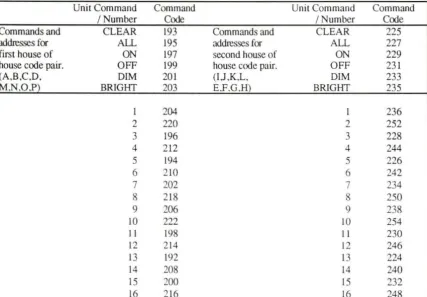
Table 4. A different setting of the switches will activate a different pair of house codes which provide for 32 separate unit codes. A list of all the possible unit and command codes is given in Table 5.
Table 4. Switch settings for house codes (Remote Measurements, Inc., 1983)
House Code
Switch
Number
Pair l 2 3 4 5 6
A,I
on
off
off
on
off
on
B,J
off
on
off
on
off
on
C,K
on
off
on
off
off
on
D,L
off
on
on
off
off
on
M ,E
on
off
on
off
on
off
N,F
off
on
on
off
on
off
O,G
on
off
off
on
on
off
P,H
off
on
off
on
on
off
Table 5. Unit and control codes for BSR modules (Remote Measurement Systems, Inc., 1983)
Unit Command Command Unit Command Command
I Number Code I Number Code Commands and CLEAR 193 Commands and CLEAR 225
addresses for ALL 195 addresses for ALL 227
first house of ON 197 second house of ON 229
house code pair. OFF 199 house code pair. OFF 23 1
(A.B,C.D. DIM 201 (IJ.K.L. DIM 233
M.N.0.P) BRIGHT 203 E.F.G.H) BRIGHT 235
l 204 I 236
2 220 2 252
3 196 3 228
4 212 4 244
5 194 5 226
6 210 6 242
7 202 7 234
8 218 8 250
9 206 9 238
LO 222 10 254
11 198 11 230
12 214 12 246
13 192 13 224
14 208 14 240
15 200 15 232
[image:38.567.44.475.104.238.2] [image:38.567.47.475.305.602.2]1750 RAM Expansion Unit
The 1750 RAM Expansion Unit increases the amount of memory of the C128 (either mode) by 512K, which is arranged in eight 64K banks. The memory is not directly accessible to the computer; programs or data must first be transferred to main memory in order to be used. The speed and convenience of this RAM, though, gives the appearance of direct access and this
allows execution of larger programs or storage of large amounts of data which would not
otherwise be possible. This memory transfer (Direct Memo1y Access or OMA) is
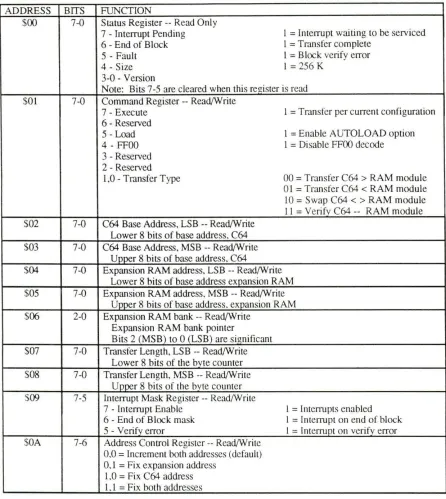
accomplished through the RAM Expansion Controller (REC). The REC internal registers are shown in Figure 2.
The REC has four operating modes:
1) Transfer a block of data from main to expansion memory.
2) Transfer a block of data from expansion to main memory.
3) Exchange or swap a block of main with a block of expansion memory.
4) Verify a block of main versus a block of expansion memory.
The programmer uses several REC internal registers to set up a particular operating mode
and the mode is chosen by setting the appropriate bits in the command register. Starting C64 address, expansion RAM address, expansion RAM bank number, and number of bytes to rransfer are all programmable values.
The REM was used in this project to store vocabula1ies for the program
ADDRESS BITS FUNCTION
$00 7-0 Status Register -- Read Only
7 - Interrupt Pending l = Interrupt waiting to be serviced 6 - End of Block I = Transfer complete
5 - Fault I = Block verify error
4 - Size I= 256 K
3-0 - Version
Note: Bits 7-5 are cleared when this register is read $01 7-0 Command Register -- Read/Write
7 - Execute I =Transfer per current configuration 6 - Reserved
5 - Load I = Enable AUTOLOAD option
4 -FFOO I = Disable FFOO decode 3 - Reserved
2 - Reserved
l.0 - Transfer Type 00 = Transfer C64 > RAM module 0 I =Transfer C64 < RAM module 10 =S wap C64 <> RAM module 11 =Verify C64 -- RAM module $02 7-0 C64 Base Address, LSB -- Read/Write
Lower 8 bits of base address, C64 $03 7-0 C64 Base Address. MSB -- Read/Write
Uooer 8 bits of base address. C64
$04 7-0 Expansion RAM address. LSB -- Read/Write Lower 8 bits of base address expansion RAM $05 7-0 Expansion RAM address. MSB -- Read/Write
Uooer 8 bits of base address. expansion RAM $06 2-0 Expansion RAM bank -- Read/Write
Expansion RAM bank pointer
Bits 2 (MSB) to 0 (LSB) are significant $07 7-0 Transfer Length, LSB -- Read/Write
Lower 8 bits of the bvte counter S08 7-0 Transfer Length, MSB -- Read/Write
Upper 8 bits of the bvte counter $09 7-5 interrupt Mask Register -- Read/Write
7 - lnterrupt Enable I = Intenupts enabled 6 - End of Block mask I = lntenupt on end of block 5 - Verify error I = Interrupt on verify error $0A 7-6 Address Control Register -- Read/Write
0.0 =Increment both addresses (default) 0. 1 = Fix expansion address
LO = Fix C64 address l.1 =Fix both addresses
[image:40.567.45.491.92.591.2]RESULTS AND DISCUSSION
Project Results
The result of this project was a voice-controlled computer system dedicated to running
compatible applications (demonstrating system use of off-the-shelf software) and
environmental control (demonstrating use of a programmer-developed application). These two
functions were brought together to form an integrated product which, with a minimum of
keyboard maneuvering, benefits those who desire to bypass the traditional method of input, the
keyboard, which can be a barrier to effective use of the computer. The computer's detailed memory map and operating system were of necessity under close study throughout the project,
resulting in acquired knowledge useful for exploiting the computer's resources for funher
development of voice input capabilities.
Product
The chief product of this project is a software interface between a speech recognition system developed for the Commodore 64 or 128 Personal Computers and C64 application
programs. This result eliminates the need for the developer to w1ite new software for any
application that might be desired for implementation in the speech input system. This product is referred to as the application interface.
This interface, composed of three machine language routines called MEMORYSWAPl ,
MEMORYSW AP2, and VOICEINTERPRETER, was designed to enable voice input to any
by Commodore and left for programmer use), where the main routine of this interface, MEMORYSWAPl , resides when loaded. MEMORYSWAPl co1mols the swapping of application related memory locations with voice input related locations and is the only routine
required to reside in computer memory at the same time as the application. If an application is
not compatible with the interface, it might be possible to shift MEMOR YSW AP l to another
unused location to accommodate the application the user needs or desires. The current
demonstration system also incorporates a user interface, the program VOICEMANAGER which is written in Commodore BASIC, that allows only the selection of an application program or the environmental control function programmed into the user interface by the developer.
The main project goal was to design a system that was user friendly to those users who have limited access to the keyboard. Although the recognition software enables the user to stop
recognition by pressing the "up arrow" key, the user and application interfaces have built into the software stop recognition functions which do not necessitate a keysu·oke. This feature allows the user to pause to speak with someone or to perfo1m a task other than computing and still does not require access to the system through the keyboard. When it is executed, this function causes the system to choose from a vocabulary or group consisting of just one phrase.
Procedures and Design Features
Two features of the voice input system were particularly strategic in accomplishing this implementation. The first feature involved the software of the application interface.
MEMORYSWAPl, the chief program written for this interface, MEMORYSWAP2, and VOICEINTERPRETER, were developed to enhance the Kemal routine responsible for getting a character from the keyboard. When an application program attempts to call a Kemal routine
called GETIN that processes keyboard input, the application instead is directed to the starting
location of MEMORYSWAPl. MEMORYSWAPl readies the system for speech input and then calls the program VOICE/RECCXJ to perform the actual recognition function. The
program MEMORYSWAPl and its associated machine language routines are the link to getting voice input to the application program. They therefore produce speech input applications from
those designed for keyboard input.
Many of the operating system routines can be replaced or augmented by a programmer via a
jump table of addresses for these routines located in Kemal ROM. Commodore has maintained this jump table through all of its computer design updates from the earliest PET through the
128 and will maintain it throughout any later versions of the operating system. This may allow
a user's written programs to be ponable from a computer to its descendant and will protect
programs from changes in successive versions of the Kernal. For example, the GETIN (get a character) routine is accessed by a jump-to-subroutine (JSR) insn·uction to location $FFE4. This is not the actual address of the routine; what it does contain is a three-byte enn-y consisting of the indirect jump (JMP) operation code (4C) and the bytes 2A and 03 which represent an
indirect address. This three-byte entry assembles into JMP ($032A) which in 6510 assembly
language is an indirect jump to an address which is stored at $032A (low byte) and $032B
vector by placing different values in locations $032A and $0328. replacing 3E and Fl, respectively. $F l 3E is the actual address of the GETIN routine. Changing the vector allow the programmer to either totally replace the Kernal routine or to add to it; this was done to the
GETIN vector for this system implementation. The code that is pointed to by the $032A-$0320 vector must end with the instruction return-from-subroutine (RTS) so that program execution continues at the instruction following the 01iginal JSR that called the Kemal routine. The other main design feature was use of the Direct Memory Access (OMA) operation of the
RAM Expansion Controller (REC), the processor in the 1750 which controls I/0 between itself
and the computer. The computer processor is temporarily halted during OMA o that the REC may utilize computer memory. The expansion memory contains indirectly accessible RAM o
that programs cannot be executed directly and data cannot be directly accessed by tl1e computer.
The use of OMA operations allows the system to use multiple vocabulaiies, which are
essential to executing the numerous functions that have been designed for this system. The voice recognition software allows for tl1e use of only one 32-phrase vocabulaiy in main memory at one time and accessing the disk drive for a substitute vocabulaiy would consume
too much time to allow for the proper functioning of the tasks that the system must accomplish.
The other need for OMA operations is due to the fact that tlle voice recognition unit does not possess its own microprocessor. T he YOICE/RECOG software is therefore executed by the computer and not witl1in the voice unit. Because application programs written for the C64 will typically exhaust the computer's memo1y resomces, the application and YOICE/RECOG
cannot share these resomces at the ame Lime. In order for the application to pe1fo1m with
voice input it must be able to access YOICE/RECOG when attempting to call the routine to get a keyboard input character. Again. OMA rran fers allow for sharing of computer resources
stored in the REM while the other program employs the CPU and main memory. They are then restored to main memory when it is time for the two to trade locations.
Software Developed
YOICEMANAGER
YOICEMANAGER is a program written in Commodore BASIC that functions as the main program and user interface for this demonstration. The environmental control function was developed in BASIC as an option in YOICEMANAGER and does not require that an external
program be loaded. YOICE!RECOG was the recognition program used in conjunction with the
user interface. Its various subroutines necessary for implementing YOICEMANAGER
functions were accessed with Commodore BASIC POKE and SYS statements. POKE allows
the programmer to specify a decimal number value to place in a specified memory location and SYS is the BAS IC equivalent of the assembly language instruction JSR, allowing the
programmer to jump to an assembly language routine from BASIC. The BASIC program
regains control when assembly language RTS i executed. The program also has a section that
prepares the system for the application intetface by loading its program files.
YOICEMANAGER begins by loading YOICE/RECOG, the speech recognition program.
and ACSTASHORFETCH, a short assembly language program written t0 allow the
STASHORFETCHYOCABULARY subroutine to function properly. As the name implies. STASHORFETCHYOCABULARY, a part of YOICEMANAGER, is used by the main program to both transfer a main memory located vocabulary t0 the 1750 and to fetch a
1750-based vocabulary back to main memory. Since vocabulary space was allocated to a RAM memory bank that re ides behind the BASIC ROM space. ACST ASHORFETCH perform
attempted, then initiates the stash or fetch operation, and banks in the ROM following that procedure, it is essential to the proper pertormance of STASHORFETCHYOCABULARY. After an opening message is displayed for the user and the program's arrays are dimensioned, FOR/NEXT loops are used to read in to the program all of the phrase names for all
vocabularies used, as well as the BSR codes used to control appliances in the environmental
control option. After all main program variables are initialized and maximum and minimum
recognition thresholds set, a check is made to determine whether the main vocabulary used,
COMMANDER, is already on the program disk. lf it is, training of COMMANDER is
bypassed and the vocabulary is instead loaded from disk before the main program's main menu
is displayed to the user. If COMMANDER is not on disk. then the program treats this run as
the user's first run of YOICEMANAGER and informs him of the need for a-aining this vocabulary. COMMANDER is trained and stored in expansion memory.
The user is given an option as to the number of times he would like to u-ain the vocabulary, from one to five times. The limit of five is imposed since to do more training would not improve recognition results. Two trainings are recommended to the user before he trains as this corresponds to recognition unit instructions.
After each training of this vocabulary, the user is shown a menu asking whether he would like to continue training it. He is asked to respond to the menu with "affirm," "negative," or
"stop recognition." The "stop recognition" response is a choice that is given at every user input opportunity throughout YOICEMANAGER except one. Its purpose is to provide the ability to stop the program when the user wants to suspend activity while preventing the system from responding to sound. either accidental or intentional. The recognition of "stop recognition.,
causes the program to jump to a subroutine called STOPRECOGNITION. This subroutine