https://doi.org/10.5194/bg-15-3967-2018 © Author(s) 2018. This work is distributed under the Creative Commons Attribution 4.0 License.
Technical Note: An efficient method for accelerating the spin-up
process for process-based biogeochemistry models
Yang Qu1, Shamil Maksyutov2, and Qianlai Zhuang1,3
1Department of Earth, Atmospheric, and Planetary Sciences, Department of Agronomy, Purdue University, West Lafayette, IN 47907, USA
2National Institute for Environmental Studies, 16-2 Onogawa, Tsukuba, Ibaraki, 305-8506, Japan 3Department of Agronomy, Purdue University, West Lafayette, IN 47907, USA
Correspondence:Qianlai Zhuang ([email protected]) Received: 20 February 2018 – Discussion started: 12 March 2018 Revised: 5 June 2018 – Accepted: 11 June 2018 – Published: 3 July 2018
Abstract.To better understand the role of terrestrial ecosys-tems in the global carbon cycle and their feedbacks to the global climate system, process-based biogeochemistry mod-els need to be improved with respect to model parameteri-zation and model structure. To achieve these improvements, the spin-up time for those differential equation-based models needs to be shortened. Here, an algorithm for a fast spin-up was developed by finding the exact solution of a linearized system representing the cyclo-stationary state of a model and implemented in a biogeochemistry model, the Terrestrial Ecosystem Model (TEM). With the new spin-up algorithm, we showed that the model reached a steady state in less than 10 years of computing time, while the original method re-quires more than 200 years on average of model run. For the test sites with five different plant functional types, the new method saves over 90 % of the original spin-up time in site-level simulations. In North American simulations, aver-age spin-up time savings for all grid cells is 85 % for either the daily or monthly version of TEM. The developed spin-up method shall be used for future quantification of carbon dynamics at fine spatial and temporal scales.
1 Introduction
Biogeochemistry models contain state variables representing various pools of carbon and nitrogen and a set of flux vari-ables representing the element and material transfers among different state variables. Model spin-up is a step to get bio-geochemistry models to a steady state for those state and
flux variables (McGuire et al., 1992; King, 1995; Johns et al., 1997; Dickinson et al., 1998). Spin-up normally uses cyclic forcing data to force the model run and reach a steady state, which will be used as initial conditions for model tran-sient simulations. The steady state is reached when mod-eled state variables show a cyclic pattern or a constant value and often requires a significant amount of computation time, which needs to be accelerated for regional and global simu-lations at fine spatial and temporal scales.
Spin-up is normally achieved by running the model re-peatedly using one or several decades of meteorological or climatic data until a steady state is reached. The step could require that the model repeatedly run for more than 2000 an-nual cycles in some extreme cases. Specifically, the model will check the stability of the simulated carbon and nitro-gen fluxes as well as state variables with specified thresh-old values. For instance, the model will check if the sim-ulated annual net ecosystem production (NEP) is less than 1 g C m−2yr−1 (McGuire et al., 1992). Another method to reach a steady state is to obtain the analytical solutions (King et al., 1995; Comins, 1997), which might also take a signifi-cantly long time.
an-alytical solution very close to a steady condition, then start spin-up from the solution, which could significantly reduce spin-up time. This technique did not reach a cyclic pattern for state and flux variables and required an additional spin-up process to achieve the steady state. However, Lardy et al. (2011) and Martin et al. (2007) have implemented their spin-up methods for a linear problem of soil carbon dynam-ics including their seasonal cycles.
Here we developed a method to accelerate the spin-up pro-cess in a nonlinear model. We tested the method for rep-resentative PFTs and North America with both daily and monthly versions of the Terrestrial Ecosystem Model (TEM; Zhuang et al., 2003). In addition, we compared the perfor-mance of our algorithms with the semi-analytical version of Xia et al. (2012). The new algorithms will help us conduct very high spatial and temporal resolution simulations with process-based biogeochemistry models in the future.
2 Method
2.1 TEM description
We used a process-based biogeochemistry model, TEM (Zhuang et al., 2003), as a test bed to demonstrate the perfor-mance of the new algorithms of spin-up. TEM simulates the dynamics of ecosystem carbon and nitrogen fluxes and pools (McGuire et al., 1992; Zhuang et al., 2010, 2003). It contains five state variables: carbon in living vegetation (Cv), nitrogen in living vegetation (Nv), organic carbon in detritus and soils (Cs), organic nitrogen in detritus and soils (Ns), and available inorganic soil nitrogen (Nav). Carbon and nitrogen dynamics in TEM are governed by the following equations:
dCv
dt =GPP−RA−LC, (1)
dNv
dt =NUPTAKE−LN, (2)
dCs
dt =Lc−RH, (3)
dNs
dt =LN−NETNMIN, (4)
dNav
dt =NINPUT+NETNMIN−NLOST−NUPTAKE, (5)
where GPP is gross primary production, RA is autotrophic respiration,LCis carbon in litterfall, NUPTAKE is nitrogen uptake by vegetation, LNis nitrogen in litterfall,RHis het-erotrophic respiration, NETNMIN is net rate of mineraliza-tion of soil nitrogen, NINPUT is nitrogen input from the out-side ecosystem, and NLOST is nitrogen loss from the ecosys-tem. Key carbon fluxes are defined as
GPP=Cmaxf (PAR) f (PHENOLOGY) f (FOLIAGE) f (T ) f (Ca, Gv) f (NA) f (FT) , (6)
NPP=GPP−RA, (7)
NEP=GPP−RA−RH. (8)
For detailed GPP definition, see Zhuang et al. (2003). NEP will be near zero when the ecosystem reaches a steady state. Therefore, the spin-up goal is to keep running the model driven with repeated climate forcing data until NEP is close to zero with a certain tolerance value (e.g., 0.1 g C m−2yr−1). 2.2 Spin-up acceleration method
TEM can be reformulated as dx
dt =g (x, t )+h(t ) , (9) wherexis a vector of state variables (e.g.,CV);h(t )is the vector of carbon–nitrogen input from the atmosphere (such as nitrogen input), independent ofx; andg (x, t )is the pro-cess rate function of element pools (e.g., GPP).
By linearizing the model in terms of pools, we could ob-tain
g (x, t )=g (x0, t )+J(x−x0) , (10) wherex0is initial pool sizes andJis the Jacobian matrix of the process rate:
J=dg
dx =
∂g1
∂x1 · · ·
∂g1
∂xn ..
. ...
∂gn ∂x1 · · ·
∂gn ∂xn
, (11)
wheregrepresentsg (x, t ).xnrepresents each state variable
in the TEM (e.g.,VC). The numerical discretization of Eq. (9) is
xi, k−xi, k−1=τ·Jk−1
2
·xi, k−1
+τg (x0, k−1)−Jk−12 ·x0, k−1+hk−1
, (12) whereτ is time step (month),xi, k is the poolxi size at time
k, andJk−1
2 is a Jacobian matrix at time stepk
−1
2. Here 1 2 refers to the half time step in the middle of a month, at which values ofJare calculated as the mean value at time stepsk andk−1.xi,0refers to the initial poolxisize.
We introduce
fk−1=g (x0, k−1)−Jk−1
2
·x0, k−1+hk−1. (13) The Eq. (12) can then be written as
xi, k−xi, k−1=τ·Jk−21·xi, k−1+τ·fk−1, (14) whereJk−1
2
is a Jacobian matrix at the time stepk−1
2. Af-ter running a large number of annual cycles, the model ap-proaches a cyclo-stationary state, which can be expressed by conditionxT+i=xi, whereT is the number of time steps in
time step using monthly climatology of temperature, precip-itation and other forcing data,T =12, and−→x1 is the size of carbon pools on 1 January, whileJ1.5is the matrix of mean process rate constants for January.
By introducing Ak=τ·Jk−1
2, yk
=τ fk−1, Bk=I, Ck=I+A,
whereIis an identity matrix, Eq. (12) can be further written as
−Ck·xi, k−1+Bk·xi,k=yk. (15)
The cyclic boundary condition isx1=xT+1. Then Eq. (13) will become
−C1·xi, T +B1·xi,1=y1. (15a) Thus Eq. (15) and (15a) become a formulation of a linear problem with T unknown vectors−→xT, which can be solved
using LU (lower and upper) decomposition or Gaussian elim-ination (Martin et al., 2007). Xia et al. (2012; see Eq. 4) and Kwon and Primeau (2006) also had linear equations for a steady state, but conducted the model simulation at an an-nual time step. Going for anan-nual average form reduces the size of the problem and prevents Xia et al. (2012) from ob-taining the exact solution of the problem including seasonal cycle (see their Eqs. 15, 15a). While our new approach runs the model at a monthly time step with the cyclic boundary conditions for state variables x, it still targets a steady state for the ecosystem at an annual time step instead of a monthly time step.
2.3 Numerical implementation
Equation (15a) is explicitly expressed as
B 0 0 . . . 0 0 0 −C
−C B 0 . . . 0 0 0 0 0 −C B . . . 0 0 0 0 . . . .
0 0 0 . . . −C B 0 0 0 0 0 . . . 0 −C B 0 0 0 0 . . . 0 0 −C B
× x1 x2 · · · · xT = y1 y2 · · · · yT . (16)
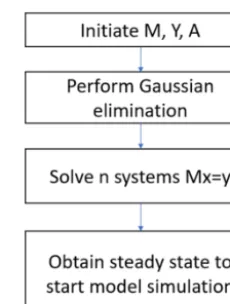
[image:3.612.370.485.63.215.2]Equation (16) can be shown in the formMx=Y. We apply the Gaussian elimination to the upper block that reducesMto a lower triangular form (Fig. 1). The resulting
Figure 1.Algorithms and procedures of the new spin-up method.
matrix is lower diagonal:
M0=
B0 0 0 . . . 0 0 0 0
−C B 0 . . . 0 0 0 0 0 −C B . . . 0 0 0 0 . . . .
0 0 0 . . . −C B 0 0 0 0 0 . . . 0 −C B 0 0 0 0 . . . 0 0 −C B
. (17) Equation (16) is thus reduced to the formM0x=Y0, where M0is the lower diagonal, and solution of Eqs. (15a) and (16) will be readily obtained forx.
2.4 Algorithm implementation for TEM In the original TEM, carbon fluxes can be defined as
NPP=GPP−MR−GR, (18)
MR=VC·KT, (19)
GR=
0.25·(GPP−MR) , if GPP>MR
0, otherwise , (20)
where NPP is defined as the difference of GPP and plant maintenance respiration (MR) and growth respiration (GR). MR is assumed as a function ofCV and temperature (KT).
Here we revised MR calculation: MR
=
VC·KT, if GPP> VC·KT 0.75·VC·KT+0.25·GPP, otherwise.
(21)
The NEP is defined as the difference between NPP and heterotrophic respiration (RH).
Table 1.Test sites for new spin-up algorithms.
Site name Location PFT Reference
1. Fort Peck 48.3◦N, 105.1◦W Grassland Gilmanov et al. (2005) 2. Bartlett Exp Forest 44.1◦N, 71.3◦W Deciduous broadleaf Ollinger et al. (2005) 3. UCI_1850 55.9◦N, 98.5◦W Evergreen needleleaf Goulden et al. (2006) 4. Vaira Ranch 38.4◦N, 121.0◦W Grassland Baldocchi et al. (2004) 5. Missouri Ozarks 38.7◦N, 92.2◦W Deciduous broadleaf Gu et al. (2007, 2012) 6. Niwot Ridge 40.0◦N, 105.5◦W Evergreen needleleaf Turnipseed et al. (2003, 2004) 7. Harvard Forest 43.5◦N, 72.2◦W Deciduous broadleaf Van Gorsel et al. (2009)
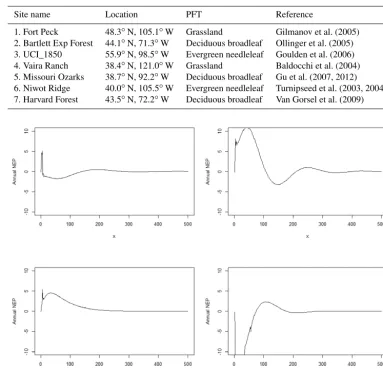
Figure 2.The time for NEP (g C yr−1m−2) to reach a steady state with the original spin-up method at the Harvard Forest site. x represents model simulation years.
to acquire the state variable values (Fig. 1). To adapt this method to a daily version of TEM, we changed the cyclic condition T from 12 to 365. The other steps are the same as for the monthly version. We tested the new method for the carbon-only version and carbon–nitrogen coupled ver-sion of TEM for different PFTs (Table 1). Specifically, for the carbon-only version, we only solved the differential equa-tions that govern the carbon dynamics, while for the carbon– nitrogen coupled version, we solved the differential equa-tions that govern both carbon and nitrogen dynamics in the system. For both versions, the spin-up process strives to reach a steady state for carbon pools and fluxes.
3 Results and discussion
At the Harvard Forest site, the traditional spin-up method took 564 years to reach the steady state for both the carbon-only and coupled carbon–nitrogen simulations with an
an-nual NEP of less than 0.1 g C m−2yr−1(Fig. 2). In contrast, the improved method took 72 years for the carbon only and 122 for the coupled carbon–nitrogen simulations. For car-bon and nitrogen pools, it took another 45 years (equivalent cyclic time) to reach a steady state with a NEP of less than 0.1 g C m−2yr−1. In comparison with the traditional spin-up method (Zhuang et al., 2003), the new method saved 65 % of computational time to reach the steady state in the carbon-only simulations (Table 2). The differences in steady-state carbon pools between using the new method and traditional spin-up methods were small (less than 0.85 %). Similarly, for the coupled carbon–nitrogen simulations, the new method saves a similar amount of time to reach the steady state.
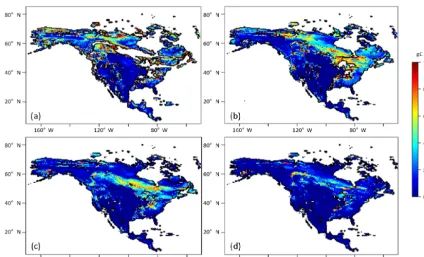
Figure 3.Simulated NEP (g C m−2yr−1) with the original spin-up method after different spin-up times of(a)50,(b)100,(c)150 and
(d)200 years. After these spin-up times, 63, 89, 93 and 98 % of grids reach their steady states, respectively.
Table 2.Spin-up time comparison for different methods for seven study sites; seconds represent real computation time, and years refer to the annual spin-up cycles.
Site Original Spin-up New method Semi-analytical no. spin-up computation computation method
year time time (equivalent
(seconds) (seconds) annual cycles)
1 231 1.3 0.5 0.7 s (+76)
2 305 1.7 0.3 0.8 s (+101)
3 245 1.5 0.4 0.9 s (+52)
4 443 2.2 0.4 0.5 s (+118)
5 304 1.8 0.4 0.8 s (+86)
6 204 1.1 0.3 0.7 s (+43)
7 564 2.5 0.6 0.9 s (+45)
different sites (Table 2). Compared to the original spin-up method, the new method is not only faster but also computa-tionally stable.
The time of spin-up to reach a steady state of NEP varied for different PFT grids using the original method (Fig. 2). In general, to allow 98 % of grid cells to reach their steady states of NEP, it takes 250 annual model runs, while the new method will only need on average of 0.6 s (equivalent to 60-year annual model runs with the original method) (Fig. 3). For regional tests in North America, we found that the av-erage saving time with the new method with monthly TEM is 25, 32 and 22 % for Alaska, Canada and the conterminous US, respectively.
To compare the performance of the new method with other existing methods, we adapted the semi-analytical method (Xia et al., 2012) to the TEM model. To do that, we first revised the TEM model structure to
dP (t )
dt =εACP (t ), (22)
whereP (t )is a vector of pools in TEM (e.g.,CV andCS). εis a scalar.Ais a pool transfer matrix (in whichAij
rep-resents the fraction of carbon transfer from pool j to i). Cis a diagonal matrix with pool components (where diag-onal components quantify the fraction of carbon left from the state variables after each time step). With this method, we obtained an analytical solution for the intermediate state. We then kept running TEM with the traditional spin-up pro-cess. Specifically, we started TEM simulation to estimate the state variable values. Based on these values, the spin-up runs were conducted to reach the final steady state. We found that the semi-analytical solution is better than the original spin-up method but slower than the new method proposed in this study (Table 2).
[image:5.612.53.281.414.534.2]rela-tively easy but will take a great amount of computing time to equilibrate. For models such as CLM, multiple methods have been tested to accelerate their spin-up process (e.g., Fang et al., 2015), the direct analytical solution method introduced in this study might be time consuming to achieve.
4 Summary
We developed a new method to speed up the spin-up process in process-based biogeochemistry models. We found that the new method shortened 90 % of the spin-up time using the traditional method. For regional simulations in North Amer-ica, average spin-up time saving is 85 % for either daily or monthly version of TEM. We consider our method is a gen-eral approach to accelerate the spin-up process for process-based biogeochemistry models. As long as the governing equations of the models can be formulated as the form in Eq. (9), the algorithm could be adopted accordingly. Our method will significantly help future carbon dynamics quan-tification with biogeochemistry models at fine spatial and temporal scales.
Data availability. All data used in this study are available from the authors upon request.
Author contributions. QZ and SM designed and supervised the re-search. YQ performed model simulations and data analysis. All au-thors contributed to the paper writing.
Competing interests. The authors declare that they have no conflict of interest.
Acknowledgements. This study is supported through projects funding to Qianlai Zhuang from the Department of Energy (DESC0008092 and DE-SC0007007) and the NSF Division of Information and Intelligent Systems (NSF-1028291). The super-computing resource is provided by the Rosen Center for Advanced Computing at Purdue University.
Edited by: Christopher A. Williams Reviewed by: two anonymous referees
References
Baldocchi, D. D., Xu, L., and Kiang, N.: How plant functional-type, weather, seasonal drought, and soil physical properties alter water and energy fluxes of an oak–grass savanna and an annual grassland, Agr. Forest Meteorol., 123, 13–39, 2004.
Comins, H. N.: Analysis of nutrient-cycling dynamics, for predict-ing sustainability and CO2-response of nutrient-limited forest ecosystems, Ecol. Model., 99, 51–69, 1997.
Dickinson, R. E., Shaikh, M., Bryant, R., and Graumlich, L.: Inter-active canopies for a climate model, J. Climate, 11, 2823–2836, 1998.
Fang, Y., Liu, C., and Leung, L. R.: Accelerating the spin-up of the coupled carbon and nitrogen cycle model in CLM4, Geosci. Model Dev., 8, 781–789, https://doi.org/10.5194/gmd-8-781-2015, 2015.
Gilmanov, T. G., Demment, M. W., Wylie, B. K., Laca, E. A., Ak-shalov, K., Baldocchi, D. D., and Emmerich, W. E.: Quantifica-tion of the CO2exchange in grassland ecosystems of the world
using tower measurements, modeling and remote sensing, in: XX International Grassland Congress: offered papers, 26, p. 587, 2005
Goulden, M. L., Winston, G. C., McMillan, A. M. S., Litvak, M. E., Read, E. L., Rocha, A. V., and Rob Elliot, J.: An eddy covariance mesonet to measure the effect of forest age on land–atmosphere exchange, Glob. Change Biol., 12, 2146–2162, 2006.
Gu, L., Meyers, T., Pallardy, S. G., Hanson, P. J., Yang, B., Heuer, M., and Wullschleger, S. D.: Influences of biomass heat and biochemical energy storages on the land surface fluxes and radiative temperature, J. Geophys. Res.-Atmos., 112, https://doi.org/10.1029/2006JD007425, 2007.
Gu, L., Massman, W. J., Leuning, R., Pallardy, S. G., Meyers, T., Hanson, P. J., and Yang, B.: The fundamental equation of eddy covariance and its application in flux measurements, 152, 135-148, Agr. Forest Meteorol., 2012.
Johns, T. C., Carnell, R. E., Crossley, J. F., Gregory, J. M., Mitchell, J. F., Senior, C. A., Tett, S. F. B., and Wood, R. A.: The second Hadley Centre coupled ocean-atmosphere GCM: model descrip-tion, spinup and validadescrip-tion, Clim. Dynam., 13, 103–134, 1997. King, D. A.: Equilibrium analysis of a decomposition and yield
model applied toPinus radiataplantations on sites of contrasting fertility, Ecol. Model., 83, 349–358, 1995.
Kwon, E. Y. and Primeau, F.: Optimization and sensitivity study of a biogeochemistry ocean model using an implicit solver and in situ phosphate data, Global Biogeochem. Cy., 20, GB4009, https://doi.org/10.1029/2005GB002631, 2006.
Lardy, R., Bellocchi, G., and Soussana, J. F.: A new method to deter-mine soil organic carbon equilibrium, Environ. Modell. Softw., 26, 1759–1763, 2011.
Martin, M. P., Cordier, S., Balesdent, J., and Arrouays, D.: Peri-odic solutions for soil carbon dynamics equilibriums with time-varying forcing variables, Ecol. Model., 204, 523–530, 2007. McGuire, A. D., Melillo, J. M., Joyce, L. A., Kicklighter, D. W.,
Grace, A. L., Moore, B. I. I. I., and Vorosmarty, C. J.: Interactions between carbon and nitrogen dynamics in estimating net primary productivity for potential vegetation in North America, Global Biogeochem. Cy., 6, 101–124, 1992.
NVIDIA CUDA Compute Unified Device Architecture Program-ming Guide, NVIDIA Corporation, 2007.
Ollinger, S. V. and Smith, M. L.: Net primary production and canopy nitrogen in a temperate forest landscape: an analysis us-ing imagus-ing spectroscopy, modelus-ing and field data, Ecosystems, 8, 760–778, 2005.
Thornton, P. E. and Rosenbloom, N. A.: Ecosystem model spin-up: Estimating steady state conditions in a coupled terrestrial carbon and nitrogen cycle model, Ecol. Model., 189, 25–48, 2005. Turnipseed, A. A., Anderson, D. E., Blanken, P. D., Baugh, W. M.,
in mountainous terrain: Part 1. Canopy and local effects, Agr. Forest Meteorol., 119, 1–21, 2003.
Turnipseed, A. A., Anderson, D. E., Burns, S., Blanken, P. D., and Monson, R. K.: Airflows and turbulent flux measurements in mountainous terrain: Part 2: Mesoscale effects, Agr. Forest Me-teorol., 125, 187–205, 2004.
Van Gorsel, E., Delpierre, N., Leuning, R., Black, A., Munger, J. W., Wofsy, S., and Chen, B.: Estimating nocturnal ecosystem respi-ration from the vertical turbulent flux and change in storage of CO2, Agr. Forest Meteorol., 149(11), 1919–1930, 2009.
Xia, J. Y., Luo, Y. Q., Wang, Y.-P., Weng, E. S., and Hararuk, O.: A semi-analytical solution to accelerate spin-up of a coupled car-bon and nitrogen land model to steady state, Geosci. Model Dev., 5, 1259–1271, https://doi.org/10.5194/gmd-5-1259-2012, 2012.
Zhuang, Q., McGuire, A. D., Melillo, J. M., Clein, J. S., Dargaville, R. J., Kicklighter, D. W., Myneni, R. B., Dong, J., Romanovsky, V. E., Harden, J., and Hobbie, J. E.: Carbon cycling in extratropi-cal terrestrial ecosystems of the Northern Hemisphere during the 20th century: a modeling analysis of the influences of soil ther-mal dynamics, Tellus B, 55, 751–776, 2003.