International Journal of Innovative Technology and Exploring Engineering (IJITEE) ISSN: 2278-3075,Volume-8 Issue-11, September 2019
Abstract- Objective of the paper is to get analyze the scientific studies by focusing on smart city concepts and sustainability to understand better. For doing such thing, the study identifies the information about the different existing and recent technologies, various research, different models and various frameworks. The methodology used for this research is qualitative by an organized review of different literatures, which examines the important terminologies like, “Smart city”, “Urban Computing” and “Sustainability”, focusing on the sustainable development of smart cities. This review gives detailed information regarding the recent scientific piece of writing focusing variety of issues related to smart cities and sustainability. This review may provide a base to the researchers looking for surrounding information to explore more. The finding gives important insights for the scholars researching in the area under discussion, and managers are trying to apply those in their respective cities. In the last section we have proposed a three layered framework of smart cities which includes the supporting technologies, pillars of smart city and the society which gets benefitted.
Keywords: Smart city, Sustainable city, Urban Computing, Urban development.
I. INTRODUCTION A. Defining Smart-City
This “smart-city” term has already been given in 1994 (Dameri & Cocchia, 2013), though the concept of smart-city is commonly used in current scenario, still there is not a clear and consistent perceptive of this term [1]. Most of the countries, mainly in the developed countries like Dubai, Barcelona and Amsterdam have initiated for Smart City. Shanghai is the leading one in China. Though, in India, the current scenario except for wide-ranging themes like availability of connectivity everywhere and Wi-Fi community, facts on what the smart cities be supposed to have is still missing [2]. The Smart City concept includes different ideas in governments, academia, international corporations and globalorganizations.In a nut shell, there is no consensus for the smart city theory. Bakıcı et al. [13] came with the idea that the smart city is concentrated on technology and modern city links people, society and information of city by using recent technologies for developing a sustainable and greener city which includes competitive, innovative and a better quality life.
As we know that the urbanization’s rapid growth plays an important role in the advancement of the country which also affects the economy of the country as well. We are moving
Revised Manuscript Received on September 05, 2019.
Md. Shamsul Haque Ansari, Research Scholar, Department of
Computer Science, Faculty of Natural Sciences, Jamia Millia Islamia, New Delhi-110025, India.
Monica Mehrotra, Proferssor, Department of Computer Science,
Faculty of Natural Sciences, Jamia Millia Islamia, New Delhi-110025, India.
towards the urbanization where urban computing plays a vital role for the same. It has modernized the lives of many people but also produced major challenges, like traffic congestion, pollution, and consumption of energy [1].
According to the report of United Nations in the year 2014, 54% population of the world lived in different cities, as compared to 30% in the year 1950. There is continuous increase in urbanization and it is anticipated to continue by almost 66% population of the world is predicted to be urban up to 2050. There is no standardization for the term “Urbanization” across the countries, thus cities has to adapt in a different way to collect the increasing demands and distinctive challenges to be handled. Urbanization has a lot of positive things. It raises economic and cultural activity; take the people together and their ideas too. It is taking the people more closely which reduces transport times and enhances the productivity [2] [3] [10] [24]. However, urbanization brings challenges too. Dense population creates the shortage of resources such as land, quality food, fresh water and energy. Hence, for promoting a quality life and economic productivity, all the cities require a kind of system which promotes the proficient and sustainable utilization of resources [3] [31] [32].
Urbanization is growing rapidly in so many modern countries, whereas few cities belonging to developed countries are getting involved in the urban reconstruction, renewal and sub-urbanization. Hence, we require inventive and innovative technologies which may sense urban dynamics automatically and give essential information to improve the sustainability of smart cities [21]. In a simple words, a smart city be supposed to comprise (i) well-organized availability of utilities for public like water, sanitation, electricity, sewerage and other services associated with the government (ii) system for demand and supply of the services related to transport for offering roads without congestion and minimum waiting time for public transport (iii) keeping an eye on and vigilant in the city for making the necessary public safety available to residents and (iv) on-demand accessibility of trustworthy emergency services like fire safety, ambulance, etc.[22] [41].
In dimensions as mentioned above, an ICT (information and communication technology) plays an essential role. Organizations like IBM and Cisco are spending a huge amount, i.e., millions of dollars for incubating technologies which helps the initiatives for smart city. One of the use cases is the “Department of Energy”, smart grid network sponsored by US in the city of Sacramento, California. There are 615,000 smart meters within customer premises which has been installed and they are linked via HANs (home area networks) and they are further linked to the AMI (advance metering infrastructure) network [22].
Development of Smart Cities and Its
Sustainability: A Smart City framework
Another use case is “Smart Amsterdam” where the “Digital Road Authority” mines variety of data related to traffic for providing services like on-demand parking space, and estimated travelling time to the users. Hence by decreasing waiting time, congestion, and air pollution, can improve the safety of road and quality life for the citizens [43]. Different types of devices discussed as under jointly form which is termed as ‘Internet of Things’ which are important in the development of smart cities:-
A variety of sensors which are used to observe the status of utilities like electricity, load on transport, water supply and captures the current data [9] [10];
Gateways which collects updated data from such the sensors, performs analytics in their boundaries locally and on the basis of the result, takes action locally to prevent faults which are likely to occur from disseminating further into the other networks [46] ; Communication infrastructure for connecting such
gateways with the server cloud to transmit data by following the provision of local area.
In cloud based architecture, Server farms warehouses the data; performs mining of this kind of data in real-time for giving useful information to different stakeholders via different medium like mobile devices. The next essential component is the “design architecture” of various ICT tools related to smart city projects. Although there are limited firms which dominate the ICT platform for smart cities in the present scenario, it is needed to build platforms through open gateways, APIs and open data sets with the intention that experts of many Indian IT firms (including both big and small) and the big developer communities may be targeted for developing innovative applications as well as other services [42] [43].
[image:2.595.305.564.294.507.2]The devices and sensors used for communication, transmission infrastructure gives big chance for electronics manufacturing locally that has been recognized like a targeted area with the government. Such kind of data collected is made open and can be utilized for big data analytics start-ups in the country. The third and the last is the “Smartness Measurement” of various cities. A body of mobile operators, i.e., the GSM Association—has launched the index for smart cities which consists of a group of market, social and economic indicators which tracks the initiatives to be taken for smart cities. The ICT/mobile indicators are the subset of a wider range of smart cities indicators. Its use will permit the cities to compute the impact of ICT/mobile on the city’s operations, its local economy and its citizens [20] [25].
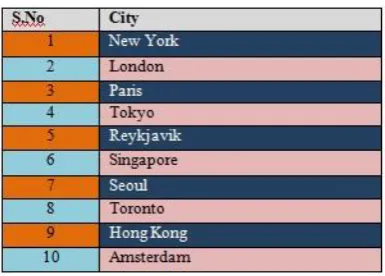
Table 1: List of top ten smart cities
According to the development of Smart Cities day by day, there is a big competition in the world for developing Smart Cities which changes according to the time, implementation and quality. Table 1 shows the list of first ten smart cities in the world declared in the year 2018[7].
B. Urbanization and Sustainability
United Nations has shared the new estimate according to which, the World population has been anticipated to attain 9.8 billion in 2050, and 11.2 billion in 2100. UN stated that, 68% people of the world have been anticipated to exist in urban areas by the year 2050.
[image:2.595.72.265.623.761.2]At present, 55% population of the world exists in urban areas, a percentage which is likely to boost up to 68% by the year 2050. Projection in figure 1 shows that the urbanization, regular change in people’s residence from rural areas to urban areas, combining with the overall growth of the world’s population could add another 2.5 billion citizens to urban areas by the year 2050, with nearby 90% of this increase taking place in Asia and Africa [7] [12] [13] [22].
Figure 1: Projected Urban Population
A general and simple aim of smart cities is to get enhanced the sustainability with support of recent technologies. If we talk about the urban areas of INDIA, according to the ministry of Urban Development they have shared the details in figure 2 which shows the INDIA’s GDP% and the prediction in upcoming years [44]. It is showing the continuous growth which shows the increase in the importance of urbanization towards the country.
In the past few years, there is a remarkable development of applications based on mobile sensing and supported through modern technologies linked to ubiquitous and persistent computing, crowd sourcing and the social networks. Hence, urban computing may be termed as the technology which can be used for data acquisition, data integration, and the analysis of big data which is heterogeneous and produced through a variety of sources in the urban spaces, like devices, vehicles, sensors, buildings and human to handle the key issues which cities face. Furthermore, such technology looks for techniques to minimize inefficiencies and must be more agile to respond resident’s
International Journal of Innovative Technology and Exploring Engineering (IJITEE) ISSN: 2278-3075,Volume-8 Issue-11, September 2019
Authors(s) Definitions
Giffinger, et al. [17]
“A city well performing in a forward-looking way in economy, people, governance, mobility, environment, and living, built on the smart combination of endowments and activities of self-decisive, independent and aware citizens.”
Hollands [35]
“A city that monitors and integrates conditions of all of its critical infrastructures, including roads, bridges, tunnels, rails, subways, airports, seaports, communications, water, power, even major buildings, can better optimize its resources, plan its preventive maintenance activities, and monitor security aspects while maximizing services to its citizens.”
Harrison, Eckman, Hamilton, Hartswick, Kalagnanam, Paraszczak and Williams [36]
A city “connecting the physical infrastructure, the IT infrastructure, the social infrastructure, and the business infrastructure to leverage the collective intelligence of the city”
Natural Resources Defense Council [37]
“A city striving to make itself “smarter” (more efficient, sustainable, equitable, and livable)”
Toppeta [38]
A city “combining ICT and Web 2.0 technology with other organizational, design and planning efforts to dematerialize and speed up bureaucratic processes and help to identify new, innovative solutions to city management complexity, in order to improve sustainability and livability.”
Washburn, Sindhu, Balaouras, Dines, Hayes and Nelson [39]
“The use of Smart Computing technologies to make the critical infrastructure components and services of a city—which include city administration, education, healthcare, public safety, real estate, transportation, and utilities—more intelligent, interconnected, and efficient”
IBM [41] “Smart City is defined by IBM as the use of information and communication technology to sense, analyze and integrate the key information of core systems in running cities” Hall [12] Smart City is one of the urban centers of the future, environment friendly and proficient
since all the structures like energy, power, transportation, education, traffic, parking, water, etc.—are designed, implemented and retained by applying electronics, superior integrated sensors, materials and networks that are connected through computerized systems containing databases, technologies for monitoring and decision-making algorithms.
[image:3.595.57.550.48.521.2]Yigitcanlar et al. [16] Smart City is a very complex combination of art, culture, education, commerce, economy and business which takes up recent technologies to enhance the efficiency level by making use of functions related to urban infrastructure.
Table 2: Proposed definitions of smart city adapted by different authors
II. LITERATURE REVIEW
Various definitions for “smart cities” have been suggested, but the idea of better quality life is doubtful till now, and the relationship between smart technologies with better quality of life has not been yet recognized clearly. Table 2 summarizes eight definitions mostly based on different reviews done by Chourabi et al. [33], Cocchia [34] and other authors. Usually, description explains the characteristics of a “good” city only, while others give emphasis to the technology.
[image:3.595.308.545.557.720.2]Hollands [11] talked about various intricacies usually faced during establishment of “smart-city” model through the explanation of the unseen factors participated in the classification of smart cities. Hall [12] stated about the idea of “smart cities” that it is one of the urban centers of the future, environment friendly and proficient since all the structures like energy, power, transportation, education, traffic, parking, water, etc.—are designed, implemented and retained by applying electronics, superior integrated sensors, materials and networks that are connected through computerized systems containing databases, technologies for monitoring and decision-making algorithms.
Giffinger [14] stated that any smart city can be understood like a smart community where different elements like people, governance, environment, and economy are put together under smart infrastructure. In other words, residents of a city are the basic component of smart cities because they shape such a city by their constant participation and involvement. Due to such grounds, a smart population is accepted as a main component for smart cities; therefore the knowledge and the education are key strategies in smart cities [15]. Additionally, social infrastructures like social capital and the intellectual capital may be treated like fundamental components of smart cities for the reason that they link people and forms relationships among them [5]. Yigitcanlar et al. [16] talked about the idea of smart city that it is a very complex combination of art, culture, education, commerce, economy and business. Although there are different opinions, and findings while describing the smart city, it is obvious that any smart city takes up recent technologies to enhance the efficiency level by making use of functions related to urban infrastructure. A smart city also looks for providing the better “quality life” to their residents. Hence, the term “smart city” may be defined as:- “a city that is sustained based on highly intelligent ICTs and social networking; communication between people and things and things and things, which goes beyond time and space; convergence between ICT and real time; and convergence with other industries by which new value-added contents and services are constantly re-created accompanied by innovation of society as a whole, including work styles, lifestyles, culture, politics, and the economy”. YU ZHENG et al.[1] discussed that the rapid growth of Urbanization has restructured the lives of so many people but also produced major issues, like congestion due to traffic, energy consumption, pollution and wastage of water. Urban computing focuses on handling such issues via using the variety of data which has been produced in different cities like traffic flow, human mobility, and geographical data. This concept links urban sensing, management of data, analytics on data, and providing services for constant improvement in people’s lives and the environment. This computing is a kind of interdisciplinary field in which computer science meet up city-related fields like transportation, civil engineering, environment, economy and sociology in the context of urban spaces[7][11]. (Zheng et al., 2014) discussed about a four layered framework, that consists of:- (i) urban sensing, (ii) urban data management, (iii) data analytics, and (iv) service providing. The first layer that is the “urban sensing layer”
which identifies the people’s mobility, for example routing activities in a network of city’s road, by means of GPS based sensors or through their signals of mobile phones. They have
the internet.
In the second layer which is “data management layer”, the mobility of human being and social media data are properly structured with few indexing structure which all together incorporates spatio-temporal information and texts, for the support of well-organized data analytics.
In the “data analytics layer”, once an irregularity occurs, we are capable to discover the locations where people’s mobility considerably varies with its origin patterns. In the “service providing layer”, the locality and explanation of the anomaly will be sent to the nearby drivers, so that they may select a bypass. Apart from this, information will be transmitted to the transportation authority for scattering the traffic and diagnosing the anomaly [1]. They have suggested future directions for the researchers, which focuses on missing technologies or which has not been well studied like balanced crowd sensing, Skewed data distribution, Managing and indexing multimode data sources, Knowledge fusion, Exploratory and interactive visualization for multiple data sources, Algorithm integration and Intervention-based analysis and prediction. (Eiman Al Nuaimi et al. 2015) reviewed the big data applications for supporting smart cities. They discussed and compared various definitions of the smart city and big data, explored the opportunities, different issues, challenges and benefits of integrating the applications of big data for smart Cities [24]. (Edward Curry et al. 2016) presented important research contributions associated with the design and development of Infrastructure, Services and Applications for the Smart City and Urban context [23]. (Chang et al. 2018) discussed about the available approaches for the assessment of smart and sustainable cities, by describing the core aspects, limitations, strengths and discussed the potential contribution of a knowledge-based urban development strategy for the successful promotion of smart and sustainable cities, presented in a proposed conceptual framework.
A. What is needed for smart cities to be sustainable?
Sustainability: M.Sethi [2] discussed that the Smart Cities may be considered as a logical view to understand the issues related to sustainable urbanization as the essential goal. Sustainability must be more flexible and adaptive with the law of nature. Decentralized act in the services of municipality, waste management, waste water management, traffic management, and the involvement of people could bring bigger benefits in place of having a centralized control on data. One of the key highlights of the government was to develop smart cities in all over the country. The objective was to make cities smart by using technology that would help a city self sustainable, remain future proof and offer the best services to its dwellers. Creating enough smart cities across the country would also help stop the mass migration from rural areas to some prominent metros in search for employment, better living and other facilities like education, healthcare etc. However, just deployment of some technologies on to the existing cities would not help the mission. “For sustainable urbanization, cities need to adopt a framework that is socially equitable, economically viable and environmentally sustainable,” feels Cisco, the US based technology major which has been playing a critical role in developing smart cities in India,
International Journal of Innovative Technology and Exploring Engineering (IJITEE) ISSN: 2278-3075,Volume-8 Issue-11, September 2019
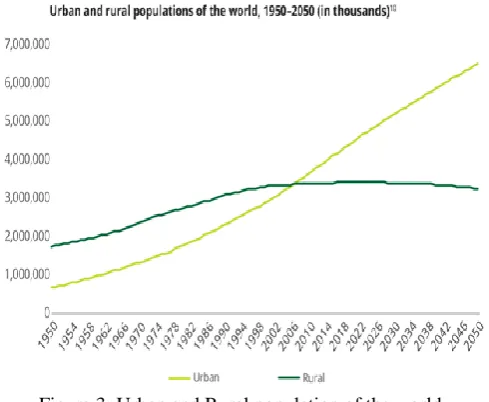
[image:5.595.48.293.108.309.2]Figure 3 shows the comparative growth of urban over rural population in the world [45]. We can see in the figure that after 2006 there is a tremendous change in the sustainability of urbanization.
Figure 3: Urban and Rural population of the world
B. Smart city Principle
For getting better understanding we can see that the principle of smart city operates on a 4-step process as described in the figure 4:-
1) Data Capturing
Smart devices are the foundation for capturing the data. For example, sensors beside roads may gather information related to traffic congestion and the condition of road, and smart meters established in many houses and offices may monitor electricity and water consumption dynamically. Current advancements in technology and the falling price of devices made it feasible to install millions of devices in the cities. Such devices may act as a backbone for a smart city [30] [42].
2) Communication
Smart devices have the data which requires to be transmitted among the servers and the control centers. A smart city requires a communication layer which makes easy communication and links different devices which ensures interoperability, integrity, safety, scalability and privacy. Any communication strategy should involve various IT vendors, service providers, communication infrastructure providers and city governments [26] [42].
3) Analysis
Data is accumulated centrally and when it is done, the smart city requires making sense of it for preparing insights which can be applicable. Such “data crunching” usually needs algorithms and computer systems which are proficient in data processing and converted it into intelligence. For instance, data collected from the traffic sensors may point out congestion in a specific locations, and other routes may be suggested to the passengers [38] [42].
Figure 4: Smart City Principal- A layered approach
4) Act
The last step is for utilizing such analysis for decision making. For example, a wide-range database related to the medical records of the patient collected by the hospitals in electronic form could be utilized to establish a strategic healthcare system based on citizen’s demand of medical services [42].
III. FRAMEWORK AND METHODOLOGY After reviewing different papers containing the keyword “smart city”, ”sustainability”, “urbanization”, “technologies”, “IoT”, etc. we found that there are different basic blocks for developing smart cities from which some plays important role as a pillar.
According to our study, we can summarize the review with major pillars for smart cities which are: - Education, healthcare, transport, building, telecom, tourism, public safety, utilities and energy which has been shown in figure 6. We have presented these pillars of smart cities as a three layered framework to show the different relationship among the entities involved. We can understand this framework with a layered approach in detail. In figure 6, a proposed framework has been given, in which we have named the first layer as “Technology” from the bottom, which includes the recent technologies involved in smart city development. Basically technology is focusing on the collection of various technologies which is being used in the current scenario. In our framework, it is providing the support to the basic pillars of smart city. Second layer is “Major Pillars of smart city” which must be focused as the major part and required to be implemented for the development of the smart city. Third layer is the “Society” which includes the citizens also. All the major pillars affect the society directly or indirectly. Now we can understand the framework in detail in the next sub section.
A. Layer 1: Technology
Internet access via Broadband and Wi-Fi Smart-city concept requires high speed connectivity everywhere and Wi-Fi networks with high bandwidth. Such network supports in the tracking of consumer internet usage, as well as machine-to-machine and machine-to-human communications (collectively termed as the “Internet of Things”) on which smart city depends upon. According to the estimate made by CISCO, 50 billion devices will be connected via internet globally by the year 2020, which will require high speed and robust network infrastructure [1] [23].
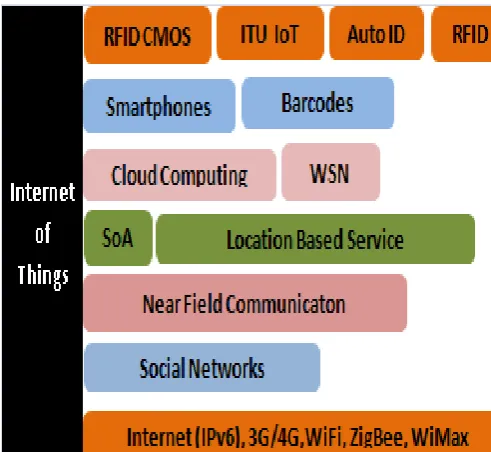
Figure 5: Technologies involved in IoT
The first layer of the proposed framework is “Technology”. Figure 5 shows the different technologies which have been involved for the development of smart cities with the support of IoT [43]. These technologies include the recent technologies also. It helps in achieving and maintaining the sustainability of smart city.
B. Layer 2:- Major Pillars of Smart City
In figure 6, the second layer is representing the different pillars of smart city which are connected to the third layer. Third layer is representing the society which gets directly affected with the development.
1) Healthcare
With the continuous change in lifestyles and the conditions of environment during the past few years, is related with the increase in occurrence of several chronic diseases. Rapid growths in the population, increasing costs and tightening budgets are pressurizing cities’ healthcare infrastructures across the world [40] [42].
Figure 6: Three layered framework for smart city
a) Tele-medicine
Services like Tele-medicine or remote healthcare is carried out through off-locations. Usually services consist of tele-consultation and tele-diagnosis that allows the experts to carry out diagnostics by medical devices from remote location. Telemedicine permit nurses to observe the patients suffering from chronic diseases remotely (tele-monitoring) and permit doctors for doing the surgeries remotely with complicated and advanced mechanical tools and communication tools. The University of Kansas founded a Center for Telemedicine and Tele-health and now it has more than 100 telemedicine sites across the state [40] [42].
b) Analytics on Healthcare
The huge quantity of data captured related to healthcare may be employed for improving the quality of healthcare and minimize the costs. Hospitals and government both can use predictive analysis to evaluate the risk of patient for specific diseases. Cities are free to take decisions based on the residents’ EHRs. For example, Emory University Hospital in the United States performs advanced analytics to make improved healthcare available for the patients [40] [42].
c) Consolidated digital health records
A paper based record can be replaced with Electronic Health Records (EHR) and it should enable the patients and doctors to refer their history completely like previous diagnoses, pathology tests, doctor’s prescriptions and the treatments. The use of combined EHR systems in smart cities can work across every hospitals, clinics and government agencies which makes healthcare services correct and more proficient. The eHealth Ontario programme in Canada is the example of a government body which is enabling the doctors and health care providers to get establish and maintain EHRs for all the 13 million residents of Ontario’s [40] [42].
2) Ease in Transportation
[image:6.595.48.294.177.403.2]International Journal of Innovative Technology and Exploring Engineering (IJITEE) ISSN: 2278-3075,Volume-8 Issue-11, September 2019
a) Ease in Smart parking
Various sensors based on wireless technology, are embedded in different parking locations which detects whether the spaces for parking are vacant or occupied. Such data is passed on to a central system that can send that data to the smart phones of users who are looking for parking spaces. “MobyPark” in the Netherlands and “Parker” by Street line in “New York City” are the current examples.
b) Ease in traffic routing
In order to handle the traffic congestion, smart sensors and the signals which are positioned in and alongside the road may be utilized to identify the flow of traffic. A system at the Back-end analyzes the flow of traffic and find out the best intervals for traffic signals. “Apps” installed on smart phones gives regular updates to passengers about the traffic. The “TrafiCam” x-stream system in Moscow is one of the best examples for the implementation of smart traffic signal solution [42].
c) Ease in infrastructure planning
The huge amount of data is captured from mobile phones, different sensors used for traffic, various smart cards, and the sensors used for parking by the planners of city infrastructure. Such data may be utilized for forecasting, simulations and predictive modeling for planning the development of infrastructure. For example, Singapore Land Transport Authority’s (LTA) Planet warehouse is used to make transport policies [40] [42].
d) Ease in Transportation
A variety of challenges are faced by the people in transportation. Developing cities come across congestion and the delay in journey which is caused by overloaded and heavy traffic, while other cities which are not so developed suffer from ageing infrastructure day by day. The infrastructure for the transportation requires several years to build as it is capital intensive [40] [42].
3) Building
a) BMS-Building Management System
Data is utilized by a centralized building management system (BMS) which acts upon typical analytics. Enhanced BMS gain knowledge of and even offer predictive preferences for various parameters such as temperature, light and other services. It may include the following:-
Water Management System (WMS) which monitors and deal with the usage of water by reducing wastage of water by leakages. WMS predict the pattern of restroom traffic and the pattern of water usage for finding out the need of water and the generation of waste water.
Energy Management Systems (EMS) which tracks the usage of energy within the building detect and eliminate the wastage of energy by the proficient management of environment control, security and lighting systems.
Security Automation Systems (SAS) and Fire Automation Systems (FAS) which contains the alarm system for anti-theft security, surveillance systems, access control, fire monitoring and response systems.
Centralized Lighting Control Systems (LCS) which manages light system and enables daylight harvesting programmes which can reduce energy consumption of illumination, utilizing the data like shade position, light intensity and the position of sun [30] [34] [42].
4) Tourism
As an end-user based on internet services, ICT (Information and Communication Technology) may be utilized as a tool for prediction to develop and organize tourism destinations in a proper way. “Tourist tracking system” could be the example of this which could assist to manage the services of transport lined with the tourists. For example, Stockholm makes use of a kind of vehicle tracking system that optimizes the services of transport across the tourist areas. Devices like Near Field Communication (NFC) tags may assist the tourists to locate their point of interest which are nearby their location. Multilingual applications may be used for informing the tourists regarding their respective route and recommend variety of tour packages accordingly. In Paris, sensors were implemented besides the monuments as well as a device was installed in the year 2012 with one application which would be utilized to convey the tourists related to the monument’s history whereas they sailed on a barge beside the Seine [42][43].
5) Public Safety
Major objective of the Public safety includes prevention and protection of the general public from everything which could cause danger, be it natural or man-made. The speedy growth in the development of technology has increased the number of options to new variety of crime, especially on cyber platforms [40] [42]. It is the responsibility of the government to make sure that the important departments (like the emergency medical services, police, fire department or cyber cells) must be laid down to fulfill these basic public requirement.
Integration and Access of multiple data sources
With the use of multiple CCTV cameras and other types of optical based sensors and devices installed in different locations, data can be captured from a broad variety multiple sources and may be integrated to prepare a base of systematic information for enhancing the protection of public. A suburb of Paris popularly known as Drancy, has implemented a network of fiber with the addition of around 300 CCTVs for city surveillance purpose. It has aided in increasing the effectiveness significantly with a huge amount of data which is being collected and processed in digital format regularly and utilized for the surveillance purpose.
6) Utilities
a) Smart Water
treatment plant issues or the performance of water sanitization systems [34][42].
Variety of smart water meters may be installed in every household, which permits the people to monitor their consumption of water in real life and can match their usage with their nearby neighbors. Smart water meters also transmit the information related to the usage of water to the authorities of water for facilitating the billing procedure and replacing the manual meter reading procedure [10].
b) Smart Energy
The most fundamental and vital resource of a city is “Energy”. Cities have not only to offer the increased demand of energy, although they also require making the sources of energy more environmentally friendly. “Smart energy”
initiative is the implementation of smart grids and smart meters in different cities. Smart meters for electricity is implemented which are based on sensors and they monitors energy consumption in real life and provides the information of consumers on their patterns of usage. Smart meters established in every home, factory and offices transmit such information related to the usage in real-time to smart grids [42].
7) Smart Education
Various countries are now establishing the recent technologies in the school curriculum too which helps in providing ease for handling the burden of educators, allowing them to emphasize on what they can do best. Enhancement in technologies gives a lot of advantages. The teachers and the Students may get benefited from improved ease of access, motivation, association and time efficiency with the help of suitable tools [21] [42].
a) Accessibility
With the implementation of smart education system (SES), increased information accessibility may occur anywhere and anytime because of efficient interconnection achieved by recent technologies which may also include the cloud computing concept. For example, North Carolina State University offers access 24 by 7 to different study materials and various available resources for schools and different colleges among the whole state by its central shared server. Teachers and Students may customize their content according to their personal learning needs through specific pages [22] [43].
b) Collaboration
The system which is known as “smart education” may offer access to everyone for same content. The system may be utilized for making the communication with the students, offering on the spot feedback, tips, results and educational content.
For example, the University of Nebraska uses collaborative technology for enhancing the flexibility and efficiency of the students and which also contains pre recorded video lectures, remote class sessions and peer discussions. Increasing access for the professors with “virtual office hours” assists to get better communication among students and faculty [42].
c) Motivational
To make the class more interesting, multimedia resources have been integrated which helps to make learning more interesting and motivating the students for learning. In Australia, various educational institutions have created
interactive learning environments for making learning more interesting and more connected [21] [42].
d) Improved Time efficiency
The concept of smart education systems (SES) does not require the presence of students at the same place and at the same time for attending the lectures of a teacher. In North Carolina, at present students may gain knowledge from the professors, and other various guest lecturers across the world by interacting them one to one in the university’s recent “virtual lecture hall,” which is supported by a “Cisco Tele Presence system” [21] [42].
e) Use of Tools
SES provides various tools for collecting and submitting precise data, such as projects, grade, essays and other participation in various activities. The system may present significant information related to student’s activities. Parents/guardians and Teachers may utilize the data to evaluate, manage the output and the effectiveness of educational progress related to the students. (Miguel J. et al. 2016) Recent advancement in various communication medium, devices, technologies and applications of social computing are offering recent urban sensing and management opportunities. Smart-phones and mobile platforms allows proper and exact tracing of information related to the world and other physical activities related to citizens by getting the benefits of those people who are willing to work in partnership towards a constant data harvesting process, known as crowd sensing. From a social perspective specially the knowledge society, it is the necessity to recognize those people, who are willing to participate in urban sensing tasks and to plan good incentives for their participation, rewards not only in monetary terms but also social ones[21] [22].
IV. CONCLUSION AND FUTURE WORK Urban computing can be understood as an interdisciplinary science, which explores how real-time technologies can assist the people to understand their cities better, as well as considering possibilities that how such technologies can improve their cities. Crowd sensing is the major area for the research to work upon.
International Journal of Innovative Technology and Exploring Engineering (IJITEE) ISSN: 2278-3075,Volume-8 Issue-11, September 2019
REFERENCES:
1. Yu Zheng, Licia Capra, Ouri Wolfson, Hai Yang, Urban Computing: Concepts, Methodologies, and Applications, ACM Transactions on Intelligent Systems and Technology, Vol. 5, No. 3, Article 38, Publication date: September 2014
2. Mahendra Sethi (2015), Smart Cities in India: Challenges and Possibilities to attain Sustainable Urbanisation
3. Yigitcanlar, T. (2015). Smart cities: an effective urban development and management model? Australian Planner, 52(1), 27–34.
4. Angelidou, M. (2014). Smart city policies: A spatial approach. Cities, 41, S3–S11.
5. Alawadhi, S.; Aldama-Nalda, A.; Chourabi, H.; Gil-Garcia, J.R.; Leung, S.; Mellouli, S.; Nam, T.; Pardo, T.A. Scholl, H.J.;Walker, S. September. Building understanding of smart city initiatives. In Proceedings of the International Conference on Electronic Government, Kristiansand, Norway, 3–6 September 2012; pp. 40–53. 6. Angelidou, M. (2015). Smart cities: A conjuncture of four forces.
Cities, 47, 95–106.
7. Ahvenniemi, H., Huovila, A., Pinto-Seppä, I., & Airaksinen, M. (2017). What are the differences between sustainable and smart cities? Cities, 60, 234–245.
8. Kondepudi, S. N. (2014). Smart sustainable cities analysis of definitions. The ITU-T focus Group for Smart Sustainable Cities, United Nations, Washington.
9. Cocchia, A. (2014). Smart and digital city: A systematic literature review. In Smart city (pp. 13–43). Berlin: Springer.
10.Goonetilleke, A., Yigitcanlar, T., Ayoko, G., & Egodawatta, P. (2014). Sustainable urban water environment: Climate, pollution and adaptation. Cheltenham: Edward Elgar.
11.Hollands, R.G. Will the real smart city please stand up? Intelligent, progressive or entrepreneurial? City 2008, 12, 303–320.
12.Hall, R.E.; Bowerman, B.; Braverman, J.; Taylor, J.; Todosow, H.; Von Wimmersperg, U. The Vision of a Smart City; Brookhaven National Lab: Upton, NY, USA, 2000.
13.Bakıcı, T.; Almirall, E.; Wareham, J. A smart city initiative: The case of Barcelona. J. Knowl. Econ. 2013, 4, 135–148.
14.Giffinger, R.; Gudrun, H. Smart cities ranking: An effective instrument for the positioning of the cities? ACE Archit. City Environ. 2010, 4, 7–26.
15.Florida, R. Cities and the Creative Class; Routledge: Abingdon, UK, 2005; pp. 1–17.
16.Yigitcanlar, T.; Kamruzzaman, M.; Buys, L.; Ioppolo, G.; Sabatini-Marques, J.; Costa, E.; Yun, J. Understanding ‘smart cities’: Intertwining development drivers with desired outcomes in a ultidimensional framework. Cities 2018.
17.Giffinger, R.; Fertner, C.; Kramar, H.; Kalasek, R.; Pichler-Milanovi´c, N.; Meijers, E. Smart Cities: Ranking of European Medium-Sized Cities; Center of Regional Science (SRF): Vienna, Austria, 2007. 18.Komninos, N. (2016). Smart environments and smart growth:
Connecting innovation strategies and digital growth strategies. International Journal of Knowledge-Based Development, 7(3), 240–263.
19.Dhingra, M., & Chattopadhyay, S. (2016). Advancing smartness of traditional settlements-case analysis of Indian and Arab old cities. International Journal of Sustainable Built Environment, 5(2), 549–563. 20.Kramers, A., Höjer, M., Lövehagen, N., & Wangel, J. (2014). Smart sustainable cities–exploring ICT solutions for reduced energy use in cities. Environmental Modelling & Software,56, 52–62.
21.Miguel J. Torres-Ruiz (2016), Urban Computing and Smart Cities Applications for the Knowledge Society, 113-119.
22. www.financialexpress.com/archive/icts-and-smart-cities/1280196/
23.Edward Curry, Schahram Dustdar, Quan Z. Sheng and Amit Sheth(2016), Smart cities – enabling services and applications,1-3. 24.Kunzmann, K. R. (2014). Smart cities: A new paradigm of urban
development. Crios, 4(1), 9–20.
25.Lara, A., Costa, E., Furlani, T., & Yigitcanlar, T. (2016). Smartness that matters: Comprehensive and human-centred characterisation of smart cities. Journal of Open Innovation, 2(8), 1–13.
26.Lee, J. H., Hancock, M. G., & Hu, M. C. (2014). Towards an effective framework for building smart cities: Lessons from Seoul and San Francisco. Technological Forecasting and Social Change, 89, 80–99. 27.Marsal-Llacuna, M. L., & Segal, M. E. (2016). The Intelligenter
method (I) for making “smarter” city projects and plans. Cities, 55, 127–138.
28.Neirotti, P., De Marco, A., Cagliano, A. C., Mangano, G., & Scorrano, F. (2014). Current trends in smart city initiatives: Some stylised facts. Cities, 38, 25–36.
29.Vanolo, A. (2014). Smartmentality: The smart city as disciplinary strategy. Urban Studies, 51(5), 883–898.
30.Yigitcanlar, T., & Lee, S. H. (2014). Korean ubiquitous-eco-city: A smart-sustainable urban form or a branding hoax? Technological Forecasting and Social Change, 89, 100–114.
31.Yigitcanlar, T., & Teriman, S. (2015). Rethinking sustainable urban development: Towards an integrated planning and development process. International journal of Environmental Science and Technology, 12(1), 341–352.
32.Evelin Priscila Trindade, Marcus Phoebe Farias Hinnig, Eduardo Moreira da Costa, Jamile Sabatini Marques,Rogério Cid Bastos and Tan Yigitcanlar, (2017). Sustainable development of smart cities: a systematic review of the literature.Journal of Open Innovation: Technology, Market and Complexity.1-14.
33.Chourabi, H.; Nam, T.; Walker, S.; Gil-Garcia, J.R.; Mellouli, S.; Nahon, K.; Pardo, T.A.; Scholl, H.J. Understanding smart cities: An integrative framework. In Proceedings of the 2012 45th Hawaii International Conference on System Science (HICSS), Maui, HI, USA, 4–7 January 2012; pp. 2289–2297.
34.Cocchia, A. Smart and digital city: A systematic literature review. In Smart City; Springer: Berlin, Germany, 2014; pp. 13–43.
35.Hollands, R.G.Will the real smart city please stand up? City 2008, 12, 303–320.
36.Harrison, C.; Eckman, B.; Hamilton, R.; Hartswick, P.; Kalagnanam, J.; Paraszczak, J.;Williams, P. Foundations for smarter cities. IBM J. Res. Dev. 2010, 54, 1–16.
37.Natural Resources Defense Council. What Are Smarter Cities? Available online: http://smartercities.nrdc.org/about (accessed on 13 May 2018)
38.Toppeta, D. The smart city vision: How innovation and ict can build smart, “livable”, sustainable cities. Innov. Knowl. Found. 2010, 5, 1–9. 39.Washburn, D.; Sindhu, U.; Balaouras, S.; Dines, R.A.; Hayes, N.; Nelson, L.E. Helping cios understand “smart city” initiatives. Growth 2009, 17, 1–17.
40.Eiman Al Nuaimi, Hind Al Neyadi, Nader Mohamed and Jameela Al-Jaroodi, Application of big data to smart cities, Springer 2015; pp. 1–15.
41.IBM. Smarter Thinking for a Smarter Planet; IBM: Armonk, NY, USA, 2010
42.https://assets.kpmg/content/dam/kpmg/pdf/2016/04/Dubai-a-new-para
digm-for-smart-cities-uae.pdf
43.Li Da Xu (Senior Member, IEEE), Wu He, Shancang Li, Internet of Things in Industries: A Survey, IEEE Transactions on Industrial Informatics, 2014, pp.1-11
44.https://graphspro.wordpress.com/2015/09/25/india-gdp-urban-share/
45.United Nations Department of Economic and Social Affairs, Population Division, World Urbanization Prospects (2014 revision) 46.D.N.Gupta and R.Kumar, “Lightweight cryptography: An IoT
AUTHORSPROFILE
Md. Shamsul Haque Ansari is a
Research Scholar in the department of Computer Science, Faculty of Natural Sciences, Jamia Millia Islamia (Central University), New Delhi-110025, INDIA. He has done MCA from UP Technical University, Lucknow – 201306, INDIA. He is having a good experience in academics and research. He has published various research papers in the conferences of international/national repute. He has good hands on experience in Database Management System also. His research interest includes: Data Mining, Software Engineering , Internet of Things and Artificial Intelligence.
Monica Mehrotra is presently working