Abstract: Attribute Reduction and missing data imputation have considerable influence in classification or other data mining task. New hybridization methodology like fuzzy rough set is more robust method to deal with imprecision and uncertainty for discrete as well as continuous data. Fuzzy rough attribute reduction with imputation (FRARI) algorithm has been proposed for attribute reduction with missing value imputation. So using FRARI algorithm complete reduce data set can be generated which has a great importance in different branches of artificial intelligence for data mining from databases. Efficiency and effectiveness of the proposed algorithm has been shown by experiment with real life data set.
Keywords : Attribute reduction, Data analysis, Fuzzy-rough set, Fuzzy set, Imputation, Missing value, Pre-processing, Rough set.
I. INTRODUCTION
Large volume of information may be stored with progress of technology. But these data sets may contain missing values as well as extraneous attributes. So extracting useful information from this huge collection of data is a challenging job. Data analysis and classification task become complicated, time consuming and costly with data sets containing missing value and/or extraneous attributes. So effective and efficient techniques, those are able to deal with missing values and extraneous attributes, fulfil our requirement. So by reducing the number of features and imputing missing value, these problems may be solved and accuracy of classification can be improved. Maximum existing data mining algorithms consider data sets as ideal that is data sets have no missing values and no extraneous attributes. So to handle missing values and reduction of extraneous attributes, pre-processing steps have great importance for effectively use existing data mining algorithms and to improve its overall performance.
In this paper Fuzzy-Rough set based pre-processing approach has been proposed to handle missing values and attribute reduction simultaneously. To handle uncertainty and impreciseness, rough set based approach is popular as no additional or prior information about data is required. Though, it is better suited for discrete data. To handle vagueness and continuous data, fuzzy sets is very popular. So by hybridization of fuzzy set and rough set, new concept fuzzy rough set is very popular to deal with imprecision and
Revised Manuscript Received on September 03, 2019 * Correspondence Author
Pallab Kumar Dey*, Department Of Computer Science, Kalna College, Kalna-713409, India.
uncertainty for discrete as well as continuous data. Fuzzy rough attribute reduction with imputation (FRARI) algorithm has been proposed for attribute reduction with missing value imputation using fuzzy rough set based discernibility matrix. Most similar object used for imputation. For most similar objet core attributes have highest priority and reduct attributes are also considered if matching occurs in corresponding attribute values [1]-[2]. So using FRARI algorithm complete reduce data set can be generated for efficient and effective data mining. Proposed method may be used efficiently for attribute reduction and missing data imputation by best suitable object with reducing data. This paper is organized is as follows: literature overview of related work described in Section 2, Section 3 devoted for proposed work using fuzzy rough set. Section 4 deals with results and discussion on proposed work
II. LITERATUREOVERVIEW
Missing values may be neglected by list-wise or pair-wise deletion but some information may be lost [3]. List-wise deletion may be useful if data set is too large and missing rate is low. All available information considered in pair-wise deletion, though covariance matrix computation makes it complex. From incomplete data sets, rule generation or knowledge extraction may be done directly [4]- [6]. In C4.5 method new records are classified using decision tree [4]. New records are also classified directly in instance based learning algorithms and in extended KNN classifier [6]. By generating certain rules with original LEM2 method and attributes block computation with known values object, modified LEM2 algorithm may be used [5].
For effective use of existing data mining algorithm pre-processing based imputation approach is preferable. Missing values may be replaced by mean for numeric type or by attributes mode for linguistic attributes considering only complete data in Mean-mode imputation [7]. In k nearest neighbour (KNN) imputation method, nearest k neighbours are used for imputation of most similar instance but computation cost is very high [8]. In Hot deck imputation, missing value may be replaced with similar case [9]. Like punch card, imputed values may come from current deck of other cards being processed (so hot). Previously collected databases are used to impute in 'cold deck' imputations, i.e. from currently not processed (so cold) decks of card. These methods may fill different value in different time and no extra value introduce, so for variance estimations these methods have significant impact. For large data set these methods may be better but sample
variance may increased for smaller data and produces poor result.
Attribute Reduction With Imputation Of Missing
Data Using Fuzzy-Rougsh Set
For estimation of incomplete data by computing maximum likelihood, an iterative procedure Expectation maximization (EM) algorithm [10] is popular. E-step (expectation) and M-step (maximization) are two step of EM algorithm and this two steps iterate and alternate until convergence. Implementation of EM algorithm is very complex. Missing values are imputed in Multiple Imputation (MI) using a model in first step and it is repeated n times to collect n complete data sets which are used in some method to predict missing value [11]. MI not efficient for larger number of missing values and also it is time consuming.
Rough set can deal with missing values efficiently. Concepts of indiscernibility relation and discernibility matrix of rough set is very popular to fill missing values [1]-[2]. Rough sets core and reduct concepts used to impute missing value using most similar object [1]-[2]. New concept tolerance relation of rough set introduced by kryszkiewicz and for incomplete information dispensability of attributes, indispensability of attributes, core, and functional dependency has been redefined for rough set attributes [12]. Decision rule has been fetch directly from such an incomplete decision table. For missing value handling three approaches discussed briefly. It is shown that main concepts of these definitions are attributes value blocks. For computing lower and upper approximations, characteristic sets, characteristic relations and for rule induction attribute value blocks may be used. Attribute value pair block used for incomplete decision tables, to determine lower and upper approximations, characteristic relations, characteristic sets and for rule induction [13]. For discrete data rough set can be used efficiently but for continuous or real valued data, rough set cannot be used efficiently. To impute missing value, fuzzy-rough nearest neighbour concept used efficiently [14]. Dubois and Prade proposed Fuzzy rough set, which is very popular tool for crisp and real valued data sets [15]. It is extended further in terms of property and axioms [16]-[17]. Fuzzy rough set can be used efficiently for attribute reduction and missing value imputation. Indiscernibility concept of rough set and vagueness of fuzzy set merged in Fuzzy-Rough sets to handle uncertainty in better way for all type of data. Rough set depends on crisp equivalence classes and fuzzy-rough set depends on fuzzy equivalence classes [15]. Fuzzy-rough dependency function and fuzzy-rough quick reduct algorithm to compute reduct has been proposed [23]. It has been shown that fuzzy-rough quick reduct algorithm may not converge [19]. Depends on uncertainty degree fuzzy-rough based quick reduct algorithm has been redefined [20]. To manage noise of misclassification, variable precision fuzzy-rough sets are introduced [21]. Reduction algorithms proposed [22]-[23] for hybrid data with the help of dependency between conditional and decisions attributes using Shannon's Information entropy as in fuzzy rough sets. Granular computing based data reduction model proposed in fuzzy rough set [24]. For simultaneous attributes selection and feature extraction fuzzy-rough set based method proposed [25]. Over reduct or sub reduct may be fetched but proper reduct cannot be fetched by these algorithms due to running time. This type of information loss may misguide
approach is very popular to find proper reduct. Fuzzy discernibility matrix proposed in fuzzy rough sets as discernibility matrix of rough sets [20], [26]-[29].
III. PROPOSEDMETHOD
All method cannot be applicable for all type of data. The
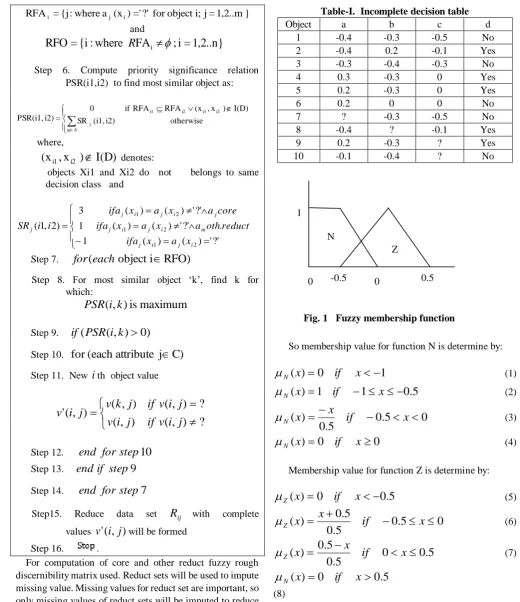
proposed method is applicable for incomplete data set where some instances are complete.Fuzzy rough based method has been proposed for attribute reduction with imputation of incomplete data. First, incomplete data set will be transformed to fuzzy decision table with appropriate fuzzy membership functions. Then from this decision table complete data instances will be fetched to form a subset of decision table with complete data. From this complete decision table core and reduct attributes will be determined using Fuzzy Rough Set. This core and reduct attributes may be used to impute missing value in fuzzy decision table [1]. Main or essential features of data sets are core attributes. Other reduct attributes influence on data set also considerable. Extraneous attributes have no importance in data mining or classification task. So other attributes may be ignored. With these concepts, core attributes have to give maximum importance to impute missing (‘?’) data i.e. priority may be consider maximum (like positive value 3). Other reduct attributes have to consider also(using less positive value like 1). According to that priority significance value may be set for different attributes. Here we will impute missing value only for core and other required reduct attributes to reduce time complexity. After imputation we will select complete data set with only reduct attribute set.
According to above discussion Fuzzy rough attribute reduction with imputation (FRARI) algorithm has been proposed as Algorithm 1.
Algorithm 1: FRARI algorithm
Input : Incomplete decision table
Output: Complete decision table with reduce attribute set.
Step 1. Transformation to fuzzy decision table with appropriate fuzzy membership functions.
Step2. A subset with complete data can be formed.
Step3. Compute core and other reduct attributes by fuzzy rough discernible matrix from this complete subset .
Step4. Reduce data set Rij with core and other
reduct attributes (aj) will be formed with
values v(i,j) .
} 1,2..m = j i; object for ?' =' ) (x a where : {j =
RFAi j i
and
1,2..n}
=
i
;
FA
where
:
{i
=
RFO
R
i
Step 6. Compute priority significance relation PSR(i1,i2) to find most similar object as:
otherwise i2) (i1, SR I(D) ) x , (x RFA RFA if 0 = i2) PSR(i1, a j i2 i1 i2 i1
A j where,
(x
i1,
x
i2)
I(D)
denotes:objects Xi1 and Xi2 do not belongs to same decision class and
?' ' ) ( ) ( . ?' ' ) ( ) ( ?' ' ) ( ) ( 1 1 3 ) 2 , 1 ( 2 1 2 1 2 1 i j i j m i j i j j i j i j j x a x ifa reduct oth a x a x ifa core a x a x ifa i i SR
Step 7.
for
(
each
object
i
RFO)
Step 8. For most similar object ‘k’, find k for which:
maximum
is
)
,
(
i
k
PSR
Step 9.
if
(
PSR
(
i
,
k
)
0
)
Step 10.for
(each
attribute
j
C)
Step 11. New
i
th object value
?
)
,
(
)
,
(
?
)
,
(
)
,
(
)
,
(
'
j
i
v
if
j
i
v
j
i
v
if
j
k
v
j
i
v
Step 12.
end
for
step
10
Step 13.end
if
step
9
Step 14.end
for
step
7
Step15. Reduce data set
R
ij with completevalues
v
'
(
i
,
j
)
will be formed Step 16. .For computation of core and other reduct fuzzy rough discernibility matrix used. Reduct sets will be used to impute missing value. Missing values for reduct set are important, so only missing values of reduct sets will be imputed to reduce time complexity.
IV. RESULTANDDISCUSSION
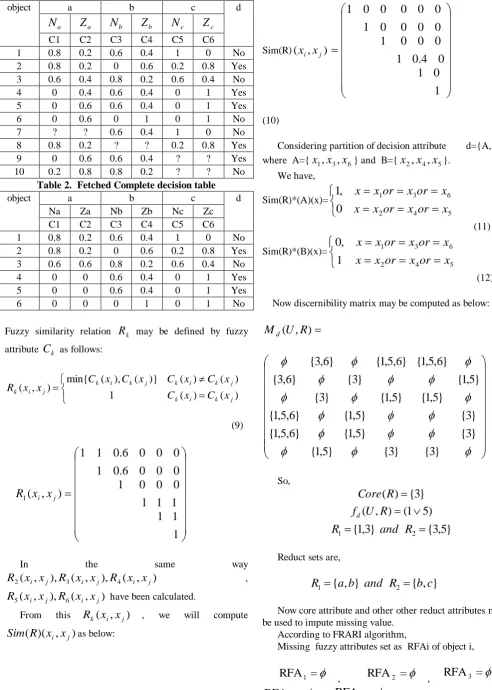
[image:3.595.31.552.57.660.2]Well known example for fuzzy rough set have been taken like [17]-[19], [27]-[28] as Error! Reference source not found.I. It has been considered that attributes (a, b and c) values may be represented by two fuzzy membership function N (trapezoidal shaped square) and Z (triangular shape) as shown in Error! Reference source not found..
Table-I. Incomplete decision table
Object a b c d
1 -0.4 -0.3 -0.5 No
2 -0.4 0.2 -0.1 Yes
3 -0.3 -0.4 -0.3 No
4 0.3 -0.3 0 Yes
5 0.2 -0.3 0 Yes
6 0.2 0 0 No
7 ? -0.3 -0.5 No
8 -0.4 ? -0.1 Yes
9 0.2 -0.3 ? Yes
10 -0.1 -0.4 ? No
So membership value for function N is determine by:
1
0
)
(
x
if
x
N
(1)5
.
0
1
1
)
(
x
if
x
N
(2)0
5
.
0
5
.
0
)
(
x
x
if
x
N
(3)0
0
)
(
x
if
x
N
(4)Membership value for function Z is determine by:
5
.
0
0
)
(
x
if
x
Z
(5)0
5
.
0
5
.
0
5
.
0
)
(
x
x
if
x
Z
(6)5
.
0
0
5
.
0
5
.
0
)
(
x
x
if
x
Z
(7)5
.
0
0
)
(
x
if
x
N
(8)
Let
N
a,
Z
a determined by attribute ‘a’;N
b,
Z
bdetermined by b;
N
c,
Z
c determined by attribute c.So Error! Reference source not found. can be transformed as Table 1 with fuzzy conditional values.
[image:3.595.306.546.60.361.2]From incomplete fuzzy decision Table 1, complete instances will be fetched as to form complete fuzzy decision table as Table 2
Table 1. Incomplete fuzzy decision table
-0.5 0 0.5
0 1
N
Z
a
N
Z
aN
bZ
bN
cZ
cC1 C2 C3 C4 C5 C6
1 0.8 0.2 0.6 0.4 1 0 No
2 0.8 0.2 0 0.6 0.2 0.8 Yes
3 0.6 0.4 0.8 0.2 0.6 0.4 No
4 0 0.4 0.6 0.4 0 1 Yes
5 0 0.6 0.6 0.4 0 1 Yes
6 0 0.6 0 1 0 1 No
7 ? ? 0.6 0.4 1 0 No
8 0.8 0.2 ? ? 0.2 0.8 Yes
9 0 0.6 0.6 0.4 ? ? Yes
[image:4.595.42.535.50.740.2]10 0.2 0.8 0.8 0.2 ? ? No
Table 2. Fetched Complete decision table
object a b c d
Na Za Nb Zb Nc Zc
C1 C2 C3 C4 C5 C6
1 0.8 0.2 0.6 0.4 1 0 No
2 0.8 0.2 0 0.6 0.2 0.8 Yes
3 0.6 0.6 0.8 0.2 0.6 0.4 No
4 0 0 0.6 0.4 0 1 Yes
5 0 0 0.6 0.4 0 1 Yes
6 0 0 0 1 0 1 No
Fuzzy similarity relation
R
k may be defined by fuzzyattribute
C
k as follows: ) ( ) ( 1 ) ( ) ( )} ( ), ( min{ ) , ( j k i k j k i k j k i k j i
k C x C x
x C x C x C x C x x R (9)
1
1
1
1
1
1
0
0
0
1
0
0
0
0
0
0
6
.
0
6
.
0
1
1
1
)
,
(
1
x
ix
jR
In the same way
)
,
(
),
,
(
),
,
(
3 42
x
ix
jR
x
ix
jR
x
ix
jR
,)
,
(
),
,
(
65
x
ix
jR
x
ix
jR
have been calculated.From this
R
k(
x
i,
x
j)
, we will compute)
,
)(
(
R
x
ix
jSim
as below:Sim(R)
(
x
i,
x
j)
1
0
1
0
4
.
0
1
0
0
0
1
0
0
0
0
1
(10)Considering partition of decision attribute d={A, B} where A={
x
1,
x
3,
x
6} and B={x
2,
x
4,
x
5}.We have, Sim(R)*(A)(x)=
5 4 2 6 3 10
,
1
x
or
x
or
x
x
x
or
x
or
x
x
(11) Sim(R)*(B)(x)=
5 4 2 6 3 11
,
0
x
or
x
or
x
x
x
or
x
or
x
x
(12)Now discernibility matrix may be computed as below:
)
,
(
U
R
M
d
}
3
{
}
3
{
}
5
,
1
{
}
3
{
}
5
,
1
{
}
6
,
5
,
1
{
}
3
{
}
5
,
1
{
}
6
,
5
,
1
{
}
5
,
1
{
}
5
,
1
{
}
3
{
}
5
,
1
{
}
3
{
}
6
,
3
{
}
6
,
5
,
1
{
}
6
,
5
,
1
{
}
6
,
3
{
So,}
3
{
)
(
R
Core
)
5
1
(
)
,
(
U
R
f
d}
5
,
3
{
}
3
,
1
{
21
and
R
R
Reduct sets are,
R
1
{
a
,
b
}
and
R
2
{
b
,
c
}
Now core attribute and other other reduct attributes may be used to impute missing value.
According to FRARI algorithm,
Missing fuzzy attributes set as RFAi of object i,
=
RFA
1 ,RFA
2=
,RFA
3=
,
=
RFA
4 ,RFA
5=
,
}
1,2..m
=
j
7;
object
for
;
C2
{C1,
=
RFA
7}
1,2..m
=
j
8;
object
for
;
C4
{C3,
=
RFA
8}
1,2..m
=
j
9;
object
for
;
C6
{C5,
=
RFA
9}
1,2..m
=
j
10;
object
for
;
C6
{C5,
=
RFA
10So,
Only
object
7,8,9,10
RFO
So for i
(7,8, 9,10) :
We have to find most similar object ‘k’ for which ,
PSR
(
i
,
k
)
is
maximum
For object 7,Priority significance relation PSR(7,i2) is maximum for i2=1.
So object 1 is most similar with object 7 and missing values of object 7 may fill in by values of object 1 with minimum error rate.
Similarly: For object 8,
Priority significance relation PSR(8,i2) is maximum for i2=2.
So object 2 is most similar with object 8 and missing values of object 8 may fill in by values of object 2 with minimum error rate.
For object 9,
Priority significance relation PSR(9,i2) is maximum for i2=5.
So object 5 is most similar with object 9 and missing values of object 9 may fill in by values of object 5 with minimum error rate.
For object 10,
Priority significance relation PSR(9,i2) is maximum for i2=3.
[image:5.595.44.297.563.788.2]So object 3 is most similar with object 10 and missing values of object 10 may fill in by values of object 3 with minimum error rate.
Table 3. Complete Decision Table
object a b c d
Na Za Nb Zb Nc Zc
C1 C2 C3 C4 C5 C6
1 0.8 0.2 0.6 0.4 1 0 No
2 0.8 0.2 0 0.6 0.2 0.8 Yes
3 0.6 0.4 0.8 0.2 0.6 0.4 No
4 0 0.4 0.6 0.4 0 1 Yes
5 0 0.6 0.6 0.4 0 1 Yes
6 0 0.6 0 1 0 1 No
7 0.8 0.2 0.6 0.4 1 0 No
8 0.8 0.2 0 0.6 0.2 0.8 Yes
9 0 0.6 0.6 0.4 0 1 Yes
10 0.2 0.8 0.8 0.2 0.6 0.4 No
Table 4. Results of experiments
FRCRB KNN C4.5
Ac 90 70 40
Ka 0.8 0.4 -0.2
Ma 0.2143 0.2857 0.52
Rt 0.303 0.3712 0.5292
If we prefer imputation of all reduct set then result will be obtained as Error! Reference source not found..
Performance of imputation result has been compare with C4.5 and KNN algorithm.
To compare performance k-nearest neighbours classifier with two-fold cross validation has been used with computation of kappa statistic (Ka), accuracy (Ac), root mean squared error (Rt) and mean absolute error (Ma). Only one instances affinity with classes taken into account, so Euclidean distance with k's value one (1) has been used. Results of experiments are presented in Table 4. These tables’ data shows that proposed methods imputation accuracy excel other methods accuracy. For prediction, an important measure is Kappa statistics on classifier performance. Substantial or almost perfect classification ability of FRARI algorithm may be described by its Kappa statistics value. Its reliability over other methods may be described by comparing kappa statistics value . Magnitude of error may be measured by Root mean squared error and Mean absolute error in a set of predictions and its score is negative oriented. Table 5 shows that error rate of proposed algorithm’s imputation is lower than others methods. So it may be conclude that FRARI algorithm is better than others and its prediction is almost perfect considering all evaluation param eter. So for practical cases it may be used. By proposed FRARI algorithm imputation with reduction can be done and its performance is also better. So it may be adopted as a best method for attribute reduction with imputation.
V. CONCLUSIONS
In this paper, attribute reduction with imputation has been proposed using fuzzy rough set approach. Data may be discrete or continuous but proposed method may be used efficiently. Experimentally it appears that FRARI algorithm may be effectively used. Rough set cannot be used for continuous data efficiently. This new direction of Fuzzy Rough set based method not only produces better result but also it can be used for all type of data. For data set which is big this work may be enhanced by computing core and other reduct attributes using other methods with less time
REFERENCES
1. P. K. Dey, “Imputation of Missing Data using Fuzzy-Rough Hybridization”, International Journal of Computer Sciences and Engineering, Vol. 6, No. 9, pp. 1-6, 2018.
2. P. K. Dey and S. Mukhopadhyay, “Core reduct based preprocessing approach to incomplete data”, International Journal of Intelligent Engineering and Systems, Vol. 10, No. 5, pp. 19-28, 2017.
3. AC Acock, “Working with Missing Values”, Journal of Marriage and Family, Vol.67, No.4, pp. 1012-1028, 2005.
4. J. R. Quinlan, C4.5: Programs for Machine Learning, Morgan Kaufmann Publishers, 1993.
5. J. W. Grzymala-Busse, “Data with missing attribute values: Generalization of idiscernibility
Machine Learning, Vol.6, pp. 37-66, 1991.
7. J. Han and M. Kamber, Data Mining: Concepts and Techniques, Morgan Kaufmann, 2001
8. J. V. Hulse and T. M. Khoshgoftaar, “Incomplete-case nearest neighbor imputation in software measurement data”, Information Sciences, Vol. 259, No. 2, pp. 596-610, 2014.
9. R. R. Andridge and R. J. A. Little, “A review of hot deck imputation for survey non- response”, International Statistical Review, Vol.78, No.1, pp. 40-64, 2010.
10.A. Dempster, N. Laired and D. Rubin, “Maximum likelihood from incomplete data via the EM algorithm”, Journal of the Royal Statistical Society, Vol.39, No.1, pp. 1-38, 1977.
11.J. L. Schafer, “Multiple imputation: a primer”, Statistical Methods in Medical Research, Vol. 8, pp. 3–15, 1999.
12.M. Kryszkiewicz, “Rough set approach to incomplete information systems”, Information Sciences, Elsevier, Vol. 112, pp.39-49, 1998. 13.J. W. Grzymala-Busse and S. Siddhaye, “Rough Set Approaches to Rule
Induction from Incomplete Data”, In: Proceedings of the IPMU'2004, the 10th International Conference on Information Processing and Management of Uncertainty in Knowledge-Based Systems, Perugia, Italy, July 4–9, vol. 2, 923–930, 2004.
14.M. Amiri and R. Jensen, “Missing data imputation using fuzzy-rough methods”, Neurocomputing, Elsevier, Vol.205, pp. 152-164, 2016. 15.D. Dubois, H. Prade, “Rough fuzzy sets and fuzzy rough sets”,
International Journal of General Systems, Vol.17, No.1, pp. 191–209, 1990
16.D.S. Young, D.G. Chen, E.C.C. Tsang, J.W.T. Lee and X.Z. Wang, “On the generalization of fuzzy rough sets”, IEEE Trans. Fuzzy Systems, Vol.13, No.3, pp. 343–361, 2005.
17.W. Wu and W. Zhang, “Constructive and axiomatic approaches of fuzzy approximation operators”, Information Sciences, Vol.159, pp. 233–254, 2004.
18.R. Jensen, Q. Shen, “Fuzzy-rough attribute reduction with application to web categorization”, Fuzzy Sets and Systems, Elsevier, Vol.141, pp. 469–485, 2004.
19.R.B. Bhatt, M. Gopal, “On the compact computational domain of fuzzy rough sets”, Pattern Recognition Letter, Vol.26, No.11, pp. 1632–1640, 2005.
20.R. Jensen, Q. Shen, “New approaches to fuzzy-rough feature selection”, IEEE Transactions on Fuzzy Systems, Vol.17, No.4, pp. 824-838, 2009. 21.A. Mieszkowicz-Rolka and L. Rolka, “Variable precision fuzzy rough sets”, Transactions on Rough sets, Springer, Vol. LNCS-3100, pp. 144-160, 2004.
22.Q. H. Hu, D. R. Yu and Z. X. Xie , “Information-preserving hybrid data reduction based on fuzzy-rough techniques”, Pattern Recognition Letters, Vol.27, No.5, pp. 414–423, 2006.
23.Q. Hu., Z. Xie and Daren Yu, “Hybrid attribute reduction based on a novel fuzzy-rough model and information granulation”, Pattern Recognition, Vol.40, pp. 3509 – 3521, 2007.
24.P. Maji and P. Garai, “Fuzzy Rough simultaneous Attribute selection and Feature Extraction Algorithm”, IEEE Transactions on Cybernetics, Vol.43, No.4, pp. 1166–1177, 2013.
25.E. C. C. Tsang, D. G. Chen, D. S. Yeung and X. Z. Wang, “Fuzzy probabilistic approximation spaces and their information measures”, IEEE Transactions on Fuzzy Systems, Vol.16, No.5, pp. 1130–1141, 2008.
26.D. Chen, L. Zhang, S. Zhao, Q. Hu and P. Zhu, “A noval algorithm for finding reducts with fuzzy rough sets”, IEEE Transactions on Fuzzy Systems, Vol.20, No.2, pp. 385–389, 2012.
27.C. C. Nghia and N. L. Giang, “Fuzzy Rough set based Attribute Reduction in Fuzzy Decision Tables”, International Journal of Computer Applicationss, Vol.132, No.4, pp. 32–37, 2015.
28.E. C. C. Tsang, D. Chen, D. S. Young, X. Wang and J. Lee, “Attribute Reduction Using Fuzzy Rough Sets”, IEEE Transactions on Fuzzy Systems, Vol.16, No.5, pp. 1130-1140, 2008.
AUTHORSPROFILE