International Journal of Innovative Technology and Exploring Engineering (IJITEE) ISSN: 2278-3075, Volume-8 Issue-7, May, 2019
Palm Extraction in American Sign Language
Gestures Using Segmentation and Skin Region
Detection
Shivashankara S, Srinath SAbstract: An outstanding to the revolution of science and technology, image-processing techniques are becoming very significant in an extensive range of Computer and Medical Applications. The Image Segmentation is a significant procedure of image processing operations. This research paper presents, an innovative framework, whose key aim is to achieve the extraction of Human Hand and Palm from the both plain and uniform background as well as complex and non-uniform background with various dissimilar lighting conditions of indoor and outdoor locations. Segmentation of an input gesture to extract the human hand and palm will be carried out by detecting upper body parts and face of an input gestures using Viola-Jones Algorithm and skin region detection technique. For segmentation, we will consider the 24 ASL Alphabets gestures and achieved 97.62% segmentation results. This paper also delivers the Mega Pixel-wise (5, 8, and 13 MP) average segmentation accuracy with respect to various background, location, and time of gestures captures.
Keywords: palm extraction; segmentation; skin region detection; threshold value; viola-jones algorithm
I. INTRODUCTION
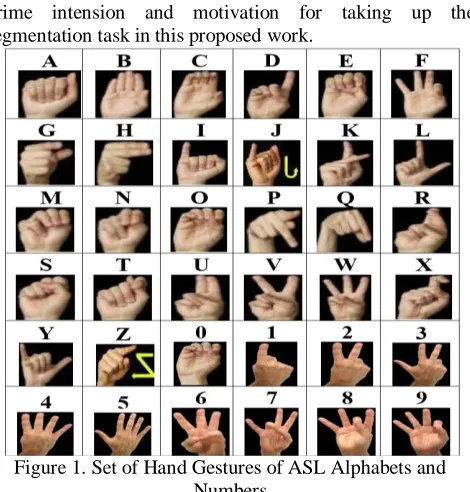
American Sign Language (ASL) is a tricky language that customs signs through moving hands aggregate with body postures and expressions of the face. ASL includes over 6000 plus gestures to make sign language (SL) communication. Figure 1 shows the hand gestures of ASL alphabets and numbers (A-Z, 0-9) which are referred as American Manual Alphabets and Numbers [1], which can be used to spell the words of English language. ASL doesn’t involves built-in readymade ASL equivalents signs or gestures for precise nouns and some of the technical terminologies [2].
Segmentation is a process of segregating a digital image into the various divisions. The objective of segmentation of input image is to make simpler of the illustration of an input image into somewhat that is much meaningful and easier for further operations [3], [4]. Image segmentation is obviously using to detect substances (objects) and boundaries (outlines, arcs, shapes etc.) of the imageries. In addition, specifically, image segmentation is a manner of allocating a tag to every single pixel in an input image in such a way that the pixels having identical tag share specified properties.
Revised Manuscript Received on May 06, 2019
Shivashankara S, Department of Computer Science & Engineering, Sri Jayachamarajendra College of Engineering, Mysuru, India,
Srinath,Department of Computer Science & Engineering, Sri Jayachamarajendra College of Engineering, Mysuru, India
The outcome of image segmentation is a collection of sections which are communally conceal the complete image, or contours set are extracted from the image. Individually the pixels in a zone are alike with regard to some features or calculated property, such as color, intensity, or texture. Neighboring regions are considerably dissimilar with regard to the identical feature. Segments are pretty homogeneous with respect to one or more characteristics. Segmentation is used for Image Simplification, Image Classification, Image Compression, Edge Detection, Object-Based Image Analysis (OBIA), Feature Extraction, and Object Recognition. Following are the some of the real-world applications of image segmentation includes, Content-based image recovery, Machine vision, Medical imaging (CT, and MRI), Detection of Object (Face, Pedestrian, Brake light, Locating objects from the satellite), Face Recognition, Iris Recognition, Fingerprint recognition, Traffic Control Systems, Video Surveillance and many more. Numerous universal determination algorithms and techniques / methods are genuinely available segmentation of images. To make more useful, the available methods essentially conjoined with domain's precise awareness in order to efficiently resolve the specific segmentation difficulties. Image segmentation techniques are broadly categorized as Threshold based segmentation, Edge based segmentation, Model based segmentation, Multi-scale segmentation, Region based segmentation, Compression based segmentation, Histogram based segmentation, Graph partitioning segmentation, Clustering based segmentation, Watershed based segmentation, Skin color based segmentation, Partial Differential Equation (PDE) based segmentation, Artificial Neural Network (ANN) based segmentation techniques and etc.. Some of the early works on hand gestures segmentation were carried out by various researchers who are working on hand gestures recognition system and also SL recognition system using various segmentation algorithms, which are stated in section 2. Most of the contributions stated in section 2 are more constraint and less beneficial to the gesture recognition task as the hand gestures captured are in plain with uniform background and complex with non-uniform background in uniform lighting conditions. From the state of the art, it is observed that, there is no proper segmentation work carried out for the hand gestures captured in natural and artificial lighting conditions with different angles and distances by the various signers and various mobile camera resolution in indoor and outdoor locations. These constraints leads to the lack of proper hand gesture segmentation and for optimal gesture
prime intension and motivation for taking up the segmentation task in this proposed work.
Figure 1. Set of Hand Gestures of ASL Alphabets and Numbers
In this proposed work, an effort has been placed to present an innovative framework, whose fundamental goal is to accomplish the extraction of Human Hand and Palm from the both plain and uniform background as well as complex and non-uniform background with various dissimilar lighting conditions of indoor and outdoor locations by capturing the hand gestures from various angles and various distances using distinct mobile camera resolutions. In proposed segmentation work, an efficient segmentation task to extract the human hand and palm is carried out using Viola-Jones algorithm for face detection and masking, and skin region detection via the Otsu’s thresholding method to extract the hand.The Rest of this research paper is organized as follows. Section 2 describes the State of Art of the Hand Gesture Segmentation; Section 3 designates the proposed work of Hand Gesture Segmentation with Viola-Jones (VJ) Algorithm and proposed algorithm; Section 4 illustrates the output result and discussions with statistics and graphical illustrations. Section 5 describe the conclusion. Finally Section 6 highlights the Future Scope of the proposed work.
II. STATE OF THE ART
A very less amount of contributions have been endeavored in segmentation of hand gestures using various segmentation algorithms.A novel Hand Gesture Recognition (HGR) technique using interactive image segmentation algorithm is recommended in [5]. For building the segmentation model of RGB image and an iteration of expectancy extreme algorithm learnt the parameters a human skin feature, depth information, Gaussian mixture model and graph model are applied. A full-bodied and effectual hand segmentation algorithm is implemented in [6] by using various color spaces and morphological operations. Here, Hand Tracking and Segmentation algorithm (HTS) is an utmost and effectual to holder the constraints occurs in skin color
the segmented hand contour for elimination of background noise. In [7], an edge detection based new approach is presented to remove the noise and segment the hand. Subhamoy Chatterjee et al [8], proposed an illumination and skin color complexion invariant segmentation technique based on K‐means
clustering and Mahalanobish distance. Feature improvement approaches such as F‐ratio‐based weighted feature mining
method and feature fusion techniques are presented.
International Journal of Innovative Technology and Exploring Engineering (IJITEE) ISSN: 2278-3075, Volume-8 Issue-7, May, 2019
In [21], the problem referred is depending on Digital Image Processing by using Color based Segmentation, Detection of skin, Segmentation of an image, Filtering an image, and Template Matching techniques. The hand gesture segmentation method is productively developed in [22] by using Non Local Means Filter (NLMF), Gaussian Mixture Model (GMM) based Subtraction and Improved Global Swarm Optimization (IGSO) based Canny Edge Detection (CED). A color based segmentation methodology is proposed in [23] to mine the object utilized for HGR of gesture video. Segmentation progression which usages color based recognition of an object is adopted to all the frames. Mandeep Kaur Ahuja, Dr.Amardeep Singh proposed a hand segmentation system in [24]. Primarily, hand region is segmented by relating skin color based model in YCbCr color space model. Later, foreground and background with low illumination images are separated by applying an Otsu thresholding technique. A first-hand interactive image segmentation technique is developed by Disi Chen et al [25] to improve the recognition rate of the hand gesture recognition. The Gibbs Random Field (GRF) is applied to the segmentation of an image and minimalize the Gibbs Energy by using Min-cut theorem to discover the optimum segmentation. The Motion Vision Based Skin Color Segmentation (MVBSCS) Technique with Radial Basis Function Neural Network (RBFNN) as a classifier is reported in [26] to recognize the static hand gestures corresponding to Digits (0-9) in uniform lighting condition. An optimal approach for segmentation of static input image gesture is developed in [27] using various color models, median filter, morphological operations and Otsu method for static HGR.
III. PROPOSED WORK
A. System Design using Viola-Jones (VJ)Algorithm
The VJ algorithm is a foremost object detection framework, which offers competitive object detection rates in real-time. It is implemented in the year 2001 by Paul Viola and Michael Jones [28]. Even if it can be skilled to identify a diversity of object classes, it is inspired principally for face detection. A humanoid can recognize the face effortlessly, however a computer requires defined directives or instructions in addition to constrictions. To make face detection more convenient, VJ needs full or complete view front straight appearances.
[image:3.612.307.526.221.323.2]The Figure 2 shows the simple rectangular features which are similar to Haar wavelets used for object detection. Using these 24-by-24 base resolution features, one can possible to capture the forehead and eye features.
Figure 2. Simple Rectangle Features for Face Detection
The three measures towards Speeded up the Detection are as follows
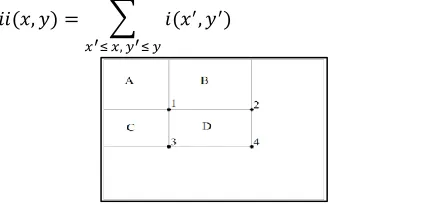
B. Integral Image: It is a quick method to calculate the simple ‘features’ and can be calculated by single pass through an image. Integral image value at a pixel (x, y) is the sum of the pixel values of the original image above and to the left of (x, y), inclusive:
Where, ii(x, y) is an integral image, and i(x, y) is an input image. The Sum within a Rectangle can be calculated by Integral Image as follows:
The sum of the pixels within the rectangle D can be calculated with four array references. An integral image value at location 1 is a sum of the pixels in rectangle A. The value at location 2 is A + B, at location 3 is A + C, and at location 4 is A + B + C + D. The sum within D can be calculated as 4 + 1 - (2 + 3).
Constrained Classifier: Adaboost algorithm, used as constrained classifier [28], boosts the classification performance of a simple (weak) learning algorithm. In other words, limit the weak learner to a single feature. The benefit is that if there are N
weak learners there are only N features to calculate. To detect the face, an initial rectangular features are selected by Adaboost classifier, is an expressive and easily inferred.
A weak classifier hj(x) contains of a feature fj, a threshold j, and
a parity pj representing the path of inequality sign:
Where, x is a 24-by-24 sub-window of an image.
In an Adaboost algorithm, the final strong Adaboost classifier for classification is:
(x, y)
(1)
(2)
Where,
And
[image:4.612.48.294.60.258.2]
єt= Lowest Error Rate Cascaded Classifiers:
Figure 3. Diagrammatic Description of the Detection Cascade
Here, the most of the true negatives are rejected very quickly at the 1st few stages and can retain the high detection rate and low false positive rate. The preliminary classifier eradicates a huge quantity of negative instances with very tiny processing. Succeeding layers eradicate supplementary negatives but need supplementary calculation. Subsequently numerous stages of processing the number of sub-windows have been condensed drastically. Figure 3 illustrates the diagramatic description of the detection cascade.
For K stages of cascading with every stage having fi as the
false positive rate, the overall false positive rate ‘F’ for the cascade is
Similarly, the overall detection rate ‘D’ is
To retain ‘F’ very low and ‘D’ very high, for every stage the goal is to take very high detection rate (close to 100%), but moderate false positive rate (say, 30%).
Figure 4. Diagrammatic Description of Cascaded Classifier for Face Detection.
The single feature classifier accomplishes 100% detection rate and around 50% false positive rate. Using the data from preceding stage, a 5 feature classifier attains 100% detection rate and 40% false positive rate (20% cumulative). Finally, a 20 feature classifier succeed 100% detection rate with 10% false positive rate (2% cumulative). Figure 4 demonstrates the diagrammatic description of cascaded classifier for Face Detection.
Some of the research works carried out using VJ algorithm for face detection and segmentation are highlighted here. In
features and fast marching method. VJ method is used for face region detection and subtracted the face by replacing with a black circle. Then skin detection and contour comparison algorithm is used for hand detection and tracking [30]. A vigorous technique for face detection using method of VJ, human skin areas are assessed by skin color model. By combining foreground and skin masks, we obtain the final mask for hand region [31]. VJ algorithm was used for detecting the face followed by the nose region to calculate min and max values for every threshold factor of Cb and Cr in [32]. In [33], at 1st, the process detects the face using the VJ algorithm then the contour of the hand is extorted with skin color detection. The VJ algorithm and Camshift algorithm are used for face detection and hand tracking respectively in [34].
A. Proposed Algorithm
The faultless segmentation of hand and palm region yields noiseless edges. So that it provides identical features which could be used as typical database features. Some of the research works on segmentation and hand gesture segmentations are carried out by many researchers which are addressed in section 2. Some of the hand gesture segmentations carried out earlier are have their own limitations.
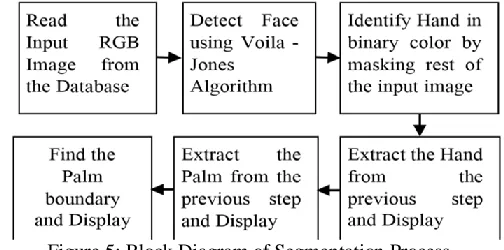
[image:4.612.310.562.453.578.2]In this proposed work, an effort has been placed to perform the segmentation of ASL Hand Gestures of the input image. In this process, static database ASL hand gestures of 24 American Manual Alphabets as input image. For segmentation process, American Manual Alphabet are fed as input gestures of human upper body with plain and uniform background as well as complex and non-uniform background with various dark and light illumination conditions of indoor and outdoor locations, and also gestures of day light and night light illumination conditions are considered. Overall 28 datasets of 24 American Manual Alphabets (28 X 24 = 672) samples are considered for Hand Gesture Segmentation. Figure 5 illustrates the block diagram of the segmentation process.
Figure 5: Block Diagram of Segmentation Process.
Segmentation Process
Step 1: Start
Step 2: Read an input RGB image from the database.
Step 3: Detect and place circle mark on the Face of an input image using VJ Algorithm.
Step 4: Convert the viola-jones applied gesture into binary image.
Step 5: Extract the identified binary hand image by masking the rest of the binary image from step 4 and display the extracted hand.
Ki i
f
F
1
Ki i
d
D
1
(6) (4)
(5)
[image:4.612.52.300.529.592.2]International Journal of Innovative Technology and Exploring Engineering (IJITEE) ISSN: 2278-3075, Volume-8 Issue-7, May, 2019
Step 6: Extract the Palm by extracting only upper half part of the extracted hand and display the extracted palm. Step7: Find the Edge of the Palm using Sobel approximation to the derivative and display the boundary of the palm.
Step 8: Stop
IV. RESULTS AND DISCUSSION
Segmentation Accuracy (SA) of the ASL Alphabet gestures are calculated using the equation as follows:
Where, n = No. of gestures that success segmentation
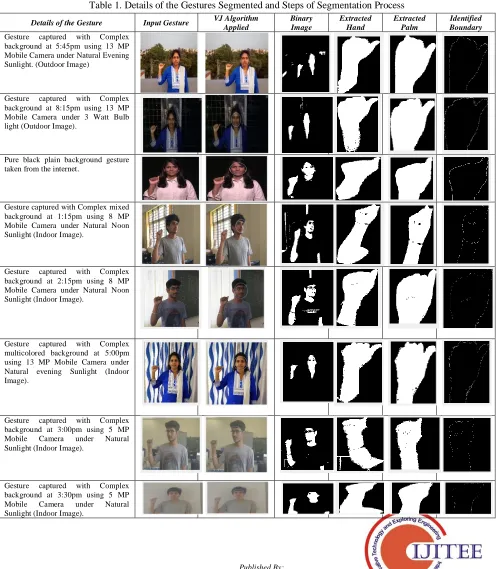
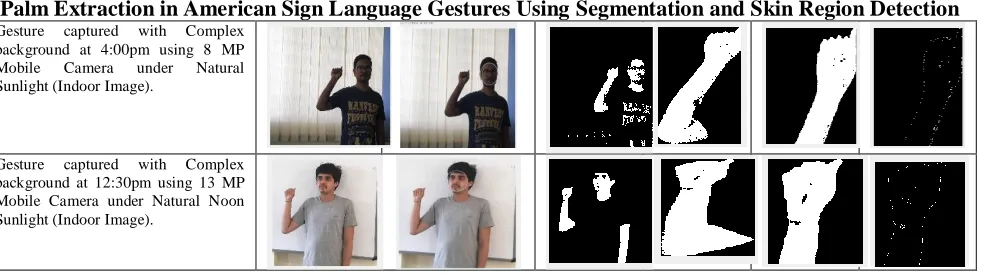
[image:5.612.59.555.184.753.2]N =No. of gestures considered for segmentation Table 1 shows the step-by-step segmentation process and details of the gestures captured in various aspects like Mega pixel of the camera used, type of background used, location, time of gestures captured with light illumination.
Table 1. Details of the Gestures Segmented and Steps of Segmentation Process
Details of the Gesture Input Gesture VJ Algorithm Applied
Binary Image
Extracted Hand
Extracted Palm
Identified Boundary
Gesture captured with Complex background at 5:45pm using 13 MP Mobile Camera under Natural Evening Sunlight. (Outdoor Image)
Gesture captured with Complex background at 8:15pm using 13 MP Mobile Camera under 3 Watt Bulb light (Outdoor Image).
Pure black plain background gesture taken from the internet.
Gesture captured with Complex mixed background at 1:15pm using 8 MP Mobile Camera under Natural Noon Sunlight (Indoor Image).
Gesture captured with Complex background at 2:15pm using 8 MP Mobile Camera under Natural Noon Sunlight (Indoor Image).
Gesture captured with Complex multicolored background at 5:00pm using 13 MP Mobile Camera under Natural evening Sunlight (Indoor Image).
Gesture captured with Complex background at 3:00pm using 5 MP Mobile Camera under Natural Sunlight (Indoor Image).
Figure 6 illustrates the Alphabet-wise Average Segmentation Accuracy of ASL Alphabets of 28 gestures sets of both indoor and outdoor location. Here, ASL Alphabet gestures P and Q achieves least segmentation rate of 71.42% accuracy, whereas remaining ASL Alphabets (Letter J and Z not included as they involve hand movement) yields an excellent segmentation rate of 100% accuracy in various location, time and background.
Table 2 illustrates the segmented and non-segmented alphabets from gestures sets 1 through 28. Here, gestures
sets 7, 8, 20, and 21 are captured in outdoor location and remaining gestures sets are captures in indoor location. In gestures sets 1, 7-9, 13, 15, 19, and 26, the ASL gestures P and Q are not segmented properly. Rest of the ASL gestures of Set 1 to 28 of plain and complex background of Indoor and Outdoor locations with different illumination conditions are successfully segmented. The ASL alphabet gestures P and Q gives 71.4% success. Rest of the ASL Alphabet gestures provides 100% segmentation accuracy
Figure 6. Alphabet-wise Average Segmentation Accuracy (Both Indoor and Outdoor included) Table 2. Segmented and Non-segmented gesture alphabets (Both Indoor and Outdoor included)
background at 4:00pm using 8 MP Mobile Camera under Natural Sunlight (Indoor Image).
[image:6.612.90.526.319.494.2]International Journal of Innovative Technology and Exploring Engineering (IJITEE) ISSN: 2278-3075, Volume-8 Issue-7, May, 2019
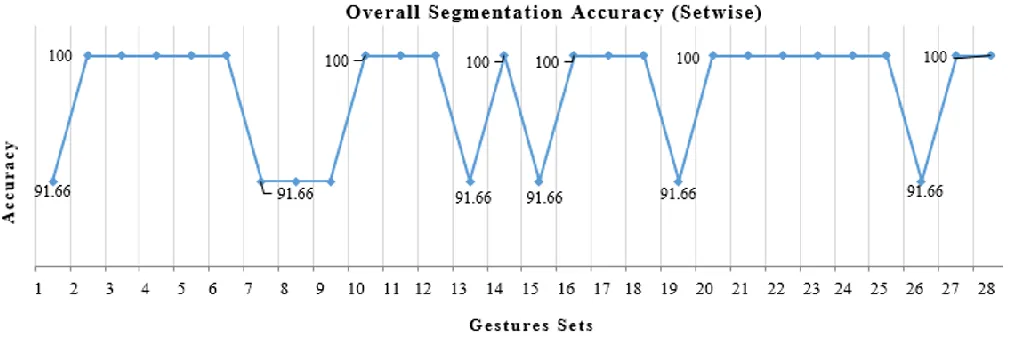
Figure 7 depicts the set-wise Segmentation Accuracy of ASL Alphabets of 28 gestures sets considering both Indoor and Outdoor locations. In set-wise segmentation, set 2-6, 10-12, 14, 16-18, 20-25, and 27-28 provides an outstanding segmentation success rate of 100% accuracy. Set 1, 7-9, 13, 15, 19, and 26 offers better segmentation rate of 91.66% accuracy.
Table 3 and Figure 8 shows the set-wise segmentation accuracy of ASL alphabet gestures considering both plain
and uniform background as well as complex and non-uniform background of various lighting conditions and dissimilar mobile camera resolutions. The plain and uniform background ASL alphabet gestures provides very good segmentation accuracy of 98.81% which is better than the complex and non-uniform background ASL alphabet gestures’ segmentation accuracy of 96.43%.
[image:7.612.52.563.68.412.2] [image:7.612.57.563.511.680.2]Table 3. Segmentation accuracy of plain and complex background gestures.
Figure 8. Background-wise average segmentation rate Figure 9 spectacles the location-wise average segmentation rate of the ASL alphabet gestures captured at indoor and outdoor locations with varying lighting conditions of natural and artificial lighting conditions as well as various mobile camera resolutions.
[image:8.595.307.514.301.417.2]Figure 9. Location-wise average segmentation rate Figure 10 highlights the average segmentation accuracy of ASL alphabet gestures captured in various Mega Pixel mobile cameras. More or less, gestures captured in 13 MP, 8 MP, and 5 MP mobile cameras are all yields almost same (± 1% to each other) segmentation accuracy. It is clear that, we can use any of the above mentioned mega pixel cameras to capture the gestures from the signers.
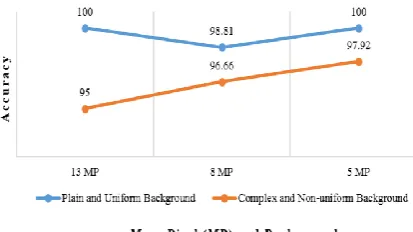
Figure 10. Overall Segmentation Accuracy Comparison Figure 11 underlines the average segmentation accuracy of ASL alphabet gestures captured in various Mega Pixel mobile cameras with plain and uniform background as well as complex and non-uniform background of the proposed method. It is noticed that, plain and uniform background ASL alphabet gestures yields better segmentation results compared to complex and non-uniform background ASL alphabet gestures in all the 3 varieties of mega pixel cameras.
Figure 11. Average Segmentation Accuracy (Mega Pixel and Background-wise) Comparison
The reason behind drop in performance in Figure 10 and Figure 11 using 13 Mega Pixel Mobile Camera compared to 8 MP and 5 MP mobile camera is, the gestures data set collected is varied with background (Plain and uniform as well as Complex and Non-uniform), Location (Indoor and Outdoor), and the time (Day and Night light illumination) of the data collected.
[image:8.595.47.288.511.629.2]International Journal of Innovative Technology and Exploring Engineering (IJITEE) ISSN: 2278-3075, Volume-8 Issue-7, May, 2019
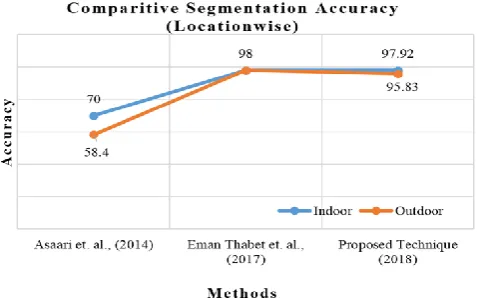
Figure 12. Comparative average segmentation rate Figure 13 highlights the comparative average segmentation rate of ASL alphabet gestures captured in both indoor location as well as outdoor location of traditional existing methods Assari et. al., (2014) [36] and Eman Thabet et. al., (2017) Vs proposed method.
[image:9.595.304.545.50.234.2]The performance degradation exists in Figure 13 and Figure 14 i.e., there is a slight drift in performance, the reason being is the number of datasets taken and the number of characters considered in proposed method is large compared to the method in comparison of Eman Thabet et al., (2017). Also the comparative complex background is less complex in the method proposed by Eman Thabet et al., (2017) than the proposed method. In proposed method, a multi-variant complex background with varying light illuminations are considered.
[image:9.595.47.285.70.208.2]Figure 13. Comparative location-wise average segmentation rate Figure 14 provides the Overall Segmentation Comparison of ASL alphabet gestures of traditional Existing methods Vs Proposed method. The reason for performance degradation exists in Figure 14 is explained in the previous paragraph.
Figure 14. Overall Segmentation Comparison
V. CONCLUSION
This research paper exhibits an innovative framework to accomplish the Hand Gesture Segmentation of 24 static Alphabets (Letter J and Z not included as they involve hand movement) of ASL. This hand gesture segmentation is carried out for the gestures captured in both plain and uniform background as well as complex and non-uniform background with various dissimilar lighting conditions of indoor and outdoor locations. This paper provides the various statistics and graphical depictions of ASL alphabet gesture segmentation and also comparative analysis of some of the existing segmentation methods with the proposed segmentation method. The overall segmentation accuracy achieved by the proposed method is 97.62%. This paper also delivers the Mega Pixel-wise (5 MP, 8 MP, and 13 MP) average segmentation accuracy with respect to various background, location, and time of gestures captures. This manuscript has a significant value for other researchers to carry out their upcoming research works of this field as this proposed segmentation work is carried out by capturing the gestures from various angles, and various distances by considering several signers and different mobile camera resolutions in natural and artificial lighting conditions of indoor and outdoor locations.
VI. FUTURE PERSPECTIVE
As part of the future perspective, this research work can be extended to segment the ASL video gestures and other complex ASL gestures in plain and complex background with different lighting conditions and time in real time environment.
REFERENCES
1. Shivashankara S, Srinath S. 2017. A comparative Study of Various Techniques and Outcomes of Recognizing American Sign Language: A Review. International Journal of Scientific Research Engineering & Technology. 6(9): 1013-1023.
2. Shivashankara S, Srinath S. 2017. A Review on Vision Based American Sign Language Recognition, its Techniques, and Outcomes. 7th IEEE International Conference on Communication Systems and
Network Technologies. Nagpur, India. 293-297.
[image:9.595.48.289.436.585.2]4. Lauren Barghout, Lee Lawrence W. 2004. Perceptual Information Processing System. US2004/0059754A (Patent).
5. Disi Chen, Gongfa Li, Du Jiang, Guozhang Jiang, Jianyi Kong, Ying Sun, Zhaojie Ju. 2017. Hand Gesture Recognition Using Interactive Image Segmentation Method. 10th International
Conference on Intelligent Robotics and Applications, Wuhan, China. 539-550.
6. Archana S Ghotkar, Gajanan K Kharate. 2012. Hand Segmentation Techniques to Hand Gesture Recognition for Natural Human Computer Interaction. International Journal of Human-Computer Interaction. 3(1): 15-25.
7. Ahmed Ben Jmaa, Walid Mahdi, Yousra Ben Jemaa, Abdelmajid Ben Hamadou. 2016. A New Approach for Hand Gestures Recognition Based on Depth Map Captured by RGB-D Camera. Computation and System’s. 20(4): 709-721.
8. Subhamoy Chatterjee, Piyush Bhandari, Mahesh Kumar Kolekar. 2017. Feature Extraction and Segmentation Techniques in a Static Hand Gesture Recognition System. In: Siddhartha Bhattacharya, Indrajit Pan, Anirban Mukherjee, Paramartha Dutta. Hybrid Intelligence for Image Analysis and Understanding. 1st publication. USA: Wiley Online Library.
9. João Lopes, Miguel Simão, Nuno Mendes, Mohammad Safeea, José Afonso, Pedro Neto. 2017. Hand/arm gesture segmentation by motion using IMU and EMG Sensing. 27th International Conference on
Flexible Automation and Intelligent Manufacturing. Modena, Italy. 107-113.
10. M M Hasan, P K Mishra. 2011. Performance Evaluation of Modified Segmentation on Multi Block for Gesture Recognition System. International Journal of Signal Processing, Image Processing and Pattern Recognition. 4(4): 17-28.
11. R Karthik Kumar, I J Augustin Jacob, S Gnanasambanthan, P Ayyanar. 2013. Gesture Based Real Time Security System using Otsu Algorithm. International Journal of Advances in Science Engineering and Technology. 1(2): 91-95.
12. Ketki P Kshirsagar. 2012. Segmentation of One and Two Hand Gesture Recognition using Key Frame Selection. International Journal of Advanced Computer Research. 2(7): 43-47.
13. Giuseppe Serra, Marco Camurri, Lorenzo Baraldi, Michela Benedetti, Rita Cucchiara. 2013. Hand Segmentation for Gesture Recognition in EGO-Vision. 3rd ACM International Workshop on Interactive Multimedia on Mobile & Portable Devices. Barcelona, Spain. 31-36.
14. Zhi-hua Chen, Jung-Tae Kim, Jianning Liang, Jing Zhang, Yu-Bo Yuan. 2014. Real-Time Hand Gesture Recognition Using Finger Segmentation. The Scientific World Journal. Article ID 267872: 1-9.
15. Xiaoming Yin and Ming Xie. 2001. Hand Gesture Segmentation, Recognition and Application. IEEE International Symposium on Computational Intelligence in Robotics and Automation. Alberta, Canada. 438-443.
16. Mokhtar M Hasan, Pramod K Mishra. 2011. Gesture Recognition using Modified HSV Segmentation. IEEE International Conference on Communication Systems and Network Technologies. Jammu, India. 328-332.
17. Weihua Liu, Yangyu Fan, TaoLei, Zhong Zhang. 2014. Human Gesture Recognition Using Orientation Segmentation Feature On Random Forest. IEEE China Summit & International Conference on Signal and Information Processing. Xi’an, China. 480-484.
18. Duan Hong, Luo Yang. 2013. A Method of Gesture Segmentation Based on Skin Color and Background Difference Method. 2nd
International Conference on Computer Science and Electronics Engineering. Hangzhou, China. 355-357.
19. Sang-Yun Park, Eung-Joo Lee. 2011. Hand Gesture Recognition using Optical Flow Field Segmentation and Boundary Complexity Comparison based on Hidden Markov Models. Journal of Korea Multimedia Society. 14(4): 504-516.
20. Ekaterini Stergiopoulou, Kyriakos Sgouropoulos, Nikos Nikolaou, Nikos Papamarkos, Nikos Mitianoudis. 2014. Real time hand detection in a complex background. Engineering Applications of Artificial Intelligence (Elsevier). 35: 55-70.
21. Tahir Khan, Dr Amir Hassan Pathan. 2015. Hand Gesture Recognition based on Digital Image Processing using MATLAB. International Journal of Scientific & Engineering Research. 6(9):338-346.
22. Priyanka Parvathy D, Dr Hema C R. 2016. Hand Gesture Identification using Preprocessing, Background Subtraction and Segmentation Techniques. International Journal of Applied Engineering Research. 11(5): 3221-3228.
Segmentation and Hidden Markov Model. International Journal of Computer Applications Technology and Research. 4(5): 386 – 389.
24. Mandeep Kaur Ahuja, Dr Amardeep Singh. 2015. Hand Gesture Recognition Using PCA. International Journal of Computer Science Engineering and Technology. 5(7): 267-271.
25. Disi Chen, Gongfa Li, Ying Sun, Jianyi Kong, Guozhang Jiang, Heng Tang, ZhaojieJu, Hui Yu, Honghai Liu. 2017. An Interactive Image Segmentation Method in Hand Gesture Recognition.
www.mdpi.com/journal/sensors. 1-17.
26. N S Sreekanth, N K Narayanan. 2017. Static Hand Gesture Recognition using Mon-vision Based Techniques. International Journal of Innovative Computer Science & Engineering. 4(2): 33-41.
27. Shivashankara S, Srinath S. 2018. American Sign Language recognition System: An Optimal Approach. International Journal of Image, Graphics and Signal Processing. 10(8): 18-30.
28. Paul Viola, Michael Jones. 2001. Robust Real-time Object Detection. 2nd International Workshop on Statistical and Computational Theories
of Vision–Modeling, Learning, Computing, and Sampling. Vancouver, Canada. 1-25.
29. Eman Thabet, Fatimah Khalid, Puteri Suhaiza Sulaiman, Razali Yaakob. 2017. Fast marching method and modified features fusion in enhanced dynamic hand gesture segmentation and detection method under complicated background. Journal of Ambient Intelligence and Humanized Computing (Springer), 8(1): 1-15.
30. Nasser H Dardas, Nicolas D Georganas. 2011. Real-Time Hand Gesture Detection and Recognition Using Bag-of-Features and Support Vector Machine Techniques. IEEE Transactions on Instrumentation and Measurement. 60(11): 3592-3607.
31. Bousaaid Mourad, Ayaou Tarik, Afdel Karim, Estraillier Pascal. 2014. Real-Time System of Hand Detection and Gesture Recognition in Cyber Presence Interactive System for E-Learning. International Journal of Engineering Research and Applications. 4(9): 1-5.
32. Eman Thabet, Fatimah Khalid, Puteri Suhaiza Sulaiman, Razali Yaakob. 2017. Low Cost Skin Segmentation Scheme in Videos Using Two Alternative Methods for Dynamic Hand Gesture Detection Method. Advances in Multimedia (Hindawi). Article ID 7645189: 1-9.
33. Varsha Dixit, Anupam Agrawal. 2015. Real Time Hand Detection & Tracking for Dynamic Gesture Recognition. International Journal of Intelligent Systems and Applications. 8: 38-44.
34. A Randive, H B Mali, S D Lokhande. 2012. Hand Gesture Segmentation. International Journal of Computer Technology and Electronics Engineering. 2(3): 125-129.
35. Mohd Shahrimie Mohd Asaari, Bakhtiar Affendi Rosdi, Shahrel Azmin Suandi. 2015. Adaptive Kalman filter incorporated Eigen hand (AKFIE) for real-time hand tracking system. Multimed Tools Applications (Springer). 74(21): 9231-9257.
AUTHOR PROFILE
1. Shivashankara S,
, Department of Computer Science & Engineering, Sri Jayachamarajendra College of Engineering, Mysuru, India,
2. Srinath,Department of Computer Science & Engineering, Sri Jayachamarajendra College of Engineering, Mysuru, India