International Journal of Innovative Technology and Exploring Engineering (IJITEE)
ISSN: 2278-3075,
Volume-8, Issue-6, April, 2019
Tweaking Decision Making
Harsh Thakur, M. Balasubramanian
Abstract: Decision making is a scrutiny effort and a venture to set down it all-embracing. The sequence of procedures during the course of which the choice producer has to volunteer with the compulsion to settle down with solitary likelihood out of manifold reachable options is characterised “Decision making”. For all
speculation assignment efficacious decision making is
authoritative. The entire work of the study is grounded on the questionnaire review, which personalities at the uppermost administration level will answer to from Construction sector. This paper delivers exigent knowledge and information about the procedure of decision-making that assist us to get the picture of the numerous glitches and complications that stand up throughout decision-making. Outcomes of the study describes the way in which various personal factors sway decision-making.
Keywords: Decision Making, Questionnaire Survey, Construction Sector, Factors Affecting.
I. INTRODUCTION
Decision making is dubiously the utmost significant element of the chores of a manager. Decision making is an erudite, introspective, goal acquiring intended stroke, starting with the fruition of a decision strategy for act and the enforcement and valuation of outcomes. Decision making can also be sketched as cashing in on essential intellectual talents to augment a choice. The decision making course is extra intricate and discrepancy than persuasive models modestly admit. Decision making plays a fundamental starring role in upgrading the strategic exemplar of the association. Decision making is a joint section of unspoken and undeniable facts. The ubiquity of the word ‘decision’ makes it sound common. Decisions are over and over again arduous to lay out and aren't as recognisable and noticeable as anticipated. Not every choice is separately perceptible, there should at all times be an unblemished topic and anamorphous section for decision. Decision making is unescapable for any investment scheme during the course of the total improvement sequence. The pre-investment phase desires selections which is on field practical, wise investment of capital with proper design selection. In the application phase, decisions are intended to look after technical and other tasks linked difficulties and to augment the usage of manageable resources. Decisions taken in the operational phase deal with probable reinstatement, makeover or postponement work. It is bound to be inevitable in mind that virtually every decision has both desired and unsolicited consequences. A substantial contributor to the nationwide budget of our country is the construction industry which is a composite, and erratic
business. Construction Industry is a sector in which taking decisions befittingly can mean the polarisation amid catastrophe and triumph. Furthermore, most of the manoeuvres belonging to this division hamper management as an enormous number of contradictory traits are included. To elude any solemn cushioning in programme decision making abilities are prerequisite for any project manager in every phase. The extraordinary pressure and stress to make the precise decision makes it extra challenging. Not just taking the precise decisions but also taking decisions in a well-timed fashion parsimoniously is imperative in construction sector. Decision making is a decisive feature in attaining victory in any field, predominantly in a region that obliges the handling of vast quantity of information and knowledge such as Construction sector and because decision-making courses govern the proficiency and usefulness of the project, the means in which decision makers land into a decision is important.
A. Scope and Need of Study
Construction industry which have need of handling vast extent of information and knowledge, decision making is a decisive aspect in attaining triumph. Disaster and feat of any company is chiefly governed by the decisions taken by them. Utmost of the time taking decision is not a tranquil chore because of the dissimilar glitches linked to it and occasionally finest promising answer is also strange. Thus, there is a requirement of a study that deals with the hitches coming while decision making. This research delivers a scrupulous knowledge and information about the decision making method which will assist in understanding the different snags and troubles that ascends while decision making and elements manipulating the decision making in construction industry.
II. METHODOLOGY
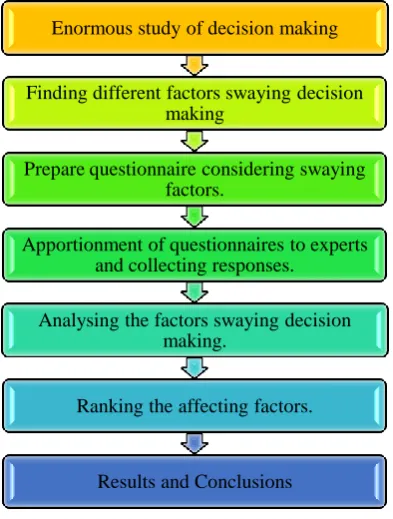
Work done in the research is very widespread. It is both adjectival as well as quantifiable. For this purpose it was imperative to pick out a technique in which the work may possibly be finished in a logical mode so as to have no lack of confidence, clatter of views and work can be ended with an unblemished attitude and tactic. The entire work of the research bank on the questionnaire survey, answer of which will be assembled from the topmost management level folks employed in construction industry. Figure 1 pronounces the technique addressed for entire study. In the commencement, a revision of former research works connected to decision making is completed through which chief personal factors swaying decision making is fixed. The questionnaire survey here is organised to recognise the chief personal factors prompting the decision making in construction industry. There are two section in questionnaire. First section is constituted of general info like
respondent’s name, age, company
Revised Manuscript Received on 17 April, 2019
Harsh Thakur, M-Tech (CEM), Civil Engineering Department, SRM Institute of Science & Technology, Chennai, Tamil Nadu, India
second section is constituted of factors prompting the decision making for valuation cause. For the study Likert Scale of 1-5 was employed, which is a psychometric response scale and respondents were requested to tick the virtual effectuality. For taking answer, initially the respondents were clarified about the objective of study, what
[image:2.595.200.397.135.395.2]study. If any doubt came to any respondent, the problem was cleared to respondent then and there itself. Only after the respondents were completely enlightened with the depiction of object of this research, the questionnaire was given to them and requested to fill it.
Fig 1: Flowchart of Methodology
III. Factors Influencing Decision Making
Once grinding prior research it can be certainly established that there are several factors that affect decision making in construction industry. The level to which they distress may fluctuate. These factors are manifold, i.e. having multiple nature because they can distress decision making both
[image:2.595.180.414.524.764.2]positively and negatively. Mostly factors swaying decision making openly disturbs the income of the firm or distresses the royalty since any interruption or postponement in decision making will upsurge period of the planned work. Figure 2 addresses the personal factors that affect decision making.
Figure 2: Personal Factors Swaying Decision Making
Enormous study of decision making
Finding different factors swaying decision making
Prepare questionnaire considering swaying factors.
Apportionment of questionnaires to experts and collecting responses.
Analysing the factors swaying decision making.
Ranking the affecting factors.
Results and Conclusions
Factors Swaying Decision Makint
Ethics
Boldness
Patience
Psychological endurance
Power
Competitiveness & willpower Physical
health Profit Intuition
Professional & Educational
International Journal of Innovative Technology and Exploring Engineering (IJITEE)
ISSN: 2278-3075,
Volume-8, Issue-6, April, 2019
IV. EXPLANATION OF ANALYSIS TECHNIQUE
The factors segregated were analysed in an organized way so as to have no room of fault. ANOVA Test was accomplished so as to find whether the factors segregated had some variance in total in the way they distress decision making. ANOVA Test is comprehensive nature wise, i.e., it considers all the means of samples at once and can be named as ‘Test for All’. Outcomes of ANOVA Test specifies that there are samples which vary from each other, but it does not point out precisely which samples vary. To attain cavernous knowledge of exactly which samples vary, Tukey Test was accomplished to find pairwise variation. Tukey Test is also called as ‘Honest Significance Difference Test’ since it establishes the variance between several sample groups. Formula utilized in the Tukey Test is clearly explained in Equation 1. After understanding the dissimilarity amongst various factors, they were ranked according to Relative Importance Index criteria, formula utilized is explained in Equation 2.
, Eq 1..
where, x1 and x2 is the means of group,
S is the Mean Square of Group, and, n is the number of group.
, Eq 2.. where, wt is the weighting given to each factor,
A is the highest weight (i.e. 5 in this case), &,
n is the total number of respondents (i.e. 200 in this case),
V. RESULTS & DISCUSSION
Table 1 designates the outcomes attained from ANOVA Test. The p-value conforming to the F-statistic of one-way ANOVA is lesser than 0.05, signifying that there is noteworthy difference amongst the factors.
Table 1: ANOVA Test Results
Source Sum of Squares
Degree of freedom
Mean Square
F statistic
p-value
Group 20.0250 9 2.2250 5.6809 0.0001 Error 11.7500 30 0.3917
Total 31.7750 39
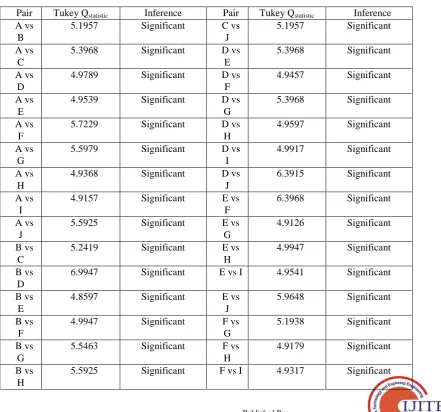
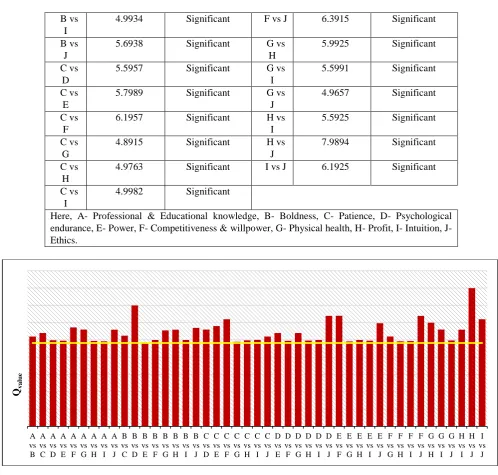
Table 2 recites the outcomes of Tukey Test. The Q-value of Tukey HSD Test for individual duo of factors is larger than the critical value, Qcritical = 4.8239 (for α=0.05, k=10,
[image:3.595.91.533.394.806.2]ν=30), proposing that certainly there is a noteworthy variance amongst every factors.
Table 2: Tukey Test Results
Pair Tukey Qstatistic Inference Pair Tukey Qstatistic Inference
A vs B
5.1957 Significant C vs J
5.1957 Significant
A vs C
5.3968 Significant D vs E
5.3968 Significant
A vs D
4.9789 Significant D vs F
4.9457 Significant
A vs E
4.9539 Significant D vs G
5.3968 Significant
A vs F
5.7229 Significant D vs H
4.9597 Significant
A vs G
5.5979 Significant D vs I
4.9917 Significant
A vs H
4.9368 Significant D vs J
6.3915 Significant
A vs I
4.9157 Significant E vs F
6.3968 Significant
A vs J
5.5925 Significant E vs G
4.9126 Significant
B vs C
5.2419 Significant E vs H
4.9947 Significant
B vs D
6.9947 Significant E vs I 4.9541 Significant
B vs E
4.8597 Significant E vs J
5.9648 Significant
B vs F
4.9947 Significant F vs G
5.1938 Significant
B vs G
5.5463 Significant F vs H
4.9179 Significant
B vs H
I
Significant Significant
B vs J
5.6938 Significant G vs H
5.9925 Significant
C vs D
5.5957 Significant G vs I
5.5991 Significant
C vs E
5.7989 Significant G vs J
4.9657 Significant
C vs F
6.1957 Significant H vs I
5.5925 Significant
C vs G
4.8915 Significant H vs J
7.9894 Significant
C vs H
4.9763 Significant I vs J 6.1925 Significant
C vs I
4.9982 Significant
Here, A- Professional & Educational knowledge, B- Boldness, C- Patience, D- Psychological endurance, E- Power, F- Competitiveness & willpower, G- Physical health, H- Profit, I- Intuition, J- Ethics.
[image:4.595.46.545.38.513.2]Here, A- Professional & Educational knowledge, B- Boldness, C- Patience, D- Psychological endurance, E- Power, F- Competitiveness & willpower, G- Physical health, H- Profit, I- Intuition, J- Ethics.
Fig 3: Graphical Presentation of Tukey Test Results.
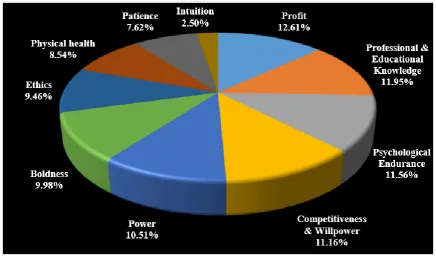
Table 3 reports the outcomes attained from RII ranking method that clarifies that out of all the personal factors, ‘Profit’ distresses the decision making the greatest followed
[image:4.595.91.505.49.249.2]by professional & educational knowledge in construction industry, while, ‘Intuition’ is the smallest distressing factor.
Table 3: Ranking Of Factors
Factors RII value Rank
Profit 0.96 1
Professional & Educational Knowledge 0.91 2
Psychological Endurance 0.88 3
Competitiveness & Willpower 0.85 4
Power 0.80 5
Boldness 0.76 6
Ethics 0.72 7
Physical health 0.65 8
Patience 0.58 9
Intuition 0.50 10
[image:4.595.87.529.628.832.2]International Journal of Innovative Technology and Exploring Engineering (IJITEE)
ISSN: 2278-3075,
Volume-8, Issue-6, April, 2019
[image:5.595.44.551.52.248.2]Here, A- Professional & Educational knowledge, B- Boldness, C- Patience, D- Psychological endurance, E- Power, F- Competitiveness & willpower, G- Physical health, H- Profit, I- Intuition, J- Ethics.
Fig 4: Graphical Presentation of RII Results
Fig 5: Effect of Personal Factors on Decision Making (in %)
VI. CONCLUSION
When the consequences of several accessible options is thoroughly known while it is implemented it becomes very easy to take virtuous decisions. In an industry such as construction which is having gigantic information and data it turns out to be very problematic while putting forward a decision, in this manner encumbering administrative work. The core aim of this study was to deliver understanding and thorough knowledge to the decision makers regarding the various factors which have greatest affect on decision making in our construction industry which will consequently make it easier for them to put forward eminence decisions, as unscrupulous decisions have the potential to breakdown the entire business. Following opinions are suggested for taking superlative decisions according to the study:
1) Since ‘Profit’ is the most affecting factor, one must come to those decisions which will always prove to be fruitful, both in long run as well as in short period. One must take as minimum risk as possible in any capital investment so that at least the decision maker is secure from economic point of view, i.e., overall he will not face any capital loss.
2) Continuously it is debated about acquiring supreme education and knowledge is vital or not for doing business. But it is very clear from the study that if you want to take supreme decisions you must attain good education in your respective field. Further, you must have a good strong hold in and about your respective profession and various details
A B C D E F G H I J
[image:5.595.80.517.311.567.2]and master of their respective field.
3) One must possess the capability to withstand circumstances of psychosomatic stress and to deal with and handle pressure situations and reactions for taking good decisions. Psychological Endurance is essential to maintain levels of performance at any level of organisation thereby making itself a key feature for an individual while taking decisions.
4) When taking decisions it is important for an individual to possess the quality of being as good as or superior compared to the rest of the individual only then can he come up with continuously best decisions. Further one must have strong will power to achieve required results, same goes with process of decision making. 5) In construction industry people like and enjoy being in control of the things and their working environment. People pursue gaining ‘Power’ and control in the firm so that everything and everybody float according to their perspective. They also look for ‘Power’ so that they get admiration and respect.
6) Decision making is not an easy task to complete, it includes a lot of complex process which sometimes is not possible to analyse and review, thus demanding a strong brashness so that one can stand by their ideas and thinking. Thus ‘Boldness’ in some situations plays a vital role, especially in situations demanding quick reply and in situations where rational methods fails.
VII. LIMITATIONS OF STUDY
1. The study is hinged on questionnaire survey and answers of personages are assumed to be dependable, precise and truthful.
2. The entire work of study is restricted to 200 samples solitary, which is accompanied merely in Southern part of India (Chennai), for auxiliary divergence one can augment the work by piloting study in other divisions of India.
REFERENCES
1. Ali S, Šaparauskas J, Turskis Z. Decision Making in Construction
Management : AHP and Expert Choice Approach. Procedia Eng. 2017;172:270-276.
2. Temiz I, Calis G. Selection of Construction Equipment by Using
Multi-criteria Decision Making Methods. Procedia Eng.
2017;196(June):286-293.
3. Ksi M, Draps M, Zawistowski J. Decision Making with use of
Building Information Modelling. 2016;153:519-526.
4. Ofek S, Akron S, Portnov BA. Stimulating green construction by
influencing the decision-making of main. Sustain Cities Soc. 2018;40(April):165-173.
5. Casanovas-rubio M, Ramos G. Resources, Conservation & Recycling
Decision-making tool for the assessment and selection of construction processes based on environmental criteria : Application to precast and
cast- in-situ alternatives. Resour Conserv Recycl.
2017;126(March):107-117.
6. Foxcroft CD. Development and validation of a managerial decision
making self-efficacy questionnaire. 2011:1-15.
7. Lu J, Han J, Hu Y, Zhang G. Multilevel decision-making : A survey.
2016;347:463-487.
8. Leu S, Vu P, Son H, Thi P, Nhung H. Automation in Construction
Development of recursive decision making model in bilateral construction procurement negotiation. Autom Constr. 2015;53:131-140.
9. Ning X, Lam K, Lam MC. Automation in Construction A
decision-making system for construction site layout planning By weighted. Autom Constr. 2011;20(4):459-473.
decision making – The need and obstacles for integration of LCA into decision analysis. Environ Sci Policy. 2018;87(March):33-44.
11.Wen Q, Qiang M, Gloor P. Science Direct Speeding up
decision-making in project environment : The effects of decision makers’ collaboration network dynamics. Int J Proj Manag. 2018;36(5):819-831.
12.Moghtadernejad S, Chouinard LE, Mirza MS. Multi-criteria
decision-making methods for preliminary design of sustainable facades. J Build Eng. 2018;19(October 2017):181-190.
13.Lampur K. METHODS FOR DECISION-MAKING IN SURVEY
QUESTIONNAIRES BASED ON LIKERT SCALE Ankur Barua. 2013;3(1):35-38.
14.Lawless DJ. The Process of Decision-Making in Universities.
1982;XII:1-9
15.Esa M, Alias A, Samad ZA. Project Manager’s Cognitive Style in
Decision Making : Perspective from Construction Industry. 2014;6(2):65-73.
AUTHORS PROFILE
Harsh Thakur, Pursuing M.Tech (Construction Engineering & Management) from SRM Institute of Science & Technology, Chennai, INDIA. Completed B.Tech (Civil Engineering) from PUNE UNIVERSITY (2015), Pune, Maharashtra, INDIA.
Mr. M. Balasubramanian, Assistant Professor in SRM Institute of Science & Technology, Chennai. Completed B.E. (Civil Engineering) from Annamalai University (2007), Chenai,
INDIA. Completed M.Tech (Construction