International Journal of Innovative Technology and Exploring Engineering (IJITEE) ISSN: 2278-3075, Volume-8 Issue-10, August 2019
Adaptation using Machine Learning for
Personalized eLearning Environment based on
Students Preference
John martin A,
\Maria Dominic M.
Abstract: Information gathering is a lifelong process of human being and the learning takes place from womb to tomb. Learners acquire, recognize, map the gathered information to knowledge and use it in day to day life. Advancement in ICT and the utilization of ICT in teaching and learning process has contributed an exponential growth. An eLearning solution has almost reached maturity, where the teaching and learning community have the proper digital infrastructure, smart phones, tablet computers and the best software platform. An innovation in teaching and learning sector has become an integral part and is mandatory. Hence the challenge is to suggest quality and appropriate learning materials to the learners. The research aims to categorize the learner according to their learning ability and to find the learning path to facilitate the learner to have appropriate and quality learning objects with the help machine learning techniques. The focus of this work is to come up with a system architecture which predicts and adapts the learner style, find the learning path and to provide the suitable learning objects in eLearning environment based on their preferences. Personalization will assist learner to improve their learning performance.
Keywords: Adaptive Learning System, Clustering, eLearning, Personalization, Learning Object.
I. INTORUCTION
The need for education is need of hour in all sectors. We can find number of definitions for Learning, the most suitable definition states that it is a “process of acquiring new, or modifying and reinforcing, existing knowledge, behaviors, skills, values, or preferences and may involve synthesizing different types of information” [1]. Massive Open Online Courses (MOOCs) or the Learning Managements System (LMSs) or the Technology Enhanced Learning or eLearning system is the application of ICT for teaching and learning process [2]. The development, improvement, innovation in teaching and learning process is necessary. eLearning systems should provide an alternative and innovative of teaching and learning than the traditional class room teaching and learning. It should personalize the desire and the need for the different actors (Learner, Tutor and Teacher) in teaching and learning process. The efforts made by these system in designing the course and the learning object are still unsatisfied, the issue is to consider the individual characteristics of learner that is recommendation and personalization of learning objects have to be addressed. Cognitive style of a learner is referred by the way in which an individual process the information [4] which determines the learning style of a leaner. The learning style of a learner is uniquely identified based on how a learner is getting and processing the information.
Revised Manuscript Received on August 10, 2019
A. John Martin holds M.C.A., M.Phil. B.Ed in Computer Science. Dr. M. Maria Dominic obtained his B.Sc, M.Sc, M.Phil and Ph.D in Computer Science.
Machine learning and information retrieval techniques are used to create a recommender system and to suggest potential items to the learner who are in need of these items. The modern Learning Management Systems are still offer the learning objects in indistinguishable way to the learners who posses various learning styles [3]. To provide personalization in an existing system, the system uses may information (Information about learning process, learners Profile, Types of Learning Objects etc). Adaptation in Learning Management System involves adaptive course delivery, collaboration of peer learners, interaction with the system and content detection and delivery [5]. In eLearning environment, there are many proposed adaptive systems and many researchers have contributed on the part of personalization. Most of the approached are based on learners’ tendency in the process of learning [6-8]. The objectives of this investigation is to classify the learner’s learning style, personalize the learning path and to deliver the right learning objects based on the learning preferences by taking the advantages machine learning algorithms.The proposed parts research paper is arranged as follows: The literature review and the similar work are presented in the section2. The experimental result and the discussion of the proposed system with the recommender system are given in section 3. In section 4, the results and discussions are provided. Finally the conclusion of the work is given in the section 5.
II. II. REVIEW OF LITERATURE AND
RELATED WORK
A. Learning
Learning is a common word which we use in everyday life. Learning takes place in all aspects of our life. Learning can be defined in many ways, one such definition is “the process
of acquiring new, or modifying
existing, knowledge, behaviors, skills, values, or preferences is called learning”.[9]. Learning is also defined as “change in behaviour”, the change takes place though experience or practice. Learning improves the performance of an individual [10]. Learning is a step-by-step process in which an individual experiences changes in knowledge, behavior, the way of process information and the way act upon the situation.
B. Learning Styles
Preference
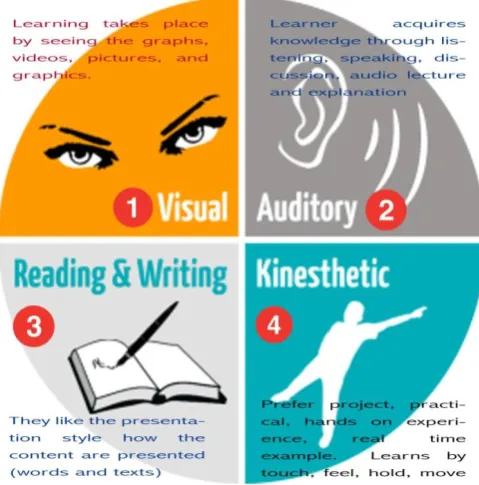
There are many research work has been carried out to predict the learner style or preferences [11-12]. Learning style represents differences in individuals' learning [13]. There are multiple proven methods and tools are available to categorize the learner based on the learner differences. Kolb’s method [14], Felder-Silverman Learning Styles (FSLS) method [15], and Myers-Briggs’s method [16]. In this article the researcher is chosen VARK model given by Neil D. Fleming [16]. It is most suitable and worldwide accepted model and guide to learning style. The characteristics of VARK model learner are shown in the figure 1.Fig. 1. Characteristics of Learner Based On VARK Model
Brusilovsky [27] presents the following approach for detecting learning model of a learner.
Collaborative Approach: In collaborative
technique the learners is expected to give precise feedback on the learning process, and the learning objects they have visited which could be used to create or redesign the existing teaching model. The generic approach is to use a questionnaire to classify the learning preference of a learner. [28]. Automated Approach: The learning process and
revision mechanism in the learning the model is performed automatically with the help of learner’s activities and the responses of learners while using the system in learning process. [28]. There are two methods used in automated approach. First method is data driven method which builds model using questionnaire (Index of Learning Style). The automated approach uses the learning behaviour of learner while using system and obtains the learning preference. The researcher is interested in automated approach.
C. eLearning
Learning conducted through electronic media and with the help internet is called eLearning. eLearning is enabled with the help of computer and network to transfer the skills and
knowledge. eLearning is the way by which we use the software systems and technology in process of teaching and learning. eLearning system is also referred as web enabled learning, computer aided learning, online learning, virtual leaning environment and virtual class rooms. eLearning content is presented in different formats like audio, video, text, images, animations etc. It makes use of the internet, intranet, and cloud to deliver the content. Today the educational institutions find that eLearning system create impact on the teaching and learning process, it is alternative and suitable system for them to enhance and support the traditional class room teaching and offer courses to a larger population of learners with any geographical barrier. The resources are available in different formats based on the learning preference like Web-based courseware, Discussion Forum, live Chat, video and audio streaming, Web chat, simulations, diagrams, charts and virtual mentoring [17] D. Adaptive eLearning Systems
An adaptive eLearning system should satisfy the need and the expectations of the individual learners. Adaptive eLearning systems can be defined as the technology enabled techniques to provide suitable knowledge to all learners with the exact learning objects based on the expectations and the learning preferences. According to Stoyanov and Kirschner, Adaptive eLearning is “an interactive system that personalizes and adapts eLearning content, pedagogical models, and interactions between participants in the environment to meet the individual needs and preferences.” [18-19]. Study in [20] explains the different methods and adaptation techniques since 1992. Current research in eLearning is focused towards learning platforms where individual learner’s hope, inspiration, style and behaviour are satisfied [21]. The adaptive eLearning system aims to facilitate and support the learner with right learning path along with learning objects in order to maximize the learning performance and to have efficient learning experience.
E. Related Work
There are number of researchers have published articles on recommender system for LMS which indicates a growing interest in development and deployment of LMS with recommender system. [24] Proposed the evaluation methods on recommender systems. Results from the survey shows that there is a need for improvement in LMS in terms of personalization of learning objects for the learners.
International Journal of Innovative Technology and Exploring Engineering (IJITEE) ISSN: 2278-3075, Volume-8 Issue-10, August 2019
Then, the propose idea uses the object clustering to make a suggestion for the personalization. In the paper [25], the authors introduced educational mining technique to predict students’ performance. The proposed system in [26] provides learning objects more beneficial to the learners. Here the personalization determined by the learning objects visited by other learners with similar profiles. It may improve the overall quality of learning by giving recommendation of learning objects but intentionally ignored individual learner’s uniqueness and their learning styles are ignored during the process of personalization.
III. Proposed System
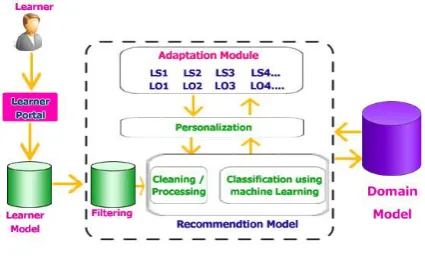
[image:3.595.325.528.48.212.2]The objective of this work is to use machine learning algorithm to classify the learners depending on their learning preference, to categorize them to a class of learning style and to suggest the suitable learning objects. The proposed system architecture is organized into three basic elements: Learner Model, Domain Model and the Learner Recommender System. These three elements interact with each other, classify the learners and find learning path so that the system can provide learner with the right Learning Objects (LO). Fig 2 represents the functional components of the proposed system.
Fig. 2. Functional Model of the proposed system.
A. Learner Model
[image:3.595.62.275.351.488.2]Learner profile is a unique characteristic which contributes for the success of learner in learning activities. The profile of a learner gives details about how the learner learns best. It is obtained by questionnaire or by analyzing the behaviour through a learning management system [29]. In our research, the log file of learner for a course is considered to build a learner profile. The collected data will be treated in an algorithm of classification to identify the leaner preferences like Visual, Aural, Read / Write and Kinesthetic.
Fig. 3. Learner Ontology Model
The learner ontology comprises the knowledge of a learner, and it consists of the following.
Personal Profile: It is static information about the learner like Id, Name, and Course enrolled. Learning Preference: Personal preference of the
learner is unique characteristic of a learner. This information is obtained from the log file of the learner which helps to classify the learner and to provide the personalized learning path with the right Learning Objects. In our model we have taken VARK model given by Neil to find the learner preference. It is one of most widely accepted model and guide to find the learning style of an individual learner [30]
X = { x [0,1], x = ( xv, xa, x rw, xk) }
Where
X is the probability of learning preference of ith learning style.
x is vector of learning styles (v – Visual, a – Aural, rw – Read / Write and k – Kinestheticesthetic)
The value for x is assigned by a numerical values 0 or 1, where 0 represents minimal satisfaction and 1 represents maximal satisfaction.
The characteristics of learning styles are assigned with numerical by examining the log file of the learner, the number visit made by the learner to the Learning Objects.
If number of visit to LO1 (Y) > 3 then x = 1; otherwise
x = 0.
Where Y = { v – Visual, a – Aural, rw – Read / Write and k – Kinestheticesthetic} of LO1.
B. Domain Model
Preference
Fig. 3. Organization of Domain Knowledge in Tree Structure
Course content model involves three layers, the first each course is divided into many chapters, and the chapters consists of a set of concepts. Each concept is mapped with different learning objects in the form of lecture notes, Audio Lesson, Video Lesson, Graph, Images, Animations, PDFs, and PPTs etc.
C. Learner Recommender System
The functional model is presented in the Fig 2. It has 3 parts, the first part deals with the classification of learner and the second and third parts deals with the personalization and adaptation. Classification module classifies learner based on their learning activities and the adaptation module adapts the learning path and suggest the learning objects to the learner. Personalization module finds the learning path and the learning object to the learner based on the learning style is suggested. Dynamically the learner model is revisited using the interaction with the learning portal and the data mining techniques is used to collect the learning activities of learner’s learner style is predicted.
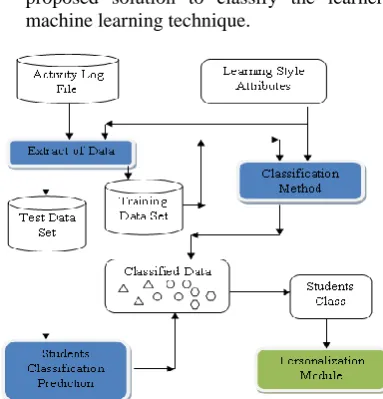
Classification of Learner: This module is uses machine learning technique to classify the learner based on the activity log file of the students. Fig. 4 shows the detailed schema which illustrates the proposed solution to classify the learner using machine learning technique.
Fig. 4. Schema of learner classification based on machine learning technique.
Methodology in classification of learners
i. Learners learning activities for a course are captured with the help of log file.
ii. Number of times the LOs visited by the learner is identified.
iii. Training data set is created based on the criteria discussed in section 3.1. The system is trained with the training data set.
iv. Machine Learning Algorithm is used to classify the learner style.
v. The system is tested with the test data for the prediction of learners’ learning style.
[image:4.595.306.547.279.444.2]For the implementation of classification algorithm, Fig 5 represents the various learning components accessed by learner at each chapter is captured and converted in CSV file format each row in the file consist of the value of LO, either 0 or 1, where 0 indicates least satisfaction and 1 indicates highest satisfaction.
Fig 5. Learning Components accessed by learner
Personalization and Adaptation Module: In [31], the researchers have proposed a solution for personalization and adaptation technique using BFS algorithm to find learning path and to provide learning objects. The module in section 3.3.2 recommends the learner about the learning path and learning objects based on the learning styles / preferences.
IV. RESULTS AND DISCUSSIONS
[image:4.595.70.262.550.750.2]International Journal of Innovative Technology and Exploring Engineering (IJITEE) ISSN: 2278-3075, Volume-8 Issue-10, August 2019
Fig. 6. Summary of Evaluation on Test Data
Random forest algorithm is used to test proposed system for classification where 66% of data used for training data set and remaining data used to test the system. The summary of data set is given below
Table- I: Summary of data set
Items Total % Observations
Correctly Classified Instances
1000 100% Number of instances that are correctly classified in the training datasets.
Incorrectly Classified Instances
0 0% Number of instances that are incorrectly classified in the training datasets.
Kappa statistic 1 - Kappa statistic compares the observed accuracy with expected accuracy.
It varies from 0 to 1, where 1 is perfect. Here the classifier performs almost perfect classification.
Mean absolute error
0.0954 The error rate for forecasting accuracy
Number of instances
1000 Number of instance in the training dataset.
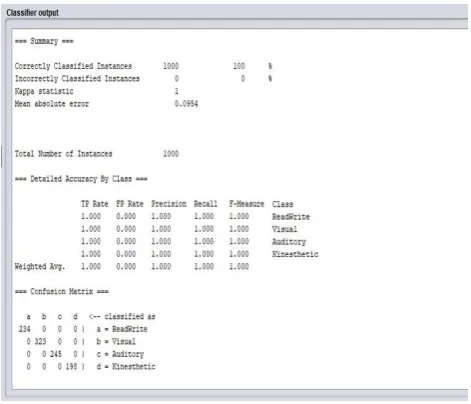
[image:5.595.336.523.170.234.2]The details of accuracy of classes is shown in the Fig 7.
Fig. 7. Accuracy of classes
The rate of true positive instances given under TP Rate Column (instances correctly classified as a given class) The rate of false instances gives under FP Rate Column (instances correctly classified as a given class)
Precision = α of instances that are truly of a class / the total instances classified as that class
Recall = α of instances classified as a given class / the actual total in that class (which is = TP rate) F-Measure = 2 * Precision * Recall / (Precision +
Recall) => gives the test accuracy.
Confusion Matrix:
Fig 8. Confusion Matrix
A confusion matrix describes the performance of a classification model (or “classifier”) on a set of test data for which the true values are known. It allows the visualization of the performance of an algorithm.
The proposed algorithm is tested by supplying test data and it classifies the learner. A sample screen shop of the test result is shown below in the Fig 9. It classifies the learner as a visual learner based on the learner profile.
Fig 9. Confusion Matrix for the tested result
V. CONCLUSION
[image:5.595.51.287.517.719.2]Preference
REFERENCES1. Learning. Retrieved from http:// en.wikipedia.org/wiki/Learning 2. Kirkwood, A. and Price, L, “Technology-enhanced learning and
teaching in higher education: what is ‘enhanced’ and how do we know? A critical literature review,” 2014, Learning, media and technology, 39(1), pp.636.
3. Aamir, M. and Bhusry, M., “Recommendation System: State of the Art Approach,” 2015, International Journal of Computer Applications, 120(12).
4. Anita Finke and Janis Bicansm, “E-Learning System Content and Architecture Evolution”, Proceedings of 16 International Conferences on Information and Software Technologies, Druskininkai, Lithuania, 2010.
5. K. Tarus, Z. Niu, A. Yousif, “A hybrid recommender system for e-learning based on context awareness and sequential pattern mining,” 2017, Soft Computing 72, 37–48
6. Wolf., C. iWeaver, (2003). Towards learning style-based eLearning in computer science education. Proceedings of the fifth Australasian conference on Computing education. Darlinghurst, Australia, 273-279.
7. Essalmi, F., Jemni Ben Ayed, L., Jemni, M., Kinshuk., and Graf S., (2010). A fully personalization strategy of eLearning scenarios. Computers in Human Behavior, 26(4), 581–59.
8. Latham, A., Crockett, K., and McLean, D. (2014). An adaptation algorithm for an intelligent natural language tutoring system. Computers & Education, 71, 97–110.
9. Richard Gross, Psychology: The Science of Mind and Behaviour 6E,
Hachette UK, ISBN 978-1-4441-6436-7.
10. Jan De Houwer & Dermot Barnes-Holmes & Agnes Moors,. (2013 January). What is learning? On the nature and merits of a functional definition of learning, Psychon Bull Rev doi: 10.3758/s13423-013-0386-3.
11. Wilfrid Laurier University, (2008). Study Skills & Supplemental Instruction Centre “Understanding your learning style”. Retrieved from https://downloads.wlu.ca
12. Katherine D. Arbuthnott, Gregory P. Krätzig., (2015). Effective Teaching: Sensory Learning Styles versus General Memory Processes, Innovative Teaching, Volume 4, Article 2.
13. Coffield, Frank; Moseley, David; Hall, Elaine; Ecclestone, Kathryn, (2004). Learning styles and pedagogy in post-16 learning: a systematic and critical review, London: Learning and Skills Research Centre. ISBN 1853389188. OCLC 505325671.
14. Kolb, D.A. (1984). Experiential learning: experience as the source of learning and development (11th ed). New Jersey-Hall.
15. Felder, R., and Silverman, L., (1988). Learning and teaching styles in engineering education. Engineering Education, 87(7), 674-684. 16. Soles, C and Moller, L,. (2001). Myers-Briggs type preferences in
distance learning education. International journal of Educational Technology, 2(2), 180-187.
17. Devajit Mahanta., Majidul Ahmed,. ELearning Objectives, Methodologies, Tools and its Limitation,.Retrieved from
https://pdfs.semanticscholar.org.
18. Chun-Hui Wu, You-Shyang Chen, Ta-Cheng Chen. (2017, October). An Adaptive eLearning System for Enhancing Learning Performance: Based on Dynamic Scaffolding Theory.
19. Yao Jung Yang., Chuni Wua,. (2008). An attribute-based ant colony system for adaptive learning object recommendation. Retrieved from
https://pdfs.semanticscholar.org
20. P. Brusilovsky, (2001, March). Adaptive Hypermedia, User Model. User-Adapt. Interact., vol. 11, no. 1, pp. 87–110.
21. S. Kulaglić, S. Mujačić, I. K. Serdarević, and S. Kasapović, (2013). Influence of learning styles on improving efficiency of adaptive educational hypermedia systems, 12th International Conference on Information Technology Based Higher Education and Training (ITHET).
22. DamindaHerath and LakshmanJayaratne, “A Personalized Web Content Recommendation System for E-Learners in E-Learning Environment,” 2017, National Information Technology Conference (NITC), 13-15 September, Colombo, Sri Lanka.
23. SongJieGong, “A Collaborative Filtering Recommendation Algorithm Based on User Clustering and Item Clustering ,“ 2010, JOURNAL OF SOFTWARE, VOL. 5, NO. 7.
24. MojisolaErdt, Alejandro Fernandez, and ChristophRensing, “Evaluating Recommender Systems for Technology Enhanced Learning: A Quantitative Survey” 2015, IEEE Transactions on Learning Technologies, pp. 326-344.
25. Thai-Nghe N., Drumond L., Krohn-Grimberghe A and Schmidt-Thieme L., “Recommender system for predicting student
performance,” 2010, In Procedia Computer Science, Volume 1, Issue 2, pp 2811-2819.
26. Hazra Imran, Mohammad Belghis-Zadeh, Ting-Wen Chang, Kinshuk, Sabine Graf, “PLORS: a personalized learning object recommender system,” 2016, Vietnam Journal of Computer Science, Volume 3, NO. 1, pp 3–13
27. Brusilovsky. (1996).Methods And Techniques Of Adaptive Hypermedia. User Modeling and User-Adapted Interaction, 6(2-3), p. 87129.
28. Christiani, N & S.T. (2000). Support Vector Machines. pages 11-18 29. Daminda Herath and Lashman Jayarathne, “Intelligent
Recommendations for e-Learning Personalization Based on Learner’s Learning Activities and Performances”, 2018, International Journal of Computer Science and Software Engineering (IJCSSE), Volume 7, Issue 6, Page: 130-137.
30. Norasmah Othmana , Mohd Hasril Amiruddinb , (2010). Different Perspectives of Learning Styles from VARK Model, International Conference on Learner Diversity.
31. A. John Martin, M. Maria Dominic (2018), Personalization Using BFS for Personalized eLearning System, JETIR August 2018, Volume 5, Issue 8
AUTHORS PROFILE
A. John Martin holds M.C.A., M.Phil. B.Ed in Computer Science. He has great passion towards teaching profession. Presently he is working for MCA department as Assistant Professor. He is a part-time Ph.D Scholar and he is currently in the second year of her PhD in Computer Science at Sacred Heart College, Tirupattur. His current research area is in Artificial Intelligence using Machine Learning Techniques. He has published research articles in National and International Journals.