International Journal of Innovative Technology and Exploring Engineering (IJITEE) ISSN: 2278-3075, Volume-8 Issue-9, July 2019
Abstract: Face recognition is an attention-grabbing area in research field due to various challenges like aging, pose variation, facial expression, and illumination problem. Now-a-days, plastic surgery is a standout amongst the above mentioned exciting issues of face recognition. Local plastic surgery is a type of plastic surgery in which any one feature of the face is changed instead of all features of face. In this paper, the face recognition on local plastic surgical faces using probabilistic approach is presented, where a probabilistic approach like Naive Bayes Classifier, Neural Network Classifier are used to recognize the faces with local plastic surgery from the database. Naive Bayes classifier is fused with Expectation Maximization Algorithm (EMA) for better recognition of the faces from the database. Finally, Results of Naive Bayes Classifier, Naive Bayes Classifier with EMA is evaluated on standard Plastic Surgery Database(PSD). Similarly, Neural network classifier is also been tested on PSD database, which will aid to decide which classifier is efficient for recognizing plastic surgical faces. The motive of this paper is give increase in recognition rate with the help of effective classifier.
Index Terms: Probabilistic approach, Naive Bayes classifier, Expectation Maximization Algorithm (EMA), Neural Network Classifier.
I. INTRODUCTION
Due to the evolving digital era, face has become one of the common means of communication, transaction, security etc. This evolution in e-transactions and other requirements the demand of fast and correct identification and authentication of a user has been continuously increasing. Thus, the human face plays an important role in verifying people’s identification and in social interactions. Use of human face for security purpose, the face recognition technology has presented a sufficiently a good amount of work in last few years. There are a few techniques for biometrics recognition, for example, iris recognition, fingerprints and face recognition [1]. In comparisons with other biometric systems, the face recognition has an advantage because the images of the face can be captured non-intrusively.
Revised Manuscript Received on July 05, 2019.
Roshni S. Khedgaonkar, Assistant Professor, Department of Computer Technology, Yeshwantrao Chavan College of Engineering, Nagpur, India
Kavita R. Singh , Associate Professor, Department of Computer Technology, Yeshwantrao Chavan College of Engineering, Nagpur, India
M.M. Raghuwanshi, Professor, Department of Information Technology, Yeshwantrao Chavan College of Engineering, Nagpur, India
Pravin M. Sonsare, Assistant Professor, Department of Computer Science and Engineering, Shri Ramdeobaba College of Engineering and Management, Nagpur, India
Various face recognition techniques have been introduced and comparison of the techniques is being done on the basis of their recognition rate to make Identification of a
face[18,19,20]. However, face recognition tools is yet an uncluttered research issue under vastly varying condition [23, 24]. As discussed above, there exist several challenges in face recognition due to posing, illumination conditions, facial expressions and aging etc. Various researches has been done on face recognition problems that addresses the above mentioned challenges related to face recognition, such as variation in expression [9], posing [22], aging [9], illumination problem [2,3,4], and disguise [10]. In addition to the mentioned challenges, another issue is of plastic surgery[25,26] that influences the performance of face recognition. Now-a-days, demand of plastic surgery has recently made plastic surgery a challenge in recognition of faces because it changes the entire facial features of the face. There are two broad categories of plastic surgery: Local Plastic Surgery and Global Plastic Surgery [5, 6]. Local plastic surgery a kind of surgery which changes a single feature of the persons face and global plastic surgery is surgery which completely modifies the total face structure of a person.
(a) (b) Fig. 1(a): Sample image of local plastic surgery
[image:1.595.328.529.397.497.2]. (b) Sample image of global plastic surgery The fig 1(a) depicted the sample image of local plastic surgery and fig 1(b) illustrated the sample image of global plastic surgery. Many approaches have been proposed to build up various classification module for face image which experienced certain component changes via plastic surgery. A near set theory is one of the approach for matching pre-surgical and post-surgical face images [7]. Probabilistic
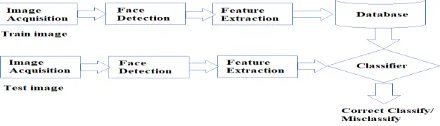
Fig.2: Face Recognition Process [2]
approach considered to be one of the approaches for solving
the face recognition
challenges. Various
algorithms of face
recognition uses
Face Recognition using Probabilistic Model for
Locally Changed Face
[image:1.595.318.538.605.668.2]distance-based method but the probabilistic model gives comparably better outcomes for face recognition under varying pose [8]. By and large, the face recognition system comprises of three stages. Specifically, face detection, feature extraction and face recognition as shown in Fig. 2.
Naive Bayes classifier a probabilistic approach that is simple but effective for face recognition problems [1]. This classifier has been used in various applications like image recognition [12], image retrieval [11] and natural language processing. The EM algorithm (Expectation Maximization algorithm) is a structure which determines probabilistic parameter, when the data has missing values. Neural Network Classifier recognize the face through training and learning the correct classification [28]. Naive Bayes classifier and EM algorithm is used as a fused approach for classifying unlabeled data for texture data classification [13].
The rest of the paper structured is as per the following. Section II briefly reviews proposed method, which talk about the flow of face recognition is being discussed and presents the overview of proposed method in which Naive Bayes classifier, Naive Bayes classifier with EM algorithm and Neural Network Classifier are used for classifying the image. Section III presents experimental results followed by section IV is conclusions.
II. PROPOSED WORK
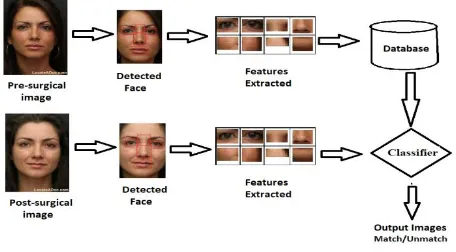
[image:2.595.55.283.462.588.2]This section of the paper presents the proposed work using probabilistic approach. Probabilistic approach is a method in which distribution describes the range of possible values and shows which value within the range are most likely. It is used for calculating the probability of the local surgical faces with its best match faces in the face database. Probabilistic approach consist of various methods such as Bayesian
Fig. 3: Overview of Proposed Work
Classifier, Nearest Neighbour Classifier, Naive Bayes classifier and Neural Network classifier which gives results based on probability of likelihood.
Face detection, initial stage of any face recognition method. Face detection process has been carried out with the help of Viola-Jones algorithm [14]. Viola-Jones detector was preferred as a detection algorithm because of its high detection rate, and its capability to run in real time [15]. Viola –Jones Algorithm uses four stages. The first stage is Haar feature selection, second stage is creating an image integration followed by training of Adaboost and last one is Cascading classifier.
Face detection is followed by feature extraction. In our work we have used Grey level co-occurrence integrated algorithm
(GLCIA) [16] method for feature extraction. GLCIA shows better results in determination of co-occurrence probability of statistical features. GLCIA algorithm is made by coordinating favored parts of two algorithms. Namely, the grey level co-occurrence hybrid structure (GLCHS) as well as
grey level co-occurrence hybrid histogram (GLCHH). The GLCIA algorithm considered as recommended technique for computing a statistical features of co-occurrence probability for huge size digital images. The GLCIA algorithm extracts various statistics such as correlation values, dissimilarity, contrast of the face, maximum probability of match shifted face, entropy value, variance of the image, inverse difference, total edge differences, recursively of the face and in homogeneity.
The extracted features are further used for recognition of the faces using Naive Bayes classifier, Naive Bayes classifier with EM algorithm and Neural Network Classifier. Naive Bayes classifier method learns from data and predict class. Probability is associated with every class [1]. Expectation Maximization Algorithm is utilized to get maximum likelihood parameters of a statistical model in situation where the equations are tough to solved openly. A neural network comprises of neurons which are organized in layers. This layered neurons changes an input value into specific output [27].
A. Probabilistic Approach
Probabilistic approach enables changes and unusual occurrence to be measure by using distributions instead of exact value in evaluation of levels of risk involved in a situation. A distribution states some range of possible values and shows which value are most likely.
B. Naive Bayes classifier
This method is one of the probabilistic method, used for classification of local surgical faces. This classifier is a kind of probabilistic models. It has dependent on applying Bayes theorem with solid (naive) presumption between various features. Naive Bayes classifier expect the occurrence of a specific feature is distinct from the occurrence of other feature. It learns from data as well as predict class with probability associated with these class[1]. Naive Bayes classifier as depicted in equation (1).
P(A│B)= (P⟨B│A⟩P(A))/P(B) (1)
Where, P (A|B): Probability (conditional probability) of occurrence of event A given the event B is true
P (A) and P (B): Probabilities of the occurrence of event A and B respectively
P (B|A): Probability of the occurrence of event B givens the event A is true
C. Neural Network Classifier
International Journal of Innovative Technology and Exploring Engineering (IJITEE) ISSN: 2278-3075, Volume-8 Issue-9, July 2019
technique is aid to solve and predict complex problems. Neural Network Classifier architecture has input layer, hidden layer and output layer. The hidden layer is used to filter important patterns from input layer and passes it to next layer.
. A neural network comprises of neurons which are organized
in layers. This layered neurons changes an input value into specific output. Each neural takes an input, applies a function
to it and then transfer the output on the next layer [27].
D. Naive Bayes classifier with EM algorithm
Expectation Maximization Algorithm is a repetitive technique to obtained maximum likelihood or posteriori estimates of parameter. Expectation Maximization Algorithm finds the model parameters even if there is have missing data. Expectation Maximization Algorithm has two steps E-step to generate the expected classification for each example and M-step to generate the most likely theory given the classified data.
Collaborating, Naive Bayes classifier with the EM algorithm is a promising minimally supervised approaches because its computational cost is low [21]. The efficient performance of Naive Bayes classifier with the EM algorithm brings an idea to use it for the face recognition.
Algorithm of Proposed Work
Input: Training dataset I of pre-surgical images I= (I1, I2, I3…In)
Output:
Face is recognized as match or mismatch with database image Steps:
1. Read the training dataset I;
2. Calculate the statistical values of each image; 3. Repeat
Calculate the probability of I1;
until the probability of all images (I1, I2, I3… In) has been calculated
4. Calculate the likelihood for each class; 5. Get the greatest likelihood;
6. Return match;
Otherwise,
return mismatch;
III. EXPERIMENTAL RESULTS
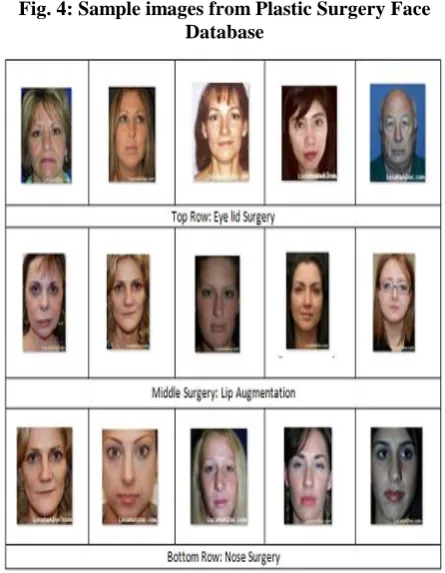
For experimentation purpose, database of Image Analysis and Biometrics Lab from IIIT Delhi [17], Plastic Surgery Face Database is used. It contains total of 98 images of pre-surgery and post-surgery of local plastic surgery. The 98 images are divided as 28 sample images of
Blepharoplasty-Asian-eyes, 15 sample images of Lip Augmentation and 55 sample images of Rhinoplasty (Nose ) surgery. Training was performed on all pre-surgical samples of 98 images and testing were conducted on post-surgical 98 images from each category such as Blepharoplasty, Lip Augmentation and Rhinoplasty. Fig 3 depicts the sample input images from Plastic Surgery Face Database [17]. The
sample images shown in fig 4 pre-surgical images utilized in training whereas the images after plastic surgery is depicted in fig. 4 have been used for testing. If the two samples (pre and post) surgical of one individual is compared in fig 3, it can be observed that how the appearance have changed drastically due to under knife issues. This makes face recognition under plastic surgery is most exciting problem. Sample images of various surgeries under local plastic surgery are depicted in fig. 5. The next stage, detection of face portion of an individual. In this phase, we have
Pre-surgical sample images
[image:3.595.317.534.179.312.2]Post-surgical sample images
Fig. 4: Sample images from Plastic Surgery Face Database
Fig. 5: Sample input images from Plastic Surgery Face Database
Fig. 6: Face detection used Viola Jones [15]
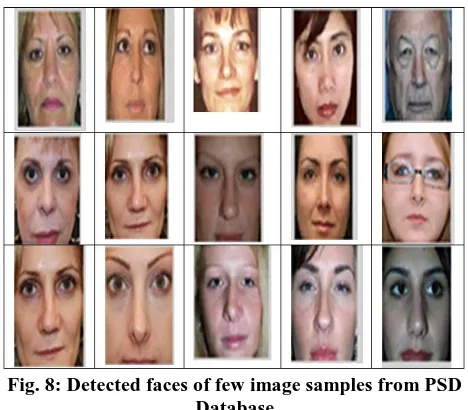
[image:3.595.314.537.329.616.2]mark as box around left eye, right eye, nose, mouth and last box that covers all the facial parts as shown in fig 6. The resultant detected face parts of few of the samples are shown in the fig 7 and detected faces of few of the sample from Plastic Surgery Face Database(PSD) are shown in fig 8. Once the face is detected, GLCIA algorithm [16] has been used in representing the human face by extracting some features. The sample output of feature extraction using GLCIA is shown in fig 9.
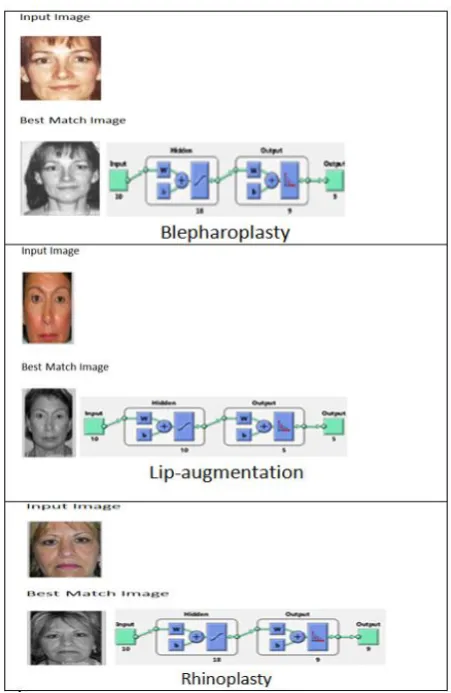
The extracted features are further used for recognition using Naive Bayes classifier, Neural Network Classifier and Naive Bayes classifier fused with EM algorithm. The test images under each category of surgery such as Blepharoplasty, Lip Augmentation and Rhinoplasty are matched using the aforementioned classifiers against the trained images. Sample resultant match under category is shows in fig. 10, fig. 11 and fig. 12 respectively.
[image:4.595.309.543.48.253.2]The sample results of recognition of local surgical faces are depicted in table I and the recognition rate of Naive Bayes classifier, Neural Network classifier and Naive Bayes with EM algorithm for different types of facial surgeries are depicted in table II. In table I S1, S2,……S8 represent the sample images from test set. From table I it can be observed that, for example Naive Bayes and Neural Network has shown correct match for sample S1 from train set, whereas fused Naive Bayes and EM classifier have shown mismatch for the same sample S1. Similarly, recognition of other samples by each of the classifier can be analyzed from the table I. The overall recognition rate of each classifier for all surgical categories has been tabulated in table II.
Fig. 7: Detected face parts of few image samples from PSD Database
Fig. 8: Detected faces of few image samples from PSD Database
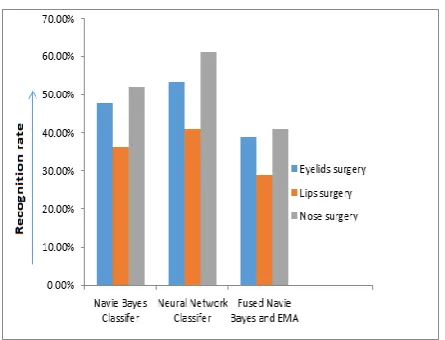
The graphical representation of recognition rate of
three different types of surgeries are shown in figure 13
in which recognition rate of Naive Bayes classifier.
Naive Bayes classifier with EM algorithm is shown for
Eyelids, Lips and Nose surgery. With same parameter it
has also been tested using Neural Network Classifier. It
has been analyzed that Naive Bayes classifier computes
Fig. 9: Feature extraction
[image:4.595.304.549.357.700.2]Blepharoplasty Lip Augmentation Rhinoplasty
[image:4.595.53.285.404.596.2]International Journal of Innovative Technology and Exploring Engineering (IJITEE) ISSN: 2278-3075, Volume-8 Issue-9, July 2019
Blepharoplasty
Lip Augmentation Rhinoplasty
[image:5.595.52.289.47.211.2]Fig. 11: Naive Bayes classifier fused with EM algorithm
the probability of individual feature and then classifies
accordingly and Neural Network Classifier works on
learning data and then classifying it. In this paper, we
presented Naive Bayes classifier fused with EM
algorithm, so that the features matched by Naive Bayes
classifier should be maximized by EM algorithm with
an expectation of more accurate results. However, as
the features of faces are changed after plastic surgery it
is difficult to match the maximized number of features.
Therefore, EM and Naive Bayes classifier in
combination is giving poor performance as compare to
Naive Bayes Classifier and Neural Network Classifier
in case face recognition of plastic surgery.
Table I: The sample results of recognition of local surgical faces
Surgery Type
Input image
Naive Bayes classifier
Fused Naive Bayes and EM classifier
Neural
Network
Classifier
Eyelids surgery
S1 Match Unmatch Match
S2 Unmatch Unmatch Match
S3 Match Match Match
Lips surgery
S4 Unmatch Unmatch Unmatch
S5 Match Match Match
Nose surgery
S6 Unmatch Unmatch Match
S7 Match Unmatch Match
S8 Match Match Unmatch
[image:5.595.313.539.48.395.2]Fig. 12: Neural Network Classifier Table II: The recognition rate of Naive Bayes, Neural Network and Naive Bayes with EM algorithm for different
types of surgery
Surgery Type
Naive Bayes classifier
Fused Naive Bayes classifier with EM algorithm
Neural Network Classifer Eyelids
surgery 47.71% 39% 53.44%
Lips
surgery 36% 29% 41%
Nose
Fig. 13: Graphical representation of recognition rate of three types of surgery
IV. CONCLUSION
This paper has introduced face recognition under local plastic surgical faces using probabilistic approach. Firstly, we have used Naive Bayes classifier for recognition of local plastic surgical faces which has given 45% accuracy in face recognition and after that Naive Bayes classifier fused with EM algorithm to yield effective recognition rate of local plastic surgical faces which has given 36% accuracy. Lastly we have used Neural Network Classifier for recognition of local plastic surgical faces which has given 51% accuracy in face recognition The Naive Bayes classifier individually has given better recognition rate compared to the combination of Naive Bayes classifier with EM algorithm. But Neural Network Classifier has given better recognition than Naive Bayes classifier.
REFERENCES
1. E. B. Putranto, P. A. Situmorang and A. S. Girsang, "Face recognition using eigenface with naive Bayes," In: 11th International Conference on Knowledge, Information and Creativity Support Systems (KICSS), Yogyakarta, pp. 1-4, 2016.
2. Ripal Patel, NidghiRathod, Ami Shah, “Comparative Analysis of Face Recognition Approaches: A Survey,” International Journal of Computer Applictaions (09758887), Volume 57, No. 17, November 2012.
3. Singh, K andZaveri, MukeshandRaghuwanshi, M. M.. (2010). Illumination and Pose Invariant Face Recognition: A Technical Review. International Journal of Computer Information Systems and Industrial Management Applications. 2.
4. Satonkar S.S, Kurhe A.B, “Challenges in Face Recognition: A Review,” International Journal of Advanced Resesrch in Computer Science (IJARCS), Volume 2, No. 4, July-August 2011.
5. S. O. Ali, V. Sagayan, A. Malik and A. Aziz, "Proposed face recognition system after plastic surgery," in IET Computer Vision, vol. 10, no. 5, pp. 342-348, 8 2016.
6. R. Singh, M. Vatsa and A. Noore, "Effect of plastic surgery on face recognition: A preliminary study,"IEEE Computer Society Conference on Computer Vision and Pattern Recognition Workshops, Miami, FL, pp. 72 -77, 2009.
7. Singh, K and Khedgaonkar, Roshni and Gawande, Swati. (2019). A New Approach to Local Plastic Surgery Face Recognition Using Near Sets.
8. S. Prince, P. Li, Y. Fu, U. Mohammed and J. Elder, "Probabilistic Models for Inference about Identity," in IEEE Transactions on Pattern Analysis and Machine Intelligence, vol. 34, no. 1, pp. 144-157, Jan. 2012.
9. R. Singh, M. Vatsa and A. Noore, "Effect of plastic surgery on face recognition: A preliminary study,"IEEE Computer Society Conference on Computer Vision and Pattern Recognition Workshops, Miami, FL, pp. 72 -77, 2009.
10. R. Singh, M. Vatsa, H. S. Bhatt, S. Bharadwaj, A. Noore and S. S. Nooreyezdan, "Plastic Surgery: A New Dimension to Face Recognition," in IEEE Transactions on Information Forensics and Security, vol. 5, no. 3, pp. 441448, Sept. 2010.
11. Shendre, A., Damahe, L.: A review: image retrieval using fusion based technique. Int. J. Control Theory Appl. 9(41), 945–955 (2017) 12. S. Samdurkar, Apurva &Kamble, Shailesh& Thakur, Nileshsingh& S.
Patharkar, Akshay. (2017) Overview of Object Detection and Tracking based on Block Matching Techniques. 313-319. 10.15439/2017R84. 13. Tsuruoka, Yoshimasa&Tsujii, Jun'ichi. :Training a naive baye 14. s classifier via the EM algorithm with a class distribution
constraint(2003).
15. Narayan T. Deshpande,"Face Detection and Recognition using Viola Jones algorthim and Fusion of PCA and ANN," in Advances in Computational Sciences and Technology ISSN 0973-6107 Vol 10, No. 5, pp. 11731189, 2017
16. P. KomalVaishnavi, M. Pavitra,"Face Recogntion using Viola -Jones Algorthim." in International Journal of Innovative Science and Research Technlogy ISSN vol.3,Issue 2, no. 2456-2165, February 2018
17. Clausi, David & Zhao, Yongping. (2003). Grey level co-occurrence integrated algorithm (GLCIA): A superior computational method to rapidly determine co-occurrence probability texture features. Computers & Geosciences. 29. 837-850.
18. http://www.iab-rubric.org/resources.htmlDatabase of Image Analysis and Biometrics Lab IIIT Delhi, Plastic Surgery Face Database. 19. G. George, R. Boben, B. Radhakrishnan and L. P. Suresh, "Face
recognition on surgically altered faces using principal component analysis," 2017 International Conference on Circuit ,Power and Computing Technologies (ICCPCT), Kollam, pp. 1-6, 2017. 20. Naeem, Muhammad; Qureshi, Imran &Azam, Faisal., Face
Recognition Techniques And Approaches: A Survey; 2015 Science International (Lahore).27. 301-305.
21. Noel Nuo Wi Tay, Janos Botzheim, Naoyuki Kubota, Joint probabilistic approach for real-time face recognition with transfer learning” Robotics and Autonomous Systems, vol.75, part B, pp. 409-421, Jan 2016.
22. M. I. H. Chowdhury and F. I. Alam, A probabilistic approach to support Self-Organizing Map (SOM) driven facial expression recognition, 2014 17th International Conference on Computer and Information Technology (ICCIT) , Dhaka, pp. 210-216, 2014. 23. F. Kahraman, B. Kurt and M. Gokmen, Robust Face Alignment for
Illumination and Pose Invariant Face Recognition; 2007 IEEE Conference on Computer Vision and Pattern Recognition, Minneapolis, MN, pp. 1-7, 2007.
24. SujataG. Bhele and V.H. Mankar, A Review Paper on Face Recognition Techniques,in The International Journal of Advanced Research in Computer Engineering and Technology (IJARCET) vol 1, Issue 8, October 2012.
25. T. Salan and K. M. Iftekharuddin, "Large pose invariant face recognition using feature-based recurrent neural network," The 2012 International Joint Conference on Neural Networks (IJCNN), Brisbane, QLD, 2012, pp. 1-7.
26. P. Dadure, S. Sikder and K. Sambyo, "Plastic Surgery Face Recognition Using LBP and PCA Algorithm," 2018 2nd International Conference on Electronics, Materials Engineering & Nano-Technology (IEMENTech), Kolkata, 2018, pp. 1-5.
27. A. Jindal, S. Gupta and L. Kaur, "Face recognition techniques with permanent changes: A review," 2015 International Conference on Green Computing and Internet of Things (ICGCIoT), Noida, 2015, pp. 689-693.
28. N. Jamil, S. Lqbal and N. Iqbal, "Face recognition using neural networks," Proceedings. IEEE International Multi Topic Conference, 2001. IEEE INMIC 2001. Technology for the 21st Century., Lahore, Pakistan, 2001, pp. 277-281.
International Journal of Innovative Technology and Exploring Engineering (IJITEE) ISSN: 2278-3075, Volume-8 Issue-9, July 2019
thor-1 Photo
to
AUTHORSPROFILE
Roshni Khedgaonkar received her B.E. degree in computer science & engineering from Anjuman College of Engineering and Technology,Nagpur in 2008. She is M.Tech. in Computer Science and Engineering from Yashvantrao Chavhan College of Engineering,Nagpur in 2012 and working as an Assistant professor in Yashvantrao Chavan College of Engineering, Nagpur. Her research interests are Image processing, Pattern recognition and Machine learning
Kavita R Singh received the B.E degree in Computer Technology in 2000 from RGCERT, Nagpur University, Nagpur, India, and the Mtech. Degree in Computer Science and Engineering from Birla Institute of Technology, Ranchi, India, in 2007, and the Ph. D. degree in Computer Science from the Sardar Vallabhbhai National Institute of Technology (SVNIT), Surat, Gujarat, India. She is currently Associate Professor in Computer Technology Department, Yeshwantrao Chavan College of Engineering, Wanadongri, and Nagpur, India. Her current research interests include the area of Data structures, Database, Rough sets, Image Processing, Machine Learning, Pattern Recognition and Near Sets.
Mukesh M. Raghuwanshi received the M.Sc. degree in Applied Electronics in the year 1986 from Amravati University, Amravati, India, and the Mtech. degree in Computer Science & DP from Indian Institute of Technology (IIT), Kharagpur, India, in 1991, and the Ph. D. degree in Computer Science from the Visvesvaraya National Institute of Technology (VNIT), Nagpur, India, in 2007. He is currently Professor in Department of Information Technology, Yeshwantrao Chavan College of Engineering, Wanadongri, and Nagpur, India. His current research interests include the area of Evolutionary computing, Genetic Algorithm, Data structures, Compilers, Programming Languages, Data Mining, Machine learning, Computer Vision and Data Warehouse.
Pravin Sonsare received his B.E. degree in computer science & engineering from Shri Ramdeobaba Kamla Nehru College of Engineering,Nagpur. He is M.E. in Computer Science and Engineering from Government
College of Engineering,Aurangabad and working as as Assistant professor in Shri Ramdeobba college of