City, University of London Institutional Repository
Citation
:
He, Y., Mehta, D., Niemerg, M., Rummel, M. and Valeanu, A. (2013). Exploring the potential energy landscape over a large parameter-space. The Journal of High Energy Physics, doi: 10.1007/JHEP07(2013)050This is the unspecified version of the paper.
This version of the publication may differ from the final published
version.
Permanent repository link:
http://openaccess.city.ac.uk/2612/Link to published version
:
http://dx.doi.org/10.1007/JHEP07(2013)050Copyright and reuse:
City Research Online aims to make research
outputs of City, University of London available to a wider audience.
Copyright and Moral Rights remain with the author(s) and/or copyright
holders. URLs from City Research Online may be freely distributed and
linked to.
Exploring the Potential Energy
Landscape Over a Large Parameter-Space
Yang-Hui He
1,Dhagash Mehta
2,Matthew Niemerg
3,Markus Rummel
4 &Alexandru Valeanu
51 Department of Mathematics, City University, London, EC1V 0HB, UK;
School of Physics, NanKai University, Tianjin, 300071, P.R. China; Merton College, University of Oxford, OX14JD, UK
2 Department of Physics, Syracuse University, Syracuse, NY 13244, USA.
3 Department of Mathematics, Colorado State University, Fort Collins, CO 80523, USA.
4 II. Institut f¨ur Theoretische Physik der Universit¨at Hamburg, D-22761 Hamburg,
Germany
5 Trinity College, University of Oxford, OX14JD, UK
Abstract
Solving large polynomial systems with coefficient parameters are ubiquitous and constitute an important class of problems. We demonstrate the computational power of two methods–a symbolic one called the Comprehensive Gr¨obner basis and a nu-merical one called the cheater’s homotopy–applied to studying both potential energy landscapes and a variety of questions arising from geometry and phenomenology. Particular attention is paid to an example in flux compactification where important physical quantities such as the gravitino and moduli masses and the string coupling can be efficiently extracted.
Contents
1 Introduction 2
1.1 Parametric Potentials 4
2 Algebraic Geometry & the Comprehensive Gr¨obner Basis Method 6
2.1 The Comprehensive Gr¨obner Basis 7
3 Numerical Algebraic Geometry and Cheater’s Homotopy 10
3.1 Cheater’s Homotopy 11
4 Illustrative Examples 14
4.1 Sys1: A Single-Modulus Example 14
4.2 Sys2: A Two-Moduli Model 16
4.3 Sys3: The Quintic 18
4.4 Further Applications: Sys4 21
5 Conclusion and Outlook 23
1
Introduction
The hypersurface defined by a potential energy functionV(~x;~a), with~x= (x1, . . . , xN)
being the variables and~a= (a1, . . . , ak) being a set of parameters, is called the
poten-tial energy landscape (PEL) of a given physical model. The landscape, in particular, refers to the potentially large number of parameters which constitutes a moduli space. The special points of a PEL, defined as the critical (or stationary) points of ∂V∂x(~x)
i = 0,
with 1 ≤ i ≤ N, give crucial information about the physical system depending on the problem at hand.
In recent years, a huge influx of advancements have come through from many areas in theoretical physics and chemistry in understanding the PEL and its rela-tion to various physical and chemical properties. The research areas where the PEL methods have have been immensely successful in explaining the underlying physics or chemistry include clusters [1–6], disordered systems and glasses [7, 8], biomolecules, protein folding, string phenomenology [9], and within this area flux compactifica-tions [10–16].
initial guess is refined to attain a single solution of the system. However, in all these methods, even after feeding a large number of random initial guesses, one can never be sure of obtaining all the solutions.
Whilemanysolutions as opposed toall solutions may be fine in many applications, often one has to find all the solutions. The problem of not obtaining all the solutions becomes crucial when one needs the information about all the local minima or the global minimum, etc. For example, in string theory models, where in many cases the potential energy landscape is defined by an effective four-dimensional,N = 1 super-gravity scalar potential V(K, W) given a K¨ahler potential K, and a superpotential
W, one has to find all the minima. These minima are called string vacua and ad-dressing the plethora of solutions is one of the most important of current theoretical challenges.
Fortunately, in a large class of models, the equations are polynomials, or at least they have polynomial-like non-linearity.1 Once they are identified as a system of polynomial equations, we can use techniques from algebraic geometry, or more specif-ically, computational algebraic geometry to solve them by systematically transform-ing a given system of multivariate polynomial equations to another system which is
easier to solve and has the same solutions as the original one. The new system of
equations is called aGr¨obner basis(GB), and the algorithm to compute one is called the Buchberger algorithm (BA).
The biggest advantage here is that one can find all the solutions of the given system once the computation is finished. Computational algebraic geometry, which is essentially a set of techniques based on the Gr¨obner basis method, has become one of the most useful tools to study a number of phenomena in theoretical physics. Recently, the rich interplay between algebraic geometry and theoretical physics, espe-cially in gauge and string theory, has been an active area of research [23]. Activities in these areas have been enhanced with the increased power of computers and the development of algorithms in computational algebraic geometry.
More specifically, a variety of methods have been used to study the moduli space of vacua over the past few years [24, 25] based on symbolic computational algebraic geometry, most of whose sub-methods and sub-algorithms rely on Gr¨obner basis techniques (cf. [26] for an overview on the method). For convenience, a freely avail-able computational package,StringVacua, which is aMathematicapackage specifically designed for phenomenologists [22,27,28] exists. StringVacuainterfaces with the ad-vanced computational algebraic geometry package Singular [29]. Using StringVacua, one can extract important information such as the dimension of the vacuum, the number of real roots in the system, stability and supersymmetry of the potential,
1 In the presence of non-perturbative effects where exponential terms contribute, one could still
reduce the system into polynomials of Lambert functions, perform standard polynomials
or the branches of moduli space of vacua, etc., using a regular desktop machine in many circumstances.
However, the GB method is known to suffer from exponential complexity, i.e., the computation time and the RAM required by the BA algorithm increases exponen-tially with the number of variables, equations, degree, and terms in each polynomial; it is usually less efficient for systems with irrational coefficient parameters~a; and it is also highly sequential, i.e., very difficult to parallelize the algorithm and put on a big cluster.
To overcome these shortcomings of the GB methods, a different approach called numerical algebraic geometry (NAG) was recently introduced. Its core algorithm, called numerical polynomial homotopy continuation (NPHC), guarantees to find all of the solutions unlike other numerical methods such as the Newton-Raphson and its variants. Moreover, unlike the Gr¨obner basis techniques, the NPHC method is “embarrassingly parallelizable”, and hence one can solve more complicated systems efficiently using computer clusters.
NAG was introduced in particle theory and statistical mechanics areas in Ref. [30]. Subsequently, the NPHC method was used to solve systems arising in numerous phys-ical phenomena in lattice field theories [31, 32], statistical physics [33–36], particle phenomenology [37, 38], and string phenomenology [39–41].
1.1 Parametric Potentials
As mentioned above, in generic physical applications, the potential energy function is defined over a possibly vast parameter-space, where each point~a represents a differ-ent physical situation. For example, in a statistical mechanics model, the parameters are the disorders [7]. Another example in theoretical chemistry where the models are Morse clusters, the parameters represent the strength of the inter-particle potential [42–45]. As a third example, in lattice field theory the parameters represent different background fields in the models [31, 32, 46, 47]. Another situation is in flux com-pactifications within string phenomenology where the parameters represent the flux quanta.
The flux quanta are discrete parameters that are given as integrals ofn-forms along
n-cycles in a compact space, see §4. Their discreteness arises as a Dirac quantization condition. For many compactification manifolds, for instance Calabi-Yau spaces, these cycles exist on the order of 10 to 100 where the flux quanta can be chosen independently. This yields an exponentially large parameter space that is only limited by conditions of conservation of certain charges in the compact space.
for each point in the parameter space. In practice, due to the large number of phys-ically interesting parameter-points, this crude way of solving the problem becomes prohibitively time consuming as well as computationally expensive. Traditionally, one resorts to assigning generic, random values to these parameters. However, this misses the intricacies of special parameters.
In this paper, we introduce two methods which deal with parametric systems ex-tremely efficiently. The first method is called theComprehensive Gr¨obner basis (CGB) method. This is a completely symbolic method where given a parametric system of equations, CGB yields a new system, leaving all the parameters in the symbolic form, which is a GB for all values of the parameters and also for all the
specializations, i.e., special values of the parameters. Once we obtain a CGB for a given system, it then only amounts to inputting the specific values of parameters and extracting the corresponding solutions out. Thus, we can efficiently solve the system for as many parameter-points as we desire since the system is solved for the whole parameter space. However, as one may surmise, this method has the same afore-mentioned short-comings as the usual GB method. Nevertheless, when successful in finishing the computation, the CGB method reduces the amount of work in finding string vacua over a large space of flux parameters drastically.
The second method is called the cheater’s homotopy (CH) method, which is based on NAG. In NPHC, one first has to estimate an upper bound on the number of solutions of the given system so that one can then construct another system which has the same number of solutions as the estimate. To reduce the computation in this method, we must come up with a tighter upper bound on the number of solutions. Three of the most important solution bounds were demonstrated in our previous works [30, 31, 33, 40]. However, in most of the realistic systems, the sparsity of the systems (i.e., the number of monomials in each equation may be only a few) is not fully taken into account. Thus, even though the original system may have only a few solutions, we may have to track many paths making it computationally expensive. Cheater’s homotopy relies on the fact that the maximum number of solutions of a parametric system of polynomial equations over all the parameter-points is that at a generic parameter-point. The number of paths to be tracked is usually drastically smaller than any of the other upper bounds for the cheater’s homotopy [48].
computations.
We would like to make the clarification that the above two methods are based on complex algebraic geometry which means that the variables are first considered to be complex, and then once the solutions are obtained, only purely real solutions are retained for analysis if the system was supposed to be made of real variables. However, there is a more recent method from real algebraic geometry, based on the discriminant varieties [50, 51], which treats both variables and parameters as reals from the beginning and gives a different set of information than the methods described in this paper. The details on this method with applications arising from physics will be addressed in forthcoming works.
We first introduce the Comprehensive Gr¨obner basis method and solve a few toy models in§2. Then, to make the paper self-contained, we briefly explain the NPHC method before explaining the cheater’s homotopy method in §3. Therein, we also introduce the salient features of theParamotopy package. In §4, we solve several toy models as well as more realistic models such as flux compactifications on the quintic manifold. We will extract some interesting physics using the string vacua of these models over a large space of fluxes. Finally, we conclude with remarks and prospects in§5.
2
Algebraic Geometry & the Comprehensive Gr¨
obner Basis
Method
In this section, we explain the concept of a Comprehensive Gr¨obner basis in more detail and some basics of algebraic geometry to set the nomenclature and also to facilitate the reader. We first introduce few technical terms leading to the definition of a Gr¨obner basis. Then, we will explain what a Comprehensive Gr¨obner basis is. Readers uninterested in the technicalities involved in the definition may freely skip subsection §2.1 after reading the next two paragraphs.
Roughly speaking, given a system of polynomial equations, the Buchberger Algo-rithm (BA), or its refined variants, compute a new equivalent system of polynomials, called a Gr¨obner basis [52] which has nicer properties; using the BA on multivariate polynomial systems is analogous to Gaussian elimination for linear systems. Nowa-days, efficient variants of the BA are available, e.g., F4 [53], F5 [54], and Involution Algorithms [55]. Symbolic computation packages such as Mathematica, Maple, Re-duce, etc., have built-in commands to calculate a Gr¨obner basis. Moreover, Singular
[29], COCOA [56], andMacaulay2 [57] are specialized packages for computational al-gebraic geometry available freely. MAGMA [58] is also such a specialized package available commercially.
is interested in solving the system at finitely many points on the parameter-space, then inserting the numerical values of the parameters in the system and obtaining a Gr¨obner basis is a quick escape, especially for a small number of parameters. A nat-ural question to ask is if it is possible to obtain a Gr¨obner basis for a given monomial ordering in terms of the symbolic form of the parametric coefficients, valid for all its special cases, called specializations. One can indeed compute such a ‘parametric Gr¨obner basis’ called Comprehensive Gr¨obner basis (CGB) [59]. Algorithmically, we use the internal libraries of Singularto compute the CGB in this paper.
2.1 The Comprehensive Gr¨obner Basis
The technicalities in this subsection will lead to a very useful result, namely that we can transform a given system of multivariate polynomial equations to another one which has the same solutions but is easier to solve. Here, the original system is considered as a basis of an algebraic object, called an ideal. Then an important result, that an appropriate change of this basis leaves the solution space unchanged, is used.
Polynomial Rings
We define a polynomial f as
f =X
α
aαxα. (2.1)
Here, the sum is over a finite number of m-tuples α = (α1, . . . , αm) and xα = xα1
1 . . . xαmm is a monomial with all αi being non-negative integers. The coefficients aα and the variables xi take values from the field K. However, to use the results of Algebraic Geometry to its full extent, unless otherwise specified, we will takeK =C. Now, if K[x1, . . . , xm] is the set of all polynomials in variables x1, . . . , xm with
coefficients in K, thenf ∈K[x1, . . . , xm] can be viewed as a functionf :Km −→K
where Km is the affine space of all coefficients. Thus, the sum and product of
two polynomials is a polynomial, and a polynomial f divides a polynomial g if and only if g = f h, for some h ∈ K[x1, . . . , xm]. Using this, it can be shown
that under addition and multiplication, K[x1, . . . , xm] satisfies all of the field axioms
except for the existence of a multiplicative inverse because x1 is not a polynomial. Indeed, K[x1, . . . , xm] satisfies the axioms for a commutative ring, or more precisely
a polynomial ring 2.
Ideal
One can now view all the polynomials of a system of polynomial equations aselements
of a polynomial ring. Hence, one can also define a correspondingvector space, called an ideal. More specifically, an ideal I is a subset of K[x1, . . . , xm] with the following
properties:
1. 0 ∈I,
2. f+g ∈I for all f, g ∈I, and
3. hf ∈I forf ∈I and h∈K[x1. . . , xm].
Consider any f ∈ I ⊂ K[x1, . . . , xm]. If f can be written as f = Pαaαhα with
aα ∈ K and hα ∈ K[x1, . . . , xm], then we write I = hhαi ⊂ K[x1, . . . , xm]. If the
indexing set α is finite, say with cardinality t, then I is called a finitely generated ideal. The polynomialsh1, . . . , htare then said to be afinite basis of I, and we write I =hh1, . . . , hti.
Affine Variety
So far, we have introduced the algebraic counterpart of Algebraic Geometry. The solution space of a given ideal is called a variety. Specifically, an affine variety of an ideal I = hh1, . . . , hti is the set of common zeros of polynomials h1. . . , ht in affine
space, denoted as V(h1, . . . , ht) or V(I).
Gr¨obner Basis
The formalism of Algebraic Geometry turns out to be very helpful. Interpreting the polynomials hi as a basis of I, we can change the basis to, say, hH1, . . . , Hsi. Then,
it can be shown that the solution space remains unchanged in an appropriate change of basis, that is, V(h1, . . . , ht) = V(H1, . . . , Hs). In essence, we use computational
techniques to find a basis that is easier to deal with than the original one, in a certain sense. Such a basis is called a Gr¨obner basis.
In linear algebra, such a change of basis can be done via Gaussian Elimination, and the new basis is the familiar Row-Echelon form. In general, an algorithm to obtain a Gr¨obner basis performs a specific set of algebraic operations including factorizing and dividing the polynomials. In any algorithm that computes a Gr¨obner basis, the division requires one to impose a total order among the monomials. This is called a
monomial ordering.
A monomial ordering is a relation ‘’ on the set of monomials xα, α ∈
Zn≥0,
satisfying the following properties:
1. the ordering always tells which of two distinct monomials is greater,
2. the relative order of two monomials does not change when they are each mul-tiplied by the same monomial, and
Different types of monomial orderings exist that satisfy the aforementioned prop-erties such as lexicographic, graded lexicographic, graded reverse lexicographic, or degree lexicographic. Different monomial orderings are useful depending on the al-gorithm that is employed to compute the Gr¨obner Basis. Lexicographic orderings will be primarily used throughout our discussion. To learn more about monomial ordering, the reader is referred to [52, 60].
By fixing a monomial order, we define a leading term for each polynomial of a given ideal, denoted as hLT(h1), . . . , LT(ht)i. One can always find a finite subset
G= hH1, . . . , Hsi of an ideal I (except for the trivial case I =h0i) such that every
leading term of f ∈ I can be generated by hLT(H1), . . . , LT(Hs)i. Here, f ∈ I
means that f is an algebraic combination ofh1, . . . , ht, as is required for I to be an
ideal. Such a subsetGis called a Gr¨obner basis with respect to the specific monomial order.3
One can show that for any given monomial order, every nontrivial ideal I ⊂
K[x1, . . . , xm], has a Gr¨obner basis and that any Gr¨obner basis for an ideal I is a
basis of I. One can also show that V(I) can be computed by any basis of I, and so the solutions of I are the same as that of any of its Gr¨obner basis for any monomial ordering.
A well-defined procedure exists to compute a Gr¨obner basis for any given ideal and monomial ordering, called the Buchberger algorithm. It should be noted that the Buchberger algorithm reduces to Gaussian elimination in the case of linear equations, as it is a generalization of the latter. Similarly, it is a generalization of the Euclidean algorithm for the computation of the Greatest Common Divisors of a univariate polynomial.
Comprehensive Gr¨obner Basis
If the leading coefficient of each element of the basis is 1 and no monomial in any element of the basis is in the ideal generated by the leading terms of the other elements of the basis, the basis is called a reduced Gr¨obner basis. A reduced Gr¨obner basis is unique for a given ideal and monomial ordering, unlike a Gr¨obner basis.
Now, if we have a parametric ideal, i.e.,I =hf1, . . . , fsi ⊂R[x1, . . . , xn;a1, . . . , am],
where R is a unique factorization domain, then a Comprehensive Gr¨obner basis (CGB) is the distinct reduced Gr¨obner basis for all possible values of the parameters
a1, . . . , am [59]. There are several algorithms available to compute the CGB [62–64].
We refer the reader willing to learn more about the actual algorithm and related issues to these references, and leave the section by noting that we use the internal libraries ofSingular to compute the CGB in this paper.
3It should be noted here that a Gr¨obner basis may not be unique for a fixed monomial ordering.
So, we call it a Gr¨obner basis rather than the Gr¨obner basis. However, the so-called reduced
Gr¨obner basis is unique for a given monomial ordering. The reader is referred to Ref. [52,60] for
Let us illustrate with a trivial example of a nonlinear parametric equation ax2+
bx+c= 0; this equation defines an ideal inC[x] with parametersa, b, cin one variable
x. Singular’s CGB library yields that there are three cases:
1. Case-1: for a=b =c= 0, the solution is the wholeC, i.e. all x∈C; 2. Case-2: for a= 0 and b6= 0, the solution is the line bx+c= 0; and
3. Case-3: for a6= 0, the solution is the quadric ax2+bx+c= 0,
as is clearly expected.
Next, let us consider a more involved example. Take the bi-variate system of two equations hf1 = ax2y2 +bxy + 2 = 0, f2 = bx +ay + 2 = 0i, where a and b are
parameters and x and y are variables. Fix the lexicographic ordering x y. Then, the leading terms are clearlyLT(f1) =ax2y2 and LT(f2) = bx. The Comprehensive
Gr¨obner basis is as follows:
1. Case-1: for a=b = 0, the solution set empty;
2. Case-2: a 6= 0, b= 0, the solution space is given by ay+ 2 = 0 = −2x2−a;
3. Case-3: a = 0, b6= 0, the solution space is given by −y+ 1 = 0 = bx+ 2;
4. Case-4: ab6= 0, the solution space is given be −a3y4−4a2y3+ (b2−4)ay2+
2b2y−2b2 = 0 andbx+ay+ 2 = 0;
the last three cases can, of course, be checked by simple substitution.
3
Numerical Algebraic Geometry and Cheater’s Homotopy
Having expounded on the virtues of the CGB, we now introduce a parallel method, which attacks our problem from an entirely different perspective. The numerical polynomial homotopy continuation (NPHC) method [61] is a recently introduced numerical method that finds all the solutions of the given system of polynomial equations. It has been used in various problems in particle theory and statistical mechanics in Refs. [30–37, 39, 40]. Here we briefly explain the NPHC method to make the paper self-contained.
For a system of polynomial equations,P(x) = 0, whereP(x) = (p1(x), . . . , pm(x))T
andx= (x1, . . . , xm)T, which isknown to have isolated solutions, theClassical B´ezout
Theorem asserts that for generic values of coefficients, the maximum number of
iso-lated solutions in Cm is Qm
i=1di, where di is the degree of the ith polynomial. This
bound, theclassical B´ezout bound (CBB), is exact for generic values. Thegenericity
Based on the CBB, a homotopy H(x, t) can be constructed as
H(x, t) =γ(1−t)Q(x) +t P(x), (3.1)
where γ is a generic complex number and Q(x) = (q1(x), . . . , qm(x))T is a system of
polynomial equations with the following properties:
1. the solutions ofQ(x) =H(x,0) = 0 are known or can be easily obtained. Q(x) is called the start system and the solutions are called the start solutions;
2. the number of solutions of Q(x) = H(x,0) = 0 is equal to the CBB;
3. the solution set of H(x, t) = 0 for 0 ≤ t ≤ 1 consists of a finite number of smooth paths, called homotopy paths, each parameterized by t ∈[0,1); and
4. every isolated solution of H(x,1) = P(x) = 0 can be reached by some path originating at a solution of H(x,0) =Q(x) = 0.
We can then track all the paths corresponding to each solution of Q(x) = 0 from
t = 0 to t = 1. The paths which reach P(x) = 0 = H(x,1) are the solutions of
P(x) = 0. By implementing an efficient path tracker algorithm, all isolated solutions of a system of multivariate polynomials system can be obtained: it is shown [61] that for a genericγ, there are no singularities (i.e., paths do not cross each other) for
t ∈ [0,1). Thus, in the end, we obtain all the solutions of the system P(x) = 0. In this respect, the NPHC method has a great advantage over all other known methods for finding stationary points.
Several sophisticated numerical packages well-equipped with path trackers exist, such asBertini[66],PHCpack[67],HOMPACK[68], and HOM4PS2[69,70], which are all available as freewares from the respective research groups.
3.1 Cheater’s Homotopy
The advantages of the homotopy based on the CBB are (1) the CBB is easy to compute, and (2) the start system based on the CBB can be solved quickly. The drawback of it is that the CBB does not take the sparsity of the system into account; systems arising in practice have far fewer solutions than the CBB, so a large portion of the computational effort is wasted.
Hence, one can also use homotopies based on tighter upper bounds. For example, the 2-Homogeneous Homotopy is constructed by first writing Cm =Ck×Ck−m for
variables, which occurs in the examples below. Given a partition, the 2HomBB is easy to compute and the start system can be solved quickly via linear algebra.
Another important homotopy is the Polyhedral Homotopy which uses the mono-mial structure of the given polynomono-mial systemP(x) based on the Bernstein-Khovanskii-Kushnirenko (BKK) Theorem [71–73] to yield the BKK bound. Essentially, this up-per bound on the number of complex solutions is obtained by computing the mixed volume of the convex hull of the Newton polytope (which is based on the exponents of the monomials appearing) of each equation. The interested reader from the physics community is referred to Ref. [30, 40] for these above two bounds. We note that, as with the CBB, the 2HomBB and BKK bounds are also generically sharp with respect to the family of polynomial systems under consideration.
However, in the realistic systems, we do need to take the sparsity of the systems fully into account. Indeed, even though the original system may have only a few solutions, we may have to track many paths making it computationally expensive. The cheater’s homotopy is a much more practical method to overcome this diffi-culty. The crux ofcheater’s homotopyrelies on a theorem, which we state without its proof below, that states that the maximum number of solutions of a parametric system of polynomial equations over all the parameter-points is the one at a generic parameter-point [48]:
Theorem 1. LetP(x, λ) = 0be a system of polynomial equations,p1(x, λ), . . . , pn(x, λ) =
0, where λ = (λ1, . . . , λm) ∈ Cm are parameters and x = (x1, . . . , xn) ∈ Cn be
vari-ables. Then, there exists an open, dense, full-measure set U ⊂Cn+m such that for
(b∗1, . . . , b∗n, λ∗1, . . . , λ∗m)∈U the following holds:
1. The set X∗ of solutions x= (x1, . . . , xn) of the system
p1(x1, . . . , xn, λ∗1, . . . , λ
∗
m) +b
∗
1 = 0,
. . .
pn(x1, . . . , xn, λ∗1, . . . , λ
∗
m) +b
∗
n= 0
consists ofd0 isolated points ford0 ≤d, wheredis the total degree of the system for a generic λ.
2. Smoothness and accessibility properties (Properties 3 and 4 of homotopies) still hold for the cheater’s homotopy which is given as follows:
H(x, t) = P(x1, . . . , xn,(1−t)λ∗1+t1, . . . ,(1−t)λ∗m+tλm) + (1−t)b∗
Another way of viewing this is to say that a “special” choice of our coefficients may cause the system to be deficient in the maximum number of solutions. If we let D be the set of all λ that cause these deficiencies, then D is a set of measure 0. Hence, cheater’s homotopy relies on the fact that we choose generic, or random, values of the coefficients. If we choose random values for λ∗, then with probability 1, λ∗ ∈/ D.
Algorithmically, for a given parametric systemP(x, λ) = 0 whereλ = (λ1, . . . , λm)
are parameters, we first simply need to solve P(x, λ) at a generic parameter-point
λ∗ ∈ Cm. This part has to be solved using a homotopy based on total degree,
2-homogeneous, or the BKK root counts. Then, in the second part, the system
P(x, λ∗) = 0 becomes the start system of all other parameter-pointsλ ∈Cm− {λ∗}
and the solutions of this system become the start solutions. Finally, each path is tracked with the below homotopy:
H(x, λ, t) = (1−t)P(x, λ∗) +t P(x, λ). (3.2)
The most important trick here is to choose the generic parameter-point from the complex space. Once the generic parameter-point is chosen from the complex space, the other parameter point can be chosen to be real if the physical situation requires. Also note that the gamma trick is implicitly employed since the λ∗ are generic.
The advantage of the cheater’s homotopy over the usual NPHC is huge. In the cheater’s homotopy, the number of start solutions is drastically smaller than any of the other upper bounds usually (in the worst case, it is equal to the smallest of all the other upper bounds), and hence the number of paths to be tracked reduces a lot. A crucial advantage is that in the cheater’s homotopy, we can obtain the start system for a generic parametric system once during a computationally expensive ‘offline’ run. This allows us to use the same start system for any number of parameter-points in the parameter-space and compute the solutions at each parameter point of interest with a much faster ‘online’ run.
Moreover, the system at each parameter-point can be solved completely indepen-dent from any other parameter-point. In addition, while solving the system at each parameter-point, each path can also be tracked independently of all others, making it “doubly parallelizable”. We should emphasize that the packages like Bertini and
PHCpack now have an implementation of cheater’s homotopy method in addition to the usual NPHC method.
A recently developed software module of Bertini, called Paramotopy [49], is a dif-ferent implementation of cheater’s homotopy than the standard one already provided withBertiniand can deal with a huge number of parameter points in parallel. In this paper we have extensively used this software. Several salient features of this new software are:
many parameter-points as required or the package can also be fed in a list of parameter-points provided by the user.
2. Paramotopy first stores the data in the RAM before writing to the hard-disk which is an efficient data-management practice making the package more effi-cient while dealing with many parameter-points simultaneously.
3. The package is able to disregard any information other than the type of solu-tions the user requires in the end, i.e., it can be asked to save only real affine solutions, or only non-singular solutions, etc. This is an important aspect of the package because by not including all the information produced in a regular run, it eliminates massive data proliferation.
4. If, for any parameter-point where certain paths require higher precision, Paramo-topy informs us so that the user can re-run these specific parameter-points at higher precision settings. Note that the parameter-points may lie on some al-gebraic subset in which exists an alal-gebraic relationship on the parameters. In this case, the number of complex solutions shrinks, and hence the related paths may require higher precision.
4
Illustrative Examples
Having explained our methods in detail, in this section, we will illustrate with ex-amples coming from a variety of physical situations, commencing with a toy model and moving onto more serious and involved cases.
4.1 Sys1: A Single-Modulus Example
We begin with a single-modulus toy example. First, we recall that given the K¨ahler potential K and superpotential W, both as polynomials in fields φA=1,...,n one can
proceed to construct the scalar potential from the standard formulae [74]:
V =eKhKAB¯D
AW DB¯W¯ −3|W|2
i
. (4.1)
As usual theDArepresents the K¨ahler derivative∂A+∂A(K), andKAB¯ is the inverse
of the field space metric
KAB¯ =∂A∂B¯K . (4.2)
Our example of this problem requires the solution of the critical set
∂AV = 0, for A= 1, . . . , n . (4.3)
• SUSY, Minkowski: ∂AV = 0, DAW = 0 for all A and W = 0;
• SUSY, AdS: ∂AV = 0, DAW = 0 for allA but W 6= 0.
Thus prepared, let us take a single field example, which is addressed in the demo of StringVacua and with which we can compare. Let the K¨ahler potential K and superpotential W of an N = 1 supersymmetric theory in a single complex moduli field T be given as
K =−3 log(T + ¯T), W =a+bT8 . (4.4)
Note that the field T comes along with its complex conjugate. Even though they can be treated as different variables by merely relabeling them, they are not actually independent variables. To avoid this problem, we can write them in terms of real and imaginary parts, i.e., T = t+i τ where t and τ are real. The potential, using (4.1), is
V = 1
3t(4b(5b(t
2+τ2)7−3a(t6−21t4τ2+ 35t2τ4−7τ6))) (4.5)
which has 2 variables. To find the stationary points of V, we need to compute the zero locus of the partial derivatives of V with respect to variables t and τ:
∂V ∂t =
1
3t2(4b(5b(13t 2−
τ2)(t2+τ2)6−3a(5t6−63t4τ2+ 35t2τ4+ 7τ6))) = 0,
∂V ∂τ =
1
3t(56bτ(5b(t
2+τ2)6+a(9t4−30t2τ2+ 9τ4))) = 0 . (4.6)
For general values of parameters a and b the system already becomes difficult to analyze using symbolic methods and one could solve the system for specific values such as a=b= 1 [26, 27].
We also note that the stationary equations in this example involve denominators. Since we are not interested in the solutions for which the denominators are zero, we clear them out by multiplying them with the numerators appropriately. In these equations, all the denominators are multiples of t. The condition that none of the denominators is zero can be imposed algebraically by adding an additional equation, 1−y t= 0, with y being an additional variable. Thus, we now have 3 equations in 3 variables. The CGB library of Singular can deal with this system. The expression of the CGB of this system is quite large so we do not write it down here.
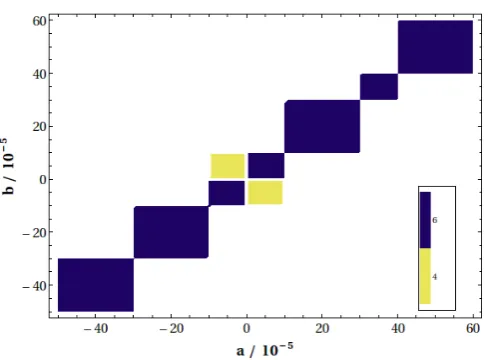
We can also solve this system using Cheater’s homotopy. For the range of values of a and b given in Figure 1 we find that there are either 6 solutions for a, b > 0 and a, b < 0 or 4 solutions for a < 0, b > 0 and a > 0, b < 0; these are indicated by different colors in Figure 1. We scan over a total of 100,150 parameter points and find a total of 582,676 solutions. Exactly half of the solutions are physical, i.e.
Figure 1. Scanned values for a and b for the one-modulus example in Sys1. The corre-sponding number of solutions of the system per parameter point is indicated by the color. The total number of parameter points is 100,150 and the spacing between the points is equidistant.
machine with 2.1GHz cloak speed). First, Bertini takes around 30 minutes to solve the system from scratch for a given parameter-point. This means that it would have taken around 5.731 years to solve the system at all the 100,150 parameter-points. With the CH method, however, we solved them in only 55 hours.
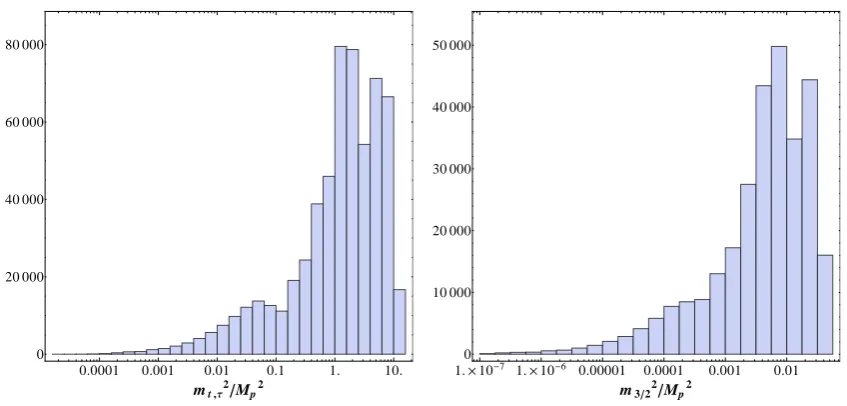
The scalar masses of the modulitandτ which can be calculated as the eigenvalues of the Hessian ofV are found to be positive for all parameter points witht >0. We give the moduli masses and the gravitino mass
m23/2 =eK|W|2, (4.7)
which determines the scale of supersymmetry breaking in Figure 2, which is a fre-quency plot of the mass values for our space of 100,150 parameters.
4.2 Sys2: A Two-Moduli Model
Now, let us move on to a model with two moduli fields. Consider the K¨ahler potential and superpotential
K =−3 log(T + ¯T)−log(S+ ¯S),
0.0001 0.001 0.01 0.1 1. 10. 0
20 000 40 000 60 000 80 000
mt ,Τ2Mp2
1.´10-7 1.´10-6 0.00001 0.0001 0.001 0.01 0
10 000 20 000 30 000 40 000 50 000
[image:18.595.89.513.79.282.2]m322Mp2
Figure 2. Masses of the moduli t and τ as eigenvalues of the Hessian (left) and the
gravitino mass (right) for the one-modulus model Sys1.
with two fields, a K¨ahler modulusT =t+iτ and the axio-dilatonS =s+iσ. Hence, using (4.1), the stationary equations to be solved are:
0 = (3a2(s−σ)(s+σ) + 6at(b(−s2+σ2) + 2cστ) + 2bcστ(t2−3τ2)
−b2(s−σ)(s+σ)(5t2−3τ2) +c2(5t2−3τ2)(t2+τ2)),
0 = (−9a2(s2+σ2) +b2(s2+σ2)(5t2−9τ2) + 2bcτ(σt2+ 18stτ −9στ2)
+c2(−5t4+ 2t2τ2−9τ4) + 6a(2b(s2+σ2)t+c(5st2+ 4σtτ −3sτ2))),
0 = (−(cσt(6a+bt)) + (6acs+ 3b2(s2+σ2)−18bcst−2c2t2)τ + 9bcστ2+ 6c2τ3),
0 = (3a2σ−6at(bσ+cτ) +b(−5bσt2 −ct2τ + 3bστ2+ 3cτ3)),
0 = 1−zts .
The first four equations arise from setting the numerators of the various partial derivatives of V to zero, and the last is an auxiliary equation to ensure that the denominator does not vanish. Therefore, this system is 5 equations in 5 variables with 3 parameters. Again, this is an example used in StringVacua, but a, b and c
are parameters that were chosen to be 1,−1,1 respectively in [26, 27]. Now, we can undertake the much more challenging task of taking a huge range of parameter-values in our computation.
Again, for generic choice of the values for a, b and c, it becomes difficult for the traditional GB method. However, we can compute the CGB for this system; The output from Singular of the CGB for this system is quite large, and, hence, we do not write it here.
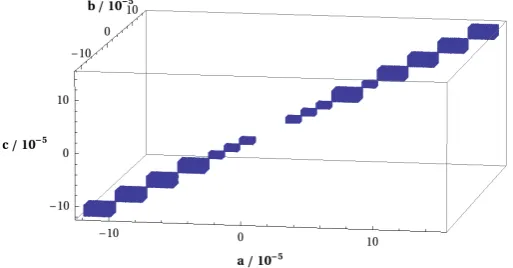
Figure 3. Scanned values for a and b and c for the two-moduli exampleSys2. The total number of parameter points is 100,672, and the spacing between the points is equidistant. The blue regions indicate that there are 6 solutions toSys2.
604,032 solutions. The physicality condition for the case of this model demands again
t >0 and also s=gs−1 >0, i.e. positive string coupling. This is fulfilled by 503,299 solutions. As for Sys1, we did our computation on a desktop machine. Bertini takes around 40 minutes to solve the system from scratch for a given parameter-point. Hence, for all the 100,672 parameter-points, it would have taken 7.682 years. How-ever, using the CH method, we solved them all in 125 hours. When evaluating the Hessian of V, we find that there is always at least one negative eigenvalue, i.e. no vacua exist for this model for the set of parameters we considered.
4.3 Sys3: The Quintic
An area of string phenomenology where one can make use of the power of Cheater’s homotopy is the landscape of flux vacua in type IIB string theory [12, 13, 15, 16]. As mentioned in Sys1, if one goes to a particular corner of the moduli space, the equations
DiW = 0 (4.9)
that determine the supersymmetric vacuum state of the no-scale scalar potential [75,
76]
V =eKKa¯bDaW DbW , (4.10)
are polynomial equations in the complex structure moduli fields φa =τ, U1, .., Uh2,1, where τ =σ+i s(= iS¯) is the axio-dilaton. The parameters of these equations are the flux integers
1 (2π)2α0
Z
Aa
F3 =f1a∈Z,
1 (2π)2α0
Z
Ba
F3 =f2a∈Z,
1 (2π)2α0
Z
Aa
H3 =h1a ∈Z,
1 (2π)2α0
Z
Ba
H3 =h2a∈Z,
where F3 and H3 are the RR and NS three-form flux of type IIB string theory, and
hAa, Bbi is a symplectic basis for the b3 = 2h2,1 + 2 three-cycles. The flux integers
are to be chosen freely as long as the D3 tadpole constraint
L= 1 (2π)4(α0)2
Z
X3
H3∧F3 =h1f2−h2f1 (4.12)
is not violated.
For supersymmetric flux configurations,F3andH3always combine into an
imaginary-self-dual (ISD) fluxG3 =F3 −τ H3 [12, 77], which can be written as [9]
∗6s H3 =−(F3−σH3). (4.13)
Consequently, one only has to consider 2h2,1+2 independent directions of the original 4h2,1+ 4 flux integers defining
H3 =
h1
h2
and F3 =
−h2
h1
, (4.14)
Then, the D3 tadpole eq. (4.12) manifests as a positive definite form, i.e.
L=h21+h22, (4.15)
for a symplectic basis of three-cycles. With this form of the D3 tadpole, we can use
Paramotopy to find all flux vacua, i.e. solutions to eq. (4.9) for all flux configurations
h1, h2 with D3 tadpole L < Lmax for a given maximal tadpole Lmax. We have to
take into account the SL(2,Z) invariance of IIB string theory in order to consider only physically equivalent flux configurations. It was shown in [78] that for fluxes of the form (4.14), only the configurations
h1 h2 ∼ = −h1
−h2
∼ =
−h2
h1 ∼ = h2
−h1
. (4.16)
are related by SL(2,Z), and hence physically equivalent.
This problem to find all supersymmetric flux vacua in the large complex structure limit was carried out for the compactification manifold CP411169[18] in [78] in the context of de Sitter model building in the K¨ahler uplifting scenario [79, 80]. To present a simple example, we consider the one complex structure modulus ψ of the mirror quintic which has h1,1 = 101 and h2,1 = 1. In the limit of large complex
structure, this describes the one moduli subspace of the quintic [81] given by the vanishing of the polynomial
x50 +x51+x52+x53+x54−5ψ x0x1x2x3x4, (4.17)
inCP411111with coordinatesx0, .., x4. To obtain a polynomial system let us introduce
the complex coordinateU =ν+i u which relates toψ as
U ' − 5
up to corrections of O(Uke2πiU) that are exponentially suppressed in the large com-plex structure limit Im(U)→ ∞. This moduli space can be described by an approx-imately polynomial prepotential in the large complex structure limit
G=ω02 −5 6 ω1 ω0 3 − 11 4 ω1 ω0 2 + 25 12 ω1 ω0
−25ζ(3)χ 2(2πi)3
!
, (4.19)
with χ= 2(h1,1−h2,1) = 200 and ωa and Gb are the periods
ωa =
Z
Aa
Ω, Gb =
Z
Bb
Ω. (4.20)
for a, b = 1,2 and Gb = ∂ωbG. ω0 can be interpreted as the normalization Ω of the
holomorphic three-form, such that the one physical variable isU =ω1/ω0. Eq. (4.19)
is valid up to corrections O(e2πikU) that are exponentially small in the limit of the
large complex structure. We define the large complex structure limit as Im(U) >2 such that these corrections to G are smaller than 10−3G.4
Together with the axio-dilaton, τ this yields a two moduli example described by the K¨ahler potential and superpotential
K =Kk−log
−i
Z
X3
Ω(U)∧Ω( ¯¯ U)
−log (−i(τ −τ¯)) ,
=−log i
2
X
a=1
(¯ωaGa−ωaG¯a)
!
−log (−i(τ −τ¯)) ,
W0 =
1 2π
Z
X3
(F3−τ H3)∧Ω(U),
= 2π
2
X
a=1
[(f1a−τ h1a)Ga−(f2a−τ h2a)Ua] ,
(4.21)
where Kk is the K¨ahler potential of the K¨ahler moduli and setting α0 = 1.
We solve eqs. (4.9) for (4.21) up to a maximal tadpole of Lmax = 625. This
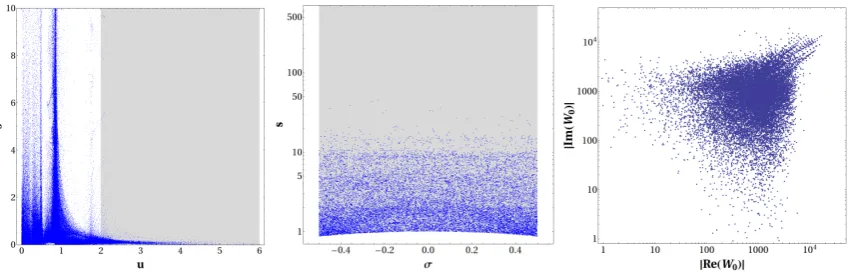
corresponds to 481,825 flux parameter points for which we find a total of 1,726,334 solutions, i.e. on average ∼ 3.6 solutions per parameter point. Only 20,280 are physical solutions, i.e. g−s1 = s > 0 and u > 2, see Figure 4. If we were to solve it at each parameter-point from scratch, then it takes 72 minutes per parameter-point. This means that for total 481,825 parameter-points that we solved the system for, we would have taken 481,825×72/60 = 578,190 hours. But instead, usingParamotopy, we solved all of them in only 3776 hours, i.e., around 26.4 human hours with a cluster of 144 processors. We could not obtain the CGB for this system in a reasonable time.
4Note that there is a conifold singularity at ψ5 = 1 that is excluded from the large complex
Figure 4. Left: Distribution of all algebraic solutions to eq. (4.9) with s > 0 and u > 0 for the K¨ahler potential and superpotential (4.21) inSys3. The gray shaded area indicates the space of physical solutions, i.e. s >0 and u >2. Middle: Distribution of the dilaton τ =σ+i s. Right: Distribution of the superpotential W0.
We can make use of the SL(2,Z) symmetry of IIB string theory, to transform each solution to the fundamental domain
− 1
2 ≤Re(τ)≤ 1
2 and |τ|>1, (4.22)
via the successive transformations
τ0 =τ+b , W00 =W0, and τ0 =−1/τ , W00 =W0/τ (4.23)
with b ∈ Z. We show the distribution of the obtained values for τ = σ +i s and the flux superpotentialW0 in Figure 4. We see that the the strongly coupled region
s= 1/gs ∼1 is preferred and values of W0 ∼ O(102−103) are preferred. The same
qualitative behavior was observed in [78] for the manifoldCP411169[18].
Finally, we give the masses m2 of the moduli t, τ, s and σ and the gravitino mass
m2
3/2 in Figure 5. For this, we have to specify the value of the K¨ahler moduli
K¨ahler potential in eq. (4.21). For a Calabi-Yau compactification, this is given as
Kk=−2 logV, whereV is the volume modulus of the Calabi-Yau and its vacuum
ex-pectation value depends on the stabilization mechanism of the K¨ahler moduli. Here we choose V = 100 in string units for definiteness.
4.4 Further Applications: Sys4
1.´10-60.00001 0.0001 0.001 0.01 0.1 1. 0
2000 4000 6000 8000
m2Mp2
0.001 0.01 0.1 1. 0
500 1000 1500 2000
m322Mp2
Figure 5. For Sys3 ((4.9) and (4.21)), the distribution of the masses m2 of the moduli
t, τ, s and σ, i.e. all eigenvalues of the Hessian of V (left) and the gravitino mass m23/2 (right) in units ofMP2 forV = 100.
For concreteness and continuing along the vein ofSys3, let us focus on the problem of finding the singular locus (or the absence thereof) given a family of quintics.5
Let us consider the family of quintic manifolds given by as a homogeneous hyper-surface in CP4 with coordinates x0, . . . , x4, and let
Q(x0, . . . , x4;a, b, c) =x50+x 5 1+x
5 2+x
5 3+x
5
4+ax0x1x2x3x4+bx40x1+cx31x2x3, (4.24)
where a, b, c are complex parameters. Of course, the most general family of quintics has 101 deformation parameters corresponding to h2,1 of the manifold, but this
ex-ample suffices to show the power of the method. Now, for b = c = 0, we have the one most familiar to us, with a=−5 being the conifold point in the complex struc-ture moduli space. The singular locus of Q is given by the Jacobian ideal h∂xiQi
for i = 0, . . . ,4, excluding the origin and defined up to scaling of the projective coordinates.
It is more convenient to work over affine patches of CP4 which can be rescaled to
be Pi ={xi = 1} for i= 0, . . . ,4. For each of the five patches, we compute the four
remaining partial derivatives, the solution of which is then the system we need to analyze. That is, we need to perform Paramotopy on
∂xj6=iQ(xi = 1;a, b, c) = 0 , i= 0, . . . ,4 . (4.25)
5Recently there has been much activity in study the database of so-called complete intersection
Calabi-Yau (CICY) manifolds of which the quintic is the simplest example as well their smooth quotients. Checking smoothness for models with this database of 7890 Calabi-Yau threefolds and
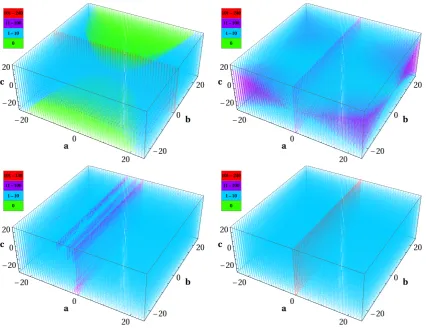
Figure 6. The number of solutions at each parameter point {a, b, c} for system P0 (top
left), P1 (top right), P2 and P3 (bottom left) and P4 (bottom right) indicated by the
different colors.
All of the 5 systems are of the same size and we take a, b, c∈[−25,25] in increments of one, i.e. 513 = 132,651 parameter points. Bertini takes from 144 to 223 seconds
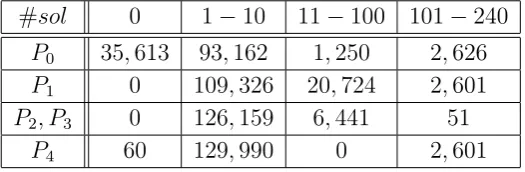
at a parameter-point if solved from scratch, hence it would have taken from 0.6057 to 0.938854 years for all 132651 parameter-points. Paramotopy solved each of these systems for all parameter-points in from 19.216 to 92.9002 hours (using 72 processors, it took 960.812 to 4645.01 seconds). Obtaining the CGB for this system is quite fast as well; however, obtaining the solutions for each parameter-point from the CGB takes the same amount of time as Paramotopy. Hence, we show the results only obtained from Paramotopy here. We show the number of solutions per parameter point indicated by the different colors in Figure 6 and Table 1. The solution space of the systemsP2 and P3 is identical since eq. (4.24) is invariant under x2 ↔x3.
5
Conclusion and Outlook
#sol 0 1−10 11−100 101−240
P0 35,613 93,162 1,250 2,626
P1 0 109,326 20,724 2,601
P2, P3 0 126,159 6,441 51
[image:25.595.167.430.84.170.2]P4 60 129,990 0 2,601
Table 1. Distributions of the number of solutions #sol for the five systems Pi.
addition to the non-linearity of the equations as one has to solve the system many times. In the present paper, we have demonstrated that two of the sophisticated algebraic geometry methods can solve such systems very efficiently provided that the nonlinearity is polynomial-like.
The first method is the Comprehensive Gr¨obner basis (CGB) which is a symbolic method based on Gr¨obner bases. Given a (non-parametric) system of equations, we can systematically find another system of equations which has the same solution space as the original one and is easier to solve, called a Gr¨obner basis. If we have a parametric system of equations, then we can compute the CGB which is a Gr¨obner basis for all values of the parameters including their special values. To obtain the solutions of the system at a specific parameter-point, one then needs to input the values of the parameters in the CGB and solve the system using the traditional methods. However, the algorithmic complexity to compute the CGB is the same, or in many cases even worse, as the Gr¨obner basis method, i.e., the memory required by the algorithm blows up exponentially with increasing number of variables, equations, monomials, and degree. Moreover, the related algorithm is highly sequential and unparallelizable. Hence, though the CGB method is extremely useful in the cases where we can finish the computation, but for many physical systems the method often falls short.
The second method we described in this paper is called the cheater’s homo-topy. Here, one first solves the given parametric system of polynomial equations at a generic parameter-point because it is shown that the number of solutions at such a parameter-point is an upper bound on the number of solutions at any other parameter-points. Then, one tracks solution-paths from the solutions at the generic parameter-point to the ones at which the system needs to be solved using the numeri-cal polynomial homotopy continuation method. This method is highly parallelizable, and, hence, we can solve the system at thousands of parameter-points in a short time on a computer cluster. We use a package calledParamotopywhich is not only a highly efficient implementation of the related algorithm, but also does data and memory management effectively. These features allow for a huge number of parameter-points to be solved simultaneously.
stabiliza-tion in string phenomenology. However, obtaining the solustabiliza-tions for each parameter-point from the CGB (for the cases it is possible to obtain the CGB) takes the same amount of time as Paramotopy; hence, we show the results only obtained from the cheater’s homotopy in this paper.
The examples are given as a 4D N = 1 effective supergravity scalar potential, defined by a K¨ahler potential K and a superpotential W. Our first two examples
Sys1 and Sys2 are toy models of one and two complex scalar fields, respectively. We looked for stationary points of these scalar potentials for ∼ 105 parameter points, finding half of the stationary points are vacua in the case ofSys1 and finding no vacua in the case of Sys2, i.e., at least one tachyonic direction always exists. Finally, we looked at flux compactifications on a realistic Calabi-Yau, the quintic in the case of two moduli. We look for flux vacua for∼5·105 flux configurations, which
corresponds to a maximal D3 tadpole ofL= 625. Our results indicate preferences of strongly coupled vacua gs &1 and values of the superpotential W0 ∼ O(102−103).
The applicability of the methods described here is, of course, much wider and is in-tended for any large parametric polynomial systems, with the parameters appearing explicitly as coefficients. Indeed, these methods should provide an extremely pow-erful tool for many areas in theoretical physics such as potential energy landscape, statistical mechanics, particle phenomenology, string phenomenology, and non-linear dynamics. As an illustration, we have applied Cheater’s homotopy to the geometry of Calabi-Yau manifolds in the case of Sys4.
If we were to solve Sys1, Sys2, the quintic, and the Calabi-Yau systems from scratch for each parameter-point using the numerical homotopy continuation method, a single processor machine would have taken 5.731 years, 7.682 years, 66.003 years, and 0.6057-0.938854 years, respectively. But using the cheater’s homotopy method we solved them in 55 hours, 125 hours, 3776 hours and 19.216-92.9002 hours, respec-tively. This is a drastic reduction of the computational efforts, see also Table 2.
System Number of parameter points single-processor Cheater’s homotopy
Sys1 100,150 5.731 yr 55 h
Sys2 100,672 7.682 yr 125 h
Sys3 481,825 66.003 yr 3776 h
Sys4 132,651 0.6−0.9 yr 19.2−92.9 h
Table 2. Number of parameter points and computation time for the examples under
consideration.
and variables defined over reals. Indeed, a more recent method exists from symbolic real algebraic geometry, based on the discriminant varieties [50, 51], which treats both variables and parameters as reals from the beginning and gives a different set of information than the methods described in this paper. This certainly constitutes a direction worthy of pursuit. On the numerical side, little progress exists in this direction, and so far methods exist to extract only limited information out for the whole parameter space. For example, in Ref. [85], a numerical method is proposed which can tell us the maximum and minimum number of real solutions over the whole parameter-space. It is our hope that the applications in this paper will also become a motivation to develop such methods and making them more for real-life applications.
Acknowledgements
DM would like to thank the U.S. Department of Energy for their support under con-tract no. DE-FG02-85ER40237; to Tianran Chen and Tim McCoy for their helpful remarks on this work; and to the entire Bertini, PHCpack and HOM4PS2 groups for their continuous support in this project. A major part of this paper is based on DM’s PhD thesis. MN wishes to thank the NSF for their partial support under grant DMS-1025564. YHH would like to thank the Science and Technology Facilities Council, UK, for an Advanced Fellowship and grant ST/J00037X/1, the Chinese Ministry of Education, for a Chang-Jiang Chair Professorship at NanKai University, the U.S. National Science Foundation for grant CCF-1048082, as well as City Uni-versity, London and Merton College, Oxford, for their enduring support. MR would like to thank Alexander Westphal for helpful discussions.
References
[1] D. Wales, Energy Landscapes : Applications to Clusters, Biomolecules and Glasses (Cambridge Molecular Science). Cambridge University Press, January, 2004.
[2] D. J. Wales, The energy landscape as a unifying theme in molecular science,Phil. Trans. Roy. Soc. A 363(2005) 357–377.
[3] D. J. Wales, Energy landscapes: Calculating pathways and rates,Int. Rev. Phys. Chem. 25(2006) 237–282.
[4] D. J. Wales and T. V. Bogdan, Potential energy and free energy landscapes.,J. Phys. Chem. B 110 (2006) 20765–20776.
[5] T. F. Middleton and D. J. Wales, Energy landscapes of model glasses. ii. results for constant pressure,J. Chem. Phys. 118 (2003) 4583–4593.
[7] K. Binder and A. Young, Spin glasses: Experimental facts, theoretical concepts, and open questions,Reviews of Modern physics58 (1986), no. 4 801.
[8] M. Kastner, Phase transitions and configuration space topology,Rev. Mod. Phys.80 (2008), no. 1 167–187.
[9] L. E. Ibanez and A. M. Uranga,String theory and particle physics: An introduction to string phenomenology, .
[10] K. Dasgupta, G. Rajesh, and S. Sethi,M theory, orientifolds and G - flux,JHEP
9908(1999) 023, [hep-th/9908088].
[11] J. McOrist and S. Sethi,M-theory and Type IIA Flux Compactifications,JHEP
1212(2012) 122, [arXiv:1208.0261].
[12] S. B. Giddings, S. Kachru, and J. Polchinski,Hierarchies from fluxes in string compactifications,Phys.Rev. D66 (2002) 106006, [hep-th/0105097].
[13] M. R. Douglas and S. Kachru,Flux compactification,Rev.Mod.Phys.79(2007) 733–796, [hep-th/0610102].
[14] D. Marsh, L. McAllister, and T. Wrase,The Wasteland of Random Supergravities,
JHEP 1203(2012) 102, [arXiv:1112.3034].
[15] M. Grana, Flux compactifications in string theory: A Comprehensive review,
Phys.Rept.423 (2006) 91–158, [hep-th/0509003].
[16] R. Blumenhagen, B. Kors, D. Lust, and S. Stieberger,Four-dimensional String Compactifications with D-Branes, Orientifolds and Fluxes,Phys.Rept.445(2007) 1–193, [hep-th/0610327].
[17] D. J. Wales,Basins of attraction for stationary-points on a potential-energy surface,
J. Chem. Soc. Faraday Trans. 88(1992) 653–657.
[18] D. J. Wales,Locating stationary-points for clusters in cartesian coordinates,J. Chem. Soc. Faraday Trans.89(1993) 1305–1313.
[19] K. Broderix, K. Bhattacharya, A. Cavagna, A. Zippelius, and I. Giardina,Energy landscape of a lennard-jones liquid: statistics of stationary points,Physical review letters85 (2000), no. 25 5360–5363.
[20] J. Doye and D. Wales,Saddle points and dynamics of lennard-jones clusters, solids and supercooled liquids,arXiv preprint cond-mat/0108310(2001).
[21] D. Wales and J. Doye,Stationary points and dynamics in high-dimensional systems,
The Journal of chemical physics 119 (2003) 12409.
[22] J. Gray, Y.-H. He, A. Ilderton, and A. Lukas, A New Method for Finding Vacua in String Phenomenology,JHEP 0707(2007) 023.
[23] Yang-Hui He, Philip Candelas, Amihay Hanany, Andre Lukas and Burt Ovrut, Ed.,
[24] J. Gray, Y.-H. He, V. Jejjala, and B. D. Nelson,Exploring the vacuum geometry of N=1 gauge theories,Nucl.Phys.B750(2006) 1–27, [hep-th/0604208].
[25] J. Gray, A. Hanany, Y.-H. He, V. Jejjala, and N. Mekareeya,SQCD: A Geometric Apercu,JHEP0805(2008) 099, [arXiv:0803.4257].
[26] J. Gray, A Simple Introduction to Grobner Basis Methods in String Phenomenology,
Adv.High Energy Phys. 2011(2011) 217035, [arXiv:0901.1662].
[27] J. Gray, Y.-H. He, and A. Lukas, Algorithmic Algebraic Geometry and Flux Vacua,
JHEP 0609(2006) 031, [hep-th/0606122].
[28] J. Gray, Y.-H. He, A. Ilderton, and A. Lukas, STRINGVACUA: A Mathematica Package for Studying Vacuum Configurations in String Phenomenology,Comput. Phys. Commun.180 (2009) 107–119.
[29] W. Decker, G.-M. Greuel, G. Pfister, and H. Sch¨onemann, Singular 3-1-3 — A
computer algebra system for polynomial computations, . http://www.singular.uni-kl.de.
[30] D. Mehta,Lattice vs. Continuum: Landau Gauge Fixing and ’t Hooft-Polyakov Monopoles,Ph.D. Thesis, The Uni. of Adelaide, Australasian Digital Theses Program (2009).
[31] D. Mehta, A. Sternbeck, L. von Smekal, and A. G. Williams,Lattice Landau Gauge and Algebraic Geometry,PoSQCD-TNT09 (2009) 025, [arXiv:0912.0450].
[32] C. Hughes, D. Mehta, and J.-I. Skullerud,Enumerating Gribov copies on the lattice, arXiv:1203.4847.
[33] D. Mehta,Finding All the Stationary Points of a Potential Energy Landscape via Numerical Polynomial Homotopy Continuation Method,Phys.Rev. E (R) 84 (2011) 025702, [arXiv:1104.5497].
[34] M. Kastner and D. Mehta,Phase Transitions Detached from Stationary Points of the Energy Landscape,Phys.Rev.Lett.107 (2011) 160602, [arXiv:1108.2345].
[35] D. Mehta, J. D. Hauenstein, and M. Kastner,Energy landscape analysis of the two-dimensional nearest-neighbor φ4 model,Phys.Rev.E85 (2012) 061103, [arXiv:1202.3320].
[36] R. Nerattini, M. Kastner, D. Mehta, and L. Casetti, Exploring the energy landscape of XY models,arXiv:1211.4800.
[37] M. Maniatis and D. Mehta, Minimizing Higgs Potentials via Numerical Polynomial Homotopy Continuation,Eur.Phys.J.Plus 127 (2012) 91, [arXiv:1203.0409].
[38] J. Camargo-Molina, B. O’Leary, W. Porod, and F. Staub,The Stability Of R-Parity In Supersymmetric Models Extended By U(1)B−L,arXiv:1212.4146.
[39] D. Mehta,Numerical Polynomial Homotopy Continuation Method and String Vacua,
Adv.High Energy Phys. 2011(2011) 263937, [arXiv:1108.1201].
Perspective on String and Gauge Theories,JHEP1207(2012) 018, [arXiv:1203.4235].
[41] J. Hauenstein, Y.-H. He, and D. Mehta,Numerical Analyses on Moduli Space of Vacua,arXiv:1210.6038.
[42] D. J. Wales,A microscopic basis for the global appearance of energy landscapes,
Science293 (2001) 2067–2069.
[43] D. J. Wales,Highlights: Energy landscapes of clusters bound by short-ranged potentials,ChemPhysChem11 (2010) 2491–2494.
[44] D. J. Wales, J. P. K. Doye, and D. J. Wales,Energy landscapes of colloidal clusters: Thermodynamics and rearrangement mechanisms,Nanoscale4 (2012) 1085 – 1100.
[45] D. J. Wales,Decoding the energy landscape: Extracting structure, dynamics and thermodynamics,Phil. Trans. Roy. Soc. A370 (2012) 2877–2899.
[46] L. von Smekal, D. Mehta, A. Sternbeck, and A. G. Williams,Modified Lattice Landau Gauge,PoSLAT2007 (2007) 382.
[47] L. von Smekal, A. Jorkowski, D. Mehta, and A. Sternbeck,Lattice Landau gauge via Stereographic Projection,PoS CONFINEMENT8(2008) 048, [arXiv:0812.2992].
[48] T. Li, T. Sauer, and J. Yorke, The cheater’s homotopy: an efficient procedure for solving systems of polynomial equations,SIAM Journal on Numerical Analysis26 (1989), no. 5 1241–1251.
[49] D. J. Bates, D. A. Brake, and M. E. Niemerg.,Paramotopy: Parameter homotopies in parallel.,in preparation (2012).
[50] W. Hanan, D. Mehta, G. Moroz, and S. Pouryahya,Stability and bifurcation analysis of coupled fitzhugh-nagumo oscillators,arXiv preprint arXiv:1001.5420 (2010).
[51] E. Hernandez-Vargas, D. Mehta, and R. Middleton,Towards modeling hiv long term behavior,arXiv preprint arXiv:1105.2823 (2011).
[52] D. A. Cox, J. Little, and D. O’Shea,Ideals, Varieties, and Algorithms: An
Introduction to Computational Algebraic Geometry and Commutative Algebra, 3/e (Undergraduate Texts in Mathematics). Springer-Verlag New York, Inc., Secaucus, NJ, USA, 2007.
[53] J. C. Faug`ere, A new efficient algorithm for computing groebner bases (f4), in
Journal of Pure and Applied Algebra, pp. 75–83, ACM Press, 1999.
[54] J. C. Faug`ere, A new efficient algorithm for computing gr¨obner bases without reduction to zero (f5), inISSAC ’02: Proceedings of the 2002 international symposium on Symbolic and algebraic computation, (New York, NY, USA), pp. 75–83, ACM, 2002.
[55] V. P. Gerdt,Involutive Algorithms for Computing Groebner Bases,ArXiv Mathematics e-prints(Jan., 2005) [math/0501].
Available at http://cocoa.dima.unige.it.
[57] D. R. Grayson and M. E. Stillman, “Macaulay2, a software system for research in algebraic geometry.” Available at http://www.math.uiuc.edu/Macaulay2/.
[58] W. Bosma, J. Cannon, and C. Playoust,The magma algebra system i: the user language,J. Symb. Comput.24 (1997), no. 3-4 235–265.
[59] V. Weispfenning,Comprehensive gr¨obner bases,Journal of Symbolic Computation
14(1992), no. 1 1–29.
[60] D. A. Cox, J. Little, and D. O’Shea,Using Algebraic Geometry. Springer-Verlag New York, Inc., Secaucus, NJ, USA, 1998.
[61] A. J. Sommese and C. W. Wampler,The numerical solution of systems of polynomials arising in Engineering and Science. World Scientific Publishing Company, 2005.
[62] A. Montes,A new algorithm for discussing gr¨obner bases with parameters,Journal of Symbolic Computation33 (2002), no. 2 183–208.
[63] A. Suzuki and Y. Sato,An alternative approach to comprehensive gr¨obner bases,
Journal of Symbolic Computation 36(2003), no. 3 649–667.
[64] D. Kapur, Y. Sun, and D. Wang,An efficient method for computing comprehensive gr¨obner bases,Journal of Symbolic Computation(2012).
[65] T. Y. Li,Solving polynomial systems by the homotopy continuation method,
Handbook of numerical analysisXI (2003) 209–304.
[66] D. J. Bates, J. D. Hauenstein, A. J. Sommese, and C. W. Wampler, “Bertini: Software for numerical algebraic geometry.” Available at
http://www.nd.edu/∼sommese/bertini.
[67] J. Verschelde, Algorithm 795: Phcpack: a general-purpose solver for polynomial systems by homotopy continuation,ACM Trans. Math. Soft. 25(1999), no. 2 251–276.
[68] A. P. Morgan, A. J. Sommese, and L. T. Watson,Finding all isolated solutions to polynomial systems using hompack,ACM Trans. Math. Softw. 15(1989), no. 2 93–122.
[69] T. Gao, T. Y. Li, and M. Wu,Algorithm 846: Mixedvol: a software package for mixed-volume computation,ACM Trans. Math. Softw. 31(2005), no. 4 555–560.
[70] T. L. Lee, T. Y. Li, and C. H. Tsai, Hom4ps-2.0, a software package for solving polynomial systems by the polyhedral homotopy continuation method,Computing83 (2008) 109–133.
[71] D. N. Bernstein,The number of roots of a system of equations,Funkts. Anal. Pril.9 (1975) 1–4.
[73] A. G. Kushnirenko,Newton polytopes and the bezout theorem,Funkts. Anal. Pril. 10 (1976), no. 3.
[74] J. Wess and J. Bagger, Supersymmetry and supergravity, . Princeton Univ. Press, 259p.
[75] E. Cremmer, S. Ferrara, C. Kounnas, and D. V. Nanopoulos,Naturally Vanishing Cosmological Constant in N=1 Supergravity,Phys.Lett. B133(1983) 61.
[76] J. R. Ellis, A. Lahanas, D. V. Nanopoulos, and K. Tamvakis,No-Scale Supersymmetric Standard Model,Phys.Lett. B134(1984) 429.
[77] F. Denef and M. R. Douglas,Distributions of flux vacua,JHEP 0405(2004) 072, [hep-th/0404116].
[78] D. Martinez-Pedrera, D. Mehta, M. Rummel, and A. Westphal,Finding all flux vacua in an explicit example,arXiv:1212.4530.
[79] M. Rummel and A. Westphal,A sufficient condition for de Sitter vacua in type IIB string theory,JHEP 1201(2012) 020, [arXiv:1107.2115].
[80] J. Louis, M. Rummel, R. Valandro, and A. Westphal,Building an explicit de Sitter,
JHEP 1210(2012) 163, [arXiv:1208.3208].
[81] P. Candelas, X. C. De La Ossa, P. S. Green, and L. Parkes,A Pair of Calabi-Yau manifolds as an exactly soluble superconformal theory,Nucl.Phys.B359(1991) 21–74.
[82] P. Candelas, A. Dale, C. Lutken, and R. Schimmrigk, Complete Intersection Calabi-Yau Manifolds,Nucl.Phys.B298(1988) 493.
[83] L. B. Anderson, Y.-H. He, and A. Lukas, Heterotic Compactification, An Algorithmic Approach,JHEP 0707(2007) 049, [hep-th/0702210].
[84] V. Braun, On Free Quotients of Complete Intersection Calabi-Yau Manifolds,JHEP
1104(2011) 005, [arXiv:1003.3235].
[85] Z. A. Griffin and J. D. Hauenstein, Real solutions to systems of polynomial equations and parameter continuation,