HALFWAY THERE? TAKING STOCK
OF THE PROGRESS OF ESIF
PROGRAMME IMPLEMENTATION
IQ-Net Review Paper 41(1)
Rona Michie and Viktoriya Dozhdeva
European Policies Research Centre Delft Technical University Delft
Postbus 5 2600 AA Delft
Netherlands
Tel: +44 (0) 141 548 3672
The IQ-Net Network promotes exchange of experience on the management and implementation of Structural Funds programmes among managing authorities and intermediate bodies. The network is managed by the European Policies Research Centre Delft under the direction of Professor John Bachtler, Stefan Kah and Dr Laura Polverari. The research for this paper was undertaken by EPRC in preparation for the 43rd IQ-Net meeting held in Zagreb, Croatia on 6-8 December 2017. The paper was written by Rona Michie and Viktoriya Dozhdeva.
The paper is the product of desk research and fieldwork visits during autumn 2017 to national and regional authorities in EU Member States (notably partners in the IQ-Net Consortium). The field research team comprised:
Stefan Kah (Austria, Slovenia)
Dr Arno van der Zwet (Belgium)
Dr Vinko Muštra (Croatia)
Dr Marie Feřtrová (Czech Republic)
Philip Vernon (Denmark)
Kaisa Granqvist (Finland)
Fabian Gal (France)
Dr Sara Davies (Germany)
Dr Eleftherios Antonopoulos (Greece)
Dr Martin Ferry (Poland)
Dr Carlos Mendez (Spain)
Viktoriya Dozhdeva (Portugal)
Dr Martin Plešivčák (Slovakia)
Dr Irene McMaster and Heidi Vironen (Sweden)
Rona Michie (United Kingdom)
EPRC thanks all those respondents from national and regional authorities and other organisations who participated in the research. EPRC also gratefully acknowledges the financial support provided by participating Member States and regions, whose contributions are partly co-financed by Technical Assistance from the Structural Funds. The authors would also like to thank Dr Martin Ferry for his help in drafting the section on closure of the 2007-13 programmes, and Phil Vernon for his help with developing the tables in Sections 1 and 3.
The partners in the IQ-Net network are as follows:
Austria
ÖROK Secretariat
Belgium
Enterprise Agency Flanders
Croatia
Ministry of Regional Development & EU Funds
Czech Republic
Ministry of Regional Development
Denmark
Danish Business Authority
Finland
France
Commissariat Général à l'Égalité des Territoires (CGET)
Germany
Nordrhein-Westfalen (North Rhine-Westphalia), Ministry for Economic Affairs, Innovation, Digitalization and Energy
Greece
Management Organisation Unit of Development Programmes S.A.
Poland
Marshal Office of the Pomorskie Region
Portugal
Agency for Development and Cohesion (ADC)
Spain
Provincial Council of Bizkaia, País Vasco (Basque Country)
Slovakia
Central Coordination Body (Office of the Deputy Prime Minister for Investments and Informatization
Slovenia
Government Office for Development and European Cohesion Policy
Sweden
Swedish Agency for Economic and Regional Growth (Tillväxtverket)
United Kingdom
Department of Communities and Local Government
Scottish Government
Welsh European Funding Office
For further information about IQ-Net, and access to the full series of IQ-Net Papers, please visit the IQ-Net website at: http://www.eprc.strath.ac.uk/iqnet/
To cite this paper, please use the following: Michie R and Dozhdeva V (2017) Halfway there? Taking stock of ESIF programme implementation, IQ-Net Review Paper 41(1), European Policies Research Centre.
Disclaimer
Halfway there? Taking stock of ESIF programme
implementation
TABLE
OF
CONTENTS
EXECUTIVE SUMMARY ... 1
1. INTRODUCTION ... 3
2. PROGRESS: COMMITMENT AND PAYMENT RATES ... 3
2.1 Commitment rates ... 3
2.2 Payment rates ... 7
2.3 The level of application of decommitment - an open question? ... 11
3. CURRENT PROGRAMMING ISSUES ... 12
3.1 Domestic changes with an impact on ESIF programmes ... 12
3.2 Ex ante conditionalities almost all resolved ... 14
3.3 Programme evolution – a continual process? ... 14
3.4 Short and longer-term priorities….the next six months at a glance ... 16
4. PROJECT GENERATION AND SELECTION ... 18
4.1 Project generation issues ... 18
4.2 New regulatory requirements still being embedded ... 19
5. NEW DEVELOPMENTS IN IMPLEMENTATION SYTEMS ... 20
5.1 Divided opinion anti-fraud measures ... 20
5.2 Financial instruments – have ambitions been met? ... 22
5.3 Varied progress on implementing new territorial approaches ... 25
5.4 Intensified evaluation activity ... 28
5.5 Progress Reports – too constraining? ... 29
5.6 Omnibus proposals still in trilogues… ... 30
5.7 Other ongoing operational issues ... 31
6. CLOSURE OF THE 2007-13 PROGRAMMES ... 32
6.1 Closure process ... 32
6.2 Commission feedback ... 32
6.3 Looking forward ... 33
7. POST-2020 ISSUES ... 34
7.1 State of discussion ... 34
7.2 Positions of Member States and regions ... 36
ANNEX 1: PROGRESS WITH FINANCIAL INSTRUMENTS IN THE IQ-NET PROGRAMMES IN 2014-20 ... 41
COUNTRY/PROGRAMME ABBREVIATIONS
Country Abbreviation
Austria AT
Belgium BE
Belgium (Vlaanderen) Vla
Croatia HR
Czech Republic CZ
Czech Republic (Integrated Regional Operational Programme) CZ IROP
Denmark DK
Finland FI
France FR
Germany DE
Germany (Nordrhein-Westfalen) NRW
Greece EL
Poland PL
Poland (Pomorskie) Pom
Portugal PT
Slovakia SK
Slovenia SI
Spain ES
Spain (País Vasco (Bizkaia)) Biz
Sweden SE
United Kingdom UK
United Kingdom (England) Eng
United Kingdom (Scotland) Sco
EXECUTIVE SUMMARY
Steady progress, following a sharp increase in commitment figures in 2016, has characterised ESIF implementation over the period.
Despite substantial progress since the last review period, commitment rates were generally higher in a comparable time span in 2007-13. The EU28 average amounts to 38.7 percent of total allocations, with the IQ-Net average reflecting similar growth dynamics. The IQ-Net average
payment rate continues to be higher than that of EU28 (12.7 percent against 11.3 percent), with levels exceeding 10 percent for seven IQ-Net partners. Interim EU payment rates, while overall significantly lower, demonstrate a similar pattern, with the IQ-Net average exceeding that of EU28 (6.2 percent against 5.4 percent).
At the same time, feedback on project generation within IQ-Net programmes is mostly positive. Strong project pipelines and good responses to issued calls have been reported in many cases, although challenges are noted related to regulatory requirements and the preparation of project documentation for large/major projects.
Success of implementation appears significantly related to the presence of previous experience; implementation difficulties often emerge in new thematic areas.
While the economic and political context for ESIF has been relatively stable in most cases, domestic changes have ranged from profound institutional reforms to completion of IB designation and changes to the Cohesion policy financial envelopes. Setting or improving conditions for faster implementation has remained an important priority.
The revision of OPs has been a continual and ongoing process, with almost all IQ-Net programmes either having already made programme changes this year or still planning the required revisions. Programme changes range from relatively minor to more fundamental and systematic.
As a result of the additional allocations provided through the Youth Employment Initiative in eligible Member States, work is undergoing on the reprogramming in an effort to free already engaged ESF resources.
In addition to changes related to the Performance Framework, many planned and implemented reallocations reflect strategic shifts and contextual changes.
In the short term, many programme managers are concentrating on meeting n+3 at the end of 2017. In the medium term, meeting the milestones for the Performance Framework and review are an important priority. Accelerating implementation, including ensuring that the positive dynamics in areas with a faster start become viral and are extended to all areas, remains high on the agenda.
New regulatory requirements are still being embedded in the ESIF implementation systems and arrangements. Some continue to cause difficulties, including the implementation of the new rules relating to financial instruments, introduction of simplified costs options, indicator reporting requirements, the e-cohesion process or stricter interpretation of State aid rules.
The scope of use of financial instruments has substantially expanded in the current programme period, with significant increases in allocations. Implementation of FIs has not been without difficulties, with the rules around the selection of implementing bodies and mobilisation of financial intermediaries being particularly problematic. In thematic terms, SME support and low-carbon are the areas with the largest proportion of OP allocations to FIs; previous experience appears an important factor in speedy FI implementation.
Implementation of the new territorial approaches is progressing at a varying pace. Implementation of sustainable urban development tools, although progressing well in several IQ-Net countries, has in some cases been associated with increases in administrative complexity and additional layering due to the governance re-arrangements required. The pace of ITI implementation also varies, with similar issues noted, including the complexity and protraction of the preparation and decision process and insufficient institutional capacity. CLLD implementation dynamics range from strategy finalisation to project approval, although on the whole, the process has also been rather protracted.
Evaluation activity has been intensifying, with minor adjustments to evaluation plans often seeking to adjust the initially foreseen timetables or rethink the focus of selected evaluations in order to reflect the dynamics of implementation and evolving evaluation needs and opportunities.
All Progress Reports were submitted by IQ-Net countries on time. Some found the preparation process to be a very positive experience, allowing a strategic and comprehensive overview of implementation progress. For others, the benefit was felt to be more limited, including due to the restricted space and belated provision of the template by the Commission.
With the Commission’s 2016 ‘Omnibus’ proposals not yet adopted, trilogues are ongoing. While a positive view is held by most IQ-Net programme managers with regards to the proposed simplifications or changes regarding small scale infrastructure, there is some frustration over the negotiation process along with concerns about the potential imposition of new obligations stemming from the proposed changes or lack of clarity with regards to specific issues.
The closure process overall appears to have gone satisfactorily for most IQ-Net programmes, despite some challenges, mostly related to the complexity and length of the process. At the same time, administrative capacity and governance approaches of programme authorities appeared to have been major factors determining the efficiency of the process.
1. INTRODUCTION
More than halfway through the 2014-20 programme period, the current set of ESIF programmes are well underway despite a slow start. 2017 has provided Member States with the opportunity to take a strategic look at the progress of implementation so far with the submission of their Progress Reports. The designation process has been completed for most programmes. Adoption of the Omnibus proposals is potentially anticipated by the start of 2018, especially relevant in the context of the ongoing debate on simplification. At the same time, 2017 has seen the submission of final implementation reports and closure packages for the 2007-13 programmes. Looking to the future, the debate on post-2020 reform has intensified, supported by the publication of the Commission’s Seventh Cohesion Report.
The aim of this paper is to provide a review of progress in implementing ESIF programmes in IQ-Net countries and regions over the last six months. The paper starts by reviewing the latest financial data on commitments and payments. It then examines current programming issues, including contextual changes with an impact on ESIF implementation and planned and accomplished changes to programmes. The next section discusses the dynamics and main issues facing project generation and selection. New developments in implementation systems are then reviewed. The closure process in the 2007-13 programmes is then reviewed and the paper closes with an overview of the current state of debate on the post-2020 reform at EU, Member State and regional levels.
2. PROGRESS: COMMITMENT AND PAYMENT RATES
2.1 Commitment rates
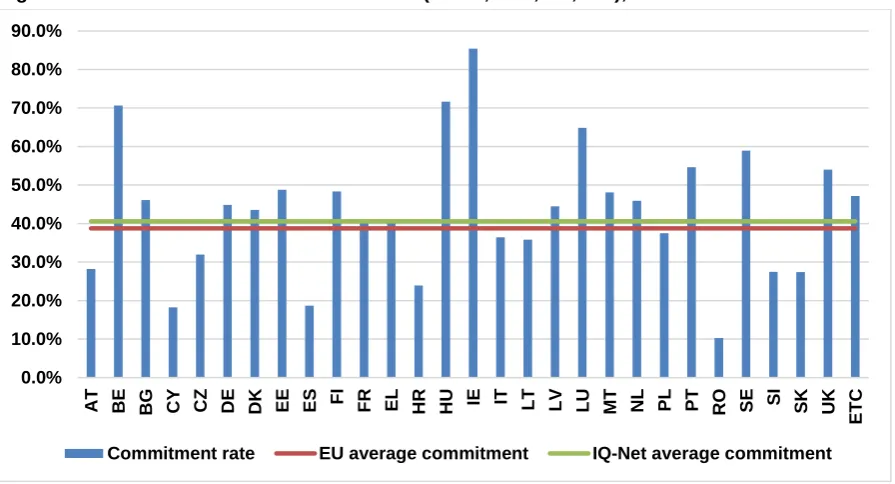
Commitment rates for ESIF programmes have increased during the second half of 2017. According to Commission data for November 2017, the average commitment rate across EU28 (Figure 1) has increased from 27.7 percent in March 2017 to 38.7 percent in November 2017. The average rate for
Figure 1: 2014-20 commitment rates in EU28 (ERDF, ESF, CF, YEI), November 2017
Source: EPRC calculations, based on EC data (https://cohesiondata.ec.europa.eu/countries), 20 November 2017.The data for the figure were taken from the DG Regio OpenData website. However, IQ-Net Managing Authorities note that they understate the current position regarding commitments.
Commitment rates are above 40 percent of total programme allocations in nine IQ-Net countries and above 50 percent in the UK (54 percent), Portugal (54.6 percent), Sweden (58.9 percent) and Belgium (70.7 percent).
The acceleration of commitment rates has been progressing at varying speeds. At the top end of the scale, the commitment rate increased by 15 percentage points between March and November 2017 (AT, CZ and EL) and ten percentage points in BE, ES, HR, PL, PT and SK.
Among the regional IQ-Net programmes, commitment rates are on average above 40 percent, constituting over half of total programme allocations, and there has been a significant acceleration in some regions (e.g. Pom, Vla). In Wales, over 60 percent of resources have now been committed under both ERDF and ESF programmes, reaching 74 percent under the West Wales ESF Programme. The figures are also high in Pomorskie (69.5 percent under both ERDF and ESF), and
Vlaanderen (65 percent).
0.0% 10.0% 20.0% 30.0% 40.0% 50.0% 60.0% 70.0% 80.0% 90.0%
AT BE BG CY CZ DE DK EE ES FI FR EL HR HU IE IT LT LV LU MT NL PL PT RO SE SI SK UK
ETC
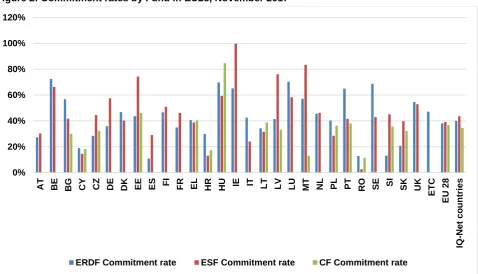
Figure 2: Commitment rates by Fund in EU28, November 2017
Source: EPRC calculations, based on EC data (https://cohesiondata.ec.europa.eu/countries), 20 November 2017. The data for the figure were taken from the DG Regio OpenData website. However, IQ-Net Managing Authorities note that they understate the current position regarding commitments.
In terms of commitment rates by Fund (ERDF, ESF and CF) (see Figure 2), the overall pattern has largely remained unchanged compared to March 2017. Inter-Fund variation has become more balanced in a range of IQ-Net countries, with commitment rates gaining pace under Funds previously ‘lagging behind’ (e.g. AT, CZ, SK). Commitment rates for a specific Fund have clearly prevailed over several consecutive review periods in some cases (e.g. ERDF in SE or PT, ESF in CZ, DE or FR). However, this trend has been reversed in the past eight months in other countries (e.g. ERDF overtaking ESF in BE or UK).
While commitment rates as at March 2017 were largely comparable to those reached around the same time during the previous period, overall commitment rates dynamics now appear to be less positive when the current levels are contrasted with those at the end of 2010 (see Figure 3).
0% 20% 40% 60% 80% 100% 120%
AT BE BG CY CZ DE DK EE ES FI FR EL HR HU IE IT LT LV LU MT NL PL PT RO SE SI SK UK
ETC
EU 2
8
IQ-N
e
t c
o
un
trie
s
Figure 3: Commitment rates – November 2017 vs. end 2010 – ERDF-CF
Source: EPRC calculations, based on EC data (https://cohesiondata.ec.europa.eu/countries), 20 November 2017. The 2017 data for the figure were taken from the DG Regio OpenData website. However, IQ-Net Managing Authorities note that they understate the current position regarding commitments.
These figures reflect Member State positions rather than individual programmes, but in EU-wide terms, only Hungary, Luxembourg, Bulgaria and Italy have reached commitment rates higher than at the same point in the previous period.
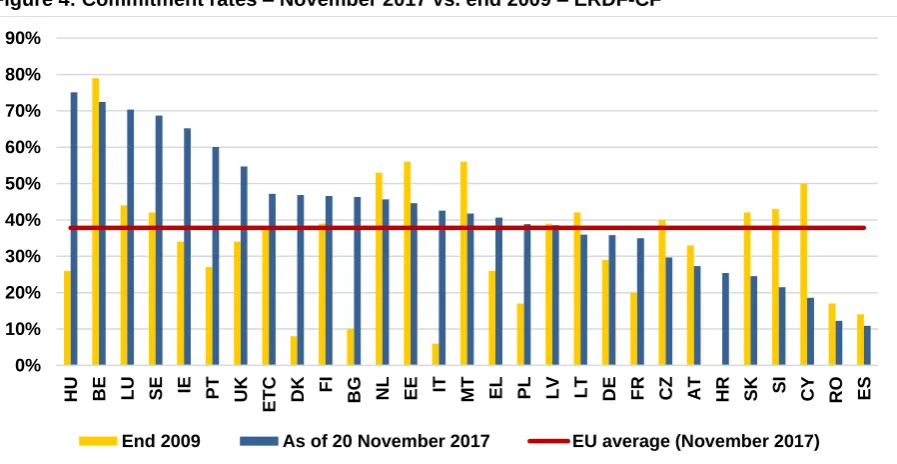
In the 2007-13 period, there was a rapid increase in EU28 average commitment levels between the end of 2009 (see Figure 4) and end of 2010 (from 23 to 54 percent). The average pace of
acceleration in 2014-20 has so far been more modest, with the EU28 average commitment rate currently remaining at 38 percent.
Figure 4: Commitment rates – November 2017 vs. end 2009 – ERDF-CF
Source: EPRC calculations, based on EC data (https://cohesiondata.ec.europa.eu/countries), 20 November 2017. The 2017 data for the figure were taken from the DG Regio OpenData website. However, IQ-Net Managing Authorities note that they understate the current position regarding commitments.
0% 20% 40% 60% 80% 100% 120%
End 2010 As of 20 November 2017 EU average (November 2017)
0% 10% 20% 30% 40% 50% 60% 70% 80% 90%
HU BE LU SE IE PT UK ETC DK
FI
BG NL EE IT MT EL PL LV LT DE FR CZ AT HR SK SI CY RO ES
[image:12.595.76.525.493.725.2]2.2 Payment rates
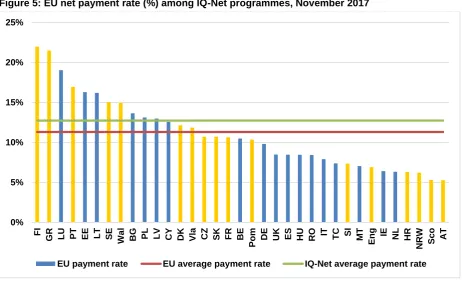
[image:13.595.73.536.144.426.2]In terms of payments, IQ-Net programmes continue to show a higher multi-Fund average rate than the EU28 as a whole(12.7 percent against 11.3 percent) (see Figure 5).
Figure 5: EU net payment rate (%) among IQ-Net programmes, November 2017
Source: EPRC calculations, based on EC data ( https://cohesiondata.ec.europa.eu/EU-Level/ESIF-2014-2020-EU-payments-daily-update-/gayr-92qh/data), 20 November 2017.
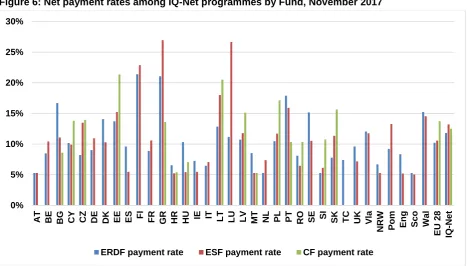
This is also true across two of the three Funds individually (11.8 against 10.2 percent for ERDF, and 13.2 against 10.6 percent for ESF. The EU28 average is slightly higher in the case of the Cohesion Fund (see Figure 6).
0% 5% 10% 15% 20% 25%
FI
GR LU PT EE LT SE Wa
l
BG PL LV CY DK Vla CZ SK FR BE
Pom DE UK ES HU RO
IT TC SI
MT Eng IE NL HR NRW Sc
o
AT
Figure 6: Net payment rates among IQ-Net programmes by Fund, November 2017
Source: EPRC calculations, based on EC data ( https://cohesiondata.ec.europa.eu/EU-Level/ESIF-2014-2020-EU-payments-daily-update-/gayr-92qh/data)
Payments remain for the most part under 16 percent of planned amounts, except for three IQ-Net programmes: Finland (22 percent), Greece (21.5 percent) and Portugal (17 percent). The ESF average payment rate across IQ-Net countries and regions, as previously, remains slightly higher than for ERDF, reflecting the EU-wide trend.
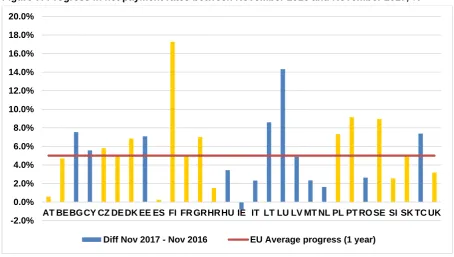
Across the EU28 as a whole, the increase in payment rates over the 2016-17 period has averaged five percentage points. In ten countries involving IQ-Net programmes, progress in terms of payment rates has been above-average (CZ, DK, EL, FI, PL, PT, SE); in three countries (DE, FR, SK) the increase in payment rates has been equal to the EU average, and in the remainder it has been lower (see Figure 7). In several IQ-Net cases (CZ, FR, SK), there has been a catch up compared to the position in Spring 2017.
0% 5% 10% 15% 20% 25% 30%
AT BE BG CY CZ DE DK EE ES FI FR GR HR HU IE IT LT LU LV MT NL PL PT RO SE SI SK TC UK Vla
NRW Pom Eng Sc
o
Wa
l
EU
2
8
IQ-N
e
t
Figure 7: Progress in net payment rates between November 2016 and November 2017, %
Source: EPRC calculations, based on EC data ( https://cohesiondata.ec.europa.eu/EU-Level/ESIF-2014-2020-EU-payments-daily-update-/gayr-92qh/data), 20 November 2017.
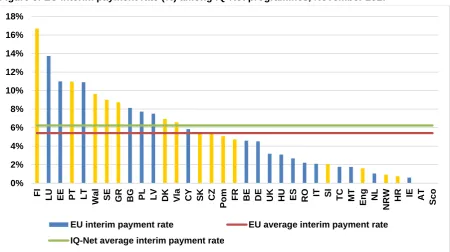
At the same time, if the interim EU payment rate is examined (i.e. payments data excluding advance payments), progress appears less substantial (see Figure 8). Whereas IQ-Net programmes’ average rate is generally higher than the EU28 as a whole (6.2 percent against 5.4 percent), progress is overall more modest. Interim payments remain for the most part under 10 percent of planned amounts, except for two IQ-Net partners: Finland (16.7 percent) and Portugal (11 percent). The general trend across IQ-Net programmes largely remains similar if net and interim payment rates are compared, with the exception of few cases – for instance, Greece, while occupying second position in terms of EU net payments (21.5 percent), shows less progress if interim payments data (8.7 percent) is used.
-2.0% 0.0% 2.0% 4.0% 6.0% 8.0% 10.0% 12.0% 14.0% 16.0% 18.0% 20.0%
AT BE BG CY CZ DE DK EE ES FI FR GRHRHU IE IT LT LU LV MT NL PL PT RO SE SI SK TC UK
Figure 8: EU interim payment rate (%) among IQ-Net programmes, November 2017
Source: EPRC calculations, based on EC data ( https://cohesiondata.ec.europa.eu/EU-Level/ESIF-2014-2020-EU-payments-daily-update-/gayr-92qh/data), 20 November 2017.
In programmes with relatively low payment rates, the reasons (according to programme managers) mostly relate to delays in programme preparation, including the late approval of the EU regulations and delegated acts (NRW) and delays and/or heavy requirements with regards to the documentation and approval of the management and control system (AT, Biz, NRW), and slow set-up of the national IT system (Biz). Other factors, with consequences for both project uptake and financial absorption (see also Section 4.1), include:
amendments to national ESIF implementation acts, which have prompted changes in procedures and documentation, causing subsequent implementation delays (Pom);
complexity associated with the implementation of FIs. For instance, in Croatia, FI represent the biggest success under the OPCC but meeting FI implementation requirements proved to be challenging (Portugal has repeatedly noted FIs as an area relatively difficult to implement due to the multiple steps that need to be taken);
institutional capacity more generally (HR);
systemic administrative obstacles (e.g. with regards to public procurement or environmental legislation in SI);
tighter compliance regime, including in the area of public procurement, resulting in delays in the submission of claims (Sco) or leading to protracted control processes for payment requests (SK);
complexity of project applications, particularly for larger projects, protracting the project selection process (SI);
stricter interpretation of State aid rules (Vla), particularly in relation to infrastructure (PT); and
late approval by DG Competition of a State aid scheme (FR).
At the same time, there is evidence that some obstacles previously cited have been fully or partially eliminated in some cases. For instance, DFB (Biz) was granted Intermediate Body status in May 2017
0% 2% 4% 6% 8% 10% 12% 14% 16% 18%
FI LU EE PT LT
Wa
l
SE GR BG PL LV DK Vla CY SK CZ
Pom FR BE DE UK HU ES RO
IT SI TC MT Eng NL
NRW
HR IE AT
Sc
o
allowing project verifications to be undertaken and potentially certification of expenditure (although this is dependent on the national IT system being ready).
2.3 The level of application of decommitment – no longer an open question?
At the time of writing, programme managers were concerned about the application of decommitment and whether this would be carried out at the level of categories of region i.e. MDR, Transition and LDR regions, or the OP as a whole. The Commission’s position had been that the calculation of decommitment should be undertaken at the level of categories of region, evoking Article 96 of the CPR and Table 17 of Annex I of Implementing Regulation 288/2014: ‘Commitments for a programme are made in accordance with the financial table of the OP, in which these commitments are broken down by Fund and by category of region.’ 1 EGESIF guidance also stated that n+3 would be assessed
by regional category. This would mean that lower progress in some regions could not be made up by better progress in other regions if they are in different regional categories.2
Several Member States argued for a less restrictive application; and some IQ-Net programme managers noted that this was a potential issue for their OP(s) (AT, CZ IROP, Eng, DK, FR, SI). In England, for example, calls for projects are based on Local Enterprise Partnership (LEP) areas, which can cover more than one category of region. The Danish MA also has an ongoing issue with projects crossing different categories of regions. In Slovenia, the MA raised issues regarding the n+3 rule interpretation, including lack of clarity on the level of application.
According to a Commission working document, the Commission has now agreed to set the target at OP level, although if an OP fails to meet its overall target the Commission will decommit the funds at category of region level, taking into account the amount spent at each level.3 Overall, therefore, steady progress has characterised ESIF implementation over the period, as reflected in both commitment and payment data.
1 See Q/A following EGESIF 13/07/2017,
http://ec.europa.eu/regional_policy/sources/docgener/informat/2014/guidance_decommitment_qa_en.pdf 2 EGESIF_17-0012-01, (30/08/2017),
3. CURRENT PROGRAMMING ISSUES
3.1 Domestic changes with an impact on ESIF programmes
In most cases the economic and political context for ESIF has been relatively stable. With some exceptions, Member States are experiencing a resumption or intensification of economic growth, although this is not always reflected in increased demand for EU funding. The main influences on ESIF programmes are associated with Brexit, domestic institutional reforms, as well as more changes to implementation arrangements.
The most far-reaching issue for the United Kingdom programmes is the UK’s exit from the EU. Article 50 was triggered by the UK Prime Minister on 29 March 2017, meaning that the UK will leave the EU by UK 29 March 2019. A letter to MAs from the UK Treasury in October 2016 extended a guarantee of (domestic) funding for ESIF projects (initially covering project approvals made up to 23 November 2016) until the point at which the UK leaves the EU. Full funding for approved projects is expected to be honoured by the government so long as they represent good value for money and are in line with domestic priorities. However, there is considerable uncertainty as to what form exit will take, whether there will be any transitional period, and how the ESIF programmes will be managed after this date.
The main contextual change affecting the implementation of ESIF in Finland continues to be related to regional government reform, initially expected to come into force in 2019 but eventually postponed by the Government to the beginning of 2020. The reform is expected to affect regional governance and development, with the responsibility for providing public healthcare and social services to be assigned to newly established regional governments. The decision on reform postponement has brought additional time for preparations, which, along with the largely remaining uncertainty, continue to burden all administrative levels in Finland. A more direct effect on the OP implementation is however expected at a later stage, when the new regional governments supposedly take the role of intermediary bodies.
In Poland, some regional actors are concerned about legal amendments which are perceived as centralising the ESIF governance and delivery system further. In September 2017 an amendment of the Polish Act on the Implementation of Cohesion Policy 2014-20 introduced regulations essentially strengthening the role of centrally-appointed regional governors (voivods) in the implementation of ROPs. The amendments have expanded the scope of involvement of the voivods in ESIF delivery, including through a newly acquired role in the OP designation process, role of observer in monitoring committee meetings or the ability to join project evaluation committees. Despite the officially claimed purpose of the amendment as providing greater
simplification, transparency and effectiveness of EU grants delivery, the initiatives are seen by Marshall Offices and regional governments as undermining the competences of MAs, complicating project selection, blurring responsibility, and overall constituting part of a broader centralisation process.
In France, the merger of regions in 2016, which led to institutional changes and reallocation of competences, is reported by the French Court of Auditors (Cour des Comptes) to have led to additional costs in the short term while cost-savings are not yet materialising as envisaged. The reallocation of competences has involved the integration of new competences into existing structures, strengthening of cooperation between the State and the regions, the merging of managing authorities while OPs remain separate. These changes have raised some concern, but so far the reform does not seem to have affected the implementation speed of ESIF.
Progress with regards to the development of the ESIF delivery system has been reported by some IQ-Net programmes. The key new development at the DFB (País Vasco) was its designation as Intermediate Body in May 2017, which is expected to allow it to discharge its core functions in the current period, particularly with regards to expenditure verification and certification.
Measures aimed at the acceleration of ESIF implementation have been undertaken or further strengthened in some cases, among other things through the following efforts:
Dedicated measures. In Portugal, efforts at accelerating ESIF execution continue to be pursued through incentives aimed at anticipating investment. In Croatia, in line with the Priority National Action Plan for speeding up ESIF implementation, further activities have been implemented aimed at enhancing simplification and streamlining of procedures to reduce barriers for beneficiaries, and developing capacities and efficiency of public administration and regional authorities involved in EU funds delivery.
Ensuring greater coordination. In Croatia, the National Coordination Committee continues to ensure overall coordination and monitoring of ESIF implementation, in line with the Priority National Action Plan for speeding up the implementation of the ESIF established in 2016. The activity of the thematic sub-committees is seen as being particularly relevant for increasing the impact and effectiveness of the Funds.
Several programmes have reported developments with regards to the policy approaches to
migration. In Finland, previous concerns over the influx of migration have now eased, and the focus has shifted to the integration and employment of migrants, which, for the first time, has also become an ERDF focus. In Poland, migrants have been incorporated into the ROP as potential beneficiaries of ESF funding, as part of broader efforts to develop more active responses to the influx of Ukrainian migrants. In Scotland, however, the MA has found that current evidence requirements under ESF are a barrier to helping vulnerable groups such as refugees, as the level of paperwork and documentation required are discouraging potential applicants.4
3.2 Ex ante conditionalities almost all resolved
All ex ante conditionalities appear to have now been met in the IQ-Net programmes, except for one outstanding issue in Greece, where incomplete fulfilment of a conditionality has been recorded as regards the river basins. Completion is foreseen by the end of 2017.
Some programme managers have noted a deficiency in the current approach to ex-ante conditionalities, in particular where they combine national frameworks and regional implementation. The issue is that there is no mechanism for the Commission to control or supervise that conditions set ex ante are subsequently upheld during implementation. This was also noted by the European Court of Auditors in their recent report on the Performance Framework.5 One example
concerns the transport ex-ante conditionality in Poland, which included a ranked list of major projects to be implemented across the country. This was approved between the Polish government and the Commission and investment in a road in Pomorskie was sixth on the list. The Polish government now plans to change the ranking in the list and cancel some of the projects. The MA has been advised by the Commission that there is no mechanism for the Commission to prevent this.
3.3 Programme evolution – a continual process?
Almost all IQ-Net programmes have either already made programme changes this year and are awaiting Commission approval, or are still planning the required revisions. As one programme manager noted, ‘the revision of OPs is a continual, never-ending process now’. OP changes
4 The MA (Scottish Government) is close to reaching agreement with the UK Department for Work and Pensions (responsible for benefits payments) on a data sharing agreement, which should help ease this situation. 5 European Court of Audits (2017) Ex ante conditionalities and performance reserve in Cohesion: innovative but
not yet effective instruments, Special Report No 15,
range from relatively minor, straightforward, often technical issues, such as in Sweden, where adjustments have been made to the way indicators are measured, moving from percentages to numbers, to more fundamental/systematic changes, such as in Greece. In Greece, large-scale changes to the OPs will be implemented in two phases, with technical adjustments taking place first, followed by systematic changes to the OPs being undertaken in the first quarter of 2018. In Portugal, also, a global re-programming exercise is expected to start by the end of the year.
Changes resulting from the MFF mid-term review are still filtering through into IQ-Net programmes – in Denmark, for instance, while the process of making the changes involving extra allocations to TO8 and TO9 under the ESF OP went smoothly with the Commission, domestic political discussions over where to spend the extra funds took some time to resolve.
As part of the MFF mid-term review, the Youth Employment Initiative (YEI) was topped up by €1.2 billion for the period 2017-20. Implementation of the YEI envisages match funding from ESF; therefore in order to access the additional allocations provided through the YEI, contributing OPs had to undergo a significant reprogramming effort to free already engaged ESF resources. In France, tackling youth unemployment is a high priority, meaning that 23 OPs as well as the PA have been affected, and while the additional resources were welcome, this has led to significant time pressure as a deadline of 15 November 2017 was imposed for the reprogramming efforts. Work on this is also underway in Portugal and Slovakia; while a modification of the allocation for YEI under ESF has already been implemented in Croatia.
In addition to changes related to the Performance Framework (see the associated Thematic Paper)6
many planned and implemented reallocations reflect strategic shifts and contextual changes.
In Portugal, changes have already taken place in relation to the devastating wildfires which took place in the summer of 2017. A reprogramming of OP Centro was agreed and responded to by the Commission very quickly, ensuring the eligibility of certain operations that had not initially been foreseen. The intention was to ensure support for companies destroyed by fires (to enable them to return to operation) and equipment / infrastructure destroyed by fires. Applications have also been made to the EU Solidarity Fund.
The Finland MA is currently considering the possibility of increasing the share of funding for Technical Assistance from three to four percent for 2019-20. Pressure to increase funding for technical support has increased because regional reform has implied changes to the OP implementation and monitoring system, and preparations for these changes will require time and personnel.
In Scotland, there will be a major programme modification following the programme review which took place earlier in 2017. A decision was made at the start of the
programme period to implement the OPs in two three-year tranches, after which a review would take place. The original intervention logic for both programmes (ERDF and ESF) was found to be sound although strategic and labour market changes require adjustments to both the scope and allocations. Proposed changes involve increasing intervention rates to address match funding issues, adding a new Investment Priority for the Highlands and Islands for culture and heritage due to demand and a lack of absorption under green infrastructure, and adjustments to the financial tables between the use of FIs, repayable assistance and grants.
Related to Brexit, in Scotland and Wales the Commission has indicated that only one ‘major’ modification of the OPs will be allowed. This is cause for significant concern, as there may be a need for further flexibility within the programmes as 29 March 2019 approaches. As one UK programme commented, “in the event that the UK programmes are ‘frozen’ on 29 March, the OPs may in effect stop being ‘programmes” and become instead “lists of projects’’. If there were to be a meaningful transition period, it would be helpful for this to enable moving funds between these projects, managing them as if they were a coherent programme.
3.4 Short and longer-term priorities….the next six months at a glance
In the short term, several programmes are concentrating on meeting n+3 at the end of 2017 (AT, CZ, HR, SI, SK). Also, if the omnibus proposals are adopted soon, action may be needed to apply any retroactivity (CZ national level).
In the medium-term, meeting the milestones for the performance framework and review are high on the agenda (CZ national level, HR, FR, Pom, SK).
Overwhelmingly, however, almost all programmes are focused on accelerating implementation, through a range of strategies, including:
improving project appraisal and approval processes (CZ IROP, SI);
launching new calls (SK);
improving project quality and uptake from regional level (DK);
speeding up implementation in outstanding areas (Pom) or for particular types of projects, such as FIs (CZ IROP, Eng, Pom, SI), urban strategies and regeneration projects (Eng, Pom), and TO4 projects (SE) ;
reprogramming (FR, Pom) and making programme modifications (Sco, SI, Wales); and
monitoring implementation progress (PT notes that the priority is to make implementation ‘viral in all areas’, ensuring that the positive dynamics in some areas are extended to all domains, including those with a slower start).
4. PROJECT GENERATION AND SELECTION
4.1 Project generation issues
Despite the data showing that overall commitment rates are somewhat lower than at the same time in the 2007-13 programme period, feedback on project generation among IQ-Net programmes is mostly very positive. Strong project pipelines and good responses to issued calls are reported. In
Austria, for example, the picture is much better than it was six months ago, as all 16 IBs are now entering data into the monitoring system. In Sweden, project uptake has been so high from the start under most programmes that there is only limited funding available for new projects. Pomorskie ROP is the leading programme in terms of levels of contracting in Poland, with around 70 percent of available funding already contracted. In País Vasco, it has proven relatively straightforward to absorb funding into domestic schemes and projects.
Several programmes are reporting more difficulties with project generation. Challenges have been linked with the regulatory requirements (ring-fencing, result orientation, late approval and amendment of regulations, delegated and implementing acts, work required to document and approve the Management and Control System), and with the preparation of project documentation for large/major projects and with for complex projects (DK, FR, NRW, Pom, SI). In Denmark, while the MA is still receiving a steady stream of applications, many are too broad to fit the programmes. The MA has identified a number of factors potentially contributing to the slower than preferred progress:
many of the difficulties have been linked to the rules on the minimum allocations in the OP. The rules may have resulted in certain areas (low-carbon/energy efficiency for ERDF and social inclusion for ESF) receiving allocations which are difficult to absorb;
more widely, allocations between priority axes may need adjustment;
due to result orientation, the IBs and applicants find the programme is too narrow and certain projects cannot fit the definition of eligibility; and
it is proving difficult to spend under TO10 (education) due to complexity in the education and labour markets, and difficulty finding additionality, as the Danish education system works well.
In France, implementation is slower in programmes with primarily major projects (e.g. PACA), as these require lengthy approval procedures. Programmes focusing on the development of the high-speed broadband network also experienced delays due to the late Commission decision on the compatibility of the national aid scheme with EU State aid regulations. In Wales, match-funding for ESF projects has been an issue, as many ESF projects are carried out by public sector organisations (local authorities and third sector) so increased pressure on public finances is having an impact.
The Spring 2017 IQ-Net Review Paper7 highlighted that new themes/Thematic Objectives are proving
to be the most difficult to implement, and that implementation is easier where there is previous experience of a theme. Two of the most common TOs being mentioned in terms of difficulties with project generation are TO4 (low-carbon) (see Box 1) and TO5 (climate change) (FR, HR, SI).
7 Lehuraux T (2017) Gathering Implementation Speed: The Progress of Structural Funds Programmes, IQ-Net
Box 1: Implementing low-carbon projects
Energy efficiency (EE) and renewable energy sources (RES) have become an increasingly important dimension of Cohesion policy, reflected in Thematic Objective 4 (TO4) - supporting the shift towards a low-carbon economy. Expenditure of over €29 billion for EE and RES is planned in the 2014-20 OPs; substantially higher than in 2007-13. Thirteen countries plan to spend more than 10 percent of their ESIF allocations in this area. At least 20 percent of total ERDF resources at national level must be allocated to TO4 in MDRs, at least 15 percent in Transition Regions and 12 percent in the LDRs. Cohesion Fund resources can be used by the LDRs to achieve the minimum fund allocation, in which case the minimum percentage of funding increases to 15 percent. Although TO4 projects are progressing relatively well in several programmes (AT, HR), difficulties are frequently reported. Specific issues include the following.
Slow progress due to lack of experience and new beneficiaries, and narrow OP indicators (DK).
RES projects have proven to be challenging due to changing legislation and market conditions. There are limited potential contractors for the quantity of projects envisaged and project offers are often too expensive for the capacities of beneficiaries. Changes in legislation relating to RES (e.g. limiting the scope for investment in on-shore wind generation) have led to changes and delay (Pom).
Insulation of housing real estate has been cumbersome, as eligible applicants represent very small organizations of flat owners with limited capacities to prepare project proposals. A very high number of small projects with high co-financing is needed to cover the OP's allocation and demand is low. The MA in cooperation with the IB has simplified requirements for applicants several times and the reallocation of finance has been proposed. Also, the FI for insulation of buildings is delayed (CZ IROP).
Progress lower than for other priority axes (Biz).
The scope of the priority axis has had to be expanded to increase uptake of funding (Eng).
Very restrictive rules (e.g. requirements for support through repayable instruments), energy-related EAC
and ring-fencing requirements are noted to be particularly challenging in Portugal, leading to this being one of areas with the lowest approval levels. A reprogramming is currently in progress related to the revision of financing conditions for projects of energy efficiency in public administration.
The Commission’s 2017 strategic report on implementation of ESIF noted low-carbon as one of the challenging areas where continued effort will be needed, to ensure the selection and effective implementation of high quality projects.8
Source: IQ-Net fieldwork and Wishlade F and Michie R (2017) Financial instruments for energy efficiency and renewable energy, report to the European Parliament REGI Committee,
http://www.europarl.europa.eu/RegData/etudes/STUD/2017/601992/IPOL_STU(2017)601992_EN.pdf
4.2 New regulatory requirements still being embedded
Three years in to the programme period, elements of the regulatory requirements introduced for 2014-20 continue to cause issues, especially for beneficiaries.
The introduction of simplified costs options has taken time to embed (SK), although the situation is improving and they are proving to be a useful tool once understood by beneficiaries (Eng).
Implementation of the new rules relating to financial instruments has been challenging (HR, Eng) and the late issuing of guidance has contributed to delays.
The focus on results has had some unintended consequences for beneficiaries and implementing bodies (DK, Eng, FI, Sco, Wal) around indicator reporting and strengthened evidence requirements. In England, the requirement for beneficiaries to evaluate projects through a summative assessment met with initial opposition, and in Wales, the more focused programmes and strengthened evidence requirements have slowed down claims submission. In Scotland, also, beneficiaries are making sure they have all the required evidence before they submit claims – thus delaying claims submission. The MA has issued guidance and held workshops on evidence requirements but project sponsors are still nervous about getting it right. To support beneficiaries, South Finland has organised a number of online trainings and provided face-to-face coaching, and as a result, beneficiaries are experiencing significantly fewer difficulties than at the start of the programme period with indicator reporting and performance orientation. West Finland has also implemented continuous training for implementing bodies.
e-Cohesion remains challenging (AT, CZ IROP).In Austria, strict use of e-Cohesion would require all communication between IB and beneficiaries to be carried out via the electronic e-Cohesion system. This is found not to be realistic in practice, particularly in a system in which the ESIF funding is only an additional aspect to the activities of IBs. On a more positive note, the e-Cohesion system appears to be a useful implementation instrument for some smaller IBs. e-Cohesion has introduced significant complexity to the monitoring system in CZ.
The increased prominence of State aid compliance in the regulations has caused serious delays for some projects in Vlaanderen. To address this, a comprehensive system of guidelines concerning State aid has been developed by the MA. The guidelines are intended to support beneficiaries as well as MA personnel and other stakeholders.
Several issues may be solved by adoption of the Omnibus proposals, although there is some uncertainty about when and whether this will actually happen:
the limits set on small-scale infrastructure have hindered implementation of some types of projects under the CZ IROP, i.e. projects for reconstruction of significant cultural sights; and
application of CPR Art. 61(8) is causing issues providing support to large enterprises under the Slovakia OP R&I.
5. NEW DEVELOPMENTS IN IMPLEMENTATION SYTEMS
5.1 Divided opinion anti-fraud measures
Use of ARACHNE is evenly split among the IQ-Net programmes – about half are using their own systems.
Programmes using ARACHNE
Programmes using domestic systems
CZ, HR, FR,
PT (AA), SI, SK,
Vla, Wal
AT, Biz, Eng,
FI, NRW, Pom,
SE, Sco
Alternatives to using ARACHNE include:
setting up a new system – in Pomorskie, a Task Force that includes representatives of the Polish Ministry of Finance and National Audit Office has been launched;
contracting development of a new tool – in Austria, the MA and IBs use a tool offered on the market, with the advantages that it provides information on potential linkages between different firms, and the collected data remains in Austria;
using existing systems: e.g. authorities in NRW assessed their own existing measures and this showed the strength of existing strong domestic rules.
The MAs using ARACHNE have the following concerns.
Clarification is needed over the legal status of data submission requirements. One programme manager noted that, according to the ARACHNE Charter9, MAs should provide
data to the tool at least every three months. The legal status of this requirement and the legal consequences of a hypothetical late provision of data are unclear, and some find a three-monthly update rate too short and not proportional to the administrative burden required.
Risk indicatorsare not relevant for all types of programme. For small programmes where projects are often atypical, the tool does not allow correct benchmarking, conversely some parameters can be irrelevant for large programmes. For example, the parameter ‘number of projects’ might indicate a potentially problematic beneficiary in a programme where national public sector organisations manage hundreds of ESIF projects. ARACHNE is therefore found to be a somewhat ‘blunt tool’. The range and detail of the ‘traffic light’ reports it produces can
be so extensive that some of the output has to be ignored, thus presenting a danger that important information is missed.
It instils more fear of audit. There is a perceived danger that auditors will use the ARACHNE reports to guide their audit ‘fishing trips’.
ARACHNE exacerbates administrative burden. Anti-fraud measures mean that project applicants are required to deliver a high number of declarations of honour – further administrative load for the entire system.
There is a lack of functionality. The web-based version of ARACHNE is not yet available, causing logistical problems where it must be installed on individual computers, and where, for example, IBs outside the MA computer system are involved in the programme. Further, the ‘status’ options provided on ARACHNE do not always coincide with those used on the MAs’ systems, requiring an elaborate ‘mapping’ workaround.
5.2 Financial instruments – have ambitions been met?
(i)
What are the ‘final’ figures for FI implementation in 2007-13?
The latest data on the implementation of FIs in 2007-13, based on the Final Implementation Reports (FIR) data10 are as follows.11
By 31 March 2017, €16.4 billion in OP contributions had been committed to FIs under the 2007-13 programmes. Of this, €15.2 billion had reached final recipients – an overall
‘absorption rate’ of almost 93 percent of OP contributions. This is an increase of 20 percent from the end of 2015.
An estimated €8.5 billion of resources have reportedly been returned for reinvestment in programme areas.
Average support per final recipient was €40,000, with average product size ranging between €16,000 for guarantees to c. €410,000 for equity investments.
There are wide variations between Member States, both in their use of FIs and levels of absorption. Italy alone accounted for over 29 percent of OP contributions paid to FIs (€4.8 billion) by end March 2017. Other large Member States also made significant payments to FIs by end March 2017 including Germany (€1.7 billion) and the UK (€1.6 billion), but payments are not directly related to country size, with Greece and Poland also each paying over €1 billion, but France just €442 million.
In 18 countries, over 90 percent of monies paid to FIs had been paid to final recipients, with Belgium, France, Lithuania Portugal and Romania all achieving full absorption. The lowest absorption rates are
10 European Commission (EC) (2017) Summary of data on the progress made in financing and implementing
financial engineering instruments reported by the managing authorities in accordance with Article 67(2)(j) of Council Regulation (EC) No 1083/2006 Programming period 2007-2013, Situation as at 31 March 2017 (at closure), European Commission,
http://ec.europa.eu/regional_policy/sources/thefunds/fin_inst/pdf/closure_data_fei_2017.pdf
found in Spain (60 percent) and the Netherlands (74 percent), while the cross-border programme FI reported zero absorption.
(ii)
How does 2014-20 compare so far?
[image:29.595.72.518.274.600.2]Comparing FI activity so far in 2014-20 to 2007-13, OP data on ‘planned’ FI use shows that overall Member States intended to almost double their spend on financial instruments to over €20 billion from ESIF resources, compared to around €11 billion in 2007-13. There are still wide variations between countries (Figure 9). 19 countries planned to increase allocations to FIs in absolute terms. In some cases these increases are substantial – in Portugal, the Czech Republic, the Netherlands and Poland, for example, FI allocations for 2014-20 are more than three times those for 2007-13. Seven Member States planned lower contributions to FIs (Austria, Belgium, Cyprus, Denmark, Finland, Greece and Italy) with significant reductions foreseen in Italy.
Figure 9: OP commitments to FIs 2007-13 (actual) and 2014-20 (planned) (€m)
Source: Wishlade F and Michie R (2017) Financial instruments in practice: uptake and limitations, Background paper to OECD Seminar on Financial Instruments, 28 June 2017, Paris.
A total of 14 OPs have planned FI spend exceeding €400 million;12 collectively these programmes
alone account for over 55 percent of planned FI spend across the EU28. At the opposite end of the spectrum, some 50 OPs plan to allocate around €20 million or less to FIs (though this may account for a large share of spend in OPs with small budgets). The data from the OPs can only provide an indication – plans change after the mandatory ex ante assessments are carried out, and Member States did not always provide indicative amounts for FIs in their OPs. Contributions to joint and EU-level instruments such as the SME Initiative are also not reflected in OP data. So far, six Member
12 EU amount.
0 500 1000 1500 2000 2500 3000 3500 4000
AT BG CZ DK ES FR HR IE LT LV NL PT SE SK
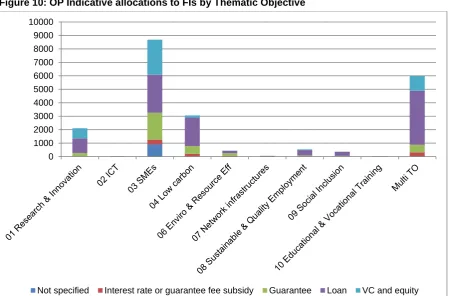
States are implementing the SME Initiative (Bulgaria, Spain, Malta, Finland, Italy and Romania). From the OP data, early indications are that SME support is likely to continue to dominate the use of FIs, although FIs for low-carbon are also significant.13
Figure 10: OP Indicative allocations to FIs by Thematic Objective
Source: Wishlade F and Michie R (2017) Financial instruments in practice: uptake and limitations, Background paper to OECD Seminar on Financial Instruments, 28 June 2017, Paris.
Among the IQ-Net programmes, not all are planning on or involved in implementing FIs (Biz, DK, Vla). The Annex provides a list of currently indicated FIs in IQ-Net programmes, along with their implementation status.
FI implementation involved a steep learning curve in 2007-13; the 2014-20 period has also brought challenges:
The rules around the selection of bodies implementing financial instruments has been problematic (FR, HR, Eng). In France, the Omnibus proposals envisage criteria for direct award to public authorities, which seem not to be compatible with the legal status of the public investment bank (BPI), which plays a major role in implementing FIs. In Croatia, a lack of interest for FIs has been noticed from European financial institutions.
Some Polish regions have struggled to mobilise financial intermediaries to take part in tenders, although this has not been an issue in Pomorskie, where progress has been good. The EIB has also struggled to find a financial intermediary under the energy efficiency FI, related to public procurement regulations which mean that open tendering procedures must
13 Wishlade F and Michie R (2017) Financial instruments in practice: uptake and limitations, Background paper to OECD Seminar on Financial Instruments, 28 June 2017, Paris.
0 1000 2000 3000 4000 5000 6000 7000 8000 9000 10000
be used. Further, national legislation on energy efficiency is limiting the potential of renewable energy, and limiting the incentives to act as financial intermediaries.
As mentioned above, most FIs are used to provide support to SMEs. The Commission has strongly encouraged use of FIs in new thematic areas, but these bring many challenges. For instance, an FI under the CZ Integrated ROP has a challenge to address strict EC requirements on ‘what is ecological’, and has found that within TO4, support for the replacement of heating devices with devices operating with natural gas is not allowed.
Previous experience is an important factor in speedy FI implementation – in Portugal, FIs for business support have been used for a long time, and it has proven easier to get them up and running in the current period, despite using a new implementation model, with a new institution being set up to manage FIs (IFD) which required more time to get things running. PT also has experience with FIs for urban regeneration, and implementation of these is fairly advanced. New areas have had a more difficult maturation process, and while possibilities are currently being studied, the outcome is still not known. At the same time, the macro-economic situation has changed since the initial programming exercise, and access to credit is now much easier. This is also affecting uptake in Nordrhein-Westfalen, where there is to date only limited interest being shown in the two FIs managed by NRW.BANK. The key challenge is that there is little demand for loans because of the strong availability of low interest loans from market-based entities e.g. banks. The NRW MA did considerable work to assess where market gaps existed before launching the FIs, and yet demand remains low in practice. The MA notes that they do not know of any German OP which has seen good take-up of funding under FIs, and they believe that they would have seen considerable difficulties in absorbing funding had they channelled a larger percentage of funding through FIs.
In the UK, Brexit poses challenges for FIs. The Wales Business Fund model originally included ERDF, public sector co-finance and legacy funds and has now been reconfigured to include only ERDF and co-investment funding. The Wales Business Fund (outside of ERDF) will still run to 2023 and legacy funds will be used at a later date, to maximise ERDF uptake in what remains of this programme period.
5.3 Varied progress on implementing new territorial approaches
Implementation of the new territorial-based strategies is progressing at a varying pace, sometimes well, but often delayed and with some remaining problems.
IQ-Net programme managers satisfied with the progress made in implementing their urban strategies include France and Austria, where there are 13 city-regional strategies in Upper Austria and one urban strategy in Vienna. The high-quality content of the urban strategies and their potential to contribute to regional development has been noted in Nordrhein-Westfalen, where a significant number of the strategies submitted to date are in the Ruhr area i.e. an industrial restructuring area with large urban areas and structural urban development challenges. In Portugal, however, ‘the commitment rate is high, whereas the execution rate is low’, although more progress is expected soon as the political situation stabilises in the aftermath of local elections.
requirement for local authorities to be formal Intermediate Bodies for integrated urban development interventions. This has caused difficulties in Nordrhein-Westfalen and in England, where so far seven devolved IBs have been designated to carry out SUD. The approach in general is found to be time-consuming and resource-intensive, especially for smaller projects. The requirement that urban development strategies must address both TO6 and TO9 has been problematic in Denmark and in Nordrhein-Westfalen, where local authorities would prefer to focus on only one of the TOs, delaying implementation of the relevant priority axis due to reluctance of local authorities to apply for funding. The requirement to produce an overarching strategy for the cities involved places an additional burden on municipalities and adds no value where it simply imposes an additional layer
on top of existing strategies, as in Denmark. Where local authorities currently face significant financial constraints, affecting their ability to co-finance projects, the issues are exacerbated. In Germany, the federal government has launched a scheme to which local authorities can apply for co-financing for urban development projects – but this scheme has its own timetable and deadlines and so local authorities will not be able to obtain funding until 2018. Further contributing to delays, many projects involve some form of infrastructure work, which cannot easily be undertaken in winter months (NRW).
Similarly mixed messages have been received on progress with Integrated Territorial Investments.
Box 2: The SOHJOA project – the last mile urban transportation – part of the ITI 6AIKA
The six largest cities in Finland (Helsinki, Espoo, Tampere, Vantaa, Oulu and Turku), home to some 30 percent of the population, have joined forces under the Six City Strategy (6Aika) to tackle their common urban challenges. 6Aika is implemented with cooperative projects which enable the cities to experiment in a larger context than just one city. Since 2014, the six cities have launched around 26 co-operation projects with a budget of €45 million.
6Aika has three focus areas: open innovation platforms, open data and interfaces, and open participation and customer service. The current project portfolio ranges from smart mobility, cleantech and agile piloting, to creating development environments for product testing and boosting open data for business. One example is the SOHJOA project, an ERDF-funded project which tests and develops new technologies to provide digital public services to citizens, specifically involving the trial of robot buses in Helsinki, Espoo and Tampere – an experiment which aims to solve some of the challenges of urban mobility (ERDF budget €224, 957). The buses have the potential to reduce operating costs, lower overall emissions and offer better service to customers (last mile from the end of classic public transport to home – e.g. in outskirts of Helsinki).
Source: https://6aika.fi/in-english/ and http://sohjoa.fi/
Several ITIs are at the pre-operational stage (SK, CZ, SI, PT). In the Integrated ROP in CZ, almost 40 calls for projects under ITIs have been announced and projects are currently being appraised, with only a limited number having reached implementation stage. Similarly in Slovenia, where eleven cities are involved in ITIs, the first projects have been selected in the field of energy efficiency and urban development. The MA expects first expenditure to take place in 2018, also in the field of sustainable urban mobility. In PT, measures have been defined and contracts signed; execution is expected to progress soon.