0022-538X/78/0026-0595$02.00/0
CopyrightX 1978 AmericanSocietyforMicrobiology PrzinedinU.S.A.
Correlation Between UV Dose
Requirement
for
Lambda
Bacteriophage Induction and Lambda Repressor
Concentration
JOHN BALUCH ANDRAQUEL SUSSMAN*
Departmentof Biological Sciences, University of Pittsburgh, Pittsburgh, Pennsylvania 15260 Received for publication 7 December 1977
Escherichia coli K-12wild type and auvrA mutantderivative were used to
constructisogenic strainsbearing one, two, three, or more phage A cIgenomes
andcontaining increasing concentrations of Arepressor asmeasured by in vitro
operatorDNA-bindingassays.The survival and phage induction inresponse to
UVirradiationweredetermined. In bothstrains,dose-response relationshipswere
obtainedasafunction of the cellularrepressorconcentration. The uvrAlysogens required one-tenth the UV fluence of the wild-type counterparts for induction. Lysogenic strains containingplasmids that overproduce the Aind+repressorand
the same lysogens with plasmids overproducing the Aind- repressor displayed
the samesurvivalcurves asthenonlysogenic parental strain; however,only the
formerproduced infectious centers (at a frequency of2 x 10-3 to 5 x
10-4)
inresponse toradiation.
The lysogenic state of coliphage lambda is hibition ofseptumformation, (ii) increased
mu-maintainedby the binding ofarepressorprotein tationrate,(iii) W-reactivation,(iv) inhibition of
specified
by the virusto twoadjacent
operators, DNAdegradation,
and (v) synthesis of proteinthereby
shutting
offtranscription
ofmostof the X.(For reviews,
seereferences33and47.)phage genome. In
wild-type
Escherichia coli Associated with the A induction process arelysogens, asmallfraction of the cells
lyse
spon- the disappearance of the operator-bindingca-taneously, giving
risetoactivephage.
Thisproc-pacity
of therepressor(31, 39, 44), brought aboutessofderepression followed
by
active viruspro-by
hostfunctions (43), and proteolytic cleavage duction has been called induction. Since 1950 of therepressorprotein
(36). UV and mitomycin (24),many external and internal effectors have Ctreatmentsrequire protein
synthesis (39, 43)beenshowntoelicitinduction in the
majority
of to exert their effect on repressor inactivation, thecells, but the mechanism of induction itself whereasgammaradiation(44),
tif-promoted
in-remainsamystery. duction
(39, 44),
and thermal induction ofAll
A-inducing
agents either interactdirectly
dna(ts)
donot(31).
with DNA(UV andgamma
radiation,
alkylating
Studiesby
anumber ofinvestigators
have ledagents,
cross-linking agents),
interfere with its to the formulation of severalputative
mecha-synthesis
during
chromosomalreplication
(thy-
nisms. Chief among these models are: that of mine starvation, temperature increase in ther- Tomizawa andOgawa
(43),
whichpostulates
themosensitive DNA elongation
mutants),
or pro- inducedsynthesis
ofaneffectorprotein capable
motethe
persistence
ofnicks andgaps in DNA either ofbinding
torepressormoleculesorcom-[polI(ts),
lig(ts), dam(ts)
atnonpermissive
tem-peting
with repressor forbinding
to operatorperature].
Theonly exception
known is thetif
sites;
that of Sussman and Ben Zeev(41),
which mutation (11) found to map at the recA locus postulates theability
ofrepressor molecules to(5), which
spontaneously
induces Aphage
at bindspecifically
to lesions that accumulate in410C
or in the presence ofadenine,
withoutnonoperator
regions
of the hostDNA, thereby
detectabledamagetothe hostDNA
(22).
Induc-making
repressorunavailable forbinding
tothetion of A
requires
arecA+
lexA+
genetic
back- Aoperators;
that of Roberts and Roberts(36),
ground (7, 19, 39).Thecharacteristics
just
men- whichpostulatesthe induced synthesis oracti-tionedapplyalsotoafewunrelated
phenomena
vationof aproteasecapableofcleaving repressorthat seemtobe
coordinately
regulated (46)
and molecules; and other models (11, 14, 16, 19)are termed "SOS functions"
(33)
becausethey
based on the presumed activities of DNApre-are ableto rescuethecellorvirusfromaDNA cursors or
degradation products.
damagingevent.Thesefunctions include
(i)
in- TomizawaandOgawa
(43)have shown a cor-595on November 10, 2019 by guest
http://jvi.asm.org/
596 VIROL.
relation between the amount of repressor pres- ment were lysed with sodiumdodecyl sulfate at 65°C.
entand the UV dosenecessarytoabolishit,but After host DNA wasprecipitatedwith 1 M NaCl at
only in segregating cells thatcontained signifi- 4°C,the plasmid DNA was recovered from the
super-cantly less repressor than do ordinary single natant by ethanol precipitation at-20°C.Thepellet
lysogens. Itispossible that thelowUVfluences was dissolved in 10 mM
Tris-hydrochloride
(pHused were very closeto the threshold amount
7.4)-10
mMNaCI-10
mMEDTA and used intrans-usede
wr.,tort
verycoe
thresol
amou formation. Sensitive andlysogenic
lines of AB1886needea
toinuce
theeefector,
andtherefore the andRS294
were transformed by the procedure ofcorrelation merely reflected the probability of Cohen et al. (6). Transformants were selected on
inducingtheeffector. Because the confirmation tryptone plates containing 20 tg oftetracyclineper ml. ofthis relationship has importantimplications Growth of bacteria andUV irradiation. Cells
forpossible models of viralinduction, we were weregrown overnight in M9 medium.
Plasmid-con-interested in extending their observation to taingstrainsweregrownin M9 withtetracycline(20
covera widerange of repressor concentrations.
ug/ml)
to ensure that the plasmid had not beenlostThe results leave no doubtthat,in the caseof by segregation. Unlessotherwisestated, all dilutions
UV
induction,
atphysiologically meaningful
re- weremade in M9medium. The cellswerediluted1:50UVeinduction,et
ratphysiologically
acorre-at
and incubated with shaking at 37°C to anoptical
pressor concentrations, there is acorrelation
density at 550nmof 0.2 (2 x10⁸/ml).Optical densitybetween the amount of repressor in the cell and measurements were made on a Bausch and Lomb
theoptimal dosenecessarytoinactivate it. Spectronic 20 spectrophotometer. Bacteria were
di-lutedto2x
106/ml
for theRS294
strains andto2xMATERIALS AND METHODS 107/mlforthe AB1886 strains. Samples of 20 ml were Bacteria. E. coli strainswerederivatives of E. coli placedinglass petri plates (9-cmdiameter)and irra-K-12. AB1886 (thrleu pro his arg thirpsLlacgal diated. UV irradiationwasperformedwithaGeneral aramtlxyl tsxuvrA) (38) and EK410 (Agal chlbio Electricgermicidallamp,15W,at adistance of98 cm.
rpsErecA)/F'galattA wereobtained from K. Ihler. The intensity, measured by a Blak-Ray UV meter,
Therepressor-overproducing strainsRS294(pKB252), was3.5x 10'J/m2pers.The cellswereimmediately
containingaplasmid bearing the repressor gene(cI) diluted andplated on tryptone platesto determine of A phage, and strain RS294 (pind-), carrying the viablecounts.The tryptoneplateshadbeen pretreated overproducer mutant repressor cI ind- gene, were with catalaseby spreading0.1ml ofa0.02%solution kindly provided by K. Backman (1). Strain RS294 over the entire surface. This treatment produced a (endA thirk Mk+) was obtainedby loss of the plasmid higher survival,aspreviouslyreported (27). To deter-pKB252,as atetracycline-sensitive strain with no re- mine theproductionofinfectivecentersafter each UV pressoractivity.Single lysogensofthese strainswere dose, sampleswere removed, diluted, and incubated prepared by conventional methods. The indicator bac- with aeration at 37°Cfor30min. Afterappropriate
teriumwasC600 Amp. dilution, a portion was added to melted soft agar Phages. The coliphages used wereA+ wild type, containing penicillin-resistant indicatorbacteria and the noninduciblemutant Aind- (20), and Axisl (13), poured on tryptone plates containing catalase and providedby D. Freifelder. 5,000 U ofpenicillin (32).AllUV-treated bacteria were Media. Supplemented M9 medium is M9 as de- handled under dim light, and theplates were incu-scribed inMiller(29)containing0.5%glucose and0.1% batedat37°Cin the darkforatleast 24 h.
Casamino Acids. Tryptone plates contain 10 g of Preparationofextracts for determination of tryptone(Difco),8gofNaCl, and15gof agar perliter. repressoractivity.Thelysogenicstrains were grown Construction ofmultiple lysogens. Double ly- in500mlof M9 and therepressor-overproducer strains sogenswerepreparedbyinfecting bacteria suspended were grown in 10ml of the same medium, both at in10mMTris-hydrochloride (pH 7.4)-10 mM
MgCI2
37°C with shaking. Conditions were maintained ex-withamultiplicity of20phages per bacterium. When actlyasfor theUV-irradiation experiments,andthe phage Axisl was used, the surviving lysogens were cultures were harvested at the same cell density. After screened fortheproduction of active phage by replica centrifugationat2,500xgfor5min,the bacteria wereplating on a lawn of sensitive Su' bacteria in the suspended in repressor buffer(10mM
Tris-hydrochlo-presence of2,ug ofmitomycin C per plate. Induced ride[pH8.0], 1mMEDTA,10mM MgCl2,200mM bacteria thatgave rise to aplaque were considered KCl,0.1 mMdithiothreitol, and 5% glycerol) and dis-doublelysogens (13). rupted by sonic treatment, and cell debris was re-Thetriple lysogen ofstrain AB1886 was obtained moved bycentrifugation at 29,000 x g for 30 min. All byconjugation of EK410 (A+) (this strain has the A manipulations were carried out at0to4°C. The su-attachment siteon theF'galfactor) with the double pernatantswerethen tested immediately for binding lysogen AB1886 (AxisAxis) and selection on EMB- activity asdescribed below. The protein concentra-galactose (29) plates containing streptomycin. The tions oftheextracts weredetermined by the method galactose-positive colonies chosen were able to trans- ofLowryetal.(23).
fer F'gal to F-gal (A) strains and produce zygotic Binding assay for A repressor. A
membrane-induction when conjugated with F' nonlysogenic binding technique (9) modified asfollowswas used to
strains. measure retention ofoperator-repressor complex. A
Construction of strains bearing plasmids. Plas- volume of0.1ml ofreaction mixture contained 10 mM mid DNA from strains RS294(pKB252) and RS294 Tris-hydrochloride (pH7.4),0.2mM EDTA, 2.5 mM (pind-)wasisolated byprocedure II of Reuben et al. MgCl2,1 mMCaCl2,50 mMKCI,0.2 mM dithiothrei-(35).Briefly, spheroplasts produced by lysozyme treat- tol, 8.5 ,g ofbovine serum albumin, 20 ,ug of calf
on November 10, 2019 by guest
http://jvi.asm.org/
thymus DNA, and 0.15 ,ug of radioactive A DNA. The two isogenic series were examined with
Dilutions ofextractsin repressorbuffer containing 50 respect to concentration ofArepressor percell,
mMKCl instead of200 mM were made justbefore the incidence ofspontaneous induction, andthe
titration, and 1 to 10
id
of thesedilutions was added to UV dose response to killing and to Ainduction.each reaction mixture. After 10 min at room temper- Repressor concentration. The levels of A
ature, the content of eachtube was passed througha
nitrocellulosefilter (Schleicher &ShuellB-6) that had repressor were measured in cells grown under
been soakedin washing buffer (same as binding buffer the same conditions and to the same celldensity
but with dithiothreitol, bovine serum albumin, and as those used for measuring phage induction.
calfthymus DNA omitted and 5% dimethyl sulfoxide Extracts were prepared and used in the A
added), and the filter was washed once by covering DNA-binding assays as described above. The
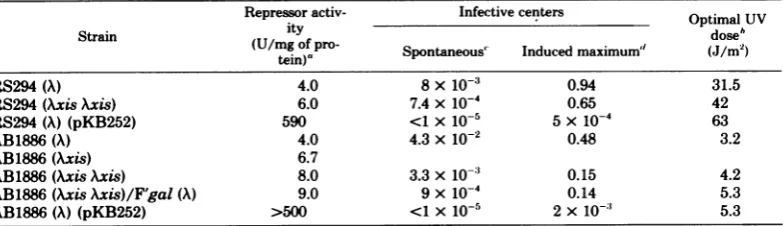
with washing buffer. Thefilters were either dried and results (Table 1) indicate that, while multiple
covered with scintillation fluid or dissolved in scintil- lysogens have more repressor than single
lyso-lation fluid containing Triton X-100 and counted. Con- gens, the levels are not strictly proportional to
trols with radioactive Aiynn DNA were run atthe the number of cI gene
copies
percellperhaps
same time, and the percentage of nonspecific label
the
tnu eraof congene ceert
cel
rprer
sretained was subtracted from the experiments. The due to a
negative
control exerted by therepres-amount ofrepressor was calculated from the dilution sor protein upon its own promotor (8, 34, 43).
thatgave 50% of maximum binding. One unit of activ- The plasmid-bearing strains contained about
ity is defined as the amount of repressor that binds 1 100-foldhigherlevels ofrepressor,asnoted
else-,ug of operatorDNA. where (1).
Chemicals.Tetracyclinewaspurchasedfrom J. B. Spontaneousinduction. Thelysogeniccell
Roerig Division, Pfizer, Inc.,penicillin G sodium was lines were checked for the proportions of
spon-from Squibb, and beef liver catalase was spon-from Sigma. taneously induced bacteria in cultures. These
results, also presented in Table 1, show that
RESULTS double lysogens produced fewer infective centers
Single andmultiple lysogenswereconstructed spontaneouslythan didsingle lysogens,and the as described in Materials and Methods, and triplelysogen showedan evenlower level.Both
single lysogens were also transformed with A lysogens containing plasmids displayed an
inci-repressor-overproducing plasmids. Two bacte- dence of spontaneous induction 2 or more orders
rial strains were employed. One (RS294) is wild ofmagnitude lower than this. The AB1886
ly-type for all DNA repair enzymes. The second sogenic strains yieldedmany more infective
cen-(AB1886) isauvrAmutant,defective forcorren- ters than their RS294 counterparts. For each donuclease II activity (4), and thus unable to bacterial strain the incidence of spontaneous
incise DNAcontaining pyrimidine dimers (12). inductionwasfound to vary inversely with the The lackofexcisionrepair leadstosingle-strand repressorconcentration.
gaps onthecomplementary strand opposite the UV-dose response of RS294
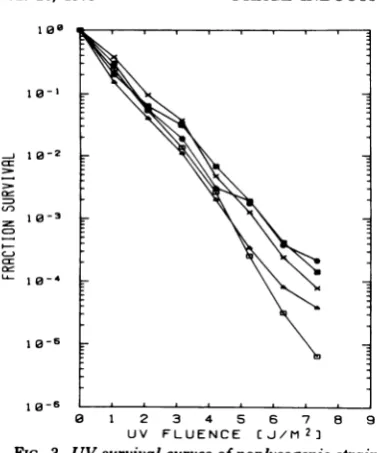
lyso-dimers (38), which makes this strain 10 times gens. Cells were irradiated with UV light to
moresensitive toUV (2). determinethe kinetics ofsurvival andtheyield
TABLE1. Concentrationsof A repressor andcomparisonofspontaneous and UV-inducedinfectivecenters Repressor activ- Infectivecenters OptimalUV Strain (U/mg
itmgoypo
of)"
Spontaneous" Induced maximum"(Mo)
dose'RS294(A) 4.0 8x10⁻³ 0.94 31.5
RS294(AxisAxis) 6.0 7.4x10⁻⁴ 0.65 42
RS294(A) (pKB252) 590 <1 x1O-5 5X 10⁻⁴ 63
AB1886(A) 4.0 4.3x10⁻² 0.48 3.2
AB1886(Axis) 6.7
AB1886(AxisAxis) 8.0 3.3x10⁻³ 0.15 4.2
AB1886(AxisAxis)/F'gal (A) 9.0 9x10⁻⁴ 0.14 5.3
AB1886(A)(pKB252) >500 <1 x 1°-5 2x 10-' 5.3
aRepressoractivityofthe
cell
extractswasdeterminedasdescribedin thetext.Samplescontaining2to20 ,ugofextractproteinwereused inassays,exceptforplasmidstrains, which had 100 times less. At 50% operator-bindingactivity,thenonspecific bindingofAimm434was10to12% formost extractsand less than 4% forplasmidstrains.
'This is the UVdosethatgavemaximal induction.
'Infective centers per cell obtained at acelldensity of 2x 10⁸/ml, minus the free phage determinedby
platingthesamecellsuspensionafter treatment withchloroform.Thefiguresare meansof severalexperiments.
dRatios ofthe infectivecentersobtainedattheoptimalUVdosetotheoriginalnumber of bacteria treated. Thefiguresare meansofseveralexperiments.
on November 10, 2019 by guest
http://jvi.asm.org/
[image:3.501.49.441.459.572.2]598 BALUCH AND SUSSMAN J. VIROL.
'oe § X the
wild
type 20 to 30% of thenonlysogenic
RS294 strainswerestillviable at the
correspond-ing optimal
induction dose. Atoptimal
UVflu-encesfor induction, the single lysogen reached
a
yield
of 48%infectivecenters,while the double10-l and
triple lysogens
reached amaximum of 15%.\\\"
phage-producing
cells (Table 1). Nevertheless,acorrelation of
inducing
UV dose with repressorconcentrationwasapparent(Fig.4).
a: \ \ \' UV-dose response ofplasmid-bearing
ly-sogens. When plasmids that overproduce
Aind+ or Aind- repressor were introduced into
single lysogens, they impartedanincreased UV
z \ \ resistancetothe
lysogens,
tosuchanextentthat_- \ \the survival kinetics became similar to those of
CD 1-3 the respective nonlysogenic strains
(Fig.
1 andcc:
E \ \^
5).
These resultsimply
that the UV fluencesusedwere not sufficientto inactivate the
large
amountofrepressorsynthesized bythe plasmid-containingstrains. Theonlydifference between
10-4 the lysogens with excess Aind+ repressor and
those with Aind- repressor is that the former
1 .8
I~~~~~~~~~~~~~~~
0I\5
0 10 20 30 40 50 60 70 80 0.9
UV FLUENCE tJ/M2,
FIG. 1. UVsurvival curves of strain RS294
nonly-sogenicandlysogenicsublines.E,RS294;El,RS294
808
. -(A); A, RS294(AxisAxis);0,RS294 (A)(pKB252); ,RS294(A) (pind-). All curves in this and subsequent i I I figures represent means of several experiments. 08.7
0-~~~~~~~~~~~~~~0
ofinduced bacteria (Fig. l and 2). It had been b 8.6previouslyestablished that the greater sensitiv- 0L
ity of lysogenic strains to UV light is due to
"J
inductionofphage (26). The results of this study co
demonstratethat single lysogens are more sen- I /
sitive to killing than double lysogens, whereas ,
thesingle lysogenscarrying plasmids that syn-
c
8 .4thesize an excess of repressor were
killed
with ikinetics similartothe
nonlysogen.
These differ--ing sensitivitiestowardsradiation were also seen 08 .3
in the production ofinfective centers (Fig. 2): i
the single lysogen was induced atlower doses Z 8
than thedouble, and the plasmid-carrying lyso- 0.2
gen needed stillmore UVfluence. The fraction
ofinduced cells at the optimal dose was
1,000
8 1timeslower in the repressor-overproducer strain
(Table 1). At higher doses yet, the cells lose the
capacity to support growth of the phage (28). 0.0 1 . I
UV-dose response of AB1886 lyso- 8 10
20
30
4050
60 70gens. The survival of strain AB1886 lysogens UV FLUENCE
jJ/Mi2i
atdoses of 1 to 4
J/m2
(Fig. 3) did notshow a FIG 2. UV induction ofA in lysogens ofRS294significant difference, because the sensitivity of containingone or
more
active cigenomes
ofA.Ordi-this strain to
killing
is such that at maximum nate: number of PFU obtained at the UV doseindi-induction of the single lysogen only about 2% of cated on abscissa, dividedby the number of PFU
the nonlysogenic cells were viable, whereas in obtained at the optimal UVdose.
on November 10, 2019 by guest
http://jvi.asm.org/
[image:4.501.274.460.300.605.2]IOs DISCUSSION
The
following
conclusionsstemfrom the data-l~~~~,
~~~presented
] inthispaper.1|
P(i)
Repressor
is
present
in progressivelyin-creased concentrations in
isogenic
strainslyso-genic
forone, two, and threeA genomes(Table
-2 \\\hx -
1).
Therepressorlevelsinthesingle
and doublelysogens
varied over a 1.5-fold rangefor strainRS294 anda2.25-foldrangebetween thesingle
10-3 - \ \ - and
triple lysogens
of AB1886.(ii)
Theoccurrenceofspontaneously
inducedC=
\&cells
isinversely
related to therepressorconcen-10
-4 - \\t\s, - tration (Table 1).(iii) Corresponding
lysogens
of a uvrAmu-tant,
incapable
ofexcising pyrimidine dimers,
I
0-\
display
amuchhigher
incidence ofspontaneous
induction while
maintaining
the samegeneral
trend betweenrepressorlevel and
yield
ofinfec-10~-6
'___
'___
'___'__'___'___'___'
tivecenters(Table 1).
0 1 2 3 4 5 6 7 8 9
(iv)
The same parameters, i.e., repressor levelUV FLUENCE C J/M 2] and capacity of the host for DNA repair,
influ-FIG. 3. UVsurvival curves of nonlysogenic strain AB1886 and its sublines containing one or more
active cIgenomes ofA.*, AB1886; O,AB1886 (A); 1 ,, A, AB1886 (Axis Axis); x, AB1886 (Axis
Axis)/
F'gal(A); 0, AB1886 (A)(pKB252).
0
Lj 9.
i
0B
'/ W
147g
,<19'm
Symol9.5 inFgB.012
C_ C ,
t~ ~~U FLENEt /M2
conta9.3n AB86()wsaottesm,53 ()(K2- ) ,A18 A pn-.Tefatoso
-1 9.2 th abcsaie
C-)0V(/M)4LUNC
AB18 cotiig nrmoeatvecgnme31- ItrL'
Pr
' 'Sybl as inFi. .91 23 56 8
proucd nfctVecentErsCirespnetoirdi-UMFU2E JM
tion, while
the latter never showed inductionAFIG.
5. UV-doserespornseofstrainAB1886andits (Fig. 5). The optimal UV dose for thetriple
Xlysogens
containing repressor-overproducing plas-lysoenoAB186ad fotheind+plasid-mids.
Survival (open symbols) or infective centerscyogeninof
AB1886(Aand fboruth tnde psasmid-5
(closedsymbols); 0,AB1886nonlysogen; 0,AB1886
contaningAB186(A wasabou thesame 5.3 (A) (pKB252);A,
AB1886
(A)
(pind).
Thefr-actions
ofJ/m',
butonly
2in 1,000 cellsofthelatterwere infective centers ofthis
last strain weremtuch
less inducible,comparedto14% of the former(Table thanlIO5,
butforconvenience have beenplacedon1). theabscissa line.
on November 10, 2019 by guest
http://jvi.asm.org/
[image:5.501.48.237.54.281.2]600 SUSSMAN J. VIROL.
ence the rate of inductionelicited by UV radia- gammaraysin the presence ofchloramphenicol
tion, much as they do the rate of spontaneous abolishes operator-binding activity without
induction (Fig. 2, 4). This further supports the cleaving all the repressor present in the cell.
conceptthat both types of induction proceed via Shinagawaetal.(40)conclude from their results
the samemolecular mechanism, as concluded by that there may be two stepsleading to repressor
Jacob and Wollman (21) based on the correla- cleavage. In the first step, the repressor could be
tion between spontaneous induction of different modified, perhaps allosterically or by absorption
strains and degree of inducibility. to damaged DNA,sothat it can no longer bind
(v) At extremely high repressor levels, pro- to operators. Inthe second step, an
endopepti-duced byjoining the cI region of A to lac oper- dase could cleave the modified repressor.
ators in the pKB252 plasmid strains, the UV The induction model proposed by Sussman
fluences tried wereincapable of inactivating all and Ben Zeev (41)is consistent with theresults
the repressor present in the cells, and the kinet- ofthis paper. Workperformedinourlaboratory
icsof cell death wereequal to those obtained for (manuscriptinpreparation)shows thatpurified
the sensitive, isogenic strain (Fig. 5). A repressor has a very high affinity for
double-The purpose ofperforming these determina- strandedDNAcontaining single-strandgaps.In
tions was to gain insight into the events that contrast, its affinity for intact or nicked
non-follow the primary DNA lesion (produced by operator DNA, as well as denatured DNA, is
UV in thiscase) and the final inactivation of A very low. Also, purified Aind- repressor has a
repressor. We know that the primary lesion has considerably lower affinity for gapped DNA.
to be processed further, since blocking both Basedontheseresults,webelieve that the DNA
pathways ofDNArepair (excision and postrep- repair intermediate isadouble-strand DNA
he-lication) prevents A induction (3); therefore an lix containing a persistent single-strand gap
intermediate in DNA repair is involved. A priori, which would bind A repressor. We explain the
we can reason that, if the role of this interme- requirement for recA+ genotype (and also for
diate,oreffector, istoactivate a catalytic func- the LexA+
phenotype,
since lexA- mutants dotion necessary toinactivate repressor, then the notsynthesizerecAproteinafterinducing
treat-optimal UV dose capable of inducing the cata- ments [14]) by assumingthat therecA protein
lytic function should be roughly the same in binds to single-strand DNA (17), thereby
pro-isogenic strains, regardless of a 1.5- to 2.5-fold tecting its physical integrity (16, 42). In its
ab-increase in repressor concentration.On the other sence, the single-strand gaps in the host DNA
hand, if theeffector interacts with the repressor, probably collapseand become substrate forthe
such as an allosteric inducer or the binding of endonucleolytic activity of itsrecBC-coded
ex-repressor to a DNA lesion, we should expect a onuclease V (18, 25, 45), which destroys its
in-close correlation between the UV dose and the ducing capacity. The thermal induction of the
concentration of repressor. The results obtained tif mutant (22) canbeexplainedasfollows. The
support the latter possibility. Therefore, any tif product has been found to be a missense
model of A induction should be able to explain recA protein (10) which is constitutive at high
this correlation. An unrestrictedcatalytic model temperature. We postulate that the mutation
suchas thatproposed byRoberts and Roberts increases the affinity of this protein for
single-(36) doesnoteasilyaccountfor thesefacts. Rob- strand DNA at 42°C, binding to temporarily
erts et al. (37) proposed an alternative model, denatured areas of the chromosome
(recombi-postulatingthat the repressor maybe altered by nation regions or others) and maintaining the
interaction with another molecule and thereby single-strand bubbles for longer than usual. The
becomesensitivetothe protease. It would have DNAbubbles wouldnotbedetectedby alkaline
tobe furtherassumed that this interacting mol- gradients, or be degraded by nucleases due to
ecule is the effector produced by the repair of thepresenceoftif-recA protein,butwould
con-primaryDNAlesions. Avery recent model pro- stituterepressor-binding sites.
posed by Gudas and Mount (15) states that a Ihvivo, both repressor and recA protein might
DNA damage product, possibly a nucleotide, is bind to the same single-strand structure, thus
an activator of the recA protein which, once providing the continuity that would allow the
modified, is responsible for inactivation of re- latter to cleave theformer. In this context, the
pressors. Theseauthors, as well as J. W. Roberts results ofPollard and Fluke (E. C. Pollard and
(personal communication), indicate that the D.J.Fluke, Biophys.J. 17: 144a, 1977), showing
recA protein is probably the ATP-dependent lack of inducedradioresistancein Alysogens but
protease that cleaves A repressor. Ifrepressor not in Aind- lysogens, are highly interesting,
inactivation is just a catalytic process, as the suggesting that A repressor may compete with
modelofGudasandMountimplies, it isdifficult recAprotein for binding sites produced after UV
to explain the finding (40) that induction by treatment.
on November 10, 2019 by guest
http://jvi.asm.org/
ACKNOWLEDGMENT repression assurant l'immunite chez les bacteries lyso-This investigation was supported by National Science genes. C. R. Adad. Sci. Ser. D 248:3219-3221. Foundationgrant PGM 76-03912. 21. Jacob, F., and E. L.Woliman. 1953. Induction ofphage
development inlysogenic bacteria. ColdSpring Harbor LITERATURE CITED Symp. Quant.Biol.18:101-119.
22. Kirby,E.P.,F.Jacob,andD. A. Goldthwait. 1967.
1. Backman, K., M.Ptashne, and W. Gilbert. 1976. Con- Prophage induction and filament formation in a mutant struction ofplasmids carrying thecI gene of bacterio- strain of Escherichia coli. Proc. Natl. Acad. Sci. U.S.A. phageA. Proc. Natl. Acad. Sci. U.S.A. 73:4174-4178. 58:1903-1910.
2. Boyce, R. P., andP.Howard-Flanders. 1964. Release 23. Lowry,0. H., N. J. Rosebrough, A. L. Farr, and R. J. of UV light-induced thymine dimers from DNA in Randall. 1951. Protein measurement with the Folin Escherichia coli K-12. Proc. Natl. Acad. Sci. U.S.A. phenolreagent. J. Biol.Chem. 193:265-275.
51:293-300. 24. Lwoff, A.,L. Siminovitch, and N. Kjeldgaard. 1950. 3. Braun, A. G. 1976. Host DNA replication or excision Induction de la production debacteriophages chez une repairrequirement forultraviolet induction of bacterio- bacterie lysogene. Ann. Inst. Pasteur (Paris) phageAlysogens. Nature (London) 261:164-166. 79:815-859.
4. Braun,A.G., and L. Grossman.1974.Anendonuclease 25. Mackay, V., and S. Linn. 1976. Selective inhibition of fromEscherichia coli that acts preferentially on UV- theDNase activity of the recBC enzyme by the DNA irradiated DNA and is absent from uvrA and uvrB binding protein from Escherichia coli. J. Biol. Chem. mutants. Proc. Natl. Acad. Sci. U.S.A.71:1838-1842. 251:3716-3719.
5. Castellazzi, M., J.George, and G. Buttin. 1972. Pro- 26. Marcovich, H. 1956. Etude de l'action des rayous ultra-phageinduction and cell division in Escherichia coli. I. violets sur le systemelysogene Escherichia coli K-12 Furthercharacterization of the thermosensitive muta- (A), K-12s, A. Ann. Inst. Pasteur (Paris) 91:511-522. tion tif-1 whoseexpression mimics the effect of UV 27. Martin, S. E., R. S. Flowers, and Z. L. Ordal. 1976.
irradiation. Mol. Gen. Genet.119:139-152. Catalase: its effect on microbial enumeration. Appl.
6. Cohen, S. N.,A.C.Y.Chang,andL Hsu. 1972. Non- Environ.Microbiol. 32:731-734.
chromosomal antibioticresistance inbacteria:genetic 28. Mattern, I. E., M.P. van Winden, and A.Rorsch.
transformation of Escherichia coli by R-factor DNA. 1965. The range of action of genescontrolling radiation Proc.Natl. Acad. Sci. U.S.A. 69:2110-2114. sensitivity in Escherichia coli. Mutat. Res. 2:111-131. 7.Donch, J.,and J.Greenberg. 1974. The effect of lex on 29. Miller, J. H. 1972. Experiments in molecular genetics. UVsensitivity, filament formation and A induction in Cold SpringHarbor Laboratory,Cold Spring Harbor, Ion mutants of Escherichia coli. Mutat. Res. N.Y.
25:403-405. 30. Mount, D.W.,and C. Kosel. 1975. Ultraviolet induced
8. Dottin, R.,L.Cutler, and M. Pearson.1975.Repression mutation inUV-resistant, thermosensitive derivatives and autogenous stimulationinvitroby bacteriophage oflexA strains of Escherichia coli K12. Mol. Gen. lambda repressor. Proc. Natl. Acad. Sci. U.S.A. Genet.136:95-106.
72:804-808. 31. Noack, D., and S. Klaus. 1972. Inactivation kinetics of 9. Echols, H., and L. Green.1971.Establishment and main- Lambda phage repressors in a mutant of Escherichia
tenanceofrepression by bacteriophagelambda: therole coli temperature sensitive in DNA replication. Mol.
ofthe cI, cI, and cIII proteins. Proc. Natl. Acad. Sci. Gen.Genet.115:216-224.
U.S.A. 68:2190-2194. 32. Ogawa, T., and J. I. Tomizawa. 1967. Abortive
lysogen-10.Emmerson, P.T.,andS. C. West. 1977.Identification izationofbacteriophage lambda b2 and residual
im-ofprotein X of Escherichia coliastherecA/tif gene munity of non-lysogenic segregants. J. Mol. Biol. product. Mol. Gen. Genet. 155:77-85. 23:225-245.
11.Goldthwait, D., and F. Jacob.1964.Sur le mechanisme 33. Radman, M. 1974. Phenomenology of an inducible mu-del'induction dudeveloppement duprophagechezles tagenic DNA repairpathway in Escherichia coli: SOS bacteries lysogenes. C. R. Acad. Sci. Ser. D 259: repairhypothesis, p. 128-142. In L. Prokash, F.
Sher-661-664. man, M.Miller, C. Lawrence, andH. W.Tabor(ed.),
12. Grossman,L.,A.Braun,R.Feldberg,and I. Mahler. Molecular andenvironmental aspectsofmutagenesis.
1975.Enzymaticrepair ofDNA. Annu.Rev. Biochem. CharlesCThomas, Publisher,Springfield, Ill.
44:19-43. 34. Reichardt, L. 1975. Control of bacteriophage lambda
13. Guarneros,G.,and H. Echols. 1970.Newmutantsof repressorsynthesis: regulationof the maintenance path-bacteriophageA with aspecific defectinexcision from wayby thecroandcIproducts. J.Mol. Biol.93:281-309. thehostchromosome. J. Mol. Biol.47:565-574. 35. Reuben, R., M.Gefter, L.Enquist, and A. Skalka.
14. Gudas,L.S. 1976.TheinductionofproteinXinDNA 1974. Newmethod for the large-scale preparation of
repair and celldivision mutantsof Escherichiacoli.J. covalently closed A DNA molecules. Virology
Mol.Biol.104:567-587. 14:1104-1107.
15.Gudas,L.S.,andD.W.Mount. 1977.Identification of 36. Roberts,J. W.,andC. W. Roberts. 1975. Proteolytic
the recA(tif) geneproductofEscherichiacoli. Proc. cleavage ofbacteriophage lambda repressor in induc-Natl. Acad.Sci. U.S.A. 74:5280-5284. tion. Proc.Natl.Acad. Sci.U.S.A.72:147-151. 16.Gudas, L. S.,and A. B.Pardee. 1975.Model for the 37. Roberts, J. W., C. W. Roberts,and D. W. Mount. 1977.
regulation of Escherichia coli DNArepairfunctions. Inactivation andproteolyticcleavageofphageA repres-Proc.Natl.Acad. Sci. U.S.A. 72:2330-2334. sorinvitro in anATP-dependentreaction. Proc. Natl. 17.Gudas,L.S.,and A. B. Pardee. 1976. DNAsynthesis Acad. Sci. U.S.A. 74:2283-2287.
inhibition and the induction ofproteinX in Escherichia 38. Rupp,W.D.,and P.Howard-Flanders. 1968. Discon-coli. J. Mol. Biol. 101:459-477. tinuities inthe DNAsynthesized inan
excision-defec-18. Hertman, I.1969.Survival, DNA-breakdown andinduc- tive strain ofEscherichiacolifollowingUVirradiation.
tionofprophageLambda inEscherichiacoli K-12 recA J. Mol.Biol.31:291-304.
uvrB double mutant. Genet. Res. 14:291-307. 39. Shinagawa,K.,and T. Itoh. 1973. Inactivation of DNA 19. Hertman,I.,and S. E. Luria. 1967. Transduction studies bindingactivityofrepressorin extractsof lambda
ly-on therole of arec+geneinUV induction ofprophage sogens treated with mitomycin C. Mol. Gen. Genet.
A.J.Mol. Biol. 23:117-133. 126:103-110.
20. Jacob, F., and A.Campbell. 1959.Sur le systemede 40. Shinagawa,H., K.Mizuuchi, and P. T. Emmerson.
on November 10, 2019 by guest
http://jvi.asm.org/
1977. Induction ofprophage lambda by-y-rays,mito- 44. West,S.C.,K. A.Powell,andP.T. Emmerson. 1975. mycinCandtif; repressorcleavage studiedbyimmu- recA+-dependent inactivation of the A repressor in
noprecipitation.Mol. Gen. Genet.155:87-91. Escherichia coli lysogens by -y-radiation and by tif 41. Sussman, R.,and H. Ben Zeev. 1975.Proposed mech- expression.Mol. Gen. Genet. 141:1-8.
anism ofbacteriophageAinduction:acquisitionofbind- 45. Willetts,N.A.,and A. J.Clark.1969.Characteristicsof ingsitesfor ArepressorbyDNA of the host. Proc.Natl. somemultiply recombination-deficientstrains of Esch-Acad. Sci. U.S.A. 72:1973-1976. erichiacoli. J.Bacteriol.100:231-239.
42. Tomizawa,J.,and H. Ogawa.1968.Breakageof DNA 46. Witkin, E. M. 1967.Theradiationsensitivityof
Esche-inrec+andrec-bacteria bydisintegrationof radiophos- richiacoli B: ahypothesis relating filament formation phorusatomsin DNAandpossiblecausesofpleiotropic andprophage induction.Proc.Natl.Acad. Sci. U.S.A. effectsof recA mutation. Cold Spring HarborSymp. 57:1275-1279.
Quant. Biol. 33:243-251. 47. Witkin,E.M.1976. Ultravioletmutagenesisandinducible
43. Tomizawa, J., and T. Ogawa. 1967. Effects of UV DNA repair in Escherichia coli. Bacteriol. Rev.
irradiationonbacteriophageAimmunity.J.Mol. Biol. 40:869-907.
23:247-263.