A Multi-sense Approach to Information Reception and
Knowledge Creation in Learning
Mehryar Nooriafshar
University of Southern Queensland Toowoomba,Australia
ABSTRACT
For thousands of years, human beings have acquired and processed information using a number of different senses. Hence, the use of different senses for information collection, analysis and remembering is something, which our brain can relate to very well.
The process of converting the information into knowledge, referencing and utilizing it, is carried out within the personal mind-based multimedia system of the human brain. The human mind can create the most sophisticated animations and multimedia as it can select different types of thought-based “audio” and “visual” effects as well as “actors”. In other words, the human mind has access to an unlimited amount of resources for designing the thought-based multimedia systems. Unfortunately, we are not able to transfer the information and knowledge in our mind directly to other people and sources. This may become possible in the future.
This paper explores the use of innovative and technology aided teaching methods, which utilize different modes and senses for the purpose of learning enhancement. Finally, it compares the learning outcomes and preferences of a sample of internationally selected students using a multimedia system, which attempts to cross the communication barriers in learning.
Keywords: multi-sense, multimedia, learning style preferences, learning by association
INTRODUCTION
sub-images, which are linked to each other. If we could somehow, transfer these images to another person in their original format then a great deal of time and effort would be saved. Unfortunately we cannot transfer our thoughts directly to other sources or people without the use of intermediate conversions. Using new technologies, one day, we may be able to transfer large amounts of information (data), and the necessary mental and physical skills to another person directly.
We can create the most sophisticated animations and multimedia in our thoughts as we can select different types of thought-based “audio” and “visual” effects as well as “actors”. In other words, we have an unlimited amount of resources to choose from to design our thought-based multimedia system.
At the present time, we do not have the technology for any direct interface and transfers of ideas between humans and machines and we rely very heavily on the use of text for information transfer and storage. One day, it will be possible to create the most sophisticated animations and multimedia in our thought; and then utilise the technology to capture and store them directly. Therefore, the technology will play a significant role in transferring our knowledge and ideas onto storage devices for future reference and other people’s use.
The use of different senses for information collection, analysis and remembering is something which our brain can relate to very well. It should be emphasised that images and sounds do not always have to be actual; they can also be virtual. Virtual images and sounds can be “seen” and “heard” in our mind. Perhaps the virtual-visual feature of our mind is the most active part in creating thoughts. When Aristotle said that without images thinking is not possible, he was probably referring to virtual images created in the human mind. We can, with the mind’s eye, visualise images of ideas.
The use of the early graphical-based writing is also a demonstration of the early human beings close association with images for information transfer and recording purposes. The use of images and symbols in this fashion led to development of hieroglyphics.
MULTIMEDIA AND EDUCATION
There is no doubt that a dedicated, skilled and knowledgeable teacher who uses speech, drawings, text, and possesses patience and willingness to repeat and interact with students is perhaps the ideal learning facilitator. This form of learning is probably the most effective type of “multimedia” learning too. It is rather hard to beat this kind of face-to-face learning. In addition to having visual, aural, text and other types of learning style preferences, in a face-to-face situation we can even utilise body language to reinforce the styles. Looking at the audience (learners) and reading their facial expressions to assess whether they fully understand is only possible in a traditional way of teaching.
So, if we can use the study/lecture notes and teach a subject in a face-to-face manner, then why do we need to simulate that process by creating computer based multimedia? The purpose is to simulate (not necessarily emulate) the classroom environment and make it available for those who are unable to attend lectures and tutorials (any face-to-face session) due to distance or enrolment mode. They can then have the opportunity of re-creating the classroom situation to suit their preferences.
Multimedia presentation of teaching materials can provide additional assistance for the learners in terms of creating the necessary images and sounds during their learning. It will also enable them to have more control in the learning process.
A less language-dependent approach in teaching/learning materials may allow us to cross the language barriers and make a significant contribution towards internationalisation of learning. For instance, we may compromise and encourage the use of more non-text based materials in the form of concept maps and animations.
Designing Effective Computer-based Multimedia
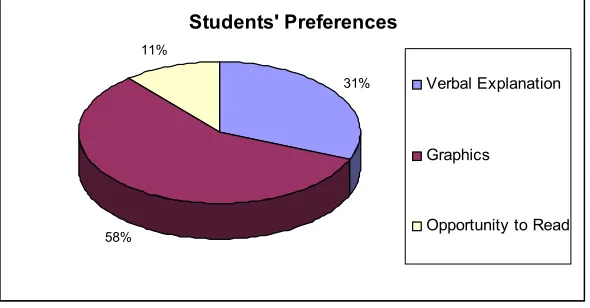
Based on a survey conducted on high school students in the Darling Downs region of Queensland, Australia (Nooriafshar, 2003) it was confirmed that a significant proportion of the students had a preference for visuals (graphics, images and diagrams), see Figure 1 below.
Students' Preferences
31%
58% 11%
Verbal Explanation
Graphics
[image:4.612.166.461.187.341.2]Opportunity to Read
Figure 1 – High School Students’ learning style preferences
In addition to catering for different learning style preferences such as visual, aural and text, teaching materials, regardless of the medium or mode, should also be based on established learning concepts and principles. For instance, encouraging the learner to build on what they already know is an effective teaching approach. This may be carried out by providing the learner with a reference point or base and then guide them to expand their knowledge. The analogy would be similar to giving the student the skeleton and then helping them to put the flesh on it.
A very interesting approach has been put forward by the well-known language teacher Michel Thomas. He adopts a less formal but very effective approach, which places an emphasis on understanding rather than memorizing. With this method, the learners do not need to take any notes, read from a book or even do any homework. Michel Thomas encourages the learners to construct their own learning material based on what they already know, see Thomas (2000). The same or similar approach may be applied to a variety of discipline areas.
linked to images or other easily remembered situations. These prompters are just memory handles which help the learner to remember and recall. These features should, when appropriate, be incorporated into an educational multimedia material.
When designing multimedia materials, we should also consider the fact that different senses invoke different parts of the brain. For example, the right-brain is the creative part and the left-brain is more sequential. So, balancing the process of information reception using different senses will allow us to use the full set of brain. Although we may lable ourselves as having a preference for either text, visual or aural, we use all of them. Text based information may not appear to represent images and sounds, but it can create the most vivid visuals in our mind. After all, writing originates from the mind-based images, sounds and actions. This has been demonstrated by writers and poets for centuries. As mentioned earlier the text-based information should be able to create the most effective and sophisticated virtual multimedia in our mind.
Therefore we do not have to convert every piece of information into real multimedia (images and sounds). Firstly, we have to pay attention to cognitive loading. As suggested by Lih-Juan (1997) the use of more than two modes can cause cognitive loading in the learners. Cognitive Load Theory suggests that when large amounts of information are presented at one time the learner can experience cognitive overload in working memory, as working memory has only a limited capacity. In effect the learner becomes overwhelmed with what is being presented, resulting in a loss of direction and focus (Lih-Juan, 1997).
Web Enhanced Multimedia Learning Environment (WEMLE) for Project
Management is based on the simulation of the way project management is taught within an undergraduate course at the University of Southern Queensland (USQ). It incorporates established educational concepts and the latest in web-based multimedia design. WEMLE has been developed by the author and his colleagues at the University of Southern Queensland (USQ – Australia), see http://www.usq.edu.au/course/material/MGT2102/
concepts (Schnotz, 2002). An appropriate analogy would be the way Dynamic Programming approaches solving reasonably complex problems by breaking them down to a number of sub-problems, solving these smaller problems and then finally putting the sub-solutions together to produce the main solution, see Nooriafshar (2002). However it should be re-emphasised that a multimedia presentation containing too many imbedded controls, also discussed above, might limit the effectiveness and efficiency of the learning event, actively retarding assimilation (Lai, 2001). The next section presents the findings of how WEMLE was used as an instrument to determine students’ preferences for learning in a multi-sense manner.
TESTING A MULTI-SENSE LEARNING METHOD FOR USERS’
LEARNING OUTCOMES
A sample of 100 Business students from the University of Southern Queensland (USQ - Australia) and the University of Texas in Arlington (UTA - USA) were chosen to participate in the survey. The objective was to identify the learning effectiveness of the same system (WEMLE) on these users (learners) and determine the learners’ learning style preferences. These students were given the opportunity to use the system on their own and then complete the online survey questionnaire.
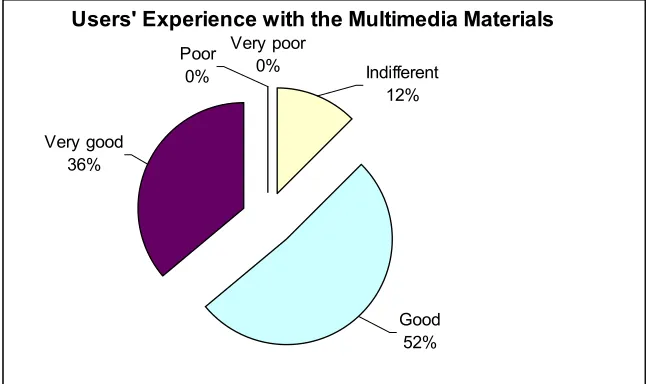
A very large proportion of the students who used the system indicated a favourable experience with the multimedia way of learning. See Figure 2.
Users' Experience with the Multimedia Materials Poor
0%
Good 52% Very good
36%
Indifferent 12% Very poor
[image:6.612.150.473.497.689.2]0%
When the data was further analysed it was found out that the preference for learning by using different senses was certainly high amongst the users.
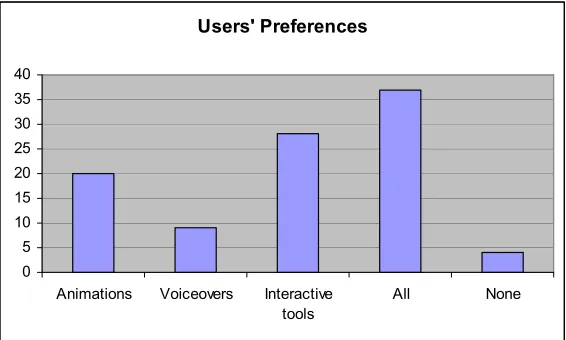
Figure 3 illustrates the students’ learning modal preference with regard to the WEMLE multimedia system. Visual features and interaction with the system appear to be most popular amongst the users. Almost every user who favoured the system’s interactive tools suggested that ease of understanding was the reason. A very high level of preference for all types of modes clearly indicates that there is a desire for using a number of senses in educational multimedia. It should be mentioned that giving choices for enabling/disabling media features to users is important. In addition to minimizing the cognitive loading problem, the ability to choose gives the student a feeling of being in control.
Users' Preferences
0 5 10 15 20 25 30 35 40
Animations Voiceovers Interactive tools
[image:7.612.171.454.282.452.2]All None
Figure 3 – Users’ learning style preference
0 10 20 30 40 50
Much less Less Same More Much more
[image:8.612.164.449.71.245.2]How Time-Consuming is Multimedia Comapred with Text-based Materials
Figure 4 – Comparison of the time spent on multimedia with the text-based materials
Influence on Understanding Poorly
2% Indifferent
16%
Positively 65% Very positively
17%
Very poorly 0%
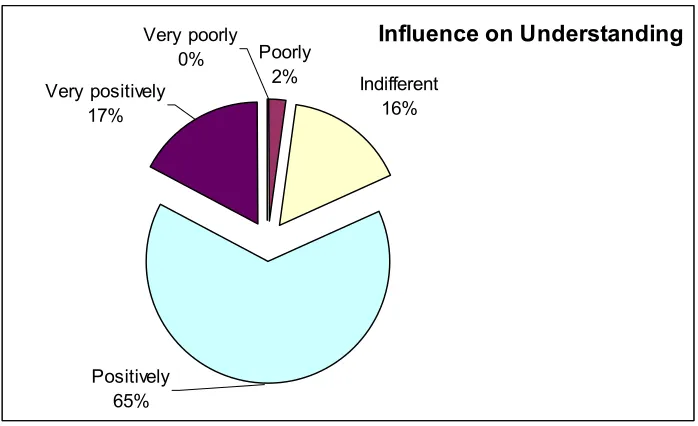
Figure 5 – The way that multimedia influenced the users’ understanding
[image:8.612.138.487.276.489.2]very important role in providing the additional assistance for achieving the multi-sense approach to learning.
CONCLUSIONS
The use of multimedia for learning was found to be a very effective method according to the students who participated in the study. The majority of the students who regarded multimedia an effective method of learning also had a very active interest in the use of computers and the Internet related technologies. The study found that students, who enjoy using computers and related technologies, also enjoy and benefit from a multimedia learning environment.
This demonstrates that a background and an exposure to modern technologies would certainly help students in the use of educational multimedia products. It is reasonable to predict that this will not be a problem or an issue in a few years time as the latest generations of students have been growing up with computers and computer technology related products around them.
It can be concluded that the majority of the learners represented by the samples of this study (selected from the Australian and American universities) have a preference for utilising a number of different senses for knowledge acquisition (visual, aural and text). This finding is compatible with the human beings’ well established desire and preference for information collection, processing and storage using several senses.
REFERENCES
Aristotle, De Anima (On the Soul), Penguin Classics, 1986.
Guide to Oxford (n.d.), The Oxford Story, University of Oxford.
Lai, Shu-Ling. (2001). ‘Controlling the Display of Animation for Better
Understanding’, Journal of Research on Technology in Education, 33(5), Summer
Nooriafshar (2003), ʺFactors Contributing to Making the Learning of Statistics an Enjoyable Experienceʺ, International Journal for Mathematics Teaching and Learning, May Issue.
Nooriafshar (2002), ʺUse of Web-Based Multimedia Technology in Teaching and Learning Mathematical Programmingʺ, Journal of Computers in Mathematics and Science Teaching 21(4), 331-349. [Online]. Available:
http://www.aace.org/dl/index.cfm/fuseaction/View/paperID/10628
Pigford, D.V. (1995), Expert Systems for Business concepts and Applications, 2nd edn,
Boyd and Fraser Publishing Company. Plato, Republic.
Schnotz, W. (2002). ‘Enabling, Facilitating, and Inhibiting Effects in Learning from Animated Pictures’, In R. Ploetzner (Ed.). International Workshop on Dynamic Visualizations and Learning, Tubingen, Germany: Knowledge Media Research Center.
Thomas M. (2000), Spanish with Michel Thomas (Introductory Course CD), Hodder & Stoughton Educational Division.
UNESCO (1999), The Revival of the Ancient Library of Alexandria, (1999), Retrieved 16 May 2002 from