Rochester Institute of Technology
RIT Scholar Works
Theses
Fall 2018
Genesee Waterways Center
Andrea Stylianou
Follow this and additional works at:https://scholarworks.rit.edu/theses
This Thesis is brought to you for free and open access by RIT Scholar Works. It has been accepted for inclusion in Theses by an authorized administrator of RIT Scholar Works. For more information, please [email protected].
Recommended Citation
G
ENESEE
W
ATERWAYS
C
ENTER
by
Andrea Stylianou
Thesis Submitted in Partial Fulfillment of the Requirements for the Degree of Master of Architecture
Department of Architecture Golisano Institute for Sustainability
Rochester Institute of Technology Rochester, NY
COMMITTEE SIGNATURE PAGE
Dennis A. Andrejko, FAIA Date
Head, Department of Architecture
Thesis Advisor
Dr. Callie Babbitt Date
Associate Professor, Department of Sustainability
Thesis Committee Member
Nana-Yaw Andoh Date
Assistant Professor, Department of Architecture
ACKNOWLEDGEMENTS
Dennis Andrejko, Nana-Yaw Andoh, & Callie Babbitt: Many thanks for your time, constant guidance, encouragement, constructive criticism & knowledge shared.
To the RIT Architecture Department, for constantly pushing me to challenge myself.
To Dr. Daniel Savoy, for his mentorship & encouraging me to pursue a Master of Architecture degree.
To my parents, for always inspiring & driving me to be my best self & supporting me & my education in every sense.
To my sisters, for being by my side through all aspects of my life.
ABSTRACT
The Genesee Waterways Center, or GWC, is home to multiple competitive and
recreational rowing programs and clubs, but lacks the appropriate facility to properly house and
cater to its patrons and visitors. Rowing is an activity that values discipline and teamwork and
has evolved into a sport that welcomes all those who are interested in joining. The GWC is
located in Rochester, NY’s Genesee Valley Park which brings many recreational visitors past or
through the boathouse. GWC wants to provide the opportunity for all those interested, but faces
three major problems: a disconnection with its surroundings, lack of a facility that can properly
accommodate its patrons and visitors, and polluted water with excess algae for those who row.
Clean water is vital to the environmental and social health of a community. This thesis
investigates the Genesee Waterways Center boathouse redesign to address the shortcomings of
the existing facility to one that can properly accommodate its many programs and members,
connect it to its surrounding site, and incorporate a water filtration system to participate in
Rochester’s educational efforts to clean and restore the Genesee River and weave it back into the
fabric of the city. The goal of this re-design is to create a more accessible riverfront that
energizes the area, restores the habitat and wildlife, unifies recreational opportunities, and
Table of Contents
COMMITTEE SIGNATURE PAGE i
ACKNOWLEDGEMENTS ii
ABSTRACT iii
TABLE OF CONTENTS iv
1. INTRODUCTION 1
2. PROBLEM STATEMENT 4
3. PROJECT MISSION 4
4. BACKGROUND 5
4.1 ROWING 5
4.2 THE BOATHOUSE 7
4.3 GENESEE RIVER POLLUTION 8
4.4 GENESEE RIVER CLEAN-UP EFFORTS 10
5. LITERATURE REVIEW 12
5.1 BOATHOUSE DESIGNS 12
5.1.1 Community Re-development & its Effect on the Waterfront 12
5.1.2 Concerns About Urban Parks in Sustainable Cities 13
5.1.3 Boathouse & Water Restoration Planning & Design Process 14
5.1.4 Evolution of Boathouses 15
5.1.5 Public Spaces as a Revitalization Tool 16
5.1.6 Athletic Facilities as Gateway to Sustainability 17
5.1.7 Water Restoration Through the Use of Architecture 18
5.2 WATER RESTORATION 22
5.2.1 Selecting the Appropriate Wastewater Treatment Technology 22
5.2.2 Monitoring & Evaluating Selected Water Treatment Method 24
5.2.3 Small Scale Water Purification Solution 25
5.2.4 The Process of a Largescale Wastewater Treatment Plant 26
5.2.5 Restoring All Types of Aquatic Ecosystems 27
5.2.6 Applying Biomimicry to Architecture for Natural Water Filtration 29
6. CASE STUDIES 31
6.1.1 Studio Gang 31
6.1.2 Indiana University South Bend Boathouse 35
6.2 PHOSPHORUS FILTRATION CASE STUDIES 38
6.2.1 Removing Phosphorus from Drainage Waters 38
6.2.2 USGS Water Filtration System 41
6.2.3 Blue Water Technologies Phosphorus Removal 42
6.2.4 Helpe Mineure River, Fourmies, France 43
7. BUILDING ANALYSIS 47
7.1 TRADITIONAL BOATHOUSE LAYOUT 47
7.1.1 Training Spaces 48
7.1.2 Social and Support Spaces 49
7.1.3 Storage 50
7.1.4 Exterior Spaces 51
8. LITERATURE REVIEW & CASE STUDY ANALYSIS 53
9. GWC SUSTAINABLE SOLUTIONS 58
9.1 CURRENT BOATHOUSE 59
9.2 PROPOSED BOATHOUSE 71
9.2.1 Program 72
9.2.2 Ground Floor 73
9.2.3 Second Floor 74
9.2.4 Architectural Features 75
9.2.5 Educational Experience 77
9.2.6 Current GWC vs. Proposed 92
9.3 PHOSPHORUS FILTRATION METHOD FOR GWC BOATHOUSE 94
9.3.1 Building Integrated System 94
9.3.2 How to Power 100
10. SUMMARY & CONCLUSION 114
11. LIST OF FIGURES 117
12. LIST OF TABLES 119
1. Introduction
The Genesee Waterways Center (GWC) is a boathouse located adjacent to the Genesee
River in Rochester, NY, which hosts a number of community-based programs. Its mission is to
bring people to the water and to provide unique recreational opportunities for the people of
Monroe County. GWC is home to several competitive collegiate and high school rowing teams
and offers learn-to-row programs, kayak clinics, and summer programs.
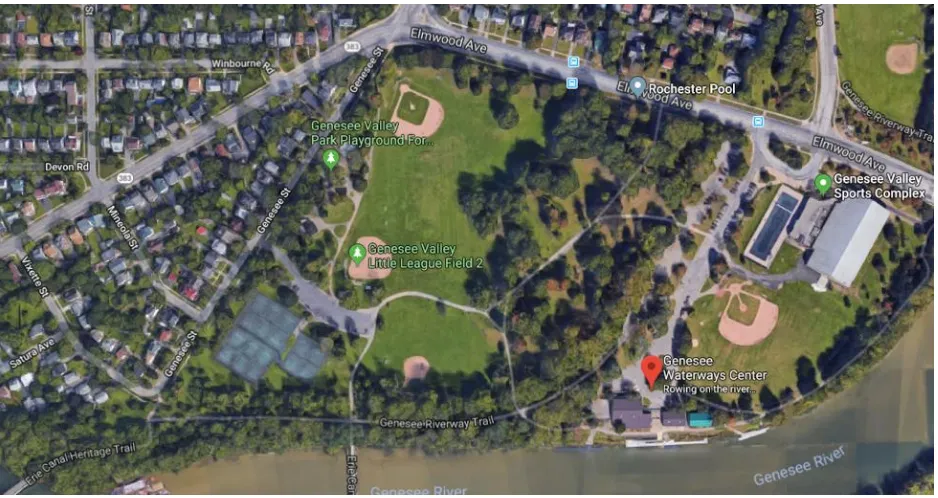
Figure 1: Location of Genesee Waterways Center, source: Google Maps
The GWC’s current building was originally designed as an auto repair shop in the late
1970s. Approximately twenty years later, GWC opened its doors to local paddlers and rowers in
Genesee Valley Park, shown in Figure 1, along with the Genesee Valley Sports Complex. The
two buildings act as entry points to walking and bicycle trails, baseball fields, tennis courts, and
waterways.
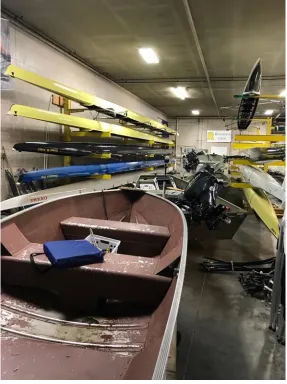
Figure 2: Genesee Waterways Center, source: author
Shortly after GWC’s opening in 1996, there were plans of a re-design to better
accommodate its new residents. The new plans fell through, however, leaving a continuously
growing program confined to the same space it opened up with twenty-one years ago, as seen in
Figure 2.
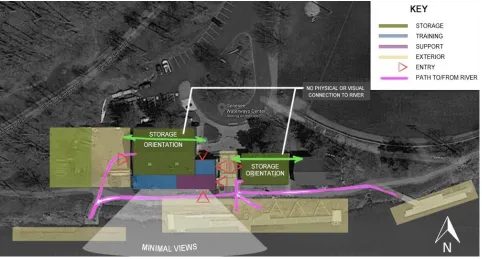
Although GWC is meant to act as an entry point to many recreational opportunities, it has
become a passing site instead of a destination. Unless visitors are specifically accessing the
facility, taking away from GWC’s mission of providing a community center.
Another problem GWC and its members face everyday is the current polluted state of the
river. The Genesee River, a historically significant river in Rochester, is infamous due to
contamination from industry use and agricultural run-off.1 Much of this pollution has since
ceased, but today’s biggest concerns for the health of the river are sediment and phosphorus (P)
pollution, which contribute to excess algae and bacteria. Rowers are exposed to the bacteria,
leading to a number of health risks; increased sedimentation and eutrophication reduces water
depth; and enhanced vegetative growth can block navigational and recreational use.2
In recent years, the city of Rochester has taken a number of steps towards building an
environmentally healthy city. The city has a wide variety of green initiative programs that allow
every type of audience to participate and to benefit from them. Few of the many green initiative
programs include the Brownfield Cleanup Project that has taken place at various locations, the
Clean Sweep program where thousands of volunteers collected thousands of tons of debris,
recycling programs, and a handbook written by the city that guides developers, institutions,
homeowners, and tenants through practical sustainable solutions. Local colleges like Rochester
Institute of Technology and University of Rochester have their own programs to help contribute
to Rochester’s efforts. The two universities aim to be leaders in promoting sustainability through
teaching, practicing, researching, and collaborating with individuals, organizations, government
agencies, etc. to further educate others about the significance of sustainability.
1 “The Genesee River.” City of Rochester. http://www.cityofrochester.gov/geneseeriver/.
2 Makarewicz, Joseph C. and Nowak, Matthew J., "Genesee River Monroe County, New York" (2010). Technical
2. Problem Statement
The purpose of this thesis design is to propose a recreational facility that enhances
activity through a more efficient and accommodating layout, acts as a water treatment station,
and creates a sense of community. The Genesee Waterways Center and its surrounding site
currently face the following social and environmental issues:
● Lack of facility, space, and equipment for competitive and recreational users.
● Contaminated river
● Lack of healthy human and water interaction
3. Project Mission
This thesis focuses on the requirements of a modern-day boathouse that integrates a
sustainable design solution to lower the river’s phosphorus levels. I am studying how the
Genesee Waterways Center boathouse can filter the Genesee River of its phosphorus pollution
because I want to find out how to integrate the GWC boathouse into the fabric of the city of
Rochester by restoring its historic rivers and enhancing clean water that is vital to the
environmental and social health of the city’s community. “The built environment influences
social behavior, promotes activity in and around the proposed architecture, and set a new
standard for future generations, and athletic design.”3 The goal of this re-design is to create a
more accessible riverfront that will work towards energizing the area, restoring the habitat and
wildlife, and bringing together the recreationally-minded community.
3 LaChance, Allison Marie, "Watt Community Rowing Center High-Performance Athletes Yield High-Performance
4. Background
4.1 Rowing
Though competitive rowing is one of the oldest and most traditional sports, it originally
began as a means of transportation prevailing in ancient Egypt and in the Roman Empire.4 Over
time, the act of rowing transitioned into a competitive act on the European and Middle Eastern
waterways, then became recreational, and was eventually introduced to the world of education.
The sport spread to elite preparatory schools and universities all over the world. According to a
former University of Maryland graduate student who focused her thesis on the Middle Branch
Boathouse in Maryland, “Today, the sport is once again at a point of transition,” as more rowing
programs are focusing on their surrounding communities to “expose those to rowing who would
not normally have the chance.”5 The sport of rowing, “also referred to as crew, is both a club
and competitive sport that continuously stretches the physical and mental limits of athletes both
on and off the water,” teaching its rowers the value of discipline, teamwork, and community.3
This sport is one that is a valuable community resource for health and community, making it a
great addition to the fabric of Rochester’s community.6 Along with the many physical benefits,
the social and personal values that are taught through rowing, “it instills notions of persistence
and self-efficacy in both youth and adults.”6 Participants are also allowed to “experience their
environment in a new way, fostering an appreciation of natural resources on the water.”6
Although “each team is unique in their coaching, rowing technique, and goals that encourages
4Britannica, The Editors of Encyclopaedia. "Rowing." Encyclopædia Britannica. August 15, 2018.
https://www.britannica.com/topic/rowing-boat-propulsion-and-sport.
5 Pless, Katlin Meredith. 2012. "The Middle Branch Boathouse: [Re]Bridging Water, Community & Sport." Order
No. 1535105, University of Maryland, College Park.
http://search.proquest.com.ezproxy.rit.edu/docview/1324128484?accountid=108.
success and teamwork,” every crew has a boathouse that assists in supporting the program.3
This sport is one that requires a significant amount of equipment and storage for both
indoor and outdoor seasons. Rowing shells, a narrow and long rowing boat designed for racing,
vary in size, ranging in overall lengths from 27 feet to over 60 feet long, as they differ in the
amount of rowers they carry, shown in Figure 3.
Figure 3: Rowing Shell, source: author
The smallest shell holds one rower, a single, and the largest holds eight rowers and a
coxswain, the steersman of the boat. In addition to the racing shells, each boat has a number of
components that come along with it, such as oars, ranging from 9 to 12 feet in length, seats,
footboards, and outriggers, which hold the oars into place. (Figure 4) Throughout the outdoor
season, a motorboat is always required to be on the water alongside the shells during practices
purposes. During the winter season, all equipment, including shells and their components and all
motorboats are stored away inside the boathouse. However, the rowing season does not end
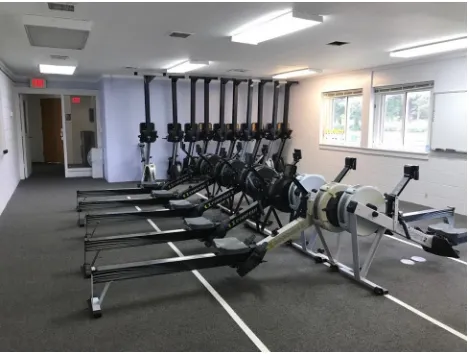
there. The winter season, December through March, rowing becomes more of an individual
sport and rowers practice and compete using indoor rowing machines. Only one rower can use a
machine at a time, requiring each crew to have multiple machines and a large enough space to
keep them in, along with other large training equipment.
Figure 4: Inside a Rowing Boat, source: http://www2.gvsu.edu/ciunganc/Index.html
4.2 The Boathouse
The boathouse plays a significant role in the sport of rowing, especially for a community
center that offers several recreational water sports to its visitors. While boathouses primarily
existed as a space for storing equipment, its role has greatly evolved along with many other
recreational facilities and sports arenas. Sports have changed greatly in the way they are viewed
by spectators. “The boathouse no longer exists as simply a storage facility from which to view
viewing and being viewed.”5 As the sport and its spectators have evolved in the way they
interact with each other, so must its home. The boathouse has a number of purposes, making it
primarily a community center today. It is a space for teams to gather, socialize, and transition
from land to water and back. It is also a place for recreational visitors to engage. Today,
boathouses are a “staging plaza to prepare and receive boats,” and a space for indoor training
during the indoor season of rowing.5 A variety of events happen in and around a boathouse
throughout the year, making it a destination all year long for administrative work, training,
preparation, regattas, or a series of racing events using rowed boats, summer camps, clinics, and
social events.
This project envisions that The Genesee Waterways Center boathouse will transition
from a storage facility with many disconnected programs that visitors stumble upon, to an open
and inviting destination that reintroduces a connection between land and water for the
community of Rochester. This boathouse will act as a connection between the different
recreational communities, bringing together all types of people, and reconnecting people with the
outdoors.5 “The boathouse must address the relationship of the body to the waterfront, both
through the movements of the sport, and through the relationship between spectator and sport.5
4.3 Genesee River Pollution
Since the 1950s, phosphorus levels have significantly increased in the Genesee River due
to wastewater treatment plant discharges, runoff, and erosion after rainfall. While a limited
amount of phosphorus is necessary for plant growth, an excessive amount can cause a dangerous
form of pollution. The problem with too much sediment and phosphorus is that they are
Eutrophication is the excessive richness of algae, which begins a cycle in rivers that becomes
difficult for the ecosystem to escape. An excess in algae requires more oxygen. The growth of
algae will continue until either oxygen or phosphorus becomes limited. As algae continues to
grow, light is unable to penetrate below the water surface. As the amount of oxygen decreases,
all oxygen-requiring organisms in the ecosystem are affected, causing deaths of fish species and
other aquatic organisms. If the rate of deaths increases, then more oxygen is necessary for
decomposition of fish species and other aquatic organisms and they are replaced by undesirable
species. However, since oxygen has become limited, the system of the river becomes
non-oxygenated and more changes occur, producing unpleasant odors and color changes. Increased
sedimentation with eutrophication will also reduce water depths, enhance vegetative growth,
blocking navigational waterways and impairing recreational use. Soil erosion is a major
contributor to sped-up eutrophication process as bank erosion during floods can transport a lot of
phosphorus from river banks and adjacent land to a stream of water. “Phosphorus also tends to
attach to soil particles and thus into surface water bodies from runoff.”7
NYSDEC’s river guideline recommends phosphorus levels to be at 20 μg P/L (micro
grams of phosphorus per liter). However, Genesee River’s phosphorus levels were found to be
at an average of 78.9 ± 14.9 μg P/L during a 2003-2009 report.8
Monroe County treats the Genesee River’s wastewater through eight treatment facilities
using a number of ways to purify wastewater from homes, businesses, and factories and send it
back to Lake Ontario. Two of the facilities, VanLare and Northwest Quadrant are biological
7 Perlman, Howard. “Phosphorus and Water.” Phosphorus and water: The USGS Water Science School.
https://water.usgs.gov/edu/phosphorus.html.
8 Makarewicz, Joseph C. and Nowak, Matthew J., "Genesee River Monroe County, New York" (2010). Technical
treatment plants and use the same cleansing processes that occur naturally in lakes and rivers.9
“Both facilities use chemical treatment, in the form of iron salts, to remove the nutrient
phosphorus by precipitation.”9
4.4 Genesee River Clean-Up Efforts
The restoration of the Genesee River has become a priority for the city of Rochester.
Other than the City’s efforts, several non-profit organizations have developed within the
community to assist reaching the city’s goal. Both the Genesee River Wilds and Genesee
RiverWatch were created with the single goal of restoring and protecting the Genesee River.
Genesee River Wilds was formed in 2008 and set out to accomplish their goal of
“improving the river’s health, protecting it from future environmental threats, and enhancing its
recreational potential” by “combining conservation, recreation, and business.”10 This non-profit
organization is determined to make ecological improvements. Its members have been doing so
by “adding forested riparian buffers along the upper Genesee River and its watershed that offer
water conservation, wildlife habitat, and natural flood control while accommodating existing
development.”10 In addition to environmental sustainability, this non-profit organization’s
purpose is to make social improvements as well. Their hope is that by adding parks, expanding
bicycle and running trails, improving existing facilities and adding new canoe and kayak
launches along the river, this will assist in increasing public interest and promoting a healthy
interaction with the Genesee.
9 “Wastewater: Collection and Treatment by Monroe County-Operated Facilities.” Monroe County Department of
Environmental Services.
Genesee RiverWatch has similar goals to Genesee River Wilds, to restore water
quality as well as promote active involvement with the river. Their approach to restoring water
quality differs in that they monitor the water quality monthly by gathering information and data
and have created a network of “eyes on the water” to report pollution or improper land uses on
5. Literature Review
5.1 Boathouse Designs
Today, cities have become vehicle-dominant, leaving little space for the pedestrians and
their recreational activities. This has had a great social and environmental impact on our
surroundings. The demand for pedestrian-friendly cities is leading to an increase in the
development of public outdoor spaces and their integration with the rest of the city. The articles
below discuss the value of natural landscapes and access to natural resources within the city and
why their restoration is necessary. Boathouses have evolved to become part of the natural
landscape within and the articles below demonstrate how they also act as tools within public
spaces.
5.1.1 Community Re-development & its Effect on the Waterfront
Brian Beresford wrote his thesis, “Thunderbird boathouse: a community development Fraser River-Middle Arm, City Centre Richmond,” to explore how the re-development of Richmond, British Columbia, would affect the riverfront. Beresford recognizes that with the way the city is redeveloping, the waterfront would gain more popularity and the boathouse community would need to adjust to the new improvements. Beresford uses his thesis to look into potential ways of developing the waterfront to “connect it to its existing and future landscape.”11
The objectives of the thesis are outlined at the start to identify each goal and how they will be
implemented. Beresford also identifies the city’s vision of the riverfront with a set of guidelines
to inform his design decisions. After a site, city, and zoning analysis, Beresford presents three
11Beresford, Brian I. "Thunderbird boathouse: a community development Fraser River-Middle Arm, city centre
design options and explains each option with its advantages and disadvantages. Although there
is an existing boathouse simultaneously acting as a community facility, Beresford further
develops the Thunderbird Boathouse to grow with its future landscape as well as its existing.
Beresford concludes that this riverfront will become a “central social and cultural axis” in this
urban environment, and emphasizes how the “culture, character, and sustainability of this region
can continue into the future” if developed properly.11
5.1.2 Concerns About Urban Parks in Sustainable Cities
Anna Chiesura’s article, "The role of urban parks for the sustainable city," discusses the many efforts that are made internationally to preserve the natural environment. Although green spaces are often limited in urban areas, Chiesura examines how natural areas provide positive services, including social and psychological. Natural areas that are well-preserved throughout cities is crucial for the well-being of its occupants. Research shows that natural elements are able to provide a reduction in stress levels and a sense of peacefulness, as well as a number of social benefits, “promoting the development of social ties and increasing social integration and interaction.”12
The author’s paper attempts to define what a sustainable city is by explaining that each city has its own criteria of what should be considered sustainable. Rather than delving into each environmental issue that can and should be solved, Chiesura focuses on the social and mental health of people and their general necessity of having clean, natural spaces to make their “city livable, pleasant, and attractive.”12 Chiesura interviewed a wide variety of people in the most
popular park in Amsterdam, Vondelpark. The survey “addressed a broad range of issues,
12Chiesura, Anna. "The role of urban parks for the sustainable city." Landscape and urban planning 68, no. 1
ranging from motives for nature, nature’s images, perception of environmental functions, environmental attitudes, and willingness-to-pay questions.”12 The results of this survey shows
that natural spaces do in fact provide positive benefits to people, indicating that they “fulfill important immaterial and non-consumptive human needs.”12 However, Chiesura points out that
although her results generally expressed people’s need for green spaces, cities’ natural spaces should have more diversity, such as vegetation and water for those with different interests. Different ages and perceptions of living environments affect “differences in reasons, activities, and feelings experienced in parks.”12
5.1.3 Boathouse & Water Restoration Planning & Design Process
A planning study of Anacostia River’s Boathouse Row has been developed by the District of Colombia Office of the Deputy Mayor for Planning and Economic Development and the Office of Planning in 2009. This land was transferred from the U.S. Government to the District of Colombia in 2008 as part of the Anacostia Waterfront Initiative. This planning study explains the overall goals of the project, its long-term vision, and gives a thorough explanation of the project’s context, planning process, existing conditions, and the context of the site.
of water recreation.”13 Two concepts are explored and discussed. “Concept 1 proposes that
most of the existing uses remain on site and are expanded,” which revolves around the issues of dredging, realigning, and widening the channel.13 The second concept is focused on not dredging
the Anacostia River, meaning that “motorized boat facilities may not be viable” in the long run.13
In this case, these uses would need to be relocated and new structures would need to be built to support these uses.13 The results of this planning study shows a more in depth plan of how each
guiding principle will be executed, but does not decide on one specific concept. It is concluded that either concept would work as short-term solutions, but some overlap between the two would take place to reach long-term solutions.
5.1.4 Evolution of Boathouses
Jeffrey D. Peterson describes in his Foreword, “Boathouses: Buildings for Re-creation,”
the evolution of boathouses, both their purpose and general design, from 19th Century urban life
to present day. Since the 19th century, boathouses became more prominent as industrialization
grew, allowing more time for leisure as there was less physical labor. Boathouses were
originally simple sheds exclusively used as storage spaces, but slowly transitioned into social
spaces as collegiate rowing grew more popular in England and the U.S. in 1829. Rowing
represented a moral ideal that the commission felt should be encouraged and required the
architecture to reflect that.14 “Strict spacing, orientation to the water, and dimensional
requirements were enforced” over the coming years, but many variations were seen throughout
the flourishment of boathouse construction, as it became a time of architectural competition
amongst the clubs.14 Traditionally, boathouses are designed with specific architectural features
13"Boathouse Row Planning Study." District of the District of Columbia Office of Planning. October 2010.
https://planning.dc.gov/publication/boathouse-row-planning-study-main-page.
such as distinct rooflines, a gable roof, arched openings, and industrial motifs, among many other
characteristics. Peterson gives many examples of boathouses that went against the traditional
design. Although several of the mentioned boathouses were designed with flat roofs, these
modern boathouses were still designed with bold and dramatic features, bringing a refreshing
take on the design of boathouses. A recurring theme that is brought up throughout his foreword,
is that boathouses have always brought us back or connected us to nature. Rowing was
developed as a sport because it was used as a means of physical and spiritual escape from cities
in the 19th century.14 This temporary escape from urban life lead people to visit rural boathouses
as part of recreational vacations.14 Today, the construction of modern day boathouses brings an
“awareness to the possible impacts of building on the water’s edge,” giving us a “greater
responsibility to do it well.”14 Peterson states that rowing creates a new group of people “to
whom the well-being of water becomes important,” creating a new kind of connection to the
waterfront, where the community cares about its waterfront.14
5.1.5 Public Spaces as a Revitalization Tool
“Planning the City Against Barriers. Enhancing the Role of Public Spaces,” by Aleksandra Sas-Bojarska and Magdalena Rembeza, studies several issues brought on by
technical barriers often found in cities, such as roads, railways, and infrastructures. A few of the many threats that are brought to cities include the destruction of the complexity of urban fabric, functional disadvantages, and environmental and landscape threats.15 Sas-Bojarska and
Rembeza argue that the city should be designed as one coherent system and unify public spaces with the urban fabric. This system can allow the city to become one linked network that
15Sas-Bojarska, Aleksandra, and Magdalena Rembeza. "Planning the City Against Barriers. Enhancing the Role of
provides “opportunities for the movement of people and wildlife between them.”15 Over time,
many cities have become increasingly vehicle-dominant, where this article believes it should be more pedestrian-dominant. A few strategies are suggested to decrease any division amongst cities, including artistic strategies. Artistic strategies “give new perspective connected with stimulating community involvement,” “can be used as effective tools for the revitalization of spaces” through public participation, and “can support the sustainable road planning.”15
Two case studies were done examining the Charles River Esplanade in Boston,
Massachusetts and Reagan’s Park in Gdansk, Poland. The two case studies show both sides, one where Boston’s public spaces are successfully integrated with its city, and how Reagan’s Park currently faces a large threat as a large road system is being planned. The Charles River Esplanade has many bridges, walkways, and river-park that ties the city’s every day walkways and cycling paths with the riverfront. The new roadway system that is being planned around Reagan’s Park will act as a barrier to a once open and accessible space also causing
environmental, landscape, and social problems. Overall, this article emphasizes the importance of one, cohesive city with accessible public spaces that functions harmoniously.
5.1.6 Athletic Facilities as Gateway to Sustainability
Sports arenas and athletic facilities go through extreme amounts of water and energy
usage, “even when they’re unused.”16 “In the past decade, gyms and arenas have been
recognized as sustainable gateway tools to raise awareness about the importance of
sustainability” and Teal demonstrates that there is an abundance of opportunities for sustainable
sports-related facilities.16 The U.S. Green Building Council (USGBC) and Green Sports Alliance
have collaborated with each other to show stadiums and athletic facilities that there are a number
of sustainable options for them.
5.1.7 Water Restoration Through the Use of Architecture
Justin Agustin Manongdo used his thesis to bring awareness to the value of water and
find a way to use architecture as a tool for collecting, protecting and respecting water.
Manongdo’s chosen site is the Ala Wai Canal in Waikiki, Hawaii, for his boathouse design, as
Hawaii is known “to protect the land that which feeds us, not just physically but emotionally and
spiritually.”17 These three words, “collect, protect, and respect,” is the main theme throughout
Manongdo’s thesis. Manongdo begins by explaining the current availability of freshwater,
where it is found or transported from, and how much climate change is affecting that.
Throughout his thesis, Hawaii’s value of freshwater is frequently discussed for health, personal
hygiene, and agriculture, as well as how vital of a resource it is throughout the world.
Manongdo analyzed how humans connect water and landscape through the utilization of architecture by demonstrating a variety of strategies to collect, protect, and respect water, sun,
and wind. He applied his frame to describe how water, sun, and wind are to be treated in the
process of collecting, protecting, and respecting. Manongdo discusses “reactivating unused
waterfronts or opportunity spaces” by studying waterfront precedents to apply to his own design and learn how it would bring people to these spaces.17 He studied waterfronts and three types of
architecture: resilient, tropical, and boathouse architecture. Each had strategies that were applied to Manongdo’s boathouse design including strategies for Collect, Protect, and Respect. Five different strategies, such as bioswales, sidewalk stormwater management, bioretention pond, roof
water collection, and terracing are defined and explained in how they can “allow architecture to have water present.”17
Bioswales, shown in Figure 5, slow, collect, and purify polluted water runoff. As water
goes through vegetation and soil, pollutants are captured, and water returns to its source.
The bioretention Pond, shown in Figure 6, is a system that collects both rainwater and
surface runoffs. Its purpose is to slow the process of water returning to its source but purifies the
water before doing so.17
Terracing is a Hawaiian strategy, shown in Figure 7, that “diverts water and slows,
purifies, and irrigates the plants within the system.”17
5.2 Water Restoration
The objective is to discuss the health of the water that surrounds boathouses and the
many ways to filter phosphorus from water. To provide some background, it is important to
understand the importance of healthy water ecosystems and the many methods that make water
restoration possible. Though there are numerous technologies and techniques that filter
phosphorus from water, each method requires its own particular materials, amount of space, and
maintenance. Various methods of water purification have been researched including artificial
filtration systems, small and large-scale systems, natural systems, and processes that mimic
nature. In addition to learning about the many types of water filtration and comparing and
contrasting which technology type is the best for its purpose, monitoring and evaluating water
treatment systems allows us to fully understand how much of an influence these different
systems can make, and which is the best fit for the Genesee River and its issues with phosphorus
pollution.
5.2.1 Selecting the Appropriate Wastewater Treatment Technology
In a Water Demand Management Workshop, Harald Schölzel and Rhonda Bower have
written a report with all the proper criteria that explains how a small-scale wastewater treatment
technology should be chosen. Their list of criteria consists of: effluent quality, water supply,
land space, maintenance and operation, cost, electrical requirement, and topography. In addition
to summarizing why each of these criteria are important in choosing a technology, Schölzel and
Bower have created a technology rating sheet that compares each technology. The sheet is
organized by primary, secondary, tertiary, and advanced treatment categories to compare each
technology equally, as demonstrated in Figure 8. The technologies discussed in this report are
water treatment technology can still be applied to this project.
Figure 8: Treatment categorization and technologies, Source: Veenstra and Alaerts (1996)
Each technology might require a different amount of land space, rated low, moderate, or
high. This depends on a number of criteria such as how large the equipment is, how many
components are required, and how much space it needs to operate. Land space availability is
often limited and cannot be negotiated, which is why it much be taken into consideration when
selecting the appropriate technology. Next, maintenance and operation play a major role when
choosing a technology, as there is “a certain degree of maintenance and skilled workforce to
perform maintenance and operational duties.”18 It is important to choose the proper level of
maintenance and operational duties that is right for that project site and its users seeing as the
18Schölzel, Harald and Rhonda Bower. Small Scale Wastewater Treatment Plant Project: Report On Project
chosen technology relies on both for it to work properly.18 Mechanical equipment requires a
certain amount of supervision, even at the lowest level of operation and maintenance, to keep the
system updated and prevent it from becoming non-operational. This also means the users
responsible for M & O must be thoroughly educated in how the system functions and what it
would need if it is not operating properly. Cost and topography are also important on the rating
list, although topography is “site specific.” Cost includes cost of construction, running costs, and
maintenance costs, which can help determine which technology type is chosen. “However,
people sometimes take the option of a less-than-adequate system that does not perform
satisfactorily giving out poor quality effluent for the sake of cutting costs.”18 Topography also
has an influence over which technology is chosen as it “can be more effective producing
better-quality effluent” and “allow easier implementation of wastewater technologies” or do just the
opposite.18 Table 1 below shows how each technology is arranged to be rated and compared to
each other.
Table 1: Example Rating Table
5.2.2 Monitoring & Evaluating Selected Water Treatment Method
Richard P Beverly’s book focuses on the full process of building a water treatment plant
from start to finish. Beverly emphasizes the importance of beginning with preliminary designs
and explains the value of starting with a simple small-scale, manageable pilot study. He explains
Technology Criteria
Process Type Effluent Quality Water Supply Land O & M Cost Electricity
Low (L)/ Moderate (M)/
High (H)
in detail every step that is necessary in a pilot study and the risks that the designer takes without
doing a pilot study. Along with focusing on the type of treatment process that will be used and
the cost of construction, Beverly discusses establishing methods of how waste will be disposed
of. “In some cases, the disposal of the chemical waste governs the type of treatment processes to
be used.”19 Next, he discusses the many filter types that can be used in water filtration, their
operational design issues, treatment processes and monitor controls, having an operator who
fully understands how to use all controls manually and automatically, and lastly, how to properly
conduct water quality evaluations. Richard Beverly’s information is extremely useful in that it
allows the designer to fully understand what goes into creating a water treatment plant and all the
important steps that must be taken before, during, and after the treatment plant’s construction.
Throughout his book, Beverly goes through every step and issue the designer might come across
through their design, but does not mention the significance of the size of a water treatment plant
at full-scale. He does, however, discuss bench-scale/jar testing that helps identify the proper
operating range of a plant, showing that both large and small-scale water treatment systems are
capable of making an impact.19
5.2.3 Small Scale Water Purification Solution
Strauss Water’s Maze is a “micro-scale” water purification device that is meant to be
installed in homes. This device has become a necessary product in “remote areas around the
world and even industrializing nations like China, India, and Brazil,” where they do not have
the “confidence in the safety, quality, and availability of the water that comes out of their tap.”20
19Beverly, Richard P. Water treatment process monitoring and evaluation. Denver: American Water Works Association, 2012.
The Maze is an “all-in-one” purifier that removes or reduced contaminants such as, heavy
metals, volatile organic contaminants, arsenic, and microbiological contaminants, and prevents
the development of bacteria and viruses. This “micro-scale” device shows that a large system is
not always the solution, but small-scale systems can make just as great of a difference, as there
is a strength in numbers.
5.2.4 The Process of a Largescale Wastewater Treatment Plant
The Stickney Water Reclamation Plant (SWRP) is the largest wastewater treatment
facility in the world located in Chicago, IL and owned and operated by the Metropolitan Water
Reclamation District. This treatment plant serves 2.3 million people in a 260 square mile area
and is capable of treating up to 1.44 billion gallons of water per day. This wastewater treatment
plant “mitigates flooding and converts wastewater into valuable resources like clear water,
phosphorous, biosolids, and natural gas.”21 This wastewater treatment plant uses processes
similar to the natural processes that occur in rivers in addition to physical and biological
processes combining air, gravity and microorganisms.21 There are three phases of treatment:
primary, secondary, and tertiary. The whole process of converting raw sewage to clean water
takes about 12 hours to be processed, cleaned, and released.21
Primary treatment begins with water entering the plant and filtering out large debris
through course screens. Water is pumped by gravity and flows throughout the treatment plant to
six 132-foot long aerated grit tanks and nine 160-foot diameter primary settling tanks removing
fats and oils to separate the solids from the water. The solids are then pumped to go through
their own treatment process where they become biosolids, an alternative to chemical fertilizers.21
21"Stickney Water Reclamation Plan." MWRDGC.
“By the end of primary treatment, 60-80% of the solids have been removed.”21 Secondary
treatment is where microorganisms help remove organic material from the wastewater. Air is
pumped through the water to aeration tanks, as microbes need oxygen. The water enters settling
thanks where remaining solids fall to the bottom and clean water flows out the top of the tank.
Next, clean water is released into the Chicago Sanitary and Ship canal.
This wastewater treatment plant is “regulated under the Environmental Protection
Agency’s National Pollutant Discharge Elimination System (NPDES) permit program,” where
rigorous standards are set and must be met.21 This treatment plant facility has received several
awards from the National Association of Clean Water Agencies and its work as also resulted in
an increase in “recreation on the waterways, such as kayaking and canoeing, a rebounding
aquatic habitat and increases in fish species.”21 Stickney WRP “is recovering valuable resources
and is expanding the use of biosolids throughout its region.”21
5.2.5 Restoring All Types of Aquatic Ecosystems
Clean-Flo International is a company that focuses on restoring water bodies using custom
engineered technologies that work with nature. They focus on bringing healthy aquatic
ecosystem backs to polluted, overgrown and dying water bodies. Clean-Flo International
recognizes that each water body is different and custom engineer each design to meet the specific
needs and requirements to achieve complete water body restoration. Clean-Flo uses six different
applications of restoration and aeration: pond lake, reservoir and river restoration, wastewater
treatment, and aquaculture. “Clean-Flo International has developed a water restoration process
surface, as beneath the surface of a river is a stagnant body of water, so that the entire river is
oxygenated by the system and the atmosphere.”22
The Clean-Flo River Restoration System uses inversion and oxygenation to enable
beneficial bacteria, insects, and fish to thrive on the bottom. This allows “beneficial bacteria to
feed on organic matter, and organic sediment is biodegraded into carbon dioxide and water.”22
As insects feed on organic matter and bacteria and fish feed on insects, there is an overall
improvement in fish health and growth rate. “In any water body, when the bottom is
oxygenated, phosphorus and nitrogen in the water column is bound to the sediment where it
becomes food for the beneficial bacteria and insects.”23 “Utilizing the Clean-Flo Continuous
Laminar Flow Inversion and Oxygenation aeration system and water treatment process for river
improvement and stream restoration, all parameters of water quality greatly improve. The river
water then becomes very clean and suitable for natural use.”23 One example of Clean-Flo
International’s River Restoration Project includes Helpe Mineure River case study.
Nonetheless, the Helpe Mineure River case study, although helpful in learning more
about Clean-Flo’s general water maintenance process, focuses on reducing ammonia and COD
levels. After speaking with a Clean-Flo representative, Clean-Flo’s process in reducing P levels
for a large-scale body of water, like the Genesee River, was discussed and carefully explained,
allowing for a more specific understanding. If there are excess P levels in water, an environment
needs to be created with maintained dissolved oxygen levels and then utilize bio-augmentation to
ensure a productive Food Chain is maintained so the excess P is directed into productive
metabolism.23 However, a river can create some difficulty as there is no retention time with the
22CFadmin. "River Restoration and Water Aeration Systems |." CLEAN-FLO. March 10, 2017.
https://www.clean-flo.com/systems/river-restoration/.
water flowing. Clean-Flo suggests that corrective interventions should be introduced along a
significant distance down the river or divert the water into a retention basin to treat and reduce P
before allowing the water back into the river.23 Another suggestion made by Clean-Flo includes
the installation of solar panels or water paddles. The water paddles are driven by the flow of the
river to generate electricity, which would be used to power a compressor to drive the aeration
units in the river.23
5.2.6 Applying Biomimicry to Architecture for Natural Water Filtration
When it comes to water filtration, there are a number of artificial systems that help clean
out water of contaminants, but there are also a number of ways that “mimic nature and its ability
to purify while controlling its flow.”24 Thomas Button explores the many ways that biomimicry
can be applied to architecture, including naturally managing and filtering water in site design.
Man-made ecosystems are created “through the use of bio-swales, green-roofs, rain gardens, tree
trenches, and roadside plantings.”24
Button discusses several ways that plants can be used as natural filtration systems,
including the “Biolytix® water filter,” “BioHaven® Floating Islands,” and “Algal turf
scrubbers.” Button explains that the “Biolytix®” is a “system that utilizes the wastewater from a
building and uses plants, stones and bacteria as a filter before releasing the water into the
environment,” as seen in Figure 9.24
24 Button, Thomas. "Biomimicry: A Source for Architectural Innovation in Existing Buildings" (2016). Thesis.
Figure 9: Biolytix water filter process, source: Biolytix
The floating islands are designed to sit atop waterbodies to aid in removing and
preventing water from further exposure to excess nutrients and that are harmful to water
ecosystems, illustrated in Figure 10.24
6. Case Studies
6.1 Boathouse Case Studies
The following case studies explore a variety of boathouses that push the sustainability
agenda through proposed concepts and established projects that face comparable problems to the
Genesee Waterways Center.
6.1.1 Studio Gang
Studio Gang, an architecture firm in Chicago, IL, has designed two separate boathouses
that once faced similar problems as GWC faces today. The two boathouses are located along the
Chicago River. Like the Genesee River, the Chicago River is long-polluted and neglected. The
city of Chicago began to take steps towards a revitalization plan in Chicago to transform the river
ecologically and recreationally, using four boathouses that sit adjacent to the river as
cornerstones.25 Studio Gang re-designed the WMS Boathouse at Clark Park in 2013 and the
Eleanor Boathouse at Park 571 in 2016, with the overall goal of a creating a healthy river.
The WMS Boathouse (Figure 11) and Eleanor Boathouse (Figure 12) are home to a
variety of different programs including rowing teams and clubs, learn to row programs, yoga
classes, etc. In addition to improving the river ecologically, Studio Gang’s designers also aimed
to improve the community’s health by making the riverfront a “destination for recreation.”25
Figure 11: WMS Boathouse at Clark Park, source: Steve Hall © Hedrich Blessing
The new boathouses allowed for an expansion of their programs and the materials used
creating a system that filters the water before returning to the river. The boathouses’ roof design,
“roof drainage elements and site design together function as its stormwater management system,
diverting 100 percent of runoff from the sewer,” as illustrated in the roof diagram in (Figure
13).25 Chicago’s method uses a more natural approach of reducing pollution through the use of
native plantings, beds of gravel, and rain gardens that retain and filter stormwater on-site before
slowly releasing it to the ground and river.
Another project by Studio Gang is the Memphis Riverfront Concept completed in 2017.
Two of the three principles this project was based on was to restore the natural conditions and
ecology of the Mississippi River and create a connective network of Memphis, Tennessee’s
[image:41.612.185.444.196.532.2]characteristics of people, culture, and existing urban spaces along the river (Figure 14).
Figure 14: Masterplan Overview, source: © Studio Gang
There was a major focus on five zones along the river. Each zone was opened up with
new walkways through their once overlooked communities with a variety of recreational
activities and pop-up events (Figure 15). A new boathouse, boardwalk, and shady grove was
people to the riverfront.26 Existing parks, paths, and public spaces have been connected, making
them more accessible. An Eco Hub has been constructed within one of the zones that has a
variety of new plantings and structures to amplify the river ecology. The Eco Hub offers
teaching and learning to the public as it is also a partner of University of Memphis and with the
Memphis Zoo. The Hub provides a hands-on research center for freshwater ecological and
science studies.
Figure 15: Memphis Riverfront Concept Rendering, source: © Studio Gang
6.1.2 Indiana University South Bend Boathouse
Sarah Fortson, a former architecture student of Ball State University, focused her thesis on
Indiana University’s Boathouse in South Bend alongside the St. Joseph River and East Race.
The goal of her boathouse design was to maximize physical and visual access to the river using
traditional boathouse facility organization. Fortson’s research shows the typical arrangement of
spaces, as well as traditional architectural characteristics of interior and exterior boathouses.
Fortson lists the four types of spaces found in a boathouse’s program and how they are
organized. The four general types of spaces are training areas, social and support areas, storage
areas, and exterior spaces. Training and social and support areas are commonly found on the
upper levels, whilst storage areas are placed on the lower levels for maximum access to the
water, seen in Figure 16. Architectural characteristics often seen in boathouses are arched
openings, multi-material construction, and industrial motifs.
Figure 16: Bubble diagram- Traditional boathouse organization, source: author
Fortson’s boating facility was designed with hopes of providing a hub of activity along her
proposed continuous park that would also accommodate and enhance the drama of traditional
the athletes.27 Through her project’s design, she also believes it is necessary to emphasize social
relaxation and physical exertion simultaneously, exhibit pride of the kayak and rowing clubs,
maximize physical and visual contact with the river for both athletes and guests, link interior and
exterior spaces and campus to the river. Fortson’s design is organized in such a way that
maximizes views of the river and brings the exterior inside by traditionally placing social and
training spaces on upper levels with balconies and large windows, as shown in Figure 17. This
provides all with maximum possible views of the river and allows natural light to pour into the
space. The club social hall provides a space for dining and lounging, emphasizing social
relaxation, while still in a facility that promotes the importance of physical exertion by having
training spaces, both on and off the water, club trophies and recreational path that surrounds the
boathouse on full display. The boathouse itself acts as a link between the university’s campus to
the river in a ceremonial way. The boathouse’s entrance was designed as a ramp, symbolizing
the docks during the launching of boats, which is traditional in competitive rowing, and
“emphasizes the importance of ceremony, circulation, and transition.”27
27 Fortson, Sarah B. 1992. "Indiana University South Bend boathouse and training facility for kayaking and rowing:
Figure 17: Indiana University South Bend Boathouse Analysis, source: author
6.2 Phosphorus Filtration Case Studies
Next, a variety of phosphorus removal methods and systems have been explored to learn
how each is constructed and its overall impact. Their results are analyzed and discussed to
understand if any could be successfully applied to the Genesee River.
6.2.1 Removing Phosphorus from Drainage Waters
A study was done by four associate professors from Oklahoma State University and
University of Maryland in 2013 looking into landscape filters that would remove dissolved
phosphorus in runoff before reaching streams and lakes. They found that industrial by-products
are typically land-filled, can easily be re-used in improving surface water quality by adsorbing
phosphorus from passing water.28 For this case study, “several phosphorus removal structures
28Penn, Chad, Josh Payne, Josh McGrath, and Jeff Vitale. "Designing Structures to Remove Phosphorus from
were constructed in residential and agricultural watersheds.”28 Industrial by-products such as flu
gas desulfurization gypsum and steel slag were used, two phosphorus sorbents, within the filters,
allowing them to be replaced after they lose their effect and representing a true removal of the
phosphorus, rather than temporarily blocking it.28 “The phosphorus removal filters were placed
in locations known to produce high dissolved P concentrations in runoff.”28 After eight months
of monitoring water flow and the filters and testing sixteen different sorbing materials, one filter
was able to remove about 25% of the dissolved phosphorus that had entered the structure. The
structure was found to be effective for about seven to eight months and was able to handle flow
rates over 100gpm.
Figure 18: Phosphorus removal structure located at Stillwater Country Club, source:
A phosphorus removal structure, shown in Figure 18 and Figure 19, can be constructed in many
different ways yet still be effective, as long as they contain the four basic principles:
a. Solid media with high affinity for P, commonly known as a “P sorption material,” or
PSM.
b. PSM is contained and placed in a hydrologically active area with high dissolved P
concentrations.
c. High dissolved P water is able to flow through the contained PSM.
d. The PSM is removable and replaceable after it’s no longer effective.29
Figure 19: Phosphorus removal structure diagram,
source: http://pods.dasnr.okstate.edu/docushare/dsweb/Get/Document-9345/L-447%20Phosphorus%20Removal.pdf
29 Oklahoma State University. L-447 Phosphorus Removal Structures.
6.2.2 USGS Water Filtration System
In 2012, a team from the U.S. Geological Survey (USGS) began designing a fully functional
phosphorus water treatment system. This filter system “uses discarded mining by-products,
called mine drainage ochre,” allowing the system to be cost-effective as well as environmentally
friendly.30 In 1999, USGS scientists found that ochre, a natural, porous mixture of clay, sand,
and ferric oxide, is an effective primary filtering agent to remove phosphorus from water.30
The USGS filter is constructed of large tanks, made of inexpensive, off-the-shelf components
rather than custom fabricated, that each hold about 600lbs of mine drainage ochre. Phosphorus
infused water is piped to the top of the tank using a gravity flow process, allowing it to pass
through the ochre and filtered water is released out of the bottom of the tank.30 Between the first
prototype’s design in 2012 at the USGS Leetown Science Center, it has taken a total of five years
to develop a large-scale filtration system, seen in Figure 20, that is “capable of filtering more
than 100 thousand gallons per day.”30
Figure 20: Phosphorus removal treatment plant, source: USGS
30 “New USGS Filter Removes Phosphorus from Waste Water.” USGS. July 19, 2017.
6.2.3 Blue Water Technologies Phosphorus Removal
Hayden Wastewater Research Facility, a research facility for Bluewater Technologies,
was constructed in April 2005 in Hayden, Idaho with the main purpose of “showcasing
phosphorus removal and developing future advanced water treatment processes.”31 The plant
provides wastewater treatment for the local community, but this system is also capable of
treating groundwater in addition to wastewater. The BluePro system uses a unique approach by
using a controlled, cost effective system by using advanced control techniques and patented
nutrient removal systems. Compared to its competitors, the BluePro system uses a lower amount
of chemical dosage throughout the entire treatment plant.
The BluePro sand filter, shown in Figure 21, uses a continuous backwash sand filter
process where the influent is distributed across the filter to the bottom of the sand column. The
water is filtered as it moves up the filter and sand coated with hydrous ferric oxide (HFO)
attracts and reacts with the phosphorus. Sand sinks to the bottom of the tank to an airlift device
and “phosphorus-laden media is transported into the washbox where discharged HFO coating
and adsorbed contaminates are separated from the media.”32 The velocity of the water in the
washbox was carefully designed to allow contaminates to be carried away while the media falls
into the filter bed. “Freshly scrubbed media from the washbox is recoated with HFO as the cycle
begins again.”32
All waste is removed from the filter through backwash allowing it to be recycled.
Recycling backwash upstream provides the added benefit of phosphorus to go through the
31Newcombe, Remy. “New System Optimizes Sand Filter Phosphorus Removal." WaterWorld.
http://www.waterworld.com/articles/print/volume-22/issue-2/feature/new-system-optimizes-sand-filter-phosphorus-removal.html.
treatment system more than once, further guaranteeing the removal of phosphorus.32 Through
the use of this system, BluePro consistently achieves low phosphorus or metal levels.”32
However, this removal system is only capable of filtering between 10,000 gpd to 1 MGD
(millions of gallons per day). While this could be an effective approach for a smaller sizes body
of water, the Genesee River’s flow rate is approximately 1,981,140.8 gpm, meaning this system
would not be an effective solution for this location.
Figure 21: BluePro Sand Filter, source: Nexom
6.2.4 Helpe Mineure River, Fourmies, France
Similar to Rochester, NY, Fourmies, France has a large textile industry with factories and
manufacturers, their Helpe Mineure River was greatly affected. As the river passes through the
unusable category.33 In the early 1970s, the town began to restore the river through a series of
actions including: “suppress direct discharges into the river, continue to upgrade storm runoff,
extend the sewage system, and improve the quality of treatment at the wastewater treatment
plant.”33 However, after all their efforts, results showed that oxygen levels were still too low
after passing through Fourmies.
Clean-Flo International joined Fourmies’s efforts in reoxygenating the river from
Fourmies to Rocquigny, about 30 miles south of Fourmies. Since the river is too shallow to
aerate directly, “Clean-Flo proposed to dam the river, divert it into a retention pond, aerate the
water, and return it to the river. Reoxygenation of the river was then instituted using the
Clean-Flo process of inversion/oxygenation,” which would reduce both COD and ammonia.33 The
retention pond, illustrated in Figure 22, was designed to have a minimum retention time of 5.5
hours at maximum flow, as it takes about 5.5 hours for the river to flow from Fourmies to
Wignehies. COD and ammonia are not reduced enough in the retention lagoon, but “by
discharging partially oxygenated water back into the river, ammonia and COD could be
improved by the time the water reaches Wignehies.”33
33Laing, Robert L., and Carlton J. Rausch. "Aeration And Pollutant Abatement In The Helpe Mineure River,
Figure 22: Reoxygenation lagoon for the Helpe Mineure River at Fourmies, France (drawing not to scale), source: "Aeration And Pollutant Abatement In The Helpe Mineure River, Fourmies, France."
The retention lagoon, was designed to hold between 33,000- 53,000 gallons of water.
There are 8 Clean-FLo inversion/oxygenation systems, consisting of 64 bottom air-diffusers
placed evenly throughout the lagoon and a small settling tank near the outlet. A water pump
circulates 100 l/s of water “from the end of the aeration section back to the beginning of the
diffuser area, where it is discharged down a cascade to be recirculated.”33 14- 100% of water is
reoxygenated a second time, depending on the flow rate. “Pumped water is discharged to the top
of a stream bed that slopes rapidly down to the lagoon,” adding additional aeration as it flows
back to into the lagoon.33
The general results of Clean-Flo’s inversion/oxygenation process were:
The appearance of fish and benthic organisms in both the river and the retention pond.
Increase in oxygen saturation from 20% to 70-100% in the river during low flow, as the water
during low flow to no odor, and the water is now much clearer downstream. Additionally, COD,
7. Building Analysis
7.1 Traditional Boathouse Layout
The traditional boathouse is designed and organized in a very specific way that allows
building users to circulate through it has smoothly and efficiently as possible. The “ultimate
goal” of a boathouse is to emphasize “activity” and “physical exertion,” while “promoting social
relaxation.”34 Themes of movement and rhythm are incorporated into the design to “exhibit
pride” by “enhancing the drama of the traditional ceremonies and pageantry of competitive
boating.”34 Along with the themes of movement and rhythm, Fortson discusses that a
boathouse’s design is meant to maximize physical and visual contact with the river, linking the
interior and exterior.34
Characteristics often found in a boathouse include: distinct rooflines, symmetrical plans,
multi-paned windows, squat towers with horizontal lines, arched openings, multi-material
construction, incorporation of imagery of ships and cranes, and industrial motifs.48 The basic
organization of the boathouse’s plan places storage on the lower level and training and social
spaces located on the upper level, allowing easy access to the river for boaters, and a view of the
river from the upper level for both athletes and spectators. Although boathouses have had these
traditional elements since the 19th century, Ivy League boathouses have added to the design
criteria by organizing their spaces in their own specific way. Ivy League boathouses also locate
boat storage on the lower level and locker and exercise spaces on the upper level, but are
designed asymmetrically, which is seen along the historic Boathouse Row on the Schuylkill
34Fortson, Sarah B. 1992. "Indiana University South Bend boathouse and training facility for kayaking and rowing :