4th Mediterranean Conference on Mathematics Education 255
ON DEVELOPMENT OF STUDENTS’ ABILITIES IN
PROBLEM POSING: A CASE OF PLANE GEOMETRY
Oleksiy Yevdokimov
Kharkov State Pedagogical University/University of Southern Queensland Ukraine/Australia
ABSTRACT
The paper reports on results of the training, which was aimed at the formation of skills and habits of posing problems of different complexity levels in the course of plane geometry using the drawing as the primary source for students’ activities in problem posing process. The paper describes and analyses some tasks, which were developed to enable the researchers to look into the thinking processes used by students when they are involved in problem posing activities. The author stresses role of students’ skills to inquiry work and important features of the use of technology in the different stages of the training.
INTRODUCTION
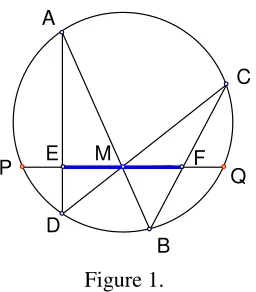
Every teacher knows that students’ mathematical knowledge can always be checked up through their skills to solve problems. Such situation was long before in teaching mathematics, it is present now and, undoubtedly, it will remain the same in future, in other words, it is an axiom of Mathematics Education. At the same time, it is the students’ skills to solve problems that contribute to the development of mathematical thinking most of all. Therefore, the perpetual question ‘how we ought to teach mathematics’ can be brought, in essence, to the question ‘how we ought to teach problem solving’. Moreover, students’ abilities and skills to solve complex problems have always been considered one of displays of their giftedness while learning mathematics. Various researchers and educators have differently characterized and used students’ abilities for problem solving. For example, at the one hand, consider the following problem (the Butterfly theorem):
4th Mediterranean Conference on Mathematics Education 256
P M F Q
A
B
C
[image:2.595.249.377.145.291.2]D E
Figure 1.
Webb (1994, p.8) wrote that
Any boy or girl who can prove the Butterfly Theorem independently goes onto my short list for the South African team for the next International Mathematical Olympiad. The Butterfly Theorem is a useful result for diagnosing high-level problem-solving ability…
At the other hand, in Sweden Kagesten and Bonta (2003) presented a project of learning mathematics through students’ oral presentations of problem solving and theories in order to strengthen the students’ understanding.
At the same time, posing of a mathematical problem, not necessarily complex one, but taking into account its originality, content and beauty, is an essentially more difficult task for the overwhelming majority of students than its solution. Even gifted in mathematics students make no exception in this respect. Only a few such students could positively perform a suggested home work, which had been proposed in an utterly simple and concise form:
Suggest one, a few or as many as you can problems of your own on plane geometry.
A problem of his/her own suggested by a student is considered by us as such a problem that the statement of it has never been known to this student before either from studying theoretical material on plane geometry or from this student’s problem solving activities. It is important to note that for problem posing activities we considered non-triviality of content as a main requirement to the prospective posed problem.
In our view, a fact that the mentioned above general home task presented significant difficulties even for gifted in mathematics students witnesses:
- firstly, even the majority of gifted in mathematics students had neither ready-made original problems of their own, nor clear ideas of their actions in possible posing of such problems;
4th Mediterranean Conference on Mathematics Education 257
Unfortunately, problem posing activities are not widely used in teaching mathematics that is exceptionally noticeable while working with gifted students whose potential is strong enough for problem posing but it is rarely used in actual practice. Moreover, Contreras & Martinez-Cruz (1999) found out that even prospective teachers’ problem posing abilities were often underdeveloped.
Summing up, we would like to note that the well-known question mentioned above can be reformulated in the question ‘how we ought to teach problem solving and problem posing’. On the second part of this sentence with respect to plane geometry we will focus our paper.
DESCRIPTION OF THE TRAINING
A group of 18 students (15-17 years old) was proposed a training, which was held in Kharkov in the scope of Summer School for gifted in mathematics students under patronage of Kharkov State Pedagogical University. It was aimed at the formation of skills and habits of composing problems of different complexity levels in the course of plane geometry using the drawing as the primary source and concrete material of prospective problems. The training was designed to develop students’ creative approach for problem posing based on their inquiry activities while learning geometry.
The aim of the paper is to analyze structure of the training proposed, present its didactical materials (tasks, worksheets etc.) and find out factors, which would contribute to deeper understanding of problem posing process by students, and obstacles, which are on their way in problem posing activities. Also, in the paper we would like to consider directions and priorities of students’ thinking while they are involved in problem posing process.
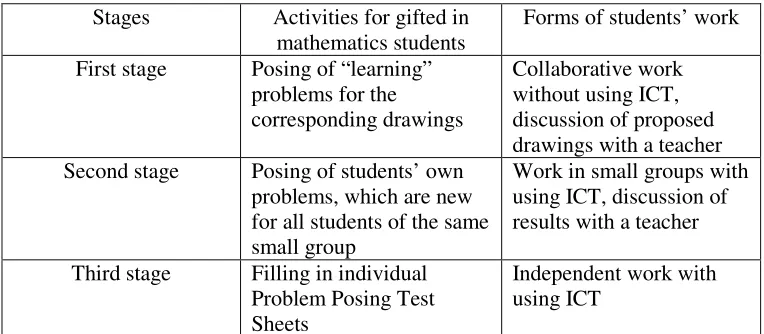
The whole training procedure was divided into three stages (see the Table 1 below).At first students were asked, making use of the suggested drawing, to show known to them properties of the geometrical objects depicted in the drawing and having relations to this drawing, i.e. those facts that can be used as ‘learning’ problems, in Sharygin’s terms (1989). The first stage of the training was certainly preparatory. Nevertheless, it had a very important role: students were taking part in problem posing, suggesting, however, only ‘learning’ problems on the basis of the knowledge they already had. At the same time findings of the properties, which were not known for students before, were also encouraged. Due to collaborative work, some students have enriched their Active Fund of Knowledge (Yevdokimov, 2003) in plane geometry having known from other students some properties of the geometrical objects depicted at the drawings. At this stage of the training 5 drawings were suggested to the students for composing ‘learning’ problems. Help of a teacher was an acceptable, but not necessary condition for students.
4th Mediterranean Conference on Mathematics Education 258
Table 1.
Stages Activities for gifted in mathematics students
Forms of students’ work
First stage Posing of “learning” problems for the corresponding drawings
Collaborative work without using ICT, discussion of proposed drawings with a teacher Second stage Posing of students’ own
problems, which are new for all students of the same small group
Work in small groups with using ICT, discussion of results with a teacher
Third stage Filling in individual Problem Posing Test Sheets
Independent work with using ICT
In some cases students had been asked for making additional constructions in the drawings before proposing their own problems to discussion with a teacher. After that, students had got acquaintance with posing “enclosed” problems, i.e. result of one problem should provide for them new possibilities and tools for posing the next, more complicated problem. We called such problems interior and exterior ones correspondingly. In the end of the stage students were involved in the problem posing activities making their own drawings, which were a basis for further inquiry work of students in the training. We would like to emphasize using information communication technologies, in particular, dynamic geometry software, by the students on the second stage of the training. According to Sanchez & Sacristan (2003), we took into account the following assumption:
There is a fundamental difference in the construction of the geometrical figure between doing it with paper-and-pencil and doing it in a dynamic geometry environment: whereas in the first one it is the construction of a particular case, in the latter one it is actually the construction of a “general case”.
Up to 15 drawings were considered in the small groups during the second stage of the training. Number of drawings for every small group depended on the features of that group, but it was not less than 10 drawings.
In the third stage of the training we evaluated students’ skills in problem posing process through their individual work on Problem Posing Test Sheets (see sample of Problem Posing Test Sheet in Appendix).
4th Mediterranean Conference on Mathematics Education 259
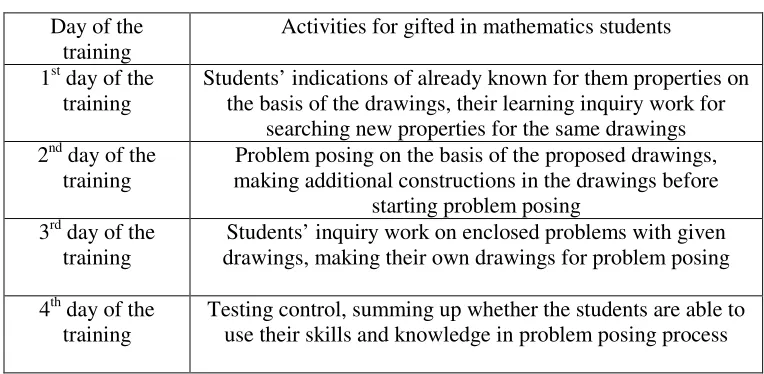
[image:5.595.106.488.262.449.2]to the students during the first three days of the training. Only the last task in the Sheets was ‘new’ for the students because it combined in itself all activities, which our students had in separate tasks of the training before. We intentionally didn’t consider such combined tasks in the learning part of the training, however, all students had possibility to complete these tasks successfully on the basis of their knowledge developed with different learning examples from the training. Summary for day by day students’ activities is in the Table 2 below.
Table 2.
Day of the training
Activities for gifted in mathematics students
1st day of the training
Students’ indications of already known for them properties on the basis of the drawings, their learning inquiry work for
searching new properties for the same drawings 2nd day of the
training
Problem posing on the basis of the proposed drawings, making additional constructions in the drawings before
starting problem posing 3rd day of the
training
Students’ inquiry work on enclosed problems with given drawings, making their own drawings for problem posing
4th day of the training
Testing control, summing up whether the students are able to use their skills and knowledge in problem posing process
We would like to note the very intensive character of students’ work during all four days. All students displayed a great interest to the proposed activities and tried to do their best in the training.
ANALYSIS OF THE STUDENTS’ WORK IN THE TRAINING
At first, we would like to point out common tendencies of students’ thinking in the problem posing process in the whole and, after that, we will dwell upon analysis of the students’ work on the certain tasks.
At all stages of the training we tried to trace students’ thinking priorities in the problem posing process, which direction was given the preference by the students, while they had problem posing activities: from posing conjecture to its proof or, vice versa, producing constructive reasonings, which lead to revealing of the property proved.
4th Mediterranean Conference on Mathematics Education 260
Proposed Problem Drawing of the problem Solution of the problem
Scheme 1.
After that, we suggested for the students to continue to the end another scheme, which would correspond, in their opinion, to problem posing process in plane geometry:
Drawing of some geometrical objects ?
Scheme 2.
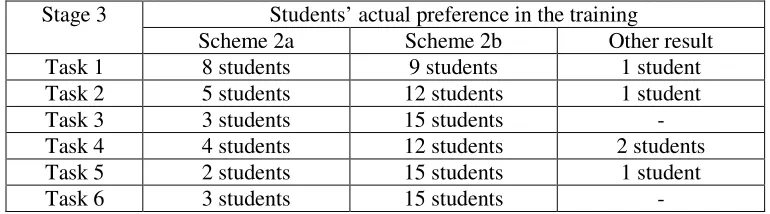
After the students had come through all three stages of the training, we compared the students’ reflections on the problem posing process with their actual steps in problem posing. It is interesting to note that most of the students suggested to use the Scheme 2a below (14 people of 18 ones) before the training.
Drawing of some geometrical objects Search/Argumentation and
constructive proof Problem posing
Scheme 2a.
Though, in reality, students have used the Scheme 2b below for the most of the tasks from the Problem Posing Test Sheets.
Drawing of some geometrical objects Conjecture posing
Proof/Rejection of conjecture
Scheme 2b.
[image:6.595.105.490.560.667.2]All data of students’ scheme preference on the third stage of the training is collected in the Table 3.
Table 3.
Students’ actual preference in the training Stage 3
Scheme 2a Scheme 2b Other result Task 1 8 students 9 students 1 student Task 2 5 students 12 students 1 student Task 3 3 students 15 students - Task 4 4 students 12 students 2 students Task 5 2 students 15 students 1 student Task 6 3 students 15 students -
4th Mediterranean Conference on Mathematics Education 261
analyze in details while considering some tasks proposed on the first two stages of the training. We would like to stress that each task proposed to students on the certain stage of the training had its own priorities in our research. Tasks for the first stage were intentionally similar in their content and format in order that students had possibility for collaborative work and discussion of their results with a teacher on this stage. Tasks for the second stage were already different in character of possible posed problems as well as in the level of inquiry work of students aimed on revealing certain properties concerning the drawings, from simple to hard ones.
Now we shortly characterize some of that tasks, which were suggested to the students on the first two stages of the training with analysis of their thinking process while having problem posing activities.
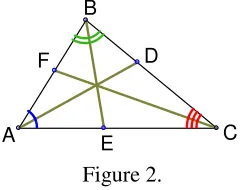
Let us consider the following drawing (Figure 2 below) – one of those suggested at the first stage of the training. On the one hand, the geometrical situation shown at the drawing, is standard and simple: a triangle ABC and its bisectors AD, BE and CF.
A
B
C D
[image:7.595.250.371.338.433.2]E F
Figure 2.
On the other hand, it contains many different facts and properties, which can be treated as ‘learning’ problems (see Appendix 2). Some of the students have pointed out more than 10 such problems in the process of the discussion. It was a real competition, though in the scope of collaborative work, among the students: who of them could propose a maximal number of properties having relation to the certain drawing. At the same time some properties remained unknown for the students until the second stage of the training was over. For example, properties B11
and B13 from Appendix 2. It witnessed of the importance of using technology, in
particular, dynamic geometry software, in learning geometry. Considering problem solving process Santos et al. (2003) noted:
Geometric and dynamic approaches to the problem might provide a means for students to visualize and examine relationships that are part of the depth structure of the task.
We took into account the mentioned above assumption for problem posing process. In the training there were many examples of students’ deeper understanding of the tasks proposed and their drawings due to the use of dynamic geometry software.
4th Mediterranean Conference on Mathematics Education 262
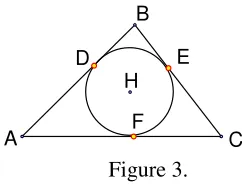
for stimulating visual thinking in problem posing of plane geometry. On the other hand, very often, having presence of the drawing, students involuntarily switched over to analytic thinking from visual one. Apparently, they unconsciously supposed that there was no further need in visual thinking with presence of the drawing. For example, on the second stage of the training students had been proposed the following drawing (Figure 3 below) – a triangle ABC and circle inscribed in it.
A
B
C
D E
[image:8.595.237.358.220.312.2]F H
Figure 3.
Almost all small groups of students suggested their first own problem concerning the drawing above in the following form:
Each point of tangency divides a corresponding side of the triangle on two parts. Find ratios of these parts for all sides of the triangle.
Therefore, not restricting students’ thinking in that direction, but for removing these obstacles, in the next step we proposed the same drawing, in which an additional construction would be a necessary requirement for possible problem posing (for another example see Task 3 (problem posing on Simson line and/or other properties) from Appendix 1).
In our previous work with gifted in mathematics students we very often observed that they had used the following strategy in problem solving (not necessarily in plane geometry):
Problem B is given for solving. Suppose property A is proved. If it follows that problem B can be brought to another easier problem or even be completely solved with using A, then everyone needs to turn to the property A for proving it.
4th Mediterranean Conference on Mathematics Education 263
Turning to the question of students’ scheme preference in the different tasks of the training we suggest that using the Scheme 2b by the most of the students showed they were insufficiently ready for active learning of geometry and independent inquiry work. Posing conjectures students intuitively tried to provide a more usual way for their practice work because problem solving activities in a classroom take a huge part of time with respect to problem posing ones in the schools all over the world.
[image:9.595.106.491.317.457.2]At the end we would like to present data collection of students’ work on the Problem Posing Test Sheets (see the Table 4 below) and give short comments on their results. We regarded that a student had completed a task successfully, if he/she had posed at least 6 problems with their proving for the Task 1 and at least 2 problems with their proving for the rest of the tasks.
Table 4. Tasks T as k 1 T as k 2 T as k 3 T as k 4 T as k 5 T as k 6 A t le as t 3 ta sk s A t le as t 4 ta sk s A t le as t 5 ta sk s A ll 6 ta sk s Number of students, who completed a certain task successfully
16 15 10 8 9 7 11 9 8 7
We distinguished three peculiarities of students’ achievements in the third stage of the training. The first one concerned two similar groups of students’ successful answers in the tasks, Tasks 1,2 and Tasks 3,4, 5 correspondingly. Task 6 had a special status for its combined character with features of the previous tasks. We noticed that only students, who had completed the Task 6 successfully, were successful with all tasks. The third peculiarity was the worst result of students’ progress in the tasks with posing of enclosed problems.
CONCLUDING REMARKS
4th Mediterranean Conference on Mathematics Education 264
development of students’ skills for multiple flexible transitions from visual thinking to analytic one and vice versa.
We would like to note that we described only the main results of our research in the paper. At the same time, we hope our analysis gives for researchers further opportunities for their work in studying and improving problem posing activities as well as methods of active learning of mathematics in the whole.
REFERENCES
Contreras, J. & Martinez-Cruz, A. M. Examining what prospective secondary teachers bring to teacher education: A preliminary analysis of their initial problem-posing abilities within geometric tasks, in F. Hitt & M. Santos (Eds.), Proceedings of PME-NA XXI, Vol. 2, 413-420, (1999).
Kagesten, O. & Bonta L. Learning mathematics through oral presentations, Proceedings of the Southern Hemisphere Symposium on Undergraduate Mathematics Teaching: Remarkable Delta03, Queenstown, New Zealand, (2003).
Sanchez, E. & Sacristan, A. I. Influential aspects of dynamic geometry activities in the construction of proofs, in N.A.Pateman, B.J.Dougherty and J.T.Zilliox (Eds.), Proceedings of the 2003 Joint Meeting of PME and PMENA, USA, Vol.4, 111-118, (2003).
Santos, M., Aguero, E., Borbon, A. & Paez, C. Students’ Use of Technology in Mathematical Problem Solving: Transforming Technological Artifacts into Mathematical Tools, in N.A.Pateman, B.J.Dougherty and J.T.Zilliox (Eds.), Proceedings of the 2003 Joint Meeting of PME and PMENA, USA, Vol.4, 119-126, (2003).
Sharygin, I. F. Advanced course in mathematics. Problem solving. Grade 10. Moscow, Prosveschenije (in Russian), (1989).
Sierpinska, A. Visualization is in the mind of the beholder, New Zealand Journal of Mathematics, 32, 173-194, (2003).
Webb, J. H. What’s the use of mathematics?, Inaugural Lecture, New Series No. 185, University of Cape Town, (1994).
4th Mediterranean Conference on Mathematics Education 265 APPENDIX 1
PROBLEM POSING TEST SHEET (SAMPLE)
1. Suggest and pose all properties of geometrical objects, which have relation to the drawing below.
2. For the drawing below pose non-trivial problems (as many as you can) and provide their solutions.
A
B
C
F D
E
3. Make additional constructions on the drawing below and pose non-trivial problems (as many as you can) with providing their solutions.
O
4. For the drawing below pose enclosed problems (as many as you can) and provide their solutions, i.e. result of one problem should provide for you new possibilities and tools for posing the other, more complicated problem.
A
B C
H L
K N
5. Make your own drawing with at least 4 different geometrical objects and pose non-trivial problems (as many as you can) on the base of that drawing with providing their solutions. Explain the reasons why you prefer such drawing.
6. Remove one or some geometrical objects from the drawing below, pose enclosed problems (as many as you can) and provide their solutions, explain the reasons why you prefer such drawing. After that, make other additional construction to the drawing and pose non-trivial problems (as many as you can) with providing their solutions.
A B
C E
F
4th Mediterranean Conference on Mathematics Education 266
APPENDIX 2
Bisector’s properties
B1. All bisectors of a triangle intersect in one and
the same point, it is a center of the circumference, which is inscribed in that triangle.
A I A1
C
B
B
1
C
1
B2. A bisector is between height and median from
the same vertex of a triangle. In isosceles triangle bisector, height and median coincide.
B
C
A H L M B3. Bisectors of interior and exterior angles of the
same vertex of a triangle are perpendicular.
B4. The bisectors of a triangle divide the opposite
sides of it into the parts, which are proportional to the corresponding adjoining sides of this
triangle. a
b a
b
1
1 = .
a b
a
c b1
1
B5. The bisector of the triangle with sides a, b, c divides the opposite side c on the segments
a ac
a b
b bc
a b
1 = 1
+
= +
, .
B6. If a segment, which connects a vertex of a triangle with a point on the opposite side of that
triangle, divides the opposite side into the parts, which are proportional to the corresponding adjoining sides of this triangle, then it is a bisector.
B7. If CD is a bisector of exterior angle C, then
BD
AD BC
AC
= .
A B
C
4th Mediterranean Conference on Mathematics Education 267
B8. If bisectors of a triangle intersect in the point I,
then it divides bisector CC1 in the following
relation CI I C a b c 1 = + . A I A1 C B B 1 C 1
B9. Length of bisector
1) l
ab C a b c = + 2 2 cos ;
2) lc2 ab a b
1 1 = − . a b a c b 1 1 A B C lc
B10. Angles between bisectors:
2 1= A+B
∠ ;
2 2= A+C
∠ ;
2 3= B+C
∠ ;
∠1+∠2=90°+A/2;
∠1+∠3=90°+B/2; ∠2+∠3=90°+C/2.
A B C 1 1 2 2 3 3
B11. A bisector of a triangle and a
mid-perpendicular to the opposite side of a triangle intersect in a point, which belongs to the circle described around this triangle
A
B
C
B12. If point I is a centre of inscribed
circumference into triangle ABC and point C1
belongs to described circumference around this triangle and line CI simultaneously, then
C1A=C1B=C1I=2 2
Rsi nC. B A
C
I
C
1
B13. A bisector divides an angle between radius of
described circumference around that triangle and its height from the same vertex of the triangle on