The fast pace of today’s automotive market and the many infl uences on consumer choice require manufacturers and dealers to understand and take actions quickly to refl ect changes in consumer preferences. This paper discusses a new method of understanding and infl uencing the path to purchase using the rules that consumers use in this journey, and the key moments of infl uence that affect the purchase decision.
Introduction
Understanding the “drivers” of purchase and reacting quickly to changes in consumer preferences in today’s new vehicle market is a challenging task given the rapid rate of change, the plethora of infl uences on consumer purchase decision making, and an increasing number of models and options available to consumers. In an environment of constant and rapid change, how can manufacturers better recognise changing consumer
importance to both auto manufacturers and dealers:
How can manufacturers tell when a new launch campaign is promoting the right messages?
How are consumers making the decisions they are? What are the critical elements of the decision? How does this vary through different stages of the purchase process? How does a particular brand or model get included in the consideration set ?
What are the critical moments of infl uence in the purchase process?
This paper describes a new model and method which addresses these issues. Recent developments in cognitive psychology provide the new insights which underpin DeltaQual™.
Cognitive psychology, and particularly the research dealing with heuristic decision-making, tells us that consumers use rule sets or heuristics to cope with the vast array of information they are •
•
•
•
•
Understanding the
path to purchase
Resolving the complexities
that in
fl
uence decisions
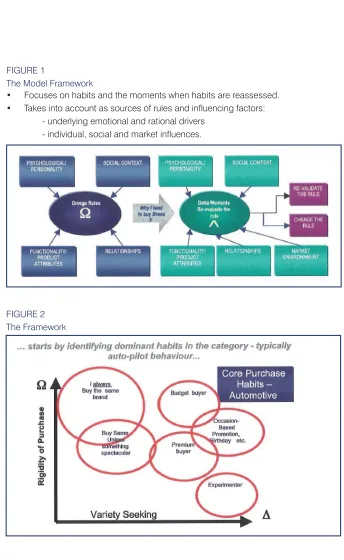
As shown in Figure 1, the model’s framework focuses on habits and the moments when habits are reassessed. It takes into account the underlying emotional and rational drivers, and individual, social, and market infl uences that act as sources of rules and as infl uencing factors in the purchasing process.
Unlike traditional qualitative research methods, the model goes beyond consumer motivations, and focuses on actual behaviour, exploring the underlying motivations and infl uencing moments.
While the model has been applied in a variety of industries and contexts, it is proving particularly useful in automotive purchase applications in the delineation and in-depth profi ling of the rules and habits, and key moments of infl uence that make up the automotive purchase funnel.
[image:2.595.212.556.129.689.2]The framework starts by identifying the dominant habits in the purchase category, as well as the rigidity of the purchasing rules. Figure 2 shows typical habits applied in the automotive purchase process, aligned along a “variety seeking” dimension.
FIGURE 1
The Model Framework
Focuses on habits and the moments when habits are reassessed. Takes into account as sources of rules and infl uencing factors:
- underlying emotional and rational drivers - individual, social and market infl uences. •
•
Individual category habits may refl ect degrees of emotional or rational drivers, as well as varying levels of consumer involvement, and exploration in the purchase process.
Once category habits have been identifi ed, the model seeks to identify the mental rules that underlie habitual behaviour, as shown in Figure 3.
Omega Rule sets tend to be simple, few in number and rather hierarchical. They may either be rational or emotion based. Identifying common categories of rules is key.
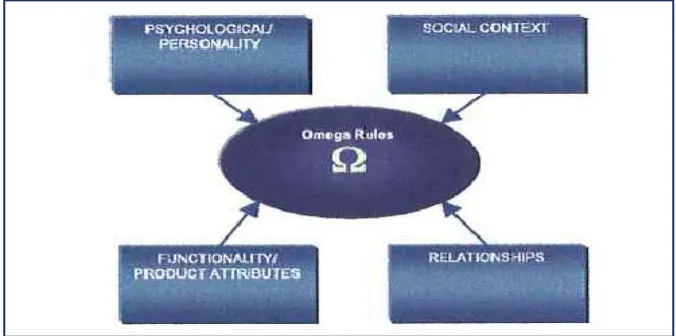
The model then identifi es the sources of Omega Rules, as shown in Figure 4.
These infl uences and their varying importance and “trade-offs” in the purchasing process are a key diagnostic element addressed by the model.
As shown in Figure 5, the framework then identifi es the tests of indicators of Omega Rules.
The indicators or “tests of rules” used by potential purchasers are often direct points of potential action by manufacturers or marketing agencies. The critical indicators or “tests” of rules used by potential purchasers need to be
FIGURE 3
[image:3.595.216.554.235.371.2]Step 1: Identify the Omega Rules that Underlie Habits
FIGURE 4
Step 2: Identify the Sources of Omega Rules
Omega Rules are the result of a unique personal chemistry. They are a mixture of person-ality, current relationships, product requirements and social context.
[image:3.595.216.554.425.593.2]Applying the Model to the Automotive Purchase Process
In applying the model to the automotive sector, it is important to understand how all of the above elements work together during the purchase cycle. Thus an understanding of the habits dominating the category, segment and model, as well as the rules and rigidity with which the rules are applied, and their sources and indicators are all important.
For example, a habitual “Budget Buyer” may place considerable emphasis on rules that dictate buying a reliable and practical vehicle, with indicators of these rules including a solid feel when closing the car door, roominess, a locally manufactured vehicle, a good manufacturer’s warranty, and so on, and with various sources of infl uence (recommended by family or mechanic) brought to bear on the purchase decision.
Potential auto purchasers bring these rules, their underlying sources, and the “tests” they apply into the various stages of the automotive purchase funnel process as shown in Figure 6.
The individual consumer’s automotive purchase funnel process can be long or short, more emotional or more rational, and depends on the “dance”
experience or “story” can really only be truly understood if pursued in depth within the context of these elements.
To understand the purchase process and to plan and react appropriately, auto manufacturers and dealers must understand the triggers that infl uence the commencement of the purchase cycle, the rules and tests that consumers use at each stage, and the role and importance of various sources of infl uence. Further, they must ensure their products match up to those rules
quite different from other qualitative research approaches. In particular, data collection is very different from other qualitative research, given that Omega Rules are hard to access and describe, while Delta Moments are often fl eeting and quickly forgotten. Therefore, the methodology leans heavily on techniques drawn from anthropology, neuro-psychology and even police interviewing techniques to access these key elements. The techniques employed include narrative building, situation and brand deconstruction, critical incident FIGURE 6
Automotive Purchase Process
As shown in Figure 7, the model employs various stages.
In adapting the model to automotive applications our experience has been that the Stage 1 client briefi ng is very important. As the method is very different from more commonly used qualitative techniques (such as focus groups and individual depth interviews) it is important that clients understand these differences—both in terms of what they will see happening from the viewing room, and in terms of the depth and types of knowledge to be gained.
Stage 2 of the model employs dual moderators. This is because it both facilitates repeat follow-up questioning and because of the sometimes concurrent and different data gathering activities taking place within the research method. Respondents are probed in depth on the dominating rules, patterns of social infl uence, important infl uencing moments, and other elements.
A key point of differentiation between this and other qualitative models is that the key results of the research may only be fully appreciated following the completion of all aspects of the study methodology. The many sources
Example 1: Exploration of the Automotive Purchasing Process
Too often, auto manufacturers and dealers are forced to operate from a surface level of understanding of the purchase process, or recognise key trends or infl uences on the purchase process far too late in the funnel to be effective. Traditional research methods have not been particularly helpful in this regard.
Traditional qualitative research is aimed at understanding underlying consumer
How did we apply the model and what did we learn?
ACNielsen Automotive conducted thirteen DeltaQual™ groups across a number of automotive segments aimed at furthering our understanding of the automotive purchase process in terms of the rules used by consumers, their rigidity, sources of infl uence and their importance, and the “tests” or indicators used.
A number of key fi ndings were derived from this study, several of which FIGURE 7
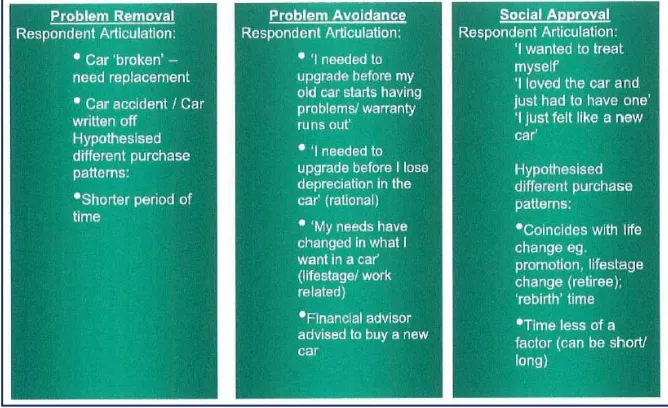
relevance of this type of information is clear, suggesting both the different appeals that might be used to address the needs of potential customers with these orientations, and the types of questions that may be useful in early segmentation/targeting of potential buyers.
For example, the different profi les above suggest different sets of questions that may be used by the automotive salesperson in qualifying prospects as to the motivations underlying the triggering stage of the purchase process that are useful in identifying buyer “hot-buttons.” These motivations may not be mutually exclusive, of course, but are predominant drivers of purchase intent. While social approval may be important to all to a certain extent, it may not be the primary trigger of funnel entry, but may defi nitely play a part in the choice of particular models to investigate (and, of course, in what model is eventually purchased). A salesperson’s knowledge of this will be extremely useful in helping to manage and facilitate the purchase consideration.
Once the trigger to entry has occurred, our research showed the usefulness of the detailed investigation that the methodology employs in terms of revealing the dominant habits and
Moderator: “You wouldn’t go to a Holden dealership to test drive their hottest new car?”
Retired Ford owner: “I had the [Ford] AU model and I wasn’t impressed with the actual look of the car, and my brother in law had the [Holden] SS and that was a lot nicer than mine, and I just --I won’t touch it. I won’t go near it because my Dad’s always had a Ford.”
Habit Verbatim 2:
Moderator: “On the last car that you did buy, what groups were you looking at?” Mid-Life SUV Group respondent: “I
or re-evaluation, and indicators that characterised the individual’s purchase process through the scoping, eliminating and last stages of the process before purchase. The following verbatim shows the importance of vehicle service expense for a respondent who had investigated a Nissan Patrol, Honda CR-V, Toyota RAV4 and numerous other vehicles in the scoping through elimination process, ultimately selecting the Toyota.
Service Expense Verbatim:
[image:6.595.217.551.222.426.2]Moderator: “It was cheaper to service?” Respondent: “Yes it was, and easier to FIGURE 8
Respondent: “Toward the end, when it was down to a couple of cars. That’s when we went into it…”
Importantly, our research showed that in terms of “tagging” people once in the funnel, there is no clear, one-dimensional, “one size fi ts all” criteria that may be applied in general or at particular stages—that is, not time, readiness to buy, nor core emotional stream. The automotive purchase process is both multi-dimensional and complex, incorporating both rational and emotional layers. An understanding of these layers and their interactions is key to interacting appropriately with consumers. The model has proven important in this regard.
The research analysis revealed three separate prototypical types of purchase process orientations, representing the relative importance or dominance of rational (left brain) vs. emotional (right brain) vs. low involvement/apathy. These may be best thought of as dominant styles or modes that individuals bring to the automotive purchase process. In reality of course, consumers may exhibit characteristics of each of these. The three prototypes shown (Figure 9) also show the
Knowledge of the three types of purchase funnels uncovered by the procedure can prove very useful for auto manufacturers, dealers, and their affi liated promotional agencies. Each profi le suggests a different purchase process, with correspondingly different themes or tasks suggested to successfully move prospects through the funnel and to eventually close the sale.
For example, a purchase funnel characterised by the emotional right
oriented copy best directed to the rational/left brain funnel).
This research can reveal to
manufacturers the dominant profi les associated with specifi c automotive segments, brands and models, therefore providing the basis to develop effective targeting messages, sales process and procedures, and promotional campaign themes and executions. That is, the fi ndings from this research can be used to both effectively and effi ciently understand and manage all stages of FIGURE 9
vehicle inspection which did not meet expectations of space or aesthetics, a trade-in price that was not optimal or beaten elsewhere, or other factors) provides the potential for direct
actionability, infl uence, and/or correction of problematic factors by manufacturer, dealer, or agency.
Example 2: A Client Case Study Purchase Process Application
One client application in the automotive purchase area was in preparation for a re-launch/refresh of a small/ light segment vehicle for a major manufacturer. Given the increasing importance of both the small segment and the model for the manufacturer in light of increasing competition, rising petrol prices and other factors, the success of the re-launch campaign and vehicle positioning was crucial. In particular the manufacturer wished to probe the purchase process decision-making of both acceptors and rejecters of the previous model across two lifestyle segments. The fi ndings from this study would then be used to appropriately address the re-launch model and its positioning.
The research objectives in this study were to explore the purchase drivers and infl uencing moments for the segment and model, along with
supplied by the client. A feature of the groups was the detailed, individual investigation of the purchase journeys of each of the respondents. Each participant was fi rst queried in depth, and in a variety of ways about the triggers that fi rst caused them to enter into the purchase process. In a similar fashion they were taken through the scoping, eliminating, and last stages of the purchase process, with detailed probing of the rules they employed and their rigidity, their infl uencing moments, sources of infl uence, and tests they applied.
As the methodology is an interactive one, other respondents were able to listen to these journeys while completing other forms of data gathering activities and exercises. As data gathering and analysis are much more comprehensive and inclusive than for other qualitative methods, a considerable amount of analysis and synergy across the various data inputs is required following the conclusion of the groups.
This synergistic analysis formed the basis of the report given to the client.
The detailed results of this specifi c research are beyond the scope of this paper and proprietary to the client. However, a number of key insights were revealed to the client in terms of the different purchase process rules, infl uential moments, and sources of infl uence that occurred between acceptors and rejecters of the target model, as well as between the two target lifestyle segments identifi ed by the client.
An example of these insights was in the profi ling of the Omega Rules and Delta Moments used by the two particular lifestyle segments of interest. While the Omega Rules used by each segment were quite similar, the importance given to these individual rules was quite varied between the segments—particularly on some key dimensions such as styling, interior features and roominess. Further, some considerable segment differences were evident between the Delta Moments that caused the Omega Rules to be re-examined, and leading to rejection of the model.
campaign were not being adequately reinforced by dealers later in the purchase funnel—resulting in Delta moments of rejection.
Conclusion
Understanding the automotive purchase process is crucial for automotive manufacturers and dealers. More than ever, the fast paced competitive environment and the many options and choices of information available to consumers require manufacturers and dealers to understand consumer decision-making and the modes of infl uence which can affect consumer new car purchasing. Research fi ndings from cognitive psychology and consumer heuristics have led to the development of a new model which provides an additional depth of understanding of these areas, with application to the automotive purchase situation.
The model continues to be refi ned and extended. While the focus of this paper has been the automotive purchase process, the model might also be usefully applied to a number of other automotive applications.
Authors
Michael Mills, Associate Director, Client Service (Information Based Consulting Group)
Nicole Torkar, Executive Director, Customised Research Services
Tina Katsinikas, Director, Client Service (Automotive Practice Group)
Andrew Dye, Associate Director, Client Service (Automotive Practice Group)