USING MATERIALS FROM THE HISTORY OF MATHEMATICS IN DISCOVERY-BASED LEARNING
Oleksiy Yevdokimov
Kharkov State Pedagogical University/University of Southern Queensland, Ukraine/Australia
Keywords: history of mathematics, discovery-based learning, e-textbook, triangle geometry
This paper reports on attempt to integrate history of mathematics in discovery-based learning using technology. Theoretical grounding of the idea is discussed. An exploratory environment on triangle geometry is described. It is designed to support and motivate students’ activities in learning through inquiry. Conjectures about properties of Lemoine point and Simson line are produced and proved by students using e-learning textbook.
Introduction
History of mathematics has always been a special branch of mathematics that actually all those concerned with the process of learning and teaching mathematics demonstrated their interest to. That interest was from primary school students to outstanding mathematicians, according to their level of understanding. The same situation remains nowadays. Lectures and seminars in which mathematical discoveries, even local and insignificant, could be traced with analysis of historical information about them, provide for students better understanding different ideas and theories, motivation for further learning, and show brilliant richness of human activities in mathematics. Unfortunately, in our time we cannot speak about full integration of history of mathematics in learning process, it is yet prematurely now, though indisputable advantages of that step at any stage of learning mathematics are out of doubt. At the same time, in discovery-based learning history of mathematics is most naturally integrated in mathematics education. Learning through inquiry a certain property of mathematical object, every student can trace how it happened for the first time in mathematics, which directions in research were more preferable in certain time, what questions had been left out of consideration due to some reasons. In the paper we will attempt to show a great potential of such integration for mathematics education. What tools can be used to help students learn and teachers teach through inquiry? In what way can the history of mathematics be integrated in discovery-based learning? Is inquiry supported with materials from the history of mathematics really an effective way to learn and teach new mathematical content? Our paper addresses these questions.
Theoretical grounding of the idea
In the twentieth century calls for an increased emphasis on discovery and inquiry in learning moved into the educational research limelight at least three times (Cuban, 1986, 1988; Cohen, 1988). Intense, although periodic, interest in discovery learning was based on a belief that this kind of learning has several advantages not shared by learning through instruction (Dewey, 1916). Bruner (1961) and Suchman (1961) stressed the importance of learning through discovery and offered some empirical evidence of its efficacy.
In mathematics education initial ideas of discovery-based learning had arisen long before Polya (1962), but he was the first, who had made the theoretical foundation for this method of teaching and attracted the interest of broad mathematical community to it. More recently, there was a consensus that students should learn through inquiry and through the construction of their own mathematics (Davis, 1991; Harel & Papert, 1990; NCTM, 1989).
to predict, therefore process of teaching mathematics (as well as teaching individual topics of various mathematical subjects) should, to a certain extent, initiate the process of mathematical discovery. Stolyar (1981) pointed out that it is easier for a student, under appropriate arrangement of teaching, to act as a mathematician, in other words, to reveal the truth, than to learn a “ready-made” system of statements and proofs without understanding their origin, meaning and interrelations.
At the same time, every next problem is an unsolved one for a student, therefore the same student gets additional motivation to make a “small” discovery for himself, solving this problem (Yevdokimov, 2003). Undoubtedly, students’ mathematical activity will become much narrower, when they have to find solution of the problem, which is already formulated in the final form. But we have the opposite situation in discovery-based learning, where students have to reveal this property.
When solution is carried out at the process of learning, in other words, a student reveals for himself/herself properties, which were discovered in mathematics long before, he/she thinks of them as a pioneer. It’s one of the key points in this method of teaching. However, in any teaching process students need textbooks. Of course, any textbooks will depend on the methods of teaching that are applied to, but we would like to point out that any textbook on mathematics designed for a student having an inquiring mind, is usually oriented towards lengthy usage. It is presupposed that a student studies the content of such books, various properties and theorems with pencil and paper, as they used to write in prefaces to many textbooks on mathematics as early as twenty and more years ago. The same is true for the problems suggested for students’ work on their own. However, it is necessary to note that content of the overwhelming majority of textbooks are composed in such a way that the student obtains “ready-made” statements of various properties in the form of already proved theorems or problems for independent solving. By all means, in mathematics education it remains a very difficult task to compile a textbook in a way that students might independently come to discovery of a certain property, i.e. statement of any property wouldn’t be necessarily present in a clear form as a problem. However, use of teaching methods aimed on the stimulating students’ research activities in practice (in particular, geometry) is not unique. This is greatly facilitated by the use of ICT and dynamic geometry software (Elsom-Cook, 1990; Mariotti et al., 1997; Arzarello et al., 1998; Furinghetti, Olivero & Paola, 2001). Santos et al. (2003, p.120) note that
‘Geometric and dynamic approaches to the problem might provide a means for students to visualize and examine relationships that are part of the depth structure of the task’.
As didactical support for conception of discovery-based learning with materials from the history of mathematics we would like to describe two fragments of the e-learning textbook in history of mathematics on triangle geometry. Following Lewis et al (1993) our aim is to show that students can learn effectively through appropriately designed inquiry environment using materials from the history of mathematics. We chose triangle geometry as a topic for such environment for the following reasons:
• first of all, this is rich historical material, which necessarily should be used in teaching to promote advanced mathematical thinking in the topic (in the USA triangle geometry was known as advanced geometry or college geometry, Davis, 1995);
• most of problems can be successfully investigated and posed by students using geometry software;
• research work of students can be easily structured within each discovered property; • all problems have plenty of links to each other (Altshiller Court, 1969).
Summing up the reasons above we would like to quote the well-known Crelle’s words:
‘It is indeed wonderful that so simple a figure as the triangle is so inexhaustible in its properties. How many as yet unknown properties of other figures may there not be?’(1821, p.176).
Description of the e-learning textbook
Concerning the structure of the e-learning textbook we hold the following order: The e-learning textbook consists of separate small units, which, on the one hand, have numerous connections to each other. On the other hand, units can be studied by students according to their preference. It is supposed that students passed a standard course in Euclid geometry before studying the units. Within each small unit tasks are structured according to the following order:
1. The structure of a unit is built on the basis of an initial problem with necessary mathematical explanation given on historical situation appropriate for a particular model (i.e. sequence of discoveries, use of certain mathematical apparatus, etc.).
2. Guess, search for possible ways to construct a small mathematical theory that relates to the given model.
3. Further development of students’ results for discovering other properties of mathematical objects of the model.
Following Brown (1976), Lakatos (1976), Polya (1962), and Steen (1988), we suggest that studying e-textbook on history of mathematics students will be involved in the following learning discovery activities: gathering observations that can be transformed in conjectures or hypotheses, producing conjectures and hypotheses, their justification and verification, counterexamples or proof.
We would like to emphasise that the proposed e-textbook (fragments will be described in the paper) shouldn’t be considered as multiple choice testing material despite some superficial similarity. Actually students can choose various versions of answers, find correct one(s) among them and go forward discovering and rediscovering various properties of different geometrical objects. This e-textbook is, first of all, a didactical tool, computer-based environment for integration history of mathematics into learning process. It is designed, like the above mentioned textbooks, for lengthy usage.
However, in the teaching process we intentionally organise students’ combined work with e-textbook and with pencil and paper. Indeed,
‘There is a fundamental difference in the construction of the geometrical figure between doing it with paper-and-pencil and doing it in a dynamic geometry environment: whereas in the first one it is the construction of a particular case, in the latter one it is actually the construction of a “general case”’ (Sanchez & Sacristan, 2003, p.116). It is important for teaching that students should perceive and understand this difference.
Before developing this e-textbook we observed, working with students, that while using history of mathematics and teaching methods through inquiry in learning geometry, students’ actions can be described by the scheme below.
Geometrical situation is given for consideration
by students
Analysis of properties, which had already been known for students before
Search of unknown properties for students
Way of conjecture Way of research
Posed problem Investigation properties of some mathematical objects
Possible solution Posed property
Scheme 1.
Visual thinking of students was employed to a larger extent in the left part of the scheme, in the right one – analytic thinking of students was a dominating component. While working on structures of tasks for e-textbook we tried to achieve certain balance between visual and analytic thinking of students (Sierpinska, 2003) in their study using the e-textbook. We took into account that for some tasks and units priorities should be given to activation visual thinking, while for other tasks – analytic thinking can be more preferable.
Turning to description and analysis of the e-learning textbook we would like to consider two units “Lemoine point” and “Simson line” in detail. At first, we concentrate on common comments to both units and after that we characterise special features for each of them.
As we mentioned above at the beginning of each unit an initial problem is placed, in other words, a specific problem, which defines the specific focus of inquiry given with historical references. Using mathematical terminology we could say that we propose to consider a specific problem with its neighbourhood in historical-mathematical sense: when a certain problem was posed for the first time, who was the author, whether that author proved/solved a problem on his/her own, who of other mathematicians was interested in, for what reasons, how long a problem was an unsolved one, etc.
link Solution. However, if they have difficulties in solving on their own, the link Learning is more preferable.
The most important thing for students, while solving a specific problem through the Learning link, is to perceive ideas and activities of discovery-based learning for their own inquiry work in the unit, though a certain property is already given in the form of a specific problem at the start of students’ investigations. After that the following questions arise for students in each unit, when solving/proving of a specific problem is over:
• What are the other properties of certain geometrical object(s) that follow from a specific problem?
• How could you use properties of geometrical object(s) from a specific problem for discovering other properties for the given geometrical object(s) or for other objects? Like Brown and Walter (1990) we propose "situation", an issue, which is a localised area of inquiry with features that can be taken as given or challenged and modified. We would like to note that there are no ready-posed problems for students starting from this stage in each unit. The rest of the properties for any mathematical object (that follow from a specific problem) were to be discovered by students with help of information communication technologies, i.e. using computer-based environment and dynamic geometry software. And again, the questions above are to be considered with their neighbourhoods in historical-mathematical sense.
Using computer-based environment students can choose one of two ways for further investigations: they can become acquainted with a certain property of geometrical object(s) including its proof, which was proposed by Euler (for example) by clicking on the link Euler’s property. However, students can take part in discovery of this property. They can accept this way by clicking on the link Discover Euler’s property. Using the latter link students receive a step-by-step system of instructions (links), which consists of local discoveries (links Discover 1, Discover 2 and so on) that follow to the final result – discovery of Euler’s property. In the similar way students have been asked to rediscover other results with help of computer-based environment.
On the one hand students take active research participation in computer simulation of rediscovering process in triangle geometry. On the other hand, on each stage computer-based environment provides students help and guidance in choosing directions for inquiry. For example, after clicking the link Discover Aussart’s property students get short analysis of conditions with a hint ‘You have to construct additional objects for further investigation. Please give your propositions’ (with multiple choice answers). After choosing the correct answer students take the next step and so on.
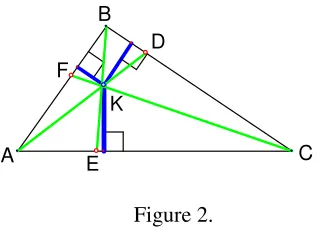
Characterising the units, in the case of “Lemoine point” we would like to show and analyse students’ work while they discovered Aussart’s property. When students successfully went through a specific problem of the unit, they had the following geometrical situation:
There is a triangle ABC and a point K such that the sum of the squares of the distances from that point to the sides of the triangle is the least (see Figure 1).
A
B
C K
It might be, of course, suggestion that three points lie on the same line (the similar idea is in the unit “Simson line”, it is true there, but for the other three points!). Or is it possible that the point K has the same property with respect to the vertices of that triangle, i.e. the sum of the squares of the distances from K to the vertices of the triangle is the least? There might be quite a lot of such questions, and the study is built on the search for the properties of the point K. Certainly, depth and broadness of students’ approaches to inquiry work depend, to a great extent, on the level of students’ mathematical training and their understanding of mathematics.
Nevertheless, one of the most appropriate actions in this geometrical situation was to draw lines going through the point K and, respectively, through one of the vertices A, B and C of the triangle, and investigation the properties of line segments AD, BE and CF respectively (was discovered by Aussart in 1848, see Figure 2 below). Some students were able to find this on their own.
A
B
C K
D
[image:6.595.218.383.258.375.2]E F
Figure 2.
Due to students’ knowledge bisector properties of a triangle, most of the first suggestions were as follows:
‘If the line segment BE were a bisector, then we would be able to assert that AE/EC=AB/BC. Perhaps, in this case there is some relationship too’.
‘It is necessary to consider if there is relationship between the parts into which every side is divided by corresponding line segments and the sides of the triangle’.
Thus, from the statements above we could see that the students had actually come closely to discovery of Aussart’s property.
Concerning the other unit we would like to characterise some problems, which are connected with a line that is usually called the Simson line (though it was probably discovered by another mathematician Walles in 1798). The Simson line of the given triangle ABC corresponding to the point D of circumcircle, is called a line going through the base of perpendiculars M, N and L respectively, drawn from D to the sides of the triangle ABC (see Figure 3).
A B
C D
N
L M
[image:6.595.232.357.583.759.2]Among the different properties of this line, we would like to point out that an angle between Simson lines, corresponding to the points M and N of circumcircle, is measured by half of the arc MN of that circle. In most cases students were able to discover this property while they investigated location of two Simson lines with help of computer-based environment and dynamic geometry software. After that they could conclude immediately that Simson lines of opposite points on a circumcircle are mutually perpendicular (very useful property for further students’ investigations). We would like to add that the point of intersection of perpendicular Simson lines lies on the Feuerbach circle (circle of nine points). Therefore, it was possible, and some students did it successfully, to provide another definition of the Feuerbach circle as a geometrical place of points of intersection perpendicular Simson lines.
Conclusions
We would like to note that using any dynamic geometry software in addition to computer-based environment significantly enriches discovery learning with e-learning textbook. We used Cinderella (Richter-Gebert & Kortenkamp, 1999) in the work with students to support e-textbook activities.
Using e-learning textbook of problems in history of mathematics gives students possibility for modelling a mathematical problem in its historical context, to carry out analysis of the learning materials and discover mathematical properties that are completely new for them as well as ways of their solving. Presented e-learning textbook is designed, first of all, for discovery-based learning, though it can be used with other methods of teaching too.
Of course, verbal description of the computer-based environment does not look so attractive and effective as it is in tutorial work in labs, where the e-learning textbook seems to have a great potential.
In my work I endeavoured to join three things that are very important in teaching mathematics: history of mathematics, discovery-based learning and using information communication technologies. By this moment the work on the e-learning textbook is not over, but the author hopes that the paper and presented fragments give possibility for teachers and educators to appreciate the author’s ideas.
References Altshiller Court, N. (1969). College Geometry, 2nd Ed., New York.
Arzarello, F., Gallino, G., Micheletti, C., Olivero, F., Paola, D. & Robutti, O. (1998). Dragging in Cabri and modalities of transition from conjectures to proofs in geometry. In: A.Olivier & K.Newstead (Eds) Proceedings of PME22, Stellenbosch, South Africa, Vol.2, 32-39.
Brown, S. I. and Walter, M. I. (1990). Problem Posing. Lawrence Erlbaum: Hillsdale NJ.
Brown, S. I. (1976). Discovery and teaching a body of knowledge. Curriculum Theory Network, 5(3), 191-218.
Bruner, J. S. (1961). The act of discovery. Harvard Educational Review, 31 (1), 21-32.
Cohen, D. K. (1988). Educational technology and school organization. In R. S. Nickerson & P. P. Zodhiates (Eds.), Technology in Education: Looking Toward 2020 (pp. 231-264). Hillsdale, NJ: Erlbaum.
Coxeter, H. S. M. and Greitzer, S. L. (1967). Geometry revisited, New York. Crelle, A. L. (1821). Sammlung, v.1.
Cuban, L. (1986). Teachers and machines. New York: Teachers College Press.
Cuban, L. (1988). A fundamental puzzle of school reform. Phi Delta Kappan, (69)5, February.
Davis, P. J. (1995). The Rise, Fall and Possible Transfiguration of Triangle Geometry: a Mini-history, The American Mathematical Monthly, 102, 204-214.
Davis, R. (1991). Constructivist views on the teaching and learning of mathematics, Journal for Research in Mathematics Education, Monograph 4, National Council of Teachers of Mathematics.
Elsom-Cook, M. (1990). Guided discovery tutoring: A framework for ICAI research. Paul Chapman Publishing: London.
Furinghetti, F., Olivero, F. & Paola, D. (2001). Students approaching proof through conjectures: snapshots in a classroom, International Journal of Mathematics Education, vol. 32, n.3, 319-335.
Harel, I. and Papert, S. (1990). Software Design as a Learning Environment Interactive Learning Environments, 1(1), 1-33.
Lakatos, I (1976). Proofs and Refutations. New York: Cambridge University Press.
Lewis, M. W., McArthur, D., Bishay, M., Chou, J. (1993).Supporting Discovery Learning in Mathematics: Design and Analysis of an Exploration Environment and Inquiry Activities, RAND Corporation, Santa Monica, CA.
Mariotti, M. A., Bartolini Bussi, M., Boero, P., Ferry, F. & Garuti, R. (1997). Approaching geometry theorems in contexts: from history and epistemology to cognition, Proceedings of PME21, Lahti, Vol. 1, 180-195.
McArthur, D. and Lewis, M. (1991). Overview of object-oriented microworlds for learning mathematics through inquiry. N-3242-NSF, RAND Corporation, Santa Monica, CA.
National Council of Teachers of Mathematics. (1989). Curriculum and Evaluation Standards for School Mathematics. Reston, VA: NCTM.
Polya, G. (1962). Mathematical Discovery, New York: John Wiley and Sons.
Richter-Gebert, J., & Kortenkamp, U. H. (1999). The Interactive Geometry Software Cinderella, Version 1.2. New York: Springer-Verlag.
Sanchez, E. and Sacristan, A. I. (2003). Influential aspects of dynamic geometry activities in the construction of proofs, in N.A.Pateman, B.J.Dougherty and J.T.Zilliox (Eds) Proceedings of the 2003 Joint Meeting of PME and PMENA, USA, Vol.4, 111-118.
Santos, M., Aguero, E., Borbon, A. & Paez, C. (2003). Students’ Use of Technology in Mathematical Problem Solving: Transforming Technological Artifacts into Mathematical Tools, in N.A.Pateman, B.J.Dougherty and J.T.Zilliox (Eds) Proceedings of the 2003 Joint Meeting of PME and PMENA, USA, Vol.4, 119-126.
Sierpinska, A. (2003). Visualization is in the mind of the beholder, Proceedings of the Southern Hemisphere Symposium on Undergraduate Mathematics Teaching: Remarkable Delta03, Queenstown, New Zealand. Steen, L. A. (1988). The science of patterns. Science, 240, 611-616.
Stolyar, A. A. (1981). Theoretical foundations for teaching mathematics, in A.A.Stolyar (Ed.) Methods of teaching mathematics, Minsk, Education Press, 10-33.
Suchman, J. R. (1961). Inquiry training: Building skills for autonomous discovery. Merrill-Palmer Quarterly of Behavior and Development, 7(3), 147-169.