Iterated elimination procedures
University of Nottingham Ningbo China, 199 Taikang East Road, Ningbo,
315100, Zhejiang, China.
First published 2019
This work is made available under the terms of the Creative Commons
Attribution 4.0 International License:
http://creativecommons.org/licenses/by/4.0
The work is licenced to the University of Nottingham Ningbo China
under the Global University Publication Licence:
https://www.nottingham.edu.cn/en/library/documents/research-support/global-university-publications-licence.pdf
Iterated Elimination Procedures
Xiao Luo
ay, Xuewen Qian
b, Chen Qu
baDepartment of Economics, National University of Singapore, Singapore 117570
bSchool of Economics, University of Nottingham Ningbo China, Ningbo 315100
This version: April 2019
Abstract
We study the existence and uniqueness (i.e., order independence) of any arbitrary form of iterated elimination procedures in an abstract environment. By allowing for a trans…nite elimination, we show a general existence of the iterated elimination procedure. Inspired by the seminal work of Gilboa, Kalai and Zemel (1990), we iden-tify a fairly weak su¢ cient condition of Monotonicity* for the order independence of iterated elimination procedure. Monotonicity* requires a monotonicity property along any elimination path. Our approach is applicable to di¤erent forms of iterated elimination procedures used in (in)…nite games, for example, iterated elimination of strictly dominated strategies, iterated elimination of weakly dominated strategies, rationalizability, and so on. We introduce a notion of CD* games, which incorpo-rates Jackson’s (1992) idea of “boundedness,” and show the iterated elimination procedure is order independent in the class of CD* games. In …nite games, we also formulate and show an “outcome” order-independence result suitable for Marx and Swinkels’s (1997) notion of nice weak dominance. JEL Classi…cation: C70, D70.
Keywords: Iterated elimination procedures; order independence; Monotonicity*; CD* games; “outcome” order independence
We are grateful to the Editor, an Associate Editor and an anonymous referee for very helpful comments and suggestions. We thank Geir Asheim, Yi-Chun Chen, Amanda Friedenberg, Yossi Greenberg, Chiu Yu Ko, Shravan Luckraz, Andrés Perea, Yongchuan Qiao, Yang Sun, Yeneng Sun, Satoru Takahashi, Chih-Chun Yang, and seminar participants at National University of Singapore and BI Norwegian Business School for helpful comments and discussions. This paper was presented at the 3rd Microeconomics Workshop at Nanjing Audit University, China, 2016, and the 17th SAET Conference, Faro, Portugal, 2017. Financial supports from National University of Singapore and University of Nottingham Ningbo China are gratefully acknowledged. The usual disclaimer applies.
yCorresponding author. Fax:+65 6775 2646. E-mail: [email protected] (X. Luo), Xuewen.Qian@nottingham.
1
Introduction
De…ning solution concepts by using iterated elimination procedures is important and useful in game theory and economics. Notably, iterated elimination of strictly dominated strategies (IESDS), iterated elimination of weakly dominated strategies (IEWDS), iterated elimination of never-best responses (IENBR)/rationalizability, and backward induction are extensively studied in game theory. The iterated elimination procedures are profoundly related to the assumption of “common knowledge of rationality”; cf., e.g., Tan and Werlang (1988), Bran-denburger (2007), BranBran-denburger, Friedenberg and Keisler (2008), and Dekel and Siniscalchi (2015).1
In this paper, we consider any form of iterated elimination procedures from a choice-theoretic viewpoint: the choice rule alludes to the choice set of the desirable/undominated elements at each stage of elimination.2 The elimination relation speci…es a feasible reduction from an arbitrary given setX, that is, a deletion of some of the undesirable elements outside the choice set ofX. Most of the research in the literature has been restricted to some speci…c form of iterated elimination procedures in the subclass of …nite or CC games (where strategy sets are compact and payo¤ functions are continuous). In this paper, we consider all possible …nite and trans…nite sequences of elimination in an abstract environment; for example, the IESDS procedure can be viewed as an (in)…nite sequence of elimination in an abstract choice problem associated with the strict domination relation.
We study the existence of the iterated elimination procedure in any arbitrary abstract environment. We show a general existence of the iterated elimination procedure possibly by using a trans…nite elimination (Theorem 1(a)). Except for the ZF axioms of set theory, our proof of the existence requires neither the Axiom of Choice nor the Well-Ordering Principle. Our existence theorem implies a well-de…ned iterative elimination procedure always exists for any arbitrary game. Under a (strong) condition of Monotonicity, the iterated elimination procedure is order independent and preserves all “…xed-points” (Theorem 1(b)).
Following Gilboa, Kalai and Zemel’s (1990) pioneering work, we take a general approach to the uniqueness of …nal outcomes (i.e., order independence) of the iterated elimination procedure; in particular, we seek weak su¢ cient conditions for order independence that can be used for various forms of iterated elimination procedures including …nite and in…nite elimination procedures used in game theory. The major feature of this paper is that we impose no restrictions on the structure of choice problems, for example, games possibly with in…nite strategy spaces and discontinuous payo¤ functions. In the literature on game theory, most of the discussions on order independence focus on …nite elimination sequences (in …nite games); see, for example, Gilboa, Kalai and Zemel (1990), Osborne and Rubinstein (1994), Marx and Swinkels (1997), Apt (2004, 2011), Ambrus (2006, 2009), Tercieux (2006),
1Equilibrium solution concepts are based on circular …xed-point reasoning, but as stressed by Selten
(1998), humans have a tendency to avoid circular concepts. A natural way of problem solving is to use step-by-step reasoning processes. In contrast to the …xed-point method, the alternative approach develops solution concepts by using iterative procedures, for example, Dekel and Fudenberg’s (1990) iterative procedure, Borgers’s (1993) iterated pure-strategy dominance, Gul’s (1996) -theories, Ambrus’s (2006) de…nition of coalitional rationalizability, Cubitt and Sugden’s (2011) reasoning-based iterative procedure, Halpern and Pass’s (2012) iterated regret-minimization procedure, and Hillas and Samet’s (2018) iterative elimination of ‡aws of weakly dominated strategies. See also Moulin (1979, 1984), Cho (1994), Borgers (1992), and Watson (1998) for fruitful applications in economics.
2Duggan and Le Breton (2014) modeled a player’s decision as a choice set and analyzed set-valued solution
Oyama and Tercieux (2009), Cubitt and Sugden (2011), Chen and Micali (2013), Asheim and Perea (2017), Perea (2018), and Hillas and Samet (2018). Only a few of the research papers, for example, Lipman (1994), Ritzberger (2002), Dufwenberg and Stegeman (2002), Green (2011), Chen, Long and Luo (2007), and Chen, Luo and Qu (2016) deal with order independence for in…nite elimination sequences in in…nite games, but with restrictions to iterated strict dominance or rationalizability.3
In this paper, we identify a fairly weak condition of Monotonicity* for the order indepen-dence of any kind of iterated elimination procedure on an arbitrary abstract choice problem (Theorem 2). Roughly speaking, Monotonicity* requires that, along an elimination sequence, no undesirable alternative (which is outside a choice set) be changed to a desirable alternative after removing some of the undesirable alternatives –that is, choice sets never expand along an elimination path. In …nite games, for instance, the commonly used IESDS procedure is an order-independent elimination procedure and satis…es Monotonicity* (because each strictly dominated strategy in any …nite game remains to be strictly dominated in a reduced game after eliminating some of the strictly dominated strategies). However, IESDS might not be order independent outside the class of …nite games; in particular, Monotonicity* may fail to be satis…ed in the in…nite case: a strictly dominated strategy in an in…nite game can be changed to a strictly undominated strategy after eliminating some of the strictly dominated strategies.4 Our main result of Theorem 2 implies that, if Monotonicity* holds, iterated strict dominance must be order independent in in…nite games. Exploring su¢ cient conditions for order independence for any kind of …nitely and trans…nitely iterated elimination procedure is the main focus of our paper.
We also provide an alternative characterization of Monotonicity* by Hereditarity* (The-orem 3). In contrast to the Monotonicity* property on choice sets of desirable alternatives, Hereditarity* is a dual property for complementary sets of undesirable alternatives –that is, dominated elements under an abstract dominance relation– which is often easy to be used in the context of games. In …nite games, Apt (2011) o¤ered a uniform proof of order in-dependence for various strategy elimination procedures based on Newman’s (1942) Lemma (see also Apt (2004)). Because Apt’s (2011) approach relies on a stronger su¢ cient condi-tion of “Hereditarity,”we can obtain his main result as a corollary of Theorem 2 (Corollary 1). In Appendix A, we demonstrate how to apply our analysis of this paper to a number of iterated elimination procedures discussed in the literature, including IESDS, IEWDS, ra-tionalizability, Borgers’s (1993) pure-strategy dominance, and Cubitt and Sugden’s (2011) reasoning-based expected utility procedure.
Along the lines of Jackson’s (1992) idea of “boundedness,”which requires any eliminated strategy to be justi…ed by an undominated dominator, we introduce a novel and useful de…nition of “closed under dominance* (CD*)” games to escape from the problem of order dependence. In CD* games, we show the iterated elimination procedure is order independent; under strict dominance, CD* games include all compact and own-uppersemicontinuous games (Theorem 4). Moreover, Gilboa, Kalai and Zemel’s (1990) procedure is an order-independent iterated elimination procedure (Corollary 2).
3See also Arieli (2012), Halpern and Pass (2012), Jara-Moroni (2012), Weinstein and Yildiz (2017), and
Yu (2014) for related discussions on (in…nitely) iterative elimination procedures.
4For instance, consider a simple one-person game in which the strategy space isX= (0;1)and the payo¤
We also extend our analysis to the order independence in terms of the …nal payo¤-pro…le outcomes. In particular, we formulate and show an “outcome” order-independence result (Theorem 5) that is applicable to Marx and Swinkels’s (1997) notion of nice weak dominance (Theorem 6). Our approach provides a general way to study the “outcome”order independence.
The rest of the paper is organized as follows. In Section 2, we provide examples to illustrate the main idea and results in this paper. In Section 3, we de…ne the iterated elimi-nation procedure on an abstract choice problem and establish its existence. We investigate the uniqueness of the iterated elimination procedure and show the order-independence re-sult under Monotonicity*. We provide an alternative characterization of Monotonicity* by Hereditarity*. In Section 4, using Jackson’s (1992) idea of “boundedness,”we introduce the notion of CD* games and show an order-independence result for CD* games. In Section 5, in the class of …nite games, we formulate and show an “outcome” order-independence result suitable for Marx and Swinkels’s (1997) nice weak dominance. Section 6 concludes. In Appendix A, we collect a number of examples of iterated elimination procedures presented in our analytical framework. To facilitate reading, all the proofs are relegated to Appendices B1 and B2.
2
Illustrative Examples
In this section, we give examples to illustrate the main idea of the paper. For simplicity, we restrict attention to iterated elimination of strictly dominated strategies (IESDS) and iterated elimination of weakly dominated strategies (IEWDS). The …rst example shows how the existence of IESDS in an in…nite game can be restored by allowing for a trans…nite elimination.5
Example 1 (Cournot competition with outside wager): Consider a three-…rm game
G= N;fSigi2N;fuigi2N , whereN =f1;2;3g,S1 =S2 = [0;1],S3 =f ; g,u1(s1; s2; s3) =
s1(1 s1 s2), u2(s1; s2; s3) = s2(1 s1 s2), and
(
u3(s1; s2; )> u3(s1; s2; ), if (s1; s2) = (1=3;1=3)
u3(s1; s2; )< u3(s1; s2; ), otherwise
.
5This example is taken from Dufwenberg and Stegeman (2002). Lipman (1994) …rst demonstrated that in
Firms 1 and 2 are in Cournot competition, whereas 3 does not in‡uence the …rms’ prof-its but has an opportunity to wager on the Cournot outcome (1=3;1=3). In this example, no IESDS exists for the-…rst-in…nite-ordinal rounds of elimination, because the limit of a sequence of elimination goes to X1 = f1=3g f1=3g f ; g (where 1 is the lowest trans…nite ordinal number), which needs to be further eliminated. However, by allowing for a trans…nite elimination, we obtain a well-de…ned IESDS that yields the Nash equilib-rium outcome(1=3;1=3; ). That is, a trans…nite sequence fXn
gn 1+1 of elimination yields
X1+1 =
f1=3g f1=3g f g. By allowing trans…nite iterations, we establish a very general existence for any form of iterated elimination procedures (Theorem 1(a)).
In this paper, we seek weak su¢ cient conditions for the uniqueness (or order indepen-dence) of the iterated elimination procedure. In …nite games, it is well known that IESDS is an order-independent elimination procedure, but IEWDS may not be order independent in general. Observe that, contrary to weak dominance, strict dominance satis…es the property that a dominated strategy remains to be dominated in a small domain after eliminating some strategies. In this respect, the order independence is related to a natural property of Monotonicity:
[Y X])[c(Y) c(X)],
where c( ) is the choice rule that speci…es the scope of choosable/undeletable elements in any arbitrary given set. Under Monotonicity, the iterated elimination procedure is indeed an order-independent procedure that preserves all “…xed-points”(Theorem 1(b)). For instance, Milgrom and Roberts’s (1990) de…nition of IESDS, Chen, Long and Luo’s (2007) de…nition of IESDS*, and Borgers’s (1993) notion of pure-strategy dominance satisfy this Monotonicity property and are order-independent elimination procedures that preserve Nash equilibria (cf. also Ritzberger (2002, Section 5.1)).
The monotonicity property is a rather strong requirement for order independence; it appears to be unnecessary under the circumstances that never occur in performing an elimi-nation. For instance, the usual de…nition of IESDS fails to satisfy this monotonicity property (because a strictly dominated strategy is never strictly dominated in the situation in which this dominated strategy is the only available choice). In fact, the strict dominance satis…es a weaker Monotonicity in a “hereditary”manner:
[X !Y])[c(Y) c(X)],
where X ! Y denotes “X is reduced to a subset Y X.” That is, the monotonicity
property holds true only for the one-step-ahead-deletion case. In …nite games, Apt (2011, Theorem 1) showed an order-independence result under Hereditarity: a dual form of this weaker monotonicity for the complements of choice sets.
Example 2 (Monotonicity*): Consider a two-person game (in which player 1 chooses a row and player 2 chooses a column):
y1 y2 y3
x1 1;1 1;1 0;0
x2 0;1 1;1 2;1
x3 0;0 0;0 2;1
For any product subsetX of strategy pro…les, the choice setc(X)consists of all weakly un-dominated strategy pro…les in the reduced game with the strategy-pro…le spaceX. IEWDS yields a unique elimination outcome: fx1; x2; x3g fy1; y2; y3g ! fx1; x2g fy1; y2; y3g !
fx1; x2g fy1; y2g ! fx1g fy1; y2g, along which the choice rulecsatis…es the monotonicity property. The choice rule c does not satisfy the monotonicity property o¤ the elimination path; for example, c(fx2g fy2; y3g) 6 c(fx2; x3g fy2; y3g). That is, the game of this example satis…es the Monotonicity* property: monotonicity is valid only along the elimina-tion path. The central result of the paper shows that, under Monotonicity*, the iterated elimination procedure must be order independent in any arbitrary game (Theorem 2).
3
Iterated Elimination Procedure
3.1
De…nition and existence
Consider an arbitrary set S of alternatives.6 A choice rule on S is a function c : 2S
! 2S
that designates a choice set c(X) X for each subset X S. (We do not require the
nonemptiness of choice sets.) We interpret that, when faced with the setX of alternatives, all elements in the choice set c(X) are regarded as “choosable/acceptable” outcomes –the alternatives that can be chosen (cf. Sen (1993, p.499)). Throughout this paper, we denote byX and Y typical subsets ofS. A choice rule cis said to satisfy Monotonicity if
[Y X])[c(Y) c(X)];
that is, acceptable outcomes are kept unchanged within a wider scope of feasible alternatives. We de…ne the elimination relation !for the choice problem (S; c) as follows:
X !Y i¤c(X) Y X.
That is,X can be reduced to Y i¤ no element in c(X) is eliminated by the reduction from
X to a subset Y of X. (Apparently, we allow X ! X for any X S.) We de…ne the
iterated elimination procedure on the choice problem (S; c), possibly by using a trans…nite elimination, as follows.7 Let0denote the …rst element in an ordinal , and let + 1 denote
the successor to in .
6Throughout this paper, we assume sets satisfy the ZF axioms (cf., e.g., Jech 2003, p.3).
7Because the setSmay be in…nite, it is natural and necessary for us to consider a trans…nite sequence of
De…nition 1. An iterated elimination process (IEP) for the choice problem (S; c) is an
elimination sequencefX g such that
(a) X0 =S,
(b) X !X +1 (and X =
\ 0< X
0
for a limit ordinal ), and
(c) X !X only if X =X.
LetL (S; c)denote the class of IEPs for the problem(S; c), which is referred to as theiterated elimination procedure for the problem (S; c). Let L (S; c) L (S; c) denote the subclass of
…nite IEPs Xk
k K (where K is a …nite ordinal) for the problem (S; c). Apparently, for
the case of …nite setS it is natural to consider the …nitely iterated elimination processes in
L (S; c).
That is, the iterated elimination procedure for the choice problem (S; c) allows to adopt
a trans…nite sequence of deletions. In De…nition 1(c), the “stopping” condition X ! X
only if X = X expresses the idea that no elements in X can be eliminated for further
consideration; that is,X =c X . Note that De…nition 1 does not require the elimination
of all elements outside the choice set: c X X +1 X ; in particular, it allows us to
eliminate no element for some round of elimination: X +1 =X . An IEP
fX g is “fast”
if X +1 = c X and X
6
= X for all < . The iterated elimination procedure for the choice problem(S; c) is calledorder independent if all the iterated elimination processes for the choice problem(S; c) yield a unique set of …nal outcomes; that is, for a subset Z S,
X =Z for all elimination sequencesfX g in L (S; c).
The following theorem implies that the iterated elimination procedure can always be de…ned, and therefore exist; that is, L (S; c)6= ? for each and every choice problem (S; c). Under Monotonicity, the iterated elimination procedure is order independent; furthermore, every IEP leads to the unique union of all “…xed points” of c, including all singleton sets
fxg=c(fxg) where x2S.
Theorem 1. (a) For any arbitrary choice problem (S; c), a (fast) IEP exists in L (S; c). (b) Suppose c satis…es Monotonicity. Then the iterated elimination procedure for the choice problem (S; c) is order independent; moreover, if X is an IEP in L (S; c), X =
[Z=c(Z)Z.
We would like to point out that, except for the ZF axioms, our proof of the existence of the iterated elimination procedure does not require the Axiom of Choice. If applied to iterated strict dominance and rationalizability in games, the proof improves the existence proofs in Chen, Long and Luo (2007) and Chen, Luo and Qu (2016), which rely on either the Axiom of Choice or the Well-Ordering Principle.
3.2
Monotonicity*: An order-independence theorem
strategies (IEWDS), fail to be order independent. Under Monotonicity, Theorem 1(b) as-serts the iterated elimination procedure must be order independent. Although this result is simple, it is useful to determine the order independence for many iterated elimination procedures used in game theory, which preserve “…xed-point”sets by Theorem 1(b). See, for example, Apt’s (2004) related discussions on the order independence of various forms of iter-ated dominance in …nite games, Ritzberger’s (2002) Theorem 5.1 for the order independence of iterated strict dominance in the subclass of CC games (where strategy sets are compact and payo¤ functions are continuous), and Chen, Long and Luo’s (2007) Theorem 1 for the order independence of IESDS* in arbitrary games.
Nevertheless, the Monotonicity property is not an unnecessarily strong requirement for order independence; it appears to be unnecessary in the circumstances that never occur in performing the iterated elimination, as illustrated by Example 2 in Section 2. We o¤er a weaker version of monotonicity for order independence, which we call “Monotonicity*”: it requires the monotonicity property only along the possible iterated elimination sequences starting at S. Let ! denote the indirect elimination relation induced by !. That is,
X ! Y i¤ there is an elimination sequencefX g such that X0 =X, X
!X +1 (and
X =\ 0< X
0
for a limit ordinal ), and X =Y.
Monotonicity*. [S ! X ! Y] )[c(Y) c(X)].
That is, Monotonicity* requires that, along an elimination sequence throughX toY, choice sets not expand; that is, no undesirable alternative outsidec(X)can be changed to a desirable one inc(Y)during the phase of eliminationX ! Y. WhenX ! Y via a …nitely-many-step elimination sequence Xk
k K, we make use of the notation! to represent such an indirect
elimination relation. We have a simpler version of Monotonicity*, called 1-Monotonicity*, which requires the monotonicity property holds for the last phase of elimination in a …nitely-many-step-elimination case.
1-Monotonicity*. [S ! X !Y]) [c(Y) c(X)].
The central result of this paper is that, under Monotonicity*, the iterated elimination pro-cedure is order independent. Moreover, 1-Monotonicity* is su¢ cient for order independence in the case of the …nitely iterated elimination procedure. Thus, 1-Monotonicity* guarantees the order independence of iterated elimination procedure for a …nite set S.
Theorem 2. (a) Suppose csatis…es Monotonicity*. Then the iterated elimination procedure for the choice problem (S; c) is order independent; that is, there exists Z S such that X = Z for all IEPs fX g in L (S; c). (b) If c satis…es 1-Monotonicity*, the …nitely iterated elimination procedure for the choice problem (S; c) is order independent; that is, there exists Z S such that XK =Z for all …nite IEPs Xk
k K in L (S; c).
is made only for the setsX andY resulting from a …nite-elimination sequence starting atS. Monotonicity* is an extension of the Aizerman property along a possible trans…nite sequence of elimination in the in…nite case.
We next provide an example to demonstrate the main idea of our proof of Theorem 2.
Example 3. Consider a two-person game under weak dominance:
l r
t 2;3 2;4
m 2;2 0;1
b 0;0 1;0
In this example, the choice setc(X)is given by the set of weakly undominanted strategies in the subsetX of strategies, and all the possible IEPs lead to the unique outcome ftg frg.
The …gure below depicts a 3 3 grid based on the two selected IEWDS processes: S00
! S10 !S20 and S00!S01 !S02.
l r
t 2,3 2,4
m 2,2 0,1
b 0,0 1,0
l r
t 2,3 2,4
r
t 2,4
S00
S10
S11= c(S00)
S01
S02
S12= c(S01)
l r
t 2,3 2,4
b 0,0 1,0
S21= c(S10)
S20
r
t 2,4
S22= c(S11)
l r
t 2,3 2,4
r
t 2,4
r
t 2,4
r
t 2,4
The key point is that, under 1-Monotonicity*, the3 3 grid has a “diamond” property: X
Z=c(X)
Y1 Y2
That is, if a set X can be reduced to two sets Y1 and Y2, the reduced sets can be fur-ther reduced to a “pivotal” set Z = c(X). For instance, consider S00 ! S10 and S00 ! S01. By 1-Monotonicity*, c(S10) c(S00) S10 and c(S01) c(S00) S01. Thus,
S10
! S11 = c(S00) and S01
We end this section by providing an example to show that, in the in…nite-set case, 1-Monotonicity* is not su¢ cient for order independence.
Example 4. Let S =f0;1;2; :::g be the set of non-negative integers. The choice rule c is de…ned as follows: for subsets X S,
c(X) =
(
(Xnf0g)nmin (Xnf0g) if jXj>1
X if jXj 1 ,
where jXj is the cardinality of the set X. In this example, two IEPs generate di¤erent outcomes:
1. X0 =S,Xn =Snf0;1; :::; ng for all n 1, andX1 \n 0Xn =?. 2. Xe0 =S,Xen =S
nf1; :::; ng for all n 1, and Xe1 \
n 0Xen=f0g.
The choice rule c satis…es 1-Monotonicity*, but it does not satisfy Monotonicity*, because
S! f0g and c(f0g) = f0g 6 c(S). (Note: \n 0c Xen =6 c \n 0Xen .)
3.3
Hereditarity*: An alternative characterization
We provide an alternative characterization for order independence by considering the com-plement ofc(X). This alternative condition is a dual form of the monotonicity* for comple-mentary sets of undesirable alternatives under an abstract dominance relation, which can be conveniently used in the context of games. De…ne DOM(X) Xnc(X).
Hereditarity*. [S ! X ! Y])[(Y \DOM(X)) DOM(Y)].
Hereditarity* says if x is dominated but not eliminated (i.e., x 2 DOM(X)\ Y) along
the elimination path S ! X ! Y, it remains to be dominated in the …nal set Y. When
we restrict attention to …nitely-many-step elimination ! , we have a simpler version of Hereditarity*:
1-Hereditarity*. [S ! X !Y])[(Y \DOM(X)) DOM(Y)].
The following result shows Hereditarity* provides an alternative characterization for Monotonicity*, and 1-Hereditarity* provides an alternative characterization for 1-Monotonicity*.
Theorem 3. (a) Hereditarity* and Monotonicity* are equivalent. (b) 1-Hereditarity* and 1-Monotonicity* are equivalent.
In the …nite case, Apt (2011) presented a stronger condition called “Hereditarity”for order independence, which require the domination relation holds true in a hereditary manner for the one-step-ahead-deletion case. Apt (2011) demonstrated some order-independence results for iterated elimination procedures in …nite games can be obtained by checking the Hereditarity property. We state Hereditarity in our setting as follows: for arbitrary subsetsX; Y S,
That is, if x is dominated but not eliminated, it is still dominated after eliminating some of the dominated elements. Because Hereditarity implies 1-Monotonicity*, Apt’s (2011, Theorem 1) order-independence result follows immediately from Theorem 2(b).8
Corollary 1. Under Hereditarity, the …nitely iterated elimination procedure for the choice problem (S; c) is order independent; that is, there exists Z S such that XK = Z for all
…nite IEPs Xk
k K in L (S; c).
4
CD* Games and Order Independence
In this section, we deal with a special class of iterated elimination procedures governed by a dominance relation between elements. Under the commonly used strict dominance, for in-stance, the problem of order dependence can occur in in…nite games where some strategies are eliminated only by strategies that are themselves dominated (cf. the example in Footnote 4). Motivated by Jackson’s (1992) idea of “boundedness”that requires strategies be eliminated only by undominated strategies, Dufwenberg and Stegeman (2002) introduced a de…nition of “games closed under dominance (CD games)”to deal with the order-dependence problem of IESDS in in…nite games. Roughly speaking, CD games satisfy the property that at any point in a …nite-step sequence of deletions, any dominated strategy has an undominated dominator. Dufwenberg and Stegeman (2002, Example 8) showed the class of CD games fails to satisfy the order independence property, and pointed out “requiring that strategies be eliminated only by undominated strategies (a variation on Jackson’s (1992) idea of ‘boundedness’) does not solve the problem of order dependence.”
It is worth noting that the original de…nition of CD games cannot be expected to solve the problem of order dependence, because any …nite game is automatically a CD game under the usual weak dominance, as noticed by Jackson (1992, p.763). In this section, we thereby o¤er a stronger notion, called “CD* games” that escape from the problem of order dependence, regardless of what dominance relation is used. The concept of CD* games is designed to capture not only Jackson’s (1992) idea of “boundedness”that strategies are eliminated only by undominated strategies, but also it is immune from the problem of “discontinuity” at limit points as demonstrated in Example 4 (see also Example 6 below). The key point here is that the novel concept of CD* games implies Monotonicity*/Hereditarity* which in turn implies the order dependence. In …nite games, observe that the usual strict domination relation indeed satis…es a slightly stronger property than “closed under dominance”: every strictly dominated strategyx has a special kind of dominatory, which satis…es (i) xremains to be dominated byy in a reduced game that keepsx andy but removes some other strictly dominated strategies, and (ii) y is not strictly dominated in the reduced game. To put it another way, any dominated element, which is not eliminated at some stage of deletion, must admit an undominated dominator in the reduced game. One might conjecture that any iterated elimination procedure, regardless of what dominance relation is used, performs well in the class of CD* games that satisfy this stronger property of “closed under dominance*.” The example below explains this point for the weak dominance.
8Apt (2011) considered the class of …nite sequences of reduction under a variety of dominance relations
Example 5.
x2 y2
x1 0;1 0;1
y1 1;1 0;0
x2 y2
x1 1;0 0;0
y1 1;1 1;0
G1 G2
InG1, the weak dominance is order independent and satis…es the CD* property: any (weakly)
dominated strategy (e.g.,y2) has an undominated dominator (e.g., x2) in the reduced game after eliminating some dominated element (e.g.,x1). InG2, on the contrary, the weak dom-inance is not order independent and fails to satisfy this property: the (weakly) dominated strategyx1 has no dominator in the reduced game after eliminating y2.
We next introduce the concept of CD* games that satisfy the stronger property of “closed under dominance” along the elimination path. Consider an arbitrary (strategic) game:
G (N;fSigi2N;fuigi2N),
where N is an (in)…nite set of players, Si is an (in)…nite set of player i’s strategies, and
ui: i2N Si ! R is player i’s arbitrary payo¤ function. Let S i2NSi. For X S, let X denote an abstract domination relation on S; that is, X is a binary relation onS. For
x; y 2 S, y X x is interpreted to mean “y dominates x conditionally on X.” For instance,
y X xcan represent the strict domination relation: “ystrictly dominates xgiven X;”that
is, y X x i¤ there exists i 2 N such that ui(yi; z i) > ui(xi; z i) for all z i 2 X i (see
von Neumann and Morgenstern (1944, Chapter XII), Greenberg (1990), and Luo (2001) for more discussions). De…ne
DOM(X) fx2X :y X x for some y2Xg.
In this section, we consider the choice problem(S; c)associated with the abstract domination relation X in game G, where c(X) = XnDOM(X). A game G (under an abstract
domi-nation relation X) is said to be closed under dominance* (CD*) if, under S ! X ! Y,
y X xfor y2X and x2Y implies that there existsz 2Y such thatz 6 Y z Y x for all
z 2Y.
CD*. [S ! X ! Y]) (Y \DOM(X)) DOMc(Y)(Y) .9
That is, at any point in any valid sequence of deletions, any dominated element surviving the deletion process has an undominated dominator at the end point of the deletion sequence. In the …nite case, we have a simpler version thereof.
1-CD*. [S ! X !Y]) (Y \DOM(X)) DOMc(Y)(Y)
Apparently, a 1-CD* game must be a CD game because the latter one can be viewed as a special case of the former one on the premiseS ! X !X.
9ForX; Y S, letDOMY (X) fx2X : y
Theorem 4 below asserts that under any arbitrary abstract domination relation, the class of CD* games has no problem of order dependence and, moreover, the …nitely iterated elimination procedure is order independent in the case of 1-CD* games. Under the strict dominance, all compact and own-uppersemicontinuous (COUSC) games are CD*.
Theorem 4. (a) Suppose G (under an abstract domination relation X) is a CD* game.
Then the iterated elimination procedure for the choice problem (S; c) associated with the abstract domination relation Xis order independent. In particular, under the strict
domi-nance relation, any COUSC game is a CD* game, and thus the IESDS procedure de…ned in De…nition 1 is order independent in L (S; c). (b) Suppose G (under an abstract domination relation X) is a 1-CD* game. Then the …nitely iterated elimination procedure for the choice
problem (S; c) associated with the abstract domination relation X is order independent.
The notion of CD* games solves the problem of order dependence. That is, the class
of CD* games excludes all problematic games that are order dependent. The class of
CD* games under the usual strict dominance abounds, including all compact and own-uppersemicontinuous games. Consequently, IESDS in De…nition 1 is always well de…ned and order independent in COUSC games. The following example shows the IESDS order-dependence problem might occur outside CD* games.10
Example 6. Consider a two-person game: G (N;fSigi2N;fuigi2N), where N = f1;2g,
S1 =S2 = [0;1]nf1=3g, and ui :Si Sj !R fori; j 2N and i6=j, de…ned by
ui(si; sj) =
(
si(1 si sj), if sj 2Q
si(1 si 1=3), if sj 2= Q
,
whereQdenotes the set of rational numbers in[0;1]. The IESDS procedure fails to be order independent; for instance, two IESDS processes generate di¤erent outcomes as follows. Let
ha; bi [a; b]nf1=3g [a; b]nf1=3g. 1. X0 =S =
ha0; b0
i,Xn =
han; bn
i (where an = 1
2(1 b
n 1) and bn= 1
2(1 a
n 1)) for
n <1, and X1=\
n<1Xn=?.
2. Xe0 = S, Xen = Xn
[ f(q; q)g for n < 1, and Xe1 = \
n<1Xen = f(q; q)g (where
q =2Q).
Under the strict dominance, this example is not a CD* game. In particular, ? =
\n<1c Xen +c Xe1 =f(q; q)g. That is, the choice rule c explodes at the limit point of
deletions. (Like Example 4, the choice rule c displays “upward jumps” at the limit point:
\n<1c Xen c Xe1 .)
The concept of CD* games is also related to the work of Gilboa, Kalai and Zemel (1990) (GKZ). GKZ studied a variety of elimination procedures and provided su¢ cient conditions
10This example is taken from Dufwenberg and Stegeman (2002). They showed that this game is a CD
for order independence. The key feature for the GKZ procedure is that for any element x
that is eliminated, there exists an uneliminated element y that dominates x. Comparing with Jackson’s (1992) idea of “boundedness” that requires the dominator be undominated, the GKZ procedure requires merely that the dominator not be eliminated. More precisely, the GKZ procedure is a class of iterated elimination processes for gameG(under an abstract domination relation X), where, for subsetsX; Y S,
X !GKZ Y i¤Y X and XnY DOMY (X).
That is, X !GKZ Y if, and only if, every eliminated element x 2 XnY is required to have
a dominator y 2 Y. Apparently, X !GKZ Y implies X
! Y, because DOMY (X)
DOM(X); the GKZ procedure can be viewed as a special form of the iterated elimination procedure in De…nition 1. The following corollary asserts that in CD* games, the GKZ procedure is precisely the iterated elimination procedure in De…nition 1; in 1-CD* games, the …nite GKZ procedure is precisely the …nitely iterated elimination procedure in De…nition 1, which is an order-independent procedure as proved by GKZ.
Corollary 2. (a) Suppose G (under an abstract domination relation X) is a CD* game.
Then the GKZ procedure is equivalent to the iterated elimination procedure in De…nition 1. (b) Suppose G(under an abstract domination relation X) is a 1-CD* game. Then the …nite
GKZ procedure is equivalent to the …nitely iterated elimination procedure in De…nition 1.
5
“Outcome” Order Independence
In this section, we extend our analytical framework to study the order independence in terms of the …nal payo¤-pro…le outcomes. More speci…cally, we show a very general “outcome” order-independence result in the class of …nite games. For simplicity, throughout this section we restrict attention to …nitely iterated elimination procedures. Our analysis is applicable to Marx and Swinkels’s (1997) “outcome”order independence for nice weak dominance (NWD). Consider a …nite game G = (N;fSigi2N;fuigi2N). Let X = i2NXi and Y = i2NYi
denote product subsets of S. Let u(s) (ui(s))i2N 8s 2S. For two strategies xi; x0i 2 Xi,
write xi 'X x0i for u(xi; x i) = u(x0i; x i) 8x i 2 X i; that is, xi is strategically equivalent
to x0
i on X. In other words, for each player j 2 N and for each pro…le x i in X i, the
strategically equivalent strategiesxi and x0i yield the same payo¤uj(xi; x i) =uj(x0i; x i).
De…ne the“outcome” inclusion Y vX as follows: for all i2N and yi 2Yi, there exists
xi 2 Xi such that xi 'XtY yi (where X tY i2N(Xi[Yi)); that is, xi is strategically
equivalent to yi on XtY. Obviously, Y X implies Y v X. The transitive closure of
v generates a useful form of “outcome” relation X $ Y, which implies the usual sense of “payo¤-outcome” equivalence (see Observation in Appendix B2).
For our purposes, we consider a product-form choice rule c(X) i2Nci(X), where
ci(X) Xi 8i 2N. The “outcome” elimination relation ` (w.r.t. v) is de…ned as follows:
for product subsetsX and Y of S,
that is,Y lies betweenX andc(X)in terms of the “outcome”inclusionv. Denote by` the indirect “outcome” elimination relation induced by the relation ` via a …nitely-many-step “outcome” elimination sequence.
1-Monotonicity* (w.r.t. v). [S ` X `Y])[c(Y)vc(X)].
Theorem 5. For any …nite game G, if the choice rule c satis…es 1-Monotonicity* (w.r.t.
v), the iterated elimination procedure for the choice problem (S; c)is “outcome” order inde-pendent; that is, XK $YK0
for all fXk
gk K and fYkgk K0 in L (S; c).
In Appendix B2, we show a stronger “outcome”order-independence result for the gener-alized iterated procedure by using the “outcome” elimination relation `. In the literature, Marx and Swinkels (1997) and Chen and Micali (2013) adopted a distinctive form of elimina-tion procedure in their analysis that allows the eliminaelimina-tion or replacement of only one of the equivalent strategies in each elimination step. By introducing the relation `, our approach o¤ers an extremely general way to study the “outcome” order independence by a variant of iterated elimination procedure; for example, it allows to add back an equivalent strategy. We provide an example to show this point.
Example 7. Consider a two-person game under weak dominance:
l r
t 2;3 2;3
m 1;0 0;1
b 0;1 1;0
In this example, for any two subsets of strategy pro…les X and Y along an elimination
path S ` X ` Y, the choice sets c(X) and c(Y) must yield the same “payo¤ outcome”
(2;3). Therefore, 1-Monotonicity* (w.r.t. v) holds. By Theorem 5, the IEWDS procedure
is “outcome” order independent in this game. The …gure below depicts a 3 3 grid of
generalized IEWDS processes, in which all the generalized iterated processes lead to the same …nal “payo¤ outcome.” For instance, S00 ! S10 ! S20 ` S21 ` S22 is such a generalized IEWDS process by using the relation `; in particular, it allows to replace an equivalent strategy (e.g.,S20
`S21) or add back an equivalent strategy (e.g., S21
`S22).
l r
t 2,3 2,3
m 1,0 0,1
b 0,1 1,0
l r
t 2,3 2,3
m 1,0 0,1
l r
t 2,3 2,3 l t 2,3 r t 2,3 l t 2,3 S00 S10 S11 S01 S02 S12 l r
t 2,3 2,3
b 0,1 1,0
S21
S20
r
t 2,3
l r
Remark. We note 1-Monotonicity* (w.r.t. v) is closely related to Perea’s (2018, De…nition 3.2) notion of “monotonicity on reachable histories”in the context of extensive games. That is, the choice rule c plays the role as the “reduction operator r” and the elements X and
Y residing in S ` X ` Y can be regarded as two sets of “plans of actions” along an
“elimination order” in Perea (2018) (cf. the table below).
1-Monotonicity* (w.r.t. v) Monotonicity on Reachable Histories
S ` X X is possible in an elimination order
X `Y r(X)jH(Y) YjH(Y) XjH(Y)
c(Y)vc(X) r(Y)jH(Y) r(X)jH(Y)
In this table, the notationXjH(Y), for instance, denotes the set of “plans of actions”(in the setX) restricted to “histories reachable underY”in Perea (2018). In the same vein, Theorem 5 in this paper is similar to Perea’s (2018) Theorem 3.2: the former shows 1-Monotonicity* (w.r.t. v) is su¢ cient for the order independence with respect to the “strategically-equivalent” outcomes in normal form games, whereas the latter shows the monotonicity on reachable histories is su¢ cient for the order independence with respect to the “realization-equivalent” outcomes in extensive form games. We thank an anonymous referee for drawing our attention to this point.
Marx and Swinkels (1997, Theorem 1) showed iterated elimination of nicely weakly dom-inated strategies is “outcome” order independent in (…nite) strategic games. By applying Theorem 5, we obtain this “outcome” order-independence result.
De…nition (Marx and Swinkels (1997)). Strategy xi is nicely weakly dominated on X
by strategy x0
i, denoted by xi X x0i, if (i) 8x i 2 X i, either ui(xi; x i) < ui(x0i; x i) or
u(xi; x i) = u(x0i; x i), and (ii) xi 6'X x0i.
De…ne the NWD choice rule c asc(X) i2Nci(X), where
ci(X) =fxi 2Xi :xi X x0i for all x0i 2Xig.
That is,ci(X) consists of all strategies for playeri that are not nicely weakly dominated on
X. We have the following lemma.
Lemma NWD. Suppose Y vX and xi; zi 2Xi. Then xi X zi if and only if xi XtY zi.
Theorem 5 and Lemma NWD imply the “outcome” order-independence result for the nice weak dominance as follows.
Theorem 6. For any …nite gameG, the NWD choice rule csatis…es 1-Monotonicity* (w.r.t.
v). Therefore, the iterated elimination of nicely weakly dominated strategies is “outcome” order independent.
Marx and Swinkels (1997) showed, if G satis…es the “transference of decisionmaker in-di¤erence” (TDI) condition,11 weak dominance is actually nice weak dominance. Thus, the iterated elimination of weakly dominated strategies (IEWDS) is “outcome” order indepen-dent in the class of TDI games (e.g., Example 7).
11The TDI condition requires that whenever the decision maker is indi¤erent between two pro…les that
6
Concluding Remarks
In this paper, we have o¤ered a de…nition of the iterated elimination procedure, by allow-ing for a trans…nite elimination, and established its general existence. Inspired by Gilboa, Kalai and Zemel’s (1990) seminal work, we have identi…ed a fairly weak su¢ cient condition of Monotonicity* for the order independence in an abstract environment. We have pro-vided an alternative characterization of Monotonicity* by Hereditarity* in (in)…nite games. In addition, we have demonstrated our approach is applicable to di¤erent forms of iter-ated elimination procedures in arbitrary strategic games. By using Jackson’s (1992) idea of “boundedness,” we introduce a notion of CD* games to escape from the problem of or-der dependence (cf. the …gure below). The class of CD* games unor-der the strict dominance is abundant, including all compact and own-uppersemicontinuous (COUSC) games. As a consequence, the IESDS procedure in De…nition 1 is always well de…ned and order indepen-dent in COUSC games. In our analytical framework, we have also formulated and shown an “outcome” order-independence result suitable for Marx and Swinkels’s (1997) nice weak dominance.
Order
Independence Monotonicity*
1-Monotonicity*
Monotonicity Hereditarity
CD* 1-CD*
1-Hereditarity* Hereditarity*
Theorem 4(b) Theorem 2(b)
Theorem 1(b)
Theorem 2(a) Corollary 1
Theorem 4(a)
Finite Games
(In)finite Games
Theorem 3(b) Theorem 3(a)
Relationship between di¤erent conditions for order independence
7
Appendix A: Examples
In this appendix, we demonstrate how to apply our analytical framework to a number of iter-ated elimination procedures discussed in the literature, including iteriter-ated strict dominance, iterated weak dominance, rationalizability, and so on. For simplicity, we restrict attention to a …nite game: G (N;fSigi2N;fuigi2N). For any subset X of strategy pro…les, we can
de…ne the choice setc(X) in the following ways.
1. [strict dominance]c(X) =XnDOM(X), where12
DOM(X) = x2X : 9i2N 9 i 2 (Xi) s.t. ui i; x0 i > ui xi; x0 i 8x0 i 2X i .
That is,c(X)consists of all strategy pro…les inX where each playeri’s strategy is strictly dominated by no mixed strategy in (Xi). Because every strictly dominated strategy
xi in a …nite game has an undominated dominator, remaining in a reduced game after
eliminating some of the strictly dominated strategies, which strictly dominatesxi in that
reduced game, (Y \DOM(X)) DOM(Y) for c(X) Y X. Thus, Hereditarity
holds. By Corollary 1, IESDS is an order-independent procedure. (Under the strict dominance relation, 1-CD* holds true, but Monotonicity fails to be satis…ed; for example,
c(x) = x =2c(X) for x2Xnc(X).)
2. [weak dominance] c(X) =XnDOM(X), where
DOM(X) =
(
x2X : 9i2N 9 i 2 (Xi) s.t. ui i; x
0
i ui xi; x0 i 8x0 i 2X i
and ui i; x0 i > ui xi; x0 i for some x0 i 2X i
)
.
That is,c(X)consists of all strategy pro…les inX where each playeri’s strategy is weakly
dominated by no mixed strategy in (Xi). The IEWDS procedure may not be order
independent in general.
3. [strict dominance*]c(X) =XnDOM(X), where
DOM(X) = x2X : 9i2N 9si 2Si s.t. ui si; x0 i > ui xi; x0 i 8x0 i 2X i .
That is,c(X)consists of all strategy pro…les inX where each playeri’s strategy is strictly dominated by no strategy inSi (see, e.g., Milgrom and Roberts (1990), Ritzberger (2002),
and Chen, Long and Luo (2007)). Since every strictly dominated strategy in a …nite game has an undominated dominator, which strictly dominates that dominated strategy
in each of subgames, (Y \DOM(X)) DOM(Y) for Y X. Thus, c(Y) c(X) if
Y X. That is, Monotonicity holds. By Theorem 1(b), The IESDS* procedure is order
independent and preserves Nash equilibria.
12We denote by (X
i) the probability space on Xi and by ui( i; x i) the expected payo¤ of player i
4. [pure-strategy dominance] c(X) = XnDOM(X), where
DOM(X) =
(
x2X : 9i2N 8Z i X i 9si 2Si s.t. ui(si; z i) ui(xi; z i)
8z i 2Z i and ui(si; z i)> ui(xi; z i) for some z i 2Z i
)
.
That is, c(X) consists of all strategy pro…les in X where each player i’s strategy is un-dominated in the sense of Borgers (1993). Under the pure-strategy dominance relation, because every dominated strategy in a …nite game is clearly dominated in each subgame,
(Y \DOM(X)) DOM(Y) for Y X. Thus, Hereditarity holds. By Corollary 1, the
iterated elimination of pure-strategy dominated strategy is an order-independent elimina-tion procedure.
5. [rationalizability] c(X) =X\BR(X), where13
BR(X) =fs2S : 8i2N 9 i 2 (X i) s.t. ui(si; i) ui(s0i; i) 8s0i 2Sig.
That is,c(X)consists of all elements inXwhere each playeri’s strategy is a best response to some probabilistic belief in (X i). SinceBR(Y) BR(X)forY X,c(Y) c(X)
if Y X. That is, Monotonicity holds. By Theorem 1(b), rationalizability is an order-independent elimination of never-best-response strategies, which preserves Nash equilibria.
6. [c-rationalizability] Ambrus (2006) proposed a solution concept of “coalitional ratio-nalizability (c-ratioratio-nalizability)” in …nite games by an iterative procedure of restrictions of strategies. The procedure is analogous to iterative elimination of never best response strategies, but operates on implicit agreements by coalitions. More speci…cally, letX and
Z be product-form subsets of strategy pro…les. Z is a supported restriction by coalition
J N given X if (i) Zj Xj for j 2 J and Zi = Xi for i =2 J and (ii) for j 2 J,
xj 2XjnZj implies
max
f j2 (X j)
uj(xj; f j)<max sj2Sj
uj(sj; g j) 8g j 2 (Z j) with g jJ =f J j ,
where f jJ and g Jj are the marginal distributions off j and g j over S J, respectively.
Let F(X) be the set of all the supported restrictions given X. We de…ne the choice rule
cfor c-rationalizability by
c(X) = \Z2F(X)Z.
Ambrus (2006) de…ned c-rationalizability by a (fast) iterated elimination procedure as-sociated with this choice rule c; that is, in each elimination round, the intersection of all supported restrictions is retained (see also Ambrus (2009) and Luo and Yang (2012) for more discussions). Ambrus (2006, Proposition 5) showed an order-independence re-sult, under the restriction that each elimination round must be an intersection of some supported restrictions. Because the choice rule c satis…es 1-Monotonicity* (see Lemma
13We denote by (X
i)the probability space onX i and byui(xi; i)the expected payo¤ of player i
4 in Appendix A), by Theorem 2(b), Ambrus’s (2006) notion of c-rationalizability is an order-independent procedure, without the aforementioned restriction.
7. [HS-weak dominance] c(X) =XnDOM(X), where
DOM(X) =
(
x2X : 9i2N 9 i 2 (Si) s.t. ui( i; x i)> ui(x)
and ui i; x0 i ui xi; x0 i 8x0 i 2X i
)
.
That is, c(X) consists of all strategy pro…les in X where each player i’s strategy is not weakly undominated in the sense of Hillas and Samet (2018, De…nition 3). Under the HS-weak dominance relation, because every dominated strategy in a …nite game has an undominated dominator, which dominates that dominated strategy in each of subgames,
(Y \DOM(X)) DOM(Y) for c(X) Y X. That is, Hereditarity holds. By
Corollary 1, the HS-weak dominance is an order-independent procedure; see Hillas and Samet’s (2018) Proposition 1.
8. [RBEU] Cubitt and Sugden (2011) o¤ered an iterative procedure of “reasoning-based expected utility procedure (RBEU)” for solving …nite games. RBEU uses a sequence of “accumulation” and “elimination” operations to categorize strategies as permissible and impermissible; some strategies remain uncategorized when the procedure halts. Cubitt and Sugden (2011) demonstrated RBEU can delete more strategies than IESDS, while avoiding the order-dependence problem associated with IEWDS. Formally, the choice rule
c( ) i2Nci( )is de…ned for each product subset X Y S S such that
ci(X Y) = SinSi+(X Y) SinSi (X Y) for all i2N,
where
Si+(X Y) = fsi 2Si : 8 2 i (X Y), ui(si; ) ui(s0i; ) for all s0i 2Sig,
Si (X Y) = fsi 2Si : 8 2 i (X Y), ui(s0i; )> ui(si; ) for some s0i 2Sig, and i (X Y) = f 2 (S i) : ( j6=i(SjnYj)) = 0 and (s i)>0 8s i 2 j=6 i(SjnXj)g.
8
Appendix B1: Proofs
Proof of Theorem 1. (a) By trans…nite recursion (see, e.g., Jech 2003, p.22), we de…ne a
sequence X
2Ord (whereOrd is the class of all ordinals) by
X0 =S, X +1 =c X , and X =\ 0< X
0
for a limit ordinal . (1)
By the Axiom Schema of Separation (see, e.g., Jech 2003, p.7), X : 2Ord is a set
because it is a subclass of the power set of S. Suppose, to the contrary, X 6= X 0 for
any 6= 0; then there is a bijection from X : 2Ord to Ord. By the Axiom Schema
of Replacement (see, e.g., Jech 2003, p.13), Ord is a set, contradicting the fact that Ord
is not a set. By (1), it follows that X = X +1 = c X for some
2 Ord. Let 0 =
inf 2Ord :X =X +1 =c X . Then the sequence X
0 is a fast IEP on(S;!).
(b) Let Z = c(Z). Obviously, Z X0. Assume, by induction, Z X 0
for all 0 < .
By monotonicity, c(Z) c X 0 for all 0 < . Therefore, Z = c(Z) X . That is,
Z X for all . Therefore, X [Z=c(Z)Z. Since X =c X , X =[Z=c(Z)Z.
To prove Theorem 2, we need the following three lemmas.
Lemma 1. If S ! X and S! Y imply there exists T such that X ! T and Y ! T, the iterated elimination procedure is order independent.
Proof. Assume, by absurdity, two IEPsS ! X =c(X)and S ! Y =c(Y), butX 6=Y.
Then there exists T such that X ! T and Y ! T. Therefore, X = T = Y, which is a
contradiction.
Lemma 2. If c satis…es Monotonicity*, S! X !Y implies Y !c(X).
Proof. Let S ! X ! Y. Since c satis…es Monotonicity*, c(Y) c(X). Since X ! Y,
c(Y) c(X) Y X. By the de…nition of!, Y !c(X).
Lemma 3. Suppose S ! X via an elimination sequence X . Then c(X)
\ < c X if csatis…es Monotonicity*.
Proof. Since c satis…es Monotonicity*, c(X) c X for all < . Therefore, c(X)
\ < c X .
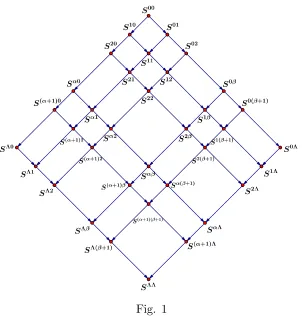
Proof of Theorem 2. (a) LetS ! X via an elimination sequence X andS ! Y
via an elimination sequence Y . We say the “diamond property holds (for X
and Y )” if there exists an -diamond grid S ; such that
1. for all ,S 0 =X and S0 =Y ;
2. for all ; , S and S are elimination sequences.
Fig. 1
Observe that S ! X and S ! Y i¤ there exists an ordinal such that S ! X via
an elimination sequence X and S ! Y via an elimination sequence Y . By
Lemma 1, it su¢ ces to show the diamond property holds true. We show it by (trans…nite) induction on . If = 1, thenS!X andS !Y. By Lemma 2, X !c(S)andY !c(S). Now assume the diamond property holds for all < . We distinguish two cases.
Case 1: is a limit ordinal. De…ne S 0 X and S
\ < S for all < and
6
= 0. Since X =\ < X , S 0 =\ < S 0. By the induction hypothesis, for all < ,
we have
S !S ( +1) 8 < , c S S ( +1) S 8 <
) \ < c S \ < S ( +1) \ < S
, \ < c S S ( +1) S .
By Lemma 3,c S \ < c S S ( +1) S . Therefore,S !S ( +1)for all <
. (If is a limit ordinal,S =\ < S =\ < \ 0< S
0
=\ 0< \ < S
0
=\ 0< S
0
.)
De…ne S \ < S = \ < \ < S . We …nd an elimination sequence S .
Similarly, we …nd an elimination sequence S withS =\ < \ < S =\ < S .
Case 2: is a successor ordinal. By the induction hypothesis, there exists ( 1)
andS ( +1) c S( 1) (andS
\ 0< S 0 if is a limit ordinal) for all 1. Since
X 1
!X , by the induction hypothesis,S ! S( 1)0
!S 0 andS
! S( 1)0
!S( 1)1.
By Lemma 2, S 0
! S 1 and S( 1)1
! S 1. Again by induction on 1, we have
S !S ( +1) for all 1andS( 1) !S for any 1(if is a limit ordinal,
the proof is similar to Case 1). Therefore, S and S for any 1 are
elimination sequences. Similarly, we can …nd an elimination sequence S such that
S for any 1 is an elimination sequence. That is, there exists an
-diamond grid S ; for X and Y . Therefore, the diamond property
holds.
(b) Let S ! X via a …nite elimination sequence Xk
k K and S ! Y via an
elimi-nation sequence Yk
k K. By 1-Montonicity*, we can similarly show the diamond property
for Xk k K and Xk k K.
Proof of Theorem 3. SupposeS ! X ! Y. Then Y X. Thus, we have
[(Y \DOM(X)) DOM(Y)],[Yn(Y \DOM(X)) YnDOM(Y)]
,[YnDOM(X) YnDOM(Y)]
,[XnDOM(X) YnDOM(Y)].
That is, (Y \DOM(X)) DOM(Y) i¤ c(X) c(Y). Therefore, Hereditarity* and
Monotonicity* are equivalent. IfS ! X !Y, we similarly obtain that 1-Hereditarity* and 1-Monotonicity* are equivalent.
Proof of Corollary 1. Suppose X ! Y. That is, c(X) Y X. By Hereditarity, we have
[(Y \DOM(X)) DOM(Y)],[Yn(Y \DOM(X)) YnDOM(Y)]
,[YnDOM(X) YnDOM(Y)]
)[XnDOM(X) YnDOM(Y)].
That is, c(Y) c(X) if X ! Y. By Theorem 2(b), the …nitely iterated elimination
procedure forG is order independent.
Proof of Theorem 4. (a) SupposeS ! X ! Y. SinceGis a CD* game,(Y \DOM(X))
DOMc(Y)(Y) DOM(Y). That is, Hereditarity* holds. By Theorem 2(a) and Theorem 3(a), the procedure is order independent in L (S; c).
Now consider a COUSC game G under the strict dominance relation. Suppose S !
X ! Y via an elimination sequence fX g . Let y X x for some y 2 X and x 2 Y.
Then, 9i 2 N such that ui(yi; x i) > ui(xi; x i) for all x i 2 X i. Since G is a COUSC
game, by the proof of Dufwenberg and Stegeman’s (2002) Lemma,9z 2S such that for all
y0 2 Y, (i) u
i zi; y0 i > ui xi; y0 i and (ii) uj(zj; x j) uj(sj; x j) for all j 2 N and all
sj 2 Sj. Since x 2Y X , z 2 X for all < . Thus, z 2 \ < X = Y. By (i) and
CD* game, and hence, the IESDS procedure is order independent inL (S; c). By Theorem 1(a), the IESDS procedure de…ned in De…nition 1 exists inL (S; c).
(b) S ! X ! Y. Since G is a 1-CD* game, (Y \DOM(X)) DOMc(Y)(Y)
DOM(Y). That is, 1-Hereditarity* holds. By Theorem 2(b) and Theorem 3(b), the …nitely iterated elimination procedure is order independent.
Proof of Corollary 2. (a) Suppose S ! X ! Y. Then c(X) Y X. Since G is
CD* and S ! X ! X, DOM(X) = DOMc(X)(X). Thus, DOM(X) = DOMY (X) =
DOMc(X)(X). Therefore, we obtain
[X!Y] ,[Y X and XnY DOM(X)]
, Y X and XnY DOMY (X)
, X !GKZ Y .
That is, for any CD* game, the GKZ procedure is equivalent to the iterated elimination procedure in De…nition 1.
(b) Suppose S ! X !Y. We similarly obtain [X !Y], X!GKZ Y . That is, for
any 1-CD* game, the …nite GKZ procedure is equivalent to the …nitely iterated elimination procedure in De…nition 1.
Lemma 4. The choice rule c for c-rationalizability satis…es 1-Monotonicity*.
Proof. Let X &J Z denote “supported restriction Z by coalition J given X.” Consider
X ! Y. Then X Y c(X) =\Z2F(X)Z 6=? by Ambrus’s (2006) Proposition 1. Since
Y \Z Y \c(X)6=?forZ 2 F(X), by Ambrus’s (2006) Lemmas 1 and 2,Y &J (Y \Z).
Then Y \Z 2 F(Y) for all Z in F(X). Thus, c(Y) = \Z2F(Y)Z \Z2F(X)(Y \Z)
\Z2F(X)Z =c(X).
9
Appendix B2: “Outcome” Order Independence
Letv denote the transitive closure ofv; that is,Y v X i¤Y =Y0
vY1
v vYK =X
for an integer K. De…ne the “outcome” equivalence relation X $ Y as Y v X and
X v Y. The following observation asserts that X $ Y implies there is an
outcome-invariant bijection between the “strategy” equivalence classes of X and of Y. Let Z'Z
i
denote the set of the equivalence classes ofZi under the “strategy”equivalence relation'Z;
that is,Z'Z
i =fz'
Z
i :zi 2Zig, where z'i Z fzi0 2Zi :zi0 'Z zig.
Observation. Suppose X $ Y. For each i 2 N, there is a bijection i from Xi'X to
Y'Y
i such that u(x) =u(y) whenever yi'Y = i(x'iX)8i2N. Subsequently, the “outcome”
relation $ implies the usual outcome equivalence in Chen and Micali (2013, De…nition 5).
In order to show Observation, we need Lemma 5.
Lemma 5. (i) Suppose xi 'X x0i 8i 2 N. Then u(x) = u(x0). (ii) Suppose Y v X. For
each i 2 N, there is an injection i from Yi'Y to Xi'X such that u(x) = u(y) whenever
x'X
Proof. (i) Sincex1 'X x01,u(x) =u x
0
1;(xj)j6=1 . Sincex2 'X x02,u(x) =u x
0
1; x
0
2;(xj)j6=1;2 .
Continue to do this replacement, we obtainu(x) =u(x0).
(ii) For all i 2 N and y'Y
i 2 Yi'Y, consider the representative strategy yi 2yi'Y. Since
Y v X, for the representative yi, there is xi 2 Xi such that yi 'XtY xi. De…ne i(yi'Y) =
x'X
i . For any y^2 Y and x^ 2 X. If y^i 'Y yi and x^i 'X xi 8i 2 N, by (i), u(^x) = u(x) =
u(y) =u(^y). Suppose i(yi'Y) = i(^y'i Y) =x'
X
i . Then yi 'XtY xi and y^i 'XtY xi. Thus,
yi 'Y y0i; that is,y'
Y
i = ^y'
Y
i . Therefore, i is an injection fromYi'Y to X'
X
i .
Proof of Observation. Suppose Y v X. Then Y = Y0
v Y1
v v YK = X for
an integer K. Let i 2 N and k = 1; :::; K. By Lemma 5(ii), there is an injection ki from
Yik 1 'Xk 1
to Yk i
'Xk such thatu yk =u yk 1 whenever yk
i
'Y k =
i yki 1
'Y k 1
8i 2 N. De…ne i = Ki
K 1
i 1i. Then i is an injection from Yi'Y to X'
X
i such
that u(x) = u(y) whenever x'X
i = i(yi'Y) 8i 2 N. Similarly, there is an injection from
X'X
i to Yi'Y because X v Y. Since Yi'Y and Xi'X are …nite, i must be a bijection.
Proof of Theorem 5. We show a stronger result: the …nitely iterated procedure (by using the relation `) is “outcome” order independent. Because 1-monotonicity* (w.r.t. v) holds,
by the proof of Theorem 2(a), for two …nite “outcome” elimination sequences fXk
gk K
and fYk
gk K on system(S;`), we have K K-grid fSklgk K;l K such that XK =SK0 =
c SK0 and YK =S0K =c S0K . Now, consider an auxiliaryK K-grid
fS(K+k)l
gk K;l K
for two sequences (starting from SK0) S(K+k)0 k K and SKl l K, where S(K+k)0 SK0
for k = 1; :::; K. Since SK0 = c SK0 and S(K+k)k = c S(K+k 1)(k 1) for k = 1; :::; K,
S(K+K)K = SK0. Therefore, S0K
` SKK
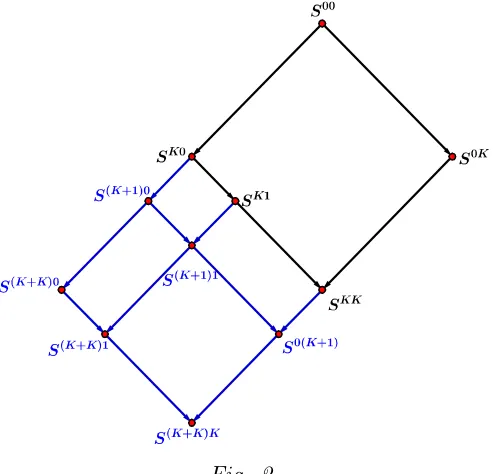
` S(K+K)K = SK0 (cf. Figure 2), and hence
XK
v YK. Similarly, YK
v XK. Consequently, XK $YK.
[image:28.612.185.432.455.692.2]Proof of Lemma NWD.Letxi; zi 2Xi,w2XtY. SinceY vX, for eachj 6=i, there is
xj 2 Xj such that wj 'XtY xj. By Lemma 5 (i), u(xi; w i) = u xi; x i and u(zi; w i) =
u zi; x i , where x i = xj j6=i 2X i. Thus, for all w2XtY,ui(xi; w i)< ui(zi; w i),
ui xi; x i < ui zi; x i and u(xi; w i) = u(zi; w i),u xi; x i =u zi; x i .
[“only if” part] Suppose xi X zi. Then, (i)8x i 2X i, either ui(xi; x i)< ui(zi; x i)
oru(xi; x i) = u(zi; x i), and (ii) xi 6'X zi. Therefore, (i)8w2XtY, either ui(xi; w i) =
ui xi; x i < ui zi; x i =ui(zi; w i) oru(xi; w i) =u xi; x i =u zi; x i =u(zi; w i),
and (ii)xi 6'XtY zi. That is, xi XtY zi.
[“if” part] Suppose xi XtY zi. Then 8x 2 X, either ui(xi; x i) < ui(zi; x i) or
u(xi; x i) = u(zi; x i). Since xi 6'XtY zi, ui(xi; w i) < ui(zi; w i) for some w 2 X tY.
Therefore, ui xi; x i = ui(xi; w i) < ui(zi; w i) = ui zi; x i where x i 2 X i. Thus,
xi 6'X zi. That is, xi X zi.
Proof of Theorem 6. Suppose X ` Y. Then c(X) v Y and Y v X. Let i 2 N. By Theorem 5, it su¢ ces to show that for each yi 2 ci(Y), there is zi 2 ci(X) such that
zi 'c(X)tc(Y) yi. Since yi 2 ci(Y) Yi and Y v X, yi 'XtY xi for some xi 2 Xi. If
xi 2 ci(X), we are done by letting zi =xi. If xi 2= ci(X), by …niteness and transitivity of
NWD,xi X zi for some zi 2ci(X). By Lemma NWD,xi XtY zi. Therefore, yi XtY zi.
Since c(X) v Y, zi 'c(X)tY zei for some zei 2 Yi. Since yi 2 ci(Y) and yi 6 Y zei, again
by Lemma NWD, yi 6 c(X)tY ezi. Therefore, yi 6 c(X)tY zi. Thus, zi 'c(X)tY yi, and hence