ALTERNATING DIRECTION METHODS FOR
HYPERBOLIC SYSTEMS
Alexander R. Gourlay
A Thesis Submitted for the Degree of PhD
at the
University of St Andrews
1966
Full metadata for this item is available in
St Andrews Research Repository
at:
http://research-repository.st-andrews.ac.uk/
Please use this identifier to cite or link to this item:
http://hdl.handle.net/10023/13788
1I8TR0D3
HTPHrJO aC SYSTEiO
A th e# l# pr###nted hy
Alsitimder H# G ourlaj;
t o
the U n iv o z^ty o f St*Aadre*#^ in « p p lie e tio n fo r
the degree of
ProQuest Number: 10166980
All rights reserved INFORMATION TO ALL USERS
The qua lity of this reproduction is d e p e n d e n t upon the qua lity of the copy subm itted. In the unlikely e v e n t that the author did not send a c o m p le te m anuscript and there are missing pages, these will be noted. Also, if m aterial had to be rem oved,
a n o te will in d ica te the deletion.
uest
ProQuest 10166980
Published by ProQuest LLO (2017). C o pyright of the Dissertation is held by the Author.
All rights reserved.
This work is protected against unauthorized copying under Title 17, United States C o d e M icroform Edition © ProQuest LLO.
ProQuest LLO.
789 East Eisenhower Parkway P.Q. Box 1346
-Y ' ,
•yamrsts^
r * ^ < H '■/: .?• :'
t^Wt.
"V ^ ' . ' t .
; ^ I i .••3 I ^ "^ -_ * 1 ' " , '
^ .V
j* Itv^nP 9 r V I ■ ■ to
.-_ ic
; X k
^4Ès£iâ^tfS2S-I deolar* th a t %h# falligwlng th#al* 1# m reg o N of r«oo«roh'we»rk #m v i# ê out ly ae# th a t the thooio I s oy own
,
oosyosltloa* sitd th a t i t has a o t prsvioumly hmn prssontod in s p p lio stio n tmr m h ig h er degrso#
. r
3=1
%■
-" ' jk'k
î1.,:ï
M ' .1 •'
r-fT^- —, I -*—I * f '
. 1 * . j ■ ■
:; - S a "
:zg#k:
: #
■
,>r. "-‘j a - , .
^,3!^ rT jf: y
.(■
W - '
■ik\- ' fVzl
Zn Ootobor 1960^ I satrlow latod a t ths U aiv araity o f St«AndrMi8 and read f o r a degree In J^ p lie d Mathe a tle # In
St#:>alvator*# College# In JUne 1964^ I graduated w ith F ir s t C lass
Honour# in Applied ::stl)ematls## In Ju ly I earn adm itted#
under Ordinanoe Id# as a fu ll-tim e Hesearoh S tu ie n t in the im partaient o f ath sm a tie s of 8t# Salvator* # Collège under the su p erv isio n o f Dr# A# k# % its h e ll#
AC.
The Author i s indebted to the Carnegie T rust f o r a
Researoh SehoXarsliip h eld during tt\m period of m searoh# and to ^ is s P. A# Cunnlnghan f o r the ex; e r t typing o f th is th e sis#
■« t' .Jp--->r
\ ’l :
L„r-I-';
7
.4_
V i ÿ
»?.- ■
_ ^ . T : .
l î t î-. .* ; *■
' I • I ! f / j ■ ' . ? '. .f _
- , - b ' - . : " 1 : f -i p a » " " " f
. .• • r. ^ I , * - *r ^ :: " |;..,“3■ ■*• • r*
v. ■
c m z n c A Z :
. / I
' I e e r tif y # # t Alexander &• Gourley hae e^ant
nine terme in f iù l ^ tii ê ree^ereh work under aiy d ireetio n # end ie ^ e qur^llfled to e u b e it the eeqcm^xuylng tb e e le
" .3,
in ep p liee tim ) f b r the degree o f Doetor o f hileeophQT*
n " .'■*
- -j, , ' -IP. -* '•' A Jk ^ "Vfc"
-^ÎS^
.■ .:-h
-=\. ■
•■UT
a fiü R iiè iVihWTfJiâer'
-V "
4i
",- 'T.T.
S M M k
5 y .r
” . . f
Chapter X. IN R jB CnON.
1.1 1.2 1 .3 1#4 1.5
1.6
1.7i.a
The equt tl<me o f oeth eaatiee^ phyoloêm
C i& eeifioeU on of eyetwae o f p a r tia l d lf f e r e a tia l eg u atio n e.
Hedxiotioa o f a see nd order hyp<«rbolie p a r tia l d if f e r e n tia l equation to a f i r s t o rd er S j'ctea.
Sons exenplea.
F in ite d if f e r s neee#
Ketatlon
om
c neepts.
E x istin g methods.
Outlook. ,'V . --»••• «■
* . f f I / i
2.1 2 .2
»■'. 2 .3
I ’
2 .4I
'-2 .5
r-2 .6
;
" 2 .7
I 2 .8
Cha ta r I I . iCT SO.S ZliVOLVm AN EIGHT ^OIM? U TXCE.
Introduotlon.
The S aalar Case.
The Veator Caae.
The Family o f S ight p o in t schemes. S ta b ility .
W atrieas w ith v a ria b le a o e ffia le n ts .
Beundazy m odifieatlon fo r fs a to ris s d f e r ^ An a lta m a tiv a f a e to r is a t ion.
A u serieai x^aaults«
1 2 11 ï j 14 16 ■Û : 1 21
28 : ' 0
Chfti t e r I I I . MSTÎIÜDS INV LVBG AN KtOllTSEH POWT LAinCB
1
laixtiduketlott.
3«1
3*^ Tk» «L^liteen p e la t repX eeea»nt.
3#3 72ie r'e#e#x&m#a&ehf@rd feo to rlM itiaii.
3#4 A ite n u k tire f& eterlm atioaa.
3#3
Ihe faetorisetioiie for variable aatrloea.
3e6
S ta b ility #3#7
Nuaarleel reeulte.
At.
BNDIXt
Xami'Aloa Of a blook trid lefo n al m atrix.
« 68 70 72 75 76 80 8A 89
Gha t e r XV.
-4.1 4 .2 4 .3 4 .4 4 .5 4 .6 4 .7 4 .6 4 .9 4.1 0
OmOOlAL CLASüXnCATr 3fl 0? METHODa. In tre d a e tie o .
The eaaet ilfferem o e replaeem eat. Goa#ta n t o o o ffie ie n t m&trice#.
A proadttatioa# u#in# forward d iffe re n c e # .
92 93 94 97 96 Apgraxlmatl m# uaiag f«m ard and baokeard d ifferen ce# 102 Xuanary o f aaheae# and th e ir accuracy.
V ariable c o e fflo le n ta . s t a b i l i t y .
M uaerical a o lu tlo a o f im l i o i t aoheaea. CoiwaitiTvg aatz*iaa#.
> /r
Chapter V. Tag nmUM^Ak CASH.
Introd^otiam .
5#1 The d jU fa m a tia l ay staa .
5 .2 %%ampl#A o f eoaaarvatlom lama*
5 .3 B x p lia lt ooa n imamaloaal eaaa.
5 .4 Im p lia it one d la a a sio a a l e&aa.
5 .5 Smomthla^ o f boundary data*
5 .6 ib ^ d le it t»>>-diMiiai >aal oaaa.
5 .7 iB p lia it too dljMmaioBal oaaa.
5 .6 Kumerlo%l : a a u lta .
119 120 121
124 -M : 128
131 133 137 140 142
Chapter VI
6.1
6.2
KXT£fiS;or3 AND CQWCLODINC BXKaSXS,
lBtirodu«tloB«
SxtBiMlona to oer* th aa too Oi moo itmonolonm* C oaaludla. rom oito.
144 145 146 148
The me them 4 H o n l fcmaul tio n of sany pro l#%a In acianoa and tachttolo.y
laada
o l h er to o m a rtial d iffa re n tiw l oouatlon (p«d«o«) o r to a oat o f aucH tiona# A p a r tia l d if f é r a n H a l e(petition ie an aquation involving the ra ta # o f oh nga o f unknof^n quanti tie e ^euoh a# to c p e ra tu ra , prae&um »••) v lth raa e o t to two or aoro ind^^panda:.t V u ia b la e u&ually iB p reaan tln ; tim e, len g th or angle#Tha t^^xact e lu tio fi to a p .d .a . in u region & w ith boundary dH ie soma fu n ctio n viiloh e a tie f ia a the equation a t avexy p o in t In E and a« tehee oart& in t . oon:;itione on 8 # For exa pit , the
fu n ctio n rapreeantin^; th e etoady eotl:>n of an Incorjpreasibla fl*iid through a s tr a ig h t uali'orm duct e a t i s f i s a p a r tia l ( i f e r a n tla l equation (Laplaoo*a equation) a t avaxy p o in t an : takfae Uia value
♦ y*) on the bourn:ary.
, For a rb itr^ u rily ah&pod regions and gener a l bouti a y con d itio n s * i t ie not u su ally poaeil Ic to d e te r i n e an exact e> lJtio ti to a given
p a r tia l d if f e r e n tia l equation# In ^n atter^pt to solve such
pzob
eas approxiraat a e t io oji hr ve been davaljped. Approxi te Bjet!*ode f a l l in to two c la sse s(a) e; rc) -ia a t. mtJhedm where, f o r exa - l e , s tninceted
a e rie s may be obt* imed f o r th~ solution# Tliaso ae^tho^s arm u su a lly v a lid only in cax ta in areas of the re^^ion under
’3 Ç-JP , ,• « ; ■ m m . M
-v-j'
(»») aummrloU «... t m l te a. t:-.o a em plgyW f in it» dl- feie.-.e» teoM ioue#: these a re mors freq u en tly used and u n iv e rsa lly
applicable# The concept o f a f in ite difference; method w ill be developed la te r#
Consider nov, he two dim ensional second order , urtD zl d iz f e r e n tia l ^ equation
%
{ 1 .1 .0 ♦ 2 1 ^ , ♦ o |jÿ * ♦ «5^ ♦ f u « s .
•# ••• 5 Bre i vUictions o f the in cpendent vgirlab es x ,y and erhaps of the dependent v azisb le u. Special eases o f (l# 1 # l) occur frecpiently, as thqy are t e mathomatio* 1 fo ras of tin» conservation p rin c ip le s o f physios# Squatlon (l#1#1) i s sai> to be
( !) e i l i p t i o i f b*»ac < 0 , (11) p arab o lic i f b*-€w ■ 0 , ( i l l ) hyperbolic i f b*-ac > 0 ,
f o r a l l x ,y ,u in he ic g lc n u a ie r consideration#
s ln p le s t and b e s t known e i lip ti o equations are TapXace's equation
and Poisson*s equation
♦ 0 - r x,y)
U iat the flu x tiu o u ^ any closed s u rf sc i s equal to the to ta l charge en clo sf^ by the su zf oe«
Those pr^lw .jS in viiich one o f the tvo independent v a ria b le s x ,y becomes the time v a ii bio t are u su a lly o f ptirab o lie o r hyp rb o llo
^)"pe# The sim plest ptaB bolio equation i s the heat conduction equation
which governs the flo e o f b ea t in a b ar or rod. The bouniary co n d itio n s o o n sis t of e ith e r %h& te ipe%%tu e given a t the te;? ends of the bar
(two values o f x ) , o r soae measure of d iffu sio n fro a the ends. I t i s u su al fo r the tem peratuio d is trib u tio n in the bar t ) be ^nown a t 30c&e
in s ta n t in time# % is i s termed tlis i n i t i a l o o n iiti^ n .
Likewise in the case o f the sim p lest hypv rb o llo equ. lio n , the wave equation
( 1 . 1 . 2 ) 3 ^ " ,
the boundary o a d i t i ^ i s a re given on two l i n a % « a,b and the i n i t i a l co n d itio n s, u su a lly u and I t s time d e riv a tiv e ^ , are given a t some in s ta n t in lime# T3)0 m ajo rity o f h p erbolio eqa< lio n s a r is e from
v ib ra tio n proble s , or those in which d is c o n tin u itie s , such as shock waves, p e r s is t in time#
The wave equ lio n can be w ritt^m in » d if fe re n t zsanimr as two f i r s t o rd er equations# We introi^uoe, as new dependent v a ria b le s , the
q u a n titie s
>
and th erefo re (1«1#2) beoomee
(1 .1 .4 ) ^ .
rYom (l# i# 3 ) i t 1# easy to # e th a t u« end u# are oonaactec by the f i r s t o rd er p a r tia l d i f e r e n tia l equation
(1 .1 .5 )
On in tro d u c tio n o f the v ec to r uhknown e # ^ th,:> equations (1 .1 .4 ) and ( 1 .1.5) can be w ritte n as the f i r s t o rd er system r a r t i a l
d if f e r e n tia l e q u a ti )ns
o r
I f * Ü - Û,
wheze A i s the 2x2 m atrix in ( 1 .1 .6 ).
This form ulation o f th e wave equation is t r i v i a l in i i s e l f , b t the p rin c ip le in v Ived form s the b a sis of the ner.t s e c ti n.
6 .
K*-'"
§ï:
The o la s tif ie a tlo n o f sgretems of p arti« d d lf fa ; : ^ tic l equations i s ;OSt e a s ily dssoribed n the equations are forrxilated in s a tr lx n o ta tio n .
C onsider the system o f a r t i a l d if f e r e n tia l equat
d\
(1.2. 1) ^ ox * ^ *
where u i s an npdlnensional v ecto r whose 0opponents (i« 1 ,2 ,* .« n ) are unknown funotions o f the two independent va la b le s % arid t , A i s an nan m atrix w ose e n tz ie r a ^ j ( i . , M , 2 , . . . n ) aro fu n ctio n s of x , t and perhaps u , and B i s an n-vector whose components are ihinctions of x ,t ,u . o ^ isra c te rlstic o f the system (1 .2 .1 ) in the x , t plane i s defined as bein<: a curve along which the v alsas of u given on the curve to g eth er w ith equation (1 .2 .1 ) are not s u f fic ie n t to
detenaine the norWL d cid v ativ e of u to tho curve. W t s len o ta the are length alon^ a ourve in the x , t ila n s and l e t ^ be s im ila rly defined along th e n o raal to the cu rv e. Then by the usu al in ru le s fo r
a r t i a l d i * f e r e n tia tio n we have
Ü • k - H • S - i • HI • 5 f • ! " - s s (1 .2 .2 )
.
S iI? • h • i • l« • g -
3
Ï • fi • -u
Thus, s u b s titu tin g the above r e la tio n s in to ( 1 .2 .1 ) , gives
(1.2. 5.) ( y ♦ y ) | | ♦ ( y ♦ * m . 0 jh a
On a oh^i m a te r ia t i c cui-'/e, i t folicw # th a t the d -t? minant of tiia m atrix of o o o fflc ia n ta o f te rn s involving the daz'ivatlva noraal to the ourva su s t vn.:iish, and so
(1.2*4) 11 ^ ♦ J t / I • 0
h e ra fo ra the W isT aoteristia ourves of the system (1 .2 .1 ) a r t g iven by ths s lu tio n s o f the ordinary d if f e r e n tia l equations
( I .T .5) ^ ( i * 1*2, . . . n)
where ( i « 1 ,2 , . . . n) are th eigenvalues of the m atrix A . I f
S^ i s a row eigenvector asso ciated w ith the ^^iganvalue X^ then m ultiplying (1.2*3) throughout the l e f t by s^ we o b tain
(1.2.6) Sj^^(t^I ♦ I j ♦ S^B m 0
Hath d e riv a tiv e in (1*2.6) i s d ira s tad along the tangent to the ourve (1.2.3) . I f a l l the eigenvalues X^ are r e a l , and i f the m atrix A has f u l l s e t o f m o l, l i n w rly-independent eig^^ruv ;0ts)2s #$, . . . sn a sso cia ted w ith them, then ( 1*2*1) can be tra n s fo r le Into the canonioal fona
•1 ^ ^ Jlî ♦ »i® ■ 0 (1 - 1.«2, . . . a)
where each equation involves d if fe re n tia tio n in one c h a ra o te rls tic
d ire c tio n given by
7^ / 1 »
î .
r e a l eigenvalue# an l e f u l l met of n l i n o rly independent eigenveotora,
then the aye tern la tam ed hy e rb o llo .
I f the mat; i% A h a n owsplea eigenvmlnea then t^:e o3 a r a o ta ris tio # are im aglm ry and tZae ayaters la o f e l l i r t i o type#
In the lin e a r ca se , where the m atrix A la Independent of the ao lu tie! v e c to r u, and has n r e a l d la tln c t eigeuvaluc& , the aye te a can In
f a c t be reduced to the diagonal form
wîiere the coaponen'a Cc are lin e a r combination# o f the u^; and the b^ are kiunm function# o f x , t , U m (U«, D#).
In th e f ollowing we a d l only be conoei'tied w il t ays tame which are
o f bypcrbolio ty p e. I t has been ah own th a t a co n dition fo r
the myatem to be rb o lie ia th a t the m atrix A h i# n re a l eigcnvalue# and a f u l l s e t of lin e a r ly independent eigenvector a . The aimp^eat
m f fio ie n o n d itio n ia th a t the m atrix A la m y w ftrio . th a t i a ,
^ i j * ^ j i ^ elcn en t in the i ^ row atid column o f
the m atrix A# V^hen tlila occur#, the flyctem ia termed ay aaetrio hypcrb^U c.
Tet ua now cooaider th e extension of these lie a s to the general f i r s t order systeo in M space dim ensions,
U
(1.2# 7) m y Aj^U^ ♦ B
ia1
Where th e m atrices A ^(i # w, ..« X) and the v ec to rs u and B are < efin ed
9 .
a re o on# ta n t. Then by th aethoJ o: aep arello n o f vorlfiblea, so lu tio n # o f the form
(1 .2 .8 ) u . c f * ••• *
e x is t where X« , # .. and X are param eter# such th a t U
(1*2.9) |X^k - f X,2I . I m 0 le i ^ ^
and C i s « constant nc!)»sero v ecto r such th a t U
(1 .2 .1 0 ) VAC o Z X.A.C
i#1 ^
I f X«, . . . , X^ are r e a l , then (1 .2 .8 ) can be regarded as a general t#r% in a F ourier reprvsen a tio n of the so lu tio n o f ( 1 .2 ./^ . I f evexy
ro o t X o f (1.2.9) i s r e a l , in a d d itio n , then the 3 1 itio n of (1 .2 .7 ) i s oso i l l s to ry , n e ith e r growing o r decaying exponent ic ily In tisMi. Therefore we are le d , in he m ultidim ensional c a se , to say th a t
(1.2.7) i s o f h^pciibQÜc type i f a l l the ro o ts X o f (1 .2 .9 ) a i e r e a l ,
and have aasooiated w ith them a oooplete s e t of n lin e a rly independent eigenvectors s a tis f : ing (1 .2 .1 0 ). '! ^ s d e fin itio n i s a lso a lie d to
he q u a a ilin e a r aystec ( 1 .2 .7 ) .
In p ra o tio e , as >EISTRICî'S ;6" has s own, the a# jo r lty of sy ste :# o f the form (1 .2 .7 ) are in f a c t of the symmetric //L erbollc type w ith the v a ria b le t i i e ^ lik e . T his nom enclature im plies th a t a l l the m atrices e . A#, . . . , are symmetric and in a d d itio n , fe i s p o sitiv e d e f in ite . I t follow s th a t a m atrix P e x is ts such th a t
^8
and th a ra fo r# the ro o ts o f (1 .2 .9 ) are the ro o ts of
U
(1 .2 .1 1 ) I I X.PA.r^ - X l| « 0
1-1 ^
M
For any r e a l oliolee of X. , ( i- 1 , . . . M) the m atrix t X.PA.H
^ i»1 ^ ^
I s syam etrlo an! thus X must be r e e l, anc the ^c<?s»ary s e t o f n lim e r ly iniependent c h a ra e te rls tlo v ec to rs e x is ts .
In the next se c tio n tht; a c tu a l mechanism w ill be given fo r the red uction o f a ^ n c r a l second order Zzyperbolie p a r tia l
d if f e r e n tia l e q m ti n to a f i r s t order symmetric hy^erbolie system .
i'i ; '
II.
1
1.3 -Bductijn o r aciCiiid ÊÊiàmr k r w r b o lia t a - t i » ! AlTtmÊÊaMÉX
tiw ntloB f i r s t o r!# r l y f a .
In th is se c tio n i t w ill be shown th a t eq u atio n s ex p ressib le in the fo rn
n a*u
) «
/ i j * i ^ end lower order terrA ,
i -1 > 1
can be reduced to a x U r.t order sy was t r i e hyperbolic system o f the fo ra
(1 .3 .2 ) ‘ t “
i« i
whez'e U i s a v e c to r whose components are lin e a r e y ib in a ti )os o f and the f i r s t p a r tia l d e riv a tiv e s >f u witii re s pee t to the space v ariB b les. We sim ll r e s t r i c t o u rselv es to the case whwfi the
c o e ffic ie n ts a re fun ctio n s o f x^, ( i ■ 1, . . . n) ani t only.
I t w ill follow th a t ( i m 1, . . . n) and B are lik ew ise A inetions o f x^0 ( i « 1, . . . a} t# SittM the second ord er o b é râ t»r on the r ig h t o f (1 .3 .1 ) must be o f e l l i p t i c type, i t follow s th a t s'G s i s a p o sitiv e d e fin ite q u ad ratic form f o r at\y re a l noiwsero v ecto r
s # ( s f , . . . Sm )', «diezw G i s the m atrix o f o e e ffic ie a ts g ^ y The f i r s t step in the red u ctio n i s to form ulate (1 .3 .1 ) in the f:>rm ( 1 .2 .7 ) . This i s accomplished by in tro d u cin g the v ecto r of unknowns
V - ( « ^ . . . . , • ( O i . . . .
■ ’"• 5
s.*r-r —
(1.3*3) ÎÎÜ ♦ lower opdar te;las.
fwi,»' itimm Bj i# 1 j# 1 ^
By Um defim itium o f thcî ooapom nte of the v e c to r V «e a lso have the equations
'4
( 1 .5 U ) - > % , imml > '« 1 J i f * ’ • “ <•!... .... e t t 1
i#1 1-1
The oombinstion o f (1 .3 .3 ) end (1 .3 .4 ) as a m atrix equation then gives us a system o f the form
(1*3*5) l î “ ) ^
t-., 1
i»1
Where A#, ( i # 1 , . . . n) aim symrtetrle m atrlo es. The m atrix i s given by
i%% g is . . . . gteO
g a t . 0
.
. .
g a t 0
. .
. .
gneO0 1
tM
For any v ec to r 2 # (s$ , . . . Sm, s e e .) ' the quadratio form
m
' 3 .
I t follow # th a t i;4ir6 e x le ta a m atrix F dapanàin^ :>n ;•>!, ••• X h,t such th a t
p # I
We define a lia u r eo d b ln ati n of the eoopm enta of V by the r e la tio n
(1 .3 .6 ) V m 5^0.
latro d u o ln g (1.3*6) in to (1 .3 .5 ) #nd m u ltip ly in g throu^fa on th# l e f t by the m atrix P le a d s to th e transform ed system^
m
K.* (r*U) . (P'D) ♦ fÇr^U
i-1 or
R # H j f D . ) ' PA^p* ^ ♦ ) ’ ^’\ l r
i 4 ..I i
i*1 which i s o f the re q ;ire d fonts
n
i«1
# " £ h
iM
where th e m atrloes ( i » 1, ### n) are syametrio#
I t should be n o ticed th a t no r e s tr ic tio n s are r e q i r e d on the æ t r i x B# In what follow s we W isll assume th a t the m atrix B i s Id e n tic a lly se ro , th a t i s , we are in te re s te d in solving the equaticm
M
(1 .3 .7 ) I I • > ' \ . imi
p a r tic u la r ly fo r the ease M # 2# Th v ex ten sio n to the case of aore
■■rr — ■'
Before in tr o the n o ta tio n and ooooepte o f nuoezioaX w w lyai# req u ired in the f ollow ing obey te r# , we «h all b r ie f ly in d io a te a few eyoraetrio h y ^ r b o lie ayg^em# re la te d to ;h y e io al
problem## The te s tr ie tio n to lin e a r eye tern# w ill bo in o^ed except iVi Chapter V where the n o n -lin ea r ease w ill be e o n s iio re i in d e ta il*
I n s e a t ion 1.1 i t we# aiown how the newlim ensional wave
eq u atio n can be w ritte n as a f i r s t o rd er system. Indeed l^nKDEXCZ^S has shown how La la c e * s equation and the h eat eondueticm equation can be sissil& rly deaorlbed [6^* But as wo s h a ll be n e in ly in te re s te d in the num érisai s e lu tio n o f problems in two (o r nom ) ^ a c e dimensions we s h a ll r e s t r i c t oureelves to exemples o f th is type.
The two-dimenoivnal wave e l a t i o n oan be w ritte n as a f i r s t ord er system in a v a rie ty o f w e
/st-w R
u i , Us being oouplcd e o lu tlo n s of the wave eq u atio n .
( b ) j | " ( ; ;
and even
(o)
/5.
A t)uree-dim( n slo n a l example ie fum iahed by the vell-knm m Maxwell*# equation#
} | ♦ f . 0 . } | . - 0
geverniag the e l^ o tr ie and aagnetio in te n s ity v e c to rs , ^ - (5$ , %#, 5#)
and £ - (Bf, Hs, B s),
whereis
the e u rl o fthe
v ecto rI f w^ - (B f, b e, B f, Z«, He* A en the above eq u atio n s oan be w ritte n in
the
aytWBStrio bypwrbolio fb raÜ
. . . 1 . . 1 • « # • —1 •
! # • —1 « #
•1 • # # # R 1 . . . . . R * • • •
# 1 • . • -1 . . . # *
• • *1 • # # • 1 • • • #
R
In the above exemple# a ll the matrloes
(in the notation of
(1 .3 .7 )) are independent o f
and t# However i f ws consider the
I o lar form of the wave equation
( 1 . 4 , 1 )0 - 0
then i t is not difM ouIt to show that an equivalent system is given by
A . . i / - s i n B eos0\ 8 \
o t \uay \^aii^-ooc6y d r V^usy r cosC? sioey 3e
where u i, u# botli s a tis fy (l#4#l), and the matrices are no longer
constant*
/ 6
1
As Stated in 1*1, i t i s u su a lly n o t p o ssib le to o b tain an ex act so lu tio n o f an sx b itra z y p a r tia l d if f e r e n tia l equation in a general reg io n , and even thoujb a s»»oall#d olesed form so 4.utlon i s found i t may not be in a form s u ita b le f o r eo ap u tatio n . For example consider
the problem of solving i eisso r* s eq u ttio n
(1 .5 .1 ) e Z - O
;v e r the re c ta n g le -1 < x , y € 1, w ith ÿ - 0 on the p i^r ia te r . The
clo sed form s o lu ti;s t f o r # iis problem i s given by
0 . I V . ^ r Moh eo«h i M t a e o . i â a i i k t
d -D
A num erical method w ill c e rtS in ly provide an adequate num erical so lu tio n .rx>re e a s ily and e f f ic ie n tly then the lab o rio u s ev alu atio n o f the above so lu tio n .
In a f i n i t e d iffe re n o e netiiod the reg io n of in te r e s t, - ie x ,y e i
in the above exairqle, i s covered by a o r mesh formed
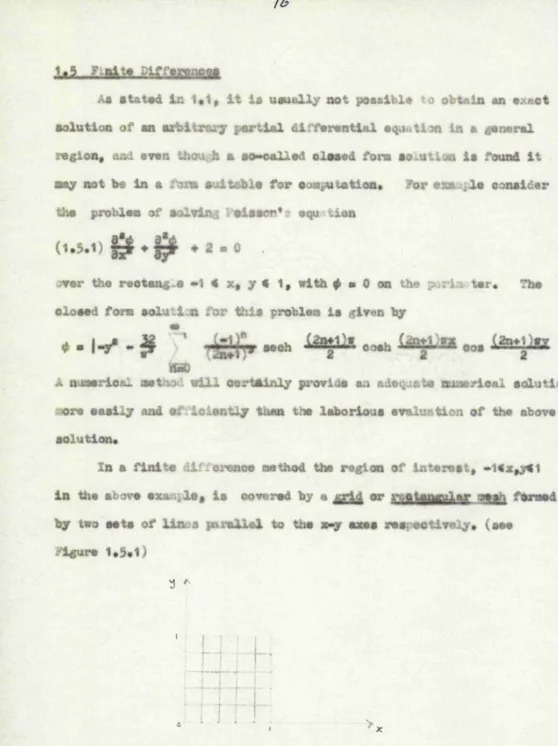
by two s e ts o f lin e s p a iw lle l to the m-y axes resf>ectivejiy. (see Figure 1 .5 .1 )
If
'4 «
(I
If' j •
: i
[image:26.621.23.581.15.761.2]/ V .
The g rid ia aaaumad to b# oiform$ the digtaao# between p n r a lle l lin e s being h# The o r I ^ ttio e p o in ts sro the in te rs e c tio n s o f the lin e s# The p srti& l d l f e rsn tim l equation i s re^Xased by s s e t o f sim ultaneous lin e a r equations oonneoting the r 2 jo s o f * a t tho l a t t i c e p o in ts in ouoh a as to approximate the p a r ti 1 d iffe re n tv a i equations# For e%a pie# co n sid er thm fo l.o o in g p a rt o f the g rid
shown in Figure 1#5#1
-'AH
j
L .
t
A«J^iâySLJUiibUa
c o n sistin g o f the p o in ts (le r# > s )# ( r * 1 ,0 * 1 , s * *#,G ,1)#
Lot denote the value of * a t the p o in t ( i , j ) # T^ien i f we take the com bination
♦ u i . 4 •
and expand by T r i o r 's tha^ran about the p o in t ( i , j ) ve o b tain
t s
*
1,4
-Therefore
^ ®"«
* § ^
1,4
♦
0
(h")
la am api roadaatiaa to
at ttia point (
1
,
4
) , and tba a n or is aaeond
order in h#
[Later t ile w ill ir feet be lefbrred to ae having a
fourth order tm noatlon error] # E^plaelng
sSaH arly, : oieaon*#
equation (l#
5
«
1
) booama
h
^*
101,4
•
3
*
1,4
* * l - l ,J ^ i ,
4
a
1
* ^ l ,
4
" * l.> l '"
3
“
0
(h*)
or
(
1
.
5
.
2
) *
1
+
1
, j ♦
♦ * i,j_ i -
«
0
(h*)
The term# of order hf on tho right hand aide o f equfitlon
oonetituto the prU^lpal port o f the truncation e:r:;or o f thla formula#
liegleotlng the truneatlaa
otTor
in
and eowmlng over tho whole
region with auoh a formula reeulta in a large met of eimwltaaeo a
equation# requiring to bo solved for the unknawn fUnoti uns f . .#
J
Obviously the saallor we take h the better aocurany we ob tain# But
any deorease in h and inazeaae in aeoureoy w ill be o: so i by the fa st
that a larger set of equations w ill have to be eolved#
However we
Shall not oonoem ouselvee ;lirthor with th is problem but, having
introduced the oonoopt of a fin ite difference method w ill now turn to
an important initi^l-boundary value problaa#
Consli:er the solution of the equation
/ f .
in the region
0 < % < a; t e O
subject to the ia itis i. condition
tt(x,0) « f ix ) I 0 < X S s
end the b*unjary o nditions
“ ( 0 , 0 ■ » ( 0 , u ( * ,t) ■ g , ( 0 : t » 0
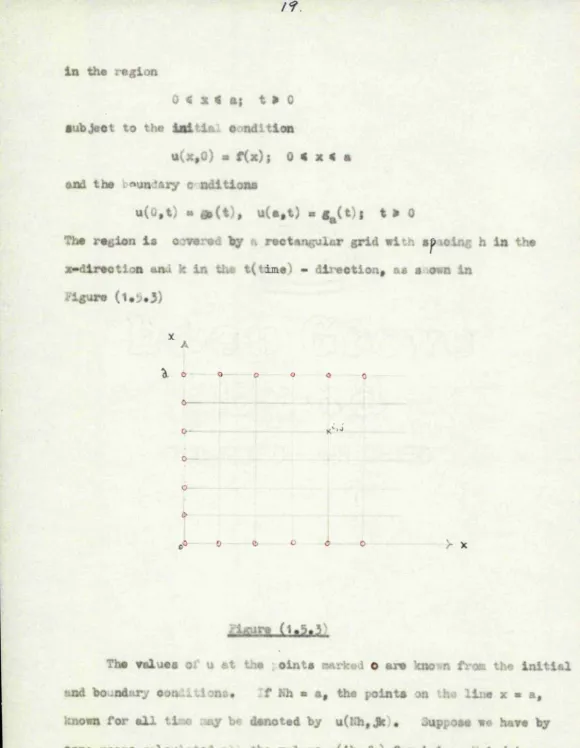
The region is covered by a rectangular grid with spicing h in the
x-direotlan end k in the t(tim e) « d irectio n , ae e own in
figure (1*5.5)
K " 0 ~
a
-( ‘ i~~
à > X
zigar» (1.5.3
The values of u a t the ointe marked o ere kno%n free the in itia l
And boundary conditions#
I f Nh * a, the points on the line x * a,
known fo r e ll tiao :ioy be denoted by u(î%, jk)#
Juppose we have by
some ueans calculated SJ..^ the values u(ih,Jk) fo r
- ' J
[image:29.621.12.592.11.759.2]9
.0
.The problem i s now to iatroauoo a re^ laoeuent of tho f i r s t order
equation in auoâ way th a t the value# u ( ih ,( * * l) k ) ,( i* 1 ,# e .n - l) may be e a lo ila te d from the k own values u (ih * jk ),(i* 1 ,# .# & * 1 ,j* 1 ,# # * a). This w ill r e s u lt in a by step crooedure fo r the o u ao rieal in te g ra tio n o f the d if f e r e n tia l ecju'tlon#
hexha^ 8 the simi les!: replaoecient would be
^ which i s u su a lly wx*itten in the form
(1 .5 .3 ) • " i , * - R/2 (*1*1,*: - - i . , ; . ) - 0(k^kk*) where
p » k/h
i s the mesh ra tio # ^n a lte r n a tiv e sohe:e of ooaparable accuracy i s given by
(’•5.4)
- i (* l* 1 ,.'^i.1 ,J - *^'(*l*1,^-*l_1,„'
f
♦ k!»')
At f i r s t s ig h t i t i s mot obvious which o f these schemes one should employ in an a c tu a l ca lcu latio n # Both values o f u. l*a+1. are obtained
th
so le ly in terms o f the valu es o f u a t the a time le v e l, Such scheoes are teraed (M oaiclt# An im p lic it scheme i s one inv Iv in g
more than one p o in t a t th e lev el# Ve s h a ll see in a l a t e r se c tio n the im portant d iftc re n c c between schemes (l#5#3) and (l#5#4) when we
co n sid er th e ir s ta b ilité ' w ith re sp e c t to growth of roun - o f f erro r#
I
I
2/.
i
I . e . H oU tign .
In tho p reo ed ln j se c tio n s a c e rta in amount of n o ta tio n has alread y been In tro 'laeed , sucZi as the re p re se n ta tio n of Lh») ÿ (lh ,y c}
by In the f:!,.sw ing ch ap ters we s h a ll be in te re s te d in problems Involving the im ependent v a ria b le s x ,y » t, w ith so lu tio n u(% *y,t)#
A square mesh in the #. ace ooerdinate p i n# w ill be asa-^ed , and th e re fo re the f allow ing n o ta tio n w ill be appropriates
u (ia , Jh, ak) ■ u"i j
Sometimes th is w ill be w ritte n simply as um. The form ula;tijn o f the schemes w ill be :%we eonp&et i f we introduce the follow ing d iffe re n c e o p e ra to
rs:-“ rs:-“ 1+1,4 " " "1 .4
■ - "* 1 .1 ,4
“ "*1,4+1 - "*1,4
^ -“"1 .4 • ”"1 ,4 “ "*1,4-1
d^Ua m UaCf - u«
fh% v b ri^ b le uw w ill be r e s tr ic te d to denote the valo^ vf the fu n ctlim , or v e c to r fu n ctio n u , a t the o in t ( ih ,J h ,s k ) , anâ Vm u l l l denote the v e c to r o f the t o t a l i t y o f u*^ j over the approprié;to r a tfcw o f i , j . Ue th e re fo re deuotes the t o t a l i t y o f values a t u a t no e s on the m^
time level#
#h«ll onl, be in te r. • ted in te a le v e l ilf f e r e n e e eehemee. th a t i s schemes w^iich conn* o t p o in ts on two neighbouring time lev els#
2%
Suoh mohaae# oan be w ritte n ( f o r a twoHipaoe dlmenaion^l , roblem) In the form
(l# 6 # l)
^ ^
(% *ih,yejh) m ^A#
\% (% elh,yejh)idiere the eummatlaae are over a f i n i t e nuige o f i , j , n o t n eo eaaarily the aaae a t the two time le v e l# . I f the n o ta tio n introduced above i s now em iloyed, (l#k , l ) oan be ;u t in to the form
A # ( d a • A # ( A a , L y )%%
o r b r ie f ly
(1#6#2) Aavic'H s AeUrt
The in v ersio n o f t:.e o p erato r A#, i f p o aaibl*, a^Xova ua to w rite ( l . 6 . j ) a#
(1,6#3) Um4>f « Cua
where C may now have m in f in ite ex; anal on in tena:^ o f the d iffe re n c e operators# I t should b<3 n o ticed th a t the ex isten ce o f i s
tantam ount to aasumint? th a t (1#6#2) can bi? solved fo r iC34>f# A lao, i f in (1#6#1), Foui*ier a e rie s are su b stitu te d fo r Umw#(x#y) and iw (x ,y ), followed by a c a n c e lla tio n o f a common f a c to r, the iw nainlng term s oan be w ritte n as
(1#6#4) # &sV.
where
• 2 ^ ^ j^ i(frh ♦ yah)^ , r .a
S 3 .
(1 .6 .5 ) V.-H > .
The q u e n tlty G (^,y) i s re fo rre d to as the s a s llf lo ' tio .i tr ix o f the hyetea ( l.6 « 2 ) . In tfni»r»X h « i l l be some function nf k so th a t t)* o p erato r C in equation (1 .6 .3 ) oan be r«snrded as involving k only.
I f (1 .6 .2 ) i s d eriv ed from a d if f e r e n tia l prhblon o f the form
. Î I - -*u
where A le a lin e a r d lT .'e re n tia l o p erato r in the space co ordinates %,y, then schene (l#6#2) i a s a id to be co n siste t i f
uniforaX y in time# { It# !! denotes some norm}# T his i s simply a
statem ent o f the swq virement th a t as k tends to sero (and hence h tends to sero as some f m otion o f k) the tru n ca tio n e r r o r var.ishes#
L et us new tu rn to the concept o f ^ la b ility w ith resp ect to sequences of c a lc u la tlc n s# each sequence w ith a fixed t i e increm ent k^ such th a t tends to sere as i increases# The c a lc u la tio n can be
regarde 1 as applying tlie in f in ite se t >f o p erato rs
c(k,)"
o a mk^ a Ti • 1,2;###
to the i n i t i a l data# The iwquirement of s ta b ili ty i s th a t no
24-thc d iffé ré no# equation and is independent of the dlfi'eix>ntiaX eq u atio n . In f a c t , to te s t fo r e t e b il ity the me trio # # are used, Ve m tat#, w ithout p ro o f, th# two condition# f o r e te b ility vloieh ehalX be
employed from time to tim e in th is theeie#
A’a j s a i i a a ; •O B d ltl»
tor
a U b U lty , th* v a i :■ c o n d itio n f253, i# th a t(1.4.6)
|x j a 1 ♦ 0(k)
(1 . 1,2, . . . n)
where X ^ ,(i
« 1,2,
M)
are the eigenvalue# o f 0 (^ ,y )[The q u a n tity o(k) o u st be included to allow fo r prdblea# whose so lu tio n # have a g m ine growth in tim e),
A ÊXitrUiQ^X e a o d itio n due to LAX«i*ICh?MTSR Fi? and KBEISS [14] ,
[
16
]
i s th a t(1.6.7) Im J « 1 ♦ 0(k) ( I . 1 ,2 , . . . a)
«twr* * ,,( 1 m 1, . . . a , ur* the #1 ;*nv*lu*m o f B*&, «h* * S* la th#
h eraiti& n transpose o f G# This s u fflo ia n t eo n d itlo n be used in the s lig h tly d if fe re n t form
(1 .6 .6 ) ||0 # & || « 1 * 0(k) where i 1. ( { i s sooe norm*
O perating on the im itia l d ata U t, m tim es w ith C(k) gives
«■ ■ '!c(k),"u*
wliieh i s an approxlm etion to th# e met so lu tio n u o f the d if f e r e n tia l
T
equation a t ( i h , ^ , a k ) where nk # T. The o p erato rs C(k^) are sa id to form a o o n v er^ i approxim ation to the so lu tio n the i n i t i a l value [ roblem i f2
'
5
.
' la# - î ^ l l ■ 0
vhèri i# a positive strictly dssressing ss<^i:œ, sush thst
I t V i - »
IM (17] has siicwn th a t fo r a properly posed lin e a r i n i t i a l valu# p rcb la n , a o o n siatan t f i n i is difforenoe rap la s s a >nt i s om vergont i f and Ouly i f i t i s stab le#
ÎÎOW 1 s t us re tu rn and c o n sid er, in the l i ^ t o f these oonoapts, th a soneaes (l#5#3) wni (I#j#4)$ I t i s a straig h tfo rw ard o alo u la tio n to v e rify th a t thss^J sehsaas are 0 n s is ts n i. Lot p, denote the S n s lific s tio n r'aotO ü ( fo r th is probisn G i s a ona+^bywona m atrix) of
tbs sohaaes (1#5#3) and (l# 5 # 4 ). Thou
Ip sI* m 1 ^ p sin*fh«
(l«b#9) IpsI* « aosV h ♦ y Êl^fih
« t • (1 - g r)sim P fh #
I t i s obvious th a t |p s | 3 i i f d 4 fo r &qy choice o f dependence of h on k# Therefore (l#5eA^) ia s ta b le f o r p < 1# Hcerevor w ith regard to (1.6.9) i t dees m atter what the r e la tio n is between h and k . Sup ose
ph # kf , o > 0
and thus
(1.6. 10) I ,,I * « 1 ♦ or
26.
« « a.
Therefore k m e t tend te w r e f a s te r than h* in o rd er th a t ( I .5.3) be s ta b le . However in p ra e tie e (l.5 « h ) ia a aueh mare aW i^pUble
scheme and would r a r e ly be used.
r ia a lly l e t us eonsider the do#a ns of depends;ice o f hyperbolic p a r tia l d if f e r e n tia l equations and th e ir re la te d d iffe re n c e schemes. In p a r tic u la r we s h a ll o n e e m c u ra tiv e s w ith the se lu tio n o f the wave equation
w ith ap p ro p riate i n i t i a l end boundary co n d itio n s, 1» reg io n 0 4 % « 1, t * 0.
> b
t=o
I ' 6 ' I
lip p es# the velue o f u a t th e p o in t mexked a (see F ig irc 1 .6 .1 ) has been obtained through seme f i n i t e d ifie re n e e oaX culation which uses
tho point# marked o # Let denote the domain o f dependence o f the d iffe re n c e rc fla e e ^ e n t, th a t ia the in te rv a l bet*#^m the extreme d ata p o in t# o on the lin e t » 0 employed in e a lo u la tin c t^)0 0 v alu e. S im ilarly l e t D d e ra te the eorroaponding domain o f dependence fo r the d if f e r e n tia l equation# Thie ooneieta of th e In te rv a l on t # 0 between
the e h a ra o te ria tio # e h itti paaa through the p o in t o and are in c lin e d a t 43* to the x , t exea# In Figure 1 # 6 # l(a), k haa been o: oaen #o th a t
D# Let B e P ^ Then azgr change in the i n i t i a l d ata in I
although a ffe c tin g th e f in a l so lu tio n of the d if f e r e n tia l equation w ill in no way a f f e c t t!# s o lu tio n o f the d iffe re n c e scheme# This s itu a tio n p e r s is ts as th e aesii s is e i s reduced, the mesh r a tio being k ep t constant# l% erefore the d iffe re n c e so lu tio n cannot be expected to converge to the so lu tio n o f th e d if f e r e n tia l equation u n less
“h - ®
as in Figure 1#6#l(b)# T his i s re fe rre d to as the Cou a n t-F rie d ric h s* ewy C ondition [3] and i t i s a necessary co n dition fo r t!w s t a b i l i t y and
U 7 S x l# tlM u tte o d a .
The ,rb b le a which we e!m ll ocm ei!er In th© : oilew lng th ree ohepters w ill be th e nuoerlo&l so lu tio n o f the f i r e t o rd er lin e a r hyperbolic ayeten in two space d laen sio n s
( U M ) f t • * .
Where u i s an ««vector and AjB a re nxn aynm etrie m atiiees which may be fu n ctio n s
of
x*y#t.Although s v cra authors have i :x)poaed selieaes f o r the m&nerical in te g ra tio n of (l# 7 # l) only two seheoes have any p A utloal value. The a o s t used a c h e # w ithout doubt i s the LAX#*T'D&0F1' aathod [23]
(ooe BUBSTtlM [2 ) , which may be w ritte n , in d iffe re io # operator n o ta tio n , in the fo ra
(1*7.2) ( I ♦ a(pA*f*A*) 6*+;(y»#p'A*) (p»*p*B*)A«
(A&AA) (6. *V« )(!#+** ) » ,* 0 (h ') This la an a i v i l o l t seheaa la v alv ln * mln* point* a t th* bna* l* v # l (a** n # i r a 1.7.1)
29.
The e e re t fe a tu re o f (1 .7 .2 ) 1# i t e poor e teb lX ity ^ a r e o t e r l e t i e o . I f ee l e t
|A«i « aax
|X j|^
Where
U - x^ij - 0,
|
b- Y l • 0
then the o o n altlo a f o r (1 .7 .2 ) to be #ta b le ie
p |) " l *
STRa.’ G [%>] has e^ioen hoe to modify tliie method eo th a t the s ta b ili ty co n d itio n i s
fIV sI * 1
(th e maximum aiiom able fo r am e x p lic it scheme, by the Courant*
Friedriehs*L e«y e x id itio a ) b u t the com plexity renders trazig*s scheme v a lu e le ss ia p re o tio a l e a lc u la tio n s .
The seeonii sehene i s due to W&IOSOF? [4 0 ]. I t i s an e ig h t« p o ln t e x p lic it scKome ba^ea on fo u r p o in ts a t each o f te c n o li^ o u rin g time le v e ls (Figure 1 .7 .2 )
y A
> t
J
■T-3 f.
iy;V)and Id given by
(1.7.3) [Ivj(X*p O Ae ♦ Kl*pB) AnS^I-pA-pB) A#Am :«#e$
• [IVî<IefA) A* ♦ (XeyB) AyV^IepAvpB) A#de «eeO(bf )
I f d ata ia given on the p lan e# , x ,y # 0 th is me* aki ia e f r e e tiv e ly
a x p lie it#
However although V endroff dem on#trated the oonvergenoe o f th is aoheme f o r a r e a t r ie tad olaae o f p ro b lr a he was unable to prove anything w ith reai^eot to i t # s t a b i l i t y . A lso, the scheme la only a p p lica b le i f the a a trlo e a a,B are negative d e fin ite #
Other ich«sea have been p r^ o e e d by ATEXIIU [ 1 ] , and
J ! •
ig
I
In the fellew ln;; ohap te r# new Im p lic it m eti^l# w ill be d # v e l(^ d w ith # view to ebtm ining eptimwm e te b ility W ieraeteristie# # A ll th# method# developed w ill be o f the eeae eocuregy a# the method# o f
Lex end e n d ro ff, end ÀendrofT.
In Chapter I I a elaa# of formulae baaed on the #e..^ node# a# weadroff*# f orw ell 1# in v eatig ated # In Chap t e r I I I a atudy of an eiehtoen«point ae^mae eg n a iatin g o f tw^ nim e-point operator# ia aa e# Chapter IV imt ro daee# a technique eh reby a l l kriowm and rumly
developed method# can be obtained by an alg e b ra ic prooeiure wiUioutI iU reet re a o rt to #oylw* a theorem#
In Chapter V a tv9§h a t a r i ia nade to conaider yrdblea when th e a a trlo e # A and B a re purely funetiona o f the ocm$)onejita o f u in aueh a
way
th a t th e ay#ten may be preaented in thec
.Tnacrvation formH. M'”’*
- •
F in a lly in C hapter VI we oonaider b r ie f ly the c ^ iix le a tio n #
neeeaaaxy to extend th e aohenea to the general N«#peoe ulm enaional ay#ten H
t i - i
r:-.
: ,
' ■ ^ " Æ à
muLprm i i
iamfOD3
vnm m
wootpoinr
îjotîc7:^'
OourlaL.; end H ltctell f9}
y.hl^
33.
A tw<>mlevel dlffexcnc# nchmrm bated on a to ta l e f e ig h t node#, fo u r a t each timo le v e l, w ill now be introduced f o r the n u n erie al e o lu tio n o f the f i^ a t o rd er lin e a r hyperbolic aye te a (1#7#1). A g e m ra l form ula w ill be derived which w ill c o n ta in , ae a sp e c ia l oaee,
the formula of 4cndroff mentioned in se c tio n 1.7# Fro» the genwral form ula a new ache a , which i a one o f a f ? ^ ily o f acW aca, ia
obtained and e a t in an d W m a tin g d ire c tio n fwm#
An a lte rn a tin g d ir e c ti cm method ia one vhei^by a { c r t i a l
d if f e r e n tia l e q u a tiw i n q apace v a ria b le s la aolw :! by a m ulti«atep f i n i t e d iffe re n c e procedure of a p a r tic u la r type# ^ nmae a ria e a from the fa c t th a t a t eacv 'step in the procedure w# solve alang lim ea
p a r a lle l to a apaoo cocordinate a x is , th ia ax is being d if fe re n t a t each step# Alt}iougi) the f i n i t e d iffe re n c e ache;^e a t each atage ia im p lic it in n a tu re , i t ia cl' a p a rtic u l r form which may be solved by a d ir e c t o r n o o # ite rc tlv e motived#
A lte rn a tin o d ire c tio n methoda were f i r s t introduced by
PKACEkAN and iAClIIUiU) in 1935 [27] f o r the num erical a c l tic n o f the h e a t conduction equation in two apaoe v ariab les# Since then, they have been extended t ; o b tain numei"ical so lu tio n a of the h ea t equation in an a r b itr a r y number o f a; ace v a ria b le a, La la c e s equation^ the wave e q u a tiw and the biharm onic equation#
T / -y ;
preo«dujr«s, «Ittaoui^h KKEXS6 [15] *nd (MKY [B] h la te d « t th# p # # # ih lllty th e ir use#
■»f_-.'a'v '' ''
-i y
M
' - y - / \
t'fTi
m . .
■ fl* i r^v . ■L’“j
p . : , : ; / '
-L+".':7\'' 'V,-.1. ,."ir . .1
-\.+ . II-?';
'J/
; '
3S.
2^1 Th# Soiai r Cmae.
To ia tro iu c # th# Wohniqu## involv#d in r#pl#oing tii# p a r tia l d ir f # r « n tla l #y#t#m (1 .7 .1 ) hy a f in it# d l f arano# soii# # , oonaidar f i r # t of a l l th# ro; la c« a# n t o f th# «calfyr form o f ( 1 *7.1 ), th a t la
^ r # A,B ar# a o a la r oonmtant# and u i s a a o a la r f,m otion o f x ,y * t.
a A
J
> t
W # 1 '
Aamming th# o ri^^n to h# a m#ah point* th* g rid aiioon iti Flguro
2 .1 .1 , ooatain# th# p o in ts u ( l t h , l s h , l , k ) - i ^ * ^ ^ ( l , - i , i * 1| l , . j , j .1, l , ^ , » . l ) th e re h ,k ere the m ah epaeinge in the epi.ee end tin e ooerdinete
36.
we o b tain
~ " 1,4
""-"“i i r " " .> 1 * “î , 4
‘^1.1.4
( ' • ’ •2) “I , . (1 + &w)
^ 1 * 1 # ♦ Ag)(1 4 A»)u“ J
and a im ile r re mult# a t the («4l)*^ time level# Ttmroforo a general fonaulm through the e i^ h t p o in ta shown in Figure 2#1#1 oan be w ritte n in the form
(2#1#3) [l4aAxeWiy4m6y^*]u?*^. [l4dAi.«r\yef^jA*lui5 , « 0
1 , J 1 ,Jwhere a , b , # . . f are a r b itr a r y non«sero o o efflela n la*
I f the v alues of 6%u" j . . . are now eximnded, by ay lo r a e r ie s , in terms of u and I t s d e riv a tiv e s witli re sp e c t to x ,y ,t a t tlie point ( i ,j f O ) , the exprear>iona
C 4 u 4 • • •
m 1 .4
(2.1.4)
^
•••
m1,4-^ 1 .4
1 ,4
eto# a :e obtained# The d e riv a tiv e s w ith re sp e c t to t In (2#1#4) are
3 'i.
■ I t ( 4 Î ♦ ■ & ( # ; • & * “ " ë l ) . ♦ l j l
p « k /h ,
and th* r#» )ltlib; apraaalom a su b a tltu t« d In ( 2 .1 ,5 ). Oo e l is ti n g th# o o # fflc l# n t# o f h | ^ h |ÿ , ^ h i j • f 3ÿ^ #T#luat#d a t ( l.j.m ) to sero we fin d th a t the fcülovlng condition# on the un nown# a , b , # , . f h ^dt«
# ■ <(l • Bjl) d » y(l ♦ jA)
(2#1*5) b # â (l « |jB) e m à (l ♦ 1^)
f«e # ip (A 4 B)
The d lf erence re Inee # n t ( 2 .1 .) ) now take# the fa ra (2 .1 .6 ) [1 ♦ ^(1 « p«%)Aa ♦ X l - pB)Ay ♦
« [1 ♦ i ( l ♦ pA)h* ♦ i ( l ♦ pB)A|| 4
where
f « c « ^p(A 4 B)
and the p rin c ip a l pni't o f the tru n c a tio n e rro r la o r orTor h*. The choice
® * 4 [.1 - p(A 4 B)J f * ^ [ l 4 p(A 4 B)J
tran afo m # (2 .1 .6 ) in to W endrcff^a acheta ( 1 .7 .3 ) f o r th<^ eo n lar form of ( 1 .7 .1 ).
However i f we -uf:# the oholoe
3 9
(2 .1 .7 ) [1 ♦ 3[l 4 i(l-*pA)A»]u?^Vl4j(l4pB)A||3ri4i(l4pL^.)A«]u*
*# J
*# J
<On Jiatroduotiun o f cn in term ed iate o r a u x ilia ry so lu tio n by aeans if V
Of the r e la tio n
(2 .1 .8 a ) f l 4 /( I - » f l ♦ i ( l 4 pA)A*J^• J
equation (2 .1 .7 ) take# the form
(l 4 %(l « 4 3(1 • pA)A».lcf*^yi 1 4 Kl4pH)Ay j(l4^(l«p3^)A||lv/^*j
which i s e q u iv ale n t to
(2.1.6b) [1 4 2(1 pA)A#]u/2^ » 1 4 5(1 4 pB)A^]vJ**^
E(ÿâation# (1 .1 .8 # / and (2 .1 .8 b ) o :n # titu te an a lte rn a tin g d ire c tio n f a c to ris a tio n o f (2 .1 .7 ) a s they req u ire the so lu tio n of two p o in t
recu n c n ce rel^tiion#
(a) in til# y*dixw ction a t the f i r s t step (b) in *he ^ « d irec tio n a t th e sec nd s te p .
This rose as aa> be rep resen ted d iag raam atically as in Igure 2 .1 .2
Ti
39.
Ve e h a ll r e f e r to tliie f^ o t r i s e t l o a as being o f Feseeman-Eaehford (F .a ) ty p e. I a a l a t e r se c tio n i t w ill be shown th a t th is {rooess re q u ire s m o d ificatio n n ear boundary p la n es.
7iie îa ilti p lie n t ion o f botii sid e s of (2.1 «8b) by (l«pB) gives
(l«pB)(l4j(l«prf\)Asla^^
m
[ 1«pB4j(l4]^)(l«pB)A^ v*Jj*
• (lepB l l4 5(l»pB)AyjV^^ -
This i s eq u iv ale n t to the foiTiuls
(2 .1 .8 a ) (l-p B )[U ( l - , A ) 6 . ] u ^ • •* * * ''i j ♦ (1+pB) *+ (l+pA )6,Ju," . The two ste p s (2 .1 .8 s ) sad ( ^.1.8c) c o n s titu te an a lte rn a tiv e form ulation wulch wc s)m ll r e f e r to ms the Dcuglms«ê\ oh fo r d (^ . . ) type fa c to ris a tio n o f ( 2 .1 .7 ) .
a.2
7b» V so tjr Caaa.Let u# now cone d er the ease wheat A, B are wax c n e ta n t a a trio e a
and u l a an n-veotor fu n ctio n % ,y ,t, Aatuae ti; it now repreaente
the v e c to r u, evaluated a t ^he po in t ( i , J , a ) .
Following (2 .1 .6 a ) and (2 .1 .8 b ) we in tro iu o e the p o lr o f P.R.
tyyo formulae
[ ! ♦ (,% ♦ ]v?% . [ I + ( r l ♦ &i)A. lu.? ,
J i# J
(
2.
2.
1)
_
[ I ♦(•> ♦ f‘A)A,lu.'J^j « [2 ♦ ( r l ♦ #R)4#lvr%T
« tero I la the u n it umb a a tr lx ( o r M tr ix o p e ra to r), a»'. aro
a o a la r e o e ffio ie n te Involving the me ah r a tio p » l^ h . H lln in a tio n
o f Xeatie to the form ula
[ i + ( o : ♦ « ) û * 3 ( i ♦ (o i ♦ fA )a.3w 2*
(2. 2. 2)
- [ l + ( r l ♦ 0B)A«](I ♦ (p l ♦ *A)Û*'u,“
Which an ev alu atio n o f the product# gives
[ I * (# I ♦ fS)Ayo(#I ♦ fA)A»o(#X ♦ » ) ( • ! ♦ * 2 ?
m f l * ( r l * #B)6w*(rI ♦ aA)A,o(rX ♦ gB )(rI ♦
, As in the s c a lu case the values of u , A»u/ etc# it e c in t# ( i# j,a ) and ( i , a re expanded aa T&ylor s e rie s in t--rss o f a
and i t s d e riv a tiv e s a t tl^e nof^e ( i ,j ,m ) . D eriv ativ es w ith re sp e c t to tiiae are replaced by tl;e re lf tie n s
«bore the l e t t e r a ss laee the m atrices A an B are o an etan l.
I f th* co * rfio i* n t« o f h | ^ 2 ^
node ( i , j,m) are in tu*n equated to aero , the e q u a ti)fa (p ♦ f • a)A ♦ (e • r ) I « 0
(p ♦ f « a)B ♦ (e • r ) I m 0
(2 .2 .4 ) ^ ^ ,
(p 4 2pf)AT 4 ( f ♦ 2pe • s)a + (e - r ) I « 0
(ÿ* ♦ 2pf)B* 4 ( f ♦ 2pe - a)B 4 (e • r ) l
m
0(kiP* 4 pf)(AB 4 BA) ♦ (f* • s*)BA ♦ (pe ♦ e f « r»)(AeB)4(e*«^r*)l»0 are o btained.
We aeek
a s o lu tio n o f equetions(^.2.4)
f w the so a la rs e , f , r , s which is v a lid fo r a l l sa tr ic e s A end B. bviously thef e i owing s e t o f eq jiitio n s m ist be s a tis f ie d ;* p 4 f * s e 0 e * r « 0
p*42pf at 0 f 4 2pe * S mO f * * s * « 0 pe 4 e f * r s m 0 lead in g to the urdque s lu ticm
e
• r a jr
* f # S " p
S u b stitu tio n o f the above v alu es in to (2 .2 .1 ) and (2 .2 .2 ) lead s to the form ulae
[I 4 j(I * pB)d||]v^* « [I 4 i( l 4 p*t)A*Ju2j
(2 .2 .5 )
[ I 4 J (I * pA)A«]u*j' * [I 4 ^(I 4 pB)dy]vJj
(
2
.
4
.
6
)
• ( I ♦ a ( i ♦ pB )4g][i ♦ Hi ♦ ^
r##p@otlveiy^ vharft
the
tt^unoatlon # rro r 1# o f o rd er h*#The ex ten eio a o f the D.R. type f a e to r iia tio n (2#1#8e) and ( 2 .1 .8e) follow s a e la ilu r p e t te rn » end 1# given by
[I ♦ i ( i - • r i ♦ i d ♦ pA)A« u.%j (a .2 .7 )
(I ♦ pB)[I ♦ î(î - pÀ)A*Ju^y- -ipBvjy^d^pB)
On •X ln lo atlo n n f (*#2.7) rtduoM to (2*2*6).
I t i s in te re s tin g to eoopere (2 .2 .6 ) w ith Wendroff*s fbraxule. k e o a llin g th a t th e l e t t e r emi be w ritte n in the fora
[I ♦ i d
-■ [I ♦ s(i ♦ pA)^*:d ♦
♦
p(A4B^A
x.1
u^.
whioh la
[ ^ U A lf b ) & „ I [i+ K W A )6 . ] ^ ’u * y
" [ 11 * i(l*pB)6,j [x* (l*pA)A«^-i pfaAAwAKlu^j
we see th a t
L." - l‘*u-. Jp'BAM.Cu'jy . a*j)
where ere the d i:fe re n e e o p areto rs la (2 .2 .6 ) end (2 .2 .6 )
re e p e o tiv e ly . fen d ro ff^ a s e h e ^ was devised i n i t i a l l y as a een tred d iffe re n o e sohe e in o rd er to lend i t s e l f to a n a ly sis by tiw
spaoe d ie e n sio n s. th a t i# fo r the equmtiom
ia i
where A ^(l « 1, #.# %) are negative d e fin ite eyari .rio aetrieem , b u t i t # s ta b i l i t y eould be ie a o a stra te d in one space dioen^l n only [40]# I t should be noted th s t iim one*disensional analog;*;#of (2#2.6) eo in eid es m ith Weodroff*s one dim ensional sohaae to give
[I ♦ } ( l • pA)AaJa^^ • [I ♦ i ( I ♦
th e re o f course no f& o to risstio n Is possible#
-i
a m i
«jsjasâ» h i PM ^M ttT t f iWl^It# #eh#M (2*2.6) 1# In f a e t only on# o f a taaiZy of posalbl# e ig h t point #ch# @# oenn#otlng fo u r points on each o f too n slg h b o irln c t planes#
z
Vm) i)
~ —^ t
a s a r * 4,2,1
«0 doflno in (a*b) I'o ra ila (a ,b # 0 ,1 ,2 ,)) mo on# which do.:«ndo on the four pointe a t the o o n ^ re o f equore e t tin e etmf# («)
( 1 ) ( * , * ) o r lU gh" t y p e , o o n a is t in : o f
(l#l)fX ej(X «p B )A e] (lepA)Vm]umee
ml
)Ay
J( (I«pA.)f
»jUa
#( 2# 5.1 ) c ( lepB )Py 31 ( l e p A ) f * )ii»ef
«f jf jOa ,
()4 3 )[I* z (l+ p B )9 * j I+a(I.*ji)A «]y.+,
• I - ( I - ï« ) 9 y ] r ie H l^ p A W lu .,
(where o f oourae (0 ,0 ) wee tk# eoheme derived in aootlcn (2 .2 )) ( i i ) ( e ,a i l ) faodiilo 4 o r " l a t é r a l " ty p e, o o n aiatin g o f ( 0 , l ) [ l e ;(l«pB)ùy ];^X«2pAfx]ia,e, •[lojr(XopB)d||][IO)p£a iO a,
(0,5)[X*ïp*9y][IOv(l^pA)ùajuaOt *[IO-.pî:Ag][!♦«(lopA)êa]oa,
(1.0)C lO ^(l«pB )4y j«.X* pA4% jWaVi #f l o :(l^ p B )6 y ] [ l o p #& Um,
(1.2)ri»;f|jR fyl[I^ (X«»p.m)9s^UaOf #[Xe^pBdy] [ lo^ (I*p.i)9# jUr>,
(2^l)[X«*5pBAy^ 1.# (i+pA)9& ]ua*i «[X^.pBVy ] | X -^(I«p-i 9^ Ua,
(2^3)[X*j(X^>B)9y j{I-* p^'ida "lX'"g(X*1^)9y][Io p ,9& U r, ( 3#0) [ I " pBdy3[l4 (l#p^l)da jUaO# # [XojpBV^] [ X^\(IepA)d% m ,
( 3 . 2 ) t l ^ : K X o | ^ ) 9 y ] . . I ^ ivAAa ^Ud-H # [ î - j ( l « î ® ) 9 y j f ! ♦ pi.V)£.^Ua#
( i i i ) (a,«v^2) modulo 4 o r "diagonal" ty p e, ootuistlcv; o f
( 0 ,2 ) : I-^pBVy jplw. pA9%]u^^ m fIeaP»Ay]ri4« pAÛ« u * j
( t *3) [ X**5pB9y
3
r lm.,:pAùz Ua^ee m ^ I^jp&:y ] ‘ Xv^pAV» ]ua,
(2.0)[X*^pBdy ][!«» p;k^a]u»Of • l*^pB9y I* pA9,]%a,,
--- ' V ' %K'- f t't. .'. 'ff* r
where d , ? ere the ^wrwerd end beokweru d life re o o e o p erato rs defined in se c tio n 1*6#
A ll the above soiic res have o v e ra ll tru n c a tio n e rro rs o f O (h^), b u t, idiereae each step o f type ( i i i ) i s a eonsifitent zoplace^iant o f
the d if f e r e n tia l eqa itio n , each step o f types ( i) and ( i i ) i s not* Therefore the " s ira i^ t» th ro u g h " and " la te r a l" type eoiioaes do not
f a l l in to the "gem^ral c la e a if ie a tio n o f a lte rn a tin g xii^eetion methods' proposed by noUGL^iS and WMM [5]^
^ ' A ll the snn>i^s (&,b) may be derived by a proeeduie id e n tic a l to th a t o a n ie d througn in se c tio n 2.2 f o r the scheme (0 # 0 ), and th e ir analogous P*H« and D.Tv* fa c to ris a tio n s o b tain ed .
tp1. '
iü d u
lA th is s s s tlo n #s S hall asks an s x a s in s tijn o f the s t a b i l i t y
of
fonsula
(2#2#6),
again fo rU#
ease ofA,B
sons ta n tsysmetrie
matrio s#
akiag
a
F ourier tra a sfo ra aio A o f ihos;aoe
v a ria b le s , as described in the in ti'o d u o tio n , the r e s u lti s obtained, «here
(2.4*1)
B f, Be » I oos ^ i ipB s in ^
and are a r b itr a r y r e a l numbers*
The s n p lif io o tl n n t r l x G o f the -ntho^ (2.2*6) i s th sre fo re given ^
G « (B#w^)*^ (B$A$)
m(ffi^ )** (BtAf )
idmre 5f i s tlie oonq^lex oanjogate of Bf. Tlie preblet* o f s t a b i l i t y i s th a t o f fin d in g em tiaates fb r the bounds o f posera of the a a p lifio s tio n m atrix G* The LmWliohtm^yer s u f fic ie n t oondltlon f o r s ta b ili ty
re q ^ iia s tiiat
(2 .i..2 ) I I S 's ll 4 1 * 0(k)
where G" i s the h r^ n itia n transpose of 0 .
Ifers
(2*4*3) ){4fBf )* * (S fîf )**(Sf Af )
and thus i f AB « Ba,
and th a aothod i s inoondlt n tH y sta b le by the o r ite r io a (2*4*2) #
However In a c tu a l proble s the commutation co n d itio n m ill r a re ly be %
s a tis fie d * À more general an ly s is i s th erefo re re q ired*
The s p e e tre l norsu o f M m ill be jgiven by the equare ro o t o f the aaximum modulus eigenvalue Of the ;ratriac
» I sea* ^ ♦ p*A®sin* ^
slnoe A i s a syam etrio ma trim* I f the end minimum
eigenvalues o f A* i t f Hem# th a t
l|A*jJ « | | 3 * | | ■ (wo#* ^
I I 4 'I I 4 I % ; N I - (« » .• f
I f Vg, m* are the ...axim# and the minlnum eigenvalues o f B*, we likew ise have
l l m i i » I l f , I I . (CO.* ÿ ♦ A J «in*
I M I - 1 i r * * ( • <*®»* f ♦ »**'! Ÿ > “ A property o f a norm (11*11) i s
llx x ll
*I j z t i I I t I I
SAL th e re fo re , on taking nom s through (2,4*3) and . in eei'tin g the above v a lu e s, the r e s u lt
IlG-Gll < l i x . l l l l i . l l | | b; * i | ||A ; * i |i ; * || ||f f ; « || || B , | | l u i l
< 00^ Ÿ
Ÿ CO.* Ÿ #p" % #1T:" ^
/'j
J
j fi 'fi
1]
^.1
I
i
i-^ 9 .
\ (oos* ^*'P*M*sin* ^ ) / \ (oos* p*v*»in* 2 ) /
i s obtainsd* fVarthor ainoa sin s < s
f b r p o sitiv e s (e&i me need only o v isid er p o sitiv e y h ), '^e have*
By elem entary oalculue i t can be shown th a t the isininusi velue of
(oos* ^ ♦ p*p* sin* i s e ith e r 1 or p^|i* depending on the sign o f (p*M* ~ 1)# In e ith e r esse we obviously have t'le r e s u lt
|jG*G|) e 1 ♦ 0 (k * ).
By Lem and iohtsye: 's oom ütion (2 .4 .2 ) th is i s aOwoAwaaxy and)
a u ffio ie n t o o n iitio a f o r t2# s ta b ili ty of the ache ne ( 2 ,2 .6 ) . S ta b ility analyses fo r the reot^ining » ab ers o f the fam ily any be ostrded th r o u ^ in a s im ila r (aanner to de o n stra te th e ir unoo; d itlo n a l s t a b i l i t y .
However we mu&t n o t oiuy ensuite s ta b ili ty in the iH e d ire c tio n b u t a lso guarantee tlia t the two p o in t reou«renoe ivi.at^ jus in h eren t in
the a lte rn a tin g d ire e tio n fo rm ulation, arc solved in such a aanner as to prevent growth o f round-off exYor in the x an: y : i : t o tio n s.
Consider solving an equation of the for® X # Q% + b